PSEB 8th Class Maths Solutions Chapter 12 Exponents and Powers Ex 12.2

Punjab State Board PSEB 8th Class Maths Book Solutions Chapter 12 Exponents and Powers Ex 12.2 Textbook Exercise Questions and Answers.

PSEB Solutions for Class 8 Maths Chapter 12 Exponents and Powers Ex 12.2

1. Express the following numbers in standard form:

Question (i)
0.0000000000085
Solution:
= \(\frac{85}{10000000000000}\)
= \(\frac{85}{10^{13}}\)
= \(\frac{8.5 \times 10}{10^{13}}\)
= 8.5 × 10 × 10-13
= 8.5 × 10⁻¹²

PSEB 8th Class Maths Solutions Chapter 12 Exponents and Powers Ex 12.2

Question (ii)
0.00000000000942
Solution:
= \(\frac{942}{100000000000000}\)
= \(\frac{942}{10^{14}}\)
= \(\frac{9.42 \times 10^{2}}{10^{14}}\)
= 9.42 × 102 × 10-14
= 9.42 × 10⁻¹²

Question (iii)
6020000000000000
Solution:
= 602 × 10000000000000
= 602 × 1013
= 6.02 × 102 × 1013
= 6.02 × 10¹⁵

Question (iv)
0.00000000837
Solution:
= \(\frac{837}{100000000000}\)
= \(\frac{837}{10^{11}}\)
= \(\frac{8.37 \times 10^{2}}{10^{11}}\)
= 8.37 × 102 × 10-11
= 8.37 × 10²+(-11)
= 8.37 × 10⁻⁹

PSEB 8th Class Maths Solutions Chapter 12 Exponents and Powers Ex 12.2

Question (v)
31860000000
Solution:
= 3186 × 10000000
= 3186 × 107
= 3.186 × 103 × 107
= 3.186 × 10³ + 7
= 3.186 × 10¹⁰

2. Express the following numbers in usual form:

Question (i)
3.02 × 10⁻⁶
Solution:
= 302 × 10-2 × 10-6
= 302 × 10-8
= \(\frac{302}{100000000}\)
= 0.00000302

Question (ii)
4.5 × 10⁴
Solution:
= \(\frac {45}{10}\) × 10000
= 45 × 1000
= 45000

PSEB 8th Class Maths Solutions Chapter 12 Exponents and Powers Ex 12.2

Question (iii)
3 × 10⁻⁸
Solution:
= \(\frac{3}{100000000}\)
= 0.00000003

Question (iv)
1.0001 × 10⁹
Solution:
= \(\frac{10001}{10000}\) × 1000000000
= 10001 × 100000
= 1000100000

Question (v)
5.8 × 10¹²
Solution:
= \(\frac {58}{10}\) × 100000000000
= 58 × 10000000000
= 5800000000000

Question (vi)
3.61492 × 10⁶
Solution:
= \(\frac{361492}{100000}\) × 1000000
= 361492 x 10
= 3614920

PSEB 8th Class Maths Solutions Chapter 12 Exponents and Powers Ex 12.2

3. Express the number appearing in the following statements in standard form:

Question (i)
1 micron is equal to \(\frac{1}{1000000}\) m.
Solution:
1 micron = \(\frac{1}{1000000}\)m
= \(\frac{1}{10^{6}}\)m
∴ 1 micron = 1 × 10⁻⁶ m

Question (ii)
Charge of an electron is 0.000,000,000,000,000,000,16 coulomb.
Solution:
Charge of an electron
= 0.000,000,000,000,000,000,16 coulomb
= \(\frac{16}{100000000000000000000}\) coulomb
= \(\frac{1.6 \times 10}{10^{20}}\) coulomb
= \(\frac{1.6}{10^{19}}\) coulomb
= 1.6 × 10⁻¹⁹ coulomb
∴ Charge of an electron = 1.6 × 10⁻¹⁹ coulomb

Question (iii)
Size of a bacteria is 0.0000005 m.
Solution:
Size of a bacteria = 0.0000005 m
= \(\frac{5}{10000000}\)m
= \(\frac{5}{10^{7}}\)m
= 5 × 10⁻⁷ m
∴ Size of a bacteria = 5 × 10⁻⁷ m

PSEB 8th Class Maths Solutions Chapter 12 Exponents and Powers Ex 12.2

Question (iv)
Size of a plant cell is 0.00001275 m.
Solution:
Size of a plant cell = 0.00001275 m
= \(\frac{1275}{100000000}\)m
= \(\frac{1275}{10^{8}}\)m
= \(\frac{1.275 \times 10^{3}}{10^{8}}\) m
= 1.275 × 10³-8
= 1.275 × 10⁻⁵
∴ Size of a plant cell
= 1.275 × 10⁻⁵ m

Question (v)
Thickness of a thick paper is 0.07 mm.
Solution:
Thickness of a thick paper = 0.07 mm
= \(\frac {7}{100}\) mm
= \(\frac{7}{10^{2}}\) mm
= 7 × 10⁻² mm
∴ Thickness of a thick paper
= 7 × 10⁻² mm

PSEB 8th Class Maths Solutions Chapter 12 Exponents and Powers Ex 12.2

4. In a stack there are 5 books each of thickness 20 mm and 5 paper sheets each of thickness 0.016 mm. What is the total thickness of the stack.
Solution:
Thickness of a book = 20 mm
∴ Thickness of 5 books = (5 × 20) mm
= 100 mm
Thickness of a paper sheet = 0.016 mm
∴ Thickness of 5 paper sheets
= (5 × 0.016) mm
= 0.08 mm
∴ Total thickness of a stack = Thickness of books + Thickness of paper sheets
= (100 + 0.08) mm
= 100.08 mm
In standard form 100.08 is written as 1.0008 × 10².
Thus, the total thickness of the stack is 1.0008 × 102 mm.

PSEB 8th Class Maths Solutions Chapter 12 Exponents and Powers Ex 12.1

Punjab State Board PSEB 8th Class Maths Book Solutions Chapter 12 Exponents and Powers Ex 12.1 Textbook Exercise Questions and Answers.

PSEB Solutions for Class 8 Maths Chapter 12 Exponents and Powers Ex 12.1

1. Evaluate:

Question (i)
3-2
Solution:
= \(\frac{1}{3^{2}}\)
= \(\frac{1}{3 \times 3}\)
= \(\frac {1}{9}\)

PSEB 8th Class Maths Solutions Chapter 12 Exponents and Powers Ex 12.1

Question (ii)
(-4)-2
Solution:
= \(\frac{1}{(-4)^{2}}\)
= \(\frac{1}{(-4) \times(-4)}\)
= \(\frac {1}{9}\)

Question (iii)
(\(\frac {1}{2}\))-5
Solution:
= \(\frac{1}{2} \times \frac{1}{2} \times \frac{1}{2} \times \frac{1}{2} \times \frac{1}{2}\)
= \(\frac{1}{\frac{1}{32}}\)
= 32

2. Simplify and express the result in power notation with positive exponent:

Question (i)
(-4)5 ÷ (-4)8
Solution:
= (-4)5 – 8 (∵ am ÷ an = am-n)
= (-4)– 3
= \(\frac{1}{(-4)^{3}}\)

PSEB 8th Class Maths Solutions Chapter 12 Exponents and Powers Ex 12.1

Question (ii)
\(\left(\frac{1}{2^{3}}\right)\)2
Solution:
= \(\frac{(1)^{2}}{\left(2^{3}\right)^{2}}\) [∵ \(\left(\frac{a}{b}\right)^{m}=\frac{a^{m}}{b^{m}}\)]
= \(\frac{1}{2^{3 \times 2}}\) [∵ (am)n = amn
= \(\frac{1}{2^{6}}\)

Question (iii)
(-3)4 × (\(\frac {5}{3}\))4
Solution:
= [(-3) × \(\frac {5}{3}\)]4 [∵ am × bm = (ab)m]
= [(-1) × 5]4
= (-1)4 × 54
= 1 × 54
= 54

Question (iv)
(3-7 ÷ 3-10) × 3-5
Solution:
= (3(-7)-(-10)) × 3-5 (∵ am ÷ an = am-n)
= (3-7+10 × 3-5
= 33 × 3-5
= 33 + (-5) (∵ am × an = am+n)
= 3-2
= \(\frac{1}{3^{2}}\)

PSEB 8th Class Maths Solutions Chapter 12 Exponents and Powers Ex 12.1

Question (v)
2-3 × (-7)-3
Solution:
= [2 × (-7)]-3 [∵ am × bm = (ab)m
= (-14)-3
= \(\frac{1}{(-14)^{3}}\)

3. Find the value of:

Question (i)
(30 + 4-1) × 22
Solution:
= (1 + \(\frac {1}{4}\)) × 22
= (\(1 \frac{1}{4}\)) × 22
= (\(\frac {5}{4}\)) × 4
= 5

Question (ii)
(2– 1 × 4-1) ÷ 22
Solution:
= (\(\frac {1}{2}\) × \(\frac {1}{4}\)) ÷ \(\frac{1}{2^{2}}\)
= (\(\frac {1}{8}\)) ÷ \(\frac {1}{4}\)
= \(\frac {1}{8}\) × \(\frac {4}{1}\)
= \(\frac {1}{2}\)

Question (iii)
(\(\frac {1}{2}\))– 2 + (\(\frac {1}{3}\))– 2 + (\(\frac {1}{4}\))– 2
Solution:
=\(\frac{1}{\left(\frac{1}{2}\right)^{2}}+\frac{1}{\left(\frac{1}{3}\right)^{2}}+\frac{1}{\left(\frac{1}{4}\right)^{2}}\)
= \(\frac{1}{\frac{1}{4}}+\frac{1}{\frac{1}{9}}+\frac{1}{\frac{1}{16}}\)
= 4 + 9 + 16
= 29

PSEB 8th Class Maths Solutions Chapter 12 Exponents and Powers Ex 12.1

Question (iv)
(3– 1 + 4– 1 + 5– 1)0
Solution:
(3-1 + 4-1 + 5-1)0
∴ [3-1 + 4-1 + 5-1]0 = 1
[∵ a0 = 1]

Question (v)
\(\left\{\left(\frac{-2}{3}\right)^{-2}\right\}\)2
Solution:
= \(\left(\frac{-2}{3}\right)^{(-2) \times 2}\) [∵ (am)m = amn]
= (\(\frac {-2}{3}\))-4
= \(\frac{(-2)^{-4}}{(3)^{-4}}\) [∵ \(\left(\frac{a}{b}\right)^{m}=\frac{a^{m}}{b^{m}}\)]
= \(\frac{3^{4}}{(-2)^{4}}\)
= \(\frac{3 \times 3 \times 3 \times 3}{(-2) \times(-2) \times(-2) \times(-2)}\)
= \(\frac {81}{16}\)

4. Evaluate:

Question (i)
\(\frac{8^{-1} \times 5^{3}}{2^{-4}}\)
Solution:
= \(\frac{2^{4} \times 5^{3}}{8}\)
= \(\frac{2^{4} \times 5^{3}}{2^{3}}\)
= 24-3 × 53
= 2 × 125
= 250

Question (ii)
(5-1 × 2-1) × 6-1
Solution:
= (\(\frac {1}{5}\) × \(\frac {1}{2}\)) × \(\frac {1}{6}\)
= (\(\frac {1}{10}\)) × \(\frac {1}{6}\)
= \(\frac {1}{60}\)

Another method:
= 5-1 × 2-1 × 6-1
= (5 × 2 × 6)-1
= (60)-1
= \(\frac {1}{60}\)

PSEB 8th Class Maths Solutions Chapter 12 Exponents and Powers Ex 12.1

5. Find the value of m for which 5m ÷ 5-3 = 55.
Solution:
∴ 5m-(-3) = 55.
∴ 5m + 3 = 55
∴ m + 3 = 5 (∵ am = an then m = n)
∴ m = 5 – 3
∴ m = 2
Thus, value of m is 2.

6. Evaluate:

Question (i)
\(\left\{\left(\frac{1}{3}\right)^{-1}-\left(\frac{1}{4}\right)^{-1}\right\}^{-1}\)
Solution:
= {\(\frac{3}{1}-\frac{4}{1}\)}-1 (∵ a-m = \(\frac {1}{am}\))
= {3 – 4}-1
= {-1}-1
= \(\frac {1}{-1}\)
= -1

Question (ii)
(\(\frac {5}{8}\))-7 × (\(\frac {8}{5}\))-4
Solution:
(\(\frac {5}{8}\))-7 × (\(\frac {5}{8}\))4
(∵ a-m = \(\frac{1}{a^{m}}\))
= (\(\frac {5}{8}\))-7+4 (∵ am × an = am+n)
= (\(\frac {5}{8}\))-3
= (\(\frac {8}{5}\))3
= \(\frac{8 \times 8 \times 8}{5 \times 5 \times 5}\)
= \(\frac {512}{125}\)

PSEB 8th Class Maths Solutions Chapter 12 Exponents and Powers Ex 12.1

7. Simplify:

Question (i)
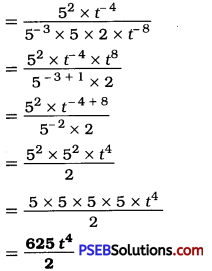
\(\frac{25 \times t^{-4}}{5^{-3} \times 10 \times t^{-8}}\) (t ≠ 0)
Solution:
PSEB 8th Class Maths Solutions Chapter 12 Exponents and Powers Ex 12.1 1

Question (ii)
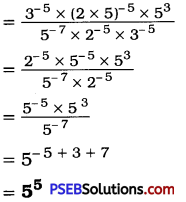
\(\frac{3^{-5} \times 10^{-5} \times 125}{5^{-7} \times 6^{-5}}\)
Solution:
PSEB 8th Class Maths Solutions Chapter 12 Exponents and Powers Ex 12.1 2

PSEB 8th Class Maths Solutions Chapter 4 Practical Geometry Ex 4.5

Punjab State Board PSEB 8th Class Maths Book Solutions Chapter 4 Practical Geometry Ex 4.5 Textbook Exercise Questions and Answers.

PSEB Solutions for Class 8 Maths Chapter 4 Practical Geometry Ex 4.5

Draw the following.

Question 1.
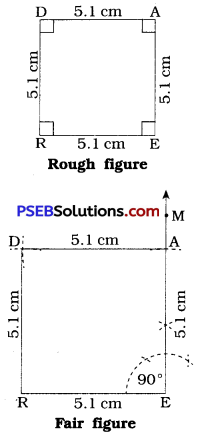
The square READ with RE = 5.1 cm.
Solution:
PSEB 8th Class Maths Solutions Chapter 4 Practical Geometry Ex 4.5 1
Steps of construction :

  • Draw a line segment RE = 5.1 cm.
  • At E, draw \(\overrightarrow{\mathrm{EM}}\), such that ∠REM = 90°.
  • With E as centre and radius =5.1 cm, draw an arc intersecting \(\overrightarrow{\mathrm{EM}}\) at A.
  • With R as centre and radius = 5.1 cm, draw an arc.
  • With A as centre and radius = 5.1 cm, draw an arc which intersect the previous arc at D.
  • Draw \(\overline{\mathrm{RD}}\) and \(\overline{\mathrm{AD}}\).

Thus, READ is the required square.

PSEB 8th Class Maths Solutions Chapter 4 Practical Geometry Ex 4.5

Question 2.
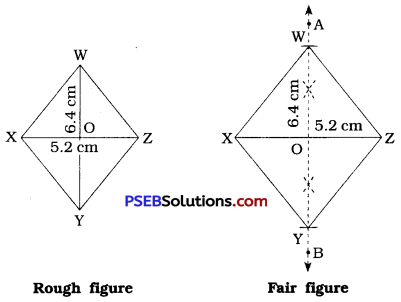
A rhombus whose diagonals are 5.2 cm and 6.4 cm long.
Solution:
PSEB 8th Class Maths Solutions Chapter 4 Practical Geometry Ex 4.5 2
[Note : The diagonals of a rhombus bisect each other at right angle.]
Here, in rhombus XYZW, YW 6.4 cm.
∴ OW = OY = 3.2 cm

Steps of construction:

  • Draw a line segment XZ = 5.2 cm.
  • Draw \(\overleftrightarrow{\mathrm{AB}}\), the perpendicular bisector of \(\overline{\mathrm{XZ}}\), which intersect \(\overline{\mathrm{XZ}}\) at O.
  • With O as centre and radius = 3.2 cm, draw an arc intersecting \(\overleftrightarrow{\mathrm{AB}}\) above \(\overline{\mathrm{XZ}}\) at W.
  • With O as centre and radius = 3.2 cm, draw another arc which intersects \(\overleftrightarrow{\mathrm{AB}}\) below \(\overline{\mathrm{XZ}}\) at Y.
  • Draw \(\overline{\mathrm{XY}}\), \(\overline{\mathrm{YZ}}\), \(\overline{\mathrm{ZW}}\) and \(\overline{\mathrm{XW}}\).

Thus, XYZW is the required rhombus.

Question 3.
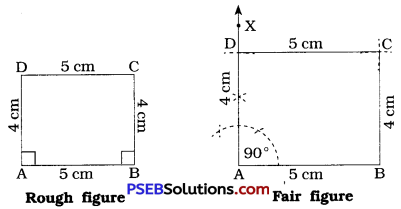
A rectangle with adjacent sides of lengths 5 cm and 4 cm.
Solution:
PSEB 8th Class Maths Solutions Chapter 4 Practical Geometry Ex 4.5 3
[Note: Each angle of a rectangle is a right angle.]
Steps of construction :

  • Draw a line segment AB = 5 cm.
  • At A, draw \(\overrightarrow{\mathrm{AX}}\), such that ∠XAB = 90°.
  • With A as centre and radius = 4 cm, draw an arc intersecting \(\overrightarrow{\mathrm{AX}}\) at D.
  • With B as centre and radius = 4 cm, draw an arc.
  • With D as centre and radius = 5 cm, draw an arc which intersects the previous arc at C.
  • Draw \(\overline{\mathrm{BC}}\) and \(\overline{\mathrm{CD}}\).

Thus, ABCD is the required rectangle.

PSEB 8th Class Maths Solutions Chapter 4 Practical Geometry Ex 4.5

Question 4.
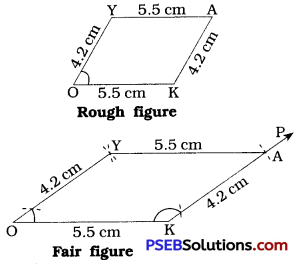
A parallelogram OKAY where OK = 5.5 cm and KA = 4.2 cm. Is it unique ?
Solution:
PSEB 8th Class Maths Solutions Chapter 4 Practical Geometry Ex 4.5 4
A parallelogram cannot be constructed as sufficient measurements are not given. It is not unique as angles may vary in parallelogram drawn by given measurements.

PSEB 8th Class Maths Solutions Chapter 4 Practical Geometry Ex 4.4

Punjab State Board PSEB 8th Class Maths Book Solutions Chapter 4 Practical Geometry Ex 4.4 Textbook Exercise Questions and Answers.

PSEB Solutions for Class 8 Maths Chapter 4 Practical Geometry Ex 4.4

1. Construct the following quadrilaterals:

Question (i).
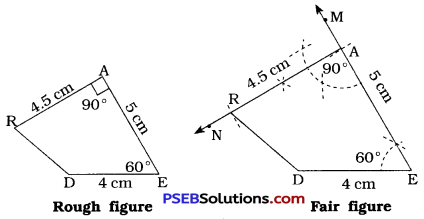
Quadrilateral DEAR
DE = 4 cm
EA = 5 cm
AR = 4.5 cm
∠E = 60°
∠A = 90°
Solution:
PSEB 8th Class Maths Solutions Chapter 4 Practical Geometry Ex 4.4 1
Steps of construction:

  • Draw a line segment DE = 4 cm.
  • At E, draw \(\overrightarrow{\mathrm{EM}}\) such that ∠DEM = 60°.
  • With E as centre and radius = 5 cm, draw an arc intersecting \(\overrightarrow{\mathrm{EM}}\) at A.
  • At A, draw \(\overrightarrow{\mathrm{AN}}\) such that ∠EAN = 90°.
  • With A as centre and radius = 4.5 cm, draw an arc intersecting \(\overrightarrow{\mathrm{AN}}\) at R.
  • Draw \(\overline{\mathrm{DR}}\).

Thus, DEAR is the required quadrilateral.

PSEB 8th Class Maths Solutions Chapter 4 Practical Geometry Ex 4.4

Question (ii).
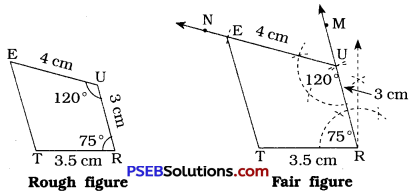
Quadrilateral TRUE
TR = 3.5 cm
RU = 3 cm
UE = 4 cm
∠R = 75°
∠U = 120°
Solution:
PSEB 8th Class Maths Solutions Chapter 4 Practical Geometry Ex 4.4 2
Steps of construction :

  • Draw a line segment TR = 3.5 cm.
  • At R, draw a \(\overrightarrow{\mathrm{RM}}\) such that ∠TRM = 75°.
  • With R as centre and radius = 3 cm, draw an arc intersecting \(\overrightarrow{\mathrm{RM}}\) at U.
  • At U, draw \(\overrightarrow{\mathrm{UN}}\) such that ∠RUN = 120°.
  • With U as centre and radius = 4 cm, draw an arc intersecting \(\overrightarrow{\mathrm{UN}}\) at E.
  • Draw \(\overline{\mathrm{ET}}\).

Thus, TRUE is the required quadrilateral.

PSEB 8th Class Maths Solutions Chapter 4 Practical Geometry Ex 4.3

Punjab State Board PSEB 8th Class Maths Book Solutions Chapter 4 Practical Geometry Ex 4.3 Textbook Exercise Questions and Answers.

PSEB Solutions for Class 8 Maths Chapter 4 Practical Geometry Ex 4.3

1. Construct the following quadrilaterals:

Question (i).
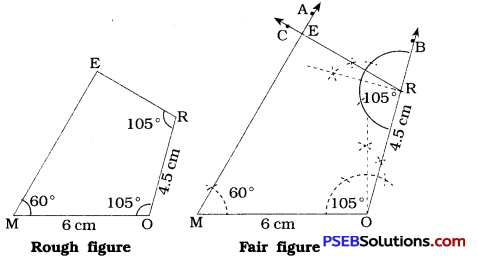
Quadrilateral MORE
MO = 6 cm
OR = 4.5 cm
∠M = 60°
∠O = 105°
∠R = 105°
Solution:
PSEB 8th Class Maths Solutions Chapter 4 Practical Geometry Ex 4.3 1

  • Draw a line segment MO = 6 cm.
  • At M, draw \(\overrightarrow{\mathrm{MA}}\), such that ∠OMA = 60°
  • At O, draw \(\overrightarrow{\mathrm{OB}}\) such that ∠MOB = 105°.
  • With O as centre and radius = 4.5 cm, draw an arc intersecting \(\overrightarrow{\mathrm{OB}}\) at R.
  • At R, draw \(\overrightarrow{\mathrm{RC}}\) such that ∠ORC = 105°.
  • Locate E at intersection of \(\overrightarrow{\mathrm{RC}}\) and \(\overrightarrow{\mathrm{MA}}\).

Thus, MORE is the required quadrilateral.

PSEB 8th Class Maths Solutions Chapter 4 Practical Geometry Ex 4.3

Question (ii).
Quadrilateral PLAN
PL = 4 cm
LA = 6.5 cm
∠P = 90°
∠A = 110°
∠N = 85°
Solution:
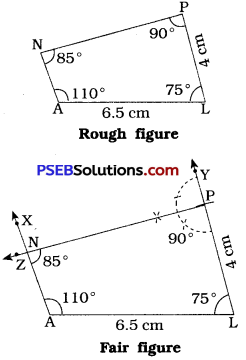
PSEB 8th Class Maths Solutions Chapter 4 Practical Geometry Ex 4.3 2
[Note : In □ PLAN, m∠P = 90°, m∠A = 110° and m∠N = 85°)
∴ m∠L = 360°- (m∠P + m∠A + m∠N)
= 360° – (90° + 110° + 85°)
= 360° – 285°
= 75°

Steps of construction:

  • Draw a line segment AL = 6.5 cm.
  • At A, draw \(\overrightarrow{\mathrm{AX}}\) such that ∠XAL = 110°. (Use protractor)
  • At L, draw \(\overrightarrow{\mathrm{LY}}\) such that ∠YLA = 75°. (Use protractor)
  • With L as centre and radius = 4 cm, draw an arc intersecting \(\overrightarrow{\mathrm{LY}}\) at P.
  • At P, draw \(\overrightarrow{\mathrm{PZ}}\) such that ∠ZPL = 90°. (∵ ∠ ZPY = 90°)
  • Locate N at intersection of \(\overrightarrow{\mathrm{AX}}\) and \(\overrightarrow{\mathrm{PZ}}\).

Thus, PLAN is the required quadrilateral.

PSEB 8th Class Maths Solutions Chapter 4 Practical Geometry Ex 4.3

Question (iii).
Parallelogram HEAR
HE = 5 cm
EA = 6 cm
∠R = 85°
Solution:
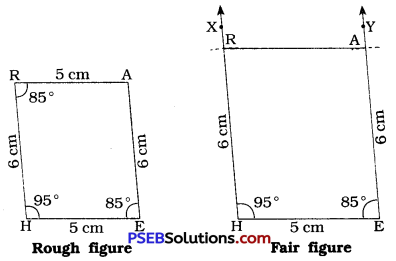
PSEB 8th Class Maths Solutions Chapter 4 Practical Geometry Ex 4.3 3
[Note : □ HEAR is a parallelogram.
Opposite sides of parallelogram are of equal lengths.]
HE = 5 cm, ∴ AR = 5 cm, EA = 6 cm, ∴ HR = 6 cm
Adjacent angles of a parallelogram arc supplementary.
m∠R = 85° (given)
∴ m∠H = 180° – 85° = 95°
Opposite angles of a parallelogram are of equal measures,
m ∠ R = 85°
∴ m ∠ E = 85°

Steps of construction:

  • Draw a line segment HE = 5 cm.
  • At H, draw \(\overrightarrow{\mathrm{HX}}\), such that ∠ XHE = 95°. (Use protractor)
  • With H as centre and radius = 6 cm, draw an arc intersecting \(\overrightarrow{\mathrm{HX}}\) at R.
  • At E, draw \(\overrightarrow{\mathrm{EY}}\) such that ∠ HEY = 85°. (Use protractor)
  • With E as centre and radius = 6 cm, draw an arc intersecting \(\overrightarrow{\mathrm{EY}}\) at A.
  • Draw \(\overline{\mathrm{AR}}\).

Thus, HEAR is the required parallelogram.

PSEB 8th Class Maths Solutions Chapter 4 Practical Geometry Ex 4.3

Question (iv).
Rectangle OKAY
OK = 7 cm
KA = 5 cm
Solution:
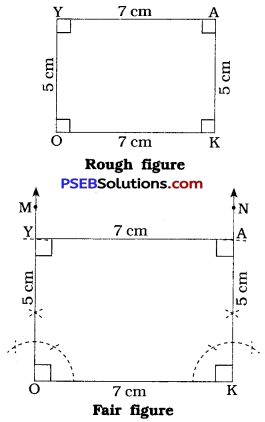
PSEB 8th Class Maths Solutions Chapter 4 Practical Geometry Ex 4.3 4
[Note: Here, OKAY is a rectangle. Opposite sides of a rectangle are of equal lengths.]
OK = 7 cm, ∴ AY = 7 cm and KA = 5 cm, ∴ OY = 5 cm
Moreover, all angles of a rectangle are right angles.

Steps of construction:

  • Draw a line segment OK = 7 cm.
  • At O, draw \(\overrightarrow{\mathrm{OM}}\) such that ∠ MOK = 90°.
  • With O as centre and radius = 5 cm, draw an arc intersecting \(\overrightarrow{\mathrm{OM}}\) at Y.
  • At K, draw \(\overrightarrow{\mathrm{KN}}\) such that ∠ NKO = 90°.
  • With K as centre and radius = 5 cm, draw an arc intersecting \(\overrightarrow{\mathrm{KN}}\) at A.
  • Draw \(\overline{\mathrm{AY}}\).

Thus, OKAY is the required rectangle.

PSEB 8th Class Maths Solutions Chapter 13 Direct and Inverse Proportions InText Questions

Punjab State Board PSEB 8th Class Maths Book Solutions Chapter 13 Direct and Inverse Proportions InText Questions and Answers.

PSEB 8th Class Maths Solutions Chapter 13 Direct and Inverse Proportions InText Questions

Try These : [Textbook Page No. 204]

1. Observe the following tables and find if x and y are directly proportional.

Question (i)

X 20 17 14 11 8 5 2
y 40 34 28 22 16 10 4

Solution:
\(\begin{aligned}
&\frac{20}{40}=\frac{1}{2}, \frac{17}{34}=\frac{1}{2}, \frac{14}{28}=\frac{1}{2}, \frac{11}{22}=\frac{1}{2}, \frac{8}{16}=\frac{1}{2} \\
&\frac{5}{10}=\frac{1}{2}, \frac{2}{4}=\frac{1}{2}
\end{aligned}\)
The value of \(\frac{\text {x}}{\text {y}}\) is same for different values of x and y. So these values x and y are directly proportional.

PSEB 8th Class Maths Solutions Chapter 13 Direct and Inverse Proportions InText Questions

Question (ii)

X 6 10 14 18 22 26 30
y 4 8 12 16 20 24 28

Solution:
\(\begin{aligned}
&\frac{6}{4}=\frac{3}{2}, \frac{10}{8}=\frac{5}{4}, \frac{14}{12}=\frac{7}{6}, \frac{18}{16}=\frac{9}{8}, \frac{22}{20}=\frac{11}{10}, \\
&\frac{26}{24}=\frac{13}{12}, \frac{30}{28}=\frac{15}{14}
\end{aligned}\)
The values of \(\frac{\text {x}}{\text {y}}\) are different for different values of x and y respectively. So these values of x and y are not directly proportional.

Question (iii)

X 5 8 12 15 18 20
y 15 24 36 60 72 100

Solution:
The values of \(\frac{\text {x}}{\text {y}}\) are different for different values of x and y respectively.
So these values of x and y are not directly proportional.

PSEB 8th Class Maths Solutions Chapter 13 Direct and Inverse Proportions InText Questions

2. Principal = ₹ 1000, Rate = 8 % per annum. Fill in the following table and find which type of interest (simple or compound) changes in direct proportion with time period.

Time Period 1 year 2 years 3 years
Simple Interest (in ₹)
Compound Interest (in ₹)

Solution:
Simple interest : SI = \(\frac{P \times R \times T}{100}\)
For calculation:
P = ₹ 1000, R = 8 %, T = …………….

Time (T) → 1 year: T = 1 2 years : T = 2 3 years : T = 3
Simple interest SI = \(\frac{P \times R \times T}{100}\) ₹ \(\frac{1000 \times 8 \times 1}{100}\)
= ₹ 80
₹ \(\frac{1000 \times 8 \times 2}{100}\)
= ₹ 160
₹ \(\frac{1000 \times 8 \times 3}{100}\)
= ₹ 240
\(\frac{\text { SI }}{\text { T }}\) \(\frac {80}{1}\) = 80 \(\frac {160}{2}\) = 80 \(\frac {240}{3}\) = 80

Here, the ratio of simple interest with time period is same for every year.
Hence, simple interest changes in direct proportion with time period.
Compound interest:
For calculation:
P = ₹ 1000, R = 8 %, T = ……………

Time → 1 year : n = 1
A = P(1 + \(\frac {R}{100}\))n
CI = A – P
A = 1000(1 + \(\frac {8}{100}\))1
= 1000 × \(\frac {108}{100}\) = 1080
∴ CI = 1080 – 1000 = ₹ 80
\(\frac{\text { CI }}{\text { T }}\) \(\frac {80}{1}\)
Time → 2 years : n = 2
A = P(1 + \(\frac {R}{100}\))n
CI = A – P
A = 1000(1 + \(\frac {8}{100}\))2
= 1000 × \(\frac {108}{100}\) × \(\frac {108}{100}\) = ₹ 1166.40
∴ CI = ₹ 1166.40 – 1000 = ₹ 166.40
\(\frac{\text { CI }}{\text { T }}\) \(\frac {166.40}{2}\)
Time → 3 years : n = 3
A = P(1 + \(\frac {R}{100}\))n
CI = A – P
A = 1000(1 + \(\frac {8}{100}\))3
= 1000 × \(\frac {108}{100}\) × \(\frac {108}{100}\) × \(\frac {108}{100}\) = ₹ 1259.712
∴ CI = ₹ 1259.712 – ₹ 1000 = ₹ 259.712
\(\frac{\text { CI }}{\text { T }}\) \(\frac {259.712}{3}\)

Here, the ratio of CI and T is not same.
Thus, compound interest is not proportional with time period.

PSEB 8th Class Maths Solutions Chapter 13 Direct and Inverse Proportions InText Questions

Think, Discuss and Write: [Textbook Page No. 204]

1. If we fix time period and the rate of interest, simple interest changes proportionally with principal. Would there be a similar relationship for compound interest? Why?
Solution:
Time period (T) and rate of interest (R) are fixed, then
Simple interest = \(\frac {PRT}{100}\) = P × Constant
So simple interest depends on principal. Simple interest changes proportionally with principal.
Now, compound interest = P(1 + \(\frac {R}{100}\))T – P
i.e., A – P
= P [(1 + \(\frac {R}{100}\)T – 1]
= P × Constant
So compound interest depends on principal.
If principal increases or decreases, then compound interest will also increases or decreases.
Thus, compound interest changes with principal.

Think, Discuss and Write : [Textbook Page No. 209]

1. Take a few problems discussed so far under ‘direct variation’. Do you think that they can be solved by ‘unitary method’?
Solution:
Yes, each problem can be solved by unitary method.
e.g. Question 4 of Exercise: 13.1
Number of bottles filled in 6 hours = 840
∴ The number of bottles filled in 1 hour = \(\frac {840}{6}\) = 140
The number of bottles filled in 5 hours = 140 × 5 = 700
Thus, 700 bottles will it fill in five hours.

PSEB 8th Class Maths Solutions Chapter 13 Direct and Inverse Proportions InText Questions

Try These : [Textbook Page No. 211]

1. Observe the following tables and find which pair of variables (here x and y) are in inverse proportion.

Question (i)

X 50 40 30 20
y 5 6 7 8

Solution:
x1 = 50 and y1 = 5
∴ x1y1 = 50 × 5
∴ x1y1 = 250

x2 = 40 and y2 = 6
∴ x2y2 = 40 × 6
∴ x2y2 = 240

x3 = 30 and y3 = 7
∴ x3y3 = 30 × 7
∴ x3y3 = 210

x4 = 20 and y4 = 8
∴ x4y4 = 20 × 8
∴ x4y4 = 160
Now 250 ≠ 240 ≠ 210 ≠ 160
∴ x1y1 ≠ x2y2 ≠ x3y3 ≠ x4y4
∴ x and y are not in inverse proportion.

Question (ii)

X 100 200 300 400
y 60 30 20 15

Solution:
x1 = 100 and y1 = 60
∴ x1y1 = 100 × 60
∴ x1y1 = 6000

x2 = 200 and y2 = 30
∴ x2y2 = 200 × 30
∴ x2y2 = 6000

x3 = 300 and y3 = 20
∴ x3y3 = 300 × 20
∴ x3y3 = 6000

x4 = 400 and y4 = 15
∴ x4y4 = 400 × 15
∴ x4y4 = 6000
Now x1y1 = x2y2 = x3y3 = x4y4
∴ x and y are in inverse proportion.

PSEB 8th Class Maths Solutions Chapter 13 Direct and Inverse Proportions InText Questions

Question (iii)

X 90 60 45 30 20 5
y 10 15 20 25 30 35

Solution:
x1 = 90 and y1 = 10
∴ x1y1 = 90 × 10
∴ x1y1 = 900

x2 = 60 and y2 = 15
∴ x2y2 = 60 × 15
∴ x2y2 = 900

x3 = 45 and y3 = 20
∴ x3y3 = 45 × 20
∴ x3y3 = 900

x4 = 30 and y4 = 25
∴ x4y4 = 30 × 25
∴ x4y4 = 750

x5 = 20 and y5 = 30
∴ x5y5 = 20 × 30
∴ x5y5 = 600

x6 = 30 and y6 = 35
∴ x6y6 = 5 × 35
∴ x6y6 = 175

Now x1y1 = x2y2 = x3y3 ≠ x4y4 ≠ x5y5 ≠ x6y6
∴ x and y are in inverse proportion.

PSEB 8th Class Maths Solutions Chapter 13 Direct and Inverse Proportions Ex 13.2

Punjab State Board PSEB 8th Class Maths Book Solutions Chapter 13 Direct and Inverse Proportions Ex 13.2 Textbook Exercise Questions and Answers.

PSEB Solutions for Class 8 Maths Chapter 13 Direct and Inverse Proportions Ex 13.2

1. Which of the following are in inverse proportion?

Question (i)
The number of workers on a job and the time to complete the job.
Solution:
If the number of workers on a job increases, then time to complete the job decreases. So, it is the case of inverse proportion.

PSEB 8th Class Maths Solutions Chapter 13 Direct and Inverse Proportions Ex 13.2

Question (ii)
The time taken for a journey and the distance travelled in a uniform speed.
Solution:
Here, the speed is uniform.
∴ The time taken for a journey is directly proportional to the speed. So, it is not the case of inverse proportion.

Question (iii)
Area of cultivated land and the crop harvested.
Solution:
For more area of cultivated land, more crops would be harvested. So, it is not the case of inverse proportion.

Question (iv)
The time taken for a fixed journey and the speed of the vehicle.
Solution:
If speed of vehicle is more, then time to cover the fixed journey would be less. So, it is the case of inverse proportion.

Question (v)
The population of a country and the area of land per person.
Solution:
For more population, less area per person would be in the country. So, it is a case of inverse proportion.

PSEB 8th Class Maths Solutions Chapter 13 Direct and Inverse Proportions Ex 13.2

2. In a Television game show, the prize money of ₹ 1,00,000 is to be divided equally amongst the winners. Complete the following table and find whether the prize money given to an individual winner is directly or inversely proportional to the number of winners?

Number of winners 1 2 4 5 8 10 20
Prize for each winner (in ₹) 1,00,000 50,000

Solution:
Here, more the number of winners, less is the prize money for each winner.
∴ This is a case of inverse proportion.
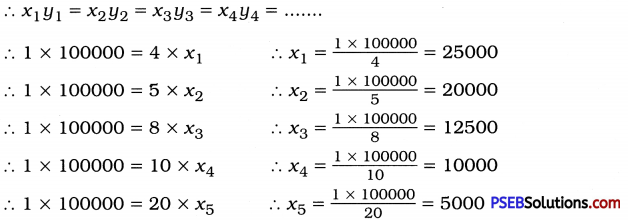
PSEB 8th Class Maths Solutions Chapter 13 Direct and Inverse Proportions Ex 13.2 1
Now, the table is as follows:

Number of winners 1 2 4 5 8 10 20
Prize for each winner (in ₹) 1,00,000 50,000 25,000 20,000 12,500 10,000 5,000

3. Rehman is making a wheel using spokes. He wants to fix equal spokes in such a way that the angles between any pair of consecutive spokes are equal. Help him by completing the following table:
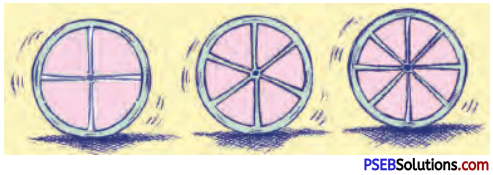
PSEB 8th Class Maths Solutions Chapter 13 Direct and Inverse Proportions Ex 13.2 2

Number of spokes 4 6 8 10 12
Angle between a pair of consecutive spokes 90° 60°

PSEB 8th Class Maths Solutions Chapter 13 Direct and Inverse Proportions Ex 13.2

Question (i)
Are the number of spokes and the angles formed between the pairs of consecutive spokes in inverse proportion?
Solution:
Here, more the number of spokes, less the measure of angle between a pair of consecutive spokes.
∴ This is a case of inverse proportion.
Here,
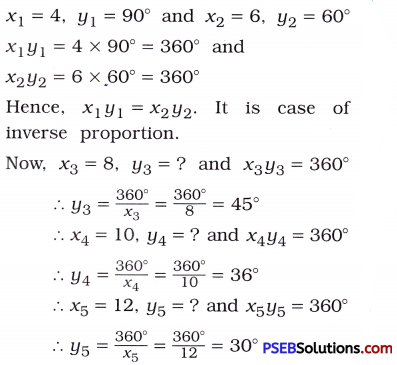
PSEB 8th Class Maths Solutions Chapter 13 Direct and Inverse Proportions Ex 13.2 3.1
Now, the table is as follows:

Number of spokes 4 6 8 10 12
Angle between a pair of consecutive spokes
90° 60° 45° 36° 30°

Question (ii)
Calculate the angle between a pair of consecutive spokes on a wheel with 15 spokes.
Solution:
Let the measure of angle be x°.
∴ 15 × x° = 4 × 90°
∴ x° = \(\frac{4 \times 90^{\circ}}{15}\) = 24°
Hence, this angle should be 24°.

Question (iii)
How many spokes would be needed, if the angle between a pair of consecutive spokes is 40°?
Solution:
Let the number of spokes be n.
∴ n × 40° = 4 × 90°
∴ n = \(\frac{4 \times 90^{\circ}}{40^{\circ}}\) = 9
Thus, 9 spokes would be needed.

4. If a box of sweets is divided among 24 children, they will get 5 sweets each. How many would each get, if the number of the children is reduced by 4?
Solution:

Number of children x Number of sweets y
x1 = 24 y1 = 5
x2 = 24 – 4 = 20 y2 = (?)

Here, if the number of children decreases, then the number of sweets received by each child will increase.
∴ This is a case of inverse proportion.
x1 × y1 = x2 × y2
∴ 24 × 5 = 20 × y2
∴ y2 = \(\frac{24 \times 5}{20}\) = 6
Thus, each child will get 6 sweets.

PSEB 8th Class Maths Solutions Chapter 13 Direct and Inverse Proportions Ex 13.2

5. A farmer has enough food to feed 20 animals in his cattle for 6 days. How long would the food last if there were 10 more animals in his cattle?
Solution:

Number of animals x Number of days y
x1 = 20 y1 = 6
x2 = 20 + 10 = 20 y2 = (?)

Here, the number of animals increases, so the number of days to feed them will decrease.
∴ This is a case of inverse proportion.
∴ x1 × y1 = x2 × y2
∴ 20 × 6 = 30 × y2
∴ y2 = \(\frac{20 \times 6}{30}\) = 4
Thus, the food will last for 4 days.

6. A contractor estimates that 3 persons could rewire Jasminder’s house in 4 days. If, he uses 4 persons instead of three, how long should they take to complete the job?
Solution:

Number of persons x Number of days y
x1 = 42 y1 = 63
x2 = (?) y1 = 63

Here, more the number of persons, less will be the time required to complete the job.
∴ This is a case of inverse proportion.
∴ x1 × y1 = x2 × y2
∴ 3 × 4 = 4 × y2
∴ y2 = \(\frac{3 \times 4}{4}\) = 3
Thus, 3 days will be required to complete the job.

PSEB 8th Class Maths Solutions Chapter 13 Direct and Inverse Proportions Ex 13.2

7. A batch of bottles were packed in 25 boxes with 12 bottles in each box. If the same batch is packed using 20 bottles in each box, how many boxes would be filled?
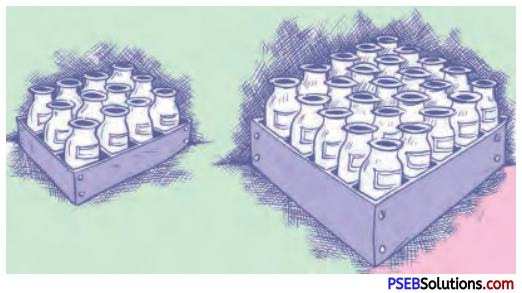
PSEB 8th Class Maths Solutions Chapter 13 Direct and Inverse Proportions Ex 13.2 4.1
Solution:

Number of bottles in a box x Number of boxes y
x1 = 12 y1 = 25
x2 = 20 y2 = (?)

Here, more the number of bottles in a box, less would be the number of boxes.
∴ This is a case of inverse proportion.
∴ x1 × y1 = x2 × y2
∴ 3 × 4 = 4 × y2
∴ y2 = \(\frac{3 \times 4}{4}\) = 3
Thus, 15 boxes would be filled.

8. A factory requires 42 machines to produce a given number of articles in 63 days. How many machines would be required to produce the same number of articles in 54 days?
Solution:

Number of machines x Number of days y
x1 = 42 y1 = 63
x2 = (?) y2 = 54

Here, if the number of days will be less, the number of machines required will be more.
∴ This is a case of inverse proportion.
∴ x1 × y1 = x2 × y2
∴ 42 × 63 = x2 × 54
∴ x2 = \(\frac{42 \times 63}{54}\) = 49
Thus, 49 machines would be required.

PSEB 8th Class Maths Solutions Chapter 13 Direct and Inverse Proportions Ex 13.2

9. A car takes 2 hours to reach a destination by travelling at the speed of 60 km/h. How long will it take when the car travels at the speed of 80 km/h?
Solution:

Speed (km/h) x Number of hours y
x1 = 60 y1 = 2
x2 = 80 y2 = (?)

Here, if the speed of car increases, then the time taken to cover the same distance will decrease.
∴ This is a case of inverse proportion.
∴ x1 × y1 = x2 × y2
∴ 60 × 2 = 80 × y2
∴ y2 = \(\frac{60 \times 2}{80}=\frac{3}{2}=1 \frac{1}{2}\) h
Thus, car would take 1\(\frac {1}{2}\) hours.

10. Two persons could fit new windows in a house in 3 days.

Question (i)
One of the persons fell ill before the work started. How long would the job take now?
Solution:

Number of persons x Number of days y
x1 = 2 y1 = 3
x2 = 2 – 1 = 1 y2 = (?)

Here, less the number of persons, more would be the number of days to complete the job.
∴ This is a case of inverse proportion.
∴ x1 × y1 = x2 × y2
∴ 2 × 2 = 1 × y2
∴ y2 = \(\frac{2 \times 3}{1}\) = 6
Thus, it would take 6 days to complete the job.

Question (ii)
How many persons would be needed to fit the windows in one day?
Solution:

Number of days x Number of persons y
x1 = 3 y1 = 2
x2 = 1 y2 = (?)

Here, less the number of days, more will be the number of persons needed.
∴ This is a case of inverse proportion.
∴ y2 = ? and x2 = 1
∴ x1 × y1 = x2 × y2
∴ 3 × 2 = 1 × y2
∴ y2 = \(\frac{3 \times 2}{1}\) = 6
Thus, 6 persons would be needed.

PSEB 8th Class Maths Solutions Chapter 13 Direct and Inverse Proportions Ex 13.2

11. A school has 8 periods a day each of 45 minutes duration. How long would each period be, if the school has 9 periods a day, assuming the number of school hours to be the same?
Solution:

Number of periods x Length of each period (in minute) y
x1 = 8 y1 = 45
x2 = 9 y2 = (?)

Here, the number of periods is more, then the length of each period will be less.
∴ This is a case of inverse proportion.
∴ x1 × y1 = x2 × y2
∴ 8 × 45 = 9 × y2
∴ y2 = \(\frac{8 \times 45}{9}\) = 40
Thus, each period would be of 40 minutes.

PSEB 8th Class Maths Solutions Chapter 13 Direct and Inverse Proportions Ex 13.1

Punjab State Board PSEB 8th Class Maths Book Solutions Chapter 13 Direct and Inverse Proportions Ex 13.1 Textbook Exercise Questions and Answers.

PSEB Solutions for Class 8 Maths Chapter 13 Direct and Inverse Proportions Ex 13.1

1. Following are the car parking charges near a railway station upto:
PSEB 8th Class Maths Solutions Chapter 13 Direct and Inverse Proportions Ex 13.1 1
Check if the parking charges are in direct proportion to the parking time.
Solution:
Here, ratio of parking charges and parking time are as follow:

Parking time Parking charges Parking charge / Parking time
4 hours ₹ 60 \(\frac{60}{4}=\frac{15}{1}\)
8 hours ₹ 100 \(\frac{100}{8}=\frac{25}{2}\)
12 hours ₹ 140 \(\frac{140}{12}=\frac{35}{3}\)
24 hours ₹ 180 \(\frac{180}{24}=\frac{15}{2}\)

Here, \(\frac {15}{1}\) ≠ \(\frac {25}{2}\) ≠ \(\frac {35}{3}\) ≠ \(\frac {15}{2}\)
Thus, the parking charges are not in direct proportion to the parking time.

PSEB 8th Class Maths Solutions Chapter 13 Direct and Inverse Proportions Ex 13.1

2. A mixture of paint is prepared by mixing 1 part of red pigments with 8 parts of base. In the following table, find the parts of base that need to be added:
Solution:

Parts of red pigment 1 4 7 12 20
Parts of base 8

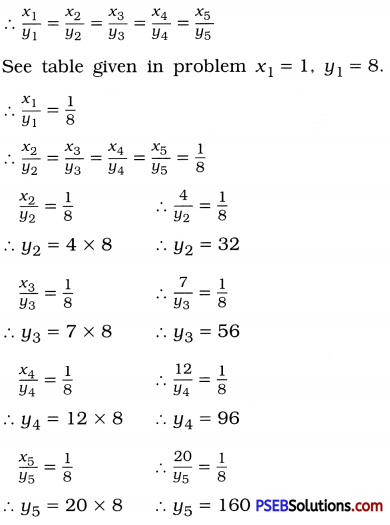
If parts of red pigment are x1, x2, x3, x4 and x5 respectively, then parts of base are y1, y2, y3, y4 and y5 respectively. Here, it is clear that mixture preparation is in direct proportion.
PSEB 8th Class Maths Solutions Chapter 13 Direct and Inverse Proportions Ex 13.1 2
Thus, the table is

Parts of red pigment 1 4 7 12 20
Parts of base 8 32 56 96 160

3. In Question 2 above, if 1 part of a red pigment requires 75 ml of base, how much red pigment should we mix with 1800 ml of base?
Solution:
See as per question 2 –
x1 = 1, y1 = 75, x2 = ? and yx2 = 1800
\(\frac{x_{1}}{y_{1}}=\frac{x_{2}}{y_{2}}\)
∴ \(\frac{1}{75}=\frac{x_{2}}{1800}\)
∴ x2 = \(\frac{1 \times 1800}{75}\)
∴ x2 = 24
Thus, 24 ml of red pigment should be mixed with 1800 ml of base.

PSEB 8th Class Maths Solutions Chapter 13 Direct and Inverse Proportions Ex 13.1

4. A machine in a soft drink factory fills 840 bottles in six hours. How many bottles will it fill in five hours?
Solution:
Let the number of bottles filled by machine in 5 h be x.

Number of hours (x) 6 5
Number of bottles filled (y) 840 ?

Here, as the number of hours decreases, the number of bottles filled will also decrease.
∴ It is case of direct proportion.
Here, x1 = 6, y1 = 840, x2 = 5 and y2 = ?
\(\frac{x_{1}}{y_{1}}=\frac{x_{2}}{y_{2}}\)
∴ \(\frac{6}{840}=\frac{5}{y_{2}}\)
∴ y2 = \(\frac{5 \times 840}{6}\)
∴ y2 = 700
Thus, 700 bottles will be filled in 5 hours.

5. A photograph of a bacteria enlarged 50,000 times attains a length of 5 cm as shown in the diagram. What is the actual length of the bacteria? If the photograph is enlarged 20,000 times only, what would be its enlarged length?
Solution:

Enlargement in picture of bacteria Length (cm)
50,000 times enlarged (x1) 5 (y1)
1 (x2) ? (y2)

Here, length of bacteria increases as picture of bacteria enlarges.
∴ It is case of, direct proportion.
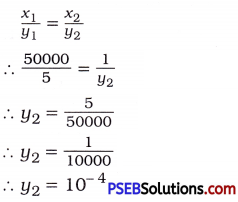
PSEB 8th Class Maths Solutions Chapter 13 Direct and Inverse Proportions Ex 13.1 2.1
Hence, the actual length of bacteria is 10-4 cm.
Now, the photograph is enlarged 20,000 times.

Enlargement in picture of bacteria Length (cm)
50,000 times enlarged (x1) 5 (y1)
20,000 times enlarged (x1) ? (y2)

∴ \(\frac{50,000}{5}=\frac{20,000}{y_{2}}\)
∴ y2 = \(\frac{20,000 \times 5}{50000}\)
∴ y2 = 2
Thus, its enlarged length would be 2 cm.

PSEB 8th Class Maths Solutions Chapter 13 Direct and Inverse Proportions Ex 13.1

6. In a model of a ship, the mast is 9 cm high, while the mast of the actual ship is 12 m high. If the length of the ship is 28 m, how long is the model ship?
Solution:

Actual ship Model ship
Length of the ship x 28 m ?
Height of mast y 12m 9 cm

This is a case of direct proportion.
x1 = 28, y1 = 12, x2 = ?, y2 = 9
\(\frac{x_{1}}{y_{1}}=\frac{x_{2}}{y_{2}}\)
∴ \(\frac{28}{12}=\frac{x_{2}}{9}\)
∴ x2 = \(\frac{28 \times 9}{12}\)
∴ x2 = 21
Thus, the length of model ship is 21 cm.

7. Suppose 2 kg of sugar contains 9 × 10⁶ crystals. How many sugar crystals are there in

Question (i)
5 kg of sugar?
Solution:

Weight of sugar (kg) x Number of sugar crystals y
x1 = 2 y1 = 9 × 106
x2 = 5 y2 = (?)

This is a case of direct proportion.
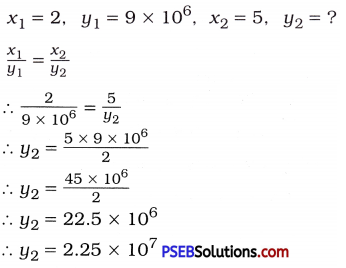
PSEB 8th Class Maths Solutions Chapter 13 Direct and Inverse Proportions Ex 13.1 3
Thus, there are 2.25 × 10⁷ crystals of sugar in 5 kg of sugar.

PSEB 8th Class Maths Solutions Chapter 13 Direct and Inverse Proportions Ex 13.1

Question (ii)
1.2kg of sugar?
Solution:

Weight of sugar (kg) x Number of sugar crystals y
x1 = 2 y1 = 9 × 106
x2 = 1.2 y2 = (?)

Here. x1 = 2, x1 = 9 × 10⁶, x2 = 1.2, y2 = ?
\(\frac{x_{1}}{y_{1}}=\frac{x_{2}}{y_{2}}\)
∴ \(\frac{2}{9 \times 10^{6}}=\frac{1.2}{y_{2}}\)
∴ y2 = \(\frac{1.2 \times 9 \times 10^{6}}{2}\)
∴ y2 = 0.6 × 9 × 106
∴ y2 = 5.4 × 10⁶
Thus, there are 5.4 × 10⁶ crystals of sugar in 1.2 kg of sugar.

8. Rashmi has a road map with a scale of 1 cm representing 18 km. She drives on a road for 72 km. What would be her distance covered in the map?
Solution:

Actual distance (km) x Distance on the map (cm) y
x1 = 18 y1 = 1
x2 = 72 y2 = (?)

This is a case of direct proportional.
Here, x1 = 18 km, y1 = 1 cm, x2 = 72 km, y2 = ?
\(\frac{x_{1}}{y_{1}}=\frac{x_{2}}{y_{2}}\)
∴ \(\frac{18}{1}=\frac{72}{y_{2}}\)
∴ y2 = \(\frac{72 \times 1}{18}\)
∴ y2 = 4
Thus, the distance covered by her on the map is 4 cm.

PSEB 8th Class Maths Solutions Chapter 13 Direct and Inverse Proportions Ex 13.1

9. A 5 m 60 cm high vertical pole casts a shadow 3 m 20 cm long. Find at the same time

Question (i)
the length of the shadow cast by another pole 10 m 50 cm high
Solution:

Height of vertical pole x Length of shadow y
x1 = 5 m 60 cm = 560 cm y1 = 3 m 20 cm = 320 cm
x2 = 10 m 50 cm = 1050 cm y2 = (?)

This is a case of direct proportionality.
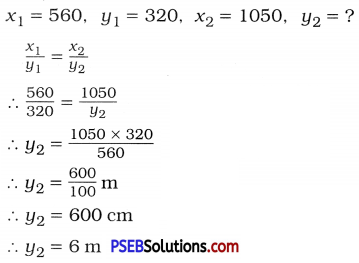
PSEB 8th Class Maths Solutions Chapter 13 Direct and Inverse Proportions Ex 13.1 4
Thus, the length of the shadow cast by another pole is 6 m.

Question (ii)
the height of a pole which casts a shadow 5 m long.
Solution:

Height of vertical pole x Length of shadow y
x1 = 560 cm y1 = 320 cm
x2 = (?) y2 = 5 m = 500 cm

x1 = 560, y1 = 320, x2 = ?, y2 = 500
\(\frac{x_{1}}{y_{1}}=\frac{x_{2}}{y_{2}}\)
∴ \(\frac{560}{320}=\frac{x_{2}}{500}\)
∴ x2 = \(\frac{560 \times 500}{320}\)
∴ x2 = 875 cm
∴ x2 = 8.75 cm
Thus, the height of the pole is 8,75 m.

PSEB 8th Class Maths Solutions Chapter 13 Direct and Inverse Proportions Ex 13.1

10. A loaded truck travels 14 km in 25 minutes. If the speed remains the same, how far can it travel in 5 hours?
Solution:

Distance (km) x Time (minute) y
x1= 14 y1 = 25
x2 = (?) y2 = 5 hours = 300

This is a case of direct proportion.
∴ Here, x1 = 14, y1 = 25, x2 = ?, y2 = 300
\(\frac{x_{1}}{y_{1}}=\frac{x_{2}}{y_{2}}\)
∴ \(\frac{14}{25}=\frac{x_{2}}{300}\)
∴ x2 = \(\frac{14 \times 300}{25}\)
∴ x2 = 168
Thus, loaded truck can travel 168 km in 5 h.

PSEB 8th Class Maths Solutions Chapter 14 Factorization InText Questions

Punjab State Board PSEB 8th Class Maths Book Solutions Chapter 14 Factorization InText Questions and Answers.

PSEB 8th Class Maths Solutions Chapter 14 Factorization InText Questions

Try These : [Textbook Page No. 219]

1. Factorise:

Question (i)
12x + 36
Solution:
12x = 2 × 2 × 3 × x and
36 = 2 × 2 × 3 × 3
Common factors = 2 × 2 × 3
∴ 12x + 36 = (2 × 2 × 3 × x) + (2 × 2 × 3 × 3)
= (2 × 2 × 3) (x + 3)
= 12 (x + 3)

PSEB 8th Class Maths Solutions Chapter 15 Introduction to Graphs InText Questions

Question (ii)
22y – 33z
Solution:
22y = 2 × 11 × y and 33z = 3 × 11 × z
Common factor =11
∴ 22y – 33z = (2 × 11 × y) – (3 × 11 × z)
= (11) × (2 × y – 3 × z)
= 11 (2y – 3z)

Question (iii)
14pq + 35pqr
Solution:
14pq = 2 × 7 × p × q and
35pqr = 7 × 5 × p × q × r
Common factor = 7pq
∴ 14pq + 35pqr = (2 × 7 × p × q) + (7 × 5 × p × q × r)
= 7 × p × q (2 + 5 × r)
= 7pq (2 + 5r)

PSEB 8th Class Maths Solutions Chapter 15 Introduction to Graphs InText Questions

Try These : [Textbook Page No. 225]

1. Divide:

Question (i)
24xy2z3 by 6yz2
Solution:
= \(\frac{24 x y^{2} z^{3}}{6 y z^{2}}\)
= \(\frac{2 \times 2 \times 2 \times 3 \times x \times y \times y \times z \times z \times z}{2 \times 3 \times y \times z \times z}\)
= \(\frac{2 \times 2 \times x \times y \times z}{1}\) = 4xyz
∴ 24xy2z3 ÷ 6yz2
= 4xyz

PSEB 8th Class Maths Solutions Chapter 15 Introduction to Graphs InText Questions

Question (ii)
63a2b4c6 by 7a2b2c3
Solution:
= \(\frac{63 a^{2} b^{4} c^{6}}{7 a^{2} b^{2} c^{3}}\)
= \(\frac{3 \times 3 \times 7 \times a^{2} \times b^{4} \times c^{6}}{7 \times a^{2} \times b^{2} \times c^{3}}\)
= 3 × 3 × \(\frac{a^{2}}{a^{2}} \times \frac{b^{4}}{b^{2}} \times \frac{c^{6}}{c^{3}}\)
= 9 × a2-2 × b4-2 × c6-3
= 9 × a0 × b2 × c3
= 9 × 1 × b2 × c3
= 9b2c3
∴ 63a2b4c6 ÷ 7a2b2c3
= 9b2c3

PSEB 8th Class Maths Solutions Chapter 14 Factorization Ex 14.4

Punjab State Board PSEB 8th Class Maths Book Solutions Chapter 14 Factorization Ex 14.4 Textbook Exercise Questions and Answers.

PSEB Solutions for Class 8 Maths Chapter 14 Factorization Ex 14.4

1. Find and correct the errors in the following mathematical statements:

Question 1.
4 (x – 5) = 4x – 5
Solution:
Error: 4 × – 5 = (- 20) and not (- 5)
Correct statement: 4 (x – 5) = 4x – 20

PSEB 8th Class Maths Solutions Chapter 14 Factorization Ex 14.4

Question 2.
x (3x + 2) = 3x2 + 2
Solution:
Error: x × 2 = 2x
Correct statement: x (3x + 2) = 3x2 + 2x

Question 3.
2x + 3y = 5xy
Solution:
Error: 2x and 3y are unlike terms.
So their sum is not possible.
Correct statement: 2x + 3y = 2x + 3y

Question 4.
x + 2x + 3x = 5x
Solution:
Error: x, 2x and 3x are like terms. So sum of their coefficient =1 + 2 + 3 = 6.
Correct statement: x + 2x + 3x = 6x

PSEB 8th Class Maths Solutions Chapter 14 Factorization Ex 14.4

Question 5.
5y + 2y + y – 7y = 0
Solution:
Error : 5y, 2y, y and – 7y all are like terms here. So sum of their coefficient = 5 + 2 + 1 – 7 = 1.
Correct statement: 5y + 2y + y – 7y = y

Question 6.
3x + 2x = 5x2
Solution:
Error: When like terms are added or subtracted their exponents do not change.
Correct statement: 3x + 2x = 5x

Question 7.
(2x)2 + 4 (2x) + 7 = 2x2 + 8x + 7
Solution:
Error: (2x)2 = 2x × 2x = 4x2
Correct statement:
(2x)2 + 4 (2x) + 7 = 4x2 + 8x + 7

PSEB 8th Class Maths Solutions Chapter 14 Factorization Ex 14.4

Question 8.
(2x)2 + 5x = 4x + 5x = 9x
Solution:
Error : (2x)2 = (2x × 2x) = 4x2
Correct statement: (2x)2 + 5x = 4x2 + 5x

Question 9.
(3x + 2)2 = 3x2 + 6x + 4
Solution:
Error : (3x + 2)2
= (3x)2 + 2 (3x)(2) + (2)2
= 9x2 + 12x + 4
Correct statement:
(3x + 2)2 = 9x2 + 12x + 4

10. Substituting x = – 3 in

Question (a)
x2 + 5x + 4 gives (- 3)2 + 5 (- 3) + 4 = 9 + 2 + 4 = 15
Solution:
Error : 5 (- 3) = – 15 and not 2
Correct statement:
Substituting x = (- 3) in, x2 + 5x + 4
= (- 3)2 + 5 (-3) + 4
= 9 – 15 + 4 = 9 + 4 – 15
= 13 – 15
= (-2)

PSEB 8th Class Maths Solutions Chapter 14 Factorization Ex 14.4

Question (b)
x2 – 5x + 4 gives (- 3)2 – 5 (- 3) + 4 = 9 – 15 + 4 = -2
Solution:
Error: -5 (-3) = + 15 and not (-15)
Correct statement:
Substituting x = (- 3) in,
x2 – 5x + 4
= (- 3)2 – 5 (- 3) + 4
= 9 + 15 + 4
= 28

Question (c)
x2 + 5x gives (- 3)2 + 5 (- 3) = – 9 – 15 = – 24
Solution:
Error : (- 3)2 = + 9
Correct statement:
Substituting x = (- 3) in, x2 + 5x
= (- 3)2 + 5 (- 3)
= 9 – 15 = – 6

PSEB 8th Class Maths Solutions Chapter 14 Factorization Ex 14.4

Question 11.
(y – 3)2 = y2 – 9
Solution:
Error : (y – 3)2
= (y)2 – 2 (y)(3) + (- 3)2
= y2 – 6y + 9
Correct statement: (y – 3)2 = y2 – 6y + 9.

Question 12.
(z + 5)2 = z2 + 25
Solution:
Error : (z + 5)2
= (z)2 + 2 (z)(5) + (5)2
= z2 + 10 z + 25
Correct statement: (z + 5)2
= z2 + 10z + 25

Question 13.
(2a + 3b) (a – b) = 2a2 – 3b2
Solution:
Error : (2a + 3b) (a – b)
= 2a (a-b) + 3b (a-b)
= 2a2 – 2ab + 3ab – 3b2
= 2a2 + ab – 3b2
Correct statement: (2a + 3b) (a – b)
= 2a2 + ab – 3b2

PSEB 8th Class Maths Solutions Chapter 14 Factorization Ex 14.4

Question 14.
(a + 4) (a + 2) = a2 + 8
Solution:
Error : (a + 4) (a + 2) = a (a + 2) + 4 (a + 2)
= a2 + 2a + 4a + 8
= a2 + 6a + 8
Correct statement: (a + 4) (a + 2)
= a2 + 6a + 8

Question 15.
(a – 4) (a – 2) = a2 – 8
Solution:
Error : (a – 4) (a – 2) = a (a – 2) – 4 (a – 2)
= a2 – 2a – 4a + 8
= a2 – 6a + 8
Correct statement: (a – 4) (a – 2)
= a2 – 6a + 8

PSEB 8th Class Maths Solutions Chapter 14 Factorization Ex 14.4

Question 16.
\(\frac{3 x^{2}}{3 x^{2}}\) = 0
Solution:
Error: Numerator and denominator, both are same. So their division is 1.
Correct statement:\(\frac{3 x^{2}}{3 x^{2}}\) = 1

Question 17.
\(\frac{3 x^{2}+1}{3 x^{2}}\) = 1 + 1 = 2
Solution:
Error: \(\frac{3 x^{2}+1}{3 x^{2}}=\frac{3 x^{2}}{3 x^{2}}+\frac{1}{3 x^{2}}\)
= 1 + \(\frac{1}{3 x^{2}}\)
Correct statement: \(\frac{3 x^{2}+1}{3 x^{2}}\) = 1 + \(\frac{1}{3 x^{2}}\)

Question 18.
\(\frac{3 x}{3 x+2}=\frac{1}{2}\)
Solution:
Error: Here, simplification of LHS is not possible.
Correct statement: \(\frac{3 x}{3 x+2}=\frac{3 x}{3 x+2}\)

Question 19.
\(\frac{3}{4 x+3}=\frac{1}{4 x}\)
Solution:
Error: Here, simplification of LHS is not possible.
Correct statement: \(\frac{3}{4 x+3}=\frac{3}{4 x+3}\)

PSEB 8th Class Maths Solutions Chapter 14 Factorization Ex 14.4

Question 20.
\(\frac{4 x+5}{4 x}\) = 5
Solution:
Error: \(\frac{4 x+5}{4 x}\)
= \(\frac{4 x}{4 x}+\frac{5}{4 x}\)
= 1 + \(\frac{5}{4 x}\)
Correct statement: \(\frac{4 x+5}{4 x}\) = 1 + \(\frac{5}{4 x}\)

Question 21.
\(\frac{7 x+5}{5 x}\) = 7x
Error: \(\frac{7 x+5}{5 x}\)
= \(\frac{7 x}{5}+\frac{5}{5}\)
= \(\frac{7 x}{5}\) + 1
Correct statement: \(\frac{7 x+5}{5}=\frac{7 x}{5}\) + 1