PSEB 12th Class Chemistry Important Questions Chapter 8 The d-and f-Block Elements

Punjab State Board PSEB 12th Class Chemistry Important Questions Chapter 8 The d-and f-Block Elements Important Questions and Answers.

PSEB 12th Class Chemistry Important Questions Chapter 8 The d-and f-Block Elements

Very Short Answer Type Questions

Question 1.
Why first ionisation enthalpy of Cr is lower than that of Zn?
Answer:
Ionisation enthalpy of Cr is less than that of Zn configuration. In case of zinc, electron comes out from completely filled 4s-orbital. So, removal of electron from zinc requires more energy as compared to the chromium.

Question 2.
Zn, Cd and Hg are soft metals. Why?
Answer:
Because they have one or more typical metallic structures at normal temperatures.

Question 3.
Although fluorine is more electronegative than oxygen, but the ability of oxygen to stabilise higher oxidation states exceeds that of fluorine. Why?
Answer:
Oxygen can form multiple bonds with metals, while fluorine can’t form multiple bond with metals. Hence, oxygen has more ability to stabilise higher oxidation state rather than fluorine.

PSEB 12th Class Chemistry Important Questions Chapter 8 The d-and f-Block Elements

Question 4.
Mn shows the highest oxidation state of + 7 with oxygen but with fluorine it shows the highest oxidation state of +4. Why?
Answer:
This is due to ability of oxygen to form pπ – dπ bond.

Question 5.
Mn2O7 is acidic whereas MnO is basic.
Answer:
Mn has +7 oxidation state in Mn2O7 and +2 in MnO. In low oxidation state of the metal, some of the valence electrons of the metal atom are not involved in bonding. Hence, it can donate electrons and behave as a base. On the other hand, in higher oxidation state of the metal, valence electrons are involved on bonding and are not available. Instead effective nuclear charge is high and hence it can accept electrons and behave as an acid.

Question 6.
Copper atom has completely filled d-orbitals in its ground state but it is a transition element. Why?
Answer:
Copper exhibits +2 oxidation state wherein it has incompletely filled d orbitals (3d9 4s0) hence a transition elements.

PSEB 12th Class Chemistry Important Questions Chapter 8 The d-and f-Block Elements

Question 7.
Why is zinc not regarded as a transition element?
Answer:
As zinc atom has completely filled d-orbitals (3d10) in its ground state as well as oxidised state, therefore, it is not regarded as transition element.

Question 8.
Zn2+ salts are white while Cu2+ salts are coloured. Why?
Answer:
Cu2+(3d94s0) has one unpaired electron in d-subshell which absorbs radiation in visible region resulting in d-d transition and hence Cu2+ salts are coloured. Zn2+(3d104s0) has completely filled d-orbitals. No radiation is absorbed for d-d transition and hence Zn2+ salts are colourless.

Question 9.
The second and third row of transition elements resemble each other much more than they resemble the first row. Explain, why?
Answer:
Due to lanthanoid contraction, the atomic radii of the second and third row transition elements is almost same. So, they resemble each other much more as compared to first row elements and show similar character.

PSEB 12th Class Chemistry Important Questions Chapter 8 The d-and f-Block Elements

Question 10.
Why does copper not replace hydrogen from acids?
Answer:
Because Cu shows E positive value.

Short Answer Type Questions

Question 1.
Why do transition elements show variable oxidation states? How is the variability in oxidation states of d-block different from that of the p-block elements?
Answer:
In transition elements, the energies of (n – 1)d orbitals and ns orbitals are nearly same. Therefore, electrons from both can participate in bond formation and hence show variable oxidation states.

In transition elements, the oxidation states differ from each other by unity e.g., Fe2+ and Fe3+, Cu+ and Cu2+ etc., while in p-block elements the oxidation state differ by units of two, e.g., Sn2+ and Sn4+, Pb2+ and Pb4+ etc. In transition elements, the higher oxidation states are more stable for heavier elements in a group e.g., Mo(VI) and W(VI) are more stable than Cr(VI) in group 6 whereas in p-block, elements the lower oxidation states are more stable for heavier elements due to the inert pair effect, e.g., Pb(II) is more stable than Pb(IV) in group 16.

PSEB 12th Class Chemistry Important Questions Chapter 8 The d-and f-Block Elements

Question 2.
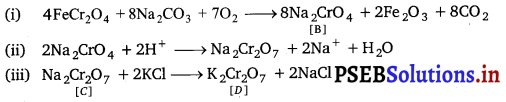
When a chromite ore (A) is fused with sodium carbonate in free excess of air and the product is dissolved in water, a yellow solution of compound (B) is obtained. After treatment of this yellow solution with sulphuric acid, compound (C) can be crystallised from the solution. When compound (C) is treated with KC1, orange crystals of compound (D) crystallise out. Identify A to D and also explain the reactions.
Answer:
K2Cr2O7 is an orange compound. It is formed when Na2Cr2O7 reacts with KCl. In acidic medium, yellow coloured \(\mathrm{CrO}_{4}^{2-}\) (chromate ion) changes into dichromate.
The given process is the preparation method of potassium dichromate from chromite ore.
A = FeCr2O4; B = Na2CrO4; C = Na2Cr2O7; D = K2Cr2O7
PSEB 12th Class Chemistry Important Questions Chapter 8 The d-and f-Block Elements 1

Question 3.
Mention the type of compounds formed when small atoms like H, C and N get trapped inside the crystal lattice of transition metals. Also give physical and chemical characteristics of these compounds.
Answer:
When small atoms like H, C and N get trapped inside the crystal lattice of transition metals.
(a) Such compounds are called interstitial compounds.
(b) Their characteristic properties are :

  1. They have high melting point, higher than those of pure metals.
  2. They are very hard.
  3. They retain metallic conductivity.
  4. They are chemically inert.

PSEB 12th Class Chemistry Important Questions Chapter 8 The d-and f-Block Elements

Question 4.
On the basis of lanthanoid contraction, explain the following:
(i) Nature of bonding in La2O3 and Lu2O3.
(ii) Trends in the stability of oxosalts of lanthanoids from La to Lu.
(iii) Stability of the complexes of lanthanoids.
(iv) Radii of 4d and 5d block elements.
(v) Trends in acidic character of lanthanoid oxides.
Answer:
(i) As the size decreases covalent character increases. Therefore, La2O3 is more ionic and Lu2O3 is more covalent.
(ii) As the size decreases from La to Lu, stability of oxosalts also decreases.
(iii) Stability of the complexes increases as the size of lanthanoids decreases.
(iv) Radii of 4d and 5d block elements will be almost same.
(v) Acidic character of oxides increases from La to Lu.

Question 5.
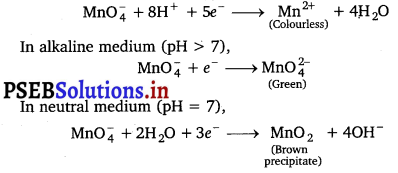
A solution of KMnO4 on reduction yields either a colourless solution of a brown precipitate or a green solution depending on pH of the solution. What different stages of the reduction do these represent and how are they carried out?
Answer:
Oxidising behaviour of KMnO4 depends on pH of the solution.
In acidic medium (pH < 7),
PSEB 12th Class Chemistry Important Questions Chapter 8 The d-and f-Block Elements 2

Question 6.
Identify the following:
(i) Oxoanion of chromium which is stable in acidic medium.
(ii) The lanthanoid element that exhibits + 4 oxidation state.
Answer:
(i) Cr2O7
(ii) Cerium

Question 7.
The magnetic moments of few transition metal ions are given below:

Metal ion Metal ion
Sc3+ 0.00
Cr2+ 4.90
Ni2+ 2.84
Ti3+ 1.73

(at no. Sc = 21, Ti = 22, Cr = 24, Ni = 28)
Which of the given metal ions :
(i) has the maximum number of unpaired electrons?
(ii) forms colourless aqueous solution?
(iii) exhibits the most stable + 3 oxidation state?
Answer:
(i) Cr2+
(ii) Sc3+
(iii) Sc3+

PSEB 12th Class Chemistry Important Questions Chapter 8 The d-and f-Block Elements

Question 8.
Consider the standard electrode potential values (M2+/M) of the elements of the first transition series.
PSEB 12th Class Chemistry Important Questions Chapter 8 The d-and f-Block Elements 3
Explain:
(i) E0 value for copper is positive.
(ii) E0 value of Mn is more negative as expected from the trend.
(iii) Cr2+ is a stronger reducing agent than Fe2+.
Answer:
(i) E0 value for copper is positive because the high energy to transform Cu(s) to Cu2+(aq) is not balanced by its hydration enthalpy.
(ii) E0 value of Mn is more negative as expected from the trend because Mn2+ has d5 configuration i. e., stable half-filled configuration.
(iii) Cr2+ is a stronger reducing agent than Fe2+ because d4 to d3 occurs in case of Cr2+ to Cr3+ (more stable \(t_{2 g}^{3}\)) while it changes from d6 to d5 in case of Fe2+ to Fe3+.

Long Answer Type Questions

Question 1.
Write similarities and differences between the chemistry of lanthanoids and that of actinoids.
Answer:
Similarities between lanthanoids and actinoids :

  1. Both lanthanoids and actinoids mainly show an oxidation state of +3.
  2. Actinoids show actinoid contraction like lanthanoid contraction is exhibited by lanthanoids.
  3. Both lanthanoids and actinoids are electropositive.

Differences between lanthanoids and actinoids :

  1. The members of lanthanoid exhibit less number of oxidation states than the corresponding members of actinoid series.
  2. Lanthanoid contraction is smaller than the actinoid contraction.
  3. Lanthanoids except promethium cure non-radioactive metals while actinoids are radioactive metals.

PSEB 12th Class Chemistry Important Questions Chapter 8 The d-and f-Block Elements

Question 2.
(a) Assign reasons for the following:
(i) Zr and Hf have almost identical radii.
(ii) The PSEB 12th Class Chemistry Important Questions Chapter 8 The d-and f-Block Elements 4, value for copper is positive (+0.34 V).
(b) Although +3 oxidation state is the characteristic oxidation state of lanthanoids but cerium shows +4 oxidation state also. Why?
Answer:
(a) (i) This is due to filling of 4/ orbitals which have poor shielding effect (lanthanoid contraction).
(ii) This is because the sum of enthalpies of sublimation and ionisation is not balanced by hydration enthalpy.
(b) It is because after losing one more electron Ce acquires stable 4f0 electronic configuration.

Question 3.
(a) How do you prepare :
(i) K2MnO4 from MnO2?
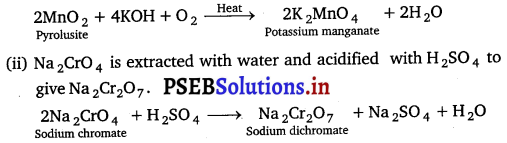
(ii) Na2Cr2O7 from Na2CrO4?
(b) Account for the following :
(i) The enthalpy of atomisation is lowest for Zn in 3d series of the transition elements.
(ii) Actinoid elements show wide range of oxidation states.
Answer:
(a) (i) Pyrolusite is fused with KOH in the presence of atmospheric oxygen to give K2MnO4.
PSEB 12th Class Chemistry Important Questions Chapter 8 The d-and f-Block Elements 5

(b) (i) In the formation of metallic bonds, no electrons from 3d-orbitals are involved in case of zinc, while in all other metals of the 3d series, electrons from the d-orbitals are always involved in the formation of metallic bonds. That is why the enthalpy of atomisation of zinc is the lowest in the series.
(ii) This is due to comparable energies of 5f, 6d and 7s orbitals.

PSEB 12th Class Chemistry Important Questions Chapter 10 Haloalkanes and Haloarenes

Punjab State Board PSEB 12th Class Chemistry Important Questions Chapter 10 Haloalkanes and Haloarenes Important Questions and Answers.

PSEB 12th Class Chemistry Important Questions Chapter 10 Haloalkanes and Haloarenes

Very Short Answer Type Questions

Question 1.
Out of PSEB 12th Class Chemistry Important Questions Chapter 10 Haloalkanes and Haloarenes 1 and PSEB 12th Class Chemistry Important Questions Chapter 10 Haloalkanes and Haloarenes 2, which is an example of allylic halide?
X
Answer:
PSEB 12th Class Chemistry Important Questions Chapter 10 Haloalkanes and Haloarenes 1 is an example of allylic halide.

Question 2.
Which of the following reactions is SN1 type ?
PSEB 12th Class Chemistry Important Questions Chapter 10 Haloalkanes and Haloarenes 3
Answer:
Reaction (ii) is SN1 reaction.

Question 3.
Which one of the following compounds is more easily hydrolysed by KOH and why?
CH3CHClCH2CH3 or CH3CH2CH2CH2Cl
Answer:
Due to +1 effect of alkyl groups the 2° carbonium ion CH3—CH—CH2—CH3 derived from sec-butyl chloride is more stable than the 1° carbonium ion \(\mathrm{CH}_{3}-\mathrm{CH}_{2}-\stackrel{+}{\mathrm{C}} \mathrm{H}_{2}\) derived from n-propyl chloride. Therefore sec-butyl chloride gets hydrolysed more easily than n-propyl chloride under SN1 conditions.

PSEB 12th Class Chemistry Important Questions Chapter 10 Haloalkanes and Haloarenes

Question 4.
What is known as a racemic mixture ? Give an example.
Answer:
equimolar mixture of a pair of enantiomers is called racemic mixture. A racemic mixture is optically inactive due to external compensation.

Question 5.
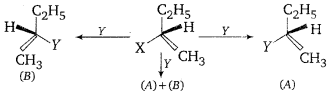
Consider the three types of replacement of group X by group Y as shown here.
PSEB 12th Class Chemistry Important Questions Chapter 10 Haloalkanes and Haloarenes 4
This can result in giving compound (A) or (B) or both. What is the process called if
(A) is the only compound obtained ?
(B) is the only compound obtained ?
(A) and (B) are formed in equal proportions ?
Answer:
(i) Retention
(ii) Inversion
(iii) Racemisation.

Question 6.
What is an asymmetric carbon?
Answer:
A carbon which is attached to four different atoms/groups is called asymmetric carbon. For example, the carbon atom in BrCHClI.

PSEB 12th Class Chemistry Important Questions Chapter 10 Haloalkanes and Haloarenes

Question 7.
What is plane polarized light?
Answer:
A beam of light which has vibration in only one plane is called plane polarized light.

Question 8.
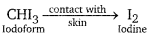
Why iodoform has appreciable antiseptic property ?
Answer:
Iodoform liberate I2 when it comes in contact with skin. Antiseptic property of iodine is due to the liberation of I2 not because of iodoform itself.
PSEB 12th Class Chemistry Important Questions Chapter 10 Haloalkanes and Haloarenes 5 (responsible for antiseptic property)

Question 9.
How does the ordinary light differ from the plane polarized light?
Answer:
Ordinary light has oscillations in all the directions perpendicular to the path of propagation whereas plane polarised light has all oscillations in the same plane.

PSEB 12th Class Chemistry Important Questions Chapter 10 Haloalkanes and Haloarenes

Question 10.
What do you .understand by the term optical activity of compounds?
Answer:
The property of certain compounds to rotate the plane of polarzed light in a characteristic way when it is passed through their solutions is called optical activity of compounds.

Short Answer Type Questions

Question 1.
Give reasons for the following:
(i) Ethyl iodide undergoes SN2 reaction faster than ethyl bromide.
(ii) (±) 2-Butanol is optically inactive.
(iii) C—X bond length in halobenzene is smaller than C—X bond length in CH3 —X.
Answer:
(i) Since I ion is a better leaving group than Br ion, hence, CH3I reacts faster than CH3Br in SN2 reaction with OH ion.

(ii) (±) 2-Butanol is a racemic mixture, i.e., there are two enantiomers in equal proportions. The rotation by one enantiomer will be cancelled by the rotation due to the other isomer, making the mixture optically inactive.

(iii) In CH3—X the carbon atom is sp2-hybridised while in halobenzene the carbon atom is sp3-hybridised. The sp2-hybridised carbon is more electronegative due to greater s-character and holds the electron pair of C—X bond more tightly than sp3-hybridised carbon with less s-character. Thus, C—X bond length in CH3—X is bigger than C—X in halobenzene.

Question 2.
Give reasons for the following:
(i) Haloalkanes easily dissolve in organic solvents.
(ii) Halogen compounds used in industry as solvents are alkyl chlorides rather than bromides and iodides.
Answer:
(i) Haloalkanes dissolve in organic solvents because the new intermolecular attractions between haloalkanes and organic solvent molecules have much the same strength as ones being broken in the separate haloalkanes and solvent molecules.
(ii) Because alkyl chlorides are more stable and more volatile than bromides and iodides.

PSEB 12th Class Chemistry Important Questions Chapter 10 Haloalkanes and Haloarenes

Question 3.
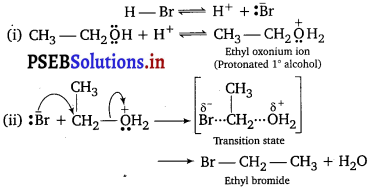
Write the mechanism of the following reaction
PSEB 12th Class Chemistry Important Questions Chapter 10 Haloalkanes and Haloarenes 6
Answer:
SN2 mechanism
PSEB 12th Class Chemistry Important Questions Chapter 10 Haloalkanes and Haloarenes 7

Question 4.
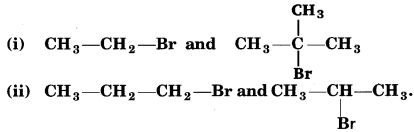
Which would undergo SN1 reaction faster in the following pairs and why ?
PSEB 12th Class Chemistry Important Questions Chapter 10 Haloalkanes and Haloarenes 8
Answer:
(i) PSEB 12th Class Chemistry Important Questions Chapter 10 Haloalkanes and Haloarenes 9
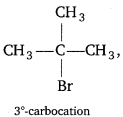
Tertiary halide reacts faster than primary halide because of greater stability of 3°-carbocation.

(ii) PSEB 12th Class Chemistry Important Questions Chapter 10 Haloalkanes and Haloarenes 10
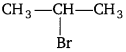
Because the secondary carbocation formed in the slowest step is more stable than the primary carbocation.

Question 5.
Give reasons:
(i) n-Butyl bromide has higher boiling point than f-butyl bromide. Racemic mixture is optically inactive.
(ii) The presence of nitro group (—NO2) at o/p positions increases the reactivity of haloarenes towards nucleophilic substitution reactions.
Answer:
(i) n-butyl bromide being a straight chain alkyl halide has larger surface area than tert butyl bromide. Larger the surface area, larger the magnitude of the van der Waal’s forces and hence higher is the boiling point.

(ii) A racemic mixture contains the two enantiomers d and l in equal •proportions. As the rotation due to one enantiomer is cancelled by equal and opposite rotation of another enantiomer, therefore, it is optically inactive.

(iii) The presence of NO2 group at o/p position in haloarenes helps in the stabilisation of resulting carbanion by -R and -I effects and hence increases the reactivity of haloarenes towards nucleophilic substitution reactions.

PSEB 12th Class Chemistry Important Questions Chapter 10 Haloalkanes and Haloarenes

Question 6.
(i) Why are alkyl halides insoluble in water ?
(ii) Why is butan-l-ol optically inactive but butan-2-ol is optically active ?
(iii) Although chlorine is an electron withdrawing group, yet it is ortho, para directing in electrophilic aromatic substitution reactions. Why ?
Answer:
(i) This is due to the inability of alkyl halide molecule to form intermolecular hydrogen bonds with water molecules.
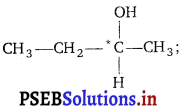
(ii) PSEB 12th Class Chemistry Important Questions Chapter 10 Haloalkanes and Haloarenes 11
due to presence of a chiral carbon butan-2-ol is an optically active compound.

(iii) As the weaker resonance (+R) effect of Cl which stabilise the carbocation formed tends to oppose the stronger inductive (-I) effect of Cl which destabilise the carbocation at ortho and para positions and makes deactivation less for ortho and para position.

Question 7.
(i) Allyl chloride can be distinguished from vinyl chloride by NaOH and silver nitrate test. Comment.
(ii) Alkyl halide reacts with lithium aluminium hydride to give alkane. Name the attacking reagent which will bring out this change.
Answer:
(i) Vinyl chloride does not respond to NaOH and silver nitrate test because of partial double bond character due to resonance.
(ii) Hydride ion (H )

Question 8.
Give the ITJPAC name of the product formed when :
(i) 2-Methyl-l-bromopropane is treated with sodium in the presence of dry ether.
(ii) 1-Methyl cyclohexene is treated with HI.
(iii) Chloroethane is treated with silver nitrite.
Answer:
(i) 2, 5-dimethylhexane
(ii) 1 -Methyl-1 -iodocyclohexane
(iii) Nitroethane

PSEB 12th Class Chemistry Important Questions Chapter 10 Haloalkanes and Haloarenes

Long Answer Type Questions

Question 1.
Some alkyl halides undergo substitution whereas some undergo elimination reaction on treatment with base. Discuss the structural features of alkyl halides with the help of examples which are responsible for this difference.
Answer:
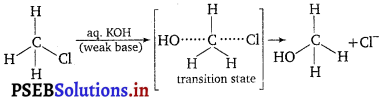
Primary alkyl halides follow SN2 mechanism in which a nucleophile attacks at 180° to the halogen atom. A transition state is formed in which carbon is bonded to two nucleophiles and finally halogen atom is pushed out. In SN2 mechanism, substitution of nucleophile takes place as follows :
PSEB 12th Class Chemistry Important Questions Chapter 10 Haloalkanes and Haloarenes 12
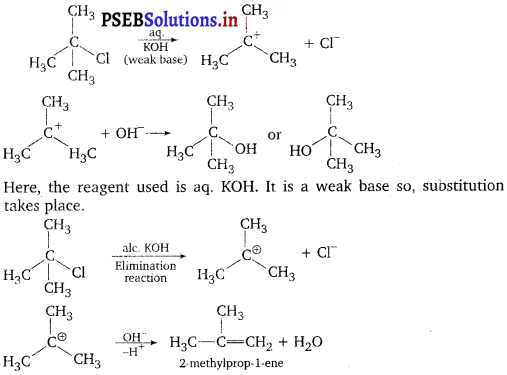
Thus, in SN2 mechanism, substitution takes place. Tertiary alkyl halides follow? SN1 mechanism, In this case, tert-alkyl halides form 3° carbocation. Now, if the reagent used is a weak base then substitution occur while if it is a strong base then instead of substitution elimination occur.
PSEB 12th Class Chemistry Important Questions Chapter 10 Haloalkanes and Haloarenes 13
As alc. KOH is a strong base, so elimination competes over substitution and alkene is formed.

PSEB 12th Class Chemistry Important Questions Chapter 10 Haloalkanes and Haloarenes

Question 2.
Why are aryl halides less reactive towards nucleophilic substitution reactions than alkyl halides ? How can we enhance the reactivity of aryl halides ?
Answer:
Aryl halides are less reactive towards nucleophilic substitution reaction due to the following reasons :
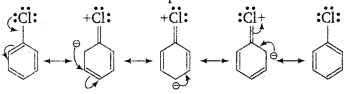
(i) In haloarenes, the lone pair of electron on halogen are in resonance with benzene ring. So, C—Cl bond acquires partial double bond character which strengthen C—Cl bond. Therefore, they are less reactive towards nucleophilic substitution reaction.
PSEB 12th Class Chemistry Important Questions Chapter 10 Haloalkanes and Haloarenes 14
(ii) In haloarenes, the carbon atom attached to halogen is sp2-hybridised. The sp2-hybridised carbon is more electronegative than sp3-hybridised carbon. This sp 2-hybridised carbon in haloarenes can hold the electron pair of C—X bond more tightly and make this C—Cl bond shorter than C—Cl bond haloalkanes.

(iii) Since, it is difficult to break a shorter bond than a longer bond therefore haloarenes are less reactive than haloarenes.
In haloarenes, the phenyl cation will not be stabilised by resonance therefore SN1 mechanism ruled out.

(iv) Because of the repulsion between the nucleophile and electron rich arenes, aryl halides are less reactive than alkyl halides.

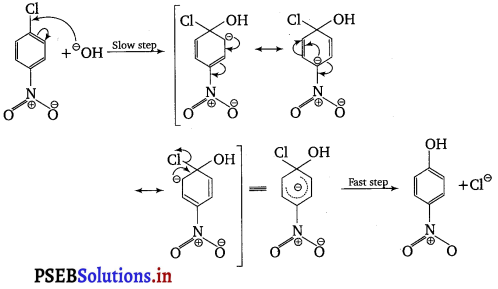
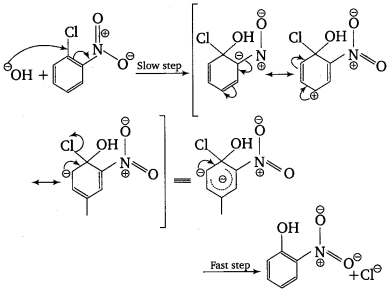
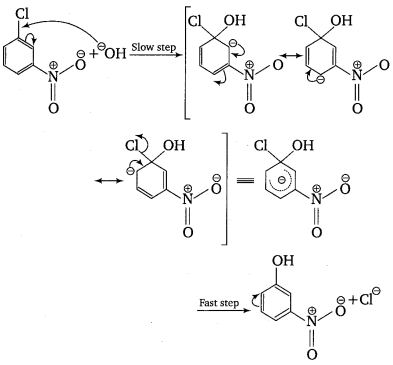
The reactivity of aryl halides can be increased by the presence of an electron withdrawing group (—NO2) at ortho and para positions. However, no effect on reactivity of haloarenes is observed by the presence of electron withdrawing group at meta-position. Mechanism of the reaction is as depicted with OH ion.
PSEB 12th Class Chemistry Important Questions Chapter 10 Haloalkanes and Haloarenes 15
PSEB 12th Class Chemistry Important Questions Chapter 10 Haloalkanes and Haloarenes 16
PSEB 12th Class Chemistry Important Questions Chapter 10 Haloalkanes and Haloarenes 17
From the above resonance, it is very clear that electron density is rich at ortho and para positions. So, presence of EWG will facilitate nucleophilic at ortho and para positions not on meta position.

PSEB 12th Class Chemistry Important Questions Chapter 9 Coordination Compounds

Punjab State Board PSEB 12th Class Chemistry Important Questions Chapter 9 Coordination Compounds Important Questions and Answers.

PSEB 12th Class Chemistry Important Questions Chapter 9 Coordination Compounds

Very Short Answer Type Questions

Question 1.
Why is CO a stronger ligand than Cl ?
Answer:
CO forms π bonds so it is a stronger ligand than Cl.

Question 2.
What is the relationship between observed colour of the complex and the wavelength of light absorbed by the complex?
Answer:
When white light falls on the complex, some part of it is absorbed. Higher the crystal field splitting, lower will be the wavelength absorbed by the complex. The observed colour of complex is the colour generated from the wavelength left over.

Question 3.
How many isomers are there for octahedral complex [CoCl2 (en) (NH3)2]+?
Answer:
There will be three isomers: cis and trans isomers. Cis will also show optical isomerism.

PSEB 12th Class Chemistry Important Questions Chapter 9 Coordination Compounds

Question 4.
Why are low spin tetrahedral complexes not formed?
Answer:
Because for tetrahedral complexes, the crystal field stabilisation energy is lower than pairing energy.

Question 5.
A complex of the type [M(AA)2X2]n+ is known to be optically active. What does this indicate about the structure of the complex? Give one example of such complex.
Answer:
An optically active complex of the type [M(AA)2X2]n+ indicates cis- octahedral structure, e.g., cis-[Pt(en)2Cl2]2+ or cis-[Cr(en)2Cl2]+.

Question 6.
Why is the complex [Co(en)3]3+ more stable than the complex [CoF6]3-?
Answer:
Due to chelate effect as the complex [Co(en)3]3+ contains chelating ligand \(\ddot{\mathrm{NH}}_{2}-\mathrm{CH}_{2}-\mathrm{CH}_{2}-\ddot{\mathrm{NH}}_{2}\).

PSEB 12th Class Chemistry Important Questions Chapter 9 Coordination Compounds

Question 7.
What do you understand by ‘denticity of a ligand’?
Answer:
The number of coordinating groups present in ligand is called the denticity of ligand. For example, denticity of ethane-1, 2-diamine is 2, as it has two donor nitrogen atoms which can link to central metal atom.

Question 8.
What type of isomerism is shown by the complex [CO(NH3)5(SCN)]2+?
Answer:
Linkage isomerism.

Question 9.
Arrange the following complex ions in increasing order of crystal field splitting energy △0 :
[Cr(Cl)6]3-, [Cr(CN)6]3-, [Cr(NH3)6]3+
Answer:
[Cr(Cl)6]3- < [Cr(NH3)6]3+ < [Cr(CN)6]3-

PSEB 12th Class Chemistry Important Questions Chapter 9 Coordination Compounds

Question 10.
A coordination compound with molecular formula CrCl3.4H2O precipitates one mole of AgCl with AgNO3 solution. Its molar conductivity is found to be equivalent to two ions. What is the structural formula and name of the compound?
Answer:
[Cr(H2O)4Cl2] Cl
[Tetraaquadichloridochromium (III) chloride]

Short Answer Type Questions

Question 1.
Give the electronic configuration of the following complexes on the basis of crystal field splitting theory.
[CoF6]3-, [Fe(CN)6]4- and [Cu(NH3)6]2+
Answer:
[CoF6]3-: Co3+(d6) \(t_{2 g}^{4} e_{g}^{2}\)
[Fe(CN)6]4- : Fe2+ (d6) \(t_{2 g}^{6} e_{g}^{0}\)
[Cu(NH3)6]2+ : Cu2+ (d9) \(t_{2 g}^{6} e_{g}^{3}\)

PSEB 12th Class Chemistry Important Questions Chapter 9 Coordination Compounds

Question 2.
(i) What type of isomerism is shown by [Co(NH3) 5ONO]Cl2?
(ii) On the basis of crystal field theory, write the electronic configuration for d4 ion, if △0 < P.
(iii) Write the hybridisation and shape of [Fe(CN)6]3-.
(Atomic number of Fe = 26)
Answer:
(i) Linkage isomerism and the linkage isomer is [Co(NH3) 5ONO]Cl2.
(ii) If △0 < P, the fourth electron enters one of two eg orbitals giving the configuration \(t_{2 g}^{3} e_{g}^{1}\).
(iii) Fe3+ : 3d5 4s0
PSEB 12th Class Chemistry Important Questions Chapter 9 Coordination Compounds 1

Question 3.
Explain why [Fe(H2O)6]3+ 5.92 BM whereas [Fe(CN)6]3- has a value of only 1.74 BM.
Answer:
[Fe(CN)6]3- involves d2sp3 hybridisation with one unpaired electron and [Fe(H2O)6]3+ involves sp3d2 hybridisation with five unpaired electrons. This difference is due to the presence of strong CN and weak ligand H2O in these complexes.

PSEB 12th Class Chemistry Important Questions Chapter 9 Coordination Compounds

Question 4.
CuSO4∙5H2O is blue in colour while CuSO4 is colourless. Why?
Answer:
In CuSO4∙5H2O, water acts as ligand as a result it causes crystal field splitting. Hence, d-d transition is possible in CuSO4∙5H2O and shows colour. In the anhydrous CuSO4 due to the absence of water (ligand), crystal field splitting is not possible and hence it is colourless.

Question 5.
Why do compounds having similar geometry have different magnetic moment?
Answer:
It is due to the presence of weak and strong ligands in complexes, if CFSE is high, the complex will show low value of magnetic moment and vice versa, e.g., [CoF6]3- and [Co(NH3)6]3+, the former is paramagnetic and the latter is diamagnetic.

Question 6.
A metal ion Mn+ having d4 valence electronic configuration combines with three bidentate ligands to form a complex compound. Assuming △0 > P:
(i) Write the electronic configuration of d4 ion.
(ii) What type of hybridisation will Mn+ ion has?
(iii) Name the type of isomerism exhibited by this complex.
Answer:
(i) \(t_{2 g}^{4} e_{g}^{0}\)
(ii) sp3d2
(iii) Optical isomerism

PSEB 12th Class Chemistry Important Questions Chapter 9 Coordination Compounds

Long Answer Type Questions

Question 1.
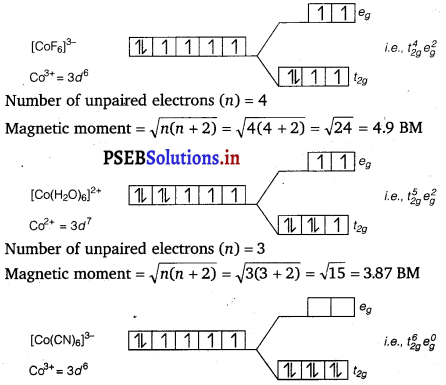
Using crystal field theory, draw energy level diagram, write electronic configuration of the central metal atom/ion and determine the magnetic moment value in the following: [COF6]3-, [CO(H2O)6]2+, [CO(CN)6]3
Answer:
Magnetic moment, μ = \(\sqrt{n(n+2)}\)
Where, n = Number of unpaired electrons
PSEB 12th Class Chemistry Important Questions Chapter 9 Coordination Compounds 2
No unpaired electrons, so it is diamagnetic.

PSEB 12th Class Chemistry Important Questions Chapter 9 Coordination Compounds

Question 2.
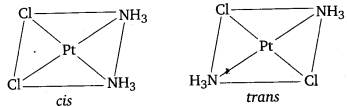
(i) Draw the geometrical isomers of complex [Pt(NH3)2Cl2].
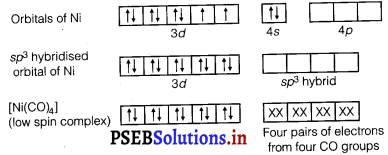
(ii) Write the hybridisation and magnetic behaviour of the complex [Ni(CO)4].
(Atomic no. of Ni = 28)
Answer:
PSEB 12th Class Chemistry Important Questions Chapter 9 Coordination Compounds 3
Geometrical isomers of [Pt(NH3)2Cl2]

(ii) The complex [Ni(CO)4] involves sp3 hybridisation.
PSEB 12th Class Chemistry Important Questions Chapter 9 Coordination Compounds 4
The complex is diamagnetic as evident from the absence of unpaired electrons.

PSEB 12th Class Chemistry Solutions Chapter 10 Haloalkanes and Haloarenes

Punjab State Board PSEB 12th Class Chemistry Book Solutions Chapter 10 Haloalkanes and Haloarenes Textbook Exercise Questions and Answers.

PSEB Solutions for Class 12 Chemistry Chapter 10 Haloalkanes and Haloarenes

PSEB 12th Class Chemistry Guide Haloalkanes and Haloarenes InText Questions and Answers

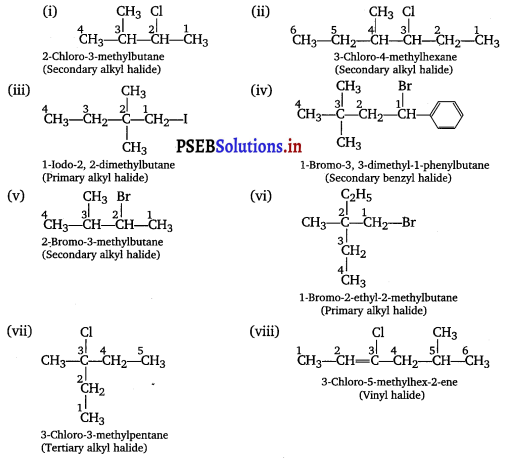
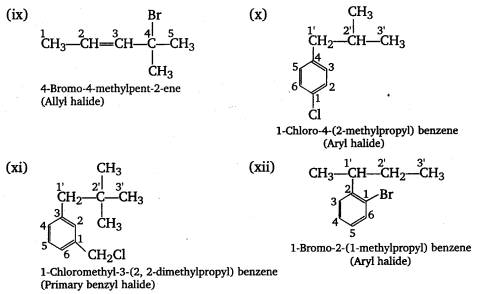
Question 1.
Name the following halides according to IUPAC system and classify them as alkyl, allyl, benzyl (primary, secondary, tertiary), vinyl or aryl halides:
(i) (CH3)2CHCH(Cl)CH3
(ii) CH3CH2CH(CH3)CH(C2H5)Cl
(iii) CH3CH2C(CH3)2CH2I
(iv) (CH3)3CCH2CH(Br)C6H5
(v) CH3CH(CH3)CH(Br)CH3
(vi) CH3C(C2H5)2CH2Br
(vii) CH3C(Cl)(C2H5)CH2CH3
(viii) CH3CH=C(Cl)CH2CH(CH3)2
(ix) CH3CH=CHC(Br)(CH3)2
(x) p-ClC6H4CH2CH(CH3)2
(xi) m-ClCH2C6H4CH2C(CH3)3
(xii) o-Br-C6H4CH(CH3)CH2CH3
Answer:
PSEB 12th Class Chemistry Solutions Chapter 10 Haloalkanes and Haloarenes 1
PSEB 12th Class Chemistry Solutions Chapter 10 Haloalkanes and Haloarenes 2

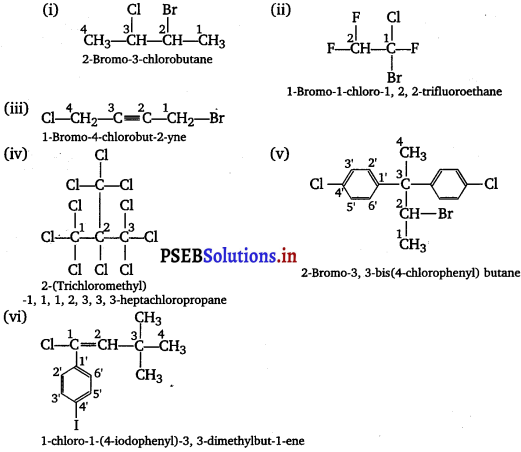
Question 2.
Give the IUPAC names of the following compounds:
(i) CH3CH(Cl)CH(Br)CH3
(ii) CHF2CBrClF
(iii) ClCH2C ☰ CCH2Br
(iv) (CCl3)3CCl
(v) CH3C(p-ClC6H4)2CH(Br)CH3
(vi) (CH3)3CCH=CClC6H4I-p
Answer:
PSEB 12th Class Chemistry Solutions Chapter 10 Haloalkanes and Haloarenes 3

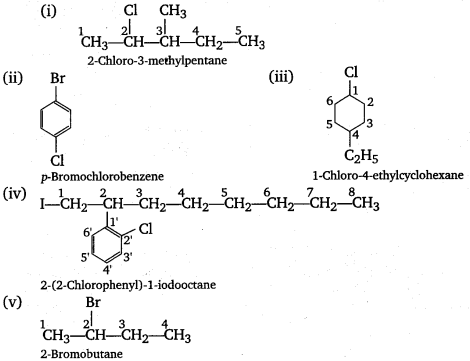
Question 3.
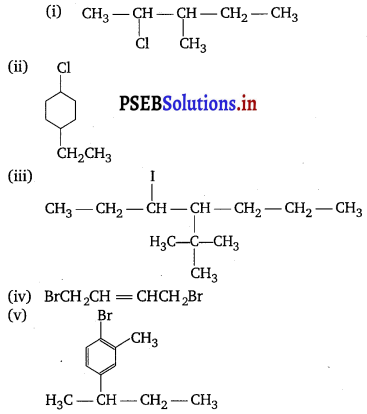
Write the structures of the following organic halogen compounds.
(i) 2-Chloro-3-methylpentane
(ii) p -Bromochlorobenzene
(iii) 1-Chloro-4-ethylcyclohexane
(iv) 2-(2-Chlorophenyl)-l-iodooctane
(v) 2 -Bromobutane
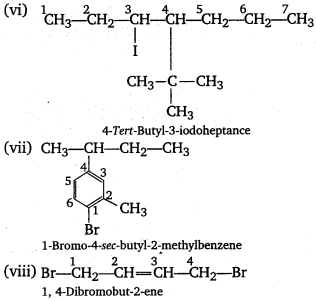
(vi) 4-terf-Butyl-3-iodoheptane
(vii) l-Bromo-4-sec-butyl-2-methylbenzene
(viii) 1,4-Dibromobut-2 -ene
Answer:
PSEB 12th Class Chemistry Solutions Chapter 10 Haloalkanes and Haloarenes 4
PSEB 12th Class Chemistry Solutions Chapter 10 Haloalkanes and Haloarenes 5

PSEB 12th Class Chemistry Solutions Chapter 10 Haloalkanes and Haloarenes

Question 4.
Which one of the following has the highest dipole moment?
(i) CH2Cl2
(ii) CHCl3
(iii) CCl4
Answer:
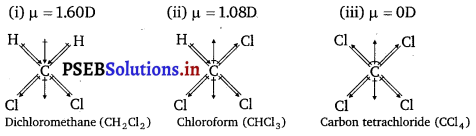
PSEB 12th Class Chemistry Solutions Chapter 10 Haloalkanes and Haloarenes 6
1. CCl4 is a symmetrical molecule. Therefore, the dipole moments of all four C—Cl bonds cancel each other. Hence, its resultant dipole moment is zero.

2. As shown in the above figure, in CHCl3, the resultant of dipole moments of two C—Cl bonds is opposed by the resultant of dipole moments of one C—H bond and one C—Cl bond. Since the resultant of one C—H bond and one C—Cl bond dipole moments is smaller than two C—Cl bonds, the opposition is to a small extent. As a result, CHC13 has a small dipole moment of 1.08 D.

3. On the other hand, in case of CH2Cl2, the resultant of the dipole moments of two C—Cl bonds is strengthened by the resultant of the dipole moments of two C—H bonds. As a result, CH2C12 has a higher dipole moment of 1.60 D than CHCl3 i.e., CH2Cl2 has the highest dipole moment.
Hence, the given compounds can be arranged in the increasing order of their dipole moments as:
CCl4 < CHCl3 < CH2Cl2

Question 5.
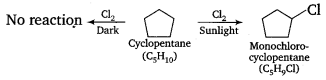
A hydrocarbon C5H10 does not react with chlorine in dark but gives a single monochloro compound C5H9Cl in bright sunlight. Identify the hydrocarbon.
Answer:
CO The hydrocarbon with molecular formula C5H10 can be either a cycloalkane or an alkene.

Since, the hydrocarbon does not react with Cl2 in the dark, it cannot be an alkene but must be a cycloalkane.
As the cycloalkane reacts with Cl2 in the presence of bright sunlight, to give a single monochloro compound, C5H9Cl, therefore all the ten hydrogen atoms of the cycloalkane must be equivalent. Therefore, the cycloalkane is cyclopentane.
PSEB 12th Class Chemistry Solutions Chapter 10 Haloalkanes and Haloarenes 7

PSEB 12th Class Chemistry Solutions Chapter 10 Haloalkanes and Haloarenes

Question 6.
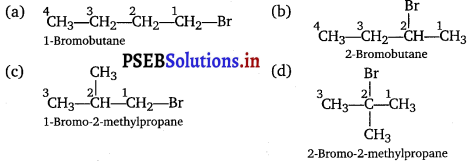
Write the isomers of the compound having formula C4H9Br.
Answer:
There are four isomers of the compound having the formula C4H9Br.
These isomers are given below:
PSEB 12th Class Chemistry Solutions Chapter 10 Haloalkanes and Haloarenes 8

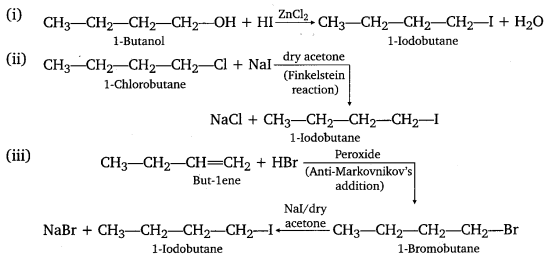
Question 7.
Write the equations for the preparation of 1-iodobutane from
(i) 1-butanol
(ii) 1-chlorobutane
(iii) but-l-ene.
Answer:
PSEB 12th Class Chemistry Solutions Chapter 10 Haloalkanes and Haloarenes 9

Question 8.
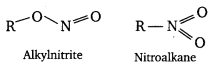
What are ambident nucleophiles? Explain with an example.
Answer:
Ambident nucleophiles are nucleophiles having two nucleophilic sites. Thus, ambident nucleophiles have two sites through which they can attack.
For example, nitrite ion is an ambident nucleophile.
PSEB 12th Class Chemistry Solutions Chapter 10 Haloalkanes and Haloarenes 10
Nitrite ion can attack through oxygen resulting in the formation of alkyl nitrites. Also, it can attack through nitrogen resulting in the formation of nitroalkanes.
PSEB 12th Class Chemistry Solutions Chapter 10 Haloalkanes and Haloarenes 11

PSEB 12th Class Chemistry Solutions Chapter 10 Haloalkanes and Haloarenes

Question 9.
Which compound in each of the following pairs will react faster in Sn2 reaction with OH?
(i) CH3Br or CH3I
(ii) (CH3)3CCl or CH3Cl
Answer:
(i) Since I ion is a better leaving group than Br ion, hence CH3I reacts faster than CH3Br in SN2 reaction with OH ion.

(ii) On steric grounds, 1° alkyl halides are more reactive than tert-alkyl halides in SN 2 reactions. Hence, CH3Cl will react at a faster rate than (CH3)3 CCl in a SN2 reaction with OH ion.

Question 10.
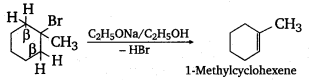
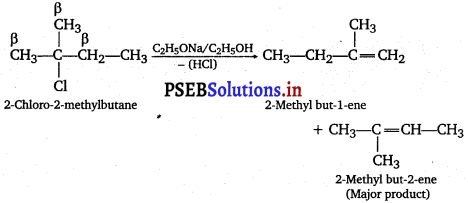
Predict all the alkenes that would be formed by dehydrohalogenation of the following halides with sodium ethoxide in ethanol and identify the major alkene:
(i) 1 -Bromo-1-methylcyclohexane
(ii) 2-Chloro-2-methylbutane
(iii) 2, 2, 3-Trimethyl-3-hromopentane.
Answer:
(i) In 1 -bromo-1 -methylcyclohexane, the β-hydrogens on either side of the Br atom are equivalent, therefore, only 1-alkene is formed.
PSEB 12th Class Chemistry Solutions Chapter 10 Haloalkanes and Haloarenes 12

(ii) All p-hydrogens in 2-chloro-2-methylbutane are not equivalent, hence on treatment with C2H5ONa/C2H5OH, it gives two alkenes.
PSEB 12th Class Chemistry Solutions Chapter 10 Haloalkanes and Haloarenes 13

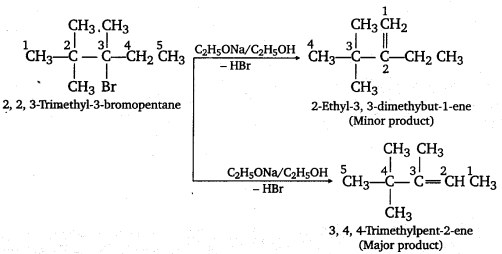
(iii) 2, 2, 3-Trimethyl-3-bromopentane has two different sets of p-hydrogen and therefore, in principle, can give two alkenes (I and II). But according to Saytzeff rule, more highly substituted alkene (II), being more stable is the major product.
PSEB 12th Class Chemistry Solutions Chapter 10 Haloalkanes and Haloarenes 14

PSEB 12th Class Chemistry Solutions Chapter 10 Haloalkanes and Haloarenes

Question 11.
How will you bring about the following conversions?
(i) Ethanol to but-1-yne
(ii) Ethane to bromoethene
(iii) Propene to 1 -nitropropane
(iv) Toluene to benzyl alcohol
(v) Propene to propynt
(vi) Ethanol to ethyl fluoride
(vii) Bromomethane to propanone
(viii) But-l-ene to but-2-ene
(ix) 1-Chlorobutane to n-octane
(x) Benzene to biphenyl.
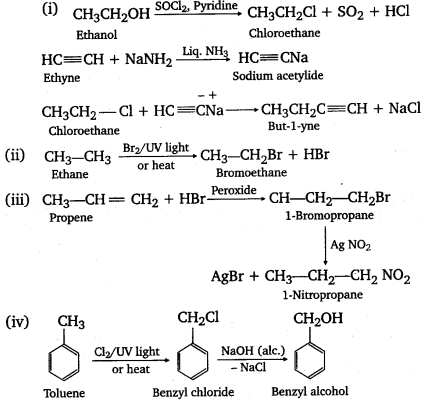
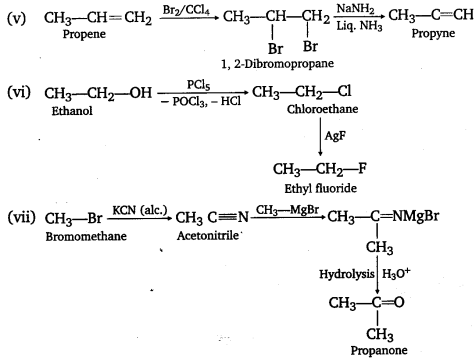
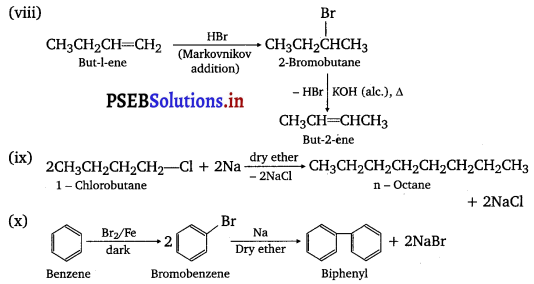
Answer:
PSEB 12th Class Chemistry Solutions Chapter 10 Haloalkanes and Haloarenes 15
PSEB 12th Class Chemistry Solutions Chapter 10 Haloalkanes and Haloarenes 16
PSEB 12th Class Chemistry Solutions Chapter 10 Haloalkanes and Haloarenes 17

Question 12.
Explain why
(i) The dipole moment of chlorobenzene is lower than that of cyclohexyl chloride ?
(ii) Alkyl halides, though polar are immiscible with water ?
(iii) Grignard reagents should be prepared under anhydrous conditions ?
Answer:
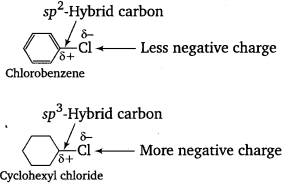
(i) Because of greater s-character, an sp2-hybrid carbon is more electronegative than an sp3-hybrid carbon. Thus, the sp2-hybrid carbon of C—Cl bond in chlorobenzene has less tendency to release electrons to Cl than an sp3-hybrid carbon of cyclohexyl chloride.
PSEB 12th Class Chemistry Solutions Chapter 10 Haloalkanes and Haloarenes 18
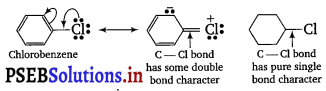
Hence, the C—Cl bond in chlorobenzene is less polar than that in cyclohexyl chloride. In other words, the magnitude of negative charge is less on Cl atom of chlorobenzene than in cyclohexyl chloride. Now, due to delocalisation of lone pairs of electrons of the Cl atom over the benzene ring, C—Cl bond in chlorobenzene acquires some double character while the C—Cl bond in cyclohexyl chloride is a pure single bond. Thus, C—Cl bond in chlorobenzene is shorter than in cyclohexyl chloride.
PSEB 12th Class Chemistry Solutions Chapter 10 Haloalkanes and Haloarenes 19
As dipole moment is a product of charge and distance, chlorobenzene has lower dipole moment than cyclohexyl chloride due to lower magnitude of negative charge on the Cl atom and shorter C—Cl distance.

(ii) Alkyl halides, though polar, are immiscible in water because they are unable to form hydrogen bonds with water molecules.

(iii) Grignard reagents are very reactive. They react with moisture present in the apparatus or the starting materials to give hydrocarbons.
PSEB 12th Class Chemistry Solutions Chapter 10 Haloalkanes and Haloarenes 20
Hence, Grignard reagent must be prepared under anhydrous conditions.

PSEB 12th Class Chemistry Solutions Chapter 10 Haloalkanes and Haloarenes

Question 13.
Give the uses of freon 12, DDT, carbon tetrachloride and iodoform.
Answer:
Uses of Freon-12(CCl2F2)

  1. It is used as a refrigerant in refrigerators and air conditioners.
  2. It is also used in aerosol spray propellants such as body sprays, hair sprays.

Uses of DDT (p, p’-dichlorodiphenyltrichloroethane)

  1. It is very effective against mosquitoes and lice.
  2. It is also used in many countries as insecticide for sugarcane and fodder crops. (But due to its harmful effects, its use has been banned in many contries including U.S.A.

Uses of Carbontetrachloride (CCl4)

  1. It is used for manufacturing refrigerants and propellants for aerosol cAnswer:
  2. It is used as feedstock in the synthesis of chlorofluorocarbons and other chemicals.
  3. It is used as a solvent in the manufacture of pharmaceutical products. Until the mid 1960’s, carbon tetrachloride was widely used as a cleaning fluid, a degreasing agent in industries, a spot reamer in homes, and a fire extinguisher.

Uses of Iodoform (CHI3)
Iodoform was used earlier as an antiseptic, but now it has been replaced by other formulations-containing iodine-due to its objectionable smell. The antiseptic property of iodoform is only due to the liberation of free iodine when it comes in contact with the skin.

Question 14.
Write the structure of the major organic product in each of the following reactions
PSEB 12th Class Chemistry Solutions Chapter 10 Haloalkanes and Haloarenes 21
PSEB 12th Class Chemistry Solutions Chapter 10 Haloalkanes and Haloarenes 22
(v) C6H5ONa + C2H6Cl →
(vi) CH3CH2CH2OH + SOCl2
PSEB 12th Class Chemistry Solutions Chapter 10 Haloalkanes and Haloarenes 23
(viii) CH3CH = C(CH3)2 + HBr →
Answer:
PSEB 12th Class Chemistry Solutions Chapter 10 Haloalkanes and Haloarenes 24

Question 15.
Write the mechanism of the following reaction
PSEB 12th Class Chemistry Solutions Chapter 10 Haloalkanes and Haloarenes 25
Answer:
The given reaction is
PSEB 12th Class Chemistry Solutions Chapter 10 Haloalkanes and Haloarenes 26
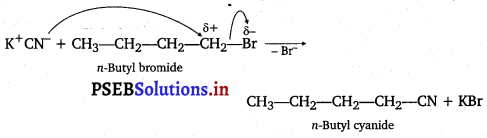
The given reaction is an SN2 reaction. In this reaction, CN acts as the nucleophile and attacks the carbon atom to which Br is attached. CN ion is an ambident nucleophile and can attack through both C and N. In this case, it attacks through the C-atom.
PSEB 12th Class Chemistry Solutions Chapter 10 Haloalkanes and Haloarenes 27

PSEB 12th Class Chemistry Solutions Chapter 10 Haloalkanes and Haloarenes

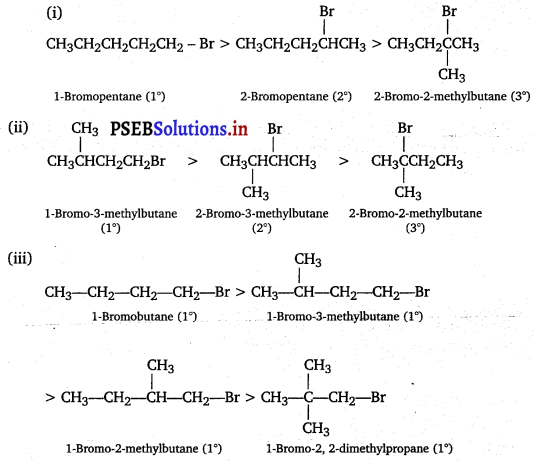
Question 16.
Arrange the compounds of each set in order of reactivity towards SN2 displacement
(i) 2-Bromo-2-methylbutane, 1 -Bromopentane, 2-Bromopentane
(ii) 1-Bromo-3-methylbutane, 2-Bromo-2-methylbutane, 3-Bromo- 2-methylbutane
(iii) 1-Bromobutane, l-Bromo-2, 2-dimethylpropane, 1-Bromo -2-methylbutane, 1-Bromo-3-methylbutane.
Answer:
PSEB 12th Class Chemistry Solutions Chapter 10 Haloalkanes and Haloarenes 28

Question 17.
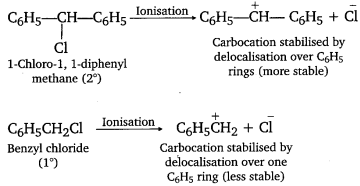
Out of C6H5CH2Cl and C6H5CHClC6H5, which is more easily hydrolysed by aqueous KOH?
Answer:
PSEB 12th Class Chemistry Solutions Chapter 10 Haloalkanes and Haloarenes 29
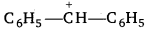
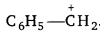
In SN1 reaction, reactivity depends upon the stability of carbocations. PSEB 12th Class Chemistry Solutions Chapter 10 Haloalkanes and Haloarenes 30 carbocation is more stable as compared to PSEB 12th Class Chemistry Solutions Chapter 10 Haloalkanes and Haloarenes 31. Therefore, C6H5CHClC6H5 gets hydrolysed more easily than C6H5CHCl.

Question 18.
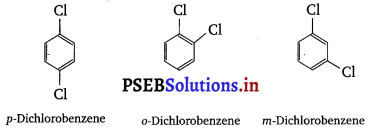
p-Dichlorobenzene has higher m.p. and lower solubility than those of o- and m-isomers. Discuss.
Answer:
PSEB 12th Class Chemistry Solutions Chapter 10 Haloalkanes and Haloarenes 32
p-Dichlorobenzene is more symmetrical than o-and m-isomers. For this reason, it fits more closely than o-and m-isomers in the crystal lattice. Therefore, more energy is required to break the crystal lattice of p-dichlorobenzene. As a result, p-dichlorobenzene has a higher melting point and lower solubility than o-and m-isomers.

PSEB 12th Class Chemistry Solutions Chapter 10 Haloalkanes and Haloarenes

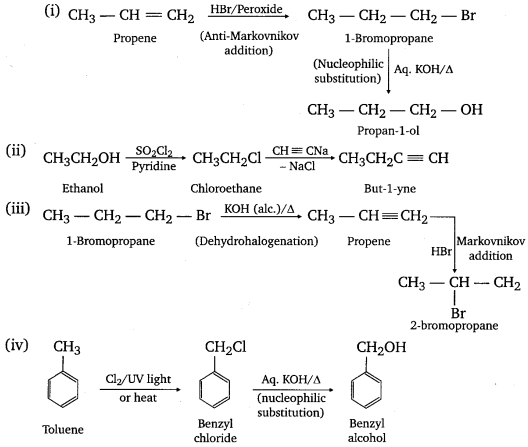
Question 19.
How the following conversions can be carried out?
(i) Propene to propan-l-ol
(ii) Ethanol to but-l-yne
(iii) 1-Bromopropane to 2-bromopropane
(iv) Toluene to benzyl alcohol
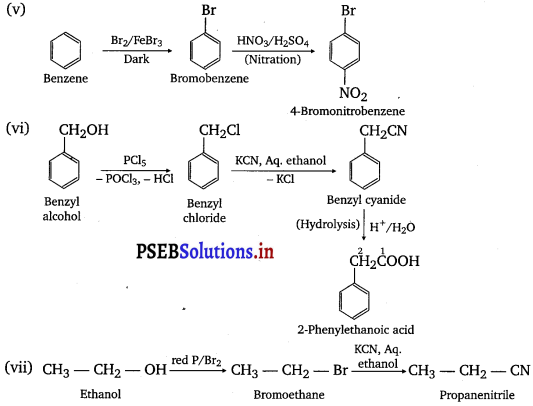
(v) Benzene to 4-bromonitrobenzene
(vi) Benzyl alcohol to 2-phenylethanoic acid
(vii) Ethanol to propanenitrile
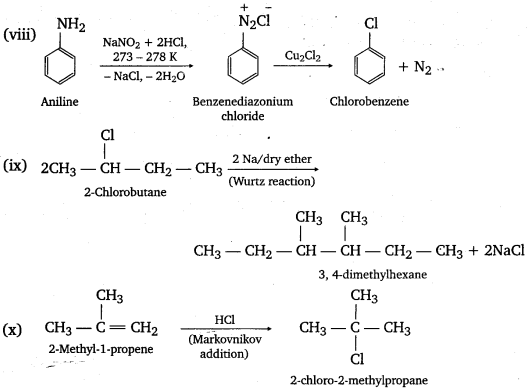
(viii) Aniline to chlorobenzene
(ix) 2-Chlorobutane to 3, 4-dimethylhexane
(x) 2-Methyl- 1-propene to 2-chloro-2-methylpropane
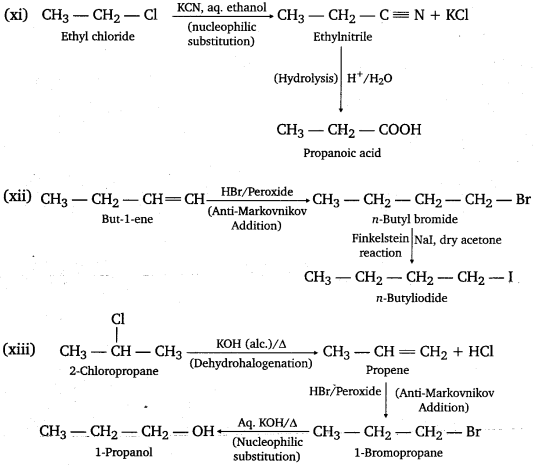
(xi) Ethyl chloride to propanoic acid
(xii) But-l-ene to n-butyliodide
(xiii) 2-Chloropropane to 1-propanol
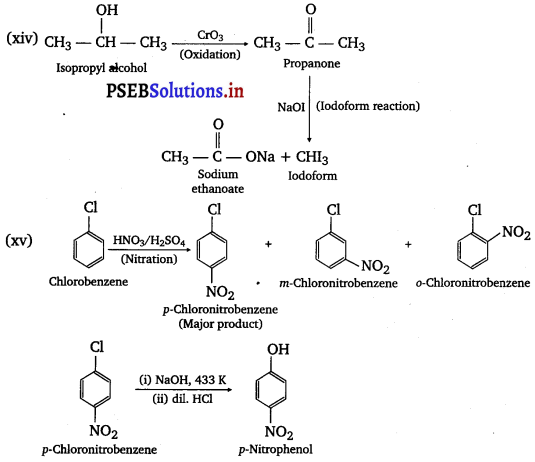
(xiv) Isopropyl alcohol to iodoform
(xv) Chlorobenzene to p-nitrophenol
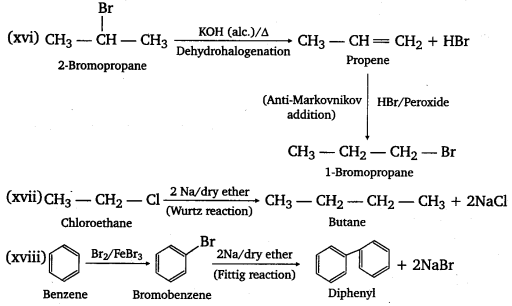
(xvi) 2-Bromopropane to 1-bromopropane
(xvii) Chloroethane to butane
(xviii) Benzene to diphenyl
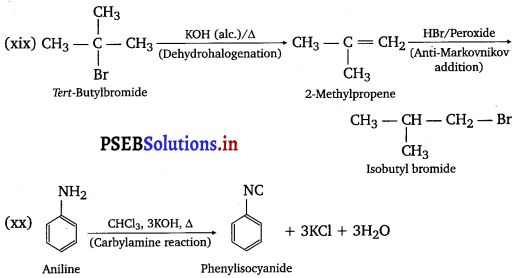
(xix) tert-Butyl bromide to isobutyl bromide
(xx) Aniline to phenylisocyanide
Answer:
PSEB 12th Class Chemistry Solutions Chapter 10 Haloalkanes and Haloarenes 33
PSEB 12th Class Chemistry Solutions Chapter 10 Haloalkanes and Haloarenes 34
PSEB 12th Class Chemistry Solutions Chapter 10 Haloalkanes and Haloarenes 35
PSEB 12th Class Chemistry Solutions Chapter 10 Haloalkanes and Haloarenes 36
PSEB 12th Class Chemistry Solutions Chapter 10 Haloalkanes and Haloarenes 37
PSEB 12th Class Chemistry Solutions Chapter 10 Haloalkanes and Haloarenes 38
PSEB 12th Class Chemistry Solutions Chapter 10 Haloalkanes and Haloarenes 39

Question 20.
The treatment of alkyl chlorides with aqueous KOH leads to the formation of alcohols but in the presence of alcoholic KOH, alkenes are major products. Explain.
Answer:
In an aqueous solution, KOH almost completely ionises to give OH ions. OH ion is a strong nucleophile, which leads the alkyl chloride to undergo a substitution reaction to form alcohol.
PSEB 12th Class Chemistry Solutions Chapter 10 Haloalkanes and Haloarenes 40
On the other hand, an alcoholic solution of KOH contains alkoxide (RO) ion, which is a strong base. Thus, it can abstract a hydrogen from the p carbon of the alkyl chloride and form an alkene by eliminating a molecule of HCl.
PSEB 12th Class Chemistry Solutions Chapter 10 Haloalkanes and Haloarenes 41
OH ion is a much weaker base than RO ion. Also, OH ion is highly solvated in an aqueous solution and as a result, the basic character of OH ion decreases. Therefore, it cannot abstract a hydrogen from the β carbon.

PSEB 12th Class Chemistry Solutions Chapter 10 Haloalkanes and Haloarenes

Question 21.
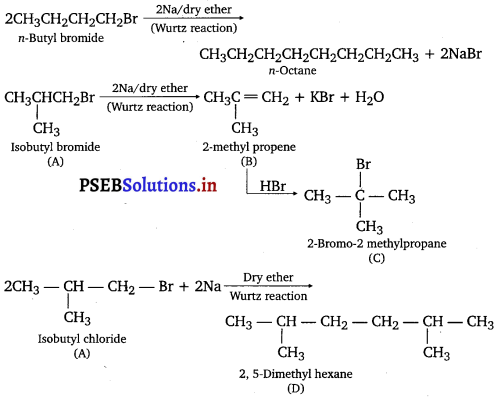
Primary alkyl halide C4H9Br (A) reacted with alcoholic KOH to give compound (B).Compound (B) is reacted with HBr to give (C) which is an isomer of (A). When (A) is reacted with sodium metal it gives compound (D), C8H18 which is different from the compound formed when n-butyl bromide is reacted with sodium. Give the structural formula of (A) and write the equations for all the reactions.
Answer:
There are two primary alkyl halides having the formula, C4H9Br. They are n-butyl bromide and isobutyl bromide.
PSEB 12th Class Chemistry Solutions Chapter 10 Haloalkanes and Haloarenes 42
Therefore, compound (A) is either n-butyl bromide or isobutyl bromide. Now, compound (A) reacts with Na metal to give compound (B) of molecular formula, C8H18 which is different from the compound formed when n-butyl bromide reacts with Na metal. Hence, compound (A) must be isobutyl bromide.
PSEB 12th Class Chemistry Solutions Chapter 10 Haloalkanes and Haloarenes 43

Question 22.
What happens when
(i) n-butyl chloride is treated with alcoholic KOH,
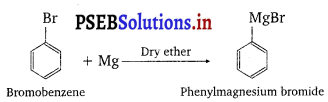
(ii) bromobenzene is treated with Mg in the presence of dry ether,
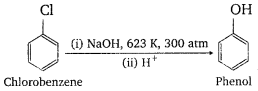
(iii) chlorobenzene is subjected to hydrolysis,
(iv) ethyl chloride is treated with aqueous KOH,
(v) methyl bromide is treated with sodium in the presence of dry ether
(vi) methyl chloride is treated with KCN.
Answer:
(i) When n-butyl chloride is treated with alcoholic KOH, the formation of but-l-ene takes place. This reaction is a dehydrohalogenation reaction.
PSEB 12th Class Chemistry Solutions Chapter 10 Haloalkanes and Haloarenes 44

(ii) When bromobenzene is treated with Mg in the presence of dry ether, phenylmagnesium bromide is formed.
PSEB 12th Class Chemistry Solutions Chapter 10 Haloalkanes and Haloarenes 45

(iii) Chlorobenzene does not undergo hydrolysis under normal conditions. However, it undergoes hydrolysis when heated in an aqueous sodium hydroxide solution at a temperature of 623 K and a pressure of 300 atm to form phenol.
PSEB 12th Class Chemistry Solutions Chapter 10 Haloalkanes and Haloarenes 59

PSEB 12th Class Chemistry Solutions Chapter 10 Haloalkanes and Haloarenes 46

(iv) When ethyl chloride is treated with aqueous KOH, it undergoes hydrolysis to form ethanol.
PSEB 12th Class Chemistry Solutions Chapter 10 Haloalkanes and Haloarenes 47

(v) When methyl bromide is treated with sodium in the presence of dry ether, ethane is formed. This reaction is known as the Wurtz reaction.
PSEB 12th Class Chemistry Solutions Chapter 10 Haloalkanes and Haloarenes 48

(vi) When methyl chloride is treated with KCN, it undergoes a substitution reaction to give methyl cyanide.
PSEB 12th Class Chemistry Solutions Chapter 10 Haloalkanes and Haloarenes 49

PSEB 12th Class Chemistry Solutions Chapter 10 Haloalkanes and Haloarenes

Chemistry Guide for Class 12 PSEB Haloalkanes and Haloarenes Textbook Questions and Answers

Question 1.
Write structures of the following compounds :
(i) 2-Chloro-3-methylpentane
(ii) 1-Chloro-4-ethylcyclohexane
(iii) 4-tert-butyl-3-iodoheptane
(iv) 1-4-Dibromobut-2-ene
(v) 1-Bromo-4-sec-butyl-2-methylbenzene
Answer:
PSEB 12th Class Chemistry Solutions Chapter 10 Haloalkanes and Haloarenes 50

Question 2.
Why is sulphuric acid not used during the reaction of alcohols with KI?
Answer:
H2SO4 cannot be used along with KI in the conversion of an alcohol to an alkyl iodide as it converts KI to corresponding HI and then oxidises it to I2.

Question 3.
Write structures of different dihalogen derivatives of propane.
Answer:
(i) ClCH2CH2CH2Cl
(ii) ClCH2CHClCH3
(iii) Cl2CHCH2CH3
(iv) CH3CCl2CH3

PSEB 12th Class Chemistry Solutions Chapter 10 Haloalkanes and Haloarenes

Question 4.
Among the isomeric alkanes of molecular formula C5H12 identify the one that on photochemical chlorination yields :
(i) A single monochloride
(ii) Three isomeric monochlorides
(iii) Four isomeric monochlorides
Answer:
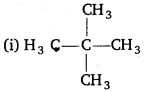
PSEB 12th Class Chemistry Solutions Chapter 10 Haloalkanes and Haloarenes 51
All the hydrogen atoms are equivalent and replacement of any hydrogen will give the same product.

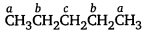
(ii) PSEB 12th Class Chemistry Solutions Chapter 10 Haloalkanes and Haloarenes 52
The equivalent hydrogens are grouped as a, b and c. The replacement of equivalent hydrogens will give the same product. Thus, three isomeric products are possible.

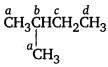
(iii) PSEB 12th Class Chemistry Solutions Chapter 10 Haloalkanes and Haloarenes 53
The equivalent hydrogens are grouped as a, b, c and d. Thus, four isomeric products are possible.

Question 5.
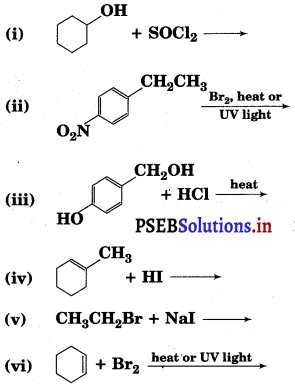
Draw the structures of major monohalo products in each of the following reactions:
PSEB 12th Class Chemistry Solutions Chapter 10 Haloalkanes and Haloarenes 54
Answer:
PSEB 12th Class Chemistry Solutions Chapter 10 Haloalkanes and Haloarenes 55

Question 6.
Arrange each set of compounds in the order of increasing boiling points.
(i) Bromomethane, Bromoform, Chloromethane, Dibromomethane.
(ii) 1-Chloropropane, Isopropyl chloride, 1 -Chlorobutane.
Answer:
(i) Chloromethane < Bromomethane < Dibromomethane < Bromoform. Boiling point increases with increase in molecular mass.

(ii) Isopropyl chloride < 1-Chloropropane < 1-Chlorobutane. Isopropyl chloride being branched has lower boiling point than 1-Chloropropane.

PSEB 12th Class Chemistry Solutions Chapter 10 Haloalkanes and Haloarenes

Question 7.
Which alkyl halide from the following pairs would you expect to react more rapidly by an SN2 mechanism ? Explain your answer.
PSEB 12th Class Chemistry Solutions Chapter 10 Haloalkanes and Haloarenes 56
Answer:
(i) CH3CH2CH2CH2Br
Being primary halide, there won’t be any steric hindrance.

(ii) PSEB 12th Class Chemistry Solutions Chapter 10 Haloalkanes and Haloarenes 57
Being a secondary halide, there will be less crowding around α-carbon than tertiary halide.

(iii) PSEB 12th Class Chemistry Solutions Chapter 10 Haloalkanes and Haloarenes 58
The presence of methyl group closer to the halide group will increase the steric hindrance and decrease the rate.

Question 8.
In the following pairs of halogen compounds, which compound undergoes faster SN1 reaction ?
PSEB 12th Class Chemistry Solutions Chapter 10 Haloalkanes and Haloarenes 59
Answer:
(i) PSEB 12th Class Chemistry Solutions Chapter 10 Haloalkanes and Haloarenes 60
2-Chloro-2-methylpropane as the tertiary carbocation is more stable than secondary carbocation.

(ii) PSEB 12th Class Chemistry Solutions Chapter 10 Haloalkanes and Haloarenes 61
2-Chloroheptane as the secondary carbocation is more stable than primary carbocation.

PSEB 12th Class Chemistry Solutions Chapter 10 Haloalkanes and Haloarenes

Question 9.
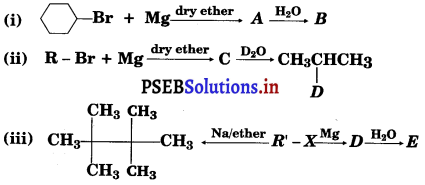
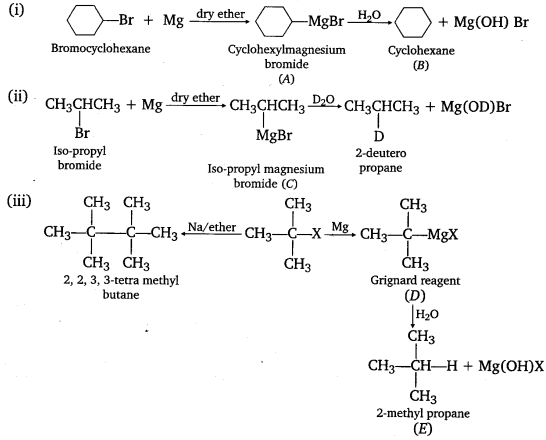
Identify A, B, C, D, E, R and R’ in the following:
PSEB 12th Class Chemistry Solutions Chapter 10 Haloalkanes and Haloarenes 62
Answer:
PSEB 12th Class Chemistry Solutions Chapter 10 Haloalkanes and Haloarenes 63

PSEB 12th Class Chemistry Solutions Chapter 8 The d-and f-Block Elements

Punjab State Board PSEB 12th Class Chemistry Book Solutions Chapter 8 The d-and f-Block Elements Textbook Exercise Questions and Answers.

PSEB Solutions for Class 12 Chemistry Chapter 8 The d-and f-Block Elements

PSEB 12th Class Chemistry Guide The d-and f-Block Elements InText Questions and Answers

Question 1.
Write down the electronic configuration of:
(i) Cr3+
(ii) Cu+
(iii) Co2+
(iv) Mn2+
(v) Pm3+
(vi) Ce4+
(vii) Lu2+
(viii) Th4+
Answer:
(i)Cr3+ = [Ar] 3d3
(ii) Cu+ = [Ar] 3d10
(iii) Co2+ = [Ar] 3d7
(iv) Mn2+ = [Ar] 3d5
(v) Pm3+ = [Xe] 4f4
(vi) Ce4+ = [Xe]
(vii) Lu2+ = [Xe] 4f145d1
(viii) Th4+ = [Rn]

Question 2.
Why are Mn2+ compounds more stable than Fe2+ towards oxidation to their + 3 state?
Answer:
Electronic configuration of Mn2+ is [Ar]18 3d5
Electronic configuration of Fe2+ is [Ar]18 3d6
It is known that half-filled and fully-filled orbitals are more stable. Therefore, Mn in (+ 2) state has a stable d5 configuration. This is the reason Mn2+ shows resistance to oxidation to Mn3+. Also, Fe2+ has 3d6 configuration and by losing one electron, its configuration changes to a more stable 3d5 configuration. Therefore, Fe2+ easily gets oxidised to Fe3+ oxidation state.

Question 3.
Explain briefly how +2 state becomes more and more stable in the first half of the first row transition elements with increasing atomic number?
Answer:
As the atomic number increases from 21 to 25, the number of electrons in the 3d-orbital also increases from 1 to 5. +2 oxidation state is attained by the loss of the two 4s electrons by these metals. Sc does not exhibit +2 oxidation state. As the number of d-electrons in +2 state increases from Ti to Mn, the stability of +2 state increases (d-orbital gradually becoming half filled). Mn(+2) has d5 electrons which is highly stable.

PSEB 12th Class Chemistry Solutions Chapter 8 The d-and f-Block Elements

Question 4.
To what extent do the electronic configurations decide the stability of oxidation states in the first series of the transition elements? Illustrate your answer with examples.
Answer:
The stability of oxidation states in the first series of the first transition elements are related to their electronic configurations.

The first five elements of the first transition series upto Mn in which the 3d-subshell is not more than half-filled, the minimum oxidation state is given by fife number of electrons in the outer s-subshell and the maximum oxidation state is given by the sum of the outer s and d-electrons. For example, Sc does not show +2 oxidation state. Its electronic configuration is 4s2 3d1. It loses all the three electrons to form SC3+.+3 oxidation state is very stable as by losing all three electrons, it attains the stable configuration of Argon. For Mn, +2 oxidation state is very stable, as after losing two 4s electrons, the d-orbitals become half-filled.

Question 5.
What may be the stable oxidation state of the transition elements with the following d-electron configurations in the ground state of their atoms?
3d3, 3d5, 3d8 and 3d4
Answer:
Stable oxidation states:
3d3 (vanadium): +2, +3, +4, +5
3d5 (chromium): +3, +4, +6
3d5 (manganese): +2, +4, +6, +7
3d8 (cobalt) : +2, +3 (in complexes)
3d4 : There is no d4 configuration in the ground state.

Question 6.
Name the oxometal anions of the first series of the transition metals in which the metal exhibits the oxidation state equal to its group number.
Answer:
(i) Vanadate, \(\mathrm{VO}_{3}^{-}\)
Oxidation state of V is + 5.

(ii) Chromate, \(\mathrm{CrO}_{4}^{2-}\)
Oxidation state of Cr is + 6.

(iii) Permanganate, \(\mathrm{MnO}_{4}^{-}\)
Oxidation state of Mn is + 7.

PSEB 12th Class Chemistry Solutions Chapter 8 The d-and f-Block Elements

Question 7.
What is lanthanoid contraction? What are the consequences of lanthanoid contraction?
Answer:
As we move along the lanthanoid series, the atomic number increases gradually by one. This means that the number of electrons and protons present in an atom also increases by one. As electrons are being added to the same shell, the effective nuclear charge increases. This happens because the increase in nuclear attraction due to the addition of proton is more pronounced than the increase in the interelectronic repulsions due to the addition of electron. Also, with the increase in atomic number, the number of electrons in the 4f orbital also increases. The 4f electrons have poor shielding effect. Therefore, the effective nuclear charge experienced by the outer electrons increases. Consequently, the attraction of the nucleus for the outermost electrons increases. This results in a steady decrease in the size of lanthanoids with the increase in the atomic number. This is termed as lanthanoid contraction.
Consequences of lanthanoid contraction

  1. There is similarity in the properties of second and third transition series.
  2. Separation of lanthanoids is possible due to lanthanoid contraction.
  3. It is due to lanthanoid contraction that there is variation in the basic strength of lanthanoid hydroxides. (Basic strength decreases from La(OH)3 to Lu(OH)3.)

Question 8.
What are the characteristics of the transition elements and why are they called transition elements? Which of the d-block elements may not he regarded as the transition eledaents?
Answer:
Characteristics of the Transition Elements (d-Block)
1. Electronic configuration : General electronic configuration of these elements is (n -1) d1-10 ns1-2.

2. Physical properties : These elements have metallic properties such as metallic lustre, high tensile strength, ductility, malleability, high thermal and electrical conductivity, low volatility (except Zn, Cd, Hg), hardness, etc. Their melting points are high.

3. Atomic and ionic size : In a given series, there is a progressive decrease in radius with increasing atomic number.

4. Ionisation enthalpies : Due to an increase in nuclear charge which accompanies the filling of inner d-orbitals, there is an increase in ionisation enthalpy along each series of the transition elements from left to right.

5. Oxidation states : These elements exhibit variable oxidation states.
e.g.,1 Transition series:
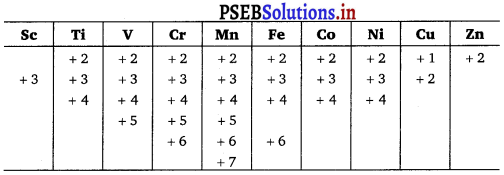
PSEB 12th Class Chemistry Solutions Chapter 8 The d-and f-Block Elements 1

6. Trends in M2+/M values: The general trend towards less negative E0 values across the series is related to the general increase in the sum of the first and second ionisation enthalpies.

7. Trends in M3+/M2+E values : Low value of Ee shows the stability of ion (either d5 or d10 configuration).

8. Magnetic properties : These elements show diamagnetism and paramagnetism.
9. Formation of coloured salts : The compounds of transition elements form coloured ions, e.g., Mn3+ violet; Fe2+ green, etc.

10. Complex formation : These elements form complex compounds due to their small size and high charge density, e.g., [PtCl4]2-

11. Catalyst: Many of these elements are used as catalyst e.g., V2O5 is used as a catalyst in contact process for the manufacture of H2SO4.

12. Interstitial compound formation : Transition elements form interstitial compounds. It means the compounds in which H, C or N etc. are trapped inside the crystal lattices of metals.

13. Alloy formation : Because of similar radii and other characteristics alloys are readily formed by these metals.
The d-block elements are called transition elements because these elements represent change or transition in properties from s-block to p-block elements.
The electronic configuration of Zn, Cd and Hg is represented by the general formula (n – 1)d10ns2. These elements have completely filled d-orbitals in ground state as well as in their common oxidation states. Therefore, they may not be regarded as the transition elements.

Question 9.
In what way is the electronic configuration of the transition elements different from that of the non-transition elements?
Answer:
Transition elements contain incompletely filled d-subshell, Le., their electronic configuration is (n – 1)d1-10ns1-2 whereas non-transition elements have no d-subshell or their subshell is completely filled and have ns1-2 or ns2np1-6 in their outermost shell.

PSEB 12th Class Chemistry Solutions Chapter 8 The d-and f-Block Elements

Question 10.
What are the different oxidation states exhibited by the lanthanoids?
Answer:
In the lanthanoid series, + 3 oxidation state is most common i.e., Ln(III) compounds are predominant. However, + 2 and + 4 oxidation states can also be found in the solution or in solid compounds.

Question 11.
Explain giving reasons:
(i) Transition metals and many of their compounds show paramagnetic behaviour.
(ii) The enthalpies of atomisation of the transition metals are high.
(iii) The transition metals generally form coloured compounds.
(iv) Transition metals and their many compounds act as good catalyst.
Answer:
(i) Transition metals and many of their compounds show paramagnetic behaviour. Paramagnetism arises due to the presence of unpaired electrons with each electron having a magnetic moment associated with its spin angular momentum and orbital angular momentum. However, in the first transition series, the orbital angular momentum is quenched. Therefore, the resulting paramagnetism is only because of the unpaired electron.

(ii) Transition metals have high effective nuclear charge and a large number of valence electrons. Therefore, they form very strong metallic bonds. As a result, the enthalpy of atomisation of transition metals is high.

(iii) Formation of coloured compounds by transition metals is due to partial adsorption of visible light. The electron absorbs the radiation of a particular frequency (of visible region) and jumps into next orbital.

(iv) Catalysts, at the solid surface, involve the formation of bonds between reactants molecules and atoms of the surface of the catalyst (I row transition metals utilised 3d and 4s-electrons for bonding). This has the effect of increasing the concentration of the reactants at the catalyst surface and also lowering of the activation energy.
Transition metal ions show variable oxidation states so they are effective catalysts, e.g.

PSEB 12th Class Chemistry Solutions Chapter 8 The d-and f-Block Elements 2
Mechanism of catalysing action of Fe3+ in the above reaction
(a) 2Fe3+ + 2I → 2Fe2+ + I2
(b) 2Fe2+ + \(\mathrm{S}_{2} \mathrm{O}_{8}^{2-}\) → 2Fe3+ + \(2 \mathrm{SO}_{4}^{2-}\)

Question 12.
What are interstitial compounds? Why are such compounds well known for transition metals?
Answer:
Interstitial compounds are those in which small atoms occupy the interstitial sites in the crystal lattice. Interstitial compounds are well known for transition metals because small-sized atoms of H, B, C, N, etc., can easily occupy position in the voids present in the crystal lattices of transition metals.

PSEB 12th Class Chemistry Solutions Chapter 8 The d-and f-Block Elements

Question 13.
How is the variability in oxidation states of transition metals different from that of the non-transition metals? Illustrate with examples.
Answer:
The oxidation states of transition elements differ from each other by unity e.g., Fe2+ and Fe3+, Cu+ and Cu2+ (due to incomplete filling of d-orbitals) whereas oxidation states of non-transition elements normally differ by two units e.g., Pb2+ and Pb4+, Sn2+ and Sn4+ etc.

Question 14.
Describe the preparation of potassium dichromate from iron chromite ore. What is the effect of increasing pH of a solution of potassium dichromate?
Answer:
Potassium dichromate is prepared from chromite ore FeCr2O4 as follows :
Step I: Conversion of chromite ore to sodium chromate.
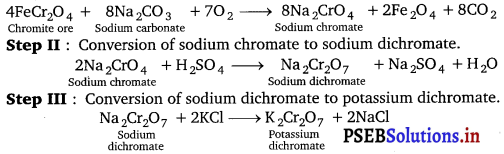
PSEB 12th Class Chemistry Solutions Chapter 8 The d-and f-Block Elements 3
Effect of pH : The chromates and dichromates can interconverted to each other in aqueous solution by increasing the pH of the solution.
\(\mathrm{CrO}_{4}^{2-}\) + 2OH ⇌ \(2 \mathrm{CrO}_{4}^{2-}\) + H2O

Question 15.
Describe the oxidising action of potassium dichromate and write the ionic equations for its reaction with
(i) iodide
(ii) iron (H) solution and
(iii) H2S.
Answer:
(i) \(\mathrm{Cr}_{2} \mathrm{O}_{7}^{2-}\) + 14H+ + 6I → 2Cr3+ + 7H2O + 3I2
(ii) \(\mathrm{Cr}_{2} \mathrm{O}_{7}^{2-}\) + 14H+ + 6Fe2+ → 2Cr3+ + 7H2O + 6Fe3+
(iii) \(\mathrm{Cr}_{2} \mathrm{O}_{7}^{2-}\) + 8H+ + 3H2S → Cr3+ + 7H2O + 3S

PSEB 12th Class Chemistry Solutions Chapter 8 The d-and f-Block Elements

Question 16.
Describe the preparation of potassium permanganate. How does the acidified permanganate solution reacts with
(i) iron
(ii) ions
(iii) SO2 and
(iii) oxalic acid? Write the ionic equations for the reactions.
Answer:
Preparation of potassium permanganate, KMnO4: Potassium permanganate is prepared by the fusion of MnO2 (pyrolusite) with potassium hydroxide and an oxidising agent such as KNO3 to form potassium manganate which disproportionate in a neutral or acidic solution to form permanganate.
2MnO2 + 4KOH + O2 → 2K2MnO4 + H2O
\(3 \mathrm{MnO}_{4}^{2-}\) + 4H+ → \(\mathrm{MnO}_{4}^{-}\) + MnO2 + H2O
On large scale : It is prepared by the alkaline oxidative fusion of MnO2 to form potassium manganate. The electrolytic oxidation of potassium manganate in alkaline solution produces KMnO4, at the anode.
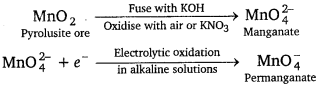
PSEB 12th Class Chemistry Solutions Chapter 8 The d-and f-Block Elements 4
Reaction of KMnO4 in acidic medium
(a) Oxidises iron (II) ions to iron (III) ions.
\(\mathrm{MnO}_{4}^{-}\) + 5Fe2+ + 8H2+ → Mn2+ + 5Fe3+ + 4H2O
(b) Oxidises SO2 to sulphuric acid.
\(2 \mathrm{MnO}_{4}^{-}\) + 5SO2 + 2H2O → 2Mn2+ + 5SO2 + 4H2O
(c) Oxidises oxalic acid to carbon dioxide.
\(2 \mathrm{MnO}_{4}^{-}\) + \(5 \mathrm{C}_{2} \mathrm{O}_{4}^{2-}\) + 16H+ → 2Mn2+ + 10CO2 + 8H2O

Question 17.
For M2+/M and M3+/M2+ systems, the E values for some metals are as follows:
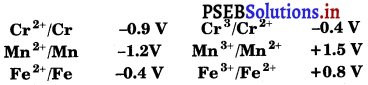
PSEB 12th Class Chemistry Solutions Chapter 8 The d-and f-Block Elements 5
Use this data to comment upon :
(i) the stability of Fe3+ in acid solution as compared to that of Cr3+ or Mn3+ and
(ii) the ease with which iron can be oxidised as compared to a similar process for either chromium or manganese metal.
Answer:
(i) Higher the reduction potential of a species, greater is the tendency for its reduction to take place. Therefore, Mn3+ with highest reduction potential would be readily reduced to Mn2+ and hence is the least stable.
Thus, from the value of reduction potential, it is clear that the stability of Fe3+ in acidic solution is more than Mn3+ but less than that of Cr3+.

(ii) Lower the reduction potential or higher the oxidation potential of a species, greater the ease with which its oxidation will take place. Thus, order of tendency to undergo oxidation is Fe < Cr < Mn.

Question 18.
Predict which of the following will be coloured in aqueous solution?
Ti3+, V3+, Cu+, Sc3+, Mn2+, Fe3+ and Co2+. Give reasons for each.
Answer:
Only those ions will be coloured which have incompletely filled d-orbitals. Those with fully-filled or empty d-orbitals are colourless. Due to d-d transition, Ti3+, V3+, Mn2+, Fe3+ and Co2+ are coloured.

PSEB 12th Class Chemistry Solutions Chapter 8 The d-and f-Block Elements

Question 19.
Compare the stability of + 2 oxidation state for the elements of the first transition series.
Answer:
The decreasing negative electrode potentials of M2+/M+1 in the first transition series shows that in general, the stability of +2 oxidation state decrease from left-to right (exception being Mn and Zn). The decrease in the negative electrode potentials is due to increase in the sum IE2 + IE2.

Question 20.
Compare the chemistry of actinoids with that of the lanthanoids with special reference to :
(i) electronic configuration
(ii) oxidation states
(iii) atomic and ionic sizes and
(iv) chemical reactivity.
Answer:
(i) Electronic configuration : The general electronic configuration of lanthanoids is [Xe]54 4f1-14 5d0-16s2 whereas that of actinoids is [Rn]865f1-146d0-17s2. Thus, lanthanoids belong to 4/-series whereas actinoids belong to 5/-series.

(ii) Oxidation states : Lanthanoids show limited oxidation states (+2, +3, +4), out of which, +3 is most common. This is because of a large energy gap between 4/, 5d and 6s subshells. On the other hand, actinoids show a large number of oxidation states because of small energy gap between 5/, 6d and 7s subshells.

(iii) Atomic and ionic sizes : Both show decrease in size of their atoms or ions in +3 oxidation state. In lanthanoids, the decrease is called lanthanoid contraction whereas in actinoids, it is called actinoid contraction. However, the contraction is greater from element to element in actinoids due to poorer shielding by 5/-electrons.

(iv) Chemical reactivity : In general, the earlier members of the lanthanoid series are quite reactive (similar to calcium) but with increasing atomic number, they behave more like aluminium.
Values for E for the half-reaction :
Ln3+ (aq) + 3e → Ln(s)
are in the range of -2.2 to -2.4 V except for Eu for which the value is -2.0 V. This is of course, a small variation.

The metals combine with hydrogen when gently heated in the gas. The carbides, Ln3C , Ln2C3 and LnC2 are formed when the metals are heated with carbon. They liberate hydrogen from dilute acids and bum in halogens to form halides. They form oxides and hydroxides —M2O3 and M(OH)3. The hydroxides are definite compounds, not just hydrated oxides, basic like alkaline earth metal oxides and hydroxides.
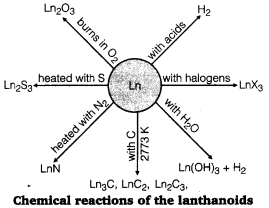
PSEB 12th Class Chemistry Solutions Chapter 8 The d-and f-Block Elements 6
The actinoids are highly reactive metals, especially when finely divided. For example, the action of boiling water on them, gives a mixture of oxide and hydride and combination with most non-metals takes place at moderate temperatures. Hydrochloric acid attacks all metals but most are slightly affected by nitric acid owing to the formation of protective oxide layers; alkalis have no action.

PSEB 12th Class Chemistry Solutions Chapter 8 The d-and f-Block Elements

Question 21.
How would you account for the following:
(i) Of the d4 species, Cr2+ is strongly reducing while manganese (III) is strongly oxidising.
(ii) Cobalt (II) is stable in aqueous solution but in the presence of complexing reagents, it is easily oxidised.
(iii) The d1 configuration is very unstable in ions.
Answer:
(i) E value for Cr3+ /Cr2+ is negative (-0.41 V) whereas E value for Mn3+/Mn2+ is positive (+1.57 V). Thus, Cr2+ ions can easily undergo oxidation to give Cr3+ ions and, therefore, act as strong reducing agent. On the other hand, Mn3+ can easily undergo reduction to give Mn2+ and hence act as oxidising agent.

(ii) Co(III) has greater tendency to form coordination complexes than Co (II). Thus, in the presence of ligands, Co (II) charges to Co (III), i.e., it easily oxidised.

(iii) The ions with d1 configuration have the tendency to lose the only electron present in d-subshell to acquire stable d0 configuration. Therefore, they are unstable and undergo oxidation or disproportionation.

Question 22.
What is meant by ‘disproportionation’? Give two examples of disproportionation reaction in aqueous solution.
Answer:
Disproportionation reactions are those reactions in which the same substance undergoes oxidation as well as reduction. In disproportion reaction, oxidation number of an element increases as well as decreases to form two different products, e.g.,
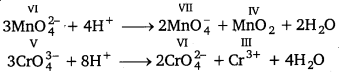
PSEB 12th Class Chemistry Solutions Chapter 8 The d-and f-Block Elements 7

Question 23.
Which metal in the first series of transition metals exhibits +1 oxidation state most frequently and why?
Answer:
Copper has electronic configuration 3d10 4s1 will attain a completely filled d-orbital and a stable configuration on losing 4s1 electron i.e., [Ar] 3d10.

PSEB 12th Class Chemistry Solutions Chapter 8 The d-and f-Block Elements

Question 24.
Calculate the number of unpaired electrons in the following gaseous ions: Mn3+, Cr3+, V3+ and Ti3+. Which one of these is the most stable in aqueous solution?
Answer:
Mn3+ = 3d4 = 4 unpaired electrons
Cr3+ = 3d3 = 3 unpaired electrons
V3+ = 3d2 = 2 unpaired electrons
Ti3+ = 3d1 =1 unpaired electron
Out of these species Cr3+ is the most stable in aqueous solution due to its tendency of complex formation.

Question 25.
Give examples and suggest reasons for the following features of the transition metal chemistry :
(i) The lowest oxide of transition metal is basic, the highest is amphoteric/acidic.
(ii) A transition metal exhibits higher oxidation state in oxides and fluorides.
(iii) The highest oxidation state is exhibited in oxo-anions of a metal.
Answer:
(i) The lowest oxide of transition metal is basic because the metal atom has low oxidation state. This means that it can donate valence electrons which are not involved in bonding to act like a base. Whereas the highest oxide is amphoteric/acidic due to the highest oxidation state as the valence electrons are involved in bonding and are unavailable. For example, MnO is basic whereas Mn2O7 is acidic.

(ii) A transition metal exhibits higher oxidation states in oxides and fluorides because oxygen and fluorine are highly electronegative elements, small in size (and strongest oxidising agents). For example, osmium shows an oxidation state of +6 in O2F6 and vanadium shows an oxidation state of +5 in V2O5.

(iii) Oxometal anions have the highest oxidation state, e.g., Cr in \(\mathrm{Cr}_{2} \mathrm{O}_{7}^{2-}\) has an oxidation state of +6 whereas Mn in \(\mathrm{MnO}_{4}^{-}\) has an oxidation state of +7. This is again due to the combination of the metal with oxygen, which is highly electronegative and oxidising element.

Question 26.
Indicate the steps in the preparation of:
(i) K2Cr2O7 from chromite ore.
(ii) KMnO4 from pyrolusite ore.
Answer:
(i) Potassium dichromate is prepared from chromite ore FeCr2O4 as follows :
Step I: Conversion of chromite ore to sodium chromate.
PSEB 12th Class Chemistry Solutions Chapter 8 The d-and f-Block Elements 3
Effect of pH : The chromates and dichromates can interconverted to each other in aqueous solution by increasing the pH of the solution.
\(\mathrm{CrO}_{4}^{2-}\) + 2OH ⇌ \(2 \mathrm{CrO}_{4}^{2-}\) + H2O
(ii) Preparation of potassium permanganate, KMnO4: Potassium permanganate is prepared by the fusion of MnO2 (pyrolusite) with potassium hydroxide and an oxidising agent such as KNO3 to form potassium manganate which disproportionate in a neutral or acidic solution to form permanganate.
2MnO2 + 4KOH + O2 → 2K2MnO4 + H2O
\(3 \mathrm{MnO}_{4}^{2-}\) + 4H+ → \(\mathrm{MnO}_{4}^{-}\) + MnO2 + H2O
On large scale : It is prepared by the alkaline oxidative fusion of MnO2 to form potassium manganate. The electrolytic oxidation of potassium manganate in alkaline solution produces KMnO4, at the anode.
PSEB 12th Class Chemistry Solutions Chapter 8 The d-and f-Block Elements 4
Reaction of KMnO4 in acidic medium
(a) Oxidises iron (II) ions to iron (III) ions.
\(\mathrm{MnO}_{4}^{-}\) + 5Fe2+ + 8H2+ → Mn2+ + 5Fe3+ + 4H2O
(b) Oxidises SO2 to sulphuric acid.
\(2 \mathrm{MnO}_{4}^{-}\) + 5SO2 + 2H2O → 2Mn2+ + 5SO2 + 4H2O
(c) Oxidises oxalic acid to carbon dioxide.
\(2 \mathrm{MnO}_{4}^{-}\) + \(5 \mathrm{C}_{2} \mathrm{O}_{4}^{2-}\) + 16H+ → 2Mn2+ + 10CO2 + 8H2O

PSEB 12th Class Chemistry Solutions Chapter 8 The d-and f-Block Elements

Question 27.
What are alloys? Name an important alloy which contains some of the lanthanoid metals. Mention its uses.
Answer:
An alloy is a homogeneous mixture of two or more metals, or metals and non-metals. An important alloy containing lanthanoid metals is misch metal which contains 95% lanthanoid metals and 5% iron along with traces of S, C, Ca and Al. It is used in Mg-based alloy to produce bullets, shells and lighter flints.

Question 28.
What are inner-transition elements? Decide which of the following atomic numbers are the atomic numbers of the inner-transition elements:
29, 59, 74, 95, 102, 104.
Answer:
The f-block elements, i.e., in which the last electron enters into /-subshell are called inner-transition elements. These include lanthanoids (58-71) and actinoids (90-103). Thus, elements with atomic numbers 59, 95 and 102 are inner-transition elements.

Question 29.
The chemistry of the actinoid elements is not so smooth as that of the lanthanoids. Justify this statement by giving some examples from the oxidation state of these elements.
Answer:
Lanthanoids show a limited number of oxidation state, viz., +2, +3 and +4 (out of which +3 is the most common). This is because of a large energy gap between 4/, 5d and 6s subshells. The dominant oxidation state of actinoids is also +3 but they show a number of other oxidation states also, e.g., uranium(Z = 92) and plutonium (Z = 94), show +3, +4, +5 and +6, neptunium (Z = 94) shows +3, +4, +5 and +7, etc. This is due to small energy difference between 5/, 6 d and 7s subshells of the actinoids.

PSEB 12th Class Chemistry Solutions Chapter 8 The d-and f-Block Elements

Question 30.
Which is the last element in the series of the actinoids? Write the electronic configuration of this element. Comment on the possible oxidation state of this element.
Answer:
The last element in the actinoid series is lawrencium (Lr). Its atomic number is 103 and its electronic configuration is [Rn]5f14 6d1 7s2. The most common oxidation state displayed by it is + 3; because after losing 3 electrons it attains stable f14 configuration.

Question 31.
Use Hund’s rule to derive the electronic configuration of Ce3+ ion and calculate its magnetic moment on the basis of spin only formula.
Answer:
58Ce =[Xe]54f15d16s2
Ce3+ = [Xe]544f1, i.e., there is only one unpaired electron, i.e., n = 1. Hence, p = \(\sqrt{n(n+2)}\) = \(\sqrt{1(1+2)}\) = \(\sqrt{3}\) = 1.73 BM

Question 32.
Name the members of the lanthanoid series which exhibit +4 oxidation states and those which exhibit +2 oxidation states. Try to correlate this type of behaviour with the electronic configurations of these elements.
Answer:
+4 = 58Ce , 59Pr, 60Nd, 65Tb, 66Dy
+2 = 60Nd, 62Su 63Eu, 69Tm, 70Yb
+2 oxidation state is exhibited when the lanthanoid has the configuration 5d06s2, so that 2 electrons are easily lost. +4 oxidation state is exhibited when the configuration left is close to 4f0 (e.g., 4f0, 4f1, 4f2) or close to 4f7 (e.g., 4f7or 4f8)

PSEB 12th Class Chemistry Solutions Chapter 8 The d-and f-Block Elements

Question 33.
Compare the chemistry of the actinoids with that of lanthanoids with reference to:
(i) electronic configuration
(ii) oxidation states and
(iii) chemical reactivity.
Answer:

Characteristics Lanthanoids Actinoids
(i) Electronic configuration [Xe] 4/1-145d0-16s2 [Rn] 5/114 6d0_1 7s2
(ii) Oxidation states Besides +3 oxidation state lanthanoids show +2 and +4 oxidation state only in a few cases. Besides +3 oxidation state, actinoids show higher oxidation state of +4, +5, +6, +7 also because of smaller energy gap between 5/, 6d and 7s subshell.
(iv) General chemical reactivity elements These are less reactive metals.

Lesser tendency towards complex formation.

Do not form oxacation. Compounds are less basic.

These are highly reactive metals

Greater tendency towards complex formation.

Form oxocation.Compounds are more basic.

Question 34.
Write the electronic configurations of the elements with the atomic numbers 61, 91,101 and 109.
Answer:
Z = 61 (Promethium, Pm), electronic configuration [Xe] 4f55d06s2
Z = 91 (Protactium, Pa), electronic configuration = [Rn] 5f26d1s2
Z = 101 (Mendelevium, Md), electronic configuration = [Rn] 5f136d07s2
Z =109 (Meitnerium, Mt), electronic configuration = [Rn] 5f146d7 7s2

Question 35.
Compare the general characteristics of the first series of the transition metals with those of the second and third series metals in the respective vertical columns. Give special emphasis on the following points :
(i) Electronic configurations,
(ii) Oxidation states,
(iii) Ionisation enthalpies and
(iv) Atomic sizes
Answer:
(i) Electronic configurations : The elements in the same vertical column generally have similar electronic configurations. Although the first series shows only two exceptions, i.e., Cr = 3d54s1 and Cu = 3d104s1 but the second series shows more exceptions, e.g., Mo(42) = 4ds5s1,Tc(43) = 4d65s1,Ru(44) = 4d75s1 Rh(45) = 4d85s1, Pb(46) = 4d105s0, Ag(47) = 4d105s1. Similarly, in the third series, W(74) = 5d46s2, Pt(78) = 5d96s1 and Au(79) = 5d10 6d1. Hence, in the same vertical column, in a number of cases, the electronic configuration of the three series are not similar.

(ii) Oxidation states : The elements in the same vertical column generally show similar oxidation states. The number of oxidation states shown by the elements in the middle of each series is maximum and minimum at the extreme ends.

(iii) Ionisation enthalpies : The first ionisation enthalpies in each series generally increase gradually as we move from left to right though some exceptions are observed in each series. The first ionisation enthalpies of some elements in the second (4d) series are higher while some of them have lower value than the elements of 3d series in the same vertical column. However, the first ionisation enthalpies of third (5d) series are higher than those of 3d and 4d series. This is because of weak shielding of nucleus of 4/-electrons in the 5d-series.

(iv) Atomic sizes : Generally, ions of the same charge or atoms in a given series show progressively decrease in radius with increasing atomic number though the decrease is quite small. But the size of the atoms of the 4d-series is larger than the corresponding elements of the 3d-series whereas those of corresponding elements of the 5d-series are nearly the same as those of 4d-series due to lanthanoid contraction.

PSEB 12th Class Chemistry Solutions Chapter 8 The d-and f-Block Elements

Question 36.
Write down the number of 3d electrons in each of the following ions:
Ti2+, V2+, Cr3+, Mn2+, Fe2+, Fe3+, Co2+, Ni2+ and Cu2+. Indicate how would you expect the five 3d-orbitals to be occupied for these hydrated ions (octahedral).
Answer:
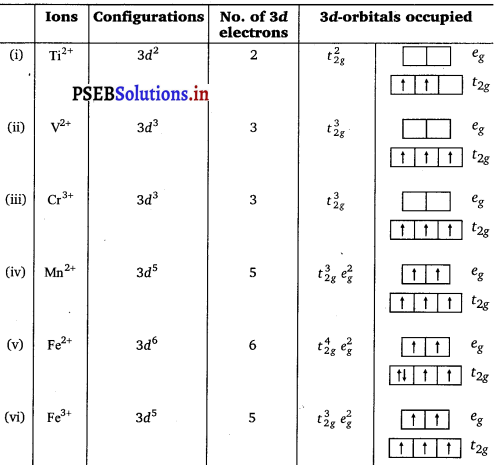
PSEB 12th Class Chemistry Solutions Chapter 8 The d-and f-Block Elements 8
PSEB 12th Class Chemistry Solutions Chapter 8 The d-and f-Block Elements 9

Question 37.
Comment on the statement that elements of the first transition series possess many properties different from those of heavier transition elements.
Answer:
The given statement is true. Some evidences in support of this statement are given below :

  1. Atomic radii of the heavier transition elements (4 d and 5d series) are larger than those of the corresponding elements of the first transition series though those of 4d and 5d series are very close to each other.
  2. Ionisation enthalpies of 5d series are higher than the corresponding elements of 3d and 4d series.
  3. Enthalpies of atomisation of 4d and 5d series are higher than the corresponding elements of first series.
  4. Melting and boiling points of heavier transition elements are greater than those of the first transition series due to stronger intermetallic bonding.

Question 38.
What can be inferred from the magnetic moment values of the following complex species?

Example Magnetic Moment (BM)
K4[Mn(CN)6] 2.2
[Fe(H2O)6]2+ 5.3
K2[Mncl4] 5.9

Answer:
Magnetic moment (μ) = \(\sqrt{n(n+2)}\) BM
For n = 1, μ = \(\sqrt{1(1+2)}\) = \(\sqrt{3}\) = 1.73;
For n = 2, μ = \(\sqrt{2(2+2)}\) = \(\sqrt{8}\) = 2.83;
For n = 3, μ = \(\sqrt{3(3+2)}\) = \(\sqrt{15}\) = 3.87;
For n = 4, μ = \(\sqrt{4(4+2)}\) = \(\sqrt{24}\) = 4.90;
For n = 5, μ = \(\sqrt{5(5+2)}\) = \(\sqrt{35}\) = 5.92
K4[Mn(CN)6]
Here, Mn is in +2 oxidation, state, i.e., as Mn2+. μ = 2.2 BM shows it has only one unpaired electron.
Hence, when CN ligands approach Mn2+ion, the electrons in 3d pair up
Hence, CN is a strong ligand. The hybridisation involved is d2sp3 forming inner orbital octahedral complex.
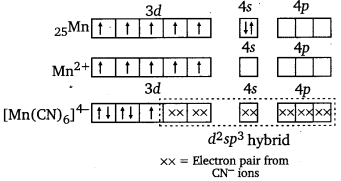
PSEB 12th Class Chemistry Solutions Chapter 8 The d-and f-Block Elements 10
[Fe(H2O)6]2+
Here, Fe is in +2 oxidation state, i.e., as Fe2+. μ = 5.3 BM shows that there are four unpaired electrons. This means that the electrons in 3d do not pair up when the ligand H2O molecules approach. Hence, H2O is a weak ligand. To accommodate the electrons donated by six H20 molecules, the hybridisation will be sp3d2.
Hence, it will be an outer orbital octahedral complex.
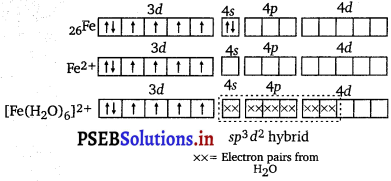
PSEB 12th Class Chemistry Solutions Chapter 8 The d-and f-Block Elements 11
K2[MnCl4]
Here, Mn is in +2 oxidation state, i.e., as Mn2+. μ = 5.9 BM shows that there are five unpaired electrons. Hence, the hybridisation involved will be sp3 and the complex will be tetrahedral.
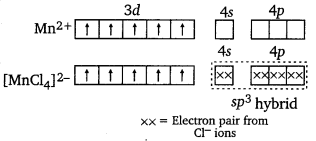
PSEB 12th Class Chemistry Solutions Chapter 8 The d-and f-Block Elements 12

PSEB 12th Class Chemistry Solutions Chapter 8 The d-and f-Block Elements

Chemistry Guide for Class 12 PSEB The d-and f-Block Elements Textbook Questions and Answers

Question 1.
Silver atom has completely filled d-orbitals (4d10) in its ground state. How can you say that it is a transition element?
Answer:
Silver (Z = 47) can show +2 oxidation state in which it has incompletely filled d-subshell (4d9 configuration). So, silver is a transition element.

Question 2.
In the series Sc (Z = 21) to Zn (Z = 30), the enthalpy of atomisation of zinc is the lowest i.e., 126 kJ mol-1. Why?
Answer:
In the first series of transition elements Sc to Zn, all elements have one or more unpaired electrons except zinc which has no unpaired electron as its outer electronic configuration is 3d104s2. Hence, interatomic metallic bonding (M-M bonding) is weaker in zinc. Therefore, enthalpy of atomisation is lowest.

Question 3.
Which of the 3d series of the transition metals exhibits the largest number of oxidation states and why?
Answer:
Mn (atomic number = 25) has electronic configuration[Ar] 3d5 4s2.
Mn has the maximum number of unpaffed electrons present in the d-subshell (5 electrons). Hence, Mn exhibits the largest number of oxidation states, i.e., + 2 to + 7 in its compounds.

PSEB 12th Class Chemistry Solutions Chapter 8 The d-and f-Block Elements

Question 4.
The E(M2+/M) value for copper is positive (+0.34 V). What is possible reason for this? (Hint: Consider its high △aH and low △hydH)
Answer:
E (M2+/M) for any metal is related to the sum of the enthalpy change taking place in the following steps:
M(s) + △aH → M(g), (△aH = Enthalpy of atomisation)
M(g) + △iH → M2+(g) (△iH = Ionisation enthalpy)
M2+(g) + aq → M2+(aq) + △hydH
(△hydH = Hydration enthalpy)
Copper has high enthalpy of ionisation and relatively low enthalpy of hydration. So, E(Cu2+/Cu) is positive. The high energy to transform Cu(s) to Cu2+(aq) is not balanced by its hydration enthalpy.

Question 5.
How would you account for the irregular variation of ionisation enthalpies (first and second) in the first series of the transition elements?
Answer:
Irregular variation of ionisation enthalpies is mainly attributed to varying degree of stability of different 3d configuration (e.g., d0, d5, d10 are exceptionally stable).

Question 6.
Why is the highest oxidation state of a metal exhibited in its oxide or fluoride only?
Answer:
Oxygen and fluorine have small size and high electronegativity. Hence, they can oxidise the metal to the highest oxidation state.

PSEB 12th Class Chemistry Solutions Chapter 8 The d-and f-Block Elements

Question 7.
Which is a stronger reducing agent Cr2+ or Fe2+ and why?
Answer:
The following reactions are involved when Cr2+ and Fe2+ act as reducing agents.

PSEB 12th Class Chemistry Solutions Chapter 8 The d-and f-Block Elements 13
The PSEB 12th Class Chemistry Solutions Chapter 8 The d-and f-Block Elements 14 value is -0.41 V and PSEB 12th Class Chemistry Solutions Chapter 8 The d-and f-Block Elements 15 value is +0.77 V. This means that Cr2+ can be easily oxidised to Cr3+, but Fe2+ does not get oxidised to Fe3+ easily. Therefore, Cr2+ is a better reducing agent that Fe2+.

Question 8.
Calculate the spin only magnetic moment of M2+ (aq) ion (Z = 27).
Answer:
Electronic configuration of M atom with Z = 27 is [Ar] 3d7 4s2.
∴ Electronic configuration of M2+ = [Ar]3d7, i.e.,

PSEB 12th Class Chemistry Solutions Chapter 8 The d-and f-Block Elements 16
Hence, it has three unpaired electrons.
∴ Spin only magnetic moment (μ) = \(\sqrt{n(n+2)}\)
= \(\sqrt{3(3+2)}\)
= \(\sqrt{15}\)
= 3.87 BM

Question 9.
Explain why Cu+ ion is not stable in aqueous solutions.
Answer:
In aqueous solutions Cu+ undergoes disproportionation to form a more stable Cu2+ ion.
2Cu+(aq) > Cu2+(aq) + Cu(s)
The higher stability of Cu2+ in aqueous solutions may be attributed to its greater negative △hyd.H0 than that of Cu+. It compensates the second ionisation enthalpy of Cu+ involved in the formation of Cu2+ ions.

PSEB 12th Class Chemistry Solutions Chapter 8 The d-and f-Block Elements

Question 10.
Actinoid contraction is greater from element to element than lanthanoid contraction. Why?
Answer:
In actinoids, 5f orbitals are filled. These 5f orbitals have a poorer shielding effect than 4f orbitals (in lanthanoids). Thus, the effective nuclear charge experienced by electrons in valence shells in case of actinoids is much more than that experienced by lanthanoids. Hence, the size contraction in actinoids is greater as compared to that in lanthanoids.

PSEB 12th Class Chemistry Important Questions Chapter 4 Chemical Kinetics

Punjab State Board PSEB 12th Class Chemistry Important Questions Chapter 4 Chemical Kinetics Important Questions and Answers.

PSEB 12th Class Chemistry Important Questions Chapter 4 Chemical Kinetics

Very Short Answer Type Questions

Question 1.
For which type of reactions, order and molecularity have the same value?
Answer:
If the reaction is an elementary reaction, order is same as molecularity.

Question 2.
Why is the probability of reaction with molecularity higher than three very rare?
Answer:
The probability of more than three molecules colliding simultaneously is very small. Hence, possibility of molecularity being three is very low.

Question 3.
State a condition under which a bimolecular reaction is kinetically first order.
Answer:
A bimolecular reaction may become kinetically of first order if one of the reactants is in excess.

PSEB 12th Class Chemistry Important Questions Chapter 4 Chemical Kinetics

Question 4.
Thermodynamic feasibility of the reaction alone cannot decide the rate of the reaction. Explain with the help of one example.
Answer:
Thermodynamically the conversion of diamond to graphite is highly feasible but this reaction is very slow because its activation energy is high.

Question 5.
Why is it that instantaneous rate of reaction does not change when a part of the reacting solution is taken out?
Answer:
Instantaneous rate is measured over a very small interval of time, hence, it does not change when a part of solution is taken out.

Question 6.
A reaction is 50% complete in 2 hours and 75% complete in 4 hours. What is the order of the reaction?
Solution:
As t75% = 2t50%
Therefore, it is a first order reaction.

PSEB 12th Class Chemistry Important Questions Chapter 4 Chemical Kinetics

Question 7.
Define threshold energy of a reaction.
Answer:
Threshold energy is the minimum energy which must be possessed by reacting molecules in order to undergo effective collision which leads to formation of product molecules.

Question 8.
Why does the rate of a reaction increase with rise in temperature?
Answer:
At higher temperatures, larger fraction of colliding particles can cross the energy barrier (i.e., the activation energy), which leads to faster rate.

Question 9.
What is the difference between rate law and law of mass action?
Answer:
Rate law is an experimental law. On the other hand, law of mass action is a theoretical law based on the balanced chemical reaction.

PSEB 12th Class Chemistry Important Questions Chapter 4 Chemical Kinetics

Question 10.
What do you understand by ‘Rate of reaction’?
Answer:
The change in the concentration of any one of the reactants or products per unit time is termed as the rate of reaction.

Question 11.
In the Arrhenius equation, what does the factor e a corresponds to?
Answer:
e-Ea/RT corresponds to the fraction of molecules that have kinetic energy greater than Ea,

Short Answer Type Questions

Question 1
What do you understand by the ‘order of a reaction’? Identify the reaction order from each of the following units of reaction rate constant:
(i) L-1mols-1
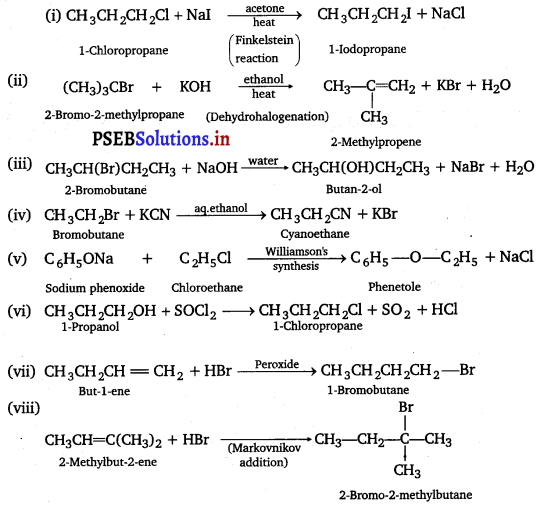
(ii) Lmol-1s-1.
Solution:
The sum of powers of the concentration of the reactants in the rate law expression is called order of reaction.
For a general reaction: aA + bB → Products
If rate = k[A]m [B]n; order of reaction = m + n

(i) General unit of rate constant, k = (mol L-1 )1-ns-1
L-1mol s-1 = (mol L-1 )1-ns-1
-1 = -1 + n ⇒ n = 0 ∴ Reaction order = 0

(ii) L mol-1 s-1 = (mol L-1)1-n s-1
1 = -1 + n ⇒ n = 2 ∴ Reaction order = 2

PSEB 12th Class Chemistry Important Questions Chapter 4 Chemical Kinetics

Question 2.
The rate constant for the first order decomposition of H2O2 is given by the following equation :
log k = 14.2 – \(\frac{1.0 \times 10^{4}}{T}\)K
Calculate Ea for this reaction and rate constant k if its half-life period be 200 minutes.
(Given: R = 8.314 JK-1 mol-1)
Solution:
Comparing the equation, log k = 14.2 – \(\frac{1.0 \times 10^{4}}{T}\) K with the equation,
log k = log A = \(\frac{E_{a}}{2.303 R T}\), we get
\(\frac{E_{a}}{2.303 R}\) = 1.0 × 10⁴ K or Ea = 1.0 × 104 K × 2.303 × R
Ea = 1.0 × 104 K × 2.303 × 8.314 JK-1
= 19.1471 × 10⁴ Jmol-1
= 191.47 kJ mol-1
For a first order reaction, tt/2 = \(\frac{0.693}{k}\) or k = \(\frac{0.693}{t_{1 / 2}}\)
k = \(\frac{0.693}{200 \mathrm{~min}}\) = 3.465 × 10 -3min-1

Question 3.
The reaction, N2(g) + O2(g) ⇌ 2NO(g) contributes to air pollution whenever a fuel is burnt in air at a high temperature. At 1500 K, equilibrium constant K for it is 1.0 × 10⁻⁵. Suppose in a case [N2] = 0.80 mol L-1 and [O2] = 0.20 mol L-1 before any reaction occurs. Calculate the equilibrium concentrations of the reactants and the product after the mixture has been heated to 1500 K.
Solution:
PSEB 12th Class Chemistry Important Questions Chapter 4 Chemical Kinetics 1
[N2] = 0.8 – 6.324 × 10⁴ mol L-1
= 0.799 molL-1
[O2] = 0.2 – 6.324 × 10⁻⁴ mol L-1
= 0.199 mol L-1

PSEB 12th Class Chemistry Important Questions Chapter 4 Chemical Kinetics

Question 4.
For a general reaction, A → B, plot of concentration of A vs time is given in figure. Answer the following questions on the basis of this graph.
PSEB 12th Class Chemistry Important Questions Chapter 4 Chemical Kinetics 2
(i) What is the order of the reaction?
(ii) What is the slope of the curve?
(iii) What are the units of rate constant?
Answer:
(i) Zero order
(ii) Slope = – k
(iii) Units of rate constant = mol L-1 s-1

Question 5.
For a reaction, A + B → products, the rate law is rate = k [A][B]a3/2. Can the reaction be an elementary reaction? Explain.
Answer:
During an elementary reaction, the number of atoms or ions colliding to react is referred to as molecularity. Had this been an elementary reaction the order of reaction with respect to B would have been 1, but in the given rate law it is \(\frac{3}{2}\). This indicated that the reaction is not an elementary reaction.

PSEB 12th Class Chemistry Important Questions Chapter 4 Chemical Kinetics

Question 6.
The rate constant for a first order reaction is 60 s-1. How much time will it take to reduce 1 g of the reactant to 0.0625 g?
Answer:
We know that, t = \(\frac{2.303}{k}\) log \(\frac{[R]_{0}}{[R]}\)
t = \(\frac{2.303}{60}\) log \(\frac{1}{0.0625}\)
t = 0.0462 s

Long Answer Type Questions

Question 1.
For the hydrolysis of methyl acetate in aqueous solution, the following results were obtained:

t/s 0 30 60
[CH3COOCH3]/mol L-1 0.60 0.30 0.15

(i) Show that it follows pseudo first order reaction, as the concentration of water remains constant.
(ii) Calculate the average rate of reaction between the time interval 30 to 60 seconds.
(Given log 2 = 0.3010, log 4 = 0.6021)
Solution:
PSEB 12th Class Chemistry Important Questions Chapter 4 Chemical Kinetics 3
As the value of k is same in both the cases, therefore, hydrolysis of methylacetate in aqueous solution follows pseudo first order reaction.

(ii) Average rate = \(-\frac{\Delta\left[\mathrm{CH}_{3} \mathrm{COOCH}_{3}\right]}{\Delta t}\)
= \(\frac{-[0.15-0.30]}{60-30}\) = \(\frac{0.15}{30}\)
Average rate = 0.005 mol L-1s-1

PSEB 12th Class Chemistry Important Questions Chapter 4 Chemical Kinetics

Question 2.
Describe how does the enthalpy of reaction remain unchanged when a catalyst is used in the reaction?
Answer:
A catalyst is a substance which increases the speed of a reaction without itself undergoing any chemical change.
According to “intermediate complex formation theory” reactants first combine with the catalyst to form an intermediate complex which is short-lived and decomposes to form the products and regenerating the catalyst.

The intermediate formed has much lower potential energy than the intermediate complex formed between the reactants in the absence of the catalyst.

Thus, the presence of catalyst lowers the potential energy barrier and the reaction follows a new alternate pathway which require less activation energy.

We know that, lower the activation energy, faster is the reaction because more reactant molecules can cross the energy barrier and change into products.

Enthalpy, △H is a ‘state function. Enthalpy of reaction, i.e., difference in energy between reactants and product is constant, which is clear from potential energy diagram.
Potential energy diagram of catalysed reaction is given as:
PSEB 12th Class Chemistry Important Questions Chapter 4 Chemical Kinetics 4

PSEB 12th Class Chemistry Important Questions Chapter 4 Chemical Kinetics

Question 3.
All energetically effective collisions do not result in a chemical change. Explain with the help of an example.
Answer:
Only effective collision lead to the formation of products. It means that collisions in which molecules collide with sufficient kinetic energy (called threshold energy = activation energy + energy possessed by reacting species).

And proper orientation lead to a chemical change because it facilitates the breaking of old bonds between (reactant) molecules and formation of the new ones i.e., in products.
e.g., formation of methanol from bromomethane depends upon the orientation of the reactant molecules.
PSEB 12th Class Chemistry Important Questions Chapter 4 Chemical Kinetics 5
The proper orientation of reactant molecules leads to bond formation whereas improper orientation makes them simply back and no products are formed.

To account for effective collisions, another factor P (probability of steric factor) is introduced K = PZABe-Ea/RT.

PSEB 5th Class Hindi Solutions Chapter 1 जब बोलो (कविता)

Punjab State Board PSEB 5th Class Hindi Book Solutions Chapter 1 जब बोलो (कविता) Textbook Exercise Questions and Answers.

PSEB Solutions for Class 5 Hindi Chapter 1 जब बोलो (कविता) (2nd Language)

Hindi Guide for Class 5 PSEB जब बोलो Textbook Questions and Answers

जब बोलो (कविता) अभ्यास

नीचे गुरुमुखी और देवनागरी लिपि में दिये गये शब्दों को पढ़ो और हिंदी शब्दों को लिखने का अभ्यास करो-

  • भिमती = मिसरी
  • वप्ले = बोलो
  • मच = सच
  • भठ = मन

PSEB 5th Class Hindi Solutions Chapter 1 जब बोलो (कविता)

नीचे एक ही अर्थ के लिए पंजाबी और हिंदी भाषा में शब्द दिये गये हैं। इन्हें ध्यान से पढ़ो और हिंदी शब्दों को लिखो-

  • व = झुक
  • ताहां = गाँठें

सही शब्द चुनकर वाक्य पूरे करो

  1. हमें ………………………….. बोलना चाहिए। (रोकर/ हँसकर)
  2. हमारी बातचीत में ………………………….. होनी चाहिए। (मिठास/ कड़वाहट)
  3. हमें सदा ………………………….. बोलना चाहिए। (सच/ झूठ)
  4. हमें ………………………….. अपनी बात कहनी चाहिए। (जल्दी-जल्दी/ सोच-समझकर)
  5. हमें अपनी बात ………………………….. कहनी चाहिए। (अकड़कर/ झुककर)

उत्तर :

  1. हँसकर
  2. मिठास
  3. सच
  4. सोच – समझकर
  5. झुककर।

तुक मिलाओ

  1. जब = …………………………..
  2. सच = …………………………..
  3. झुक = …………………………..
  4. बोलो = …………………………..

उत्तर :

  1. जब – तब।
  2. सच – सच।
  3. झुक – रुक।
  4. बोलो – तोलो।

PSEB 5th Class Hindi Solutions Chapter 1 जब बोलो (कविता)

पढ़ो और समझो

  • हँस + कर = हँसकर
  • झुक + कर = झुककर
  • रुक + कर = रुककर
  • सोच + समझ + कर = सोच-समझकर

वाक्य बनाओ

  1. मिसरी-सी
  2. सच-सच
  3. रच-रच
  4. मन की गाँठें

उत्तर :

  1. मिसरी – सी – कोयल की मीठी कूक कानों में मिसरी – सी घोलती है।
  2. सच – सच – सच – सच बताओ, कल तुम कहाँ थे ?
  3. रच – रच – कभी न बातें रच – रच बोलो।
  4. मन की गाँठे – हँस – हँस कर अपने मन की गाँठे खोलो।

रचनात्मक अभिव्यक्ति
PSEB 5th Class Hindi Solutions Chapter 1 जब बोलो (कविता) 1
चित्र देखकर दिए गए शब्दों की सहायता से वाक्य पूरे करो-
आदर बुरी रोकर मिलजुलकर

  1. ऊँची आवाज़ में चीखकर बोलना ………………………….. आदत है।
  2. हमें आपस में ………………………….. रहना चाहिए।
  3. ………………………….. अपनी बात कहने वाले बच्चे किसी को नहीं भाते।
  4. हमें बड़ों का ………………………….. करना चाहिए।

उत्तर :

  1. बुरी
  2. मिल – जुलकर
  3. रोकर
  4. आदर।

PSEB 5th Class Hindi Solutions Chapter 1 जब बोलो (कविता)

बहुवैकल्पिक प्रश्न

प्रश्न 1.
‘बोलो’ की तुकबन्दी करते हुए शब्द मिलाएं, सही पर गोला लगाओ।
‘तोलो’ सुनो, बुलाओ, भलो
उत्तर :
तोलो

प्रश्न 2.
‘जब’ की तुकबन्दी करते हुए शब्द मिलाएं, सही पर गोला लगाओ।
तब, आब, साहब, ताब
उत्तर :
तब

प्रश्न 3.
‘सच’ की तुकबन्दी करते हुए शब्द मिलाएँ आज, राज, बच, बचना
उत्तर :
बच।

जब बोलो (कविता) Poems

1. जब बोलो, तब हँस कर बोलो,
बातों में मिसरी-सी घोलो।
जब बोलो, तब सच-सच बोलो,
कभी न बातें रच-रच बोलो।

शब्दार्थ –

मिसरी – सी = मिश्री जैसी, मिठास।
सच – सत्य।
रच – रच कर = बना – बना कर।

सरलार्थ – प्रस्तुत पंक्तियों में कवि बच्चों को वाणी में मधुरता और सत्यनिष्ठा को अपनाने की प्रेरणा देते हुए कहता है कि जब भी बोलो तब हँसहँस कर बात करो। मुस्कुरा कर बातें करनी चाहिएं ताकि सुनने वाले को अच्छा लगे। तुम्हारी बातों में मिठास होनी चाहिए। जब भी किसी से बात करो तो सच – सच बोलो कभी भी बना – बना कर बात नहीं करनी चाहिए।

PSEB 5th Class Hindi Solutions Chapter 1 जब बोलो (कविता)

2. जब बोलो, तब झुक कर बोलो,
सोच समझ कर, रुक कर बोलो।
हँस कर मन की गाँठे खोलो,
जब बोलो, तब हँस कर बोलो।

शब्दार्थ – झुककर = विनम्रता से। रुक कर = धीरे – धीरे, शांति से। हँस कर =मुस्करा कर। मन की गाँठें = मन के भेद।

सरलार्थ प्रस्तुत पंक्तियों में कवि बच्चों को विनम्रता और मधुरता को अपनाने की प्रेरणा देते हुए कहता है कि जब भी बोलो विनम्रता से बोलो, बात को सुन कर, सोच – समझकर और धीरे – धीरे, शांत भाव से बोलो। मन पर पडी दविधा की गाँठों को, परतों को, भेदों को, हँसकर खोलना चाहिए। मधुर वाणी बोलनी चाहिए। जब भी बोलो हँसकर बात करनी चाहिए।

जब बोलो (कविता) शब्दार्थ – Meanings

  • मिसरी = चीनी से बनी वस्तु
  • मिसरी-सी = मिठास से भरी हुई
  • रच-रच बोलना = अपने आप बात बनाकर कहना
  • मन की गाँठ = मन में छिपी बात

PSEB 11th Class Physics Important Questions Chapter 1 Physical World

Punjab State Board PSEB 11th Class Physics Important Questions Chapter 1 Physical World Important Questions and Answers.

PSEB 11th Class Physics Important Questions Chapter 1 Physical World

Very short answer type questions

Question 1.
Why do we call Physics an exact Science?
Answer:
Most of measurement in Physics are made with high precise and accuracy, so it is called an exact Science.

Question 2.
Give two approaches to study physics.
Answer:
Two approaches to study physics are unification and reduction.

Question 3.
Name the scientific principle behind the technology of steam engine.
Answer:
Laws of thermodynamics is the scientific principle behind the technology of steam engine.

PSEB 11th Class Physics Important Questions Chapter 1 Physical World

Question 4.
Give one major discovery resulted due to basic laws of electricity and magnetism.
Answer:
Wireless communication technology was a major discovery due to laws of electricity and magnetism.

Question 5.
What is the range of weak nuclear force?
Answer:
The range of a weak nuclear force is of the order of 10-16 m.

Question 6.
Give an example of achievement in unification.
Answer:
Unified celestial and terrestrial mechanics showed that the same laws of motion and the law of gravitation apply to both the domains.

Question 7.
Give an example for conservation law of energy.
Answer:
A freely falling body under gravity is an example of conservation law of energy.

Short answer type questions

Question 1.
Give the salient features of Einstein’s theory.
Answer:
According to Einstein

  • Mass and energy are interconvertible.
  • Space and time are interconnected.

Question 2.
Name the phenomena/fields with which microscopic domain of physics deals. Which theory explains these phenomena?
Answer:
The microscopic domain of physics deals with the constitution and structure of matter at atomic and nuclear scale.
The Questionuantum theory is currently accepted, as the proper framework for explaining microscopic phenomena.

PSEB 11th Class Physics Important Questions Chapter 1 Physical World

Question 3.
Name three important discoveries of physics, which have revolutionised modem chemistry.
Answer:
Three important discoveries of physics, which have revolutionised modem chemistry are :

  1. study of radioactivity,
  2. quantum theory
  3. study of isotopes and determination of their masses by mass spectrographs.

Question 4.
Name four fundamental forces in nature.
Answer:
Four fundamental forces present in nature are:

  • Gravitational force
  • Electromagnetic force
  • Weak nuclear force
  • Strong nuclear force.

Question 5.
Name three important discoveries of physics, which have contributed a lot in development of biological sciences.
Answer:
The most important discoveries of physics, which have contributed a lot in development of biological sciences are :

  • Ultrasonic waves.
  • X-rays and neutron diffraction technique.
  • Electron microscope.
  • Radio isotopes.

Question 6.
Briefly explain how physics is related to technology?
Answer:
Progress in the field of science and technology is interrelated. Sometimes technology gives rise to new physics and at other times physics generates new technology. The discipline of thermodynamics arose mainly to understand and improve the working of heat engines. Similarly discovery of basic laws of electricity and magnetism led to development of wireless communication technology. Therefore, we can conclude that physics and technology are closely related.

Long answer type questions

Question 1.
How Physics is related to other sciences?
Answer:
Physics is so important branch of science that without the knowledge of Physics, other branches of science cannot make any progress. This can be seen from the following:

(a) Physics in relation to Mathematics: The theories and concepts of Physics lead to the development of various mathematical tools like differential equations, equations of motion etc.

(b) Physics in relation to Chemistry: The concept of interaction between various particles lead to understand the bonding and the chemical structure of a substance. The concept of X-ray diffraction and radioactivity had helped to distinguish between the various solids and to modify the periodic table.

(c) Physics in relation to Biology: The concept of pressure and its measurement has helped us to know the blood pressure of a human being, which in turn is helpful to know the working of heart. The discovery of X-rays has made it possible to diagonose the various diseases in the body and fracture in bones. The optical and electron microscopes are helpful in the studies of various organisms. Skin diseases and cancer can be cured with the help of high energy radiations like X-rays, ultraviolet rays.

(d) Physics in relation to Geology: The internal structure of various rocks can be known with the study of crystal structure. Age of rocks and fossils can be known easily with the help of radioactivity i. e., with the help of carbon dating.

(e) Physics in relation to Astronomy: Optical telescope has made it possible to study the motion of various planets and satellites in our solar system.
Radio telescope has helped to study the structure of our galaxy and to discover pulsars and quasars (heavenly bodies having star like structure). Pulsars are rapidly rotating neutron stars. Doppler’s effect predicted the expAnswer:ion of universe. Kepler’s laws are responsible to understand the nature of orbits of the planets around the sun.

(f) Physics in relation of Meterology: The variation of pressure with temperature leads to forecast the weather.

(g) Physics in relation to Seismology: The movement of earth’s crust and the types of waves produced help us in studying the earthquake and its effect.

PSEB 11th Class Physics Important Questions Chapter 1 Physical World

Question 2.
Write short note on origin and Fundamental forces in nature.
Answer:
These are the. following four basic forces in nature:
(a) Gravitational forces
(b) Electromagnetic forces
(c) Strong force or nuclear forces
(d) Weak forces.
Some of the important features of these forces are discussed below:

(a) Gravitational forces: These are the forces of attraction between any two bodies in the universe due to their masses separated by a definite distance. These are governed by Newton’s law of gravitation given by
PSEB 11th Class Physics Important Questions Chapter 1 Physical World 1
where, m1, m2 are the masses of two bodies
r = distance between them
G = Universal gravitational constant
= 6.67 × 10¹¹ Nm2kg2

Characteristics of Gravitational Forces

  • They are always attractive. They are never repulsive. They exist between macroscopic as well as microscopic bodies.
  • They are the weakest forces in nature.
  • They are central forces in nature i. e., they set along the line joining the centres of two bodies.
  • They are conservative forces.
  • They obey inverse square law i.e.,F ∝ \(\frac{I}{r^{2}}\) they vary inversely as the
    square of the distance between the two bodies.
  • They are long range forces i.e., gravitational forces between any two bodies exist even when their distance of separatioji is quite large.
  • The field particles of gravitational forces are called gravions. The concept of exchange of field particles between two bodies explains how the two bodies interact from a distance.

(b) Electromagnetic forces: They include the electrostatic and magnetic forces. The electrostatic forces are the forces between two static charges while magnetic forces are the forces between two magnetic poles. The moving charges give rise to the magnetic firce. The combined action of these forces are called electromagnetic forces.
Characteristics of Electromagnetic Forces

  • These forces are both attractive as well as repulsive.
  • They are central forces in anture.
  • They obey inverse sQuestionuare law.
  • They are conservative forces in nature.
  • These forces are due to the exchange of particles known as photons which carry no charge and have zero rest mass.
  • They are 10 times stronger as compared to gravitational forces and 1011 times stronger than the weak forces.

(c) Strong forces: They are the forces of nuclear origin. The particles inside the nucleus are charged particles (protons) and neutral particles (neutrons) which are bonded to each other by a strong interaction called nuclear force or strong force.
Hence they may be defined as the forces binding the nucleons (protons and neutrons) together in a nucleus. They are responsible for the stability of the atomic nucleus. They are of three types :

  1. n-n forces are the forces of attraction between two neutrons.
  2. p-p forces are the forces of attraction between two protons.
  3. n-p forces are the forces of attraction between a proton and a neutron.

Characteristics of Strong Forces

  • They are basically attractive in nature and become repulsive when the distance between nucleons is less than 0.7 fermi.
  • They obey inverse square law.

(d) Weak forces: They are defined as the interactions which take place between elementary particles during radioactive decay of a radioactive substance. In β – decay, the nucleus changes into a proton, an electron and a particle called anti-neutrino (which is uncharged). The interaction between the electron and the anti-neutrino is known as weak interaction or weak force.

Characteristics of Weak Forces

  • They are 1025 times stronger than the gravitational forces.
  • They exist between leptons and leptons, leptons and mesons etc.
    (a) and (b) types are the forces that we encouncer in macroscopic world while (c) and (d) types are the forces that we encountered in microscopic world.

PSEB 11th Class Physics Solutions Chapter 1 Physical World

Punjab State Board PSEB 11th Class Physics Book Solutions Chapter 1 Physical World Textbook Exercise Questions and Answers.

PSEB Solutions for Class 11 Physics Chapter 1 Physical World

PSEB 11th Class Physics Guide Physical World Textbook Questions and Answers

Question 1.
Some of the most profound statements on the nature of science have come from Albert Einstein, one of the greatest scientists of all time. What do you think did Einstein mean when he said: “The most incomprehensible thing about the world is that it is comprehensible”?
Answer:
The physical world around us is full of different complex natural phenomena so the world is incomprehensible. But with the help of study and observations it has been found that all these phenomena are based on some basic physical laws and so it is comprehensible.

Question 2.
“Every great physical theory starts as a heresy and ends as a dogma”. Give some examples from the history of science of the validity of this incisive remark.
Answer:
The above statement is true. Validity of this incisive remark can be validated from the example of moment of inertia. It states that the moment of inertia of a body depends on its energy. But according to Einstein’s mass-energy relation (E = mc2), energy depends on the speed of the body.

PSEB 11th Class Physics Solutions Chapter 1 Physical World

Question 3.
“Politics is the art of the possible”. Similarly, “Science is the art of the soluble”. Explain this beautiful aphorism on the nature and practice of science.
Answer:
It is well known that to win over votes, politicians would make anything and everything possible even when they are least sure of the same. And in science the various natural phenomena can be explained in terms of some basic laws. So as ‘Politics is the art of possible’ similarly ‘Science is the art of the soluble’.

Question 4.
Though India now has a large base in science and technology, which is fast expanding, it is still a long way from realizing its potential of becoming a world leader in science. Name some important factors, which in your view have hindered the advancement of science in India.
Answer:
Some important factors in our view which have hindered the advancement of science in India are:

  • Proper funds are not arranged for the development of research work and laboratories. The labs and scientific instruments are very old and outdated.
  • Most of the people in India are uneducated and highly traditional. They don’t understand the importance of science.

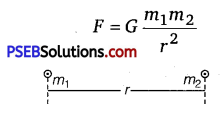
  • There is no proper employment opportunity for the science educated person in India.
  • There are no proper facilities for science education in schools and colleges in India.

Question 5.
No physicist has ever “seen” an electron. Yet, all physicists believe in the existence of electrons. An intelligent but superstitious man advances this analogy to argue that ‘ghosts’ exist even though no one has “seen” one. How will you refute his argument?
Answer:
No physicist has ever seen an electron but there are practical evidences which prove the presence of electron. Their size is so small, even powerful microscopes find it difficult to measure their sizes. But still its effects could be tested. On the other hand, there is no phenomena which can be explained on the basis of existence of ghosts.

Our senses of sight and hearing are very limited to observe the existence of both.
So, there is no comparison between the two given cases.

Question 6.
The shells of crabs found around a particular coastal location in Japan seem mostly to resemble the legendary face of a Samurai. Given below are two explanations of this observed fact. Which of these strikes you as a scientific explanation?

(a) A tragic sea accident several centimes ago drowned a young Samurai. As a tribute to his bravery, nature through its inscrutable ways immortalized his face by imprinting it on the crab shells in that area.

(b) After the sea tragedy, fishermen in that area, in a gesture of honor to their dead hero, let free any crab shell caught by them which accidentally had a shape resembling the face of a Samurai. ConseQuestionuently, the particular shape of the crab shell survived longer and therefore in course of time the shape was genetically propagated. This is an example of evolution by artificial selection.

[Note: This interesting illustration taken from Carl Sagan’s ‘The Cosmos’ highlights the fact that often strange and inexplicable facts which on the first sight appear ‘supernatural’ actually turn out to have simple scientific explanations. Try to think out other examples of this kind].
Answer:
Explanation (b) is correct as it is a scientific explanation of the observed fact.

PSEB 11th Class Physics Solutions Chapter 1 Physical World

Question 7.
The industrial revolution in England and Western Europe more than two centuries ago was triggered by some key scientific and technological advances. What were these advances?
Answer:
More than two centuries ago, England and Western Europe invented steam engine, electricity, theory of gravitation and the explosives. Steam engines helped them in the field of heat and thermodynamics, theory of gravitation in field of motion and making guns and cannons. These progresses brought about industrial revolution in England and Western Europe.
Few of which are given below:

  • Steam engine formed on the application of heat and thermodynamics.
  • Discovery of electricity helped in designing dynamos and motors.
  • Safety lamp which was used safety in mines.
  • Invention of powerloom which used steampower was used for spinning and weaving.

Question 8.
It is often said that the world is witnessing now a second industrial revolution, which will transform the society as
radically as did the first. List some key contemporary areas of science and technology, which are responsible for this
revolution.
Answer:
Some of the key contemporary areas of science and technology which may trAnswer:form the society radically are:

  • Development of super fast computers.
  • Internet and tremendous advancement in information technology.
  • Development in Biotechnology.
  • Development of super-conducting materials at room temperature.
  • Development of robots.

Question 9.
Write in about 1000* words a fiction piece based on your : speculation on the science and technology of the twenty second century.
Answer:
Let us imagine a spaceship moving towards a distant star, 500 light years away. Let it be propelled by current fed into the electric motor consisting of superconducting wires. In space, suppose there is a particular region which has such a high temperature that destroys the superconducting property of electric wires of the motor. At this stage, another spaceship
filled with matter and anti-matter comes to the rescue of the first ship and it (i. e., 1st ship) continues its onward journey.

Another way to put is: Now matter can be changed into energy and energy into matter. A man of 22nd century stands on a plateform of a specially designed machine which energises him and his body disappears in the form of energy. After split of a second, he appears at a place much far away from the previous one just intact.

Question 10.
Attempt to formulate your ‘moral’ views on the practice of science. Imagine yourself stumbling upon a discovery, which has great academic interest but is certain to have nothing but dangerous conseQuestionuences for the human society. How, if at all, will you resolve your dilemma?
Answer:
In our view a type of discovery which is of great academic interest but harmful for human society should not be made public because science is for the society, society is not for science.

PSEB 11th Class Physics Solutions Chapter 1 Physical World

Question 11.
Science, like any knowledge, can be put to good or had use, depending on the user.Given below are some of the applications of science. Formulate your views on whether the particular application is good, bad or something that cannot be so clearly categorized:
(a) Mass vaccination against small pox to curb and finally eradicate this disease from the population. (This has already been successfully done in India).
(b) Television for eradication of illiteracy and for mass communication of news and ideas.
(c) Prenatal sex determination
(d) Computers for increase in work efficiency
(e) Putting artificial satellites into orbits around the Earth
(f) Development of nuclear weapons
(g) Development of new and powerful techniQuestionues of chemical and biological warfare.
(h) Purification of water for drinking
(i) Plastic surgery
(j) Cloning
Answer:
(a) Mass vaccination is good as it is used to make the society free from the diseases like Small Pox.

(b) Television for eradication of illiteracy and for mass communication of news and ideas is good as it is a medium which is easily under the reach of common man and also they are very habitual to it.

(c) Prenatal sex determination is bad because people are misusing it. Some of the people after determination of sex of child, think to abort. They do it specially with girl child.

(d) Computers for increase in work efficiency is good as using the computer a man can do much more work with greater efficiency and accuracy as it could do without computers.

(e) Putting artificial satellites into orbits around the Earth is a good development as these satellites serve many purposes like Remote Sensing, Weather Forcasting etc. These informations have very high importance for us as we can plan the things in advance.

(f) Development of nuclear weapons is bad as they can be used in mass destruction.

(g) Development of new and powerful techniQuestionues of chemical and biological warfare are bad as they can also be used for mass destruction.

(h) Purification of water for drinking is good as we can save ourseleves from the diseases which we can have due to drinking the contaminated water.

(i) Plastic surgery is good as with the help of it a man or woman can remove the skin defects occuring due to accidents or some other reasons. It has some bad effects too but they are not very considerable.

(j) Cloning is good as far as animals are concerned with the help of it we can develop some special species which can be used to serve some specific purposes. But it is not good for human beings.

Question 12.
India has had a long and unbroken tradition of great scholarship – in mathematics, astronomy, linguistics, logic and ethics. Yet, in parallel with this, several superstitious and obscurantistic attitudes and practices flourished in our society and unfortunately continue even today – among many educated people too. How will you use your knowledge of science to develop strategies to counter these attitudes?
Answer:
Poverty and illiteracy are the two major factors which make people superstitious in India. So to remove the superstitious and obscurantist attitude we have to first overcome these factors. Everybody should be educated, so that one can have scientific attitude. Knowledge of science can be put to use to prove people’s superstitious wrong by showing them the scientific logic behind everything happening in our world.

PSEB 11th Class Physics Solutions Chapter 1 Physical World

Question 13.
Though the law gives women equal status in India, many people hold unscientific views on a woman’s innate nature, capacity and intelligence, and in practice give them a secondary status and role. Demolish this view using scientific arguments, and by quoting examples of great women in science and other spheres; and persuade yourself and others that, given equal opportunity, women are on par with men.
Answer:
Some people in our society have the view that women do not have the innate nature, capacity and intelligence.
To demolish this view there are many examples of women who have proven their abilities in science and other fields.
Madam Curie, Mother Teresa, Indira Gandhi, Marget Thatcher, Rani Laxmi Bai, Florence Nightingale are some examples. So in this era women are definitely not behind man in any field.

Question 14.
“It is more important to have beauty in the equations of physics than to have them agree with experiments”. The great British physicist P. A. M. Dirac held this view. Criticize this statement.
‘ Look out for some eQuestionuations and results in this book which strike you as beautiful.
Solution:
An equation which agrees with experiment must also be simple and hence beautiful. We have some simple and beautiful equations in physics such as
E = mc2 (Energy of light) .
E = hv (Energy of a photon)
KE = 1 / 2 mv 2 (Kinetic energy of a moving particle)
PE = mgh (Potential energy of a body at rest)
W = F. d (Work done)
All have the same dimensions. One experiment shows dependency of energy on speed, the other shows dependency on frequency and displacement.
That’s the beauty of equations in physics coming from different experiments.

Question. 15.
Though the statement quoted above may be disputed, most physicists do have a feeling that the great laws of physics are at once simple and beautiful. Some of the notable physicists, besides Dirac, who have articulated this feeling are Einstein, Bohr, Heisenberg, Chandrasekhar and Feynman. You are urged to make special efforts to get access to the general books and writings by these and other great masters of physics (See the Bibliography at the end of this book). Their writings are truly inspiring!
Solution:
There is no doubt that great laws of physics are at once so simple and beautiful and are easy to grasp. For example, let us look at some of these:

  • E = mc2 is a famous Einstein’s mass energy equivalence relation which has a great impact not only on the various physical phenomena but also on the human lives.
  • Plank’s Questionuantum condition i.e., E = hv is also a simple and beautiful eQuestionuation and it is a great law of physics.
  • ∆x. ∆p ≥ \(\frac {1}{2}\).\(\frac{h}{2 \pi}\) or ∆ E. A t ≥ \(\frac {1}{2}\).\(\frac{h}{2 \pi}\) is Heisenberg’s.

Uncertainly Principle which is also very simple, beautiful and interesting. It is a direct conseQuestionuence of the dual nature of matter.

  • λ = \(\frac{h}{m v}\) is also a famous eQuestionuation in physics known as de-Broglie euation. It is again simple and beautiful.

PSEB 11th Class Physics Solutions Chapter 1 Physical World

Question 16.
Textbooks on science may give you a wrong impression that studying science is dry and all too serious and that scientists are absent minded introverts who never laugh or grin. This image of science and scientists is patently false. Scientists like any other group of humans have their share of humorists, and many have led their lives with a great sense of fun and adventure, even as they seriously pursued their scientific work. Two great physicists of this genre are Gamow and Feynman. You will enjoy reading their books listed in the Bibliography.
Answer:
It is not an exercise as such but is a statement of facts. We can add the names of other scientists who were humorists along with being physicists. They are C.V. Raman, Homi Jahangir Bhabha, Einstein and Bohr. India have several politiciAnswer: like M.M. Joshi, V.P. Singh etc. who are physicists. President A.P.J. Kalafn is also a great nuclear scientist.

PSEB 5th Class Punjabi Solutions Chapter 1 ਮੇਰਾ ਹਿੰਦੁਸਤਾਨ

Punjab State Board PSEB 5th Class Punjabi Book Solutions Chapter 1 ਮੇਰਾ ਹਿੰਦੁਸਤਾਨ Textbook Exercise Questions and Answers.

PSEB Solutions for Class 5 Punjabi Chapter 1 ਮੇਰਾ ਹਿੰਦੁਸਤਾਨ (1st Language)

ਪਾਠ-ਅਭਿਆਸ ਪ੍ਰਸ਼ਨ-ਉੱਤਰ

I. ਯਾਦ ਰੱਖਣ ਯੋਗ ਗੱਲਾਂ

ਪ੍ਰਸ਼ਨ 1.
“ਮੇਰਾ ਹਿੰਦੁਸਤਾਨ ਕਵਿਤਾ ਨੂੰ ਪੜ੍ਹ ਕੇ ਕਿਹੜੀਆਂ ਚਾਰ-ਪੰਜ ਗੱਲਾਂ ਤੁਹਾਨੂੰ ਯਾਦ ਰੱਖਣ ਯੋਗ ਲੱਗੀਆਂ ਹਨ, ਉਨ੍ਹਾਂ ਨੂੰ ਲਿਖੋ ।
ਉੱਤਰ:

  1. ਸਾਡੇ ਦੇਸ਼ ਦਾ ਨਾਂ ਹਿੰਦੁਸਤਾਨ ਹੈ, ੲਸ ਨੂੰ ‘ਭਾਰਤ’ ਵੀ ਕਿਹਾ ਜਾਂਦਾ ਹੈ ।
    ਭਾਰਤ ਦੀ ਰਾਜਧਾਨੀ ਦਿੱਲੀ ਹੈ ।
    ਭਾਰਤ ਵਿਚ ਕੁੱਲ 28 ਦੇਸ਼ ਹਨ ।
    ਭਾਰਤ ਦਾ ਰਾਸ਼ਟਰੀ ਝੰਡਾ ਤਿਰੰਗਾ ਹੈ, ਜਿਸ ਦੇ ਤਿੰਨ ਰੰਗ-ਕੇਸਰੀ, ਸਫ਼ੈਦ, ਹਰਾ-ਹਨ ।

II. ਜ਼ਬਾਨੀ.ਪ੍ਰਸ਼ਨ

ਪ੍ਰਸ਼ਨ 1.
ਦੇਸਾਂ-ਪਰਦੇਸਾਂ ਵਿਚ ਹਿੰਦੁਸਤਾਨ ਦੀ ਸ਼ਾਨ ਕਿਹੋ-ਜਿਹੀ ਹੈ ?
ਉੱਤਰ:
ਉੱਚੀ ।

PSEB 5th Class Punjabi Solutions Chapter 1 ਮੇਰਾ ਹਿੰਦੁਸਤਾਨ

ਪ੍ਰਸ਼ਨ 2.
ਹਿੰਦੁਸਤਾਨ ਦੇ ਚਸ਼ਮਿਆਂ ਵਿਚੋਂ ਫੁੱਟਦਾ ਪਾਣੀ ਕਿਹੋ-ਜਿਹਾ ਲਗਦਾ ਹੈ ?
ਉੱਤਰ:
ਚਾਂਦੀ ਰੰਗਾ ।

ਪ੍ਰਸ਼ਨ 3.
ਸਾਨੂੰ ਹਰ ਨਵੀਂ ਸਵੇਰ ਨੂੰ ਕੀ ਵੰਡਣਾ ਚਾਹੀਦਾ ਹੈ ?
ਉੱਤਰ:
ਫੁੱਲਾਂ ਜਿਹੀ ਮੁਸਕਾਨ ।

ਪ੍ਰਸ਼ਨ 4.
ਕਵਿਤਾ ਨੂੰ ਲੈ ਵਿਚ ਗਾਓ ।
ਉੱਤਰ:
(ਨੋਟ-ਵਿਦਿਆਰਥੀ ਆਪ ਹੀ ਗਾਉਣ ਦਾ ਅਭਿਆਸ ਕਰਨ ।).

III. ਸੰਖੇਪ ਉੱਤਰ ਵਾਲੇ ਪ੍ਰਸ਼ਨ

ਪ੍ਰਸ਼ਨ 1.
ਅਸੀਂ ਹਿੰਦੁਸਤਾਨ ਦੀ ਮਿੱਟੀ ਨੂੰ ਸੀਸ ਨੇ ਕਿਉਂ ਨਿਵਾਉਂਦੇ ਹਾਂ ?
ਉੱਤਰ:
ਸਿਆਣੇ ਕਹਿੰਦੇ ਹਨ ਕਿ ਆਪਣੇ ਦੇਸ਼ ਦੀ ਮਿੱਟੀ ਮਾਂ ਸਮਾਨ ਹੁੰਦੀ ਹੈ । ੲਸ ਕਰਕੇ ਅਸੀਂ ੲਸ ਨੂੰ ਸੀਸ ਨਿਵਾਉਂਦੇ ਹਾਂ ।

PSEB 5th Class Punjabi Solutions Chapter 1 ਮੇਰਾ ਹਿੰਦੁਸਤਾਨ

ਪ੍ਰਸ਼ਨ 2.
ਸਾਨੂੰ ਕਿਸ ਪ੍ਰਕਾਰ ਦੀ ਕਮਾੲ ਕਰਨੀ ਚਾਹੀਦੀ ਹੈ ?
ਉੱਤਰ:
ਸਾਨੂੰ ਹੱਕ-ਹਲਾਲ ਦੀ ਕਮਾੲ ਕਰਨੀ ਚਾਹੀਦੀ ਹੈ ।

IV. ਬਹੁਤ ਛੋਟੇ ਉੱਤਰ ਵਾਲੇ ਪ੍ਰਸ਼ਨ

ਪ੍ਰਸ਼ਨ 1.
ਤੁਹਾਡੀ ਪਾਠ-ਪੁਸਤਕ ਵਿਚ ਪ੍ਰੋ: ਜੋਗਾ ਸਿੰਘ ਦੀ ਲਿਖੀ ਹੋੲ ਕਿਹੜੀ ਕਵਿਤਾ ਸ਼ਾਮਿਲ ਹੈ ?
ਉੱਤਰ:
ਮੇਰਾ ਹਿੰਦੁਸਤਾਨ ।

ਪ੍ਰਸ਼ਨ 2.
‘ਮੇਰਾ ਹਿੰਦੁਸਤਾਨ ਕਵਿਤਾ ਵਿਚ ਕਵੀ ਕਿਸ ਦੀ ਪ੍ਰਸੰਸਾ ਕਰਦਾ ਹੈ ?
ਉੱਤਰ:
ਆਪਣੇ ਦੇਸ਼ ਹਿੰਦੁਸਤਾਨ ਦੀ ॥

ਪ੍ਰਸ਼ਨ 3.
“ਮੇਰਾ ਹਿੰਦੁਸਤਾਨ ਕਵਿਤਾ ਵਿਚ ਕਵੀ ਕਿਸ ਲੲ ਪਿਆਰ ਤੇ ਸਤਿਕਾਰ ਪ੍ਰਗਟ ਕਰਦਾ ਹੈ ?
ਉੱਤਰ:
ਆਪਣੇ ਦੇਸ਼ ਹਿੰਦੁਸਤਾਨ ਲੲ ।

PSEB 5th Class Punjabi Solutions Chapter 1 ਮੇਰਾ ਹਿੰਦੁਸਤਾਨ

ਪ੍ਰਸ਼ਨ 4.
ਤੁਹਾਡੀ ਪਾਠ-ਪੁਸਤਕ ਵਿਚ ਦੇਸ਼-ਪਿਆਰ ਦੀ ਕਵਿਤਾ ਕਿਹੜੀ ਹੈ ?
ਉੱਤਰ:
ਮੇਰਾ ਹਿੰਦੁਸਤਾਨ ।

V. ਬਹੁਵਿਕਲਪੀਵਸਤੁਨਿਸ਼ਠ ਪ੍ਰਸ਼ਨ

ਪ੍ਰਸ਼ਨ 1.
“ਮੇਰਾ ਹਿੰਦੁਸਤਾਨ , ਕਵਿਤਾ ਕਿਸ ਕਵੀ ਦੀ ਲਿਖੀ ਹੋੲ ਹੈ ?
(ਉ) ਧਨੀ ਰਾਮ ਚਾਤ੍ਰਿਕ
(ਅ) ਪ੍ਰੋ ਜੋਗਾ ਸਿੰਘ
(ੲ) ਡਾ: ਹਰੀ ਸਿੰਘ ਜਾਚਨ .
(ਸ) ਸਵਰਨ ਹੁਸ਼ਿਆਰਪੁਰੀ ।
ਉੱਤਰ:
(ਅ) ਪ੍ਰੋ: ਜੋਗਾ ਸਿੰਘ

ਪ੍ਰਸ਼ਨ 2.
“ਹਿੰਦੁਸਤਾਨ ਦਾ ਦੂਸਰਾ ਨਾਂ ਕੀ ਹੈ ?
(ਉ) ਪੰਜਾਬ
(ਅ) ਭਾਰਤ
(ੲ) ਸ੍ਰੀ ਲੰਕਾ
(ਸ) ਹਰਿਆਣਾ ।
ਉੱਤਰ:
(ਅ) ਭਾਰਤ ।

ਪ੍ਰਸ਼ਨ 3.
ਭਾਰਤ ਵਿਚ ਕੁੱਲ ਕਿੰਨੇ ਰਾਜ ਹਨ ?
(ਉ) 30
(ਅ) 28
(ੲ) 25
(ਸ) 35.
ਉੱਤਰ:
(ਅ) 28.

PSEB 5th Class Punjabi Solutions Chapter 1 ਮੇਰਾ ਹਿੰਦੁਸਤਾਨ

ਪ੍ਰਸ਼ਨ 4.
ਭਾਰਤ ਦੀ ਰਾਜਧਾਨੀ ਕਿਹੜੀ ਹੈ ?
(ਉ) ਨਵੀਂ ਦਿੱਲੀ
(ਅ) ਚੰਡੀਗੜ੍ਹ
(ੲ) ਮੁੰਬੲ .
(ਸ) ਕੋਲਕਾਤਾ
ਉੱਤਰ:
(ੳ) ਨਵੀਂ ਦਿੱਲੀ

ਪ੍ਰਸ਼ਨ 5.
ਭਾਰਤ ਦੇ ਝੰਡੇ ਦਾ ਕੀ ਨਾਂ ਹੈ ?
(ਉ) ਤਿਰੰਗਾ
(ਅ) ਯੂਨੀਅਨ ਜੈਕ
(ਬ) ਮੋਰਪੰਖ
(ਸ) ਵਿਕਾਸ ਚਿੰਨ੍ਹ
ਉੱਤਰ:
(ੳ) ਤਿਰੰਗਾ

ਪ੍ਰਸ਼ਨ 6.
ਭਾਰਤ ਦੇ ਝੰਡੇ ਵਿਚ ਕਿੰਨੇ ਰੰਗ ਹਨ ?
(ਉ) ਦੋ
(ਅ) ਤਿੰਨ
(ੲ) ਚਾਰ
(ਸ) ਪੰਜ
ਉੱਤਰ:
(ਅ) ਤਿੰਨ

PSEB 5th Class Punjabi Solutions Chapter 1 ਮੇਰਾ ਹਿੰਦੁਸਤਾਨ

ਪ੍ਰਸ਼ਨ 7.
ਭਾਰਤ ਦੇ ਪਰਬਤ ਕਿਹੋ ਜਿਹੇ ਹਨ ?
(ੳ) ਉੱਚੇ ਤੇ ਬਰਫ਼ਾਂ ਲੱਦੇ ,
(ਅ) ਉੱਚੇ-ਨੀਵੇਂ
ੲ) ਖੁਸ਼ਕ
(ਸ) ਸੋਨ-ਸੁਨਹਿਰੀ ।
ਉੱਤਰ:
(ੳ) ਉੱਚੇ ਤੇ ਬਰਫ਼ਾਂ ਲੱਦੇ ।

ਪ੍ਰਸ਼ਨ 8.
ਭਾਰਤ ਦੇ ਚਸ਼ਮਿਆਂ ਵਿਚੋਂ ਕਿਹੋ ਜਿਹਾ ਪਾਣੀ ਫੁੱਟਦਾ ਹੈ ?
(ਉ) ਸੋਨ-ਸੁਨਹਿਰੀ
(ਅ) ਚਾਂਦੀ ਰੰਗਾ
(ੲ) ਸ਼ੀਸ਼ੇ ਵਰਗਾ
(ਸ) ਰੋਗ ਨਿਵਾਰਨ ।
ਉੱਤਰ:
ਆ ਚਾਂਦੀ-ਰੰਗਾ ।

ਪ੍ਰਸ਼ਨ 9.
ਭਾਰਤ ਦੀ ਮਿੱਟੀ ਵਿਚੋਂ ਕਿਹੋ ਜਿਹੇ ਦਾਣੇ ਉੱਗਦੇ ਹਨ ?
(ਉ) ਸੁਨਹਿਰੀ
(ਅ) ਰੁਪਹਿਰੀ
(ੲ) ਮੋਤੀਆਂ ਵਰਗੇ
(ਸ) ਰਤਨਾਂ ਵਰਗੇ ।
ਉੱਤਰ:
(ੲ) ਮੋਤੀਆਂ ਵਰਗੇ ।

PSEB 5th Class Punjabi Solutions Chapter 1 ਮੇਰਾ ਹਿੰਦੁਸਤਾਨ

ਪ੍ਰਸ਼ਨ 10.
ਸਿਆਣੇ ਲੋਕਾਂ ਅਨੁਸਾਰ ਮਿੱਟੀ ਕੀ ਹੈ ?
(ਉ) ਭੈਣ
(ਅ) ਮਾਂ
(ੲ) ਚਾਚੀ
(ਸ) ਤਾੲ ।
ਉੱਤਰ:
(ਅ) ਮਾਂ ।

ਪ੍ਰਸ਼ਨ 11.
ਸਿਆਣੇ ਲੋਕਾਂ ਨੇ ਮਾਂ ਕਿਸ ਨੂੰ ਕਿਹਾ ਹੈ ?
(ਉ) ਦੇਸ਼ ਦੀ ਮਿੱਟੀ ਨੂੰ
(ਅ) ਦੇਸ਼ ਦੀ ਪੂੰਜੀ ਨੂੰ
(ੲ) ਦੇਸ਼ ਦੀ ਹਵਾ ਨੂੰ
(ਸ) ਦੇਸ਼ ਦੀ ਬਨਸਪਤੀ ਨੂੰ ।
ਉੱਤਰ:
(ਉ) ਦੇਸ਼ ਦੀ ਮਿੱਟੀ ਨੂੰ ।

ਪ੍ਰਸ਼ਨ 12.
ਰਿਸ਼ੀਆਂ-ਮੁਨੀਆਂ, ਗੁਰੂਆਂ-ਪੀਰਾਂ ਨੇ ਕਿਸ ਦੀ ਸ਼ਾਨ ਵਧਾੲ ਹੈ ?
(ੳ) ਭਾਰਤ ਦੀ
(ਅ) ਹਰਿਆਣੇ ਦੀ
(ੲ) ਨੇਪਾਲ ਦੀ
(ਸ) ਬੰਗਾਲ ਦੀ ।
ਉੱਤਰ:
(ੳ) ਭਾਰਤ ਦੀ ।

PSEB 5th Class Punjabi Solutions Chapter 1 ਮੇਰਾ ਹਿੰਦੁਸਤਾਨ

ਪ੍ਰਸ਼ਨ 13.
ਕਿਨ੍ਹਾਂ ਨੇ ਦੁਨੀਆ ਵਿਚ ਭਾਰਤ ਦੀ ਧਾਂਕ ਜਮਾੲ ਹੈ ?
(ਉ) ਪੀਰਾਂ ਨੇ
(ਅ) ਪ੍ਰੇਮੀਆਂ ਨੇ
(ੲ) ਜੋਧਿਆਂ ਨੇ
(ਸ) ਭਗਤਾਂ ਨੇ ।
ਉੱਤਰ:
(ੲ) ਜੋਧਿਆਂ ਨੇ ।

ਪ੍ਰਸ਼ਨ 14.
ਭਾਰਤ ਦੀ ਕਿਹੜੀ ਚੀਜ਼ ਨੂੰ ਦੁਨੀਆ ਮੰਨਦੀ ਹੈ ?
(ਉ) ਵਿੱਦਿਆ ਨੂੰ
(ਅ) ਭਗਤੀ ਨੂੰ
(ੲ) ਸ਼ਕਤੀ ਨੂੰ
(ਸ) ਜੋਤਸ਼ ਨੂੰ ।
ਉੱਤਰ:
(ੳ) ਵਿੱਦਿਆ ਨੂੰ ।

ਪ੍ਰਸ਼ਨ 15.
ਭਾਰਤ ਦੇ ਹਾਲੀ, ਪਾਲੀ ਤੇ ਮਜ਼ਦੂਰ ਕਿਹੋ ਜਿਹੀ ਕਮਾੲ ਕਰਦੇ ਹਨ ?
(ਉ) ਰੋਟੀ ਜੋਗੀ
(ਅ) ਹੱਕ-ਸੱਚ ਦੀ
(ੲ) ਹਰਾਮ ਦੀ
(ਸ) ਥੋੜ੍ਹੀ-ਬਹੁਤ ।
ਉੱਤਰ:
(ਅ) ਹੱਕ-ਸੱਚ ਦੀ ।

PSEB 5th Class Punjabi Solutions Chapter 1 ਮੇਰਾ ਹਿੰਦੁਸਤਾਨ

ਪ੍ਰਸ਼ਨ 16.
ਭਾਰਤ ਦੇ ਹਾਲੀ, ਪਾਲੀ ਤੇ ਮਜ਼ਦੂਰ ਕਿਸ ਚੀਜ਼ ਤੋਂ ਦੂਰ ਰਹਿੰਦੇ ਹਨ ?
(ਉ) ਮਿਹਨਤ ਤੋਂ
(ਅ) ਲਾਲਚ ਤੋਂ
(ੲ) ਕੂੜ ਤੋਂ
(ਸ) ਸੱਚ ਤੋਂ ।
ਉੱਤਰ:
(ੲ) ਕੁੜ ਤੋਂ।

ਪ੍ਰਸ਼ਨ 17.
ਭਾਰਤ ਦਾ ਹਰ ਗੱਭਰੂ ਕਿਹੋ ਜਿਹਾ ਹੈ ?
(ਉ) ਬਾਂਕਾ
(ਅ) ਸ਼ੁਕੀਨ
(ੲ) ਲਾਲਚੀ
(ਸ) ਕੰਜੂਸ ।
ਉੱਤਰ:
(ੳ) ਬਾਂਕਾ ।

ਪ੍ਰਸ਼ਨ 18.
ਭਾਰਤ ਦੀ ਹਰ ੲਕ ਮੁਟਿਆਰ ਕਿਹੋ ਜਿਹੀ ਹੈ ?
(ੳ) ਰਕਾਨ
(ਅ) ਜਾਨ
(ੲ) ਮਹਾਨ
(ਸ) ਬੇਨਾਮ ।
ਉੱਤਰ:
(ੳ) ਰਕਾਨ ।

PSEB 5th Class Punjabi Solutions Chapter 1 ਮੇਰਾ ਹਿੰਦੁਸਤਾਨ

ਪ੍ਰਸ਼ਨ 19.
ਹੇਠ ਲਿਖਿਆਂ ਵਿਚੋਂ ਕਵਿਤਾ ਕਿਹੜੀ ਹੈ ?
(ੳ) ਮੇਰਾ ਹਿੰਦੁਸਤਾਨ
(ਅ) ਗੱਤਕਾ
(ੲ) ਫੁਲਕਾਰੀ ਕਲਾ
(ਸ) ਕਹੀ ਹੱਸ ਪੲ ।
ਉੱਤਰ:
(ੳ) ਮੇਰਾ ਹਿੰਦੁਸਤਾਨ ।

ਪ੍ਰਸ਼ਨ 20.
“ਮੇਰਾ ਹਿੰਦੁਸਤਾਨ ਕਵਿਤਾ ਕਿਹੜੇ ਛੰਦ ਵਿਚ ਲਿਖੀ ਗੲ ਹੈ ?
(ਉ) ਕਬਿੱਤ
(ਆ) ਦੋਹਰਾ
(ੲ) ਸੋਰਠਾ
(ਸ) ਦਵੱੲਆ ।
ਉੱਤਰ:
(ਸ) ਦਵੱੲਆ ।

(ਨੋਟ-ਪੰਜਵੀਂ ਦੇ ਵਿਦਿਆਰਥੀਆਂ ਲੲ . ਕਵਿਤਾ ਦੇ ਛੰਦਾਂ ਬਾਰੇ ਸਮਝਣਾ ਮੁਸ਼ਕਿਲ ਹੋਵੇਗਾ । ੲਸ ਕਰਕੇ ਉਹ ੲਸ ਪੁਸਤਕ ਦੀ ਹਰ ਕਵਿਤਾ ਦੇ ਛੰਦ ਦਾ ਨਾਂ ਯਾਦ ਕਰ ਲੈਣ ਜੋ ਕਿ ਹੇਠ ਲਿਖੇ ਅਨੁਸਾਰ ਹਨ ।)

ਕਵਿਤਾ – ਛੰਦ ,
1. ਮੇਰਾ ਹਿੰਦੁਸਤਾਨ – ਦਵੱੲਆ
2. ਬਾਰਾਂਮਾਹ – ਚੌਪੲ
3. ਆਉ ਰਲ-ਮਿਲ ਰੁੱਖ ਲਗਾੲਏ – ਚੌਪੲ
4. ਚਿੜੀਆ ਘਰ – ਕੋਰੜਾ
5. ਬੋਲੀ ਹੈ ਪੰਜਾਬੀ ਸਾਡੀ – ਕਬਿਤ
6. ਸੱਚੀ ਮਿੱਤਰਤਾ – ਦਵੱੲਆ
7. ਦਾਦੀ ਦੀ ਪੋਤਿਆਂ ਨੂੰ ਨਸੀਹਤ -. ਦਵੱੲਆ
8. ਹਿੰਦ-ਵਾਸੀਆਂ ਨੂੰ ਅੰਤਿਮ ਸੰਦੇਸ਼ – ਬੈਂਤ .
9. ਸਾਰਾਗੜ੍ਹੀ ਦੀ ਲੜਾੲ – ਬੈਂਤ ।

ਪ੍ਰਸ਼ਨ 21.
ਸਤਰ ਪੂਰੀ ਕਰੋ :-‘ ‘
ਉੱਚੇ ਪਰਬਤ ਬਰਫ਼ਾਂ ਲੱਦੇ, ਖੜੇ ਜਿਉਂ ਬੰਨ੍ਹ ਕੇ ਢਾਣੀ ।
ਇਸ ਦੇ ਚਸ਼ਮਿਆਂ ਵਿਚੋਂ ਫੁੱਟਦਾ …………… ।
(ਉ) ਗੰਦਾ-ਮੰਦਾ ਪਾਣੀ
(ਅ) ਸੋਹਣਾ ਸੁਥਰਾ ਪਾਣੀ
(ੲ) ਚਾਂਦੀ ਰੰਗਾ ਪਾਣੀ
(ਸ) ਚਮਕਾਂ ਮਾਰਦਾ ਪਾਣੀ ।
ਉੱਤਰ:
(ੲ) ‘ਚਾਂਦੀ ਰੰਗਾ ਪਾਣੀ ।

PSEB 5th Class Punjabi Solutions Chapter 1 ਮੇਰਾ ਹਿੰਦੁਸਤਾਨ

ਪ੍ਰਸ਼ਨ 22.
ਸਤਰ ਪੂਰੀ ਕਰੋ :
ੲਸਦੀ ਮਿੱਟੀ ਵਿਚ ਉੱਗਦੇ ਨੇ, ਮੋਤੀਆਂ ਵਰਗੇ ਦਾਣੇ ॥
ਇਹ ਮਿੱਟੀ ਤਾਂ ਮਾਂ ਹੁੰਦੀ ਹੈ ……………
(ੳ) ਆਖਣ ਲੋਕ ਸਿਆਣੇ
(ਅ) ਆਖਣ ਸਭ ਨਿਆਣੇ
(ੲ) ਆਖਣ ਲੁੱਟ ਪੁੱਟ ਜਾਣੇ
(ਸ) ਆਖ਼ਰ ਮਰ ਖਪ ਜਾਣੇ ।
ਉੱਤਰ:
(ੳ) ਆਖਣ ਲੋਕ ਸਿਆਣੇ

ਪ੍ਰਸ਼ਨ 23.
ਸਤਰ ਪੂਰੀ ਕਰੋ :
ੲਕ ਬਾਗ਼ ਵਿਚ ਅਸੀਂ ਹਾਂ ਉੱਗੇ, ਬੂਟੇ ਕੲ ਤਰ੍ਹਾਂ ਦੇ ।
……………. ਪਾਣੀ ਜਿਵੇਂ ਸਰਾਂ ਦੇ ।
(ਉ) ਪਰ ਆਪਸ ਵਿਚ ਲੀਰੋ ਲੀਰ ਹਾਂ
(ਅ) ਪਰ ਆਪਸ ਵਿਚ ਘੁਲੇ-ਮਿਲੇ ਹਾਂ
(ੲ) ਪਰ ਆਪਸ ਵਿਚ ਲੜਦੇ ਰਹਿੰਦੇ
(ਸ) ਪਰ ਆਪਸ ਵਿਚ ਪਿਆਰ ਨਾ ਰੱਖੀਏ ।
ਉੱਤਰ:
(ਅ) ਪਰ ਆਪਸ ਵਿਚ ਘੁਲੇ-ਮਿਲੇ ਹਾਂ ।

ਪ੍ਰਸ਼ਨ: 24.
ਦਿੱਤੇ ਤੁਕਾਂਤਾਂ ਤੋਂ ਕਾਵਿ-ਸਤਰਾਂ ਬਣਾਓ :
…………………… ਢਾਣੀ ।
………………….. ਬਾਣੀ ।
ਉੱਤਰ:
ਉੱਚੇ ਪਰਬਤ ਬਰਫ਼ਾਂ ਲੱਦੇ ਖੜੇ ਜਿਉਂ ਬੰਨ ਕੇ ਢਾਣੀ ।
ਇਸ ਦੇ ਚਸ਼ਮਿਆਂ ਵਿੱਚੋਂ ਫੁੱਟਦਾ ਚਾਂਦੀ ਰੰਗਾ ਪਾਣੀ ।
(ਨੋਟ – ਪ੍ਰਸ਼ਨ 20, 21, 22 ਤੇ 23 ਵਰਗੇ ਪ੍ਰਸ਼ਨਾਂ ਦੇ ਉੱਤਰ ਲੲ ਦੇਖੋ ੲਸ ਪੁਸਤਕ . ਵਿਚ ਅਗਲੇ ਸਫ਼ੇ ॥).

VI. ਵਿਆਕਰਨ ਪ੍ਰਸ਼ਨ

ਪ੍ਰਸ਼ਨ 1.
“ਦੇਸ ਦਾ ਪਰਦੇਸ ਨਾਲ ਜੋ ਸੰਬੰਧ ਹੈ, ਨੂੰ ਉਸੇ ਤਰ੍ਹਾਂ “ਉੱਚੇ ਦਾ ਸੰਬੰਧ ਕਿਸ ਨਾਲ ਹੋਵੇਗਾ ?
(ੳ) ਸੁੱਚੇ
(ਅ) ਭੀੜੇ .
(ੲ) ਨੀਵੇਂ
(ਸ) ਮਾੜੇ ।
ਉੱਤਰ:
(ੲ) ਨੀਵੇਂ ।

PSEB 5th Class Punjabi Solutions Chapter 1 ਮੇਰਾ ਹਿੰਦੁਸਤਾਨ

ਪ੍ਰਸ਼ਨ 2.
‘ਹਰੇ-ਭਰੇ’ ਨਾਲ ‘ਸੁੱਕੇ-ਸੜੇ ਦਾ ਜੋ ਸੰਬੰਧ ਹੈ, ਉਸੇ ਤਰ੍ਹਾਂ ‘ਮੈਦਾਨ ਦਾ ਸੰਬੰਧ ਕਿਸ ਨਾਲ ਹੋਵੇਗਾ ?
(ਉ) ਟੋਆ-ਟਿੱਬਾ/ਪਰਬਤ
(ਅ ਪੱਧਰ
(ੲ) ਚਰਾਗਾਹ
(ਸ) ਖੇਤ-
ਉੱਤਰ:
(ੳ) ਟੋਆ-ਟਿੱਬਾ/ਪਰਬਤ ।

ਪ੍ਰਸ਼ਨ 3.
ਜੇਕਰ, “ਮਾਂ ਦਾ ਵਿਰੋਧੀ ਸ਼ਬਦ “ਬਾਪ ਹੈ, ਤਾਂ “ਸਿਆਣੇ ਦਾ ਵਿਰੋਧੀ ਕੀ ਹੋਵੇਗਾ ?
(ਉ) ਨਿਆਣੇ/ਮੂਰਖ
(ਅ) ਸਮਝਦਾਰ
(ੲ) ਬੁੱਧੀਹੀਨ
(ਸ) ਬਿਗਾਨੇ ।
ਉੱਤਰ:
(ੳ) ਨਿਆਣੇ/ਮੂਰਖ ।
(ਨੋਟ-ਅਜਿਹੇ ਪ੍ਰਸ਼ਨਾਂ ਦੇ ਉੱਤਰ ਲੲ ਹੇਠ ਲਿਖੇ ਵਿਰੋਧੀ (ਉਲਟੇ ਅਰਥਾਂ ਵਾਲੇ ਸ਼ਬਦ ਯਾਦ ਕਰੋ ॥)

ਵਿਰੋਧੀ ਸ਼ਬਦ

ਪਿਆਰਾ – ਦੁਪਿਆਰਾ
ਸੀਸ – ਚਰਨ
ਵਰਦਾਨ – ਸਰਾਪ
ਘੁਲੇ-ਮਿਲੇ – ਲੀਰੋ-ਲੀਰ/ਵੱਖ-ਵੱਖ
ਵਧਾੲ – ਘਟਾੲ
ਰਿਸ਼ੀ-ਮੁਨੀ – ਚੋਰ-ਉਚੱਕੇ
ਕਾਮੇ – ਵਿਹਲੜ
ਕਰਮੇ – ਮੁਟਿਆਰ
ਗਭਰੂ – ਝੂਠ/ਕੂੜ
ਹੱਕ – ਨਾ ਹੱਕ
(ਨੋਟ-ਅਜਿਹੇ ਪ੍ਰਸ਼ਨਾਂ ਦੇ ਉੱਤਰ ਲੲ ਅਗਲੇ ਸਫ਼ਿਆਂ ਵਿਚ ਦਿੱਤੇ ਵਿਰੋਧੀ ਸ਼ਬਦ ਯਾਦ ਕਰੋ )

ਪ੍ਰਸ਼ਨ 4.
ਕਿਹੜਾ ਸ਼ਬਦ-ਜੋੜ ਸਹੀ ਹੈ ?
(i)
(ੳ) ਪਿਯਾਰਾ
(ਅ) ਪੇਆਰਾ
(ੲ) ਪੇਯਾਰਾ
(ਸ) ਪਿਆਰਾ ।
ਉੱਤਰ:
ਪੇਆਰਾ

PSEB 5th Class Punjabi Solutions Chapter 1 ਮੇਰਾ ਹਿੰਦੁਸਤਾਨ

(ii)
(ਉ) ਪਰਦੇਸ
(ਅ) ਪ੍ਰਦੇਸ਼
(ੲ) ਪਰਦੇਸ਼
(ਸ) ਪਰਦੇਸ਼ ।
ਉੱਤਰ:
ਪਰਦੇਸ਼

(iii)
(ਉ) ਪਰਬਤ
(ਅ) ਪ੍ਰਬਤ
(ੲ) ਪਰਵਤ
(ਸ) ਪ੍ਰਵਤ ॥
ਉੱਤਰ:
ਪਰਬਤ

(iv)
(ੳ) ਬੰਨ
(ਆ) ਬਨੁ
(ੲ ਬਨ੍ਹ
(ਸ) ਬੰਹ ।
ਉੱਤਰ:
ਬੰਨ੍ਹ

(v)
(ੳ) ਮੈਦਾਨ ‘ਤੇ
(ਆ) ਮਦਾਨ
(ੲ) ਮਦਾਣ
(ਸ) ਮੈਦਾਣ ।
ਉੱਤਰ:
ਮੈਦਾਨ,

PSEB 5th Class Punjabi Solutions Chapter 1 ਮੇਰਾ ਹਿੰਦੁਸਤਾਨ

(vi)
(ੳ) ਸਿਆਨੇ
(ਅ) ਸਿਆਣੇ
(ੲ) ਸਯਾਨੇ
(ਸ) ਸਿਯਾਨੇ ।
ਉੱਤਰ:
ਸਿਆਣੇ,

(vii)
(ੳ) ਨਿਵਾੲਏ
(ਅ) ਨਿਬਾੲਏ
(ੲ) ਨਵਾੲਏ
(ਸ) ਨਬਾੲਏ ।
ਉੱਤਰ:
ਨਿਵਾੲਏ,

(viii)
(ੳ) ਵਿਦਿਆ
(ਅ) ਵਿੱਦਿਆ
(ੲ) ਬਿਦਿਆ
(ਸ) ਬਿੱਦਿਆ
ਉੱਤਰ:
ਵਿੱਦਿਆ,

PSEB 5th Class Punjabi Solutions Chapter 1 ਮੇਰਾ ਹਿੰਦੁਸਤਾਨ

(ix)
(ੳ) ਰਹਿਣ
(ਅ) ਰੈਹਣ
(ੲ) ਰੈਣ
(ਸ) ਰੈਹਨ ।
ਉੱਤਰ:
ਰਹਿਣ

(x)
(ੳ) ਗਭਰੂ
(ਅ) ਗੱਭਰੂ
(ੲ) ਗੱਬਰੂ
(ਸ) ਗਭਰੂ ।
ਉੱਤਰ:
ਗੱਭਰੂ ।

ਪ੍ਰਸ਼ਨ 5.
ਹੇਠ ਲਿਖਿਆਂ ਵਿਚੋਂ ਸ਼ਬਦ-ਕੋਸ਼ ਅਨੁਸਾਰ ਕਿਹੜਾ ਸ਼ਬਦ ਪਹਿਲਾਂ ਆਵੇਗਾ ?
(ੳ) ਸਵੇਰ
(ਅ) ਸੀਸ
(ੲ) ਸਭ
(ਸ) ਸਿਆਣੇ ॥
ਉੱਤਰ:
(ੲ) ਸਭ
(ਨੋਟ – ਅਜਿਹੇ ਪ੍ਰਸ਼ਨਾਂ ਦੇ ਉੱਤਰ ਲੲ ਪੜੋ ਅਗਲੇ ਸਫ਼ਿਆਂ ਵਿਚ ‘ਕੋਸ਼ਕਾਰੀ” ਸਿਰਲੇਖ ਹੇਠੇ ਦਿੱਤੀ ਜਾਣਕਾਰੀ ॥)

PSEB 5th Class Punjabi Solutions Chapter 1 ਮੇਰਾ ਹਿੰਦੁਸਤਾਨ

ਪ੍ਰਸ਼ਨ 6.
‘ਸਭ ਦੇਸਾਂ-ਪਰਦੇਸਾਂ ਦੇ ਵਿਚ, ਉੱਚੀ ੲਸ ਦੀ ਸ਼ਾਨ । ੲਸ ਤੁਕ ਵਿਚ ਕਿਹੜਾ ਸ਼ਬਦ ਪੜਨਾਂਵ ਹੈ ?
(ਉ) ਸਭ
(ਆ) ਦੇਸ਼ਾਂ
(ੲ) ਸ਼ਾਨ
(ਸ) ਇਸ ।
ਉੱਤਰ:
(ਸ) ਇਸ ।
(ਨੋਟ-ਅਜਿਹੇ ਪ੍ਰਸ਼ਨਾਂ ਦੇ ਉੱਤਰ ਲੲ ੲਸ ਪੁਸਤਕ ਦੇ ਅਖ਼ੀਰਲੇ ਸਫ਼ਿਆਂ ਵਿਚ ਦਿੱਤੀ । ਨਾਂਵ, ਪੜਨਾਂਵ, ਵਿਸ਼ੇਸ਼ਣ ਤੇ ਕਿਰਿਆ ਸ਼ਬਦਾਂ ਬਾਰੇ ਜਾਣਕਾਰੀ ਪ੍ਰਾਪਤ ਕਰੋ ।

ਪ੍ਰਸ਼ਨ 7.
“ਮੇਰਾ ਹਿੰਦੁਸਤਾਨ ਕਵਿਤਾ ਵਿੱਚ ਆਏ ਕੋੲ 10 ਨਾਂਵ ਚੁਣੋ ਅਤੇ ਸੁੰਦਰ ਲਿਖਾੲ ਵਿਚ ਲਿਖੋ :
ਉੱਤਰ:

  1. ਹਿੰਦੁਸਤਾਨ .
  2. ਦੇਸ
  3. ਪਰਬਤ
  4.  ਬਰਫ਼ਾਂ
  5. ਚਮਿਆਂ
  6. ਪਾਣੀ
  7. ਮਿੱਟੀ
  8. ਮੋਤੀਆਂ
  9. ਦਾਣੇ
  10. ਲੋਕ ।

ਪ੍ਰਸ਼ਨ 8.
ਹੇਠ ਲਿਖੇ ਸ਼ਬਦਾਂ ਦੀ ਬੋਲ-ਲਿਖਤ ਕਰਵਾੲ ਜਾਵੇ :
ਹਿੰਦੁਸਤਾਨ
ਬਰਫ਼ਾਂ
ਬੰਨ੍ਹ
ਮੋਤੀਆਂ
ਉੱਗਦੇ
ਘੁਲੇ-ਮਿਲੇ
ਮੁਸਕਾਨ
ਵਰਦਾਨ,
ਧਾਂਕ-ਜਮਾੲ ।
ਉੱਤਰ:
(ਨੋਟ – ਵਿਦਿਆਰਥੀ ੲਨ੍ਹਾਂ ਸ਼ਬਦਾਂ ਦਾ ਉਚਾਰਨ ਕਰਦੇ ਹੋਏ ੲਕ-ਦੂਜੇ ਨੂੰ ਸੁੰਦਰ ਲਿਖਾੲ ਕਰ ਕੇ ਲਿਖਣ ਲੲ ਕਹਿਣ )

PSEB 5th Class Punjabi Solutions Chapter 1 ਮੇਰਾ ਹਿੰਦੁਸਤਾਨ

ਨੋਟ – ਪੰਜਵੀਂ ਦੇ ਵਿਦਿਆਰਥੀਆਂ ਲੲ ਕਵਿਤਾ ਦੇ ਛੰਦਾਂ ਬਾਰੇ ਸਮਝਣਾ ਮੁਸ਼ਕਿਲ ਹੋਵੇਗਾ । ੲਸ – ਕਰਕੇ ਉਹ ੲਸ ਪੁਸਤਕ ਵਿੱਚ ਲਿਖੇ ਹਰ ਛੰਦ ਦਾ ਨਾਂ ਯਾਦ ਕਰ ਲੈਣ ।

ਨੋਟ – ਬਹੁਵਿਕਲਪੀ ਪ੍ਰਸ਼ਨਾਂ ਵਿਚ ਉੱਪਰ ਦਿੱਤੇ ਅਨੁਸਾਰ ਹਰ ਪ੍ਰਸ਼ਨ ਦੇ ਤਿੰਨ-ਚਾਰ ਉੱਤਰ ਦਿੱਤੇ ਹੁੰਦੇ ਹਨ, ਜਿਨ੍ਹਾਂ ਵਿਚ ੲਕ ਠੀਕ ਹੁੰਦਾ ਹੈ ਤੇ ਬਾਕੀ ਗ਼ਲਤ । ਵਿਦਿਆਰਥੀਆਂ ਨੇ ਠੀਕ ਉੱਤਰ ਉੱਤੇ ਜਾਂ ਤਾਂ ਸਹੀ (✓) ਦਾ ਨਿਸ਼ਾਨ ਲਾਉਣਾ ਹੁੰਦਾ ਹੈ ਜਾਂ ਉਸ ਸਹੀ ਉੱਤਰ ਨੂੰ ਲਿਖਣਾ ਹੁੰਦਾ ਹੈ । ੲਸ ਪੁਸਤਕ · ਵਿਚ ਅਗਲੇ ਪਾਠਾਂ ਸੰਬੰਧੀ ਅਜਿਹੇ ਪ੍ਰਸ਼ਨਾਂ ਦਾ ੲੱਕੋੲਕ, ਠੀਕ ਉੱਤਰ ਹੀ ਦਿੱਤਾ ਗਿਆ ਹੈ ਤੇ ਬਾਕੀ ਗ਼ਲਤ ਉੱਤਰ ਨਹੀਂ ਦਿੱਤੇ ਗਏ । ਵਿਦਿਆਰਥੀ ੲਨ੍ਹਾਂ ਨੂੰ ਯਾਦ ਕਰਕੇ ਹੀ ਪ੍ਰੀਖਿਆ ਦੀ ਤਿਆਰੀ ਕਰ ਸਕਦੇ। ਹਨ ।

VII ਕੁੱਝ ਹੋਰ ਜ਼ਰੂਰੀ ਪ੍ਰਸ਼ਨ :

ਪ੍ਰਸ਼ਨ 1.
ਹੇਠ ਲਿਖੀਆਂ ਸਤਰਾਂ ਪੂਰੀਆਂ ਕਰੋ :
(ੳ) ਉੱਚੇ ਪਰਬਤ ਬਰਫ਼ਾਂ ਲੱਦੇ,
ਖੜੇ ਜਿਉਂ ਬੰਨ੍ਹ ਕੇ ਢਾਣੀ ।
………………………….. ।

(ਅ) ੲਸ ਦੀਆਂ ਨਦੀਆਂ ੲਸ ਦੇ ਜੰਗਲ,
ਹਰੇ-ਭਰੇ ਮੈਦਾਨ ।
………………………….. ।

(ੲ) ਇਸ ਮਿੱਟੀ ਵਿੱਚ ਉੱਗਦੇ ਨੇ,
ਮੋਤੀਆਂ ਵਰਗੇ ਦਾਣੇ ।
………………………… ।

(ਸ) ੲਸ ਮਿੱਟੀ ਨੂੰ ਸੀਸ ਨਿਭਾੲਏ,
ੲਹ ਮਿੱਟੀ ਵਰਦਾਨ ।
……………………… ।
ਉੱਤਰ:
(ੳ) ਉੱਚੇ ਪਰਬਤ ਬਰਫ਼ਾਂ ਲੱਦੇ,
ਖੜੇ ਜਿਉਂ ਬੰਨ੍ਹ ਕੇ ਢਾਣੀ ।
ੲਸ ਦੇ ਚਸ਼ਮਿਆਂ ਵਿੱਚੋਂ ਫੁੱਟਦਾ,
ਚਾਂਦੀ ਰੰਗਾ ਪਾਣੀ ।

PSEB 5th Class Punjabi Solutions Chapter 1 ਮੇਰਾ ਹਿੰਦੁਸਤਾਨ

(ਅ) ੲਸ ਦੀਆਂ ਨਦੀਆਂ, ੲਸ ਦੇ ਜੰਗਲ,
ਹਰੇ-ਭਰੇ ਮੈਦਾਨ ।
ਮੇਰਾ ਹਿੰਦੁਸਤਾਨ ! ਮੇਰਾ ਪਿਆਰਾ ਹਿੰਦੁਸਤਾਨ !!

(ੲ) ੲਸ ਦੀ ਮਿੱਟੀ ਵਿੱਚ ਉੱਗਦੇ ਨੇ,
ਮੋਤੀਆਂ ਵਰਗੇ ਦਾਣੇ ।
ੲਹ ਮਿੱਟੀ ਤਾਂ ਮਾਂ ਹੁੰਦੀ ਹੈ, ‘
ਆਖਣ ਲੋਕ ਸਿਆਣੇ ।

(ਸ) ੲਸ ਮਿੱਟੀ ਨੂੰ ਸੀਸ ਨਿਵਾੲਏ,
ੲਹ ਮਿੱਟੀ ਵਰਦਾਨ ॥
ਮੇਰਾ ਹਿੰਦੁਸਤਾਨ !
ਮੇਰਾ ਪਿਆਰਾ ਹਿੰਦੁਸਤਾਨ !!

ਪ੍ਰਸ਼ਨ 2.
ਸਤਰਾਂ ਪੂਰੀਆਂ ਕਰੋ :
(ਉ) ੲਕ ਬਾਗ਼ ਵਿਚ ਅਸੀਂ ਹਾਂ ਉੱਗੇ,
ਬੂਟੇ ਕੲ ਤਰ੍ਹਾਂ ਦੇ ।
………………………..

(ਅ) ਰਿਸ਼ੀਆਂ, ਮੁਨੀਆਂ, ਗੁਰੂਆਂ, ਪੀਰਾਂ,
ੲਸ ਦੀ ਸ਼ਾਨ ਵਧਾੲ ।
…………………………
…………………………
ਉੱਤਰ:
(ੳ) ੲਕ ਬਾਗ ਵਿਚ ਅਸੀਂ ਹਾਂ ਉੱਗੇ,
ਬੂਟੇ ਕੲ ਤਰ੍ਹਾਂ ਦੇ ।
ਪਰ ਆਪਸ ਵਿਚ ਘੁਲੇ-ਮਿਲੇ ਹਾਂ,
ਪਾਣੀ ਜਿਵੇਂ ਸਰਾਂ ਦੇ ।

PSEB 5th Class Punjabi Solutions Chapter 1 ਮੇਰਾ ਹਿੰਦੁਸਤਾਨ

(ਅ) ਰਿਸ਼ੀਆਂ, ਮੁਨੀਆਂ, ਗੁਰੂਆਂ, ਪੀਰਾਂ,
ੲਸ ਦੀ ਸ਼ਾਨ ਵਧਾੲ ।
ੲਸ ਦੇ ਜੋਧਿਆਂ ਨੇ ਜੱਗ ਉੱਤੇ,
ਆਪਣੀ ਧਾਂਕ ਜਮਾੲ ।

ਪ੍ਰਸ਼ਨ 3.
ਹੇਠ ਲਿਖੀਆਂ ਕਾਵਿ-ਸਤਰਾਂ ਦੇ ਨਾਲ ਮਿਲਦੀਆਂ ਸਤਰਾਂ ਲਿਖੋ
(ਉ) ਹਰ ੲਕ ਨਵੀਂ ਸਵੇਰ ਵੰਡੀਏ,
ਫੁੱਲਾਂ ਜਿਹੀ ਮੁਸਕਾਨ । ਪ੍ਰੀਖਿਆ 2008)
…………………………… ।

(ਅ) ੲੱਥੋਂ ਦੀ ਵਿੱਦਿਆ ਨੂੰ ਵੀਰੋ !
ਮੰਨਦਾ ਕੁੱਲ ਜਹਾਨ ।
………………………….।

(ੲ) ਇਸ ਦੇ ਹਾਲੀ, ੲਸ ਦੇ ਪਾਲੀ,
ਕਾਮੇ ਤੇ ਮਜ਼ਦੂਰ ।
…………………………..।

(ਸ) ਇਸ ਦਾ ਹਰ ੲਕ ਗੱਭਰੂ ਬਾਂਕਾ,
ਹਰ ਮੁਟਿਆਰ ਰਕਾਨ ।
………………………… ।
ਉੱਤਰ:
(ਉ) ਹਰ ੲੱਕ ਨਵੀਂ ਸਵੇਰ ਵੰਡੀਏ,
ਫੁੱਲਾਂ ਜਿਹੀ ਮੁਸਕਾਨ ।
ਮੇਰਾ ਹਿੰਦੁਸਤਾਨ ! ਮੇਰਾ ਪਿਆਰਾ ਹਿੰਦੁਸਤਾਨ !!

(ਅ) ੲੱਥੋਂ ਦੀ ਵਿੱਦਿਆ ਨੂੰ ਵੀਰੋ !
ਮੰਨਦਾ ਕੁੱਲ ਜਹਾਨ ।
ਮੇਰਾ ਹਿੰਦੁਸਤਾਨ ! ਮੇਰਾ ਪਿਆਰਾ ਹਿੰਦੁਸਤਾਨ !!

(ੲ) ਇਸ ਦੇ ਹਾਲੀ, ੲਸ ਦੇ ਪਾਲੀ,
ਕਾਮੇ ਤੇ ਮਜ਼ਦੂਰ ।
ਹੱਕ, ਸੱਚ ਦੀ ਕਰਨ ਕਮਾੲ,
ਰਹਿਣ ਕੂੜ ਤੋਂ ਦੂਰ ।

PSEB 5th Class Punjabi Solutions Chapter 1 ਮੇਰਾ ਹਿੰਦੁਸਤਾਨ

(ਸ) ੲਸ ਦਾ ਹਰ ੲਕ ਗੱਭਰੂ ਬਾਂਕਾ,
ਹਰ ਮੁਟਿਆਰ ਰਕਾਨ ।
ਮੇਰਾ ਹਿੰਦੁਸਤਾਨ ! ਮੇਰਾ ਪਿਆਰਾ ਹਿੰਦੁਸਤਾਨ !!

ਪ੍ਰਸ਼ਨ 4.
ਹੇਠ ਲਿਖੇ ਸ਼ਬਦਾਂ ਨੂੰ ਵਾਕਾਂ ਵਿੱਚ ਵਰਤੋ :ਪਰਦੇਸ, ਚਾਂਦੀ, ਵਿੱਦਿਆ, ਬਾਗ਼, ਜੋਧੇ ।
ਉੱਤਰ:

  1. ਪਰਦੇਸ ਪਿਰਾੲਆ ਦੇਸ਼, ਵਿਦੇਸ| ਬਹੁਤ ਸਾਰੇ ਪੰਜਾਬੀ ਲੋਕੲੰਗਲੈਂਡ, ਅਮਰੀਕਾ, ਕੈਨੇਡਾ ਆਦਿ ਪਰਦੇਸਾਂ ਵਿਚ ਰਹਿੰਦੇ ਹਨ ।
  2. ਚਾਂਦੀ (ੲਕ ਬਹੁਮੁੱਲੀ ਚਿੱਟੀ ਚਮਕੀਲੀ ਧਾਤ, ਰੁੱਪਾ)-ਮੇਰੇ ਹੱਥ ਵਿਚ ਚਾਂਦੀ ਦਾ ਕੜਾ ਹੈ ।
  3. ਵਿੱਦਿਆ ਪੜ੍ਹਾੲ-ਲਿਖਾੲ)-ਸਕੂਲ-ਕਾਲਜ ਵਿੱਦਿਆ ਦੇ ਮੰਦਰ ਹਨ ।
  4. ਬਾਗ਼ ਬਗੀਚਾ, ਪੌਦਿਆਂ, ਫੁੱਲਾਂ-ਫਲਾਂ ਨਾਲ ਸ਼ਿੰਗਾਰੀ ਥਾਂ)-ਅਸੀਂ ਹਰ ਰੋਜ਼ ਸਵੇਰੇ ਸੈਰ ਕਰਨ ਲੲ ਬਾਗ਼ ਵਿਚ ਜਾਂਦੇ ਹਾਂ ।
  5. ਜੋਧੇ ਜੰਗ ਲੜਨ ਵਾਲੇ)-ਭਾਰਤੀ ਜੋਧਿਆਂ ਨੇ ਜੰਗ ਵਿਚ ਦੁਸ਼ਮਣਾਂ ਦੇ ਦੰਦ ਖੱਟੇ ਕਰ ਦਿੱਤੇ ।

VIII. ਰਚਨਾਤਮਕ ਕਾਰਜ

ਪ੍ਰਸ਼ਨ 1.
ਹੇਠ ਦਿੱਤੇ ਰਾਸ਼ਟਰੀ ਝੰਡੇ ਦੇ ਚਿਤਰ ਵਿਚ ਰੰਗ ਭਰੋ :
PSEB 5th Class Punjabi Solutions Chapter 1 ਮੇਰਾ ਹਿੰਦੁਸਤਾਨ 1
ਉੱਤਰ:
(ਨੋਟ-ਵਿਦਿਆਰਥੀ ਆਪੇ ਹੀ ਕਰਨ ॥

ਪ੍ਰਸ਼ਨ 2.
ਆਪਣੇ ਸਕੂਲ ਦੇ ਮੁੱਖ ਅਧਿਆਪਕ/ਮੁੱਖ ਅਧਿਆਪਕਾ ਨੂੰ ਬਿਮਾਰੀ ਦੀ ਛੁੱਟੀ ਲੈਣ ਲੲ ਅਰਜ਼ੀ ਬੇਨਤੀ-ਪੱਤਰ) ਲਿਖੋ ।
ਉੱਤਰ:
ਨੋਟ-ੲਸ ਪ੍ਰਸ਼ਨ ਦਾ ਉੱਤਰ ਦੇਣ ਲੲ ਦੇਖੋ ਅਗਲੇ ਸਫ਼ਿਆਂ ਵਿਚ ਦਿੱਤਾ ‘ਚਿੱਠੀ-ਪੱਤਰ ਜੋ ਵਾਲਾ ਭਾਗ ॥

PSEB 5th Class Punjabi Solutions Chapter 1 ਮੇਰਾ ਹਿੰਦੁਸਤਾਨ

ਔਖੇ ਸ਼ਬਦਾਂ ਦੇ ਅਰਥ

ਸ਼ਾਨ – ਵਡਿਆੲ ।
ਢਾਣੀ – ਟੋਲੀ ।
ਚਸ਼ਮਾ – ਧਰਤੀ ਵਿਚੋਂ ਆਪ-ਮੁਹਾਰਾ ਫੁੱਟ ਰਿਹਾ ਪਾਣੀ ।
ਸੀਸ – ਸਿਰ ।
ਵਰਦਾਨ – ਬਖ਼ਸ਼ਿਸ਼ ।
ਸਰਾਂ – ਸਰੋਵਰਾਂ, ਤਲਾਵਾਂ ।
ਮੁਨੀ – ਮੋਨਧਾਰੀ ਸਾਧੂ ।
ਰਿਸ਼ੀ-ਮੁਨੀ – ਧਾਰਮਿਕ ਮਹਾਂਪੁਰਸ਼ ।
ਧਾਂਕ ਜਮਾੲ – ਦਬਦਬਾ ਕਾੲਮ ਕੀਤਾ, ਡੂੰਘਾ ਪ੍ਰਭਾਵ ਪਾੲਆ ।
ਜਹਾਨ – ਦੁਨੀਆ ।
ਹਾਲੀ – ਹਲ ਚਲਾਉਣ ਵਾਲੇ ਕਿਸਾਨ ।
ਪਾਲੀ – ਪਸ਼ੂ ਪਾਲਣ ਵਾਲੇ ।
ਹੱਕ ਸੱਚ ਦੀ – ਧਰਮ ਅਨੁਸਾਰ, ਮਿਹਨਤ ਦੀ ।
ਕੂੜ – ਝੂਠ ।
ਬਾਂਕਾ – ਛੈਲ-ਛਬੀਲਾ, ਸੁੰਦਰ ।
ਰਕਾਨ – ਸੁਘੜ-ਸਿਆਣੀ ॥