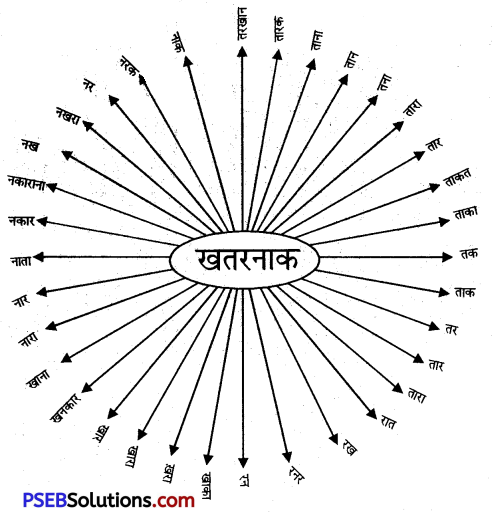
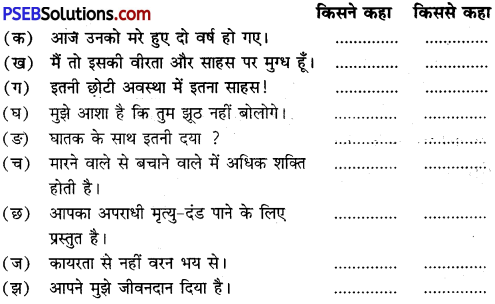
PSEB 8th Class Hindi Solutions Chapter 8 बस चुप भली

Punjab State Board PSEB 8th Class Hindi Book Solutions Chapter 8 बस चुप भली Textbook Exercise Questions and Answers.

PSEB Solutions for Class 8 Hindi Chapter 8 बस चुप भली

Hindi Guide for Class 8 PSEB बस चुप भली Textbook Questions and Answers

(क) भाषा – बोध

I. शब्दार्थ

निगाह = नज़र।
जुबानदराजी = अधिक बोलने की आदत।
दस्तक = खटखटाना।
जहर उगलना = बुरा-भला कहना।
रामबाण औषधि = अचूक दवा।
नसीहतें = उपदेश।
बयान = वर्णन करना।
चटोरी = स्वाद लेने वाली।
रसना = जीभ।

PSEB 8th Class Hindi Solutions Chapter 8 बस चुप भली

II. इन मुहावरों को अपने वाक्यों में प्रयोग करें:

1. काला अक्षर भैंस बराबर
2. छाती पर मूंग दलना
3. फाँसी का फंदा चूमना
4. कान पकड़ना
5.मैदान में कूद पड़ना
6. राग अलापना
7. नमक खाना
8. अपना-सा मुँह लेकर चले जाना
9. जान के पीछे पड़ना
उत्तर:
1. काला अक्षर भैंस बराबर – आज के युग में काला अक्षर भैंस बराबर व्यक्ति को समाज में सम्मान प्राप्त नहीं होता।
2. छाती पर मूंग दलना – गणेशी का बदमाश पोता न पढ़ता है और न ही कोई काम करता है, बस बूढ़ी दादी की छाती पर मूंग दलता रहता है।
3. फाँसी का फंदा चूमना – भगत सिंह ने देश के लिए खुशी-खुशी फाँसी का फंदा चूम लिया था।
4. कान पकड़ना – मैं तो कान पकड़ता हूँ कि तुम्हारे घर अब कभी नहीं आऊँगा।
5. मैदान में कूद पड़ना – झांसी की रानी अंग्रेजों के व्यवहार से क्रोधित हो कर मैदान में कूद पड़ी थी।
6. राग अलापना – तेरी यहाँ कोई सुनवाई नहीं तो फिर क्यों अपना राग अलाप रहा है।
7. नमक खाना – तुम्हारा बरसों तक नमक खाया है इसलिए यह काम तो मुझे करना ही पड़ेगा।
8. अपना-सा मुँह लेकर चले जाना – अफ़सर ने जब गाँव वालों की बात सुनी ही नहीं तो वे अपना-सा मुँह लेकर चले गए।
9. जान के पीछे पड़ना – ये गुंडे तो तुम्हारी जान के पीछे पड़े हुए हैं इसलिए जल्दी पुलिस की सहायता प्राप्त करो।

(ख) विषय – बोध

I. सही पर (✓) और गलत पर (×) का चिह्न लगायें :

(क) जुबानदराजी बुरी आदत है?
(ख) मौन के बल पर कालिदास का विवाह राजकुमारी से नहीं हुआ था। ( )
(ग) निर्दय जुबान के कारण रहीम अन्तिम दिनों में परेशान हुए थे। ( )
(घ) बिहारी लाल और मुरारी लाल को साहब ने तरक्की दी थी। ( )
(ङ) चुनाव अभियान में लेखक ने खन्ना का पक्ष लिया था। ( )
उत्तर:
सही- क, ग।
गलत- ख, घ, ङ।

PSEB 8th Class Hindi Solutions Chapter 8 बस चुप भली

II. इन प्रश्नों के उत्तर एक या दो वाक्यों में लिखें :

प्रश्न (क)
सब आफ़तों से बचने की रामबाण औषधि क्या है?
उत्तर:
सब आफ़तों से बचने की रामबाण औषधि मौन धारण कर लेना है।

प्रश्न (ख)
न चाहते हुए भी हम क्यों जुबानदराजी करते हैं?
उत्तर:
न चाहते हुए भी मन के भावों के कारण जुबान नियंत्रण में नहीं रहती है और हम जुबानदराजी करते हैं।

प्रश्न (ग)
जुबानदराजी के कारण मनसूर का क्या परिणाम हुआ?
उत्तर:
जुबानदराजी के कारण मनसूर को फांसी के फंदे पर झूलना पड़ा था।

प्रश्न (घ)
अपने ही घर में लेखक को मेहमान क्यों बनना पड़ा?
उत्तर:
लेखक को अपने किसी जान-पहचान वाले के बेटे की शादी में न चाहते हुए भी भागीदार बनने के कारण अपने ही घर में मेहमान बनना पड़ा था।

प्रश्न (ङ)
बिहारी लाल और मुरारी लाल की गवाही से लेखक ने मुक्ति किस युक्ति से ली?
उत्तर:
लेखक को झूठ-मूठ की भयंकर खाँसी का बहाना करने की युक्ति से बिहारी लाल और मुरारी लाल की गवाही से मुक्ति मिली थी।

III. चार या पाँच वाक्यों में उत्तर लिखें:

प्रश्न (क)
एक चुप सौ सुख’ इस तथ्य (सच्चाई) को अपनी युक्तियों से स्पष्ट करें।
उत्तर:
वास्तव में ही ‘एक चुप सौ सुख’ एक सच्चाई है। यदि दो मित्र आपस में किसी भी बात पर झगड़ पड़ें तो उन में से किसी एक का पक्ष नहीं लिया जा सकता। ऐसा करने से उन दो में से एक मित्र का दुश्मन बन जाना निश्चित होता है। लड़ाई-झगड़ा तो घर में भी हो जाता है। चुप रह कर किसी भी पक्ष का साथ न देना समस्या को कम ही करता है और अपने शत्रुओं और विरोधियों की संख्या को भी कम करता है।

PSEB 8th Class Hindi Solutions Chapter 8 बस चुप भली

प्रश्न (ख)
क्या हर स्थिति में चुप रहना चाहिए’ अपने विचार लिखें।
उत्तर:
हर स्थिति में चुप नहीं रहना चाहिए। ऐसा तो केवल वही कर सकता है जो मूर्ख हो या पागल हो। जब कोई अन्याय के रास्ते पर चलता हुआ किसी पर भी अनावश्यक रूप से अत्याचार कर रहा हो तो चुप नहीं रहना चाहिए। देखकर मक्खी नहीं निगली जा सकती। जब हमारे हितों को चोट लग रही हो या किसी पर भी अनर्थ ढाया जा रहा हो तो चुप नहीं रहना चाहिए, सदा चुप रहने वाले को लोग मूर्ख ही मानते हैं और जीवन जीते हुए मूर्ख कदापि नहीं बनना चाहिए। इसके लिए व्यवहार बुद्धि का प्रयोग करना चाहिए।

प्रश्न (ग)
बिहारी लाल और मुरारी लाल के झगड़े से बचने के लिए लेखक ने क्या नाटक किया?
उत्तर:
बिहारी लाल और मुरारी लाल के झगड़े से बचने के लिए लेखक ने अपने दफ़्तर के साहब से भयंकर खांसी का नाटक किया था। वह ज़ोर-जोर से खाँसी करते हुए लुढ़क गया था। उसने अपनी सांस रोक ली थी। उसे डिस्पैंसरी ले जाना पड़ा था।

प्रश्न (घ)
लेखक ने उलझनमयी परिस्थितियों कोर्ट कचहरी, शादी-मंगनी, चुनाव उपचुनाव-आदि से दूर रहने का संकेत क्यों दिया है ?
उत्तर:
जब हम किसी विषय पर चुप हो जाते हैं और किसी भी पक्ष के पक्ष या विपक्ष का साथ नहीं देते तो लोग हमें अपना शस्त्र नहीं बना पाते। वे हम से तब किसी गवाही की उम्मीद नहीं रखते। उन्हें लगता है कि हम उनके किसी काम के नहीं हैं। ऐसी स्थिति में हम कोट-कचहरी, शादी-मंगनी, चुनाव-उपचुनाव आदि चक्करों से बच जाते हैं।

(ग) व्यावहारिक व्याकरण

I. निम्नलिखित शब्दों में से उपसर्ग पृथक् करें :

1. अधिपति, अध्यक्ष, अध्यात्म, अधिराज।
2. अभिप्राय, अभिशाप, अभिलाषा, अभिमान।
3. अपराध, अपमान, अपशब्द, अपवाद।
4. अतिशय, अतिनिर्धन, अत्याचार, अत्यावश्यक।
5. अनुवाद, अनुचर, अनुरूप, अनुकरण।
6. अवगुण, अवनति, अवस्था, अवसर।
7. उपमान, उपवन, उपकार, उपमंत्री।
8. निर्भय, निर्दोष, निर्वाह, नीरोग (निर्)
9. निस्तार, निश्चल, निष्प्राण, निष्प्रभ (निस / निश / निष् । निः)
10. परिचय, परिमाण, परिक्रमा, परिवर्तन।
उत्तर:
1. अधि
2. अभि
3. अप
4. अति
5. अनु
6. अव
7. उप
8. निर्
9. निस / निश / निष् / निः
10. परि।

PSEB 8th Class Hindi Solutions Chapter 8 बस चुप भली

II. समस्तपदों को अलग करें (विग्रह)

जुबान दराजी = ……………….
वाणी-संयम = ……………….
योग-साधना = ……………….
तन-मन = ……………….
शरणागत = ……………….
रसोईघर = ……………….
आपबीती = ……………….
अनपढ़ = ……………….
उत्तर:
जुबान दराजी = जुबान की दराजी
वाणी-संयम = वाणी का संयम
योग-साधना = योग की साधना
तन-मन = तन और मन
शरणागत = शरण में गत
रसोई घर = रसोई के लिए घर
आप बीती = अपने पर बीती
अनपढ़ = नहीं पढ़ा है जो/ न पढ़ा

PSEB 8th Class Hindi Guide बस चुप भली Important Questions and Answers

बहुविकल्पीय प्रश्न निम्नलिखित प्रश्नों के उत्तर सही विकल्प चुनकर लिखें

प्रश्न 1.
किस पर लगाम लगाने से सभी काम शीघ्रता और शांति से हो जाते हैं ?
(क) हाथों पर
(ख) पैरों पर
(ग) जुबान पर
(घ) मन पर।
उत्तर:
जुबान पर।

प्रश्न 2.
जुबानदराजी के कारण किसे फाँसी पर झूलना पड़ा
(क) महमूद को
(ख) मनसूर को
(ग) मुनव्वर को
(घ) मुज़रूह को।
उत्तर:
मनसूर को।

PSEB 8th Class Hindi Solutions Chapter 8 बस चुप भली

प्रश्न 3.
गवाही नहीं देने से मुक्ति कैसे मिलती है ?
(क) बेहोश होकर
(ख) बीमार होकर
(ग) खांसी के दौरे से
(घ) विदेश भाग कर।
उत्तर:
खांसी के दौरे से।

प्रश्न 4.
रहीम के अनुसार अनुचित बात कहने पर जूते किसे पड़ते हैं ?
(क) मुँह को
(ख) खोपड़ी को
(ग) पीठ को
(घ) टांगों को
उत्तर:
खोपड़ी को।

प्रश्न 5.
विधानसभा के चुनाव अभियान का काम संभालने से बचने के लिए लेखक कहाँ चले गए ?
(क) दिल्ली
(ख) शिमला
(ग) अमृतसर
(घ) पटियाला।
उत्तर:
दिल्ली

PSEB 8th Class Hindi Solutions Chapter 8 बस चुप भली

बस चुप भली Summary

बस चुप भली पाठ का सार

युगों से समझदार लोग सभी प्रकार की मुसीबतों से बचने के लिए एक ही बात कहते आएं हैं कि ‘एक चुप सौ सुख’। जुबान पर लगाम लगाने से सभी काम शीघ्रता और शांति से पूरे हो जाते हैं लेकिन जुबान है कि मुँह में टिकती ही नहीं। जरा-सी बात पर गज भर लंबी हो कर यह बाहर निकल आती है और झगड़े का बड़ा कारण बन जाती है। बुजुर्गों की चुप रहने की नसीहत धरी-की-धरी रह जाती है। चुप रहना आसान नहीं है पर इसके फ़ायदे बहुत हैं। मूर्ख और अनपढ़ कालिदास केवल चुप रहने के कारण सुंदर राजकुमारी का पति बन गया था और वहीं अपने युग का सबसे बड़ा दार्शनिक मन्सूर जोबस हर बात को बोलने के कारण फांसी के फंदे पर लटका दिया गया था। तभी तो रहीम को कहना पड़ा था कि जुबान अच्छी-बुरी सब बातें कह कर स्वयं तो दाँतों के पीछे मुँह में जा छिपती है और जूते बेचारी खोपड़ी को खाने पड़ते हैं। पिछले विधानसभा चुनाव के समय मुहल्ले के दो लोग लेखक के घर पधारे।

वे दोनों चाहते थे कि लेखक महोदय उनके लिए चुनावअभियान का सारा कार्यभार संभाल लें। लेखक ने उन दोनों को किन्हीं विशेष एहसानों के कारण साफ-साफ मना तो करना नहीं था, इसलिए उन्होंने उन्हें एक कागज़ पर लिख कर बताया कि वे मौन व्रत पर थे और अगले दिन बताएंगे कि वे उन दोनों में से किस के लिए काम करेंगे। अगले दिन सुबह-सवेरे वे दिल्ली चले गए और विवाद से बच गए। दफ़्तर में बिहारी लाल और मुरारी लाल ने आपस में जोरदार झगड़ा किया, तोड़-फोड़ भी कर दी। बड़े साहब ने उन दोनों के कहने पर लेखक को गवाह के रूप में बुलाया। संकट से बचने के लिए लेखक ने भयंकर खाँसी के दौरे का नाटक किया। लेखक को तो डिस्पैंसरी भेज दिया गया पर बिहारी-मुरारी दोनों की तरक्की रोक दी गई थी जिसका सारा दोष दोनों ने लेखक पर डाला। एक बार मुहल्ले के कुछ बुजुर्गों ने अपने होनहार पुत्र को विवाह के लिए लड़की पक्ष को दिखाने हेतु लेखक का घर चुन लिया। लेखक चाह कर भी उन्हें ना नहीं कह सका जिसका परिणाम है कि अब उसका मेहमानखाना लड़के-लड़की वालों के आपसी झगड़ों का पंचायत घर बना हुआ है। लेखक का यही मानना है कि कोर्ट-कचहरी, शादी-मंगनी, चुनाव-उपचुनाव, सिफ़ारिश, गवाही, जमानत आदि से दूर ही रहना चाहिए। यदि ऐसा नहीं किया जा सकता तो जुबान अवश्य खोलनी पड़ेगी और जुबान का रस तो निश्चित रूप से दुःखदायी होता ही है।

PSEB 12th Class Religion Solutions Chapter 5 General Introduction to Puranas, Upanishads and Shastras

Punjab State Board PSEB 12th Class Religion Book Solutions Chapter 5 General Introduction to Puranas, Upanishads and Shastras Textbook Exercise Questions and Answers.

PSEB Solutions for Class 12 Religion Chapter 5 General Introduction to Puranas, Upanishads and Shastras

Long Answer Type Questions:

Question 1.
Discuss in brief but meaningful the salient features of Purana literature and its importance in Hinduism.
Or
Discuss the importance of Puranas in Hinduism.
Or
Give a brief account of important Puranas.
Or
Discuss in brief but meaningful the subject-matter of Puranas.
Or
Explain how Puranas were written?
Or
What is meant by Puranas? Give a brief account of the various Puranas.
Or
Write in brief about the Puranas.
Or
Give information about famous five Puranas.
Answer:
The Puranas are the ancient texts of the Hindus. The Purana means ancient. They have been written in Sanskrit. No definite period is given for their writing. These are not a creation of single century. They are described in the Atharvaveda, Upanishads and epics. There have been made changes in them from time to time and new chapters were added to them. The Puranas were given their final touch in the Gupta period. Hence the Puranas have been written by several writers.

The Puranas were called the Fifth Veda and the Shudras were given the permission to read them. The total number of Purans are 18. These Puranas have been divided into three parts. There Eire 6 PurEihas in each part and they Eire called Shiva, Vaishnava, and Brahman Pur ana.

These parts are as follows :

1. Shiva Purana :

  • Vayu
  • Linga
  • Skanda
  • Agni
  • Matsya
  • Kurma.

2. Vaishnava Purana :

  • Vishnu
  • Bhagvata
  • Narada
  • Garuda
  • Padma.

3. Brahman Purana :

  • Brahman
  • Brahmand
  • Brahmavaivrata
  • Markandeya
  • Bhavishya and
  • Vamana.

The prevalent Vedic and Non-Vedic religious beliefs, myths and stories are compiled in the Puranas. Myths are those stories that have no proof, but they Eire very popular. Each Purana is divided into five parts. These parts are :

  1. Search: It describes about the creation of the world.
  2. Pratisarga: It gives a description about the development, destruction and recreation of the world.
  3. Vansh: It gives a description of the lineage of the famous kings and Rishis.
  4. Manzanar: It gives a description of the great battles fought on this earth and the important event in each of them.
  5. Vanshanucharita: It gives a description of the kings of great lineage and the feats of the Rishis.

What is worth remembering here is that we do not have the original Puranas with us. What we have with us today as the Puranas, may not necessarily have the. descriptions as per the above divisions. A brief description of the Puranas is as follows :

1. The Brahman Purana: It is also called the Adi Purana. It has 14,000 shlokas in it. Most of it describes the pilgramage places of India. Besides this, it also gives a description of Krishana, Rama, Surya, famous royal families, earth, hell,’ various castes and about Varna Ashrama system.

2. The Padma Purana: This is the biggest Purana. It has almost 55,000 shlokas in it. It describes the Srishti Khand, Bhumi KhEind, Swarga Khand and Pataal Khand. It gives a detailed description of the Vishnu Katha and Rama Katha. Besides these, this Purana also describes about the holy places and fasts. Several stories pertaining to myths Eire Eilso recorded in it.

3. The Vishnu Purana: This Purana has 23,000 shlokas in it.*It says that Vishnu is the supreme god. He alone has created the world and protects it. Famous among the stories given in it are the stories of Prahlad and Dhruva. It also describes the strange things about this world and the people of heaven. It gives a description of several famous lineages. In the fifth and last part, the various miraculous deeds of Krishna have been discussed.

4. The Vayu Purana : This Purana has 11,000 shlokas in it. It describes several stories associated with the glory of Shiva. For this reason, it is also called the Shiva Pursina. It describes several lineages. It has great historical importance because it is based on facts. It also gives the geographical description which is quite useful.

5. The Bhagvata Purana : Most popular among the Puranas associated with Lord Vishnu is the Bhagavata Purana. It gives a description of several stories associated with the life of Lord Krishna. It also says that Lord Buddha and the founder of Sankhya philosophy, Kapil are incarnations of Vishnu. This Purana is not very important from historical point of view.

6. The Narada Purana : This Purana consists of 25,000 shlokas. This Purana is related to the worship of Vishnu. It gives a detailed description of the prevalent ‘ education in ancient India. It does not give a description of the lineages.

7. The Markandeya Purana : There are 900 shlokas in this Purana. It gives a detailed description of the Vedic gods Indra, Surya and Agni etc. It also gives a description of several famous lineages.

8. The Agni Purana : This Purana has 15,400 shlokas. According to a belief, this Purana was narrated to Rishi Vashisht by Agni god himself. This Purana is associated with Shaivism. It throws ample light on several important subjects like war tactics, methods to perform the yajans, astrology, geography, law, grammar, medicine, fasts, donation, marriage etc. Undoubtedly, this Purana is like an encyclopaedia.

PSEB 12th Class Religion Solutions Chapter 5 General Introduction to Puranas, Upanishads and Shastras

9. The Bhavishya Purana : This Purana has 14,000 shlokas in it. There are several stories related to the gods Brahma, Vishnu, Shiva and Surya. It also describes several ancient royal families and sages. Besides these, it also discusses several rituals which were performed at that time.

10. The Brahmavaivarta Purana : This Purana has 18,000 shlokas in it. This Purana tells Brahman as the creator of this universe. It gives a detailed description of Lord Krishna’s life. It also describes about Radha. In it, Ganesha has been called is an incarnation of Krishna.

11. The Linga Purana : This Purana has 11,000’shlokas in it. This Purana is associated with Shaivism. It describes about the incarnations of Shiva, fasts and holy places. It preaches to worship the linga as a form of Shiva.

12. The Varaha Purana: It has 10,700 shlokas in it. It giyes a detailed description of the worship of Vishnu in the incarnation of Varaha. It also gives a description related to Shiva, Durga and Ganesha.

13. The Skanda Purana : It was a large Purana. It describes 51,000 shlokas in it. This Purana is not available now. Information about it can be gathered from examples cited in the other texts. This Purana mainly describes about the worship of Shiva. Besides this, it gives useful information about the several holy places and temples of India.

14. The Vamana Purana : There are 10,000 shlokas in this Purana. Most of this Purana describes about the worship of gods like Shiva, Vishnu and Ganesha etc. It also describes several mythical stories.

15. The Kurina Purana : There are 18,000 shlokas in this Purana. It describes the worship of the Kurma incarnation of Vishnu. It gives a description of several mythical stories.

16. The Matsya Purana: It has 14,000 shlokas in it. This Purana is a conversation between a matsya (fish) and Manu. When this world was destroyed then this fish saved man. It gives a detailed description of several famous royal families. Besides these, there is a description of several fairs and pilgrimages.

17. The Garura Purana : There are 18,000 shlokas in this Parana. There is a description of the methods involved in the worhship of Vishnu. It gives important information about the yajnas, astrology, grammar, social science, physical education and ghosts and spirits. It gives detailed information about the last rites, sati system and pitra shradhs.

18. The Brahmanda Parana : There are 12,000 shlokas in this Pur ana. This Purana was read by Brahman. It gives a description about several dynasties and pilgramages. Importance of the Pur anas The Puranas present a detailed picture of the ancient Indian culture. The customs and traditions prevalent in Hinduism today are a gift of the Puranas. These Puranas throw ample light on the religious beliefs of the Hindus, the methods of worship of the gods and goddesses, fasts, shradhs, birth, marriage and rites performed at the time of death.

Idol worship and belief in incarnation is also a gift of the Puranas. These Puranas popularized the tradition of worship of forefathers further. People were inspired to donate. The description of the popular dynasties given in the Puranas proved to be quite useful historically.

The description of the pilgramages and temples gives us important infbrmation about the contemporary art. Besides these, the Puranas throw ample light on the social, economic and political condition of ancient India. Undoubtedly, it would be no exaggeration if the Puranas are called the encyclopaedia of Indian culture. Dr. R.C. Hazra has aptly remarked, “The Puranas have played a very important part in the life of the Hindus for more than two thousand years.

They have brought home to the common man the wisdom of the saints of the highest order without creating any discord. The authors of these works took every individual into consideration and made such prescriptions as would benefit him in.his social and religious life.”

Question 2.
Discuss in brief but meaningful the subject matter and importance of Upanishads.
Or
Give a brief account and importance and meaning of Upanishads.

Or
Discuss the contents of Upanishads and their importance.
Or
Explain the subject-matter of Upanishadls.
Or
Write a short note on the main teachings of the Upanishads.
Or
Discuss the main teachings of the Upanishads.
Or
What do you know about the main teachings of the Upanishads?
Or
What do you know about the main doctrines of the Upanishads?
Or
What is meant by Upanishads? Give a brief account of their main features.
Or
Give introduction about the Upanishads.
Or
Write about the m$dn teachings of the Upanishads. Name two earliest Upanishads.
Or
What is meant by Upanishads? Describe any two of them in brief.
Answer:
The Upanishads are considered as the true origin of Indian philosophy. Upanishads are those texts which incorporate in them the spiritual knowledge of the „ world of highest order just as pearls are held together in a string. The lustre o’f these pearls helps to eradicate the inner darkness of a person and, he is illuminated to such an extent that it outshines the light of the even sun. It would be no exaggeration to say that the Upanishads are the prime source of Indian philosophy. The word Upanishad is made from a combination of three words. The word ‘Up’ means near, ‘Ni’ means devotion and ‘Shad’ means to sit. Thus the word Upanishad’ means sitting beside with complete devotion.

PSEB 12th Class Religion Solutions Chapter 5 General Introduction to Puranas, Upanishads and Shastras

In fact, Upanishad is such knowledge which a guru gives to his students secretly. The Upanishads are also called Vedanta because they are considered to be consequential part of the Vedas. Vedanta means the last knowledge. This means that there is no knowledge beyond or after Upanishads. The Upanishads were composed by different sages between 1000 B.C. and 300 B.C. The total number of all Upanishads is 108. Upanishads like Isha, Kena, Prashna, Mundaka, Taittiriya, Aitareya, Chhandogya, Brihadaranyaka Shvetashvatara, Kaushitaki and Katha are considered the most important. The main teachings of the Upanishads are as follows :

1. Nature of Self : The word Self has been frequently used in the Upanishads because it is considered as the ultimate source of all knowledge. Self is the omnipresent living element. This element forms the basic foundation of all elements. This assumes a living form and resides in the hearts of all people. This is Brahman or the Atman (Absolute). For this reason, the Self is considered as the source of all light. According to the Upanishads, the Self is the only element about which there is no doubt. The Self is the determined strength. It is not transitory. It itself forms the basis of all transitory elements. For this reason, it is unchanging itself.

2. Nature of the Absolute : The word ‘Brahman’ is derived from an element of Sanskrit language called ‘Briha’ which means to grow or to proceed. From philosophical point of view, Brahman is an element which led to the creation of the visible world. Brahman is considered as an epitome of the power of man and nature. He is the master of unlimited powers because he himself is boundless. He is all pervading and the light of all lights. Despite being the basis of all virtues it is called Nirguna. He is the source of complete knowledge. It is impossible to describe his knowledge in words. Undoubtedly, he is the basic cause and foundation of the entire world.

3. Identity of Self and the Absolute : The sages have considered the Self and Brahman as a single entity in the Upanishads. They were considered as one basic element. For this reason, in the Upanishads, the words Self and the Absolute are used interchangeably at- several places. The distinction is only in words but not in meaning or element. There is only one primary element. He is sometimes called Self and sometimes called the Absolute. Just as a river joins the sea, so does the Self sublime with the Parmatman. Because the Self and the Absolute are one, therefore they cannot be differentiated. In brief, the Upanishadic philosophy looks like an ocean in a drop.

4. Creation of the World : There are several instances of the description of the creation of the world in the Upanishads. It tells that Brahman (the Absolute) created the world. Prior to the creation of the world, Brahman was present in its own Self. Then Brahman decided to express Himself in various forms. In this manner, began the creation of the world.

5. Belief in Karma Theory : The Upanishads believed in the Karma Theory. According to this, each person had to pay for his deeds (Karmas). The fruits of the deeds of the previous birth would have to be borne during the present birth. The fruits of the deeds of this birth would be borne in the next birth. The joys and sufferings of our lives depend upon our own deeds. Hence we should always indulge in good deeds and keep a distance from evil deeds. It is due to one’s ill deeds that a man gets separated from the Parmatman and continues to be a part of the vicious circle of transmigration.

6. Moral Virtues : The Upanishads have greatly emphasised on moral virtues. It is only when one adopts the moral virtues then he can swim across the ocean of this life. These virtues are :

  • Always speak the truth.
  • Love all beings.
  • Think of others’ misery as one’s own.
  • Keep distance from pride, greed and evil thinking,
  • Do not indulge in stealing or robbing,
  • Obey the tenets of religion.
  • Do not show laxity towards the study of the Vedas, education, deities and forefathers,
  • Be sincere towards social welfare,
  • Respect your guru.

7. Maya : The Upanishads have thrown ample light on the principle of Maya. The world and its elements have been referred to as Maya. Ignorant men run after the attractive elements of this world. To acquire them, they do not hesitate to use even the worst meAnswer:Maya veils one’s intelligence and renders man to be trapped in the cycle of transmigration. An intelligent man understands the mystery of Maya and so does not fall a prey to this vicious Maya. Only such persons attain salvation (Moksha).

8. Moksha : The attainment of Moksha is the prime objective of a man’s life. Through Karma, a man is subjected to the sufferings of transmigration. The Atman inside the body is the partner to all joys and sufferings. Till the time, the Atman is trapped in the body, it cannot free itself of joys and sufferings. Ignorance is the prime cause of all bonds of man. When this ignorance is destroyed, man is freed from all bonds and he attains salvation.

Moksha is the last step of ladder of man’s knowledge upon reaching there, he achieves all. Nothing supersedes the joy of attaining Moksha. According to the Upanishads, Moksha can be attained only through knowledge. The famous historian Dr. S.N. Sen has aptly remarked, “The Upanishads are rich in deep philosophical content and are the bed¬rock on which all the latter philosophical development rests.”

Question 3.
Explain the meaning and nature of Self and the Absolute.
Or
What is the relationship between Self and the Absolute? Explain.
Answer:
A detailed information in context of the Self and Brahman has been given in the Upanishads. What is the Self? What is meant by Brahman? What is the form of these two and what is the relationship between these two, a brief description in this context is given as follows :

(A) Nature of Self
The word Self has been used quite often in the Upanishads because they are considered to be a storehouse of complete knowledge. Self is the omnipresent living element. This element is the basic foundation of all elements (both materialistic and non-materialistic). It takes the form of a living being and resides in all hearts. It is Brahman or the Absolute. For this reason, Self is called the flame of all flames. The form of Self has been described in the Upanishads in the following manner :

1. Self is Certain Being: According to the Upanishads, the Self is the only thing which cannot be put to doubt. Self is a certain being. It does not need to be proved because it is self evident. It is considered to be a basis of all materialistic and non- materialistic elements. No experience is without the Self being involved in it, but it does not experience. It is the witness to all experiences.

2. Self is Permanent: Self is permanent. It is not transitory. It is the basis of all temporary things. Hence, it cannot be changed. It is beyond all psychological actions
and hence it is not affected by worldly changes. In fact, it is the creator of all changes but lives in its past. Hence one cannot deny the permanence of Self.

3. The Doctrine of Five Layers : To understand the form of Self, the Taittiriya Upanishad gives the Doctrine of the Five Layers. These five layers are :

  • Annamayi Kosh : It is a non-living and lifeless element. It comes at a materialistic level.
  • Pranmayi Kosh : It comes at a living level. It includes all flora and fauna.
  • Manomayi Kosh : It comes at a stage of consciousness. It is the objective of life.
  • Vigyanmayi Kosh : It is at a level of self consciouness. In it consciousness develops logical intellect.
  • Anandmayi Kosh : It is the true level of the Self. It destroys the spirit of diversity and differentiation.

The first four layers become a part of this pleasure (Anand) which is the last stage of their development. Hence the Doctrine of Five Layers proves that the Self is pure, living form of pleasure.

4. The Four Stages : The Mandukya Upanishad tries to explain the four stages of Self on the basis of consciousness. These four stages are :

  • The Stage of Wakefulness : In this stage the heart experiences pleasure from things of the world with the help of his senses.
  • The Stage of Dreams : In this stage consciousness presents several pictures (reflections) in itself.
  • The Stage of beep Sleep : It is the stage of deep sleep. The pleasure experienced in this stage is not real.
  • The Turiya Stage : It is a religious state. All ignorance gets destroyed here. The state of pleasure that the Self attains at this stage is indescribable.

PSEB 12th Class Religion Solutions Chapter 5 General Introduction to Puranas, Upanishads and Shastras

(B) Nature of the Absolute:

The word ‘Brahman’ is derived from an element ‘Briha’ in Sanskrit language which means to grow, increase and sprout. It can thus give a philosophical conclusion that Brahman is that element that has created this visual world. Brahman is considered-: to be a form of a person and nature is considered to be a form of power. His powers are unlimited because he Himself is without boundation. He is considered to be omnipotent and the source of all fight.

He is Nirguna (Attributeless) despite being the basis of all forms. He is the storehouse of all knowledge. It is impossible to describe his knowledge in words. Undoubtedly, He is the root cause and basis of the entire universe. A brief description of the form of the Absolute is as follows :

1. Absolute is Qualified Essence: The Upanishads have referred to the sages as the form of the Absolute at several places. The Mundaka Upanishad talks about the form of the Absolute as being present everywhere south-north, west-east, above the sky and below the earth. The Absolute is the universe. Brihadaranyaka Upanishad states that initially there was the Absolute alone but when he attained form, it became omnipresent.

The Chhandogya Upanishad says that the Brahman reaches everyone through all actions, all desires, all fragrances and all tastes. In short, it implies that Absolute is all in one.

2. Absolute is Attributeless Essence : The Upanishads refer to the Absolute as the attributeless essence. It has no form, colour, shape etc. For this reason it can neither be seen nor can it be understood. The Mundaka Upanishad says that the Brahman is neither visible, nor receivable and without clan, eyes, ears, hands and feet etc. Shankar says that the Brahman is the cause of all the universe but it cannot be converted into it. It is the basis of all changes. Since the Absolute is nondescriptive, it has been described using the words ‘Neti, Neti’ (no end, no end).

3. Absolute is the Cause of World : The Upanishads call the Absolute as the cause of the world. According to the Taittiriya Upanishad, it is Brahman which leads to the creation of all things and because of which they continue to be in existence and in the end they become a part of it. The Chhandogya Upanishad calls the Absolute as ‘Tajlan’ which means that which originates from the Absolute, lives with the help of its support and in the end becomes an inseparable part of it. It implies that the Absolute gave an expression to this world and its origin and end is caused by the Absolute.

4. Absolute is the Source of Light: The Upanishads consider the Absolute as the source of light. The sun, moon, stars etc. give light as parts of the light of the Absolute. The light of the Absolute should not be considered to be a form of the materialistic light because the materialistic light can be seen with the eyes but the light of the Absolute can be seen only through the power of Yoga. The spiritual light of the Absolute is present in all the things of this worl’d.

5. Absolute is Existence : The Absolute is considered to be of existence according to the Upanishads. In philosophy, Absolute means existence. The Absolute is the basis of all existence. Wherever there is existence, it is because of the Absolute. The Absolute is not dependent on anything for its existence but it is considered to be the foundation of the existence of all creatures and elements. Consequently, the Absolute is considered to be the form of all truth.

6. Absolute is Bliss : The Absolute is called a bliss in the Upanishads. What is worth remembering here is that this bliss is not like the other pleasures of the world. It is limitless and endless like the sea of pleasure. It is due to the bliss of the Absolute that all creatures are bom in this universe. It is the cause of life of all creatures. Each creation experiences this pleasure on the basis of one’s potential. In the end, all the creatures get immersed in this pleasure. There is no end to this pleasure of the Absolute because it is the form of complete bliss.

Identity of Self and the Absolute:

The sages in the Upanishads have made no distinction between the Self and the Absolute. They considered it as one basic element. For this reason, they often use the terms Self and the Absolute interchangeably. The distinction is merely that of words but there is no distinction of meaning or element. The basic element of this world is only one. It is sometimes called Self and sometimes called the Absolute. Just as a river meets the sea and becomes a part of it, similarly the Self becomes a part of the Absolute. Because the form of Self and the Absolute is one, hence, they cannot be distinguished. In brief, looking for the ocean in one drop or one drop in the ocean is what the Upanishadic philosophy is all about.

PSEB 12th Class Religion Solutions Chapter 5 General Introduction to Puranas, Upanishads and Shastras

Question 4.
Give a brief account of the main teachings of Bhagvadgita.
Or
Explain the basic teachings of Bhagvadgita.
Or
Discuss in detail the Karamayoga.
Answer:
The Bhagvadgita is a part of the Mahabharata. It is more popularly known by the name Gita. There are 18 chapters and 700 shlokas (verses) in it. The sermon of Gita was given by Lord Krishna to Aijuna before the battle of Mahabharata began. The ideology imparted by Gita was usually beyond the comprehension of the common man. The ideas of Gita have a magical impact on the common people. It is for this reason, that the Gita is dear to all the Hindus even today. Ramanuja (1017—1137) wrote a commentary on Bhagvadgita and interpreted its teachings.

It has been translated into many languages of the world. Its most popular English translation have been done by Edwin Arnold under the title, The Song Celestial. A brief description of the main teachings of the Gita is as follows :

1. God : The Gita calls the Parmatman (God) as the creator of all world. He is one. He is omnipotent and present in all creatures and objects. He is the creator, preserver and destroyer of all creatures. God is the basis of all knowledge, truth, joy, sorrow, violence, non-violence, courage, happiness, fame and disrespect etc. The tenth chapter of the Gita says, “I am the initiator of everything. Everything is borne out of me. Knowing this, the intelligent men with full devotion worship me.” God is immortal. He is free from the bonds of birth and death. He is the greatest of all.

2. Atman : According to the Gita, the body is not the Atman (soul). The circle of birth and death is related to the body and not the Atman. The Soul is the indestructible element. The water, wind, weapons etc. have no impact on the Atman. Neither does it bom, nor does it die. Just as a man removes his old and tattered clothes to wear new ones, similarly the Atman discards old bodies to enter into new ones.

3. Karamayoga : Karamayoga is a famous principle of the Gita. No creature can spend a single moment without Karma. A person who is able to control his senses and work selflessly is called Karamayogi and those persons who fall a victim to their senses and work to show off are called hypocrite. Except Karamayogi (Karma which does not desire of any fruits), the rest are all full of bonds. Hence, the Gita inspires a man to be a Karamayogi. According to the Gita, every Karma bears fruit which has to be borne by the person. It is never possible that a person performs an action and escapes its fruit. It is an inevitable principle. The fruits of one’s deeds lead one into the vicious circle of transmigration.

He bears the sufferings of fruit of the deeds of the previous birth and through new deeds, gathers the fruits of this birth to move on to the next birth. As a consequence of his deeds, man attains several stages of life, the highest being the Parampad which is his highest goal. Only through Karamayoga man can attain Parampad.

4. Bhaktiyoga : Bhaktiyoga is counted among the three main paths of the Gita. Bhakti is of several types :

  • Prapti Bhakti : It is a kind of bhakti in which the devotee comes with a pious heart in the shelter of God and gets detached from the materialistic elements,
  • Swarth Bhakti : Most of the bhakti in this world is purposeful. The reason for this is that some people resort to bhakti after they are hassled by troubles and they want to get rid of them,
  • Jnana Bhakti: Such bhagats deeply study the Shastras to fulfil their desire of knowledge and by God’s grace are able to attain true knowledge,
  • Nirguna Bhakti : This is a kind of bhakti in which God is considered omnipresent in all forms and thus he serves all the creatures.
  • Saguna Bhakti : In this kind of bhakti, the devotee with a pure heart pays devotion to the idol of his god.
  • Kirtan Bhakti : In this bhakti, the devotee constantly indulges in Kirtan in the name of God.
  • Shravana Bhakti : This type of bhakti is for the less educated. For this reason, they cannot deeply study the Shastras. Consequently, they listen to the sermons of Shastras from the others and tread on the path of bhakti. All these forms of bhakti are considered as a source of Mukti (salvation).

5. Jnanayoga : According to the Bhagvadgita, the fire of knowledge reduces all the bonds of Karma to ashes. For this reason, there is no purer a thing than knowledge in this world. This knowledge is not limited to the knowledge of ordinary elements. It actually means pure knowledge of the Soul. This is called Jnanayoga. Of Karmayoga, Bhaktiyoga and Jnanayoga, Jnanayoga receives prominence because without the knowledge of the Soul, a man can neither be a true Karamayogi nor can he be a true devotee.

After attaining human form, the creature who is not able to attain the knowledge of the Soul can never attain freedom from the bondage of cycle of Karma. Knowledge is the best way to attain salvation because knowledge sets the seed of Karma on fire and a burnt seed cannot give rebirth to a plant.

Question 5.
What do you know about the three paths shown in the Bhagwadgita for the benefit of mankind?
Or
Which are the three Yogas mentioned in the Bhagvadgita? Discuss.
Or
How many Yogas are referred to in the Bhagvadgita? Discuss in detail.
Or
Which are three Yogas mentioned in the Bhagvadgita? Discuss Bhaktiyoga.
Answer:
The Bhagvadgita or the Gita is one of the sacred texts of the Hindus. It gives a simple solution in clear words to all the problems of human life. The Gita does not suggest any one way of life for the attainment of salvation. It says that if every man’s behaviour is different from the other, then there ought to be different ways of reaching one’s ultimate goal. There are three ways of doing this Karamayoga, Bhaktiyoga and Jnanayoga. A man chooses his own path of life according to his nature and interest.

PSEB 12th Class Religion Solutions Chapter 5 General Introduction to Puranas, Upanishads and Shastras

1. Karamayoga : Karamayoga is a famous principle of the Gita. No creature can spend a single moment without Karma. A person who is able to control his senses and work selflessly is called Karamayogi and those persons who fall a victim to their senses and work to show off are called hypocrite. Except Karamayogi (Karma which does not desire of any fruits), the rest are all full of bonds. Hence, the Gita inspires a man to be a Karamayogi. According to the Gita, every Karma bears fruit which has to be borne by the person. It is never possible that a person performs an action and escapes its fruit. It is an inevitable principle. The fruits of one’s deeds lead one into the vicious circle of transmigration.

He bears the sufferings of fruit of the deeds of the previous birth and through new deeds, gathers the fruits of this birth to move on to the next birth. As a consequence of his deeds, man attains several stages of life, the highest being the Parampad which is his highest goal. Only through Karamayoga man can attain Parampad.

2. Bhaktiyoga : Bhaktiyoga is counted among the three main paths of the Gita. Bhakti is of several types :

  • Prapti Bhakti : It is a kind of bhakti in which the devotee comes with a pious heart in the shelter of God and gets detached from the materialistic elements,
  • Swarth Bhakti : Most of the bhakti in this world is purposeful. The reason for this is that some people resort to bhakti after they are hassled by troubles and they want to get rid of them,
  • Jnana Bhakti: Such bhagats deeply study the Shastras to fulfil their desire of knowledge and by God’s grace are able to attain true knowledge,
  • Nirguna Bhakti : This is a kind of bhakti in which God is considered omnipresent in all forms and thus he serves all the creatures.
  • Saguna Bhakti : In this kind of bhakti, the devotee with a pure heart pays devotion to the idol of his god.
  • Kirtan Bhakti : In this bhakti, the devotee constantly indulges in Kirtan in the name of God.
  • Shravana Bhakti : This type of bhakti is for the less educated. For this reason, they cannot deeply study the Shastras. Consequently, they listen to the sermons of Shastras from the others and tread on the path of bhakti. All these forms of bhakti are considered as a source of Mukti (salvation).

3. Jnanayoga : According to the Bhagvadgita, the fire of knowledge reduces all the bonds of Karma to ashes. For this reason, there is no purer a thing than knowledge in this world. This knowledge is not limited to the knowledge of ordinary elements. It actually means pure knowledge of the Soul. This is called Jnanayoga. Of Karmayoga, Bhaktiyoga and Jnanayoga, Jnanayoga receives prominence because without the knowledge of the Soul, a man can neither be a true Karamayogi nor can he be a true devotee.

After attaining human form, the creature who is not able to attain the knowledge of the Soul can never attain freedom from the bondage of cycle of Karma. Knowledge is the best way to attain salvation because knowledge sets the seed of Karma on fire and a burnt seed cannot give rebirth to a plant.

Question 6.
What do you know about Nishkama Karma of Bhagvadgita?
Answer:

Karamayoga : Karamayoga is a famous principle of the Gita. No creature can spend a single moment without Karma. A person who is able to control his senses and work selflessly is called Karamayogi and those persons who fall a victim to their senses and work to show off are called hypocrite. Except Karamayogi (Karma which does not desire of any fruits), the rest are all full of bonds. Hence, the Gita inspires a man to be a Karamayogi. According to the Gita, every Karma bears fruit which has to be borne by the person. It is never possible that a person performs an action and escapes its fruit. It is an inevitable principle. The fruits of one’s deeds lead one into the vicious circle of transmigration.

He bears the sufferings of fruit of the deeds of the previous birth and through new deeds, gathers the fruits of this birth to move on to the next birth. As a consequence of his deeds, man attains several stages of life, the highest being the Parampad which is his highest goal. Only through Karamayoga man can attain Parampad.

PSEB 12th Class Religion Solutions Chapter 5 General Introduction to Puranas, Upanishads and Shastras

Question 7.
Who gave the lesson contained in the Bhagvadgita and to whom? Of the three Yogas in the Gita, write about the Bhakti Yoga.
Answer:
The preachings given in the Bhagvadgita were given by Lord Krishna to Aijuna.

Bhaktiyoga : Bhaktiyoga is counted among the three main paths of the Gita. Bhakti is of several types :

  • Prapti Bhakti : It is a kind of bhakti in which the devotee comes with a pious heart in the shelter of God and gets detached from the materialistic elements,
  • Swarth Bhakti : Most of the bhakti in this world is purposeful. The reason for this is that some people resort to bhakti after they are hassled by troubles and they want to get rid of them,
  • Jnana Bhakti: Such bhagats deeply study the Shastras to fulfil their desire of knowledge and by God’s grace are able to attain true knowledge,
  • Nirguna Bhakti : This is a kind of bhakti in which God is considered omnipresent in all forms and thus he serves all the creatures.
  • Saguna Bhakti : In this kind of bhakti, the devotee with a pure heart pays devotion to the idol of his god.
  • Kirtan Bhakti : In this bhakti, the devotee constantly indulges in Kirtan in the name of God.
  • Shravana Bhakti : This type of bhakti is for the less educated. For this reason, they cannot deeply study the Shastras. Consequently, they listen to the sermons of Shastras from the others and tread on the path of bhakti. All these forms of bhakti are considered as a source of Mukti (salvation).

Question 8.
What do you mean by Dharma Shastras? Write a note on the main Dharma Shastras.
Or
Which subjects have been touched in Dharma Shastras? Explain.
Or
What is Dharma Shastra? Explain any one of the Dharma Shastra.
Or
What is Shastra? Give brief description of any Hindu Scripture (Shastra).
Or
Write a brief note on Hindu Scriptures (Shastras).
Or
Describe the main features of Shastras.
Or
Explain the importance of Dharma Shastras.
Or
Describe Dharma Shastras.
Answer:
The Dharma Shastras Eire ancient texts of the Hindus. These are also called Smritis. Of these Dharma Shastras, the most famous are Manu’s Dharma Shastra or Manu Smriti. Besides this, the Smritis composed by Yajnavalkaya, Vishnu and Narda are also important. The historians disagree on the period of the composition of the Dharma Shastras. The common view is that they were created between 1st B.C. and Ith B.C. These Dharma Shastras are composed in Sanskrit. In these, the Vishnu Sihriti is composed in prose whereas the rest of the three Dharma Shastras are written in the form of a poem.

These Dharma Shastras render light on the religious, social, political and economic regulations of ancient India explicitly. Consequently, these Dharma Shastras are a valuable source for us to know about the condition of the people of that time. A brief description of the main Dharma Shastras is as follows :

1. Manu Smriti : Manu Smriti is also known by the name Manu Samhita. It was composed by Manu. Manu is considered as the world’s first law giver. In his compositions, he has given important information about the origin of Dharma and its sources. It clearly defines the roles of the Brahmans, Kshatriyas, Vaishyas and Shudras. The Brahmanas occupied the highest position in society whereas the Shudras were considered the lowest. In it, human life is divided into four ashramas i.e. Brahmacharya, Grihastha, Vanaprastha and Sanyasa and the associated responsibilities and importance is also described in it.

In it, Manu has also described the rules that the kings should follow. According to this, the king should appoint a Council of Ministers to run the administration of the state. The king should least interfere in the local administration. Manu believed that we should respect and serve our parents, teachers and elders.

If they are angry with usr we should not lose our temper. Because we can never repay them for what they have done for us. A person who disrespects them should be fined with 100 pana. According to Manu, women should not be given the right to study the Vedas or the right to property. Their ideas should never be trusted. They should not be given freedom. He was in favour of early marriage. He opposed widow remarriage and Niyoga practices.

According to Manu, people should lead a simple and pious life. According to him, wicked and evil doers have to face several difficulties in hell. He was strictly against gambling. According to him, the government should fix the prices of goods. Besides these subjects, Manu has also given information about Yoga, Meditation, Transmigration and Moksha in his composition.

2. Yajnavalkya Smriti : Though Yajnavalkya Smriti is brief as compared to Manu Smriti but it is important in several aspects. The description in it is bound by principles and the language is lucid. It is considered to be composed between 100 B.C. and 300 B.C. Yajnavalkya Smriti is divided into three chapters. The first chapter deals with the values right from conception to marriage, the duties of a wife, the rights and duties of the four Vamas, the rules of charity, the rules for observing shradhas and the fruits of observing them, the appropriate qualities of a ruler and his ministers, judicial system and the penance for criminals and the tax system explicitly.

The second chapter gives the difference between Dharma Shastra and Artha Shastra. Rights to property, the rules relating to slavery, gambling, theft, rape, border disputes . are given in great details. The third chapter renders light on the last rites, period of sorrow, means of attaining purity, Atman, path to Moksha, evil doers, yogis, means to attain knowledge of the Atman, hell, objectives of remorse, killing of creatures etc.

The Yajnavalkya Smriti and Manu Smriti differ on certain issues. Manu on one hand has allowed a Brahmana to marry the daughter of a Shudra, on the other hand Yajnavalkya opposed it. Manu has criticised Niyoga whereas Yajnavalkya was in favour of it. Manu believed that the widows should have no right over property whereas Yajnavalkya was completely in favour of it. Manu was strictly against gambling whereas Yajnavalkya did not consider it bad. He was in favour of bringing it under the control of the government to obtain revenue. Yajnavalkya has provided important and useful information about biology and medical science in his Smriti.

3. Vishnu Smriti : This Smriti was composed between 100 A.D. and 300 A.D. It was written in the form of prose. In it some shlokas have been taken from Manu and Yajnavalkya’s Smritis. In Vishnu Smriti, the Aryan region has been described more explicitly than Manu Smriti. It covers almost the whole of India. It proves that during the period when Vishnu Smriti was composed, the Aryans had spread in the whole of India. The rulers were the focus of administration.

To expand their empires and protect their subjects was their prime duty. A Council of Ministers was appointed to help the king to run the administration efficiently, The ministers were appointed primarily on the basis of their abilities and loyalty towards the state. The smallest unit of administration was called Gram (village). To give fair justice to the subjects was the prime responsibility of the ruler. Vishnu Smriti gives a detailed description of the types of crimes and the punishments awarded for them.

The Manu Smriti describes that due to their highest position in society there should be no tax imposed on the Brahmans but the Vishnu Smriti favoured it. Vishnu Smriti was against gambling and considered it as a blot on society. It believed in the Varna system and Ashrama system prevalent in society. The Shudras too could become ascetics whereas according to the Manu Smriti they could not attain Sanyasa. During this period, the situation of women worsened.

This can be guaged from the fact that the Sati system began during this period. Vishnu Smriti emphasises on the fact that people should lead simple and pious life. They should not even speak to the crooked people. Vishnu Smriti also describes the coins namely yava, masha, swama, nishak, kishnal etc. It proves that trade at that time was not only conducted through the barter system but also by coins.

4. Narda Smriti : This Smriti was composed between 100. A.D. and 400 A.D. This Smriti has some shlokas from the Manu Smriti but it has its own qualities. The king appointed spies to keep him informed of the incidents of the kingdom. Kul, Shreni and Gana were institutions for social welfare. These institutions made their own policies and rules. The king interfered less in the internal affairs of these institutions. The Narda Smriti gives a detailed account of the judicial process of the state. The king was considered as the supreme justice of the state. His decisions were final.

If a thief was not caught, the king had to give an amount equivalent to the value of things lost from his treasury. Anyone who sheltered the thief or bought the stolen goods was considered equally guilty and deserved a punishment. Different punishments were awarded for different crimes. To be proved innocent, one had to go through seven tests which have been described in it.

Narda was in favour of bringing gambling under government control so that the government could earn some income from it. He was not in favour of a widow being given the property of her husband. He supported widow-remarriage and Niyoga traditions. He described the 15 kinds of slaves prevalent in society. Their duty was to serve the main three castes. They had no right to own property.

There was a system of partnership in business and the profit or loss was to be distributed proportionately among the partners. Narda has described the coins called dinar, pana and swama. He laid down some rules for the learning of students and artisAnswer:They had to go to the workshops of their masters to learn work. They could not leave their masters before the prescribed period of learning or else they were heavily penalised.

It is clear from the above mentioned description that the Dharma Shastras render great light on the various laws and traditions and customs. They are very important from historical point of view. Dr. R.C. Majumdar has aptly remarked, “The Dharma Shastras, also called Smritis, have played a very important part in Hindu life during the last two thousand years. Although the Vedas are regarded as the ultimate sources of dharma, in practice it is the Smriti works to which the Hindus all over India turn for the real exposition of religious duties and usages. They are also regarded as the only authentic sources of Hindu law and social customs.”

PSEB 12th Class Religion Solutions Chapter 5 General Introduction to Puranas, Upanishads and Shastras

Question 9.
What is meant by Manu Smriti? What subjects have been discussed in it?
Or
What do you know about Manu Smriti? Explain.
Answer:
The Manu Smriti is counted^irst amongst the few in the Dharma Shastras. It is also called the Manava Dharma Shastra. It was composed between 200 B.G. and 200 A.D. There are 27,000 shlokas in it and there are 12 chapters in it. It is written in Sanskrit in poem form. Manu is considered to be the first law giver to the world. In his creation, Manu has thrown ample light on the religious, social, political and economic regulations of India, during the contemporary era. A brief description of these regulations is as given below :

1. Four Sources of Dharma : The biggest contribution of Manu towards Indian heritage is his information about the four sources of Dharma. According to him, Vedas are the first source of Dharma. They give the basic element to all the religions of the world. The second source is Smriti. Smriti implies all those things that are written on the basis of one’s memory power. Smriti is different from Shruti. Shruti includes those things which are directly heard from the Absolute.

Dharma Shastras come under Smriti and the Vedas come under Shruti. A person who obeys the laws given in the Shruti and Smriti, attains fame in one’s lifetime and becomes the recepient of extreme pleasure in the next birth. The third source is the recognised customs and traditions but they should be based on good behaviour. The fourth source is that which is followded by the Self but that too should be based on good behaviour.

2. Administrative Laws : The Manu Smriti renders a great significance to the role of the king. He was the chief of the state. He was considered to be a form of God. His main duty was to protect Dharma and his subjects. It was essential for his subjects to follow his orders. The king was absolute. He used to form a Council of Ministers comprising 7 or 8 ministers with the objective of running the administration properly. Mukhyamatya was the head of this council and he was usually a Brahmana.

It explicitly describes the capabilities of the ministers and their duties, rules of battle, taxes imposed by the king over his subjects. Manu was not in favour of imposing taxes on the Brahmanas. Even the handicapped were not taxed. For administrative convenience, every kingdom was divided into several administrative units. The smallest administrative unit was Gram (village) which was headed by the Gramini. The king hardly interfered in the local administration.

3. Judicial Administration : Manu contributed commendably towards the field of law. He was the first person who distinguished between the civil and criminal laws. He considered it to be the first duty of the king to give fair justice. The ruler established several courts in his kingdom. The Kul, Shreni and Gana were also given the right to establish their own courts. If not satisfied by the decision of the court, any appellant could plead before the ruler. Manu has described 18 types of crimes like default in repayment of loan, breach of trust, breaking one’s promise, stealth, robbery, defamation, succession relation, extra marital affairs, non-payment of dues, border disputes etc.

Different punishments have been fixed for different crimes. Manu was not in favour of awarding death sentence to the Brahmanas. To make the criminals commit their crimes, they were even made to go through a fire test or a water test. In brief, there was no branch of the modem law system that remained untouched by Manu.

4. Varna System : Manu was in favour of the*prevalent Varna system. According to him, the Brahmanas were bom out of the mouth of the Absolute, the Kshatryias emerged from his arms, the Vaishyas from the stomach and the Shudras from his feet. The Brahmanas had the highest position in society. Their main work was to study the Vedas and help others to study them, to perform yajnas for the benefit of others, giving and taking donations, to act as the judge and the chief advisor of the ruler. They were expected to lead a pious and simple life. The main work of the Kshatriyas was to protect people.

Besides this they had been asked to study the Vedas, perform yajnas and give gifts. The primary works of a Vaishya were trade- commerce, agriculture and cattle rearing. They too could study the Vedas. The work of the Shudras was to serve the above mentioned three castes selflessly. They were not allowed to study the Vedas.

5. The Four Ashramas : Considering human life span to be approximately of 100 years, Manu has divided it into 4 Ashramas of 25 years each. They were Brahmacharya Ashrama, Grihastha ashrama, Vanaprastha Ashrama and Sanyasa Ashrama. All these Ashramas were fixed for the above mentioned three castes. The first ashrma was Brahmacharya. In it a child attained knowledge from the age of 5 years to the age of 25 years. Grihastha Ashrama was from 25 to 50 years. In it man marries in order to
have children. He took complete responsibility of their rearing.

It was esssential for every family to have a son. Vanaprastha Asharma was from 50 to 75 years. In it a man left his home and went to the forest to lead the life of an ascetic. The fourth and the last ashrama was Sanyasa. It was from 75 to 100 years. In it a man lived like a Sanyasi and tried to attain salvation.

6. Views about Women: Manu was not in favour of giving independence to women. He was of the view that a woman should be taken care of by her father when unmarried, by her husband when married and by her sons if her husband dies. He said that women put men on the wrong path. He was not in favour of believing what women said. Manu had favoured child marriage. He said that women should get married between the age of 8 to 12 years. Manu opposed widow remarriage and the system of Niyoga.

According to Niyoga system, a widow could marry her brother-in-law to produce a son. Manu was not in favour of giving property rights to women. She could only obtain ‘Istree Dhan’ which she got with herself as dowry. Despite all the restrictions that were placed on women, Manu respected women greatly in the form of a housewife. He said, “God resides where women are respected, and if women are not respected, religious rites are futile”.

7. Some Other Views : Manu has advised people to lead a holy and pious life. He said that an evil person always lives in suffering. He considered liars as the greatest thieves. Such evil doers go straight to hell. He said that parents, teachers and elders should always be respected. Whoever does not do so, should be punished. Manu has also thrown light on the rules pertaining to commercial trade. In the words of A.A. MacDonell,“No work has enjoyed so great a reputation and authority, throughout India for centuries as the Manava Dharmashastra, also called the Manu Smriti.”

Question 10.
Write short notes on any two of the following :

  1. Puranas
  2. Upanishads
  3. Shastras.

Answer:
The Puranas are the ancient texts of the Hindus. The Purana means ancient. They have been written in Sanskrit. No definite period is given for their writing. These are not a creation of single century. They are described in the Atharvaveda, Upanishads and epics. There have been made changes in them from time to time and new chapters were added to them. The Puranas were given their final touch in the Gupta period. Hence the Puranas have been written by several writers.

The Puranas were called the Fifth Veda and the Shudras were given the permission to read them. The total number of Purans are 18. These Puranas have been divided into three parts. There Eire 6 PurEihas in each part and they Eire called Shiva, Vaishnava, and Brahman Pur ana.

PSEB 12th Class Religion Solutions Chapter 5 General Introduction to Puranas, Upanishads and Shastras

These parts are as follows :

1. Shiva Purana :

  • Vayu
  • Linga
  • Skanda
  • Agni
  • Matsya
  • Kurma.

2. Vaishnava Purana :

  • Vishnu
  • Bhagvata
  • Narada
  • Garuda
  • Padma.

3. Brahman Purana :

  • Brahman
  • Brahmand
  • Brahmavaivrata
  • Markandeya
  • Bhavishya and
  • Vamana.

The prevalent Vedic and Non-Vedic religious beliefs, myths and stories are compiled in the Puranas. Myths are those stories that have no proof, but they Eire very popular. Each Purana is divided into five parts. These parts are :

  1. Search: It describes about the creation of the world.
  2. Pratisarga: It gives a description about the development, destruction and recreation of the world.
  3. Vansh: It gives a description of the lineage of the famous kings and Rishis.
  4. Manzanar: It gives a description of the great battles fought on this earth and the important event in each of them.
  5. Vanshanucharita: It gives a description of the kings of great lineage and the feats of the Rishis.

What is worth remembering here is that we do not have the original Puranas with us. What we have with us today as the Puranas, may not necessarily have the. descriptions as per the above divisions. A brief description of the Puranas is as follows :

1. The Brahman Purana: It is also called the Adi Purana. It has 14,000 shlokas in it. Most of it describes the pilgramage places of India. Besides this, it also gives a description of Krishana, Rama, Surya, famous royal families, earth, hell,’ various castes and about Varna Ashrama system.

2. The Padma Purana: This is the biggest Purana. It has almost 55,000 shlokas in it. It describes the Srishti Khand, Bhumi KhEind, Swarga Khand and Pataal Khand. It gives a detailed description of the Vishnu Katha and Rama Katha. Besides these, this Purana also describes about the holy places and fasts. Several stories pertaining to myths Eire Eilso recorded in it.

3. The Vishnu Purana: This Purana has 23,000 shlokas in it.*It says that Vishnu is the supreme god. He alone has created the world and protects it. Famous among the stories given in it are the stories of Prahlad and Dhruva. It also describes the strange things about this world and the people of heaven. It gives a description of several famous lineages. In the fifth and last part, the various miraculous deeds of Krishna have been discussed.

4. The Vayu Purana : This Purana has 11,000 shlokas in it. It describes several stories associated with the glory of Shiva. For this reason, it is also called the Shiva Pursina. It describes several lineages. It has great historical importance because it is based on facts. It also gives the geographical description which is quite useful.

5. The Bhagvata Purana : Most popular among the Puranas associated with Lord Vishnu is the Bhagavata Purana. It gives a description of several stories associated with the life of Lord Krishna. It also says that Lord Buddha and the founder of Sankhya philosophy, Kapil are incarnations of Vishnu. This Purana is not very important from historical point of view.

6. The Narada Purana : This Purana consists of 25,000 shlokas. This Purana is related to the worship of Vishnu. It gives a detailed description of the prevalent education in ancient India. It does not give a description of the lineages.

7. The Markandeya Purana : There are 900 shlokas in this Purana. It gives a detailed description of the Vedic gods Indra, Surya and Agni etc. It also gives a description of several famous lineages.

8. The Agni Purana : This Purana has 15,400 shlokas. According to a belief, this Purana was narrated to Rishi Vashisht by Agni god himself. This Purana is associated with Shaivism. It throws ample light on several important subjects like war tactics, methods to perform the yajans, astrology, geography, law, grammar, medicine, fasts, donation, marriage etc. Undoubtedly, this Purana is like an encyclopaedia.

9. The Bhavishya Purana : This Purana has 14,000 shlokas in it. There are several stories related to the gods Brahma, Vishnu, Shiva and Surya. It also describes several ancient royal families and sages. Besides these, it also discusses several rituals which were performed at that time.

10. The Brahmavaivarta Purana : This Purana has 18,000 shlokas in it. This Purana tells Brahman as the creator of this universe. It gives a detailed description of Lord Krishna’s life. It also describes about Radha. In it, Ganesha has been called is an incarnation of Krishna.

11. The Linga Purana : This Purana has 11,000’shlokas in it. This Purana is associated with Shaivism. It describes about the incarnations of Shiva, fasts and holy places. It preaches to worship the linga as a form of Shiva.

12. The Varaha Purana: It has 10,700 shlokas in it. It giyes a detailed description of the worship of Vishnu in the incarnation of Varaha. It also gives a description related to Shiva, Durga and Ganesha.

13. The Skanda Purana : It was a large Purana. It describes 51,000 shlokas in it. This Purana is not available now. Information about it can be gathered from examples cited in the other texts. This Purana mainly describes about the worship of Shiva. Besides this, it gives useful information about the several holy places and temples of India.

14. The Vamana Purana : There are 10,000 shlokas in this Purana. Most of this Purana describes about the worship of gods like Shiva, Vishnu and Ganesha etc. It also describes several mythical stories.

15. The Kurina Purana : There are 18,000 shlokas in this Purana. It describes the worship of the Kurma incarnation of Vishnu. It gives a description of several mythical stories.

16. The Matsya Purana: It has 14,000 shlokas in it. This Purana is a conversation between a matsya (fish) and Manu. When this world was destroyed then this fish saved man. It gives a detailed description of several famous royal families. Besides these, there is a description of several fairs and pilgrimages.

17. The Garura Purana : There are 18,000 shlokas in this Parana. There is a description of the methods involved in the worhship of Vishnu. It gives important information about the yajnas, astrology, grammar, social science, physical education and ghosts and spirits. It gives detailed information about the last rites, sati system and pitra shradhs.

18. The Brahmanda Parana : There are 12,000 shlokas in this Pur ana. This Purana was read by Brahman. It gives a description about several dynasties and pilgramages. Importance of the Pur anas The Puranas present a detailed picture of the ancient Indian culture. The customs and traditions prevalent in Hinduism today are a gift of the Puranas. These Puranas throw ample light on the religious beliefs of the Hindus, the methods of worship of the gods and goddesses, fasts, shradhs, birth, marriage and rites performed at the time of death.

Idol worship and belief in incarnation is also a gift of the Puranas. These Puranas popularized the tradition of worship of forefathers further. People were inspired to donate. The description of the popular dynasties given in the Puranas proved to be quite useful historically.

The description of the pilgramages and temples gives us important infbrmation about the contemporary art. Besides these, the Puranas throw ample light on the social, economic and political condition of ancient India. Undoubtedly, it would be no exaggeration if the Puranas are called the encyclopaedia of Indian culture. Dr. R.C. Hazra has aptly remarked, “The Puranas have played a very important part in the life of the Hindus for more than two thousand years.

They have brought home to the common man the wisdom of the saints of the highest order without creating any discord. The authors of these works took every individual into consideration and made such prescriptions as would benefit him in.his social and religious life.”

The Upanishads are considered as the true origin of Indian philosophy. Upanishads are those texts which incorporate in them the spiritual knowledge of the „ world of highest order just as pearls are held together in a string. The lustre o’f these pearls helps to eradicate the inner darkness of a person and, he is illuminated to such an extent that it outshines the light of the even sun. It would be no exaggeration to say that the Upanishads are the prime source of Indian philosophy. The word Upanishad is made from a combination of three words. The word ‘Up’ means near, ‘Ni’ means devotion and ‘Shad’ means to sit. Thus the word Upanishad’ means sitting beside with complete devotion.

In fact, Upanishad is such knowledge which a guru gives to his students secretly. The Upanishads are also called Vedanta because they are considered to be consequential part of the Vedas. Vedanta means the last knowledge. This means that there is no knowledge beyond or after Upanishads. The Upanishads were composed by different sages between 1000 B.C. and 300 B.C. The total number of all Upanishads is 108. Upanishads like Isha, Kena, Prashna, Mundaka, Taittiriya, Aitareya, Chhandogya, Brihadaranyaka Shvetashvatara, Kaushitaki and Katha are considered the most important. The main teachings of the Upanishads are as follows :

1. Nature of Self : The word Self has been frequently used in the Upanishads because it is considered as the ultimate source of all knowledge. Self is the omnipresent living element. This element forms the basic foundation of all elements. This assumes a living form and resides in the hearts of all people. This is Brahman or the Atman (Absolute). For this reason, the Self is considered as the source of all light. According to the Upanishads, the Self is the only element about which there is no doubt. The Self is the determined strength. It is not transitory. It itself forms the basis of all transitory elements. For this reason, it is unchanging itself.

2. Nature of the Absolute : The word ‘Brahman’ is derived from an element of Sanskrit language called ‘Briha’ which means to grow or to proceed. From philosophical point of view, Brahman is an element which led to the creation of the visible world. Brahman is considered as an epitome of the power of man and nature. He is the master of unlimited powers because he himself is boundless. He is all pervading and the light of all lights. Despite being the basis of all virtues it is called Nirguna. He is the source of complete knowledge. It is impossible to describe his knowledge in words. Undoubtedly, he is the basic cause and foundation of the entire world.

PSEB 12th Class Religion Solutions Chapter 5 General Introduction to Puranas, Upanishads and Shastras

3. Identity of Self and the Absolute : The sages have considered the Self and Brahman as a single entity in the Upanishads. They were considered as one basic element. For this reason, in the Upanishads, the words Self and the Absolute are used interchangeably at- several places. The distinction is only in words but not in meaning or element. There is only one primary element. He is sometimes called Self and sometimes called the Absolute. Just as a river joins the sea, so does the Self sublime with the Parmatman. Because the Self and the Absolute are one, therefore they cannot be differentiated. In brief, the Upanishadic philosophy looks like an ocean in a drop.

4. Creation of the World : There are several instances of the description of the creation of the world in the Upanishads. It tells that Brahman (the Absolute) created the world. Prior to the creation of the world, Brahman was present in its own Self. Then Brahman decided to express Himself in various forms. In this manner, began the creation of the world.

5. Belief in Karma Theory : The Upanishads believed in the Karma Theory. According to this, each person had to pay for his deeds (Karmas). The fruits of the deeds of the previous birth would have to be borne during the present birth. The fruits of the deeds of this birth would be borne in the next birth. The joys and sufferings of our lives depend upon our own deeds. Hence we should always indulge in good deeds and keep a distance from evil deeds. It is due to one’s ill deeds that a man gets separated from the Parmatman and continues to be a part of the vicious circle of transmigration.

6. Moral Virtues : The Upanishads have greatly emphasised on moral virtues. It is only when one adopts the moral virtues then he can swim across the ocean of this life. These virtues are :

  • Always speak the truth.
  • Love all beings.
  • Think of others’ misery as one’s own.
  • Keep distance from pride, greed and evil thinking,
  • Do not indulge in stealing or robbing,
  • Obey the tenets of religion.
  • Do not show laxity towards the study of the Vedas, education, deities and forefathers,
  • Be sincere towards social welfare,
  • Respect your guru.

7. Maya : The Upanishads have thrown ample light on the principle of Maya. The world and its elements have been referred to as Maya. Ignorant men run after the attractive elements of this world. To acquire them, they do not hesitate to use even the worst meAnswer:Maya veils one’s intelligence and renders man to be trapped in the cycle of transmigration. An intelligent man understands the mystery of Maya and so does not fall a prey to this vicious Maya. Only such persons attain salvation (Moksha).

8. Moksha : The attainment of Moksha is the prime objective of a man’s life. Through Karma, a man is subjected to the sufferings of transmigration. The Atman inside the body is the partner to all joys and sufferings. Till the time, the Atman is trapped in the body, it cannot free itself of joys and sufferings. Ignorance is the prime cause of all bonds of man. When this ignorance is destroyed, man is freed from all bonds and he attains salvation.

Moksha is the last step of ladder of man’s knowledge upon reaching there, he achieves all. Nothing supersedes the joy of attaining Moksha. According to the Upanishads, Moksha can be attained only through knowledge. The famous historian Dr. S.N. Sen has aptly remarked, “The Upanishads are rich in deep philosophical content and are the bed¬rock on which all the latter philosophical development rests.”

The Dharma Shastras Eire ancient texts of the Hindus. These are also called Smritis. Of these Dharma Shastras, the most famous are Manu’s Dharma Shastra or Manu Smriti. Besides this, the Smritis composed by Yajnavalkaya, Vishnu and Narda are also important. The historians disagree on the period of the composition of the Dharma Shastras. The common view is that they were created between 1st B.C. and Ith B.C. These Dharma Shastras are composed in Sanskrit. In these, the Vishnu Sihriti is composed in prose whereas the rest of the three Dharma Shastras are written in the form of a poem.

These Dharma Shastras render light on the religious, social, political and economic regulations of ancient India explicitly. Consequently, these Dharma Shastras are a valuable source for us to know about the condition of the people of that time. A brief description of the main Dharma Shastras is as follows :

1. Manu Smriti : Manu Smriti is also known by the name Manu Samhita. It was composed by Manu. Manu is considered as the world’s first law giver. In his compositions, he has given important information about the origin of Dharma and its sources. It clearly defines the roles of the Brahmans, Kshatriyas, Vaishyas and Shudras. The Brahmanas occupied the highest position in society whereas the Shudras were considered the lowest. In it, human life is divided into four ashramas i.e. Brahmacharya, Grihastha, Vanaprastha and Sanyasa and the associated responsibilities and importance is also described in it.

In it, Manu has also described the rules that the kings should follow. According to this, the king should appoint a Council of Ministers to run the administration of the state. The king should least interfere in the local administration. Manu believed that we should respect and serve our parents, teachers and elders.

If they are angry with usr we should not lose our temper. Because we can never repay them for what they have done for us. A person who disrespects them should be fined with 100 pana. According to Manu, women should not be given the right to study the Vedas or the right to property. Their ideas should never be trusted. They should not be given freedom. He was in favour of early marriage. He opposed widow remarriage and Niyoga practices.

According to Manu, people should lead a simple and pious life. According to him, wicked and evil doers have to face several difficulties in hell. He was strictly against gambling. According to him, the government should fix the prices of goods. Besides these subjects, Manu has also given information about Yoga, Meditation, Transmigration and Moksha in his composition.

2. Yajnavalkya Smriti : Though Yajnavalkya Smriti is brief as compared to Manu Smriti but it is important in several aspects. The description in it is bound by principles and the language is lucid. It is considered to be composed between 100 B.C. and 300 B.C. Yajnavalkya Smriti is divided into three chapters. The first chapter deals with the values right from conception to marriage, the duties of a wife, the rights and duties of the four Vamas, the rules of charity, the rules for observing shradhas and the fruits of observing them, the appropriate qualities of a ruler and his ministers, judicial system and the penance for criminals and the tax system explicitly.

The second chapter gives the difference between Dharma Shastra and Artha Shastra. Rights to property, the rules relating to slavery, gambling, theft, rape, border disputes . are given in great details. The third chapter renders light on the last rites, period of sorrow, means of attaining purity, Atman, path to Moksha, evil doers, yogis, means to attain knowledge of the Atman, hell, objectives of remorse, killing of creatures etc.

The Yajnavalkya Smriti and Manu Smriti differ on certain issues. Manu on one hand has allowed a Brahmana to marry the daughter of a Shudra, on the other hand Yajnavalkya opposed it. Manu has criticised Niyoga whereas Yajnavalkya was in favour of it. Manu believed that the widows should have no right over property whereas Yajnavalkya was completely in favour of it. Manu was strictly against gambling whereas Yajnavalkya did not consider it bad. He was in favour of bringing it under the control of the government to obtain revenue. Yajnavalkya has provided important and useful information about biology and medical science in his Smriti.

3. Vishnu Smriti : This Smriti was composed between 100 A.D. and 300 A.D. It was written in the form of prose. In it some shlokas have been taken from Manu and Yajnavalkya’s Smritis. In Vishnu Smriti, the Aryan region has been described more explicitly than Manu Smriti. It covers almost the whole of India. It proves that during the period when Vishnu Smriti was composed, the Aryans had spread in the whole of India. The rulers were the focus of administration.

To expand their empires and protect their subjects was their prime duty. A Council of Ministers was appointed to help the king to run the administration efficiently, The ministers were appointed primarily on the basis of their abilities and loyalty towards the state. The smallest unit of administration was called Gram (village). To give fair justice to the subjects was the prime responsibility of the ruler. Vishnu Smriti gives a detailed description of the types of crimes and the punishments awarded for them.

The Manu Smriti describes that due to their highest position in society there should be no tax imposed on the Brahmans but the Vishnu Smriti favoured it. Vishnu Smriti was against gambling and considered it as a blot on society. It believed in the Varna system and Ashrama system prevalent in society. The Shudras too could become ascetics whereas according to the Manu Smriti they could not attain Sanyasa. During this period, the situation of women worsened.

This can be guaged from the fact that the Sati system began during this period. Vishnu Smriti emphasises on the fact that people should lead simple and pious life. They should not even speak to the crooked people. Vishnu Smriti also describes the coins namely yava, masha, swama, nishak, kishnal etc. It proves that trade at that time was not only conducted through the barter system but also by coins.

4. Narda Smriti : This Smriti was composed between 100. A.D. and 400 A.D. This Smriti has some shlokas from the Manu Smriti but it has its own qualities. The king appointed spies to keep him informed of the incidents of the kingdom. Kul, Shreni and Gana were institutions for social welfare. These institutions made their own policies and rules. The king interfered less in the internal affairs of these institutions. The Narda Smriti gives a detailed account of the judicial process of the state. The king was considered as the supreme justice of the state. His decisions were final.

If a thief was not caught, the king had to give an amount equivalent to the value of things lost from his treasury. Anyone who sheltered the thief or bought the stolen goods was considered equally guilty and deserved a punishment. Different punishments were awarded for different crimes. To be proved innocent, one had to go through seven tests which have been described in it.

Narda was in favour of bringing gambling under government control so that the government could earn some income from it. He was not in favour of a widow being given the property of her husband. He supported widow-remarriage and Niyoga traditions. He described the 15 kinds of slaves prevalent in society. Their duty was to serve the main three castes. They had no right to own property.

There was a system of partnership in business and the profit or loss was to be distributed proportionately among the partners. Narda has described the coins called dinar, pana and swama. He laid down some rules for the learning of students and artisAnswer:They had to go to the workshops of their masters to learn work. They could not leave their masters before the prescribed period of learning or else they were heavily penalised.

It is clear from the above mentioned description that the Dharma Shastras render great light on the various laws and traditions and customs. They are very important from historical point of view. Dr. R.C. Majumdar has aptly remarked, “The Dharma Shastras, also called Smritis, have played a very important part in Hindu life during the last two thousand years. Although the Vedas are regarded as the ultimate sources of dharma, in practice it is the Smriti works to which the Hindus all over India turn for the real exposition of religious duties and usages. They are also regarded as the only authentic sources of Hindu law and social customs.”

PSEB 12th Class Religion Solutions Chapter 5 General Introduction to Puranas, Upanishads and Shastras

Short Answer Type Questions (Type 1):

Question 1.
Describe the salient features of Puranas Literature in brief but meaningful.
Or
What is meant by Puranas?
Answer:
The Puranas are the ancient texts of the Hindus. The Purana means ancient, ’hey have been written in Sanskrit. There have been made changes in them from me to time and new chapters were added to them. Hence the Puranas have been itten by several writers. The Puranas were called the Fifth Veda and the Shudras re given the permission to read them. The total number of Purans are 18. These Puranas have been divided into three parts. There are six Puranas in each part and they are called Shiva, Vaishnava and Brahman Purana.

Question 2.
What is discussed in the Puranas?
Answer:
The prevalent Vedic and Non-Vedic religious beliefs, myths and stories are compiled in the Puranas. Each Purana is divided into five parts. These parts are :

  • Sarga : It describes about the creation of the world.
  • Pratisarga : It gives a description about the development, destruction and recreation of the world.
  • Vansh : It gives a description of the lineage of the famous kings and Rishis.
  • Manvantar : It gives a description of the great battles fought on this earth and the important event in each of them.
  • Vanshanucharita : It gives a description of the kings of great lineage and the feats of the Rishis.

Question 3.
Describe in brief but meaningfully the two popular Puranas.
Answer:

  • The Brahman furana : It is also called the Adi Purana. It has 14,000 shlokas in it. Most of it describes the pilgrimage places of India. Besides this, it also gives a description of Krishna, Rama, Surya, famous royal families, earth, hell, various castes, Varna Ashrama system and about Shradhs.
  • The Padma Purana : This is the biggest Purana. It has almost 55,000 shlokas in it. It describes the Srishti Khand, Bhumi Khand, Swarga Khand and Pataal Khand. It gives a detailed description of the Vishnu Katha and Rama Katha. Besides these, this Purana also describes about the holy places and fasts.

Question 4.
Describe the importance of Puranas Literature.
Answer:
The Puranas present a detailed picture of the ancient Indian culture. The customs and traditions prevalent in Hinduism today are a gift of the Puranas. These Puranas throw ample light on the religious beliefs of the Hindus, the methods of worship of the gods and goddesses, fasts, shradhas, birth, marriage and rites performed at the time of death. Idol worship and belief in incarnation is also a gift of the Puranas. These Puranas popularized the tradition of worship of forefathers further. People were inspired to donate. The description of the popular dynasties given in the Puranas proved to be quite useful historically.

Question 5.
What do you mean by the Upanishads?
Answer:
The Upanishads are those texts which describe knowledge. They are 108 in number and they were composed by different hermits between 550 B.C. to 100 B.C. These throw light on the indepth spiritual subjects. These try to tell what soul is and what is its relation to the Supreme Soul. They have tried to solve severa mysteries pertaining to life and death.

Question 6.
What is the nature of Self and Absolute according to the Upanishads?
Answer:

  • Nature of Self: The word Self has been frequently used in the Upanisha because it is considered as the ultimate source of all knowledge. Self is the omniorese living element. This element forms the basic foundation of all elements. This assumes a living form and resides in the hearts of all people.
  • Nature of the Absolute : The word ‘Brahman’ is derived from an element of Sanskrit language called ‘Briha’ which means to grow or to proceed. From philosophical point of view, Brahman is an element which led to the creation of the visible world. Brahman is considered as an epitome of the power of man and nature. He is the master of unlimited powers because he himself is boundless. He is all pervading and the light of all lights.

Question 7.
According to Upanishads ‘Brahma’ is formless. Elucidate.
Or
According to Upanishads Brahma is the creator of Universe. Discuss.
Answer:
Brahman is considered as an epitome of the power of man and nature. He is the master of unlimited powers because he himself is boundless. He is all pervading and the light of all lights. Despite being the basis of all virtues it is called Nirguna. He is the source of complete knowledge. It is impossible to describe his knowledge in words. Undoubtedly, he is the basic cause and foundation of the entire world.

PSEB 12th Class Religion Solutions Chapter 5 General Introduction to Puranas, Upanishads and Shastras

Question 8.
What is meant by Moksha according to the Upanishads?
Answer:
According to the Upanishads, the attainment of Moksha is the prime objective of a man’s life. Through Karma, a man is subjected to the sufferings of transmigration. The Atman inside the body is the partner to all joys and” sufferings. Till the time, the Atman is trapped in the body, it cannot free itself of joys and sufferings. Ignorance is the prime cause of all bonds of man. When this ignorance is destroyed, man is freed from all bonds and he attains salvation. –

Question 9.
Write a short note on Bhagvadgita.
Answer:
The Bhagvadgita is one of the sacred texts of the Hindus. The Bhagvadgita is a part of the Mahabharata. It is more popularly known by the name Gita. There are 18 chapters and 700 shlokas in it. The sermon of Gita was given by Lord Krishna to Arjuna before the battle of Mahabharata began. The ideas of Gita have a magical impact on the common people. It is for this reason, that the Gita is dear to all the Hindus even today. It gives a simple solution in clear words to all the problems of human life.

Question 10.
Write a short note on the Karmayoga.
Answer:
Karamyoga is a famous principle of the Gita. No creature can spend a single moment without Karma. A person who is able to control his senses and works selflessly is called Karamayogi and those persons who fall a victim to their senses and works to show off are called hypocrite. Except Karamayoga (Karma which does not desire of my fruits), the rest are all full of bonds. Hence, the Gita inspires a man to be a laramayogi. Acce ding to the Gita, every Karma bears fruit which has to be borne by e person. It is never possible that a person performs an action and escapes its fruit.

Question 11.
What do you mean by Jnanayoga?
Answer:
According to the Bhagvadgita, the fire of knowledge reduces all the bonds of Karma to ashes. For this reason, there is no purer a thing than knowledge in this world. This knowledge is not limited to the knowledge of ordinary elements. It actually means pure knowledge of the Soul. This is called Jnanayoga. Knowledge is the best way to attain salvation because knowledge sets the seed of Karma on fire and a burnt seed cannot give rebirth to a plant.

Question 12.
What are the Dharma Shastras?
Answer:
The Dharma Shastras are ancient texts of the Hindus. Of these Dharma Shastras, the most famous are Manu’s Dharma Shastra or Manu Smriti. Besides this, the Smritis composed by Yajnavalkaya, Vishnu and Narda are also important. These Dharma Shastras are composed in Sanskrit.

Short Answer Type Questions (Type-2):

Question 1.
Describe the salient features of Puranas Literature in brief but meaningful.
Or
What is meant by Puranas?
Answer:
The Puranas are the ancient texts of the Hindus. The Pur ana means ancient. They have been written in Sanskrit. No definite period is given for their writing. These are not a creation of any single century. They are described in the Atharvaveda, Upanishads and epics. There have been made changes in them from time to time and new chapters were added to them. The Puranas were given their final touch in the Gupta period. Hence the Puranas have been written by several writers. The Puranas were called the Fifth Veda and the Shudras were given the permission to read them. The total number of Purans are 18. These Puranas have been divided into three parts. There are six Puranas in each part and they are called Shiva, Vaishnava and Brahman Purana.

These parts are as follows :

(1) Shiva Purana :

  • Vayu
  • Linga
  • Skanda
  • Agni
  • Matsya
  • Kurina.

(2) Vaishnava Purana :

  • Vishnu
  • Bhagvata
  • Narada
  • Garura
  • Padma.

(3) Brahman Purana :

  • Brahman
  • Brahmand
  • Brahmavaivrata
  • Markandeya
  • Bhavishya
  • Vamana.

Question 2.
What is discussed in the Puranas?
Answer:
The prevalent Vedic and Non-Vedic religious beliefs, myths and stories are compiled in the Puranas. Myths are those stories of which there is no proof, but they are very popular. Each Purana is divided into five parts. These parts are :

  • Sarga : It describes’ about the creation of the world.
  • Pratisarga : It gives a description about the development, destruction and recreation of the world.
  • Vansh : It gives a description of the lineage of the famous kings and Rishis.
  • Manvantar : It gives a description of the great battles fought on this earth and the important event in each of them.
  • Vanshanucharita : It gives a description of the kings of great lineage and the feats of the Rishis.

What is worth remembering here is that we do not have the original Puranas with us. What we have with us today as the Puranas, may not necessarily have the descriptions as per the above divisions.

PSEB 12th Class Religion Solutions Chapter 5 General Introduction to Puranas, Upanishads and Shastras

Question 3.
Give a brief account of any five Puranas.
Answer:
(1) The Brahman Purana : It is also called the Adi Purana. It has 14,000 shlokas in it. Most of it describes the pilgrimage places of India. Besides this, it also gives a description of Krishna, Rama, Surya, famous royal families, earth, hell, various castes, Varna Ashrama system and about Shradhs.

(2) The Padma Purana : This is the biggest Purana. It has almost 55,000 shlokas in it. It describes the Srishti Khand, Bhumi Khand, Swarga Khand and Pataal Khand. It gives a detailed description of the Vishnu Katha and Rama Katha. Besides these, this Purana also describes about the holy places and fasts.

(3) The Vishnu Purana : This Purana has 23,000 shlokas in it. It says that Vishnu is the supreme god. He alone has created the world and protects it. It also describes the strange things about this world and the people of heaven. It gives a description of several famous lineages.

(4) The Vayu Purana : This Purana has 11,000 shlokas in it. It describes several stories associated with the glory of Shiva. For this reason, it is also called the Shiva Purana. It describes several lineages. It has great historical importance.

(5) The Bhagvata Purana : Most popular among the Puranas associated with Lord Vishnu is the Bhagavata Purana. It gives a description of several stories associated with the life of Lord Krishna.

Question 4.
Describe the importance of Puranas Literature.
Or
What are the main features of Puranas literature?
Or
Puranas are very important in Hinduisim. Discuss.
Answer:
The Puranas present a detailed picture of the ancient Indian culture. The customs and traditions prevalent in Hinduism today are a gift of the Puranas. These Puranas throw ample light on the religious beliefs of the Hindus, the methods of worship of the gods and goddesses, fasts, shradhas, birth, marriage and rites performed at the time of death. Idol worship and belief in incarnation is also a gift of the Puranas. These Puranas popularized the tradition of worship of forefathers further. People were inspired to donate.

The description of the popular dynasties given in the Purana?’ proved to be quite useful historically. The description of the pilgrimages and temples gives us important information about the contemporary art. Besides these, the Puranas throw ample light on the social, economic and political condition of ancient India. Undoubtedly, it would be no exaggeration if the Puranas are called the encyclopaedia of Indian culture.

Question 5.
What do you mean by the Upanishads?
Or
Describe the name of five Upanishads and their importance.
Or
Give informations about Upanishads literature.
Answer:
The Upanishads are those texts which describe knowledge. Since they are the last part of the Vedas, they are also called the Vedanta. They are 108 in number and they were composed by different hermits between 1000-500 B.C. These throw light on the indepth spiritual subjects. These try to tell what soul is and what is its relation to the Supreme Soul. They have tried to solve several mysteries pertaining to life and death. They throw ample light on subjects like Karma, Moksha, Maya and Transmigration. Dr. S.R. Goyal has rightly said, “The Upanishadic philosophy is rightly regarded as the source of all Indian Philosophy.”

Question 6.
What is the nature of Self and Absolute according to the Upanishads?
Answer:
1. Nature of Self: The word Self has been frequently used in the Upanishads because it is considered as the ultimate source of all knowledge. Self is the omnipresent living element. This element forms the basic foundation of all elements. This assumes a living form and resides in the hearts of all people. This is Brahman or the Parmatman
Or
According to Upanishads Brahma is the creator of Universe. Discuss.
Answer:
The word ‘Brahman’ is derived from an element of Sanskrit language called ‘Briha’ which means to grow or to proceed. From philosophical point of view, Brahman is an element which led to the creation of the visible world. Brahman is considered as an epitome of the power of man and nature. He is the master of unlimited powers because he himself is boufidless. He is all pervading and the light of all lights. Despite being the basis of all virtues it is called Nirguna. He is the source of complete knowledge. It is impossible to describe his knowledge in words. Undoubtedly, he is the basic Cause and foundation of the entire world.

Question 8.
What do you know about the Doctrine of Five Layers?
Answer:
To understand the form of Self, the Taittiriya Upanishad gives the Doctrine of the Five Layers. These five layers are :

  1. Annamayi Kosh : It is a non-living and lifeless element. It comes at a materialistic level.
  2. Pranmayi Kosh : It comes at a living level. It includes all flora and fauna.
  3. Manomayi Kosh : It comes at a stage of consciousness. It is the objective of life.
  4. Vigyanmayi Kosh : It is at a level of self consciousness. In it consciousness develops logical intellect.
  5. Anandmayi Kosh : It is the true level of the Self. It destroys the spirit of diversity and differentiation.

The first four layers become a part of this pleasure (Anand) which is the last stage of their development. Hence the Doctrine of Five Layers proves that the Self is pure, living form of pleasure.

Question 9.
What is meant by Moksha according to the Upanishads?
Answer:
According to the Upanishads, the attainment of Moksha is the prime objective of a man’s life. Through Karma, a man is subjected to the sufferings of transmigration. The Atman inside the body is the partner to all joys and sufferings. Till the time, the Atman is trapped in the body, it cannot free itself of joys and sufferings. Ignorance is the prime cause of all bonds of man. When this ignorance is destroyed, man is freed from all bonds and he attains salvation. Moksha is the last step of ladder of man’s knowledge. Upon reaching there he achieves all. Nothing supersedes the joy of attaining Moksha. According to the Upanishads, Moksha can be attained only through knowledge.

PSEB 12th Class Religion Solutions Chapter 5 General Introduction to Puranas, Upanishads and Shastras

Question 10.
Write a short note on Bhagvadgita.
Answer:
The Bhagvadgita is one of the sacred texts of the Hindus. The Bhagvadgita is a part of the Mahabharata. It is more poularly known by the name Gita. There are 18 chapters and 700 shlokas in it.

The sermon of Gita was given by Lord Krishna to Arjuna before the battle of Mahabharata began. The ideology imparted by Gita was usually beyond the comprehension of the common man. The ideas of Gita have a magical impact on the common people. It is for this reason, that the Gita is dear to all the Hindus even today. It gives a simple solution in clear words to all the problems of human life. The Gita does not suggest any one way of life for the attainment of salvation.

It says that if every man’s behaviour is different from the other, then there ought to be different ways of reaching one’s ultimate goal. There are three ways of doing this : Karamayoga, Bhaktiyoga and Jnanayoga. A man chooses his own path of life according to this nature and interest.

Question 11.
Write a short note on the Karmayoga.
Answer:
Karamyoga is a famous principle of the Gita. No creature can spend a single moment without Karma. A person who is able to control his senses and works selflessly is called Karamayogi and those persons who fall a victim to their senses and works to show off are called hypocrite. Except Karamayoga .(Karma which does not desire if any fruits), the rest are all, full of bonds. Hence, the Gita inspires a man to be ,a Karamayogi. According to the Gita, every Karma bears fruit which has to be borne by the person. It is never possible that a person performs an action and escapes its fruit.

It is an inevitable principle. The fruits of one’s deeds lead one into the vicious circle of transmigration. He bears the sufferings of fruit of the deeds of the previous birth and through new deeds, gathers the fruits of this birth to move on to the next birth. As a consequence of his deeds, man attains several stages of life, the highest being the Parampad which is his highest goal. Only the Karamyoga can help man attain Parampad.

Question 12.
Give a brief account of the Bhaktiyoga.
Answer:
Bhaktiyoga is counted among the three main paths of the Gita. Bhakti is of several types :

(1) Prapti Bhakti : It is a kind of bhakti in which the devotee comes with a pious heart in the shelter of God and gets detached from the materialistic elements,

(2) Swarth Bhakti : Most of the bhakti in this world is purposeful. The reason for this is that some people resort to bhakti after they are hassled by troubles and they want to get rid of them.

(3) Jnana Bhakti: Such bhagats deeply study the Shastras to fulfil their desire of knowledge and by God’s grace are able to attain true knowledge.

(4) Nirguna Bhakti: This is a kind of bhakti in which God is considered omnipresent in all forms and thus. He serves all the creatures,

(5) Saguna Bhakti: In this kind of bhakti, the devotee with a pure heart pays devotion to the idol of his god.

(6) Kirtan Bhakti : In this bhakti, the devotee constantly indulges in Kirtan in the name of God.

(7) Shravana Bhakti: This type of bhakti is for the less educated. For this reason, they cannot deeply study the Shastras. Consequently, they listen to the sermons of Shastras from the others and tread on the path of bhakti. All these forms of bhakti are considered as a source of Mukti (salvation).

Question 13.
What do you mean by Jnanayoga?
Answer:
According to the Bhagvadgita, the fire of knowledge reduces all the bonds of Karma to ashes. For this reason, there is no purer a thing than knowledge in this world. This knowledge is not limited to the knowledge of ordinary elements. It actually means pure knowledge of the Soul. This is called Jnanayoga. Of Karmayoga, Bhaktiyoga and Jnanayoga, Jnanayoga receives prominence because without the knowledge of the Soul, a man can neither be a true Karamayogi nor can he be a true devotee.

After attaining human form, the creature who is not able to attain the knowledge of the Soul can never attain freedom from the bondage of cycle of Karma. Knowledge is the best way to attain salvation because knowledge sets the seed of Karma on fire and a burnt seed cannot give rebirth to a plant.

PSEB 12th Class Religion Solutions Chapter 5 General Introduction to Puranas, Upanishads and Shastras

Question 14.
Describe in brief but meaningful the salient features of Dharma Shastras.
Or
What are the Dharma Shastras?
Or
Describe Dharma Shastras.
Or
Describe the importance of Shastra literature.
Answer:
The Dharma Shastras are ancient texts of the Hindus. These are also called Smritis. Of these Dharma Shastras, the most famous are Manu’s Dharma Shastra or Manu Smriti. Besides this, the Smritis composed by Yajnavalkaya, Vishnu and Narda are also important. The historians disagree on the period of the composition of the Dharma Shastras. The common view is that they were created between 1st B.C. and 5th B.C. These Dharma Shastras are composed in Sanskrit.

In these, the Vishnu Smriti is composed in prose whereas the rest of the three Dharma Shastras are written in the form of a poem. These Dharma Shastras render light on the religious, social, political and economic regulations of ancient India explicitly. Consequently, these Dharma Shastras are a valuable source for us to know about the condition of the people of that time.

Question 15.
Write a short note on the Manu Smriti.
Or
Give information about Manu Smriti.
Answer:
Manu Smriti is also known by the name Manu Samhita. It was composed by Manu. Manu is considered as the world’s first law giver. In his compositions, he has given important information about the origin of Dharma and its sources. It clearly defines the roles of the Brahmanas, Kshatriyas, Vaishyas and Shudras. The Brahmanas occupied the highest position in society whereas the Shudras were considered the lowest. In it, human life is divided into four ashramas i.e. Brahmacharya, Grihastha, Vanaprastha and Sanyasa and the associated responsibilities and importance is also described in it.

In it, Manu has also described the rules that the kings should follow. According to this, the king should appoint a Council of Ministers to run the administration of the state. The king should least interfere in the local administration. Manu believed that we should respect and serve our parents, teachers and elders. If they are angry with us, we should not lose our temper. Because we can never repay them for what they have done for us. According to Manu, women should not be given the right to study the Vadas or the right to property.

Question 16.
What do you mean by the Four Ashramas?
Answer:
Considering human life span to be approximately 100 years, Manu has divided it into four Ashramas of 25 years each. They were Brahmacharya Ashrama, Grihastha ashrama, Vanaprastha Ashrama and Sanyasa Ashrama. All these Ashramas were fixed for the above mentioned three castes. The first ashrma was Brahmacharya. In it a child attained knowledge from the age of 5 years to the age of 25 years. Grihastha Ashrama was from 25 to 50 years.

In it man indulged in marriage to produce children. He took complete responsibility of their rearing. It was essential for every family to have a son. Vanaprastha Asharma was from 50 to 75 years. In it a man left his home and went to the forest to lead the life of an ascetic. The fourth and the last ashrama was Sanyasa. It was from 75 to 100 years. In it a man lived like a Sanyasi and tried to attain salvation.

Question 17.
What views are given about women in’Manu Smriti?
Answer:
Manu was not in favour of giving independence to women. He was of the view that a woman should be taken care of by her father when unmarried, by her husband when married and by her sons once her husband dies. ‘He said that women put men on the wrong path. He was not in favour of believing what women said. Manu had favoured child marriage. He said that women should get married between the age 8 to 12 years. Manu opposed widow remarriage and the system of Niyoga. According to Niyoga system, a widow could marry her brother-in-law to produce a son.

Manu was not in favour of giving property rights to women. She could only obtain Tstree Dhan’ which she got with herself as dowry. Despite all the restrictions that were placed on women, Manu respected women greatly in the form of a housewife. He said, “God resides where women are respected, where women are not respected, religious rites are futile”.

Question 18.
What do you know about Yajnavalkya Smriti?
Answer:
Though Yajnavalkya Smriti is brief as compared to Manu Smriti but it is important in several aspects. The description in it is bound by principal and the language is lucid. It is considered to be composed between 100 B.C. and 300 B.C. Yajnavalkya Smriti is divided into three chapters. The first chapter deals with the values right from conception to marriage, the duties of a wife, the rights and duties of the four Varnas, the rules of charity, the rules for observing shradhas and the fruits of observing them, the appropriate qualities of a ruler and his ministers, judicial system and the penance for criminals and the tax system explicitly.

The second chapter gives the difference between Dharma Shastra and Artha Shastra, rights to property, the rules relating slavery, gambling, theft, rape, border disputes in great details. The third chapter renders light on the last rites, period of sorrow, means of attaining purity, Soul, path to Moksha, evil doers, yogis, means to attain knowledge of the Soul, hell, objectives of remorse, killing of creatures etc.

PSEB 12th Class Religion Solutions Chapter 5 General Introduction to Puranas, Upanishads and Shastras

Question 19.
Write a short note on the Vishnu Smriti.
Answer:
The Vishnu Smriti was composed between 100 A.D. and 300 A.D. It was written in the form of prose. In it some shalokas have been taken from Manu and Yajnavalkya’s Smritis. In Vishnu Smriti, the Aryan region has been described more explicitly than Manu Smriti. It covers almost the whole of India. It proves that during the period when Vishnu Smriti was composed, the Aryans had spread in the whole of India. The rulers were the focus of administration. To expand their empires and to protect their subjects was their prime duty. A Council of Ministers were appointed to help the king to run the administration efficiently. The ministers were appointed primarily on the basis of their abilities and loyalty towards the state.

The smallest unit of administration was called Gram (village). To give fair justice to the subjects was a prime responsibility of the ruler. Vishnu Smriti gives a detailed description of the types of crimes and the punishments awarded for them. Vishnu Smriti was against gambling and considered it as a blot on society. It believed in the Varna system and Ashrama system prevalent in sociey. During this period, the situation of women worsened. This can be guaged from the fact that the Sati system began during this period.

Question 20.
What do you know about the Narda Smriti?
Answer:
This Smriti was composed between 100 A.D„,and 400 A.D. This Smriti has some shlokas from the Manu Smriti but it has its own qualities. The king appointed spies to keep him informed of the incidents of the kingdom. Kul, Shreni and Gana were institutions for social welfare. These institutions made their own policies and rules. The king interfered less in the internal affairs of these institutions. The Narda Smriti gives a detailed account of the judicial process of the state. The king was considered as the supreme justice of the state. His decisions were final.

If a thief was not caught, the king had to give an amount equivalent to the value of things lost from his treasury. Anyone who sheltered the thief or bought the stolen goods was considered equally guilty and deserved a punishment. Different punishments were awarded for different crimes. To be proved innocent, one had to go through seven tests which have been described in it. Narda was in favour of bringing gambling under government control so that the government could earn some income from it. He was not in favour of a widow being given the property of her husband. He supported widow-remarriage and Niyoga traditions. He described the 15 kinds of slaves prevalent in society.

Answer in One Word to One Sentence:

Question 1.
What is meant by the Puranas?
Answer:
The Puranas mean ancient/the oldest.

Question 2.
In which language were the Puranas written?
Answer:
Sanskrit.

Question 3.
Which is known as the fifth Veda?
Answer:
Puranas.

PSEB 12th Class Religion Solutions Chapter 5 General Introduction to Puranas, Upanishads and Shastras

Question 4.
How many Puranas are there?
Or
Give the total number of Puranas.
Answer:
18.

Question 5.
In how many groups the Puranas have been classified?
Answer:
The Puranas have been classified in three groups.

Question 6.
Name the three groups of the Puranas.
Answer:

  • Shiva Puranas,
  • Vaishnava Puranas,
  • Brahman Puranas.

Question 7.
Name any two famous Puranas.
Answer:
Shiva Puranas and Vaishnava Purana.

Question 8.
Mention any one Purana included in Shiva Puranas.
Answer:
Linga Purana.

Question 9.
Mention any one Purana included in Vaishnava Puranas.
Answer:
Vishnu Purana.

Question 10.
Mention any one Purana included in Brahama Puranas.
Answer:
Brahmanda Purana.

Question 11.
In how many parts each Purana has been divided?
Answer:
Five parts.

Question 12.
In what part of the Purana the origin of the world has been described?
Answer:
Sarga part.

Question 13.
Which part of the Purana is considered historically important?
Answer:
Fifth part.

Question 14.
Which is the oldest of the Puranas?
Answer:
Brahman Purana.

Question 15.
By what other name the Brahman Purana is known?
Answer:
Adi Purana.

Question 16.
How many shlokas are there in the Brahman Purana?
Answer:
14,000 shlokas.

Question 17.
Which is the largest Purana?
Answer:
Padama Purana.

Question 18.
How many shlokas Padama Purana has?
Answer:
55,000 shlokas.

Question 19.
Of how many shlokas Vishnu Purana contains?
Answer:
23,000 shlokas.

Question 20.
By what other name Vayu Purana is known?
Answer:
Shiva Purana.

Question 21.
Bhagvata Purana is related with which god?
Answer:
Bhagvata Purana is related with Vishnu.

Question 22.
How many shlokas Narada Purana contains?
Answer:
25,000 shlokas.

Question 23.
With which god Narada Purana is associated?
Answer:
Lord Vishnu.

Question 24.
Which Purana has the least number of shlokas’?
Answer:
Markandeya Purana.

PSEB 12th Class Religion Solutions Chapter 5 General Introduction to Puranas, Upanishads and Shastras

Question 25.
How many shlokas Markandeya Purana contains?
Answer:
900 shlokas.

Question 26.
Name any two gods mentioned in the Markandya Purana?
Answer:

  • Indra,
  • Agni.

Question 27.
With which god Bhavishya Purana is associated?
Answer:

  • Brahman,
  • Vishnu,
  • Shiva,
  • Surya.

Question 28.
How many shlokas does Skanda Purana contain?
Answer:
51,000 shlokas.

Question 29.
With which god Skanda Purana is associated?
Answer:
Lord Shiva.

Question 30.
Between whom the dialogue goes on in Matsaya Purana?
Answer:
There is a dialogue between the Matsaya (Fish) and Manu.

Question 31.
With which god Garura Purana is associated?
Answer:
Lord Vishnu.

Question 32.
Mention any one subject of the Puranas.
Answer:
The origin of the world.

Question 33.
What is meant by Upanishad?
Answer:
To sit close with absolute reverence.

Question 34.
Why are the Upanishads called Vedanta?
Answer:
They are the finale of the Vedas.

Question 35.
In which language the Upanishads are composed?
Answer:
Sanskrit.

Question 36.
When were the Upanishads composed?
Answer:
During 550 to 100 B.C.

Question 37.
What is the total number of Upanishads?
Answer:
108.

Question 38.
Give the nunfber of main Upanishads.
Answer:
The main Upanishads are eleven.

Question 39.
Write the name of famous five Upanishads.
Or
Name any two Upanishads.
Answer:

  • Isha,
  • Kena,
  • Katha,
  • Prasma,
  • Taittiriya.

Question 40.
Mention first two Upanishads.
Answer:

  • Brihadaranyka,
  • Chhandogya.

Question 41.
When were Brihadaranyka and Chhandogya Upanishads composed?
Answer:
During 550 to 450 BC.

PSEB 12th Class Religion Solutions Chapter 5 General Introduction to Puranas, Upanishads and Shastras

Question 42.
Mention any two subjects of the Upanishads.
Answer:

  • The nature of soul,
  • The principle of Karma.

Question 43.
Is soul impermanent according to the Upanishads?
Answer:
No.

Question 44.
Mention two Upanishadic moral principles.
Answer:

  • Always speak the truth,
  • Love living beings.

Question 45.
What according to the Upanishads is the ultimate aim of life?
Answer:
To attain Moksha.

Question 46.
The Bhagvadgita forms a part of which epic?
Answer:
The Bhagvadgita is a part of Mahabharata.

Question 47.
In which language was the Bhagvadgita composed?
Answer:
It was composed in Sanskrit.

Question 48.
How many shlokas the Bhagvadgita contain?.
Answer:
700 shlokas.

Question 49.
What does Bhagvadgita mean?
Answer:
It means Divine Song.

Question 50.
Who gave the sermon to whom in the Bhagvadgita?
Answer:
Lord Krishna gave sermon to Aijuna.

Question 51.
How many Yogas are mentioned in the Bhagvadgita?
Answer:
Three Yogas have been mentioned in the Bhagvadgita.

Question 52.
What are the three Yogas mentioned in the Gita?
Answer:
They are Karamayoga, Bhaktiyoga and Jnanayoga.

Question 53.
Mention any one of Gita’s sermon.
Answer:
Man has to reap the fruit of his Karma.

Question 54.
How many type of Bhaktis are mentioned in the Bhagvadgita?
Answer:
The Gita mentions seven types of Bhaktis.

Question 55.
Mention any one types of Bhaktis expostulated in the Gita.
Answer:
Jnana Bhakti.

Question 56.
Who translated the Gita into English first of all?
Answer:
Edwin Arnold.

Question 57.
Who wrote commentary on the Gita?
Answer:
Ramanuja wrote commentary on the Gita.

Question 58.
What is meant by Dharma Shastras?
Or
What are the Dharma Shastras?
Answer:
They are the ancient law books of the Hindus.

Question 59.
Mention any one Dharma Shastras.
Answer:
Manu Smriti.

Question 60.
In which language Dharma Shastras were written?
Answer:
Sanskrit.

Question 61.
Which is the oldest Dharma Shastra?
Answer:
Manu Shastra.

Question 62.
Who is said to be the progenitor of mankind?
Answer:
Manu is believed to be the progenitor of mankind.

Question 63.
Who was the author of Manu Smriti?
Answer:
Manu.

Question 64.
By what other name Manu Smriti is known?
Answer:
Manava Dharma Shastra.

Question 65.
Which Dharma Shastra prescribes the duties of four varanas?
Answer:
Manu Smriti.

Question 66.
In how many Ashramas human life has been divided?
Answer:
Four Ashramas.

Question 67.
Mention any one Ashrama.
Answer:
Grihastha Ashrama.

Question 68.
Does Manu,Smriti allow the Shudras to read the Vedas?
Answer:
No.

PSEB 12th Class Religion Solutions Chapter 5 General Introduction to Puranas, Upanishads and Shastras

Question 69.
How many sources of Dharma Manu Smriti mention?
Answer:
Four.

Question 70.
Mention any one source of Dharma as mentioned by Manu.
Answer:
The Vedas.

Question 71.
Which Dharma Shastra was against gambling?
Answer:
Vishnu Smriti.

Question 72.
Which Dharma Shastra favoured widow marriage.
Answer:
Narda Smriti.

Question 73.
What subjects have been discussed in Dharma Shastras?
Answer:
Rules of conduct and customs.

Fill in the Blanks:

1. The puranas means ……………
Answer:
ancient/the oldest.

2. The Puranas were written in ……………
Answer:
Sanskrit.

3. The Puranas are …………. in number.
Answer:
18.

4. Each Purana has been divided into …………… parts.
Answer:
five.

5. In …………… the origin of the the world has been’ described.
Answer:
Sarga.

6. The …………… gives a description of the lineage of the famous Kings and Rishis.
Answer:
Vanshanucharita.

7. The Brahman Purana is also known as …………….
Answer:
Adi Purana.

8. The biggest Purana was the …………… Purana.
Answer:
Padma.

9. The Vayu Purana is also called the …………… Purana.
Answer:
Shiva.

10. The Narada Purana contains …………….. Shlokas.
Answer:
25000.

11. The Garur Purana consists …………….. Shlokas.
Answer:
18000.

12. The ……………… Purana is the shortest of all the Puranas.
Answer:
Markandeya.

PSEB 12th Class Religion Solutions Chapter 5 General Introduction to Puranas, Upanishads and Shastras

13. The Upanishads are also called …………..
Answer:
The Vedanta.

14. The Upanishads preached the principle of ……………. layers.
Answer:
five.

15. The Bhagvadgita is a part of the …………….
Answer:
Mahabharata.

16. The Bhagvadgita contains ……………. Shlokas.
Answer:
700.

17. Gita’s sermon was given by ……………..
Answer:
Lord Krishana.

18. ………….. Yogas have been mentioned in the Bhagvadgita.
Answer:
Three.

19. The Dharam Shastras were written in ……………..
Answer:
Sanskrit.

20. …………… is believed to be the progenitor of mankind.
Answer:
Manu.

21. Manu Smriti is also known as …………….. Dharam Shastra.
Answer:
Manava.

22. Manu Smriti does ……………… allow giving property rights and reading Vedas facility to women.
Answer:
not.

True Or False:

1. The Puranas were written in Sanskrit language.
Answer:
True

2. The Puranas were called the Fifth Veda.
Answer:
True

3. The Puranas are 10 in number.
Answer:
False

4. The Brahman Purana is the biggest Purana.
Answer:
False

5. The Padma Purana has 55000 shlokas in it.
Answer:
True

6. The Vayu Purana is also known as the Shiva Purana.
Answer:
True

7. The Bhagvata Purana is associated with the glory of Shiva.
Answer:
False

8. The Narada Purana is related to the worship of Vishnu.
Answer:
True

9. The Agni Purana was the shortest among the Puranas.
Answer:
False

10. The Bhavishya Purana has 14,000 shlokas in it.
Answer:
True

11. There are 51,000 shlokas in the Skanda Purana.
Answer:
True

12. The Matsya Purana is conversation between a fish and Manu.
Answer:
True

13. The total number of Upanishads is 108.
Answer:
True

14. The Upanishads were written in Pali language.
Answer:
False

15. The Upanishads give the Doctrine of Five layers.
Answer:
True

16. Bhagvadagita is a part of the Ramayana.
Answer:
False

17. The Bhagvadgita has 18 chapters.
Answer:
True

18. The Sermon of Gita was given by Lord Krishna to Aijuna.
Answer:
True

19. The Bhagvadgita has a belief in four Yogas.
Answer:
False

20. The ancient law texts of Hindus are called the Dharma Shastras.
Answer:
True

21. Manu Smriti was composed by Yajnavalkya.
Answer:
False

22. Manu is considered as the progenitor of mankind.
Answer:
True

23. The Narda Smriti was in favour of the widow’s marriage.
Answer:
True

Multiple Choice Questions:

1. What is the total number of Puranas?
(a) 6
(b) 10
(c) 15
(d) 18
Answer:
(d) 18

2. In which language were the Puranas written?
(a) Hindi
(b) Punjabi
(c) Sanskrit
(d) English
Answer:
(c) Sanskrit

3. In how many groups the Puranas have been classified?
(a) 3
(b) 4
(c) 5
(d) 6.
Answer:
(a) 3

4. Which of the following is not a Shiva Purana?
(a) The Vayu
(b) The Vishnu
(c) The Skanda
(d) The Linga
Answer:
(b) The Vishnu

5. Which part of the Puranas contains description of the lineage of the famous kings and rishis?
(a) Vansh
(b) Vaushanu Charita
(c) Sarga
(d) Manvantar
Answer:
(a) Vansh

6. Which of the following is the oldest Purana?
(a) The Brahman Purana
(b) The Padma Purana
(c) The Vishnu Purana
(d) The Agni Purana
Answer:
(a) The Brahman Purana

7. Which of the following is the largest Purana?
(a) The Vishnu Purana
(b) The Skanda Purana
(c) The Vamana Purana
(d) The Padma Purana
Answer:
(d) The Padma Purana

8. What is the total number of shlokas in the Padma Purana?
(a) 15,000
(b) 23,000
(c) 51,000
(d) 55,000
Answer:
(d) 55,000

9. Which of the following is the smallest Purana?
(a) The Varana Purana
(b) The Vamana Purana
(c) The Padma Purana
(d) The Markandeya Purana
Answer:
(d) The Markandeya Purana

10. Which of the following Puranas contain the details of last rites?
(a) The Narada Purana
(b) The Vayu Purana
(c) The Garur Purana
(d) The Bhavishya Purana
Answer:
(c) The Garur Purana

11. What is the total number of Upanishads?
(a) 6
(b) 11
(c) 18
(d) 108
Answer:
(d) 108

12. Which of the following is not a Upanishad?
(a) Isha
(b) Kena
(c) Chhandogaya
(d) Skanda
Answer:
(d) Skanda

13. Who gave the sermon in the Bhagvadgita?
(a) Lord Krishna Ji
(b) Aijuna
(c) Lord Rama Ji
(d) Shiva
Answer:
(a) Lord Krishna Ji

14. The Bhagvad Gita is a part of which of the following texts?
(a) rrhe Ramayana
(b) The Mahabharata
(c) The Buddha Charita
(d) The Katha vathu
Answer:
(b) The Mahabharata

15. How many sMokas are there in Bhagvadgita?
(a) 500
(b) 700
(c) 800
(d) 900
Answer:
(b) 700

16. What are the ancient law texts called?
(a) Vedas
(b) Mahabharata
(c) Ramayana
(d) Dharam Shastras
Answer:
(d) Dharam Shastras

17. Which of the following is also known as Manava Dharma Shastra?
(a) Yajnavalkya Smriti
(b) Manu Smriti
(c) Vishnu Smriti
(d) Narada Smriti
Answer:
(b) Manu Smriti

18. Who is called Progenitor of mankind?
(a) Narada
(b) Vishnu
(c) Manu
(d) Yajnavalkya
Answer:
(c) Manu

19. Which of the following Puranas was against the freedom of women?
(a) Manu Smriti
(b) Narda Smriti
(c) Vishnu Smriti
(d) Yajnavalkya Smriti
Answer:
(a) Manu Smriti

PSEB 12th Class Religion Solutions Chapter 4 Introduction to Vedic Literature

Punjab State Board PSEB 12th Class Religion Book Solutions Chapter 4 Introduction to Vedic Literature Textbook Exercise Questions and Answers.

PSEB Solutions for Class 12 Religion Chapter 4 Introduction to Vedic Literature

Long Answer Type Questions:

Question 1.
Describe the salient features of Vedic literature in brief but meaningful.
Or
Discuss the salient features of Vedic literature.
Or
Describe the salient features and importance of Vedic literature.
Or
What is meant by Vedic literature? Explain briefly the early and later Vedic literature.
Or
Give a brief introduction of Vedic literature. Write short notes on four Vedas as well.
Or
Explain the main features and importance of the Vedic literature.
Or
Give a brief introduction about, the Vedic literature.
Or
Describe the salient features of vedic literature.
Answer:
Vedic literature implies that literature which was composed by the Aryans and this literature is considered to be a storehouse of valuable knowledge. It describes the solutions to the spiritual and other problems of life. Undoubtedly the main objective behind the composition of Vedic literacture was religious but it also gives a clear indication of the social, economic and political life of the people of the early Vedic period.

For this reason, this literature is considered to be a trustworthy source of the ancient Indian history. It is completely written in Sanskrit. On the basis of the time of composition, the Vedic literature can be divided into two parts : the early Vedic understand their meanings.

There are different Brahmanas in each Veda. Most famous among the Brahmanas are Aitareya Brahmana, Taittiriya Brahmana, Gopatha Brahmana and Shatpatha Brahmana etc. They have been written in prose. They give us knowledge about the methods of performing yajnas and sacrifices. These also give a complete description of the brave deeds of the popular kings. The Brahmanas . have great historic value.

3. The Aranyakas : These texts are a part of the Brahmanas. These texts have been written about the ascetics who lived in the forests. They emphasie more on the spiritual subjects and moral duties. They also explain about the customs associated with yajnas and sacrifices. Aitareya Aranyaka, Kaushitaki Aranyaka, Taittiriya Aranyaka and Brihada Aranyaka are the names of a few very popular texts.

4. The Upanishads : The Upanishads are those texts which describe knowledge. Since they are the last part of the Vedas, they are also called the Vedanta. They are 108 in number and they were composed by different hermits between 1000-500 B.C. Famous among these are Isha, Kena, Katha, Prashna, Mundaka, Aitareya, Chhandogya, Brihad Aranyaka, Kaushitaki and Shveta Shvatara. These throw light. on the indepth spiritual subjects.

These try to tell what soul is and what is its relation to the Supreme Soul. They have tried to solve several mysteries pertaining to life and death. They throw ample light on subjects like Karma, Moksha, Maya and Transmigration. Dr. S.R. Goyal has rightly said, “The Upanishadic philosophy is rightly regarded as the source of all Indian Philosophy.”

(B) Later Vedic Literature:

The Vedangas, Sutras, Upavedas, Puranas, Dharama shastras and Epics are . included in the later Vedic period. The literature composed during this period is also, called Smriti because this was composed by the hermits based on their knowledge.

1. The Vedangas: The Vedangas imply a part of the Vedas. They are 6 in number, and they are related to different subjects. They are Shiksha, Chhanda, Kalpa, Viyakarana, Nirukta and Jyotisha. Most important is the Kalpa Vedanga which describes the customs and traditions of the Aryans Vedangas are important to comprehend the Vedas properly and to recite them properly.

2. The Sutras: A new style of writing emerged in literature in the later Vedic, period. This was called the Sutra. These tried to indicate more meaning in fewer words. Their main objective was that the people may easily memorize the Vedic literature. These can be divided into three categories.

Srauta Sutra: It describes the yajnas, sacrifices, and other religious customs and traditions.

Griha Sutra: This Sutra is the most important Sutra among all the Sutras. It describes all the duties to be performed by human beings from birth to death.

Dharma Sutra: It gives a description of the laws and traditions prevalent then. The Upavedas :

3. The Upavedas are an aid to the Vedas. These are four in number.

  • Ayurveda: It describes medicinal herbs.
  • Dhanurveda: It describes the art of fighting battles.
  • Gandharvaveda: It throws light on the subjects pertaining to music.
  • Shilpa Veda: It gives information related to art and architecture.

4. The Dharmashastras: The Dharmashastras are the law texts of the Hindus. These are also called the Smriti Grants. Of these, Manu Smriti is the oldest and the most important Dharmashastra. Besides this, the other important Shastras are Yajnavalkya Smriti, Vishnu Smriti and Narad Smriti. These throw ample light on the four castes, ashramas, daily rites to be performed, duties of the rulers and the judicial system. Hence the Dharmashastras are very important from the historical point of view.

5. The Puranas : The Puranas mean ancient. It is one of our important sources to know about ancient history. There are 18 Puranas in all. Popular among them are Vishnu, Bhagvata, Matsya and Vayu Purana. Each Purana has been divided into five parts. The first part deals with the origin of the world, the second discusses the second origin of the world, the third discusses the lineage of gods, the fourth discusses the Mahayugas and the fifth discusses the famous dynasties. Historically, the fifth part of Puranas is the most beneficial.

6. Six Schools of Indian Philosophy: There are six well-known schools of Hindu philosophy, popularly known as Darshanas or Shastras. In these testaments, many wise Rishis had tried to explain intricate philosophical thoughts connecting God, soul, death and birth. The higher philosophy indicates how superior was the deep wisdom of the Aryans How were the Aryans ahead of others and how could they check the temptations of materialism.

  • Sankhya Shastra of Kapila: Rishi Kapila is the author of this Shastra. He denies the existence of God and asserts that matter (prakrit) and soul are the only two realities. It is through the formation and reformation of matter and soul, the creation takes place.
  • Yoga Shastra of Patanjali: It is directly related to the Yoga and suggests the practice of Yoga’ with the object of achieving God.
  • Nyaya Shastra of Gautama: Rishi Gautama has expounded a philosophy that God can be realised through right thinking and right knowledge.
  • Vaisheshik Shastra of Kanad: Rishi Kanad holds the view that the whole world is an assimilation of atoms, which are indestructible.
  • Purva Mimansa of Jamini: Jamini’s philosophy throws light on the sacrifices and religous rites of the Aryans which is a key to the attainment of Mukti.
  • Uttar Mimansa of Vyasa: Rishi Vyasa advocates worshipping of God. God is supreme, omnipotent and omnipresent. Therefore, He alone should be worshipped with utmost sincerity and devotion.

7. The Epics : The Ramayana and the Mahabharata are two famous epics of the later Vedic period. The Ramayana was written by Maharishi Valmiki. It has 24,000 shalokas in it. The main subject of the Ramayana is the battle between Sri Ramchandra and Ravana. The Mahabharata is the biggest epic of India. It was written by Rishi Veda Vyasa. It has more than 1,00,000 shalokas in it. The Bhagvadgita is a part of the Mahabharata. The main subject of the Mahabharata is the battle between the Pandvas and the Kauravas.

These two epics throw ample light on the religious, social, political and economic conditions of the people at that time. Professor H.V. Sreenivasa Murthy has rightly said, “The two great epics, the Ramayana and the Mahabharata throw a flood of light on various aspects of human culture. They have to a large extent, moulded the character and life of our people. Thus they form the strongest link between India, old and new.”

Importance of the Vedic Literature:

The Vedic literature occupies a special place in Indian history. It is called the heart and soul of Hinduism; The reason for this is that this literature describes in great detail the basic principles of Hindu philosophy. How was this earth created? What is Atman (Soul)? What is its connection with the Parmatman? What is Moksha and how is it attained? What is Karma? What is knowledge? Why does man keep wandering in the vicious circle of vices?

These are a few mysterious questions the answers to which are clearly given in the later Vedic literature. Hence the Vedic literature acts as a pillar of Hinduism. Besides this, the literature is a valuable source of information about the social, political and economic life of people.

In brief, the Vedic literature acted as a mirror for the Indian culture? It has been a source of inspiration for the authors and scholars of not only India but abroad as well. Undoubtedly, it is a matter of great pride for us. In the words of the famous historians B.P. Saha and K.S. Behera, “The Vedic literature is a magnificient contribution of the Aryans to the Indian culture and civilisation. No doubt, the Vedas are predominantly religious literature but the Vedas directly indicate about religious, social, economic and political conditions of the time.”

PSEB 12th Class Religion Solutions Chapter 4 Introduction to Vedic Literature

Question 2.
Explain the following :

  1. Puranas
  2. Upanishads
  3. Rigveda
  4. Shastras.

Answer:

(1) Puranas : The Puranas mean ancient. It is one of our important sources to know about ancient history. There are 18 Puranas in all. Popular among them are Vishnu, Bhagvata, Matsya and Vayu Purana. Each Purana has been divided into five parts. The first part deals with the origin of the world, the second discusses the second origin of the world, the third discusses the lineage of gods, the fourth discusses the Mahayugas and the fifth discusses the famous dynasties. Historically, the fifth part of Puranas is the most beneficial.

(2) Upanishads : The Upanishads are those texts which describe knowledge. Since they are the last part of the Vedas, they are also called the Vedanta. They are 108 in number and they were composed by different hermits between 1000-500 B.C. Famous among these are Isha, Kena, Katha, Prashna, Mundaka, Aitareya, Chhandogya, Brihad Aranyaka, Kaushitaki and Shveta Shvatara. These throw light. on the indepth spiritual subjects.

These try to tell what soul is and what is its relation to the Supreme Soul. They have tried to solve several mysteries pertaining to life and death. They throw ample light on subjects like Karma, Moksha, Maya and Transmigration. Dr. S.R. Goyal has rightly said, “The Upanishadic philosophy is rightly regarded as the source of all Indian Philosophy.”

3. Rigveda : Vedic literature implies that literature which was composed by the Aryans and this literature is considered to be a storehouse of valuable knowledge. It describes the solutions to the spiritual and other problems of life. Undoubtedly the main objective behind the composition of Vedic literacture was religious but it also gives a clear indication of the social, economic and political life of the people of the early Vedic period.

For this reason, this literature is considered to be a trustworthy source of the ancient Indian history. It is completely written in Sanskrit. On the basis of the time of composition, the Vedic literature can be divided into two parts : the early Vedic understand their meanings.

4. Shastras : There are six well-known schools of Hindu philosophy, popularly known as Darshanas or Shastras. In these testaments, many wise Rishis had tried to explain intricate philosophical thoughts connecting God, soul, death and birth. The higher philosophy indicates how superior was the deep wisdom of the Aryans How were the Aryans ahead of others and how could they check the temptations of materialism.

  • Sankhya Shastra of Kapila: Rishi Kapila is the author of this Shastra. He denies the existence of God and asserts that matter (prakrit) and soul are the only two realities. It is through the formation and reformation of matter and soul, the creation takes place.
  • Yoga Shastra of Patanjali: It is directly related to the Yoga and suggests the practice of Yoga’ with the object of achieving God.
  • Nyaya Shastra of Gautama: Rishi Gautama has expounded a philosophy that God can be realised through right thinking and right knowledge.
  • Vaisheshik Shastra of Kanad: Rishi Kanad holds the view that the whole world is an assimilation of atoms, which are indestructible.
  • Purva Mimansa of Jamini: Jamini’s philosophy throws light on the sacrifices and religous rites of the Aryans which is a key to the attainment of Mukti.
  • Uttar Mimansa of Vyasa: Rishi Vyasa advocates worshipping of God. God is supreme, omnipotent and omnipresent. Therefore, He alone should be worshipped with utmost sincerity and devotion.

Question 3.
Describe the salient features of four Vedas in brief but meaningful.
Or
Discuss in brief four Vedas and their importance in, the field of Religion.
Or
How many Vedas are there? Explain with their names in brief but meaningful.
Or
How Vedas were written? Discuss any two in brief.
Or
Discuss in brief but iqeaningful the importance of four Vedas.
Or
Describe the main features of Vedas.
Or
Write the names of the four Vedas. Explain in brief any two Vedas.
Or
Write about the main characteristics of the Vedas. Name any two of the Vedas.
Or
Write in brief about the four Vedas.
Or
What do you know about the Vedas?
Or
Name the four Vedas. Explain Rigveda in detail.
Or
Discuss the subject-matter of the Rigveda. Name the four Vedas.
Or
Throw light on the subject-matter of the Rigveda.
Or
What are the total number of Vedas? Explain any two Vedas.
Or
Describe the main contents of Rigveda and Samaveda.
Answer:
The Vedas have the highest position in Vedic literature. There are four Vedas. Their names are Rigveda, Samaveda, Yajurveda and Aharvaveda. The Atharvaveda was added to the count of Vedas in the end. For this reason, the first three Vedas are also known by the name of ‘Terai’. These Vedas have been written in Sanskrit. These are considered to be the most sacred texts of Hinduism. The word Veda has been derived from the element ‘Vid’ which means knowledge or to know.

In other words, the Vedas can be called the storehouse of knowledge of the a This knowledge had been acquired by Rishis. For this reason, the Vedas have also been called ‘Smriti’ The Vedas were composed between 1500 B.C. and 600 B.C. Undoubtedly, the Vedas are a valuable source to know about the religious, social, political and economic history of the Aryans A brief description of the features of the Vedas is as follows :

1. The Rigveda : The Rigveda is the ancient and the most important of all the Vedas of the Aryans Rig has been derived from the word ‘Rik’ which means the mantras chanted while worshipping. For this reason, the Rigveda is also called a collection of mantras composed in devotion of the gods. The Rigveda was composed between 1500-1000 B.C. It was a time when the Aryans lived in Punjab. The Rigveda is an exhaustive text. It has 1028 suktas (hymns). Each sukta has several mantras. The total number of mantras in the Rigveda are 10,562.

These have been divided into ten chapters. Some chapters are big while some are small. The first and tenth chapter (mandal) are the lengthiest. Both the mandals have 191 stanzas each. The second to seventh mandals are considered to be the heart of the Rigveda. They are considered to be older than the rest of the mandals. The ninth chapter has in it the mantras devoted to Lord Soma only.

The Rigveda has the maximum number of mantras (250) in devotion of Lord Indra. 200 mantras are in devotion of Agni. The rest are devoted to Varan, Suryar Rudra, ‘ Soma, Usha, Ratri and Saraswati. All these gods and goddesses were considered to be a symbol of natural forces. These gods were very powerful and great. They used to acquire human form and when appeased by the devotion of their devotees, blessed them with several boons. They were worshipped to obtain victory in battles, obtain wealth, a comfortable and long life and children. Several Rishis have written mantras in the Rigveda. Popular among them were Vishwamitra, Bhardwaj, Vashishtha, Vamadeva, Atri, Kanva and Gritsmada.

The Rigveda has mantras by women like y Apala Ghosha, Vishwavara, Mudgalini and Lopamudra etc. The famous Gayatri Mantra is also given in the Rigveda which is read by the Hindus even today. Though the Rigveda was composed from religious point of view yet it has great historical importance as well.

2. The Samaveda : The word Sama means melodious songs. For this reason, it is also called a collection of melodious songs. It has a total of 1875 mantras. Of these, only 75 mantras are new and the rest have been extracted from the Rigveda. These mantras have been divided into two parts which are called Poorvarachika and Uttarrachika. There are 650 mantras in the Poorvarachika whereas there are 1225 mantras in the Uttarrachika.

The mantras were sung melodiously during the performance of yajnas. The priests who used to sing these mantras were called the Udagatris. These mantras were sung in the seven swaras. Three types of musical instruments were used while singing the mantras i.e. Venu, Dudubhi and Veena. Undoubtedly, the Samaveda can be called the first and the most valuable source of Indian music.

3. The Yajurveda : Yajur implies yajna and Yajurveda is a text that consists of the mantras recited at the time of performance of yajnas. It has 2086 mantras in it. These mantras have been divided into 40 chapters. A part of the Yajurveda is in prose and a part of it is in poetic form. It is believed that this Veda was composed in Kurukshetra. The objective of this Veda was to tell about the procedure to be followed during the performance of yajnas.

The priests who helped while performing the yajnas were called ‘Adhavaryu’. The yajnas were performed in order to appease the gods so that they could fulfil the desires of their devotees. Hence, this Veda was centred around ‘Karmakanda’. It also tells about the measures to acquire divine powers. This Veda is divided into two parts i.e. Shukla Yajurveda and Krishna Yajurveda. The Shukla Yajurveda describes only the mantras whereas the Krishna Yajurveda also gives their meanings. This Veda gives us valuable information about the social and religious lives of the Aryans

4. The Atharvaveda : The Atharvaveda was composed in the end. Its name came from the name of Atharvana Rishi. He was the master of magical powers and was famous for destroying ghosts and spirits. Infact, the Atharvaveda is actually a collection of mantras related to black magic. It gives methods to control the powers of ghosts and witches. This proves that there was a drastic change in the religious life of the Aryans by then. Besides this, this Veda also describes the cure of the several diseases. This Veda is also called the Brahmaveda because this Veda was written by Brahman priests.

They took the aid of Agni to protect human beings from ghosts and spirits. There are a total 731 hymns and approximately 6000 mantras. Of these, approximately 1200 mantras have been taken from the Rigveda. This Veda has been divided into 20 chapters. Its 20th chapter is the longest which comprises of 928 mantras.

PSEB 12th Class Religion Solutions Chapter 4 Introduction to Vedic Literature

Question 4.
Describe Yajurveda among four vedas.
Answer:

The Yajurveda : Yajur implies yajna and Yajurveda is a text that consists of the mantras recited at the time of performance of yajnas. It has 2086 mantras in it. These mantras have been divided into 40 chapters. A part of the Yajurveda is in prose and a part of it is in poetic form. It is believed that this Veda was composed in Kurukshetra. The objective of this Veda was to tell about the procedure to be followed during the performance of yajnas.

The priests who helped while performing the yajnas were called ‘Adhavaryu’. The yajnas were performed in order to appease the gods so that they could fulfil the desires of their devotees. Hence, this Veda was centred around ‘Karmakanda’. It also tells about the measures to acquire divine powers. This Veda is divided into two parts i.e. Shukla Yajurveda and Krishna Yajurveda. The Shukla Yajurveda describes only the mantras whereas the Krishna Yajurveda also gives their meanings. This Veda gives us valuable information about the social and religious lives of the Aryans.

Question 5.
What is meant by Vedic literature? What are the main subjects of the Vedic literature?
Or
Examine the important aspects of the Vedas.
Or
Which main subjects are touched in Rigveda? Mention the total number of hymns given in Rigveda.
Or
Write about the subject-matter of Rigveda. Write a brief note on the Purush-Sukta hymn.
Or
Write about the main features of Hinduism.
Or
Give an account of the religious thoughts of Vedas.
Or
Explain the spiritual importance of Vedas.
Answer:
The Vedic literature primarily describes the principles of Hinduism. It gives a description of polytheism, monotheism and henotheism. It even describes the means of pleasing the gods through yajnas and sacrifices. It also describes how the world was created? What is Atman and what is Brahman? What is the relationship between the Atman and Brahman? What is the principle of Karma and Transmigration? What is Moksha and how can it be obtained? What is heaven and hell? A brief description of these thoughts is given below :

1. Polytheism : It is clear from the description in the Rigveda that in the beginning the Aryans worshipped the forces of nature as god. Each shining, thundering and bright looking beautiful object or power was considered as a god or a goddess. According to the Rigveda, the Aryans worshipped 33 gods. These .were divided into three parts. These were : gods of the heaven, gods of earth and the gods between the heaven and the earth. All these gods were considered powerful and great. At one time, a particular god was worshipped and at another instance another deity was worshipped. This popularised the principle of polytheism.

2. Monotheism : During the Vedic Age, there was always the principle of polytheism behind the principle of monotheism. In many places in the Rigveda, Indra is spoken of as the sole Lord of the universe, and Brahman, the sole spirit of all gods, “All gods are one, only the saints have described them differently”. The Ish Upanishad says, “He is fire, He is sun, He is the wind, He is the moon, He is Shukra, He is Brahman, He is water and He is the sole Lord. He is the sole source of light.” It is clear from these examples that the Aryans believed in one omnipotent god.

3. Henotheism : Although the Aryans believed in several gods yet none of them was considered superior or inferior. Each was considered great in his own right and each of them was praised with the same devotion. The deity related to a region was considered supreme in that region. A verse in Rigveda cites, ‘O deities ! None of you is inferior, none of you is a small child. You all are great.” In this manner, the Aryans considered all their gods equal.

4. Yajnas and Sacrifices: To appease the gods and goddesses, the Aryans indulged in several yajnas during the Vedic period. These were conducted methodically with all the rituals so that the deity may not get displeased due to any mistake. First a vedi was built for the yajnas. Then the pious fire was ignited. In this fire ghee, milk, rice and somras were poured. Several animals like goat, sheep and horses were sacrificed during the yajnas.

The small yajnas were conducted at the family level whereas the bigger yajnas were conducted by the elite class. During the post Vedic period, these yajnas had become a complex process. There was a hope or desire for victory in battles, acquisition of wealth, obtaining a child and happy family life behind performing these yajnas. According to Dr. S.R. Goyal, “Vedic religion was essentially a religion of yajnas or sacrifices. The worshipper offered some oblations to god with the chanting of prayers and expected that God would grant him desired boon in return.”

5. How was the world created? : How was the world created? The Nasdia Sukta of Rigveda gives us important information with regard to this. It tells us that before the creation of the world, there was the presence of God alone. There was darkness all around without Him. It was then that God decided to create the world. Not only did he create men, animals, birds, etc. but also created the sun, the moon, the stars, mountains, seas, rivers and flowers etc. The Upanishads have also repeatedly described that the Brahman had created the whole universe.

6. What is Self? : The Aryans believed in Self. The .word Self has been often used in the Upanishads. It is omnipresent. The living element in all creatures is the Self. For this reason, this is called the source of all light. It is Brahman or God. It assumes a living role and resides in the hearts of all beings. The Self is immortal. It continues to enter from one body to the other till it attains freedom from all Karmas. After this, it sublimes with Brahman. In this manner, there is no distinction between Self and Brahman.

7. What is Absolute? : The Upanishads vividly describe the Absolute (the Brahman). It is the Brahman who is the creator of this world. He is the master of unlimited powers. He is capable of doing everything. He is the source of all fights. He is the true heart and an epitome of happiness. He is the store-house of complete knowledge. His description is beyond words. He is immortal. Brahman is the Atman, the Self. For this reason, there is no basic distinction between Brahman and the Self.

8. Worship of Forefathers : The Rigveda gives a description of the worship of forefathers. The forefathers resided in heaven. They were the ancestors of the Aryans Their worship was considered equivalent to the worship of gods. There are several verses in the Rigveda in their devotion. It was expected that the worship of the forefathers would help protection of their descendants, would eradicate their problems, would bless them with wealth, power, long fife and children. With time, the devotion of the Aryans towards the worship of their forefathers increased manifold.

9. Rita and Dharman : The Rigveda and the other Vedic texts have described the words Rita and Dharman several times. Rita implies the process that runs the functioning of this world. It is according to the Rita that the sun rises in the morning. The sun, moon and stars appear bright. The earth revolves around the sun. It eradicates all darkness to spread light. Rita is therefore a universal truth.

Anrita (myth) is the opposite of Rita. Dining the time of the Upanishads, the word Dharma replaced the word Rita. The word ‘Dharman’ means law. These were constructed by the gods. These were applicable to the materialistic world, men and sacrifices. The good men led their lives according to Dharman.

10. Karma and Transmigration : The Vedic literature has time and again mentioned that man is the maker of his own luck. What he sows, so shall he reap. If he performs good deeds, he would be free from the vicious circle of transmigration and attain Moksha (salvation). If he indulges in ill-deeds, he would always be sad and troubled and he would under no circumstances receive freedom from transmigration, A man’s deeds follow him just like his own shadow.

11. Moksha : The attainment of Moksha is the prime objective of the life of a man’s life. Due to his ignorance and lack of knowledge, man spends his entire life running after the attainment of materialistic ends. He indulges in materialistic pleasures and thinks that he has achieved everything by acquiring wealth. He forgets that everything in this world is momentary. He is forever trapped in these cobwebs and is never able to get freedom.

When man is able to overcome his ignorance, all his doubts get eradicated. He knows all and attains freedom from all bonds of the world. This is the condition of Moksha. The Atman sublimes with the Parmatman and he attains happiness forever.

PSEB 12th Class Religion Solutions Chapter 4 Introduction to Vedic Literature

12. Faith in Heaven andi Hell: The Vedic literature describes that the Aryans believed in heaven and hell. According to them, those who lead their lives according to the moral principles, give charity and do not give any trouble to anyone reside in heaven after their death. This is a place where all the gods .reside. It is a place of full happiness. On the other hand, the sinners and wicked men go to hell after death. The Pin-anas etc. give a detailed description of the grave miseries in hell.

13. Purusha-Sukta: The Purusha-Sukta is described in the tenth chapter of the Rigveda. According to this, Brahman had created the Brahmanas from his mouth, the Kshatriyas from his arms, the Vaishyas from his thighs and Shudras from his feet. This led several historians to believe that the caste system had gained popularity during the Rigvedic period. But nowhere else is it mentioned in the Rigveda in this context.

It is said that the Purusha-Sukta was. created several hundred years after the Rigveda. Its language is different from the Rigveda. It is clear from the Purusha- Sukta that at that time the four Varnas i.e. Brahmanas, Kshatriyas, Vaishyas and Shudras had come into existence. The Brahmanas served as purohits (priests), the Kshatriyas fought battles, the Vaishyas undertook farming and trade and the Shudras worked to serve the rest three Varnas.

Short Answer Type Questions (Type-1):

Question 1.
Describe in brief but meaningful the salient features of Rigveda.
Or
Discuss the importance of Rigveda’ in Vedic literature.
Or
Write a short note on Rigveda.
Answer:
The Rigveda is the .oldest and the most important of all the Vedas of the Aryans It was composed between 1500-1000 B.C. It has 1028 suktas in it which have been divided into 10 chapters.Each hymn has several mantras. The total number of mantras given in the Rigveda is 10,552. The maximum number of mantras are in praise of Indra. They are 250 in number. The Rigveda is considered to be the most valuable source of knowing about the lives of the Aryans

Question 2.
What do you know about the Samaveda?
Answer:
The word Sama means melodious songs. For this reason Samaveda is also called a collection of melodious songs. It has a total of 1875 mantras. Of these, only 75 mantras are new and the rest have been extracted from the Rigveda. The mantras were sung melodiously during the performance of yajnas. The priests who used to sing these mantras were called the Udagatris. Undoubtedly, the Samaveda can be called the first and the most valuable source of Indian music.

Question 3.
Give a brief account of the Yajurveda.
Answer:
Yajur implies yajna and Yajurveda is a text that consists of the mantras recited at the time of performance of yajnas. It has 2086 mantras in it. A part of the Yajurveda is in prose and a part of it is in poetic form. The objective of this Veda was to tell about the procedure to be followed during the performance of yajnas. The priests who helped while performing the yajnas were called ‘Adhavaryu’. The yajnas were performed in order to appease the gods so that they could fulfil the desires of their devotees. Hence, this Veda was centred around ‘Karmakanda’.

Question 4.
Write a short note on the Atharvaveda.
Or
What do you know about Atharvaveda? Explain.
Answer:
The Atharvaveda was composed in the end. In fact, the Atharvaveda is actually a collection of mantras related to black magic. It gives methods to control over the powers of ghosts and witches. This provps that there was a drastic change in the religious life of the Aryans by then. Besides this, this Veda also describes the cure of the several diseases. This Veda is also called the Brahmaveda because this Veda was written by Brahman priests.

Question 5.
What is the importance of the six Shastras of Philosophy?
Or
Describe the importance of Khat Darshan.
Answer:
There are six well-known schools of. Hindu philosophy, popularly known as Darshanas or Shastras. These are

  • Sankhya Shastra of Kapila
  • Yoga Shastra of Patanjali
  • Nyaya Shastra of Gautama
  • Vaisheshik Shastra of Kanad
  • Purva Mimansa of Jamini
  • Uttar Mimansa of Vyasa. In these testaments, many wise ishis tried to explain intricate philosophical thoughts connecting God, soul, death ad birth.

PSEB 12th Class Religion Solutions Chapter 4 Introduction to Vedic Literature

Question 6.
What do you mean by Epics and their importance?
Answer:
The Ramayana and the Mahabharata are two famous epics of the later Vedic period. The Ramayana was written by Maharishi Valmiki. It has 24,000 shlokas in it. The main subject of the Ramayana is the battle between Ramchandra and Ravana. Mahabharata is the biggest epic of India. It was written by Rishi Veda Vyasa. It has more than 1,00,000 shlokas in it. The Bhagvadgita is a part of the Mahabharata. The main subject of the Mahabharata is the battle between the Pandvas and the Kauravas. These two epics throw ample light on the religious, social, political and economic conditions of the people at that time.

Question 7.
Describe the importance of Vedic Literature.
Or
What is the importance of the Vedic Literature?
Or
Describe the prominent features of the vedic literature.
Answer:
The Vedic literature occupies a special place in Indian history. It is called the heart and soul of Hinduism. The reason for this is that this literature describes in great detail the basic principles of Hindu philosophy. How was this earth created? What is Atman? What is its connection with the Parmatman? What is Moksha and how is it attained? What is Karma? What is knowledge? Why does man keep wandering in the vicious circle of vices? These are a few mysterious questions the answers to which are clearly given in the later Vedic literature.

Question 8.
Give a brief account of the main two subjects of the Vedic Literature.
Answer:

  • Henotheism : Although the Aryans believed in several gods yet none of them was considered superior or inferior. Each was considered great in his own right and each of them was praised with the same devotion. The deity related to a region was considered supreme in that region.
  • Yajnas and Sacrifices : To appease the gods and goddesses, the Aryans indulged in several yajnas during the Vedic period. These were conducted methodically with all the rituals. The small yajnas were conducted at the family level whereas the bigger yajnas were conducted by the elite class. During the post Vedic period, these yajnas had become a complex process. There was a hope or desire for victory in battles, acquisition of wealth, obtaining a child and happy family life behind performing these yajnas.

Question 9.
What is meant by Self and Absolute according to Vedic Literature?
Answer:

  • What is Self? : The Aryans believed in Self. The word Self has been often used in the Upanishads. It is omnipresent. The living element in all creatures is the Self. For this reason, this is called the source of all light. It is Brahman or God.
  • What is Absolute? : The Upanishads vividly describe the Absolute (the Brahman). It is the Brahman who is the creator of this world. He is the master of unlimitei powers. He is capable of doing everything. He is the source of all lights. He is immorta

Question 10.
What do you mean, by Rita and Dharman?
Answer:
The Rigveda and the other Vedic texts have described the words Rita and Dharman several times, Rita implies the process that runs the functioning of this world. It is according to the Rita that the sun rises in the morning. The sun, moon and stars appear bright. The earth revolves around the sun. It eradicates all darkness to spread light. Rita is therefore a universal truth. Anrita (myth) is the opposite of Rita. During the time of the Upanishads, the word Dharman replaced the word Rita. The word ‘Dharman’ means law. These were constructed by the gods.

Question 11.
What is meant by Moksha according to Vedic Literature?
Answer:
According to the Vedic Literature, the attainment of Moksha is the prime objective of a man’s life. Due to his ignorance and lack of knowledge, man spends his entire life running after the attainment of materialistic ends. When man is able to overcome his ignorance, all his doubts get eradicated. He knows all and attains freedom from all bonds of the world. This is the condition of Moksha. The Soul sublimes with the Supreme Soul and attains happiness forever.

Question 12.
What do you know about Purusha Sukta?
Answer:
The Purusha Sukta is described in the tenth chapter of the Rigveda. According to this, Brahman had created the Brahmanas from his mouth, the Kshatriyas from his arms, the Vaishyas from his thighs and Shudras from his feet. It is clear from the Purusha Sukta that at that time the four Vamas i.e. Brahmanas, Kshatriyas, Vaishyas and Shudras had come into existence. The Brahmanas served as purohits (priests), the Kshatriyas fought battles, the Vaishyas undertook farming and trade and the Shudras worked to serve the above mentioned three Varnas.

PSEB 12th Class Religion Solutions Chapter 4 Introduction to Vedic Literature

Short Answer Type Questions (Type-2):

Question 1.
Discuss the importance of Rigveda in Vedic liturature.
Or
Write a short note on Rigveda.
Answer:
The Rigveda is the oldest and the most important of all the Vedas of the Aryans It is perhaps the oldest book. It was composed between 1506-1000 B.C. It ‘S 1028 suktas in it which have been divided into 10 chapters. These hymns were iposed by Rishis who were men of great insight and wisdom. Each hymn has mantras. The total number of mantras given in the Rigveda is 10,552. Mantras idressed to various gods and goddesses.

The maximum number of mantras are lise of Indra. They are 250 in number. The gods and goddesses described in the Rigveda symbolised natural forces. They were worshipped for victory in battle, obtaining wealth, children and a comfortable life. The Rigveda is considered to be the most valuable source of knowing about the lives of the Aryans

Question 2.
What do you know about the Samaveda?
Answer:
The word Sama means melodious songs. For this reason Samaveda is also called a collection of melodious songs. It has a total of 1875 mantras. Of these, only 75 mantras are new and the rest have been extracted from the Rigveda. These mantras have been divided into two parts which are called Poorvarachika and Uttarrachika. There are 650 mantras in the Poorvarachika whereas there are 1225 mantras in the Uttarrachika. The mantras were sung melodiously during the performance of yajnas. The priests who used to sing these mantras were called the Udagatris.

These mantras were sung in the seven swaras. Three types of musical instruments were used while singing the mantras i.e. Venu, Dudubhi and Veena. Undoubtedly, the Samaveda can be called the first and the most valuable source of Indian music.

Question 3.
Give a brief account of the Yajurveda.
Answer:
Yajur implies yajna and Yajurveda is a text that consists of the mantras recited at the time of performance of yajnas. It has 2086 mantras in it. These mantras have been divided into 40 chapters. A part of the Yajurveda is in prose and a part of it is in poetic form. It is believed that this Veda was composed in Kurukshetra. The objective of this Veda was to tell about the procedure to be followed during the performance of yajnas. The priests who helped while performing the yajnas were called ‘Adhavaryu’. The yajnas were performed in order to appease the gods so that they could fulfil the desires of their devotees.

Hence, this Veda was centred around ‘Karmakanda’. It also tells about the measures to acquire divine powers. This Veda is divided into two parts i.e. Shukla Yajurveda and Krishna Yajurveda. The Shukla Yajurveda describes only the mantras whereas the Krishna Yajurveda also gives their meanings. This Veda gives us valuable information about the social and religious lives of the Aryans

Question 4.
Write a short note on the Atharvaveda.
Or
What do you know about Atharvaveda? Explain.
Answer:
The Atharvaveda was composed in the end. Its name came from the name of Atharvana Rishi. He was the master of magical powers and was famous for destroying ghosts and spirits. In fact, the Atharvaveda is actually a collection of mantras related to black magic. It gives methods to control over the powers of ghosts and witches. This proves that there was a drastic change in the religious life of the Aryans by ther Besides this, this Veda also describes the cure of the several diseases.

This Veda also called the Brahmaveda because this Veda was written by Brahman prie They took the aid of Agni to protect human beings from ghosts and spirits. Ther a total 731 stanzas and approximately 6000 mantras. Of these, approximately mantras have been extracted from the Rigveda. This Veda has been divided which comprises of 928 mantras.

PSEB 12th Class Religion Solutions Chapter 4 Introduction to Vedic Literature

Question 5.
What is the importance of the six schools of Indian Philosophy?
Answer:
There are six well-known schools of Hindu philosophy, popularly known as Darshanas or Shastras. In these testaments, many wise Rishis tried to explain intricate philosophical thoughts connecting God, soul, death and birth. The higher philosophy indicates how the deep wisdom of the Aryans was superior, how they were ahead of others and how they could check the temptations of materialism.

  1. Sankhya Shastra of Kapila : Rishi Kapila is the author of this Shastra. He denies the existence of God and asserts that matter (prakrit) and soul are the only two realities. It is through the formation and reformation of matter and soul, the creation takes place.
  2. Yoga Shastra of Patanjali : It is directly related to the Yoga and suggests the practice of Yoga for achieving God.
  3. Nyaya Shastra of Gautama : Rishi Gautama has expounded a philosophy that God can be realised through right thinking and right knowledge.
  4. Vaisheshik Shastra of Kanad : Rishi Kanad holds the view that the whole world is an assimilation of atoms, which are indestructible.
  5. Purva Mimansa of Jamini : Jamini’s philosophy throws light on the sacrifices and religious rites of the Aryans which is a key to the attainment of Mukti.
  6. Uttar Mimansa of Vyasa : Here Rishi Vyasa advocates worshipping of God. God is supreme, omnipotent and Maker of everything. Therefore, He should be worshipped with utmost sincerity and devotion.

Question 6.
What do you mean by Epics and their .importance?
Answer:
The Ramayana and the Mahabharata are two famous epics of the later Vedic period. The Ramayana was written by Maharishi Valmiki. It has 24,000 shlokas in it. The main subject of the Ramayana is the battle between Ramchandra and Ravana. Mahabharata is the biggest epic of India. It was written by Rishi Veda Vyasa. It has more than 1,00,000 shlokas in it. The Bhagvadgita is a part of the Mahabharata. The main subject of the Mahabharata is the battle between the Pandvas and the Kauravas. These two epics throw ample light on the religious, social, political and economic conditions of the people at that time.

Question 7.
Describe the vedic literature.
Or
Describe the importance of Vedic Literature.
Or
What is the importance of the Vedic Literature?
Or
Describe the prominent features of the vedic literature.
Answer:
The Vedic literature occupies a special place in Indian history. It is called the heart and soul of Hinduism. The reason for this is that this literature describes in great detail the basic principles of Hindu philosophy. How was this earth created? What is Atman? What is its connection with the Parmatman? What is Moksha and how is it attained? What is Karma? What is knowledge? Why does man keep wandering in the vicious circle of vices? These are a few mysterious questions the answers to which are clearly given in the later Vedic literature.

Hence the Vedic literature acts as a pillar of Hinduism. Besides this, the literature is a valuable source of information about the social, political and economic life of people. In brief, the Vedic literature acted as a mirror for the Indian culture. It has been a source of inspiration for the authors and scholars of not only India but abroad as well. Undoubtedly, it is a matter of great pride for us.

Question 8.
Describe the number of Vedas and their contents in brief but meaningful.
Or
Give a brief account of the main subjects of the Vedic Literature.
Or
Describe the prominent features of Vedic literature.
Answer:
The number of Vedas are four. The main subjects of the vedic literature are as follows :

(1) Henotheism : Although the Aryans believed in several gods yet none of them Was considered superior or inferior. Each was considered great in his own right and each of them was praised with the same devotion. The deity related to a region was considered supreme in that region.

(2) Yajnas and Sacrifices : To appease the gods and goddesses, the Aryans indulged in several yajnas during the Vedic period. These were conducted methodically with all the rituals. The small yajnas were conducted at the family level whereas the bigger yajnas were conducted by the elite class. During the post Vedic period, these yajnas had become a complex process. There was a hope or desire for victory in battles, acquisition of wealth, obtaining a child and happy family life behind performing these yajnas.

(3) How was the world created? : How was the world created? The Nasdia Sukta of Rigveda gives us important information with regard to this. It tells us that before the creation of the world, there was the presence of God alone. There was darkness all around without Him. It was then that God decided to create the world.

(4) What is Self? : The Aryans believed in Self. The word Self has been often used in the Upanishads. It is omnipresent. The living element in all creatures is the Self. For this reason, this is called the source of all light. It is Brahman or God.

(5) What is Absolute? : The Upanishads vividly describe the Absolute (the Brahman). It is the Brahman who is the creator of this world. He is the master of unlimited powers. He is capable of doing everything. He is the source of all lights. He is immortal.

PSEB 12th Class Religion Solutions Chapter 4 Introduction to Vedic Literature

Question 9.
What do you mean by Rita and Dharman?
Answer:
The Rigveda and the other Vedic texts have described the words Rita and Dharman several times. Rita implies the process that runs the functioning of this world. It is according to the Rita that the sun rises in the morning. The sun, moon and stars appear bright. The earth revolves around the sun. It eradicates all darkness to spread light. Rita is therefore a universal truth. Anrita (myth) is the opposite of. Rita.

During the time of the Upariishads, the word Dharman replaced the word Rita. The word ‘Dharman’ means law: These were constructed by the gods. These were applicable to the materialistic world, men and sacrifices. The good men led their lives, according to Dharman.

Question 10.
What is meant by Moksha according to Vedic Literature?
Answer:
According to the Vedic Literature, the attainment of Moksha is the prime objective of a man’s life. Due to his ignorance and lack of knowledge, man spends his.: entire life running after the attainment of materialistic ends. He indulges in materialistic pleasures and thinks that he has achieved everything by acquiring wealth. He forgets that everything in this world is momentary. He is forever trapped in these cobwebs and is never able to get freedom.

When man is able to overcome his ignorance, all his doubts get eradicated. He knows all and attains freedom from all bonds of the world. This is the condition of Moksha. The Soul sublimes with the Supreme Soul and attains happiness forever.

Question 11.
What do you know about Purusha Sukta?
Answer:
The Purusha Sukta is described in the tenth chapter of the Rigveda. According to this, Brahman had created the Brahmanas from his mouth, the Kshatriyas from his arms, the Vaishyas from his thighs and Shudras from his feet. This led several historians to believe that the caste system had gained popularity during the Rigvedic period. But nowhere else is it mentioned in the Rigveda in this context. It is said that the Purusha Sukta was created several hundred years after the Rigveda.

Its language is different from the Rigveda. It is clear from the Purusha Sukta that at that time the four Varnas i.e. Brahmanas, Kshatriyas, Vaishyas and Shudras had come into existence. The Brahmanas served as purohits (priests), the Kshatriyas fought battles, the Vaishyas undertook farming and trade and the Shudras worked to serve the- above mentioned three Varnas.

Answer in One Word to One Sentence:

Question 1.
What do you mean by the Vedic literature?
Answer:
The Vedic literature means the literature written by the Aryans.

Question 2.
In which language the Vedic literature was written?
Answer:
Sanskrit.

Question 3.
How many parts does the Vedic literature has?
Answer:
Two parts.

Question 4.
At what of time the Vedas were written?
Answer:
1500-600 BC.

Question 5.
Who composed the Vedas?
Answer:
The Vedas were composed by the Rishis as divine ordinance.

Question 6.
What does ‘Shruti’ mean?
Answer:
‘Shruti’ implies that part of Vedic literature which the Rishis composed at the instance of divine revelation.

Question 7.
What is meant by ‘Smriti’?
Answer:
Smriti form that part of Vedic literature which the Rishis created out of their personal understanding of the world.

Question 8.
What is meant by the Veda?
Answer:
Reservoir of knowledge.

Question 9.
Give the number of the Vedas.
Answer:
Four.

Question 10.
Who classified the four Vedas?
Answer:
‘Rishi’ Ved Vyasa Ji.

Question 11.
Mention the name of the Vedas.
Or
Write the names of four Vedas.
Answer:
The Rigveda, the Samaveda, the Yajurveda and the Atharvaveda.

PSEB 12th Class Religion Solutions Chapter 4 Introduction to Vedic Literature

Question 12.
Which is the most ancient and important Veda?
Answer:
Rigveda.

Question 13.
When was the Rigveda composed?
Answer:
1500 to 1000 BC.

Question 14.
How many Suktas does the Rigveda contain?
Answer:
1028 Suktas.

Question 15.
How many Mandals does the Rigveda contain?
Answer:
Ten Mandals.

Question 16.
Write the total number of hymns given in the Rigveda.
Or
How many Mantras does the Rigveda contains?
Answer:
10,552 Mantras.

Question 17.
To which deity the largest number of Mantras have been dedicated in the Rigveda?
Answer:
Lord Indra.

Question 18.
How many Mantras in the Rigveda have been dedicated to Lord Indra?
Answer:
250 Mantras.

Question 19.
Mention the names of Rishis whose Mantras are given in the Rigveda.
Or
Mention any two Rishis whose Mantras the Rigveda contains.
Answer:

  • Vamadeva,
  • Vishvamitra.

Question 20.
Mention the name of women whose Mantras find space in the Rigveda.
Or
Tell the name of any two women who have contributed Mantras to Rigveda.
Answer:

  • Apala,
  • Ghosha.

Question 21.
The Gayatri Mantra finds mention in which Veda?
Answer:
Rigveda.

Question 22.
Which Veda is considered the source of Indian music?
Answer:
Samaveda.

Question 23.
How many Mantras does the Samaveda contain?
Answer:
1875 Mantras.

Question 24.
By what name was the purohit (priest) addressed who recited Mantras?
Answer:
Udagatri.

Question 25.
Which Veda contains the Mantras recited at Yajna?
Answer:
Yajurveda.

Question 26.
How was the priest offering sacrifice at the time of Yajna addressed?
Answer:
Hotri.

Question 27.
In what two parts Yajurveda is divided?
Answer:

  • Shukla Yajurveda,
  • Krishna Yajurveda.

Question 28.
Which was the last Veda to be composed?
Answer:
Atharvaveda.

Question 29.
How many Suktas does the Atharvaveda has?
Answer:
731 Suktas.

Question 30.
Which Veda contains Mantras related to black magic?
Answer:
Atharvaveda.

Question 31.
Mention two Vedas which formed part of tri-vidya.
Answer:

  • The Rigveda,
  • The Samaveda.

PSEB 12th Class Religion Solutions Chapter 4 Introduction to Vedic Literature

Question 32.
Why were the Brahmanas composed?
Answer:
To simplify the understanding of the Vedas.

Question 33.
Mention any two Brahmanas compositions.
Answer:

  • Aitreya Brahmana,
  • Taittiriya Brahmana.

Question 34.
Name the hooks enunciating the code of conduct for those ascetics who lived in the forests.
Answer:
Aranayakas.

Question 35.
What is meant by Vedangas?
Answer:
Constituent of the Veda.

Question 36.
Mention any two Vedangas.
Answer:

  • Shiksha,
  • Kalpa.

Question 37.
Which Vedanga reflects socio-religio customs of the Aryans?
Answer:
Kalpa Vedanga.

Question 38.
Name any two Sutras.
Answer:

  • Srauta Sutra,
  • Griha Sutra.

Question 39.
How many are the Upvedas?
Answer:
Four.

Question 40.
Mention any two of the Upvedas.
Answer:

  • Ayurveda,
  • Dhanurveda.

Question 41.
Which Veda describes about medicines and herbs?
Answer:
Atharavaveda.

Question 42.
Mention the name of Upveda that describes the art of war.
Answer:
Dhanurveda.

Question 43.
On whcih subject the Gandharvaveda throws light?
Answer:
Art of music.

Question 44.
Who composed the Yoga Shastra?
Answer:
Patanjali.

Question 45.
Mention any two Shastras.
Answer:
Yoga Shastra and Nyaya Shastra.

Question 46.
Mention two great epics of India.
Answer:

  • The Ramayana,
  • The Mahabharata.

Question 47.
Which is the greatest epic of India?
Answer:
Mahabharata.

Question 48.
Who composed Mahabharata?
Answer:
Maharishi Ved Vyasa Ji.

PSEB 12th Class Religion Solutions Chapter 4 Introduction to Vedic Literature

Question 49.
The Mahabharata consists of how many shlokas?
Answer:
The Mahabharata contains one lakh shlokas.

Question 50.
Who composed the Ramayana?
Answer:
Maharishi Valmiki Ji.

Question 51.
Give the number of shlokas in the Ramayana.
Answer:
24,000 shlokas.

Question 52.
Mention any two main subjects of the Vedic literature.
Answer:

  • What is self?
  • Rita and Dharman.

Question 53.
How many gods are mentioned in the Rigveda?
Answer:
33.

Question 54.
Which Sukta of the Rigveda mentions about the origin of the world?
Answer:
Nasdia Sukta of the Rigveda describes about the origin of the world.

Question 55.
What according to the Vedic literature is the ultimate aim of human life?
Answer:
The attainment of Moksha.

Question 56.
Which Sukta of the Rigveda mentions about four castes?
Answer:
Purusha Sukta.

Fill in the Blanks:

1. Vedas are …………… in number.
Answer:
four

2. The ………….. is the oldest and the most important veda.
Answer:
Rigveda

3. The Rigveda contains a total of …………… Suktas.
Answer:
1028

4. The Samaveda is also called ………….. Granth.
Answer:
Gaayan

5. The …………… contains the mantras recited at Yegna.
Answer:
Yajurveda

6. The …………… contains the dscription of herbal medicine used to cure diseases.
Answer:
Atharvaveda

7. The Upanishads are ………….. in number.
Answer:
108

8. The Vedangas imply a part of …………
Answer:
Vedas

9. The Vedangas are …………… in number.
Answer:
six

PSEB 12th Class Religion Solutions Chapter 4 Introduction to Vedic Literature

10. The ………….. describes the art of fighting battles.
Answer:
Dhanurveda

11. The ………….. throws light on the subjects pertaining to music.
Answer:
Gandharvaveda

12. The writer of the Yoga Shastra was …………..
Answer:
Patanjali.

13. The name of the author of the Nyaya Shastra was ………….
Answer:
Gautama

14. The Ramayana was written by ……………..
Answer:
Maharishi Valmiki Ji

15. The Mahabharata was composed by ……………
Answer:
Maharishi Ved Vyasa Ji

16. The priest who offered the sacrifice at the time of Yajna was adressed as ……………..
Answer:
Hotri

True Or False:

1. The Rigvedic literature is also called Saruti.
Answer:
True

2. The Vedas are eight in number.
Answer:
False

3. The Rigveda is oldest and important Veda of the Aryans.
Answer:
True

4. The Vedas were written in Pali language.
Answer:
False

5. Maharishi Ved Vyasa Ji classified the Vedas.
Answer:
True

6. The Rigveda has been divided into 10 mandals.
Answer:
True

7. Maximum number of mantras are in praise of Agni in the Rigveda.
Answer:
False

8. Udagatri were those priests who recited mantras.
Answer:
True

9. The Yajurveda is the Veda which contains the mantras recited at the time of Yajnas.
Answer:
True

10. The Atharvaveda is also known as the Brahamaveda.
Answer:
True

11. The Brahmanas are part of the Upanishads.
Answer:
False

12. The Upanishads are total 108 in number.
Answer:
True

PSEB 12th Class Religion Solutions Chapter 4 Introduction to Vedic Literature

13. The Kalpa Vedanga is the most important Vedanga.
Answer:
True

14. The Dharma Sutra gives a description of prevalent laws and traditions of the Maurayan period.
Answer:
False

15. There are four Upvedas.
Answer:
True

16. The Ayurveda describes the art of war.
Answer:
False

17. Rishi Kapila is the author of Sankhya Shastra.
Answer:
True

18. The Ramayana was composed by Maharishi Valmiki Ji.
Answer:
True

19. The Mahabharata consists of 24000 shlokas.
Answer:
False

20. The attainment of Moksha is the ultimate aim of human life according to Vedic literature.
Answer:
True

Multiple Choice Questions:

1. In which language the Vedic literature was written?
(a) Pah
(b) Prakrit
(c) Hindi
(d) Sanskrit
Answer:
(d) Sanskrit

2. What is the total number of Vedas?
(a) 4
(b) 5
(c) 6
(d) 18
Answer:
(a) 4

3. By which Rishi Vedas were divided?
(a) Ved Vyasa
(b) Vissh
(c) Vishwamitra
(d) Gautam
Answer:
(a) Ved Vyasa

4. Which of the following is the oldest and Important Veda?
(a) The Rigveda
(b) The Samaveda
(c) The Yajurveda
(d) The Atharvaveda
Answer:
(a) The Rigveda

5. Which of the following is not a Veda?
(a) The Gandharva Veda
(b) The Samaveda
(c) The Yajurveda
(d) The Atharvaveda
Answer:
(a) The Gandharva Veda

6. How many suktas are there in the Rigveda?
(a) 1028
(b) 1875
(c) 731
(d) 10,552
Answer:
(a) 1028

7. Which of the following Veda is not in the Tri-vedya?
(a) The Atharvaveda
(b) The Yajurveda
(c) The Samaveda
(d) The Rigveda.
Answer:
(a) The Atharvaveda

8. Which Veda contains the Mantras recited at Yajna?
(a) The Rigveda
(b) The Samaveda
(c) The Yajurveda
(d) The Atharvaveda
Answer:
(c) The Yajurveda

9. The Aranyakas are part of which literature?
(a) The Upanishads
(b) The Brahmanas
(c) The Dharmashastras
(d) The Mahabharta
Answer:
(b) The Brahmanas

PSEB 12th Class Religion Solutions Chapter 4 Introduction to Vedic Literature

10. What is the total number of the Upanishads?
(a) 18
(b) 108
(c) 48
(d) 128
Answer:
(b) 108

11. Which of the following Upavedas describes medicinal herbs?
(a) Ayurveda
(b) Dhanurveda
(c) Gandharvaveda
(d) Shilpaveda
Answer:
(a) Ayurveda

12. Which of the following composes Yoga Shastra?
(a) Kapila
(b) Patanjali
(c) Gautama
(d) Vyasa
Answer:
(b) Patanjali

13. Who composed The Ramayana?
(a) Maharishi Ved Vyasa Ji
(b) MaharishiValmiki Ji
(c) Maharishi Vishwamitra Ji
(d) Maharishi Gautama Ji
Answer:
(b) MaharishiValmiki Ji

14. How many shlokas are there in the Ramayana?
(a) 14,000
(b) 20,000
(c) 24,000
(d) 26,000
Answer:
(c) 24,000

15. Who wrote the Mahabharta?
(a) Maharishi Ved Vyasa Ji
(b) Maharishi Balmiki Ji
(c) Maharishi Gautma Ji
(d) Maharishi Vashishtha Ji
Answer:
(a) Maharishi Ved Vyasa Ji

PSEB 8th Class Hindi Solutions Chapter 7 गुरु गोबिन्द सिंह जी

Punjab State Board PSEB 8th Class Hindi Book Solutions Chapter 7 गुरु गोबिन्द सिंह जी Textbook Exercise Questions and Answers.

PSEB Solutions for Class 8 Hindi Chapter 7 गुरु गोबिन्द सिंह जी

Hindi Guide for Class 8 PSEB गुरु गोबिन्द सिंह जी Textbook Questions and Answers

(क) भाषा – बोध

I. शब्दार्थ

दशम् = दसवें।
दुर्लभ = जिनका मिलना कठिन हो।
तेजस्वी = शक्तिशाली।
बलात् = बलपूर्वक, ज़बरदस्ती।
अल्पावस्था = छोटी आयु।
आक्रमण = हमला।
मैत्री = मित्रता।
कृपाण = तलवार।
निधन = स्वर्गवास।
नेतृत्व करना = अगुवाई करना।

PSEB 8th Class Hindi Solutions Chapter 7 गुरु गोबिन्द सिंह जी

II. मुहावरों और लोकोक्तियों का वाक्यों में प्रयोग करो

1. छक्के छुड़ाना –
2. होनहार बिरवान के होत चीकने पात –
3. काम तमाम करना –
4. हिम्मत न हारना –
5. वीरगति को प्राप्त होना –
6. तलवार के घाट उतारना –
7. खूब फलना –
8. फूलना –
9. बीड़ा उठाना –
10. मौत को गले लगाना –
11. ईंट से ईंट बजाना –
12. प्राण फूंक देना –
13. जान से खेलना –
उत्तर:
1. छक्के छुड़ाना – शिवाजी ने मुग़ल सेना के छक्के छुड़ा दिए थे।
2. होनहार बिरवान के होत चीकने पात – गुरु गोबिन्द सिंह की बचपन में ही अद्भुत योग्यता इस बात की परिचायक थी कि होनहार बिरवान के होत चीकने पात।
3. काम तमाम करना – तलवार के एक ही वार से उसने डाकू का काम तमाम कर दिया।
4. हिम्मत न हारना – अनेक संकटों के बाद भी गुरु जी ने हिम्मत न हारी।
5. वीरगति को प्राप्त होना – युद्ध में अनेक भारतीय सैनिक वीरगति को प्राप्त हो गए थे।
6. तलवार के घाट उतारना – वीर सैनिक ने शत्रु को तलवार के घाट उतार दिया।
7. खूब फलना – फूलना-ईश्वर की कृपा से हमारा व्यापार खूब फल-फूल गया है।
8. बीड़ा उठाना – मैंने देश की सेवा करने का बीड़ा उठा लिया है।
9. मौत को गले लगाना – गरीब किसान ने उधार न चुका पाने के कारण नदी में कूद कर मौत को गले लगाया था।
10. ईंट से ईंट बजाना – चन्द्रगुप्त मौर्य ने अपने विरोधियों की ईंट से ईंट बजा दी थी।
11. प्राण फूंक देना – सेठ जी की सहायता ने युवक में प्राण फूंक दिये थे।
13.जान से खेलना – जान से खेलकर राहुल ने अपने पिता को डाकुओं से बचा लिया था।

(ख) विषय – बोध

I. इन प्रश्नों के उत्तर एक या दो वाक्यों में लिखें :

प्रश्न (क)
भारतीय इतिहास में गुरु गोबिन्द सिंह जी का नाम क्यों प्रसिद्ध है ?
उत्तर:
गुरु गोबिन्द सिंह के त्याग, बलिदान और वीरता के कारण ही उनका नाम भारतीय इतिहास में प्रसिद्ध है।

प्रश्न (ख)
गोबिन्द राय ने पिता को बलिदान के लिए प्रेरणा क्यों दी ?
उत्तर:
गोबिन्द राय ने अपने पिता गुरु तेग़ बहादुर को हिन्दू-धर्म की रक्षा के लिए बलिदान देने की प्रेरणा दी।

प्रश्न (ग)
गुरु जी के प्रिय खेल क्या-क्या थे ?
उत्तर:
गुरु गोबिन्द सिंह जी के प्रिय खेल हथियार चलाना, घुड़सवारी करना, साथियों की दो टोलियाँ बनाकर नकली युद्ध करना आदि थे।

PSEB 8th Class Hindi Solutions Chapter 7 गुरु गोबिन्द सिंह जी

प्रश्न (घ)
‘पाऊँटा’ शब्द का क्या अर्थ है ?
उत्तर:
पाऊँटा का अर्थ है पाँव टिकाना। जिस स्थान पर गुरु जी ने पाँव टिकाए, वह स्थान पाऊँटा साहिब के नाम से प्रसिद्ध हुआ।

प्रश्न (ङ)
गुरु जी ने सेना क्यों सजाई ?
उत्तर:
गुरु गोबिन्द सिंह जी ने धर्म की रक्षा और औरंगज़ेब के अत्याचारों का मुकाबला करने के लिए सेना सजाई।

प्रश्न (च)
जफरनामा के विषय में आप क्या जानते हैं ?
उत्तर:
निडर और साहसी गुरु गोबिन्द सिंह जी ने औरंगज़ेब को जो फ़ारसी में पत्र लिखा था उसे जफ़रनामा कहते हैं।

II. इन प्रश्नों के उत्तर चार या पाँच वाक्यों में लिखें :

प्रश्न (क)
गोबिन्द राय का बचपन ‘होनहार बिरवान के होत चीकने पात’ कहावत को कैसे चरितार्थ करता है ?
उत्तर:
गुरु गोबिन्द सिंह जी जब बाल्यावस्था में ही थे, तो उनमें महानता के गुण झलकने लगे थे। तीर-तलवार चलाना, घुड़सवारी करना आदि उनके प्रिय खेल थे। जब कश्मीरी पंडित फ़रियाद लेकर गुरु तेग़ बहादुर जी के पास आनन्दपुर आए तो उस समय गुरु गोबिन्द सिंह जी केवल नौ वर्ष के थे। उन्होंने अपने पिता गुरु तेग़ बहादुर जी को धर्म की रक्षा तथा अत्याचारों के विरुद्ध बलिदान देने की प्रेरणा दी। गुरु गोबिन्द सिंह जी की इन्हीं विशेषताओं के कारण यह लोकोक्ति उन पर पूर्णतया चरितार्थ होती है, ‘होनहार बिरवान के होत चीकने पात।’

प्रश्न (ख)
गुरु जी ने खालसा पंथ की स्थापना कैसे की ?
उत्तर:
गुरु गोबिन्द सिंह जी ने सन् 1699 को वैशाखी के पर्व पर आनन्दपुर साहिब में दरबार सजाया। भरी सभा में उन्होंने बलिदान के लिए पाँच शिष्यों की माँग की। सभा में सन्नाटा छा गया। फिर दिल्ली का जाट धर्मदास, द्वारिका का धोबी मुहकम चन्द, जगन्नाथ का कहार हिम्मत राय और लाहौर का क्षत्रिय दयाराम और विदर का नाई साहब चन्द बलिदान के लिए सामने आए। गुरु जी एक-एक करके उन्हें अपने तम्बू में ले जाते और उन्हें वहाँ बैठा देते। इस तरह पाँच प्यारों का चुनाव किया गया। उन्हें अमृत छकाया। ‘पाँच ककार धारण कराये। स्वयं भी अमृत पिया। इस तरह धर्म की रक्षा के लिए खालसा पंथ की स्थापना की।

प्रश्न (ग)
“इन पुत्रन के सीस, पर, वार दिए. सुत चार,
चार मुए तो क्या भया, जीवित कई हजार।”
इन पंक्तियों का क्या भाव है?
उत्तर:
मुग़ल सेना से लड़ते हुए गुरु गोबिन्द सिंह जी ने अपने एक जाट शिष्य की हवेली को ही किला बना कर शत्रु का सामना किया। उनके दो पुत्र अजीत सिंह और जुझार सिंह युद्ध में वीरगति को प्राप्त हो गए। छोटे दोनों पुत्र जोरावर सिंह और फतेह सिंह को सरहिन्द के सूबेदार ने जीवित ही दीवार में चिनवा दिया पर उन्होंने अपना धर्म नहीं बदला। माता सुन्दरी के आँसुओं को देखकर गुरु जी ने भरी सभा में कहा था-

इन पुत्रन के सीस पर, वार दिए सुत चार,
चार मुए तो क्या भया, जीवित कई हजार।

अर्थात् मेरे हज़ारों शिष्य पुत्रों के समान हैं। मैंने चार पुत्रों का बलिदान इन्हीं की रक्षा के लिए किया है। वे चार मर भी गए तो कोई बड़ी बात नहीं, जबकि मेरे कई हज़ार पुत्र जीवित हैं।

PSEB 8th Class Hindi Solutions Chapter 7 गुरु गोबिन्द सिंह जी

प्रश्न (घ)
‘सुभ करमन से कबहूँ न टरौ’ पंक्ति का क्या भाव है?
उत्तर:
गुरु गोबिन्द सिंह जी स्वभाव से मानवतावादी थे। वे किसी भी अवस्था में जीवन की राह में आने वाली मुसीबतों और कठिनाइयों से भयभीत नहीं होते थे। धर्म और जाति की रक्षा के लिए वे सदा तत्पर रहते थे। ‘सुभ करमन से कबहूँ न टरौ’ से तात्पर्य है कि मैं जीवन की राह पर शुभ कार्यों को पूरा करने से कभी भी भयभीत न होऊँ। मैं सदा जाति और धर्म के लिए श्रेष्ठ कार्य करता रहूँ।

प्रश्न (ङ)
“मैं हूँ परम पुरख का दासा। देखन आयो जगत तमासा” पंक्ति का भाव स्पष्ट करें।
उत्तर:
गुरु गोबिन्द सिंह जी पूर्ण रूप से ईश्वर में विश्वास रखते हुए अपने कर्तव्यपथ पर डटे रहे थे। “मैं हूँ परम पुरख का दासा। देखन आयो जगत तमासा” के द्वारा उन्होंने यही माना है कि मैं परम पिता परमात्मा का दास हूँ और उनके द्वारा रचे गए संसार रूपी इस तमाशे को देखने के लिए ही धरती पर आया हूँ। इस संसार की सुंदरता-बदसूरती, अच्छाई-बुराई, कोमलता-कठोरता, सच-झूठ, प्रेम-घृणा आदि सब सांसारिक तमाशे ही हैं। महान् आत्मा होते हुए भी एक सामान्य व्यक्ति की तरह गुरु जी ने इस संसार में रह कर परमात्मा के तमाशे ही तो देखे थे।

प्रश्न (च)
गुरु गोबिन्द सिंह जी का व्यक्तित्व अलौकिक था, स्पष्ट करें।
उत्तर:
गुरु गोबिन्द सिंह जी का व्यक्तित्व निस्संदेह रूप से अलौकिक था। उन्होंने धर्म, जाति और देश के लिए अपने युग को दिशा-निर्देश ही नहीं दिया था बल्कि स्वयं तलवार हाथ में थाम कर इन्सानियत के दुश्मनों को संसार से दूर भी कर दिया था। वे अवतार पुरुष थे जिन्होंने निर्जीवों में प्राण फूंक दिये थे, कायरों को वीरता का पाठ पढा दिया था और वीरों को शेर की तरह बहादुर बना दिया था। उनके एक-एक सिंह में लाखों से जूझने की अद्भुत शक्ति थी। उन्होंने अपनी अलौकिक क्षमता से धर्म, जाति और राष्ट्र को नया जीवन प्रदान कर दिया था। वै महान् बोद्धा, दीन-दुखियों के संरक्षक, महान् संत, धर्म और संस्कृति के उद्धारक, खालसा पंथ के संस्थापक और मानवतावादी होने के कारण लौकिक न हो कर अलौकिक थे।

PSEB 8th Class Hindi Solutions Chapter 7 गुरु गोबिन्द सिंह जी

(ग) व्यावहारिक व्याकरण

I. अनेक शब्दों के लिए एक शब्द लिखें

जो विश्वास के योग्य हो – ……………
जो निडरता से कार्य करे – ……………
जो कभी न मरे – ……………
आक्रमण करने वाला – ……………
धर्म से सम्बन्धित – ……………
दूर की सोचने वाला – ……………
जो घोड़े की सवारी करे – ……………
जानने की इच्छा रखने वाला – ……………
उत्तर:
1. जो विश्वास के योग्य हो – विश्वसनीय, विश्वासपात्र
2. जो निडरता से कार्य करे – निर्भीक/निडर
3. जो कभी न मरे – अमर
4. आक्रमण करने वाला – आक्रमणकारी/हमलावर
5. धर्म से सम्बन्धित – धार्मिक
6. दूर की सोचने वाला – दूरदर्शी
7. जो घोड़े की सवारी करे – घुड़सवार
8. जानने की इच्छा रखने वाला – जिज्ञासु

II. निम्नलिखित समास का विग्रह करके समास का नाम बतायें :

शस्त्र विद्या = ……………
धर्म परिवर्तन = ……………
महापुरुष = ……………
पुत्र इच्छा = ……………
युद्ध साम्रगी = ……………
भयभीत = ……………
पंजाब = ……………
उत्तर:
शस्त्र विद्या = शस्त्र की विद्या – संबंध तत्पुरुष समास
धर्म परिवर्तन = धर्म का परिवर्तन – संबंध तत्पुरुष समास
महापुरुष = महान् है पुरुष जो – कर्मधारय समास
पुत्र इच्छा = पुत्र की इच्छा – संबंध तत्पुरुष समास
युद्ध साम्रगी = युद्ध के लिए सामग्री – संप्रदान तत्पुरुष समास
भयभीत = भय से भीत – करण तत्पुरुष समास
पंजाब = पाँच आबों (नदियों) का समूह-द्विगु समास।

PSEB 8th Class Hindi Solutions Chapter 7 गुरु गोबिन्द सिंह जी

III. सन्धि-विच्छेद करें

अत्याचारी = ……………
युवावस्था = ……………
अल्पावस्था = ……………
भाषानुवाद = ……………
रामायण = ……………
दुर्लभ = ……………
विद्याभ्यास = ……………
सम्मान = ……………
उत्तर:
संधि विच्छेद
अत्याचारी = अति + आचारी।
युवावस्था = युवा + अवस्था।
अल्पावस्था = अल्प + अवस्था।
भाषानुवाद = भाषा + अनुवाद।
रामायण = राम + आयन।
दुर्लभ = दुः + लभ।
विद्याभ्यास = विद्या + अभ्यास।
सम्मान = सम् + मान।

IV. विशेषण बनाएँ

साहित्य + इक = साहित्यिक
सम्प्रदाय + इक = ………
धर्म + इक = ……………
संस्कृति + इक = ………
साहस + इक = …………..
स्वभाव + इक = ………..
उत्तर:
विशेषण
साहित्य + इक = साहित्यिक
सम्प्रदाय + इक = साम्प्रदायिक
धर्म + इक = धार्मिक
संस्कृति + इक = सांस्कृतिक
साहस + इक = साहसिक
स्वभाव + इक = स्वाभाविक।

PSEB 8th Class Hindi Solutions Chapter 7 गुरु गोबिन्द सिंह जी

V. ‘प्रहार’ और ‘प्रशिक्षित’ में ‘प्र’ उपसर्ग है। ‘निर्जीव’ में ‘निर्’ और ‘दुर्लभ’ में ‘दुर्’ उपसर्ग है। इन तीनों उपसर्गों का प्रयोग करते हुए पाँच-पाँच शब्द लिखें।

उत्तर:
प्र – प्रगति, प्रमाण, प्रवीण, प्रचण्ड, प्रवृत्ति।
निर् – निर्लज्ज, निर्लोभ, निर्बल, निर्धन, निर्जन।
दुर् – दुर्दशा, दुर्जन, दुर्गम, दुराचार, दुर्लभ।

(घ) रचनाबोध

प्रश्न 1.
गुरु गोबिन्द सिंह जी पर एक निबन्ध लिखें।
उत्तर:
निबन्ध-लेखन भाग देखिए।

PSEB 8th Class Hindi Guide गुरु गोबिन्द सिंह जी Important Questions and Answers

बहुविकल्पीय प्रश्न निम्नलिखित प्रश्नों के उत्तर सही विकल्प चुनकर लिखें

प्रश्न 1.
श्री गुरु गोबिन्द सिंह जी सिखों के कौन-से गुरु थे ?
(क) द्वितीय
(ख) चतुर्थ
(ग) अष्टम
(घ) दशम्।
उत्तर:
दशम्।

PSEB 8th Class Hindi Solutions Chapter 7 गुरु गोबिन्द सिंह जी

प्रश्न 2.
श्री गुरु गोबिन्द सिंह जी का जन्म कब हुआ था ?
(क) 22-12-1646
(ख) 22-12-1666
(ग) 22-12-1665
(घ) 22-12-1664.
उत्तर:
22-12-1666.

प्रश्न 3.
श्री गुरु गोबिन्द सिंह जी का जन्म कहाँ हुआ था ?
(क) पटियाला
(ख) पटना
(ग) पाटन
(घ) पालमपुर।
उत्तर:
पटना।

प्रश्न 4.
श्री गुरु गोबिन्द सिंह जी का बचपन का नाम क्या था ?
(क) गोबिन्द राय
(ख) गोबिन्द राम
(ग) गोबिन्द सिंह
(घ) गोबिन्द लाल।
उत्तर:
गोबिन्द्र राय।

प्रश्न 5.
श्री गुरु गोबिन्द सिंह जी ने गुरु पद कब ग्रहण किया था ?
(क) 11-11-1657
(ख) 11-11-1670
(ग) 11-11-1675
(घ) 11-11-1660.
उत्तर:
11-11-1675.

प्रश्न 6.
पाऊँटा साहिब का किला कब बना था?
(क) 1680
(ख) 1682
(ग) 1683
(घ) 1685.
उत्तर:
1685.

प्रश्न 7.
पाँच प्यारों का चुनाव कहाँ हुआ था ?
(क) पटना साहिब में
(ख) नांदेड़ में
(ग) आनन्दपुर साहिब में
(घ) अमृतसर में।
उत्तर:
आनन्दपुर साहिब में।

PSEB 8th Class Hindi Solutions Chapter 7 गुरु गोबिन्द सिंह जी

प्रश्न 8.
गुरु गोबिन्द सिंह जी के कितने पुत्रों ने बलिदान दिया था ? ।
(क) दो
(ख) तीन
(ग) चार
(घ) पाँच।
उत्तर:
चार।

प्रश्न 9.
‘जफरनामा’ किस भाषा की रचना है ?
(क) अरबी
(ख) फ़ारसी
(ग) संस्कृत
(घ) गुरुमुखी।
उत्तर:
फ़ारसी।

प्रश्न 10.
खालसा पंथ की स्थापना सन् 1699 ई० को किस दिन हुई थी ?
(क) लोहड़ी के
(ख) वैशाखी के
(ग) दीपावली के
(घ) दशहरा के।
उत्तर:
वैशाखी के।

गुरु गोबिन्द सिंह जी Summary

गुरु गोबिन्द सिंह जी पाठ का का सार

गुरु गोबिन्द सिंह जी सिखों के दशम गुरु थे। वे अनेक गणों के भंडार थे। वे धीर. वीर. त्यागी और तेजस्वी महापुरुष थे। उन्होंने देश धर्म की रक्षा के लिए अपने चारों पुत्रों का बलिदान दिया। वे महान् योद्धा थे। वे सूर्य के समान तेजस्वी थे। उन्होंने कायरों को वीर बनाया और वीरों को सिंह बना दिया था।

गुरु जी का जन्म 22 दिसम्बर, सन् 1666 ई० को पटना (बिहार) में हुआ। उनका बचपन का नाम गोबिन्द राय रखा गया। उनके पिता गुरु तेग़ बहादुर जी थे। उनकी माता जी श्रीमती गुजरी जी थीं। गोबिन्द राय जी का बचपन भी असाधारण था। शस्त्र और शास्त्र विद्या से उन्हें बड़ा प्रेम था।

PSEB 8th Class Hindi Solutions Chapter 7 गुरु गोबिन्द सिंह जी

गुरु तेग़ बहादुर परिवार सहित पटना से आनन्दपुर आ गए। देश में औरंगजेब का शासन था। भयभीत कश्मीरी गुरु तेग़ बहादुर जी की शरण में आए। उन्होंने हिन्दू-धर्म की रक्षा के लिए प्रार्थना की। गुरु तेग़ बहादुर जी ने कहा-“स्थिति किसी महापुरुष का बलिदान चाहती है।” पास बैठे नौं वर्षीय पुत्र गोबिन्द राय ने कहा-“पिता जी, आप से बढ़ कर बलिदान योग्य महापुरुष कौन हो सकता है ?” पुत्र की इच्छा को समझ कर गुरु जी ने दिल्ली पहुँच कर चाँदनी चौक में अपना शीश भेंट कर दिया।

श्री गोबिन्द राय ने 11 नवम्बर, सन् 1675 को गुरु-पद ग्रहण किया। उन्होंने गुरु-गद्दी पर बैठकर ही धर्म की रक्षा का बीड़ा उठाया। उन्होंने पाँच सिखों को संस्कृत पढ़ने के लिए काशी भेजा। सन् 1685 ई० में उन्होंने यमुना के किनारे एक किला बनवाया जिसका नाम पाऊँटा साहिब रखा गया। वहाँ गुरु जी ने अपनी सैन्य शक्ति को बढ़ाया। गुरु जी की बढ़ती शक्ति से पहाड़ी राजा उनके शत्रु बन गए। औरंगजेब भी क्रोधित हो उठा। सन् 1699 ई० में वैशाखी के दिन गुरु जी ने आनन्दपुर साहिब में दरबार सजाया। वहाँ आपने पाँच प्यारों का चुनाव किया। वहाँ खालसा पंथ की स्थापना की। गुरु जी ने अपना नाम गोबिन्द सिंह रखा। धर्म की रक्षा करने के लिए अन्याय तथा अत्याचार के विरुद्ध संघर्ष किया। उन्होंने अपने चारों पुत्रों को देश धर्म के लिए बलिदान कर दिया।
गुरु जी ने औरंगज़ेब को फ़ारसी में एक पत्र लिखा। इसे ‘जफ़रनामा’ कहा जाता है। औरंगज़ेब को इसमें धिक्कारा गया था। गुरु जी नन्देड़ (महाराष्ट्र) में रहने लगे। वहाँ से उन्होंने बन्दा बहादुर को अत्याचार का दमन करने के लिए पंजाब भेजा। उसने सरहिन्द की ईंट से ईंट बजा दी। गुरु गोबिन्द सिंह जी 7 अक्तूबर, सन् 1708 ई० को स्वर्ग सिधार गए। उनके महान् आदर्श आज भी हमारे प्रेरणा स्रोत हैं।


PSEB 12th Class Hindi Solutions Chapter 25 वापसी

Punjab State Board PSEB 12th Class Hindi Book Solutions Chapter 25 वापसी Textbook Exercise Questions and Answers.

PSEB Solutions for Class 12 Hindi Chapter 25 वापसी

Hindi Guide for Class 12 PSEB वापसी Textbook Questions and Answers

(क) लगभग 60 शब्दों में उत्तर दें:

प्रश्न 1.
‘वापसी’ एकांकी का प्रमुख पात्र कौन है ? स्पष्ट करते हुए उसका चरित्र-चित्रण करें।
उत्तर:
‘वापसी’ एकांकी का प्रमुख पात्र रायसाहब की बड़ी विधवा साली सरोजनी है। उसे रायसाहब ने रंगून में अपने पास बुला लिया था। वह उनकी बेटी चन्द्रिका का पालन पोषण करने लगी। धीरे-धीरे वह घर की स्वामिनी बन गई। रायसाहब के रिटायर होने के बाद वह उनके साथ ही स्वदेश आ गई। वह रायसाहब को शराब पीने से रोकती रही। अपने भाई कृपानाथ को भी शराब पीने पर डाँटती है। किन्तु दूसरे रिश्तेदारों की तरह वह भी स्वार्थी है और रायसाहब के सारे धन को स्वयं ही हड़पना चाहती है किन्तु मौका देखकर वह सौदेबाज़ी करने पर राजी हो जाती है।

प्रश्न 2.
‘वापसी’ एकांकी का नामकरण कहाँ तक सार्थक है ? स्पष्ट करें।
उत्तर:
‘वापसी’ एकांकी का नामकरण संक्षिप्त और सार्थक है। रायसाहब की बर्मा वापसी के निर्णय के साथ ही एकांकी समाप्त हो जाता है। वापसी का आधार रायसाहब के सभी सगे-सम्बन्धियों का स्वार्थी होना था जो बाप बड़ा न भैया सब से बड़ा रुपैया के सिद्धान्त पर विश्वास रखते हैं। रायसाहब के धन के लिए वे जिस प्रकार लड़ते हैं, उसे देखकर रायसाहब की वापसी ही उचित थी।

प्रश्न 3.
‘वापसी’ एकांकी से क्या शिक्षा मिलती है ? अपने शब्दों में लिखो।
उत्तर:
‘वापसी’ एकांकी से हमें यह शिक्षा मिलती है कि हमें अपने पड़ोसियों के दुःख-दर्द में सिद्धेश्वर की तरह ही सहायता करनी चाहिए। किसी पड़ोसी के बीमार होने पर अपने आराम की परवाह न करते हुए डॉक्टर को बुलाना चाहिए। उसकी एवं उसके परिवार की जहाँ तक हो सके सहायता करनी चाहिए। साथ ही पड़ोसी के सगे-सम्बन्धियों के गलत व्यवहार पर उन्हें डाँटना भी चाहिए।

PSEB 12th Class Hindi Solutions Chapter 25 वापसी

प्रश्न 4.
निम्नलिखित का चरित्र-चित्रण करें

  1. सिद्धेश्वर
  2. रायसाहब।

उत्तर:
(1) सिद्धेश्वर
सिद्धेश्वर रामप्रसन्न रायसाहब के एक निकट के सम्बन्धी अम्बिका का पडौसी है। वह शुभचिंतक है और इसीलिए वह रायसाहब का हाल-चाल पूछने आता है। पता चलने पर कि उनकी हालत खराब है। डॉक्टर को दिखाने की सलाह देता है। वह परामर्शदाता है। वह रायसाहब को धनी व्यक्ति जानकर उनके हाथ से कुछ दान-पुण्य, पूजा-पाठ कराने की भी सलाह देता है। इसके लिए वह किसी पंडित को भी बुलाने को तैयार हो जाता है। वह सहायक और धार्मिक प्रवृत्ति का व्यक्ति है और इसीलिए पंडित न मिलने पर वह स्वयं गीता का पाठ करता है। रायसाहब के सगे-संबंधियों को धन के लिए लड़ते-झगड़ते देख उन्हें डाँटता भी है। कुल मिला कर वह परोपकारी स्वभाव का व्यक्ति है।

(2) रायसाहब
रामप्रसन्न जो रंगून (बर्मा) में नौकरी करते थे, रायसाहब की पदवी प्राप्त की थी। वे पर्याप्त संपन्न थे और उन्होंने बहुत-सा धन कमाया था। पैंतीस वर्ष की नौकरी के बाद रिटायर होकर अपनी बड़ी विधवा साली के साथ स्वदेश लौटे। स्वदेश में आकर वे अपने भाई के घर न ठहर कर अपने एक रिश्तेदार अम्बिका के घर ठहरते हैं। वे समझदार और दुनियादारी समझने वाले इन्सान थे। इसीलिए उन्होंने अम्बिका के घर आकर अपने सगे-सम्बन्धियों को परखने के लिए बीमार होने का नाटक किया था और जब देखा था कि उनके सभी रिश्तेदार स्वार्थी स्वभाव के थे उन्हें उनसे प्यार नहीं था बल्कि उनके धन से प्यार था। इसी कारण उन्होंने वापस बर्मा जाने का निश्चय किया था।

(ख) लगभग 150 शब्दों में उत्तर दें:

प्रश्न 5.
‘वापसी’ एकांकी का सार लिखो।
उत्तर:
देखिए पाठ के आरम्भ में दिया गया सार।

प्रश्न 6.
‘वापसी’ एकांकी श्री उदयशंकर भट्ट का मानवीय संबंधों के खोखलेपन पर एक व्यंग्य है, व्याख्या करें।
उत्तर:
‘वापसी’ एकांकी भट्ट जी का एक सामाजिक एकांकी है, जिसमें लेखक ने मानवीय सम्बन्धों के खोखलेपन पर एक भरपूर व्यंग्य किया है। रायसाहब बर्मा में पैंतीस वर्षे रहकर वहाँ से जब ढेर सारा धन कमा कर स्वदेश लौटते हैं तो हर किसी की नज़र उनकी दौलत पर रहती है। रायसाहब अपने भाई दीनानाथ के यहाँ न ठहर कर अपने एक सम्बन्धी अम्बिका के घर ठहरते हैं। अम्बिका की पत्नी भागीरथी यह जानना चाहती है कि बर्मा में राय साहब ने अपने दोनों मकान बेच दिए हैं या नहीं। मतलब वह जानना चाहती है कि सारा पैसा वे अपने साथ ही लाए हैं। रायसाहब बीमार क्या पड़े कि सब ने उन्हें मरा समझ लिया। कृपानाथ उनका साला डॉक्टर को बुलाने जाता है तो डॉक्टर को बुलाने के स्थान पर शराब पीकर आता है।

यहाँ तक कि राय साहब की साली सरोजिनी भी उनका अन्त समय निकट आया समझती है। रायसाहब का भाई दीनानाथ भी मगरमच्छ के आँसू बहाने लगता है। वास्तव में उन सबकी नज़र रायसाहब के कैशबक्स पर थी, उसे हथियाने की हर कोई कोशिश करता है। सम्बन्धों में आई स्वार्थपरता के कारण ही रायसाहब जो बीमार होने का नाटक कर रहे थे, वे वापस बर्मा जाने का निर्णय लेते हैं, क्योंकि सब रिश्तेदारों की पोल खुलते देख ली थी।

प्रश्न 7.
सिद्धेश्वर के चरित्र द्वारा लेखक मानवीय मूल्यों की स्थापना करना चाहता है, कैसे ?
उत्तर:
एकांकी ‘वापसी’ में अम्बिका का पड़ोसी सिद्धेश्वर ही एक ऐंसा पात्र है, जिसे रायसाहब के धन से कोई लेना देना नहीं। वह तो नि:स्वार्थ भाव से एक पड़ोसी के नाते रायसाहब की सेवा करना चाहता है। जब उसे पता चलता है कि राय साहब का साला डॉक्टर लेने गया शराब पीकर आया है तो वह डॉक्टर बुलाने को तैयार हो जाता है। उसका विचार है कि जब तक साँस तब तक तो आस रखनी ही चाहिए। अतः डॉक्टर को अवश्य दिखाना चाहिए, किन्तु रायसाहब के सगे संबंधी तो उनके मरने का इंतज़ार कर रहे थे। यह जानकर कि रायसाहब धनी आदमी हैं, वह उनके हाथ से दान-पुण्य, पूजा-पाठ करवाने की सलाह देता है।

वह गीता पाठ के लिए किसी पंडित को भी लाने के लिए तैयार हो जाता है। किंतु सेवा करने के भाव से वह स्वयं ही गीता सुनाने को तैयार हो जाता है। वह अपने घर से गीता लाकर इसका पाठ भी करता है। इससे पूर्व वह डॉक्टर के यहाँ भी हो आता है। रायसाहब के सगे-सम्बन्धी जब छीनाझपटी और गाली-गलौच में लगे हुए थे, वह निष्काम और निःस्वार्थ भाव से गीता का पाठ करता रहता है। वह उन्हें इस प्रकार झगड़ा करने पर डाँटता भी है और खेद भी व्यक्त करता है। इस प्रकार हम देखते हैं कि लेखक ने सिद्धेश्वर के पात्र द्वारा मानवीय मूल्यों की स्थापना करने का प्रयास किया है।

(ग) सप्रसंग व्याख्या करें:

प्रश्न 8.
देखू कैश बॉक्स कैसे हथियाते हैं। खिलाएँ हम, रखें हम, प्यार करें हम, सेवा करें हम, दान-पुण्य करें हम और माल ले जाएँ ये, जो उनके कुछ भी नहीं, नौकरों की तरह जिन्हें रखा, आज वे उनके सगे बन गए।
उत्तर:
प्रसंग:
प्रस्तुत पंक्तियाँ श्री उदयशंकर भट्ट जी द्वारा लिखित एकांकी ‘वापसी’ से ली गई हैं। प्रस्तुत पंक्तियाँ अम्बिका ने रायसाहब के साले कृपानाथ से उस समय कही हैं जब रायसाहब के कैशबॉक्स के लिए छीना झपटी हो रही थी।

व्याख्या:
कृपानाथ द्वारा रायसाहब का कैशबॉक्स उठा लेने पर अम्बिका उससे कहते हैं कि देखू कैशबॉक्स कैसे हथियाते हैं। रायसाहब को खिलायें हम, रखें हम, प्यार करें हम, सेवा करें हम, दान-पुण्य करें हम और माल अर्थात् उनकी धन-सम्पत्ति ले जाएँ ये, जो उनके कुछ भी नहीं। रायसाहब ने नौकरों की तरह जिन्हें रखा आज वे उनके सगे हो गए हैं। अम्बिका ने ये बातें इसलिए कहीं, क्योंकि रायसाहब बर्मा से आकर उसी के घर में ठहरे थे।

PSEB 12th Class Hindi Solutions Chapter 25 वापसी

प्रश्न 9.
बड़े दुःख की बात है। एक प्राणी कष्ट में है और आप लोग उसकी अवस्था में दुःखी होना तो दूर, आपस में उसके पैसे के लिए लड़ रहे हो।
उत्तर:
प्रसंग:
प्रस्तुत पंक्तियाँ श्री उदयशंकर भट्ट जी द्वारा लिखित एकांकी ‘वापसी’ में से ली गई हैं। प्रस्तुत पंक्तियाँ अम्बिका के पड़ौसी सिद्धेश्वर ने गीता का पाठ करते समय रायसाहब के रिश्तेदारों से उस समय कही हैं जब वे रायसाहब के कैशबॉक्स के लिए लड़-झगड़ रहे थे।

व्याख्या:
रायसाहब के रिश्तेदारों को उनके कैशबॉक्स के लिए लड़ते-झगडते देख सिद्धेश्वर ने गीता का पाठ करते हुए रुक कर कहा कि बड़े दुःख की बात है। एक व्यक्ति कष्ट. में है अर्थात् मरने के करीब है और आप लोग ऐसी अवस्था में दुःखी होने की बजाए आपस में उनके पैसे के लिए लड़ रहे हैं।

प्रश्न 10.
मैं मरा नहीं, अभी जिन्दा हूँ। तुम्हारी परीक्षा ली थी। आज मेरी आँखें खुल गईं। मुझे मालूम हो गया, कौन कितने पानी में है। मैं तुम्हारा भाई भी नहीं। मैं वापिस बर्मा जाऊँगा।
उत्तर:
प्रसंग-प्रस्तुत पंक्तियाँ, श्री उदयशंकर भट्ट जी द्वारा लिखित एकांकी ‘वापसी’ में से ली गई हैं। प्रस्तुत पंक्तियाँ एकांकी के अन्त में रायसाहब ने अपने सगे-सम्बन्धियों को सम्बोधित करके कही हैं।

व्याख्या:
रायसाहब ने बीमार होने का नाटक किया था किन्तु उनके रिश्तेदार यह समझकर कि वे मरने ही वाले हैं, उनके धन के लिए लड़ने-झगड़ने लगे तो रायसाहब ने भेद खोलते हुए कहा कि मैं मरा नहीं, अभी जीवित हूँ। मैंने बीमारी का नाटक करके तुम्हारी परीक्षा ली थी। आज तुम्हारा व्यवहार देखकर मेरी आँखें खुल गईं। मुझे मालूम हो गया कि कौन कितने पानी में है अर्थात् कौन मुझ से सच्चा प्रेम करता है। मुझे तुम्हारे व्यवहार से यह मालूम पड़ गया है कि मैं तुम्हारा भाई भी नहीं। मैं वापस बर्मा जाऊँगा।

प्रश्न 11.
राय साहब वापस बर्मा क्यों चले जाते हैं ?
उत्तर:
राय साहब अपने रिश्तेदारों को उन के धन के लिए आपस में लड़ते-झगड़ते देखकर, यह निश्चय करते हैं कि उनके रिश्तेदारों को उनसे नहीं बल्कि उनके धन से प्रेम है, वापस बर्मा चले जाते हैं।

PSEB 12th Class Hindi Guide वापसी Additional Questions and Answers

अति लघूत्तरात्मक प्रश्न

प्रश्न 1.
‘वापसी’ एकांकी के लेखक कौन हैं ?
उत्तर:
उदय शंकर भट्ट।

प्रश्न 2.
श्री भट्ट जी का जन्म कब और कहाँ हुआ था?
उत्तर:
सन् 1897 ई० में उत्तर प्रदेश के बुलंदशहर में।

प्रश्न 3.
श्री भट्ट किस विषय को स्कूल में पढ़ाया करते थे?
उत्तर:
संस्कृत में।

प्रश्न 4.
देश के विभाजन के बाद लेखक ने कहां कार्य किया था?
उत्तर:
दिल्ली के आकाशवाणी केंद्र में।

प्रश्न 5.
आपकी पाठ्यपुस्तक में संकलित एकांकी वापसी’ में रायसाहब का नाम क्या था?
उत्तर:
राम प्रसन्न।

प्रश्न 6.
वापसी का प्रमुख पात्र कौन है?
उत्तर:
रायसाहब की बड़ी विधवा साली सरोजनी।

प्रश्न 7.
रायसाहब ने सरोजनी को अपने पास कहाँ बुला लिया था?
उत्तर:
रंगून में।

प्रश्न 8.
सरोजनी राय साहब को क्या करने से रोकती थी?
उत्तर:
शराब पीने से।

PSEB 12th Class Hindi Solutions Chapter 25 वापसी

प्रश्न 9.
रायसाहब के सभी रिश्तेदार स्वभाव से कैसे थे?
उत्तर:
स्वार्थी।

प्रश्न 10.
सिद्धेश्वर को आप रायसाहब के लिए क्या कहेंगे?
उत्तर:
शुभचिंतक।

प्रश्न 11.
स्वदेश लौटकर रायसाहब कहाँ रहे थे?
उत्तर:
अपने रिश्तेदार अंबिका के घर।

प्रश्न 12.
अपने सगे-संबंधियों को समझने के लिए रायसाहब ने क्या किया था?
उत्तर:
उन्होंने बीमार होने का नाटक किया था।

प्रश्न 13.
राय साहब के सभी रिश्तेदार स्वभाव से कैसे थे?
उत्तर:
लालची और स्वार्थी।

प्रश्न 14.
रायसाहब कितने वर्ष तक बर्मा में रहे थे?
उत्तर:
पैंतीस वर्ष तक।

प्रश्न 15.
राय साहब ने क्या निर्णय लिया था?
उत्तर:
वे वापस बर्मा जाने का निर्णय लेते हैं।

प्रश्न 16.
‘वापसी’ नामकरण की सार्थकता दो शब्दों में कीजिए।
उत्तर:

  1. संक्षिप्त
  2. सार्थक

प्रश्न 17.
गीता का पाठ कौन कर रहा था?
उत्तर:
सिद्धेश्वर

प्रश्न 18.
‘वापसी’ एकांकी में सरोजिनी का राय साहब से क्या सम्बन्ध है ?
उत्तर:
सरोजिनी राय साहिब की विधवा साली है।

वाक्य पूरे कीजिए

प्रश्न 19.
देख कैश बॉक्स……………।
उत्तर:
कैसे हथियाते हैं।

प्रश्न 20.
मैं मरा नहीं…………
उत्तर:
अभी जिन्दा हूँ।

प्रश्न 21.
……, कौन कितने पानी में है।
उत्तर:
मुझे मालूम हो गया।

PSEB 12th Class Hindi Solutions Chapter 25 वापसी

बहुविकल्पीय प्रश्नोत्तर

1. वापसी किस विद्या की रचना है ?
(क) एकांकी
(ख) कहानी
(ग) उपन्यास
(घ) रेखाचित्र
उत्तर:
(क) एकांकी

2. वापसी एकांकी के प्रमुख पुरुष पात्र कौन हैं ?
(क) रायकुमार
(ख) रायसाहब
(ग) रामकुमार
(घ) राजकुमार
उत्तर:
(ख) रायसाहब

3. सिद्धेश्वर किसका पाठ कर रहा था ?
(क) गीता का
(ख) रामचरितमानस का
(ग) रामायण का
(घ) श्रीराम का
उत्तर:
(क) गीता का

4. ‘वापसी’ की प्रमुख पात्रा कौन है ?
(क) सरोजनी
(ख) सुत्रंदिनी
(ग) सुरम्या
(घ) सौम्या
उत्तर:
(क) सरोजनी

कठिन शब्दों के अर्थ

भाग्य फूटना = दुर्भाग्य। चूस डाला = निचोड़ दिया, कमजोर कर दिया। मिन्नत = खुशामद । लत = बुरी आदत। कुलच्छने = बुरे लक्षणों वाला। बेसुध = बेहोश विवश = मजबूर। भय = डर। आँख खुलना = सचेत होना।

वापसी Summary

वापसी जीवन परिचय

उदयशंकर भट्ट का संक्षिप्त जीवन परिचय दीजिए।

उदयशंकर भट्ट जी का जन्म सन् 1897 ई० में उत्तर प्रदेश के बुलन्दशहर में हुआ। शिक्षा-प्राप्ति के पश्चात् आपने लायलपुर (पाकिस्तान) के एक स्कूल में संस्कृत अध्यापक के रूप में नौकरी शुरू की। वहाँ से आप सनातन धर्म संस्कृत कॉलेज, लाहौर में पढ़ाते रहे। यहीं पर इन्होंने साहित्य साधना आरम्भ की। विभाजन के बाद इन्होंने दिल्ली के आकाशवाणी केंद्र में कार्य किया। इनके अभिनव एकांकी, स्त्री का हृदय, आदिम युग, समस्या का अन्त, अन्धकार और प्रकाश तथा पर्दे के पीछे एकांकी संग्रह विशेष उल्लेखनीय हैं। इन्होंने अनेक रेडियो एकांकी भी लिखे हैं। सन् 1964 ई० में इनका निधन हो गया था।

वापसी एकांकी का सार

वापसी एकांकी का सार लिखो।

रायसाहब राम प्रसन्न पैंतीस वर्ष तक रंगून में काम करने के बाद स्वदेश लौटे हैं। बर्मा में उन्होंने काफ़ी धन कमाया था जिसे लेकर वे स्वदेश लौटे थे। घर उनका कोई नहीं था अतः वे एक सम्बन्धी के यहाँ ठहरें। दिन-रात शराब में मस्त रहने के कारण उनका स्वास्थ्य गिर गया। एकांकी का जब पर्दा उठता है तो रायसाहब पलंग पर लेटे हैं। उसी कमरे में उनका कैशबक्स भी पड़ा है। रायसाहब की बेटी अपनी मासी से उनके इस तरह लेटे होने का कारण जानना चाहती है तो मासी सरोजिनी इसे अपना मन्दभाग्य बताती है कि वह रायसाहब को शराब पीने से न रोक सकी। सरोजिनी सन्दूक की चाबियों के गुच्छे की तलाश करती है। तभी उनका पड़ौसी सिद्धेश्वर आकर रायसाहब को किसी डॉक्टर को दिखाने की बात कहता है और उन्हें मृत्यु के करीब जानकर कोई दान-पुण्य की बात कहता है।

सरोजिनी किसी पण्डित से उन्हें गीता सुनाने की बात कहती है। सिद्धेश्वर उन्हें ज़मीन पर उतार देने की बात कहता है। तभी रायसाहब के सम्बन्धी अम्बिका, उनके भाई दीनानाथ तथा दीनानाथ का साला वंशीधर आते हैं। वे सब रायसाहब की मृत्यु निकट देख उनके कैशबक्स की चाबियों के लिए आपस में छीना-झपटी करते हैं, गाली-गलौच करते हैं और सौदेबाज़ी पर उतर आते हैं। अन्त में पता चलता है कि रायसाहब नाटक कर रहे थे। वे उठ बैठते हैं और अपने सगे सम्बन्धियों के व्यवहार से निराश होकर बर्मा वापस जाने का निर्णय करते हैं।

PSEB 8th Class Hindi Solutions Chapter 6 मुँह बोले बेटे

Punjab State Board PSEB 8th Class Hindi Book Solutions Chapter 6 मुँह बोले बेटे Textbook Exercise Questions and Answers.

PSEB Solutions for Class 8 Hindi Chapter 6 मुँह बोले बेटे

Hindi Guide for Class 8 PSEB मुँह बोले बेटे Textbook Questions and Answers

(क) भाषा बोध

I. शब्दार्थ

दुर्घटना = दुर् + घटना = बुरी घटना
असमर्थ = शक्ति के बाहर
निरुत्तर = निर् + उत्तर = उत्तर न देना
गति = चाल
चौकस = सतर्क
शीघ्र = जल्दी
फुर्ती = तेजी
अनुरोध = प्रार्थना
लथपथ = भीगा हुआ, तर। .
समीप = पास
दर्पण = शीशा
पर्याप्त = काफी
इशारा = संकेत
दंग = हैरान
तिराहा = तीन रास्तों का समूह
प्रभाव = असर।

PSEB 8th Class Hindi Solutions Chapter 6 मुँह बोले बेटे

II. इन शब्दों को अपने वाक्यों में प्रयुक्त करें

दुर्घटना – ……………..
निरुत्तर – ……………..
चौकस – ……………..
लथपथ – ……………..
प्रभाव – ……………..
दंग – ……………..
उत्तर:
दुर्घटना – बस दुर्घटना में कई लोग मारे गए।
निरुत्तर – गुरु जी के कथन पर सब निरुत्तर हो गए।
चौकस – यात्रा करते समय चौकस रहना चाहिए।
लथपथ – सब घायल खून से लथपथ थे।
प्रभाव – महात्मा जी के भाषण का बड़ा प्रभाव हुआ।
दंग – मोहन के आने पर सब दंग रह गए।

III. मुहावरों का वाक्यों में प्रयोग करें

1.  झाँसा देना – ……………..
2. चम्पत हो जाना – ……………..
3. जान में जान आना – ……………..
4. धोखा खाना – ……………..
5. आँख लगना – ……………..
6. लहूलुहान होना – ……………..
7. जान के लाले पड़ना – ……………..
8. ढांढ़स बंधाना – ……………..
9. साँस फूलना – ……………..
10. दंग रह जाना – ……………..
11. चपेट में आ जाना – ……………..
12. चौकसी बरतना – ……………..
13. बंटाधार हो जाना – ……………..
उत्तर:
1. झाँसा देना – आज के राजनीतिज्ञ जनता को झांसा देने में बहुत चतुर हैं।
2. चम्पत हो जाना – लुटेरा पुलिस को देखते ही चम्पत हो गया।
3. जान में जान आना – सुरेश के सकुशल लौटने पर सब की जान में जान आ गई।
4. धोखा खाना – जनता नेताओं से बार-बार धोखा खाती रहती है।
5. आँख लगना – ठण्डी हवा के झोंके से सुधा की आँख लग गई।
6. लहूलुहान होना – दुर्घटना में सभी यात्री लहूलुहान हो गए।
7. जान के लाले पड़ना – सब यात्रियों को अपनी-अपनी जान के लाले पड़े थे।
8. ढांढ़स बंधाना – दुर्घटना स्थल पर लोगों ने बढिया को ढांढस बंधाया।
9. साँस फूलना – पहाड़ी की चढ़ाई पर साँस फूलने लगता है।
10. दंग रह जाना – छोटी-सी बच्ची की चतुराई भरी बातें सुन कर मैं तो दंग रह गया हूँ।
11. चपेट में आ जाना – दो कारों की टक्कर की चपेट में बेचारा साइकिल वाला भी आ गया था।
12. चौकसी बरतना – बिजली के उपकरणों को हाथ लगाते समय हमेशा चौकसी बरतनी चाहिए।
13.बंटाधार हो जाना – तुम्हारे बहकावे में आकर मेरी परीक्षा का भी बंटाधार हो गया है।

PSEB 8th Class Hindi Solutions Chapter 6 मुँह बोले बेटे

(ख) विषय बोध

I रिक्त स्थानों की पूर्ति करें

(1) दो बसों की ……….. हो गई थी।
उत्तर:
टक्कर

(2) मार्च का ……….. था।
उत्तर:
महीना

(3) नौजवान …… वाली दुकान से …. खरीद लाया।
उत्तर:
दवाइयों, टीका

(4) हम ……… पास हैं।
उत्तर:
बी० ए०

(5) नौकरी की ………… में हैं।
उत्तर:
तलाश।

II. इन प्रश्नों के उत्तर एक या दो वाक्यों में लिखें :

प्रश्न (क)
घटना स्थल से शिमला कितनी दूर था?
उत्तर:
घटना स्थल से शिमला पाँच मील दूर था।

प्रश्न (ख)
सोहन लाल खन्ना चण्डीगढ़ से कहाँ जा रहे थे?
उत्तर:
सोहन लाल खन्ना चण्डीगढ़ से शिमला जा रहे थे।

प्रश्न (ग)
डॉ० सोहन लाल खन्ना बस से उतरने के लिए कितनी देर इन्तजार करते रहे?
उत्तर:
सोहन लाल खन्ना बस से उतरने के लिए पाँच मिनट इन्तजार करते रहे।

प्रश्न (घ)
जब दुर्घटना घटित हुई तब कौन-सा महीना था?
उत्तर:
जब दुर्घटना घटी, उस समय मार्च का महीना था।

प्रश्न (ङ)
कितने युवक डॉ० खन्ना की ओर लपके ?
उत्तर:
दो युवक डॉ० खन्ना की ओर लपके।

PSEB 8th Class Hindi Solutions Chapter 6 मुँह बोले बेटे

III. इन प्रश्नों के उत्तर चार या पाँच वाक्यों में लिखें :

प्रश्न (क)
दुर्घटना होने के बाद जब डॉ० खन्ना की आँख खुली तो उन्होंने क्या अनुभव किया?
उत्तर:
जब बसों के टकराने से डॉ० खन्ना की आँख खुली तो वह दस-बीस सैकण्ड तक यह न समझ पाये कि वह सपना देख रहे थे कि सचमुच कोई दुर्घटना हुई है। उनके निचले होंठ और ठोडी के बीच के भाग से खून टपक रहा था। उन्हें दर्द हो रही थी। उन के सफेद स्वैटर पे खून के धब्बे थे।

प्रश्न (ख)
दोनों लड़कों ने डॉ० खन्ना की किस प्रकार सहायता की?
उत्तर:
दोनों लड़कों ने डॉ० खन्ना की बहुत सहायता की। बस से उतरने पर उनका भारी सामान उठा लिया। फिर वे उन्हें घायल अवस्था में एक अस्पताल ले गए। अपने पास से पैसे खर्च करके उन्हें टीका लगवाया। तदन्तर उन्हें पंचायत भवन पहुंचाया।

प्रश्न (ग)
‘मुँह बोले बेटे’ कहानी का उद्देश्य स्पष्ट करें।
उत्तर:
‘मुँह बोले बेटे’ कहानी का उद्देश्य यह है कि मुसीबत और कष्ट में फंसे व्यक्ति की नि:स्वार्थ भाव से सहायता करनी चाहिए। स्वयं कष्ट सहकर भी दूसरों की मदद करनी चाहिए। व्यर्थ में किसी पर सन्देह नहीं करना चाहिए। सभी इन्सान स्वार्थी या धोखेबाज नहीं होते। बेरोज़गार और सुविधाविहीन लोग भी परोपकारी होते हैं और वे सेवाभाव का कोई मूल्य नहीं चाहते।

(ग) व्यावहारिक व्याकरण

I. कारक ढूंढ़ कर नाम बताएँ

(1) दो बसों की टक्कर हो गई।
(2) चण्डीगढ़ से शिमला के लिए चले थे।’
(3) बाज़ार में काफ़ी भीड़ थी।
(4) लड़कों ने डॉ० खन्ना की बहुत सेवा की।
(5) दोनों लड़के डॉ० खन्ना के मुँह बोले बेटे बन गए।
(6) डॉ० खन्ना ने अपनी आप बीती सुनाई।
(7) स्ट्रेचर से उतर कर चप्पल पहनी।
(8) हे भगवान्! रक्षा करो।
(9) लड़कों को पैसे दिए।
(10) दर्पण में देखना चाहते थे।
उत्तर:
(1) बसों की-सम्बन्ध
(2) चण्डीगढ़ से-अपादान, शिमला के लिए-कर्म
(3) बाज़ार में-अधिकरण
(4) लड़कों ने-करण, खन्ना का-संबंध।
(5) दोनों लड़केकर्ता, खन्ना के-संबंध
(6) खन्ना ने-कर्ता
(7) स्ट्रेचर से-अपादान
(8) हे भगवान्संबोधन
(9) लड़कों को-सम्प्रदान
(10) दर्पण में-अधिकरण।

PSEB 8th Class Hindi Solutions Chapter 6 मुँह बोले बेटे

II. इन वाक्यों में सकर्मक क्रिया पर गोला लगायें तथा अकर्मक क्रिया को रेखांकित करें :

(i) दो बसों की टक्कर हो गई थी।
(ii) नींद का झोंका आया।
(ii) वे खिड़की से सटी सीट पर बैठे थे।
(iv) दोनों एक साथ बोले।
(v) खन्ना साहब ने दोनों ओर निगाह दौड़ाई।
(vi) दोपहर का समय था।
(vii) उसने अपना वाहन रोक दिया।
(viii) मार्च का महीना था।
उत्तर:
(i) बसों की टक्कर हो गई-सकर्मक
(ii) नींद का झोंका आया-अकर्मक
(iii) सीट पर बैठे थे-सकर्मक
(iv) दोनों एक साथ बोले-अकर्मक
(v) दोनों ओर निगाह दौड़ाई-अकर्मक
(vi) दोपहर का समय था-अकर्मक
(vii) वाहन रोक दिया-सकर्मक
(viii) मार्च का महीना था-अकर्मक।

PSEB 8th Class Hindi Solutions Chapter 6 मुँह बोले बेटे

III. विराम चिह्न लगायें

  • एक युवक ने हँसते हुए कहा हम ही आपको पंचायत भवन पहुँचाएँगे
  • बस हमारे पीछे पीछे चले आओ
  • मुँह खोलने में कष्ट होने पर भी शिष्टाचार के नाते उन्होंने पूछ ही लिया बेटा तुम क्या काम करते हो
  • डॉक्टर ने पूछा कहिए दादा कैसा लग रहा है
  • उन्होंने कहा हाँ अब ठीक हूँ

उत्तर:

  • एक युवक ने हँसते हुए कहा- “हम ही आपको ‘पंचायत भवन’ पहुँचाएँगे।” ।
  • बस, हमारे पीछे-पीछे चले आओ।
  • मुँह खोलने में कष्ट होने पर भी शिष्टाचार के नाते उन्होंने पूछ ही लिया, “बेटा! तुम क्या काम करते हो?”
  • डॉक्टर ने पूछा, “कहिए दादा! कैसा लग रहा है?”
  • उन्होंने कहा, “हाँ! अब ठीक हूँ।”

IV. विशेषण बनायें।

नीचे = निचला
ऊपर = …………….
आगे = …………….
भीतर = …………….
पीछे = …………….
बाहर = …………….
उत्तर:
नीचे = निचला
ऊपर = ऊपरी
आगे = अगला
भीतर = भीतरी
पीछे = पिछला
बाहर = बाहरी।

V. यद्यपि-तथापि, जो-सो, यदि-तो, क्योंकि-इसलिए आदि योजकों को प्रयोग करते हुए वाक्य बनाएँ।

उत्तर:
यद्यपि-तथापि – यद्यपि वह ग़रीब है, तथापि ईमानदार है।
जो-सो – जो उचित समझो, सो लिखो।
यदि-तो – यदि तुम वहाँ गए तो मेरा काम करते आना।।
क्योंकि-इसलिए – क्योंकि वह बीमार हो गया, इसलिए परीक्षा नहीं दे सका।

PSEB 8th Class Hindi Solutions Chapter 6 मुँह बोले बेटे

VI. शब्दों के शुद्ध रूप लिखें

दूरघटना – …………….
लहूलुहान – …………….
सवारिया – …………….
वयोवरदध – …………….
अनूरोध – …………….
उत्तर:
अशुद्ध रूप – शुद्ध रूप
दूरघटना – दुर्घटना
लहूलूहान – लहूलुहान
सवारिया – सवारियाँ
वयोवरदध – वयोवृद्ध
अनूरोध – अनुरोध।

VII. समस्त पद विग्रह करें

पंचायत-भवन = …………….
दुर्घटना-स्थल = …………….
गंतव्य-स्थलों = …………….
उत्तर:
(1) पंचायत का भवन।
(2) दुर्घटना का स्थल।
(3) गंतव्य का स्थल।

(घ) रचना भाग

I. अपने मित्र को आँखों देखी दुर्घटना का विवरण देते हुए पत्र लिखो।

उत्तर:
181-मॉडल टाऊन,
पटियाला।
दिसंबर 18, 20….
प्रिय परमजीत,
नमस्ते।

आशा है कि घर में सभी प्रसन्नचित होंगे। मैं काफी दिन से तुम्हें पत्र लिखने की सोच रहा था। लेकिन परीक्षाओं के कारण ऐसा नहीं कर पाया। आज स्कूल से लौटते समय मैंने एक ऐसी दुर्घटना देखी जिसे तुम्हें बताने के लिए मैं चाह कर भी स्वयं को रोक नहीं पा रहा हूँ। तुम्हें तो पता ही है कि मेरा स्कूल और घर का फासला बहुत कम है और मुझे वहाँ पहुंचने में मुश्किल से पांच मिनट लगते हैं। आज जब छुट्टी के बाद मैं स्कूल से घर की ओर चला तो स्कूल के गेट से कुछ आगे एक मोटा आवारा सांड सड़क किनारे खड़ा था। वह बिल्कुल शांत था। एक रिक्शा चालक वहीं पास ही सड़क पर खड़ा था। शायद वह सवारी का इंतजार कर रहा था। अचानक सांड को पता नहीं क्या हुआ? उसने दो-तीन बार अपने अगले खुर जमीन पर ज़ोर से मारे और उस रिक्शा चालक की ओर सिर झुका कर तेज़ी से भागा और सीधा उसके पेट में टक्कर मार दी। उसके सींग उस बेचारे के पेट में जा घुसे। सांड ने अपना सिर पीछे किया। खून से रंगा हुआ रिक्शा चालक चीख भी नहीं पाया था कि सांड ने उसे अपने पाँव से कुचल डाला। जब तक लोग सांड को काबू कर पाते तब तक बेचारा रिक्शा वाला खून से लथपथ सड़क किनारे मृत रूप में पड़ा था। यह देखकर सब सन्न रह गए थे। यह दृश्य मेरे लिए अति भयानक था। ईश्वर ऐसा कभी किसी को न दिखाए। मेरा मन अभी भी अन्दर ही अन्दर डर रहा है। बाकी फिर कभी लिखूगा।
माता-पिता जी को मेरा प्रणाम कहना।
तुम्हारा मित्र,
रमनीत सिंह।

PSEB 8th Class Hindi Solutions Chapter 6 मुँह बोले बेटे

II. यदि आपकी किसी ने संकट के समय सहायता की हो तो उसे 50 शब्दों में लिखें।

उत्तर:
पिछले सोमवार मैं स्कूल नहीं गया था। पेट में तेज दर्द था जो दवाई लेने के बाद भी ठीक नहीं हुआ था। मम्मी ने मुझे स्कूल न जाने के लिए कहा था और स्वयं ही पड़ोस में रहने वाले आलोक को मेरी छुट्टी का प्रार्थना-पत्र दे आई थी। लगभग दो-तीन घंटे बाद पेट दर्द ठीक हो गया और मैं पिता जी की दुकान पर चला गया। उन्होंने मुझे बिजली का बिल जमा कराने के लिए पैसे दिए। मैं साइकिल पर बिल जमा कराने गया। बिल जमा करा के जब लौट रहा था तो मेरा साइकिल एक स्कूटर वाले से टकरा गया। मैं सड़क पर जा गिरा था। मेरा सिर सड़क से टकरा गया था। मुझे इसके बाद कुछ पता नहीं। मुझे एक आदमी उठा कर डॉक्टर के पास ले गया था। मेरी आँखें जब खुली तो वह मेरे पास था। उसने मेरी पट्टी करवाई थी। वही मुझे मेरे घर छोड़ कर गया था। मैं उसकी सद्भावना और सहायता को अपने जीवन में कभी नहीं भुला पाऊँगा।

PSEB 8th Class Hindi Guide मुँह बोले बेटे Important Questions and Answers

बहुविकल्पीय प्रश्न निम्नलिखित प्रश्नों के उत्तर सही विकल्प चुनकर.लिखें

प्रश्न 1.
एक बस चण्डीगढ़ से कहाँ जा रही थी ?
(क) कांगड़ा
(ख) मनाली
(ग) शिमला
(घ) सोलन।
उत्तर:
शिमला।

प्रश्न 2.
दूसरी बस शिमला से कहाँ जा रही थी ?
(क) चण्डीगढ़
(ख) रोपड़
(ग) अमृतसर
(घ) लुधियाना।
उत्तर:
चण्डीगढ़।

प्रश्न 3.
किस बस का ड्राइवर खून से लथपथ था ?
(क) शिमला की
(ख) चण्डीगढ़ की
(ग) सोलन की
(घ) रोपड़ की।
उत्तर:
चण्डीगढ़ की।

प्रश्न 4.
डॉ० सोहनलाल खन्ना किस सीट पर बैठे थे ?
(क) सातवीं
(ख) आठवीं
(घ) दसवीं।
उत्तर:
नौवीं।

PSEB 8th Class Hindi Solutions Chapter 6 मुँह बोले बेटे

प्रश्न 5.
एम्बुलेंस कितने घायलों को अस्पताल ले गई ?
(क) चार
(ख) पाँच
(ग) छः
(घ) सात।
उत्तर:
छः।

प्रश्न 6.
वैन के किस ड्राइवर ने खन्ना साहब को अस्पताल तक पहुँचाया ?
(क) पारसी
(ख) खान
(ग) सिक्ख
(घ) पंडित।
उत्तर:
सिक्ख।

प्रश्न 7.
खन्ना साहब को युवकों ने कहाँ पहुँचाया ?
(क) उनके घर
(ख) पंचायत भवन
(ग) होटल
(घ) धर्मशाला।
उत्तर:
पंचायत भवन।

प्रश्न 8.
कितने युवकों ने खन्ना साहब की सहायता की ?
(क) दो
(ख) तीन
(ग) चार
(घ) पांच।
उत्तर:
दो।

PSEB 8th Class Hindi Solutions Chapter 6 मुँह बोले बेटे

प्रश्न 9.
युक्क खन्ना साहब के लिए क्या खरीद कर लाए ?
(क) फल
(ख) भोजन
(ग) टीका
(घ) दवा।
उत्तर:
टीका

प्रश्न 10.
खन्ना साहब ने युवकों को कितने रुपए का नोट देना चाहा ?
(क) पचास
(ख) सौ
(ग) दो सौ
(घ) पाँच सौ।
उत्तर:
पचास।

प्रश्न 11.
युवक कितने पढ़े-लिखे थे ?
(क) मैट्रिक
(ख) बारहवीं
(ग) बी. ए.
(घ) एम. ए.।
उत्तर:
बी.ए.।

प्रश्न 12.
युवकों को किसकी तलाश थी ?
(क) मकान की
(ख) भोजन की
(ग) नौकरी की
(घ) समान की।
उत्तर:
समान की।

PSEB 8th Class Hindi Solutions Chapter 6 मुँह बोले बेटे

मुँह बोले बेटे Summary

मुँह बोले बेटे कहानी का सार

‘मुँह बोले बेटे’ नामक कहानी इन्सानियत का पाठ पढ़ाने वाली एक कहानी है। दो बसों में टक्कर हो गई। एक बस चण्डीगढ़ से शिमला जा रही थी, दूसरी शिमला से चण्डीगढ़। चण्डीगढ़ वाली बस का ड्राइवर खून से लथपथ अपनी सीट में फँसा कराह रहा था। डॉ० सोहन लाल खन्ना नौवीं सीट पर बैठे थे। वह शिमला जा रहे थे। वे नींद के झोंके में थे। जैसे ही टक्कर हुई वह अगली सीट से टकरा गए। खून की कुछ बूंदें टपक पड़ी। सभी सवारियों को अपनी जान के लाले पड़े थे। सभी बस से उतरने लगे। सब उतरने की जल्दी में थे। डॉ० सोहन लाल खन्ना सब के बाद बस से उतर सके। उनका रुमाल खून से तर-बतर हो चुका था। बस से उतरने पर दो युवक खन्ना साहब की ओर बढ़े। एक ने उनका अटैची थाम लिया और दूसरे ने बैग।

पुलिस की सूचना पर एक एम्बुलेंस की गाड़ी आई। वह छः घायलों को अस्पताल ले गई। इनमें एक महिला भी थीं। रोकने पर भी कोई वाहन वहाँ न रुकता था। लोग दुर्घटना के लिए कंकरीट को दोष दे रहे थे। खन्ना साहब को यह डर था कि कहीं दोनों युवक सामान लेकर चंपत न हो जाएं। युवकों के अनुरोध पर खन्ना साहिब ने पहाड़ी सड़क पर चढ़ने का इरादा बना लिया। एक किलोमीटर चलने के बाद तिराहा आया। इतने में एक वैन आई। उसका ड्राइवर एक सिक्ख नौजवान था। वह उन्हें अस्पताल तक पहुँचाने को तैयार हो गया। दोनों युवक और खन्ना साहब उसमें सवार हो गए। दस-बारह मिनट बाद वैन एक चौड़ी सड़क पर जा रुकी। अब तीनों अस्पताल तक पहुँचने के लिए छोटे रास्ते पर चल पड़े। खन्ना साहब अब भी शंकित थे। थोड़ी देर में एक सरकारी अस्पताल में पहुँच गए। डॉक्टर ने खन्ना साहब को स्ट्रेचर पर लिटाया और चोट पर दवाई का फाहा रख दिया। डॉक्टर के कहने पर एक नौजवान दवाइयों वाली दुकान से टीका खरीद लाया।

खन्ना साहब की कमर में टीका लगाया गया। खन्ना साहब ने स्वस्थ मन से कहाअब वह ठीक है। पहाड़ी-साहित्य-गोष्ठी का समय दस बजे था। खन्ना साहब ने कहाडॉक्टर साहब आपका भी धन्यवाद है, और इन दोनों बेटों का भी। उन्होंने लड़कों से कहा बेटा ! इंजैक्शन कितने का आया ? अपने पैसे ले लो। मुझे एक कुली कर दो, जो पंचायतभवन पहुँचा दे। एक युवक ने हँसते हुए कहा-हम ही आपको पंचायत भवन पहुँचाएंगे।

दूसरे ने कहा-वहीं आपसे इंजैक्शन के पैसे ले लेंगे। डॉक्टर की फीस और माल ढुलाई का भाड़ा भी लेंगे। तीनों पंचायत भवन की ओर चल पड़े। पूछने पर दोनों युवकों ने बताया कि वे बी० ए० पास थे और वे किसी नौकरी की तलाश में थे। अब खन्ना साहब पंचायत भवन पहुँच गए थे। खन्ना साहब ने लड़कों को पचास रुपये का नोट देते हुए कहा-‘बेटा’, यह लो दवाई के पैसे। अपने घर का पता बता दो। युवकों ने कहा-आपने हमें बार-बार बेटा कहा है। पैसे देकर हमारी इन्सानियत पर धब्बा न लगाएं। खन्ना साहब के मन में उन ‘मुँह बोले बेटों’ के सद् कारनामे याद आने लगे।

PSEB 8th Class Hindi Solutions Chapter 5 पेड़

Punjab State Board PSEB 8th Class Hindi Book Solutions Chapter 5 पेड़ Textbook Exercise Questions and Answers.

PSEB Solutions for Class 8 Hindi Chapter 5 पेड़

Hindi Guide for Class 8 PSEB पेड़ Textbook Questions and Answers

(क) भाषा – बोध

I. शब्दार्थ:

स्वच्छ = साफ़।
विश्रामस्थल = आराम का स्थान
कोटर = वृक्षों की खोह, गह्वर।
नीड़ = घोंसला।
बरगद = बोहड़, वटवृक्ष।
वन-सम्पदा = वनों की दौलत।
लोलुप = लालची।
विभूतियाँ = सम्पत्तियाँ।
आशीष = आशीर्वाद।
पथिकों = मुसाफिरों।
पर्यावरण = वातावरण।
चिकित्सक = वैद्य, डॉक्टर।
भक्षक = खाने वाला।

PSEB 8th Class Hindi Solutions Chapter 5 पेड़

(ख) विषय – बोध

I. इन प्रश्नों के उत्तर एक या दो वाक्यों में लिखें.

प्रश्न (क)
धूल और धुएँ से दूषित वातावरण में पैदा होने वाले रोगों की कौनसी सर्वोत्तम दवा है ?
उत्तर:
दूषित वातावरण में, खाँसी, श्वास-रोग, हृदय रोग, कैंसर आदि घातक रोग पनपते हैं। इनसे बचने की एकमात्र दवा शुद्ध वायु है। यह केवल पेड़ों से ही उपलब्ध हो सकती है।

प्रश्न (ख)
पेड़ किस तरह अपनी ममता बरसाते हैं ?
उत्तर:
पेड़ मनुष्य को फल-फूल देकर अपनी ममता बरसाते रहते हैं।

प्रश्न (ग)
शरारती बच्चे पेड़ों से किस तरह फल प्राप्त करते हैं ?
उत्तर:
शरारती बच्चे उन पर पत्थर फेंक कर फल प्राप्त करते हैं।

प्रश्न (घ)
पक्षी और जीव-जन्तु पेड़ पर कहाँ-कहाँ घर बनाकर रहते हैं ?
उत्तर:
पक्षी पेड़ पर घोंसले बना कर रहते हैं। अन्य जीव-जन्तु पेड़ों की खोखल (खोह) में अपना आवास बनाते हैं।

प्रश्न (ङ)
नीम के पेड़ को बड़ा चिकित्सक क्यों कहा गया है ?
उत्तर:
नीम के सभी अंग अर्थात् जड़, छाल, पत्ते, फल-फूल किसी-न-किसी रोग का इलाज उपलब्ध कराते हैं। मधुमेह के रोगियों के लिए नीम वरदान है। इसके पत्ते, फलफूल रक्त-शोधक हैं। इसी कारण नीम को बड़ा चिकित्सक कहा गया है।

PSEB 8th Class Hindi Solutions Chapter 5 पेड़

प्रश्न (च)
पेड़ों को सोने के अण्डे देने वाली मुर्गी क्यों कहा गया है ?
उत्तर:
पेड़ मानव-जाति के लिए हर प्रकार से उपयोगी हैं। मनुष्य को फल-फूल, जड़ी-बूटियाँ, लकड़ी पेड़ों से ही प्राप्त होती है। इसी कारण इन्हें सोने का अंडा देने वाली मुर्गी कहा गया है।

प्रश्न (छ)
पाँच फल देने वाले पेड़ों के नाम लिखें।
उत्तर:
(1) आम
(2) जामुन
(3) अनार
(4) सेब
(5) खजूर।

PSEB 8th Class Hindi Solutions Chapter 5 पेड़

II. इन प्रश्नों के उत्तर चार-पाँच वाक्यों में लिखें

प्रश्न (अ)
प्रस्तुत कविता ‘पेड़’ का सारांश अपने शब्दों में लिखें।
उत्तर:
‘पेड़’ कविता का सारांश पहले दिया जा चुका है।

प्रश्न (आ)
पेड़ों को उगाना और उनकी रक्षा करना मनुष्य के लिए क्यों आवश्यक
उत्तर:
मानव-सभ्यता का विकास करने में पेड़ों का योगदान सभी को ज्ञात है। हम अपने जीवन बिताने के लिए जो कुछ खाते हैं, वह पेड़-पौधों की ही देन है। सभी प्रकार के फल जैसे-आम, सेब, अंगूर, आदि मधुर फल हमें पेड़ों से ही प्राप्त होते हैं। सभी प्रकार की सब्जियाँ और दालें भी पौधों से ही प्राप्त होती हैं। हमारे घरों में जितना भी फर्नीचर है, दरवाजे और खिड़कियाँ हैं, उनकी लकड़ी हमें पेड़ों से ही प्राप्त होती है। हमारे आवागमन को सुविधापूर्ण बनाने में पेड़ों की महत्त्वपूर्ण भूमिका है। रेलगाड़ियों के डिब्बे और पटड़ियों के आधार पेड़ों से प्राप्त लकड़ी से ही तैयार होते हैं। पेड़ों की लकड़ी ईंधन के रूप में भी प्रयुक्त होती है। इन्हीं कारणों से मनुष्य को पेड़ लगाने चाहिए। पेड़ वातावरण को भी स्वच्छ रखते हैं अतः मनुष्य के लिए पेड़ लगाना आवश्यक है।

(ग) व्यावहारिक व्याकरण

I. इन काव्य-पंक्तियों में से क्रिया-शब्द छाँटिए

हरियाली-आशीष बाँटते,
भरते जीवन की झोली।
वर्षा लाते अन्न उगाते,
बरसाते ममता भोली।
उत्तर:
बाँटते, भरते, लाते उगाते, बरसाते क्रिया-शब्द हैं।

II. इन शब्दों के समानार्थक शब्द देंपेड़, मानव, हवा, फूल, नज़र, पक्षी, हाथ, नीड़।

उत्तर:
पेड़ = वृक्ष, तरु। मानव = मनुष्य, इन्सान, नर। हवा = वायु, अनिल। फूल = कुसुम, पुष्प। नज़र = दृष्टि, निगाह। पक्षी = खग, विहग। नीड़ = घोंसला, घरोंदा। हाथ = हस्त, कर।

PSEB 8th Class Hindi Solutions Chapter 5 पेड़

III. विपरीतार्थक शब्द लिखेंरक्षक, प्राणी, रोग, लाभ, धूप, ताज़ा, दुःख, स्वागत।

रक्षक – …………….
प्राणी – …………….
रोग – …………….
लाभ – …………….
धूप – …………….
ताज़ा – …………….
दुःख – …………….
स्वागत – …………….
उत्तर:
रक्षक – भक्षक।
प्राणी – अप्राणी (जड़)।
रोग – नीरोग।
लाभ – हानि।
धूप – छाया।
ताज़ा – बासी।
दुःख – सुख।
स्वागत – तिरस्कार।

PSEB 8th Class Hindi Solutions Chapter 5 पेड़

IV. शुद्ध करके लिखें

अशुद्ध – शुद्ध रूप
विशराम – …………….
चीकित्सक – …………….
कुलहाड़ा – …………….
विभूती – …………….
लोलूप – …………….
सम्पधा – …………….
भाशा – …………….
उत्तर:
अशुद्ध – शुद्ध रूप
विशराम – विश्राम
चीकित्सक – चिकित्सक
कुलहाड़ा – कुल्हाड़ा.
विभूती – विभूति
लोलूप – लोलुप।
सम्पधा – संपदा
भाशा – भाषा।

V. निम्नलिखित समासों का विग्रह. करें तथा समास का नाम बतायें :

विश्राम स्थल = …………….
जीव-जन्तु = …………….
वन सम्पदा = …………….
पीपल-बरगद = …………….
उत्तर:
विश्राम स्थल = विश्राम के लिए स्थल – संप्रदान तत्पुरुष समास

जीव-जन्तु = जीव और जन्तु – द्वंद्व समास
वन-सम्पदा = वन की सम्पदा – संबंध तत्पुरुष समास
पीपल-बरगद = पीपल और बरगद – द्वंद्व समास।

PSEB 8th Class Hindi Solutions Chapter 5 पेड़

VI. निम्नलिखित की संधि विच्छेद करें :

स्वच्छ – …………….
पर्यावरण – …………….
मनोरम – …………….
स्वागत – …………….
वर्षर्तु – …………….
उत्तर:
स्वच्छ – सु + अच्छ
पर्यावरण – परि + आवरण
मनोरम – मनः + रम
स्वागत – सु + आगत
वर्षर्तु – वर्षा + ऋतु।

(घ) रचना – भाग

I. ‘पेड़ों’ का हमारे जीवन में महत्त्व’ विषय पर एक 150 शब्दों का निबन्ध । लिखें।

उत्तर:
पेड़ों का हमारे जीवन में महत्त्व
प्राय : कहा जाता है कि पेड़-पौधे ही हमारा जीवन हैं। यह कथन पूरी तरह से सत्य है। पेड़-पौधे हम सब जीवों के लिए प्रकृति के अद्भुत उपहार हैं और इन्हीं के कारण हम सब का जीवन संभव है। यदि पेड़-पौधे न हों तो धरती पर अन्य प्राणियों का जीवन संभव नहीं हो सकता। पेड़-पौधे ही सूर्य के प्रकाश में अपना भोजन स्वयं तैयार करते हैं। वे स्वयं जीवित रहते हैं और अन्य सभी प्राणी उन से ही किसी-न-किसी रूप में जीवन प्राप्त करते हैं। पेड़-पौधे ही हमें सांस लेने के लिए ऑक्सीजन प्रदान करते हैं। पेड़ हमें भयानक से भयानक रोगों को समाप्त करने वाली अमूल्य औषधियां प्रदान करते हैं। इन्हीं से हमें तरहतरह के फल प्राप्त होते हैं; पौधे हमें सब्ज़ियाँ और अनाज प्रदान करते हैं जिन से आवश्यक पोषक तत्वों की प्राप्ति होती है। ये ही प्राकृतिक खाद प्रदान करते हैं जिनसे फसलें उगती हैं और भूमि की उपजाऊ शक्ति बढ़ती है। पेड़-पौधों के महत्त्व के कारण ही प्राचीनकाल में ऋषि-मुनि वनों में रहते थे और वहीं अपने शिष्यों को शिक्षा दिया करते थे। युगों से बढ़, पीपल, तुलसी, नीम आदि को जीवन में अति महत्त्वपूर्ण माना जाता रहा है। हरे वक्षों को काटना पाप माना जाता है। संध्या के बाद किसी पत्ते को तोड़ने का निषेध है। पेड़ वर्षा लाने में सहायक होते हैं। प्राचीन काल में जब कागज़ की खोज नहीं हुई थी तो भोज पत्तों पर ही लिखा जाता था। आदि मानव ने सदियों तक वृक्षों की छाल को अपने वस्त्रों के समान प्रयोग किया था। उनकी टहनियों को अस्त्र-शस्त्र की तरह प्रयुक्त किया था। जब वह सभ्य हुआ तो उन्हीं की सहायता से अपनी झोंपड़ियां और घर बनाए थे। आज भी पेड़ों से प्राप्त लकड़ी का घर में भरपूर प्रयोग किया जाता है। फर्नीचर इसी से ही तो बनता है। पेड़ों की रक्षा हर अवस्था में की जानी चाहिए। यदि किसी भी कारण हमें एक पेड़ काटना पड़े तो उसकी जगह दो पेड़ लगाने चाहिए और उनकी रक्षा की जानी चाहिए। प्रत्येक व्यक्ति और समाज को पेड़ों का महत्त्व समझना चाहिए।

PSEB 8th Class Hindi Solutions Chapter 5 पेड़

II. अपने मित्र को पत्र लिखकर अपने स्कूल में होने वाले ‘वन-महोत्सव’ का वर्णन करें।

उत्तर:
48-सराभा नगर,
लुधियाना।
सितम्बर 17, 20….
प्रिय सखी नव्या,
नमस्ते।

मैं तुम्हें बहुत लम्बे समय के बाद पत्र लिख रही हूँ। तुम्हारा भी तो कोई पत्र नहीं आया था। शायद तुम्हें पढ़ाई और परीक्षाओं में उलझ कर समय नहीं मिला होगा। मैं पिछले सप्ताह तक अपने स्कूल के एक कार्यक्रम के कारण बहुत व्यस्त थी। हमारे स्कूल में वन महोत्सव इस बार बड़े उत्साह से मनाया गया था और मुझे भी इस कार्यक्रम के लिए कुछ ज़िम्मेदारियों को सौंपा गया था। सच मुझे कार्यक्रम में सहभागी बन कर बहुत अच्छा लगा। कार्यक्रम से पंद्रह दिन पहले ही सब कक्षाओं में पर्यावरण बचाओ’ शीर्षक से चित्रकलाप्रतियोगिता का हर कक्षा में आयोजन किया गया था और सभी से दस-दस श्रेष्ठ प्रवृष्टियां ले कर उन्हें मुख्य हॉल में सजाया गया था। माली ने स्कूल के चारों ओर की दीवार के साथ-साथ पौधे लगाने के लिए गड्ढे खोद दिए थे। जिस दिन मुख्य कार्यक्रम था उसमें एक दिन पहले शाम के समय दो सौ फूलों-फलों के पौधे नर्सरी से स्कूल में मंगवा लिए थे। मुख्य कार्यक्रम में नगर के उपायुक्त महोदय को मुख्य अतिथि के रूप में आमंत्रित किया गया था। वे ठीक समय पर पहुँच गए थे। पहले उनका स्वागत किया गया और फिर एक रंगारंग कार्यक्रम प्रस्तुत किया गया जिसमें पर्यावरण संबंधी एक नाटिका भी प्रस्तुत की गई थी। मुख्य अतिथि के भाषण के बाद पौधों में से एक को रोपित किया गया था। अन्य पौधे अध्यापकों और विद्यार्थियों ने लगाए थे। उन पौधों की देखभाल की ज़िम्मेदारी माली के साथ-साथ हम विद्यार्थियों को भी दी गई है। जब पेड़-पौधे बड़े हो जाएंगे तब हमारा स्कूल हरा-भरा दिखाई देने लगेगा। तुम भी मुझे स्कूल के बारे में कुछ लिखना। अच्छा, अब बस करती हूँ।

अंकल-आंटी को मेरी ओर से नमस्ते।
तुम्हारी सखी,
मान्या।

III. एक-एक पौधा लगायें और उसकी देखभाल करें।

उत्तर:
आप अपनी मनपसंद का पौधा लगायें और उसकी देखभाल करें।

PSEB 8th Class Hindi Guide पेड़ Important Questions and Answers

बहुविकल्पीय प्रश्न निम्नलिखित प्रश्नों के उत्तर सही विकल्प चुनकर लिखें

प्रश्न 1.
‘पेड़’ कविता के कवि कौन हैं ?
(क) डॉ. बच्चन
(ख) डॉ. योगेन्द्र बख्शी
(ग) डॉ. संसार चन्द्र
(घ) डॉ. पंत।
उत्तर:
डॉ. योगेन्द्र बख्शी।

प्रश्न 2.
पेड़ झूम-झूम कर क्या देते हैं ?
(क) फल
(ख) फूल
(ग) पत्ते
(घ) हवा।
उत्तर:
हवा।

PSEB 8th Class Hindi Solutions Chapter 5 पेड़

प्रश्न 3.
पेड़ किनके विश्राम स्थल हैं ?
(क) छाया के
(ख) धरती के
(ग) पथिकों के
(घ) जल के।
उत्तर:
पथिकों के।

प्रश्न 4.
पेड़ पक्षियों को क्या देते हैं ?
(क) कोटर
(ख) नीड़
(ग) पीड़ा
(घ) छाया।
उत्तर:
नीड़।

प्रश्न 5.
कवि ने बड़ा चिकित्सक’ किस पेड़ को बताया है ?
(क) आम
(ख) अमरूद
(ग) कीकर
(घ) नीम।
उत्तर:
नीम।

सप्रसंग व्याख्या

1 झूम-झूम कर पेड़ कह रहे
यह लो ताज़ा स्वच्छ हवा,
धूल धुएँ से दूषित जग के,
रोगों की है यही दवा।

शब्दार्थ : स्वच्छ = साफ़। दूषित = गन्दा। जग = संसार। रोगों = बीमारियों।

प्रसंग : प्रस्तुत पद्यांश हमारी हिन्दी की पाठ्य-पुस्तक में संकलित ‘पेड़’ कविता में से लिया गया है। कविता के रचयिता डॉ० योगेन्द्र बख्शी हैं। इसमें पेड़ों की महिमा का वर्णन किया गया है।

व्याख्या:
पेड़ मानव समाज को झूम-झूम कर कह रहे हैं कि ताज़ा और स्वच्छ हवा लो। पेड़ ही वायु को शुद्ध कर देते हैं। धूल और धुएँ से दूषित हुए इस संसार को यही पेड़ बीमारियों से छुटकारा दिलाते हैं। भाव यह है कि पेड़ धूल और धुएँ को दूर करते हैं और रोगों से मुक्ति दिलाते हैं।

विशेष

  1. कवि ने पेड़ों की देन की ओर संकेत किया है।
  2. भाषा सरल, सरस और सहज है।

PSEB 8th Class Hindi Solutions Chapter 5 पेड़

2 हरियाली-आशीष बाँटते।
भरते जीवन की झोली।
वर्षा लाते, अन्न उगाते,
बरसाते ममता भोली।

शब्दार्थ : आशीष = आशीर्वाद। जीवन = ज़िन्दगी। वर्षा = बरसात। ममता = ममत्व, प्यारा।

प्रसंग:
यह पद्यांश डॉ० योगेन्द्र बख्शी द्वारा रचित ‘पेड़’ नामक कविता से लिया गया है। इसमें कवि ने पेड़ों के महत्त्व को प्रकट किया जो हमारे जीवन के लिए आवश्यक होते हैं।

व्याख्या:
पेड़ मानव समाज को हरियाली का आशीर्वाद बाँटते हैं। ये मनुष्य की झोली खुशियों से भर देते हैं। पेड़ वर्षा लाने में सहायक सिद्ध होते हैं। यही अन्न पैदा करने में मददगार बनते हैं। ये अपना भोला प्यार बरसाते रहते हैं। भाव यह है कि पेड़ हरियाली प्रदान कर मानव को प्रसन्न रखते हैं।

विशेष:

  1. कवि ने पेड़ों की उपयोगिता की ओर संकेत किया है।
  2. भाषा सरल और सरस है।

3 विश्रामस्थल ये पथिकों के,
कड़ी धूप में दे छाया।
पत्थर फेंक रहे हाथों ने,
भी इनसे मधु फल पाया।

शब्दार्थ : विश्रामस्थल = आराम का स्थान। पथिकों = मुसाफिरों। मधु = मीठा।

प्रसंग : यह पद्यांश डॉ योगेन्द्र बख्शी द्वारा रचित ‘पेड़’ नामक कविता से लिया गया है। इसमें कवि ने पेड़ों के महत्त्व को प्रकट किया जो हमारे जीवन के लिए आवश्यक होते

व्याख्या:
पेड़ों की महिमा का गुण-गान करते हुए कवि कहता है कि ये थके-मांदे मुसाफिरों के लिए आराम करने का स्थल प्रदान करते हैं अर्थात् थके-हारे मुसाफ़िर इसकी शीतल छाया में आराम करते हैं। ये उन्हें कड़कती धूप में छाया प्रदान करते हैं। पेड़ों की महिमा का कहाँ तक बख़ान करें, जो हाथ इन पर पत्थर फेंकते हैं, उन्हें भी ये मीठे फल प्रदान करते हैं। भाव यह है कि हम पेड़ों की बहुत उपेक्षा करते हैं, जबकि पेड़ हमें स्वच्छ वायु, फल, लकड़ी एवं छाया प्रदान करते हैं।

विशेष:

  1. कवि ने पेड़ों के महत्त्व को स्पष्ट किया है।
  2. भाषा सरल, सरस और सहज है।

PSEB 8th Class Hindi Solutions Chapter 5 पेड़

4 जीव-जन्तुओं को कोटर दें,
पक्षी को देते हैं नीड़।
पर्यावरण मनोरम करते,
प्राणी का दुःख इनकी पीड़।

शब्दार्थ : कोटर = वृक्षों की खोह, गह्वर। नीड़ = घोंसला। पर्यावरण = वातावरण। मनोरम = सुन्दर, मन को अच्छा लगने वाला। प्राणी = जीव। पीड़ = दुःख।

प्रसंग:
यह पद्यांश ‘पेड़’ नामक कविता से लिया गया है। यह डॉ० योगेन्द्र बख्शी द्वारा रचित है। इसमें कवि ने पेड़ों के महत्त्व को प्रकट किया जो हमारे जीवन के लिए आवश्यक होते हैं।

व्याख्या:
कवि वृक्षों के महत्त्व को प्रतिपादित करते हुए कहता है-ये सभी जीवजन्तुओं को रहने के लिए तनों में बने खोह (कोटर) प्रदान करते हैं। उड़ने वाले पक्षियों को ये घोंसले देते हैं। अधिकतर पक्षी वृक्षों पर अपने घोंसले बनाते हैं। ये पेड़ वातावरण को सुन्दर एवं स्वच्छ बनाते हैं। हर जीव के दुःख को ये अपना दुःख मानते हैं। भाव है कि पेड़ समस्त मानव जाति एवं जीव-जन्तुओं को हमेशा देते ही हैं, उनसे कुछ लेते नहीं।

विशेष:

  1. कवि ने पेड़ों की उपयोगिता प्रकट की है।
  2. भाषा सरल, सरस और सहज है।

5 पीपल बरगद युगों-युगों से,
अपने बनते रहे हकीम।
सारी नज़रें टिकी उसी पर,
बड़ा चिकित्सक अपना नीम।

शब्दार्थ : बरगद = बोहड़, वटवृक्ष। चिकित्सक = वैद्य, डॉक्टर।
प्रसंग : प्रस्तुत अवतरण ‘पेड़’ नामक कविता से लिया गया है। इस कविता के कवि डॉ० योगेन्द्र बख्शी हैं। कवि ने पेड़ों के महत्त्व को इस माध्यम से प्रकट किया है।

व्याख्या:
कवि कहता है-अति प्राचीनकाल से ही पेड़ के विभिन्न भाग औषधि के रूप में प्रयुक्त होते रहे हैं। पीपल और बरगद तो हकीम के रूप में सिद्ध हुए हैं। आज के नवीन अनुसंधानों ने भी सिद्ध कर दिया कि नीम का पेड़ रोगों का उपचार करने वाला बहुत बड़ा वैद्य है। भाव यह है कि पेड़ हमें अनेक प्रकार की जीवनदायी जड़ी-बूटियाँ भी प्रदान करते हैं।

विशेष:

  1. कवि ने पेड़ों के महत्त्व को प्रकट किया है।
  2. सामान्य बोलचाल के शब्दों का प्रयोग किया है।

PSEB 8th Class Hindi Solutions Chapter 5 पेड़

6 सोने के अण्डे देती,
मुर्गी पर तने, कुल्हाड़े अब।
थोड़ा लाभ प्राप्त करने हित
लोलुप नज़रें गाड़े अब।

शब्दार्थ : लाभ = फायदा। प्राप्त = पाना, ग्रहण करना। करने हित = करने के लिए। लोलुप = लालची।

प्रसंग : प्रस्तुत अवतरण ‘पेड़’ नामक कविता से लिया गया है। इस कविता के रचयिता डॉ० योगेन्द्र बख्शी हैं। कवि ने पेड़ों के महत्त्व को इस माध्यम से प्रकट किया है।

व्याख्या:
कवि पेड़ों की अन्धा-धुन्ध कटाई पर क्षुब्ध होकर कहता है-पेड़ तो सोने का अण्डा देने वाली मुर्गी के समान हैं। उस पर मनुष्य ने कुल्हाड़े तान लिए हैं। उन्हें काटने पर उतारू हो गया है। यह तो मानव की हीन प्रवृत्ति है कि थोड़ा-सा लाभ प्राप्त करने के लिए उन पर लालची नजरें गड़ा रखी हैं। भाव है कि थोड़े से लाभ के लिए वृक्षों को काटना निंदनीय है।

विशेष:

  1. कवि ने मनुष्य के लालची और स्वार्थी स्वभाव को प्रकट किया है।
  2. भाषा सरल और सरस है।

7 वन-सम्पदा धरोहर अपनी,
प्राणि मात्र की रक्षक है।
इसका नाश करेगा जो भी,
मानवता का भक्षक है।

शब्दार्थ : वन-सम्पदा = वनों की दौलत। धरोहर = विरासत। प्राणि मात्र = सब जीवों। रक्षक = रक्षा करने वाला। मानवता = इन्सानियत। भक्षक = खाने वाला।

प्रसंग : प्रस्तुत अवतरण ‘पेड़’ नामक कविता से लिया गया है। इस कविता के रचयिता डॉ० योगेन्द्र बख्शी हैं। कवि ने पेड़ों के महत्त्व को इस माध्यम से प्रकट किया है।

व्याख्या:
कवि कहता है कि वन हमें विरासत में मिली एक महान् दौलत हैं। वनसम्पदा जीव मात्र की रक्षा करती है। जो भी इसे नष्ट करेगा, वह इन्सानियत का भक्षक होगा। भाव है कि वन-सम्पदा हमारी धरोहर है, इसकी रक्षा करना हमारा परम कर्त्तव्य है।

विशेष:

  1. कवि ने पेड़ काटने वालों को बुरा माना है।
  2. भाषा सरल, सरस और सहज है।

PSEB 8th Class Hindi Solutions Chapter 5 पेड़

8 रंग-बिरंगे गंध भरे,
फूलों की भाषा में स्वागत।
पाना है तो पेड़ उगाओ,
ये विभूतियाँ बिन लागत।

शब्दार्थ : गन्ध = खुशी। स्वागत = आने पर खुशी। विभूतियाँ = सम्पत्तियाँ।

प्रसंग:
प्रस्तुत अवतरण ‘पेड़’ नामक कविता से लिया गया है। इसके कवि डॉ० योगेन्द्र बख्शी हैं। कवि ने पेड़ों के महत्त्व को इस माध्यम से प्रकट किया है।

व्याख्या:
कवि कहता है कि पेड़ विविध रंगों वाले हैं, जो खुशबू से भरे रहते हैं। ये अपने फूलों की भाषा में सबका स्वागत करते हैं। यदि बिना मूल्य दिए बहुमूल्य दौलत प्राप्त करनी है तो सबको मिलकर पेड़ लगाने चाहिए। भाव है कि पेड़ मानव जाति की अमूल्य सम्पत्ति हैं, सभी को पेड़ लगाने चाहिए।

विशेष:

  1. कवि ने पेड़ों की उपयोगिता के कारण इन्हें उगाने की प्रेरणा दी है।
  2. भाषा सरल और सरस है।

PSEB 8th Class Hindi Solutions Chapter 5 पेड़

पेड़ Summary

पेड़ कविता का सार

‘पेड़’ डॉ० योगेन्द्र बख्शी के द्वारा रचित कविता है। इसमें कवि ने पेड़ों की महिमा का गान किया है। पेड़ पर्यावरण की रक्षा करते हैं। इन्हीं से वायु स्वच्छ होती है। संसार को धुएँ और धूल से दूर करके यही रोगों से मुक्ति दिलाते हैं। पेड़ हरियाली लाते हैं। यही वर्षा लाते हैं और अन्न पैदा करते हैं। झुलसती गर्मी में ये पथिकों को छाया प्रदान करते हैं। हमें मधुर फल भी पेड़ से प्राप्त होते हैं। पेड़ ही जीव-जन्तुओं और पक्षियों को सहारा देते हैं। पर्यावरण को स्वच्छ बनाकर सभी प्राणियों को सुख पहुँचाते हैं। पीपल, बरगद युगों से हकीम बन कर प्राणियों के रोग दूर करते आए हैं। नीम अनेक रोगों को दूर करता रहा है और वह हमारा बड़ा चिकित्सक सिद्ध होता है। पेड़ तो सोने का अण्डा देने वाली मुर्गी के समान है। मनुष्य की लोभी नज़रें इसी पर कुल्हाड़ा चला रही हैं। वन-सम्पदा को जो भी नष्ट करता है, वह मानवता का भक्षक है। पेड़ धरती की विभूतियाँ हैं। इनकी रक्षा करना सबका कर्त्तव्य है।