PSEB 7th Class Social Science Notes Chapter 6 Human Environment – Settlements, Means of Transport and Communication

This PSEB 7th Class Social Science Notes Chapter 6 Human Environment – Settlements, Means of Transport and Communication will help you in revision during exams.

PSEB 7th Class Social Science Notes Chapter 6 Human Environment – Settlements, Means of Transport and Communication

→ Man: Man is a dynamic organ of the environment.

→ Agriculture and Industrial Revolution: It has given man a permanent lifestyle.

→ Human life: It appeared on earth only a few million years ago.

→ Nomadic life: For the major part of his life, the man was a hunter, gatherer and led a nomadic life.

→ Technology: Man invented fire, progressed from stone age tools to building shelters, agriculture, clothing, etc.

PSEB 7th Class Social Science Notes Chapter 6 Human Environment - Settlements, Means of Transport and Communication

→ Civilisation: It represented cultural development and a stage of life of living in cities.

→ Settlements: Development of permanent villages, towns, and cities.

→ Sites for settlements: Preference-based on the availability of water called Wet Point’ settlements.

→ Other influencing factors: topography, availability of transport and communication, commercial activities.

→ Global village: As the distances have become shorter the world has become a global village.

→ Importance of Transport: Roads, Railway, Air, Shipping, Pipelines.

→ Roads: Offer ‘door-to-door’ service, can be constructed in mountainous regions.

→ Railways: Starting with steam engines, today use diesel or electricity – Metro rail (underground) in cities.

→ Shipping: Cheapest means today’s mechanized boats, trawlers, and ships in use.

→ Air transport: Fast but costly.

PSEB 7th Class Social Science Notes Chapter 6 Human Environment - Settlements, Means of Transport and Communication

→ Pipelines: Used for distribution of oil, gas, or electricity.

→ Communication: Radio, telephone, television, newspapers, internet-global access even sitting in any corner of the earth-information and knowledge-based communication today.

→ Mass communication: Radio, T.V., and newspapers are effective means of mass communication.

→ Temporary settlement: A type of settlement that is occupied for a short time is called a temporary settlement.

→ Permanent settlement: A type of settlement in which people build homes to live permanently.

→ Transport: The means by which people and goods are being carried from one place to another.

→ Roadways: The widely used means of transport for short-distance journeys are roads. The roads can be metalled and unmetalled.

PSEB 7th Class Social Science Notes Chapter 6 Human Environment - Settlements, Means of Transport and Communication

→ Railways: The railways are used to transport heavy and bulky goods long-distance.

→ Waterways: The use of rivers, canals, seas, and oceans to carry goods and passengers through ships and vessels are called waterways.

PSEB 7th Class Social Science Notes Chapter 5 Natural Vegetation and Wildlife

This PSEB 7th Class Social Science Notes Chapter 5 Natural Vegetation and Wildlife will help you in revision during exams.

PSEB 7th Class Social Science Notes Chapter 5 Natural Vegetation and Wildlife

→ Natural Vegetation: Natural vegetation means the flora which takes seed on its own.

→ Because of differences in surface and climate, many types of vegetation are found on earth.

→ Parts of Natural Vegetation: It can be divided into three parts:

  • Forests
  • Grazing fields
  • Desert bushes

PSEB 7th Class Social Science Notes Chapter 5 Natural Vegetation and Wildlife

→ Types of Forests: The annual rainfall, climate change, and temperature affect the different types of forests.

→ The forests have been divided into three types:

  • Equatorial forests
  • Monsoon or deciduous forests
  • Coniferous forests

→ Hot Deserts: These places lack rainfall and vegetation and there is sand and sand on all sides.

→ Cold Deserts: In these areas, there is snow everywhere. When the snow melts sometimes, some flowery plants grow.

→ Animal Kingdom: In the world, there are many species of animals. Many colourful birds are also found.

→ Many species of wildlife have become extinct because of human activities.

→ Animal Sanctuaries: For the protection of wildlife many sanctuaries have been made so that the wildlife can be saved from extinction.

→ Forests: A tract of woodland or a type of biome in which the dominant plants are trees.

→ Grasslands: The areas of the world where natural vegetation is made up of grass.

→ Tropical Evergreen: The forests of areas with an annual rainfall of 200 cm or more.

→ Tropical Deciduous Forests: These forests are the typical type of natural vegetation of monsoon regions.

PSEB 7th Class Social Science Notes Chapter 5 Natural Vegetation and Wildlife

→ Mediterranean Forests: These forests are found in areas with hot summers and mild rainy winters.

→ Thorny bushes: These are the typical vegetation of dry deserts. Xerophytic vegetation grows with long roots.

→ Tundra Vegetation: The vegetation of extremely cold regions consists of mosses and lichens.

→ Coniferous Forests: These are also called Taiga. Trees are tall, softwood, and have a conical shape with needle-like leaves.

PSEB 7th Class Social Science Notes Chapter 4 Ocean

This PSEB 7th Class Social Science Notes Chapter 4 Ocean will help you in revision during exams.

PSEB 7th Class Social Science Notes Chapter 4 Ocean

→ Oceans: The big reservoirs of water on earth are known as oceans. The Pacific Ocean, Atlantic Ocean, and Indian ocean are the main oceans.

→ Pacific Ocean: It is the longest and deepest ocean on earth. It is so deep that even the highest peak Mt. Everest can sink in it.

→ Seas: Every ocean is divided into small parts. These small parts are known as seas.

→ Speeds of Ocean Water: The ocean water has three speeds waves, currents, tides.

PSEB 7th Class Social Science Notes Chapter 4 Ocean

→ Waves: Ripples in ocean water caused by winds blowing over the sea.

→ Current: When the ocean water starts moving in a specific direction it is known as oceanic current.

→ The speed of oceanic current normally ranges from 2 km/hr to 10 km/hr.

→ Tides: Regular rise and fall of ocean water as a result of the gravitational pull of the sun and the moon. It happens twice in 24 hrs.

→ High tide and Low tide: On a full moon day the tides of the sea rise to the highest level. It is called high tides.

→ When the oceanic tides rise to the lowest level it is called low tides.

→ Water cycle: Unending movement of water between hydrosphere, atmosphere, lithosphere, and back to the hydrosphere.

→ Groundwater: Water that soaks underground, roots of plants help water go underground.

→ Transpiration: Water vapours are returned to the atmosphere by plants.

PSEB 7th Class Social Science Notes Chapter 4 Ocean

→ Water budget: The balancing of precipitation on the ground with evaporation and transpiration in the atmosphere.

→ Waves: Ripples in ocean water caused by winds blowing over the sea.

PSEB 7th Class Social Science Notes Chapter 3 Atmosphere and Temperature

This PSEB 7th Class Social Science Notes Chapter 3 Atmosphere and Temperature will help you in revision during exams.

PSEB 7th Class Social Science Notes Chapter 3 Atmosphere and Temperature

→ Atmosphere: The big protective layer surrounding the earth.

→ Composition of Atmosphere: Atmosphere is a mixture of different gases. Two gases are main Nitrogen (almost 78%) and Oxygen (almost 21%).

→ Layers of Atmosphere: Four layers.

  • Troposphere
  • Stratosphere
  • Mesosphere
  • Thermosphere

→ Troposphere: This layer is the closest to the earth. All the happenings take place in the troposphere. This layer protects us from the dangerous ultra-violet rays of the sun.

PSEB 7th Class Social Science Notes Chapter 3 Atmosphere and Temperature

→ Factors affecting the atmosphere: Three main factors affect the atmosphere

  • Latitudes
  • Height above the sea level
  • Distance from the sea.

→ Global Warming: The increase in global temperatures brought about the increased emission of greenhouse gases into the atmosphere.

→ Troposphere: It is the lowermost layer of the atmosphere.

→ Weather: It is the description of the atmospheric conditions of a particular place at a particular time for a short period of time.

→ Climate: It is the composite or integrated picture of the weather conditions over a long period of time such as a season or a year.

PSEB 7th Class Social Science Notes Chapter 2 The Internal and External Face of the Earth

This PSEB 7th Class Social Science Notes Chapter 2 The Internal and External Face of the Earth will help you in revision during exams.

PSEB 7th Class Social Science Notes Chapter 2 The Internal and External Face of the Earth

→ Lithosphere: It includes the earth’s crust called Sial. The normal width of this part is almost 100 kms. It has more Silicon and Aluminium.

→ Minerals: These are those natural substances that are made up of one element or a combination of elements.

PSEB 7th Class Social Science Notes Chapter 2 The Internal and External Face of the Earth

→ Rocks: The combined form of natural minerals is called Rocks. These are of three types Igneous, Sedimentary and Metamorphic.

→ Magma: In the depth of the earth, most substances are found in a melt state called Magma.

→ Lava: When magma reaches the earth’s surface, it is called lava.

→ Igneous and Metamorphic Rocks:

  • The molten lava cools down, gets solidified, and thus comes into existence-Igneous Rocks.
  • Metamorphic rocks come into existence through Igneous and Sedimentary rocks.
  • In fact, Igneous and sedimentary rocks undergo a transformation that is chemical as well as structural because of pressure and heat.
  • As a result, the construction and structure of these rocks changes, and these are called Metamorphic rocks.
  • Example: Granite is an igneous rock while Gneiss made up of Granite is a metamorphosized rock.

→ Metallic and Non-metallic Minerals: Metallic minerals contain metals like iron, silver, etc. while Non-metallic minerals don’t contain metals like Abhrak, Potassium, Gypsum, etc.

→ Preservation of Minerals: It takes hundreds of years the make minerals, so these must be preserved.

→ Crust: The outermost layer of earth.

→ Core: The innermost layer of the earth.

→ Sedimentary rocks: Any rock formed by the deposition of sediments.

PSEB 7th Class Social Science Notes Chapter 2 The Internal and External Face of the Earth

→ Mantle: The mantle is the intermediate layer between the crust and the core of the earth.

→ Minerals: A mineral is a naturally occurring substance having a definite chemical composition and physical properties.

→ Lithospheric plates: A large segment of earth crust that can ‘float’ across the heavier, semi-molten rock below.

PSEB 7th Class Social Science Notes Chapter 1 Environment

This PSEB 7th Class Social Science Notes Chapter 1 Environment will help you in revision during exams.

PSEB 7th Class Social Science Notes Chapter 1 Environment

→ Earth: The earth is called a blue planet – 71% is water and 29% is an island.

→ Environment: Environment means surroundings. Its components are the Physical, Biological, and Cultural environment.

→ Physical Environment: The prevailing natural conditions comprising the land, water, and air.

→ Biological Environment: It consists of all life forms – animals including humans, plants, and other organisms.

→ Earth’s Spheres: The above four components form spheres called the lithosphere, hydrosphere, atmosphere, and biosphere.

PSEB 7th Class Social Science Notes Chapter 1 Environment

→ Lithosphere: The outermost layer of the crust is called the lithosphere (Rock-sphere).

→ The rocky layer under continents is called Sial and under oceans is called Sima.

→ Hydrosphere: Rivers, lakes, seas, and oceans comprise this sphere and provide support to all life forms.

→ Atmosphere: The thin layer of air around earth.

→ Biosphere: Biosphere is a narrow zone of contact between land, water, and air. It is a life-giving sphere.

→ Biotic environment: The world of living things.

→ Abiotic environment: The world of non-living things.

→ Components of the environment: Land, Water, Air.

→ Crust: Hardtop layer of the earth.

→ Landforms: Mountains, Plateaus, Plains.

PSEB 7th Class Social Science Notes Chapter 1 Environment

→ Ecosystem: A community of plants and animals within a particular physical environment.

→ Human Environment: Human life is closely related to the environment of the earth.

PSEB 6th Class Maths Solutions Chapter 2 Whole Numbers Ex 2.1

Punjab State Board PSEB 6th Class Maths Book Solutions Chapter 2 Whole Numbers Ex 2.1 Textbook Exercise Questions and Answers.

PSEB Solutions for Class 6 Maths Chapter 2 Whole Numbers Ex 2.1

1. Answer the following questions:

Question (a)
Write the smallest whole number.
Solution:
The smallest Whole number = 0

PSEB 6th Class Maths Solutions Chapter 2 Whole Numbers Ex 2.1

Question (b)
Write the smallest natural number.
Solution:
The smallest natural number = 1

Question (c)
Write the successor of 0 in whole numbers.
Solution:
Successor of 0 = 0 + 1 = 1

Question (d)
Write the predecessor of 0 in whole numbers.
Solution:
Predecessor of 0 is whole number is not possible.

Question (e)
Write the Largest whole number.
Solution:
Largest whole number is not possible.

2. Which of the following statements are True (T) and which are False (F)?

Question (a)
Zero is the smallest natural number.
Solution:
False

PSEB 6th Class Maths Solutions Chapter 2 Whole Numbers Ex 2.1

Question (b)
Zero is the smallest whole number.
Solution:
True

Question (c)
Every whole number is a natural number.
Solution:
False

Question (d)
Every natural number is a whole number.
Solution:
True

Question (e)
1 is the smallest whole number.
Solution:
False

Question (f)
The natural number 1 has no predecessor in natural numbers.
Solution:
True

Question (g)
The whole number 1 has no predecessor in whole numbers.
Solution:
False

PSEB 6th Class Maths Solutions Chapter 2 Whole Numbers Ex 2.1

Question (h)
Successor of the largest two-digit number is smallest three-digit number.
Solution:
True

Question (i)
The successor of a two-digit number is always a two-digit number.
Solution:
False

Question (j)
300 is the predecessor of 299.
Solution:
False

Question (k)
500 is the successor of 499.
Solution:
True

Question (l)
The predecessor of a two-digit number is never a single-digit number.
Solution:
False

3. Write the successor of each of following:

Question (a)
100909
Solution:
Successor of 100909
= 100909 + 1
= 100910

PSEB 6th Class Maths Solutions Chapter 2 Whole Numbers Ex 2.1

Question (b)
4630999
Solution:
Successor of 4630999
= 4630999 + 1
= 4631000

Question (c)
830001
Solution:
Successor of 830001
= 830001 + 1
= 830002

Question (d)
99999.
Solution:
Successor of 99999
= 99999 + 1
= 100000

4. Write the predecessor of each of following:

Question (a)
1000
Solution:
Predecessor of 1000 = 1000 – 1
= 999

PSEB 6th Class Maths Solutions Chapter 2 Whole Numbers Ex 2.1

Question (b)
208090
Solution:
Predecessor of 208090 = 208090 – 1
= 208089

Question (c)
7654321
Solution:
Predecessor of 7654321 = 7654321 – 1
= 7654320

Question (d)
12576.
Solution:
Predecessor of 12576 = 12576 – 1
= 12575

5. Represent the following numbers on the number line: 2, 0, 3, 5, 7, 11, 15.
Solution:
Draw a line. Mark a point on it. Label it ‘O’. Mark a second point to the right of 0. Label it 1. The distance between these points labelled as 0 and 1 is called unit distance. On this line, mark a point to the right of 1 and at unit distance from 1 and label it 2. In this way go on labeling points at unit distance as 3, 4, 5, …………… on the line.

PSEB 6th Class Maths Solutions Chapter 2 Whole Numbers Ex 2.1 1

6. How many whole numbers are there between 22 and 43?
Solution:
Whole numbers between 22 and 43 are 23, 24, 25, 26, 27, 28, 29, 30, 31, 32, 33, 34, 35, 36, 37, 38, 39, 40, 41, 42
∴ There are 20 whole numbers between 22 and 43.
Or [(43 – 22) – 1 = 21 – 1 = 20].

PSEB 6th Class Maths Solutions Chapter 2 Whole Numbers Ex 2.1

7. Draw a number line to represent each of following on it.

Question (a)
3 + 2
Solution:
We draw a number line and move 3 steps from 0 to the right and mark this point as A.
Now, starting from A we move 2 steps towards right and move at B.
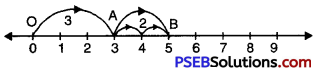
PSEB 6th Class Maths Solutions Chapter 2 Whole Numbers Ex 2.1 2
OA = 4, AB = 2, OB = 5
Hence, OB = 3 + 2 = 5.

Question (b)
4 + 5
Solution:
We draw a number line.
Starting from point 0 (i.e. zero), we move 4 steps to the right and mark this point as A.
Now, starting from A we move 5 steps towards right and arrive at B.
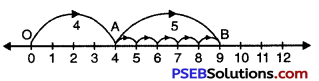
PSEB 6th Class Maths Solutions Chapter 2 Whole Numbers Ex 2.1 3
OA = 4, AB = 5, OB = 9
Hence, OB = 4 + 5 = 9.

PSEB 6th Class Maths Solutions Chapter 2 Whole Numbers Ex 2.1

Question (c)
6 + 2
Solution:
We draw a number line.
Starting from point 0 (i.e. zero), we move 6 steps to the right and mark this point as A.
Now, starting from A we move 2 steps towards right and arrive at B.
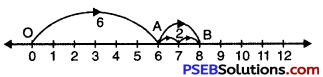
PSEB 6th Class Maths Solutions Chapter 2 Whole Numbers Ex 2.1 4
OA = 6, AB = 2, OB = 8
Hence, OB = 6 + 2 = 8.

Question (d)
8 – 3
Solution:
We draw a number line.
Starting from point 0 (i.e. zero), we move 8 steps to the right and arrive at A.
Now, starting from A we move 3 steps to the left of A and arrive at B.
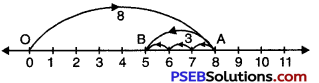
PSEB 6th Class Maths Solutions Chapter 2 Whole Numbers Ex 2.1 5
OA = 8, AB = 3, OB = 5
Hence, OB = 8 – 3 = 5.

Question (e)
7 – 4
Solution:
We draw a number line.
Starting from point 0 (i.e. zero), we move 7 steps to the right and arrive at A.
Now, starting from A we move 4 steps to the left of A and arrive at B.
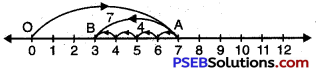
PSEB 6th Class Maths Solutions Chapter 2 Whole Numbers Ex 2.1 6
OA = 7, AB = 4, OB = 3
Hence, OB = 7 – 4 = 3.

PSEB 6th Class Maths Solutions Chapter 2 Whole Numbers Ex 2.1

Question (f)
7 – 2
Solution:
We draw a number line.
Starting from point 0 (i.e. zero), we move 7 steps to the right and arrive at A.
Now, starting from A, we move 2 steps to the left of A and arrive at B.
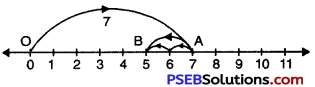
PSEB 6th Class Maths Solutions Chapter 2 Whole Numbers Ex 2.1 7
OA = 7, AB = 2, OB = 5
Hence, OB = 7 – 2 = 5.

Question (g)
3 × 3
Solution:
We draw a number line.
Starting from 0 we move 3 units to the right of 0 to arrive at A.
We make two more such same moves starting from A (total 3 moves of 3 units each) to reach finally at C which represents 9.
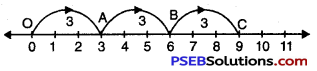
PSEB 6th Class Maths Solutions Chapter 2 Whole Numbers Ex 2.1 8
Hence, 3 × 3 = 9.

Question (h)
2 × 5
Solution:
We draw a number line.
We start from 0 move 5 units at a time to right.
We make 2 such moves. We shall reach at 10.
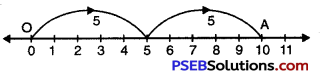
PSEB 6th Class Maths Solutions Chapter 2 Whole Numbers Ex 2.1 9
So, 2 × 5 = 10.

PSEB 6th Class Maths Solutions Chapter 2 Whole Numbers Ex 2.1

Question (i)
3 × 5
Solution:
We draw a number line.
We start from 0, move 5 units at a time to right.
We make 3 such moves. We shall reach at 15.
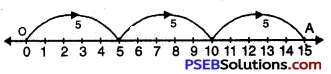
PSEB 6th Class Maths Solutions Chapter 2 Whole Numbers Ex 2.1 10
So, 3 × 5 = 15

Question (j)
9 ÷ 3
We draw a number line.
Starting from 0, we move 9 units to the right of 0 to arrive at A.
Now, from A take moves of 3 units to the left of A till we reach at ‘O’. We observe that there are 3 moves.
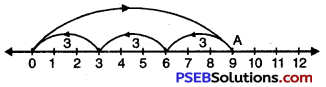
PSEB 6th Class Maths Solutions Chapter 2 Whole Numbers Ex 2.1 11
So, 9 ÷ 3 = 3.

Question (k)
12 ÷ 4
We draw a number line.
Starting from 0, we move 12 units to the right of 0 to arrive at A.
Now, from A take moves of 4 units to the left of A till we reach at ‘O’. We observe that there are 3 moves.
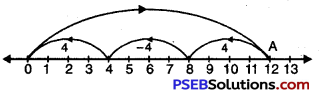
PSEB 6th Class Maths Solutions Chapter 2 Whole Numbers Ex 2.1 12
So, 12 ÷ 4 = 3.

PSEB 6th Class Maths Solutions Chapter 2 Whole Numbers Ex 2.1

Question (l)
10 ÷ 2
Solution:
We draw a number line.
Starting from 0, we move 10 units to the right of 0 to arrive at A.
Now, from A take moves of 2 units to the left c A till we reach at ‘O’. We observe that there are 5 moves.
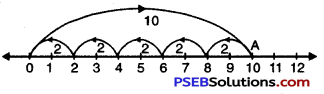
PSEB 6th Class Maths Solutions Chapter 2 Whole Numbers Ex 2.1 13
So, 10 ÷ 2 = 5.

8. Fill in the blanks with the appropriate symbol < or > :

Question (i)
(a) 25 ……………. 205
(b) 170 …………… 107
(c) 415 …………… 514
(d) 10001 ………….. 9999
(e) 2300014 ………….. 2300041
(f) 99999 …………… 888888.
Solution:
(a) 25 < 205 (b) 170 > 107
(c) 415 < 514 (d) 10001 > 9999
(c) 2300014 < 2300041
(f) 99999 < 888888.

PSEB 7th Class Maths Solutions Chapter 8 Comparing Quantities Ex 8.3

Punjab State Board PSEB 7th Class Maths Book Solutions Chapter 8 Comparing Quantities Ex 8.3 Textbook Exercise Questions and Answers.

PSEB Solutions for Class 7 Maths Chapter 8 Comparing Quantities Ex 8.3

1. Find what is the profit or loss in the following transactions. Also find profit percent or loss percent in each case.

Question (i).
Gardening shears bought for ₹ 250 and sold for ₹ 325
Solution:
C.P. of gardening shears = ₹ 250
S.P. of gardening shears = ₹ 325
Profit = S.P. – C.P.
= ₹ 325 – ₹ 250
= ₹ 75
Profit percentage = \(\left[\frac{\text { Profit }}{\text { Cost price }} \times 100\right] \%\)
= \(\left[\frac{75}{250} \times 100\right] \%\)
= 30%

Question (ii).
A refrigerater bought for ₹ 12,000 and sold at ₹ 13,500
Solution:
C.P. of refrigerator = ₹ 12,000
S.P. of refregerator = ₹ 13,500
Profit = S.P. – C.P.
= ₹ 13,500 – ₹ 12,000
= ₹ 1500
Profit percentage = \(\left(\frac{\text { Profit }}{\text { C.P. }} \times 100\right) \%\)
= \(\left(\frac{1500}{12000} \times 100\right) \%\)
= 12.5%

Question (iii).
A cupboard bought for ₹ 2,500 and old at ₹ 3,000.
Solution:
C.P. of card board = ₹ 2,500
S.P. of card board = ₹ 3,000
Profit = S.P. – C.P.
= ₹ 3000 – ₹ 2500
= ₹ 500
Profit percentage = \(\left(\frac{\text { Profit }}{\text { C.P. }} \times 100\right) \%\)
= \(\left(\frac{500}{2500} \times 100\right) \%\)
= 20%

PSEB 7th Class Maths Solutions Chapter 8 Comparing Quantities Ex 8.3

Question (iv).
A shirt bought for ₹ 250 and sold at ₹ 150
Solution:
C.P. of shirt = ₹ 250
S.P. of shirt a ₹ 150
Since S.P. is less than C.P.
So, there will be a loss
Loss = C.P. – S.P.
= ₹ 250 – ₹ 150
= ₹ 100
Loss percentage = \(\left(\frac{\text { Loss }}{\text { C.P. }} \times 100\right) \%\)
= \(\left(\frac{100}{250} \times 100\right) \%\)
= 40%

2. A shopkeeper buys an article for ₹ 735 and sold it for ₹ 850. Find his profit or loss.
Solution:
C.P. of an article = ₹ 735
S.P. of an article = ₹ 850
Profit = ₹ 850 – ₹ 735
= ₹ 115

3. Kirti bought a saree for ₹ 2500 and sold it for ₹ 2300. Find her loss and loss percent.
Solution:
C.P. of saree = ₹ 2500
S.P. of saree = ₹ 2300
Loss = C.P. – S.P.
= ₹ 2500 – ₹ 2300
= ₹ 200
Loss percentage = \(\left(\frac{\text { Loss }}{\text { C.P. }} \times 100\right) \%\)
= \(\frac {200}{2500}\) × 100
= 8%

PSEB 7th Class Maths Solutions Chapter 8 Comparing Quantities Ex 8.3

4. An article was sold for ₹ 252 with a profit of 5%. What was its cost price ?
Solution:
S.P. of an article = ₹ 252
Profit = 5%
Let C.P. of article = ₹ 100
Profit = 5% of ₹ 100
= ₹ 5
S.P. of article = ₹ 100 + ₹ 5
= ₹ 105
If S.P. is ₹ 105, then C.P. = ₹ 100
If S.P. is ₹ 1 then C.P. = ₹ \(\frac {100}{105}\)
If S.P. is ₹ 252, then C.P. = ₹ \(\frac {100}{105}\) × 252
= ₹ 240

5. Amrit buys a book for ₹ 275 and sells it at a loss of 15%. For how much does she sell it ?
Solution:
C.P. of book = ₹ 275
Loss = 15%
∴ Loss on ₹ 275 = ₹ \(\frac {15}{100}\) × 275
= ₹ 41.25
Thus, S.P. of book = ₹ 275 – ₹ 41.25
= ₹ 233.75

6. Juhi sells a washing machine for ₹ 13500. She losses 20% in the bargain. What was the price at which she bought it ?
Solution:
S.P. of washing machine = ₹ 13500
Let C.P. = ₹ 100
Loss = 20%
S.P. = ₹ 100 – ₹ 20
= ₹ 80
If S.P. of washing machine is ₹ 80 then its cost price = ₹ 100
If S.P. of washing machine is ₹ 1 then its cost price = ₹ \(\frac {100}{80}\)
If S.P. of washing machine is ₹ 13500
then its cost price = ₹ \(\frac {100}{80}\) × 13500
= ₹ 16875

PSEB 7th Class Maths Solutions Chapter 8 Comparing Quantities Ex 8.3

7. Anita takes a loan of ₹ 5000 at 15% per year as rate of interest. Find the interest she has to pay at the end of one year.
Solution:
Here, Principal (P) = ₹ 5000
Rate (R) = 15% per year
Time (T) = 1 year
Simple interest = \(\frac{\mathrm{P} \times \mathrm{R} \times \mathrm{T}}{100}\)
= \(\frac{5000 \times 15 \times 1}{100}\)
= ₹ 750

8. Find the amount to be paid at the end of 3 years in each case :

Question (i).
Principal = ₹ 1200 at 12% p.a.
Solution:
P = ₹ 1200, R = 12% p.a.
T = 3 years
Simple interest = \(\frac{\mathrm{P} \times \mathrm{R} \times \mathrm{T}}{100}\)
= \(\frac{1200 \times 12 \times 3}{100}\)
= ₹432
Amount = Principal + Simple Interest
= ₹ 1200 + ₹ 432
= ₹ 1632

Question (ii).
Principal = ₹ 7500 at 5% p.a.
Solution:
P = ₹ 7500, R = 5% p.a. T = 3 years
SI = \(\frac{\mathrm{P} \times \mathrm{R} \times \mathrm{T}}{100}\)
= ₹\(\frac{7500 \times 5 \times 3}{100}\)
= ₹ 1125
Amount = P + S.I. = ₹ 7500 + ₹ 1125
= ₹ 8625

PSEB 7th Class Maths Solutions Chapter 8 Comparing Quantities Ex 8.3

9. Find the time when simple interest on ₹ 2500 at 6% p.a. is ₹ 450
Solution:
P = ₹ 2500, R = 6% p.a. Time = T = ?,
S.I. = ₹ 450
T = \(\frac{\mathrm{SI} \times 100}{\mathrm{P} \times \mathrm{R}}\)
T = \(\frac{450 \times 100}{2500 \times 6}\)
= 3 years

10. Find the rate of interest when simple interest on ₹ 1560 in 3 years is ₹ 585.
Solution:
Principal (P) = ₹ 1560
Time (T) = 3 years
S.I. = ₹ 585
R = \(\frac{\text { SI } \times 100}{\mathrm{P} \times \mathrm{T}}\)
= \(\frac{585 \times 100}{1560 \times 3}\)
= \(\frac {125}{10}\)
= 12.5
Thus Rate of interest is 12.5% p.a.

11. If Nakul gives an interest of ₹ 45 for, one year at 9% rate p.a. what is the sum he borrowed ?
Solution:
Here S.I.= ₹ 45, R = 9% p.a.
T = 1 year, P = ?
P = \(\frac{\text { S.I. } \times 100}{\mathrm{R} \times \mathrm{T}}\)
= \(\frac{45 \times 100}{9 \times 1}\)
= ₹ 500

12. If ₹ 14,000 is invested at 4% per annum simple interest, how long will it take for the amount to reach ₹ 16240 ?
Solution:
P = ₹ 14,000
R = 4% p.a.
T = ?
A = ₹ 16240
S.I. = A – P
= ₹ 16240 – ₹ 14,000
= ₹ 2240
T = \(\frac{\text { SI } \times 100}{\mathrm{R} \times \mathrm{P}}\)
= \(\frac{2240 \times 100}{14000 \times 4}\)
= 4 years

PSEB 7th Class Maths Solutions Chapter 8 Comparing Quantities Ex 8.3

13. Multiple Choice Questions :

Question (i).
If a man buys an article for ₹ 80 and sells it for ₹ 100, then gain percentage is
(a) 20%
(b) 25%
(c) 40%
(d) 125%
Answer:
(b) 25%

Question (ii).
If a man buys an article for ₹ 120 and sells it for ₹ 100, then his loss percentage is
(a) 10%
(b) 20%
(c) 25%
(d) 16\(\frac {2}{3}\)%
Answer:
(d) 16\(\frac {2}{3}\)%

Question (iii).
The salary of a man is ₹ 24000 per month. If he gets an increase of 25% in the salary, then the new salary per month is
(a) ₹ 2,500
(b) ₹ 28,000
(c) ₹ 30,000
(d) ₹ 36,000
Answer:
(c) ₹ 30,000

Question (iv).
On selling an article for ₹ 100, Renu gains ₹ 20 Her gain percentage is
(a) 25%
(b) 20%
(c) 15%
(d) 40%
Answer:
(a) 25%

PSEB 7th Class Maths Solutions Chapter 8 Comparing Quantities Ex 8.3

Question (v).
The simple interest on ₹ 6000 at 8% p.a. for one year is
(a) ₹ 600
(b) ₹ 480
(c) ₹ 400
(d) ₹ 240
Answer:
(b) ₹ 480

Question (vi).
If Rohini borrows ₹ 4800 at 5% p.a. simple interest, then the amount she has to return at the end of 2 years is.
(a) ₹ 480
(b) ₹ 5040
(c) ₹ 5280
(d) ₹ 5600
Answer:
(c) ₹ 5280

PSEB 7th Class Science Notes Chapter 18 Wastewater Story

This PSEB 7th Class Science Notes Chapter 18 Wastewater Story will help you in revision during exams.

PSEB 7th Class Science Notes Chapter 18 Wastewater Story

→ Sewage is liquid waste, most of it is water that has dissolved and suspended impurities. These impurities are called contaminants.

→ An underground network of pipes that carry wastewater from a home to a point of disposal is called Sewerage.

→ Sewage is transported through the closed pipes to the wastewater treatment plants where pollutants are separated and reformed and then flow into rivers and oceans.

→ During wastewater treatment pollutants are separated by physical, chemical, and biological methods.

PSEB 7th Class Science Notes Chapter 18 Wastewater Story

→ Sludge is a solid that settles to the bottom during water purification.

→ Wastewater treatment co-products are sludge and biogas.

→ A manhole is a lid-covered open space through which a person can enter and can check the sewerage system.

→ Open defecation is a breeding ground for flies, mosquitoes, and other insects that cause many diseases.

→ Do not throw oil, ghee, grease, etc. in a drain or in the open. Doing so will make drain chock.

→ Throw trash only in the bin (dustbin).

→ Pollutants: Dissolved and suspended impurities in dirty water are called pollutants.

→ Sewerage: A network of small and large pipes that carry wastewater to the drainage area.

→ Manhole: Large open mouth holes are made at every 50-60 meters of the sewerage system.

→ Individual who enters the sewage can check and remove sewage problem if any.

PSEB 7th Class Science Notes Chapter 18 Wastewater Story

→ Water Treatment Plant: A place where impurities are separated from wastewater.

→ Water Treatment: The process of separating impurities from wastewater is called water treatment.

→ Sludge is the solid that settles in the sewage water purification tank.

→ Septic tank: This is a small system of sewage treatment containing monoaerobic bacteria that remove waste products. It has connections with main sewage pipes.

PSEB 7th Class Science Notes Chapter 17 Forests: Our Lifeline

This PSEB 7th Class Science Notes Chapter 17 Forests: Our Lifeline will help you in revision during exams.

PSEB 7th Class Science Notes Chapter 17 Forests: Our Lifeline

→ A system made up of plants, animals, and micro-organisms are called a forest.

→ The top layer of the forest is Canopy Layer, the mid-layer is the Crown layer and the lower layer is the Understory layer.

→ Forests protect the soil from erosion.

→ Soil helps in the growth and development of trees.

PSEB 7th Class Science Notes Chapter 17 Forests: Our Lifeline

→ Humus shows that nutrients from the bodies of dead plants and animals have been incorporated into the soil.

→ Forests act like green lungs and produce many products. That is why forests are so important.

→ A forest is an area whose uppermost layer is topped by trees.

→ Forests are always green.

→ A variety of animals, plants, and insects are found in forests.

→ All wild animals, herbivores or carnivores, depend on plants for food in one or the another way.

→ Forests continue to grow and develop and can regenerate.

→ Forests affect climate, water cycle, and air quality.

→ Trees, shrubs, vegetation, herbs, etc. all are found in forests.

→ According to the height of trees and plants, forests are divided into three categories:

  • Canopy
  • Crown
  • Understory

PSEB 7th Class Science Notes Chapter 17 Forests: Our Lifeline

→ Forest soil helps in regeneration.

→ Forest plants emit vapours and help bring rain and regulate the temperature of the environment.

→ Different layers of vegetation in forests provide food and shelter to animals, birds, and insects.

→ In the forest, soil, water, air, and living things have interdependence on each other.

→ Forests provide important basic necessities for communities living in forested areas.

→ Forests maintain and regulate climate, water cycle, and air quality.

→ Decomposers depend on the dead bodies of plants and animals and turn them into simple substances.

→ Deforestation causes global warming, decreases rainfall, increases pollution, and erodes soil.

→ To maintain balance in nature and maintain habitat for wild animals and plants forest plays an important role.

→ Forest: A forest is an area where there is a lot of dense vegetation, including animals, trees, bushes, and weeds that grow naturally.

→ Canopy: The top layer of tree branches forms a dense top layer of trees on earth which is called the canopy.

PSEB 7th Class Science Notes Chapter 17 Forests: Our Lifeline

→ Crown layer: The layer in which the branches and trunks of trees come, is called the crown or crown layer.

→ Understory Layer: The shaded area below which there is very little light, is called the lower or understory layer.

→ Ecosystems: Living things and their environment work together to create ecosystems. Plants, animals, and microorganisms are the biological components of the ecosystem. These are divided into different categories of producers, consumers, and decomposers.

→ Food chain: In ecology, the sequence of transfer of matter and energy in the form of food from one organism to another organism is called a food chain.
For example:
PSEB 7th Class Science Notes Chapter 17 Forests: Our Lifeline

→ Food Web: A food web consists of a network of many food chains. A food chain helps provide food to organisms at the next food level.

→ Afforestation: The process of planting trees on a large scale is called Afforestation.

→ Decomposers: Microorganisms that decompose the dead bodies of plants and animals into humus, are called Decomposers.

PSEB 7th Class Science Notes Chapter 17 Forests: Our Lifeline

→ Erosion: In the absence of trees and plants top layer of soil is lost, This process of carrying away the topsoil by wind and water is called soil erosion.

→ Replenishment of forest: Planting a large number of plants and trees in the forest area is called forest replenishment.
