PSEB 6th Class Maths MCQ Chapter 2 Whole Numbers

Punjab State Board PSEB 6th Class Maths Book Solutions Chapter 2 Whole Numbers MCQ Questions with Answers.

PSEB 6th Class Maths Chapter 2 Whole Numbers MCQ Questions

Multiple Choice Questions

Question 1.
The smallest whole number is:
(a) 0
(b) 1
(c) 2
(d) 3.
Answer:
(a) 0

PSEB 6th Class Maths MCQ Chapter 2 Whole Numbers

Question 2.
The smallest natural number is:
(a) 0
(b) 1
(c) 2
(d) 3.
Answer:
(b) 1

Question 3.
The successor of 38899 is:
(a) 39000
(b) 38900
(c) 39900
(d) 38800.
Answer:
(b) 38900

Question 4.
The predecessor of 24100 is:
(a) 24999
(b) 24009
(c) 24199
(d) 24099.
Answer:
(d) 24099.

Question 5.
The statement 4 + 3 = 3 + 4 represents:
(a) Closure
(b) Associative
(c) Commutative property
(d) Identity.
Answer:
(c) Commutative property

Question 6.
Which of the following is the additive identity?
(a) 0
(b) 1
(c) 2
(d) 3.
Answer:
(a) 0

Question 7.
The multiplicative identity is ………………. .
(a) 0
(b) 1
(c) 2
(d) 3
Answer:
(b) 1

PSEB 6th Class Maths MCQ Chapter 2 Whole Numbers

Question 8.
15 × 32 + 15 × 68 = …………….. .
(a) 1400
(b) 1600
(c) 1700
(d) 1500
Answer:
(d) 1500

Question 9.
The largest 4 digit number divisible by 13 is:
(a) 9997
(b) 9999
(c) 9995
(d) 9991.
Answer:
(a) 9997

Question 10.
The successor of 3 digit largest number is:
(a) 100
(b) 998
(c) 1001
(d) 1000
Answer:
(d) 1000

Question 11.
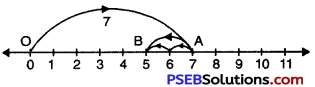
Which of the following is shown on the given number line?
PSEB 6th Class Maths MCQ Chapter 2 Whole Numbers 1
(a) 2 + 5
(b) 5 + 2
(c) 7 – 2
(d) 7 – 5.
Answer:
(d) 7 – 5

PSEB 6th Class Maths MCQ Chapter 2 Whole Numbers

Question 12.
The whole number which comes just before 10001 is:
(a) 10000
(b) 10002
(c) 9999
(d) 9998.
Answer:
(a) 10000

Question 13.
The smallest natural number is:
(a) 1
(b) 0
(c) 9
(d) 10
Answer:
(a) 1

Question 14.
Which is the smallest whole number?
(a) 1
(b) 0
(c) -1
(d) 9
Answer:
(b) 0

Question 15.
Which is the successor of 100199?
(a) 100198
(b) 100197
(c) 100200
(d) 100201.
Answer:
(c) 100200

Question 16.
Which is the predecessor of 10000?
(a) 10001
(b) 9999
(c) 10002
(d) 9998.
Answer:
(b) 9999

Question 17.
How many whole numbers are there between 32 and 53?
(a) 21
(b) 22
(c) 19
(d) 20.
Answer:
(d) 20

PSEB 6th Class Maths MCQ Chapter 2 Whole Numbers

Fill in the blanks:

  1. 25 …………… 205
  2. 10001 …………. 9999
  3. 15 × 0 = …………….
  4. 0 ÷ 25 = ………….
  5. 1 ÷ 1 = ……………

Answer:

  1. <
  2. >
  3. 0
  4. 0
  5. 1

Write True or False:

Question 1.
Zero is smallest natural number. (True/False)
Answer:
False

Question 2.
All natural numbers are whole numbers. (True/False)
Answer:
True

Question 3.
All whole numbers are, natural numbers. (True/False)
Answer:
False

PSEB 6th Class Maths MCQ Chapter 2 Whole Numbers

Question 4.
The naitural number 1 has no predecessor. (True/False)
Answer:
True

Question 5.
500 is the predecessor of 490. (True/False)
Answer:
False

PSEB 6th Class Maths Solutions Chapter 2 Whole Numbers Ex 2.3

Punjab State Board PSEB 6th Class Maths Book Solutions Chapter 2 Whole Numbers Ex 2.3 Textbook Exercise Questions and Answers.

PSEB Solutions for Class 6 Maths Chapter 2 Whole Numbers Ex 2.3

1. If the product of two whole numbers is zero. Can we say that one or both of them will be zero? Justify through examples.
Solution:
One of them can be Zero i.e. 0 × 5 = 0
Both of them can be Zero i.e. 0 × 0 = 0.

PSEB 6th Class Maths Solutions Chapter 2 Whole Numbers Ex 2.3

2. If the product of two whole numbers is 1. Can we say that one or both of them will be 1? Justify through examples.
Solution:
Both of them will be 1.
Example: 1 × 1 = 1.

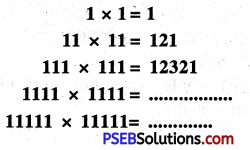
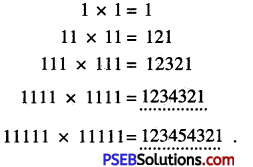
3. Observe the pattern in the following and fill in the blanks:
PSEB 6th Class Maths Solutions Chapter 2 Whole Numbers Ex 2.3 1
Solution:
PSEB 6th Class Maths Solutions Chapter 2 Whole Numbers Ex 2.3 2

PSEB 6th Class Maths Solutions Chapter 2 Whole Numbers Ex 2.3

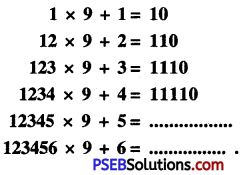
4. Observe the pattern and fill in the blanks:
PSEB 6th Class Maths Solutions Chapter 2 Whole Numbers Ex 2.3 3
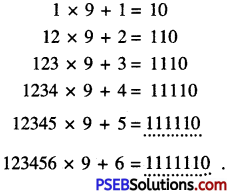
Solution:
PSEB 6th Class Maths Solutions Chapter 2 Whole Numbers Ex 2.3 4

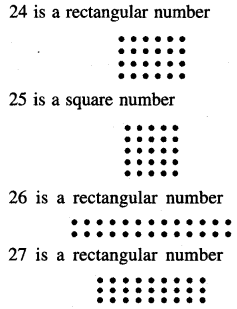
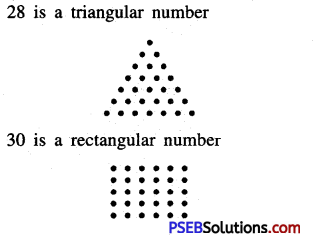
5. Represent numbers from 24 to 30 according to rectangular, square or triangular pattern.
Solution:
Numbers from 24 to 30 are 24, 25, 26, 27, 28, 29, 30.
PSEB 6th Class Maths Solutions Chapter 2 Whole Numbers Ex 2.3 5
PSEB 6th Class Maths Solutions Chapter 2 Whole Numbers Ex 2.3 6

PSEB 6th Class Maths Solutions Chapter 2 Whole Numbers Ex 2.3

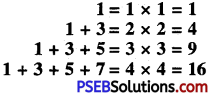
6. Study the following pattern:

Question (i)
PSEB 6th Class Maths Solutions Chapter 2 Whole Numbers Ex 2.3 7
Hence find the sum of
(a) First 12 odd numbers
(b) First 50 odd numbers.
Solution:
(a) Sum of first 12 odd numbers = 12 × 12 = 144
(b) Sum of first 50 odd numbers = 50 × 50 = 2500

PSEB 6th Class Maths Solutions Chapter 2 Whole Numbers Ex 2.2

Punjab State Board PSEB 6th Class Maths Book Solutions Chapter 2 Whole Numbers Ex 2.2 Textbook Exercise Questions and Answers.

PSEB Solutions for Class 6 Maths Chapter 2 Whole Numbers Ex 2.2

1. Find the sum by suitable arrangement of terms:

Question (a)
837 + 208 + 363
Solution:
837 + 208 + 363
= (837 + 363) + 208
= 1200 + 208
= 1408

PSEB 6th Class Maths Solutions Chapter 2 Whole Numbers Ex 2.2

Question (b)
1962 + 453 + 1538 + 647.
Solution:
1962 + 453 + 1538 + 647
= (1962 + 1538) + (453 + 647)
= 3500 + 1100
= 4600

2. Find the product by suitable arrangement of terms:

Question (a)
2 × 1497 × 50
Solution:
= (2 × 50) × 1497
= 100 × 1497
= 149700

Question (b)
4 × 263 × 25
Solution:
= (4 × 25) × 263
= 100 × 263
= 26300

Question (c)
8 × 163 × 125
Solution:
= (8 × 125) × 163
= 1000 × 163
= 163000

Question (d)
963 × 16 × 25
Solution:
= 963 × (16 × 25)
= 963 × 400
= 385200

PSEB 6th Class Maths Solutions Chapter 2 Whole Numbers Ex 2.2

Question (e)
5 × 171 × 60
Solution:
= (5 × 60) × 171
= 300 × 171
= 51300

Question (f)
125 × 40 × 8 × 25
Solution:
= (125 × 40) × (8 × 25)
= 5000 × 200
= 1000000

Question (g)
30921 × 25 × 40 × 2
Solution:
= 30921 × (25 × 40) × 2
= 30921 × 1000 × 2
= 61842000

Question (h)
4 × 2 × 1932 × 125
Solution:
4 × 2 × 1932 × 125
= 1932 × (4 × 2 × 125)
= 1932 × 1000
= 1932000

Question (i)
5462 × 25 × 4 × 2.
Solution:
= 5462 × 2 × 25 × 4
= 10924 × 100
= 1092400

PSEB 6th Class Maths Solutions Chapter 2 Whole Numbers Ex 2.2

3. Find the value of each of the following using distributive property:

Question (a)
(649 × 8) + (649 × 2)
Solution:
(649 × 8) + (649 × 2)
= 649 × (8 + 2)
= 649 × 10
= 6490

Question (b)
(6524 × 69) + (6524 × 31)
Solution:
(6524 × 69) + (6524 × 31)
= 6524 × (69 + 31)
= 6524 × 100
= 652400

Question (c)
(2986 × 35) + (2986 × 65)
Solution:
(2986 × 35) + (2986 × 65)
= 2986 × (35 + 65)
= 2986 × 100
= 298600

Question (d)
(6001 × 172) – (6001 × 72).
Solution:
(6001 × 172) – (6001 × 72)
= 6001 × (172 – 72)
= 6001 × 100
= 600100

4. Find the value of the following:

Question (a)
493 × 8 + 493 × 2
Solution:
(a) 493 × 8 + 493 × 2
= 493 × (8 + 2) = 493 × 10
= 4930

PSEB 6th Class Maths Solutions Chapter 2 Whole Numbers Ex 2.2

Question (b)
24579 × 93 + 7 × 24579
Solution:
24579 × 93 + 7 × 24579
= 24579 × (93 + 7)
= 24579 × 100
= 2457900

Question (c)
3845 × 5 × 782 + 769 × 25 × 218
Solution:
3845 × 5 × 782 + 769 × 25 × 218
= 769 × 5 × 5 × 782 + 769 × 5 × 5 × 218
= 769 × 5 × 5 × (782 + 218)
= 769 × 25 × 1000
= 19225 × 1000
= 19225000

Question (d)
3297 × 999 + 3297.
Solution:
3297 × 999 + 3297
= (3297) × (999 + 1)
= 3297 × 1000
= 3297000

5. Find the product, using suitable properties:

Question (a)
738 × 103
Solution:
= 738 × (100 + 3)
= (738 × 100) + (738 × 3)
[Using a × (b + c) = (a × b) + (a × c)]
= 73800 + 2214
= 76014

PSEB 6th Class Maths Solutions Chapter 2 Whole Numbers Ex 2.2

Question (b)
854 × 102
Solution:
= 854 × (100 + 2)
= (854 × 100) + (854 × 2)
[Using a × (b + c) = (a × b) + (a × c)]
= 85400 + 1708
= 87108

Question (c)
258 × 1008
Solution:
= 258 × (1000 + 8)
= (258 × 1000) + (258 x 8)
[Using a × (b + c) = (a × b) + (a × c)]
= 258000 + 2064
= 260064

Question (d)
736 × 93
Solution:
= 736 × (100 – 7)
= 736 × 100 = 736 × 7
[Using a × (b – c) = (a × b) – (a × c)]
= 73600 – 5152
= 68448

Question (e)
816 × 745
Solution:
= (800 + 16) × 745
= 800 × 745 + 16 × 745
[Using a × (b + c) = (a × b) + (a × c)]
= 596000 + 11920
= 607920

PSEB 6th Class Maths Solutions Chapter 2 Whole Numbers Ex 2.2

Question (f)
2032 × 613
Solution:
= 2032 × (600 + 13)
= 2032 × 600 + 2032 × 13
[Using a × (b + c) = (a × b) + (a × c)]
= 1219200 + 26416
= 1245616

6. A taxi driver filled his car petrol tank with 40 litres of petrol on Monday. The next day, he filled the tank with 50 litres of petrol. If the petrol costs ₹ 78 per litre, how much he spend in all on petrol?
Solution:
Petrol filled on Monday = 40 Litres
Petrol filled on Tuesday = 50 Litres
Total Petrol filled = 40 + 50 = 90 Litres
Cost per litre = ₹ 78
Total Cost = 90 × ₹ 78
= ₹ 7020

7. A vendor supplies 32 litres of milk to a hotel in the morning and 68 litres of milk in the evening. If the milk costs ₹ 35 per litre, how much money is due to the vendor per day?
Solution:
Milk supplied in the morning = 32 Litres
Milk supplied in the evening = 68 Litres
Total milk supplied = 32 + 68
= 100 Litres
Cost Per litre = ₹ 35
∴ Total cost of milk per day = 100 × ₹ 35
= ₹ 3500

PSEB 6th Class Maths Solutions Chapter 2 Whole Numbers Ex 2.2

8. We know that 0 × 0 = 0. Is there any other whole number which when multiplied by itself gives the product equal to the number itself? Find out the number.
Solution:
Yes, there is a whole number 1.
Here 1 × 1 = 1.

9. Fill in the blanks:

Question (i)
(a) 15 × 0 = ………….. .
(b) 15 + 0 = ………….. .
(c) 15 – 0 = ………….. .
(d) 15 ÷ 0 = ………….. .
(e) 0 × 15 = ………….. .
(f) 0 + 15 = ………….. .
(g) 0 ÷ 15 = ………….. .
(h) 15 × 1 = ………….. .
(i) 15 ÷ 1 = ………….. .
(j) 1 ÷ 1 = ………….. .
Solution:
(a) 0,
(b) 15,
(c) 15,
(d) Not defined,
(e) 0,
(f) 15,
(g) 0,
(h) 15,
(i) 15,
(j) 1.

PSEB 6th Class Maths Solutions Chapter 2 Whole Numbers Ex 2.2

Question 10.
The product of two Whole numbers is zero. What do you conclude. Explain with example.
Solution:
We conclude that one number must be zero such 25 × 0 = 0.

Question 11.
Match the following:

1. 537 × 106 = 537 ×100 + 537 × 6 (a)  Commutativity under multiplication
2. 4 × 47 × 25 = 4 × 25 × 47 (b) Commutativity under addition
3. 70 + 1923 + 30 = 70 + 30 + 1923 (c)  Distributivity of multiplication over addition.

Solution:

1. 537 × 106 = 537 × 100 + 537 × 6 (c)  Distributivity of multiplication over addition.
2. 4 × 47 × 25 = 4 × 25 × 47 (a)  Commutativity under multiplication
3. 70 + 1923 + 30 = 70 + 30 + 1923 (b) Commutativity under addition

PSEB 6th Class Maths Solutions Chapter 2 Whole Numbers Ex 2.1

Punjab State Board PSEB 6th Class Maths Book Solutions Chapter 2 Whole Numbers Ex 2.1 Textbook Exercise Questions and Answers.

PSEB Solutions for Class 6 Maths Chapter 2 Whole Numbers Ex 2.1

1. Answer the following questions:

Question (a)
Write the smallest whole number.
Solution:
The smallest Whole number = 0

PSEB 6th Class Maths Solutions Chapter 2 Whole Numbers Ex 2.1

Question (b)
Write the smallest natural number.
Solution:
The smallest natural number = 1

Question (c)
Write the successor of 0 in whole numbers.
Solution:
Successor of 0 = 0 + 1 = 1

Question (d)
Write the predecessor of 0 in whole numbers.
Solution:
Predecessor of 0 is whole number is not possible.

Question (e)
Write the Largest whole number.
Solution:
Largest whole number is not possible.

2. Which of the following statements are True (T) and which are False (F)?

Question (a)
Zero is the smallest natural number.
Solution:
False

PSEB 6th Class Maths Solutions Chapter 2 Whole Numbers Ex 2.1

Question (b)
Zero is the smallest whole number.
Solution:
True

Question (c)
Every whole number is a natural number.
Solution:
False

Question (d)
Every natural number is a whole number.
Solution:
True

Question (e)
1 is the smallest whole number.
Solution:
False

Question (f)
The natural number 1 has no predecessor in natural numbers.
Solution:
True

Question (g)
The whole number 1 has no predecessor in whole numbers.
Solution:
False

PSEB 6th Class Maths Solutions Chapter 2 Whole Numbers Ex 2.1

Question (h)
Successor of the largest two-digit number is smallest three-digit number.
Solution:
True

Question (i)
The successor of a two-digit number is always a two-digit number.
Solution:
False

Question (j)
300 is the predecessor of 299.
Solution:
False

Question (k)
500 is the successor of 499.
Solution:
True

Question (l)
The predecessor of a two-digit number is never a single-digit number.
Solution:
False

3. Write the successor of each of following:

Question (a)
100909
Solution:
Successor of 100909
= 100909 + 1
= 100910

PSEB 6th Class Maths Solutions Chapter 2 Whole Numbers Ex 2.1

Question (b)
4630999
Solution:
Successor of 4630999
= 4630999 + 1
= 4631000

Question (c)
830001
Solution:
Successor of 830001
= 830001 + 1
= 830002

Question (d)
99999.
Solution:
Successor of 99999
= 99999 + 1
= 100000

4. Write the predecessor of each of following:

Question (a)
1000
Solution:
Predecessor of 1000 = 1000 – 1
= 999

PSEB 6th Class Maths Solutions Chapter 2 Whole Numbers Ex 2.1

Question (b)
208090
Solution:
Predecessor of 208090 = 208090 – 1
= 208089

Question (c)
7654321
Solution:
Predecessor of 7654321 = 7654321 – 1
= 7654320

Question (d)
12576.
Solution:
Predecessor of 12576 = 12576 – 1
= 12575

5. Represent the following numbers on the number line: 2, 0, 3, 5, 7, 11, 15.
Solution:
Draw a line. Mark a point on it. Label it ‘O’. Mark a second point to the right of 0. Label it 1. The distance between these points labelled as 0 and 1 is called unit distance. On this line, mark a point to the right of 1 and at unit distance from 1 and label it 2. In this way go on labeling points at unit distance as 3, 4, 5, …………… on the line.
PSEB 6th Class Maths Solutions Chapter 2 Whole Numbers Ex 2.1 1

6. How many whole numbers are there between 22 and 43?
Solution:
Whole numbers between 22 and 43 are 23, 24, 25, 26, 27, 28, 29, 30, 31, 32, 33, 34, 35, 36, 37, 38, 39, 40, 41, 42
∴ There are 20 whole numbers between 22 and 43.
Or [(43 – 22) – 1 = 21 – 1 = 20].

PSEB 6th Class Maths Solutions Chapter 2 Whole Numbers Ex 2.1

7. Draw a number line to represent each of following on it.

Question (a)
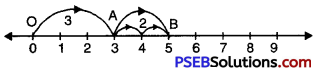
3 + 2
Solution:
We draw a number line and move 3 steps from 0 to the right and mark this point as A.
Now, starting from A we move 2 steps towards right and move at B.
PSEB 6th Class Maths Solutions Chapter 2 Whole Numbers Ex 2.1 2
OA = 4, AB = 2, OB = 5
Hence, OB = 3 + 2 = 5.

Question (b)
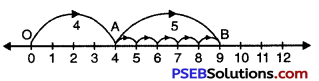
4 + 5
Solution:
We draw a number line.
Starting from point 0 (i.e. zero), we move 4 steps to the right and mark this point as A.
Now, starting from A we move 5 steps towards right and arrive at B.
PSEB 6th Class Maths Solutions Chapter 2 Whole Numbers Ex 2.1 3
OA = 4, AB = 5, OB = 9
Hence, OB = 4 + 5 = 9.

PSEB 6th Class Maths Solutions Chapter 2 Whole Numbers Ex 2.1

Question (c)
6 + 2
Solution:
We draw a number line.
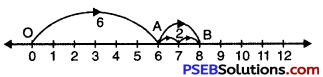
Starting from point 0 (i.e. zero), we move 6 steps to the right and mark this point as A.
Now, starting from A we move 2 steps towards right and arrive at B.
PSEB 6th Class Maths Solutions Chapter 2 Whole Numbers Ex 2.1 4
OA = 6, AB = 2, OB = 8
Hence, OB = 6 + 2 = 8.

Question (d)
8 – 3
Solution:
We draw a number line.
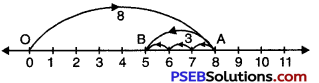
Starting from point 0 (i.e. zero), we move 8 steps to the right and arrive at A.
Now, starting from A we move 3 steps to the left of A and arrive at B.
PSEB 6th Class Maths Solutions Chapter 2 Whole Numbers Ex 2.1 5
OA = 8, AB = 3, OB = 5
Hence, OB = 8 – 3 = 5.

Question (e)
7 – 4
Solution:
We draw a number line.
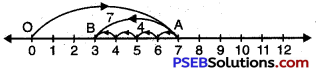
Starting from point 0 (i.e. zero), we move 7 steps to the right and arrive at A.
Now, starting from A we move 4 steps to the left of A and arrive at B.
PSEB 6th Class Maths Solutions Chapter 2 Whole Numbers Ex 2.1 6
OA = 7, AB = 4, OB = 3
Hence, OB = 7 – 4 = 3.

PSEB 6th Class Maths Solutions Chapter 2 Whole Numbers Ex 2.1

Question (f)
7 – 2
Solution:
We draw a number line.
Starting from point 0 (i.e. zero), we move 7 steps to the right and arrive at A.
Now, starting from A, we move 2 steps to the left of A and arrive at B.
PSEB 6th Class Maths Solutions Chapter 2 Whole Numbers Ex 2.1 7
OA = 7, AB = 2, OB = 5
Hence, OB = 7 – 2 = 5.

Question (g)
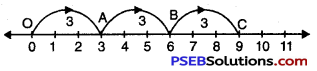
3 × 3
Solution:
We draw a number line.
Starting from 0 we move 3 units to the right of 0 to arrive at A.
We make two more such same moves starting from A (total 3 moves of 3 units each) to reach finally at C which represents 9.
PSEB 6th Class Maths Solutions Chapter 2 Whole Numbers Ex 2.1 8
Hence, 3 × 3 = 9.

Question (h)
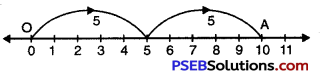
2 × 5
Solution:
We draw a number line.
We start from 0 move 5 units at a time to right.
We make 2 such moves. We shall reach at 10.
PSEB 6th Class Maths Solutions Chapter 2 Whole Numbers Ex 2.1 9
So, 2 × 5 = 10.

PSEB 6th Class Maths Solutions Chapter 2 Whole Numbers Ex 2.1

Question (i)
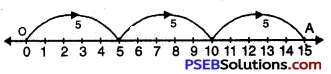
3 × 5
Solution:
We draw a number line.
We start from 0, move 5 units at a time to right.
We make 3 such moves. We shall reach at 15.
PSEB 6th Class Maths Solutions Chapter 2 Whole Numbers Ex 2.1 10
So, 3 × 5 = 15

Question (j)
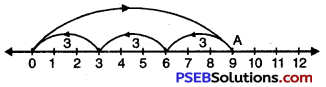
9 ÷ 3
We draw a number line.
Starting from 0, we move 9 units to the right of 0 to arrive at A.
Now, from A take moves of 3 units to the left of A till we reach at ‘O’. We observe that there are 3 moves.
PSEB 6th Class Maths Solutions Chapter 2 Whole Numbers Ex 2.1 11
So, 9 ÷ 3 = 3.

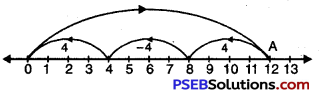
Question (k)
12 ÷ 4
We draw a number line.
Starting from 0, we move 12 units to the right of 0 to arrive at A.
Now, from A take moves of 4 units to the left of A till we reach at ‘O’. We observe that there are 3 moves.
PSEB 6th Class Maths Solutions Chapter 2 Whole Numbers Ex 2.1 12
So, 12 ÷ 4 = 3.

PSEB 6th Class Maths Solutions Chapter 2 Whole Numbers Ex 2.1

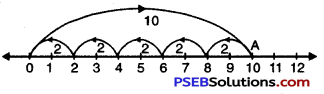
Question (l)
10 ÷ 2
Solution:
We draw a number line.
Starting from 0, we move 10 units to the right of 0 to arrive at A.
Now, from A take moves of 2 units to the left c A till we reach at ‘O’. We observe that there are 5 moves.
PSEB 6th Class Maths Solutions Chapter 2 Whole Numbers Ex 2.1 13
So, 10 ÷ 2 = 5.

8. Fill in the blanks with the appropriate symbol < or > :

Question (i)
(a) 25 ……………. 205
(b) 170 …………… 107
(c) 415 …………… 514
(d) 10001 ………….. 9999
(e) 2300014 ………….. 2300041
(f) 99999 …………… 888888.
Solution:
(a) 25 < 205 (b) 170 > 107
(c) 415 < 514 (d) 10001 > 9999
(c) 2300014 < 2300041
(f) 99999 < 888888.

PSEB 6th Class Maths MCQ Chapter 1 Knowing Our Numbers

Punjab State Board PSEB 6th Class Maths Book Solutions Chapter 1 Knowing Our Numbers MCQ Questions with Answers.

PSEB 6th Class Maths Chapter 1 Knowing Our Numbers MCQ Questions

Multiple Choice Questions

Question 1.
The number of digits are:
(a) 9
(b) 10
(c) 8
(d) Infinite.
Answer:
(b) 10

PSEB 6th Class Maths MCQ Chapter 1 Knowing Our Numbers

Question 2.
The greatest 4 digit number using 1, 5, 2, 9 once is:
(a) 9215
(b) 9512
(c) 5912
(d) 9521.
Answer:
(b) 9512

Question 3.
The smallest 4 digit number using 2, 0, 3, 7 once is:
(a) 0237
(b) 2037
(c) 7320
(d) 7023.
Answer:
(b) 2037

Question 4.
Which of the following are in ascending order?
(a) 217, 271, 127, 721
(b) 217, 127, 721, 271
(c) 127, 217, 271, 721
(d) 721, 271, 217, 127.
Answer:
(c) 127, 217, 271, 721

Question 5.
The face value of digit 4 in 23468 is:
(a) 4
(b) 400
(c) 40
(d) 468.
Answer:
(a) 4

Question 6.
The place value of digit 2 in 4123 is:
(a) 23
(b) 2
(c) 20
(d) 200.
Answer:
(c) 20

PSEB 6th Class Maths MCQ Chapter 1 Knowing Our Numbers

Question 7.
The difference between place value and face value of 5 in 76542 is:
(a) 537
(b) 45
(c) 0
(d) 495
Answer:
(d) 495

Question 8.
5 × 10000 + 3 × 100 + 2 × 10 + 2 = …………..
(a) 5322
(b) 53022
(c) 50322
(d) 53202.
Answer:
(c) 50322

Question 9.
Four lakh two thousand three hundred fifty-one = …………..
(a) 42351
(b) 402351
(c) 420351
(d) 4002351.
Answer:
(b) 402351

Question 10.
How many four-digit numbers are there?
(a) 9999
(b) 9900
(c) 9000
(d) 9990.
Answer:
(c) 9000

Question 11.
Seventeen million twenty-four thousand fifty-four = …………….
(a) 172454
(b) 170024054
(c) 170240054
(d) 17024054.
Answer:
(d) 17024054.

PSEB 6th Class Maths MCQ Chapter 1 Knowing Our Numbers

Question 12.
1 Crore = …………….. million.
(a) 1
(b) 10
(c) 100
(d) 1000.
Answer:
(b) 10

Question 13.
Rounded off 7213 to nearest thousands.
(a) 7200
(b) 7000
(c) 7210
(d) 7213.
Answer:
(b) 7000

Question 14.
Rounded off 45553 to nearest hundreds.
(a) 45500
(b) 45550
(c) 45600
(d) 45650.
Answer:
(c) 45600

Question 15.
Solve : (9 – 4) × 6 = …………….. .
(a) 30
(b) 54
(c) 78
(d) 64.
Answer:
(a) 30

Question 16.
Which of the following number does not have symbol in Roman numerals?
(a) 0
(b) 1
(c) 10
(d) 1000.
Answer:
(a) 0

PSEB 6th Class Maths MCQ Chapter 1 Knowing Our Numbers

Question 17.
How many symbols are used in Roman Numerals?
(a) 5
(b) 8
(c) 9
(d) 7.
Answer:
(d) 7

Question 18.
Which of the following are meaningless?
(a) LXIX
(b) XC
(c) IL
(d) LI.
Answer:
(c) IL

Question 19.
CLXVI = ………..
(a) 164
(b) 144
(c) 176
(d) 166.
Answer:
(d) 166

Question 20.
XCIX + XLVI = …………….
(a) CVL
(b) CLV
(c) CXLV
(d) CXLIV.
Answer:
(c) CXLV

Question 21.
Using the digits 4, 5, 7 and 0 without repetition which of the following is the smallest four-digit number?
(a) 0457
(b) 4057
(c) 4507
(d) 4075.
Answer:
(b) 4057

PSEB 6th Class Maths MCQ Chapter 1 Knowing Our Numbers

Question 22.
Using the digits 2, 8, 7 and 4 without repetition which of the following is the greatest four-digit number?
(a) 2874
(b) 8742
(c) 8472
(d) 8274.
Answer:
(b) 8742

Question 23.
Which is the smallest four digits number made from the digits 3, 8, 7 by using one-digit twice?
(a) 3378
(b) 3783
(c) 3873
(d) 3837.
Answer:
(a) 3378

Question 24.
Make the greatest four-digit number from the digits 9, 0, 5 by using one-digit twice.
(a) 9005
(b) 9905
(c) 9950
(d) 9050.
Answer:
(c) 9950

Question 25.
Take two digits, 2 and 3, from diem make smallest four digit number, using both the digits equal number of time.
(a) 3232
(b) 2323
(c) 3223
(d) 2233.
Answer:
(d) 2233.

Question 26.
Take two digits, 2 and 3 from them make greatest four-digit number, using both the digits equal number of time.
(a) 3232
(b) 3322
(c) 3223
(d) 2323.
Answer:
(b) 3322

Question 27.
The greatest number from 4536, 4892, 4370, 4452 is:
(a) 4536
(b) 4892
(c) 4370
(d) 4452.
Answer:
(b) 4892

PSEB 6th Class Maths MCQ Chapter 1 Knowing Our Numbers

Question 28.
Out of 15623, 15073, 15189, 15800 the smallest number is:
(a) 15623
(b) 15073
(c) 15189
(d) 15800.
Answer:
(b) 15073

Question 29.
The ascending order of the numbers 847, 9754, 8320, 571 is:
(a) 847, 9754, 8320, 571
(b) 9754, 8320, 847, 571
(c) 571, 847, 8320, 9754
(d) 571, 8320, 847, 9754.
Answer:
(c) 571, 847, 8320, 9754

Fill in the blanks:

Question 1.
1 lakh = ten thousands.
Answer:
Ten

Question 2.
1 million = ……………… hundred thousand.
Answer:
Ten

Question 3.
1 crore = ……………….. million.
Answer:
Ten

Question 4.
1 crore = …………… ten lakh.
Answer:
Ten

PSEB 6th Class Maths MCQ Chapter 1 Knowing Our Numbers

Question 5.
1 million = ……………. lakh.
Answer:
Ten

Write True/False:

Question 1.
The number of digits are 10. (True/False)
Answer:
True

Question 2.
The greatest four-digit number is 1000. (True/False)
Answer:
False

Question 3.
The place value of digit 5 in 3564 is 50. (True/False)
Answer:
False

Question 4.
0 does not have symbol in Roman numbers. (True/False)
Answer:
True

PSEB 6th Class Maths MCQ Chapter 1 Knowing Our Numbers

Question 5.
IL is meaningless. (True/False)
Answer:
True

PSEB 6th Class Maths MCQ Chapter 4 Integers

Punjab State Board PSEB 6th Class Maths Book Solutions Chapter 4 Integers MCQ Questions with Answers.

PSEB 6th Class Maths Chapter 4 Integers MCQ Questions

Multiple Choice Questions

Question 1.
How many integers are between -3 to 3?
(a) 5
(b) 6
(c) 4
(d) 3.
Answer:
(a) 5

PSEB 6th Class Maths MCQ Chapter 4 Integers

Question 2.
Which of the following integer is greater than -3?
(a) -5
(b) -4
(c) 0
(d) -10.
Answer:
(c) 0

Question 3.
Which of the following integers are in ascending order?
(a) -5, -9, -7, -8
(b) -9, -8, -7, -5
(c) -5, -7, -8, -8, -9
(d) -8, -5, -9, -7.
Answer:
(b) -9, -8, -7, -5

Question 4.
Which of the following integers are in descending order?
(a) 3, 0, -2, -5
(b) -5, -2, 0, 3
(c) -5, 3,-2, 0
(d) -2, 0, -5, 3.
Answer:
(a) 3, 0, -2, -5

Question 5.
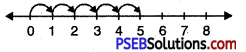
The given number line represents:
PSEB 6th Class Maths MCQ Chapter 4 Integers 1
(a) 5 + 1
(b) 1 + 5
(c) 1 + 1 + 1 + 1 + 1
(d) 5 + 5 + 5 + 5 + 5.
Answer:
(c) 1 + 1 + 1 + 1 + 1

PSEB 6th Class Maths MCQ Chapter 4 Integers

Question 6.
3 less than -2 =
(a) -5
(b) -6
(c) 5
(d) 6.
Answer:
(a) -5

Question 7.
(-2) + 8 =
(a) -6
(b) -10
(c) 10
(d) 6.
Answer:
(d) 6.

Question 8.
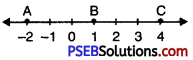
Which of the following statements is true about the given number line:
PSEB 6th Class Maths MCQ Chapter 4 Integers 2
(a) Value of A is greater than value of B.
(b) Value of A is greater than value of C.
(c) Value of B is less than value of C.
(d) Value of C is less than value of B.
Answer:
(c) Value of B is less than value of C.

Question 9.
(-7) + (-12) + 11 =
(a) -19
(b) 30
(c) -23
(d) -8.
Answer:
(d) -8.

PSEB 6th Class Maths MCQ Chapter 4 Integers

Question 10.
15 – (-12) + (-27) =
(a) 0
(b) -54
(c) -24
(d) 54.
Answers :
(a) 0

Question 11.
What is the number of integers between -4 and -1?
(a) 3
(b) 4
(c) 5
(d) 6.
Answer:
(b) 4

Question 12.
What is the number of integers between -8 and -2?
(a) 3
(b) 4
(c) 5
(d) 6.
Answer:
(c) 5

Question 13.
Which is the largest integers among -7, -6, -5, -4 and -3?
(a) -6
(b) -5
(c) -4
(d) -3.
Answer:
(d) -3.

PSEB 6th Class Maths MCQ Chapter 4 Integers

Question 14.
Which is the smallest integer among -3, -2, 0 and 1?
(a) -3
(b) -2
(c) 0
(d) 1.
Answer:
(a) -3

Question 15.
The value of (-7) + (-9) + 4 + 16 is:
(a) 36
(b) 22
(c) 4
(d) 27.
Answer:
(c) 4

Fill in the blanks:

Question (i)
The sum of (-9) + (+4) + (-6) + (+3) is …………. .
Answer:
– 8

Question (ii)
The successor of -5 is ……………. .
Answer:
– 4

Question (iii)
-19 + …………. = 0.
Answer:
19

PSEB 6th Class Maths MCQ Chapter 4 Integers

Question (iv)
100 + …………. = 0.
Answer:
– 100

Question (v)
50 + (-50) = ……………. .
Answer:
0

Write True/False:

Question (i)
-8 is to the right of -10 on number line. (True/False)
Answer:
True

Question (ii)
-100 is to the right of -50 on number line. (True/False)
Answer:
False

Question (iii)
Smallest negative integer is -1. (True/False)
Answer:
False

PSEB 6th Class Maths MCQ Chapter 4 Integers

Question (iv)
-26 is larger than -25. (True/False)
Answer:
False

Question (v)
The sum of two integers is always an integer. (True/False)
Answer:
True

PSEB 6th Class Maths Solutions Chapter 4 Integers Ex 4.3

Punjab State Board PSEB 6th Class Maths Book Solutions Chapter 4 Integers Ex 4.3 Textbook Exercise Questions and Answers.

PSEB Solutions for Class 6 Maths Chapter 4 Integers Ex 4.3

1. Fill the suitable integer in box:

Question (i)
(a) 2 + _ = 0
(b) _ + 11 =0
(c) -5 + _ = o
(d) _ + (-9) = 0
(e) 3 + _ = 0
(f) _ + 0 = 0.
Solution:
(a) 2 + -2 = 0
(b) -11 + 11 =0
(c) -5 + 5 = o
(d) 9 + (-9) = 0
(e) 3 + (-3) = 0
(f) 0 + 0 = 0.

PSEB 6th Class Maths Solutions Chapter 4 Integers Ex 4.3

2. Subtract using number line:

Question (a)
5 from -7
Solution:
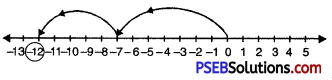
(-7) – 5
PSEB 6th Class Maths Solutions Chapter 4 Integers Ex 4.3 1
Hence , -7 – 5 = -12

Question (b)
-3 from -6
Solution:
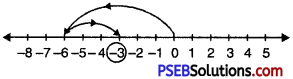
-6 – (-3)
= -6 + (additive inverse of -3)
= -6 + (3)
PSEB 6th Class Maths Solutions Chapter 4 Integers Ex 4.3 2
Hence, -6 + 3 = -3

Question (c)
-2 from 8
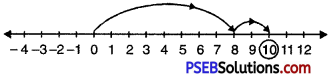
Solution:
8 – (-2)
= 8 + (additive inverse of -2)
= 8 + (2)
PSEB 6th Class Maths Solutions Chapter 4 Integers Ex 4.3 3
Hence, 8 + 2 = 10

PSEB 6th Class Maths Solutions Chapter 4 Integers Ex 4.3

Question (d)
3 from 9.
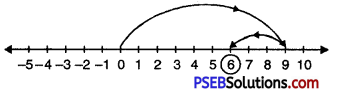
Solution:
9 – 3
PSEB 6th Class Maths Solutions Chapter 4 Integers Ex 4.3 4
Hence, 9 – 3 = 6

3. Subtract without using number line:

Question (a)
-6 from 16
Solution:
16 – (-6)
= 16 + (6) = 16 + 6
= 22

Question (b)
-51 from 55
Solution:
55 – (-51)
= 55 + (51) = 55 + 51
= 106

Question (c)
75 from -10
Solution:
-10 – 75
= -(10 + 75)
= -85

PSEB 6th Class Maths Solutions Chapter 4 Integers Ex 4.3

Question (d)
-31 from -47.
Solution:
-47 – (-31)
= -47 + 31 = -(47 – 31)
= -16

4. Find:

Question (a)
35 – (20)
Solution:
= (35 – 20)
= 15

Question (b)
(-20) – (13)
Solution:
= -(20 + 13)
= -33

Question (c)
(-15) – (-18)
Solution:
= (-15) + (18)
= 3

PSEB 6th Class Maths Solutions Chapter 4 Integers Ex 4.3

Question (d)
72 – (90)
Solution:
= -(90 – 72)
= -18

Question (e)
23 – (-12)
Solution:
= 23 + (12)
= 23 + 12
= 35

Question (f)
(-32) – (-40).
Solution:
= 40 – 32
= 8

5. Simplify:

Question (a)
2 – 4 + 6 – 8 – 10
Solution:
= 2 + 6 – 4 – 8 – 10
= 2 + 6 -(4 + 8 + 10)
= 8 – 22
= -14

Question (b)
4 – 2 + 2 – 4 – 2 + 2
Solution:
= 4 + 2 + 2 – 2 – 4 – 2
= 8 – 8
= 0

PSEB 6th Class Maths Solutions Chapter 4 Integers Ex 4.3

Question (c)
4 – (-9) + 7 – (-3)
Solution:
=4 + 9 + 7 + 3
= 23

Question (d)
(-7) + (-19) + (-7).
Solution:
= -(7 + 19 + 7)
= – 33

PSEB 6th Class Maths Solutions Chapter 5 Fractions Ex 5.2

Punjab State Board PSEB 6th Class Maths Book Solutions Chapter 5 Fractions Ex 5.2 Textbook Exercise Questions and Answers.

PSEB Solutions for Class 6 Maths Chapter 5 Fractions Ex 5.2

1. Classify the following as proper and improper fractions:

Question (i)
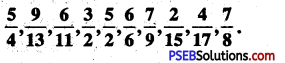
PSEB 6th Class Maths Solutions Chapter 5 Fractions Ex 5.2 1
Solution:
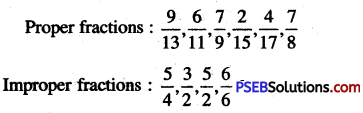
PSEB 6th Class Maths Solutions Chapter 5 Fractions Ex 5.2 2

PSEB 6th Class Maths Solutions Chapter 5 Fractions Ex 5.2

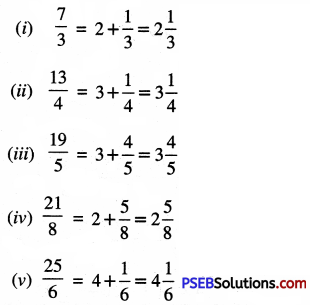
2. Express each of the following as mixed fractions, Also represent with diagrams:

Question (i)
\(\frac {27}{5}\)
Solution:
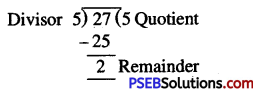
PSEB 6th Class Maths Solutions Chapter 5 Fractions Ex 5.2 3
∴ Mixed fraction
= Quotient \(\frac {Remainder}{Divisor}\) = \(5\frac {2}{5}\)

Question (ii)
\(\frac {13}{4}\)
Solution:
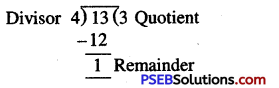
PSEB 6th Class Maths Solutions Chapter 5 Fractions Ex 5.2 4
∴ Mixed fraction
= Quotient \(\frac {Remainder}{Divisor}\) = \(3\frac {1}{4}\)

Question (iii)
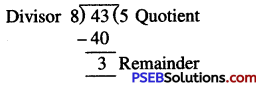
\(\frac {43}{8}\)
Solution:
PSEB 6th Class Maths Solutions Chapter 5 Fractions Ex 5.2 5
∴ Mixed fraction
= Quotient \(\frac {Remainder}{Divisor}\) = \(5\frac {3}{8}\)

Question (iv)
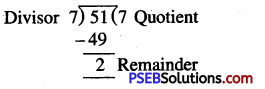
\(\frac {51}{7}\)
Solution:
PSEB 6th Class Maths Solutions Chapter 5 Fractions Ex 5.2 6
∴ Mixed fraction
= Quotient \(\frac {Remainder}{Divisor}\) = \(7\frac {2}{7}\)

PSEB 6th Class Maths Solutions Chapter 5 Fractions Ex 5.2

Question (v)
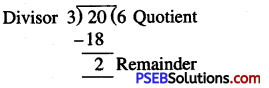
\(\frac {20}{3}\)
Solution:
PSEB 6th Class Maths Solutions Chapter 5 Fractions Ex 5.2 7
∴ Mixed fraction
= Quotient \(\frac {Remainder}{Divisor}\) = \(6\frac {2}{3}\)

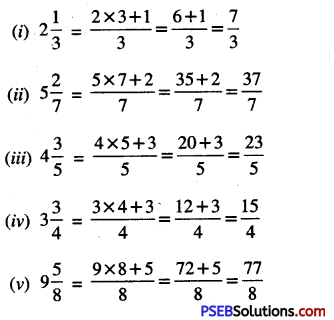
3. Express each of the following mixed fractions as improper fractions:

Question (i)
(i) \(\)2 \frac{1}{3}\(\)
(ii) \(\)5 \frac{2}{7}\(\)
(iii) \(\)4 \frac{3}{5}\(\)
(iv) \(\)3 \frac{3}{4}\(\)
(v) \(\)9 \frac{5}{8}\(\)
Solution:
PSEB 6th Class Maths Solutions Chapter 5 Fractions Ex 5.2 8

PSEB 6th Class Maths Solutions Chapter 5 Fractions Ex 5.2

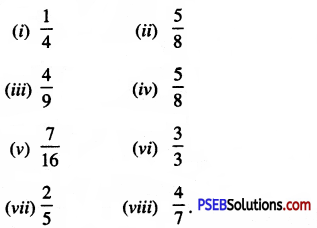
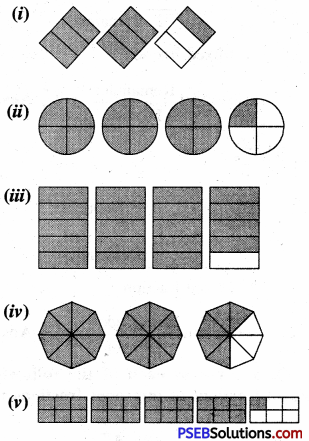
4. Express the shaded portion as Improper Fraction and Mixed fraction:

Question (i)
PSEB 6th Class Maths Solutions Chapter 5 Fractions Ex 5.2 9
Solution:
PSEB 6th Class Maths Solutions Chapter 5 Fractions Ex 5.2 10

PSEB 6th Class Maths Solutions Chapter 5 Fractions Ex 5.1

Punjab State Board PSEB 6th Class Maths Book Solutions Chapter 5 Fractions Ex 5.1 Textbook Exercise Questions and Answers.

PSEB Solutions for Class 6 Maths Chapter 5 Fractions Ex 5.1

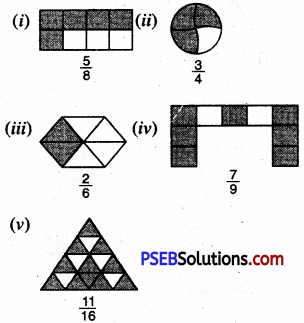
1. Write the fraction representing the shaded portion:
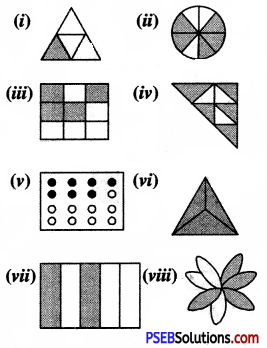
PSEB 6th Class Maths Solutions Chapter 5 Fractions Ex 5.1 1
Solution:
PSEB 6th Class Maths Solutions Chapter 5 Fractions Ex 5.1 2

PSEB 6th Class Maths Solutions Chapter 5 Fractions Ex 5.1

2. Colour the part according to the given fraction:
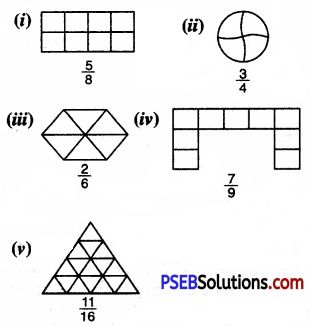
PSEB 6th Class Maths Solutions Chapter 5 Fractions Ex 5.1 3
Solution:
PSEB 6th Class Maths Solutions Chapter 5 Fractions Ex 5.1 4

3. Write the fraction for each of the following:

Question (i)
(i) Three-Fourth
(ii) Seven-Tenth
(iii) A Quarter
(iv) Five-Eighth
(v) Three-Twelvth.
Solution:
(i) \(\frac {3}{4}\)
(ii) \(\frac {7}{10}\)
(iii) \(\frac {1}{4}\)
(iv) \(\frac {5}{8}\)
(v) \(\frac {3}{12}\)

PSEB 6th Class Maths Solutions Chapter 5 Fractions Ex 5.1

4. Write the fraction for the followings:

Question (i)
numerator = 5
denominator = 9
Answer:
\(\frac {5}{9}\)

Question (ii)
numerator = 2
denominator = 11
Answer:
\(\frac {2}{11}\)

Question (iii)
numerator = 6
denominator = 7
Answer:
\(\frac {6}{7}\)

5. Write the numerator and the denominator for the followings:

Question (i)
\(\frac {2}{3}\)
Solution:
Given fraction is \(\frac {2}{3}\) = \(\frac {Numerator}{Denominator}\)
∴ Numerator = 2
and Denominator = 3

Question (ii)
\(\frac {1}{4}\)
Solution:
Given fraction is \(\frac {1}{4}\) = \(\frac {Numerator}{Denominator}\)
∴ Numerator = 1
and Denominator = 4

PSEB 6th Class Maths Solutions Chapter 5 Fractions Ex 5.1

Question (iii)
\(\frac {5}{11}\)
Solution:
Given fraction is \(\frac {5}{11}\) = \(\frac {Numerator}{Denominator}\)
∴ Numerator = 5
and Denominator = 11

Question (iv)
\(\frac {9}{13}\)
Solution:
Given fraction is \(\frac {9}{13}\) = \(\frac {Numerator}{Denominator}\)
∴ Numerator = 9
and Denominator = 13

Question (iv)
\(\frac {17}{16}\) = \(\frac {Numerator}{Denominator}\)
∴ Numerator = 17 and
Denominator = 16

6. Express:

Question (i)
1 day as a fraction of 1 week.
Solution:
We know 1 week = 7 days
∴ Required fraction= \(\frac {1}{7}\)

Question (ii)
40 seconds as a fraction of 1 minute.
Solution:
We know 1 minute = 60 seconds
∴ Required fraction = \(\frac {40}{60}\) or \(\frac {2}{3}\)
(Dividing both terms by 20)

PSEB 6th Class Maths Solutions Chapter 5 Fractions Ex 5.1

Question (iii)
15 hours as fraction of 1 day.
Solution:
We know 1 day = 24 hours
∴ Required fraction = \(\frac {15}{24}\) or \(\frac {5}{8}\)
(Dividing both terms by 3)

Question (iv)
2 months as a fraction of 1 year.
Solution:
We know 1 year = 12 months
∴ Required fraction = \(\frac {2}{12}\) or \(\frac {1}{6}\)
(Dividing both terms by 2)

Question (v)
45 cm as a fraction of 1 metre.
Solution:
We know 1 metre = 100 cm
∴ Required fraction = \(\frac {45}{100}\) or \(\frac {9}{20}\)
(Dividing both terms by 5)

7. Write the numbers from 1 to 25.

Question (i)
What fraction of them are even numbers?
Solution:
Numbers from 1 to 25 are:
1,2, 3, 4,5,6, 7, 8, 9, 10, 11, 12, 13, 14, 15, 16, 17, 18, 19, 20, 21, 22, 23, 24, 25 i.e. 25 in number.
Even numbers out of these numbers are:
2, 4, 6, 8, 10, 12, 14, 16, 18; 20, 22, 24 i.e. 12 in number
∴ Required fraction = \(\frac {12}{25}\)

PSEB 6th Class Maths Solutions Chapter 5 Fractions Ex 5.1

Question (ii)
What fraction of them are prime numbers?
Solution:
Prime number out of these numbers are:
2, 3, 5, 7, 11, 13, 17, 19, 23 i.e. 9 in number
∴ Required fraction = \(\frac {9}{25}\)

Question (iii)
What fraction of them are multiples of 3?
Solution:
Multiples of 3 out of these numbers are:
3, 6, 9, 12, 15, 18, 21, 24 i.e. 8 in number
∴ Required fraction = \(\frac {8}{25}\)

8. In class 6th, there are 24 boys and 18 girls. What fraction of total students represent boys and girls?
Solution:
Boys = 24
Girls = 18
Total students = 24 + 18 = 42
Fraction which represents boys
= \(\frac {24}{42}\) or \(\frac {4}{7}\)
(Dividing both terms by 6)
Fraction which represents girls
= \(\frac {18}{42}\) or \(\frac {3}{7}\)
(Dividing both terms by 6)

9. A bag contains 6 red balls and 7 blue balls. What fraction of balls represent red and blue colour?
Solution:
Red balls = 6
Blue balls = 7
Total number of red and blue balls = 6 + 7 = 13
Fraction which represents red balls = \(\frac {6}{13}\)
Fraction which represents blue balls = \(\frac {7}{13}\)

PSEB 6th Class Maths Solutions Chapter 5 Fractions Ex 5.1

10. Sidharth has a cake. He cuts it into 10 equal parts. He gave 2 parts to Naman, 3 parts to Nidhi, 1 parts to Seema and the remaining four parts he kept for himself. Find:

Question (i)
What fraction of cake, he gave to Naman?
Solution:
Total parts = 10
Fraction of cake, he gave to Naman = \(\frac {2}{10}\) or \(\frac {1}{5}\)

Question (ii)
What fraction of cake, he gave to Nidhi?
Solution:
Fraction of cake, he gave to Nidhi = \(\frac {3}{10}\)

Question (iii)
What fraction of cake, he kept for himself?
Solution:
Fraction of cake, he kept for himself = \(\frac {4}{10}\) or \(\frac {2}{5}\)

Question (iv)
Who has more cake than others?
Solution:
Sidharth has more cake than others

11. In a box, there are 12 apples, 7 oranges and 5 guavas. What fraction of fruits in box represents each?
Solution:
Apples = 12, Oranges = 7
and Gauvas = 5
Total fruits = 12 + 7 + 5 = 24.
Fraction which represents apples
= \(\frac {12}{24}\) or \(\frac {1}{2}\)
Fraction which represents oranges
= \(\frac {7}{24}\)
Fraction which represents Gauvas
= \(\frac {5}{24}\)

PSEB 6th Class Maths Solutions Chapter 5 Fractions Ex 5.1

12. Dishmeet has 20 pens. He gives one-fourth to Balkirat. How many pens Dishmeet and Balkirat have?
Solution:
Total pens = 20
Pens Balkirat has = One-fourth of 20
= \(\frac {22}{7}\) × 20 = 5
Pens Dishmeet has = 20 – 5 = 15

13. Represent the following fraction on the number line?

Question (i)
\(\frac {2}{5}\)
Solution:
In order to represent \(\frac {2}{5}\) on number line, we divide the gap between 0 and 1 into 5 equal parts, which are, (as shown)
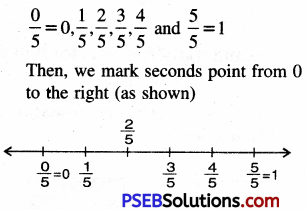
PSEB 6th Class Maths Solutions Chapter 5 Fractions Ex 5.1 5

Question 2.
\(\frac {5}{7}\)
Solution:
In order to represent \(\frac {5}{7}\) on number line, we divide the gap between 0 and 1 into 7 equal parts, which are, (as shown)
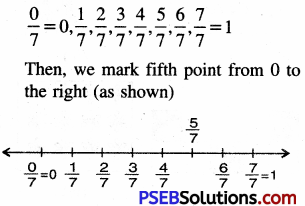
PSEB 6th Class Maths Solutions Chapter 5 Fractions Ex 5.1 6

PSEB 6th Class Maths Solutions Chapter 5 Fractions Ex 5.1

Question 3.
\(\frac {3}{10}\), \(\frac {5}{10}\), \(\frac {1}{10}\)
Solution:
In order to represent \(\frac {3}{10}\), \(\frac {5}{10}\), \(\frac {1}{10}\) on number line, we divide the gap between 0 and 1 into 10 equal parts, which are (as shown)
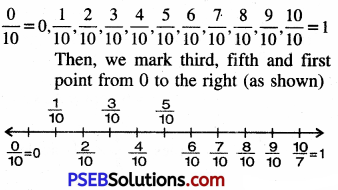
PSEB 6th Class Maths Solutions Chapter 5 Fractions Ex 5.1 7

Question 4.
\(\frac {3}{8}\), \(\frac {5}{8}\), \(\frac {7}{8}\)
Solution:
In order to represents \(\frac {3}{8}\), \(\frac {5}{8}\), \(\frac {7}{8}\) on number line, we divide the gap between 0 and 1 into 8 equal parts, which are (as shown)
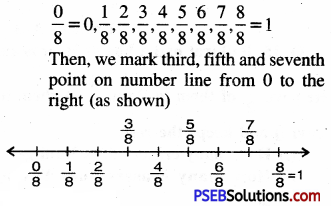
PSEB 6th Class Maths Solutions Chapter 5 Fractions Ex 5.1 8

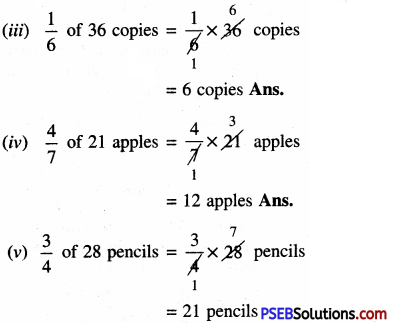
14. Find:

(i) \(\frac {3}{5}\) of 20 books
(ii) \(\frac {5}{8}\) of 32 pens
(iii) \(\frac {1}{6}\) of 36 copies 6
(iv) \(\frac {4}{7}\) of 21 apples
(v) \(\frac {3}{4}\) of 28 pencils.
Solution:
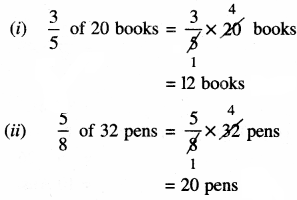
PSEB 6th Class Maths Solutions Chapter 5 Fractions Ex 5.1 9
PSEB 6th Class Maths Solutions Chapter 5 Fractions Ex 5.1 10

PSEB 6th Class Maths Solutions Chapter 5 Fractions Ex 5.1

15. Balkirat had a box of 36 erasers. He gave \(\frac {1}{2}\) of them to Rani, \(\frac {2}{9}\) of them to Yuvraj and keeps the rest.

Question (i)
(i) How many erasers does Rani get?
(ii) How many erasers does Yuvraj get?
(iii) How many erasers does Harnik keep?
Solution:
Total erasers = 36
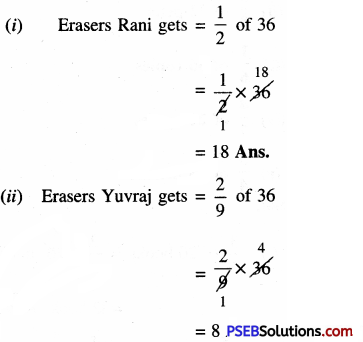
PSEB 6th Class Maths Solutions Chapter 5 Fractions Ex 5.1 11
(iii) Erasers Harnik gets = 36 – (18 + 8)
= 36 – 26
= 10

16. State True/False

Question (i)
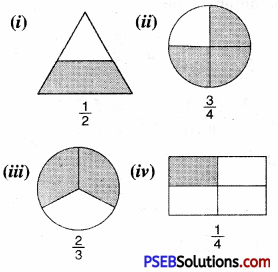
PSEB 6th Class Maths Solutions Chapter 5 Fractions Ex 5.1 12
Solution:
(i) False
(ii) True
(iii) True
(iv) True

PSEB 6th Class Maths Solutions Chapter 4 Integers Ex 4.2

Punjab State Board PSEB 6th Class Maths Book Solutions Chapter 4 Integers Ex 4.2 Textbook Exercise Questions and Answers.
PSEB Solutions for Class 6 Maths Chapter 4 Integers Ex 4.2

1. Using number line write the integer which is:

Question (a)
5 less than -1
Solution:
5 less than -1 = ?
We need to find the integer which is 5 less than -1.
So, we shall start with ‘-1 ’ and proceed 5 steps to the left of -1 as shown below:
PSEB 6th Class Maths Solutions Chapter 4 Integers Ex 4.2 1
Therefore 5 less than -1 is -6

PSEB 6th Class Maths Solutions Chapter 4 Integers Ex 4.2

Question (b)
5 more than -5
Solution:
5 more than -5 = ?
We need to find the integer which is 5 more than -5.
So, we shall start with -5 and proceed 5 steps to the right of -5 as shown below:
PSEB 6th Class Maths Solutions Chapter 4 Integers Ex 4.2 2
Therefore 5 more than -5 is zero.

Question (c)
2 less than 5
Solution:
2 less than 5 = ?
We need to find the integer which is 2 less than 5.
So, we shall start with 5 and proceed
2 steps to the left of 5 as shown below:
PSEB 6th Class Maths Solutions Chapter 4 Integers Ex 4.2 3
Therefore 2 less than 5 is 3.

Question (d)
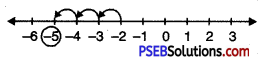
3 less than -2.
Solution:
3 less than – 2 = ?
We need to find the integer which is 3 less than -2.
So, we shall start with -2 and proceed 3 steps to the left of -2 as shown below:
PSEB 6th Class Maths Solutions Chapter 4 Integers Ex 4.2 4
Therefore 3 less than -2 is -5.

PSEB 6th Class Maths Solutions Chapter 4 Integers Ex 4.2

2. Using number line, add the following integers:

Question (a)
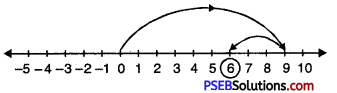
9 + (-3)
Solution:
On number line we shall start from 0 and move 9 steps to the right of zero. Then we shall move three steps to the left of ‘+9’. We finally reach at +6. Thus, +6 is the answer.
PSEB 6th Class Maths Solutions Chapter 4 Integers Ex 4.2 5
Hence, 9 + (-3) = +6

Question (b)
5 + (-11)
Solution:
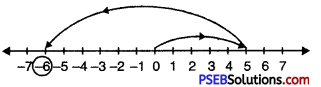
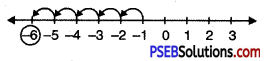
On number line we shall start from 0 and move 5 steps to the right of zero. Then we shall move eleven steps to the left of ‘+5’. We finally reach at ‘-6’. Thus, -6 is the answer.
PSEB 6th Class Maths Solutions Chapter 4 Integers Ex 4.2 6
Hence, 5 + (-11) = -6

Question (c)
(-1) + (-4)
Solution:
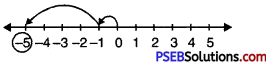
On number line we first move 1 step to the left of zero. Then we moved ahead 4 steps to the left of ‘-1\ We finally reaches at -5. Thus -5 is the answer.
PSEB 6th Class Maths Solutions Chapter 4 Integers Ex 4.2 7
Hence, (-1) + (-4) = -5

Question (d)
(-5) + 12
Solution:
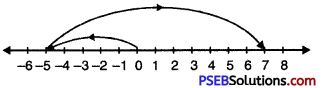
On number line we shall move 5 steps to the left of zero. Then we shall move 12 steps to the right of ‘-5’ and finally reach at ‘+7’. Thus +7 is the answer.
PSEB 6th Class Maths Solutions Chapter 4 Integers Ex 4.2 8
Hence, (-5) + 12 = +7

PSEB 6th Class Maths Solutions Chapter 4 Integers Ex 4.2

Question (e)
(-1) + (-2) + (-4)
Solution:
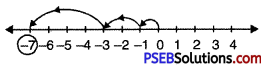
Step I: On number line we shall move one step to the left of zero suggested by minus sign of ‘-1’.
Step II: Then we shall move 2 steps to the left of -1 suggested by minus sign of -2 and we reach at ‘-3’.
Step III: Then again we shall move 4 steps to the left of ‘-3’ suggested by minus sign of -4 and finally we reach at-7.
PSEB 6th Class Maths Solutions Chapter 4 Integers Ex 4.2 9
Hence, (-1) + (-2) + (-4) = -7

Question (f)
(-2) + 4 + (-5)
Solution:
Step I: On number line we shall move 2 steps to the left of zero suggested by minus sign of ‘-2’.
Step II: Then we shall move 4 steps to the right of ‘-2’ suggested by plus sign of ‘44’ and we reach at +2.
Step III: Then we shall move 5 steps to the left of ‘+2’ as suggested by minus sign of ‘-5’ and finally we reach at -3. Thus answer is ‘-3’.
PSEB 6th Class Maths Solutions Chapter 4 Integers Ex 4.2 10
Hence, (-2) + 4 + (-5) = -3

Question (g)
(-3) + (5) + (-4).
Solution:
Step I: On number line we shall move 3 steps to the left of zero as suggested by minus sign of ‘-3’.
Step II: Then we shall move 5 steps to the right of ‘-3’ as suggested by plus sign of ‘+5’ and we reach at ‘+2’.
Step III: Then we shall move 4 steps to the left of ‘+2’ as suggested by minus sign of ‘4’ and finally we reach at ‘-2’. Thus ‘-2’ is the answer.
PSEB 6th Class Maths Solutions Chapter 4 Integers Ex 4.2 11
Hence, (-3) + (5) + (-4) = -2

3. Add without using number line:

Question (a)
18 + 13
Solution:
18 + 13 = 31

PSEB 6th Class Maths Solutions Chapter 4 Integers Ex 4.2

Question (b)
18 + (- 13)
Solution:
18 + (- 13) = + (18 – 13) = +5

Question (c)
(-18) + 13
Solution:
(-18) + 13 = – (18 – 13) = -5

Question (d)
(-18) + (-13)
Solution:
(-18) + (-13) = -(18 + 13) = -31

Question (e)
180 + (-200)
Solution:
180 + (-200) = -(200 – 180) = -20

PSEB 6th Class Maths Solutions Chapter 4 Integers Ex 4.2

Question (f)
111 + (-67)
Solution:
111 + (-67) = (777 – 67) = 710

Question (g)
1262 + (-366) + (-962)
Solution:
1262 + (-366) + (-962)
= 1262 – (366 + 962)
= 1262 – 1328
= -(1328 – 1262) = -66

Question (h)
30 + (-27) + 21 + (-19) + (-3) + 11 + (-9)
Solution:
30 + (-27) + 21 + (-19) + (-3) + 11 + (-9)
= 30 + 21 + 11 + (-27) + (-19) + (-3) + (-9)
= 62 + (-58) = 62 – 58 = 4

Question (i)
(-7) + (-9) + 4 + 16
Solution:
(-7) + (-9) + 4+16 = (-16) + 20 = 4

PSEB 6th Class Maths Solutions Chapter 4 Integers Ex 4.2

Question (j)
37 + (-2) + (-65) + (-8).
Solution:
37 + (-2) + (-65) + (-8)
= 37 – (2 + 65 + 8)
= 37 – 75 = -38

4. Write the successor and predecessor of the following:

Question (a)
-15
Solution:
Successor of -15 = -15 + 1 = -14
Predecessor of -15 = -15 – 1 = -16

Question (b)
27
Solution:
Successor of 27 = 27 + 1 = 28
Predecessor of 27 = 27 – 1 = 26

Question (c)
-79
Solution:
Successor of -79 = -79 + 1 = -78
Predecessor of -79 = -79- 1 = -80

PSEB 6th Class Maths Solutions Chapter 4 Integers Ex 4.2

Question (d)
0
Solution:
Successor of 0 = 0+ 1 = 1
Predecessor of 0 = 0 – 1 = -1

Question (e)
29
Solution:
Successor of 29 = 29 + 1 = 30
Predecessor of 29 = 29 – 1 = 28

Question (f)
-18
Solution:
Successor of -18 = -18 + 1 = -17
Predecessor of -18 = -18 – 1 = -19

Question (g)
-21
Solution:
Successor of -21 = -21 + 1 = -200
Predecessor of -21 = -21 – 1 = -22

Question (h)
99
Solution:
Successor of 99 = 99 + 1 = 100
Predecessor of 99 = 99 – 1 = 98

Question (i)
-1
Solution:
Successor of-1 = -1 + 1 = 0
Predecessor of -1 = -1 – 1 = -2

Question (j)
-13.
Solution:
Successor of -13 = -13 + 1 = -12
Predecessor of -13 = -13 – 1 = -14

PSEB 6th Class Maths Solutions Chapter 4 Integers Ex 4.2

5. Complete the following addition table:

+ -3 -4 -2 +1 +2 +3
-2
-3
0
+1
+2

Solution:

+ -3 -4 -2 + 1 +2 +3
-2 -5 -6 -4 -1 0 + 1
-3 -6 -7 -5 -2 -1 0
0 -3 -4 -2 + 1 +2 +3
+ 1 -2 -3 -1 +2 +3 +4
+2 -1 -2 0 +3 +4 +5