Rosy’s meeting with Nessy Question Answer Class 6 English Solutions Chapter 8 PSEB Solutions

Punjab State Board PSEB 6th Class English Book Solutions Chapter 8 Rosy’s meeting with Nessy Textbook Exercise Questions and Answers.

Class 6th English Solutions Chapter 8 Rosy’s meeting with Nessy Question Answers

Rosy’s meeting with Nessy Class 6 Questions and Answers

Activity 1.

Look up the following words in a dictionary. You should seek the following information about the words and put them in your WORDS notebook.
1. Meaning of the word as used in the lesson (Adjective/Noun/Verb, etc.)
2. Pronunciation (The teacher may refer to the dictionary or the mobile phone for correct pronunciation.)
3. Spellings

ripples dangerous run past merged
herbivore creature scared monster

Post-reading

Vocabulary Expansion :

Meanings of new words can often be discovered by carefully reading words that come before and after the difficult word. Look at the sentences from the story and their meanings. The meanings can be guessed from other words in the sentence.

1. Go down to the Lake.
Meaning : Rosy wants to go to the lake which is at a lower place than her house.

2. I will throw some stones into the water and watch the ripples.
Meaning : Rosy wants to see a series of waves on the water by dropping stones into the water.

3. She ran past a board that read. …….
Meaning : She left the board behind.

4. Her parents had told her that there was no such thing. It was a myth.
Meaning : Myth is a story about something. It may not be true.

PSEB 6th Class English Solutions Chapter 8 Rosy’s meeting with Nessy

Activity 2.

Given below are some words from the lesson. Guess their meaning taking hints from the story. Write the meaning in the blanks.

monster giant
creature living animal
merged joined together
herbivore vegan
dangerous unsafe/risky

Activity 3.

For each word given below, find a word from the lesson that sounds the same.

1. wood — would
2. two — too
3. board — bored
4. site — sight
5. no — know

What did you notice ?
Each pair of words has the same sound but different meanings.
Such pairs of words are called homophones.

PSEB 6th Class English Solutions Chapter 8 Rosy’s meeting with Nessy

1. Write 5 more pairs of homophones.

1. by-buy
2. sun-son
3. pray-prey
4. male-mail
5. eight-ate.

2. Choose the correct word for each.

(a) Give me ……………… address. (there/their)
(b) He …………….. the ball. (caught/cot)
(c) We …………….. with our eyes. (sea/see)
(d) I have only …………….. pen. (won/one)
(e) Please give me …………… sugar. (some/sum)
Answer:
(a) their
(b) caught
(c) see
(d) one
(e) some.

Learning to Read and Comprehend

Activity 4.

Answer the following questions :

Question 1.
Where did Rosy go ?
रोजी कहां गई ?
Answer:
Rosy went to meet her Aunt Tina in Scotland.

Question 2.
What is Loch Ness ?
Loch Ness क्य है ?
Answer:
Loch Ness is a deep and dangerous lake.

Question 3.
Where did Rosy go when she felt bored ?
बोर होने पर रोज़ी कहां गई ?
Answer:
Rosy went down to the lake when she felt bored.

Question 4.
What did Rosy want to do at the lake ?
रोजी झील पर क्या करना चाहती थी ?
Answer:
Rosy wanted to throw stones into the water and enjoy the scene of ripples.

Question 5.
Who did she find in the lake ?
उसने झील में किसे देख ?
Answer:
She found Nessy, a huge creature in the lake. It had pointed spikes on its back.

Activity 5.

Say ‘True’ or ‘False’ for the following statements.

1. Rosy went to visit her Aunt Teena in Scotland. — (True)
2. Aunt Teena told her to go out and throw stones into the lake. — (False)
3. Rosy met Nessy who wanted to eat her. — (False)
4. Nessy was a herbivore. — (True)
5. Rosy went around the lake on Nessy’s back. — (True)

Activity 6.

Read the statements given below. Three options are given. Tick the right option.

Question 1.
Scotland is in the ……………… of the United Kingdom.
(a) South
(b) West
(c) North.
Answer:
(c) North.

Question 2.
The lake is …………..
(a) nice and blue
(b) deep and dangerous
(c) black and dirty.
Answer:
(b) deep and dangerous.

PSEB 6th Class English Solutions Chapter 8 Rosy’s meeting with Nessy

Question 3.
Rosy gathered some stones because ………………
(a) she wanted to count them
(b) she wanted to put them in her pocket
(c) she wanted to throw them into the lake.
Answer:
(c) she wanted to throw them into the lake.

Question 4.
The stone made a ……………. sound when they touched water.
(a) splash
(b) ouch
(c) eeks.
Answer:
(a) splash.

Question 5.
Nessy was a …………… creature.
(a) huge
(b) small
(c) bad.
Answer:
(a) huge.

Question 6.
Nessy looked like a …
(a) rhinoceros
(b) dinosaur
(c) crocodile.
Answer:
(b) dinosaur.

Question 7.
Nessy offered Rosy ………….
(a) a ride on its neck
(b) some fruits from the lake
(c) more stones to throw
Answer:
(a) a ride on its neck.

Question 8.
People called Nessy a monster because ……
(a) they were scared of its size
(b) they did not know her
(c) she talked like humans.
Answer:
(b) they did not know her.

PSEB 6th Class English Solutions Chapter 8 Rosy’s meeting with Nessy

Question 9.
Rosy caught onto Nessy’s strong … to sit on her back.
(a) neck
(b) horns
(c) humps
Answer:
(b) horns

Question 10.
Rosy did not see Nessy’s cave because ………..
(a) she was scared to go underwater
(b) she had to go to Edinburgh
(c) her aunt was waiting for her.
Answer:
(c) her aunt was waiting for her.

Learning Language

Past Tense

Look at the following passage from the story.
Nessy started the journey through the lake. Soon they were swimming all around the lake. Rosy caught hold of Nessy tightly. Nessy went in and out of the water. “Whoosh!” said Nessy as it went into the water and “Whee!” as it came out. Rosy was also enjoying it. She said, “This is fun!”

What do you see ? Have the action words (verbs) such as started’, ‘caught’, ‘went’ been used in their first forms ? No. Is the action happening currently ? No. It has happened in the past. When we talk of the past, we use the past tense.  इस अनुच्छेद में Past की घटना का वर्णन किया गया है। Past के लिए हम (Verb की दूसरी फार्म) Past Tense का प्रयोग करते हैं।

Activity 7.

Complete the following passage using the correct form of the verb given in the brackets.
Once an elephant

PSEB 6th Class English Solutions Chapter 8 Rosy’s meeting with Nessy 1

1. _____ (live) in a village. He 2. _____ (become) friend with a tailor. The elephant used to 3._____ (go) to a river for a bath. After drinking water and taking a bath it 4. _____ (pass) by a tailor’s shop and the tailor 5. _____ it something to eat. One day the tailor _____ (be) in an angry mood. The elephant 7. _____ (come) that day as usual. The tailor 8. _____ (prick) the elephant’s trunk with his needle The elephant 9. _____ (feel) pain. He 10. _____ (make) up his mind to teach a tailor a lesson. 11. _____ to the river, 12. _____ (have) his bath and then 13. _____ (fill) up its trunk with muddy water. He 14._____ (stop) at the tailor’s shop and 15. _____ (throw) the muddy water on the clothes in the shop. The clothes were 16. _____ (spoil) with mud. He 17._____ (feel) sad for his misdeed. But it 18. _____ (be) too late.
Answer:
1. lived
2. became
3. go
4. passed
5. gave
6. was
7. came
8. pricked
9. felt
10. made
11. went
12. had
13. filled
14. stopped
15. threw
16. spoiled
17. felt
18. was.

Past Tense Explained

We have already done the present tense. Let us look at the past tense now. The past tense in English is used :
1. to talk about the past
2. for politeness There are four past tense forms in English. But we will look at only two
i.e. Past Simple and Past Continuous.
Examples : Past simple : I worked.
(a) to talk about the past :
1. Sonu lived in Mumbai.
2. Seema worked in a bank.
3. The elephant felt pain.

PSEB 6th Class English Solutions Chapter 8 Rosy’s meeting with Nessy

(b) to talk about the present in a few polite expressions :
1. I would like some tea, please.
2. Could you please shut the door ?
3. I just hoped that you would help me.

Activity 8.

1 Given below are some newspaper headlines. Change them into Simple Past.
1. A strong earthquake jolts Uttarakhand.
2. Amitabh Bachchan wins the best actor Filmfare award.
3. India outplays West-Indies in cricket.
4. Salman Ali wins the Indian Idol.
5. Bachendri Pal becomes the first Indian woman to scale Mount Everest.
Answer:
1. A strong earthquake jolted Uttarakhand.
2. Amitabh Bachchan won the best actor Filmfare award.
3. India outplayed West-Indies in cricket.
4. Salman Ali won the Indian Idol.
5. Bachendri Pal became the first Indian woman to scale Mount Everest.

Activity 9.

Read the following passage and answer the questions that follow :

The Himalayas are the highest mountains on Earth. The mountains are covered with snow. The highest peak, Mount Everest is 8848 metres above sea level. Tenzing Norgay and Edmund Hilary were the first two people to set foot on Mount Everest. Since then, many people have successfully scaled the peak. Avtar Singh Cheema was the first Indian to reach Everest. Many climbers have also died while attempting to reach the peak. Some climbers have reported that they have seen large human-like footprints in the snow. There is a myth that a snowman called Yeti lives there.

PSEB 6th Class English Solutions Chapter 8 Rosy’s meeting with Nessy 2

1. New answer the questions :
(a) Which are the highest mountains in the world ?
Answer:
The Himalayas are the highest mountains in the world.

(b) What is the height of the highest peak in the world ?
Answer:
It is 8848 metres above the sea level.

(c) Who were the first people to set foot on Mount Everest ?
Answer:
They were : Tenzing Norgay and Edmund Hilary.

PSEB 6th Class English Solutions Chapter 8 Rosy’s meeting with Nessy

(d) What was the name of the first Indian to scale Everest ?
Answer:
His name was Avtar Singh Cheema.

(e) What is the name given to the snowman that some people believe lives there?
Answer:
He is Yeti.

2. Give meanings of the following words :
(a) myth : an imaginary story, काल्पनिक कहानी
(b) footprints : footmarks, पैरों के निशान
(c) climbers : People who go up, आरोही

Activity 10.

Match the following phrases with the right pictures and write them in the space given under the pictures/symbols.
1. go straight ahead
2. turn right
3. go down (the road)
4. go past (the toy shop)
5. take the exit
6. turn left
Answer:
Look at the following symbols.
PSEB 6th Class English Solutions Chapter 8 Rosy’s meeting with Nessy 4
The teacher will read the directions and the students will match them with the appropriate symbol.

Activity 11.

(Refer To Appendix For Text At Page No. 123)

Listen carefully to two phone messages that were there in your voicemail. Your teacher will read them twice.

Write the following sentences from the messages in the correct group (Message 1 and Message 2).

The message was at a quarter to five. — (2)
The woman says thank you for the birthday message. — (1)
The woman decribes the house. — (2)
The woman gives directions. — (2)
The woman talks about a swimming pool. — (1)
The woman talks about a bank. — (2)
Answer:

Message 1 Message 2
The woman says thank you for the birthday message.
The woman talks about a swimming pool.
The message was at a quarter to five.
The Woman describes the house.
The woman gives directions.
The woman talks about a bank.

Comprehension Of Passages

Read the given passages and answer the questions that follow each.

(1) Rosy had come to visit her Aunt Teena in Scotland, which is in the north of the United Kingdom. Her aunt lived near the Loch Ness. Loch Ness is a deep lake. Rosy felt bored at her aunt’s home. “Aunt Teena, I want to go down to the Lake. I am feeling bored,” she said. Her aunt said, “Sure, Rosy, you may. What will you do there ?”

PSEB 6th Class English Solutions Chapter 8 Rosy’s meeting with Nessy

“I will throw some stones into the water and watch the ripples,” said Rosy, “Don’t go too near the Lake. It is very deep and dangerous” said Aunt Teena. Rosy ran out of the door and then to the lake. She ran past a board that read, “Loch Ness-Home of the farmous Loch Ness Monster.” Rosy read the board and smiled. Her parents had told her that there was no such thing. It was a myth. Rosy believed them.

(i) Where did Rosy’s Aunt Teena live ?
रोजी की आंटी टीना कहां रहती थी ?

(ii) What warning did Aunt Teena give Rosy? Why?
आंटी टीना ने रोज़ी को क्या चेतावनी दी और क्यों ?

(iii) Choose true or false statements and write them in your answer book :
(a) Teena was feeling bored.
(b) She ran past the lake.

(iv) Complete the following sentences according to the meaning of the passage.
(a) Rosy read the board and
(b) It is very deep and nd ………….
Or
Match the words with their meanings :

(a) Myth to trust
(b) Believe an imaginary story
a boring story

Answer:
(i) She lives near a deep lake in Scotland.
(ii) Aunt Teena warned Rosy not to go too near the lake.
(iii)
(a) True
(b) False.
(iv)
(a) Rosy read the board and smiled.
(b) It is very deep and dangerous.
Or
(a) myth : an imaginary story
(b) believe : to trust

PSEB 6th Class English Solutions Chapter 8 Rosy’s meeting with Nessy

(2) Reaching the Lakeshore, she looked around for some small stones that she could throw in the lake. She gathered a few and put them in her pocket after counting them. She looked for a nice spot to sit and found a big rock near the lake.

She started throwing the stones as far as she could. Each stone said SPLASH as it touched the water ! She loved the sound of the water. And she enjoyed watching the round ripples. She enjoyed watching them going away slowly and then merging into water.

She threw another stone. “SPLASH” came the sound. She loved the sound and the sight. She kept throwing stones one after the other. The water seemed very deep there. She threw another stone. Suddenly she heard a sound, “Eeks !” Rosy was surprised. “Who’s there” she said. No answer. She threw another stone. “Eeks ! stop thowing stones !” said a voice.

(i) What did Rosy gather and why ?
रोज़ी ने क्या इकट्ठा किया और क्यों ?

(ii) What surprised Rosy ?
रोजी को किस बात से हैरानी हई ?

(iii) Choose true or false statements and write them in your answer book :
(a) Rosy loved the sound and sight.
(b) Rosy did not like to watch the round ripples.

(iv) Complete the following sentences according to the meaning of the passage.
(a) She enjoyed the ripples going away and merging …………………. .
(b) She looked for a ……………. to sit.
Or Match the words with their meanings.

(a) Spot stone
(b) Merge mix
place

Answer:
(i) Rosy gathered some small stones to throw them in the lake.
(ii) A sound coming from the lake water surprised Rosy.
(iii)
(a) True
(b) False.
(iv)
(a) She enjoyed the ripples going away and merging into water.
(b) She looked for a nice spot to sit.
Or
(a) spot – place
(b) merge – mix.

PSEB 6th Class English Solutions Chapter 8 Rosy’s meeting with Nessy

(3) Nessy started to laugh. Its laugh was very loud. Rosy looked at Nessy with fear. She could only see its head and long neck. It had triangular spikes on its neck. It had bits of plants hanging from its mouth. Rosy could see that it had sharp teeth and it could eat her in one bite if it wanted. But the plant in its mouth suggested that it was a herbivore. Rosy left relaxed.

“Why do people call you a monster? Are you really a monster ?” Rosy asked. “No, I am not a monster ! People call me a monster because they do not know me. I belong to the dinosaur family. I only eat plants, not little girls,” Nessy assured Rosy. “Would you like a ride on my back ?”? Rosy looked at Nessy. “How big are you ?” she asked.

“Well, I’m more than 100 feet long. I’ve got humps on my back. I’m very thin. I have feet and arms too but I use them only to swim and glide around the lake. Would you like a ride on my back around the lake ?”’ Nessy asked again.

(i) How did Nessy laugh ?
Nessy कैसे हंस ? ?

(ii) Give two physical features of Nessy ?
नैसी के दो शारीरिक लक्षण लिखो।

(iii) Choose true or false statements and write them in your answer book.
(a) Nessy belonged to the Rosy Family.
(b) Nessy had no feet and arms.

(iv) Complete the following sentences according to the meaning of the passage.
(a) The plants in its mouth suggested that …………… .
(b) Nessy had triangular spikes
Or
Match the words with their meanings :
(a) Glide – without tension
(b) Relaxed – slip/crawl
shocked
Answer:
(i) Nessy laughed very loudly.
(ii) Nessy had sharp teeth. It had a long neck.
(iii)
(a) False
(b) False.
(iv)
(a) The plants in its mouth suggested that it was a herbivore.
(b) Nessy had triangular spikes on its back.
Or
(a) glide – slip/crawl
(b) relaxed – without tension

PSEB 6th Class English Solutions Chapter 8 Rosy’s meeting with Nessy

(4) Nessy started the journey through the lake. Soon they were swimmings all around the lake. Rosy caught hold of Nessy tightly. Nessy went in and out of the water. “Whoosh !” said Nessy as it went into the water and “Wheeee !” as it came out. Rosy was also enjoying it. She said, “This is fun!” “Would you like to see my cave ?”? Nessy asked. “I’d love to but on another day. It’s getting late. My aunt must be waiting for me.” Rosy answered.

“Ok, then we will meet again. How long are you going to be here ?” said Nessy. “Another week. But tomorrow I am going to Edinburgh for sightseeing,” informed Rosy.

“Great, then. We’ll meet again the day after,” said Nessy. “Fine, please take me back to the Lakeshore”, Rosy said, Within no time they were at the shore and said bye to each other. Now Rosy had a friend in Scotland, Life, for Rosy, was going to be exciting!

(i) Who took Rosy in and out of the water ? Did Rosy enjoy it ?
रोज़ी को पानी से अंदर-बाहर कौन ले गया ? क्या रोज़ी को इसमें आनंद आया ?

(ii) How much time did they take to reach the shore ?
उन्हें किनारे पर पहुंचने में कितना समय लगा ?

(iii) Choose true or false statements and write them in your answer book :
(a) Life for Rosy was going to be boring.
(b) Rosy caught hold of Nessy tightly.

(iv) Complete the following sentences according to the meaning of the passage.
(a) Soon they were swimming ……………..
(b) I’d love to but………………
Or
Match the words with their meanings :

(a) Shore coast/bank
(b) Cave noise
den

Answer:
(i) Nessy took Rosy in and out of the water. Rosy enjoyed it very much and called it a fun.
(ii) They took no time for this.
(iii)
(a) False
(b) True.
(iv)
(a) Soon they were swimming all around the lake.
(b) I’d love to but on another day.
Or
(a) shore – coast/bank
(b) cave – den

Use Of Words/Phrases In Sentences

1. Sure (certain, definite)
I am sure to win the race.
मुझे विश्वास है कि मैं दौड़ जीतूंगा।

2. Dangerous (risky)
It is dangerous to cross this river.
इस नदी को पार करना खतरनाक है।

3. Merge (to get mix up or join together)—
The ship merged into the sea.
जलयान समुद्र में समा गया।

4. Scared (afraid, alarmed)
He got scared to see a snake.
वह सांप को देख कर डर गया।

PSEB 6th Class English Solutions Chapter 8 Rosy’s meeting with Nessy

5. Monster (giant)
Dinosaurs looked like a monster.
डायनासोर दानव जैसा लगता था।

6. Shocked (agonised, sad)
He was shocked to hear the death of his father.
उसे अपने पिता की मृत्यु का समाचार सुनकर सदमा पहुंचा।

7. Look for (search)
I am looking for a new job.
मैं नई नौकरी की तलाश कर रहा हूं।

8. Sight (Scene)
The sight at the canal was very beautiful.
नहर का दृश्य बहुत ही सुंदर था।

9. Creature (living being)
An ant is a tiny creature.
च्यूटी छोटा सा जीव होती है।

10. Huge (very big, large).
I saw a huge rock.
मैंने एक विशाल चट्टान देखीं।

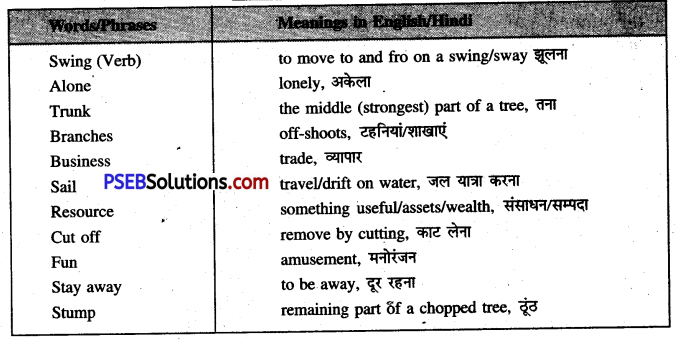
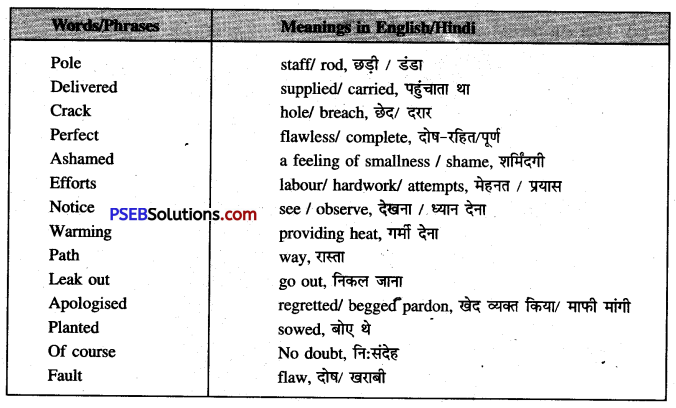
Word Meanings
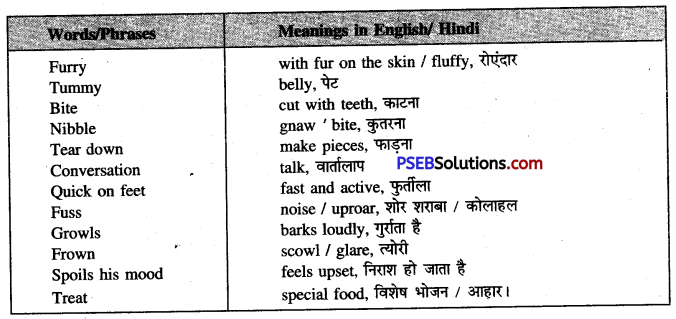
PSEB 6th Class English Solutions Chapter 8 Rosy’s meeting with Nessy 5

Rosy’s meeting with Nessy Summary in Hindi

Rosy had come ………………….. believed them.

रोज़ी अपनी आंटी टीना से मिलने स्कॉटलैंड आई जो कि यूनाइटिड किंगडम के उत्तर में है। उसकी आंटी लॉच नैस् (Loch Ness) के निकट रहती थी। लॉच नैस् एक गहरी झील है। रोज़ी अपनी आंटी के घर पर बोर होने लगी। उसने कहा, “आंटी टीना, मैं नीचे झील पर जाना चाहती हूँ। मैं बोर हो रही हूँ।” उसकी आंटी ने कहा, “अवश्य, रोज़ी तुम जा सकती हो। तुम वहाँ क्या करोगी ?”

रोज़ी ने कहा, “मैं पानी में पत्थर फेंकूगी और लहरों को देखूगी। टीना की आंटी ने कहा “झील के बहुत नज़दीक मत जाना। वह बहुत गहरी और खतरनाक है।” रोजी दरवाज़े से बाहर की ओर भागी और फिर झील की ओर। वह एक बोर्ड के आगे से निकली जिस पर लिखा था-“Loch Ness-Home of the Famous Loch Ness Monster”.

PSEB 6th Class English Solutions Chapter 8 Rosy’s meeting with Nessy

(प्रसिद्ध लॉच नैस् दानव का घर।) रोज़ी ने बोर्ड पढ़ा और मुस्कराई। उसके माता-पिता ने उसे बताया था कि ऐसा कुछ . नहीं होता। यह एक काल्पनिक कथा थी। रोज़ी उन पर विश्वास करने लगी थी। .

Reaching the Lakeshore …………….. said Nessy.

झील के किनारे पहुँचकर उसने चारों ओर कुछ छोटे पत्थरों की तलाश की ताकि वह उन्हें झील में फेंक सके। उसने कुछ पत्थर इकट्ठे किये और उन्हें गिन कर अपनी जेब में डाल लिया। उसने बैठने के लिए एक सुन्दर स्थान की तलाश की और उसे झील के निकट एक बड़ी चट्टान मिल गई। वह पत्थरों को दूर से दूर फेंकने लगी। हर पत्थर जैसे ही पानी को छूता उसमें से पाक (SPLASH) की आवाज़ आती।

उसे पानी की आवाज़ अच्छी लगती और वह गोलगोल लहरों को देखकर आनन्द लेती। वह उन्हें धीरे-धीरे दूर जाते और पानी में समाते देखकर खुश होती। उसने एक और पत्थर फेंका। पाक (SPLASH) की आवाज़ आई। उसे आवाज़ और दृश्य अच्छे लगे। वह एक के बाद एक पत्थर फेंकती रही। वहाँ पानी बहुत अधिक गहरा लगता था।

उसने एक और पत्थर फेंका। अचानक उसे ‘Eeks’ की आवाज़ सुनाई दी। रोज़ी हैरान रह गई। उसने पूछा, “कौन है वहाँ ?” कोई उत्तर नहीं मिला। उसने एक और पत्थर फेंका। एक आवाज़ आई “Eeks ! पत्थर फेंकने बंद करो।” झील में कौन है यह देखने के लिए रोज़ी ने झील में देखा। उसने पानी में एक बहुत बड़ा (विशालकाय) जानवर देखा।

वह डायनासोर जैसा था। वह हरे रंग का था। उसके छोटे-छोटे सींग थे। वह अपना सिर झील के किनारे से रगड़ रहा था। जानवर ने कहा, “तुम झील में पत्थर क्यों फेंक रही हो ? चोट लग रही है।” रोज़ी ने डर कर जीव की ओर देखा। उसने कहा, “माफ़ करना”। जानवर ने कहा, “अच्छा, तो ठीक है।” जानवर ने रोजी को देखा और उसके चेहरे पर दुःख के भाव देखे। विशाल जीव ने कहा, “मैं नैसी (Nessy) हूँ।

लोग मुझे लॉच नैस् मास्टर (Loch Ness Monster) कहकर पुकारते हैं। तुम कौन हो ?” रोज़ी बोलने वाले इस जीव से थोड़ा डर गई। वह शांत रही। नैसी ने कहा, “डरो मत। मैं किसी को कोई हानि नहीं पहुँचाती। उसने कहा, “परन्तु तुम तो बहुत ही विशाल हो।” नैसी ने कहा, “मेरे आकार के बारे में मत सोचो। क्या मैंने कभी यहाँ किसी को नुकसान पहुंचाया है ?” रोज़ी ने कहा, “मुझे नहीं पता। मैं स्कॉटलैंड की नहीं हूँ।” नैसी ने कहा, “अच्छा मुझे अपना नाम बताओ।”

“I’m Rosy. ……………………………… felt relaxed.

मैं रोज़ी हूँ। मैं अपनी आंटी टीने के यहां आई हूँ। मुझे यह स्थान बहुत ही नीरस और ठंडा लगा है। मुझे यह स्थान पसन्द नहीं है।”  नैसी हंसने लगी। उसकी हंसी बहुत ऊँची थी। रोज़ी ने डर कर नैसी को देखा। वह केवल उसकी लम्बी गर्दन और सिर को ही देख सकती थी। उसकी गर्दन पर तिकोने आकार की सीकें थी।

उसके मुंह से पौधों के टुकड़े लटक रहे थे। रोज़ी को उसके नुकीले दाँत दिखाई पड़े और यदि वह चाहती तो उसे एक ही बार (एक टुकड़े) में खा जाती। परन्तु उसके मुँह के पौधे यह बताते थे कि वह शाकाहारी है। रोज़ी ने राहत महसूस की। .

PSEB 6th Class English Solutions Chapter 8 Rosy’s meeting with Nessy

Why do people …………………………….. to be exciting!

रोज़ी ने पूछा, “लोग तुम्हें दानव क्यों कहते हैं ? क्या तुम वास्तव में दानव हो ?” नैसी ने रोज़ी को आश्वस्त किया, “नहीं, मैं दानव नहीं हूँ! लोग मुझे दानव इसलिए कहते हैं क्योंकि वे मेरे बारे में नहीं जानते। मैं डायनासोर के परिवार से संबंध रखती हूँ। मैं केवल पौधे खाती हूँ न कि छोटी बच्चियाँ। क्या तुम मेरी पीठ पर सवारी करना चाहोगी।” रोजी ने नैसी की ओर देखा। उसने पूछा, “तुम कितनी बड़ी हो ?” नैसी ने फिर से कहा,”अच्छा, मेरी लम्बाई 100 फीट से अधिक है।

मेरी पीठ पर (हम्प) कूबड़ है। मैं बहुत पतली हूँ। मेरे पैर और बाजू भी हैं परन्तु मैं उनका उपयोग केवल झील में तैरने और सरकने के लिए करती हूँ। क्या झील में मेरी पीठ पर सवारी करना चाहोगी।” रोजी ने सिर हिलाया। नैसी ने कहा, “मेरी पीठ पर चढ़ जाओ और इसे पकड़ लो।” रोजी ने उसके मज़बूत सींगों को पकड़ा और उसे उसकी पीठ पर बैठने का स्थान मिल गया। उसने उसकी एक सींक को मज़बूती से पकड़ लिया।

नैसी ने उससे पूछा, “क्या तुम तैयार हो ?” रोजी एकाएक रोमांचित हो उठी। उसने कहा, “नैसी, हाँ मैं तैयार नैसी ने झील में चक्कर लगाना शुरू किया। शीघ्र ही वे झील में सभी जगह तैरने लगे। रोज़ी ने नैसी को मज़बूती से पकड़ लिया। नैसी पानी के अन्दर और बाहर आने-जाने लगी। नैसी जब पानी के अन्दर जाती तो ‘हूश’ (Whoosh!) तथा जब बाहर आती तो ‘ही…’ (Wheeee!) की आवाज़ निकालती।

रोज़ी भी इसका आनन्द ले रही थी। उसने कहा, “मज़ा आ गया।” नैसी ने पूछा, “क्या तुम मेरी गुफा देखना चाहोगी।” रोजी ने उत्तर दिया, “जरूर देखना चाहूँगी परन्तु फिर किसी दिन। मुझे देर हो रही है। मेरी आंटी मेरा इन्तज़ार कर रही होगी।” नैसी ने कहा, “ठीक है, तो फिर मिलेंगे! तुम यहां पर कब तक रहोगी ?” रोज़ी ने बताया, “एक सप्ताह और ।

परन्तु कल मैं एडिनबर्ग (Edinburgh) के दर्शनीय स्थल देखने जा रही हूँ।”. नैसी ने कहा, “बहुत बढ़िया। तो हम परसों दोबारा मिलेंगे।” रोजी ने कहा, “ठीक है, कृपया मुझे वापिस झील के किनारे छोड़ दो।” उसी क्षण वे किनारे पर पहुंच गए और उन्होंने एक-दूसरे को अलविदा कहा। अब रोज़ी के पास स्कॉटलैंड में एक मित्र था। रोज़ी के जीवन में एक रोमांच आने लगा था।

Retranslation Of Isolated Sentences

1. I want to go down to the Lake. — मैं नीचे झील पर जाना चाहती हूँ।
2. I will throw stones into the water. — मैं पानी में पत्थर फेंकूगी।
3. Rosy read the board and smiled. — रोज़ी ने बोर्ड पढ़ा और मुस्कराई।
4. It was a myth. — यह एक काल्पनिक कथा थी।
5. She loved the sound of the water. — उसे पानी की आवाज़ अच्छी लगी।
6. She kept throwing stones one after the other. — वह एक के बाद एक पत्थर फेंकती रही।
7. The water seemed very deep there. — वहाँ पानी बहुत अधिक गहरा लगता था।
8. She saw a huge animal. — उसने एक विशालकाय जानवर देखा।
9. It had small little horns. — उसके छोटे-छोटे सींग थे।
10. Rosy looked at the creature with fear. — रोज़ी ने डरते हुए जीव को देखा।
11. She kept quiet. — वह शांत रही।
12. I find this place very cold and boring. — मुझे यह स्थान बहुत ही नीरस और ठंडा लगता है।
13. It had triangular spikes on its neck. — इसकी गर्दन पर तिकोने आकार की कीलें (सीकें) थीं।
14. Why do people call you a monster ? — लोग तुम्हें दानव क्यों कहते हैं ?
15. I only eat plants, not little girls. — मैं केवल पौधे खाती हूँ न कि छोटी बच्चियां।
16. I have got humps on my back. — मेरी पीठ पर कूबड़ हैं।
17. Would you like to see my cave ? — क्या तुम मेरी गुफ़ा देखना चाहोगी।
18. Within no time they were at the shore.– उसी क्षण वे किनारे पर पहुंच गए।

English Class 6 Solutions PSEB Prose

The Peacock and the Crow Question Answer Class 6 English Solutions Chapter 4 PSEB Solutions

Punjab State Board PSEB 6th Class English Book Solutions Chapter 4 The Peacock and the Crow Exercise Questions and Answers.

Class 6th English Solutions Chapter 4 The Peacock and the Crow Question Answers

The Peacock and the Crow Class 6 Questions and Answers

Activity 1.

Look up the following words in a dictionary. You should seek the following information about the words and put them in your WORDS notebook.

1. Meaning of the word as used in the lesson (Adjective / Noun / Verb etc.).
2. Pronunciation (The teacher may refer to the dictionary or the mobile phone for correct pronunciation).
3. Spellings

feathers perching collected
reflection ignoring humiliated
accepted realized apologized

PSEB 6th Class English Solutions Chapter 4 The Peacock and the Crow

Vocabulary Expansion

Activity 2.

Look at the following pairs of words. They have the same meaning but different forms. Column 1 has the second form and column 2 has the first form. Fill up blank spaces in Column 2 with the first form of the given words. A few have been done for you.
PSEB 6th Class English Solutions Chapter 4 The Peacock and the Crow 1
PSEB 6th Class English Solutions Chapter 4 The Peacock and the Crow 2
Answer:

S.No. Column 1
second form words
Column 2
first form words
1. lived live
2. liked like
3. wanted want
4. looked look
5. said say
6. wished wish
7. saw see
8. got get
9. collected collect
10. stuck stick
11. flew fly
12. felt feel
13. started start
14. accepted accept
15. thought think

Learning to Read and Comprehend

Activity 3.

Read and write answers.

Question 1.
What did the crow not like about himself ?
कौए को अपनी क्या चीज़ पसंद नहीं थी ?
Answer:
The crow did not like his black feathers.

PSEB 6th Class English Solutions Chapter 4 The Peacock and the Crow

Question 2.
Who did he want to be like? Why ?
वह किस जैसा बनना चाहता था और क्यों ?
Answer:
He wanted to be like a peacock because a peacock is a beautiful bird.

Question 3.
What did he say to the other crows ?
उसने अन्य कौओं से क्या कहा?
Answer:
He told the other crows that he did not belong to them. He asked them to stay away from him.

Question 4.
What did the crow see on the ground ?.
कौए ने धरती पर क्या देखा?
Answer:
The crow saw many peacock feathers on the ground.

Question 5.
What did he do with the peacock feathers ?
उसने मोर के पंखों का क्या किया?
Answer:
He stuck them into his wings, his tail and on this head.

PSEB 6th Class English Solutions Chapter 4 The Peacock and the Crow

Activity 4.

1 Who said to whom ?

1. “You look so dull and plain. Look how beautiful the peacocks are.”
2. “Look at my beautiful feathers. I don’t belong to you anymore. So, stay away from me”.
3. “Peacock feathers will not make you a peacock.”
4. “We should accept ourselves the way we are.”
5. “You will not be able to fly properly with these stuck on your body”.
Answer:
1. The crow to his fellow crows.
2. The crow to his fellow crows.
3. The peacocks to the crow.
4. The old wise crow to the crow.
5. The old wise crow to the crow.

Activity 5.

Complete the sentences in the following blanks.

1. One day perching on his tree,
Hints : …………….. the crow saw many peacock feathers on the ground.

2. The crow flew to the river to
Hints : …………….. see his reflection.

3. The peacocks knew that
Hints : …………..he was not one among them. He was a crow.

4. He tore off the entire peacock feathers
Hints : ………………. that were stuck to his feathers.

5. Then, he went to his friends
Hints : …………… and apologized for insulting them.
नोट : विद्यार्थी पूरा वाक्य लिखें।

PSEB 6th Class English Solutions Chapter 4 The Peacock and the Crow

Learning Language

Preposition

A preposition is a word placed before a Noun or Pronoun to indicate place, direction.
किसी Noun या Pronoun से पहले प्रयोग होने वाला शब्द, जो स्थान दिशा आदि दर्शाता है को Preposition कहते है|
on in, into, upon, between, among, under, in front of, beside, behind, आदि शब्द Prepositions है।
PSEB 6th Class English Solutions Chapter 4 The Peacock and the Crow 3
Punctuation
In this lesson, we will continue with punctuation and concentrate on Full stop, Comma, Question Mark and Exclamation mark.
1. The full ( . ) stop is used in the following cases (स्थितियों) :
(a) to mark the end of an assertive or imperative sentence such as :
(i) The baby is sleeping. (assertive or positive)
(ii) Don’t make a noise here. (imperative-order or request)
(b) to mark the abbreviations such as M.A., P.M.
(c) to mark the initials such as Mr. J.D. Kohli, Mrs. B. Sharma

2. The comma (,) is used in the following cases :
(a) to separate words from each other :
1. She is a tall, pretty and gentle girl.
2. Meera has pens, pencils papers and books.
3. We do our work neatly, quickly and correctly.
4. My brother was born on Friday, March 26, 1984.
A comma is generally not used before ‘and’.
प्रायः ‘and’ से पहले comma तही लगया जात |

PSEB 6th Class English Solutions Chapter 4 The Peacock and the Crow

3. Question Mark (?) is used at the end of a question.

1. What is your name?
2. Do you have an umbrella ?
3. She is beautiful, isn’t She ?
4. Did Saawan go to Mumbai ?

4. Exclamation mark (!) is used to show shock, surprise or happiness, sadness, etc.
1. What a lovely place !
2. She is beautiful !
3. Wow!
4. Oh!
4. Hurray!

Activity 6.

Put comma, fullstops, capitals, question marks in the sentences given below wherever required.
1. my name is ali and i come form malerkotla
2. my favourite color is blue what is yours
3. i have a dog its name is caesar
4. my sisters name is manju she is sixty four.
5. my phone number is 260086 ·
6. her uncle hemant is from gurdaspur in punjab
7. i am not from chandigarh, i am from ludhiana in punjab
8. kumar is from australia he lives in melbourne
9. do you like tea or coffee
10. please get biscuits vegetables fruits and some nuts from the market
Answer:
1. My name is Ali and I come from Malerkotla.
2. My favourite color is blue. What is yours?
3. I have a dog. Its name is Caesar.
4. My sister’s name is Manju. She is sixty four.
5. My phone number is 260086.
6. Her uncle, Hemant is from Gurdaspur in Punjab.
7. I am not from Chandigarh; I am from Ludhiana in Punjab.
8. Kumar is from Australia. He lives in Melbourne.
9. Do you like tea or coffee ?
10. Please get biscuits, vegetables, fruits and some nuts from the market.

PSEB 6th Class English Solutions Chapter 4 The Peacock and the Crow

Reading a short Passage

Activity 7.

Read the following story.
Self Realisation A lioness died soon after giving birth to a cub. A mother sheep saw the cub and felt pity for it. She raised the cub among her lambs. However, the naughty lambs made fun of him for his different looks. The cub felt sad about this.

One day, a lion attacked the herd. He was surprised to see the cub running away with the herd. He caught the cub and roared angrily. “Why are you running with the sheep ?” he asked the cub. The cub was scared. He said, “Please don’t kill me. I am a very young lamb.”‘

The lion dragged the cub to a river. “Look at your reflection,”he roared. The cub was surprised. He realized that he was not a sheep but a mighty lion. He became so happy that he started roaring like a lion. One should keep trying to realize one’s worth and hidden skills. Success lies in knowing yourself like the young cub.

1. Answer the following

1. Who raised the cub ?
2. Why was the cub not happy ?
3. What did the cub do on seeing the lion ?
4. What did the lion do?
5. What did the cub see in the river ?

PSEB 6th Class English Solutions Chapter 4 The Peacock and the Crow 4
Answer:
1. A mother sheep raised the cub.
2. The cub was not happy because the naughty lambs made fun of him.
3. He started running with the herd of sheep.
4. The lion caught the cub and asked him why he was running.
5. The cub saw his reflection in the river.

PSEB 6th Class English Solutions Chapter 4 The Peacock and the Crow

2. Fill in the blanks using a word from the passage.
1. The cub realized that it was not a …………….. but a ……………
2. We should try to realize our …………….. and ……………… skills.
3. One should keep ……………. to realize one’s …………….. and hidden ……………
Answer:
1. sheep, mighty lion,
2. worth, hidden,
3. trying, skills.

3. Choose the correct option :

Question 1.
The cub saw his reflection and realized that it was a ………
(a) lion
(b) tiger
(c) sheep
(d) wolf
Answer:
(a) lion

Question 2.
The lion caught the cub. What did he say to the cub ?
(a) Why are you running with the sheep ?
(b) Please don’t kill me.
(c) I am a very young lamb.
(d) You are a lion.
Answer:
(a) Why are you running with the sheep ?

Learning to Listen

Activity 8.

Dictation of words
The teacher will give students dictation of 10 words from the text. Students will write them in their notebooks.
Note : Do it yourself.

Learning to Speak

Activity 9 (Pairwork)

Speak the words used for dictation aloud with proper pronunciation.
Note : Do it yourself. Learning to Write

Activity 10.

Look at the picture given below and describe it in your words.
For the description, you may use the following words / phrases.
1. forest
2. trees
3. crow
4. fox
5. a piece of
6. cheese
Answer:
This is a lovely forest. There are many tall trees in it. A crow is sitting in a tree. He has a piece of cheese in its beak. There is a fox under the tree. It wants to get that piece. It will flatter the crow to sing. When the crow opens its beak, the piece of cheese will fall down. The fox will take it away to eat.

PSEB 6th Class English Solutions Chapter 4 The Peacock and the Crow

Comprehension Of Passages

Read the given passages and answer the Questions that follow each :

(1) Once there lived a crow who did not like his black feathers. He wanted to be like a peacock because the colourful feathers of the peacock looked very beautiful. “You look so dull and plain. Look how beautiful the peacocks are. I wish I were a peacock.” he would say to other crows.
PSEB 6th Class English Solutions Chapter 4 The Peacock and the Crow 5
One day, perching on his tree, the crow saw many peacock feathers on the ground. The feathers looked very beautiful. Seeing those peacock feathers, he got an idea. He collected all the feathers and stuck them into his wings and the tail. He also put a few on his head to look like a peacock. He flew to a river to see his reflection.

(i) Why did the crow want to be like a peacock ?
कौआ मोर जैसा क्यों बनना चाहता था ?

(ii) What did he do with the peacock feathers ?
उसने मोर के पंखों का क्या किया ?

(iii) Choose true or false statements and write them in your answer book :
(a) The crow had beautiful feathers.
(b) The feathers of a peacock are colourful.

(iv) Complete the following sentences according to the meaning of the passage :
(a) The crow saw many peacock feathers ——-
(b) He collected all the feathers and ——- wings.
Or
Match the words with their meanings :

(a) perch sleep
(b) reflection sit
shadow

Answer:
(i) The crow wanted to be like a peacock because the colourful feathers of the peacock looked very beautiful.
(ii) He stuck the peacock feathers to his body.
(iii)
(a) False
(b) True.
(iv)
(a) The crow saw many peacock feathers on the ground.
(b) He collected all the feathers and stuck them into his wings.
Or.
(a) perch — sit
(b) reflection — shadow

PSEB 6th Class English Solutions Chapter 4 The Peacock and the Crow

(2) “Now I am also as beautiful as a peacock,” he said to himself. He thought that now he should live among the peacocks. So, he went to join the pride of peacocks but peacocks laughed at him. They did not accept him. The peacocks knew that he was not one among them.

He was a crow. “Peacock feathers will not make you a peacock,” they said to him.Sad and feeling insulted, he thought that his crow friends would be happy to see his new feathers. He returned to his fellow crows. None of his fellow crows accepted him.

They did not want him back because he had insulted them earlier. They also knew that he had been insulted by the peacocks. They also started laughing at him. They looked at his feathers and laughed at his face.

(i) Why did the crow think of living among the peacocks ?
कौए ने मोरों के बीच रहने की क्यों सोची ?

(ii) Why did his fellow crows not want him back ?
उसके साथी कौए उसकी वापिसी क्यों नहीं चाहते थे ?

(iii) Choose true or false statements and write them in your answer book :
(a) Peacock feathers will make a crow peacock.
(b) The fellow crows laughed at the crow when he came back.

(iv) Complete the following sentences according to the meaning of the passage :
(a) None of his fellow crows ………
(b) They looked at his feathers and …………
Or
Match the words with their meanings :

(a) Accept make fun
(b) Laugh at to be happy
own

Answer:
(i) The crow thought so because he thought that he was as beautiful as a peacock.
(ii) His fellow crows did not want him back because he had insulted them earlier.
(iii)
(a) False
(b) True
(iv)
(a) None of his fellow crows accepted him.
(b) They looked at his feathers and laughed at his face.
Or
(a) Accept — own
(b) Laugh at — make fun

PSEB 6th Class English Solutions Chapter 4 The Peacock and the Crow

(3) Then, an old and wise crow came and told him, “We should accept ourselves the way we are. Don’t try to copy others, blindly. Peacock feathers are good for peacocks only. For crows the peacock feathers are heavy. You will not be able to fly properly with these stuck on your body. I hope you have learnt your lesson.”

The crow realized his mistake. Though he thought that he was looking handsome, he found it difficult to fly properly. He tore off the entire peacock feathers that were stuck to his feathers. He accepted his plain self. Then, he went to his friends and apologized for insulting them. They accepted him and became friends again. The crow was finally happy.

(i) What was the advise of the wise crow ? Write two sentences.
बुद्धिमान कौए की क्या शिक्षा थी ? दो वाक्य लिखें।

(ii) Why did the crow tear off his peacock feathers ?
कौए ने अपने मोर पंख क्यों उखाड़ फेंके ?

(iii) Choose true or false statements and write them in your answer book :
(a) The crow thought that he was looking handsome.
(b) The crow found it easy to fly properly.

(iv) Complete the following sentences according to the meaning of the passage.
(a) He accepted his ……………..
(b) They accepted him and ………..
Or
Match the words with their meanings :

(a) realized insulted
(b) tore off removed
accepted

Answer:
(i) His advise was : We should accept ourselves as we are. Don’t try to copy others.
(ii) He tore off his peacock feathers because he realized his mistake. He could not fly properly with peacock feathers.
(iii)
(a) True
(b) False
(iv)
(a) He accepted his plain self.
(b) They accepted him and became friends again.
Or
(a) realized – accepted
(b) tore off – removed.

PSEB 6th Class English Solutions Chapter 4 The Peacock and the Crow

Use Of Words/Phrases In Sentences

1. Apologise (say sorry) —
He apologised for his mistake.
उसने अपनी गलती पर खेद व्यक्त किया।

2. Laugh at (make fun) —
Don’t laugh at the poor.
गरीबों का मज़ाक मत उड़ाओ।

3. Accept (own/acknowledge) —
He accepted his mistake.
उसने अपनी गलती स्वीकार कर.ली।

4. Feathers (wings) —
The peacock has beautiful feathers.
मोर के पंख सुंदर होते हैं।

5. Ignore (neglect) —
Don’t ignore your studies.
अपनी पढ़ाई की उपेक्षा मत करो।

6. Perch (sit) —
Many sparrows are perching on the ground.
धरती पर बहुत सी चिड़ियां बैठी हैं।

7. Feel proud (take pride in) —
Don’t feel proud of your riches.
अपनी अमीरी पर अहंकार मत करो।

8. Entire (whole ) —
The entire hall was full.
पूरा हाल भरा हुआ था।

9. Realize (feel) —
She soon realized her mistake.
उसे जल्दी ही अपनी गल्ती का अहसास हो गया।

PSEB 6th Class English Solutions Chapter 4 The Peacock and the Crow

10. Handsome (pretty) —
My elder brother is very handsome.
मेरा बड़ा भाई बहुत सुंदर है।

Word Meanings:

PSEB 6th Class English Solutions Chapter 4 The Peacock and the Crow 6

The Peacock and the Crow Summary in Hindi

Once there lived …………………. was a crow.

एक बार एक कौआ था जिसे अपने काले पंख अच्छे नहीं लगते थे। वह मोर जैसा बनना चाहता था क्योंकि उसे मोर के रंग-बिरंगे पंख बहुत ही सुंदर लगते थे। वह दूसरे कौओं से कहता, “तुम बहुत ही नीरस और साधारण दिखते हो। देखो मोर कितने सुंदर हैं। काश मैं मोर होता।” एक दिन कौआ अपने पेड़ की शाखा पर बैठा था तभी उसने बहुत से मोर पंख ज़मीन पर पड़े देखे। पंख बहुत ही सुंदर लग रहे थे।

मोर के पंखों को देखकर उसे एक विचार सूझा। उसने सारे पंखों को इकट्ठा किया और उसे अपने पंखों तथा पूंछ पर लगा लिया। उसने कुछ पंख अपने सिर पर भी लगा लिए ताकि वह मोर जैसा दिखाई दे। वह अपनी परछाई देखने के लिए नदी की ओर उड़ चला। उसने खुशी से कहा, “वाह! अब मैं मोर जैसा सुंदर दिखता हूँ।”उसने अपने आप से कहा, “अब मैं मोर जितना सुंदर हूँ।”

उसने सोचा कि अब उसे मोरों के साथ रहना चाहिए। इसलिए वह मोरों के झुंड में शामिल होने के लिए चला गया परन्तु मोर उस पर हंसने लगे। उन्होंने उसे अपनाया नहीं। मोर जानते थे कि वह उनके जैसा नहीं है। वह एक कौआ है।

PSEB 6th Class English Solutions Chapter 4 The Peacock and the Crow

Peacock feathers ………………. was finally happy.

उन्होंने उससे कहा, “मोर पंख तुम्हें मोर नहीं बना देंगे।” उदासी और अपमान (शर्मिंदगी) से भर कर उसने सोचा कि उसके कौए दोस्त उसके नए पंखों को देखकर खुश होंगे। वह अपने साथी कौओं के पास वापिस आ गया। उसके साथी कौओं में से किसी ने भी उसे अपना स्वीकार नहीं किया। वह नहीं चाहते थे कि वह वापिस आए क्योंकि वह पहले उनकी बेइज्जती कर चुका था। वे यह भी जानते थे कि मोरों ने उसकी बेइज्जती की हैं।

उन्होंने भी उस पर हंसना शुरु कर दिया। उन्होंने उसके पंखों को देखा और उसके सामने उसका मजाक उड़ाने लगे। तभी एक बुद्धिमान बूढ़ा कौआ आ गया और उसे कहां, “हम जैसे हैं हमें अपने आप को वैसा ही स्वीकार करना चाहिए। आँख मूंद कर दूसरों की नकल मत करो। मौरो के पंख केवल मोरों के लिए ही अच्छे हैं। कौओं के लिए मोर पंख भारी हैं।

उन्हें अपने शरीर पर लगा कर तुम ठीक ढंग से नहीं उड़ सकते। मुझे आशा है कि तुम्हें अपना सबक मिल चुका है।” कौए ने अपनी गलती स्वीकार कर ली। यद्यपि वह सोचता था कि वह सुन्दर दिख रहा है फिर भी उसके लिए उड़ पाना कठिन था। उसने अपने पंखों पर लगे सभी मोर पंख उखाड़ फेंके।

उसने अपने आपको साधारण (सादा) रूप में स्वीकर कर लिया। तब वह अपने मित्रों के पास गया और उनसे अपने द्वारा की गई बेइज्जती के लिए माफी मांगी। उन्होंने उसे अपना लिया और वे मित्र बन गए। अंततः कौआ खुश हो गया ।

Retranslation Of Isolated Sentences

1. He wanted to be like a peacock. — वह मोर जैसे दिखाई देना चाहता था।
2. You look so dull and plain. — तुम बहुत ही नीरस और साधारण दिखते हों।
3. The crow saw many peacock feathers on the ground. — कौए ने बहुत सारे मोर पंख ज़मीन पर पड़े देखे।
4. I look as beautiful as a peacock. — मैं मोर की तरह सुंदर लगता हूँ।
5. I don’t belong to you any more. — अब मेरा तुमसे कोई (संबंध) नाता नहीं है।
6. Peacock feathers will not make you a peacock. — मोर पंख तुम्हें मोर नहीं बना देंगे।
7. He returned to his fellow crows. — वह अपने साथी कौओं के पास वापिस आ गया।
8. We should accept ourselves the way we are. — हम जैसे हैं हमें अपने आपको वैसा ही स्वीकार कर लेना चाहिए।
9. I hope you have learnt your lesson. — मुझे आशा है कि तुम्हें अपना सबक मिल चुका है।
10. The crow realized his mistake. — कौए ने अपनी गलती मान ली।
11. The crow was finally happy.– अंतत: कौआ खुश हो गया।

English Class 6 Solutions PSEB Prose

I am Happy with Who I am Question Answer Class 6 English Solutions Poem Chapter 4 PSEB Solutions

Punjab State Board PSEB 6th Class English Book Solutions Poem 4 I am Happy with Who I am Textbook Exercise Questions and Answers.

Class 6th English Solutions Poem Chapter 4 I am Happy with Who I am Question Answers

I am Happy with Who I am Class 6 Questions and Answers

Activity 1.

Look up the following words in a dictionary. You should seek the following information about the words and put them in your WORDS notebook.
1. Meaning of the word as used in the lesson (Adjective/Noun/Verb, etc.)
2. Pronunciation (The teacher may refer to the dictionary or the mobile phone for correct pronunciation.)
3. Spellings

mirror index finger confident
precious being matter

PSEB 6th Class English Solutions Poem 4 I am Happy with Who I am

Activity 2.

Pick up words from the text that match the rhyme of the following words.
1. me, see, be
2. mirror, finger, matter, better, colour.

Activity 3.

Read the following words and use them in meaningful sentences.
1. Precious Life is precious.
2. Confident-I am confident of me.

Learning to Read and Comprehend

Activity 4.

Read the poem and answer the following question :

Question.
What does the poet see in the mirror ?
कवि शीशे में क्या देखता है ?
Answer:
She sees herself
(a) looking back at her.
(b) showing the index finger.
(c) saying no one can be like her.

PSEB 6th Class English Solutions Poem 4 I am Happy with Who I am

Activity 5.

Question.
Make a list of the things that the poet says about herself.
कवि द्वारा अपने बारे में कही गई बातों की सूची बनाओ।
Answer:
(a) I believe in myself, my being, my size, my shape, my colour.
(b) I am happy with who I am.
(c) I am unique and precious.

Activity 6.

Use of ‘is’, ‘am’, ‘are’. Look at these sentences :
1. I am honest.
2. They are working hard.
3. He is reading a newspaper.
4. You are very intelligent.
The words in bold – ‘is’, ‘am’ ‘are’, are helping verbs.
is, am, are here found
PSEB 6th Class English Solutions Poem 4 I am Happy with Who I am 1
1. ‘am’ is used with ‘I’.
I am doing my work.

2. ‘is’ is used with singular subjects.
She is my best friend
Rohit is singing a song.

PSEB 6th Class English Solutions Poem 4 I am Happy with Who I am 2

3. “are’ is used with ‘you’ and plural subjects.
You are very beautiful.
Anu and Neha are good friends.

Learning to Listen

Activity 7 (Pair Work)

The teacher will choose simple pictures of trees, flowers, hut, etc. for the students. Sit with your partner facing another side. Your partner will describe a picture. The sister will give one student a simple photograph and the other a blank piece of paper. The first student will describe in detail the photograph, while the second student will try to draw it on the paper :

Students can use phrases as
1. I am going to describe a/an….
2. It is red/blue/green ….
3. The __ is very big/small/shady/tall ….
The teacher will collect all the photos and the drawings and select the drawing that is closest to the verbal description. The teacher will show the photo to the students and tell them why she/ he has chosen that picture.

PSEB 6th Class English Solutions Poem 4 I am Happy with Who I am

Learning to Speak
Note : Do it yourself in the classsroom with help of your teacher.

Activity 8.

Our parents love us. They say the best things to us. Do we love ourselves ? Do you think we should believe in ourselves ? Yes ! We must if we want to give our best to other people, we must think that we are good. We must think that we can do it. Now, look at the chart given below. Read it carefully. Animal parents also love their children. Now get into pairs. Say all the sentences in the chart to your partner, Take turns in speaking. When you have finished saying to your partner, say all the sentences to yourself. Remember to add YES before each sentence.

Positive Things To Say To Myself

PSEB 6th Class English Solutions Poem 4 I am Happy with Who I am 4
Answer:
1. Yes, I love myself
2. Yes, I mother
3. Yes.

Learning to Write

Activity 9.

Write a short paragraph on ‘What I like about myself’. You may use the sentences given in the chart for guidance.

“What I like about myself

60-70 words.

I am a precious gift of God to my parents. God has given me many positive things. I am strong. I am smart. I have a kind heart. I am helpful. I am loving and caring. I keep going because I believe in myself. My confidence is great. I face every difficulty boldly. On the whole, I am a good person. I am unique as no one is there like me. The whole world needs me because I can make it better. Thus, I am special. I will not change myself for anyone.

PSEB 6th Class English Solutions Poem 4 I am Happy with Who I am

Learning to Use Language

Activity 10.

Complete the following worksheet.
My Name : X
My age : 10 years
My height : 5 feet
My colour : fair
My hair : black and curly
My hobby : painting
My favourite Book : Grandma stories
My favourite Sport : hockey
My dream : to become a scientist

PSEB 6th Class English Solutions Poem 4 I am Happy with Who I am 3

Share your sheet with your partner. Are your answers the same ? Are they different ? In what ways are you both different from each other ? The beginning is given :
Answer:
Our names are different. My name is X. His/her name is Y. Our age is different. My age is 10 years. His/her age is 11 years. Our heights are different. My height is 5 feet. His/her height is 5 feet 2 inches. Our colours are different. My colour is fair. His/her colour is little brown. Our hair are different. My hair is black and curly. His/her hair is black and plain. Our hobbies are different. My hobby is painting. His/her hobby is reading books. Our favourite books are also different. My favourite book is ‘Grandma Stories’ whereas his/her favourite book is ‘Animal Stories’. We like to play different games. My favourite game is hockey. But his/her favourite game is Kabaddi.

Comprehension Of Stanzas

Read stanzas given below and answer the questions that follow each :

(1) I often look into the mirror
And I like what I see,
I see myself looking back at me
Showing the index finger.
Saying no one can be like me.

1. What does the poet often look into ?
कवि प्रायः किस चीज़ में देखता है ?

2. What does he/she see in it ?
इसमें वह क्या देखता/देखती है ?

3. Which finger does the figure show ?
आकृति में कौन सी उंगली दिखती है ?

PSEB 6th Class English Solutions Poem 4 I am Happy with Who I am

What does it tell the poet ?
वह कवि को क्या बताती है ?
Or
Name the poem and the poet.
कविता और कवि का नाम बताएं।
Answer:
1. He/she often looks into the mirror.
2. He/she sees himself/herself looking back at him/her.
3. The figure shows the index finger. (astant)
4. It tells the poet that none can be like him/her.
Or
The name of the poem ‘I’m happy with who I am and that of the poet is Vandana Lunyal.

(2) I’m unique, the mirror tells me
I’m precious, I matter
The world has a need of me
If I smile and make it better
Saying no one can be like me.

1. What does the mirror tell the poet ? Mention any two things.
शीशा कवि को क्या बताता है ? कोई दो बातें लिखें।

2. Who needs him/her ?
उसकी ज़रूरत किसे है ?

3. How can he/she make the world better?
वह संसार को कैसे बेहतर बना सकता/सकती है ?

4. Pick out the word from the stanza that means ‘no one can be like me’.
Or
Which word in the stanza rhymes with ‘matter’?
Answer:
1. The mirror tells the poet that he/she is precious and that he/she matters.
2. The world needs him/her.
3. He/she can make the world better with his/her smiles.
4. ‘unique’
or
‘better’.

PSEB 6th Class English Solutions Poem 4 I am Happy with Who I am

(3) Be confident, says the mirror
Whatever you are, be happy.
I believe in myself, my being
My size, my shape, my colour
I’m happy with who I am !

1. What does the mirror say to the poet ?
शीशा कवि से क्या कहता है ?

2. Name two things he/she believes in ?
उसे अपनी किन चीज़ों में विश्वास है ? कोई दो लिखें।

3. What is the poet happy with ?
कवि किस बात से खुश (संतुष्ट) है ?

4. Name the poem and the poet ?
कविता तथा कवि का नाम बताएं।
Or
Complete the given sentence :
I ………….myself.
Answer:
1. The mirror asks the poet to be confident. He/she should be happy with whatever he/she is.
2. He/She believes in his/her shape and size.
3. The poet is happy with who he/she is.
4. The name of the poem is ‘I’m Happy with who I am. Its poet is Vandana Lunyal.
Or
I believe in myself.

Word Meanings
PSEB 6th Class English Solutions Poem 4 I am Happy with Who I am 5

I am Happy with Who I am Poem Summary in English

I am Happy with Who I am Summary in English

This three stanza poem gives us a lot of a self confidence. It inspires us to believe firmly in what we are. The poet sees into mirror and sees his/her reflection. It tells him/her that he/she is unique. No one is like him/her in the world.

To he/she is precious because the world needs him/her. He/she should be proud of his/her size, colour shape and everything of his/hers. He/She should be happy of whatever he/she is, His/her smiles can makes the world better place to live in.

PSEB 6th Class English Solutions Poem 4 I am Happy with Who I am

I am Happy with Who I am Summary in Hindi

कविता यह संदेश देती है कि व्यक्ति जैसा भी हो उसे उसी में खुश रहना चाहिए। कवि को शीशे में अपना चेहरा देखना अच्छा लगता है। उसका चेहरा उसकी ओर देख रहा होता है और अपनी तर्जनी से इशारा करते हुए कहता है कि कवि जैसा और कोई नहीं हो सकता। वह कवि को बताता है कि वह अद्वितीय है और संसार के लिए मूल्यवान है।

वह अपनी मुस्कान से संसार को बेहतर बना सकता है। शीशा कवि से कहता है कि वह अपने आप पर विश्वास रखे और जैसा है, उसी में खुश रहे। कवि उत्साहित होकर कहता है कि उसे स्वयं में विश्वास है। उसे अपने आकार, आकृति तथा रंग पर मान है। इसलिए वह जैसा भी है, उसी में खुश है।

Class 6th English Book Solutions PSEB Poetry

I am Writing a Letter Question Answer Class 6 English Solutions Poem Chapter 3 PSEB Solutions

Punjab State Board PSEB 6th Class English Book Solutions Poem 3 I am Writing a Letter Textbook Exercise Questions and Answers.

Class 6th English Solutions Poem Chapter 3 I am Writing a Letter Question Answers

I am Writing a Letter Class 6 Questions and Answers

Activity 1.

Look up the following words in a dictionary. You should seek the following information about the words and put them in your WORDS notebook.
1. Meaning of the word as used in the lesson/Adjective/Noun/Verb, etc.)
2. Pronunciation (The teacher may refer to the dictionary or the mobile phone for correct pronunciation)
3. Spellings

clearly anxious travels
blot envelope turn over

PSEB 6th Class English Solutions Poem 3 I am Writing a Letter

Vocabulary Expansion

Activity 2.

Make meaningful sentences of the following words.

1. anxious – I am anxious to know about your health.
2. envelope – Open this envelope. There is a letter in it.
3. blotting paper – I dried up the ink with a piece of blotting paper.

Learning to Read and Comprehend

Activity 3.

Answer the following questions.

Question 1.
Who is the poet writing the letter to ?
कवि किस को पत्र लिख रहा है ?
Answer:
The poet is writing the letter to his mother.

Question 2.
What did the poet write on the envelope ?
कवि ने लिफ़ाफ़े पर क्या लिखा ?
Answer:
The poet wrote the date and the address on the envelope.

Question 3.
Why was the poet anxious ?
कवि चिंतित क्यों था ?
Answer:
The poet was anxious to write the letter neatly.

Question 4.
What is the meaning of ‘My pen travels slowly’ ?
‘My pen travels slowly’ का क्या अर्थ है ?
Answer:
It means that he writes very slowly.

Question 5.
What is the meaning of ‘There’s just room for ten’ ?
“There’s just room for ten’ का क्या अर्थ है ?
Answer:
It means that the room was left for ten words only.

Learning Language

Adverbs

Look at the underlined words in the following sentences :
नीचे दिए गए वाक्यों में रेखाकिंत शब्दों पर ध्यान दें।
1. The dog works faithfully for his master.
2. We cannot see clearly in the dark.
3. The old man is walking slowly.
4. Please do the work carefully.
The underlined words tell us how the actions have been done. Such words are called adverbs.
रेखांकित शब्द हमें यह बताते हैं कि क्रिया कैसे हुई। ऐसे शब्द Adverbs कहलाते हैं।

PSEB 6th Class English Solutions Poem 3 I am Writing a Letter

Activity 4.

Pick out adverbs in the following sentences.
1. The dog barked loudly.
2. The boy talked rudely.
3. The child cried bitterly.
4. We sleep early at night.
5. The king treated his people kindly.
Answer:
1. loudly
2. rudely
3. bitterly
4. early
5. kindly.
An adverb is a word that tells us more about a verb. The function of adverbs is to add to the meaning of the verb. Adverbs are used to modify a verb, an adjective or another adverb.

Adverb वह शब्द है जो किसी verb, adjective या किसी अन्य Adverb के बारे में कुछ बताता है। Adverb प्रायः-ly जोड़ कर बनाए जाते हैं।

For Example:
‘Clear’ is an adjective. “Clear’ is modified by adding-ly’ to it i.e. “clearly’.

Adjectives

Adjectives are used to add more to the ‘noun’ in a sentence. It describes the noun. It is also called the describing word.

किसी Noun की विशेषता बताने वाले शब्द Adjectives कहलाते है इन्हें ‘decribing words’ भी कहा जाता है, क्योंकि यह Noun की कुछ और अधिक व्याख्या करते हैं।

Examples :
1. He is a tall boy.
2. Reena is a rich girl.
3. I have a warm blanket.
4. Harry is a strong boy.

Activity 5.

Find any five ‘describing words’ from the poem and write them in the space provided. Also, write the word that it describes.
For example : Once there was a big green tree. Little boy played under its cool shade.

Describing Word (Adjective) Described Word (Noun)
1. big tree
2. little boy
3. cool shade
4. long sheet
5. evening post
6. right address
7. Dearest mummy
8. nice blotting paper

PSEB 6th Class English Solutions Poem 3 I am Writing a Letter

Activity 6.

Make sentences about yourself using adjectives.
My name is (विद्यार्थी स्वयं लिखें)
PSEB 6th Class English Solutions Poem 3 I am Writing a Letter 2
1. I am a good boy.
2. I live in a ……….. small village.
3. I have a ……….. big house.
4. It is a very beautiful house.
5. I study in a famous school. It is the best school in my city.
6. My school has many flower, plants and green trees.
Adjectives can be used to compare the qualities in a person, animal or a thing.
Adjectives का प्रयोग व्यक्तियों, वस्तुओं तथा जीवों के गुणों की तुलना करने के लिए भी किया जाता है।
Examples :
1. Harry is a strong boy.
2. Monu is stronger than Harry.
3. Vicky is the strongest.
The word “strong’ शक्तिशाली) is a quality. ‘Monu is stronger (अधिक शक्तिशाली) than Harry’ means Monu is more strong than Harry. Vicky is the strongest (सबसे शक्तिशाली) means that Vicky is stronger than both Harry and Monu. In the sentences above, there is a comparison of the quality i.e. strong.

In English grammar, it is called degrees of comparison.

Let us look at the following three tables. The tables show the degrees of comparison in different types of adjectives :

Positive Comparative Superlative
strong stronger strongest
kind kinder kindest
long longer longest
small smaller smallest
sweet sweeter sweetest
tall taller tallest
young younger youngest
fat fatter fattest
slim slimmer slimmest
deep deeper deepest
Positive Comparative Superlative
beautiful more beautiful most beautiful
active more active most active
helpful more helpful most helpful
careful more careful most careful
attractive more attractive most attractive
popular more popular most popular
faithful more faithful most faithful
famous more famous most famous
difficult more difficult most difficult
intelligent more intelligent most intelligent
polite more polite most polite

PSEB 6th Class English Solutions Poem 3 I am Writing a Letter

Positive Comparative Superlative
bad worse Worst
good better best
far farther farthest
little less least
much more most
some more most
many more most

Activity 7.

Here are some sentences making comparisons between two things.

Fill in the blanks with the most suitable form of the adjective given in the brackets :

1. My room is ____ (big) than yours.
2. Sachin’s score is ____ (good) than Sehwag’s.
3. The Pacific Ocean is ____ (deep) than the Arctic Ocean.
4. The Arctic Ocean is ____ (cold) than the Indian Ocean.
5. Ravi is ____ (polite) than Sunny.
6. My sister is ___ (tall) than me.
7. A rose is _____ (beautiful) than a marigold.
8. The earth is ___ (large) than the moon.
9. A ounce is ___ (little) than a pound.
10. Learning Mandarin is ____ difficult than learning English.
Answer:
1. bigger
2. better
3. deeper
4. colder
5. more polite
6. taller
7. more beautiful
8. larger
9. less
10. more difficult.

Activity 8.

Complete the following sentences by using the correct form of adjective given in bold.
Example : I have a fast car, but my friend’s car is Complete sentence : I have a fast car, but my friend’s car is faster.

1. This is a nice dog, It’s much ____ than my friend’s dog.
2. Here is Laxmi. She’s five years old. Her brother Ram is ten. Ram is ____
3. Anita has an interesting hobby, but my sister has the ____ hobby in the world.
4. Last holiday I read a good book. My father gave me an even ____ book last weekend.
5. School is boring, but homework is ____ than school.
6. Skateboarding is a dangerous hobby. Bungee jumping is ____than skateboarding.
7. This magazine is cheap, but that one is ____
8. We live in a small house, but my grandparents’ house is even ____ than ours.
Answer:
1. nicer
2. older
3. most interesting
4. better
5. more boring
6. more dangerous
7. cheaper
8. smaller.

PSEB 6th Class English Solutions Poem 3 I am Writing a Letter

Adverbs

When an adverb modifies a verb, it usually tells us how, when, where, how often and how much the action is performed.
Adverb प्रायः यह बताता है क्रिया कौसे, कब, कहां, कितनी बार या कितनी हुई
Examples :
1. How : He crossed the road quickly.
2. When : We ran a race yesterday.
3. Where : He sat here.
4. How often : She goes for a jog daily.
5. How much : My timing in the 100 meter race was the fastest.

Activity 9.

Underline the adverbs in the following sentences.
1. Sunita kept her bag carefully in the cupboard.
2. Urmil walks gracefully.
3. The police took timely action.
4. Harish always wakes up at 5 o’clock.
5. I came home early from the office.
6. I checked my purse thoroughly but could not find the pen.
7. Please come quietly in my room.
8. He walked slowly after the operation.
9. Where did you go yesterday ?
10. Write clearly.
Answer:
1. carefully
2. gracefully
3. timely
4. always
5. early
6. thoroughly
7. quietly
8. slowly
9. yesterday
10. clearly.

Activity 10.

Adverbs add to the meaning of a verb. Write in the space provided the verb and the adverb in each sentence in activity 9. The first one is given as an example.

S.No. Verb Adverb
1. kept carefully
2. walks gracefully
3. took timely
4. wakes (up) always
5. came early
6. checked thoroughly
7. come quietly
8. walked slowly
9. went yesterday
10. write clearly

PSEB 6th Class English Solutions Poem 3 I am Writing a Letter

Learning to Read and Comprehend

Activity 11.

The poem is about writing a letter. Write the steps of writing a letter mentioned in the poem. One is done for you.

Writing the date clearly….

  • Writing the right address
  • Salutation / e.g. Dearest Mummy
  • Contents or Body of the letter
  • Closing
  • Signature

Learning to speak

Activity 12.

Practise speaking the following words with your teacher. Stress the letters in capitals more than others in each word.
Answer:
1. LEtter (R is silent)
2. POst — (पो ….)
3. MOst — (मो….)
4. PERson (R is silent) — (प….)
5. ADDress — (एड् ….)
6. beGIN — (…. गिन)
7. TRAvels — ( ट्रै …)
8. ANxious — (एं …)
9. ENvelope — ( एँन् )

नोट : विद्यार्थी इन शब्दों का उच्चारण करते समय Capital letters पर अधिक जोर दे | जैसे POst
We use language for talking, reading, writing and listening.
हम बोलते, पढ़ते, लिखते और सुनते समय भाषा का प्रयोग करते हैं।
Let us do an activity of using the language. Let us write a message.

What is a message ?
A message is short. It has information for someone. These days we can use mobile phones to talk but it is still important to know how to write a brief message.

Important points to remember :
कोई Message लिखते समय निम्नलिखित बातों का ध्यान रखें।

1. Place the message within a box.
2. Do not write the address of the sender or the receiver.
3. Do not exceed the word limit of 50 words
4. Mention the time and date of the message.
5. Begin with a brief salutation.
6. Write in the reported speech.
7. Write only the essential points. Do not add anything extra.
8. You can use abbreviations and symbols.
9. Write your name at the end of the message.
10. Keep it informal.

Message Format

Message

Time

Date
Salutation

Content (Not More Than 50 Words)

Name

PSEB 6th Class English Solutions Poem 3 I am Writing a Letter

Activity 13.

Let’s read a telephonic conversation between Navneet and Vineeta.

Navneet : Hello, Is that 2626068 ?
Vineeta : Yes.
Navneet : Am I talking to Harneet ?
Vineeta : May I know who is calling ?
Navneet : I am Navneet. I study in the same college as Harneet. Is she there?
Vineeta : No, she has gone to the market. Why don’t you call her on her mobile ?
Navneet : I tried but it was not reachable. I need to give her a message.
Vineeta : You can give me the message.
Navneet : Tell her that the trip for tomorrow has been postponed and she must come ready for regular classes.
Vineeta : I will tell her.
Navneet : Thank your.

Vineeta has to go to her friend’s house so she writes the message for Harneet and pastes on the refrigerator.

Message

January 22, 20…….

5 pm

Hello Harneet
Navneet called to tell you that your college trip has been postponed and there will be regular classes tomorrow.
Vineeta.

नोट : विद्यार्थी दिए गए format तथा message का अध्ययन करें तथा अपने friends को school से जुड़े messages लिखने का अभ्यास करें।

Activity 14.

You are the Principal of a school. You have received a phone call from a students’ father. The name of the student is Amrinder. He studies in 6th class. His father has said that Amrinder’s grandmother is not well and he should reach home quickly. Write a message for the student. [The message is to be sent to him in the Class.) :

MESSAGE

Feb. 26, 20…..

11 a.m.

Amrinder, the student of class 6th is informed that his grandmother is not well and his father wants him to reach home quickly.
A.B. Singh
(Principal)

Comprehension Of Stanzas

Read stanzas given below and answer the questions that follow each :

(1) I am writing a letter
To send by the evening post
It is to the person
I care for the most,
Write the date clearly
And put the right address.
And begin ‘Dearest Mummy’,
(Did anyone guess ?)

1. Who is the poet writing the letter to ?
कवि किस को पत्र लिख रहा है ?

2. How will he send it ?
वह इसे कैसे भेजेगा ?

3. Why does he use the word ‘Dearest for his Mummy?
वह अपनी मां के लिए ‘Dearest’ शब्द का प्रयोग क्यों करता है?

4. What does he write on the envelope ?
वह लिफ़ाफे पर क्या लिखता है ?

5. Write the name of the poem and the poet.
कविता और कवि का नाम लिखें।
Answer:
1. The poet is writing the letter to his mother.
2. He will send it by the evening post.
3. He uses this word because she is the person he loves and cares the most.
4. The name of the poem is ‘I am Writing a letter’. The name of its poet is Margaret G.
Rhodes.

PSEB 6th Class English Solutions Poem 3 I am Writing a Letter

(2) My new pen travels slowly
All down the long sheet,
Because I am so anxious
To keep it all neat.
I carefully blot it
To dry up the ink
Such nice blotting paper
The colour is pink !

1. Write the name of the poem and the poet.
कवि और कविता का नाम लिखें।

2. Why does the poet’s pen run slowly ?
कवि का पेन् धीरे क्यों चलता है ?

3. What is he anxious about ?
वह किस बात के लिए चिंतित है ?

4. What does he use to dry up the ink ? What is its colour ?
वह स्याही को सुखाने के लिए किस चीज़ का प्रयोग करता है ? यह किस रंग की है ?
Or
Write two pairs of rhyming words in the stanza.
पद्य में से दो जोड़े एक जैसी लय वाले शब्दों के लिखें।
Answer:
1. The name of the poem is ‘I am Writing a Letter and that of the poet is Margaret G.
Rhodes.
2. His pen runs slowly because it is new.
3. He is anxious about the neatness of his letter.
4. He uses a blotting paper to dry up the ink. Its colour is pink.
Or
sheet-neat ; ink-pink.

PSEB 6th Class English Solutions Poem 3 I am Writing a Letter

(3) I turn the page over
And on goes my pen,
Till lastly come kisses,
There’s just room for ten
The envelope’s ready
I put the stamp on,
And run to the postbox,
And now it has gone.

1. When does the writer’s pen become fast ?
लेखक का पेन् तेज़ कब होता है ?

2. When does he put the stamp on the envelope ?
वह लिफ़ाफ़े पर टिकट कब लगाता है ? .

3. What does he write in the last lines ?
अंतिम पंक्तियों में वह क्या लिखता है ?

4. Why does he run to the postbox ?
वह दौड़ कर पोस्ट बॉक्स पर क्यों जाता है ?
Or
Write the words that rhyme with each other in the stanza.
पद्य में से वे शब्द लिखें जिनकी लय एक जैसी है।
Answer:
1. His pen becomes fast after he turns the page over.
2. He puts the stamp on the envelope when the letter is ready.
3. He expresses his love for his mother in the last lines.
4. He runs to the postbox to post his letter.
Or
pen-ten; on-gone.

Word Meanings

PSEB 6th Class English Solutions Poem 3 I am Writing a Letter

I am Writing a Letter Poem Summary in English

I am Writing a Letter Summary in English

To write a letter for a child is happy experience. If the letter is for its mother, the experience becomes more exciting. In this poem too, a child is writing a letter to its mother. It addresses her as ‘Dearest Mummy.’ It is anxious to write the letter very neatly. So it writes very slowly. If a drop of ink leaks and makes a blot on the sheet. it dries, it up with a piece of nice bloting paper.

The child gets fast after turning over the page. It writes its love and kisses for its mother. It stops when a little space in left. In the ends it puts a stamp on the letter and runs to the postbox to post it. It is happy that its letter has gone now.

PSEB 6th Class English Solutions Poem 3 I am Writing a Letter

I am Writing a Letter Summary in Hindi

कवि (बच्चा) अपनी मां को एक पत्र लिख रहा है। वह इसे शाम की डाक से भेजेगा। वह अपनी मां से सबसे ज़्यादा प्रेम करता है और उसके लिए Dearest Mummy शब्दों का प्रयोग करता है। वह बहुत धीरे-धीरे लिखता है, क्योंकि उसका पेन् नया है। लिफ़ाफ़ा (पत्र) काफ़ी लम्बा है और वह साफ़-साफ़ लिखना पसंद करता है।

पत्र पर स्याही गिरने पर में वह उसे गुलाबी स्याही-चूस से सुखा देता है ताकि पत्र साफ़ दिखे। अंत में जगह थोड़ी रह जाती है तो वह अपनी मां को प्रेम भरे और चुम्बन भरे शब्द लिखता है। पत्र पूरा होते ही वह लिफ़ाफ़े को बंद करके उस पर डाक-टिकट लगाता है और दौड़ कर पोस्ट बॉक्स पर जाता है। अब उसका पत्र चला गया है।

Class 6th English Book Solutions PSEB Poetry

PSEB 6th Class Maths Solutions Chapter 10 Practical Geometry Ex 10.2

Punjab State Board PSEB 6th Class Maths Book Solutions Chapter 10 Practical Geometry Ex 10.2 Textbook Exercise Questions and Answers.

PSEB Solutions for Class 6 Maths Chapter 10 Practical Geometry Ex 10.2

1. With the help of a ruler, construct line segments of given lengths:

Question (i)
5 cm
Solution:
Steps of Construction.

1. Place the ruler on a paper and hold it firmly.
2. Mark a point A with the pencil against 0 of the ruler and the point B against 5 cm mark of the ruler.
PSEB 6th Class Maths Solutions Chapter 10 Practical Geometry Ex 10.2 1
3. Join the two points A and B by moving the pencil along the ruler.
PSEB 6th Class Maths Solutions Chapter 10 Practical Geometry Ex 10.2 2
Thus, AB = 5 cm is the required line segment.

PSEB 6th Class Maths Solutions Chapter 10 Practical Geometry Ex 10.2

Question (ii)
6.5 cm
Solution:
Steps of Construction.

1. Place the ruler on a paper and hold it firmly.
2. Mark a point A with the pencil against 0 of the ruler and another point B against 6.5 cm mark of the ruler.
PSEB 6th Class Maths Solutions Chapter 10 Practical Geometry Ex 10.2 3
3. Join the two points A and B by moving the pencil along the ruler. Thus, AB = 6.5 cm is the required line segment.)
PSEB 6th Class Maths Solutions Chapter 10 Practical Geometry Ex 10.2 4

Question (iii)
5.2 cm
Solution:
Steps of Construction.

1. Place the ruler on a paper and hold it firmly.
2. Mark a point P with the pencil against 0 of the ruler and another point Q against 5.2 cm mark of the ruler.
PSEB 6th Class Maths Solutions Chapter 10 Practical Geometry Ex 10.2 5
3. Join the two points P and Q by moving the pencil along the ruler. Thus, PQ = 5.2 cm is the required line segment.
PSEB 6th Class Maths Solutions Chapter 10 Practical Geometry Ex 10.2 6

Question (iv)
6.8 cm
Solution:
Steps of Construction.

1. Place the ruler on a paper and hold it firmly.
2. Mark a point C with the pencil against o of the ruler and another point D against 6.8 cm mark of the ruler.
3. Join the two points C and D by moving the pencil along the ruler.
PSEB 6th Class Maths Solutions Chapter 10 Practical Geometry Ex 10.2 7
Thus CD = 6.5 cm is the required line segment.

PSEB 6th Class Maths Solutions Chapter 10 Practical Geometry Ex 10.2

Question (v)
9.7 cm
Solution:
Steps of Construction.

1. Place the ruler on a paper and hold it firmly.
2. Mark a point L with the pencil against zero mark of the ruler and another point M against 9.7 cm mark of the ruler.
PSEB 6th Class Maths Solutions Chapter 10 Practical Geometry Ex 10.2 8
3. Join the two points L and M by moving the pencil along the ruler.
PSEB 6th Class Maths Solutions Chapter 10 Practical Geometry Ex 10.2 9
4. Thus, LM = 9.7 cm is the required line segment.

Question (vi)
8.4 cm.
Solution:
Steps of Construction.

1. Place the ruler on a paper and hold it firmly.
2. Mark a point X with the pencil against zero of the ruler and another point Y against 8.4 cm mark of the ruler.
PSEB 6th Class Maths Solutions Chapter 10 Practical Geometry Ex 10.2 10
3. Join the two points X and Y by moving the pencil along the ruler.
PSEB 6th Class Maths Solutions Chapter 10 Practical Geometry Ex 10.2 11
4. Thus XY = 8.4 cm is the required line segment.

2. Draw line segments given in Question by using a ruler and compasses.
Solution:
(i) Steps of Construction.

1. Draw a line l and mark a point A on it.
PSEB 6th Class Maths Solutions Chapter 10 Practical Geometry Ex 10.2 12
2. Place the compasses pointer on the zero mark of the ruler. Open it to place the pencil point upto the 5 cm mark.
3. Now without changing the opening of compasses, place the pointer on A and draw an arc to cut the line l at point B.
PSEB 6th Class Maths Solutions Chapter 10 Practical Geometry Ex 10.2 13
4. Thus AB = 5 cm is the required line segment.

(ii) Steps of Construction.

1. Draw a line l and mark a point A on it.
PSEB 6th Class Maths Solutions Chapter 10 Practical Geometry Ex 10.2 14
2. Place the compasses pointer on the zero mark of the ruler. Open it to place the pencil point upto the 6.5 cm mark.
3. Now without changing the opening of compasses, place the pointer on A and draw an arc to cut the line l at point B.
PSEB 6th Class Maths Solutions Chapter 10 Practical Geometry Ex 10.2 15
4. Thus AB = 6.5 cm is the required line segment.

PSEB 6th Class Maths Solutions Chapter 10 Practical Geometry Ex 10.2

(iii) Steps of Construction.

1. Draw a line l and mark a point A on it.
PSEB 6th Class Maths Solutions Chapter 10 Practical Geometry Ex 10.2 16
2. Place the compasses pointer on the zero mark of the ruler.
Open it to place the pencil point up to the 5.2 cm mark.
3. Now without changing the opening of compasses, place the pointer on A and draw an arc to cut the line l at point B.
PSEB 6th Class Maths Solutions Chapter 10 Practical Geometry Ex 10.2 17
4. Thus AB = 5.2 cm is the required line segment.

(iv) Steps of Construction.

1. Draw a line l and mark a point P on it.
PSEB 6th Class Maths Solutions Chapter 10 Practical Geometry Ex 10.2 18
2. Place the compasses pointer on the zero mark of the ruler. Open it to place the pencil point upto the 6.8 cm mark.
3. Now without changing the opening of compasses, place the pointer on P and draw an arc to cut the line l at point Q.
PSEB 6th Class Maths Solutions Chapter 10 Practical Geometry Ex 10.2 19
4. Thus PQ = 6.8 cm is the required line segment.

(v) Steps of Construction.

1. Draw a line l and mark a point L on it.
PSEB 6th Class Maths Solutions Chapter 10 Practical Geometry Ex 10.2 20
2. Place the compasses pointer on the zero mark of the ruler. Open it to place the pencil point upto the 9.7 cm mark.
3. Now without changing the opening of compasses, place the pointer on L and draw an arc to cut the line l at point M.
PSEB 6th Class Maths Solutions Chapter 10 Practical Geometry Ex 10.2 21
4. Thus LM = 9.7 cm is the required line segment.

(vi) Steps of Construction.

1. Draw a line l and mark a point X on it.
PSEB 6th Class Maths Solutions Chapter 10 Practical Geometry Ex 10.2 22
2. Place the compasses pointer on the zero mark of the ruler. Open it to place the pencil point upto the 8.4 cm mark.
3. Now without changing the opening of compasses, place the pointer on X and draw an arc to cut the line l at point Y.
PSEB 6th Class Maths Solutions Chapter 10 Practical Geometry Ex 10.2 23
4. Thus XY = 8.4 cm is the required line segment.

3. Construct AB of length 8.4 cm. From it cut off AC of length 5.3 cm. Measure BC.
Solution:
Steps of Construction.
1. Draw a line l and mark a point A on it.
PSEB 6th Class Maths Solutions Chapter 10 Practical Geometry Ex 10.2 24
2. Place the compasses pointer on the zero mark of the ruler. Open it to place the pencil point upto the 8.4 cm mark.
3. Now without changing the opening of compasses, place the pointer on A and draw an arc to cut the line l at point B.
4. Thus AB = 8.4 cm.
5. Now open the compasses equal to AC = 5.3 cm.
6. Place the metal point of compasses on A. Then point with pencil point draw an arc, interecting the line l at C.
7. Now AC = 5.3 cm.
8. By measurement BC = 3.1 cm.

PSEB 6th Class Maths Solutions Chapter 10 Practical Geometry Ex 10.2

4. Draw two line segments AB and CD of lengths 8.4 cm and 4.5 cm respectively. Construct the line segments of the following lengths:

Question (i)
AB + CD
Solution:
AB + CD = 8.4 cm + 4.5 = 12.9 cm. We can construct a line segment AD of length 12.9 cm. Using a ruler and compasses.

Steps of Construction:

1. Draw line segment AB = 8.4 cm and segment CD = 4.5 cm line.
PSEB 6th Class Maths Solutions Chapter 10 Practical Geometry Ex 10.2 25
2. Draw a line l longer than combined length of AB and CD i. e. 12.9 cm. Mark a point A on it.
PSEB 6th Class Maths Solutions Chapter 10 Practical Geometry Ex 10.2 26
3. Take the compasses and measure AB. Without changing the opening of the compasses place its needle at A and draw an arc intersecting line l at B.
PSEB 6th Class Maths Solutions Chapter 10 Practical Geometry Ex 10.2 27
4. Again adjust the 8.4 cm compass and measure the line segment CD.
5. Without changing the opening of the compasses place the pointer at B on the line l and draw an arc cutting the line l at P.
PSEB 6th Class Maths Solutions Chapter 10 Practical Geometry Ex 10.2 28
6. Then AP is the required line segment whose length is equal to the sum of lengths of line segments AB and CD.
7. On measurement AP = 12.9 cm.
PSEB 6th Class Maths Solutions Chapter 10 Practical Geometry Ex 10.2 29
Verification:
AP= AB + BP
= AB + CD
= 8.4 cm + 4.5 cm
= 12.9 cm.

PSEB 6th Class Maths Solutions Chapter 10 Practical Geometry Ex 10.2

Question (ii)
AB – CD
Solution:
Steps of Construction:

1. Draw a line l and mark point A on it.
2. Take the compasses and measures AB. Without changing the opening of the compasses place its needle at A and draw an arc intersecting l at B.
PSEB 6th Class Maths Solutions Chapter 10 Practical Geometry Ex 10.2 30
3. Again adjust the compasses and measure the line segment CD.
4. Without changing the opening of the compasses place the pointer at B and draw an arc intersecting AB at Q.
5. AQ is the required line segment whose length is equal to difference of lengths of line segments AB and CD.
PSEB 6th Class Maths Solutions Chapter 10 Practical Geometry Ex 10.2 31
6. On measurement AQ = 3.9 cm.

Verification:
AQ = AB – OB
= AB – CD
= 8.4 cm – 4.5 cm
= 3.9 cm.

Question (iii)
2 CD.
Solution:
Steps of Construction.

1. Draw a line l and mark point P on it.
PSEB 6th Class Maths Solutions Chapter 10 Practical Geometry Ex 10.2 32
2. Open out the compasses and adjust measure CD without changing the opening of the compasses place the needle at point P and draw an arc intersecting line l at point X such that PX = CD.
PSEB 6th Class Maths Solutions Chapter 10 Practical Geometry Ex 10.2 33
3. Now again without changing the opening of compasses place the needle at point X and draw an arc cutting the line l at Q. Such that XQ = CD.
PSEB 6th Class Maths Solutions Chapter 10 Practical Geometry Ex 10.2 34
Thus, PQ is the required line segment which is equal to 2 CD.
4. Measure PQ, PQ = 9 cm.
Verification.
Now, PQ = PX + XQ
= CD + CD = 2CD
= 2 × 4.5 cm = 9 cm
Hence, PQ = 2 CD.

PSEB 6th Class Maths Solutions Chapter 10 Practical Geometry Ex 10.2

5. Draw two line segments PQ and RS of lengths 6.4 cm and 3.6 cm respectively. Construct the line segments of the following lengths:

Question (i)
PQ + RS
Solution:
Steps of Construction.

1. Draw line segment PQ = 6.4 cm and line segment RS = 3.6 cm.
PSEB 6th Class Maths Solutions Chapter 10 Practical Geometry Ex 10.2 35
2. Draw a line l longer than combined length of PQ and RS i. e. 10 cm. Take a point P on it.
PSEB 6th Class Maths Solutions Chapter 10 Practical Geometry Ex 10.2 36
3. Take the compasses and measure PQ. Without changing the opening of the compasses place its needle at P and draw an arc cutting line l at Q.
PSEB 6th Class Maths Solutions Chapter 10 Practical Geometry Ex 10.2 37
4. Again adjust the compasses and measure the line segment RS.
5. Without changing the opening of the compasses place the pointer at Q on the line l and draw an arc cutting the line l at R.
PSEB 6th Class Maths Solutions Chapter 10 Practical Geometry Ex 10.2 38
Thus PT is the required line segment whose length is equal to the sum of line segments PQ and RS.
7. Measure PT = 10 cm.

Verification:

PT = PQ + QT
= PQ + RS
= 6.4 cm + 3.6 cm
= 10 cm

PSEB 6th Class Maths Solutions Chapter 10 Practical Geometry Ex 10.2

Question (ii)
PQ – RS
Solution:
Steps of Construction:

1. Draw a line l and mark a point P on it.
PSEB 6th Class Maths Solutions Chapter 10 Practical Geometry Ex 10.2 39
2. Take the compasses and measure PQ. Without changing the opening of the compasses place its needle at P and draw an arc intersecting l at Q.
PSEB 6th Class Maths Solutions Chapter 10 Practical Geometry Ex 10.2 40
3. Again adjust the compasses and measure the line segment RS.
4. Without changing the opening of the compasses place the pointer at Q and draw an arc intersecting PQ at T.
PSEB 6th Class Maths Solutions Chapter 10 Practical Geometry Ex 10.2 41
5. PT is the required line segment whose length is equal to difference of lengths of line segments PQ and RS.
6. Measure PT, PT = 2.8 cm
Verification:
PT = PQ – QT
= PQ – RS
= 6.4 cm – 3.6 cm
= 2.8 cm.

Question (iii)
2 PQ
Solution:
Steps of Construction:

1. Draw a line l and mark a point A on it.
PSEB 6th Class Maths Solutions Chapter 10 Practical Geometry Ex 10.2 42
2. Take the compasses and measure PQ. Without changing the opening of the compasses place its needle at point A and draw an arc intersecting line l at point B such that AB = PQ.
PSEB 6th Class Maths Solutions Chapter 10 Practical Geometry Ex 10.2 43
3. Now again without changing the compasses, place the needle at point B and draw an arc cutting the line l at C such that BC = PQ.
PSEB 6th Class Maths Solutions Chapter 10 Practical Geometry Ex 10.2 44
4. Then AC is the required line segment whose length is equal to 2 PQ.
5. Measure AC, AC = 12.8 cm

Verification:
AC = AB + BC
= PQ + PQ
= 2PQ = 2 × 6.4 cm
= 12.8 cm.

PSEB 6th Class Maths Solutions Chapter 10 Practical Geometry Ex 10.2

Question (iv)
2 RS
Solution:
Steps of Construction

1. Draw a line l and mark a point A on it.
PSEB 6th Class Maths Solutions Chapter 10 Practical Geometry Ex 10.2 45
2. Take the compasses and measure RS. Without changing the compasses, place the needle at point A and draw an arc intersecting the line l at point B such that AB = RS.
PSEB 6th Class Maths Solutions Chapter 10 Practical Geometry Ex 10.2 46
3. Again without changing the opening of compasses, place the needle at point B and draw an arc cutting line l at C such that BC = RS.
4. Then AC is the required line segment whose length is equal to 2RS.
PSEB 6th Class Maths Solutions Chapter 10 Practical Geometry Ex 10.2 47
5. Measure AC, AC = 7.2 cm

Verification:
AC = AB + BC
= RS + RS
= 2 RS = 2 × 3.6 cm
= 7.2 cm.

Question (v)
3 RS.
Solution:
Steps of Construction.

1. Draw a line l and mark point A on it.
PSEB 6th Class Maths Solutions Chapter 10 Practical Geometry Ex 10.2 48
2. Take the compasses and measure RS. Without changing the compasses, place the needle at point A and draw an arc cutting the line l at point B such that AB = RS.
PSEB 6th Class Maths Solutions Chapter 10 Practical Geometry Ex 10.2 49
3. Again, without changing the opening of the compasses, place the needle at point B and draw an arc cutting line l at C such that BC = RS.
PSEB 6th Class Maths Solutions Chapter 10 Practical Geometry Ex 10.2 50
4. Once again, without changing the opening of the compasses, place the needle at point C and draw an arc cutting line l at D such that CD = RS. Then AD is the required line segment whose length is equal to 3 RS.
PSEB 6th Class Maths Solutions Chapter 10 Practical Geometry Ex 10.2 51
5. Measure AD, AD = 10.8 cm
Verification:
AD = AB + BC + CD
= RS + RS + RS
= 3RS = 3 × 3.6 cm
= 10.8 cm

PSEB 6th Class Maths Solutions Chapter 10 Practical Geometry Ex 10.2

6. Draw a line segment PQ of any length. Now without measuring it draw a copy of PQ.
Solution:
Steps of Construction.

1. Draw given line segment PQ
PSEB 6th Class Maths Solutions Chapter 10 Practical Geometry Ex 10.2 52
2. Draw a line l and mark a point A on it.
PSEB 6th Class Maths Solutions Chapter 10 Practical Geometry Ex 10.2 53
3. Take the compass and measure PQ. Without disturbing the compasses, place the needle of the compasses at point A on l and draw an arc, which intersect the line l at point B.
PSEB 6th Class Maths Solutions Chapter 10 Practical Geometry Ex 10.2 54
4. Then AB is the required line segment which is equal to the length of PQ. Thus AB = PQ

PSEB 6th Class Hindi Vyakaran लिंग परिवर्तन

Punjab State Board PSEB 6th Class Hindi Book Solutions Hindi Grammar Ling Parivartan लिंग परिवर्तन Exercise Questions and Answers, Notes.

PSEB 6th Class Hindi Grammar लिंग परिवर्तन

(i) ‘आ’ लगाने से

पुल्लिग – स्त्रीलिंग
छात्र – छात्रा
बाल – बाला
महोदय – महोदया
वृद्ध – वृद्धा
प्रिय – प्रिया
पिता – माता
आचार्य – आचार्या
योग्य – योग्या
अध्यापक – अध्यापिका
मूर्ख – मूर्खा
शिष्य – शिष्या

PSEB 6th Class Hindi Vyakaran लिंग परिवर्तन

(ii) ‘ई’ लगाने से

पुल्लिग – स्त्रीलिंग
नर – नारी
काका – काकी
देव – देवी
ताया – ताई
मामा – मामी
चाचा – चाची
बेट – बेटी
पोता – पोती
घोड़ा – घोड़ी
हिरन – हिरनी
पुत्र – पुत्री
साला – साली
लड़का – लड़की
दोहता – दोहती
गधा – गधी
गीदड़ – गीदड़ी
नगर – नगरी
तोता – तोती
बकरा – बकरी
राजा – रानी
पति – पत्नी
विद्वान – विदुषी
दास – दासी
दादा – दादी
नाना – नानी
पुरुष – स्त्री
साधु – साधवी
कवि – कवयित्री

PSEB 6th Class Hindi Vyakaran लिंग परिवर्तन

(iii) ‘इया’ लगाने से

पुल्लिग – स्त्रीलिंग
लोटा – लुटिया
चूहा – चुहिया
बेटा – बिटिया
कुत्ता – कुतिया
डिब्बा – डिबिया
बन्दर – बन्दरिया
मुन्ना – मुनिया
बन्दर – बन्दरिया
गुड्डा – गुड़िया
बूढ़ा – बुढ़िया
चिड़ा – चिड़िया
बछड़ा – बछिया

(iv) ‘इका’ लगाने से

गायिक – गायिका
चालक – चालिका
सेविक – सेविका
बालक – बालिका
लेखिक- लेखिका
अध्यापक – अध्यापिका
पाठिक – पाठिका
नायक – नायिका

PSEB 6th Class Hindi Vyakaran लिंग परिवर्तन

(v) ‘इन’ लगाने से

हलवाइन – हलवाई
सूबेदार – सूबेदारिन
पुजारी – पुजारिन
बाघ – बाघिन
ग्वाला – ग्वालिन
साँप – साँपिन
नाग – नागिन
भाई – बहन

(vi) ‘आइन’ लगाने से

बाबू – बबुआइन
दुबे – दुबाइन
लाला – लालाइन
चौबे – चौबाइन

(vii) ‘नी’ लगाने से

ऊँट – ऊँटनी
मजदूर – मज़दूरनी
मोर – मोरनी
रीछ – रीछनी
सिंह – सिंहनी
शेर – शेरनी
हंस – हंसनी
हाथी – हथिनी

PSEB 6th Class Hindi Vyakaran लिंग परिवर्तन

(vii) ‘आनी’ लगाने से

पुल्लिग – स्त्रीलिंग
जेठ – जेठानी
नौकर – नौकरानी
सेठ – सेठानी
इन्द्र – इन्द्राणी
देवर – देवरानी

(ix) भिन्न रूप वाले शब्द

साधु – साध्वी
मर्द – औरत
बिलाव – बिल्ली
विधुर – विधवा
भैंसा – भैंस
ननदोई – ननद
सम्राट – साम्राज्ञी
वर – वधू
भाई – भावज
बैल – गाय
युवक – युवती
बहनोई – बहन
बाप – माँ
ससुर – सास

PSEB 6th Class Hindi Vyakaran वचन परिवर्तन

Punjab State Board PSEB 6th Class Hindi Book Solutions Hindi Grammar Vachan Parivartan वचन परिवर्तन Exercise Questions and Answers, Notes.

PSEB 6th Class Hindi Grammar वचन परिवर्तन

(i) आकारान्त पुल्लिग शब्दों के ‘आ’ को ‘ए’ में बदलकर एकवचन से बहुवचन बनाया जाता है। जैसे-

एकवचन – बहुवचन
कुत्ता – कुत्ते
बेटा – बेटे
लड़का – लड़के
शीशा – शीशे
बच्चा – बच्चे
कपड़ा – कपड़े
घोड़ा – घोड़े
तोता – तोते
लोटा – लोटे
बटेरा – बेटे
हीरे – हीरा
पंखा – पंखे
तिनका – तिनके

PSEB 6th Class Hindi Vyakaran वचन परिवर्तन

(ii) अकरान्त स्त्रीलिंग शब्दों के अन्त में ‘अ’ को एँ में बदलकर एकवचन से बहुवचन बनता है। जैसे-

कलम – कलमें
दवात – दवातें
पुस्तक – पुस्तकें
रात – रातें
आँख – आँखें
बात – बातें
मेज – मेजें
चाल – चालें
कसम – कसमें
बहन – बहनें
कपड़ा – कपड़े
इमारत – इमारतें

(iii) इकारान्त और ईकारान्त स्त्रीलिंग संज्ञाओं के अन्तिम ‘ई’ को ह्रस्व करके अन्त में ‘याँ’ जोड़ कर एकवचन से बहुवचन बनाया जाता है; जैसे-

रीति – रीतियाँ
नदी – नदियाँ
तिथि – तिथियाँ
टोपी – टोपियाँ
शक्ति – शक्तियाँ
कापी – कापियाँ
नीति – नीतियाँ
रानी – रानियाँ
स्त्री – स्त्रियाँ
टोली – टोलियाँ
लडकी – लड़कियाँ
थाली – थालियाँ
नारी – नारियाँ
सखी – सखियाँ

PSEB 6th Class Hindi Vyakaran वचन परिवर्तन

(iv) जिन शब्दों के अन्त में ‘या’ होता है, उनमें ‘या’ पर चन्द्र बिन्दु (*) लगाकर एकवचन से बहुवचन बनाया जाता है। जैसे-

गुड़िया – गुड़ियाँ
चिड़िया – चिड़ियाँ
बुढ़िया – बुढ़ियाँ
डिबिया – डिबियाँ
चुहिया – चुहियाँ
बिटिया – बिटियाँ

(v) आकारान्त, इकारान्त और ऊकारान्त स्त्रीलिंग शब्दों के अन्त में ‘एँ’ जोड़कर एकवचन से बहुवचन बनते हैं; जैसे-

कन्या – कन्याएँ
वस्तु – वस्तुएँ
कथा – कथाएँ
ऋतु – ऋतुएँ
माला – मालाएँ
वधू – वधुएँ
माता – माताएँ
बहू – बहुएँ
लता – लताएँ
धातु – धातुएँ
विद्या – विद्याएँ
सभा – सभाएँ
दिशा – दिशाएँ
शाखा – शाखाएँ

PSEB 6th Class Hindi Vyakaran वचन परिवर्तन

फुटकर बहुवचन रूपावली

गुरु – गुरुओं
बन्धु – बन्धुओं
साधु – साधुओं
राजा – राजाओं

PSEB 6th Class Hindi Vyakaran उपसर्ग और प्रत्यय

Punjab State Board PSEB 6th Class Hindi Book Solutions Hindi Grammar Upasarg aur Pratyay उपसर्ग और प्रत्यय Exercise Questions and Answers, Notes.

PSEB 6th Class Hindi Grammar उपसर्ग और प्रत्यय

प्रश्न 1.
उपसर्ग किसे कहते हैं ? इसके कितने प्रकार हैं ?
उत्तर:
जो शब्दांश किसी शब्द के आरम्भ में जुड़ कर उसके अर्थ को बदल देते हैं, उन्हें उपसर्ग कहा जाता है; जैसे-प्र + हार = प्रहार (हार = माला या हार जाना) प्रहार का अर्थ हमला या प्रहार करना।

संस्कृत के उपसर्गों का प्रयोग तत्सम शब्दों के साथ होता है। जैसे-

उपसर्ग अर्थ उदाहरण
अति अधिक अतिप्रिय, अतिरिक्त, अत्यन्त
अधि विशेष, प्रधान अधिकार, अध्यक्ष, अधिपति
अनु पीछे अनुशासन, अनुचर, अनुमान, अनुरूप
अप बुरा अपकर्ष, अपकार, अपमान, अपयश
अभि सामने अभिसार, अभिमुख, अभिमान, अभ्यास
अव नीचे, हीन अवनति, अवतार, अवगुण
तक, चारों ओर आमरण, आजीवन, आगमन, आकार
उत् ऊपर, ऊँचा उद्गार, उत्कर्ष, उत्थान, उत्तीर्ण
उप सहायक, पास उपकार, उपमंत्री, उपस्थित, उपदेश
दुः, दुर् बुरा, कठिन दुश्चरित्र, दुष्कर, दुष्कर्म, दुश्शासन, दुराचार, दुर्जन, दुर्दशा
नि विशेष निरत, नियम, निवारण, निकाम
निः, निर् बिना, बाहर निस्तेज, निश्चज, निष्काम, निर्गुण, निर्धन, निगमन
परा परे, उलटा परामर्श, पराजय, पराभव, पराक्रम
परि चारों ओर परिक्रमा, परिश्रम, परिचय, परिवर्तन
प्र विशेष, आगे प्रकाश, प्रगति, प्रसिद्ध, प्रचार, प्रदेश, प्रबल
प्रति उलटा, विपरीत प्रत्युत्तर, प्रतिकूल, प्रतिकार, प्रतिशोध
वि विशेष, भिन्न विकास, विज्ञान, विशेष, विदेश, विमान
सम् अच्छी तरह सम्पूर्ण, संगीत, संतोष, संसार
सु अच्छा सुमति, सुधार, स्वागत, सूक्ति, सुगति
नहीं अजर, अज्ञान, अमर, अधर्म, असुर
अधः नीचे अधोमुख, अध:पतन, अधोलिखित
कु बुरा कुमार्ग, कुपुत्र, कुकर्म, कुरूप, कुमति
पर पराया परदेश, पराधीन, परधन
बहु बहुत बहुमूल्य, बहुवचन, बहुमुखी
सह साथ सहकारी, सहपाठी, सहयोग, सहशिक्षा
साथ ससाथ, सरस, सपरिवार, सफल, सगोत्र

PSEB 6th Class Hindi Vyakaran उपसर्ग और प्रत्यय

प्रश्न 2.
प्रत्यय किसे कहते हैं और इसके कितने भेद हैं ?
उत्तर:
जो धातु या शब्द के अन्त में जुड़ कर उसके रूप को बदल देते हैं, उन्हें प्रत्यय कहा जाता है।

प्रत्यय शब्द
-अन गमन, चलन, दर्शन
-अना घटना, सूचना, भावना
-ति गति, स्तुति, यति, मति
-या क्रिया, विद्या, माया
-ता सुन्दरता, मधुरता, दासता, साधुता, मानवता
– त्व गुरुत्व, महत्त्व (महत् + त्व), बन्धुत्व, कवित्व, नारीत्व
-अक कारक, पाठक, लेखक
-इक धार्मिक, दैनिक, ऐतिहासिक, मार्मिक, हार्दिक, दार्शनिक
-मान् बुद्धिमान् श्रीमान्, कीर्तिमान्
-वान् बलवान् , रथवान्, धनवान्, दयावान्
-आई चढ़ाई, लड़ाई, खुदाई, पढ़ाई, लिखाई, अच्छाई
-पन बचपन, लड़कपन, पागलपन, भोलापन, सस्तापन
-त रंगत, बचत, हालत, संगत
-हार पालनहार, सिरजनहार, होनहार, राखनहार, देवनहार
-आव पड़ाव, छिड़काव, घेराव
-आवट थकावट, सजावट, रुकावट, लिखावट
-खाना डाकखाना, कैदखाना, छापाखाना, जेलखाना, दवाखाना।

PSEB 6th Class Hindi Vyakaran उपसर्ग और प्रत्यय

प्रश्न 3.
उपसर्ग और प्रत्यय में अन्तर स्पष्ट कीजिए।
उत्तर:
उपसर्ग शब्द के प्रारम्भ में जुड़कर उसके अर्थ को बदल देते हैं जैसे-देशराष्ट्र आदेश-आज्ञा।

प्रत्यय शब्द के अन्त में जुड़कर उसके अर्थ को बदलते हैं। जैसे बनाना-बनावट। सजाना-सजावट।

PSEB 6th Class Maths Solutions Chapter 9 Understanding Elementary Shapes Ex 9.6

Punjab State Board PSEB 6th Class Maths Book Solutions Chapter 9 Understanding Elementary Shapes Ex 9.6 Textbook Exercise Questions and Answers.

PSEB Solutions for Class 6 Maths Chapter 9 Understanding Elementary Shapes Ex 9.6

1. Give two examples of each of the following shapes from your surroundings:

Question (i)
Cube
Solution:
Cube. Examples:
(i) Dice,
(ii) Sugar cubes.

PSEB 6th Class Maths Solutions Chapter 9 Understanding Elementary Shapes Ex 9.6

Question (ii)
Cuboid
Solution:
Cuboid. Examples:
(i) Matchbox,
(ii) Geometry box.

Question (iii)
Cone
Solution:
Cone: Examples:
(i) Ice cream cone,
(ii) Joker cap.

Question (iv)
Cylinder
Solution:
Cylinder. Examples:
(i) Drum,
(ii) Circular pipe.

Question (v)
Shpere.
Solution:
Shpere. Examples:
(i) Globe,
(ii) Ball.

PSEB 6th Class Maths Solutions Chapter 9 Understanding Elementary Shapes Ex 9.6

2. Classify the following as plane figures and solid figures:

Question (i)
(i) Rectangle
(ii) Sphere
(iii) Cylinder
(iv) Circle
(v) Cube
(vi) Cuboid
(vii) Triangle
(viiii) Cone
(ix) Square
(x) Prism.
Solution:
Plane figures:
(i) Rectangle
(iv) Circle
(vii) Triangle
(ix) Square.

Solid figures:
(ii) Sphere
(iii) Cylinder
(v) Cube
(vi) Cuboid
(viii) Cone
(x) Prism.

3. Write the name of shapes in the base of the following solids:

Question (i)
Cube
Solution:
Square

PSEB 6th Class Maths Solutions Chapter 9 Understanding Elementary Shapes Ex 9.6

Question (ii)
Cylinder
Solution:
Circle

Question (iii)
Tetrahedron
Solution:
Equilateral triangle

Question (iv)
Cuboid
Solution:
Rectangle

Question (v)
Square Pyramid.
Solution:
Square.

PSEB 6th Class Maths Solutions Chapter 9 Understanding Elementary Shapes Ex 9.6

4. Fill in the table:

Shape Number of Flat Faces Number of Curved Faces Number of Vertices Number of Edges
(i) Cuboid
(ii) Cube
(iii) Cylinder
(iv) Cone
(v) Sphere
(vi) Triangular Prism
(vii) Square Pyramid
(viii) Tetrahedron

Solution:

Shape Number of Number of Number of Number of
Flat Faces Curved Facet! Vertices Edges
(i) Cuboid 6 Nil 8 12
(ii) Cube 6 Nil 8 12
(iii) Cylinder 2 1 Nil 2
(iv) Cone 1 1 1 1
(v) Sphere Nil 1 Nil Nil
(vi) Triangular Prism 5 Nil 6 9
(vii) Square Pyramid 5 Nil 5 8
(viii) Tetrahedron 4 Nil 4 6

PSEB 6th Class Hindi Vyakaran विराम-चिह्न

Punjab State Board PSEB 6th Class Hindi Book Solutions Hindi Grammar Viram-Chinh विराम-चिह्न Exercise Questions and Answers, Notes.

PSEB 6th Class Hindi Grammar विराम-चिह्न

PSEB 6th Class Hindi Vyakaran विराम-चिह्न

प्रश्न 1.
विराम चिल से क्या अभिप्राय है ? हिन्दी में प्रचलित चिह्न को स्पष्ट करें।
उत्तर:
बातचीत करते समय हम अपने भावों को स्पष्ट करने के लिए कहीं-कहीं ठहरते हैं। लिखने में भी ठहराव प्रकट करते हैं। ठहराव को प्रकट करने के लिए जो चिह्न लगाए जाते हैं, वे विराम चिह्न कहलाते हैं।

मुख्य विराम चिह्न

1. पूर्ण विराम (।) :
(क) हर वाक्य के अन्त में लगाया जाता है। जैसे-गोपाल आठवीं कक्षा में पढ़ता है।
(ख) कविता में वाक्य की पूर्णता-अपूर्णता नहीं देखी जाती। इसका प्रयोग पद या पंक्ति के अन्त में किया जाता है।

2. अल्प-विराम-(,) : बोलने वाला जहाँ बहुत थोड़ी देर के लिए रुकता है, वहाँ अल्प-विराम लगता है; जैसे-मैं, कमला और गीता कल मन्दिर जाएंगी।

3. प्रश्न-सूचक चिह्न-(?) : प्रश्न-सूचक वाक्य के अन्त में प्रश्न-सूचक चिह्न लगाया जाता है; जैसे-इस समय भारत के प्रधानमन्त्री कौन हैं ?

4. उद्धरण चिह्न-(“”) : किसी के कथन को उसी रूप में दिखाने के लिए उद्धरण चिह्न लगाया जाता है; जैसे-महात्मा गांधी जी ने कहा था, “सच्चाई की अन्त में विजय होती है।”

5. विस्मयादि बोधक चिहन-(!) : विस्मयादि बोधक चिह्न अव्ययों के बाद लगते हैं; जैसे- अहो! हाय! आदि।

6. निर्देशक-(-) : इसका प्रयोग कथोपकथन (बातचीत) में बोलने वाले के नाम के आगे आता है। माता-पुत्र! इधर आओ, मेरी बात सुनो। आचार्य-बालको! भारत को कब आज़ादी मिली थी ?

7. योजक-(-) : दो शब्दों को जोड़ने के लिए योजक चिहन का प्रयोग होता है; जैसे-माता-पिता की सेवा करो।

8. कोष्ठक चिह्न-() :
(क) किसी शब्द के अर्थ को स्पष्ट करने के लिए कोष्ठक चिहन का प्रयोग होता है; जैसे- क्या तुम मेरे कहने का तात्पर्य (मतलब) समझ गए ?
(ख) विभाग सूचक अंक या अक्षरों के लिए भी इसी चिह्न का प्रयोग होता है; जैसेसंज्ञा के तीन भेद हैं-(1) व्यक्तिवाचक (2) जातिवाचक और (3) भाववाचक।

9. लाघव चिह्न-(०) : जहाँ शब्द को पूरा न लिखकर उसका संक्षिप्त रूप लिन दिया जाए वहाँ लाघव चिह्न का प्रयोग होता है; जैसे-लाला लाजपत राय-ला० लाजपत राय लिखा जाता है। पंडित जवाहर लाल नेहरू-पं० जवाहर लाल नेहरू लिखा जाता है।

PSEB 6th Class Hindi Vyakaran विराम-चिह्न

नीचे लिखे वाक्यों में उचित विराम चिह्न लगाएँ

प्रश्न 1.
(1) राजा ने कहा आप थक गए हैं
(2) राजा ने कहा मैं तुम्हें जानता भी नहीं फिर तुमने कोई अपराध भी नहीं किया जिसके लिए मैं तुम्हें क्षमा करूँ
(3) साधु ने कहा देखो कोई दौड़ा हुआ यहाँ आ रहा है आओ उसे देखें
(4) तुम मुझे नहीं जानते लेकिन मैं तुम्हें जानता हूँ
उत्तर:
(1) राजा ने कहा, “आप थक गए हैं।”
(2) राजा ने कहा मैं तुम्हें जानता भी नहीं फिर तुमने कोई अपराध भी नहीं किया जिसके लिए मैं तुम्हें क्षमा करूँ
(3) साधु ने कहा देखो कोई दौड़ा हुआ यहाँ आ रहा है आओ उसे देखें
(4) तुम मुझे नहीं जानते लेकिन मैं तुम्हें जानता हूँ

निम्नलिखित में उचित विराम चिह्न लगाएँ

प्रश्न (1)
मित्र कैसा अद्भुत खेल है क्या जीवन भी एक खेल के समान है थोड़ा सोचकर बताना।
उत्तर:
“मित्र, कैसा अद्भुत खेल है ? क्या जीवन भी एक खेल के समान है ? थोड़ा सोच कर बताना।”

प्रश्न (2)
उसने पुस्तकें कापियां तथा कुछ अन्य सामान खरीदा सामान को थैले में डालकर दुकानदार से पूछा कितने पैसे दूं
उत्तर:
उसने पुस्तकें, कापियां तथा कुछ अन्य सामान खरीदा; सामान को थैले में डालकर दुकानदार से पूछा, “कितने पैसे दूँ ?”

प्रश्न (3)
मेरे मित्र दौड़ कर आओ यह देखो कितना सुन्दर फूल खिला है इसे तोड़ना मत मित्र ने मुझसे कहा
उत्तर:
“मेरे मित्र! दौड़ कर आओ। यह देखो कितना सुन्दर फूल खिला है। इसे तोड़ना मत।”-मित्र ने मुझसे कहा।

प्रश्न (4)
पिता, पुत्र तथा पुत्री तीनों एक साथ बोले क्या गाड़ी अभी तक नहीं आई नहीं आई मैं उत्तर में बोला
उत्तर:
पिता पुत्र तथा पुत्री-तीनों एक साथ बोले, “क्या गाड़ी अभी तक नहीं आई ?” “नहीं आई” मैं उत्तर में बोला।

PSEB 6th Class Hindi Vyakaran विराम-चिह्न

प्रश्न (5)
संजय ने पापा से पूछा पापा यह फसल कहीं कहीं से क्यों कटी हुई है
उत्तर:
संजय ने पापा से पूछा, “पापा, यह फसल कहीं-कहीं से क्यों कटी हुई है ?”

प्रश्न (6)
मुझे आते देख पिता जी बोले बेटी तैयार नहीं हुई देर न कर वे लोग आध-पौन घंटे तक आने वाले हैं
उत्तर:
मुझे आते देख, पिता जी बोले, “बेटी, तैयार नहीं हुई। देर न कर, वे लोग आध-पौन घंटे तक आने वाले हैं।”

प्रश्न (7)
माँ तुम रो क्यों रही हो क्या तुम्हें अपने किए पर दुःख है राकेश ने प्रश्न किया
उत्तर:
“माँ, तुम रो क्यों रही हो ? क्या तुम्हें अपने किए पर दुःख है?” राकेश ने प्रश्न किया।

प्रश्न (8)
स्वामी रामतीर्थ एक कवि दार्शनिक सन्त देशभक्त तथा समाज सुधारक थे
उत्तर:
स्वामी रामतीर्थ एक कवि, दार्शनिक, सन्त, देशभक्त तथा समाज सुधारक थे।