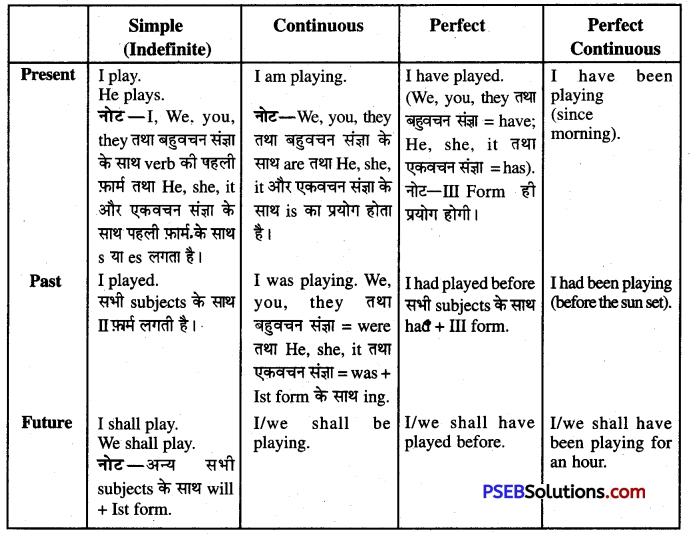
PSEB 7th Class English Grammar Sentence and its Types

Punjab State Board PSEB 7th Class English Book Solutions English Grammar Translation Exercise Questions and Answers, Notes.

PSEB 7th Class English Grammar Translation

A sentence is a well arranged group of words which makes complete sense.
शब्दों का वह सुव्यवस्थित समूह जिसका पूरा अर्थ निकले, Sentence (वाक्य) कहलाता है। जैसे:

  1. Mohan is a good player.
  2. Where is.your house?
  3. Help me, please.
  4. Hurrah ! We have won the match.

PSEB 7th Class English Grammar Translation

Kinds of Sentences
वाक्य चार प्रकार के होते हैं-
1. Assertive Sentences. Assertive Sentences वे वाक्य होते हैं जिनमें किसी बात (Positive या Negative) का वर्णन होता है। इन वाक्यों को Statements भी कहते हैं। इनके अन्त में Full stop (.) लगता है।

2. Interrogative Sentences. ऐसे वाक्यों से किसी प्रश्न का बोध होता है। इनके अन्त में प्रश्न चिन्ह (?) लगाया जाता है।

3. Imperative Sentences. ऐसे वाक्यों से आज्ञा, आदेश, उपदेश अथवा विनती का बोध होता है। इनके अन्त में Full stop (.) लगता है।

4. Exclamatory Sentences. ये ऐसे वाक्य होते हैं जो मन के अकस्मात् भावों को अथवा किसी इच्छा को प्रकट करते हैं। इनके अन्त में Sign of exclamation (!) लगता है। जैसे-

  • May you live long !
  • Hurrah ! We have passed.
  • How beautiful the flower is !

Exercise 1

I. Rewrite the following jumbled groups of words as sentences. (Remember to begin with a capital letter and end with a full stop, a question mark or an exclamation mark)

1. faithful is animal the a dog.
2. so am I tired
3. grandparents fond Ali is his of
4. are when leaving for you Patiala
5. best Ravi Harpreet friends are and
6. cooks my food tasty mother
7. got rain we in wet the
8. has lakes Nainital lovely
9. graceful is Radha a dancer
10. circus the enjoyed children the
Answer:
1. The dog is a faithful animal.
2. I am so tired.
3. Ali is fond of his grandparents.
4. When are you leaving for Patiala ?
5. Ravi and Harpreet are best friends.
6. My mother cooks tasty food.
7. We got wet in the rain.
8. Nainital has lovely lakes.
9. Radha is a graceful dancer.
10. The children enjoyed the circus.

II. Make sentences of your own with the following words. The first one has been done for you:

1. fox – The fox is a cunning animal.
2. clever – He is very …………
3. beauty – There is ……….. all around us.
4. run – Don’t …………. to the water.
5. sweetly – She sings ………… .
6. behind – There is a tree …………. the hut.
7. they – ………… are good boys.
8. and – Ram ……….. Sham are good friends.
9. bouquet – This ………….. is very beautiful.
10. the – ………….. Taj is in Agra.
11. children – Nehru loved ………. .
Answer:
1. fox – The fox is a cunning animal.
2. clever – He is very clever.
3. beauty – There is beauty all around us.
4. run – Don’t run to the water.
5. sweetly – She sings sweetly.
6. behind – There is a tree behind the hut.
7. they – They are good boys.
8. and – Ram and Sham are good friends.
9. bouquet – This bouquet is very beautiful.
10. the – The Taj is in Agra.
11. children – Nehru loved children.

PSEB 7th Class English Grammar Translation

Exercise 2

I. Read the following sentences and say whether they are Assertive (A), Interrogative (In), Imperative (Im) or Exclamatory (E) sentences:

1. What a sweet fhango this is !
2. Where are you going for a holiday ?
3. I need your help to do this sum.
4. Please close the door.
5. Mr. Gupta is going for a walk.
6. Do you play tennis everyday ?
7. How terribly hot it is !
8. Be attentive when I teach.
9. The rainbow has seven colours.
10. Have you had your bath ?
Answer:
1. What a sweet fhango this is ! – (E)
2. Where are you going for a holiday ? – (In)
3. I need your help to do this sum. – (A)
4. Please close the door. – (Im)
5. Mr. Gupta is going for a walk. – (A)
6. Do you play tennis everyday ? – (In)
7. How terribly hot it is ! – (E)
8. Be attentive when I teach. – (Im)
9. The rainbow has seven colours. – (A)
10. Have you had your bath ? – (In)

II. Rewrite the following sentences inserting suitable punctuation marks. The first one has been done for you.

1. doesn’t the nightingale sing sweetly Doesn’t the nightingale sing sweetly ?
2. nepal is a beautiful country Nepal is a beautiful country.
3. how green the grass is How green the grass is !
4. leave the room immediately Leave the room immediately.
5. will you get me a glass of water Will you get me a glass of water ?
6. sukhwinder is a great singer Sukhwinder is a great singer.
7. what a naughty boy he is What a naughty boy he is !
8. what is the answer to this question What is the answer to this question ?
9. have your breakfast immediately Have your breakfast immediately.
10. gandhiji is called the father of the nation Gandhiji is called the Father of the Nation.
11. why do you want to go out now Why do you want to go out now ?
12. oh god what a beautiful sight Oh God ! what a beautiful sight!
1. doesn’t the nightingale sing sweetly Doesn’t the nightingale sing sweetly ?

PSEB 7th Class English Grammar Translation

III. Turn the following statements into negative and questions. The first two have been done for you.

Statements Negative Interrogative
1. She is a clever girl. She is not a clever eirl. Is she a clever eirl ?
2. Ranjit likes mangoes. Raniit does not like mangoes. Does Raniit like maneoes ?
3. Radha is happy. Radha is not happy. Is Radha happy ?
4. They have played badly. They have not played badly. Have they played badly ?
5. Rina bought a car. Rina did not buy a car. Did Rina buy a car ?
6. We are going for a picnic ? We are not going for a picnic. Are we going for a picnic ?
7. They went to Shimla. They did not go to Shimla. Did they go to Shimla ?
8. You must go home now. You must not go home now. Must you go home now ?
9. We returned home in the evening. We did not return home in the evening. Did we return home in the evening ?
10. They can speak Punjabi. They cannot speak Punjabi. Can they speak Punjabi ?

PSEB 7th Class English Vocabulary Punctuation

Punjab State Board PSEB 7th Class English Book Solutions English Vocabulary Punctuation Exercise Questions and Answers, Notes.

PSEB 7th Class English Vocabulary Punctuation

Punctuation का अर्थ है-लिखने में प्रयुक्त विराम चिन्ह। जब कभी हम लिखते हैं तो हमें अपने भावों को स्पष्ट करने के लिए कई स्थानों पर रुकना पड़ता है। इसके लिए कुछ विशेष नियम हैं और उन्हीं के अनुसार हम विराम चिन्हों का वाक्यों में प्रयोग करते हैं। ग़लत चिन्ह लगाने से वाक्यों का अर्थ भी बदल जाता है। यह बात नीचे लिखे वाक्यों से स्पष्ट हो जाएगी।

Examples:

  1. “The Sun”, said the Moon, “moves round the Earth.”
  2. The Sun said, “The Moon moves round the Earth.”

PSEB 7th Class English Vocabulary Punctuation

ऊपर दिए गए दोनों वाक्य एक जैसे शब्द समूहों से बने हैं, परन्तु विराम चिन्ह अलग-अलग ढंग से लगाए गए हैं जिससे कि इनके अर्थों में अन्तर आ गया है।

पहले वाक्य का यह अर्थ निकलता है-
चन्द्रमा ने कहा, “सूर्य पृथ्वी के चारों ओर घूमता है।”
इसके विपरीत दूसरे वाक्य का अर्थ निकलता है
सूर्य ने कहा, “चन्द्रमा पृथ्वी के चारों ओर घूमता है।”

Capital Letters and Important Punctutation Marks

  1. Capital Letters. [ABC]
  2. Full Stop [.]
  3. Comma [,]
  4. Mark of Interrogation [?]
  5. Inverted Commas [” “]
  6. Apostrophe [‘]
  7. Mark of Exclamation [!]

1. CAPITAL LETTERS

अंग्रेजी भाषा ही एकमात्र ऐसी भाषा है, जिसमें दो प्रकार के Letters (अक्षर) होते हैं

  1. Capital letters (बड़े अक्षर) जैसे- A, B, C…….
  2. Small letters (छोटे अक्षर) जैसे-a, b, c, ……

इन बड़े तथा छोटे अक्षरों का प्रयोग करने के विशेष नियम हैं1. प्रत्येक वाक्य के पहले शब्द का पहला letter (अक्षर) capital (बड़ा) होता है; जैसे,
Once a fox was hungry.
The teachers are teaching.

2. Inverted Commas (” “) के भीतर लिखे जाने वाले प्रत्येक वाक्य के पहले शब्द का पहला letter capital होता है; जैसे,
He said to me, “Who is he?”

3. Proper Noun तथा Proper Adjective का पहला letter capital होता है; जैसे,-
I met Mohan. (Proper Noun) He is an Indian. (Proper Adjective) I visited Japan. (Proper Noun) I like English people. (Proper Adjective).

4. दिनों, महीनों, त्योहारों, पुस्तकों, जातियों आदि के नाम सदा capital letter से आरम्भ होते हैं; जैसे,
He came here on Monday. (Day)
I read the Ramayana. (Book)
He was happy on Diwali. (Festival)

5. शब्दों का संक्षिप्त रूप (Abbreviations) प्रस्तुत करते समय capital letters का प्रयोग होता है; जैसे,
M.P., M.L.A., M.A., B.A.

PSEB 7th Class English Vocabulary Punctuation

6. भाषाओं तथा विषयों के नाम का पहला अक्षर capital होता है; जैसे,
Hindi, English, History, Science.

7. God तथा God के लिए प्रयोग किए जाने वाले pronoun (सर्वनाम) He, His, Him सदा capital letter से आरम्भ होते हैं; जैसे,
I pray to God. I pray to Him daily. I love His ways.

II. Use of Full Stop (.)

1. Exclamatory तथा Interrogative sentences को छोड़कर सभी वाक्यों के अन्त में Full Stop का प्रयोग होता है।
Ram ate food.
Come here.
He is a great man.

2. Abbreviations के अन्त में Full Stop का प्रयोग होता है; जैसे,
He is an M.A.
I met Mr. R.R. Sharma.
Sh. Tulsi Ram is an M.L.A.

III. Use Of Comma (,)

Comma का प्रयोग निम्नलिखित ढंग से किया जाता है:

1. एक ही Part of speech के शब्दों को पृथक करने के लिए; जैसे,-
(i) I bought a chair, a table and a fan.
(ii) He is kind, gentle and brave.

2. Apposition (व्याख्या करने वाले शब्दों) से पहले तथा बाद में; जैसे,
Ram, our friend, is going to England.

3. Reported Speech को शेष वाक्य से अलग करने के लिए; जैसे,
Ram said to me, “You are a good player.”

4. No तथा Yes के पश्चात्; जैसे,
No, I cannot go there.
Yes, I shall see him today.

5. तिथि को वर्ष से अलग करने के लिए; जैसे,
March 23, 20…. .

6. Adverb Clause को Principal Clause से अलग करने के लिए; जैसे,
When he came here, I met him.

IV. Sign of Interrogation (?)

प्रश्नवाचक चिन्ह (Sign of Interrogation) का प्रयोग प्रश्नवाचक वाक्य के अन्त में होता है; जैसे,
How are you?
Do you love me?

V. Use of Inverted Commas (” “)

(a) किसी व्यक्ति की बात को उसी के द्वारा कहे हुए शब्दों में व्यक्त करने के लिए Inverted Commas (“”) का प्रयोग किया जाता है; जैसे,
He said to me, “Where are you going ?”
Ram said to him, “How are you now ?”

(b) यदि किसी व्यक्ति द्वारा कहे गए शब्द दो भागों में हों, तो Inverted Commas दो बार आरम्भ होते हैं और दो बार बन्द होते हैं; जैसे,-
“He”, said Mohan, “is a foolish boy.”

PSEB 7th Class English Vocabulary Punctuation

VI. Use of Apostrophe (‘)

(a) Possessive case बनाने के लिए Noun के साथ प्रयोग किया जाता है; जैसे,
Sita’s house.
Ram’s house.

(b) किसी लुप्त अक्षर के स्थान पर भी इसका प्रयोग किया जाता है; जैसे,
Don’t = Do not
Can’t = cannot
Didn’t = Did not
I’ve = I have
That’s = That is
Haven’t = Have not

VII. Sign of Exclamation (!)

1. विस्मयादि बोधक (Exclamatory) शब्दों या शब्द-समूहों के बाद; जैसे,-
What a beautiful flower !
How fine the building is !

2. सम्बोधन सूचक शब्दों के बाद; जैसे,-
Thief ! Thief ! Catch the thief.
Mother ! Mother ! I am alone.
Foolish ! Do not do it.

3. सुख-दुःख आदि प्रकट करने वाले शब्दों के साथ; जैसे,-
Alas ! I am undone.
Hurrah ! We have won the match.

4. शुभ-कामना प्रकट करने वाले वाक्यों के अन्त में; जैसे,-
May you live long !
May you succeed !

Exercises

I. Rewrite the sentences using commas and capitals, where necessary. The first one has been done for you:

1. will you get the radio for us rachna ?
Will you get the radio for us, Rachna ?

2. the gita the bible and the quran are all holy books.
The Gita, the Bible and the Quran are all holy books.

3. the stars the moon and the sun are heavenly bodies.
The stars, the moon and the sun are heavenly bodies.

4. akbar the great and birbal were great admirers of each other.
Akbar the great and Birbal were great admirers of each other.

5. on reaching the banks of ganga he offered his prayers.
On reaching the banks of Ganga, he offered his prayers.

6. saying thus he breathed his last.
Saying thus, he breathed his last.

PSEB 7th Class English Vocabulary Punctuation

II. Rewrite the following sentences using appropriate marks of punctuation. One has been done for you:

1. what shall I bring you when I come back home said the king to his sisters.
“What shall I bring you when I come back home ?” said the king to his sisters.

2. the traveller said can you tell me the way to the nearest inn yes said the man
The traveller said, “Can you tell me the way to the nearest inn ?” “Yes”, said the man.

3. dont be afraid little boy I wont harm you I want to be your friend said the giant.
“Don’t be afraid, little boy. I won’t harm you. I want to be your friend,” said the giant.

4. will your mother not be sorry to see you without jewellery gaurav asked
“Will your mother not be sorry to see you without jewellery ? Gaurav asked.

5. how have you found so much wealth asked ali babas wife
“How have you found so much wealth ?” asked Ali Baba’s wife.

6. the staff room needs sweeping take the broom and sweep it said the principal.
“The staff room needs sweeping. Take the broom and sweep it,” said the Principal.

7. O king replied buddha this is the custom we always observe.
“O king”, replied Buddha, “this is the custom we always observe.”

8. mrs prasad said how much did you pay for this picture.
Mrs. Prasad said, “How much did you pay for this picture ?”

9. gopal sita radha and neelu went to ludhiana.
Gopal, Sita, Radha and Neelu went to Ludhiana.

10. the farmer said I cant give you any money
The farmer said, “I can’t give you any money.”

III. Use an apostrophe where necessary. Some may not need. One has been done for you:

1. The clowns hat had a feather. The clown’s hat had a feather.
2. Bulbul’s eyes are brown. Bulbul’s eyes are brown.
3. The boys ties were flying about. The boys’ ties were flying about.
4. My sisters essay got the first prize. My sister’s essay got the first prize.
5. The childrens books are torn. The children’s books are torn.
6. Lets go to the zoo this evening. Let’s go to the zoo this evening.
7. Crows nests are made of twigs. Crows’ nests are made of twigs.
8. On Sunday therell be a fair. On Sunday there’ll be a fair.
9. The babies dresses were on sale. The babies dresses were on sale.

PSEB 7th Class English Vocabulary Punctuation

IV. Punctuate the following with commas and inverted commas, where needed.

1. Rajan said Goodbye.
2. Shiela says in our house there are chairs tables fans and radios.
3. Whose books are these ? said Rani.
4. I looked for my pen everywhere said Ali.
5. Give me the books, shouted Ranjit.
Answer:
1. Rajan said, “Goodbye.”
2. Shiela says, “In our house, there are chairs, tables, fans and radios.”
3. “Whose books are these ?” said Rani.
4. “I looked for my pen everywhere,” said Ali.
5. “Give me the books,” shouted Ranjit.

PSEB 7th Class English Vocabulary Comparison using ‘as’

Punjab State Board PSEB 7th Class English Book Solutions English Vocabulary Comparison using ‘as’ Exercise Questions and Answers, Notes.

PSEB 7th Class English Vocabulary Comparison using ‘as’

एक जैसे गुणों वाली दो वस्तुओं को तुलना के लिए as………. as का प्रयोग किया जाता है। किसी गुणधर्म को Highlight करने के लिए उसकी तुलना उसी गुणधर्म वाली किसी भी अन्य वस्तु से की जा सकती है।

1. as good as gold
2. as happy as a clown
3. as sharp as a razor
4. as big as elephant

PSEB 7th Class English Vocabulary Comparison using ‘as’

5. as heavy as lead
6. as beautiful as moon
7. as gentle as lamb
8. as silent as dea$
9. as small as ant
10. as thin as paper
11. as white as snow
12. as tall as giraffe
13. as clever as fox
14. as costly as diamond.
15. as proud as peacock
16. as hot as sun
17. as pretty as flower
18. as sweet as honey
19. as red as rose
20. as strong as iron
21. as innocent as lamb
22. as clever as fox/monkey/owl/crow
23. as wild as lion
24. as soft as silk
25. as light as cotton
26. as black as night
27. as wise as crow
28. as brave as lion.
29. as sure as death
30. as deep as ocean
31. as cold as ice
32. as black as coal
33. as busy as a bee
34. as clear as bell
35. as common as dirt
36. as deaf as a post

PSEB 7th Class English Vocabulary Comparison using ‘as’

37. as easy as A.B.C.
38. as large as life
39. as light as air
40. as straight as an arrow

PSEB 7th Class English Vocabulary Synonyms

Punjab State Board PSEB 7th Class English Book Solutions English Vocabulary Synonyms Exercise Questions and Answers, Notes.

PSEB 7th Class English Vocabulary Synonyms

A Synonyms is a word which is same in meaning (एक समान अर्थ) to another word; as-

Word – Synonym

auspicious – happy/lucky
alive – lively
along – side by side
aim – objective
beautiful – pretty

PSEB 7th Class English Vocabulary Synonyms

bow – to bend
blaze – fire
believe – trust
banks – shores
courtier – a member of a royal court
comer – end point of some place
crack – rift
complete – full
cultural – traditional
celebrate – to hold make merry
deep – far-down
deities – gods/goddesses
diamond – a precious stone
dawn – morning
expect – hope
energy – power
famous – well-known
false – untrue
fright – panic, threaten
fervous – zeal
glance – look
gentle – kind
grey – brown
handsome – smart
honest – truthful
immobile – stationary
mounds – heaps/piles
nice – fine
overcome – win over
peace – calmness
patience – toleration
prepared – ready
paddy – rice crop
real – genuine
strong – tough
slumber – sound sleep
sight – scene
slightly – a little
stout – well built/strong
silent – quiet, motionless

PSEB 7th Class English Vocabulary Synonyms

smooth – plain
stuck – got busy
to pass – to move onward
tiny – little
together – along with
tense – nervous
trade – business
tribal – related to a tribe
ugly – bad looking
woods – jungle

PSEB 7th Class English Vocabulary Antonyms

Punjab State Board PSEB 7th Class English Book Solutions English Vocabulary Antonyms Exercise Questions and Answers, Notes.

PSEB 7th Class English Vocabulary Antonyms

An Antonym is a word which is opposite in meaning to another word; as

Word – Antonym

departure – arrival
ugly – beautiful
after – before

PSEB 7th Class English Vocabulary Antonyms

white – black
big – small
break – make
begin – end
buy – sell
complete – incomplete
clean – dirty
come – go
cruel – kind
cool – warm
catch – throw
care – neglect
calm – noisy
dawn – dusk
day – night
earth – sky
east – west
friend – enemy
front – behind
first – last
found – lost
give – take
good – bad
hate – love
here – there
hide – seek
happy – sad
hot – cold
in – out
late – early
love – hate
long – short
land – water
morning – evening
many – few
now – then
near – far
new – old
open – close
obey – disobey
proud – humble
push – pull
pretty – ugly
rich – poor
right – wrong/left
some – many
sit – stand
soon – late

PSEB 7th Class English Vocabulary Antonyms

tall – short
top – bottom
up – down
virtue – vice
wild – pet/domestic
win – lose
weak – strong

PSEB 7th Class English Grammar Verb (Conjugation)

Punjab State Board PSEB 7th Class English Book Solutions English Grammar Verb (Conjugation) Exercise Questions and Answers, Notes.

PSEB 7th Class English Grammar Verb (Conjugation)

वे शब्द जो किसी क्रिया (action) को व्यकत करते हैं, Verbs कहलाते हैं। Verbs दो प्रकार के होते हैं- Main Verbs (मुख्य क्रियाएं) तथा helping verbs (सहायक क्रियाएं)

नीचे लिखे वाक्यों को पढ़िए:

  1. Dev is sleeping.
  2. Geeta made a doll.
  3. They laughed.
  4. The girls are going out.
  5. Our team will play a match.

ऊपर दिए गए वाक्यों में sleeping, made, laughed, going तथा play मुख्य क्रियाएं (Main verbs) है। परन्तु is, are, will सहायक क्रियाएं (Helping Verbs) हैं। वे मुख्य क्रियाओं की सहायता करती हैं।
सहायक क्रियाएं निम्नलिखित हैं:
Is, am, are, was, were, has, have, had, do, does, did, will, would, shall, should, can, could, may, might, must, ought to, need, dare, used to.

PSEB 7th Class English Grammar Verb (Conjugation)

Exercises

I. Pick out the helping verbs in the following sentences.

1. I have found a bag.
2. Where were you going yesterday ?
3. I am learning to swim.
4. He has lost his book.
5. You may go out now.
6. I will bring an orange for you.
7. They are cutting the hedge.
8. Where do you live?
9. I shall give you some money.
10. You can go now.
Hints:
1. have
2. were
3. am
4. has
5. may
6. will
7. are
8. do
9. shall
10. can.

II. Fill in the blanks with suitable helping verbs:

1. The teacher…………. not punish the whole class.
2. We………….go for a picnic tomorrow.
3. Where………….. the books kept ?
4. Who………….stolen my money?
5. Which games…………played in school ?
6. The winner…………..receive a prize from the chief guest.
7. …………you seen the Taj Mahal ?
8. When…………..your tutor come to teach you ?
9. Ravi…………go to London or America for his holidays.
10. ………….I help you with your problems ?

PSEB 7th Class English Grammar Verb (Conjugation)

Hints:
1. did
2. shall
3. were
4. has
5. are
6. will
7. Have
8. does
9. will
10. May.

PSEB 7th Class English Grammar Translation

Punjab State Board PSEB 7th Class English Book Solutions English Grammar Translation Exercise Questions and Answers, Notes.

PSEB 7th Class English Grammar Translation

Present Indefinite Tense

1. मैं स्कूल जाता हूँ। – I go to school.
2. बच्चे खेलते हैं। – Children play.
3. माता जी खाना बनाते हैं। – Mother cooks food.
4. लड़के खेलते हैं। – Boys play.
5. मोहित दांत साफ़ करता है। – Mohit brushes his teeth.

PSEB 7th Class English Grammar Translation

Present Indefinite Tense (Interrogative)

1. क्या आप स्कूल जाते हैं ? – Do you go to school ?
2. आप क्या चाहते हो ? – What do you want ?
3. आप देर से क्यों आते हो ? – Why do you come late ?
4. आप कहाँ रहते हो। – Where do you live?
5. आपका स्कूल कब लगता है ? – When does your school start ?

Present Indefinite Tense (Negative)

1. रोहित झूठ नहीं बोलता है। – Rohit does not tell lies.
2. मैं खाना बेकार नहीं करता हूँ। – I don’t waste food.
3. आप गाना नहीं गाते हो। – You do not sing a song.
4. समय किसी के लिए भी नहीं रूकता है। – Time does not wait for anyone.
5. हम स्कूल लेट नहीं जाते। – We do not go to school late.

Past Indefinite Tense

1. मैं स्कूल गया। – I went to school.
2. आपने खाना खाया। – You took food.
3. मेरी माता जी ने भोजन बनाया। – My mother cooked food.
4. मैंने कल पाठ याद किया। – I learnt my lesson yesterday.
5. चपरासी ने घंटी बजाई। – The peon rang the bell.

Past Indefinite Tense (Interrogative)

1. क्या आप कल स्कूल गए थे ? – Did you go to school yesterday ?
2. आप कल कितने बजे बाज़ार गए थे ? – At what time did you go to the market yesterday ?
3. आप कल देर से क्यों आए ? – Why did you come late yesterday ?
4. उन्होंने मेरी बात क्यों नहीं सुनी ? – Why did they not listen to me ?
5. उषा ने खाना कब बनाया। – When did Usha cook food ?

Past Indefinite Tense (Negative)

1. मैंने झूठ नहीं बोला। – I did not tell a lie.
2. शरन ने दवाई नहीं ली। – Sharan did not take medicine.
3. रचना ने कसरत नहीं की। – Rachna did not take excercise.
4. भारत ने मन नहीं हारा। – Bharat did not lose heart.
5. चपरासी ने घंटी नहीं बजाई। – The poen did not ring the bell.

Future Indefinite Tense

1. कल बरसात होगी। – It will rain tomorrow.
2. मैं कल स्कूल आऊँगा। – I will come to school tomorrow.
3. वह कल दिल्ली जाएगा। – He will go to Delhi tomorrow.
4. आप कल रमेश से मिलोगे। – You will meet Ramesh tomorrow.
5. रमन कल मुझे ई-मेल करेगा। – Raman will send me an e-mail tomorrow.

PSEB 7th Class English Grammar Translation

Future Indefinite Tense (Negative)

1. बच्चे झूठ नहीं बोलेंगे। – The children will not tell lies.
2. पंछी गीत नहीं गाएंगे। – The birds will not sing songs.
3. नांव समुद्र में नहीं डूबेगी। – The boat will not sink in the sea.
4. आज बरसात नहीं होगी। – It will not rain today.
5. आप स्कूल से छुट्टी नहीं करोगे। – You will not take a leave from the school.

Future Indefinite Tense (Interrogative)

1. क्या आप कल मुझे मिलेगें ? – Will you meet me tomorrow ?
2. क्या चित्रकार चित्र बनाएगा ? – Will the painter paint a picture ?
3. क्या वह गाना गाएंगे ? – Will they sing a song ?
4. आप स्कूल कब आएंगे ? – When will you come to school ?
5. आप मेरा काम क्यों नहीं करोगे ? -Why will you not do my work ?

Present Continuous Tense

1. बच्चे पढ़ रहे हैं। – Children are reading.
2. अंजू कार चला रही है। – Anju is driving a car.
3. आपको पसीना आ रहा है। – You are perspiring/sweating.
4. पानी बहुत तेज़ बह रहा है। – Water is running very fast.
5. अध्यापक पढ़ रहा है। – The teacher is teaching.

Present Continuous Tense (Interrogative)

1. क्या पानी तेज़ी से बह रहा है ? – Is the water running fast ?
2. लोग वृक्षों की छाया क्यों ढूंढ़ रहे हैं ? – Why are the people looking for the shade of the trees. ?
3. क्या रानी निशी की मदद कर रही है ? – Is Rani helping Nishi ?
4. मोहन घर कब जा रहा है ? – When is Mohan going home ?
5. उसकी माता कौन-सा खाना बना रही है ? – Which food is her mother cooking ?

Present Continuous Tense (Negative)

1. छोटे बच्चे खाना नहीं खा रहे हैं। – Little children are not eating food.
2. रोहित गाड़ी तेज़ नहीं चला रहा है। – Rohit is not driving fast.
3. सीता अपना काम ठीक नहीं कर रही है। – Sita is not doing her work.
4. बरसात नहीं हो रही है। – It is not raining.
5. मकैनिक कार ठीक नहीं कर रहा है। – Mechanic is not repairing the car.

Past Continuous Tense

1. वह सफलता के लिए प्रार्थना कर रहा था। – He was praying for success.
2. मेरा भाई स्कूल जा रहा था। – My brother was going to school.
3. मां पैसे बचा रही थी। – Mother was saving money.
4. सिमर नई किताब लिख रही थी। – Simar was writing a new book.
5. बरसात हो रही थी। – It was raining.

PSEB 7th Class English Grammar Translation

Past Continuous Tense (Negative)

1. साइकिल तेज़ नहीं चल रही थी। – The bicycle was not running fast.
2. पंछी उड़ नहीं रहे थे। – The birds were not flying.
3. मेरी सहेली गाना नहीं गा रही थी। – My friend was not singing a song.
4. मेरी माता जी गुस्सा नहीं कर रही थी। – My mother was not angry.
5. बच्चे शोर नहीं मचा रहे थे। – The Children were not making a noise.

Past Continuous Tense (Interrogative)

1. क्या सभी अपना पाठ याद कर रहे थे ? – Were all learning their lesson ?
2. पारस अपना जन्मदिन कैसे मना रहा था ? – How was Paras celebrating his birthday ?
3. लेखक कौन सी किताब लिख रहा था ? – Which book was the writer writing ?
4. राकेश घर कब जा रहा होगा ? – When was Rakesh going home ?
5. बरसात कब हो रही थी ? – When was it raining ?

Future Continuous Tense

1. मैं कल बस से दिल्ली जा रहा होगा। – I will be going to Delhi by bus tomorrow.
2. मेरे माता जी इस वक्त खाना बना रहे होंगे। – My mother will be cooking food at this time.
3. प्रीति गाना गा रही होगी। – Preeti will be singing a song.
4. रचित फिल्म देख रहा होगा। – Rachit will be watching a movie.
5. कल मनजीत पेपर दे रहा होगा। – Manjeet will be taking a test tomorrow.

Future Continuous Tense (Negative)

1. अगले सप्ताह किसान फ़सल नहीं काट रहा होगा। – The farmer will not be reaping the crop next week.
2. परीक्षा के दौरान हम टी०वी० नहीं देख रहे होंगे। – We were not watching T.V. during the examinations.
3. मुस्कान शाम के समय चाय नहीं पी रही होगी। – Muskan will not be taking tea in the evening.
4. वह घर नहीं जा रही होगी। – She will not be going home.
5. बच्चा इस समय सो नहीं रहा होगा। – The child will not be sleeping by this time.

Future Continuous Tense (Interrogative)

1. गुरमुख शाम का क्या कर रहा होगा ? – What will he be doing in the evening ?
2. क्या कल सुबह सोनू पढ़ रहा होगा ? – Will Sonu be reading in the morning tomorrow ?
3. क्या नरेश नई किताब खरीद रहा होगा ? – Will Naresh be buying new book ?
4. क्या सोनू क्रिकेट खेल रहा होगा ? – Will Sonu playing cricket ?
5. निशी शाम को घर कैसे जा रही होगी ? – How will Nishi going home in the evening ?

PSEB 7th Class English Grammar Translation

Other Sentences

1. मेरा बात सुनो। – Listen to me.
2. विनम्रता से बात करो। – Speak gently.
3. अपनी किताब मुझे दो। – Give me your book.
4. एक-दूसरे को धक्का ना मारो। – Don’t push one another.
5. आपस में मत झगड़ो। – Don’t quarrel among yourselves.
6. वह आदमी अमीर है। – That man is rich.
7. चाय गर्म है। – Tea is hot.
8. वह घर सुन्दर है। – That house is beautiful.
9. वह अच्छा अध्यापक है। – He is a good teacher.
10. धरती सूर्य के इर्द-गिर्द घूमती है। – The earth moves around the Sun.

PSEB 7th Class English Grammar Subject-Verb-Object

Punjab State Board PSEB 7th Class English Book Solutions English Grammar Subject-Verb-Object Exercise Questions and Answers, Notes.

PSEB 7th Class English Grammar Subject-Verb-Object

एकवचन कर्ता (Subject) के साथ एकवचन क्रिया (Verb) का प्रयोग किया जाता है, जबकि बहुवचन कर्ता के साथ बहुवचन क्रिया का प्रयोग किया जाता है।

एकवचन क्रियाएं is, am, was, has, does तथा I form + s/es हैं। बहुवचन क्रियाएं हैं- are, were, have, do आदि।

Ram goes,
Ram and Sham go.
They go.
She goes.

PSEB 7th Class English Grammar Subject-Verb-Object

1. यदि दो या दो से अधिक एकवचन Subjects को and से जोड़ा जाए तो प्राय: उनके साथ बहुवचन Verb का प्रयोग होता है; जैसे,

  • Mohan and Ram are friends.
  • Mohan, Sham and Ram play together.
  • He and his brother have done the work.
  • Sham and Gopal were there in the meeting.
  • He and his friend do not work together.

2. यदि दो एकवचन संज्ञाएं (Nouns) किसी एक व्यक्ति या किसी एक चीज़ का बोध कराती हों तो ऐसी एकवचन संज्ञाओं (Nouns) के साथ एकवचन Verb का प्रयोग होता है; जैसे,

  • My brother and helper has arrived.
  • The leader and speaker is sitting on the stage.
  • A great Gandhian and leader is dead.

नोट- (i) यदि एक ही व्यक्ति का बोध कराना हो तो Article का प्रयोग दोनों संज्ञाओं अथवा विशेषणों में से पहली संज्ञा या विशेषण के साथ ही किया जाता है।
(ii) यदि दो संज्ञाओं से दो अलग व्यक्तियों का बोध कराना हो तो प्रत्येक संज्ञा (Noun) से पूर्व Article का प्रयोग किया जाएगा। ऐसी अवस्था में बहुवचन क्रिया (Verb in Plural) का प्रयोग किया जाएगा।
The leader and the speaker are sitting on the stage.

3. यदि दो कर्त्ता मिलकर किसी एक विचार (one idea) को व्यक्त करते हों तो एकवचन क्रिया (Verb in Singular) का प्रयोग होता है; जैसे,

  • Fish and meat is the food of the Bengalis.
  • Slow and steady wins the race.
  • Twenty kilometres is not a long distance.
  • The horse and the carriage has arrived.

4. यदि एकवचन कर्ता (Subject) से पूर्व each अथवा every का प्रयोग किया जाए तो एकवचन क्रिया (Verb in Singular) का प्रयोग होता है; जैसे,

  • Every boy and girl was well dressed.
  • Every man, woman and child was present.
  • Each day and each hour takes its account.

5. यदि दो या दो से अधिक एकवचन कर्ता (Subjects) को or, nor, either…….. or, neither…………nor से जोड़ा जाए तो एकवचन क्रिया का प्रयोग होता है; जैसे,

  • Work or play has no difference for me.
  • Neither he nor I was present.
  • Either Mohan or Sohan has broken the slate.
  • Neither food nor water was available there.
  • Neither pleasure nor pain affects me.

6. जब or तथा nor से जोड़े गए Subjects का वचन भिन्न-भिन्न हो तो बहुवचन क्रिया का प्रयोग होना चाहिए तथा बहुवचन कर्ता को क्रिया के साथ रखना चाहिए; जैसे,

  • Sham or his brothers have broken the slate.
  • Neither the monitor nor the students were present.
  • Neither the speaker nor the listeners were serious.
  • Either the man or his sons have gone wrong.

7. जब or अथवा nor से विभिन्न कर्ता (Subjects) जुड़े हुए हों, तो क्रिया (Verb) अपने निकटतम् Subject: के Person (पुरुष) से मेल खाता है; जैसे,

  • Either he or I have to go to Delhi.
  • Neither you nor he is to blame.
  • Either you or father is paying for it.

8. जब कर्ता (Subjects) के वचन अथवा पुरुष में अन्तर हो और वे and से जुड़े हों तो क्रिया (Verb) बहुवचन में प्रयोग होती है।

  • He and I are good friends.
  • My father and I have jointly done this.
  • You and he are always together.
  • You and I are always in time.

PSEB 7th Class English Grammar Subject-Verb-Object

9. समूहवाचक संज्ञा (Collective Noun) के साथ पूरे समूह का भाव व्यक्त करने के लिए एकवचन क्रिया (Verb in Singular) का प्रयोग होता है। परन्तु यदि समूह के व्यक्तियों (individuals) का बोध कराना हो तो बहुवचन क्रिया (Verb in Plural) का प्रयोग होता है; जैसे,

  • The Committee has chosen its Chairman.
  • There is a large number of boys in the class.
  • A number of players were playing foul.
  • The police were called out. The crew was efficient.
  • The crew were arrested after the accident.

10. कुछ संज्ञाएं देखने में बहुवचन लगती हैं, परन्तु वे भाव में एकवचन होती हैं। ऐसी संज्ञाओं के साथ एकवचन क्रिया (Verb) लगती है; जैसे,

  • The news is good.
  • Physics is an easy subject.

11. कुछ संज्ञाएं देखने में एकवचन लगती हैं परन्तु उनका अर्थ बहुवचन होता है। ऐसी संज्ञाओं के साथ बहुवचन क्रिया (Verb in Plural) का प्रयोग होता है; जैसे,

  • The cattle are grazing in the field.
  • People are there in the field.

12. हमें क्रिया का मेल वास्तविक Subject के साथ ही कराना चाहिये। कभी-कभी हम क्रिया का निकटतम Plural Subject के साथ मेल कर देते हैं और वास्तविक Subject की अनदेखी कर देते हैं। हमें क्रिया का मेल वास्तविक Subject के साथ ही करना चाहिये; जैसे,

  • Each of the students was a player.
  • Neither of the women was tall.
  • Each one of plots is for sale.
  • One of the boys was my friend.

13. यदि Subject में दो Nouns या Pronouns ‘with’ या ‘as well as’ के साथ जुड़े हों, तो क्रिया उनमें से पहले noun या pronoun से मेल खाती हैः जैसे:

  • Ram, with all the members of his family, was present.
  • He, as well as his friends, is there in the hall.
  • Mohan, and not his friend, has done this.
  • I, as well as he, have worked hard.

14. जब किसी क्रिया का Subject कोई Relative Pronoun हो, तो क्रिया Relative Pronoun से ठीक पहले वाले Subject के अनुसार लगती है; जैसे

  • I, who am your guide, shall stand by you.
  • You, who are my guide, are expected to stand by me.
  • He is among the persons who are against me.

PSEB 7th Class English Grammar Subject-Verb-Object

Exercise

In each of the following sentences supply a verb in agreement with its subject.

1. My scissors ………………. lost.
2. The police ………………… investigating the case.
3. Neither of the students …………………. right.
4. Raja and Rama ………………… in the garden.
5. Gagan with his friend ………………. come today.
6. Every boy and girl ………………… invited for the programme.
7. Five rupees ………………… too much for this item.
8. A packet of sweets ………………. given to each child.
9. All the children ……………….. going for the movie.
10. Six kilometres …………………. a long distance to walk.
11. Ram as well as Ravi ……………….. to be helped.
12. One of the students …………………. hurt while playing.
13. The military ………………… put on alert.
14. He, with his father, ……………… among the first to arrive.
15. There ………………… several mistakes in your work.
16. The quality of the fruits …………………. very good.
17. No news ……………… good news.
18. Twice three times ……………….. six.
19. Either he or ………………… at fault.
Hints:
1. are
2. is
3. is
4. were
5. has
6. was
7. are
8. was
9. are
10. is
11. is
12. was
13. was
14. was
15. are
16. is
17. is
18. is
19. am.

PSEB 7th Class English Grammar Prepositions

Punjab State Board PSEB 7th Class English Book Solutions English Grammar Prepositions Exercise Questions and Answers, Notes.

PSEB 7th Class English Grammar Prepositions

Preposition वह शब्द है जिसका प्रयोग Noun अथवा Pronoun के साथ स्थिति, समय, संबंध या साधन आदि दर्शाने के लिए किया जाता है।

उदाहरण-
There is a teacher in the class.
He is fond of milk.
The man jumped off the horse.

PSEB 7th Class English Grammar Prepositions

पहले वाक्य में in, teacher की स्थिति को व्यक्त करता है।
दूसरे वाक्य में of, fond तथा milk का आपसी सम्बन्ध बताता है।
तीसरे वाक्य में off, jumped तथा horse के आपसी सम्बन्ध को स्पष्ट करता है।

Preposition का प्रयोग प्रायः अपने Object से पहले किया जाता है। जैसा कि उपर्युक्त तीनों वाक्यों से स्पष्ट है, परन्तु कभी-कभी वह अपने Object के बाद भी प्रयोग होता है; जैसे,

Here is the book that you asked for.
What are you thinking of ?

Some Important Prepositions

1. Act upon (अमल करना)-Act upon my advice.
2. Aim at (निशाना बांधना)-The hunter aimed at the bird.
3. Angry with (क्रोधित)-The teacher is angry with you.
4. Agree with (सहमत होना)-I agree with you.
5. Agree.to (सहमत होना))-He agreed to my proposal.
नोट – (i) किसी व्यक्ति से सहमति के लिए agree के साथ with का प्रयोग किया जाता है।
(ii) किसी सुझाव से सहमति के लिए agree के साथ to का प्रयोग किया जाता है।
6. Absent from (अनुपस्थित होना)-She is absent from the class.
7. Afraid of (भयभीत)-He is afraid of his teacher.
8. Believe in (विश्वास रखना)-I believe in God.
9. Born of (जन्म लेना)-Pt. Nehru was born of rich parents.
10. Busy with (व्यस्त)-He is busy with his work.
11. Care for (परवाह करना)-He does not care for me.
12. Deal in (व्यापार करना)-He deals in sugar.
13. Die of (किसी रोग से मरना)-He died of fever.
14. Die for (के लिए मरना)-He died for his country. नोट-
(i) किसी बीमारी से मरने के लिए Die of का प्रयोग होता है।
(ii) देश पर मर मिटने के लिए Die for आता है।
15. Differ with (असहमत)-I differ with you.
16. Different from (से भिन्न)-This pen is different from that one.
17. Faith in (में विशवास)-I have faith in God.
18. Faithful to (के प्रति वफादार)-The dog is faithful to his master.
19. Fail in (असफल होना)-He failed in Hindi.
20. Famous for (के लिए प्रसिद्ध) Agra is famous for the Taj.

PSEB 7th Class English Grammar Prepositions

21. Fed up with (से तंग होन)-I am fed up with him.
22. Feed on (निर्वाह करना)-Cows feed on grass.
23. Fit for a (के योग्य)-I am fit for this work.
24. Full of (भरा होना)-The jug is full of water.
25. Fond of (का चाव होना)- I am fond of milk.
26. Glad at (प्रसन्न)-I am glad at your success.
27. Good at (निपुण)-I am good at English.
28. Good for (के लिए उपयोगी)-Milk is good for health.
29. Give up (त्यागना)-Give up your bad habits.
30. Invite to (आमंत्रित करना)- I invited him to tea.
31. Junior to (पद से नीचा)-He is junior to me.
32. Keep to (रहना)-Always keep to the left.
33. Kind to (दयालु)- He is kind to the poor.
34. Knock at (खटखटान)-I am knocking at the door.
35. Laugh at (हंसी उड़ान)-The boys laughed at the poor.
36. Lead to (जाना)-This road leads to Ambala.
37. Listen to (ध्यान देना)-Listen to me.
38. Look after (देखभाल करना)-I look after my old mother.
39. Mad with (से पगल)-He was mad with joy.
40. Made of (बनी हुई)-This table is made of wood.
41. Married to (विवाह होना या विवाह करना)-Rama was married to Sita.
42. Mix with (मेल जोल रखना)-Do not mix with bad boys.
43. Obedient to (अज्ञाकारी)-Ram is obedient to his teacher.
44. Pass through (गुज़रना)-He passed through a forest.
45. Put out (बुझाना)-Put out the fire.
46. Take pity (दया करना)-He took pity on me.
47. Popular with (सर्वप्रिय)-The teacher is very popular with the students.
48. Pray to (प्रार्थना करना)-I pray to God daily.
49. Proud of (गर्व करना)-I am proud of you.
50. Quick at (तेज)-He is quick at work.
51. Quarrel with (झगड़ना)-We should not quarrel with others.
52. Reply to (उतर देना)-He did not reply to my letter.
53. Send for (बुला भेजना)-He sent for the doctor.
54. Senior to (पद से ऊंचा)-He is senior to me.
55. Short of (कमी होना)-I am short of money.
56. Sick of (दःखी)-I am sick of this life.

PSEB 7th Class English Grammar Prepositions

57. Sorry for (के लिए खेद)-I am sorry for coming late.
58. Thankful to (के प्रति धन्यवादी)-I am thankful to you for your help.
59. Useful for (के लिए उपयोगी)- Milk is useful for health.
60. Wait for (प्रतीक्ष करना)- Please wait for me.

Exercise 1

Choose suitable prepositions from the box to fill in the blanks. One has been done for you:

from, across, along, between, by, on, behind, against, among, under, over, with, into, for, of, at, in front of.
1. There are trees in front of our house.
2. Do not stand………….. a vehicle.
3. We lost the match……………… Govt. High School, Ropar.
4. The minister stood ……………. the people.
5. Keep the bags ……………… the desk and the table.
6. People built houses ……………… the bridge.
7. We went ……………. bus to Amritsar.
8. The fare ……………. Chandigarh to Ludhiana is not cheap.
9. The boy stood……………. the hill.
10. Look ……………. the bag for your pens.
11. GO …………… Samir to the market.
12. Do not run but walk ……………… the bridge.
13. Run ……………. the road and call the man.
14. Look……………. the book and answer.
15. The boy is looking ……………… a bride.
Hints:
2. behind
3. against
4. among
5. between
6. under
7. by
8. from
9. on
10. into
11. with
12. across
13. along
14. over
15. for.

PSEB 7th Class English Grammar Prepositions

Exercise 2

I. Put a tick V on the correct preposition as shown in the first sentence:

1. Akshay takes delight (in/by) his studies.
2. Beware (from/of) thieves in a new place.
3. We all agreed (to/with) the proposal.
4. Rajmah and rice are popular (among/to) children.
5. The building was set (with/on) fire.
6. Do not be jealous (on/of) others.
7. Her face seems familiar (to/with) me.
8. We are known (about/to) Dr. Sharma.
9. I do not approve (with/of) smoking
10. Daljit lives (on/at) Madhya Marg.
11. Always write (în/with) ink.
12. Sam does not like interference (on/in) his work.
13. Pammi is married (with/to) Sukhwinder.
14. Our final examination is held (on/in) March.
15. Akhil is always late (for/to) school.
16. I have applied (from/for) leave.
17. We always talk (about/on) discipline.
18. The boy complained (with/against) me.
19. This book is useful (under/for) children.
20. Rana has just recovered (at/from) illness.
Hints:
1. in
2. of
3. to
4. among
5. on
6. of
7. to
8. to
9. of
10. at
11. in
12. in
13. to
14. in
15. for
16. for
17. about
18. against
19. for
20. from.

PSEB 7th Class English Grammar Prepositions

II. Using the words followed by preposition, make sentences of your own. The first one has been done for you:

interfere with, fit for, confident of, sorry for, mix with, make fun of, prays at, acted upon, bent on, superior to.
1. I do not allow my music lessons to ……………. my studies.
2. He is ………….. this post.
3. He is ………….. his success.
4. I am …………. the delay.
5. Do not ………….. bad boys.
6. Don’t ………… of the beggar.
7. He ………… Sri Harmandar Sahib.
8. He …………. my advice.
9. He is …………. making mischief.
10. My pen is ………… yours.
Answer:
1. I do not allow my music lessons to interfere with my studies.
2. He is fit for this post.
3. He is confident of his success.
4. I am sorry for the delay.
5. Do not mix with bad boys.
6. Don’t make fun of the beggar.
7. He prays at Sri Harmandar Sahib.
8. He acted upon my advice.
9. He is bent on making mischief.
10. My pen is superior to yours.

PSEB 7th Class English Grammar Adjectives with Degrees

Punjab State Board PSEB 7th Class English Book Solutions English Grammar Adjectives with Degrees Exercise Questions and Answers, Notes.

PSEB 7th Class English Grammar Adjectives with Degrees

An Adjective is a word which qualifies or adds something to the meanings of a Noun or a Pronoun.
जो शब्द किसी Noun अथवा Pronoun की विशेषता प्रकट करता है उसे Adjective (विशेषण) कहते हैं।

Adjective प्रायः Noun के साथ प्रयोग होता है और यह किसी व्यक्ति, पशु अथवा स्थान की विशेषता बताता है या किसी संख्या अथवा मात्रा का बोध कराता है। जैसे:

  1. Many years ago there was a miser. (संख्या)
  2. He never ate good food. (विशेषता)
  3. He spent little money. (मात्रा)
    Adjectives मुख्यत: 9 प्रकार के होते हैं।

1. Adjectives of Quality. जो विशेषण किसी व्यक्ति अथवा वस्तु के गुण- दोष का बोध कराते हैं उन्हें Adjective of Quality (गुणवाचक विशेषण) कहते हैं। जैसे-
good, fresh, bad आदि।।

2. Proper Adjectives. Proper Nouns से बनने वाले विशेषण Proper Adjectives (व्यक्तिवाचक विशेषण) कहलाते हैं। जैसे:-
Indian, Chinese.

3. Adjectives of Quantity. जो विशेषण किसी वस्तु की मात्रा का बोध कराते हैं उन्हें Adjectives of Quantity (परिमाणवाचक विशेषण) कहते हैं। इस प्रकार के Adjective प्रायः कितने (How much) शब्द का उत्तर देते हैं। जैसे:-
some, no, great.

4. Adjectives of Number. जो विशेषण संख्या अथवा क्रम का- बोध कराते हैं उन्हें Adjectives of Number (संख्यावाचक विशेषण) कहते हैं। जैसे:-
two, all आदि।

5. Distributive Adjectives. जो विशेषण किसी विशेष वर्ग के व्यक्ति अथवा वस्तु को अलग-अलग प्रकट करें, उन्हें Distributive Adjectives (विभाजन विशेषण) कहते हैं। जैसे : each, either, every आदि।

6. Demonstrative Adjectives. जो विशेषण सम्बन्धित व्यक्ति अथवा वस्तु की ओर संकेत करते हैं उन्हें Demonstrative Adjectives (संकेतवाचक विशेषण) कहते हैं। जैसे:-
This pen; That girl.

7. Interrogative Adjectives. जो विशेषण प्रश्न पूछने के लिए प्रयोग किए जाते हैं उन्हें Interrogative Adjectives (प्रश्नवाचक विशेषण) कहते हैं। जैसे:-
which, what, whose आदि।

8. Possessive Adjectives. किसी वस्तु या व्यक्ति पर अधिकार व्यक्त करने वाले विशेषण को Possessive Adjectives (सम्बन्धवाचक विशेषण) कहा जाता है। जैसे:-
My book, Your brother, आदि।

9. Emphasizing Adjectives. जो शब्द Possessive Adjectives पर बल देने के लिए प्रयोग किए जाते हैं वे Emphasizing Adjectives कहलाते हैं।
प्रायः Own शब्द इसके लिए प्रयोग किया जाता है। जैसे:-
I became my own servant.

Degree of Adjectives

(1)
PSEB 7th Class English Grammar Adjectives with Degrees 1
इसी प्रकार के कुछ अन्य विशेषण जिनके साथ er तथा est का प्रयोग होता है, निम्नलिखित हैं:
Loud (ऊंची आवाज़), small (छोटा), warm (गर्म), young (आयु में छोटा), cheap (सस्ता), bright (चमकीला) इत्यादि।

(2)
PSEB 7th Class English Grammar Adjectives with Degrees 2

इसी प्रकार के अन्य विशेषण हैं, Busy.(व्यस्त), dirty (गन्दा), dry (शुष्क), early (पहले या जल्दी) इत्यादि।

(5)
PSEB 7th Class English Grammar Adjectives with Degrees 3

इसी प्रकार के अन्य विशेषण हैं: Stupid (मूर्ख), active (फुर्तीला), expensive (महंगा), powerful (शक्तिशाली) आदि।

Exercise 1

I. Underline the adjectives of quality in the sentences given below. The first one has been done for you:

1. Reema is a good singer.
2. Naina wore a red sari for the party.
3. Johnny Walker was a funny man.
4. Look ! there’s a shiny coin.
5. Abha has chubby cheeks and a dimple chin.
6. Kolkata is a congested city.
7. Pandit Nehru was the first Prime Minister of India.
8. Get the black car from the garage.
9. Many families died in the earthquake.
10. Milk is a healthy drink.
Hints:
2. red
3. funny
4. shiny
5. chubby, dimple
6. congested
7. first
8. black
9. Many
10. healthy.

II. Add an adjective of quality to the following nouns. The first one has been done for you:

1. a tasty meal.
2. a ……….. bread.
3. a ………. dress
4. a ………. night
5. a ………. story
6. a ……… woman.
7. a ………. baby.
8. a ……… class.
9. an ………. play
10. a ……… building.
Hints:
2. fresh
3. new
4. dark
5. funny.
6. fat
7. lovely
8. middle
9. interesting
10. tall.

III. Replace the word in italics with a word from the box to give the opposite meaning and rewrite the sentence. The first one has been done for you:

tidy, short, broad, easy, sour, honest. active, modern, bright, strong, clever, useless.
1. It is a dull day. It is a bright day.
2. The room is untidy
3. The road ahead is narrow. …………..
4. Difficult sums take up time.
5. The sweet litchis are from Dehradun. ……
6. The weak boy won the match. ……………
7. The dishonest servant ran away. ……………
8. Jassi is very lazy. …………….
9. The fort is an example of ancient architecture…..
10. Babita is a foolish girl. ………….
11. The spanner is a useful tool. ………….
12. The tall boy is my brother. …………….
Hints:
2. tidy
3. broad
4. Easy
5. sour
6. strong
7. honest
8. active
9. modern
10. wise
11. useless
12. short.

IV. Choose from these adjectives of quantity and number to fill in the blanks given below. One has been done for you.

a few, ten, some, a little, second, enough, any, two, much, several, few.
(a) Some elephants were seen near a village.
(b) Renu has ……….milk every night.
(c) Sam has ……….money to buy a scooter.
(d) Rafiq found ……….gold coins in the trunk.
(e) The ……….day of the week is Monday.
(f). The ………. brothers live in Delhi.
(g) Very ……….tickets are there for the show.
(h) Put ……….sugar in the tea.
(i) Panna does not spend ……….time on exercise.
(j) I read ……….pages before going to bed.
(k) We have ……….fingers on our hands.
(l) ……… people watch the television everyday.
Hints:
(b) some
(c) enough
(d) several
(e) second
(f) two
(g) few
(h) a little
(i) any
(j) a few
(k) ten
(l) Several.

V. Fill in the blanks with an adjective of your choice:

(a) You will need ………… paper and ……….. ink for your test.
(b) ……… monkeys sat in the compartment.
(c) I have to write ………… letters today.
(d) Father sent ………….. money for my expenses.
(e) There are ………….. boys in the class.
(f) The book has …………. illustrations.
(g) I would like …………. tea.
(h) The ship sank into the ………. sea.
Hints:
(a) white, blue
(b) Some
(c) many
(d) enough
(e) thirty
(f) beautiful
(g) some
(h) deep.

Exercise 2

I. Fill in the blanks with the correct form of the adjective given in the brackets. The first one has been done for you:

1. Samarjit is the best showman in the town. (good)
2. Meena is the ……… girl in her class. (intelligent)
3. Anuj is ………. than Aman. (short)
4. Anita is ………. than Jamuna. (pretty)
5. Iron is the ………. of all metals. (heavy)
6. John is the ……… student in Mathematics. (bad)
7. Raman is ……. than Lalit. (tall)
8. A train journey is ……… than a road journey. (comfortable)
Hints:
2. most intelligent
3. shorter
4. prettier
5. heaviest
6. worst
7. taller
8. more comfortable.

II. Give the comparative and superlative degrees of the following adjectives:

Positive Comparative Superlative
bright brighter brightest
noble nobler noblest
many more most
little less least
intelligent more intelligent most intelligent
strange stranger strangest
red redder reddest
bad worse worst
ugly uglier ugliest
Good better Best
rich richer richest
heavy heavier heaviest
wonderful more wonderful most wonderful
able abler ablest
much more most
clever cleverer cleverest
courageous more courageous most courageous
dirty dirtier dirtiest
neat neater neatest
wide wider widest.

III. Use words from the box to complete the sentences. One has been done for you.

snow, ice, feather, lion, bee, snail, fox, silk, clown, bat.
1. Raj is as brave as a ………… .
2. Her friend proved to be as cunning as a ………… .
3. The room was as cold as …………… .
4. The pages were as white as ………… .
5. My sister is as busy as a …………. .
6. The old man is as blind as a ………….
7. Ramu is as funny as a …………. .
8. The train is as slow as a ……….. .
9. The box weighs as light as a …………. .
10. Her skin is as soft as ………… .
Answer:
1. Raj is as brave as a lion.
2. Her friend proved to be as cunning as a fox.
3. The room was as cold as ice.
4. The pages were as white as snow.
5. My sister is as busy as a bee.
6. The old man is as blind as a bat.
7. Ramu is as funny as a clown.
8. The train is as slow as a snail.
9. The box weighs as light as a feather.
10. Her skin is as soft as silk.

IV. Fill in the blanks with some, little, a little, few, much, any and many. The first one has been done for you:

1. I requested Salil to give me a ……….. money.
2. The trunk holds ……….. clothes.
3. There is ……….. space in the hall.
4. There were very …………. people at the party.
5. There are too ………. poor people in India.
6. I carried ……….. clothes for the trip.
7. Please pour ………. oil in the bottle.
8. Shiela has ………… work to do.
9. Raju has ………… friends in the U.S.A.
10. I take a ………….. food at night.
11. There aren’t ………… students in school today.
12. Rajat gave me ……… tips for the exams.
Answer:
1. I requested Salil to give me a little money.
2. The trunk holds some clothes.
3. There is little space in the hall.
4. There were very few people at the party.
5. There are too many poor people in India.
6. I carried some clothes for the trip.
7. Please pour some oil in the bottle.
8. Shiela has much work to do.
9. Raju has few friends in the U.S.A.
10. I take a little food at night.
11. There aren’t any students in school today.
12. Rajat gave me many tips for the exams.

V. Make sentence of your own with comparative and superlative of the adjectives of much, little, few and many. The first one has been done for you.

Answer:
1. More : I have more clothes than my sister.
Most : She is the most beautiful girl of our class.

2. Less : I spend less than I earn.
Least : I am least worried about his result.

3. Fewer : There are fewer boys than girls in the class.
Fewest : Attendance is the fewest today.

4. More : I have more clothes than my sister.
Most : Most of the students are absent today.

VI. Form adjectives by joining letters from circle ‘B’ with circle ‘A’ and make sentences of your own. One has been done for you.

PSEB 7th Class English Grammar Adjectives with Degrees 4
1. yearly – They are holding yearly meeting.
2. lovely – She is a lovely girl.
3. handy – I have a handy bag.
4. useful – Milk is useful for health.
5. girlish – I don’t like your girlish behaviour.
6. childish – I don’t like your childish talks.
7. costly – The watch is very costly.
8. dutiful – Hira is a dutiful son.
9. thoughtful – He is in a thoughtful mood.
10. noisy – I cannot work in a noisy atmosphere.
11. motherly – She showers motherly love upon me.

VII. Pick out the adjectives in the following sentences and say whether they are adjectives of quality, quantity or number. The first one has been done for you:

1. Sonu is a dishonest man. (quality)
2. Dolly is six years old. (number)
3. There is little hope for her survival. (quantity)
4. There is very little milk to drink (quantity)
5. Those poor children are hungry. (quality)
6. How many marks have you got ? (number)
7. An empty mind is a devil’s workshop. (quality)
8. I have enough cash to buy a mobile. (quantity)

VIII. Underline the adjectives in the given sentences. The first one has been done for you:

1. A small leak can sink a big ship.
2. All work and no play makes Jack a dull boy.
3. He gave me many sweets.
4. These apples are raw.
5. The dog is a faithful animal.
6. Which book do you want to buy ?
7. There is a little milk in the jug.
8. A wise enemy is better than a foolish friend.
9. This is cold water.
10. He has enough milk for tea.

IX. Correct the degrees of adjectives in the sentences. The first one has been done for you:

1. He is the strong man in our village.
He is the strongest man in our village.

2. Ram gets less salary.
Ram gets a little salary.

3. Mohan is my older brother.
Mohan is my elder brother.

4. This mountain is high than that mountain.
This mountain is higher than that mountain.

5. My handwriting is better in the class.
My handwriting is the best in the class.

6. Gita’s left hand is weak than the right hand.
Gita’s left hand is weaker than the right hand.

7. Suman is good than Gurmeet in music.
Suman is better than Gurmeet in music.

Exercise 3

I. Underline demonstrative adjectives in the sentences. The first one has been done for you:

1. This sari is hand-painted.
2. Give me that book.
3. That book belongs to Milan.
4. These mangoes are for distribution.
5. These boys did not appear for the test.
6. Take that pot to the kitchen.
7. Ahmed joined this school recently.
8. Where did you get those flowers from?
9. Mohan presented me this silver plate.
10. We did not go to those places for security reasons.
Hints:
2. that
3. That
4. These
5. These
6. that
7. this
8. those
9. this
10. those.

II. Underline possessive adjectives and underline interrogative adjectives in these sentences:

1. What colour is your hair ?
2. Which is my towel ?
3. Whose car has her sister taken ?
4. What gift have you bought for your friend ?
5. Which desk is yours?
6. What is your name?
7. Whose watch has her brother worn ?
8. Which tools does the gardener need for his work ?
9. Which chocolates do you want for your shop ?
Hints:
1. What, your
2. Which, my
3. Whose, her
4. What, your
5. Which, yours
6. What, your
7. Whose, her
8. Which, his
9. Which, your.

PSEB 7th Class English Grammar Adjectives with Degrees