PSEB 7th Class English Grammar Adverbs

Punjab State Board PSEB 7th Class English Book Solutions English Grammar Adverbs Exercise Questions and Answers, Notes.

PSEB 7th Class English Grammar Adverbs

An Adverb is a word which modifies or adds something to the meanings of a Verb, an Adjective or another Adverb.
जो शब्द किसी Verb, Adjective अथवा किसी अन्य Adverb की विशेषता प्रकट करे उसे Adverb (क्रिया):

  1. He speaks loudly.
  2. Snowfall was very beautiful.
  3. Mr. Sharma walks too slowly.

PSEB 7th Class English Grammar Adverbs

पहले वाक्य में loudly शब्द speaks (Verb) की विशेषता प्रकट करता है।
दूसरे वाक्य में very शब्द beautiful (Adjective) की विशेषता प्रकट करता है।
तीसरे वाक्य में too शब्द Slowly (Adverb) की विशेषता प्रकट करता है।

Exercise 1

Underline the adverbs in the following sentences:

1. The child slept soundly.
2. Meena works hard for her living.
3. Sam will return tomorrow.
4. Simi lives there.
5. Flies go everywhere.
6. Navjot talks softly.
7. The car stopped outside.
8. We must always speak respectfully to our elders.
9. Pammi looked sadly at Rani.
10. Aunt cooked quickly for us.
Hints:
1. soundly
2. hard
3. tomorrow
4. there
5. everywhere
6. softly
7. outside
8. always, respectfully
9. sadly
10. quickly.

Exercise 2

Fill in the blanks with appropriate adverbs of manner from the box. The first one has been done for you:

rudely
thoughtfully
heavily
politely
sincerely
happily
quickly
quietly
1. The children ate quickly.
2. Samir went ………. to the hostel.
3. The boy looked ………. at me.
4. The father sat …………
5. Teachers work ……….
6. The father spoke ………. to his son.
7. The salesman answered ……….
8. It rained ………. yesterday.
Hints:
2. happily
3. rudely
4. thoughtfully
5. sincerely
6. quietly
7. politely
8. heavily.

PSEB 7th Class English Grammar Adverbs

Exercise 3

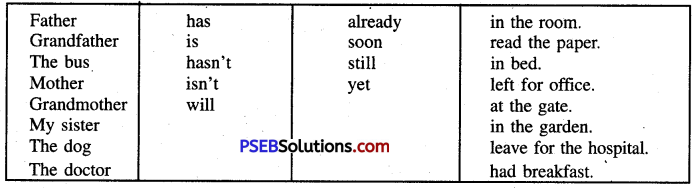
A table has been given below with adverbs of time. Make sentences using words from the different columns. The first one has been done for you.

PSEB 7th Class English Grammar Adverbs 1
Answer:
(1) Father has already read the paper.
(2) Grandfather is still in bed.
(3) The bus is already at the gate.
(4) Mother hasn’t yet, had breakfast.
(5) Grandmother is still in the garden.
(6) My sister hasn’t yet left for office.
(7) The dog is still at the gate.
(8) The doctor will soon leave for the hospital.

Exercise 4

I. Underline the adverbs of place in the following sentences. The first one has been done for you:

1. Maya stood therė.
2. Children ran up and down.
3. The hunter looked inside the box.
4. We walked in by the first gate.
5. Tilak ran forward.
6. Raj went everywhere for his test.

II. Match the following verbs and adverbs given below:

Verbs Adverbs
wait seriously
drive patiently
work soundly
study fast
sleep bravely
fight early
walk honestly
wake slowly

Answer:

Verbs Adverbs
wait patiently
drive slowly
work honestly
study seriously
sleep soundly
fight bravely
walk fast
wake early

Exercise 5

I. Using the words given in the box, complete the following sentences. The first one has been done for you:

seldom, twice, often, once, always, frequently
1. The students went ………… to see Gadar.
2. The man dived ………….. into the river.
3. I …………. keep medicines with me.
4. We ………….. go out to eat.
5. My grandmother …………. visits Sri Harmandar Sahib.
6. We …………….. go to watch movies.
7. I …………. dream of going abroad.
8. Sanjay goes …………. for walks.
Answer:
1. The students went twice to see Gadar.
2. The man dived once into the river.
3. I often keep medicines with me.
4. We seldom go out to eat.
5. My grandmother frequently visits Sri Harmandar Sahib.
6. We seldom go to watch movies.
7. I always dream of going abroad.
8. Sanjay goes frequently for walks.

PSEB 7th Class English Grammar Adverbs

II. Rewrite the sentences using the words given in the brackets. The first one has been done for you:

1. Ajay ……………… borrows books from me. (often)
Ajay often borrows books from me.

2. Children are difficult to get along with. (sometimes)
Children are sometimes difficult to get along with.

3. I will work in a factory (never).
I will never work in a factory.

4. Ludhiana is cold in January (usually)
Ludhiana is usually cold in January.

5. Harpreet is cheerful. (always)
Harpreet is always cheerful.

6. Raman concentrates on his studies. (seldom)
Raman seldom concentrates on his studies.

7. Krishma is a crowd puller (always).
Krishma is always a crowd puller.

8. Anjan drives fast (never).
Anjan never drives fast.

Exercise 6

Use these adverbs of degree : fully, almost, most, very, quite, extremely, nearly in sentences of your own. One has been done for you:

1. The students ……….. agreed with the teacher.
2. It is ………… time to go.
3. Mr. A is ……….. wanted criminal.
4. He is ………… rich.
5. I am ………. well.
6. It is …………. cold.
7. This pot is ………. empty.
Answer:
1. The students fully agreed with the teacher.
2. It is almost time to go.
3. Mr. A is most wanted criminal.
4. He is very rich.
5. I am quite well.
6. It is extremely cold.
7. This pot is nearly empty.

Exercise 7

Write questions to the answers given below. The first one has been done for you:

1. Where did you go?
Answer:
I went to get some water.

2. How many friends has Suraj?
Answer:
Suraj has five friends.

PSEB 7th Class English Grammar Adverbs

3. When did your mother come?
Answer:
My mother came yesterday.

4. Where were the children?
Answer:
The children were in the house.

5. How is the patient keeping?
Answer:
The patient is keeping well.

6. Where is Tirupati ?
Answer:
Tirupati is in Tamil Nadu.

7. When do you plan to return?
Answer:
I plan to return tomorrow.

8. Why are you sad ?
Answer:
I am sad for I have lost a pen.

Exercise 8

Fill in the blanks with the positive, comparative or the superlative degree of adverbs given in brackets:

1. Raj likes painting best (well) of all.
2. He worked as …………………… (slowly) as he wished.
3. Amarjit walks ……………………. (quickly) than I do.
4. Carl Lewis ran ……………………… (fast) of all.
5. You came …………………… (early) than I expected.
6. Suman acted …………………. (generously) among all.
7. Actions speak ……………………… (loud) than words.
8. It is not correct to go any ……………………. (far) in this storm.
9. The ………………….. (early) you leave, the ……………… (soon) you can return.
10. Fatima doesn’t shout as ………………. (loudly) as you do.

PSEB 7th Class English Grammar Adverbs

Hints:
2. slowly
3. more quickly
4. fastest
5. earlier
6. most generously
7. louder
8. farther
9. earlier, sooner
10. loudly.

PSEB 7th Class English Vocabulary Prefix and Suffix

Punjab State Board PSEB 7th Class English Book Solutions English Vocabulary Prefix and Suffix Exercise Questions and Answers, Notes.

PSEB 7th Class English Vocabulary Prefix and Suffix

A- Prefix

Prefix : mid-
mid+way = midway
mid+term = midterm
mid+west = midwest
mid+stream = midstream
mid+day = midday
mid+night = midnight

PSEB 7th Class English Vocabulary Prefix and Suffix

Prefix : re-
re+read = reread
re+write = rewrite
re+think = rethink
re+start = restart
re+act = react

Prefix : over-
over+do = overdo
over+dose = overdose
over+load = overload
over+throw = overthrow
over+leaf = overleaf
ab+normal = abnormal
ab+sent = absent

Prefix : mis-
mis+manage = mismanage
mis+take = mistake
mis+use = misuse

Prefix : pre-
pre+view = preview
pre+test = pretest
pre+plan = preplan
pre+position = preposition
pre+tend = pretend
pre+caution = precaution
pre+judge = prejudge

Prefix : in-
in+vade = invade
in+ability = inability
in+action = inaction
in+effective = ineffective
in+visible = invisible

Prefix : dis-
dis- dis+agree = disagree
dis+able = disable
dis+grace = disgrace
dis+loyal = disloyal

PSEB 7th Class English Vocabulary Prefix and Suffix

Prefix : un-
un+well = unwell
un+able = unable
un+trained = untrained
un+do = undo

B-Suffix

Suffix : -able
favour+able = favourable
objection+able = objectionable
reason+able = reasonable
remark+able = remarkable
value+able = valuable

Suffix : -ance
accept+ance = acceptance
allow+ance = allowance
defy+ance = defiance
guide+ance = guidance

Suffix : -ment
agree+ment = agreement
attach+ment = attachment
fulfil+ment = fulfilment
pay+ment = payment
refresh+ment = refreshment
settle+ment = settlement

Suffix : -ful
beauty+ful = beautiful
care+ful = careful
grace+ful = graceful
hope+ful = hopeful

PSEB 7th Class English Vocabulary Prefix and Suffix

Suffix : -er
begin+er = beginner
build+er = builder
invade+er =invader
make+er = maker
command+er = commander

Suffix : -less
art+less = artless
hope+less = hopeless
noise+less = noiseless
taste+less = tasteless
weight+less = weightless
help+less = helpless

Suffix : -y
cloud+y = cloudy
fault+y = faulty
sand+y = sandy
sleep+y = sleepy
rain+y = rainy

Suffix : -en
gold+en = golden
silk+en = silken
light+en = lighten
soft+en = soften
bright+en = brighten

PSEB 7th Class English Vocabulary Prefix and Suffix

Suffix : -ous
grace+ous = gracious
nerve+ous = nervous
courage+ous = courageous
mystery+ous = mysterious
danger+ous = dangerous

PSEB 7th Class English Grammar Conjunctions

Punjab State Board PSEB 7th Class English Book Solutions English Grammar Conjunctions Exercise Questions and Answers, Notes.

PSEB 7th Class English Grammar Conjunctions

A conjunction is a word which joins words or sentences together.
वह शब्द जो शब्दों अथवा वाक्यों को आपस में जोड़े, Conjunction (संयोजक) कहलाता है। जैसे:

  1. Moti and Narain were friends.
  2. I know that he is honest.
  3. He failed because he did not work hard.

इन वाक्यों में and, that तथा because शब्दों एवं वाक्यों को आपस में जोड़ते हैं। अतः ये शब्द conjunctions

PSEB 7th Class English Grammar Conjunctions

Exercise 1

I. Rewrite each pair of sentences by using ‘because’, ‘and’, ‘but’, ‘or’, ‘else’, “otherwise and ‘unless’. One has been done for you:

1. You must walk’ fast. You will not reach the station.
You must walk fast or you will not reach the station.

2. Rina is a girl. Tony is a boy.
Rina is a girl but Tony is a boy.

3. Radha is studying. Hardeep is watching cartoons.
Radha is studying but Hardeep is watching cartoons.

4. Find the key. You will be standing out.
Find the key else you will be standing out..

5. Lock the door. Robbers will break into the house.
Lock the door otherwise robbers will break into the house.

6. Study seriously. You will not get promotion.
Unless you study seriously you will not get promotion.

7. Take exercise regularly. You will not keep fit.
Take exercise regularly otherwise you will not keep fit.

8. Put the alarm. You will not wake on time.
Put the alarm or you will not wake on time.

9. Rama sells fruits. She sells vegetables.
Rama sells fruits but she sells vegetables.

10. I like my parents. They encourage me.
I Like my parents because they encourage me.

11. They started well. They failed in the end.
They started well but they failed in the end.

12. Control your ways. You will be punished.
Control your ways or you will be punished.

II. Using the conjunctions “so’, ‘therefore’, ‘because’, “as’, ‘since’, ‘though”, “still and “although’ make sentences of your own. The first one has been done for you:

1. I am not well so I did not go to school today.
2. It was very cold, therefore I did not go for a walk.
3. My father punished me because I stole his pen.
4. I forgave him as he spoke the truth.
5. Since he is my brother, I must help him.
6. Though they played well, they could not win the match.
7. Raj hit the gentleman still he forgave him.
8. Although he ran fast, he could not win the race.

PSEB 7th Class English Grammar Conjunctions

III. Underline the conjunctions in the following sentences. The first one has been done for you:

1. I won’t forgive you unless you return my money.
2. Sanjay is rich yet he is a miser.
3. I am weak but I can run fast.
4. Although I am weak, I can run fast.
5. She is old, so her limbs are weak.
6. I was angry with him because he disobeyed me.
7. You are not an honest man, still I will help you.
8. The lady fed the child since she cared for her.
9. It is very hot, therefore I am drinking a cold drink.
10. As there is no milk, I am not having tea.
11. Take the medicine else you will remain sick.
12. Though he is poor, he is happy and content.
13. It was raining still the children went out to play.
14. We did not start the dinner till the guests arrived.

Exercise 2

I. Combine the following pair of sentences by using neither ……… nor ; either………….. or:

1. Soma is not intelligent. Gopal is not intelligent.
2. Hari doesn’t know the answer. Manjit doesn’t know the answer.
3. I shall write you a letter. I shall telephone you.
4. You can go by bus. You can go by train.
5. Our country isn’t poor. Our country isn’t small.
6. You can play in the playground. You can read in the library.
7. He has not come from England. He has not come from America.
Answer:
1. Neither Soma nor Gopal is intelligent.
2. Neither Hari nor Manjit knows the answer.
3. I shall either write you a letter or telephone you.
4. You can either go by bus or by train.
5. Our country is neither poor nor small.
6. You can either play in the playground or read in the library.
7. He has neither come from England nor from America.

PSEB 7th Class English Grammar Conjunctions

II. Fill in the blanks with appropriate conjunctions and, unless, if, or, but, till, though, neither……. nor, either… or:

1. The beggar sang for a long time……………. nobody gave him anything.
2. He felt sad………….. stopped singing.
3. He is …………….. an actor …………… a teacher. He is a student.
4. The musician said, “Give me your violin ………….. I will play for you.”
5. They …………. eat bread ………………….. chapattis for breakfast.
6. ………….. I ran fast I missed the train.
7. I shall wait …………….. you return.
8. Catch me …………… you can.
9. You will be late …………… you hurry.
10. Raman will sing ……………. you so desire.
11. He saw me …………….. did not talk to me.
12. I have a rupee. You can ………….. take it ………….. leave it.
13. Gopal is not to be seen. He is ……………. at home …………….in his office.
14. He did not come …………… I invited him.
Hints:
1. but
2. and
3. neither, nor
4. and
5. either, or
6. Though
7. till
8. if
9. unless
10. if
11. but
12. either, or
13. neither, nor
14. though.

PSEB 7th Class English Grammar Noun

Punjab State Board PSEB 7th Class English Book Solutions English Grammar Noun Exercise Questions and Answers, Notes.

PSEB 7th Class English Grammar Noun

A Noun is the name of a person an animal place or a thing.
किसी व्यक्ति, पशु स्थान अथवा वस्तु के नाम को Noun (संज्ञा) कहते हैं; जैसे,

  1. Mr. Amitabh Mukerjee is a Bengali.
  2. Geeta went to Patiala.
  3. A balloon was flying in the sky.

PSEB 7th Class English Grammar Noun

1. पहले वाक्य में व्यक्ति अर्थात् Mr. Amitabh Mukerjee, दूसरे में स्थान अर्थात् Patiala और तीसरे में वस्तु अर्थात् balloon का नाम दिया गया है। ये तीनों शब्द Nouns हैं।

Kinds:
Nouns चार प्रकार के होते हैं।

  • Proper Noun. Proper Noun (व्यक्तिवाचक संज्ञा) किसी विशेष व्यक्ति या स्थान का नाम होता है, जैसे:
  • Dinesh is a good boy.
  • Chandigarh is the capital of Punjab.

2. Common Noun. जिस शब्द से किसी जाति के प्रत्येक व्यक्ति, स्थान, अथवा वस्तु का बोध हो, उसे Common Noun (जातिवाचक संज्ञा) कहते हैं; जैसे:

  • She went to a lawyer.
  • Amritsar is a big city.

3. Collective Noun. जिस संज्ञा से समूह का बोध होता है उसे Collective Noun (समुदायवाचक संज्ञा) कहते हैं; जैसे:

  • A hockey team has eleven players.
  • There are fifty boys in our class.
  • She has lost her bunch of keys.

4. Abstract Noun. जिस संज्ञा से किसी वस्तु के गुण, कार्य अथवा अवस्था का बोध होता है, उसे Abstract Noun (भाववाचक संज्ञा) कहते हैं; जैसे:
गुण-Goodness, kindness, honesty, beauty.
कार्य-Laughter, hatred.
अवस्था-Boyhood, sleep, childhood, length, breadth.

Exercise 1

I. Underline the common nouns in the following sentences. Some sentences have more than one common noun. One has been done for you.
1. The baby was afraid of the dark.
2. Many people were being treated in the hospital.
3. The sky was full of dark clouds.
4. My house is very large.
5. I like to play with my favourite toys.
6. Books give us a lot of information.
7. Amarjit has injured his arm.
8. The old lady was very lonely.
9. The train to Jalandhar was late again.
10. The teacher spoke to her students.
11. Simran loves watching the television.
Hints:
2. people, hospital
3. clouds
4. house
5. toys
6. Books
7. arm
8. lady
9. train
10. teacher, students
11. television.

II. Fill in the blanks with suitable common nouns to form meaningful sentences:

1. Ravi could not find his ………….. in his bag.
2. Rahim fell into the
3. The ………… was late today.
4. Our ………….. is very beautiful.
5. We bought some …………. yesterday.
6. I saw a long
Hints:
1. pen
2. river
3. bus
4. garden
5. flowers
6. snake.

Exercise 2

I. Underline the proper nouns in the following sentences. Some sentences have more than one proper noun. The first one has been done for you:
1. Nutan was a great actress of India.
2. Ravana is a character from the Ramayana
3. The Ganges flows down from the Himalayas.
4. Children enjoyed at Appu Ghar.
5. The Esteem is an expensive car.
6. Prince Rana died in a tragic road accident.
7. Mr. Mohan uses a Videocon washing machine.
8. The Charminar is in Hyderabad.
9. The film Sholay was seen by a large number of people.
10. February is the shortest month of the year.
11. Verka ice-cream is available in many flavours.
Hints:
2. Ravana, Ramayana
3. Ganges, Himalayas
4. Appu Ghar
5. Esteem
6. Prince Rana
7. Mr. Mohan, Videocon washing machine
8. Charminar, Hyderabad
9. Sholay
10. February
11. Verka ice-cream.

PSEB 7th Class English Grammar Noun

II. Fill in the blanks with suitable proper nouns to form meaningful sentences.

1. My pet dog …………. is very lovable.
2. …………. is a popular hill station.
3. My favourite television programme is ………
4. The film ………… is running in four theatres.
5. The month of ………….. is very cold.
Hints:
1. Don
2. Shimla
3. Hungama
4. Sholay
5. January.

Exercise 3

I. Underline the collective nouns in the following sentences. The first one has been done for you.

1. The army marched forward to occupy the land.
2. Father bought a packet of sweets.
3. Our class is very noisy.
4. The mob destroyed the furniture.
5. We booked a suite of rooms in the hotel.
6. A herd of cattle was grazing in the field.
Hints:
2. packet
3. class
4. mob, furniture
5. suite
6. herd.

II. Fill in the blanks in the following phrases with collective nouns. Choose from the box given below:

soldiers
grapes
bananas
bees
stick
musicians
sailors
stones
puppies.
wolves
1. a band of musicians
2. a bundle of sticks
3. a heap of stones
4. a bunch of grapes
5. a regiment of soldiers
6. a pack of wolves
7. a swarm of bees
8. a bunch of bananas
9. a crew of sailors
10. a litter of puppies.

III. Choose from the following list of collective nouns to form meaningful sentences:

school
library
pride
audience
committee
1. The …………. held a two hour meeting.
2. The …………. enjoyed the film.
3. We saw a …………. of whales in the sea.
4. The ………….. of lions was an impressive sight.
5. The students collected books from the ………
Hints:
1. committee
2. audience
3. school
4. pride
5. library.

Exercise 4

I. Underline the abstract nouns in the following sentences. The first one has been done for you.

1. Soldiers are known for their bravery.
2. Books provide us with knowledge.
3. My grandfather enjoys good health.
4. We lost hope of finding our stolen jewellery.
5. Raj suffered a loss when he sold his house.
6. Navin was in a lot of pain after he fell.
7. The teacher told the parents about their son’s progress.
8. The little boy cried in fear on seeing the tiger.
9. It is our duty to respect our parents.
10. Most of us are afraid of failure.
Hints.
2. knowledge
3. health
4. hope
5. loss
6. pain
7. progress
8. fear
9. duty
10. failure.

PSEB 7th Class English Grammar Noun

II. Match abstract nouns from the given box that are opposite in meaning to those listed below. One has been done for you:

life
success
war
hatred
wealth
disagreement
cowardice
pain
cruelty
sorrow
noise
dishonesty.
Answer:
1. Silence – noise
2. kindness – cruelty
3. love – hatred
4. happiness – sorrow
5. agreement – disagreement
6. bravery – cowardice
7. peace – war
8. pleasure – pain
9. death – life
10. poverty – wealth
11. honesty – dishonesty
12. failure – success.
Note : A phrase doing the work of a noun is called a noun phrase.

Exercise 5

Underline the noun phrases in the following sentences:

1. I enjoy swimming in the river.
2. Serving our country is our duty.
3. Helping the poor gives me joy.
4. His dislike for me is unjustified.
5. My love for my friends is deep.
Answer:
1. I enjoy swimming in the river.
2. Serving our country is our duty.
3. Helping the poor gives me joy.
4. His dislike for me is unjustified.
5. My love for my friends is deep.
Note : A clause doing the work of a noun is called a noun clause.

PSEB 7th Class English Grammar Noun

Exercise 6

Underline the noun clause in the sentences.

1. I believe that he is honest.
2. Let me know where you are going.
3. No one doubts what he says.
4. I hope that he will pass his examination.
5. I do not know what he wants to do after graduation.
Answer:
1. I believe that he is honest.
2. Let me know where you are going.
3. No one doubts what he says.
4. I hope that he will pass his examination.
5. I do not know what he wants to do after graduation.

PSEB 7th Class Hindi Vyakaran पर्यायवाची या समानार्थक शब्द

Punjab State Board PSEB 7th Class Hindi Book Solutions Hindi Grammar Paryayvachi ya Samanarthak Shabd पर्यायवाची या समानार्थक शब्द Exercise Questions and Answers, Notes.

PSEB 7th Class Hindi Grammar पर्यायवाची या समानार्थक शब्द

अग्नि – अनल, पावक, आग, दहन, ज्वाला।
अपमान – अनादर, तिरस्कार, निरादर।
अमृत – सुधा, पीयूष, सोम।
असुर – राक्षस, दैत्य, दानव, दनुज ।
अन्धकार – अन्धेरा, तम, तिमिर।
अश्व – घोड़ा, वाजी, घोटक।
आंख – नेत्र, चक्षु, नयन, लोचन।
आकाश – गगन, अम्बर, नभ, आसमान, अन्तरिक्ष ।
इनाम – पुरस्कार, पारितोषिक, आनन्दकर।
इच्छा – अभिलाषा, चाह, मनोरथ, कामना, लालसा।
इन्द्र – देवेन्द्र, सुरेन्द्र, सुरपति, देवराज।
ईश्वर – ईश, परमात्मा, परमेश्वर, प्रभु।
उषा – प्रभात, सवेरा, निशान्त।

PSEB 7th Class Hindi Vyakaran पर्यायवाची या समानार्थक शब्द

उद्देश्य – मकसद, लक्ष्य, ध्येय।
उपकार – हित, भलाई, नेकी, भला।
कपड़ा – वस्त्र, अम्बर, पट, वसन।
कमल – जलज, नलिन, पंकज, सरोज, राजीव, नीरज।
कान – कर्ण, श्रोता, श्रवण।
किनारा – तट, तीर, कूल।
किरण – रश्मि, अंशु, कर।
केश – बाल, अलक. कच।
कोयल – पिक, कोकिल।
क्रोध – गुस्सा, रोष, कोप।
गंगा – भागीरथी, देवनदी, सुरसरी, नदीश्वरी।
गृह – घर, सदन, निकेतन, भवन, वास, आलय, शाला।
चन्द्रमा – शशि, चन्द्र, राकेश, चाँद, सोम।
जल – नीर, पानी, पय, रस।
तलवार – खड्ग, कृपाण, करवाल।
तालाब – सर, सरोवर, जलाशय, ताल ।

PSEB 7th Class Hindi Vyakaran पर्यायवाची या समानार्थक शब्द

दास – नौकर, सेवक, अनुचर।
देवता – सुर, अमर, देव।
दुनिया – विश्व, संसार, जगत्, जग, भूमण्डल।
दूध – दुग्ध, गोरस, पय, क्षीर।
नदी – सरिता, जलमाला, नद, तटनी।
नारी – स्त्री, महिला, अबला, वनिता।
नाव – नौका, तरिणी, जलयान, बेड़ा।
पवन – हवा, वायु, समीर, अनिल।
पत्नी – वधू, गृहिणी, स्त्री, प्राणप्रिया, भार्या ।
पति – स्वामी, नाथ, प्राणनाथ।
पर्वत – गिरि, पहाड़, शैल, नग, अचल।
पक्षी – खग, पतंग, नभचर। पुत्र-सुत,बेटा, लड़का, पूत।
पुत्री – सुता, बेटी, लड़की।
पुष्प – कुसुम, सुमन, फूल, प्रसून ।
पृथ्वी – भू, भूमि, धरती, वसुधा, धरा।

PSEB 7th Class Hindi Vyakaran पर्यायवाची या समानार्थक शब्द

बाग – बगीचा, वाटिका, उपवन, उद्यान।
बादल – मेघ, घन, जलद, नीरद।
माता – जननी, माँ, मात, मैया, अम्ब ।
मृत्यु – निधन, देहान्त, अन्त, मौत।
मनुष्य – मनुज, नर, आदमी, मानव, पुरुष।
युवक – जवान, युवा, तरुण।
राजा – नृप, नरेश, सम्राट्, नरेन्द्र, नरपति।
रात – रजनी, निशा, रात्रि।

PSEB 7th Class Hindi Vyakaran भाववाचक संज्ञाएँ

Punjab State Board PSEB 7th Class Hindi Book Solutions Hindi Grammar Bhav vachak Sangyaen भाववाचक संज्ञाएँ Exercise Questions and Answers, Notes.

PSEB 7th Class Hindi Grammar भाववाचक संज्ञाएँ

शब्द – भाववाचक
अज्ञान – अज्ञानता
अपना – अपनापन
अच्छा – अच्छाई
अधिक – अधिकता
उजाला – उजालापन
उलझन – उलझाव
उठना – उठाव
ऊँचा – ऊँचाई
एक – एकता
कठिन – कठिनता
कठोर – कठोरता
कड़ा – कड़ाई
कंजूस – कंजूसी
कायर – कायरता

PSEB 7th Class Hindi Vyakaran भाववाचक संज्ञाएँ

कटु – कटुता
कुशल – कुशलता
कृत्रिम – कृत्रिमता
कृपण – कृपणता
कमाना – कमाई
काटना – कटौती
खट्टा – खटाई, खटास
खुजलाना – खुजली
खेलना – खेल
खोदना – खुदाई
गहरा – गहराई
ठण्डा – ठण्डक
ठगना – ठगी
अंगड़ाना – अंगड़ाई
आलसी – आलस्य
आवश्यक – आवश्यकता
आगे-पीछे – आगा-पीछा
इन्सान – इन्सानियत
ईश्वर – ऐश्वर्य
उदार – उदारता
गुरु – गौरव
गिरना – गिरावट
गर्म – गर्मी
गाना – गीत

PSEB 7th Class Hindi Vyakaran भाववाचक संज्ञाएँ

गुलाम – गुलामी
घबराना – घबराहट
घेरना – घिराव
चतुर – चतुराई
चालाक – चालाकी
चौड़ा – चौड़ाई
चढ़ना – चढ़ाई
चलना – चाल
चिकना – चिकनाई
चमकना – चमक
चिल्लाना – चिल्लाहट
चुनना – चुनाव
जागना – जागरण
जलना – जलन
जीना – जीवन
परतन्त्र – परतन्त्रता
डाका – डकैती
ढिठ – ढिठाई
तीव्र – तीव्रता
दास – दासता
देव – देवत्व
दुर्बल – दुर्बलता
दुष्ट – दुष्टता
दौड़ाना – दौड़
दुहराना – दुहराई
धोना – धुलाई
नीच – नीचता

PSEB 7th Class Hindi Vyakaran भाववाचक संज्ञाएँ

पण्डित – पण्डिताई, पाण्डित्य
प्यासा – प्यास
पूर्ण – पूर्णता
पीसना – पिसाई
पकड़ना – पकड़
पहचानना – पहचान
मीठा – मिठास
मुस्कराना – मुस्कराहट
मूर्ख – मूर्खता
मोटा – मुटापा, मोटापन
मिलना – मिलावट
मारना – मार
राजा – राज्य
लड़का – लड़कपन
लाल – लालिमा
लड़ना – लड़ाई
लूटना – लूट
लम्बा – लम्बाई
लिखना – लिखाई
शुद्ध – शुद्धता, शुद्धि
वीर – वीरता
शीघ्र – शीघ्रता
सजना – सजावट

PSEB 7th Class Hindi Vyakaran भाववाचक संज्ञाएँ

पालना – पालन
बच्चा – बचपन
बालक – बालकपन
बुद्धिमान् – बुद्धिमत्ता
बूढ़ा – बुढ़ापा
बनना – बनावट
बैठना – बैठक
बहना – बहाव
बुरा – बुराई
बोलना – बोल
नम्र – नम्रता
बेचना – बेच
भला – भलाई
भूखा – भूख
भय – भयानक
भिड़ना – भिड़न्त
मित्र – मित्रता
मधुर – मधुरता
महान् – महत्ता
सेवक – सेवा, सेवकाई
सज्जन – सज्जनता
सादा – सादगी

PSEB 7th Class Hindi Vyakaran भाववाचक संज्ञाएँ

स्वस्थ – स्वास्थ्य
सुन्दर – सुन्दरता
स्वतन्त्र – स्वतन्त्रता
सहायक – सहायता
सरल – सरलता
सीना – सिलाई
सजाना – सजावट
सर्द – सर्दी
सच्चा – सच्चाई
साधारण – साधारणतया
हरा – हरियाली
हँसी – हँसना
हारना – हार

PSEB 7th Class Hindi Vyakaran विपरीतार्थक या विलोम शब्द

Punjab State Board PSEB 7th Class Hindi Book Solutions Hindi Grammar Viparitarthak ya Vilom Shabd विपरीतार्थक या विलोम शब्द Exercise Questions and Answers, Notes.

PSEB 7th Class Hindi Grammar विपरीतार्थक या विलोम शब्द

शब्द -विपरीतार्थक
असुर – सुर
अन्त – आरम्भ
अनेकता – एकता
आलस्य – उद्यम
आशा – निराशा
आयात – निर्यात
आगामी – विगत
उपकार – अपकार
उचित – अनुचित
उतार – चढ़ाव
आज्ञा – अवज्ञा
अनिवार्य – ऐच्छिक

PSEB 7th Class Hindi Vyakaran विपरीतार्थक या विलोम शब्द

अनुकूल – प्रतिकूल
अमृत – विष
अवनति – उन्नति
उत्थान – पतन
उदार – कृपण
आहार – निराहार
इहलोक – परलोक
ईर्ष्या – स्पर्धा
उधार – नकद
उपयोगी – व्यर्थ, अनुपयोगी
ऐश्वर्य – दारिद्रय
ऐच्छिक – अनैच्छिक
आदि – अन्त
आय – व्यय

PSEB 7th Class Hindi Vyakaran विपरीतार्थक या विलोम शब्द

अज्ञात – ज्ञात
आदान – प्रदान
अपकार – उपकार
अपना – पराया
अन्याय – न्याय
अधिक – न्यून
अच्छा – बुरा
अस्त – उदय
अन्धकार – प्रकाश
कृत्रिम – स्वाभाविक
कटु – मीठा
आदर – निरादर
कठिन – सरल
कपटी – निष्कपट
ऊष्ण – शीत
उपस्थित – अनुपस्थित
उपयुक्त – अनुपयुक्त
ऋण – उऋण
एक – अनेक
एकता – अनेकता

PSEB 7th Class Hindi Vyakaran विपरीतार्थक या विलोम शब्द

उत्तीर्ण – अनुत्तीर्ण
उत्तर – प्रश्न
कृतज्ञ – कृतघ्न
कुटिल – सरल
क्रय – विक्रय
कायर – साहसी
काला – सफ़ेद
कीर्ति – अपकीर्ति
कोमल – कर्कश
गुरुता – लघुता
आस्तिक – नास्तिक
आकाश – पाताल
खल – सज्जन, साधु
खरा – खोटा
गुण – अवगुण
उत्पत्ति – निष्पत्ति
गहरा – उथला
घृणा – प्रीति
चेतन – जड़
कायर – निडर
डरपोक – निर्भीक
डूबना – तैरना
तीव्र – मन्द

PSEB 7th Class Hindi Vyakaran विपरीतार्थक या विलोम शब्द

तेजस्वी – तेजहीन
त्यागी – स्वार्थी
थोड़ा – बहुत
दानी – कृपण
दया – निर्दयता
दिन – रात
दयालु – निर्दय
हार – जीत
लेन – देन
लघु – गुरु
लोभी – निर्लोभी
लोभ – संतोष
शब्द
चंचल – गम्भीर, स्थिर
चतुर – मूर्ख
छल – निश्छल
जीवन – मरण
जन्म – मृत्यु

PSEB 7th Class Hindi Vyakaran विपरीतार्थक या विलोम शब्द

जंगलि – पालतू
जंगम – स्थावर
जीत – हार
जय – पराजय
ज्येष्ठ – कनिष्ठ
जल – यौवन
जरा – स्थल
जटिल – सरल
दुर्बल – बलवान्
दायाँ – बायाँ
धर्म – अधर्म
देव – दानव
धर्मात्मा – पापात्मा
धनवान् – निर्धन
धनी – निर्धन
नवीन – प्राचीन
नास्तिक – आस्तिक
नागरिक – ग्रामीण
निद्रा – जागरण
निकट – दुर
निर्यात – आयात
निन्दा – स्तुति
निगलना – उगलना
निश्चय – अनिश्चय
न्याय – अन्याय
पाप – पुण्य
प्रत्यक्ष – परोक्ष

PSEB 7th Class Hindi Vyakaran विपरीतार्थक या विलोम शब्द

पण्डित – मूर्ख
पराधीन – स्वाधीन
शुष्क – आई
वृद्ध – बालक
वर – शाप
विजय – पराजय
विधवा – सधवा
विजित – पराजित
विरोध – समर्थन
वैर – प्रेम
गुलाम – आज़ाद
विद्वान् – मूर्ख
शांत – अशांत
शुद्ध – अशुद्ध
शुभ – अशुभ
शोक – हर्ष
परतन्त्र – स्वतन्त्र
प्रीति – वैर
परिश्रम – आलस्य
प्रसन्न – अप्रसन्न
पूर्ण – अपूर्ण
स्त्री – पुरुष

PSEB 7th Class Hindi Vyakaran विपरीतार्थक या विलोम शब्द

पवित्र – अपवित्र
फीका – मीठा
बच्चा – बूढ़ा
बुराई – भलाई
बाहर – अन्दर
भय – अभय
भयभीत – निर्भय
भयानक – सुन्दर, प्रिय
भेद – अभेद
भ – भविष्य
सु्ख – दुःख
स्थिर – अस्थिर
सुगन्ध – दुर्गन्ध
सभ्य – असभ्य
संक्षिप्त – विस्तृत
सुर – असुर
साधु – शैतान/असाधु
शाप – वरदान
शिक्षित – अशिक्षित
शत्रु – मित्र
सदाचार – दुराचार
सत्य – असत्य
सुपुत्र – कुपुत्र

PSEB 7th Class Hindi Vyakaran विपरीतार्थक या विलोम शब्द

संयोग – वियोग
स्वामी – सेवक
स्वर्ग – नरक
सज्जन – दुर्जन
स्वदेश – विदेश
सफल – असफल
सुन्दर – असुन्दर
भला – बुरा
भारी – हल्का
मधुर – कटु
मान – अपमान
मितव्ययी – अपव्ययी
सम्मान – अपमान
मानव – दानव
मृदु – कठोर
महान् – झुट
मलिन – स्वच्छ
मौखिक – लिखित

PSEB 7th Class Hindi Vyakaran विपरीतार्थक या विलोम शब्द

यश – अपयश
योग्य – अयोग्य
राजा – रंक
रक्षक – भक्षक
रोगी – स्वस्थ
लाभ – हानि
सरल – कठिन
उल्लास – हर्ष
हार – जीत
सुहागिन – विधवा
सरल – जटिल
सौभाग्य – दुर्भाग्य
ज्ञान – अज्ञान
सम्पत्ति – विपत्ति
हर्ष – शोक
हितकारी – अहितकारी
हृष्टपुष्ट – क्षीण, कृश
श्रद्धा – घृणा
ज्ञानी – अज्ञानी
क्षमा – दण्ड
दुर्बल – सबल

PSEB 7th Class Hindi Vyakaran लिंग परिवर्तन

Punjab State Board PSEB 7th Class Hindi Book Solutions Hindi Grammar Ling Parivartan लिंग परिवर्तन Exercise Questions and Answers, Notes.

PSEB 7th Class Hindi Grammar लिंग परिवर्तन

पुल्लिग – स्त्रीलिंग
छात्र – छात्रा
आचार्य – आचार्या
बाल – बाला
योग्य – योग्या
क्षत्रिय – क्षत्रिया
महोदय – महोदया
वृद्ध – वृद्धा
प्रिय – प्रिया
मामा – मामी
अध्यापक – अध्यापिका
काका – काकी
ताया – ताई
शिष्य – शिष्या
चाचा – चाची
बेटा – बेटी
नार – नारी

PSEB 7th Class Hindi Vyakaran लिंग परिवर्तन

देव – देवी
घोड़ा – घोड़ी
हिरन – हिरनी
साला – साली
दोहता – दोहती
लड़का – लड़की
पोता – पोती
मुर्गा – मुर्गी
दास – दासी
गीदड़ – गीदड़ी
दादा – दादी
नाना – नानी
पुत्र – पुत्री
गधा – गधी
मुन्ना – मुनिया
बन्दर – बकरा
बकर – बकरी
गुड्डा – गुड़िया
लोटा – लुटिया
बूढ़ा – बुढ़िया
चूहा – चूहाया
बन्दर – बन्दरिया
लोमड़ – लोमड़ी
शेर – शेरनी
कुत्ता – कुत्तिया

PSEB 7th Class Hindi Vyakaran लिंग परिवर्तन

डिब्बा – डिबिया
बछड़ा – बछिया
चालक – चालिका
बालक – बालिका
अध्यापक – अध्यापिका
नायक – नायिका
साँप – साँपिन
हत्यारा – हत्यारिन
दुबे – दुबाइन
पंडित – पंडिताइन
ठाकुर – ठकुराइन
मजदूर – मज़दूरनी
रीछ – रीछनी
शेर – शेरनी
हंस – हंसनी
नौकर – नौकरानी
ब्रह्मचारी – ब्रह्मचारिणी
मन्त्री – मन्त्रिणी
अपराधी – अपराधिनी
इन्द्र – इन्द्रानी
श्रीमान् – श्रीमती
धनवान् – धनवती
दयावान् – दयावती
बुद्धिमान् – बुद्धिमती
दाता – दात्री
साधु – साध्वी
पति – पत्नी
हाथी – हथिनी
विधुर – विधवा
भैंसा – भैंस

PSEB 7th Class Hindi Vyakaran लिंग परिवर्तन

स्वामी – स्वामिनी
ननद – ननदोई
चिड़ा – चिड़िया
गायक – गायिका
सेवक – सेविका
लेखक – लेखिका
पाठक – पाठिका
सूबेदार – सूबेदारिन
नाग – नागिन
बाबू – बबुआइन
लाला – लालाइन
देवर – तपस्विनी
तपस्वी – तपस्विनी
हितकारी – हितकारिणी
हितैषी – हितैषिणी
वैरी – वैरिणी
गुणवान् – गुणवती
भगवान् – भगवती
बलवान् – बलवती
कवि – कवयित्री
पुत्र – पुत्री
आदमी – औरत
सेठ – सेठानी
जेठ – जेठानी
बाघ – बाघनी
ऊँट – ऊँटनी
मोर – मोरनी
चौब – चौबाइन
सिंह – सिंहनी
बिलाव – बिल्ली
नर – नारी
सम्राट – साम्राज्ञी

PSEB 7th Class Hindi Vyakaran लिंग परिवर्तन

वर – वधू
बैल – गाय
युवा – युवती
पिता – माता
ससुर – सास
पुरुष – स्त्री
भाई – भावज
राजा – रानी
बहनोई – बहन
बाप – मां
विद्वान् – विदुषी
साला – सलहज

PSEB 7th Class Hindi Vyakaran वचन परिवर्तन

Punjab State Board PSEB 7th Class Hindi Book Solutions Hindi Grammar Vachan Parivartan वचन परिवर्तन Exercise Questions and Answers, Notes.

PSEB 7th Class Hindi Grammar वचन परिवर्तन

एकवचन – बहुवचन
कुत्ता – कुत्ते
लड़का – लड़के
बच्चा – बच्चे
लोटा – लोटे
तिनका – तिनके
पंखा – पंखे
कलम – कलमें
पुस्तक – पुस्तकें
आँख – आँखें
मेज – मेजें
स्त्री – स्त्रियाँ
नदी – नदियाँ
टोपी – टोपियाँ
टोली – टोलियाँ

PSEB 7th Class Hindi Vyakaran वचन परिवर्तन

नीति – नीतियाँ
लड़की – लड़कियाँ
नारी – नारियाँ
गुड़िया – गुड़ियाँ
बुढ़िया – बुढ़ियाँ
चुहिया – चुहियाँ
कन्या – कन्याएँ
कथा – कथाएँ
माला – मालाएँ
मात – माताएँ
बेटा – बेटे
शीशा – शीशे
कपड़ा – कपड़े
घोड़े – घोड़ा
तोता – तोते
बटेर – बटेरे
हीरा – हीरे
दवात – दवातें
रात – रीतियाँ
बात – बातें
चाल – चालें
बहन – बहनें
रीति – रीतियाँ
तिथि – तिथियाँ
शक्ति – शक्तियाँ

PSEB 7th Class Hindi Vyakaran वचन परिवर्तन

कापी – कापियाँ
रानी – रानियाँ
थाली – थालियाँ
सखी – सखियाँ
चिड़िया – चिड़ियाँ
डिबिया – डिबियाँ
बिटिया – बिटियाँ
वस्तु – वस्तुएँ
ऋतु – ऋतुएँ
वधु – वधुएँ
बहू – बहुएँ
लता – लताएँ
विद्या – विद्याएँ
शाखा – शाखाएँ
गुरु – गुरुओं
साधु – साधुओं
धातु – धातुएँ
सभा – सभाएँ
दिशा – दिशाएँ
बन्धु – बन्धुओं
राजा – राजाओं