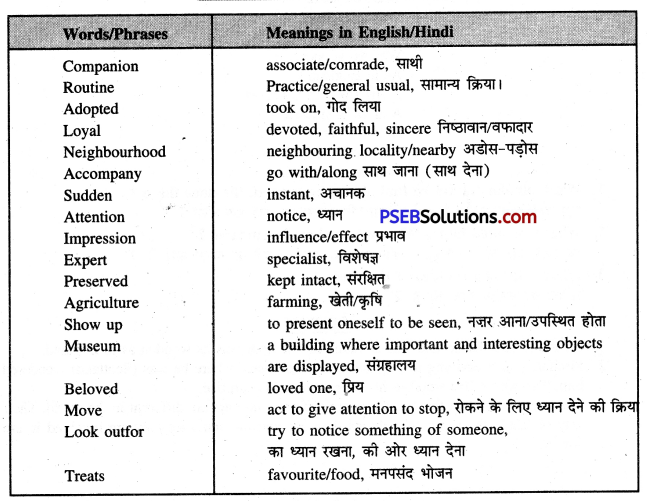
Hachiko-The World’s Most Loyal Dog Question Answer Class 7 English Solutions Chapter 8 PSEB Solutions

Punjab State Board PSEB 7th Class English Book Solutions Chapter 8 Hachiko-The World’s Most Loyal Dog Textbook Exercise Questions and Answers.

Class 7th English Solutions Chapter 8 Hachiko-The World’s Most Loyal Dog Question Answers

Hachiko-The World’s Most Loyal Dog Class 7 Questions and Answers

Activity 1.

Look up the following words in a dictionary. You should seek the following information about the words and put them in your WORDS notebook.
1. Meaning of the word as used in the story (adjective/noun/verb, etc.)
2. Pronunciation (The teacher may refer to the dictionary or the mobile phone for correct . pronunciation.)
3. Spellings

Akita neighborhood agriculture accompany
routine receive hemorrhage show up
beloved employees devoted museum

Vocabulary Expansion

Activity 2.

Write antonyms of the following words.

1. respect — disrespect
2. affection — hatred/hate
3. usual — unusual
4. followed — led
5. lonely — crowded/populous
6. presence — absence
7. master — servant
8. loyalty — disloyalty

PSEB 7th Class English Solutions Chapter 8 Hachiko-The World’s Most Loyal Dog

Activity 3.

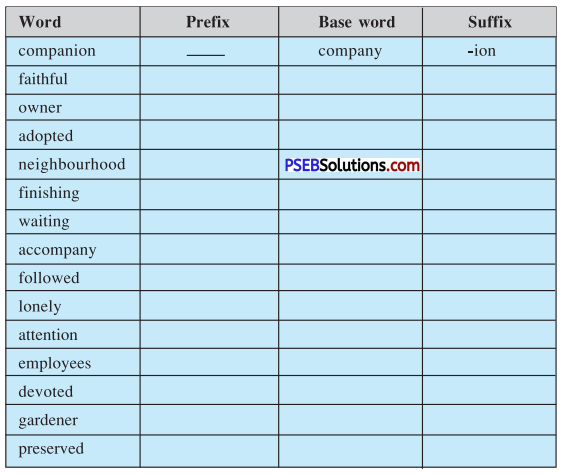
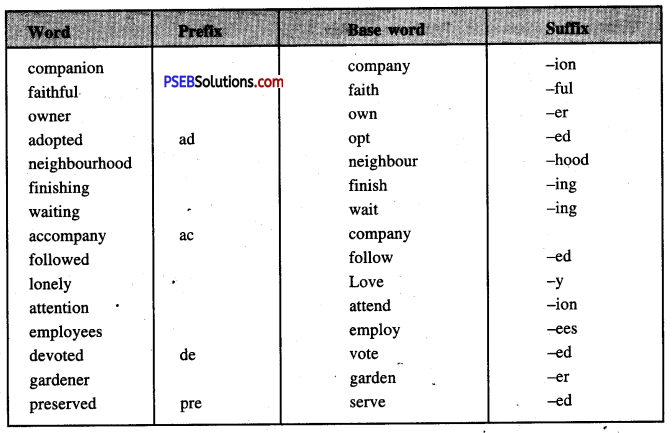
Look at the following words in the grid. Identify the base words and prefixes and suffixes added to them. Write the base word and the prefix/suffix in the space given for each.
PSEB 7th Class English Solutions Chapter 8 Hachiko-The World’s Most Loyal Dog 1
Answer:
PSEB 7th Class English Solutions Chapter 8 Hachiko-The World’s Most Loyal Dog 2

Learning to Read and Comprehend

Activity 4.

Answer the following questions based on the above story.

Question 1.
Who was Hachiko ?
हचीको कौन था ?
Answer:
Hachiko was a very faithful and loyal dog. He was true companion.

Question 2.
What was his breed ?
उसकी प्रजाति (ब्रीड) कौन – सी थी?
Answer:
His breed was Akita.

Question 3.
When was he born ?
वह कब पैदा हुआ ?
Answer:
He was born on November 10, 1923.

PSEB 7th Class English Solutions Chapter 8 Hachiko-The World’s Most Loyal Dog

Question 4.
Who adopted him ?
उसे किसने गोद लिया ?
Answer:
Professor Hidesburo adopted him, first.

Question 5.
Where did Ueno teach ?
यूनो कहाँ पढ़ाते थे ?
Answer:
Ueno tought in the Agriculture Department of the Tokyo Imperial University.

Question 6.
What was their routine ?
अनकी दिनचर्या क्या थी ?
Answer:
Everyday morning they would walk to the Shibuya Railway Station. At 3 p.m. the professor would return and the dog would go to the railway station to accompaning him back home.

Question 7.
What happened to the Professor one day ?
एक दिन प्रोफैसर को क्या हुआ ?
Answer:
One day the Professor died because of a sudden brain harmorrhage.

Question 8.
What did Hachiko do after Ueno died ?
हचीको ने यूनो की मृत्यु के बाद क्या किया ?
Answer:
He would daily go to the railway station at 3 p.m. to receive his master.

Question 9.
Who adopted Hachiko after Ueno died ?
यूनो की मृत्य के बाद हचीको को किसने गोद लिया ?
Answer:
After Ueno died his former gardener, kujaburo kobayashi adopted Hachiko.

Question 10.
Who went to see Hachiko after coming to know about his routine ?
हचीको की दिनचर्या का पता चलने पर कौन उसे देखने गया ?
Answer:
Hirokichi Saito who was an expert on the Akita breed of dogs, went to see Hachiko.

Activity 5.

Choose the right answer and write in the given space.
Answer:
1. Hachiko was a very loyal/disloyal dog — loyal
2. Shibuya is a place near/away from Tokyo — near
3. Ueno always came back on the 3/4pm train. — 3 p.m.
4. Hachiko would wait for Ueno at the station/home. — Station
5. Hachiko lived for 11/13 years. — Station

PSEB 7th Class English Solutions Chapter 8 Hachiko-The World’s Most Loyal Dog

Activity 6.

Discuss and answer the following questions.

Question 1.
Why did people make statues of Hachiko ?
Answer:
People made the statues of Hachiko to make him immortal for his loyalty and faithfulness.

Question 2.
Why do you think Saito wiped a tear from his cheek?
Answer:
Saito was an expert of the Akita breed of dogs. He read the sad hard of Hachiko.

Learning Language

Conjugation of Verbs

Verb conjugation का अर्थ है कि कोई verb वाक्य में Person, Tense, Number या Mood में परिवर्तन के साथ कैसे बदलता है।

Person.

In English, we have six different persons -first-person singular (I), second-person singular (you), third-person singular (he/she/it/one), first-person plural (we), second-person plural (you), and third-person plural (they). We must conjugate a verb for each person. The verb to be is a particularly notable verb for conjugation because it is an irregular verb.

PSEB 7th Class English Solutions Chapter 8 Hachiko-The World’s Most Loyal Dog

Conjugation of the verb ‘to be’ (is/am/are)

Person Tense
Past Present Future
I was am will be
you were arc will be
he /she/it was is will be
we were are will be
they were are will be

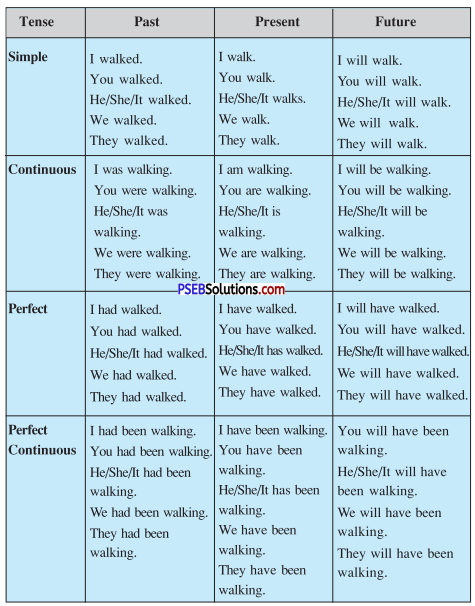
Tense के अनुसार भी Verb के रूप में बदलाव आता है। इसे समझने के लिए नीचे दी गई तालिका अध्ययन of करें इसमें Verb ‘walk’ के माध्यम से verb की Conjugation को समझाया गया है।

Conjection
PSEB 7th Class English Solutions Chapter 8 Hachiko-The World’s Most Loyal Dog 3

Activity 7.

Select the correct form of the verb given in the options and fill it in the given blank.

Question 1.
Meena …………………_since morning.
(a) has been dancing
(b) is dancing
(c) dances
Answer:
(a) has been dancing.

Question 2.
I ………….. in the garden when she came to my house.
(a) am working
(b) was working
(c) worked
Answer:
(b) was working.

PSEB 7th Class English Solutions Chapter 8 Hachiko-The World’s Most Loyal Dog

Question 3.
I ………………….. in the factory for two hours when Seema called.
(a) have been working
(b) was working
(c) had been working
Answer:
(c) had been working.

Question 4.
I ……………… my exam this time next week.
(a) will be writing
(b) will write
(c) would be writing
Answer:
(a) will be writing.

Question 5.
They had already left when I …………. home.
(a) reached
(b) have reached
(c) had reached
Answer:
(a) reached.

Question 6.
If you are hungry, I ………….. ……. you something to eat.
(a) am getting
(b) will get
(c) will be getting
Answer:
(b) will get.

Question 7.
Saavan ………….. songs.
(a) writes
(b) write
(c) written
Answer:
(a) writes.

Question 8.
We …………. often go to the garden.
(a) don’t
(b) doesn’t
(c) haven’t
Answer:
(a) don’t

PSEB 7th Class English Solutions Chapter 8 Hachiko-The World’s Most Loyal Dog

Question 9.
We …………… to Delhi last week.
(a) went
(b) have gone
(c) had gone.
Answer:
(a) went.

Question 10.
The children …………………. a splendid performance.
(a) gives
(b) give
(c) gave.
Answer:
(b) give.

Learning to Listen

Activity 8

Your teacher will read out a dialogue. Listen to the dialogue and answer the following questions.

Question 1.
Which movie do these people plan to watch ?
(a) The Lion King
(b) The Two Towers
(c) Singham
(d) Mowgli
Answer:
(d) Mowgli.

Question 2.
When do they plan to watch the movie ?
(a) on the weekend
(b) tomorrow
(c) today evening
(d) next Friday
Answer:
(b) tomorrow.

Question 3.
Where do they plan to meet ?
(a) at the Subway close to the mall
(b) in front of the mall
(c) at the coffee shop close to the mall
(d) at home
Answer:
(a) at the Subway close to the mall.

PSEB 7th Class English Solutions Chapter 8 Hachiko-The World’s Most Loyal Dog

Question 4.
What time do they plan to meet ?
(a) at 7:30 pm
(b) at 12 noon
(c) at 1pm
(d) at 3:45 pm
Answer:
(c) at 1pm.

Learning to Speak

Activity 9

Look at the picture given below and describe, in your own words, what is happening.
PSEB 7th Class English Solutions Chapter 8 Hachiko-The World’s Most Loyal Dog 4
Answer:
1. There are two furry dogs in the picture.
2. One dog is big, the other is small.
3. The big dog is white with a black shade in colour.
4. The small dog is also white but it has a shade of grey colour on his body.
5. Both the dogs have belt- round their necks. This suggests they are pet ones.
6. The colours of their belt is red and blue respectively.
7. The big dog looks furious. But the little one appears to be playful.
8. The little dog is carrying a twig in his mouth.

Learning to Write

Activity 10

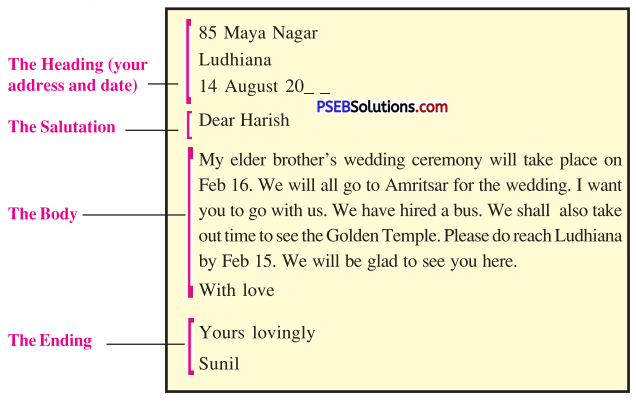
Write a letter to your cousin telling her/him about the new pet (a dog or a cat) you have adopted.
You should write in the letter

what pet you have adopted
what you have named it
how you play with your pet
how it has changed your life or routine

15, New Colony,
Phagwara.
14 March, 20…….
Dear Vipin,
You will be glad to know that I have adopted a day. It is a stray dog. I have named it Tommy. It is like a small toy. It takes milk, bread and meat. It plays with us. We throw the ball away and Tommy runs after it and return with the ball to us. As it gets up early in the morning, it has changed my life. We together go for a walk in the morning and in the evening. We run a race which I never win. I hope you will be happy to meet it.
Your loving brother,
Rahul.

PSEB 7th Class English Solutions Chapter 8 Hachiko-The World’s Most Loyal Dog

Learning to Use Language

Activity 11

Browse the following sites for more information and also to watch a film on Hachiko. After going through the sites, write all the new information you get on Hachiko
(The teacher must arrange the use of the Internet for students in the computer lab.)
नोट-अध्यापक की सहायता से स्वयं करें।

Comprehension Of Passages

Read the following passages carefully and answer the question that follow each.

(1) Hachiko, the dog was more than just a pet. He was a true companion. He was very loyal and faithful. Every day, Hachiko would greet his human friend, his master, a routine the faithful dog kept, even after his owner’s death. A golden-brown of Akita breed, Hachiko was born on November 10, 1923 in a farm in Japan. In 1924, Professor Hidesaburo Ueno adopted Hachiko and brought him to live with him in Shibuya, a small town in the neighbourhood of Tokyo.

Professor Hidesaburo Ueno taught in the Agriculture Department of Tokyo Imperial University. Every morning the professor would walk to the Shibuya railway station and Hachiko would also go with him to see his master take the train to work. After finishing the day’s classes, the professor would take the train back and return to the station at 3 pm.

1. Who was Hachiko ? Give his any two good qualities.
हचिको कौन था ? उसके कोई दो अच्छे गुण लिखो।

2. Where did Professor Ueno live ?
प्रोफैसर यूनो कौन था ?

3. Choose true and false statements and write them in your note book. . .
(a) The dog followed his routine even after his master’s death.
(b) The professor returned to his home town at 3 p.m. daily.

4. Complete the sentence according to the meaning of the passage.
(a) Professor Ueno taught in the ……………
(b) Hachiko, the dog was more than …….

5. Match the words with their meanings.

(a) faithful comeback
(b) return to take turn
loyal

Answer:
1. Hachiko was a pet dog. He was a true companion. He was very loyal and faithful.
2. Professor Ueno lived in Shibuya, a small town in the neighbourhood of Tokyo.
3.
(a) True
(b) True
4.
(a) Professor Ueno tought in the Agriculture Department of Tokyo University.
(b) Hachiko the dog was more than just a pet.
5.
(a) faithful-loyal
(b) return-come back.

PSEB 7th Class English Solutions Chapter 8 Hachiko-The World’s Most Loyal Dog

(2) The master and Hachiko kept this schedule until one sad day in May 1925 Professor Veno suffered a sudden brain hemorrhage while teaching and passed away. That day, Hachiko showed up at 3 pm as usual, but his beloved master never came back. Hachiko returned the next day at the same time, hoping that Veno would be there to meet him. Of course, the professor did not return, but his loyal Hachiko never gave up hope.

Hachiko was at Shibuya Station the next day again at 3 pm, then the day after, and the day after that. Soon, the lonely dog began to draw the attention of the other passengers.
At first, the station workers were not friendly with the dog, but after some time, people started looking out for him. Even the station employees would bring food and treats for the devoted dog and sometimes sit and keep him company.

1. How did Ueno die?
यूनो की मृत्यु कैसे हुई ?

2. What change did the dog bring about in the station workers ?
कुत्ते ने स्टेशन कर्मचारियों में क्या परिवर्तन लाया ?

3. Choose true and false statements and write them in your note book.
(a) The dog lost his hope as the days passed.
(b) Ueno died in May 1925.

4. Complete the sentence according to the meaning of the passage.
(a) Hachiko showed up at …………… as usual to the dog.
(b) The station employees would bring …………. for the devoted dog.

5. Match the words with their meanings.

(a) devoted died
(b) passed away sincere
appeared

Answer:
1. Ueno while teaching suffered a sudden brain haemorrhage and died.
2. The station workers who were not friendly with him, stated looking out for him. They started giving him food and their company.
3.
(a) False
(b) True.
4.
(a) Hachiko showed up at 3pm as usual.
(b) The station employees would bring food and treats for the devoted dog.
5.
(a) devoted — sincere
(b) Passed away — died.

3. One of Professor Ueno’s former students, Hirokichi Saito was an expert on the Akita breed of dogs. He came to know of Hachiko and his routine. He decided to take the train to Shibuya to see if Hachiko would still be waiting.

When Saito arrived at the station, he saw Hachiko there waiting for his master. He wiped a tear from his cheek. He waited for Hachiko to make the next move. After a long wait, Hachiko stood up and went from there. Saito followed the dog from the station to the home of Ueno’s former gardener, Kuzaburo Kobayashi who had adopted Hachiko but Hachiko waited only for Ueno.

For nearly a decade, after his master passed away, the dog continued to show up at the same spot every day until Hachiko died at the age of eleven on March 08, 1935. The dog became a symbol of loyalty in Japan – and now for the world.

1. Who was Hirokichi Saito ?
हीरोकीची सेंटो कौन था ?

2. He wiped a tear from his cheek ? What does this line show ?
उसने कुत्ते के गाल से एक आँसू पोंछा। यह पंक्ति क्या दर्शाती है? ।

3. Choose true and false statements and write them in your note book.
(a) After the death of Ueno his former gardner adopted Hachiko.
(b) Hachiko died at the age of thirty-five.

4. Complete the sentence according to the meaning of the passsage.
(a) After a long wait. Hachiko stood up and ………
(b) The dog become a ……………. in Japan.

5. Match the words with their meanings.

(a) decade took on
(b) adopted a period of ten years died.
died

Answer:
1. Hirokichi Saito was a former student of professor Ueno. He was an expert on the Akita breed of dogs.
2. This line show that Hachiko was very sad at heart after his master’s death.
3.
(a) True
(b) False.
4.
(a) After a long wait Hachiko Stood up and went from these.
(b) The dog became a symbol of loyalty in Japan.
5.
(a) decade – a period of ten years
(b) adopted – took on

PSEB 7th Class English Solutions Chapter 8 Hachiko-The World’s Most Loyal Dog

Use Of Words/Phrases In Sentences

1. Loyal (devoted, sincere) —
Should be loyal to the country.
हमें देश के प्रति निष्ठावान होना चाहिए।

2. Faithful (loyal, sincere) —
A dog is a faithful animal.

3. True (firm) —
He is true to his word promise.
वह अपने वचन का पक्का है। I

4. Recieve (to get) —
I received your letter yesterday.
मुझे कल तुम्हारा पत्र मिला।

5. Show up (to appear, to present) —
You must show up in the school ground at 9. am.
तुम्हें प्रातः 9 बजे स्कलू ग्राऊंड में पहुंच जाना चाहिए।

6. Passedaway (died) —
My grandmother passed away last month.
मेरी दादी पिछले महीने चल बसे।

7. Look out (take care) —
Look out ! The train has started.
देखो! रेलगाड़ी चल चुकी है।

8. Expert (specialist) —
My uncle is an Expert on birds.
मेरे चाचा जी पंछियों के माहिर हैं।

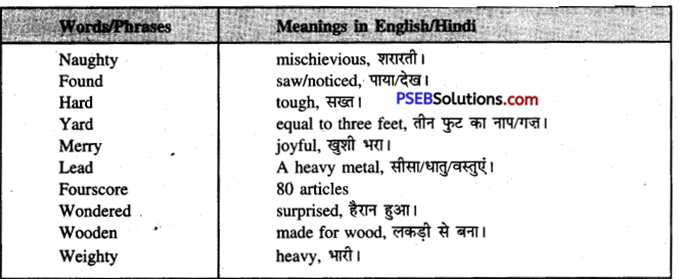
Word Meanings
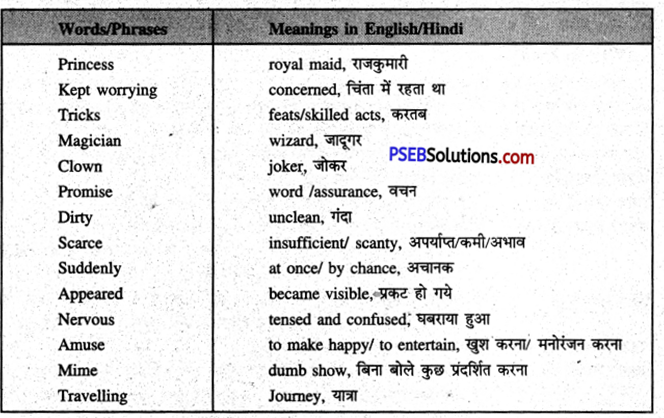
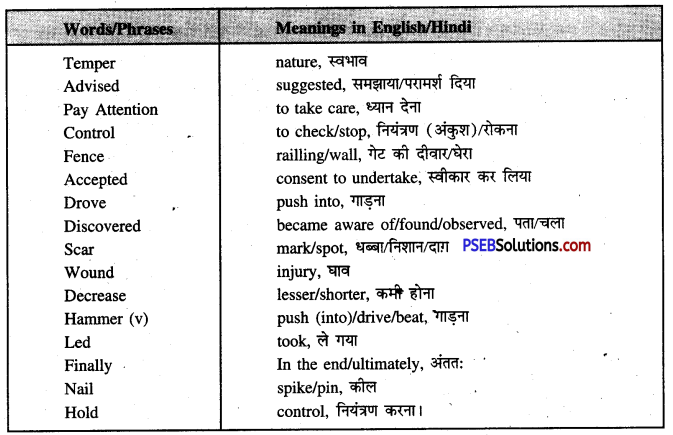
PSEB 7th Class English Solutions Chapter 8 Hachiko-The World’s Most Loyal Dog 5

Hachiko-The World’s Most Loyal Dog Summary in Hindi

Hachiko, the dog ……….. passed away.

हचीको (Hachiko) नामक कुत्ता पालतू होने से कहीं अधिक महत्त्व रखता है। वह एक सच्चा साथी था। वह बहुत ही निष्ठावान तथा वफादार था। हचीको प्रतिदिन अपने मानव मित्र जो इसका मालिक था, का अभिवादन करता था। यही दिनचर्या वफादार कुत्ते ने अपने मालिक की मृत्यु के बाद भी जारी रखी।

सुनहरी भूरी, अकीता प्रजाति (Akita bread) के हचीको का जन्म 10 नवम्बर, 1923 को जापान के एक खेत में हुआ। 1924 में प्रोफेसर एजाबुरो यूनो (Professor Hidesaburo Ueno) ने हचीको को गोद ले लिया और उसे टोक्यो के एक छोटे से शहर शिबुआ (Shibuya) में ले आये। प्रोफ़ेसर एज़ाबुरो यूनो टोक्यो इम्पीरियल यूनिवर्सिटी के कृषि विभाग में पढ़ाते थे। प्रत्येक सुबह प्रोफ़ेसर शिबुआ स्टेशन तक टहलते हुए जाते थे और हचीको भी उनके साथ जाता था तकि वह अपने मालिक को काम पर जाते हुए ट्रेन पकड़ते देखे।

PSEB 7th Class English Solutions Chapter 8 Hachiko-The World’s Most Loyal Dog

अपने दिन की कक्षाओं को समाप्त करके प्रोफेसर वापिसी के लिए ट्रेन पकड़ते और 3 बजे स्टेशन पर पहुंचते। हचीको स्टेशन पर पहुंच जाता और प्रोफेसर का इंतजार करता और उनके साथ टहलता हुआ वापिस घर आता। जोड़ी की प्रतिदिन की यही दिनचर्या थी। हर रोज़ हचीको एक ही समय पर अपने मालिक को लेने पहुंच जाता। मालिक और हचीको ने अपना कार्यक्रम तब तक जारी रखा जब तक एक अशुभ दिन मई, 1925 को प्रोफेसर यूनो की अचानक ब्रेन हेमेज से मृत्यु नहीं हो गई।

That day …………. …….. still be waiting.

उस दिन, हचीको हमेशा की भांति 3 बजे आ गया, परन्तु उसका प्रिय मालिक कभी वापिस नहीं आया। हचीको अगले दिन उसी समय इस आशा के साथ वापिस आया कि यूनो उसे वहां मिलेंगे। निःसंदेह प्रोफेसर कभी वापिस नहीं आए, परन्तु उनके वफ़ादार हचीको ने कभी आशा नहीं छोड़ी।

दिन बीतते गए और हचीको प्रतिदिन 3 बजे शिबुआ स्टेशन पर आ जाता था। शीघ्र ही अन्य यात्रियों का ध्यान इस अकेले डॉग (कुत्ते) की ओर जाने लगा। पहले पहल स्टेशन के कर्मचारी कुत्ते के साथ मित्रवत् नहीं थे परन्तु कुछ समय के बाद उसकी ओर ध्यान देने लगे। यहाँ तक कि स्टेशन के कर्मचारी उस वफ़ादार कुत्ते के लिए भोजन खाने के लिए उसके मनचाहे पदार्थ लाने लगे। कभीकभी वे उसके पास बैठ कर उसका साथ देते। दिन हफ्तों में, फिर महीनों में, फिर सालों में बदलें और हचीको, हर रोज इंतजार करने आता। उसकी उपस्थिति ने शिबुआ के स्थानीय लोगों पर ऐसा प्रभाव छोड़ा कि वह उनके लिए निष्ठा और विश्वास का एक प्रतीक बन गया, जैसे वह उनका नायक हो।

प्रोफेसर यूनो का एक पुराना छात्र हिरोकिची सैटो (Hirokichi Saito), अकीता नस्ल के कुत्तों का विशेषज्ञ था। उसे हचीको और उसकी दिनचर्या का पता चला। उसने निर्णय किया कि वह ट्रेन से शिबुआ जाएगा और देखेगा कि क्या हचीको अभी भी इंतज़ार कर रहा है।

When Saito arrived ……………………. go to Japan.

जब सैटो स्टेशन पहुंचा तो उसने हचीको को अपने मालिक का इंतजार करते देखा। उसने उसके गाल पर एक आंसू को पोंछा। उसने हचीको के अगले कदम की प्रतीक्षा की। एक लम्बे इंतजार के बाद हचीको उठ खड़ा हुआ और वहाँ से चला गया। सैटो ने कुत्ते का स्टेशन से उस घर तक पीछा किया जो यूनो के पुराने माली कुजाबुरो कोबायशी (Kuzaburo Kobayashi) था जिसने हचीको को गोद ले लिया था।

परन्तु हचीको यूनो का ही इंतजार करता था।अपने मालिक की मृत्यु के बाद लगभग दस वर्ष तक हचीको (कुत्ता) उसी जगह पर प्रतिदिन दिखाई देता रहा, जब तक कि 11 वर्ष की आयु में 8 मार्च 1935 को उसकी मृत्यु नहीं हो गई। (कुत्ता) डॉग जापान में वफ़ादारी का प्रतीक बन गया और अब पूरे विश्व में बन गया है।डॉग के प्रति आदर और प्यार के कारण लोग हचीको को “चुकेन हचीको” (Chukan Hachiko) पुकारने लगे।

इसका अर्थ है-वफ़ादार कुत्ता हचीको। हचीको की याद में एक बुत्त बनाया गया है शिबुआ में तथा एक उस स्थान पर जहाँ वह अपने मालिक यूनो को काम से वापिस आने पर मिलता था। हचीको के मृत शरीर को (म्यूजियम) संग्रहालय में संरक्षित करके रखा गया है। हां, यदि आप जापान जाएं तो आप अब भी हचीको को मिल सकते हैं।

Retranslation Of Isolated Sentences

1. He was a true companion.
वह एक सच्चा साथी था।

2. Hachiko wot his human friend his master.
हचीको अपने मानव मित्र अर्थात् अपने मालिक का अभिवादन करता था।

3. Hachiko was born on November 10, 1923.
हचीको का जन्म 10 नवम्बर 1923 को हुआ।

4. Every morning the professor would walk to the Shibuya railway station.
प्रत्येक सुबह प्रोफेसर शिबुआ स्टेशन तक टहलते हुए जाते थे।

5. Hachiko would also go with him.
हचीको भी उनके साथ जाता था।

6. The pair followed the same routine every day.
जोड़ी की प्रतिदिन की यही दिनचर्या थी।

7. But his beloved master never came back.
परन्तु उसका प्रिय मालिक कभी वापिस नहीं आया।

8. Even the station employees would bring food for the devoted dog.
यहाँ तक कि स्टेशन के कर्मचारी भी उस वफादार कुत्ते के लिए भोजन लाते थे।

PSEB 7th Class English Solutions Chapter 8 Hachiko-The World’s Most Loyal Dog

9. His presence made a great impression on the local people of Shibuya.
उसकी उपस्थिति ने शिबुआ के स्थानीय लोगों को बहुत अधिक प्रभावित किया।

10. Yes, you can still meet Hachiko if you go to Japan
हां, यदि आप जापान जाएं तो आप अब भी हचीको से मिल सकते हैं।

English Guide for Class 7 PSEB Prose

Birbal’s Khichdi Question Answer Class 7 English Solutions Chapter 2 PSEB Solutions

Punjab State Board PSEB 7th Class English Book Solutions Chapter 2 Birbal’s Khichdi Textbook Exercise Questions and Answers.

Class 7th English Solutions Chapter 2 Birbal’s Khichdi Question Answers

Birbal’s Khichdi Class 7 Questions and Answers

Activity 1

I Look up the following words in a dictionary. You should seek the following information about the words and put them in your WORDS notebook.
1. Meaning of the word as used in the story (adjective/noun/verb, etc.)
2. Pronunciation (The teacher may refer to the dictionary or the mobile phone for correct pronunciation).
3. Words that normally go with the given word.
For example : ‘return’ does not take ‘back’ with it. It is not correct to say ‘I returned back from work’.
4. Spellings

glowing starving frozen extreme
deserve consider warmth brahmin

Activity 2

(Prefixes and Suffixes)

Look at the following words. Break them into smaller words and look up the meaning of the words if required.
Example : The word ‘uncooked’ can be broken as under.
un + cook + ed
In the example above, un – is a prefix to cook and -ed is a suffix.

Prefixes and suffixes : कुछ अक्षरों या शब्दांशों को किसी मुख्य शब्द के आगे या पीछे जोड़ने से उसका अर्थ बदल जाता है। ये शब्दांश Prefixes तथा Suffixes कहलाते हैं।

PSEB 7th Class English Solutions Chapter 2 Birbal’s Khichdi

Prefixes : ये शब्दांश मुख्य शब्द के आगे जोड़े जाते हैं। इनसे प्रायः विपरीत शब्द बनाए जाते हैं, जैसे
un + happy = unhappy.
Prefixes with their meanings and examples :

Prefix Meaning Example
non-, un-, im-, in-, il-, ir- not, opposite nonsense, unhappy
re- again, back revisit, replay
mis- wrongly, not misunderstand
de- reverse, remove out of deactivate, dehydrate
CO- with, together coexist
dis-,di- separation, away, apart, two dislike, diacid

Suffixes : ये शब्दांश मुख्य शब्द के पीछे जोड़े जाते हैं। इनके प्रयोग से Nouns, Adjectives, Plural तथा Parts of Speech
जैसे – progress + ion = progression.

Suffixes with their meanings and examples :

Suffix Meaning Example
-er, -or one who; or showing a comparison teacher, faster
-able, -ible capable of being unforgettable, reversible
-d, -ed forming the past tense or having the quality of added, loved
-ing forming a gerund meaning an “act of” or the present participle singing
-ment the act, state or result of an action appointment, government
-ive having the quality of creative, divisive

Now let us look at some words from the story and see how we can break them. In the.. word ‘impossible’, im- is prefix and in the word ‘national’ – al is a suffix.
Answer:
1. frozen
2. return
3. extremely
4. disappointed
5. shivering
6. wisest
7. realise
8. looking

PSEB 7th Class English Solutions Chapter 2 Birbal’s Khichdi

Learning to Read and Comprehend

Activity 3

Write answers to the following questions :

Question 1.
What time of the year was it in the story ?
कहानी में साल के किस समय का वर्णन था ?
Answer:
It was winter-January and February.

Question 2.
What had happened to the ponds and lakes ?
तालाबों तथा झीलों को क्या हुआ था ?
Answer:
The ponds and lakes were all frozen.

Question 3.
What did Akbar want to know ?
अकबर क्या जानना चाहता था ?
Answer:
Akbar wanted to know if a man would do anything for money.

Question 4.
Why did the brahmin accept Akbar’s challenge ?
बाहाण ने अकबर की चुनौती क्यों स्वीकार कर ली ?
Answer:
The brahmin accepted Akbar’s challenge because he was poor and needed money to feed his family.

Question 5.
How much money did Akbar agree to give to the brahmin ?
अकबर ब्राह्मण को कितना धन देने पर सहमत हुआ ?
Answer:
Akbar agreed to give two thousand gold coins to the brahmin.

PSEB 7th Class English Solutions Chapter 2 Birbal’s Khichdi

Activity 4.

Who said to whom ? Write in the given space.

Question 1.
Stand inside the forzen pond all through the night without any clothes and I will give you two thousand gold coins.
Answer:
Akbar to brahmin.

Question 2.
How could you stand in the forzen pond in such an extreme temperature ?
Answer:
Akbar to brahmin.

Question 3.
Oh brahmin, you have cheated me.
Answer:
Akbar to brahmin.

Question 4.
Your Majesty, it is impossible to get the warmth from the lights glowing so far away!
Answer:
Birbal to Akbar

Question 5.
Birbal, I considered you to be the wisest in this country, but you have proved me wrong.
Answer:
Akbar to Birbal.

Activity 5

What do you understand about Birbal in the story ? Write three to four sentences on Birbal.
Answer:
Birbal was a courtier in Akbar’s court. He was very wise and witty. He solved the brahmin’s case very cleverly. He helped him get his reward. His plan of Khichdi forced ((विवश कर दिया)) Akbar to give the brahmin two thousand gold coins.

Learning Language
Adverbs :

Activity 6

Look at the following words. Notice what is common in them.

1. harshly
2. faintly
3. mainly
4. truly
5. frankly
The common thing about the words above is the use of the letters ‘ly’ at the end. The words can easily be divided into two parts. (word + ly).
For example : harsh + ly
Words that end with -ly are mostly Adverbs. Adverbs of Manner usually take -ly after a word.
‘ly’ खे समाप्त होने वाले शब्द मुख्यतः Adverbs होते है| ये मुख्यतः Adverbs of manner हेते है | समय को व्यक्त करने वाले Adverbs बारम्बरता को व्यक्त करते हैं

PSEB 7th Class English Solutions Chapter 2 Birbal’s Khichdi

जैस —
1. The girls always get late for the party.
2. I usually do yoga every morning.
3. He is often late for work.
4. My dentist told me to brush my teeth twice daily.
Adverbs are of many types (कई प्रकार के) such as time, place, ‘manner, frequency etc.

Activity 7

Question 1
Divide the following words into two parts. The first has been done for you.
Answer:
1. mainly — main + ly
2. generally — general + ly
3. aptly — apt + ly
4. sternly — stern + ly
5. normally — normal + ly
6. suddenly — sudden + ly
7. carefully — careful + ly
8. rarely — rare + ly

Activity 8

Fill in the blanks with appropriate -ly words given in the box.

truly, sternly, fairly, certainly, quietly

1. Akbar spoke ………………. with the brahmin.
2. The exam was …………….. easy.
3. Birbal was ………… wise.
4. You should …………. take leave from work.
5. The student sat …………… after the teacher scolded him.
Answer:
1. sternly
2. truly
3. certainly
4. fairly
5. quietly.

Activity 9

The following exercise will help you to understand how Adverbs of Frequency work. Choose the best answer to complete each sentence.

Question 1.
I ……………. late on weekends.
(a) get up usually
(b) get usually up
(c) usually get up
(d) up get usually
Answer:
(c) usually get up.

Question 2.
My father …………… late for work.
(a) never is
(b) is never
(c) are never
(d) were never
Answer:
(b) is never

PSEB 7th Class English Solutions Chapter 2 Birbal’s Khichdi

Question 3.
How ……………… on weekends ?
(a) often do you travel
(b) do you often travel
(c) often you do travel
(d) often does you travel
Answer:
(a) often do you travel

Question 4.
Tim …………. early for class.
(a) often is
(b) are often
(c) often are
(d) is often
Answer:
(d) is often

Question 5.
When do you ………… go on vacation each year ?
(a) always
(b) never
(c) usually
(d) ever.
Answer:
(c) usually

PSEB 7th Class English Solutions Chapter 2 Birbal’s Khichdi

Activity 10 (pairwork)

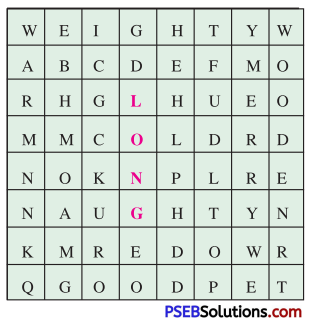
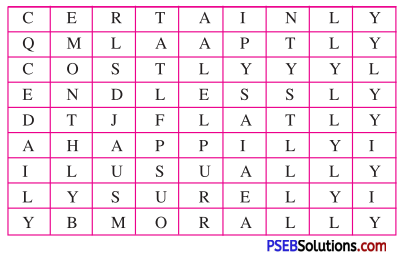
The following grid has some-ly words. You can find them either vertically or horizontally. Find them and write them in the blanks given below. (The teacher will explain how to do the activity.)
PSEB 7th Class English Solutions Chapter 2 Birbal’s Khichdi 1
Answer:
1. Certainly
2. Costly
3. Endlessly
4. Flatly
5. Usually
6. Surely
7. Morally
8. Daily
9. Monthly
10. Happily

Learning to Speak

Activity 11

Three sets of dialogues are given below. Practise them in the class.

Note : The teacher must get the dialogues rehearsed one at a time in pairs and small groups. The best three groups in speaking for each set will present their dialogue in front of the class. The teacher must help the students to understand the text and speak as instructed in square brackets.

Set I (Pairwork)
Akbar (to Birbal) : Tell me one thing, Birbal! Do you think a man will do anything for money ? [question]
Birbal (to Akbar) : Yes, Your Majesty. [statement]
Akbar (to Birbal) : Alright, then prove it ! [order]

Set 2 (a group of 3)
Birbal (to Akbar) : Your Majesty, this brahmin is ready to do anything for the sake of money. [statement]
Akbar (to Birbal) : Will he do what I say, Birbal ? [question]
Birbal (to Akbar) : Yes, Your Majesty. [statement]
Birbal (to the brahmin): Are you ready to do anything that His Majesty asks you to ? [question]
Brahmin (to Akbar) : Anything, if I get some money to feed my family, Your Majesty. [statement)
Akbar (to the brahmin): Stand inside the frozen pond all through the night without any clothes. For this, I will give you two thousand gold coins. [order]

PSEB 7th Class English Solutions Chapter 2 Birbal’s Khichdi

Set 3 (a group of 3)
Akbar (to the brahmin) : Tell me, how could you stand in the frozen pond in such an extreme temperature ? [question] ·
The brahmin (to Akbar): It was very difficult. It was freezing. But I needed the money for my family. So I kept standing in the cold water. [statement]
Akbar (to the brahmin) : Was it due to money that you could stand in the water all night ? [question]
The brahmin (to Akbar) : Your Majesty, I could also see the faintly glowing lights of the palace.
The lights helped me. I kept looking at the lights and thinking about the food my family will get. [statement]
Akbar (angrily to the brahmin) : What ! Oh brahmin, you have cheated me! (exclamation]
The brahmin (to Akbar) : Your Majesty, I did as you said. I have not cheated. [statement]
Akbar (angrily to the brahmin) : You do not deserve the reward. You looked at the palace lights and got warmth from the lights. [statement]
The brahmin (pleadingly to Akbar) : Your Majesty, I have stood all night in the freezing waters of the pond. [statement]
Akbar (sternly to the brahmin): I will not give you any reward for this. If you say one more word, I will put you in jail for cheating. [order]
Birbal (to Akbar): Your majesty, it is impossible to get the warmth from the lights glowing so far away! (exclamation)

नोटः विद्यार्थी कक्षा में स्वयं अभ्यास करे

Learning to Write

Dialogue writing :

Writing a dialogue is a very interesting activity. If you already have a passage, converting it into dialogue form is very simple. You must remember :
कोई Dialogue (वार्तालाप) लिखते समय निम्नलिखित बातों का ध्यान रखा जाता है
1. You do not use words such as ‘said’, ‘asked’, ‘replied’, ‘told’, etc. Instead, you use ‘to’ at its place.
2. You use colon: after addressee put in round bracket.
3. You do not use inverted commas (” “) for what the speaker has to say.
Example :

Statements Birbal told the messenger, “Give my message to the emperor.” Birbal tells the messenger to go to the emperor and give him a message.
Process (विधि )
Step. 1 Remove ‘told’, comma and inverted commas. Remove ‘tells’
Step 2. Instead of ‘told’ use ‘to’ Remove ‘to’ after ‘messenger’. Use ‘to’ and remove ‘tells’.
Step 3. Put ‘to’ and ‘the messenger’ in round brackets after the name of the speaker.
Step 4. Add colon (:) the name of the speaker and the addressee as in Birbal
(to the messenger) :
Step 5. ……….. Make the first letter of the statement capital
Dialogue Birbal (to the messenger): Give my message to the emperor. Birbal (to the messenger): Go to the emperor and give him a message.

PSEB 7th Class English Solutions Chapter 2 Birbal’s Khichdi

Activity 12 (pairwork)

Read the given statements and rewrite them as dialogues.

1. Statement : Akbar said, “Birbal. I considered you to be the wisest in this country, but you have proved me wrong.”
Dialogue :
Akbar (to Birbal) : I considered you to be the wisest in this country, but you have proved me wrong.
2. Statement : Birbal said, “Why, Your majesty ?”
Dialogue : Birbal (to Akbar) : Why, Your majesty ?
3. Statement : Akbar said, “How will the khichdi get cooked when it is one meter above the fire ? What is wrong with you Birbal ?” Dialogue :
Akbar (to Birbal) : How will the Khichdi get cooked when it is one meter above the fire ? What is wrong with you ?

Learning to Use Language

Activity 13 (Group Work)

Students will do this activity in a group of four or five.
Let us write a small paragraph. The topic is ‘A Visit to a Hill Station’. Read the questions given below and answer them in complete sentences.

PSEB 7th Class English Solutions Chapter 2 Birbal’s Khichdi 2

Question 1.
Where did you go ?
Answer:
I went to Shimla.

Question 2.
Who did you go with ?
Answer:
I went with my uncle.

PSEB 7th Class English Solutions Chapter 2 Birbal’s Khichdi

Question 3.
How did you reach there ?
Answer:
I reached there by bus.

Question 4.
How long did it take ?
Answer:
It took us three hours.

Question 5.
Where did you stay ?
Answer:
I stayed at an inn.

Question 6.
What did you do during the day ?
Answer:
During the day we visited touring spots.

Question 7.
What did you doʻat night ?
Answer:
At night we slept early because we were tired.

Question 8.
How was your trip ?
Answer:
We enjoyed the trip very much.

Now put all your answers together and write in a paragraph form in the following box.
PSEB 7th Class English Solutions Chapter 2 Birbal’s Khichdi 3
नोटः विद्यार्थी इसे स्वयं करें

Comprehension Of Passages

Read the given passages and answer the questions that follow each :

(1) It was winter time. The ponds and lakes near Akbar’s palace were all frozen. At Akbar’s court :
Akbar asked Birbal, “Tell me one thing, Birbal ! Do you think a man will do anything for money ?”
Birbal replied, “Yes, Your Majesty”… Akbar ordered, “Alright, then prove it !”. The next day, Birbal came to the court along with a brahmin. He was extremely poor and his family was starving. He had no money to feed them.

Birbal said to the king, “This brahmin is ready to do anything for the sake of money”. Akbar asked, “Will he do what I say ?”.

“Anything, if I get some money to feed my family,” said the poor brahmin, before Birbal could reply.
The king said to the brahmin, “Stand inside the frozen pond all through the night without any clothes and I will give you two thousand gold coins.”

PSEB 7th Class English Solutions Chapter 2 Birbal’s Khichdi

1. Why were ponds and lakes frozen ?
तालाब और झीलें क्यों जमी हुई थीं ?

2. What was the poor brahmin asked to do for money ?
धन के बदले ब्राह्मण से क्या करने को कहा गया ?

3. Choose true and false statements and write them in your answer book :
(a) Birbal came to the court along with a brahmin.
(b) Birbal had no money to feed his family.

4. Complete the sentences according to the meaning of the passage :
(a) Birbal was asked to prove that …………..
(b) Brahmin was extremely poor and ………..

5. Match the words with their meanings :

(a) pond iced
(b) frozen empty
pool

Answer:
1. The ponds and lakes were frozen because it was winter time.
2. He was asked to stand inside the frozen pond all through the night without any clothes.
3.
(a) True
(b) False
4.
(a) Birbal was asked to prove that a man will would do anything for money.
(b) Brahmin was extremely poor and his family was starving.
5.
(a) pond – pool
(b) frozen – iced.

PSEB 7th Class English Solutions Chapter 2 Birbal’s Khichdi

(2) In the morning, he returned to Akbar’s court to receive his reward of two thousand gold coins. The king asked the brahmin, “How could you stand in the frozen pond in such an extreme temperature ?” The innocent brahmin replied, “I could see faintly glowing lights of the palace a mile away and that was a ray of hope for me. I kept looking at the lights and thinking about my family that they will get food if I continue to stand in the pond.”

Akbar suddenly became very stern. He said harshly, “Oh brahmin, you have cheated me I will not give you any reward for this. You looked at the palace lights and got warmth from the lights. You do not deserve the reward.” Birbal said, “Your Majesty, it is impossible to get the warmth from the lights glowing so far away !”.

1. How much was the reward ?
ईनाम कितना था ?

2. Why did Akbar refuse to give brahmin his reward ?
अकबर ने ब्राह्मण को उसका ईनाम देने से क्यों इन्कार कर दिया ?

3. Choose true and false statements and write them in your answer book :
(a) The lights of the palace were glowing brightly.
(b) Akbar suddenly became very stern.

4. Complete the sentences according to the meaning of the passage :
(a) You do not deserve ……
(b) You looked at the palace lights and ……..

PSEB 7th Class English Solutions Chapter 2 Birbal’s Khichdi

5. Match the words with their meanings :

(a) warmth very serious
(b) stern heat
very cold

Answer:
1. The reward was two thousand gold coins.
2. Akbar refused to give brahmin his reward because he thought that the brahmin had cheated him.
3.
(a) False
(b) True
4.
(a) You do not deserve the reward.
(b) You looked at the palace lights and got warmth from the lights.
5.
(a) warmth — heat
(b) stern — very serious

(3) The next day, Birbal did not go to Akbar’s court. He sent a messenger to the emperor saying that he would come to the court only after his Khichdi gets cooked. Birbal did not turn up even after five days. The emperor himself went to Birbal’s house to see what he was doing. He saw that Birbal had lit the fire and kept the pot of uncooked khichdi one yard above the fire. Akbar said, “Birbal, I considered you to be the wisest in this country, but you have proved me wrong.”

1. What message did Birbal’s messenger bring ?
बीरबल का संदेशवाहक क्या संदेश लाया ?

2. Why did Akbar himself go to Birbal’s house ?
अकबर स्वयं बीरबल के घर क्यों गया ?

3. Choose true and false statements and write them in your answer book :
(a) Birbal turned up after five days.
(b) Birbal had lit the fire to cook his khichdi.

4. Complete the sentences according to the meaning of the passage :
(a) Birbal had kept the pot of uncooked khichdi ………
(b) Akbar considered Birbal to be …………..

PSEB 7th Class English Solutions Chapter 2 Birbal’s Khichdi

5. Match the words with their meanings :

(a) emperor foolish
(b) Uncooked king
not ready

Answer:
1. He brought the message that Birbal would come to the court only after his Khichdi gets cooked.
2. Akbar went to Birbal’s house to see what he was doing.
3.
(a) False
(b) True
4.
(a) Birbal had kept the pot of uncooked khichdi one yard above the fire.
(b) Akbar considered Birbal to be the wisest in the country.
5.
(a) emperor – king
(b) uncooked – not ready

(4) Birbal said, “Why, your majesty ?”
Akbar said, “How will the khichdi get cooked when it is one yard above the fire ? What is wrong with you, Birbal ?”
Birbal kept stirring the pot and replied, “Oh my Great Emperor, when it is possible for a person to receive warmth from the faintly glowing lights a mile away, then it should be possible for this khichdi, which is just a yard above the fire to get cooked.”

1. Who was cooking khichdi ?
खिचड़ी कौन पका रहा था ?

2. How was he cooking it ?
वह इसे कैसे पका रहा था ?

3. Choose true and false statements and write them in your answer book :
(a) Akbar started stirring the pot.
(b) Birbal’s khichdi was still uncooked.

4. Complete the sentences according to the meaning of the passage :
(a) It is not possible for a person to get warmth from lights ………….
(b) It was not possible for Birbal’s khichdi to get …………..

5. Match the words with their meanings :

(a) glowing cooking
(b) receive bright
get

Answer:
1. Birbal was cooking Khichdi.
2. He was cooking it by keeping the pot a yard above the fire.
3.
(a) False
(b) True
4.
(a) It is not possible for a person to get warmth from lights a mile away.
(b) It was not possible for Birbal’s khichdi to get cooked.
5.
(a) glowing – bright
(b) receive – get

Use Of Words/Phrases In Sentences

1. Palace (mansion) —
Akbar lived in a beautiful palace.
अकबर एक शानदार महल में रहता था।

2. Frozen (Chilled) —
I was almost frozen with cold.
मैं ठंड से जम-सा गया।

3. Extremely (very, badly) —
It was extremely cold yesterday.
कल बहुत अधिक ठंड थी।

4. Glowing (shining) —
I saw many lights glowing in the park.
मैंने पार्क में बहुत सी बत्तियां चमकती देखीं।

5. Starving (dying of hunger) —
The poor beggar was starving for lack of food.
गरीब भिखारी भोजन न होने के कारण भूखा मर रहा था।

PSEB 7th Class English Solutions Chapter 2 Birbal’s Khichdi

6. Warmth (heat) —
We made a fire for warmth.
हमनें गर्मी पाने के लिए आग जलाई।

7. Deserve (to be worthy of) —
First deserve then desire.
किसी चीज़ की इच्छा रखने से पहले उसके अधिकारी बनो।

8. Extreme (to the last extent) —
In June, heat is at its extreme.
जून में गर्मी चरम पर होती है।

9. Consider (take for) —
I considered him to be a rich man.
मैं उसे एक अमीर आदमी समझता था।

10. Shiver (shake with cold) —
The old man was shivering with cold.
बूढ़ा आदमी ठंड से कांप रहा था।

11. Turn up (reach/come) —
I waited for my friend, but he did not turn up.
मैं अपने मित्र का इंतज़ार करता रहा, परंतु वह नहीं आया।

PSEB 7th Class English Solutions Chapter 2 Birbal’s Khichdi

Word Meanings
PSEB 7th Class English Solutions Chapter 2 Birbal’s Khichdi 4

Birbal’s Khichdi Summary in Hindi

It was winter ……….. the night, shivering.

सर्दी का मौसम (समय) था। अकबर के महल के निकट सभी तालाब तथा झीलें जमी हुई थीं। अकबर के दरबार में : अकबर ने बीरबल से पूछा, “बीरबल, एक बात बताओ। तुम्हारे विचार में क्या कोई आदमी पैसे के लिए कुछ भी कर सकता है ?” बीरबल ने उत्तर दिया, “हाँ, महाराज।” अकबर ने आदेश दिया, “ठीक है, तो सिद्ध करो।”

अगले दिन, बीरबल अपने साथ एक ब्राह्मण को लेकर दरबार में आया। वह बहुत ही ग़रीब था और उसका परिवार भूख से मर रहा था। उसके पास परिवार को भोजन देने के लिए कोई धन नहीं था। बीरबल ने राजा से कहा, “यह ब्राह्मण धन के लिए कुछ भी करने के लिए तैयार है।” अकबर ने पूछा, “जो मैं कहूँगा क्या यह वही करेगा ?”

बीरबल के उत्तर देने से पहले ही ब्राह्मण बोला, “यदि मुझे अपने परिवार को पालने के लिए धन मिल जाए, तो मैं कुछ भी करूंगा।” राजा ने ब्राह्मण से कहा, “इस जमे हुए तालाब में बिना कपड़ों के पूरी रात खड़े रहो, तो मैं तुम्हें दो हज़ार स्वर्ण मुद्राएं दूंगा।” गरीब ब्राह्मण को धन की आवश्यकता थी। उसके पास कोई विकल्प नहीं था। वह ठंड से कांपते हुए पूरी रात उस जमे हुए तालाब में खड़ा रहा।

In the morning ………..listen to him.

सुबह वह अपने पुरस्कार की दो हज़ार स्वर्ण मुद्राएं लेने के लिए अकबर के दरबार में वापिस आया। राजा ने ब्राह्मण से पूछा, “तुम इतने चरम तापमान में इस जमे हुए तालाब में कैसे खड़े रहे ?” मासूम ब्राह्मण ने उत्तर दिया, “मुझे एक मील दूर स्थित महल की रोशनियों की मद्धम (धीमी) चमक दिखाई दे रही थी। वही मेरे लिए आशा की किरण थी। मैं लगातार रोशनी को देखता रहा और अपने परिवार के बारे में सोचता रहा कि यदि मैं इस तालाब में खड़ा रहा तो मेरे परिवार को भोजन मिल जायेगा।”

अकबर अचानक कठोर हो गए। उन्होंने कठोरता से कहा, “अरे ब्राह्मण, तुमने मुझे छला है। मैं तुम्हें इसके लिए कोई पुरस्कार नहीं दूंगा। तुम महल की रोशनियों को देखते रहे और उससे गर्मी लेते रहे। तुम पुरस्कार के अधिकारी नहीं हो।” बीरबल ने कहा, “महाराज, इतनी दूर चमकती रोशनी से गर्मी मिलना नामुमकिन है।” . अकबर ने उसकी एक न सुनी।

How could the poor ………… realise his mistake.

गरीब ब्राह्मण राजा से बहस कैसे कर सकता था ? वह अकबर के दरबार से निराश होकर तथा खाली हाथ वापिस लौट गया। अगले दिन, बीरबल अकबर के दरबार में नहीं गया। उसने राजा के पास यह संदेश देकर अपना एक संदेश-वाहक भेजा कि वह अपनी खिचड़ी पक जाने के बाद ही दरबार में उपस्थित होगा।

बीरबल पाँच दिन बाद भी नहीं पहुंचा। राजा स्वयं बीरबल के घर यह देखने के लिए गए कि वह क्या कर रहा है। उन्होंने देखा कि बीरबल ने आग जला रखी है और अपनी कच्ची खिचड़ी का बर्तन आग से एक गज़ ऊपर रखा हुआ है। अकबर ने कहा, “बीरबल, मैं तुम्हें देश का सबसे बुद्धिमान व्यक्ति मानता था, परन्तु तुमने मुझे गलत सिद्ध कर दिया

बीरबल ने कहा, “महाराज, क्यों ?” अकबर ने कहा, “खिचड़ी कैसे पकेगी जबकि यह आग से एक गज़ ऊपर है ? बीरबल, तुम्हें क्या हो गया है ?” बीरबल ने बर्तन को हिलाना जारी रखा और उत्तर दिया, “ओह मेरे महाराज ! जब एक मील दूर चमकती मंद रोशनी से एक व्यक्ति को गर्मी मिल सकती है तो इस खिचड़ी का पक जाना भी संभव है क्योंकि यह तो आग से केवल एक गज़ ही ऊपर है।”

अकबर को अपनी गलती का एहसास हो गया। उसने ग़रीब ब्राह्मण को बुलवाया और उसे दो हज़ार स्वर्ण मुद्राएं दीं। अकबर खुश था कि बीरबल ने उसे उसकी गलती का एहसास करवाकर उसकी मदद की है।

PSEB 7th Class English Solutions Chapter 2 Birbal’s Khichdi

Retranslation Of Isolated Sentences

1. It was winter time.
सर्दी का मौसम (समय) था।

2. Do you think a man will do anything for money ?
तुम्हारे विचार में क्या कोई आदमी पैसे के लिए कुछ भी कर सकता है ?

3. He was extremely poor and his family was starving.
वह बहुत गरीब था और उसका परिवार भूख से मर रहा

4. I will give you two thousand gold coins.
मैं तुम्हें दो हज़ार स्वर्ण मुद्राएं दूंगा।

5. He stood in the frozen pond.
वह जमे हुए तालाब में खड़ा रहा।

6. I kept looking at the lights.
मैं लगातार रोशनी को देखता रहा।

7. He returned disappointed and bare-handed.
वह निराश होकर और खाली हाथ वापिस लौट गया।

8. Birbal did not turn up even after five days.
बीरबल पाँच दिन बाद भी नहीं पहुँचा।

9. He saw that Birbal had lit the fire.
उन्होंने देखा कि बीरबल ने आग जला रखी है।

10. I considered you to be the wisest in this country.
मैं तुम्हें देश का सबसे बुद्धिमान व्यक्ति मानता था।

11. What is the wrong with you ?
तुम्हें क्या हो गया है ?

12. Akbar realised his mistake.
अकबर को अपनी गलती का एहसास हो गया।

English Guide for Class 7 PSEB Prose
An Earthquake Question Answer Class 7 English Solutions Poem Chapter 3 PSEB Solutions

Punjab State Board PSEB 7th Class English Book Solutions Poem 3 An Earthquake Textbook Exercise Questions and Answers.

Class 7th English Solutions Poem Chapter 3 An Earthquake Question Answers

An Earthquake Class 7 Questions and Answers

Activity 1.

Look up the following words/phrases in a dictionary. You should seek the following information about the words and put them in your WORDS notebook.
1. Meaning of the word as used in the poem (adjective/noun/verb. etc).
2. Pronunciation (The teacher may refer to the dictionary or the mobile phone for correct pronunciation
3. Spellings

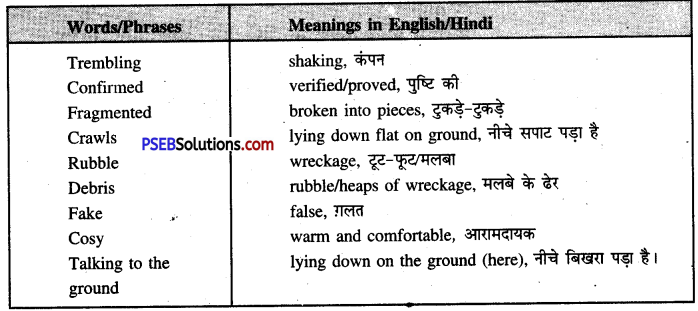
trembling confirmed crashing down stood tall fragmented
crawls rubble debris cosy tombs

PSEB 7th Class English Solutions Poem 3 An Earthquake

Vocabulary Expansion

Activity 2.

Write five pairs of rhyming words from the poem.

1. awake-shake
2. fake-quake
3. tall-crawl
4. debris-trees
5. found-ground
6. shake-fake
7. down-town

Activity 3.

Have you ever experienced an earthquake? It may result in a disaster if the earthquake is big. There are two types of disasters-natural and man-made. Study the image below.
PSEB 7th Class English Solutions Poem 3 An Earthquake 1

Look at the picture and make a list of all the natural as well as man-made disasters.

Natural Disasters — Man-made Disasters

1. Cyclones — Terrorism
2. Drought — Bomb explosion
3. Landslides — Industrial incidents
4. Earthquakes — Pollution
5. Floods — Epidemics
6. Famine — War

Learning to Read and Comprehend

Activity 4.

Answer the following questions.

Question 1.
What is the poem about ?
कविता किसके बारे में है ?
Answer:
The poem is about an earthquake and disaster caused by it.

Question 2.
What happened as the poet lay awake ?
‘जिस समय कवि जाग कर लेटा हुआ था उस समय क्या हुआ ?
Answer:
His bed began to shake as there was an earthquake.

Question 3.
How did the poet come to know about the earthquake ?
कवि को भूकम्प का पता कैसे चला ?
Answer:
The trembling fan told him about the earthquake.

Question 4.
What confirmed the poet’s fear about the quake ?
भूकम्प के बारे में कवि के भ्रम की पुष्टि किस बात ने की ?
Answer:
The trembling fan confirmed his fear about the quake.

Question 5.
What happened after the quake ? Make a list.
भूचाल/भूकम्प के बाद क्या हुआ ? एक सूची बनाइए।
Answer:
(a) The houses crashed down.
(b) Houses, roads, parks-everything broke into pieces.
(c) There were heaps of debris on the ground.
(d) People came out of their homes crying.

Read and Understand

Activity 5

Explain the meaning of the following lines from the poem.

Question 1.
Kissing and talking to the ground.
Answer:
Everything lay flat on the ground.

PSEB 7th Class English Solutions Poem 3 An Earthquake

Question 2.
Some of which have now become tombs.
Answer:
Some of them were now changed into tall heaps of debris.

Learning Language Prepositions

Read the following sentences.

1. Your pencils are in the box.
2. The woman sat on the bench.
3. The helicopter flew over the house.
4. The earthquake changed the houses into debris.
5. Simran felt the earth shaking beneath her feet.
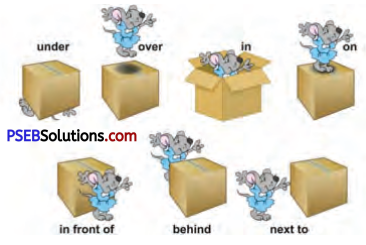
इन वक्यो में in, on,over,into and beneath आदि शब्द दो nouns के बीच सम्बन्ध बताते है| इन्हें prepositions कहा जाता है।
इस प्रकार prepositions :
(a) nouns/pronouns का सम्बन्ध वाक्य में अन्य शब्दों से जोड़ती हैं।
(b) के बाद वाक्य में object का काम करने वाला कोई noun होता है।
PSEB 7th Class English Solutions Poem 3 An Earthquake 2

Activity 6.

Choose suitable prepositions from the box to fill in the given blanks. The first one is done for you.

on to by from in front of
with at into behind for

1. There are trees in front of our house.
2. Look ………….. the blackboard.
3. Keep the bags ……………. the table.
4. The boy is looking ……………. an answer.
5. We went ……………. bus to Amritsar.
6. He travelled with me ………… Chandigarh to Patiala.
7. The girl stood …………….. the bench.
8. Look …………….. the bags for our papers.
9. Go …………… Sameer to the market.
10. Run …………….. call the man.
PSEB 7th Class English Solutions Poem 3 An Earthquake 3
Answer:
2. at,
3. on
4. for
5. by
6. from
7. on
8. into
9. with
10. behind.

PSEB 7th Class English Solutions Poem 3 An Earthquake

Activity 7.

Using the words followed by preposition, make sentences of your own. The first one is done for you.

interfere with fit for confident of sorry for mix with
make fun of prays at acted upon bent on superior to

1. I do not let my music lessons interfere with my studies.
2. This water in not fit for drinking.
3. I am confident of my success.
4. I am sorry for this mistake.
5. Don’t mix with bad boys.
6. Never make fun of the poor.
7. She prays at home these days.
8. He acted upon his father’s advice.
9. The boy is bent on making a mischief.
10. Your box is superior to mine.

Activity 8.

Practise the following poem with your partner.

Mynah
In a cold month
Under the cloudy sky
Near the dark forest
Beside the rumbling river
On the sandy bank
Under the green tree
Sat a twittering mynah. — Vandana Lunyal

Learning to Listen Dictation

Activity 9.

Listen to your teacher regarding an earthquake scene and fill in the blanks.

1. The ………………….. is creaking and rattling.
2. Books are ……………….. from the bookcase.
3. ………….. are swinging.
4. The bookcase …………………. on the floor.
5. The …………………. are rattling.
6. There are …………….. outside.
7. A car alarm ……………
8. Dogs are …………………..
9. A baby is ……………
10. …………….. are shouting.
11. The ……………… is making temple bells ring.
12. There are ………………. sounds from bricks falling to the ground.
13. Trees ………………….. are swaying.
14. Drop, take cover and …………………. on to an object.
15. Stay in the Drop, ………………… and Hold On position under your desk.
PSEB 7th Class English Solutions Poem 3 An Earthquake 4
Answer:
1. building
2. falling
3. Fans
4. falls
5. windows
6. noises
7. sounds
8. barking
9. crying
10. People
11. shaking
12. crashing
13. outside
14. hold
15. Cover.

PSEB 7th Class English Solutions Poem 3 An Earthquake

Learning to Speak (Pairwork)

Activity 10.

You have read a newspaper report on the Tsunami warning issued for Kanyakumari. Tell your partner about what you have read. Your partner will ask you questions on Tsunami. The given image will help you to understand what a Tsunami is.
PSEB 7th Class English Solutions Poem 3 An Earthquake 5
Answer:
Manav : Ankit, do you know there is a Tsunami warning for Kanyakumari in the today’s paper ?
Ankit : Oh, no ! when is it expected ? What is Tsunami ?
Manav : It is expected any time between 10 a.m. to 12 a.m. today. A Tsunami is a huge sea wave rising about 25 feet high from the sea level. It is very dangerous as it brings a lot of death and destruction with it.
Ankit : How does it originate ?
Manav : It originates due to an earthquake in the sea-surface. Volcanic erruption under the sea also gives birth to a Tsunami.
Ankit : Are there any precautionary measures ?
Manav : People have been warned to go to land from the seashore. Fishermen have been warned against the danger. They are asked not to go for fishing for the day.
Ankit : What happens during Tsunami ?
Manav : It hits the sea-coast and washes away everything that comes in its way. It runs at a very high speed. Buildings crash down, electric poles and big trees are uprooted. Communication system is damaged. People and cattle near the sea-coast are washed
off. Nothing survives.

PSEB 7th Class English Solutions Poem 3 An Earthquake

Learning to Write (Group work)

Activity 11.

India and the whole world suffered an attack of novel coronavirus due to which everyone had to stay at home. It was done to stay away from other people who might be infected with the virus. It is called ‘SOCIAL DISTANCING’. Make a list of Do’s and Don’ts that the Government and the TV channels were telling us.’

Do’s Don’ts
1. Wash your hands for 20 seconds regularly many times a day.
2. Stay at home.
3. Cover your mouth and nose with a mask.
4. Keep social distancing.
5. Sanitise your hands if you touch something.
1. Don’t touch your mouth and nose time and again.
2. Never go out without a mask.
3. Don’t move on road without any purpose.
4. Don’t spit in the open.
5. Never use a used mask/mask used by anybody.

Learning to Use Language

Activity 12.

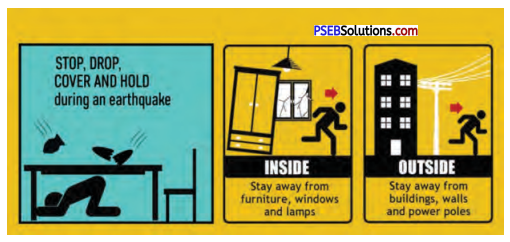
Study the following table and the picture. Take hints from the picture and write 5 points on how you saved yourself and your friend when an earthquake came when you were having lunch during your school break.

Your Location Do Don’t
Indoors drop, take cover under a strong table or desk and hold on. stand near the inner wall or sit by strong furniture and cover your head and neck with your arms. stay close to windows, fire places, appliances such as the fridge or TV. stay close to cupboards or furniture or any other object that may topple or fall.
Outdoors stay in an open area, away from any walls or trees. stay close to any walls or trees, electric poles, power lines, street lights, etc.

PSEB 7th Class English Solutions Poem 3 An Earthquake 6

Answer:
Last year in the month of April, my friend and I were sitting alone in our classroom. It was break time and we were having lunch. Suddenly, I saw the fan in our class shaking. I realized it was an earthquake. We got scared. We heard children screaming. I quickly dropped myself down and took cover under a strong table. My friend tried to peep out of a window.

PSEB 7th Class English Solutions Poem 3 An Earthquake

I asked my friend not to do this and cover his head and neck with his arms. Then we crawled out of the door. Now we came in the open. We kept ourselves away from the school walls and trees. But there was a power-pole near us. To avoid it we crawled to a place nothing heavy or dangerous near us. Soon the quake was over. We thanked God that we were safe.

Comprehension Of Stanzas

Read the following stanzas carefully and answer the questions that follow each :

(1) As I lay wide awake
My beds began to shake.
Was my fear real or fake ?
The trembling fan confirmed the quake.
The houses came crashing down
“Oh my God !” cried the whole town!

1. Name the poem and the poet.
कविता और कवि का नाम बताओ।

2. What confirmed that there was an earthquake?
भूचाल आने की पुष्टि किसने की ?

3. What happened to the houses?
मकानों को क्या हुआ?
Answers
1. The name of the poem is ‘An Earthquake and that of the poet is Vandana Lunyal.
2. The trembling fan confirmed that there was an earthquake.
3. The houses crashed down.

(2) A moment ago, the town stood tall
Now fragmented, on the ground, it crawls.
Turned to rubble, Changed into debris
Houses, roads, parks and trees.
Everywhere, everything is found
Kissing and talking to the ground.
People out of their cosy homes
Some of which have now become tombs.

1. What has changed the scene of the town? How does it look now?
शहर का दृश्य किसने बदल दिया है ? अब शहर कैसा लगता है?

2. What has happened to the cosy houses?
शहर के आरामदायक घरों को क्या हुआ है ?

PSEB 7th Class English Solutions Poem 3 An Earthquake

3. What is the central idea of the poem?
कविता का केंद्रीय भाव क्या है ?
Answers
1. An earthquake has changed the scene of the town. The town that stood tall is lying in broken pieces on the ground.
2. The cosy houses of the people become tombs of debris.
3. The poem is based on the idea that an earthquake brings death and disaster with it. Tall buildings, roads and poles get badly cracked and turn into pieces. There are heaps of debris all around. Cries of people render every heart.

Word Meanings

PSEB 7th Class English Solutions Poem 3 An Earthquake 7

An Earthquake Summary in Hindi

यह कविता एक भूकम्प और उससे होने वाले विनाश के बारे में है। कवि जाग गया था और अपने बिस्तर पर लेटा हुआ था। अचानक उसका पलंग हिलने लगा। उसके मन में भूचाल का डर पैदा हुआ। उसी समय उसका पंखा कांपने लगा और कवि जान गया कि यह वास्तव में ही भूचाल है।

PSEB 7th Class English Solutions Poem 3 An Earthquake

सारे शहर में हाहाकार मच गया। लोग चीखते हुए अपने घरों से बाहर आ गये। ऊंचे-ऊंचे मकान नीचे आ गिरे। सड़कों, वृक्षों आदि के टुकड़े हो गए। सब कुछ सपाट हो गया। ऐसे लगता था कि पूरा शहर धरती पर लेट गया है। जगह-जगह मलबे के ऊँचे-ऊँचे ढेर लग गए। इस प्रकार भूचाल ने एक विनाशकारी दृश्य प्रस्तुत किया ।

Class 7 PSEB Solutions Poetry

Mountaineers Question Answer Class 7 English Solutions Chapter 4 PSEB Solutions

Punjab State Board PSEB 7th Class English Book Solutions Chapter 4 Mountaineers Textbook Exercise Questions and Answers.

Class 7th English Solutions Chapter 4 Mountaineers Question Answers

Mountaineers Class 7 Questions and Answers

Activity 1

Look up the following words in a dictionary. You should seek the following information about the words and put them in your WORDS notebook.
1. Meaning of the word as used in the lesson (adjective/noun/verb, etc.)
2. Pronunciation (The teacher may refer to the dictionary or the mobile phone for correct pronunciation.)
3. Spellings

sea-level achievement feat climber mountaineer
summit scale expedition felicitated dedicated
trek acclimatization starved deter adventurous

PSEB 7th Class English Solutions Chapter 4 Mountaineers

Vocabulary Expansion

Activity 2

Make meaningful sentences of the words given below :

1. sea-level – A hill is a part of land above sea-level.
2. achievement – Ashoka won great achievements.
3. mountaineer – I want to become a mountaineer.
4. summit – There is a summit within us too.
5. expedition – The went on a hunting expedition.
6. felicitated – The brave children were felicitated with a big reward.
7. dedicated – I am fully dedicated to my parents.
8. acclimatization – None can survive without acclimatization to the atmoshpere.
9. starved – The poor man starved without food.
10. adventurous – Mountaineering is something adventurous.

Learning to Read and Comprehend

Activity 3

Read and answer the following questions.

Question 1.
Who was the first Indian to climb Everest ?
ऐवरेस्ट पर चढ़ने वाला पहला भारतीय कौन था ?
Answer:
Captain Avtar Singh Cheema was the first Indian to climb Mount Everest.

Question 2.
Who led the 1965 Indian Expedition to Mount Everest ?
1965 में माउंट एवरेस्ट पर जाने वाले भारतीय अभियान का नेतृत्व किसने किया?
Answer:
Commander M.S. Kohli led that expedition.

Question 3.
When did the first Indian reach the peak ?
चोटी पर पहला भारतीय कब पहुंचा ?
Answer:
The first Indian reached the peak on May 20, 1965.

Question 4.
Which awards did Captain Cheema receive ?
कैप्टन चीमा को कौन-से पुरस्कार दिये गये ?
Answer:
Captain Cheema received Arjuna Award and Padma Shri.

Question 5.
What is the oxygen-starved area of the mountains called ?
‘पर्वतों का ऑक्सीजन की कमी वाला क्षेत्र क्या कहलाता है ?
Answer:
It is called ‘Death Zone’.

PSEB 7th Class English Solutions Chapter 4 Mountaineers

Activity 4

Choose the most appropriate option from the given four :

Question 1.
The highest point on the planet is ………
(a) Kanchenjunga
(b) Mount Everest
(c) Kilimanjaro
(d) K2.
Answer:
(b) Mount Everest

Question 2.
The height of Mount Everest above sea-level is …………….
(a) 30,102 feet
(b) 29,000 feet
(c) 29,028 feet
(d) 20,196 feet
Answer:
(c) 29,028 feet.

Question 3.
The first people to stand on top of Mount Everest were …..
(a) Kohli
(b) Sir Edmund Hillary
(c) Tenzing Norgay
(d) Both (b) & (c)
Answer:
(d) Both (b) & (c)

Question 4.
The first Indian to summit Mount Everest was …………..
(a) Kohli
(b) Tenzing Norgay
(c) Sir E. Hillary
(d) Colonel Avtar Singh Cheema
Answer:
(d) Colonel Avtar Singh Cheema

Question 5.
Colonel Avtar Singh Cheema was the ………….. person in the world to scale the peak.
(a) 20th
(b) 16th
(c) 1st
(d) 3rd
Answer:
(b) 16th

PSEB 7th Class English Solutions Chapter 4 Mountaineers

Question 6.
Both Cheema and Kohli were felicitated by the Indian Government with ……………
(a) Nishan-e-Khalsa
(b) Dronacharya Award
(c) Vir Award
(d) Arjuna Award
Answer:
(d) Arjuna Award

Question 7.
A postage stamp was dedicated to the success of the …………… Everest Expedition.
(a) 1933
(b) 1965
(c) 1989
(d) 1970.
Answer:
(b) 1965

Question 8.
The route between 26,000-29,020 feet is called the ………
(a) last zone
(b) upper zone
(c) death zone
(d) middle zone.
Answer:
(c) death zone.

Learning Language

Pronouns

Let us revisit the pronouns :
Noun या Noun Phrase के स्थान पर प्रयोग किए जाने वाले शब्द pronouns कहलाते हैं।
We use a pronoun to avoid repetition of a noun or a noun phrase. The words such as ‘they’, ‘she’, ‘her’, ‘he’ and ‘it’ are pronouns.

Subject and Object Pronouns :
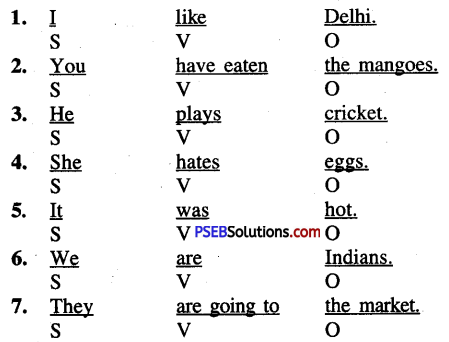
Subject pronouns which are: ‘I’, ‘you’, ‘he’, ‘she’, ‘it’, ‘we’ and ‘they’. Of course, we use ‘you’ when we are talking to one person and also when we are talking to more than one person. Observe the use of subject pronouns. They are the subject of a verb.

Note: S = Subject, V = Verb, O = Object 1.
PSEB 7th Class English Solutions Chapter 4 Mountaineers 1
Object Pronouns :
These are: ‘me’, ‘you’, ‘him’, “her”, “it’, ‘us’ and ‘them’. ‘It’ and ‘you are the same when they are subject pronouns or object pronouns.
PSEB 7th Class English Solutions Chapter 4 Mountaineers 2

We use them after prepositions.

1. It’s important to him.
2. How money students will come with you ?
3. Look at me!
4. The tiffin is for her.
5. I am looking forward to it.
6. Would you like to come with us ?
7. Rita makes dinner for them.

PSEB 7th Class English Solutions Chapter 4 Mountaineers

3. We use them after ‘be’ verb (is , am , are , was, were).
1. Who’s there ? It’s me!
2. It’s you.
3. This is him.
4. It was her !
5. It was them.

4. We use them for short answers .
1. A: Who is at the door ? B: Me!
2. A: Who ate the mango ? B: Her ! .
3. A: Call her. I’m hungry. B: Me too.

5. With short answers, we can also use a subject pronoun + a verb
1. A: Who’s there? B: I am !
2. A: Who ate the mango ? B: She did !
3. A: I’m hungry. B: I am too.

6. We use them after “as’ and ‘than’ for comparison.
1. He’s as tall as me.
2. She’s prettier than her

7. We can also use the subject pronoun +a verb in the same situation.
1. He’s taller than I am.
2. She’s prettier than she is.

8. We use them after ‘but’ and ‘except’.
1. Everybody went home early but me. (me = I didn’t)
2. Everybody reached their except you.

PSEB 7th Class English Solutions Chapter 4 Mountaineers

Activity 5

Study the box below. Fill in the blanks that follow to complete the sentences.
PSEB 7th Class English Solutions Chapter 4 Mountaineers 3

1. Do you know that girl ? Do you know ____ ?
2. My sister and I have enough food____ can all share.
3. Raj and Reema are late ____ should hurry.
4. He gave a beautiful gift ____ I really like it.
5. Buffalos are very big so ____ eat a lot of food.
6. My sister is studying hard because ____ has a test tomorrow.
7. Are you okay? Can I help —
8. My new neighbours are very helpful. I really like
9. I want to read my book. Where did you keep
10. I’m busy right now. Could you please call —after an hour ?
11. He gave me a pen but lost it.
12. We gave money to the shopkeeper and he gave — milk.
13. I don’t eat junk food because __ isn’t healthy.
14. Who is she? Do you know ___ name?
Answer:
1. her
2. we
3. They
4. me
5. they
6. she
7. you
8. them
9. it
10. me
11. I,
12. us
13. it
14. her.

Activity 6

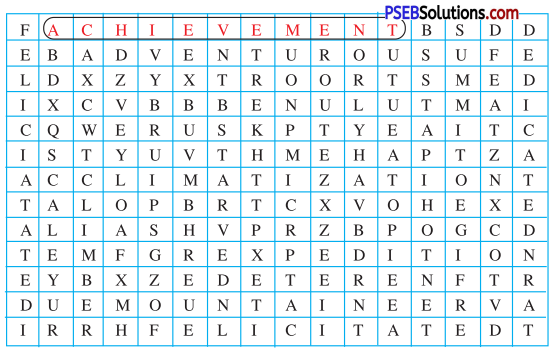
Your teacher will speak some words from the passage. Listen carefully and find the words in the grid below and encircle them. The first one has been done for you.

Achievement
PSEB 7th Class English Solutions Chapter 4 Mountaineers 4
Learning to Speak

Activity 7

Let us practise some tongue twisters. Your teacher will say a word or a phrase or a sentence. You will repeat after your teacher.
Example :
Teacher : seashore
Students : seashore
Teacher : by the seashore
Students : by the seashore
Teacher : seashells by the seashore
Students : seashells by the seashore
Teacher : She sells seashells by the seashore
Students : She sells seashells by the seashore
Now, practise the following tongue twisters with your teacher.
1. Red leather, yellow leather.
2. Kitty caught the kitten in the kitchen.
3. Not these things here, but those things there.
4. I can think of six thin things, but I can think of six thick things too.
5. The big bug bit the little beetle, but the little beetle bit the big bug back.
नोट : अध्यापक के साथ मिलकर अभ्यास करें।

PSEB 7th Class English Solutions Chapter 4 Mountaineers

Learning to Write

Writing Notices

A notice should contain all the necessary details such as:
1. Name of the issuing authority (school, etc.)
2. Date of issue/release of the notice
3. Title/Subject of the Event (what?)
4. BODY-purpose/event/date/time/duration/place or venue (why, what, when, where and whom)
5. Authorized signatory : Name and signature (contact details)

Format of a Notice

Name of the issuing agency/authority
NOTICE

Date of issue/Release of the notice

Title/Subject of the Event
BODY
(purpose/event/date/time/duration/place or venue)

Signatures
(Name)
Designation

नोट :-ध्यान से अध्ययन करें कि Notice कैसे लिखना है। नीचे दी गई बातों का भी ध्यान रखें :

1. लिखने का उद्देश्य स्पष्ट हो।
2. 50 शब्दों से अधिक न लिखें। अपने उद्देश्य पर ही केंद्रित रहें।
3. कुछ भी बार-बार लिखने से बचें।
4. Notice को Box में लिखें। Box का नमूना Pencil से बनाएं।
5. “Notice” तथा “Title” Capitals (बड़े अक्षरों) में लिखें।
6. Notice का शीर्षक अर्थपरक हो।
7. Notice में 5 w’s – ‘what’ , ‘why’, ‘when’ , ‘where’ and ‘who’ होने चाहिएं।

Activity 8.

You are the Principal of your school. Write a notice mentioning that your school is going to hold a science exhibition on the 15th of next month. It is mandatory for all the students to participate and make a science project. Final selection of science projects will take place a week before the exhibition. The class teachers will select the best three projects in each class.

A.B.C. High School
Notice

March 12, 2020

SCIENCE EXHIBITION

Our school is going to held a science exhibition on 15th of next month in the school hall. All the students must participate in it. Each student should bring a science project of his/her own. The best three projects in each class will be selected a week before the exhibition.
Sd/-
…………
Principal

Learning to use Language

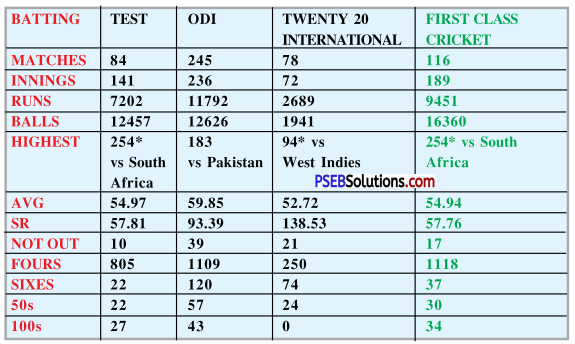
Look at the following information as in (January 2020) about Virat Kohli.
PSEB 7th Class English Solutions Chapter 4 Mountaineers 5

PSEB 7th Class English Solutions Chapter 4 Mountaineers

Activity 9

Study the chart above and answer the following questions.

Question 1.
What is the highest score of Virat Kohli in First Class Cricket ?
Answer:
It is 254 not out against South Africa.

Question 2.
What is his batting average in One Day Internationals ?
Answer:
It is 59.85.

Question 3.
How many sixes has Virat Kohli hit in Test Cricket till now ?
Answer:
22

Question 4.
How many runs has he made in One Day Internationals ?
Answer:
11,702

Question 5.
How many centuries has he hit in Twenty 20 Internationals ?
Answer:
He has hit no century in Twenty 20 internationals.

Activity 10

Write 6-8 sentences on Virat Kohli’s performance in Test Cricket. Use the information in the chart given above to write the paragraph. Begin your paragraph with :

Virat Kohli is one of the greatest batsmen today. He is the captain of Team India. He has played 84 Tests so far and has scored 7202 runs in 141 Innings. His highest score is 254 not out against South Africa. His average run rate is 54.97. In Test Cricket he has scored 12,457 balls and hit 27 centuries and 22 50’s hitting 805 fours and 22 sixes. In 10 Tests Kohli remained not out.

Comprehension Of Passages

Read the followings passages carefully and answer the questions that follow each :

(1) Mount Everest is the highest point on the planet at 29,028 feet above sea level. For many people, reaching Mount Everest peak is a once-in-a-lifetime achievement. This kind of feat requires huge funds, very tough training and very good luck. The first people to stand on the top of Everest were a local climber Tenzing Norgay and Sir Edmund Hillary, a mountaineer from New Zealand in 1953. Since then, a lot of people have achieved this feat. Some of them are from India too.

1. Name the highest point on earth with its height above sea level.
धरती के सबसे ऊंचे बिन्दु का नाम तथा उसकी समुद्र-तल से ऊँचाई बताएं।

2. Who were the first two people (persons) to scale it ?
इस पर पहुंचने वाले पहले दो व्यक्ति कौन थे ?

3. Choose true and false statements and write them in your note-book.
(a) Mount Everest is a once-in-a-lifetime achievement.
(b) The highest peak on our planet has never been scaled after 1953.

4. Complete the sentences according to the meaning of the passage.
(a) Since then ……….. have achieved this feat.
(b) This kind of feat requires ………. funds and ………. luck.

PSEB 7th Class English Solutions Chapter 4 Mountaineers

5. Match the words with their meanings.

(a) requires achieves
(b) funds needs
money

Answer:
1. Mount Everest is the highest point on earth. It is 29,028 feet high above the sea level.
2. The first two people to scale it were a local climber Tenzing Norgay and a New Zealander Sir Edmund Hillary.
3.
(a) True
(b) False
4.
(a) Since then a lot of people have achieved this feat.
(b) This kind of feat requires huge funds and very good luck.
5.
(a) requires — needs
(b) funds — money

(2) The first Indian to summit Mount Everest was Captain Avtar Singh Cheema (1933-1989) on May 20, 1965. He was a captain in the 7th Bn Parachute Regiment at that time. Later, he was promoted to the post of a Colonel. He was also the 16th person in the world to scale the peak.

He was a part of the third Indian Expedition led by Commander M.S. Kohli and others. Kohli was an officer in the Indo-Tibetan Border Police. Both Cheema and Kohli were felicitated by the Indian Government with Arjuna Award. They also received Padma Shri and Padma Bhushan respectively. Kohli was also given Nishan-e-Khalsa by the Punjab Government. A postage stamp was dedicated to the success of the 1965 Everest Expedition.

1. Mention any two achievements of Captain Cheema.
कैप्टन चीमा की किन्हीं दो सफलताओं का उल्लेख कीजिए।

2. Who was M.S. Kohli ?
M.S. Kohli कौन था ?

3. Choose true and false statements and write them in your note-book.
(a) Mr. Kohli could not win Arjuna Award.
(b) Mr. Kohli received Padma Bhushan for his achievement.

4. Complete the sentences according to the meaning of the passage.
(a) A postage stamp was dedicated to the success of
(b) Kohli was also given …………. by the Punjab government.

PSEB 7th Class English Solutions Chapter 4 Mountaineers

5. Match the words with their meanings.

(a) summit devoted/allocated
(b) dedicated top/peak
flop

Answer:
1. Captain Cheema was the first Indian to reach the Mount Everest. He was also the 16th person in the world to scale this peak.
2. M.S. Kohli was an officer in the Indo-Tibetan Border Police.
3.
(a) False
(b) True
4.
(a) A postage stamp was dedicated to the success of the 1965 Everest Expedition.
(b) Kohli was also given Nishan-e-Khalsa by the Punjab Government.
5.
(a) summit — top/peak
(b) dedicated — devoted/allocated.

(3) Climbing Everest Peak is not for untrained mountaineers. It is extremely dangerous. The trek to the summit (peak of Everest) takes months of physical training and weeks of acclimatization and adjusting to the physical condition. Climbers need to get used to the oxygen-starved heights of the mountain. The route between 26,000 and 29,020 feet is called the “death zone”. At this height, the body cannot get enough oxygen and begins to die minute by minute. This distance must be covered in less than a day to avoid damage to the body.

1. Climbing Everest Peak is not for untrained people. Why ?
ऐवरेस्ट शिखर पर चढ़ना अप्रशिक्षित लोगों का काम नहीं है। क्यों ?

2. What happens to the body in the death zone’ ?
‘ मौत के क्षेत्र ‘ में शरीर के साथ क्या होता है।

3. Choose true and false statements and write them in your note-book.
(a) Climbers need to get used to oxygen-starved heights of the mountain.
(b) The trek to the Everest needs no physical training.

4. Complete the sentences according to the meaning of the passage.
(a) The route between …………. and …………. feet is called the “death zone”.
(b) The distance of the …………… must be covered in less than a day.

5. Match the words with their meanings.

(a) extremely highly
(b) damage usually
harm

Answer:
1. It is not for untrained people because it is very dangerous.
2. In the death zone, body begins to die minute by minute for lack of oxygen.
3.
(a) True
(b) False
4.
(a) The route between 26,000 and 29,020 feet is called the “death zone”.
(b) The distance of the death zone must be covered in less than a day.
5.
(a) extremely – highly
(b) damage – harm.

PSEB 7th Class English Solutions Chapter 4 Mountaineers

Use Of Words/Phrases In Sentences

1. Feat (Something adventurous)-
The cyclist showed many feats with his bicycle.
साइकिल चलाने वाले ने अपने साइकिल के साथ कई कमाल दिखाए।

2. Climber (mountaineer) –
Many climbers have reached the highest peak of the world.
कई पर्वतारोही (चढ़ाई करने वाले लोग) संसार की सबसे ऊंची चोटी तक जा पहुंचे हैं।

3. Scale (climb) –
It is not easy to scale the Himalayas.
हिमालय पर चढ़ना कोई आसान काम नहीं है।

4. Deter (put off/stop/detain)
The rain did not deter the students from coming to school.
वर्षा ने छात्रों को स्कूल आने से नहीं रोका।

5. Peak (mountain top/summit)-
A mountain is a high-land with a peak.
पर्वत ऊँचा भू-भाग होता है जिसकी एक चोटी होती है।

6. Wait for (held back for)-
I am waiting for my friend.
मैं अपने मित्र का इंतजार कर रहा हूं।

7. Dangerous (full of risk)-
This pond is deep and dangerous.
यह तालाब गहरा और खतरनाक है।

Word Meanings:
PSEB 7th Class English Solutions Chapter 4 Mountaineers 6

Mountaineers Summary in Hindi

Mount Everest …………………….. Scale the peak.

माऊंट एवरेस्ट इस ग्रह की सबसे ऊँची चोटी है जो समुद्र तल से 29,028 फुट ऊँची है। बहुत से लोगों के लिए माऊंट ऐवरेस्ट की चोटी पर चढ़ना जीवन भर की एक उपलब्धि है। इस तरह के साहसिक कार्य के लिए बड़ी धनराशि, कठिन प्रशिक्षण और बहुत अच्छे भाग्य की आवश्यकता होती है। 1933 में ऐवरेस्ट के शिखर (चोटी) पर सबसे पहले पहुँचने वालों में एक स्थानीय पर्वतारोही तेंजिंग नोरगे और न्यूजीलैंड के पर्वतारोही सर एडमण्ड हिलेरी थे।

तब से बहुत से लोगों ने यह कमाल कर दिखाया है। उनमें से कुछ भारतीय भी हैं। 20 मई 1965 को माऊंट एवरेस्ट के शिखर पर पहुँचने वाले कप्तान अवतार सिंह चीमा (1933-1989) पहले भारतीय थे। वह उस समय सातवीं बटालियन पेराशूट रेजीमेंट में कप्तान थे। बाद में उन्हें कर्नल के पद पर पदोन्नत कर दिया गया। वह शिखर पर पहुँचने वाले विश्व के 16वें व्यक्ति भी थे।

He was a part …………………… adventurous spirit.

वे कमांडर एम०एस० कोहली और कुछ अन्य के नेतृत्व में चलाए गए तीसरे भारतीय अभियान का हिस्सा थे। कोहली इंडो-तिब्बत बार्डर पुलिस में आफिसर थे। भारत सरकार ने चीमा और कोहली दोनों को अर्जुन पुरस्कार से सम्मानित किया। उन्हें क्रमशः पद्दमश्री और पद्म भूषण भी दिया गया। पंजाब सरकार ने कोहली को निशानए-खालसा से भी सम्मानित किया। 1965 के ऐवरेस्ट अभियान की सफलता के उपलक्ष्य में एक डाक टिकट भी जारी किया गया।

PSEB 7th Class English Solutions Chapter 4 Mountaineers

ऐवरेस्ट शिखर पर चढ़ना अप्रशिक्षित पर्वतारोहियों का काम नहीं है। यह अत्यन्त खतरनाक है। अभियान (ऐवरेस्ट शिखर) पर जाने के लिए महीनों का शारीरिक प्रशिक्षण, तथा (अनुकूलन) होना और भौतिक परिस्थितियों के अनुसार अपने आप को ढालने के लिए कई तरह का अभ्यास चाहिए। पर्वतारोहियों को कम आक्सीजन वाली पहाड़ी-चोटियों के लिए अभ्यस्त होना चाहिए। 26,000 और 29,020 फुट के बीच के रास्ते को “मौत का क्षेत्र” कहा जाता है। इस ऊँचाई पर शरीर को पर्याप्त आक्सीजन नहीं मिलती और यह क्षण प्रति क्षण कमजोर होता जाता है। यह दूरी एक दिन से कम समय में तय कर ली जानी चाहिए ताकि शरीर को कोई नुकसान न पहुँचे।

इन खतरों के बावजूद भी माऊंट एवरेस्ट पर जाने वाले पर्वतारोहियों की संख्या बढ़ रही है। यह संख्या इतनी अधिक बढ़ चुकी है कि पर्वातारोहियों को शिखर पर खड़े होने के लिए अपनी बारी की घंटों प्रतीक्षा करनी पड़ती है। ‘मौत के क्षेत्र’ में उनका यह अतिरिक्त समय उनके खतरे को बढ़ाता है परन्तु साहसिक कार्य के प्रति उनके उत्साह में कोई कमी नहीं आती।

Retranslation Of Isolated Sentences

1. Mount Everest is the highest point on the planet.
माऊंट एवरेस्ट इस ग्रह का सबसे ऊंचा बिन्दु है।

2. This kind of feat requires huge foods
मा नाता के साहसिक कार्य के लिए बड़ी धनराशि की जरूरत होती है।

3. Some of them are from India too.
उनमें से कुछ भारतीय भी हैं।

4. The first Indian to summit Mount Everest was Captain Avtar Singh Cheema.
उनमें से कुछ भारतीय भी हैं। माऊंट एवरेस्ट के शिखर पर पहुँचने वाले पहले भारतीय । थे कप्तान अवतार सिंह चीमा।

5. He was also the 16th person in the world to scale the peak.
वह शिखर पर पहुंचने वाले विश्व के 16वें व्यक्ति भी थे।

6. A postage stamp was dedicated to the success of 1965 Everest Expedition.
1965 के ऐवरेस्ट अभियान की सफलता के उपलक्ष्य में एक डाक टिकट भी जारी किया गया।

7. It is extremely dangerous.
यह अत्यन्त खतरनाक है।

PSEB 7th Class English Solutions Chapter 4 Mountaineers

8. The route between 26,000 and 29,020 · feet is called the death Zone”.
26,000 और 29,020 फुट ऊँचाई के बीच के रास्ते को “मौत का क्षेत्र” कहा जाता है।

9. The distance must be covered in less than a day.
इस दूरी को एक दिन से कम समय में पूरा कर लिया जाना चाहिए।

English Guide for Class 7 PSEB Prose
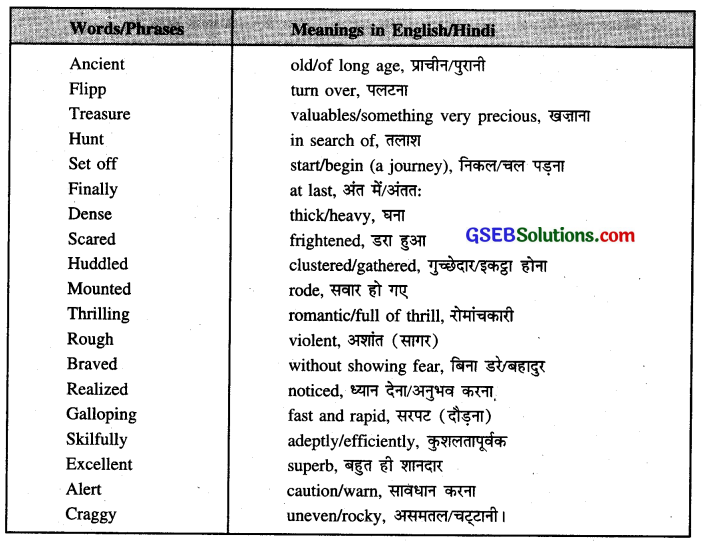
A Hole in the Fence Question Answer Class 7 English Solutions Chapter 7 PSEB Solutions

Punjab State Board PSEB 7th Class English Book Solutions Chapter 7 A Hole in the Fence Textbook Exercise Questions and Answers.

Class 7th English Solutions Chapter 7 A Hole in the Fence Question Answers

A Hole in the Fence Class 7 Questions and Answers

Activity 1.

Look up the following words/phrases in a dictionary. You should seek the following information about the words and put them in your WORDS notebook.
1. Meaning of the word as used in the story (adjective/noun/verb, etc.)
2. Pronunciation (The teacher may refer to the dictionary or the mobile phone for correct pronunciation.)
3. Spellings

fence advised control hammer accept
decrease discover temper scar wound

Vocabulary Expansion

Activity 2

Solve the crossword puzzle given below. Read the hints (meanings) for the words given under ‘Across’ and ‘Down’. The words are from the story.
PSEB 7th Class English Solutions Chapter 7 A Hole in the Fence 1
Answer:
PSEB 7th Class English Solutions Chapter 7 A Hole in the Fence 2
Across →
5. able to manage
6. find something new
8. to take something
9. barrier
10. a mark on the skin

Down ↓
1. hit something hard
2. a tear in the skin
3. become lesser or smaller
4. guiding someone
5. a state of being angry or calm

PSEB 7th Class English Solutions Chapter 7 A Hole in the Fence

Activity 3.

Answer the following questions as briefly as you can.

Question 1.
Why did the boy have no friends ?
लड़के के दोस्त क्यों नहीं थे ?
Answer:
The boy had no friends because he always used a bad language in a fit of anger.

Question 2.
Why were his parents worried ?
उसके माता-पिता क्यों चिंतित थे ?
Answer:
His parents were worried because he had a bad temper.

Question 3.
Whạt task did his father give him to do ?
उसके पिता ने उसे कौन-सा कार्य करने को दिया ?
Answer:
His father gave him a bag of nails and hammer and said, “Every time you lose your temper you must hammer a nail into the back of the fence.

Question 4.
How did it help the boy ?
इसने लड़के की मदद कैसे की ?
Answer:
By hammering nails, he discovered that it was easier to control the anger than to drove nails.

Question 5.
What did his father tell him after he had taken out all the nails ?
जब लड़के ने सभी कील निकाल दिए तो पिता ने उस बच्चे को क्या बताया ?
Answer:
The father told him that a wound given with the words is as bad as the one given with a knife.

Question 6.
What is the moral of the story?
कहानी से क्या शिक्षा मिलती है ?
Answer:
We should be polite to others and use kind words.

Activity 4.

Write ‘True’ or ‘False’ in the space given against each statement.

1. The boy had many friends. — (False)
2. He had a habit of using bad language. — (True)
3. His mother came up with a plan to help him. — (False)
4. The boy hammered nine nails into the fence on his first day — (False)
5. The boy never learned to control his temper — (False)

PSEB 7th Class English Solutions Chapter 7 A Hole in the Fence

Activity 5

Select the correct option and fill it in the given blank.

Question 1.
The little boy was …………………. by other boys.
(a) popular
(b) liked
(c) disliked.
Answer:
(c) disliked.

Question 2.
The boy had no friends because ………….
(a) he used bad language
(b) he bullied other boys
(c) he would hit small boys.
Answer:
(a) he used bad language

Question 3.
His father thought of a/an …..
(a) advice to give him
(b) task to give him
(c) reason for his behaviour.
Answer:
(a) advice to give him

Question 4.
The father asked the boy to … whenever he felt angry.
(a) count from 1-10
(b) drive a nail into the fence
(c) pull out a nail from the fence.
Answer:
(b) drive a nail into the fence

Question 5.
The father was able to …. ….. him a lesson about good behaviour.
(a) show
(b) teach
(c) make.
Answer:
(b) teach.

Learning Language

Sentence and its Types

Read the following sentences or groups of words.
1. Amit is a good actor.
2. Where are you going?
3. Seema works very hard.
4. What a beautiful day!
5. Chandigarh is the capital of Punjab.
Please note that all these sentences:
1. begin with capital letters
2. end with a full stop (.), a question mark (?) or an exclamation mark (!)
Notice that these groups of words make complete sense.
Sentence शब्दों का सार्यक समूह होता है।
Now, read the following group of words:
pot flowers The are in
इस शब्द समूह का कोई अर्थ नहीं है।
Now read the same words in another order :
The flowers are in the pot.
यह शब्द समूह पूरा अर्थ देता है | इसलिए यह राक sentence है

PSEB 7th Class English Solutions Chapter 7 A Hole in the Fence

Activity 6.

Rearrange the following groups of words and punctuate to make meaningful sentences

Question 1.
ferocious lions animals are.
Answer:
Lions are ferocious animals.

Question 2.
love grandparents a my me lot.
Answer:
Grandparents love me a lot.

Question 3.
is my best Rajan friend.
Answer:
Rajan is my best friend.

Question 4.
Mercury system in is the hottest the planet solar.
Answer:
Mercury is the hottest planet in the solar system.

Question 5.
is the Ganges sacred a river.
Answer:
The ganges is a sacred river.

Activity 7

Make meaningful sentences by using the following words.

1. building – This is a tall building.
2. chair – The chair is made of wood.
3. dance – She likes to dance.
4. walk – Morning walk is good for health.
5. dictionary – I have an English, Punjabi dictionary.

Types of Sentences.

Sentences are of four types: Declarative, Interrogative, Imperative and Exclamatory.

1. Declarative sentences tell something or make a statement. A full stop (.) is used at the end of such sentence.
2. Interrogative ये वाक्य कोई प्रशन पूछते है | इनके अन्त question mark (?) “INT GIRI
3. Imperative : These sentences are either requests or commands. They tell someone to do something. They also end with a full stop.
4. Exclamatory : These sentences show a feeling and exclamation mark (!) mark is used at the end of such sentence.

Activity 8

Identify the type of sentence and write it in the given space.

1. Will the guests be late ? — Interrogative
2. She scored a century. — Declarative
3. I have completed my work. — Declarative
4. Read this book now. — Imperative
5. The trip was exciting ! — Exclamatory
6. Who went to Delhi ? — Interrogative
7. Shut the door. — Imperative
8. What a cute dog ! — Exclamatory
9. Butter is better than jam. — Declarative
10. Brush your teeth. — Imperative I

Activity 9

Identify each type of sentence and explain your answer.

1. The students went on an educational trip.
Type : Declarative.
Reason : It is a statement.

2. Shall we go to the Thunder Zone Theme Park ?
Type : Interrogative.
Reason : It asks a question.

PSEB 7th Class English Solutions Chapter 7 A Hole in the Fence

3. We must try to be on our best behaviour for the next two months.
Type : Declarative
Reason : It is a statement.

4. The dog ate the biscuit.
Type : Declarative.
Reason : It is a statement.

5. Wow, I have won the lottery !
Type : Exclamatory
Reason : This shows a feeling and uses an exclamation mark at the end.

6. How far away is the park from the school ?
Type : Interrogative
Reason : It asks a question and has a question mark at the end.

7. Let’s go back soon or we will miss the train !.
Type : Exclamatory
Reason : This gives a suggestion and warning.

8. Stop asking questions.
Type : Imperative
Reason : It gives a command.

9. Let’s go to the party!
Type : Exclamatory
Reason : It gives a suggestion.

10. The students wondered why they were going to the amusement park.
Type : Declarative.
Reason : It is a statement.

Learning to Listen

Activity 10

Listen to your teacher’s instructions on how to grow a plant. Try to write as you listen. After 5 minutes, your teacher will speak again. Complete your activity while listening to the process the second time.
You will need
1. seeds of your choice such as pumpkin seeds, sunflower seeds, lima beans or pinto beans
2. good quality soil
3. a container to hold the soil and your seeds
4. water
5. light and heat Now write all the steps with their description in the grid given below.
Description de Take some seeds of pumpkin or sunflower Use good quality soil. Take a container to hold the soil and seeds. Water the soil and the seeds.
Put the container in the open for light and heat. Learning to Speak
Answer:

Steps Description
1. Take some seeds of pumpkin or sunflower
2. Use good quality soil.
3. Take a container to hold the soil and seeds.
4. Water the soil and the seeds.
5. Put the container in the open for light and heat.

Activity 11 (Pairwork) 

Based on your listening activity and your notes in the grid above, discuss with your partner the process of how a seed becomes a plant. You can also take hints from the diagram given below.
PSEB 7th Class English Solutions Chapter 7 A Hole in the Fence 3
Answer:
1. Fill the container with soil.
2. Plant the seeds in the soil.
3. Keep the container at a warm place. Sunlight is good but try to avoid too much direct sunlight. A window sill is a good spot.
4. Keep the soil moist by watering it every day.
5. Be careful not to use too much water.
6. Record your observations as the seeds germinate and seedlings begin to sprout from the seeds.

PSEB 7th Class English Solutions Chapter 7 A Hole in the Fence

Learning to Write

Personal Letters

Letters written to one’s parents, relatives and friends are called personal letters.

Format of Personal Letters

1. The Heading (your address and date):
13 Mall Road Ludhiana
15 June 20_ _
2. The Salutation: Dear Anu, Dear Daddy, Dear Brother, etc.
3. The Body: whatever your want to tell
4. The Ending: (For parents and siblings) Yours affectionately/
Your affectionate son; Yours lovingly/Your loving son ;
(For friends or known)Yours sincerely

Specimen of a Personal Letter

Write a letter to your friend inviting him to attend the wedding party of your elder brother.
PSEB 7th Class English Solutions Chapter 7 A Hole in the Fence 4

Activity 12.

Imagine that you are Neeraj. Write a letter to your cousin telling him/her how you helped a friend used to overcome his habit of using bad language. You may share with your friend the idea you used to stop him from using bad language.
Answer:
105 The Mall,
Amritsar,
June, 20, 2020.
Dear Navjot,
I received your letter yesterday. I want to tell you about a friend of mine who had a bad temper. He used bad words even in his routine talks. This bad habit earned him a bad name. No one liked to talk to him. So I hit upon a plan to reform him. Whenever he used a bad word, I objected to it and made him to say ‘sorry’. Gradually, he got tired of his sorries. He began to control his speech. Within a week, he was speaking a kindly and softly. It was a great change which made both of us happy and surprised.
Your loving brother
Neeraj

Learning to Use Language

Activity 13

Look at the picture given below. In the given space, describe what is happening in the picture.
PSEB 7th Class English Solutions Chapter 7 A Hole in the Fence 5
Water-Cycle
The picture shows the water-cycle in nature. Water in oceans, ponds, rivers and other water evaporates due to heat. The vapour gets mixed with the air. The air becomes light and goes up. Clouds are formed.

PSEB 7th Class English Solutions Chapter 7 A Hole in the Fence

Trees cool down the clouds and the vapour get condensed into water drops, hailstones etc. They being heavy drop down on earth. It is called precipitation. All this is water. It flows down on the ground and get collected in the water bodies again. Hence, the completion of the cycle.

Comprehension Of Passages

Read the following passages carefully and answers the questions that follow each :

(1) Once there was a little boy who lived with his parents in a small village. His parents were worried because he had a bad temper. He had no friends because he always used bad language in a fit of anger. His parents advised him many times to control his anger but he did not pay attention.

The father kept thinking and then he got an idea. The next day, his father gave him a bag of nails and a hammer. He said to him, “Every time you lose your temper, you must hammer a nail into the back of the fence.” The boy accepted the task happily.

1. Why were the boy’s parents worried ?
लड़के के माता-पिता चिंतित क्यों थे ?

2. What task did his father gave him ?
उसके पिता ने उसे क्या काम करने को दिया ?

3. Choose true and false statements and write them in your note book.
(a) The boy refused to do the job.
(b) His boy lived in a small village ?

PSEB 7th Class English Solutions Chapter 7 A Hole in the Fence

4. Complete the sentences according to the meaning of the passage.
(a) He always used bad language in ………..
(b) Her father gave him a ………….. and a hammer.

5. Match the words with their meanings.

(a) temper idea
(b) accepted agreed to
nature.

Answer:
1. The boy’s Parents were worried because he had a bad temper.
2. His father asked him to hammer a nail into the back of the fence every time he lost his temper.
3.
(a) False
(b) True.
4.
(a) He always used bad language in a fit of angers.
(b) His father gave him a bag of nails and a hammer.
5.
(a) temper – nature
(b) accepted – agreed to

(2) Every time, the boy felt angry, he ran to the fence and drove a nail into it. The first day, the boy had driven thirty nails into the fence. After a few days, the number of nails started decreasing. Over the next few weeks, he discovered that it was easier to control his anger than to drive those nails into the fence. Finally, the day came when the boy did not lose his temper at all.

He had not hammered any nail into the fence. He told his father about it. The father gave him one more task to do. He asked the boy to pull out one nail for each day that he was able to hold his temper. The days passed and the little boy was finally able to tell his father that all the nails were gone.

1. How many nails did the boy push into the fence the first day?
पहले दिन लड़के ने दीवार में कितने कील गाड़े ?

2. What did the boy discover after a few weeks?
कुछ सप्ताह बाद लड़के को क्या पता चला ।।

3. Choose true and false statements and write them in your notebook.
(a) The boy could not control his anger?
(b) Pulling out of a nail meant no anger.

PSEB 7th Class English Solutions Chapter 7 A Hole in the Fence

4. Complete the sentence according to the meaning of the passage.
(a) The boy finally told his father that ………. were gone.
(b) After a few day, the number of nails

5. Match the words with their meaning.

(a) discovered control
(b) hold realized
push

Answer:
1. The first day, the boy pushed thirty nails into the fence.
2. He discovered that it was easier to control his anger than to drive nails into the fence.
3.
(a) False
(b) True.
4.
(a) The boy finally told his father that all the nails were gone.
(b) After a few days the number of nails started decreasing
5.
(a) discovered-realized
(b) hold-control

(3) The father led the little boy to the fence. He said, “You have done well, my son. Now, look at these holes in the fence. The fence will never be the same again.” The boy looked at his father and said, “I did it because you asked me to.

“I know”, said the father, “when you say things in anger, they leave a scar just like this one. You can put a knife in a man and draw it out. It won’t matter how many times you say you are sorry, the wound will always be there. A wound given with your words is as bad as the one given with a knife.”

1. What did the father show his son ?
पिता ने अपने पुत्र को क्या दिखाया ?

2. What lesson did the father teach his son ?
पिता ने अपने पुत्र को क्या सबक दिया ?

3. Choose true and false statements and write them in your note book.
(a) The fence will never be the same again.
(b) The father led to little boy to school.

4. Complete the sentence according to the meaning of the passage.
(a) When you say things in …………., they …………. a scar.
(b) The wound will ………….

PSEB 7th Class English Solutions Chapter 7 A Hole in the Fence

5. Match the words with their meanings :

(a) wound mark
(b) Scar bad words
Injury

Answer:
1. The father showed holes in the fence to his son.
2. The father tought his son that a wound given with words is as a bad as the one given with
a knife.
3.
(a) True
(b) False.
4.
(a) When you say things in anger, they leave a scar.
(b) The wounds will always be there.
5.
(a) wound-injury
(b) scar –mark

Use Of Words/Phrases In Sentences

1. Pay attention (listen to)—
Pay attention to what I say.
मैं जो कहता हूँ उसकी ओर ध्यान दो।

2. Scar (mask, spot)
Hammer this nail into the door.
यह कील दरवाजे में गाड़ दो।

3. Hammer (v) (Push)
Hammer this nail into the door.
यह कील दरवाजे में गाड़ दो।

4. Decrease (lesser)
His pain decreased after some time.
उसकी दर्द कुछ देर बाद कम हो गई।

5. Hold (Contol, put a check on –
Hold your tongue.
अपनी जुबान सम्भालो।

6. Control (hold)
Try to control your anger.
अपने गुस्से पर काबू पाने की कोशिश करो।

7. To say sorry (to regret) —
You must say sorry when you misbehave.
गंदा व्यवहार करने पर तुम्हें खेद जताना चाहिए।

8. Accept (acknowledge)
you must accept your mistake.
तुम्हें अपनी गलती स्वीकार कर लेनी चाहिए।

9. Advise (to suggest) —
I advised him to work hard.
मैंने उसे परिश्रम करने का सुझाव दिया।

Word Meaning.
PSEB 7th Class English Solutions Chapter 7 A Hole in the Fence 6

A Hole in the Fence Summary in Hindi

Once there was ………………. nails were gone.

एक बार एक छोटा-सा लड़का था जो अपने माता-पिता के साथ एक छोटे से गाँव में रहता था। उसके माता पिता उसके बुरे स्वभाव के कारण चिंतित थे। उसका कोई मित्र नहीं था क्योंकि वह क्रोध में आकर अभद्र भाषा का प्रयोग करता था। उसके माता-पिता ने उसे क्रोध पर अंकुश लगाने के लिए बहुत बार समझाया।

PSEB 7th Class English Solutions Chapter 7 A Hole in the Fence

परन्तु वह कोई ध्यान नहीं देता था। पिता निरंतर सोचते रहते थे और तभी उन्हें एक विचार सूझा। अगले दिन उसके पिता ने उसे कीलों का एक थैला और हथौड़ा दिया। उन्होंने उससे कहा, “जितनी बार भी तुम्हें क्रोध आये तुम बाड़ (गेट की दीवार) के पीछे कील लगा देना।” बच्चे ने यह काम खुशी-खुशी स्वीकार कर लिया। जब भी बच्चे को क्रोध आता वह गेट की दीवार की ओर भाग कर जाता और उसमें एक कील गाड़ देता।

पहले दिन बच्चे ने चार दीवारी में तीस कील गाड़े। कुछ दिनों बाद कीलों की संख्या कम होने लगी। अगले कुछ सप्ताह में उसने अनुभव किया कि क्रोध पर नियंत्रण पाना कील गाड़ने से अधिक आसान था। अन्ततः एक दिन ऐसा आया जब बच्चे को बिल्कुल भी क्रोध नहीं आया। उसने दीवार में कोई भी कील नहीं गाड़ा था।

उसने इसके बारे में अपने पिता को बताया। उसके पिता ने उसे एक और काम करने के लिए दिया। उन्होंने कहा जिस किसी दिन तुम क्रोध पर काबू रखो, उस दिन एक कील निकाल लेना। दिन बीतते गए और छोटा लड़का अपने पिता की आखिरकार यह बताने के योग्य हो गया कि सभी कील निकल गए हैं। .

The father led ………….. words be kind !

पिता छोटे लड़के को दीवार की ओर ले गए। उन्होंने कहा, “मेरे बच्चे, तुमने बहुत अच्छा काम किया है। अब, दीवार में सुराखों को देखो। यह दीवार कभी-भी पहले जैसी नहीं हो सकती।” लड़के ने अपने पिता को देखा और कहा, “मैंने यह काम इसलिए किया क्योंकि आपने मुझे ऐसा करने को कहा था।” पिता ने कहा, “मैं जानता हूँ। जब तुम क्रोध में होते तो तुम जो कुछ भी कहते हो, वह इसी तरह निशान छोड़ जाता है।

तुम एक आदमी को चाकू मार दो और बाहर निकाल लो। इससे कोई फ़र्क नहीं पड़ेगा कि तुमने उससे कितनी बार माफ़ी मांगी, क्योंकि घाव सदा वहीं रहेगा। शब्दों से दिए गए घाव उतने ही बुरे हैं जितने कि चाकू से दिए गए घाव।” क्या आपको नहीं लगता, कि पिता ने लड़के को एक अच्छा उपदेश दिया ? मित्रों और प्रिय दोस्तों का हमारे जीवन में बहुत महत्त्व है जैसे कि तुम हमारे लिए हो। वे तुम्हें मुस्कराहट तथा हंसी देते हैं। यदि तुम अपने मित्रों को खोना नहीं चाहते तो अपने शब्दों का चुनाव सावधानीपूर्वक करो। आपके शब्द विनम्र होने चाहिएं।

PSEB 7th Class English Solutions Chapter 7 A Hole in the Fence

Retranslation Of Isolated Sentences :

1. His parents were worried because he had a bad temper. — उसके माता-पिता उसके बुरे स्वभाव के कारण चिंतित थे।
2. They advised him many times to control his anger. — उन्होंने उसे अपने क्रोध पर अंकुश लगाने के लिए कई बार समझाया।
3. He got an idea. — उन्हें (उसे) एक विचार सूझा।
4. The boy accepted the task happily. — लड़के ने वह काम खुशी-खुशी स्वीकार कर लिया।
5. The number of nails started decreasing. — कीलों की संख्या घटने लगी।
6. It was easier to control the anger. — क्रोध पर नियंत्रण पाना अधिक आसान था।
7. The father gave him one more task to do. — पिता ने उसे एक और काम करने को दिया।
8. I did it because you asked me to. — मैंने यह काम इसलिए किया क्योंकि आपने मुझे ऐसा करने के लिए कहा।
9. A wound given with your words is as bad as the one given with knife. — शब्दों से दिया गया घाव उतना ही बुरा है जितना कि चाकू से दिया गया घाव।
10. They make you smile and laugh. — वे तुम्हें मुस्कराहट और हंसी प्रदान करते हैं।
11. Let your words be kind. — आपके शब्द विनम्र होने चाहिएं।

English Guide for Class 7 PSEB Prose

The Hunter and the Deer Question Answer Class 7 English Solutions Poem Chapter 2 PSEB Solutions

Punjab State Board PSEB 7th Class English Book Solutions Poem 2 The Hunter and the Deer Textbook Exercise Questions and Answers.

Class 7th English Solutions Poem Chapter 2 The Hunter and the Deer Question Answers

The Hunter and the Deer Class 7 Questions and Answers

Activity 1.

1. Meaning of the word as used in the poem (adjective/noun/verb, etc.)
2. Pronunciation (The teacher may refer to the dictionary or the mobile phone for correct pronunciation.)
3. Spellings :

Journey plea buck
doe fawn beast

Vocabulary Expansion

Activity 2.

Pick up words from the poem that match the rhyme of the following words.
PSEB 7th Class English Solutions Poem 2 The Hunter and the Deer 3

Activity 3.

Read the words in the following table and do as directed.
PSEB 7th Class English Solutions Poem 2 The Hunter and the Deer 1
Answer:
PSEB 7th Class English Solutions Poem 2 The Hunter and the Deer 2

PSEB 7th Class English Solutions Poem 2 The Hunter and the Deer

Activity 4

Read the poem and select the appropriate option to fill in the given blanks.

Question 1.
The hunter went on a journey to find some …………………..
(a) deer meat
(b) dog meat
(c) horse meat
Answer:
(a) deer meat

Question 2.
The hunter found …………………
(a) a dog
(b) a buck
(c) a bear
Answer:
(b) a buck

Question 3.
The other word for a male deer is ………..
(a) doe
(b) fawn
(c) buck
Answer:
(c) buck

Question 4.
The poet thought that the buck was begging for ………
(a) the fawn’s life
(b) his own life
(c) the doe’s life
Answer:
(b) his own life

PSEB 7th Class English Solutions Poem 2 The Hunter and the Deer

Question 5.
A female deer is called a ………
(a) doe
(b) fawn
(c) buck
Answer:
(a) doe

Question 6.
A young deer is called a …………
(a) doe
(b) fawn
(c) buck
Answer:
(b) fawn

Question 7.
The hunter remembered what he came for and raised his ……….
(a) hand
(b) gun
(c) head
Answer:
(b) gun

Question 8.
A …….. came out of nowhere.
(a) doe
(b) fawn
(c) buck
Answer:
(b) fawn

Question 9.
The hunter felt that he could not the buck.
(a) kill
(b) raise
(c) look at
Answer:
(a) kill

Question 10.
The hunter gathered__for feeding the deer.
(a) fruits
(b) leaves
(c) nuts.
Answer:
(c) nuts.

Activity 5.

Write answers to the following questions.

Question 1.
What did the hunter want to eat ?
शिकारी क्या खाना चाहता था ?
Answer:
The hunter wanted to eat some deer meat.

Question 2.
What did the hunter see ?
शिकारी ने क्या देखा ?
Answer:
The hunter saw a buck.

PSEB 7th Class English Solutions Poem 2 The Hunter and the Deer

Question 3.
Why did the hunter not kill the buck ?
शिकारी ने हिरण को क्यों नहीं मारा ?
Answer:
The hunter did not kill the buck because he saw a plea of mercy in his eyes. He begged for his life.

Question 4.
What did the hunter do ?
शिकारी ने क्या किया ?
Answer:
The hunter gathered some nuts and fed the buck.

Question 5.
How did the buck feel after eating nuts ?
नट्स खा कर हिरण ने कैसा महसूस किया ?
Answer:
After eating nuts, the buck felt himself out of fear.

Activity 6.

Explain the following statements in your own words.

1. And if he killed the buck he’d feel like a beast.
2. And something grew in him.
3. And he felt the deer’s lack of fear.
Answer:
1. Killing is a beastly act.
2. A feeling of mercy arose in him.
3. He felt that the deer had lost his fear.

Learning Language

Determiners

Let us look at the following sentences :

1. The rabbit found its hole.
2. I ate the vanilla cake in the evening.
3. The metal cans are recyclable.

PSEB 7th Class English Solutions Poem 2 The Hunter and the Deer 6

The italicized words above are determiners.
Determiners are words like ‘the’, ‘an’, ‘this’ or ‘some that always come before a noun or before any other adjectives used for the noun.

PSEB 7th Class English Solutions Poem 2 The Hunter and the Deer

There are four different types of determiners in English :
(1) Articles
(2) Demonstratives
(3) Quantifiers and
(4) Possessives.

1. Articles बहुत ही महत्त्वपूर्ण Determiners हैं। ये तीन हैं-a, an, तथा the. इनका प्रयोग Singular nouns gent Adjectives on the IT Articles are among the most common of the determiners. There are three singular articles: ‘a’, ‘an’, and ‘the’. Articles specify (or determine) which noun the speaker is referring to. ‘A’ and ‘an’ are indefinite articles. They are used when you are talking about a general version of the noun.
For example:
1. A cat is a cute animal.
2. An eagle can see the ground from the sky.

‘A’ is used before words that begin with the sound of a consonant such as ‘p’, ‘l’, ‘d’, ‘s’, and ‘an’ is used before words beginning with the sound of a vowel such
as ‘a’, ‘e’, ‘i’, o’, ‘u’.
Examples : Consonant sound
1. a cat
2. a pan.
3. a European :
4. a cow
5. a hen
PSEB 7th Class English Solutions Poem 2 The Hunter and the Deer 7
Examples : Vowel sound
1. an apple
2. an honest man
3. an umbrella
4. an hour
5. an egg
PSEB 7th Class English Solutions Poem 2 The Hunter and the Deer 8

“The’ is a definite article. It is used before a specific noun, as-
1. He went to the best restaurant in the city.
2. The kitten is meowing too loudly.
Here the speaker is talking about a particular (विशेष) kitten and a particular restaurant.

PSEB 7th Class English Solutions Poem 2 The Hunter and the Deer

Activity 7.

In the following sentences, choose one of the three options and put a tick on the right one.
1. I have a/an/the/good idea.
2. That is a/an/the/interesting toy!
3. I have kept the bag in alan/the/cupboard.
4. Do the Sharmas have a/an/the/blue car ?
5. The water in a/an/the/river is dirty.
6. He had a/an/the/piece of chocolate.
7. I like to eat a/an/the/egg everyday.
8. She has a/an/the/good habit of brushing her teeth twice a day.

PSEB 7th Class English Solutions Poem 2 The Hunter and the Deer 9

9. Raghav likes to walk in a/an/the/rain.
10. Radha plays a/an/the game of chess everyday.
Answer:
1. a
2. an
3. the
4. a
5. the
6. a
7. an
8. the
9. the
10. the.

2. Demonstrative adjectives : are also used as determiners in English. They are – “this”, “that, “these’ and ‘those’. Demonstratives are used in a situation in which the speaker can point to an item.
PSEB 7th Class English Solutions Poem 2 The Hunter and the Deer 10
For example:
1. Do you want this piece of cake ?
2. I don’t want to watch that movie.
3. These black grapes are sour.
4. He wanted to hire those boys for the job.
“This’ and ‘these’ point to the items close to us; “that and those’ refer to items far away. Note also “this’ and ‘that are singular while these’ and ‘those’ are plural.

PSEB 7th Class English Solutions Poem 2 The Hunter and the Deer

Activity 8.

Let us help Richard describe his office.
PSEB 7th Class English Solutions Poem 2 The Hunter and the Deer 11

Write ‘this’ or ‘these for things that are near him, and that’ or ‘those’ for things that are not near him. One has been done for you.
1. This laptop is new.
2. ………….. wooden cabinet is for his papers.
3. ………….. books are about business.
4. ………….. computer is also new.
5. ………….. dustbin is very good
6. ……….. curtains are very old.
7. ………… plant is beautiful.
8. …………… wooden horses are nice.
9. …………. cage does not have a real bird.
10. ……….. drawers need repair.
Answer:
2. This
3. These
4. This
5. That
6. These
7. That
8. These
9. This
10. These.

3. Quantifiers: Quantifiers are determiners that indicate how much or how little of the noun is being talked about. They include words such as ‘all’, “a few’, and many’.
For example :
1. She read all the books.
2. She liked all the sweets equally.
3. A few children like beans, so the school canteen stopped serving beans to them.
4. Many kittens are taught to hunt by their mothers.

PSEB 7th Class English Solutions Poem 2 The Hunter and the Deer

Activity 9.

In the following sentences choose one of the options and put a tick on the right one.

PSEB 7th Class English Solutions Poem 2 The Hunter and the Deer 12

1. There are only ……………… bananas left in the box.
(a) a few
(b) a little

2. We need ……………. butter for this cake.
(a) a few
(b) a little

3. There are only ……….. days left to give the reports.
(a) a few
(b) a little

4. I bought …………. apples from this shop.
(a) a few
(b) a little

5. …………….. people live in your city ?
(a) How much
(b) How many

6. …………… water is there in the sea ?
(a) How much .
(b) How many

7. We need …………… bananas.
(a) some
(b) any

8. You can’t buy …………….. oranges in this shop.
(a) some
(b) any

9. There is a bus ……………… 2 hours.
(a) each
(b) every

10. We enjoyed …………….. minute of our holidays.
(a) each
(b) every
Answer:
1. (a) a few
2. (b) a little
3. (a) a few
4. (a) a few
5. (b) How many
6. (a) How much
7. (a) some
8. (b) any
9. (b) every
10. (a) each.

4. Possessive Adjectives: When talking about a noun that belongs to someone or something, we use possessive adjectives to show ownership. Possessive adjectives include ‘my’, ‘your’, ‘his’, ‘her’, ‘its’, ‘our’ and their’. For example :
1. Where is your mother ?
2. The dog growled and showed its teeth.
3. My best friend loves cats.
4. Which one is his car ?
5. Speaking the truth is her best quality.
6. In the autumn season, trees shed their leaves.
7. It’s our house.
The possessive adjective (determiner) comes before the noun.

Activity 10

Complete the following letter written by Ashok to Deepak. Fill in the correct possessive adjectives.

Hello Deepak
…….1. ….. name is Ashok. This is ……. 2……….. friend Satish. He is thirteen years old …….. 3. ……. sister is nine. They have got a pet. ……. 4. ……. pet is a dog. …… 5. ……. name is Caesar. Satish and I go to the same school. There are 600 boys and girls in ……. 6. ……. school. Satish’s class teacher’s name is Mrs. Sharma. She has got a pet, too. ……. 7. ……. pet is a cat. Our class teacher is Mr. Gupta. I like ……. 8……… lessons. He has three dogs. The dogs love to play in …….. 9. ……. garden. Now I have a question for you. What is ……. 10. ……. pet ?
Yours
Ashok

PSEB 7th Class English Solutions Poem 2 The Hunter and the Deer 13
Answer:
1. My
2. my
3. His
4. Their
5. His/Its
6. our
7. Her
8. his
9. his/their
10. your.

PSEB 7th Class English Solutions Poem 2 The Hunter and the Deer

Learning to Listen

Activity 11.

Your teacher will speak five words. You will listen to him/her carefully and write the words in the space provided. Thereafter, you will write three rhyming words for each in the space given under each word. An example is given :

Example Word Light
fight
kite
white

PSEB 7th Class English Solutions Poem 2 The Hunter and the Deer 14

नोट – कृपया अपने अध्यापक से अन्य शब्द लेकर rhyming words लिखने का अभ्यास करें। हमने यहां अपनी ओर से ये शब्द दिए हैं।

S.No. Word 1
hit
Word 2
book
Word 3
sing
Word 4
peep
Word 5 behind
1. hit shook ring deep find
2. sit took bring sleep kind
3. fit hook king keep bind

Learning to Speak (Pairwork)

Kindness to other people and animals is very important for human beings. We must be kind to others. In our life, many people have been kind to us. Do you remember any kind act done to you by your neighbour, friend, mother, uncle or a stranger ?

Activity 12.

Tell your partner about how someone was kind to you/how you were kind to someone (a human being/an animal).
Some useful words/phrases

1. my neighbour/friend
2. kindness
3. sympathy
4. virtue
5. made me smile
6. generosity
7. greatest gift
8. won my heart
9. I can’t forget
Answer:
Yesterday it was very cold. I saw an old and weak beggar by the roadside. He was poorly clothed and was shivering badly. But I was in full winter dress, i.e., all woollen. I had a blanket too. I took it off and put it on the beggar. His body stopped shaking soon. Had I not given him the blanket, he would have surely died. He blessed and blessed me. It made me smile. I felt great within me. Really the acts of kindness fetch true happiness. Sympathy is divine.

PSEB 7th Class English Solutions Poem 2 The Hunter and the Deer

Learning to Write

Application

Study the following format of writing an application for fee concession.

Addressed to
The Principal [Name of the school]
[Address]
[Date]
Subject
Subject : Application for Fee Concession
Salutation
Sir/Madam
Body of Application
I beg to say that I am a student of class 7 in this school. I am a good student. I always stand 1st in the class. My parents are poor. They are unable to pay full fees. Therefore, I request you to kindly grant me a concession in my fee. I shall be very thankful to you.
Closing
Thanking you
Yours obediently
[Your Name]
[Class and section] [Roll No.]

Activity 13

Write an application to your Principal requesting him/her to grant you sick leave for three days.

The Headmaster
SD High School
Sangrur
Sir
I beg to say that I am a student of VIIth class. I am ill. My whole body is aching. So I cannot come to school. Kindly grant me leave for three days.
I shall be thankful to you for this kind act.
Yours obediently
XYZ
February 19, 20……

Learning to Use Language

Read the following example of a four line poem.

My Home
My home is a brick house
Where it’s warm and safe to be ;
I wish all the world’s children
Could be lucky, like me. — Trevor Harvey

PSEB 7th Class English Solutions Poem 2 The Hunter and the Deer 15

Activity 14.

Use some of the following words/phrases or any other you like to write your own four line poem.

I, see, blue, violet, red, rainbow, colours, flowers, evening, breeze, trees, swaying, dance

Look ! A colourful garland in the sky,
A beautiful rainbow, necklace of a bride.
After the rain all fresh and gay,
Among dancing flowers, she wears it with pride.

PSEB 7th Class English Solutions Poem 2 The Hunter and the Deer

Stanzas For Comprehension

Read the following stanzas carefully and answer the questions that follow each :

(1) The Hunter and the Deer
The Hunter went on a journey
To find some deer meat
He saw a buck and looked into his eyes
He saw a plea, the buck begging for his life
A doe and a fawn came from behind
Needing the buck in their lives.

1. What did the hunter see in the buck’s eye ?
शिकारी ने हिरण की आंखों में क्या देखा ?

2. Who needed the buck in their lives?
जीवन में हिरण की ज़रूरत किसे थी ?

3. Name the poem and the poet ?
कविता और कवि का नाम बताएं।
Answer:
1. The hunter saw an appeal of mercy for life in the buck’s eyes.
2. His family members, the doe and the fawn, needed the buck in their lives.
3. The name of the poem is ‘The hunter and the Deer’. Its poet is anonymous

(2) The hunter knew what he came for and raised his gun
But out of nowhere, he saw the buck’s son
It was cute, to say the least
And if he killed the buck he’d feel like a beast
The hunter looked at the deer again
And something grew in him.

1. How did the buck’s son look ?
हिरण का पुत्र कैसा लगता था ?

2. What feeling arrested the hunter ?
शिकारी के मन में क्या भावना आई ?

3. What is the central idea of the poem ?
कविता का केंद्रीय भाव क्या है ?
Answer:
1. The buck’s son looked very cute.
2. He felt that if he killed the buck, he would be no better than an animal.
3. Mercy and pity for animals is the central idea of the poem. Having pity on the weak and innocent is a great virtue. The art of kindness gives real happiness.

(3) He gathered some nuts and fed the deer
And he felt the deer’s lack of fear
He smiled a great big smile
He stayed with the deer for a while
And he went home feeling great

1. How did he feed the deer ?
उसने हिरण को भोजन कैसे कराया ?

2. Why did he smile a big smile ?
वह खुल कर क्यों मुस्कराया ?

3. Write the rhyming words in the Stanza. Two or three pairs.
पद्य में से लय वाले शब्द लिखें। दो या तीन जोड़े।
Answer:
1. He collected some nuts and fed the deer.
2. He smiled a big smile to see the buck without fear.
3. deer – fear; smile – while.

PSEB 7th Class English Solutions Poem 2 The Hunter and the Deer

Word Meanings
PSEB 7th Class English Solutions Poem 2 The Hunter and the Deer 16

The Hunter and the Deer Summary in Hindi

यह कविता पशुओं के प्रति दया और प्रेम का व्यवहार करने का पाठ पढ़ाती है। एक शिकारी हिरण का मांस प्राप्त करने के लिए वन में शिकार करने गया। उसने एक हिरण को देखा और उसे मारना चाहा। परंतु उसने उसकी आँखों में अपनी याचना के भाव देखे जो जिंदगी की भीख मांग रहे थे। इतने में एक हिरणी और उसका बच्चा भी आ गए। वे चाहते थे कि शिकारी हिरण को उनकी खातिर छोड़ दे। शिकारी तो शिकार के लिए आया था।

इसलिए उसने अपनी बंदूक उठाई। तभी हिरण का बच्चा (पुत्र) आगे आ गया जो बहुत ही प्यारा था। उसे देखकर शिकारी के विचार बदल गए। उसने सोचा कि किसी की जान लेना तो जानवरों का काम है। अत: उसने कुछ नट्स इकट्ठे करके हिरण को खिलाए। हिरण खुश हो गया और उसका डर जाता रहा। परंतु दयावान शिकारी उससे भी अधिक प्रसन्न था क्योंकि उसने नेकी का एक महान् कार्य किया था।

Class 7 PSEB Solutions Poetry

Rent for Water Question Answer Class 7 English Solutions Chapter 1 PSEB Solutions

Punjab State Board PSEB 7th Class English Book Solutions Chapter 1 Rent for Water Textbook Exercise Questions and Answers.

Class 7th English Solutions Chapter 1 Rent for Water Question Answers

Rent for Water Class 7 Questions and Answers

Activity 1.

Look up the following words in a dictionary. You should seek the following information about the words and put them in your WORDS notebook.
1. Meaning of the word as used in the chapter (adjective/noun/verb, etc.)
2. Pronunciation (The teacher may refer to the dictionary or the mobile phone for correct pronunciation.)
3. Spellings

arguing draw bowing pleaded justice

नोट :-
1. विद्यार्थी Lesson के आरंभ में दिए गए Word-Meanings पढ़ें।
2. Pronunciation के लिए अपने अध्यापक से निर्देश लें।
3. दिए गए शब्दों की Spellings याद करें और इन्हें बार-बार सीखने का अभ्यास करें।

PSEB 7th Class English Solutions Chapter 1 Rent for Water

Vocabulary Expansion

1. draw water (to take out water from a well)
I am thirsty. — Please let me draw water from your well.

2. Your Majesty (respectful words used when talking to or about a king or a queen)
(i) “Your Majesty ! I am a poor farmer. Please help me.”
(ii) His Majesty will soon arrive at the palace.

3. get justice (to be treated justly)
(i) People go to the court to get justice.
(ii) The farmer understood that he will get justice in the court.

4. instead of (in place of)
(i) There were green small lanes instead of busy streets.
(ii) There were big trees instead of tall buildings.
(iii) I think I will have tea instead of coffee today.

Activity 2.

Insert instead of in the following sentences, wherever needed :

1. Today, I will have butter jam on my bread.
2. By mistake, Sahib went to the railway station airport to pick up his friend.
3. I want to buy Samsung mobile Apple.
4. I wore blue socks red.
5. Rajinder had fresh cream custard.
Answer:
1. Today I will have butter instead of jam on my bread.
2. By mistake, Sahib went to the railway station instead of airport to pick up his friend.
3. I want to buy Samsung mobile instead of Apple.
4. I wore blue socks instead of red.
5. Rajinder had fresh cream instead of custard.

PSEB 7th Class English Solutions Chapter 1 Rent for Water

Learning to Read and Comprehend

Activity 3.

Answer the following questions :

Question 1.
Why did the farmer buy the well ?
किसान ने कुआँ क्यों खरीदा ?
Answer:
The farmer bought the well to water his fields.

Question 2.
Who did he buy it from ?
उसने इसे किससे खरीदा ?
Answer:
He bought it from his neighbour.

Question 3.
What was the argument between the farnier and his neighbour about ?
किसान और उसके पड़ोसी के बीच किस बात का झगड़ा था ?
Answer:
The argument between the two was about the water in the well. The farmer wanted to take out water. But his neighbour would not allow him.

Question 4.
Where did they go to solve the issue ?
इस मामले को सुलझाने के लिए वे कहां गए ?
Answer:
They went to the court of King Krishna Dev Rai.

Question 5.
What did the king do to solve their case ?
राजा ने उनके मामले को सुलझाने के लिए क्या किया ?
Answer:
The king asked the wisest minister of his court Tenali Raman to solve the case.

Question 6.
How did Tenali Raman solve the case ?
तेनाली रमन ने मामले को किस प्रकार सुलझाया ?
Answer:
He solved the case by doing justice to the farmer. He asked the neighbour to pay rent for his water in the farmer’s well.

PSEB 7th Class English Solutions Chapter 1 Rent for Water

Activity 4.

Read and answer the questions that follow :

1. The farmer bought the well so that he could water his fields.
Who is ‘he’ in the sentence ? ……………….

2. ‘I have sold you the well, not the water, so you cannot draw the water from it.’
What does ‘it’ mean in the sentence ? ……………….

3. They went to the court of King Krishna Dev Rai.
Who are ‘they’ in the sentence ? ……………….

4. He was listening to the complaints of the people of his Kingdom.
Who is ‘he’ in the sentence ? ……………….

5. I bought a well from him to water my fields.
Who is ‘him’ in the sentence ? ……………….
Answer:
1. The farmer
2. well
3. The farmer and his neighbour
4. King Krishna Dev Rai
5. The neighbour.

Activity 5.

Read the sentences taken from the story. Answer the questions that follow in the given blanks.

Question 1.
They decided to take the issue to the king.
What was the issue ?
Answer:
The problem of water in the well.

Question 2.
Why are you looking sad ?
Who was looking sad and why ?
Answer:
The farmer was looking sad because his neighbour would not let him take out water from the well.

PSEB 7th Class English Solutions Chapter 1 Rent for Water

Question 3.
I want justice, Your Majesty!
What was the farmer’s argument ?
Answer:
The farmer’s argument was that he had paid for the well so the water in the well was his.

Question 4.
Tenali Raman had solved this tricky situation.
How did Tenali Raman solve the problem ?
Answer:
He solved the case by doing justice to the farmer. He asked the neighbour to pay rent for his water in the farmer’s well.

PSEB 7th Class English Solutions Chapter 1 Rent for Water

Learning Language

The Noun : Revision
A noun is the name of a person, place, animal, thing, etc.
किसी व्यक्ति, स्थान, पशु, वस्तु आदि के नाम को Noun कहते हैं।
Let us look at some sentences.

  • Divyam is a good dancer.
  • New York is a big city.
  • Animals are important for the existence of human beings.

The words in bold are nouns. They are the names of a person, place, animal or a thing.

PSEB 7th Class English Solutions Chapter 1 Rent for Water 1

Nouns के प्रकार – The ‘thing’ mentioned above may be concrete (a bag, a pencil, a pen – something that we can taste sight see and touch) or abstract (peace, honesty, goodness – something that we can only feel but cannot see or touch).

नोट:
1. जिन वस्तुओं को हम देख तथा छू सकते हैं उनके नाम Concrete Nouns कहलाते हैं।
2. जिन वस्तुओं को हम छू या देख नहीं सकते केवल अनुभव कर सकते हैं, उनके नाम Abstract Nouns कहलाते हैं।

Look at the picture given below :
PSEB 7th Class English Solutions Chapter 1 Rent for Water 2
In the picture above, the word “glee’ is an Abstract Noun. “The dog?, ‘the ball”, “the grass’ and ‘the sky’ that we can see are Concrete Nouns.

Examples (उदाहरण) of Concrete Nouns
1. people (जनसाधारण) — (man, woman, dentist, teacher)
2. animals (जानवर) — (cat, dog, bird, eagle)
3. objects (वस्तुएां) — (book, pencil, pen, blanket)
4. places and geographical features (स्थान तथा भौगोलिक विशेषतएां) — (mountain, valley, Punjab, India)

Examples ( उदाहरण ) of Abstract Nouns
1. qualities and characteristics — (beauty, kindness, wisdom)
2. emotions and states of mind — (love, happiness, anger)
3. concepts and ideas — (justice, freedom, truth)
4. events and processes — (progress, Friday, Diwali)

Collective Nouns are words that describe a group of people, animals or things.

bunch bevy class commitee  litter

PSEB 7th Class English Solutions Chapter 1 Rent for Water 3

PSEB 7th Class English Solutions Chapter 1 Rent for Water 4

A particular type of Collective Nouns is called “Nouns of Assembly’. These are phrases that describe a group of animals, such as
‘Nouns of Assembly’
1. a pride of lions
2. a murder of crows
But sometimes people also make up funny or clever new ones such as
‘Nouns of Assembly’ एक विशेष प्रकार के Collective Noun होते हैं | ये प्रायः पशुओं के समूह को व्यक्त करते है, जैसे
3. a blister of shoes
4. a forest of books

PSEB 7th Class English Solutions Chapter 1 Rent for Water

Activity 6

Read the sentences below and underline the Concrete Nouns and encircle the Abstract Nouns.

C = Concrete, A = Abstract.

1. I felt pain when the surgeon put stitches on my arm.
2. I fell in love with that little puppy.
3. After lunch, Seema went to the market.
4. My mom will pick me up from school every week.
5. The kitten jumped upon the table and ate the cake.
6. Sanya’s childhood was painful.
7. I have full trust in my maid.
8. She is planting flowers in the garden.
9. That girl is very beautiful.
10. A dog is a loyal animal.
नोट : शेष विद्यार्थी Hints के अनुसार स्वयं करें।
Answer:
2. love (A), puppy (C)
3. lunch (C), Seema (C), market (C)
4. mom (C), school (C), week (A)
5. kitten (C), table (C), cake (C)
6. Sanya (C), childhood (A)
7. trust (A), maid (C)
8. flowers (C), garden (C)
9. girl (C), beautiful (A)
10. dog (C), animal (C).

Activity 7

Given below are two boxes. Match the words in box 1 with their collective nouns in box 2. (The teacher can also convert it into a group game by cutting out the word labels in both the boxes and asking the students to match them.)
PSEB 7th Class English Solutions Chapter 1 Rent for Water 5

नोट :-Box 1 के शब्दों का Box 2 के Collective Nouns से मेल कराएं।
Answer:
1. an army – of frogs
2. a colony – of rabbits
3. a herd – of cattle
4. a litter – of puppies
5. a bouquet – of flowers
6. a deck – of cards
7. a lounge – of lizards
8. a range – of mountains
9. a bunch – of grapes
10. a fleet -of ships
11. a pack – of wolves
12. a school – of fish
13. a company – of actors
14. a flock – of birds
15. a swarm of bees
16. a pride of lions

PSEB 7th Class English Solutions Chapter 1 Rent for Water

Learning to Listen

Activity 8

The teacher will read a story twice. You must number the sentences given below as the events happen in the story. You will mark the sequence in the space given after each sentence. Number one has been done for you.
Answer:
1. Ram said that the mango tree was his; while Sham said he owned it. (2)
2. Birbal understood- the situation. (4)
3. Unable to find a way out, they decided to ask Birbal for help. (3)
4. Upon hearing Birbal, Ram nodded and said he agreed to the suggestion (5)
5. He said, “The tree belongs to Sham because the very thought of cutting it down troubled him.” (8)
6. Someone who has cared for it for three years won’t cut it down. (9)
7. He told the brothers to remove all the mangoes, share them between the two brothers and then cut the tree in two equal halves. (5)
8. Birbal found out who the real owner of the tree was. However, Sham pled not to cut the tree for he had nurtured it for three whole years. (7)
9. Once, two brothers, Ram and Sham, were fighting over the ownership of a mango tree. (1)

Learning to Speak

Activity 9

Look at the words given below. They are commonly mispronounced. Learn to pronounce them well. Repeat the words after your teacher.
(The teacher must check the pronunciation before teaching.)

PSEB 7th Class English Solutions Chapter 1 Rent for Water 6

1. clothes – क्लोद्ज़
2. monkey – माँकि
3. picture – पिक्च्अ
4. bury – बरि
5. dengue – डेंगू
6. donkey – डंकी
7. village – विल्जि
8. heart – हॉट
9. tomb – टाँब
10. Wednesday – वेड्ज़डे
11. women – वुमेन्
12. develop – डिवेल्प
13. plumber – प्लम्ब्अ
14. truth – टूथ
15. coupon – कूपन

PSEB 7th Class English Solutions Chapter 1 Rent for Water

Learning to Write

Activity 10.

Look at the picture given below. Describe the picture in your own words in the given space. You can use the following words to describe the picture.

park children playing trees green slides seesaw clouds sky

PSEB 7th Class English Solutions Chapter 1 Rent for Water 7

This is a lovely park. There are two tall trees with green leaves. Near them there are some little plants and small trees. Many children have come. They are having fun in their own way. Some are playing. A child is walking with his father. Two girls are going up and down on a sea-saw. Some boys are enjoying themselves on slides. The weather is fine. Some clouds are sailing in the sky. The scene is lively and fresh.

Word-meanings : Enjoying-आनंद उठा रहे, Lively-जीवित, Weather-मौसम, Sailing-चल रहे।

Learning to Use Language

Activity 11

Giving Directions Read the following phrases :

1. Go straight ….. सीधे जाइए।
2. Take a right/left turn ……. दाएं/बाएं मुड़ जाएं।
3. Turn left/right …………….. बाएं/दाएं मुड़िए।
4. Go along the road……….सड़क के साथ-साथ चलते जाएं।
5. Go down this street …….. इस गली/ सड़क में (पर) जाएँ
6. Walk down ……….. पैदल चलते जाएं।
7. Next to the …………………. इसके आगे
8. Go past. ……………… (वहाँ से) गुजर जाएां
9. Until you come to the …………… जब तक आप (वहां तक) पहुंच नहीं जाते।
10. For about 1 kilometre …………. लगभग 1 कि०मी० तक
11. About three buildings away …. लगभग तीन भवन आगे

Study the following road map of Malad Mumbai. Give directions to Nanika standing on the Palm Court side of the Link Road to reach Goregaon Railway Station using the above mentioned phrases.
PSEB 7th Class English Solutions Chapter 1 Rent for Water 8
Answer:
1. Take the Link Road.
2. Go along it till you reach Chincholi Bunder Road.
3. Turn to the left and then to the right.
4. At a little distance, you will see a flyover bridge. Cross it and you are at Goregaon Railway Station.

Comprehension Of Passages

Read the given passages and answer the questions that follow each :

(1) Once upon time a man sold his well to a farmer. The farmer bought the well so that he could water his fields. The next day when the farmer went to draw water from that well, the man did not allow him to draw the water from it. He said, “I have sold you the well not the water, so you cannot draw the water from it.” They started arguing. When they could not solve the problem, they decided to take the issue to the king. They went to the court of King Krishna Dev Rai.

King Krishna Dev Rai was sitting in his courtroom. He was listening to the complaints of the people of his kingdom. The man and the farmer came inside the courtroom of the king and greeted the king by joining their hands and bowing in front of him. The farmer looked very sad. King Krishna Dev Rai asked him.“Why are you looking sad ? What is your problem ?”

PSEB 7th Class English Solutions Chapter 1 Rent for Water

1. Why did the farmer buy the well ?
किसान ने कुआँ क्यों खरीदा?

2. Why did the man not allow the farmer to draw water from the well ?
आदमी ने किसान को कुएँ से पानी निकालने की अनुमति क्यों नहीं दी ?

3. Choose true and false statements and write them in your answer book.
(a) They decided to take the issue to Tenali Raman.
(b) The King was listening to the complaints.

4. Complete the sentences according to the meaning of the passage.
(a) The man and the farmer came inside ………….
(b) The two men greeted the king by ……

5. Match the words with their meanings.

(a) problem objection
(b) complaint agreement
difficulty

Answer:
1. The farmer bought the well so that he could water his fields.
2. The man did not allow it because he said that he had sold the well, not the water.
3.
(a) False
(b) True.
4.
(a) The man and farmer came inside the courtroom of the king.
(b) The two men greeted the king by joining their hands and bowing in front of him.
5.
(a) problem — difficulty
(b) complaint — objection

(2) The farmer replied, “This man is my neighbour. I needed water for my fields. I bought a well from him to water my fields.” The king said, “Did you not pay him the money ?” The farmer said, “I did, Your Majesty ! With great difficulty. I had collected money to buy a well. I bought the well from him by giving him the money he had asked for.”

The King asked the man, “Did the farmer give you the money for the well ?”! The man said, “Yes, Your Majesty”. The king asked the farmer, “So what is the argument about, then ?”. The farmer said, “Now, he’s asking me to pay the money for the water too. The water in the well is mine now. Why should I pay him more ? I want justice, Your Majesty !

The king asked the neighbour, “What is this ? Is it true?”’ The neighbour also pleaded, “Yes, Your Majesty! I sold him the well, but not the water inside it.” The king found the problem very interesting and asked Tenali Raman, the wisest minister of his court, to solve it. Tenali Raman then, said to the neighbour,“ We understand that you sold your well to the farmer but not the water.”’

1. How much money did the farmer pay for the well ?
किसान ने कुएँ के लिए कितना पैसा दिया?

2. What did the neighbour say about the water ?
पड़ोसी ने पानी के बारे में क्या कहा ?

3. Choose true and false statements and write them in your answer book.
(a) The farmer collected the money easily.
(b) The neighbour wanted extra money for the water in the well.

4. Complete the sentences according to the meaning of the passage.
(a) The king found the problem ……
(b) Tenali Raman was the

5. Match the words with their meanings :

(a) argument hardships
(b) interesting logic
funny

Answers
1. The farmer paid as much money as his neighbour had asked for.
2. The neighbour said that he had not sold the water.
3.
(a) False
(b) True
4.
(a) The king found the problem very interesting.
(b) Tenali Raman was the wisest minister of the king’s court.
5.
(a) argument — logic
(b) interesting – funny.

PSEB 7th Class English Solutions Chapter 1 Rent for Water

(3) The wise minister looked at the farmer and said. “So, the well belongs to you and the water to your neighbour”. “Yes, Sir”, “said the farmer. “So is he giving you the rent for keeping his water in your well ?”’ asked Tenali Raman. “No, Sir”, said the farmer, smilingly. He had understood that he would get justice.

Tenali Raman said to the man, “Since you have kept your water in the well, you should pay the rent to the farmer or take out your water immediately. If you do not take out your water from this man’s well, you must pay two gold coins as rent to the farmer for keeping your water in the farmer’ well. And the farmer will pay you one gold coin every month for drawing the water from the well for his fields.”

King Krishna Dev Rai started smiling at how Tenali Raman had solved this tricky situation and done justice too. Tenali Raman proved that greed is not good and punished the neighbour for his dishonesty.

1. Was the neighbour paying rent for the water ?
क्या पड़ोसी कुएँ के पानी का किराया दे रहा था?

2. What did Tenali Raman prove ?
तेनाली रमन ने क्या सिद्ध किया ?

3. Choose true and false statements and write them in your answer book.
(a) The farmer understood that he would get justice.
(b) The king had solved the tricky situation.

4. Complete the sentences according to the meaning of the passage :
(a) Tenali Raman had solved the tricky situation and …..
(b) The rent for keeping water in the well was …………….

5. Match the words with their meanings :

(a) immediately at once
(b) rent gladly
fee

Answers:
1. No, he was not paying any rent.
2. Tenali Raman proved that greed (लालच) is not good.
3.
(a) True
(b) False
4.
(a) Tenali Raman had solved the tricky situation and done justice too.
(b) The rent for keeping water in the well was two gold coins.
5.
(a) immediately – at once
(b) rent — fee.

Use Of Words/Phrases In Sentences

1. Well (a water body)
We draw water from a well.
हम एक कुएं से पानी निकालते हैं।

2. Neighbour (person living nearby)
Sh. Maan Singh is my neighbour.
श्री मानसिंह मेरे पड़ोसी हैं।

3. Argument (reason, logic)
I don’t agree to your argument.
मैं तुम्हारे तर्क से सहमत नहीं हूँ।

4. In front of (before)
Our house is in front of a park.
हमारा मकान एक पार्क के सामने है।

5. Decide (resolve)
We decided to go for a picnic.
हमने पिकनिक पर जाने का फैसला किया।

6. Kingdom (a state)
Ashoka had a large kingdom.
अशोक का राज्य विशाल था।

7. Complaint (objection)
The officer did not listen to my complaint.
अफ़सर ने मेरी शिकायत नहीं सुनी।

8. Problem (trouble)
Tell me your problem.
मुझे अपनी समस्या बताइए।

9. Tricky (difficult/knotty)
I was caught in a tricky situation.
मैं एक कठिन परिस्थिति में फंस गया।

10. Collected (gathered)
Many people collected round the magician.
जादूगर के चारों ओर बहुत-से लोग इकट्ठे हो गए।

11. Looked at (saw)
The hunter looked at the bird and took aim.
शिकारी ने पक्षी देखा और उस पर निशाना बांधा।

12. Understood (knew/realized)
I understood his problem and helped him.
मैं उसकी समस्या समझ गया और उसकी सहायता की।

PSEB 7th Class English Solutions Chapter 1 Rent for Water

Word Meanings
PSEB 7th Class English Solutions Chapter 1 Rent for Water 10

Rent for Water Summary in Hindi

Once upon a time, …………………………………… is your problem ?

एक समय की बात है एक आदमी ने अपना कुआँ एक किसान को बेचा। किसान ने कुआँ इसलिए खरीदा था ताकि वह अपने खेतों को पानी दे सके। अगले दिन जब किसान कुएँ से पानी निकालने गया तो आदमी ने उसे पानी नहीं निकालने दिया। उसने कहा, “मैंने कुऔं बेचा है, पानी नहीं, इसलिए तुम इसमें से पानी नहीं निकाल सकते।” वे बहस करने लगे। जब वे अपनी समस्या का कोई हल नहीं निकाल पाए तो उन्होंने निर्णय लिया कि वे मामला राजा के पास ले जाएंगे। वे राजा कृष्ण देव राय की अदालत (दरबार) में गए।

राजा कृष्ण देव राय अपनी दरबारी अदालत में बैठे थे। वे अपने राज्य के लोगों की समस्याएं सुन रहे थे। आदमी और किसान राजा के दरबार में आए और उन्होंने उनके सामने हाथ जोड़कर तथा झुककर उनका अभिवादन किया। किसान बहुत उदास था। राजा कृष्ण देव राय ने उससे पूछा, “तुम उदास क्यों लग रहे हो ? तुम्हारी क्या समस्या है ?”

The farmer narrated ………….. the water inside it.

किसान ने राजा को सारी बात बताई। उसने दुःखी आवाज़ में कहा, “महाराज! मैं एक गरीब किसान हूँ। मेरे लिए दो वक्त का खाना जुटाना भी कठिन है। कृपया मेरी सहायता कीजिए।” राजा ने कहा, “ठीक है, मुझे अपनी समस्या बताओ।” किसान ने उत्तर दिया, “यह आदमी मेरा पड़ोसी है। मुझे अपने खेतों के लिए पानी चाहिए था। मैंने इससे अपने खेतों को पानी देने के लिए एक कुआँ खरीदा था।” राजा ने कहा, “क्या तुमने इसे कुएँ का भुगतान नहीं दिया।”

किसान ने कहा, “कर दिया था, महाराज! बड़ी मुश्किल से मैंने कुआँ खरीदने के लिए रुपया इकट्ठा किया था। इसने जितना रुपया मांगा था मैंने वो रुपया देकर इससे कुआँ खरीदा था।” राजा ने आदमी से पूछा, “क्या किसान ने तुम्हें कुएँ के बदले पैसे दिए थे ?” आदमी ने कहा, “हां, महाराज।” राजा ने आदमी से पूछा, “तो फिर बहस किस बात की है ?” किसान ने कहा, “अब यह मुझसे पानी के लिए भी पैसे मांग रहा है, कुएँ का पानी अब मेरा है। मैं इसे और पैसे क्यों दूँ ? महाराज! मुझे न्याय चाहिए।” राजा ने पड़ोसी से पूछा, “यह क्या कह रहा है ? क्या यह सच है ?” पड़ोसी ने भी जोर देते हुए कहा, “हाँ, महाराज! मैंने इसे कुआँ बेचा है, परन्तु उसका पानी नहीं।” .

The king found ……………… for his dishonesty.

राजा को यह समस्या बड़ी रोचक लगी और उसने दरबार के बुद्धिमान दरबारी तेनाली रमन से हल खोजने के लिए कहा। तेनाली रमन ने तब पड़ोसी से कहा, “हम समझ गए हैं कि तुमने अपना कुआँ किसान को बेचा है, परन्तु पानी नहीं।” आदमी ने कहा, “हाँ, श्रीमान।” तेनाली रमन ने कहा, “परन्तु तुमने कुआँ बेचा था और उसकी कीमत ले ली थी।” आदमी ने कहा, “हाँ श्रीमान्!” बुद्धिमान दरबारी ने किसान की ओर देखा और कहा, “तो कुआँ तुम्हारा है और उसका पानी तुम्हारे पड़ोसी का है।”किसान ने कहा, “हाँ, श्रीमान्।” तेनाली रमन ने पूछा, “तो क्या यह तुम्हें कुएँ में अपना पानी रखने के लिए किराया दे रहा है?” किसान ने मुस्कराते हुए कहा, “नहीं, श्रीमान्।” वह समझ गया कि अब उसे न्याय मिलेगा।

तेनाली रमन ने आदमी से कहा, “क्योंकि तुमने अपना पानी कुएँ में रखा हुआ है, इसलिए तुम्हें किसान को किराया देना होगा अथवा तुरंत अपना पानी बाहर निकालना होगा। यदि तुम इस आदमी के कुएँ से अपना पानी बाहर नहीं निकालोगे, तो तुम्हें किसान को उसके कुएँ में पानी रखने के लिए किराए के रूप में दो स्वर्ण मुद्राएँ देनी होंगी और किसान तुम्हें एक स्वर्ण मुद्रा प्रति मास अपने खेतों के लिए पानी निकालने के लिए देगा।” राजा कृष्ण देव राय मुस्कराने लगे कि किस प्रकार तेनाली रमन ने इस कठिन परिस्थिति को सुलझाया है और न्याय भी किया है। तेनाली रमन ने सिद्ध किया कि लालच अच्छा नहीं होता और पड़ोसी को उसकी बेईमानी के लिए दंड दिया।

PSEB 7th Class English Solutions Chapter 1 Rent for Water

Retranslation Of Isolated Sentences

1. The farmer bought the well so that he could water his fields. — किसान ने कुआँ इसलिए खरीदा था ताकि वह अपने खेतों को पानी दे सके।
2. When they could not solve the problem, they decided to take the issue to the king. — जब वे अपनी समस्या का कोई हल नहीं निकाल पाए तो उन्होंने निर्णय लिया कि वे मामला राजा के पास ले जायेंगे।
3. King Krishna Dev Rai was sitting in his courtroom. — राजा कृष्ण देव राय अपनी दरबारी अदालत
में बैठे थे।
4. The farmer looked very sad. — किसान बहुत उदास था।
5. The farmer narrated everything to the king. — किसान ने राजा को सारी बात कह बताई।
6. It is very difficult for me to get two meals everyday.– मेरे लिए दो वक्त का खाना जुटाना भी कठिन है।
7. I needed water for my fields. — मुझे अपने खेतों के लिए पानी चाहिए था।
8. I had collected money to buy a well. — मैंने कुआँ खरीदने के लिए रुपए इकट्ठे किए थे।
9. The water in the well is mine now. — कुएँ का पानी अब मेरा है।
10. The king found the problem very interesting. — राजा को यह समस्या बड़ी रोचक लगी।
11. He had understood that he would get justice. — वह समझ गया कि अब उसे न्याय मिलेगा।
12. Tenali Raman proved that greed is not — तेनाली राम ने सिद्ध किया कि लालच अच्छा नहीं होता।

English Guide for Class 7 PSEB Prose

The Giving Tree Question Answer Class 6 English Solutions Chapter 3 PSEB Solutions

Punjab State Board PSEB 6th Class English Book Solutions Chapter 3 The Giving Tree Textbook Exercise Questions and Answers.

Class 6th English Solutions Chapter 3 The Giving Tree Question Answers

The Giving Tree Class 6 Questions and Answers

Activity 1.

Look up the following words in a dictionary. You should seek the following information about the words and put them in your WORDS notebook.
1. Meaning of the word as used in the lesson (Adjective/Noun/Verb, etc.)
2. Pronunciation (The teacher may refer to the dictionary or the mobile phone for correct pronunciation.)
3. Spellings

Swing (verb) trunk branches
business sail resource

Vocabulary Expansion

Activity 2.

Read the following phrases. Find out their meaning by reading the story again. Write two meaningful sentences using each phrase.

1. climb up
(a) He climbed up a tall tree.
(b) We climbed up a hill.

PSEB 6th Class English Solutions Chapter 3 The Giving Tree

2. Cut off
(a) Our village was cut off from the city during rains.
(b) I cut off the spoiled part of the mango.

3. cut down
(a) He cut down the old neem tree.
(b) Many trees were cut down by the villagers

4. Stay away
(a) stay away from the bad people.
(b) I stay away from the crowd of people.

5. Take away
(a) Drinking took away his life.
(b) The thief took away my purse.

Learning to Read and Comprehend

Activity 3.

Read the story carefully and answer the following questions in “Yes”/“No’. For example :

Question : Did the boy love the tree when he was a child ?
Answer : Yes, he did.

Question 1.
Did the tree love the little boy ?
Answer:
Yes, she did.

Question 2.
Did the tree have money to give the boy ?
Answer:
No, she didn’t.

Question 3.
Did the boy want to go to a nearby village ?
Answer:
No, he didn’t.

Question 4.
Did the boy get married ?
Answer:
Yes, he did.

PSEB 6th Class English Solutions Chapter 3 The Giving Tree

Question 5.
Did the tree allow the boy to sit down on the stump ?
Answer:
Yes, she did.

Activity 4.

Answer the following questions.

Question 1.
Who would come and play with the tree ?.
वृक्ष के साथ कौन आकर खेलता था ?
Answer:
A little boy would come and play with the tree.

Question 2.
Who was too big to climb and play ?
कौन इतना बड़ा था कि ऊपर चढ़ कर खेल नहीं सकता था ?
Answer:
The boy was too big to climb up the tree and play.

Question 3.
Why did the boy want a boat ?
लड़के को नाव क्यों चाहिए थी ?
Answer:
The boy wanted a boat to sail him away to another city.

Question 4.
Why did the boy want to go to another city ?
लड़का किसी दूसरे शहर क्यों जाना चाहता था ?
Answer:
The boy wanted to go to another city for business.

Question 5.
What did the tree say in the end ?
अंत में वृक्ष ने क्या कहा ?
Answer:
In the end the tree asked the boy to sit on her stump and rest.

Activity 5.

Fill in the blanks with the words given below. You can use each word twice, if necessary.
sailed, tree, stump, grew, happy, climb up, swing, house, tired, apples

1. Once there was a boy and a ……………….
2. The boy played with the ……………………
3. The tree asked the boy to …………………… and ………………….. from her branches.
4. The boy ………………….. older.
5. The tree asked the boy to sell-off …………………… to get money.
6. The boy cut off the branches to make a …….
7. The boy made a boat from the trunk of the tree and …………………. away.
8. The tree was not ……………
9. The boy came back to the tree. He said that he was
10. The boy sat on the ………………….. to rest.
Answer:
1. tree
2. tree
3. climb up, swing
4. grew
5. apples
6. house
7. sailed
8. happy
9. tired
10. stump.

PSEB 6th Class English Solutions Chapter 3 The Giving Tree

Activity 6.

Give opposites of the given words in the given space.

Word — Opposite
1. happy — sad
2. give — take
3. sell — buy
4. come — go
5. quiet — noisy
6. climb up — climb down

Activity 7.

Add ‘ed to the following words and write a meaningful sentence.
Example: Stay: I stayed in Jammu for a week.
PSEB 6th Class English Solutions Chapter 3 The Giving Tree 1
Answer:
1. want – He wanted to take rest.
2. climb – He climbed up a hill.
3. play – We played football,
4. sail – The ship sailed away to U.S.A.
5. rest – We rested under a tree.

Learning Language

Pronoun

A pronoun is a word used in place of a noun.
Noun (संज्ञा) के स्थान पर प्रयोग होने वाला शब्द Pronoun (सर्वनाम) कहलाता है|
The words ‘they’ ; ‘she’; ‘her’; ‘he’; ‘it are used in place of nouns.
We call them Pronouns. There are three main kinds of pronouns :
Pronouns मुख्य रूप से तीन प्रकार के होते हैं —
1. Personal Pronoun
2. Demonstrative pronoun
3. Interrogative pronoun

1. Personal Pronoun :
Pronouns which are used in place of proper nouns to avoid repetition are called personal pronouns. ये Pronouns वाक्य में Proper Noun की बारम्बारता से बचने के लिए प्रयोग में लाये जाते हैं।
For example :
My mother is very tired because my mother has been working the whole day.
My mother is very tired because she has been working for the whole day.

PSEB 6th Class English Solutions Chapter 3 The Giving Tree

There are three kinds of personal pronouns.

1. Pronouns of the First Person
Singular — Plural
I, my, mine, me, myself — We, our, ours, us, ourselves

2. Pronouns of the Second Person
Singular — Plural
you, yours, yourselves, your — you, yours, yourself, your

3. Pronouns of the Third Person
Singular — Plural
he, she, it, him, her — them, their, theirs

Activity 8.

Fill in the blanks using personal pronouns.

Question 1.
……………. often reads until late at night.
(a) he
(b) Aman
(c) Meena
(d) they
Answer:
(a) he

Question 2.
…………….. is running up and down the stairs.
(a) the cat
(b) she
(c) my brother
(d) you
Answer:
(b) she

PSEB 6th Class English Solutions Chapter 3 The Giving Tree 2

Question 3.
……………….. is from Mumbai.
(a) Rosy
(b) my friend
(c) he
(d) this statue
Answer:
(c) he

Question 4.
Have ……………….. got a dog, Meena ?
(a) anyone
(b) they
(c) someone
(d) it
Answer:
(b) they

Question 5.
We enjoy the roses so much. ………………. really make the garden beautiful.
(a) they
(b) its
(c) someone
(d) flowers
Answer:
(a) they

PSEB 6th Class English Solutions Chapter 3 The Giving Tree

Question 6.
Aman isn’t an architect. ……………. . is an engineer
(a) he
(b) they
(c) it
(d) she
Answer:
(a) he

Question 7.
Are …………. friends or not ?
(a) he
(b) she
(c) we
(d) it
Answer:
(c) we

Question 8.
My doctor was born in London. …. ………….. teaches language lessons in his spare time.
(a) they
(b) it
(c) she
(d) he
Answer:
(d) he

Question 9.
All my teachers are from Europe. …………….. come from all over the continent.
(a) she
(b) we
(c) they
(d) them
Answer:
(c) they

Question 10.
Our friends are athletes. All of ………………. are either strong, fast, or both.
(a) we
(b) they
(c) them
(d) you
Answer:
(c) them

2. Demonstrative Pronoun

A demonstrative pronoun is a pronoun that is used to point to something within a sentence. These pronouns can indicate items in space or time and they can be either singular or plural.
TE Pronoun aice À force on ha ca as forgeim H GIRT GIGI ITE Singular Haal Plural fti
नीचे दिए गए वाक्यों में italicized शब्द Demonstrative Pronouns हैं : This was my mother’s purse. That looks like the car I used to drive. These are nice shoes, but they look uncomfortable. Those look like riper than the apples on my tree.

PSEB 6th Class English Solutions Chapter 3 The Giving Tree

Activity 9.

Fill in the blanks using demonstrative pronouns. Choose the best answer to complete each sentence.

Question 1.
……………… was such an interesting experience.
(a) that
(b) these
(c) those
(d) such
Answer:
(a) that

Question 2.
Are ……………. your shoes ?
(a) that
(b) them
(c) those
(d) this
Answer:
(c) those

Question 3.
You’ll have to get your own pen. ……… is mine.
(a) that
(b) those
(c) such
(d) this
Answer:
(d) this

Question 4.
There is no end to ……..
(a) such
(b) those
(c) this
(d) none
Answer:
(c) this

Question 5.
Because of their bad behaviour, ……….. ……… of the children were given allowances.
(a) none
(b) that
(c) those
(d) them
Answer:
(a) none

Question 6.
………………. of them had seen it before.
(a) those
(b) neither
(c) such
(d) this
Answer:
(b) neither

Question 7.
Is …………… yours ?
(a) this
(b) those
(c) these
(d) such
Answer:
(a) this

Question 8.
Everyone ate early. When we arrived ……………… was left.
(a) that
(b) such
(c) none
(d) neither
Answer:
(c) none

Question 9.
Please give me one of .
(a) that
(b) those
(c) this
(d) such
Answer:
(b) those

PSEB 6th Class English Solutions Chapter 3 The Giving Tree

Question 10.
……………….. are nice looking.
(a) this
(b) that
(c) these
(d) such.
Answer:
(c) these

3. Interrogative (प्रशनवाचक) Pronoun

An interrogative pronoun is used to make asking questions easy. There are just five interrogative pronouns. ये Pronoun प्रश्न पूछने के लिए प्रयोग किए जाते हैं और प्रायः प्रश्नवाचक शब्द से आरंभ होते हैं।

The five interrogative pronouns are what, which, who, whom, and whose.
What is used to ask questions about people or objects.
(लोगों तथा वस्तुओं के बारे में प्रश्न)
What do you want for dinner ?
What is your name ?

Which is used to ask questions about people or objects.
Which seat would you like?
Which of these ice cream flavours is you favourite ?

Who is used to ask questions about people.
(व्यकतियों के बारे में प्रशन)
Who is that man over there ?
Who is the strongest in the class ?

Whom is used to ask questions about people.
With whom did you go to the class ?

Whose is used to ask questions about people or objects, always related to possession.
Whose sweater is this?
I wonder whose dog is digging our lawn ?

Activity 10.

Fill in the blanks with an interrogative pronoun.

Question 1.
……………….. threw the football ?
(a) who
(b) what
(c) which
(d) whose
Answer:
(a) who

Question 2.
…… Would you prefer, coffee or tea ?
(a) who
(b) whom
(c) which
(d) whose
Answer:
(c) which

PSEB 6th Class English Solutions Chapter 3 The Giving Tree

Question 3.
………………. time do we need to be at the station?
(a) which
(b) what
(c) whose
(d) whom
Answer:
(b) what

Question 4.
…………….. bike is that ?
(a) whom
(b) whose
(c) what
(d) who
Answer:
(b) whose

Question 5.
……………. is your brother’s name?
(a) who
(b) whom
(c) what
(d) whose
Answer:
(c) what

Question 6.
……………. did you tell ?
(a) whom
(b) what
(c) whose
(d) which
Answer:
(b) what

Question 7.
……………. of these books have you read ?
(a) what
(b) whom
(c) whose
(d) which
Answer:
(d) which

Question 8.
…………….. wants ice-cream ?
(a) what
(b) whom
(c) who
(d) whose
Answer:
(c) who

Learning to Write

Activity 11.

Did you like the story ? Talk to your partner and discuss two things you liked and one thing you did not like in the story. After discussion, add another paragraph to change the ending of the story.
Answer:
The boy sat there thinking. He thought of trees who give something to man all through their lives. They gift their all happily and become a stump. They give the message : “Real happiness lies in giving’. But it is a pity that man cuts down trees unwisely. He has no regard for their usefulness and selflessness.

Learning to Use Language

Activity 12.

Write a letter to your friend inviting him for the birthday party.

Kailash Colony
…………. City
March 12, 20…
My dear Vinod
You will be glad to know that my birthday falls on March 20. I am planning to celebrate it at home. There will be a programme of dance and music. A dinner will also be served. All our friends are coming to the party. I hope you will also join us. I am sure you will enjoy yourself.
Yours sincerely
Prem

PSEB 6th Class English Solutions Chapter 3 The Giving Tree

Learning to Listen

Activity 13.

The teacher will read the story to the students again. Listen to the story carefully. Write whether the statements are ‘True’ or ‘False’ in the given space.

1. The tree loved the little boy. — (True)
2. The tree liked the boy to swing from the branches of the tree. — (True)
3. The tree became sad whenever the boy came back. — (False)
4. The tree gave the boy a lot of money. — (False)
5. The tree asked the boy to cut off her branches and make a house. — (True)
6. The boy wanted a ship to go to another city. — (False)
7. The tree allowed the boy to cut down her trunk. — (True)
8. At last, the boy wanted a quiet place to sit and rest. — (True)
9. The tree refused the boy from sitting on her old stump. — (False)
10. The story shows that the boy is selfish. — (True)

Learning to Speak.

Activity 13 (Role Play)

The children will work in pairs.
Practise speaking the following sentences with your partner. One of you will become the tree and one will become the boy. After practice, all the pairs will speak in front of the class.
1. The tree: Come, boy, come. Climb up my trunk, swing from my branches, eat apples and be happy.
2. The boy: I am too big to climb and play. I want some money to buy things and have fun. Can you give me some money ?
3. The tree: I have no money but you can take my apples and sell them in the city. Then you will have some money and you will be happy.
4. The tree: Come, boy, come. Climb up my trunk, swing. from my branches, eat apples and be happy.
5. The boy: I am too busy to climb trees. I want to get married. I need a house. Can you give me a house ?
6. The trees : You may cut off my branches. Build a house and be happy.

Comprehension Of Passages

Read the given passages and answer the questions that follow each.

(1) Once there was a tree and she loved a little boy. Every day the boy would come, eat applies and play with her. He would swing from her branches and eat apples. The boy loved the tree very much. And the tree was very happy.

The time went by. The boy grew older. The tree was often alone. One day the boy came to the tree. The tree said, “Come, boy, come. Climb up my trunk, swing from my branches, eat apples and be happy.” “I am too big to climb and play,” said the boy. “I want some money to buy things and have fun. Can you give me some money ?” The tree said, “I have no money but you can take my apples and sell them in the city. Then you will have some money and you will be happy.” The boy did so and went away. The tree was happy.

(i) What made the tree very happy ?
वृक्ष को क्या बात बहुत अधिक खुशी देती थी ?

(ii) Why did the tree give the boy her apples ?
वृक्ष ने लड़के को अपने सेब क्यों दिए ?

(iii) Choose true or false statements.
(a) The boy grew younger.
(b) The boy wanted money to buy things for fun.

(iv) Complete the following sentences according to the meaning of the passage.
(a) The tree was often ————
(b) The tree loved ————
Or
Match the words with their meanings :

(a) alone go down
(b) climb lonely
go up

Answer:
(i) The boy’s love for her made the tree very happy.
(ii) She gave the boy her apples to sell and get money.
(iii)
(a) False
(b) True
(iv)
(a) The tree was often alone.
(b) The tree loved a little boy.
Or
(a) alone – lonely
(b) climb – go up

PSEB 6th Class English Solutions Chapter 3 The Giving Tree

(2) The boy again stayed away for a long time. One day he came back. The tree was very happy and said, “Come, boy, come. Climb up my trunk, swing from my branches, eat apples and be happy.” The boy said, “I am too sad to play. I want to go to another city for business.

Can you give me a boat that will take me away to another city.” The tree said, “Cut down my trunk and make a boat. Then you can sail away and be happy. The boy did so and sailed away. The tree was very happy, but not really.

After a long time, the boy who was now an old man came back again. “I am sorry, boy. I have nothing to give you,” said the tree. I wish I could give you something. I am just an old stump.” “I don’t need anything now. I just want a quiet place to sit and rest.

I am very tired,” said the boy. “Well, an old stump is good for sitting and resting. Come, boy, sit down and rest.” The boy sat on the stump to rest. And the tree was very happy.

(i) Why was the boy sad ?
लड़का क्यों उदास था ?

(ii) What was the only thing that the boy wanted in the end ?
अंत में लड़का कौन-सी एक मात्र चीज़ चाहता था ?

(iii) Choose true or false statements and write them in your answer book :
(a) The boy had grown old.
(b) He was too sad to play.

(iv) Complete the following sentences according to the meaning of the passage.
(a) Cut down my trunk and ……………..
(b) An old stump is good for ……………
Or
Match the words with their meanings :

(a) business calm
(b) quiet trade
sad

Answer:
(i) The boy was sad because he wanted to go to another city for business, but he had no boat.
(ii) In the end, he just wanted a quiet place to sit and rest.
(iii)
(a) True
(b) True
(iv)
(a) Cut down my trunk and make a boat.
(b) An old stump is good for sitting and resting.
Or
(a) business – trade
(b) quiet – calm

PSEB 6th Class English Solutions Chapter 3 The Giving Tree

Use Of Words/Phrases In Sentences

1. Swing (Verb)(move to and fro on a swing) –
The girls are swinging in the park.
लड़कियां पार्क में झूला झूल रही हैं।

2. Branches (off-shoots) –
A big tree has many branches.
बड़े वृक्ष की कई शाखाएं होती हैं।

3. Business (trade) –
He has gone out for a business.
वह व्यापार के लिए बाहर गया हुआ है।

4. Climb (go up) –
I can’t climb this wall,
मैं इस दीवार पर नहीं चढ़ सकता।

5. Stump (remaining part of a chopped tree) –
The stump of tree was very hard.
वृक्ष का ढूंठ बहुत ही कठोर था।

6. Another (one more). –
Please give me another pen.
कृपया मुझे एक और पेन दीजिए।

7. Build (make, construct) –
We are building a new house.
हम एक नया मकान बना रहे हैं। .

8. Carry away (take away) –
Carry away your books from here.
अपनी पुस्तकें यहां से ले जाओ।

Word Meanings

PSEB 6th Class English Solutions Chapter 3 The Giving Tree 3

The Giving Tree Summary in Hindi

Once there was ……………. tree was happy.

एक बार एक मादा वृक्ष था और वह एक छोटे से बच्चे को प्यार/दुलार करता था। बच्चा प्रतिदिन आता था, सेब खाता था और उसके साथ खेलता था। वह उसकी टहनियों पर झूलता था और सेब खाता था। बच्चा वृक्ष को बहुत प्यार करता था। इसलिए वृक्ष खुश था।

समय बीतता गया। बच्चा बड़ा हो गया। वृक्ष प्रायः अकेला रहता था। एक दिन बच्चा वृक्ष के पास आया। वृक्ष ने कहा, “आओ, बच्चे, आओ। मेरे तने पर चढ़ जाओ, मेरी टहनियों पर झूलो, सेब खाओ और खुश रहो।” बच्चे ने कहा, “मैं इतना बड़ा हो गया हूँ कि मैं चढ और खेल नहीं सकता।

PSEB 6th Class English Solutions Chapter 3 The Giving Tree

मुझे मनोरंजन के लिए कुछ चीजें खरीदने के लिए कुछ पैसे चाहिएं। क्या तुम मुझे कुछ पैसे दे सकते हो ?” वृक्ष ने कहा, “मेरे पास पैसे नहीं है परन्तु तुम मेरे सेब ले सकते हो और उन्हें ले जाकर शहर में बेच सकते हो तब तुम्हारे पास कुछ पैसा आ जायेगा और तुम खुश रहोगे।”

बच्चे ने वैसा ही किया और चला गया। वृक्ष खुश था। बच्चा लम्बे समय तक वापिस नहीं आया। वृक्ष उदास था। एक दिन बच्चा वापिस आया। वृक्ष ने खुशी से कहा, “आओ, बच्चे, आओ। मेरे तने पर चढ़ जाओ, मेरी टहनियों पर झूलो, सेब खाओ और खुश रहो।” बच्चे ने कहा, “मैं इतना व्यस्त हूँ कि मैं वृक्षों पर नहीं चढ़ सकता।

मैं शादी करना चाहता हूँ। मुझे एक घर चाहिए। क्या तुम मुझे एक घर दे सकते हो ?” वृक्ष ने कहा, “तुम मेरी शाखाओं को काट . सकते हो। घर बना लो और खुश रहो। “बच्चे ने उसकी शाखाओं को काटा और ले जाकर अपना घर बना लिया। वृक्ष खुश था।

The boy again ……… was very happy.

बच्चा फिर से एक लम्बे समय तक दूर रहा। एक दिन वह वापिस आया। वृक्ष बहुत खुश हुआ और कहा, “आओ, बच्चे, आओ। मेरे तने पर चढ़ जाओ, मेरी टहनियों पर झूलो, सेब खाओ और खुश रहो।” बच्चे ने कहा, “मैं इतना उदास हूँ कि मैं खेल नहीं सकता। मैं व्यापार के लिए दूसरे शहर जाना चाहता हूँ।

क्या तुम मुझे एक नाव दे सकते हो जो मुझे दूसरे शहर ले जाये ?” वृक्ष ने कहा, “मेरा तना काट लो और नाव बना लो। तब तुम नाव चला कर दूर जा सकते हो और खुश रह सकते हो।” बच्चे ने वही किया और नाव पर चला गया। वृक्ष खुश हो गया परन्तु वास्तव में वह खुश नहीं था।

बहुत समय बाद वह बच्चा जो अब बूढ़ा आदमी बन चुका था वापिस लौट आया। वृक्ष ने कहा, “बच्चे, मुझे खेद है, मेरे पास तुम्हें देने के लिए कुछ नहीं है। काश! मैं तुम्हें कुछ दे पाता। मैं केवल एक पुराना ढूंठ हूँ।” बालक (बूढ़ा आदमी) ने कहा, “मुझे अब कुछ नहीं चाहिए।

मैं तो केवल बैठने और आराम करने के लिए एक शांत जगह चाहता हूँ। मैं बहुत थक चुका हूँ।” “अच्छा, एक पुराना लूंठ बैठने और आराम करने के लिए अच्छी जगह है। आओ, बच्चे बैठ जाओ और आराम करो।” बालक आराम करने के लिए ढूंठ पर बैठ गया। इससे वृक्ष बहुत ही खुश हो गया।

Retranslation Of Isolated Sentences

1. She loved a little boy.
वह एक छोटे से बालक से प्रेम करती थी।

2. The boy grew older.
लड़का बड़ा हो गया।

3. The tree was often alone.
वृक्ष प्राय: अकेला रहता था।

4. I am too big to climb and play.
मैं इतना बड़ा हो गया हूं कि चढ़ (ऊपर) और खेल नहीं सकता।

5. The tree was happy.
वृक्ष खुश था।

6. The boy did not come back for a long time.
लड़का लम्बे समय तक वापिस नहीं आया।

PSEB 6th Class English Solutions Chapter 3 The Giving Tree

7. I want to get married.
मैं शादी करना चाहता हूँ।

8. You may cut off my branches.
तुम मेरी शाखाएं काट सकते हो।

9. I want to go to another city for business.
मैं व्यापार के लिए किसी दूसरे शहर जाना चाहता

10. Cut down my trunk and make a boat.
मेरा तना काट कर नाव बना लो।

11. I wish I could give you something.
काश! मैं तुम्हें कुछ दें पाती/पाता।

12. I just want a quiet place to sit and rest.
मुझे केवल बैठने और आराम करने के लिए एक शांत जगह चाहिए।

English Class 6 Solutions PSEB Prose
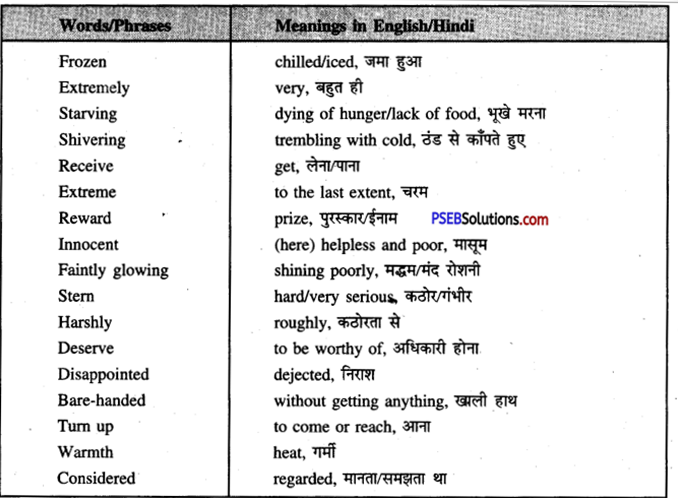
The Lake of the Moon Question Answer Class 6 English Solutions Chapter 2 PSEB Solutions

Punjab State Board PSEB 6th Class English Book Solutions Chapter 2 The Lake of the Moon Textbook Exercise Questions and Answers.

Class 6th English Solutions Chapter 2 The Lake of the Moon Question Answers

The Lake of the Moon Class 6 Questions and Answers

Activity 1.

Look up the following words in a dictionary. You should seek the following information about the words and put them in your WORDS notebook. :
1. Meaning of the word as used in the lesson (Adjective, Noun, Verb. etc.)
2. Pronunciation (The teacher may refer to the dictionary or the mobile phone for correct pronunciation.)
3. Spellings

majestic tusker severe drought prevent
messenger reflect protection disturb to and fro

PSEB 6th Class English Solutions Chapter 2 The Lake of the Moon

Vocabulary Expansion

Some animals live or move together. The group of animals have different names. Elephants move in herds, rabbits live in colonies and birds flock together. ‘Herds’ and ‘colonies’ are collective nouns. Collective nouns are names for a ‘collection’ or a ‘number’ of people or things.

कुछ पशु एक साथ समूह में रहते हैं। पशुओं या वस्तुओं के समूह को विभिन्न नाम दिए जाते हैं, जैसे – Herd of elephants (हाथियों का झुंड), Colony of rabbits (खरगोशों की बस्ती), flock of birds (पक्षियों का समूह) Collective Nouns कहलाते हैं।

Let us look at some more collective nouns.

1. Collection of horses – team of horses
2. group of ants – army of ants
3. group of vultures – wake of vultures
4. group of cards – pack of cards
5. group of ladies – bevy of ladies
PSEB 6th Class English Solutions Chapter 2 The Lake of the Moon 1

Activity 2.

Match the following things with their group name :
PSEB 6th Class English Solutions Chapter 2 The Lake of the Moon 4
Answer:
PSEB 6th Class English Solutions Chapter 2 The Lake of the Moon 2
PSEB 6th Class English Solutions Chapter 2 The Lake of the Moon 3

Learning to Read and Comprehend

Activity 3.

Choose the correct option and put a tick :

Question 1.
What happened in the area where the elephants lived ?
(a) there were floods
(b) there was no water
(c) there was fire in the jungle.
Answer:
(b) there was no water.

PSEB 6th Class English Solutions Chapter 2 The Lake of the Moon

Question 2.
The elephant king told the elephant to go to :
(a) different lakes
(b) the moon
(c) different directions
Answer:
(c) different directions

Question 3.
What was close to the lake ?
(a) a big forest
(b) a colony of rabbits
(c) the moon
Answer:
(b) a colony of rabbits.

Question 4.
Why did rabbits panic ?
(a) thousands of rabbits died
(b) elephants would drink all the water in the lake
(c) the moon would get angry
Answer:
(a) thousands of rabbits died.

Question 5.
What did the king of rabbits want other rabbits to find?
(a) water
(b) another place to go
(c) solution
Answer:
(c) solution

Question 6.
What did one little rabbit say?
(a) fight the elephants
(b) hide till the elephants go away
(c) make him a messenger to the elephant king
Answer:
(c) make him a messenger to the elephant king

Question 7.
What did the little rabbit climb?
(a) a mountain
(b) a huge rock
(c) on the back of the elephant king
Answer:
(b) a huge rock

Question 8.
What did the little rabbit say to the Elephant King ?
(a) that he was the messenger of the Moon
(b) he ordered the king to leave their area
(c) that the elephants should be ready for a fight
Answer:
(a) that he was the messenger of the Moon

Question 9.
What message does he give to the King?
(a) that the elephant herd had soiled the water of the holy lake
(b) rabbits, were under the special protection of the moon
(c) both ‘a’ and ‘b’
Answer:
(c) both ‘a’ and ‘b’.

PSEB 6th Class English Solutions Chapter 2 The Lake of the Moon

Question 10.
Where does the rabbit take the elephant king ?
(a) a lake
(b) another forest
(c) none of the above
Answer:
(a) a lake.

Activity 4.

Answer the following questions :

Question 1.
What happened to the place where the herd of elephants lived ?
उस स्थान को क्या हुआ जहां हाथियों का झुंड रहता था ?
Answer:
There was a severe drought (भीषण सुखा) and there was no water.

Question 2.
Where was the water found ?
पानी कहां मिला था ?
Answer:
The water was found in a lake in another jungle.

Question 3.
Who became the messenger ?
संदेशवाहक कौन बना?
Answer:
A little rabbit became the messenger.

Question 4.
Why did the water move to and fro ?
पानी इधर-उधर क्यों हिलने लगा ?
Answer:
The water moved to and fro because it was disturbed.

Question 5.
Why did the elephant king believe that the Moon had become angrier ?
राजा हाथी को इस बात का विश्वास क्यों हुआ कि चांद और अधिक क्रोधित हो उठा है ?
Answer:
It was so because the Moon had started moving to and fro.

Learning Language

Noun : Gender

Gender is a type of noun. There are four types of Genders.

1. Masculine Gender : The names of all male persons or animals (सभी नर व्यक्तियों या पशुओं के नाम) are of Masculine Gender. Example : man, uncle, lion, prince, master, etc.

2. Feminine Gender :
The names of all female persons or animals (सभी मादा व्यक्तियों या पशुओं के नाम) are of Feminine Gender. Example : woman, daughter, queen, lioness, etc.

3. Neuter Gender :
Things that do not have life (सभी निर्जीव वस्तुएं) are neither male or female. They belong to the Neuter Gender. Example : knife, computer, tree, chair, table, cycle, etc.

PSEB 6th Class English Solutions Chapter 2 The Lake of the Moon

4. Common Gender :
Names that can be used for both males and females (वे नाम जिनका प्रयोग नर तथा मादा दोनों के लिए किया जा सकता है) are of Common Gender. Example : child, teacher, student, parent, leader, etc.

Change of Gender

Activity 5.

Sometimes the word is slightly changed and-ess is added. Some examples are given in the table.
Complete the ones that have been left blank in the table. (teacher must help] :
PSEB 6th Class English Solutions Chapter 2 The Lake of the Moon 5

Activity 6.

Many nouns have different words for the Masculine and the Feminine. Some examples are done for you. Complete the ones that have been left blank in the table. [teacher must help] :
PSEB 6th Class English Solutions Chapter 2 The Lake of the Moon 6

PSEB 6th Class English Solutions Chapter 2 The Lake of the Moon

Activity 7.

Sometimes half the word that shows gender gets changed. Some examples are done for you. Complete the ones that have been left blank in the table. [teacher must help] :
Masculine milkman
PSEB 6th Class English Solutions Chapter 2 The Lake of the Moon 7

Activity 8.

Some words change but their patterns are different. Some examples are done for you. Complete the ones that have been left blank in the table. [teacher must help] :

PSEB 6th Class English Solutions Chapter 2 The Lake of the Moon 8

नोट :-Magician वास्तव में Common gender है।

Activity 9.

Some words are common to both genders. These words can be used for both males and females. Such words are called Common Gender. Some examples are done for you. Complete the ones that have been left blanks in the table, [teacher must help]:

pilot friend
bird parent
baby teacher
doctor member
child candidate
president shopkeeper
artist enemy
pupil player

Activity 10.

Some words have no gender. Such words are called Neuter gender. Some examples are done for you. Complete the ones that have been left blank in the table, [teacher must help]:

Neuter Gender
chair mountain
paper fan
book computer
school camera
pencil photo
map table
scooter rickshaw

PSEB 6th Class English Solutions Chapter 2 The Lake of the Moon

Activity 11.

Fill in the blanks using the correct option:
aunt, cow, queen, uncle, pilot, man, lady, hen, cock, duck
1. A ………………. wears a crown.
2. A …………… flies an aeroplane.
3. My grandmother is an old ……………
4. My father is a very kind and caring ……….
5. A ………….. gives us milk.
6. A ………….. lays eggs.
7. My father’s brother is my ………….
8. My mother’s sister is my
9. A ……………. quacks all day long in the pond.
0. A ………… says cock-a-doodle-doo.
Answer:
1. queen
2. pilot
3. lady
4. man
5. cow
6. hen
7. uncle
8. aunt
9. duck
10. cock

Activity 12

Write the opposite gender.
1. husband — wife
2. master — mistress
3. milkmaid — milkman
4. Peahen — peacock
5. nephew — niece
6. washer man — washer woman
7. president — president
8. queen — king
9. goose — gander
10. princess — prince

Reading a short passage

Activity 13

Read the story and do as directed :

The king was very angry. He ordered his guards to put his minister in prison. The minister had argued with the king on some law and order issue. The minister was put in prison. One day, the emperor went to the prison to see his minister. The king told him. “I will set you free on one condition. You must bring me a horse that is neither white nor black nor brown nor grey”.

The minister was surprised at this demand. However, he agreed to this condition. A week later, the minister came to the palace. “Have you found a horse ?” the King asked. “Yes, my lord”, the minister replied. “But I will show him to you only on a religious day.

The king agreed. Let me know the next religious day. The minister replied, “I will show you the horse on any day other than Sunday, Monday, Tuesday, Wednesday, Thursday, Friday or Saturday.”

The king started laughing. He was cleverly outsmarted by his minister. The minister was set free and promoted to the next higher position.

A. Write the meanings of :
(a) outsmart – outwit,पछाड़ देना
(b) issue – matter,मामला

B. Answer the following:

(a) Why was the King angry ?
Answer:
The King was angry because his minister had argued with him on some law and order issue.

(b) Why was the minister surprised at King’s demand ?
Answer:
The minister was surprised because there was no horse of the colour the king wanted.

PSEB 6th Class English Solutions Chapter 2 The Lake of the Moon

Choose the right option.

Question 1.
The argument between the king and the minister was about
(a) law and order issue
(b) religious issue
(c) war issue.
Answer:
(a) law and order issue.

Question 2.
The king ordered his guards to put his minister in prison because the minister had
(a) failed to reach the palace on time.
(b) not obeyed the king’s orders.
(c) argued with him on law and order issue.
Answer:
(c) argued with him on law and order issue.

Question 3.
The minister was surprised at the king’s demand because
(a) all horses are either black or brown or grey or white.
(b) there were no horses in the kingdom.
(c) there was no time to find a horse that the king wanted.
Answer:
(a) all horses are either black or brown or grey or white.

Activity 14(Pairwork):

Write as many words as you can think of that rhyme with the following words. One rhyming word is given for each word. And practise speaking them with your partner.

PSEB 6th Class English Solutions Chapter 2 The Lake of the Moon 9

नोट :- विद्यार्थी इन्हें बोलने का अभ्यास करें।

Learning to Write

Letter Writing (Informal)

Writing a letter is an art. It has a set format that must be followed. Given ahead is the format.
Answer:
PSEB 6th Class English Solutions Chapter 2 The Lake of the Moon 10

नोट-विद्यार्थी पत्र लिखते समय इस Format का प्रयोग करें।

PSEB 6th Class English Solutions Chapter 2 The Lake of the Moon

Activity 15

Write a letter to your uncle thanking him for the beautiful gift he has sent to you.
Answer:
28 Moti Nagar
Ludhiana
March 29, 20….
My dear Uncle,
Last Monday was my birthday. I received many other gifts too. But your gift was the best one. The watch had a silver dial and a golden chain. All praised this beautiful watch. I felt proud of you. The watch will be very useful to me. It will make my life regular and punctual. I shall never be late for school now. I shall keep this watch with great care. After all, this is a token of your love for me. I celebrated it at home. A big cake was cut. Most of our near and dear ones were present. But you were absent. I missed you very much. However, you did not forget the day. You have sent me a gift.
With regards
Yours lovingly
Ravi
Address :
Shri Manohar Lal
Prem Street
Joginder Nagar
Rohtak.

Comprehension Of Passages

Read the given passages and answer the questions that follow each :

(1) A severe drought hit the area. There was no rain for some years. All the rivers and ponds dried up. Birds and animals started dying of thirst. The wild elephants suffered too due to lack of water. The king of elephants understood that many of them would die of thirst if they did not get water soon. He had to find water for his herd as quick as possible. He told the elephants to go in different directions to look for water.

One of them found a large lake full of water in another jungle far away. The king was happy. He ordered all the elephants to start moving towards the lake. It was a beautiful lake. However close to the lake was a colony of rabbits. The elephants had to pass through that colony. Thousands of rabbits were crushed to death and thousands more were injured. The rabbits were in a state of panic.

(i) What was the effect of drought on birds and animals ?
पशु-पक्षियों पर सूखे का क्या प्रभाव पड़ा ?

(ii) Who found water ? Where was it ?
पानी किसे मिला ? यह कहां था?

(iii) Choose true or false statements and write them in your answer book :
(a) Close to the lake was a colony of rabbits.
(b) The elephants had to pass through the lake.

(iv) Complete the following sentences according to the meaning of the passage.
(a) Thousands of rabbits were crushed ……….
(b) The …………. were in a panic.
Or
Match the words with the meanings :

(a) panic wounded
(b) injured great fear
captured

Answer:
(i) The birds and animals started dying of thirst.
(ii) One of the elephants found water. It was in a large lake in another jungle far away.
(iii)
(a) True
(b) False.
(iv)
(a) Thousands of rabbits were crushed to death.
(b) The rabbits were in a panic.
Or
(a) panic — great fear
(b) injured — wounded.

PSEB 6th Class English Solutions Chapter 2 The Lake of the Moon

(2) The rabbits thought and thought. How could they stop the elephants ? One little rabbit stoop up. “Your Majesty,” he said, “if you send me as your messenger to the king of the elephants, I may be able to find a solution.” “Who said these words is not mentioned.”

The little rabbit hurried to the spot where elephants lived. He saw a group elephants returning from the lake. Right in the middle was the king of elephants. To get near him was impossible. “I will be crushed to death,” thought the rabbit. So he climbed up a huge rock.

“O king of the elephants,” he shouted, “Hear me, please.” The king heard his voice and turned towards him.“Who are you ?” he asked. “I am a messenger.” replied the rabbit. “A messenger ? From whom ?” “I am a messenger from the mighty Moon.”

(i) Why did the rabbit not go near the king of elephants ?
खरगोश हथियों के राजा के निकट क्यों न गया ?

(ii) What did he do instead ?
इसकी बजाय उसने क्या किया ?

(iii) Choose true. or false statements and write them in your answer book :
(a) The king did not hear the rabbit.
(b) The king of the elephants was in the middle of the group.

(iv) Complete the following sentences according to the meaning of the passage.
(a) The king heard his voice and ……..
(b) I am a messenger from ………..
Or
Match the words with the meanings :

(a) spot place/site
(b) huge far away
very big

Answer:
(i) The rabbit did not go near the king of elephants lest he should be crushed to death.
(ii) He climbed up a huge rock.
(iii)
(a) False
(b) True.
(iv)
(a) The king heard his voice and turned towards him.
(b) I am a messenger from the mighty Moon.
or
(a) spot — place/site
(b) huge – very big.

(3) “Sir, the Moon says,” said the little rabbit, “You, the king of the elephants, have brought your herd to my holy lake. You and your herd have soiled its water. You and your herd have killed thousands of rabbits on your way to the lake.

You must know that rabbits are under my special protection. Everyone knows that the king of the rabbits lives with me. I ask you not to kill any more rabbits. If you do not agree, something bad will happen to you and your herd.” The king of the elephants was shocked.

He looked at the little rabbit. “You are right,” he said. “We may have killed many rabbits on our way to the lake. I shall see that you do not suffer anymore. I shall request the Moon to forgive me for my sins. Please tell me what I should do.”

(i) What was the Moon’s message to the king of elephants ?
हाथियों के राजा के नाम चांद का क्या संदेश था ?

(ii) Who wanted the Moon to foregive him and for what ?
चांद से माफ़ी कौन चाहता था और किस बात के लिए ?

(iii) Choose true or false statements and write them in your answer book :
(a) The elephants had killed thousands of rabbits.
(b) The king of the elephants was happy.

(iv) Complete the following sentences according to the meaning of the passage.
(a) If you do not agree something bad will happen to ………..
(b) I shall see that ……
Or
Match the words with their meanings :

(a) protection punishment
(b) sins defence
bad deeds

PSEB 6th Class English Solutions Chapter 2 The Lake of the Moon

Answer:
(i) The Moon’s message was not to kill any more rabbits.
(ii) The king of elephants wanted the Moon to forgive him for his sins.
(iii)
(a) True
(b) False
(iv)
(a) If you do not agree something bad will happen to you and your herd.
(b) I shall see that you do not suffer anymore.
Or
(a) protection – defence
(b) sins – bad deeds.

Use Of Words/Phrases In Sentences

1. Huge (very big) —
A palace is a huge building.
महल एक बहुत बड़ा भवन होता है। I

2. Due to (because of —
could not attend the meeting due to illness.
बीमारी के कारण मैं मीटिंग में न जा सका।

3. Look for (search) —
We are looking for our lost bal.
हम अपनी गुम हुई गेंद ढूंढ रहे हैं।

4. Disturb (interrupt) —
Don’t disturb me. I am doing my homework.
मेरे काम में बाधा मत डालो। मैं घर का काम कर रहा हूँ।

5. Severe (acute) —
I have severe pain in my body.
मेरे शरीर में बहुत अधिक दर्द है।

6. To and fro (here and there) —
The swing was moving to and fro.
झूला इधर-उधर आ जा रहा था।

7. Majestic (grand) —
The Taj Mahal is a majestic building.
ताजमहल एक शानदार इमारत है।

8. Prevent (stop) —
I could not prevent him to soil his clothes.
मैं उसे अपने कपड़े गंदे करने से न रोक सका।

9. Reflect (cast back/give back) —
Water reflects light.
पानी प्रकाश को परावर्तित करता है

10. Injured (wounded) —
Many people were injured in the accident.
दुर्घटना में कई लोग घायल हो गए।

11. Occur to (strike one’s mind) —
It did not occur to me that I was running into danger.
मैं यह न समझ सका कि मैं खतरे में पड़ रहा हूं।

Word Meanings 

PSEB 6th Class English Solutions Chapter 2 The Lake of the Moon 11

The Lake of the Moon Summary in Hindi

Once upon a time …………………………. state of panic.

एक समय की बात है, जंगल में हाथियों का एक बहुत बड़ा झुंड रहता था। उनका राजा एक बहुत बड़ा राजसी हाथी था जो अपने झुंड से बहुत प्यार करता था। उस क्षेत्र में भयंकर सूखा पड़ा। कुछ वर्षों से वहाँ वर्षा नहीं हुई थी। सभी नदियां तथा तालाब सूख गए। पक्षी और जानवर प्यास से मरने लगे।

जंगली हाथियों को भी पानी की कमी के कारण मुसीबत का सामना करना पड़ा। हाथियों का राजा समझ गया यदि उन्हें शीघ्र ही पानी नहीं मिला तो उनमें से बहुत से मर जाएंगे। उसे जल्दी से जल्दी अपने झुंड के लिए पानी की तलाश करनी होगी। उसने हाथियों को अलग-अलग दिशा में जाकर पानी ढूंढने के लिए कहा।

उनमें से एक को दूर किसी दूसरे जंगल में पानी से भरी एक बड़ी झील मिली। राजा खुश हुआ। उसने सभी हाथियों को उस झील की ओर चलने का आदेश दिया।झील सुन्दर थी। परन्तु झील के निकट खरगोशों की एक बस्ती थी। हाथियों को उस बस्ती में से होकर जाना पड़ता था। हजारों खरगोश मारे जाते थे और उससे भी कई हजार अधिक खरगोश घायल हो जाते थे। खरगोश आतंकित थे।

PSEB 6th Class English Solutions Chapter 2 The Lake of the Moon

Thinking …………..not mentioned.

उनके राजा ने एक सभा बुलाई। उसने कहा, “जंगली हाथियों का एक झुंड हमारी बस्ती में से निकलता है। उन्होंने हमें हजारों की संख्या में पहले ही मार डाला है और कई हजार घायल हो गए हैं। हमें शीघ्र ही जरूरी कदम उठा कर और अधिक मौतों को रोकना होगा। मैं चाहता हूँ कि तुम सब अपनी जाति की सुरक्षा के लिए किसी तरीके पर विचार करो” खरगोशों ने बार-बार सोचा। हाथियों को कैसे रोका जाए? एक छोटा सा खरगोश उठ खड़ा हुआ। उसने कहा, “महाराज, यदि आप मुझे हाथियों के राजा के पास अपना दूत बनाकर भेजे तो मैं कोई समाधान निकाल पाऊँगा।”

The little Rabbit ………………………. I should do.”

छोटा खरगोश तेज़ी से उस स्थान की ओर गया जहाँ हाथी रहते थे। उसने हाथियों के एक समूह को झील से वापिस आते देखा। उनके बिल्कुल बीच हाथियों का राजा था। उसके पास पहुँचना असंभव था ( खरगोश ने सोचा, “मैं तो कुचलकर मारा जाऊँगा।” इसलिए वह एक बहुत बड़ी चट्टान पर चढ़ गया। वह चिल्लाया, ” ओ, हाथियों के राजा कृपया मेरी बात सुनें।” राजा ने आवाज़ सुनी और उसकी ओर मुड़ा। उसने कहा, “कौन हो तुम ?” खरगोश ने उत्तर दिया, “मैं एक दूत हूँ।” “एक दूत ? किसके यहाँ से ?” “मैं शक्तिशाली चंद्रमा का दूत हूँ।” “सच में ? तुम क्या चाहते हो? क्या मेरे लिए चंद्रमा का कोई संदेश है?”

“हाँ, हाँ महाराज, परन्तु तुम मुझसे क्रोधित मत होना। मैं तो केवल एक दूत हूँ। मैं तो केवल अपना कर्त्तव्य निभा रहा हूँ।” राजा हाथी ने कहा, “बिल्कुल ठीक, एक दूत को उसके कुछ भी कहने के लिए दण्डित नहीं किया जाता। तुम कहो जो भी कहने के लिए आए हो। मैं तुम्हें कोई हानि नहीं पहुँचाऊंगा। तुम तो केवल अपना कर्तव्य निभा रहे हो।” छोटे से खरगोश ने कहा, “श्री मानजी, चंद्रमा कहता है “हाथियों के राजा, तुम अपने झुंड को मेरी पवित्र झील पर लाए हो। तुमने और तुम्हारे झंड ने मेरे जल को गंदा कर दिया है। तुमने और तुम्हारे झंड ने झील की ओर जाते हुए हजारों खरगोशों को मार डाला है। तुम्हें पता होना चाहिए कि खरगोश मेरे विशेष संरक्षण में हैं। सभी जानते हैं कि खरगोशों का राजा मेरे साथ रहता है।

मैं तुम्हें कह रहा हूँ कि अव और खरगोशों को मत मारना। यदि तुम नहीं मानोगे तो तुम्हें और तुम्हारे झुंड के साथ कुछ बुरा होगा।” राजा को दुख पहुँचा। उसने छोटे से खरगोश की ओर देखा। “तुम ठीक कह रहे हो।” उसने कहा हो सकता है, “हमने झील के रास्ते में बहुत से खरगोशों को मार डाला हो। मैं इस बात का ध्यान रखूगा कि तुम्हें अब और अधिक कष्ट न उठाना पड़े। मैं चंद्रमा से निवेदन करूंगा कि वह मुझे मेरे पापों के लिए क्षमा कर दें। कृपया मुझे बताओ कि मुझे क्या करना चाहिए।”

“Come with me ………………….. fooled or befooled ?

खरगोश ने उत्तर दिया, “मेरे साथ अकेले आओ। आओ, मैं तुम्हें चंद्रमा के पास ले चलता हूँ।” छोटा खरगोश भारी भरकम हाथी को झील पर ले गया। वहाँ उन्होंने शांत (ठहरे हुए) जल में चांद का प्रतिबिंब (परछाईं) देखा। छोटे झील सुन्दर थी। परन्तु झील के निकट खरगोशों की एक बस्ती थी। हाथियों को उस बस्ती में से होकर जाना पड़ता था। हजारों खरगोश मारे जाते थे और उससे भी कई हजार अधिक खरगोश घायल हो जाते थे। खरगोश आतंकित थे।

Thinking …….. not mentioned.

उनके राजा ने एक सभा बुलाई। उसने कहा, “जंगली हाथियों का एक झुंड हमारी बस्ती में से निकलता है। उन्होंने हमें हजारों की संख्या में पहले ही मार डाला है और कई हजार घायल हो गए हैं। हमें शीघ्र ही जरूरी कदम उठा कर और अधिक मौतों को रोकना होगा। मैं चाहता हूँ कि तुम सब अपनी जाति की सुरक्षा के लिए किसी तरीके पर विचार करो” खरगोशों ने बार-बार सोचा। हाथियों को कैसे रोका जाए? एक छोटा सा खरगोश उठ खड़ा हुआ। उसने कहा, “महाराज, यदि आप मुझे हाथियों के राजा के पास अपना दूत बनाकर भेजे तो मैं कोई समाधान निकाल पाऊँगा।”

The little Rabbit …………. ……………. I should do.

” छोटा खरगोश तेज़ी से उस स्थान की ओर गया जहाँ हाथी रहते थे। उसने हाथियों के एक समूह को झील से वापिस आते देखा। उनके बिल्कुल बीच हाथियों का राजा था। उसके पास पहुँचना असंभव था ( खरगोश ने सोचा, “मैं तो कुचलकर मारा जाऊँगा।” इसलिए वह एक बहुत बड़ी चट्टान पर चढ़ गया।

वह चिल्लाया, ” ओ, हाथियों के राजा कृपया मेरी बात सुनें।” राजा ने आवाज़ सुनी और उसकी ओर मुड़ा। उसने कहा, “कौन हो तुम ?” खरगोश ने उत्तर दिया, “मैं एक दूत हूँ।” “एक दूत ? किसके यहाँ से ?” “मैं शक्तिशाली चंद्रमा का दूत हूँ।” “सच में ? तुम क्या चाहते हो? क्या मेरे लिए चंद्रमा का कोई संदेश है?”

“हाँ, हाँ महाराज, परन्तु तुम मुझसे क्रोधित मत होना। मैं तो केवल एक दूत हूँ। मैं तो केवल अपना कर्त्तव्य निभा रहा हूँ।” राजा हाथी ने कहा, “बिल्कुल ठीक, एक दूत को उसके कुछ भी कहने के लिए दण्डित नहीं किया जाता। तुम कहो जो भी कहने के लिए आए हो। मैं तुम्हें कोई हानि नहीं पहुँचाऊंगा। तुम तो केवल अपना कर्तव्य निभा रहे हो।

” छोटे से खरगोश ने कहा, “श्री मानजी, चंद्रमा कहता है “हाथियों के राजा, तुम अपने झुंड को मेरी पवित्र झील पर लाए हो। तुमने और तुम्हारे झंड ने मेरे जल को गंदा कर दिया है। तुमने और तुम्हारे झंड ने झील की ओर जाते हुए हजारों खरगोशों को मार डाला है। तुम्हें पता होना चाहिए कि खरगोश मेरे विशेष संरक्षण में हैं।

सभी जानते हैं कि खरगोशों का राजा मेरे साथ रहता है। मैं तुम्हें कह रहा हूँ कि अव और खरगोशों को मत मारना। यदि तुम नहीं मानोगे तो तुम्हें और तुम्हारे झुंड के साथ कुछ बुरा होगा।” राजा को दुख पहुँचा। उसने छोटे से खरगोश की ओर देखा। “तुम ठीक कह रहे हो।” उसने कहा हो सकता है, “हमने झील के रास्ते में बहुत से खरगोशों को मार डाला हो। मैं इस बात का ध्यान रखूगा कि तुम्हें अब और अधिक कष्ट न उठाना पड़े। मैं चंद्रमा से निवेदन करूंगा कि वह मुझे मेरे पापों के लिए क्षमा कर दें। कृपया मुझे बताओ कि मुझे क्या करना चाहिए।”

PSEB 6th Class English Solutions Chapter 2 The Lake of the Moon

“Come with me ………………….. fooled or befooled ?

खरगोश ने उत्तर दिया, “मेरे साथ अकेले आओ। आओ, मैं तुम्हें चंद्रमा के पास ले चलता हूँ।” छोटा खरगोश भारी भरकम हाथी को झील पर ले गया। वहाँ उन्होंने शांत (ठहरे हुए) जल में चांद का प्रतिबिंब (परछाईं) देखा। छोटे

खरगोश ने कहा, “महाराज, चांद से मिलें।” हाथी ने अपनी सूंड को जल में डुबोया और कहा, “कृपया मुझे चांद की पूजा करने दो।” जैसे ही पानी को छेड़ा गया पानी में चांद इधर-उधर हिलने लगा। खरगोश ने कहा, ” अब, चाँद पहले से भी अधिक क्रोधित है।” राजा हाथी ने पूछा, ” क्यों ? मैंने ऐसा क्या किया ?” खरगोश ने उत्तर दिया, “आपने झील के पवित्र जल को छुआ है।” हाथी ने अपना सिर झुका लिया।

“कृपया चंद्रमा से कहो मुझे माफ कर दें। हम आगे से कभी भी इस झील के पवित्र जल को नहीं छुएंगे न ही हम फिर कभी उन खरगोशों को हानि पहुँचाएंगे जो चांद के सबसे प्रिय हैं।” इस तरह राजा और उसका झुंड वहां से चले गए। शीघ्र ही वर्षा होने लगी और हाथी खुशी से रहने लगे। उन्हें यह कभी भी नहीं पता चला कि एक छोटे से खरगोश ने उन्हें मूर्ख बनाया है या चकमा दिया है।

Retranslation Of Isolated Sentences

1. Once upon a time, a large herd of elephants lived in a jungle. .
एक समय की बात है जंगल में हाथियों का एक बहुत बड़ा झुंड रहता था।

2. There was no rain for some years.
कुछ वर्षों से वर्षा नहीं हुई थी।

3. The wild elephants suffered too due to lack of water.
जंगली हाथियों को भी पानी की कमी के कारण मुसीबत का सामना करना पड़ा।

4. He had to find water for his herd as quickly as possible.
उसे जल्दी से जल्दी अपने झुंड के लिए पानी की तलाश करनी थी।

5. It was a beautiful lake.
झील सुंदर थी।

6. The rabbits were in a state of panic.
खरगोश आतंकित/भयभीत थे।

7. They have already killed thousands of us.
उन्होंने हमें हजारों की संख्या में पहले ही मार डाला है।

8. The rabbits thought and thought.
खरगोशों ने बार-बार सोचा।

9. Who said these words is not mentioned.
ये शब्द किसने कहे इसका कोई पता नहीं।

10. I will be crushed to death..
मैं तो कुचल (रौंद) कर मारा जाऊँगा।

11. I am a messenger from mighty moon.
मैं शक्तिशाली चंद्रमा का दूत हूँ।

12. You and your herd have soiled its water.
तुमने और तुम्हारे झुंड ने इसके जल को गंदा कर दिया है।

PSEB 6th Class English Solutions Chapter 2 The Lake of the Moon

13. The king of the elephants was shocked.
हाथियों का राजा दुखी हो उठा।

14. Please ask the Moon to forgive me.
कृपया चद्रंमा से कहो कि वह मुझे माफ कर दें।

English Class 6 Solutions PSEB Prose

PSEB 7th Class Maths MCQ Chapter 15 Visualising Solid

Punjab State Board PSEB 7th Class Maths Book Solutions Chapter 15 Visualising Solid MCQ Questions with Answers.

PSEB 7th Class Maths Chapter 15 Visualising Solid MCQ Questions

Multiple Choice Questions

Question 1.
Identify the side view for the given solid.
PSEB 7th Class Maths MCQ Chapter 15 Visualising Solid 1
(a)
PSEB 7th Class Maths MCQ Chapter 15 Visualising Solid 2
(b)
PSEB 7th Class Maths MCQ Chapter 15 Visualising Solid 3
(c)
PSEB 7th Class Maths MCQ Chapter 15 Visualising Solid 4
(d) None of these.
Answer:
(a)
PSEB 7th Class Maths MCQ Chapter 15 Visualising Solid 7

PSEB 7th Class Maths MCQ Chapter 15 Visualising Solid

Question 2.
Identify the front view for the given solid.
PSEB 7th Class Maths MCQ Chapter 15 Visualising Solid 5
PSEB 7th Class Maths MCQ Chapter 15 Visualising Solid 6
(d) None of these.
Answer:
PSEB 7th Class Maths MCQ Chapter 15 Visualising Solid 8

Fill in the blanks :

Question 1.
The name of the figure PSEB 7th Class Maths MCQ Chapter 15 Visualising Solid 9 is ……………..
Answer:
Cone

Question 2.
The number of edges of a cube are ……………..
Answer:
12

Question 3.
The number of faces of a cuboid are ……………..
Answer:
6

PSEB 7th Class Maths MCQ Chapter 15 Visualising Solid

Question 4.
Opposite faces of a die always have a total of …………….. dots on there.
Answer:
7

Question 5.
The number of corners of a cube are ……………..
Answer:
8

Write True or False :
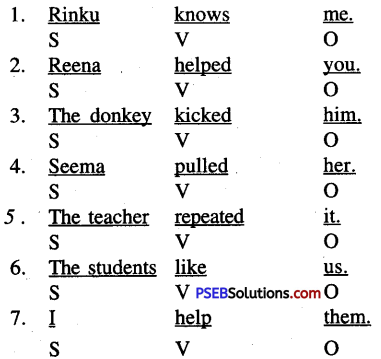
Question 1.
Cube is solid figure.
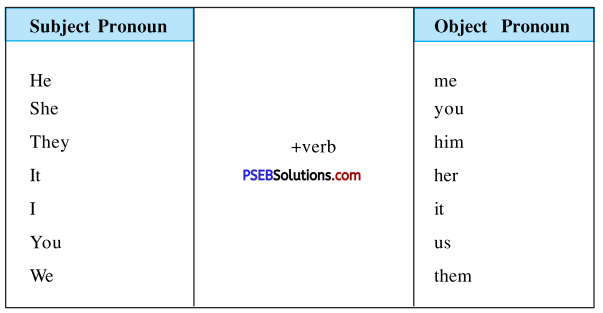
Answer:
True

Question 2.
Plane figure has three dimensions.
Answer:
False

PSEB 7th Class Maths MCQ Chapter 15 Visualising Solid

Question 3.
Rectangle is a plane figure.
Answer:
True

Question 4.
A cylinder has two flat surfaces.
Answer:
True

Question 5.
A cube has twelve edges.
Answer:
True