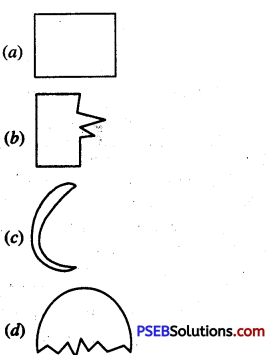
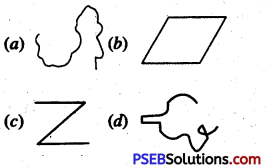
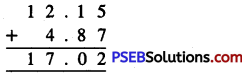
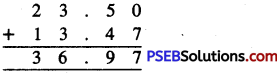
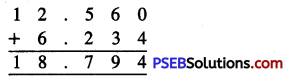
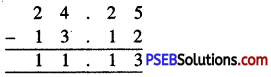
PSEB 6th Class Maths Solutions Chapter 6 Decimals Ex 6.1

Punjab State Board PSEB 6th Class Maths Book Solutions Chapter 6 Decimals Ex 6.1 Textbook Exercise Questions and Answers.

PSEB Solutions for Class 6 Maths Chapter 6 Decimals Ex 6.1

1. Write each of the following in figures:

Question (i)
Seventy-two point one four.
Solution:
Seventy-two point one four = 72.14

PSEB 6th Class Maths Solutions Chapter 6 Decimals Ex 6.1

Question (ii)
Two hundred fifty-seven point zero eight
Solution:
Two hundred fifty-seven point zero eight = 257.08

Question (iii)
Eight point two five-six.
Solution:
Eight point two five six = 8.256

Question (iv)
Forty-five and twenty-three hundredths.
Solution:
Forty five and twenty three hundredths
= 45 + \(\frac {23}{100}\)
= 45.23

Question (v)
Six hundred twenty-one and two hundred fifty-three thousandths
Solution:
Six hundred twenty-one and two hundred fifty-three thousandths
= 621 + \(\frac {253}{1000}\)
= 621.253

PSEB 6th Class Maths Solutions Chapter 6 Decimals Ex 6.1

Question (vi)
Twelve and eight thousandths.
Solution:
Twelve and eight thousandths
= 12 + \(\frac {8}{1000}\)
= 12.008

2. Write the following decimal numbers in words:

Question (i)
12.52
Solution:
12.52 = Twelve point five two or twelve and fifty-two hundredths.

Question (ii)
7.148
Solution:
7.148 = Seven point one four eight or seven and one hundred forty-eight thousandths.

PSEB 6th Class Maths Solutions Chapter 6 Decimals Ex 6.1

Question (iii)
0.24
Solution:
0.24 = Zero Point two four or twenty-four hundredths.

Question (iv)
5.018
Solution:
5.018 = Five-point zero one eight or five and eighteen thousandths.

Question (v)
.009.
Solution:
.009 = Point zero zero nine or nine thousandths.

3. Write the following decimals in the place value table:

Question (i)
(i) 21.569
(ii) 0.64
(iii) 3.51
(iv) 14.087
(v) 3.002.
Solution:

Number Thousands Hundreds Tens Ones Tenths Hundredths Thousandths
1. 21.569 2 1 5 6 9
2. 0.64 0 6 4
3. 3.51 3 5 1
4. 14.087 1 4 0 8 7
5. 3.002 3 0 0 2

PSEB 6th Class Maths Solutions Chapter 6 Decimals Ex 6.1

4. Write the following as decimals:

Question (i)
40 + \(\frac {2}{10}\)
Solution:
40 + \(\frac {2}{10}\) = 40.2

Question (ii)
700 + 5 + \(\frac {3}{10}\) + \(\frac {4}{100}\)
Solution:
700 + 5 + \(\frac {3}{10}\) + \(\frac {4}{100}\) = 705.34

Question (iii)
100 + \(\frac {5}{100}\) + \(\frac {3}{1000}\)
Solution:
100 + \(\frac {5}{100}\) + \(\frac {3}{1000}\) = 10.053

Question (iv)
100 + \(\frac {7}{10}\) + \(\frac {4}{1000}\)
Solution:
100 + \(\frac {7}{10}\) + \(\frac {4}{1000}\) = 0.704

PSEB 6th Class Maths Solutions Chapter 6 Decimals Ex 6.1

Question (v)
\(\frac {5}{1000}\)
Solution:
\(\frac {5}{1000}\) = 0.005

5. Write the decimals shown in the following place value table:

Question (i)

Thousands Hundreds Tens Ones Tenth Hundredths Thousandths
5 2 4 1 2
2 0 3 4 2 1
6 1 0 2 3
4 0 0 1
1 0 0 0 3

Solution:
(i) 524.12
(ii) 2034.21
(iii) 61.023
(iv) 4.001
(v) 100.03

PSEB 6th Class Maths Solutions Chapter 6 Decimals Ex 6.1

6. Expand the following decimals.

Question (i)
2.5
Solution:
2.5 = 2 + 0.5
= 2 + \(\frac {5}{10}\)

Question (ii)
18.43
Solution:
18.43 = 10 + 8 + 0.4 + 0.03
= 10 + 8 + \(\frac {4}{10}\) + \(\frac {3}{100}\)

Question (iii)
4.05
Solution:
4.05 = 4 + 0.05
= 4 + \(\frac {5}{100}\)

Question (iv)
13.123
Solution:
13.123 = 10 + 3 + 0.1 + 0.02 + 0.003
= 10 + 3 + \(\frac {1}{10}\) + \(\frac {2}{100}\) + \(\frac {3}{1000}\)

PSEB 6th Class Maths Solutions Chapter 6 Decimals Ex 6.1

Question (v)
245.456
Solution:
245.456 = 200 + 40 + 5 + 0.4 + 0.05 + 0.006
= 200 + 40 + 5 + \(\frac {4}{10}\) + \(\frac {5}{100}\) + \(\frac {6}{1000}\)

Question (vi)
20.057
Solution:
20.057 = 20 + 0.05 + 0.007
= 20 + \(\frac {5}{100}\) + \(\frac {7}{1000}\)

PSEB 6th Class Maths MCQ Chapter 5 Fractions

Punjab State Board PSEB 6th Class Maths Book Solutions Chapter 5 Fractions MCQ Questions with Answers.

PSEB 6th Class Maths Chapter 5 Fractions MCQ Questions

Multiple Choice Questions

Question 1.
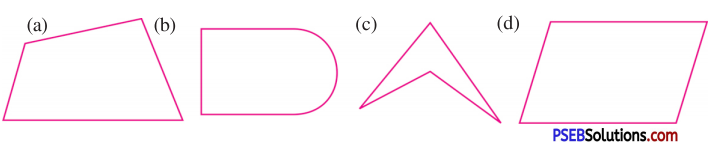
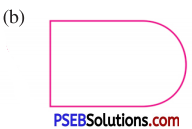
Which of the following does not represent any fraction?
PSEB 6th Class Maths MCQ Chapter 5 Fractions 1.1
Answer:
PSEB 6th Class Maths MCQ Chapter 5 Fractions 1

PSEB 6th Class Maths MCQ Chapter 5 Fractions

Question 2.
Which of the following is a proper fraction?
(a) \(\frac {5}{5}\)
(b) \(\frac {12}{11}\)
(c) \(\frac {7}{9}\)
(d) 7
Answer:
(c) \(\frac {7}{9}\)

Question 3.
Which of the following is an improper fraction?
(a) \(\frac {5}{8}\)
(b) \(2\frac {3}{4}\)
(c) \(\frac {7}{11}\)
(d) \(\frac {15}{16 }\)
Answer:
(b) \(2\frac {3}{4}\)

Question 4.
The fractions having las numerator are called …………. fractions.
(a) Like
(b) Unlike
(c) Unit
(d) Proper.
Answer:
(c) Unit

Question 5.
The fractions having same denominators are called …………. fractions.
(a) Proper
(b) Unit
(c) Improper
(d) Like.
Answer:
(d) Like.

Question 6.
The fraction having different denominators are called ……………. fractions.
(a) Unlike
(b) Like
(c) Improper
(d) Unit.
Answer:
(a) Unlike

PSEB 6th Class Maths MCQ Chapter 5 Fractions

Question 7.
Express 8 hours as a fraction of 1 day.
(a) \(\frac {2}{3}\)
(b) \(\frac {1}{3}\)
(c) \(\frac {8}{1}\)
(d) \(\frac {1}{8}\)
Answer:
(b) \(\frac {1}{3}\)

Question 8.
Find : \(\frac {2}{5}\) of ₹ 20.
(a) ₹ 8
(b) ₹ 10
(c) ₹ 12
(d) ₹ 40.
Answer:
(a) ₹ 8

Question 9.
Write \(\frac {19}{4}\) as mixed fraction.
(a) \(3\frac {4}{5}\)
(b) \(4\frac {4}{3}\)
(c) \(4\frac {3}{4}\)
(d) \(5\frac {1}{4}\)
Answer:
(c) \(4\frac {3}{4}\)

Question 10.
\(7\frac {2}{3}\) = ……………….
(a) \(\frac {17}{3}\)
(b) \(\frac {23}{3}\)
(c) \(\frac {13}{3}\)
(d) \(\frac {42}{3}\)
Answer:
(b) \(\frac {23}{3}\)

PSEB 6th Class Maths MCQ Chapter 5 Fractions

Question 11.
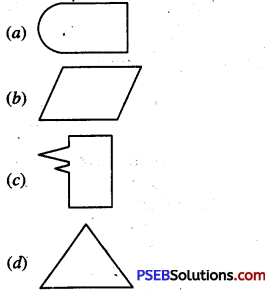
Which of the following represents an improper fraction?
PSEB 6th Class Maths MCQ Chapter 5 Fractions 2.1
Answer:
PSEB 6th Class Maths MCQ Chapter 5 Fractions 2

Question 12.
Which of the following is an equivalent of \(\frac {5}{7}\)?
(a) \(\frac {25}{49}\)
(b) \(\frac {20}{35}\)
(c) \(\frac {35}{49}\)
(d) \(\frac {35}{28}\)
Answer:
(c) \(\frac {35}{49}\)

Question 13.
PSEB 6th Class Maths MCQ Chapter 5 Fractions 3.1
(a) 32
(b) 24
(c) 40
(d) 16
Answer:
(a) 32

Question 14.
Which of the following are in ascending order?
(a) \(\frac{2}{3}, \frac{2}{7}, \frac{2}{5}\)
(b) \(\frac{2}{3}, \frac{2}{5}, \frac{2}{7}\)
(c) \(\frac{2}{7}, \frac{2}{3}, \frac{2}{5}\)
(d) \(\frac{2}{7}, \frac{2}{5}, \frac{2}{3}\)
Answer:
(d) \(\frac{2}{7}, \frac{2}{5}, \frac{2}{3}\)

PSEB 6th Class Maths MCQ Chapter 5 Fractions

Question 15.
Which of the following are in descending order?
(a) \(\frac{1}{8}, \frac{1}{3}, \frac{1}{9}\)
(b) \(\frac{1}{3}, \frac{1}{8}, \frac{1}{9}\)
(c) \(\frac{1}{8}, \frac{1}{9}, \frac{1}{3}\)
(d) \(\frac{1}{3}, \frac{1}{9}, \frac{1}{8}\)
Answer:
(b) \(\frac{1}{3}, \frac{1}{8}, \frac{1}{9}\)

Question 16.
\(\frac{4}{6}+\frac{3}{6}\) = …………. .
(a) \(\frac {7}{12}\)
(b) \(\frac {7}{8}\)
(c) \(1\frac {1}{6}\)
(d) \(1\frac {1}{12}\)
Answer:
(c) \(1\frac {1}{6}\)

Question 17.
\(\frac{4}{9}+\frac{5}{9}-\frac{2}{9}\) = ……………. .
(a) \(\frac {7}{9}\)
(b) \(\frac {7}{18}\)
(c) \(\frac {11}{9}\)
(d) \(\frac {5}{9}\)
Answer:
(a) \(\frac {7}{9}\)

Question 18.
\(\frac{2}{3}+\frac{1}{6}\) = ………………
(a) \(\frac {3}{9}\)
(b) \(\frac {5}{6}\)
(c) \(\frac {7}{6}\)
(d) \(\frac {5}{9}\)
Answer:
(b) \(\frac {5}{6}\)

PSEB 6th Class Maths MCQ Chapter 5 Fractions

Question 19.
4 – \(\frac {1}{3}\) = …………….
(a) \(4\frac {1}{3}\)
(b) \(3\frac {1}{3}\)
(c) \(4\frac {2}{3}\)
(d) \(3\frac {2}{3}\)
Answer:
(d) \(3\frac {2}{3}\)

Question 20.
Divide \(\frac {1}{6}\) by 2
(a) \(\frac {1}{3}\)
(b) \(\frac {1}{12}\)
(c) \(\frac {1}{18}\)
(d) 12
Answer:
(b) \(\frac {1}{12}\)

Question 21.
Which fraction is represented by point P on the adjoining number line?
PSEB 6th Class Maths MCQ Chapter 5 Fractions 3
(a) \(\frac {4}{5}\)
(b) \(\frac {5}{6}\)
(c) \(\frac {3}{4}\)
(d) \(\frac {3}{5}\)
Answer:
(a) \(\frac {4}{5}\)

Question 22.
Which fraction is represented by point P on the adjoining number line?
PSEB 6th Class Maths MCQ Chapter 5 Fractions 4
(a) \(\frac {1}{2}\)
(b) \(\frac {3}{5}\)
(c) \(\frac {4}{5}\)
(d) \(\frac {2}{5}\)
Answer:
(d) \(\frac {2}{5}\)

PSEB 6th Class Maths MCQ Chapter 5 Fractions

Question 23.
Which of the following fractions are in ascending order?
(a) \(\frac{1}{2}, \frac{1}{3}, \frac{1}{4}\)
(b) \(\frac{5}{10}, \frac{5}{11}, \frac{5}{12}\)
(c) \(\frac{1}{10}, \frac{1}{100}, \frac{1}{1000}\)
(d) \(\frac{3}{10}, \frac{4}{10}, \frac{7}{10}\)
Answer:
(d) \(\frac{3}{10}, \frac{4}{10}, \frac{7}{10}\)

Question 24.
Which of the following fractions are in descending order?
(a) \(\frac{1}{3}, \frac{1}{4}, \frac{1}{5}\)
(b) \(\frac{4}{11}, \frac{4}{12}, \frac{4}{13}\)
(c) \(\frac{1}{10}, \frac{1}{100}, \frac{1}{1000}\)
(d) \(\frac{7}{10}, \frac{9}{10}, \frac{11}{10}\)
Answer:
(a) \(\frac{1}{3}, \frac{1}{4}, \frac{1}{5}\)

Question 25.
Which of the following fraction is shown in the shaded portion of the figure?
PSEB 6th Class Maths MCQ Chapter 5 Fractions 5
(a) \(\frac {1}{3}\)
(b) \(\frac {2}{4}\)
(c) \(\frac {3}{4}\)
(d) \(\frac {2}{5}\)
Answer:
(b) \(\frac {2}{4}\)

Fill in the blanks:

Question (i)
The fraction shown in the shaded portion of the figure is ……………..,
PSEB 6th Class Maths MCQ Chapter 5 Fractions 6
Answer:
\(\frac {1}{4}\)

PSEB 6th Class Maths MCQ Chapter 5 Fractions

Question (ii)
The fraction of the shaded portion shown by the following figure is …………. .
PSEB 6th Class Maths MCQ Chapter 5 Fractions 7
Answer:
\(\frac {1}{8}\)

Question (iii)
The fraction of the shaded portion shown by the given figure is …………… .
PSEB 6th Class Maths MCQ Chapter 5 Fractions 8
Answer:
\(\frac {3}{7}\)

Question (iv)
The upper part of the fraction is called ……………. .
Answer:
numerator

Question (v)
The lower part of the fraction is called ……………. .
Answer:
denominator

Write True/False:

Question (i)
The fraction \(\frac {3}{5}\) is read as three fifth. (True/False)
Answer:
True

PSEB 6th Class Maths MCQ Chapter 5 Fractions

Question (ii)
The fraction whose numerator is less than the denominator is called the proper fraction. (True/False)
Answer:
True

Question (iii)
\(\frac {7}{8}\) is an improper fraction. (True/False)
Answer:
False

Question (iv)
Mixed fraction is a combination of a whole number and a proper fraction. (True/False)
Answer:
True

Question (v)
Fraction with the same denominator are called unlike fractions. (True/False)

Answer:
False

PSEB 6th Class Maths Solutions Chapter 5 Fractions Ex 5.6

Punjab State Board PSEB 6th Class Maths Book Solutions Chapter 5 Fractions Ex 5.6 Textbook Exercise Questions and Answers.

PSEB Solutions for Class 6 Maths Chapter 5 Fractions Ex 5.6

1. Multiply:

Question (i)
(i) \(\frac {1}{5}\) × 4
(ii) \(\frac {2}{7}\) × 3
(iii) \(\frac {5}{8}\) × 2
(iv) \(\frac {7}{12}\) × 4
(iv) 10 × \(\frac {4}{5}\)
Solution:
PSEB 6th Class Maths Solutions Chapter 5 Fractions Ex 5.5 1

PSEB 6th Class Maths Solutions Chapter 5 Fractions Ex 5.6

2. Divide:

Question (ii)
(i) \(\frac {1}{4}\) ÷ 5
(ii) \(\frac {3}{5}\) ÷ 3
(iii) \(\frac {5}{8}\) ÷ 3
(iv) \(\frac {6}{7}\) ÷ 2
(iv) \(\frac {12}{15}\) ÷ 6.
Solution:
PSEB 6th Class Maths Solutions Chapter 5 Fractions Ex 5.5 2
PSEB 6th Class Maths Solutions Chapter 5 Fractions Ex 5.5 3

PSEB 6th Class Maths Solutions Chapter 5 Fractions Ex 5.5

Punjab State Board PSEB 6th Class Maths Book Solutions Chapter 5 Fractions Ex 5.5 Textbook Exercise Questions and Answers.

PSEB Solutions for Class 6 Maths Chapter 5 Fractions Ex 5.5

1. Add the following:

Question (i)
PSEB 6th Class Maths Solutions Chapter 5 Fractions Ex 5.5 1
Solution:
PSEB 6th Class Maths Solutions Chapter 5 Fractions Ex 5.5 2
PSEB 6th Class Maths Solutions Chapter 5 Fractions Ex 5.5 3
PSEB 6th Class Maths Solutions Chapter 5 Fractions Ex 5.5 4
PSEB 6th Class Maths Solutions Chapter 5 Fractions Ex 5.5 5
PSEB 6th Class Maths Solutions Chapter 5 Fractions Ex 5.5 6
PSEB 6th Class Maths Solutions Chapter 5 Fractions Ex 5.5 7

PSEB 6th Class Maths Solutions Chapter 5 Fractions Ex 5.5

2. Subtract the following:

Question (i)
PSEB 6th Class Maths Solutions Chapter 5 Fractions Ex 5.5 8
Solution:
PSEB 6th Class Maths Solutions Chapter 5 Fractions Ex 5.5 9
PSEB 6th Class Maths Solutions Chapter 5 Fractions Ex 5.5 10
PSEB 6th Class Maths Solutions Chapter 5 Fractions Ex 5.5 11
PSEB 6th Class Maths Solutions Chapter 5 Fractions Ex 5.5 12
PSEB 6th Class Maths Solutions Chapter 5 Fractions Ex 5.5 13
PSEB 6th Class Maths Solutions Chapter 5 Fractions Ex 5.5 14

PSEB 6th Class Maths Solutions Chapter 5 Fractions Ex 5.5

3. Simplify the following:

Question (i)
PSEB 6th Class Maths Solutions Chapter 5 Fractions Ex 5.5 15
Solution:
PSEB 6th Class Maths Solutions Chapter 5 Fractions Ex 5.5 16
PSEB 6th Class Maths Solutions Chapter 5 Fractions Ex 5.5 17
PSEB 6th Class Maths Solutions Chapter 5 Fractions Ex 5.5 18
PSEB 6th Class Maths Solutions Chapter 5 Fractions Ex 5.5 19
PSEB 6th Class Maths Solutions Chapter 5 Fractions Ex 5.5 20
PSEB 6th Class Maths Solutions Chapter 5 Fractions Ex 5.5 21
PSEB 6th Class Maths Solutions Chapter 5 Fractions Ex 5.5 22
PSEB 6th Class Maths Solutions Chapter 5 Fractions Ex 5.5 23
PSEB 6th Class Maths Solutions Chapter 5 Fractions Ex 5.5 24
PSEB 6th Class Maths Solutions Chapter 5 Fractions Ex 5.5 25
PSEB 6th Class Maths Solutions Chapter 5 Fractions Ex 5.5 26

PSEB 6th Class Maths Solutions Chapter 5 Fractions Ex 5.5

4. An iron pipe of length \(6 \frac{2}{3}\) metres long was cut into two pieces. One piece is \(4 \frac{3}{7}\) metre long. What is the length of other pieces?
Solution:
Total length of an iron pipe
= \(6 \frac{2}{3}\) m = \(\frac{20}{3}\) metre
Length of one piece
= \(4 \frac{3}{7}\) metre = \(\frac{31}{7}\) metre
∴ Length of other piece
PSEB 6th Class Maths Solutions Chapter 5 Fractions Ex 5.5 27

5. Ashok bought \(\frac{7}{10}\)kg of mangoes and Taran \(\frac{11}{15}\)kg of apples. How much fruit did he buy in all?
Solution:
PSEB 6th Class Maths Solutions Chapter 5 Fractions Ex 5.5 28

6. Avi did \(\frac{3}{5}\) of his homework on Saturday and \(\frac{1}{10}\) of the same homework on Sunday. How much of the homework did he do over the weekend?
Solution:
Homework he did weekend
\(\frac{3}{5}+\frac{1}{10}=\frac{3 \times 2}{5 \times 2}+\frac{1}{10}=\frac{6}{10}+\frac{1}{10}\)
∴ Home work done in weekend
\(\frac{6+1}{10}=\frac{7}{10}\)

PSEB 6th Class Maths Solutions Chapter 5 Fractions Ex 5.5

7. Charan spent \(\frac {1}{4}\) of his pocket money on a movie and \(\frac {3}{8}\) on a new pen and \(\frac {1}{8}\) on a pencil. What fraction of his pocket money did he spend?
Solution:
Total money he spent
= \(\frac{1}{4}+\frac{3}{8}+\frac{1}{8}=\frac{1}{4} \times \frac{2}{2}+\frac{3}{8}+\frac{1}{8}\)
= \(\frac{2}{8}+\frac{3}{8}+\frac{1}{8}=\frac{2+3+1}{8}\)
= \(\frac{6}{8}=\frac{3}{4}\)
So, pocket money spent = \(\frac {3}{4}\)

8. Simar lives at a distance of 4 km from the school. Prabhjot lives at a distance of \(\frac {2}{3}\) km less than Simar’s distance from the school. How far does Prabhjot live from the school?
Solution:
Distance of Simar from school = 4 km Distance of Prabhjot from school
PSEB 6th Class Maths Solutions Chapter 5 Fractions Ex 5.5 29

PSEB 6th Class Maths Solutions Chapter 5 Fractions Ex 5.3

Punjab State Board PSEB 6th Class Maths Book Solutions Chapter 5 Fractions Ex 5.3 Textbook Exercise Questions and Answers.

PSEB Solutions for Class 6 Maths Chapter 5 Fractions Ex 5.3

1. Write the fraction for the shaded part and check whether these fractions are equivalent or not?

Question (i)
PSEB 6th Class Maths Solutions Chapter 5 Fractions Ex 5.3 1
Solution:
PSEB 6th Class Maths Solutions Chapter 5 Fractions Ex 5.3 2

PSEB 6th Class Maths Solutions Chapter 5 Fractions Ex 5.3

2. Find four equivalent fractions of the followings:

Question (i)
(i) \(\frac {1}{4}\)
(ii) \(\frac {3}{5}\)
(iii) \(\frac {7}{9}\)
(iv) \(\frac {5}{11}\)
(v) \(\frac {2}{3}\)
Solution:
PSEB 6th Class Maths Solutions Chapter 5 Fractions Ex 5.3 3
PSEB 6th Class Maths Solutions Chapter 5 Fractions Ex 5.3 4

PSEB 6th Class Maths Solutions Chapter 5 Fractions Ex 5.3

3. Write the lowest equivalent fraction (simplest form) of :

Question (i)
(i) \(\frac {10}{25}\)
(ii) \(\frac {27}{54}\)
(iii) \(\frac {48}{72}\)
(iv) \(\frac {150}{60}\)
(v) \(\frac {162}{90}\)
Solution:
PSEB 6th Class Maths Solutions Chapter 5 Fractions Ex 5.3 5

4. Are the following fractions equivalent or not?

Question (i)
\(\frac{5}{12}, \frac{25}{60}\)
Solution:
We have
PSEB 6th Class Maths Solutions Chapter 5 Fractions Ex 5.3 6
By cross product,
5 × 60 = 300 and 12 × 25 = 300
Since two cross products are same
So, the given fractions are equivalent.

PSEB 6th Class Maths Solutions Chapter 5 Fractions Ex 5.3

Question (ii)
\(\frac{6}{7}, \frac{36}{42}\)
Solution:
We have
PSEB 6th Class Maths Solutions Chapter 5 Fractions Ex 5.3 7
By cross product,
6 × 42 = 252 and 7 × 36 = 252
Since two cross products are same
So, the given fractions are equivalent.

Question (iii)
\(\frac{7}{9}, \frac{56}{72}\)
Solution:
We have
PSEB 6th Class Maths Solutions Chapter 5 Fractions Ex 5.3 8
By cross product,
7 × 72 = 504 and 9 × 56 = 504
Since two cross products are same
So, the given fractions are equivalent.

5. Replace [ ] 1 in each of the following by the correct number.

Question (i)
\(\frac{2}{7}\) = 12 / [ ]
Solution:
Observe the numerators we have 12 ÷ 2 = 6
So, we multiply both numerator and denominator of \(\frac {2}{7}\) by 6
We get \(\frac{2}{7}=\frac{2 \times 6}{7 \times 6}=\frac{12}{42}\)
Hence, the correct number in [ ] 1 is 42

Question (ii)
\(\frac{5}{8}\) = 35 / [ ]
Solution:
Observe the numerators we have 35 ÷ 5 = 7
So, we multiply both numerator and denominator of \(\frac {5}{8}\) by 7
We get \(\frac{5}{8}=\frac{5 \times 7}{8 \times 7}=\frac{35}{56}\)
Hence, the correct number in [ ] is 56.

Question (iii)
\(\frac{24}{36}\) = 6 / [ ]
Solution:
Observe the numerators we have 24 ÷ 6 = 4
So, we divide both numerator and denominator of \(\frac {24}{36}\) by 4
We get \(\frac{24}{36}=\frac{24 \div 4}{36 \div 4}=\frac{6}{9}\)
Hence, the correct number in [ ] is 9

PSEB 6th Class Maths Solutions Chapter 5 Fractions Ex 5.3

Question (iv)
\(\frac{30}{48}\) = 8 / [ ]
Solution:
Observe the denominators we have 48 ÷ 8 = 6
So, we divide both numerator and denominator of \(\frac {30}{48}\) by 6
We get \(\frac{30}{48}=\frac{30 \div 6}{48 \div 6}=\frac{5}{8}\)
Hence, the correct number in ⊇ is 5

Question (v)
\(\frac{7}{4}\) = 42 / [ ]
Solution:
Observe the numerators we have 42 ÷ 7 = 6
So, we multiply both numerator and denominator of \(\frac {7}{4}\) by 6
We get \(\frac{7}{4}=\frac{7 \times 6}{7 \times 6}=\frac{42}{24}\)
Hence, the correct number in [ ] is 24

6. Find the equivalent fraction of \(\frac {3}{5}\), having

Question (i)
numerator 18
Solution:
(i) Equivalent fraction of \(\frac {3}{5}\), having numerator 18 is
\(\frac{3}{5}\) = 18 / [ ]
Observe the numerators, we have 18 ÷ 3=6
So, we multiply both numerator and denominator of \(\frac {3}{5}\) by 6
∴ \(\frac{3}{5}=\frac{3 \times 6}{5 \times 6}=\frac{18}{30}\)
Thus, required equivalent fraction of \(\frac{3}{5}=\frac{18}{30}\)

PSEB 6th Class Maths Solutions Chapter 5 Fractions Ex 5.3

Question (ii)
denominator 20
Solution:
Equivalent fraction of \(\frac {3}{5}\), having denominator 20 is \(\frac{3}{5}\) = [ ] / 20
Observe the denominators, we have 20 ÷ 5 = 4
So, we multiply both numerator and denominator of \(\frac {3}{5}\) by 4
Thus, required equivalent fraction of \(\frac{3}{5}=\frac{12}{20}\)
∴ \(\frac{3}{5}=\frac{3 \times 4}{5 \times 4}=\frac{12}{20}\)
Thus, required equivalent fraction of
\(\frac{3}{5}=\frac{12}{20}\)

Question (iii)
numerator 24.
Solution:
Equivalent fraction of \(\frac {3}{5}\) , having numerator 24 is
\(\frac{3}{5}\) = 24 / [ ]
Observe the numerators, we have 24 ÷ 3 = 8
So, we multiply both numerator and denominator of \(\frac {3}{5}\) by 8
∴ \(\frac{3}{5}=\frac{3 \times 8}{5 \times 8}=\frac{24}{40}\)
Thus, required equivalent fraction of
\(\frac{3}{5}=\frac{24}{40}\)

7. Find the equivalent fraction of \(\frac {24}{40}\), having

Question (i)
(i) numerator 6
(ii) numerator 48
(iii) denominator 20
Solution:
(i) Equivalent fraction of \(\frac {24}{40}\), numerator 6 is
\(\frac{24}{40}\) = 6 / [ ]
Observe the numerators, we have 24 ÷ 6 = 4
So, we divide both numerator and denominator of \(\frac {24}{40}\) by 4
∴ \(\frac{24}{40}=\frac{24 \div 4}{40 \div 4}=\frac{6}{10}\)
Thus, required equivalent fraction of
\(\frac{24}{40}=\frac{6}{10}\)

PSEB 6th Class Maths Solutions Chapter 5 Fractions Ex 5.3

Question (ii)
numerator 48
Solution:
Equivalent fraction of \(\frac {24}{40}\), having numerator 48 is
\(\frac{24}{40}\) = 48 / [ ]
Observe the numerators, we have 48 ÷ 24 = 2
So, we multiply both numerator and denominator of \(\frac {24}{40}\) by 2
∴ \(\frac{24}{40}=\frac{24 \times 2}{40 \times 2}=\frac{48}{80}\)
Thus, required equivalent fraction of
\(\frac{24}{40}=\frac{48}{80}\)

Question (iii)
denominator 20
Solution:
Equivalent fraction of \(\frac {24}{40}\), having denominator 20 is
\(\frac{24}{40}\) = [ ] / 20
Observe the denominators, we have 40 ÷ 20 = 2
So, we divide both numerator and denominator of \(\frac {24}{40}\) by 2
\(\frac{24}{40}=\frac{24 \div 2}{40 \div 2}=\frac{12}{20}\)
∴ Thus, required equivalent fraction of
\(\frac{24}{40}=\frac{12}{20}\)

PSEB 6th Class Maths Solutions Chapter 5 Fractions Ex 5.4

Punjab State Board PSEB 6th Class Maths Book Solutions Chapter 5 Fractions Ex 5.4 Textbook Exercise Questions and Answers.

PSEB Solutions for Class 6 Maths Chapter 5 Fractions Ex 5.4

1. Find the different set of like fractions:
PSEB 6th Class Maths Solutions Chapter 5 Fractions Ex 5.4 1
Solution:
PSEB 6th Class Maths Solutions Chapter 5 Fractions Ex 5.4 2

PSEB 6th Class Maths Solutions Chapter 5 Fractions Ex 5.4

2. Write any three like fractions of:

Question (i)
(i) \(\frac {2}{5}\)
(ii) \(\frac {1}{4}\)
(iii) \(\frac {11}{6}\)
Solution:
PSEB 6th Class Maths Solutions Chapter 5 Fractions Ex 5.4 3

3. Encircle unit fractions:
PSEB 6th Class Maths Solutions Chapter 5 Fractions Ex 5.4 4
Solution:
\(\frac{1}{8}, \frac{1}{9}, \frac{1}{7}\)

4. Fill in the boxes with >, < or =

Question (i)
PSEB 6th Class Maths Solutions Chapter 5 Fractions Ex 5.4 5
Solution:
PSEB 6th Class Maths Solutions Chapter 5 Fractions Ex 5.4 6

PSEB 6th Class Maths Solutions Chapter 5 Fractions Ex 5.4

5. Compare using >, < or =

Question (i)
PSEB 6th Class Maths Solutions Chapter 5 Fractions Ex 5.4 7
Solution:
PSEB 6th Class Maths Solutions Chapter 5 Fractions Ex 5.4 8

6. Compare using >, < or =

Question (i)
PSEB 6th Class Maths Solutions Chapter 5 Fractions Ex 5.4 9
Solution:
PSEB 6th Class Maths Solutions Chapter 5 Fractions Ex 5.4 10

7. Arrange the following fractions in ascending order:

Question (i)
PSEB 6th Class Maths Solutions Chapter 5 Fractions Ex 5.4 11
Solution:
We know that in fractions having the same denominator the greater the numerator, the greater the value of the fractional numbers. Therefore the given fractions in:
(i) Ascending order is : \(\frac{3}{10}, \frac{5}{10}, \frac{7}{10}\)
(ii) Ascending order is : \(\frac{1}{7}, \frac{4}{7}, \frac{6}{7}\)
(iii) Ascending order is : \(\frac{1}{8}, \frac{3}{8}, \frac{5}{8}, \frac{7}{8}\)
We know that in fractions having the same numerator, the fractions with smaller denominator is greater:
(iv) Ascending order is : \(\frac{5}{9}, \frac{5}{7}, \frac{5}{3}\)
(v) Ascending order is : \(\frac{3}{13}, \frac{3}{11}, \frac{3}{7}\)
(vi) First find L.C.M. of denominators 4, 6, 12. Now, we convert the given fractions into fractions with denominator 12, we have:
PSEB 6th Class Maths Solutions Chapter 5 Fractions Ex 5.4 12
(vii) First find L.C.M. of denominators 7, 35, 14, 28. Now, we convert the given fraction into fractions with denominators 140, we have
PSEB 6th Class Maths Solutions Chapter 5 Fractions Ex 5.4 13
(viii) First find HCF of 3, 9, 12, 15. Now we convert the given fractions into fractions with denominator 180, we have:
PSEB 6th Class Maths Solutions Chapter 5 Fractions Ex 5.4 14
PSEB 6th Class Maths Solutions Chapter 5 Fractions Ex 5.4 15

PSEB 6th Class Maths Solutions Chapter 5 Fractions Ex 5.4

8. Arrange the following fractions in descending order:

Question (i)
\(\frac{5}{9}, \frac{7}{9}, \frac{1}{9}\)
Solution:
If two or more fractions having the same denominator then fraction with greater numerator is greater fraction:
(i) Descending order is : \(\frac{7}{9}, \frac{5}{9}, \frac{1}{9}\)

Question (ii)
\(\frac{3}{11}, \frac{5}{11}, \frac{2}{11}, \frac{7}{11}\)
Solution:
Descending order is : \(\frac{7}{11}, \frac{5}{11}, \frac{3}{11}, \frac{2}{11}\)
If two or more fractions having the same numerator then the fraction with a small denominator is greater.

Question (iii)
\(\frac{2}{7}, \frac{2}{13}, \frac{2}{9}\)
Solution:
Descending order is : \(\frac{2}{7}, \frac{2}{9}, \frac{2}{13}\)

Question (iv)
\(\frac{1}{5}, \frac{1}{3}, \frac{1}{8}, \frac{1}{2}\)
Solution:
Descending order is : \(\frac{1}{2}, \frac{1}{3}, \frac{1}{5}, \frac{1}{8}\)

Question (v)
\(\frac{1}{6}, \frac{5}{12}, \frac{5}{18}, \frac{2}{3}\)
Solution:
First find L.C.M. of denominators 6, 12, 18, 3.
Now, we convert the given fractions into a fraction with denominator 36, we have:
PSEB 6th Class Maths Solutions Chapter 5 Fractions Ex 5.4 16

Question (vi)
\(\frac{3}{4}, \frac{9}{20}, \frac{11}{15}, \frac{17}{30}\)
Solution:
First find L.C.M. of denominator 4, 20,15, 30. Now, we convert the given fractions into a fraction with denominator 60, we have:
PSEB 6th Class Maths Solutions Chapter 5 Fractions Ex 5.4 17
PSEB 6th Class Maths Solutions Chapter 5 Fractions Ex 5.4 18

9. Kasvi covered \(\frac {1}{3}\) of her journey by car, \(\frac {1}{5}\) by rickshaw and \(\frac {2}{15}\) on foot. Find by which means, she covered the major part of her journey.
Solution:
Journey covered by car = \(\frac {1}{3}\)
Journey covered by Rickshaw = \(\frac {1}{5}\)
Journey covered on foot = \(\frac {2}{15}\)
PSEB 6th Class Maths Solutions Chapter 5 Fractions Ex 5.4 19
We observe that \(\frac {5}{15}\) i.e. \(\frac {1}{3}\) is the greatest.
Hence the major part of journey was covered by car.

PSEB 6th Class Maths Solutions Chapter 5 Fractions Ex 5.4

10. Father distributed his property among his three sons. The eldest one got \(\frac {3}{10}\), the middle got \(\frac {1}{6}\) and the youngest got \(\frac {1}{5}\) part of the property. State how the property was distributed in ascending order.
Solution:
Property eldest son got = \(\frac {3}{10}\) part
Property middle son got = \(\frac {1}{6}\) part
and Property youngest son got = \(\frac {1}{5}\) part
PSEB 6th Class Maths Solutions Chapter 5 Fractions Ex 5.4 20

PSEB 6th Class Maths Solutions Chapter 3 Playing with Numbers Ex 3.2

Punjab State Board PSEB 6th Class Maths Book Solutions Chapter 3 Playing with Numbers Ex 3.2 Textbook Exercise Questions and Answers.

PSEB Solutions for Class 6 Maths Chapter 3 Playing with Numbers Ex 3.2

1. Find the common factors of the followings:

Question (i)
16 and 24
Solution:
The factors of 16
= 1, 2, 4, 8, 16
The factors of 24
= 1, 2, 3, 4, 6, 8, 12, 24
Common factors of 16 and 24
= 1, 2, 4, 8

PSEB 6th Class Maths Solutions Chapter 3 Playing with Numbers Ex 3.2

Question (ii)
25 and 40
Solution:
The factors of 25
= 1, 5, 25
The factors of 40
= 1, 2, 4, 5, 8, 10, 20, 40
Common factors of 25 and 40
= 1, 5

Question (iii)
24 and 36
Solution:
The factors of 24
= 1, 2, 3, 4, 6, 8, 12, 24
The factors of 36
= 1, 2, 3, 4, 6, 12, 18, 36
Common factors of 24 and 36
= 1, 2, 3, 4, 6, 12

Question (iv)
14, 35 and 42
Solution:
The factors of 14
= 1, 2, 7, 14
The factors of 35
= 1, 5, 7, 35
The factors of 42
= 1,2,3, 6, 7, 21, 42
Common factors of 14, 35 and 42
= 1, 7

Question (v)
15, 24 and 35.
Solution:
The factors of 15
= 1, 3, 5, 15
The factors of 24
= 1, 2, 3, 4, 6, 8, 12, 24
The factors of 35
= 1, 5, 7, 35
Common factors of 15, 24 and 35.
= 1

PSEB 6th Class Maths Solutions Chapter 3 Playing with Numbers Ex 3.2

2. Find first three common multiples of the followings:

Question (i)
3 and 5
Solution:
The multiples of 3
= 3, 6, 9, 12, 15, 18, 21, 24, 27, 30, 33, 36, 39, 42, 45
The multiples of 5
= 5, 10, 15, 20, 25, 30, 35, 40,45
First three common multiples of 3 and 5
= 15, 30 and 45

Question (ii)
6 and 8
Solution:
The multiples of 6
= 6, 12, 18, 24, 30, 36, 42, 48 54, 60, 66, 72
The multiples of 8
= 8, 16, 24, 32, 40, 48, 56, 64, 72
First three common multiples of 6 and 8
= 24, 48 and 72

Question (iii)
2, 3 and 4.
Solution:
The multiples of 2
= 2, 4, 6, 8, 10, 12, 14, 16, 18, 20, 22, 24, 26, 28, 30, 32, 34, 36
The multiples of 3
= 3, 6, 9, 12, 15, 18, 21, 24, 27, 30, 33, 36
The multiples of 4
= 4, 8, 12, 16, 20, 24, 28, 32, 36
First three common multiples of 2, 3 and 4
= 12, 24 and 36

3. Which of the following numbers are divisible by 2 or 4?

Question (i)
52314
Solution:
52314 is divisible by 2 as it is even number.
52314 is not divisible by 4 because the last two digits i.e. 14 which is not divisible by 4

PSEB 6th Class Maths Solutions Chapter 3 Playing with Numbers Ex 3.2

Question (ii)
678913
Solution:
678913 is not divisible by 2. As it is an odd number.
678913 is not divisible by 4 because the last two digits i.e. 13 is not divisible by 4.

Question (iii)
4056784
Solution:
4056784 is divisible by 2. As it is an even number.
4056784 is also divisible by 4 because the last two digits i.e. 84 which is divisible by 4.

Question (iv)
21536
Solution:
21536 is divisible by 2. As it is an even number.
21536 is divisible by 4. As number formed by their last two digits is divisible by 4.

Question (v)
412318.
Solution:
412318 is divisible by 2. As it is an even number.
412318. is not divisible by 4. As number formed by their last two digits is not divisible by 4.

4. Which of the following numbers are divisible by 3 or 9?

Question (i)
654312
Solution:
654312 is divisible by 3.
As sum of its digits = 6 + 5 + 4 + 3 + 1 + 2 = 21, which is divisible by 3.
654312 is not divisible by 9.
As sum of its digits = 21, which is not divisible by 9.

PSEB 6th Class Maths Solutions Chapter 3 Playing with Numbers Ex 3.2

Question (ii)
516735
Solution:
516735 is divisible by 3.
As sum of its digits = 5 + 1 + 6 + 7 + 3 + 5 = 27, which is divisible by 3.
516735 is also divisible by 9.
As sum of its digits = 27, which is divisible by 3.

Question (iii)
423152
Solution:
423152 is divisible by 3.
As sum of its digits = 4 + 2 + 3 + 1 + 5 + 2=17, which is not divisible by 3.
423152 is also not divisible by 9.
As sum of its digits = 17, which is not divisible by 9.

Question (iv)
704355
Solution:
704355 is divisible by 3.
As sum of its digits = 7 + 0 + 4 + 3 + 5 + 5 = 24, which is divisible by 3.
704355 is not divisible by 9.
As sum of its digits = 24, which is not divisible by 9.

Question (v)
215478.
Solution:
215478 is divisible by 3.
As sum of its digits = 2 + 1 + 5 + 4 + 7 + 8 = 27, which is divisible by 3.
215478 is divisible by 9.
As sum of its digits = 27, which is divisible by 9.

5. Which of the following numbers are divisible by 5 or 10?

Question (i)
456803
Solution:
456803 is not divisible by 5
As its last digit is not 0 or 5.
456803 is not divisible by 10
As its last digit is not 0.

PSEB 6th Class Maths Solutions Chapter 3 Playing with Numbers Ex 3.2

Question (ii)
654130
Solution:
654130 is divisible by both 5 and 10
As its last digit is 0.

Question (iii)
256785
Solution:
256785 is divisible by 5
As its last digit is 5.
256785 is not divisible by 10
As its last digit is not 0.

Question (iv)
412508
Solution:
412508 is not divisible by 5
As its last digit is not 0 or 5.
412508 is not divisible by 10
As its last digit is not 0.

Question (v)
872565.
Solution:
872565 is divisible by 5
As its last digit is 5.
872565 is not divisible by 10
As its last digit is not 0.

6. Which of the following numbers are divisible by 8?

Question (i)
457432
Solution:
457432 is divisible by 8, because its last three digits are 432, which is divisible by 8.

PSEB 6th Class Maths Solutions Chapter 3 Playing with Numbers Ex 3.2

Question (ii)
5134214
Solution:
5134214 is not divisible by 8, because its last three digits are 214, which is not divisible by 8.

Question (iii)
7232000
Solution:
7232000 is divisible by 8, because its last three digits are 000, which is divisible by 8.

Question (iv)
5124328
Solution:
5124328 is divisible by 8, because its last three digits are 328, which is divisible by 8.

Question (v)
642516.
Solution:
642516 is not divisible by 8, because its last three digits are 516, which is not divisible by 8.

7. Which of the following numbers are divisible by 6?

Question (i)
425424
Solution:
425424 is divisible by 2 because, it has 4 in its units place.
Sum of digits = 4 + 2 + 5+4 + 2 + 4 = 21
Sum of digits of 425424 is divisible by 3.
∴ 425424 is divisible by 2 as well as 3
Hence, 425424 is divisible by 6.

Question (ii)
617415
Solution:
617415 is not divisible by 2 because, it has 5 in its units place.
∴ 617415 is not divisible by 6.

PSEB 6th Class Maths Solutions Chapter 3 Playing with Numbers Ex 3.2

Question (iii)
3415026
Solution:
3415026 is divisible by 2 because, it has 6 in its units place.
Sum of digits = 3 + 4 + 1 + 5 + 0 + 2 + 6 = 21
Sum of digits of 3415026 is divisible by 3
So, 3415026 is divisible by 3
∴ 3415026 is divisible by 2 as well as 3
Hence, 3415026 is divisible by 6.

Question (iv)
4065842
Solution:
4065842 is divisible by 2 because, it has 2 in its units place.
Sum of digits = 4 + 0 + 6 + 5 + 8 + 4 + 2 = 29
Sum of digits of 4065842 is not divisible by 3.
So, 4065842 is not divisible by 3.
∴ 4065842 is divisible by 2 but not by 3.
Hence, 4065842 is not divisible by 6.

Question (v)
725436.
Solution:
725436 is divisible by 2 because, it has 6 in its units place.
Sum of digits = 7 + 2 + 5 + 4 + 3 + 6 = 27
Sum of digits of 725436 is divisible by 3.
So, 725436 is divisible by 3.
∴ 725436 is divisible by 2 as well as 3
Hence, 725436 is divisible by 6.

8. Which of the following numbers are divisible by 11?

Question (i)
4281970
Solution:
4281970 is divisible by 11.
PSEB 6th Class Maths Solutions Chapter 3 Playing with Numbers Ex 3.2 1
Since sum of its digits in odd places = 4 + 8 + 9 + 0 = 21 and
sum of its digits in even places = 2 + 1 + 7 = 10
Their difference = 21 – 10=11, which is odd places digits divisible by 11.

PSEB 6th Class Maths Solutions Chapter 3 Playing with Numbers Ex 3.2

Question (ii)
8049536
Solution:
8049536 is divisible by 11.
PSEB 6th Class Maths Solutions Chapter 3 Playing with Numbers Ex 3.2 2
Since sum of its digits in odd places = 8 + 4 + 5 + 6 = 23
and sum of its digits in even places = 0 + 9 + 3 = 12
Difference = 23 – 12 = 11, which is divisible by 11.

Question (iii)
1234321
Solution:
1234321 is divisible by 11.
PSEB 6th Class Maths Solutions Chapter 3 Playing with Numbers Ex 3.2 3
Since sum of its digits in odd places = 1 + 3 + 3 + 1 = 8
and sum of its digits in even places = 2 + 4 + 2 = 8
Difference = 8 – 8 = 0.

Question (iv)
6450828
Solution:
6450828 is not divisible by 11.
PSEB 6th Class Maths Solutions Chapter 3 Playing with Numbers Ex 3.2 4
Since sum of its digits in odd places = 6 + 5 + 8 + 8 = 27
and sum of its digits in even places = 4 + 0 + 2 = 6
Difference = 27 – 6 = 21, which is not divisible by 11.

Question (v)
5648346.
Solution:
5648346 is divisible by 11.
PSEB 6th Class Maths Solutions Chapter 3 Playing with Numbers Ex 3.2 5
Since sum of its digits in odd places = 5 + 4 + 3 + 6 = 18 and
sum of its digits in even places = 6 + 8 + 4 = 18.
Difference = 18 – 18 = 0.

9. State True or False:

Question (i)
If a number is divisible by 24, then it is also divisible by 3 and 8.
Solution:
True

PSEB 6th Class Maths Solutions Chapter 3 Playing with Numbers Ex 3.2

Question (ii)
60 and 90 both are divisible by 10 then their sum is not divisible by 10.
Solution:
False

Question (iii)
If a number is divisible by 8 then it is also divisible by 16.
Solution:
False

Question (iv)
If a number is divisible by 15 then it is also divisible by 3.
Solution:
True

Question (v)
144 and 72 are divisible by 12 then their difference is also divisible by 12.
Solution:
True

10. If a number is divisible by 5 and 9 then by which other numbers will that number be always divisible?
Solution:
If a number is divisible by 5 and 9. Then the number is also divisible by their product i.e. 5 × 9 = 45.

11. Which of the following pairs are co-prime?

Question (i)
25, 35
Solution:
Two numbers are said to be co-prime if they do not have a common factor other than 1.
Given numbers are 25 and 35 Factors of 25 = 1, 5, 25
Factors of 35 = 1, 5, 7, 35
Since 25 and 35 have 1 and 5 two common factors
∴ 25 and 33 are not co-prime.

Question (ii)
16,21
Solution:
Given numbers are 16 and 21
Factors of 16 = 1, 2, 4, 8, 16
Factors of 21 = 3, 7, 21
There is only 1 common factors 16 and 21 are co-prime
∴ 16 and 21 are co-prime.

PSEB 6th Class Maths Solutions Chapter 3 Playing with Numbers Ex 3.2

Question (iii)
24, 41
Solution:
Given numbers are 24 and 41
Factors of 24 = 1, 2, 3, 4, 6, 8, 12, 24
Factors of 41 = 1, 41
There is only one (1) common factors.
∴ 24 and 41 are co-prime.

Question (iv)
48,33
Solution:
Given numbers are 48 and 33
Factors of 48 = 1, 2, 3, 4, 6, 8, 12, 16, 24, 48
Factors of 33 = 1, 3, 11
There are two common factors 1 and 3.
∴ 48 and 33 are not co-prime.

Question (v)
20, 57.
Solution:
Given numbers are 20 and 57
Factors of 20 = 1, 2, 4, 5, 10, 20
Factors of 57 = 1, 3, 19, 57
There is only only one (1) common factors.
∴ 20 and 57 are co-prime.

PSEB 6th Class Maths Solutions Chapter 3 Playing with Numbers Ex 3.1

Punjab State Board PSEB 6th Class Maths Book Solutions Chapter 3 Playing with Numbers Ex 3.1 Textbook Exercise Questions and Answers.

PSEB Solutions for Class 6 Maths Chapter 3 Playing with Numbers Ex 3.1

1. Write down all the factors of each of the following:

Question (i)
18
Solution:
18 = 1 × 18
18 = 2 × 9
18 = 3 × 6
So, 1, 2, 3, 6, 9 and 18 are factors of 18

PSEB 6th Class Maths Solutions Chapter 3 Playing with Numbers Ex 3.1

Question (ii)
24
Solution:
24 = 1 × 24
24 = 2 × 12
24 = 3 × 8
24 = 4 × 6
So, 1, 2, 3, 4, 6, 8, 12 and 24 are factors of 24

Question (iii)
45
Solution:
45 = 1 × 45
45 = 3 × 15
45 = 5 × 9
So, 1, 3, 5, 9, 15 and 45 are factors of 45

Question (iv)
60
Solution:
60 = 1 × 60
60 = 2 × 30
60 = 3 × 20
60 = 4 × 15
60 = 5 × 12
60 = 6 × 10
So, the factors of 60 are 1, 2, 3, 4, 5, 6, 10, 12, 15, 20, 30 and 60

Question (v)
65.
Solution:
65 = 1 × 65
65 = 5 × 13
So, 1, 5, 13 and 65 are the factors of 65

PSEB 6th Class Maths Solutions Chapter 3 Playing with Numbers Ex 3.1

2. Write down the first six multiples of each of the following:

Question (i)
6
Solution:
First six multiples of 6 are:
6, 12, 18, 24, 30 and 36

Question (ii)
9
Solution:
First six multiples of 9 are:
9, 18, 27, 36, 45 and 54

Question (iii)
11
Solution:
First six multiples of 11 are:
11, 22, 33, 44, 55 and 66

Question (iv)
15
Solution:
First six multiples of 15 are:
15, 30, 45, 60, 75 and 90

PSEB 6th Class Maths Solutions Chapter 3 Playing with Numbers Ex 3.1

Question (v)
24.
Solution:
First six multiples of 24 are:
24, 48, 72, 96, 120 and 144

3. List all the numbers less than 100 that are multiples of:

Question (i)
17
Solution:
Multiples of 17 less than 100 are:
17, 34, 51, 68 and 85

Question (ii)
12
Solution:
Multiples of 12 less than 100 are:
12, 24, 36,48, 60, 72, 84 and 96

Question (iii)
21.
Solution:
Multiples of 21 less than 100 are:
21, 42, 63 and 84

4. Which of the following are prime numbers?

Question (i)
39
Solution:
Given number = 39
We find that 39 is divisible by 3.
∴ It has more than two factors.
∴ So, 39 is not a prime number

PSEB 6th Class Maths Solutions Chapter 3 Playing with Numbers Ex 3.1

Question (ii)
129
Solution:
Given number =129
It is divisible by 1 and itself So, it has exactly two factors.
∴ 129 is a prime number

Question (iii)
177
Solution:
Given number = 177
We find that 177 is divisble by 3
∴ It has more than two factors.
So, 177 is not a prime number

Question (iv)
203
Solution:
Given number = 203
It is divisible by 1 and itself
So, 203 is a prime number

Question (v)
237
Solution:
Given number = 237
We find that 237 is divisible by 3
∴ It has more than two factors.
So, 237 is not a prime number

PSEB 6th Class Maths Solutions Chapter 3 Playing with Numbers Ex 3.1

Question (vi)
361.
Solution:
Given number = 361
We find that 361 is divisible by 19
∴ It has more than two factors.
So, 361 is not a prime number

5. Express each of the following as sum of two odd prime numbers:

Question (i)
16
Solution:
16 = 3 + 13
= 5 + 11

Question (ii)
28
Solution:
28 = 11+ 17

Question (iii)
40.
Solution:
40 = 3 + 37
= 11 + 29
= 17 + 23

PSEB 6th Class Maths Solutions Chapter 3 Playing with Numbers Ex 3.1

6. Write all the prime numbers between the given numbers:

Question (i)
1 to 25
Solution:
Prime numbers between 1 to 25 are:
2, 3, 5, 7, 11, 13, 17, 19, 23

Question (ii)
85 to 105
Solution:
Prime numbers between 85 to 105 are:
89, 97, 101, 103

Question (iii)
120 to 140.
Solution:
Prime numbers between 120 to 140 are:
127, 129, 131, 137, 139

7. Is 36 a perfect number?
Solution:
Factors of 36 are:
2, 3, 4, 6, 9, 12, 18, 36
Sum of all the factors of 36
= 2 + 3 + 4 + 6 + 9 + 12+18 + 36
= 90
= 2 × 45
But sum of all factors of a number = 2 × Number
Thus, 36 is not a perfect number

PSEB 6th Class Maths Solutions Chapter 3 Playing with Numbers Ex 3.1

8. Find the missing factors:

Question (i)
(i) 5 × …. = 30
(ii) …. × 6 = 48
(iii) 7 × …. = 63
(iv) …. × 8 = 104
(v) …. × 7 = 105.
Solution:
(i) 5 × 6 =30
(ii) 8 × 6 = 48
(iii) 7 × 9 = 63
(iv) 13 × 8 = 104
(v) 15 × 7 = 105.

9. List all 2-digit prime numbers, in which both the digits are prime numbers.
Solution:
All 2-digit numbers, in which both the digits are prime numbers are:
23, 37, 53, 73

PSEB 6th Class Maths MCQ Chapter 2 Whole Numbers

Punjab State Board PSEB 6th Class Maths Book Solutions Chapter 2 Whole Numbers MCQ Questions with Answers.

PSEB 6th Class Maths Chapter 2 Whole Numbers MCQ Questions

Multiple Choice Questions

Question 1.
The smallest whole number is:
(a) 0
(b) 1
(c) 2
(d) 3.
Answer:
(a) 0

PSEB 6th Class Maths MCQ Chapter 2 Whole Numbers

Question 2.
The smallest natural number is:
(a) 0
(b) 1
(c) 2
(d) 3.
Answer:
(b) 1

Question 3.
The successor of 38899 is:
(a) 39000
(b) 38900
(c) 39900
(d) 38800.
Answer:
(b) 38900

Question 4.
The predecessor of 24100 is:
(a) 24999
(b) 24009
(c) 24199
(d) 24099.
Answer:
(d) 24099.

Question 5.
The statement 4 + 3 = 3 + 4 represents:
(a) Closure
(b) Associative
(c) Commutative property
(d) Identity.
Answer:
(c) Commutative property

Question 6.
Which of the following is the additive identity?
(a) 0
(b) 1
(c) 2
(d) 3.
Answer:
(a) 0

Question 7.
The multiplicative identity is ………………. .
(a) 0
(b) 1
(c) 2
(d) 3
Answer:
(b) 1

PSEB 6th Class Maths MCQ Chapter 2 Whole Numbers

Question 8.
15 × 32 + 15 × 68 = …………….. .
(a) 1400
(b) 1600
(c) 1700
(d) 1500
Answer:
(d) 1500

Question 9.
The largest 4 digit number divisible by 13 is:
(a) 9997
(b) 9999
(c) 9995
(d) 9991.
Answer:
(a) 9997

Question 10.
The successor of 3 digit largest number is:
(a) 100
(b) 998
(c) 1001
(d) 1000
Answer:
(d) 1000

Question 11.
Which of the following is shown on the given number line?
PSEB 6th Class Maths MCQ Chapter 2 Whole Numbers 1
(a) 2 + 5
(b) 5 + 2
(c) 7 – 2
(d) 7 – 5.
Answer:
(d) 7 – 5

PSEB 6th Class Maths MCQ Chapter 2 Whole Numbers

Question 12.
The whole number which comes just before 10001 is:
(a) 10000
(b) 10002
(c) 9999
(d) 9998.
Answer:
(a) 10000

Question 13.
The smallest natural number is:
(a) 1
(b) 0
(c) 9
(d) 10
Answer:
(a) 1

Question 14.
Which is the smallest whole number?
(a) 1
(b) 0
(c) -1
(d) 9
Answer:
(b) 0

Question 15.
Which is the successor of 100199?
(a) 100198
(b) 100197
(c) 100200
(d) 100201.
Answer:
(c) 100200

Question 16.
Which is the predecessor of 10000?
(a) 10001
(b) 9999
(c) 10002
(d) 9998.
Answer:
(b) 9999

Question 17.
How many whole numbers are there between 32 and 53?
(a) 21
(b) 22
(c) 19
(d) 20.
Answer:
(d) 20

PSEB 6th Class Maths MCQ Chapter 2 Whole Numbers

Fill in the blanks:

  1. 25 …………… 205
  2. 10001 …………. 9999
  3. 15 × 0 = …………….
  4. 0 ÷ 25 = ………….
  5. 1 ÷ 1 = ……………

Answer:

  1. <
  2. >
  3. 0
  4. 0
  5. 1

Write True or False:

Question 1.
Zero is smallest natural number. (True/False)
Answer:
False

Question 2.
All natural numbers are whole numbers. (True/False)
Answer:
True

Question 3.
All whole numbers are, natural numbers. (True/False)
Answer:
False

PSEB 6th Class Maths MCQ Chapter 2 Whole Numbers

Question 4.
The naitural number 1 has no predecessor. (True/False)
Answer:
True

Question 5.
500 is the predecessor of 490. (True/False)
Answer:
False

PSEB 6th Class Maths Solutions Chapter 2 Whole Numbers Ex 2.3

Punjab State Board PSEB 6th Class Maths Book Solutions Chapter 2 Whole Numbers Ex 2.3 Textbook Exercise Questions and Answers.

PSEB Solutions for Class 6 Maths Chapter 2 Whole Numbers Ex 2.3

1. If the product of two whole numbers is zero. Can we say that one or both of them will be zero? Justify through examples.
Solution:
One of them can be Zero i.e. 0 × 5 = 0
Both of them can be Zero i.e. 0 × 0 = 0.

PSEB 6th Class Maths Solutions Chapter 2 Whole Numbers Ex 2.3

2. If the product of two whole numbers is 1. Can we say that one or both of them will be 1? Justify through examples.
Solution:
Both of them will be 1.
Example: 1 × 1 = 1.

3. Observe the pattern in the following and fill in the blanks:
PSEB 6th Class Maths Solutions Chapter 2 Whole Numbers Ex 2.3 1
Solution:
PSEB 6th Class Maths Solutions Chapter 2 Whole Numbers Ex 2.3 2

PSEB 6th Class Maths Solutions Chapter 2 Whole Numbers Ex 2.3

4. Observe the pattern and fill in the blanks:
PSEB 6th Class Maths Solutions Chapter 2 Whole Numbers Ex 2.3 3
Solution:
PSEB 6th Class Maths Solutions Chapter 2 Whole Numbers Ex 2.3 4

5. Represent numbers from 24 to 30 according to rectangular, square or triangular pattern.
Solution:
Numbers from 24 to 30 are 24, 25, 26, 27, 28, 29, 30.
PSEB 6th Class Maths Solutions Chapter 2 Whole Numbers Ex 2.3 5
PSEB 6th Class Maths Solutions Chapter 2 Whole Numbers Ex 2.3 6

PSEB 6th Class Maths Solutions Chapter 2 Whole Numbers Ex 2.3

6. Study the following pattern:

Question (i)
PSEB 6th Class Maths Solutions Chapter 2 Whole Numbers Ex 2.3 7
Hence find the sum of
(a) First 12 odd numbers
(b) First 50 odd numbers.
Solution:
(a) Sum of first 12 odd numbers = 12 × 12 = 144
(b) Sum of first 50 odd numbers = 50 × 50 = 2500