PSEB 12th Class History Solutions Chapter 18 Anglo-Sikh Relations 1800-1839 A.D.

Punjab State Board PSEB 12th Class History Book Solutions Chapter 18 Anglo-Sikh Relations 1800-1839 A.D. Textbook Exercise Questions and Answers.

PSEB Solutions for Class 12 History Chapter 18 Anglo-Sikh Relations 1800-1839 A.D.

Long Answer Type Questions:

Question 1.
Who was Jaswant Eao Holkar? Why Ranjit Singh did not help him?
Answer:
Jaswant Rao Holkar was a Maratha Chief. In 1805 A.D. he was defeated by the Britishers. So he came to Punjab to seek Ranjit Singh’s help against the British. Maharaja Ranjit Singh gave a warm welcome to Holkar. But Maharaja Ranjit Singh did not agree to extend him active help against the British, which was the real purpose of Holkar’s visit to Amritsar. Maharaja Ranjit Singh did not help Holkar owing to the following reasons :

Firstly, Maharaja Ranjit Singh overawed by the discipline of the British army. Secondly, a small army of the Britishers had forced a huge army of the Marathas to flee from the battlefield. So it was natural for Maharaja Ranjit Singh to conclude that a small contingent of the Sikh army joining hands with Holkar would not bring about any marked change in the situation. Thirdly, in order to take a decision about Holkar, Maharaja Ranjit Singh called a Gurmata of the Sikh Sardars at Amritsar.

After deep deliberations it was decided that any help extended to Holkar might prove disastrous for the Lahore Raj. Fourthly, Maharaja Ranjit Singh did not want to convert Punjab into an arena of battlefield. His kingdom was still very small and this battle could prove ruinous for the newly growing Sikh State.

PSEB 12th Class History Solutions Chapter 18 Anglo-Sikh Relations 1800-1839 A.D.

Question 2.
Analyse the relationship of Ranjit Singh and Britishers in the first phase.
Or
Study the circumstances leading to Treaty of Amritsar.
Or
Describe the Anglo-Sikh relations between 1800 to 1809.
Answer:
Maharaja Ranjit Singh wanted to bring all the Sikh states under him. With this aim in view he invaded the Malwa region twice in 1806 A.D. and 1807 A.D. He conquered many regions and accepted tributes from many chiefs. Scared by these invasions, the Sardars of Malwa region sought help from the English. But as the danger of Napoleon’s invasion on India had increased, so the English wanted to make a friendly treaty with Maharaja Ranjit Singh, instead of giving help to the Sikh Chiefs of Malwa.

In addition the dialogue between Ranjit Singh and Charles Metcalfe in 1808 A.D. failed. Ranjit Singh attacked Malwa for the third time in 1809 A.D. and brought some area under his control. At this time, the danger of Napoleon’s invasion on India had receded. Now the English started military preparations to make Ranjit Singh accept their conditions. As a result, a treaty was signed between Ranjit Si knowri as Treaty of Amritsar.

Question 3.
Describe the singinficance of the Treaty of Amritsar signed between Ranjit Singh and the English.
Or
Describe the historical significance of the Treaty of Amritsar (1809).
Or
Write the main clauses and importance of Amritsar treaty.
Or
Describe the main clauses and importance of Treaty of Amritsar between Maharaja Ranjit Singh and the English.
Answer:
The Treaty of Amritsar was signed on April 25, 1809 A.D. between Maharaja Ranjit Singh and the English. This treaty was very significant from the historical point of view. According to this treaty Maharaja Ranjit Singh accepted Sutlej as the eastern boundary of his empire. As such his dream to become the emperor of all the Sikh states was shattered for ever. It caused not only political but also economic loss to Ranjit Singh. But this treaty proved useful to the Maharaja in some aspects. He succeeded in protecting his newly established kingdom from the powerful English.

Now Ranjit Singh had no danger on the east from the English. So he succeeded in expanding his empire in the North-West direction. On the other hand, the influence of the English spread upto the Sutlej river. Having no danger from Punjab side, the English could consolidate their position in other parts of India. This treaty enhanced the prestige of the English to a great extent.

Question 4.
Why was tension created between the English and Maharaja Ranjit Singh over the Sind tangle?
Answer:
Sind was very important from geographical and commercial point of view. So both, the English and Maharaja Ranjit Singh wanted to bring it under their control. In 1831 A.D., the English deputed Alexander Burns to get its geographical knowledge. In order to deceive Maharaja Ranjit Singh, he was invited by Governor- General Lord Bentinck for a meeting at Ropar. This meeting took place on October 26,1831 A.D. By holding this meeting the English, very cleverly, kept Ranjit Singh’s attention diverted.

On the other hand, they sent Colonel Pottinger to Sind to sign a treaty with Sind. He succeeded in signing a commercial treaty with the Amirs of Sind in 1832 A.D. This treaty strained the relations between Ranjit Singh and the English. In 1838 A.D., the English signed another treaty with the Amirs of Sind. Consequently, Sind came under the influence of the English. Maharaja could not swallow this bitter pill. It further strained the Anglo-Sikh relations.

Question 5.
Why was tension created between Maharaja Ranjit Singh and English over Ferozepur tangle?
Answer:
The Britishers wanted to bring Ferozepur under their control. This city was hardly at a distance of 40 miles from Lahore. The English could have a better view of Ranjit Singh’s activities from this place. Besides, the possession of Ferozepur was essential to surround the Punjab. Although the Britishers had been looking towards Ferozepur greedily for a long time, they had been postponing its acquisition lest Ranjit Singh should feel annoyed with them.

That is why, the Britishers had been conceding his control over Ferozepur till 1835 A.D. But, by now the situation had changed. The Britishers did not need Ranjit Singh’s friendship any more. Therefore, they forcibly took possession of Ferozepur in 1835 A.D. In 1838 A.D., the Britishers set up a big military cantonment here. Although Ranjit Singh expressed his resentment over the seizure of Ferozepur and setting up of a military cantonment there by the British, yet they did not bother about it. The Maharaja had to just swallow his pride.

PSEB 12th Class History Solutions Chapter 18 Anglo-Sikh Relations 1800-1839 A.D.

Question 6.
Write a brief note on Tri-partite Treaty and its significance.
Or
Discuss about Tri-partite Treaty.
Answer:
In 1837 A.D., Russia was fast advancing towards Asia. In order to check . any possibility of Russian attack on India, the Britishers wanted to establish friendly relations with the Afghanistan ruler, Dost Mohammad Khan. With this end in view, they sent Captain Alexander Burns to Afghanistan. But the talks could not mature. Then the British made a plan to make the ex-ruler of Afghanistan, Shah Shuja, the new ruler of Afghanistan. The British forced Ranjit Singh, also to become a party to the treaty. In this way, a tripartite treaty between the British, Shah Shuja and Maharaja Ranjit Singh was signed on 26th June, 1838 A.D.

The prominent terms of the tripartite treaty were :

  • Shah Shuja would be made the king of Afghanistan with the co-operation of the British and Maharaja Ranjit Singh,
  • Shah Shuja would accept Maharaja Ranjit Singh’s suzerainty ‘ over the Afghan territories conquered by him.
  • Shah Shuja promised to abide by all those decisions concerning Sind taken by the British and Maharaja Ranjit Singh.
  • Shah Shuja would have no contact with any world power without the permission of the British and the Sikhs.
  • The enemy of one power would be regarded as the enemy of the other two powers also.
  • In order to enthrone Shah Shuja, Maharaja Ranjit Singh would help him with 5,000 soldiers and Shah Shuja would give Rs. 2 lakh to the Maharaja in return thereof.

According to the tripartite treaty, the Sikh and the British forces jointly attacked Afghanistan in January 1839 A.D. In April 1839 A.D., they captured Qandhar. The action against Dost Mohammad Khan was still going on when Maharaja Ranjit Singh passed away on 27th June, 1839 A.D.

Question 7.
Write about the relations between the English and the Sikhs from 1809 to 1839.
Answer:
On 25th April, 1809 A.D. Maharaja Ranjit Singh signed the treaty of Amritsar with the Britishers. It provided for perpetual friendship between both as the British agreed to have no concern to the north of the river Sutlej. There was the state of distrust and suspicion between 1809 A.D. and 1812 A.D. as each side entertained imaginary apprehensions.

Gradually the doubts began to disappear, David Oterlony was given warm welcome at the marriage of Prince Kharak Singh. During 1812 A.D. and 1821 A.D. both sides adopted a neutral policy. In 1822 A.D. the Anglo-Sikh relations got little bit strained over the ownership of village Wadni.

The signing of a Commercial treaty with Sind and the capture of Shikarpur and Ferozepur by British widened the gulf between Maharaja and the British. Moreover, Ranjit Singh was forced to sign a tripartite treaty in 1838 A.D. Maharja Ranjit Singh died in 1839 A.D.

PSEB 12th Class History Solutions Chapter 18 Anglo-Sikh Relations 1800-1839 A.D.

Essay Type Questions:

Question 1.
Study the Anglo-Sikh relations from 1800 to 1809 A.D. from a critical point of view.
Or
Critically examine Ranjit Singh’s relations with the British from 1800 to 1809 A.D.
Or
Examine the circumstances leading to the Treaty of Amritsar of 1809 A.D. What were its terms and respective advantages derived by the Maharaja and the British from it?
Or
Discuss the circumstances leading to the Treaty of Amritsar (1809 AD.). Examine the significance of this treaty.
Or
What do you kngw about the Treaty of Amritsar? What was gained by Maharaja Ranjit Singh and the English by this Treaty?
Answer:
The British were looking towards Punjab with greedy eyes since long times. On the other hand Maharaja Ranjit Singh wanted to establish his sovereignty over the whole of Punjab. Thus the imperialist attitjide of both the powers influenced their relations to a great extent. The relationship between Maharaja Ranjit Singh and the British during the period between 1800 to 1809 A.D. can be discussed as follows:

1. Mission of Yusuf Ali 1800 A.D.: Maharaja Ranjit Singh had established cordial relations with the ruler of Afghanistan Shah Zaman. So, the British government was alarmed at it. It feared that Shah Zaman and Maharaja Ranjit Singh might jointly attack the British. Such a situation could prove dangerous for them. In order to avert this possibility, the Britishers sent their emissary, Yusuf Ali, to the court of Mdharaja Ranjit Singh. But this mission was yet on the way, when a civil war broke out in Afghanistan. As the possibility of the Shah Zaman’s invasion of India was over Yusuf Ali was recalled. So, this mission remained confined to the level of a goodwill mission only.

2. Holkar’s visit to Punjab 1805 A.D.: After having suffered a defeat at the hands of the Britishers in 1805 A.D. the Maratha Sardar Jaswant Rao Holkar came to Punjab to seek Maharaja Ranjit Singh’s help against the British. He declined the help to Holkar. At that time, Maharaja Ranjit Singh did not want to convert Punjab into an arena of battlefield. His kingdom was still very small and this battle could prove ruinous for the newly growing Sikh State.

3. Treaty of Lahore 1806 A.D.: Since Maharaja Ranjit Singh had not helped Holkar, the Britishers were very happy with him. They signed a treaty with Maharaja Ranjit Singh at Lahore on 1st January, 1806 A.D. This treaty which is famous in history as the treaty of Lahore had the following main clauses :

  • Ranjit Singh would not help Jaswant Rao Holkar and his companion Amir Khan. He would permit them to go away peacefully to a distance of 30 miles from Amritsar.
  • In future too, Ranjit Singh would have no relations of any kind with Holkar.
  • As long as Ranjit Singh abstained from any intercourse with the enemies of the British Government the latter would not enter the Sikh territory. Thus, by signing a treaty with the British, Maharaja Ranjit Singh saved his empire from the likelihood of facing a great danger.

4. Napoleonic Danger : Soon after the arrival of the new Governor-General Lord Minto in India, the international situation in Europe underwent a radical change. In the year 1807 A.D., Napoleon signed the treaty of Tilsit with Russia. According to this treaty, Russia assured him of its full co-operation in the event of his invasion on India. The growing influence of Napoleon upset the British Government in India. In order to face this situation, it decided to make friendship with Maharaja Ranjit Sii)gh.

5. Metcalfe’s First Mission : The Britishers sent Charles Metcalfe to sign a treaty with Maharaja Ranjit Singh. He met the Maharaja at Khem Karan on 11th Sept. 1808 A.D. Here he placed the following proposals before Maharaja Ranjit Singh:

  • In case Napoleon invaded India, both Ranjit Singh and the British would jointly face him. Ranjit Singh would not allow the army of Napoleon to pass through the Punjab.
  • In case of war with France, Maharaja Ranjit Singh would permit the British forces to pass through the Punjab.

Maharaja Ranjit Singh was very wise. He had realised that the Britishers were in dire need of his friendship at that time. So before agreeing to the proposals of the Britishers, he placed the following conditions before Charles Metcalfe

  • Firstly the British government should acknowledge his sovereignty over the whole of Sikh country.
  • Secondly, the British shouldn’t interfere in case Ranjit Singh was involved in a war against the ruler of Kabul. As Metcalfe had no authority to concede what Ranjit Singh had asked for, so the negotiations broke off.

6. Metcalfe’s Second Mission: Napoleon was involved in a battle with Spain. Therefore, the danger of his invasion on India was averted. Now, the British .decided to check the growing influence of Ranjit Singh. In this connection Charles Metcalfe met Maharaja Ranjit Singh at Amritsar on 10th December, 1808 A.D. This talk also remained inconclusive.

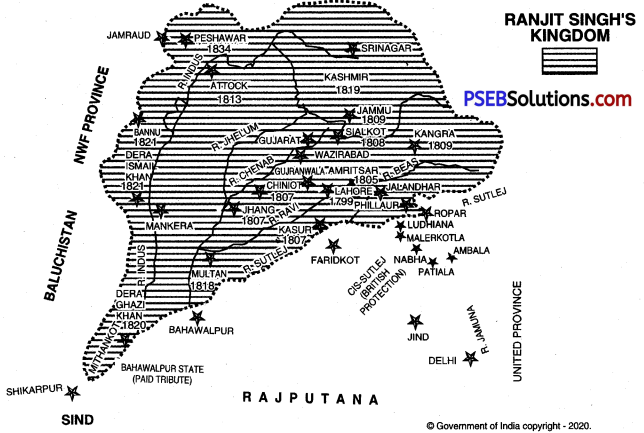
7. Warfare Preparations : The British began to make warfare preparations in order to have their conditions conceded. In February, 1809 A.D., they sent an army to Ludhiana under the command of Sir David Ochterlony. On seeing this attitude of the Britishers, Maharaja Ranjit Singh also started making preparations for warfare. Diwan Mohkam Chand who was the commander of the Maharaja’s : army was deputed to Phillaur. Maharaja Ranjit Singh even performed the ceremony of auspicious moment for starting the battle. Despite all these preparations, Maharaja Ranjit Singh at the last moment yielded to the British demands.

8. The Treaty of Amritsar 1809 A.D.: On 25th April, 1809 A.D. Maharaja Ranjit Singh signed the treaty of Amritsar with the Britishers. The treaty had the following clauses :

  • It provided for perpetual friendship between the British Government and the State of Lahore. The British agreed to have no concern with the territories and subjects of the Maharaja to the north of the river Sutlej.
  • The State of Lahore bound itself not to commit any encroachments on the possessions of the Cis-Sutlej Chiefs or to maintain in its territories more troops than were necessary for internal duties.
  • Any violation of these stipulations would render the treaty null and void.
  • The treaty having been concluded at Amritsar on 25th April, 1809 A.D. was signed by Charles Metcalfe on behalf of the British and Maharaja Ranjit Singh Qn behalf of the Lahore Darbar.

9. Disadvantages of the Treaty of Amritsar to Ranjit Singh : The Treaty of Amritsar of 1809 A.D. resulted in many disadvantages to Ranjit Singh :

  • One of the greatest cherished ideals of Ranjit Singh’s life was, that he wanted to be the sole ruler of all the Sikhs. The treaty of Amritsar shattered this dream of Ranjit Singh forever.
  • This treaty dealt a serious blow to Ranjit Singh’s power, prestige and dig¬nity. This treaty proved that the power and position of the Britishers were much more than that of Ranjit Singh.
  • With the treaty of Amritsar, the Britishers came closer to Punjab. From this point of view, the ultimate effect of the treaty of Amritsar proved disastrous for Ranjit Singh’s empire.
  • The treaty of Amritsar had put a check on Maharaja Ranjit Singh from taking possession of the Cis-Sutlej areas. So, a big chunk of Punjab could not be¬come the part of his kingdom. In this way, Maharaja Ranjit Singh had to suffer not only a great territorial but economic loss also.

10. Advantages of the Treaty of Amritsar to Ranjit Singh: The signing of the Treaty of Amritsar in 1809 A.D. had some advantages to Ranjit Singh :

  • By signing the treaty with the British, Maharaja Ranjit Singh saved the Punjab state from ruin. If Ranjit Singh had challenged the Britishers at that time, he would certainly have lost his kingdom.
  • The Treaty of Amritsar proved useful for Ranjit Singh. Owing to the treaty, the eastern boundary of Ranjit Singh’s empire became secure. As a result, Ranjit Singh could include Attock, Multan, Kashmir, Derajat and Peshawar to Punjab.

11. Advantages of the Treaty of Amritsar to the British: By signing the Treaty of Amritsar in 1809 A.D. the British got the ahead advantages :

  • The Treaty of Amritsar was a big diplomatic victory for the British. They stopped Ranjit Singh from advancing towards the east, even without firing a shot.
  • By the Treaty of Amritsar, the Britishers made many territorial gains. Without fighting any battle with Ranjit Singh, they could extend the boundaries of their empire from Jamuna to river Sutlej. It added to the stature of the British East India Company a great deal.
  • Because of the Treaty of Amritsar, friendly relations were established between the British and Ranjit Singh. The British felt no danger from the Sikhs. They devoted their whole attention to crushing other powers in India. Soon, they were able to bring the Marathas, the Pindaries and the Gorkhas under their submission.
  • Another advantage which the Britishers had by signing the Treaty of Amritsar, was that Punjab became a buffer state between Afghanistan and British India. Consequently, the British were able to rid themselves of the prob¬lems of North-West Frontiers.

PSEB 12th Class History Solutions Chapter 18 Anglo-Sikh Relations 1800-1839 A.D.

Question 2.
Describe the Anglo-Sikh relations between 1809-1839 A.D.
Or
Give the main features of the relations between Maharaja Ranjit Singh and the British during 1809-1839 AD.
Or
Critically discuss the Anglo-Sikh relations from 1809 to 1839 A.D.
Answer:
The Treaty of Amritsar was signed between the British and Maharaja Ranjit Singh on 25th April 1809 A.D. It proved a new turning point in their relations. A brief account of these relations is as follows:

1. Period of some Distrust and Suspicion: Despite the Treaty of Amritsar, the state of distrust and suspicion continued between the British and Maharaja Ranjit Singh between 1809 A.D. and 1812 A.D. Each side entertained imaginary apprehensions. They left spying agents in order to know the military and diplo¬matic moves of each other. The spies made exaggerated reports to their governments. In order to deal with the situation, the British set up a powerful military cantonment at Ludhiana. On the other hand, Maharaja Ranjit Singh got a fort constructed at Phillaur and kept a heavy force in it.

2. Improvement in the Relations: Gradually the doubts between Maharaja Ranjit Singh and the British began to disappear. In 1812 A.D. Maharaja Ranjit Singh invited David Ochterlony to attend the marriage of Prince Kharak Singh. He was given a warm welcome when he reached the Lahore Darbar. During 1812 A.D. and 1821 A.D. the Britishers and Maharaja Ranjit Singh adopted a neutral policy and did not interfere in each other’s affairs. So, the tension, if any in their relations disappeared.

3. Problem of Wadni: In 1822 A.D. the relations between the British and Maharaja Ranjit Singh became strained over the ownership of village Wadi. At the insistence of Sada Kaur, the Britishers drove out Ranjit Singh’s forces from Wadi. Ranjit Singh felt enraged at it, but he prudently avoided the collision with the British.

4. Cordiality Restored 1824-30 A.D.: In 1823 A.D. Captain Wade, the new political agent at Ludhiana had accepted Ranjit Singh’s claim over Wadni. In this way, once again cordial relations began to develop between the British and the Sikhs. When in 1824. A.D. the Nepal government sought Ranjit Singh’s help against the British, he declined it. Likewise, in 1825 A.D. Maharaja Ranjit Singh refused to help the ruler of Bharatpur against the British. In 1826 A.D., when Maharaja Ranjit Singh fell ill, the Britishers sent Dr. Murray for his treatment. In this way, a marked improvement took place in the relations between the two.

5. Question of Sind : The area of Sind was geographically and commercially very significant. So both Maharaja Ranjit Singh and the British were keen in con¬trolling it. In 1831 A.D. the British sent Alexander Burns to gather information about Sind. In order that Maharaja Ranjit Singh might not develop any doubt, he was invited to Ropar to hold a meeting with the Governor-General William Bentinck. This meeting was held on 26th October, 1831 A.D. The Britishers very cleverly kept him absorbed in talks. On the other hand, the English suc¬ceeded in signing a commercial treaty with Sind in 1832 A.D. It led to bitterness between their relations.

6. Question of Shikarpur : The question of Shikarpur further widened the gulf between Maharaja Ranjit Singh and the British. The Shikarpur area was also significant from the commercial and geographical point of view. In 1836 A.D., when Majari tribe attacked the frontier state of Ranjit Singh, he defeated them and captured Shikarpur. At that time an English troop under Wade, also reached there. They forced Ranjit Singh to vacate Shikarpur. Ranjit Singh was compelled to re¬treat because he did not want to fight with the Britishers.

7. Question of Ferozepur : The Britishers wanted to bring Ferozepur under their control. Therefore, they forcibly took possession of Ferbzepur in 1835 A.D. In 1838 A.D., the Britishers set up a big military cantonmen.t here. Although Ranjit Singh expressed his resentment over the seizure of Ferozepur but the British did not bother about it. The Maharaja had to just swallow his pride.

8. Tripartite Treaty : In 1837 A.D., Russia was fast advancing towards Asia. The Britishers feared that Russia might invade India through Afghanistan. In order to prevent this attack and to depose the ruler of Afghanistan, Dost Mohammad Khan, the British signed the tripartite treaty on 26th June, 1838 A.D. with the ex-ruler of Afghanistan Shah Shuja and Maharaja Ranjit Singh. Maharaja Ranjit Singh was not interested in signing this treaty but he was forced to do so by the British. The tripartite treaty was a great diplomatic defeat of Maharaja Ranjit Singh. He was yet thinking of taking revenge of this humiliation when he died on 27th June, 1839 A.D.

An Estimate of Ranjit Singh’s Policy Towards The British The historians differ over the policy adopted by Maharaja Ranjit Singh towards the British. Some historians hold the view that Maharaja Ranjit Singh gave proof of his sagacity and far-sightedness by not fighting with the Britishers. Ranjit Singh knew very well the power of the Britishers and did not want to see an abrupt end of the Khalsa Raj. Secondly, owing to his friendship with the British, he was able to expand the Sikh state a great deal towards North-West.

On the other hand some other historians have strongly criticised the policy of Ranjit Singh towards the British. They hold the view that Ranjit Singh had adpoted the policy of yielding to the British from 1809 A.D. till the end of his life. In 1809 A.D., through the treaty of Amritsar, Maharaja Ranjit Singh was forced to withdraw his forces from the areas beyond Sutlej. In the matter of Sind, Shikarpur and Ferozepur, he had been grievously insulted. The tripartite treaty had been forcibly imposed on him. Ranjit Singh’s words “All will turn red” bear witness to his cowardliness.

To submit to the cruel and the brutal all the time can’t be termed either just or worthy. It was, indeed, his greatest political blunder. Dr. N.K. Sinha aptly says, “Perhaps with the solicitude inherent in all’ builders he feared to ex¬pose the kingdom, he had created, to the risks of war and chose instead the policy of yielding, yielding and yielding.”

Question 3.
Discuss the relations of Ranjit Singh with the British from 1800 to 1839 A.D.
Or
Give a brief account of Anglo-Sikh relations between 1800 to 1839 A.D.
Or
Briefly describe the relations between Maharaja Ranjit Singh and the British during 1800 to 1839 A.D. Did Maharaja adopt the policy of yielding to the British?
Or
What type of relations existed between Maharaja Ranjit Singh and East India Company?
Answer:
For answer to this question students are requested to see the answers of Question Nos.l and 2.

PSEB 12th Class History Solutions Chapter 18 Anglo-Sikh Relations 1800-1839 A.D.

Short Answer Type Questions:

Question 1.
Who was Jaswant Rao Holkar? Why did Maharaja Ranjit Singh not help him?
Answer:
Jaswant Rao Holkar was a Maratha Chief. In 1805 A.D. he was defeated by the British. So he came to Punjab to seek Maharaja Ranjit Singh’s help against the British. Maharaja Ranjit Singh did not agree to extend his active help against the British, due to these reasons :

  • Maharaja Ranjit Singh was dreaded to see the discipline of the British army,
  • Gurmata of the Sikh Sardars at Amritsar, decided that any help extended to Holkar might prove disastrous for the Lahore Raj.
  • Maharaja Ranjit Singh did not want to convert Punjab into an arena of the battlefield.

Question 2. Describe the circumstances of the Treaty of Amritsar.
Or
Study the circumstances leading to the Treaty of Amritsar.
Or
Describe the Anglo-Sikh relations between 1800 to 1809.
Answer:
Maharaja Ranjit Singh wanted to bring all the Sikh states under him. So, he invaded the Malwa region twice in 1806 A.D. and 1807 A.D. He conquered many regions. The conversation between Ranjit Singh and Charles Metcalfe in 1808 A.D. failed. Ranjit Singh attacked Malwa for the third time in 1808 A.D. Now the English started military preparations to make Ranjit Singh accept their conditions. As a result, a treaty was signed between Ranjit Singh and the English on April 25, 1809 A.D. It was known as the Treaty of Amritsar.

Question 3.
What were the three conditions of the Treaty of Amritsar?
Answer:

  • It provided for perpetual friendship between the British govt, and the state of Lahore,
  • The state of Lahore bound itself not to maintain in its territories more troops than were necessary for internal duties.
  • The British agreed to have no concern with the territories and subjects of the Maharaja to the north of River Sutlej.

Question 4.
Describe the significance of the Treaty of Amritsar signed between Ranjit Singh and the English.
Or
Give the historical significance of the Treaty of Amritsar (1809).
Or
Write the main clauses and importance of the Amritsar Treaty.
Or
Mention the terms and significance of the Treaty of Amritsar.
Or
What was the significance of the Treaty of Amritsar?
Answer:
The Treaty of Amritsar was signed on April 25,1809 A.D. between Maharaja Ranjit Singh and the English. According to this treaty Maharaja Ranjit Singh accepted Sutlej as the eastern boundary of his empire. As such his dream to become the emperor of all the Sikh states was shattered for ever. It caused not only political but also economic loss to Ranjit Singh. But this treaty proved useful to the Maharaja in protecting his newly established kingdom from the powerful English. This treaty enhanced the prestige of the English to a great extent.

Question 5.
Why was tension created between the English and Maharaja Ranjit Singh over the Sind tangle?
Answer:
Sind was very important from geographical and commercial point of view. So both, the English and Maharaja Ranjit Singh wanted to bring it under their control. Colonel Pottinger succeeded in signing a commercial treaty with the Amirs of Sind in 1832 A.D. In 1838 A.D., the English signed another treaty with the Amirs of Sind. Consequently, Sind came under the influence of the English. Maharaja could not swallow this bitter pill but he did not dare to take any step against the English.

Question 6.
Why was tension created between Maharaja Ranjit Singh and the English over Ferozepur.
Answer:
The British wanted to bring Ferozepur under their control. They could keep an eye on Ranjit Singh’s activities from here. Moreover, Ferozepur could help them in surrounding Punjab. The British forcibly brought Ferozepur under their control in 1835 A.D. and set up their military contonment there in 1838 A.D. Ranjit Singh was annoyed over it but the English never bothered about it.

Question 7.
Write a brief note on Tri-partite Treaty and its significance.
Or
Write a short note on Tri-partite Treaty.
Answer:
Russia was fast advancing to Asia in 1837 A.D. At such a time, a Tri¬partite Treaty was signed among the English, Maharaja Ranjit Singh and Shah Shuja on June 26, 1838 A.D. According to this treaty it was decided to make Shah Shuja the ruler of Afghanistan. Maharaja Ranjit Singh did not want to be a part of the treaty but he was compelled to do so by the British.

Question 8.
Write about the relations between the English and the Sikhs from 1809-1839.
Answer:
On 25th April, 1809 A.D. Maharaja Ranjit Singh signed the Treaty of Amritsar with the Britishers. It provided for perpetual friendship between them as the British agreed to have no concern to the north of the river Sutlej. There was the state of distrust and suspicion between 1809 A.D. and 1830 A.D. as each side entertained imaginary apprehensions. During 1830-39 A.D. the relations between the two remained tense over the questions of Sind, Shikarpur and Ferozepur.

PSEB 12th Class History Solutions Chapter 18 Anglo-Sikh Relations 1800-1839 A.D.

Objective Type Questions:

Question 1.
When was the first contact established between the English and the Sikhs?
Or
When did the English and Maharaja Ranjit Singh come into contact with each other? ‘
Answer:
In 1800 A.D.

Question 2.
Who was Yusuf Ali?
Answer:
The English sent Yusuf Ali to Lahore Darbar as their emissary in 1800 A.D.

Question 3.
When did the Maratha leader, Jaswant Rao Holkar come to Punjab?
Answer:
1805 A.D.

Question 4.
When was the treaty of friendship was first signed between Maharaja Ranjit Singh and the British?
Answer:
In 1806 A.D.

Question 5.
State any one term of the Treaty of Lahore of 1806 A.D.
Answer:
Maharaja Ranjit Singh would not help Holkar.

Question 6.
Who was Charles Metcalfe?
Answer:
He was a British official.

Question 7.
How many times Charles Metcalfe and Maharaja Ranjit Singh met?
Answer:
Two.

Question 8.
How many times and when did Maharaja Ranjit Singh attack Malwa?
Answer:
Three times between 1806 to 1808 A.D.

Question 9.
When did Maharaja Ranjit Singh attack Malwa for the first time?
Answer:
1806 A.D.

Question 10.
Mention any one factor which led to the signing of the Treaty of Amritsar.
Answer:
The courtiers of Maharaja Ranjit Singh advised him not to engage in a conflict with the British.

Question 11.
When was the famous Treaty of Amritsar signed?
Or
When did the Treaty of Amritsar take place -?
Or
When was the ‘Treaty of Amritsar’ settled?
Answer:
April 25, 1809 A.D.

Question 12.
Give any one main clause of the Treaty of Amritsar.
Answer:
There will be fast friendship between the British Government and the Lahore Darbar.

Question 13.
What was the loss of Treaty of Amritsar to Maharaja Ranjit Singh?
Answer:
It dashed all the hopes of Maharaja Ranjit Singh’s ever becoming the emperor of the Sikhs.

PSEB 12th Class History Solutions Chapter 18 Anglo-Sikh Relations 1800-1839 A.D.

Question 14.
Name any one advantage of the Treaty of Amritsar for Maharaja Ranjit Singh?
Or
What was the advantage of the Treaty of Amritsar for Maharaja Ranjit Singh?
Answer:
It saved the infant kingdom of Maharaja Ranjit Singh from premature end.

Question 15.
Name any one advantage of the Treaty of Amritsar for the English.
Answer:
It greatly enhanced the prestige of the English.

Question 16.
When did the relations between Maharaja Ranjit Singh and the British strain over Wadni?
Answer:
In 1822 A.D.

Question 17.
In 1823 A.D. who was appointed the new political agent at Ludhiana?
Answer:
Captain Wade.

Question 18.
In 1826 which British doctor treated Maharaja Ranjit Singh?
Answer:
Dr. Murray.

Question 19.
When did Maharaja Ranjit Singh meet William Bentinck?
Or
When did Maharaja Ranjit Singh meet the British Governor General?
Answer:
October 26, 1831 A.D.

Question 20.
Where did Maharaja Ranjit Singh meet the British Governor General?
Answer:
Ropar.

Question 21.
Whom did the English send for signing a treaty with Sind?
Answer:
Col. Pottinger.

Question 22.
When did the English occupy Ferozepur?
Answer:
1835 A.D.

Question 23.
When was the Tripartite Treaty signed?
Answer:
June 26, 1838 A.D.

Fill in the blanks:

1. Mission of Yusuf Ali came to Punjab in ……………..
Answer:
1800 A.D.

2. Jaswant Rao Holkar came to Punjab in ……………
Answer:
1805 A.D.

3. The Treaty of Lahore was signed between the English and Maharaja Ranjit Singh in …………….. A.D.
Answer:
1806 A.D.

4. Maharaja Ranjit Singh attacked Malwa in ………….. for the first time.
Answer:
1806 A.D.

5. Maharaja Ranjit Singh attacked Malwa in …………. for the third time.
Answer:
1808 A.D.

6. Charles Metcalfe met Ranjit Singh at ………….. for the second time.
Answer:
Amritsar

PSEB 12th Class History Solutions Chapter 18 Anglo-Sikh Relations 1800-1839 A.D.

7. The Treaty of Amritsar was signed by the English and Maharaja Ranjit Singh on ……………….
Answer;
April 25, 1809 A.D.

8. According to the Treaty of Amritsar, …………… was boundary between the British and Maharaja Ranjit Singh.
Answer:
Sutlej

9. Maharaja Ranjit Singh met William Bentinck in 1831 at ……………..
Answer:
Ropar

10. The Tripartite Treaty was signed between Maharaja Ranjit Singh, Shaji Shuja and the English in ………..
Answer:
1838 A.D.

True or False:

1. Yusuf Ali Misson came to Punjab in 1800 A.D.
Answer:
True

2. The Maratha leader Jaswant Rao Holkar came to Punjab in 1805 A.D.
Answer:
True

3. The Treaty of Lahore was signed between the English and Maharaja Ranjit Singh in 1805 A.D.
Answer:
False

4. Maharaja Ranjit Singh attacked Malwa in 1806 A.D. for the first time.
Answer:
True

5. In 1808 A.D. Charles Metcalfe met Maharaja Ranjit Singh at Khem Karan.
Answer:
True

6. On April 25, 1809 A.D. Maharaja Ranjit Singh and the Britishers signed the Treaty of Amritsar.
Answer:
True

7. The Treaty of Amritsar was a blow to Ranjit Singh’s prestige.
Answer:
True

8. In 1826 A.D., the Britishers sent Dr. Murray for the treatment of Maharaja Ranjit Singh.
Answer:
True

9. Lord William Bentinck met Maharaja Ranjit Singh in 1831 A.D. at Ropar.
Answer:
True

10. The Britishers occupied Ferozepur in 1835 A.D.
Answer:
True

11. The Tripartite Treaty was signed on 26th Jufte, 1838 A.D. between Maharaja Ranjit Singh, Shah Shuja and the British.
Answer:
True

PSEB 12th Class History Solutions Chapter 18 Anglo-Sikh Relations 1800-1839 A.D.

Multiple Choice Questions:

1. When did the Maratha leader, Jaswant Rao Holkar come to Punjab?
(a) 1801 A.D.
(b) 1802 A.D.
(c) 1805 A.D.
(d) 1809 A.D.
Answer:
(c) 1805 A.D.

2. When was the first treaty signed between the English and Maharaja Ranjit Singh?
(a) 1805 A.D.
(b) 1806 A.D.
(c) 1807 A.D.
(d) 1809 A.D.
Answer:
(b) 1806 A.D.

3. How many times did Maharaja Ranjit Singh attack Malwa?
(a) Twice
(b) Three times
(c) Four times
(d) Five times.
Answer:
(b) Three times

4. When did Maharaja Ranjit Singh attack Malwa for the first time?
(a) 1805 A,D.
(b) 1806 A.D.
(c) 1807 A.D.
(d) 1809 A.D.
Answer:
(b) 1806 A.D.

5. Where did Charles Metcalfe meet Maharaja Ranjit Singh for the first time?
(a) Ludhiana
(b) Amritsar
(c) Lahore
(d) Khem Karan.
Answer:
(d) Khem Karan.

6. When did Treaty of Amritsar take place between Maharaja Ranjit Singh and the English?
(a) 1805 A.D.
(b) 1809 A.D.
(c) 1812 A.D.
(d) 1821 A.D.
Answer:
(b) 1809 A.D.

7. Which river was made the boundary between the British Empire and Maharaja Ranjit Singh by the Treaty of Amritsar in 1809 A.D.?
(a) Beas River
(b) Sutlej River
(c) Ravi River
(d) Jhelum River.
Answer:
(b) Sutlej River

8. When did meeting between Maharaja Ranjit Singh and William Bentinck take place?
(a) 1809 A.D.
(b) 1811 A.D.
(c) 1821 A.D.
(d) 1831 A.D.
Answer:
(d) 1831 A.D.

9. Where did the Maharaja Ranjit Singh 3jid William Bentinck met?
(a) Amritsar
(b) Ludhiana.
(c) Ropar
(d) Lahore.
Answer:
(c) Ropar

10. When did the English sign a treaty with Amirs of Sind?
(a) 1829 A.D.
(b) 1830 A.D.
(c) 1831 A.D.
(d) 1832 A.D.
Answer:
(d) 1832 A.D.

11. When was the Tripartite Treaty signed?
(a) 1839 A.D.
(b) 1845 A.D.
(c) 1838 A.D.
(d) 1809 A.D.
Answer:
(c) 1838 A.D.

PSEB 12th Class History Solutions Chapter 17 Maharaja Ranjit Singh’s Career and Conquests

Punjab State Board PSEB 12th Class History Book Solutions Chapter 17 Maharaja Ranjit Singh’s Career and Conquests Textbook Exercise Questions and Answers.

PSEB Solutions for Class 12 History Chapter 17 Maharaja Ranjit Singh’s Career and Conquests

Long Answer Type Questions:

Question 1.
Give a brief account of the career of Maharaja Ranjit Songh.
Or
Describe briefly the life of Maharaja Ranjit Singh.
Answer:
Maharaja Ranjit Singh was born in 1780 A.D. His father, Mahan Singh was the Chief of the Sukarchakia Misl. When he was four years old, he fell a victim to small pox. At the age of 12, he got the first opportunity to go to the battle. Maharaja Ranjit Singh was married to Mehtab Kaur of Kanahia Misl. When Maharaja Ranjit Singh grew to be 17, he took over the charge of administration. His first and the most significant victory was that of Lahore in 1799 A.D. Conquest of Amritsar in 1805 A.D., Gujarat in 1809 A.D. and of Multan in 1818 A.D. were some of the major victories of Maharaja Ranjit Singh.

Ranjit Singh sent three expeditions to Kashmir and finally annexed it in 1819 A.D. Peshawar was also annexed in 1834 A.D. by the Maharaja. In 1805 A.D., Maharaja abolished the institution of Gurmata and became politically independent. Maharaja Ranjit Singh was also an efficient administrator. He had appointed very able and honest ministers to run the administration. He was very shrewd and far sighted diplomat. The Anglo-Sikh friendship was an evidence of his political sagacity. Maharaja Ranjit Singh passed away on 27 June, 1839 A.D.

PSEB 12th Class History Solutions Chapter 17 Maharaja Ranjit Singh’s Career and Conquests

Question 2.
What was the political condition of Punjab on the accession of Maharaja Ranjit Singh?
Or
What was the political condition of Punjab at the time when Maharaja Ranjit Singh ascended the throne?
Answer:
When Maharaja Ranjit Singh took the reins of Sukarchakia Misl in his hands in 1797 A.D., the political condition of the Punjab was deplorable. An atmosphere of complete anarchy and unrest prevailed in the Punjab. The mighty Mughal empire had crumbled to dust. On its ruins many independent small Kingdoms were established. The Sikhs had found 12 independent Misls in most parts of the Punjab.

Their unity was a thing of the past and they had started quarrelling among themselves. Shah Zaman, the niler of Kabul started invading the Punjab in order to bring it under his control. Sansar Chand, the ruler of Kangra and Bhim Sen Thapa the ruler of Nepal were on a look-out for getting control of – the Punjab. The Marathas and the English were also dreaming of bringing Punjab under their control, but they were involved with other powers of India.

Question 3.
Write a short note on Shah Zaman.
Answer:
Shah Zaman became the new ruler of Afghanistan after the death of his father, Taimur Shah in 1793 AL.D. He immediately turned his attention to recovering the Punjab from the Sikhs. With this objective he invaded the Punjab in 1793 A.D. and again in 1795 A.D., but he had to go back to Kabul leaving these expeditions. He easily occupied Lahore during his third invasion in January 1797 A.D. The Bhangi Sardars of Lahore, Lehna Singh and Gujjar Singh took to their heels as they heard of Shah Zaman’s invasion. But Shah Zaman had to go back to Kabul due to a rebellion there at that time. Taking advantage of the oppournity, the Bhangi Sardars again got hold of Lahore. In November 1798 A.D.,

once again Shah Zaman took control of Lahore. This time again he had to return to Kabul due to a rebellion. Maharaja Ranjit Singh occupied Lahore on July 7, 1799 A.D. In 1800 A.D. Shah Zaman lost his empire in a coup.

Question 4.
Explain briefly any five conquests of Maharaja Ranjit Singh.
Answer:
Undoubtedly Maharaja Ranjit Singh was the greatest ruler of Punjab. By his ability and efforts he converted his small kingdom into a vast empire during his reign (1799-1839). His main conquests are mentioned below:

1. Conquest of Lahore, 1799 A.D.: The first and the most important conquest of Maharaja Ranjit Singh was the conquest of Lahore. The three Bhangi Sardars and Sahib Singh, Mohar Singh and Chet Singh jointly ruled Lahore. People were very unhappy due to their tyrannical rule, so they invited Ranjit Singh to take over Lahore. Deeming it a golden chance, Ranjit Singh invaded Lahore and occupied it on July 7, 1799 A.D.

2. Conquest of Amritsar, 1805 A.D.: The city of Amritsar was very important for the Sikhs from the religious point of view. It was considered the Mecca of the Sikhs. It was also the most famous trade centre. In order to be an emperor of the Punjab, the control over Amritsar was essential. In 1805 A.D. Ranjit Singh invaded Amritsar and defeated Mai Sukhan, the widow of Gulab Singh. In this way, Amritsar was conquered.

3. Conquest of Multan, 1818 A.D.: Multan was very important from trade and geographical point of view. Sind could be easily conquered by having a control over Multan. The Maharaja had to attack seven times to conquer Multan. Every time, Muzaffar Khan the ruler of Multan evaded Maharaja Ranjit Singh by offering him a heavy ransom. In 1818 A.D. Maharaja Ranjit Singh resolved to make a conquest of Multan. He sent a vast army under ‘the command of Misar Diwan Chand. After a pitched battle the army of Maharaja Ranjit Singh conquered Multan. It was indeed one of the important conquests of Maharaja Ranjit Singh.

4. Conquest of Kashmir, 1819 A.D.: The valley of Kashmir was famous for its scenic beauty and trade. Ranjit Singh tried to conquer it in 1813 and 1814 A.D. but did not succeed. The conquest of Multan greatly encouraged Maharaja Ranjit Singh. He sent a huge army under the command of Misar Diwan Chand to conquer Kashmir. This army defeated Jabbar Khan, the ruler of Kashmir and occupied Kashmir in 1819 A.D.

5. Conquest of Peshawar, 1834 A.D : Peshawar was an important region from the geographical point of view. In his first expedition in 1818 A.D. Maharaja Ranjit Singh had defeated Yar Mohammad Khan and Dost Mohammad Khan but he resolved not to include Peshawar in his empire. In 1823 A.D., Azim Khan, a minister of Afghanistan took over the control of Peshawar. Maharaja Ranjit Singh defeated him in a pitched battle of Naushehra and again got control over Peshawar. He annexed Peshawar to his empire in 1834 A.D.

PSEB 12th Class History Solutions Chapter 17 Maharaja Ranjit Singh’s Career and Conquests

Question 5.
Give a brief account of the conquest of Lahore by Ranjit Singh and its significance.
Or
Write a brief note on Maharaja Ranjit Singh’s conquest of Lahore.
Or
What was the importance of Maharaja Ranjit Singh’s Lahore conquest?
Answer:
The conquest of Lahore was the first important political achievement of X Maharaja Ranjit Singh. Lahore assumed great importance, being the biggest and oldest city of the Punjab. Besides, it had been the capital of the Punjab since long. Three Bhangi Sardars, Sahib Singh, Mohar Singh and Chet Singh jointly ruled over it. People were very unhappy due to their oppressive rule. In November 1798 A.D., Shah Zaman, the ruler of Kabul had conquered Lahore but he had to go back due to a mutiny in Kabul. Taking advantage of this opportunity, the Bhangi Sardars had again brought Lahore under their control.

As people there were fed up with their misdeeds, they invited Maharaja Ranjit Singh to take control of Lahore. Ranjit Singh with the help of his mother-in-law, Sada Kaur attacked Lahore. On hearing the news of invasion, Sahib Singh and Mohar Singh fled in panic. Chet Singh gave in after a short while. In this way, Ranjit Singh brought Lahore under his control on July 7, 1799 A. D. It laid the foundation of a sovereign Sikh monarchy in Punjab.

Question 6.
Write a short note ‘on the battle of Bhasin.
Answer:
The occupation of Lahore by Ranjit Singh aroused the jealousies among the leading chiefs of Punjab. Jassa Singh Ramgarhia, Sahib Singh Bhangi of Gujarat, Gulab Singh Bhangi of Amritsgfr, Jodh Singh of Wazirabad and Nizam- ud-Din of Kasur made a united front against Ranjit Singh. The joint forces under the command of Gulab Singh Bhangi assembled at Bhasin near Lahore. Ranjit Singh too reached Bhasin to face them.

For about two months, neither side dared to attack. Unexpectedly one day Gulab Singh Bhangi died of over-drifliking. It demoralised the opponents of Ranjit Singh and they fled away from the battlefield. In this way Ranjit Singh scored a victory without shedding a drop of blood. Xhis ‘ victory to Ranjit Singh warded off his great danger. It also strengthened his hold over Lahore.

Question 7.
Describe briefly about the conquest of Amritsar by Maharaja Ranjit Singh and its importance.
Or
Discuss briefly the significance of the conquest of Amritsar.
Answer:
The city of Amritsar was of. great religious importance to the Sikhs. It was the Mecca of the Sikhs. Besides, it was also the most famous trade centre of the Punjab. It was very essential for Ranjit Singh to take control of Amritsar in order to become Maharaja of the Punjab. Mai Sukhan, widow of Gulab Singh was ruling over Amritsar as the guardian of her minor son Gurdit Singh. In 1805 A.D., Maharaja Ranjit Singh asked her to hand over the fort of Lohgarh and famous gun Zamzama to him.

Mai Sukhan refused to accept the proposal, so Maharaja Ranjit Singh attacked Amritsar, along with his mother-in-law Sada Kaur and Fateh Singh Ahluwalia. After a short resistance, Mai Sukhan accepted defeat. In this way, in 1805 A.D. Maharaja Ranjit Singh got control over Amritsar. With the conquest of Amritsar, Maharaja Ranjit Singh’s fa’me spread far and wide.

PSEB 12th Class History Solutions Chapter 17 Maharaja Ranjit Singh’s Career and Conquests

Question 8.
How did Maharaja Ranjit Singh conquer Multan?
Answer:
Multan was important from geographic and economic point of view. Hence, Maharaja Ranjit Singh wanted to conquer it. Multan was under the rule of Afghan Governor, Nawab Muzaffar Khan. As such he was under the rule of the Kabul Government, but in reality he was ruling independently. From 1802 A.D. to 1817 A.D., Maharaja Ranjit Singh sent six expeditions to Multan. Each time Nawab Muzaffar Khan avoided the army of Ranjit Singh with a Nazrana. In 1818 A.D. Maharaja decided to conquer Multan. He started preparing for an attack on Multan on a large scale.

Misar Diwan Chanid, who was one of the popular generals of the Maharaja, was sent to conquer Multan with an army of 20,000 soldiers in January 1818 A.D. On the other hand, Nawab Muzaffar Khan started preparing to face the armies of the Maharaja. He declared a religious war (Jihad) against the Sikhs.

The siege to Multan continued for four months but the Sikhs were not successful in capturing the fort. On 2nd June, 1818 A.D., the Akali leader Sadhu Singh was successful in entering the fort with some of his companions. Behind him, the Sikh armies also entered the fort. Nawab Muzaffar Khan and his sons valiantly faced them. In the end, Muzaffar Khan and his five sons were killed. His sixth son was wounded and rest ef the two asked for forgiveness.

Thus, the Sikh army occupied Multan. When Maharaja Ranjit Singh received the news of this important victory, he was pleased. Festivities took place to celebrate this victory for days on end. Misar Diwan Chand was bestowed upon with the title of ‘Zafar Jang’.

Question 9.
Describe the significance of Maharaja Ranjit Singh’s conquest of Multan.
Answer:
The conquest of Multan was one of the significant conquests of Maharaja Ranjit Singh. The importance of this conquest can be gauged from the facts given below:

1. A death blow to the Afghan Power : The conquest of Multan sounded the death knell of Afghan influence in the Punjab. There was a time when the Sikhs would run to the forests and hills on hearing the news of Ahmad Shah Abdali’s invasion because at that time it was not possible for them to face a direct clash with the AfghAnswer: The conquest of Multan turned the tables. This conquest marked an end to the Afghan power in the Punjab and proved that the Sikhs were far more powerful than the Afghans.

2. Multan stood like a wall between Sind and Bahawalpur : With the occupation of Multan by Ranjit Singh, the Muslims of Sind and Bahawalpur were separated. With this separation, they could not form a joint front against Ranjit Singh. In this way, Multan stood like a wall between Sind and Bahawalpur.

3. Some Small Muslim States accepted the Submission of Ranjit Singh: Another important result of the conquest of Multan by Maharaja Ranjit Singh was that the Muslim rulers of some small states like Bahawalpur, Derajat, Dera Ghazi Khan and Dera Ismail Khan were terrified and so they accepted the suzerainty of Maharaja Ranjit Singh.

4. Increase in the Revenue : The land of Multan was very fertile. So with its victory, Ranjit Singh’s revenue increased a great deal. The record of the Khalsa Darbar shows that Ranjit Singh received Rs. 7 lakhs per annum as revenue from Multan. With this money Ranjit Singh got the opportunity to execute his future
plans.

5. Commercial Advantage : The conquest of Multan proved useful from commercial point of view. The trade of India with Afghanistan and the Central Asia was carried on through Multan. With Ranjit Singh’s control over this important centre of trade, the trade of Punjab was greatly encouraged.

Question 10.
How did Maharaja Ranjit Singh conquer Kashmir?
Answer:
Kashmir was very famous for its natural beauty and trade. So Maharaja Ranjit Singh wanted to bring Kashmir under his control. Right at that time Fateh Khan, a minister of Kabul, was also planning to conquer Kashmir. As both of them were not in a position to conquer Kashmir individually, they made an agreement at Rohtas. According to this agreement,

Maharaja Ranjit Singh decided to send 12,000 soldiers under the command of Diwan Mohkam Chand to assist Fateh Khan. On the other hand Fateh Khan agreed to give 1/3 of the conquered area and the booty. In 1813 A.D. both the armies marched to Kashmir. Ata Mohammad Khan, Governor of Kashmir advanced to face the joint forces.

But he was defeated in a battle at Shergarh. After conquering Kashmir, Fateh Khan gave, Maharaja Ranjit Singh nothing. In 1814 A.D. Maharaja Ranjit Singh invaded Kashmir for the second time. He had to face defeat in this expedition. Emboldened by the victory of Multan in 1818 A.D. Maharaja Ranjit Singh invaded Kashmir in 1819 A.D. for the third time. In a battle at Supin which was fought on 5th July, 1819 A.D. Jabbar Khan, the then Governor of Kashmir; suffered a defeat. In this way, Maharaja Ranjit Singh succeeded in bringing Kashmir under his control.

PSEB 12th Class History Solutions Chapter 17 Maharaja Ranjit Singh’s Career and Conquests

Question 11.
Describe the significance of Maharaja Ranjit Singh’s conquest of Kashmir.
Answer:
1. It increased the prestage of Maharaja Ranjit Singh; The conquest of Kashmir was a very significant conquest of Maharaja Ranjit Singh. It greatly increased his prestige and pride. His supremacy was accepted beyond Leh, Lhasa and mountains of Kara Kurram. His frontier in the north had reached its natural bounds.

2. It gave a rude jolt to the Afghan power. The control of Kashmir by the Sikhs dealt a severe blow to the Afghan influence in India and it encouraged the morale of Sikh forces.

3. It increased the income of the Government. The conquest of Kashmir resulted in economic gain to the Maharaja. This province yielded annual income of 40,00,000 rupees to Maharaja Ranjit Singh.

4. It encouraged the Trade. The conquest of Kashmir was also useful from a commercial point of view. Kashmir was famous in the world for its shawl industry. Besides, Kashmir was also famous for fruits of many types, and for its forests. With the annextion of Kashmir to the Panjab its trade got great impetus.

Question 12.
Write a brief note on the battle of Naushehra or Tibba Tehri.
Answer:
Azim Khan, the ruler of Kabul had invaded and conquered Peshawar in January 1823 A.D. He declared Jihad (religious war) against the Sikhs, as a result of which many Afghans swarmed under his banner. On the other hand, Maharaja Ranjit Singh sent a vast army of 20,000 to face the army of Azim Khan. Hari Singh Nalwa, General Allard, General Ventura, Akali Phula Singh, Fateh Singh Ahluwalia and prince Kharak Singh were sent along with this army.

Maharaja Ranjit Singh himself commanded this expedition. A fierce battle took place between the two armies at Naushehra or Tibba Tehri on March 14,1823 A.D.

Azim Khan had also about 20,000 soldiers. In the beginning of the battle, the Afghans had the upper hand. Akali Phula Singh and many other famous warriors were killed in this battle. At this juncture, Maharaja Ranjit Singh infused a new spirit and dynamism into his army. Now the Sikhs attacked the Afghans so vigorously that the latter had to flee to save their lives. As a result pf the victory in this decisive battle the morale of Maharaja Ranjit Singh’s army was enhanced. Azim Khan soon died due to shock of his humiliating defeat in this battle.

Question 13.
Briefly write about the significance of Maharaja Ranjit Singh’s conquest of Peshawar.
Answer:
Maharaja Ranjit Singh’s conquest of Peshawar was one of the most significant conquests. This conquest greatly enhanced the prestige of Maharaja Ranjit Singh. The influence of his military power was acknowledged all over India and his empire also expanded. It sounded the death knell of Afghan supremacy beyond the river Indus,

The Punjabis heaved a sigh of relief after 8 centuries when Maharaja Ranjit Singh conquered Peshawar, because the Muslim invaders invaded Punjab and other parts of India through this route. These invasions had created the atmosphere of unrest and anarchy in India.The danger of these invasions disappeared with Maharaja Ranjit Singh’s conquest of Peshawar. This conquest also proved economically useful to Maharaja Ranjit Singh. Peshawar yielded about 12 lakh rupees annual income to Maharaja Ranjit Singh.

PSEB 12th Class History Solutions Chapter 17 Maharaja Ranjit Singh’s Career and Conquests

Question 14.
What policy did Maharaja Ranjit Singh adopt towards the defeated rulers?
Answer:
Maharaja Ranjit Singh not only brought several states under his control but also adopted a successful administrative policy. This policy was uniformly applied to all the rulers, may they be Sikhs, Hindus or the Muslims. Many rulers, who accepted the suzereinty of Ranjit Singh were returned their states. Those rulers whose areas were annexed to his empire, were given some posts in the Maharaja’s Darbar or given suitable Jagirs enough for their living.

A stern policy was adopted against those rulers who continued to oppose Maharaja Ranjit Singh. In short the policy of kindness and leniency adopted by Maharaja Ranjit Singh towards the defeated rulers had no parallel in the history of that period.

Question 15.
What policy did Maharaja Ranjit Singh adopt towards the Sikh Misls?
Examine the Misl policy of Ranjit Singh.
Answer:
Ranjit Singh adopted a special type of policy towards the Sikh Misls. The main characteristics of this policy were as follows :

  • To give no weightage either to relationships or to sentiments in matters of state expansion.
  • Not to bother whether it is just or unjust to take possession of the areas of the Misl Sardars while expanding the state.
  • To make friendship with the powerful Misl Sardars or to establish matrimonial relations with them so that on one hand their co-operation might be extracted and on the other hand the possible formation of any powerful joint front against him might be ruled out.
  • To attack the weak Misl Sardars and annex their territories to his state.
  • On getting an opportunity to betray even the friendly Misl Sardars and annex their states to his kingdom. .
  • To do away with the important central institution i.e. the ‘Gurmata’ so that no Misldar might equal Ranjit Singh.

Ranjit Singh first of all established friendly relations with the Kanahia Misl. In 1796 A.D., he married Mehtab Kaur, the daughter of late Gurbaksh Singh. At Tarn Taran in 1798 A.D., Ranjit Singh made his second marriage with Raj Kaur. In 1801 A.D. Ranjit Singh and Fateh Singh exchanged turbans and took an oath in the presence of the Guru Granth Sahib Ji that they would live like brothers and stand by each other through thick and thin.

Afterwards Fateh Singh rendered yeoman’s contribution in several campaigns of Ranjit Singh. On the other hand he attacked the weak misls and attached them to his kingdom. In July 1799 A.D., Ranjit Singh conquered Lahore from the Bhangi Sardars. After this, he conquered Dallewalia Misl, Karor Singhia Misl, Nakkai Misl and Faizalpuria Misl. When Maharaja Ranjit Singh became confident that his state had grown powerful, he deemed it fit to change his policy towards the friendly Misls.

Essay Type Questions:

Early Career Of Maharaja Ranjit Singh:

Question 1.
Describe the early life of Maharaja Ranjit Singh. How far is his early life different from that of Shivaji?
Or
Describe in detail the early life of Maharaja Ranjit Singh.
Answer:
Maharaja Ranjit Singh occupies an important place in the Sikh history. By virtue of his ability he converted his small state into a vast empire. In this way, Maharaja Ranjit Singh translated the dream of Sikh Empire into a reality. A brief account of Maharaja Ranjit Singh’s early career is given ahead :

1. Birth and Parentage: Ranjit Singh was born in 1780 A.D. His father Mahan Singh was the Chief of the Sukarchakia Misl. There is a controversy among historians about the place and date of his birth. Historians like Osborne, Griffin, Mc-Gregar, Latif, Shahmat Ali and Kanahiya Lai say that his date of birth was 2nd November, 1780 A.D.

On the other hand Sohan Lai Suri, a court historian of Ranjit Singh, and Diwan Amar Nath, a contemporary historian of Ranjit Singh say that Ranjit Singh’s birthday was 13th November, 1780 A.D. Similarly there is also a difference of opinion among the historians about Ranjit Singh’s birthplace. Some historians opine that Ranjit Singh was born at Gujranwala. While on the other hand, some historians believe that Ranjit Singh was born at his maternal grandparents’ house at Badrukhan in Jind State.

Modern historians accept Gujranwala to be Ranjit Singh’s birth place. The name of Ranjit Singh’s mother was Raj Kaur. Ranjit Singh’s childhood name was Budh Singh.

2. Childhood and Education : Since Ranjit Singh was the only son of his parents he was brought up in the lap of luxury. Ranjit Singh was four years old, when he fell a victim to small-pox. Luckily, Ranjit Singh recovered after some time but the scars of the disease were left on his face and the light of his left eye was gone for ever.

When Ranjit Singh was five years old, he was sent to Bhag Singh’s ‘Dharmshala’. at Gujranwala for education. But, Ranjit Singh had no interest in studies, so, he remained illiterate all his life. Ranjit Singh spent most of his time in horse-riding, swordsmanship and shooting. As a result, with the passage of time, he became a top class horse-rider, skilful bowman and expert swordsman. Observing Ranjit Singh’s ability, his father Mahan Singh predicted,

“The state of Gujranwala will not be a sufficient place for my brave son Ranjit Singh. He would become a great warrior.”

3. Acts of bravery: Ranjit Singh was hardly 12 years old, when he got the first opportunity to go in a battle. Mahan Singh had taken his son, Ranjit Singh along with him in the campaign of Sodhran fort. Mahan Singh suddenly fell grievously ill, so he had to return from the battlefield. He handed over the command to Ranjit Singh. Ranjit Singh not only inflicted a crushing defeat on his enemies, but also robbed them of their ammunition. Mahan Singh was very happy over this victory. He changed his son’s name from Budh Singh to Ranjit Singh (the victor of battle).

In 1793 A.D., once while hunting alone Ranjit Singh reached near Ladowali village. Hashmat Khan, the Chief of the Chatha clan, on finding Ranjit Singh alone, hid himself behind a bush. When Ranjit Singh passed by the bush, Hashmat Khan dealt a powerful blow of sword to Ranjit Singh, but Ranjit Singh had a miraculous escape. He promptly counter-attacked and beheaded him

4. Marriage : Ranjit Singh was six years old, when he was engaged to the granddaughter of the Kanahia Misl Sardar, Jai Singh, and the daughter of

PSEB 12th Class History Solutions Chapter 17 Maharaja Ranjit Singh’s Career and Conquests Img 1

Gurbaksh Singh, Mehtab Kaur. In 1796 A.D. when Ranjit Singh was 16 years old, he was married with Mehtab Kaur with great pomp and show. This marriage proved very useful in the political career of Ranjit Singh. According to Griffin, Ranjit Singh had 18 Queens.

5. The Triune Regency: When Ranjit Singh was only 12 years old, his father Mahan Singh died in 1792 A.D. Since Ranjit Singh was only a minor, the task of state administration passed into the hands of his mother, Raj Kaur. Raj Kaur did not have any administrative skill, so she handed over the charge to her favourite, Diwan Lakhpat Rai. In 1796 A.D. when Ranjit Singh was married to Mehtab Kaur, his mother-in-law, Sada Kaur too began to take interest in matters of administration. In this way during 1792 A.D. to 1797 A.D. the administration of Sukarchakia Misl remained in the hands of three persons Raj Kaur, Diwan Lakhpat Rai and Sada Kaur. So, this period is called the period of the Triune Regency.

6. The end of Triune Regency: When Ranjit Singh grew to be 17, he took over the charge of administration. Some European and Muslim historians have tried without any historical facts that Ranjit Singh had got his mother Raj Kaur and Diwan Lakhpat Rai murdered because of the illicit relations between them. But Dr. N.K. Sinha, Dr. G.L. Chopra, Sita Ram Kohli and Khuswant Singh are of the opinion that the allegation of his mother’s murder against Ranjit Singh is a matter of sheer injustice. Secondly, the allegation of mother’s murder is not consistent with the character of Ranjit Singh.

As we are well aware that during his reign Ranjit Singh had never punished even a single hardcore criminal with death sentence. How such a kind ruler could murder his own mother? Dr. H.R. ‘Gupta aptly says, “The story is purely malicious and absolutely unfair and unjust.”

PSEB 12th Class History Solutions Chapter 17 Maharaja Ranjit Singh’s Career and Conquests

Political Condition Of The Punjab:

Question 2.
What was the political condition of the Punjab on the eve of Ranjit Singh’s accession? How did this condition prove helpful in his rise to power?
Or
Describe the political condition of the Punjab on the eve of Maharaja Ranjit Singh’s accession to power.
Answer:
In 1797 A.D. when Ranjit Singh took over the reins of the Sukarchakia Misl, the atmosphere of anarchy and lawlessness was prevalent in Punjab. The Mughal rule had come to an end in the Punjab and the Sikhs, Afghans and Rajputs had established their small independent states on its ruins. Thus, the political condition of the Punjab, proved eminently, suitable in the rise of Ranjit Singh to power. A brief description of the political condition at the time of Ranjit Singh’s accession to power is as follows :

The Sikh Misls:

In most parts of the Punjab, twelve independent Sikh Misls were established. It was to the good luck of Ranjit Singh that by the end of the 18th century, no Misl was left powerful enough. A brief description of the important Misls is as follows :

1. Bhangi Misl: Before the growth of Ranjit Singh’s power, the Bhangi Misl in the North-West of the Sutlej river was very powerful. The two most important towns of the Punjab, Lahore and Amritsar, were under this Misl. Besides these, the areas of Gujarat and Sialkot were also under it. Among the Bhangi Sardars Chet Singh, Sahib Singh and Mohar Singh were the prominent leaders. All these Bhangi rulers were great addicts of bhang (hemp). They spent most of their times in merry-making. Consequently, the Bhangi Misl had lost much of its previous glory and power. It was heading fast towards its end.

2. Ahluwalia Misl : The founder of the Ahluwalia Misl was Jassa Singh Ahluwalia. He was a great warrior, a valiant general and a splendid organiser. He had brought under his submission the territories situated between Jalandhar Doab and Bari Doab. He Was a very brave and fearless warrior. In 1739 A.D. when Nadir Shah was going back from India with the booty, he attacked his army and took away with much of his booty. He had defeated the forces of Ahmad Shah Abdali on a number of times. Because of these reasons, the Sikhs of the Punjab held Jassa Singh Ahluwalia in great esteem. It was fortunate for Ranjit Singh that this great warrior died in 1783 A.D. After his death Bhag Singh became his successor but he lacked the qualities of Jassa Singh Ahluwalia.

3. Kanahia Misl: The founder of the Kanahia Misl was Jai Singh Kanahia. He was very brave and courageous warrior. He had -under him the areas of Mukerian, Gurdaspur, Datarpur, Dharampur and Pathankot. Jai Singh’s son, Gurbaksh Singh was also very brave. He died in 1785 A.D. In 1796 A.D., Ramjit Singh was married to Gurbaksh Singh’s daughter, Mehtab Kaur. This marriage proved very significant for the political career of Ranjit Singh. In 1798 A.D. Jai Singh died and the reins of the Kanahia Misl fell into the hands of Gurbaksh Singh’s widow and Ranjit Singh’s mother-in-law Sada Kaur. She was a very ambitious woman.

4. Sukarchakia Misl: The founder of the Sukarchakia Misl Charat Singh was the grandfather of Ranjit Singh. He had under him Gujranwala, Eminabad and Sialkot. After the death of Charat Singh in 1774 A.D. he was succeeded by his son, Mahan Singh. He had all the qualities of a great Sardar. He expanded his Misl by conquering new areas. After the death of Mahan Singh in 1792 A.D., his son Ranjit Singh became his successor. Since Ranjit Singh was barely 12 years old at that time, the task of running the administration of the Misl fell into the hands of his mother Raj Kaur, Diwan Lakhpat Rai and mother-in-law, Sada Kaur till 1797 A.D.

5. Ramgarhia Misl: Sardar Jassa Singh Ramgarhia was a very bold and brave warrior. His rule was over Gurdaspur, Kalanaur, Batala and Qadian. It war Ranjit Singh’s good fortune that at the time of his rise, Jassa Singh Ramgarhia had grown quite old. So, he could not become a hurdle in the way of Ranjit Singh.

6. Faizalpuria Misl: Nawab Kapoor Singh was the founder of the Faizalpuria Misl. He was certainly a great Sikh leader, who ably guided the Sikhs at the most critical time. After the death of Nawab Kapoor Singh in 1753 A.D. his nephew Khushal Singh became his successor. He was a brave and able Sardar. He had expanded the Faizalpuria Misl by conquering the areas of Jalandhar, Nurpur, Beharampur, Patti etc. In 1795 A.D. after the death of Khushal Singh his son, Budh Singh ascended the throne. It was Ranjit Singh’s good fortune that Budh Singh did not prove to be a competent ruler.

7. Other Misls : Besides the above mentioned Misls, there existed the Dallewalia, Phulkian, Karorsinghia, the Nishanwalia, the Nakkai and the Shahid Misls. At the time of Ranjit Singh’s rise to power, these Misls were very weak. So, they had no significance in the politics of the Punjab.

Muslim States:

Towards the end of the 18th century, in the North-West of Punjab, the Muslims had established many independent states. The states of Kasur, Multan, Kashmir, Attock and Peshawar were famous among them. Kasur was under the rule of a Pathan ruler, Nizarp-ud-Din. At that time Multan was under Nawab Muzaffar Khan, Kashmir under Ata Mohammad Khan, Attock under Jahandad Khan and Peshawar under Fateh Khan. Besides these states, many other small Muslim states also existed. There was no unity among these Muslim rulers. A struggle for power was always going on among them. Consequently, done of them was powerful enough to create hurdles in the way of Ranjit Singh.
Hill States

To the North of Punjab several independent hill states had come into existence at the time of Ranjit Singh’s rise to power. The state of Kangra was the most famous. Kangra was under the rule of a Rajput ruler, Sansar Chand Katoch. He was dreaming of conquering the whole of Punjab. Towards the end of the 18th century the Rajput rulers were ruling hill spates like Mandi, Kulu, Chamba, Basoli, Suket, Nurpur. and Jammu. Their rulers were very weak and they kept quarrelling among one another. So, they could pose no danger to Ranjit Singh.

The Gorkhas:

The Gorkhas of Nepal were very brave. Towards the close of the 18th century, they had started expanding their power towards the Punjab. Ip 1794 A.D., they had captured Garhwal and Kumaun. Bhim Sen Thapa decided to attack the Punjab under the able leadership of his son Amar Singh Thapa. Therefore a confrontation between Ranjit Singh and the Gorkhas was imminent.

George Thomas:

George Thomas was a brave Englishman. He had established an independent state in the South-East of Punjab at Hansi. There he got constructed a fort named Georgegarh after his own name. He invaded the areas of Patiala and Jind several times and indulged in looting there. The rule of George Thomas could not last long. The French General Paron defeated him and drove him but of the Punjab. General Paron’s rule, too, did not last long.

The Marathas:

Till 1797 A.D. the Marathas under their able leader Daulat Rao Sindhia were able to capture Meerut and Delhi. He wanted to conquer Punjab. Another Maratha leader, Dhara Rao, too had made certain invasions against the South-East based Phulkian Misl of the Punjab. The Marathas could pose a serious danger to Ranjit Singh, but fortunately for Ranjit Singh, exactly at the same time the Marathas got involved with the British, who were very powerful. So, they could not pay their attention to the Punjab. ,

The British:

Towards the end of the 18th century, the power of the British had greatly increased in India. Although the British were looking greedily towards the Punjab but at that time they had locked horns with the Marathas, the Nizam of Hyderabad and many other problems. Therefore, Ranjit Singh had no immediate danger from the Britishers. »

Shah Zaiiian:

The ruler of Afghanistan, Shah Zaman, could pose a danger to the power of Ranjit Singh. He had become the new ruler of Afghanistan after the death of his father, Timur Shah in 1793 A.D. He tried to reoccupy Punjab.-With this objective, he invaded Punjab four times between 1793 and 1798 A.D. to go back to Kabul for one reason or the other. In this way, the likely danger of Shah Zaman to the power of Ranjit Singh was averted. It is obvious from the description given above that towards the end of the 18th century the political condition of the Punjab was favourable to Ranjit Singh. He took full advantage of the condition and succeeded in establishing a strong Sikh enipire.in the Punjab.

The famous historian Dr. G.L. Chopra aptly says, “Thus the political situation on the eve of the 19th century was eminently suited for the rise of a resolute and outstanding personality, who might weld these discordant elements steadily into an organised kingdom and as we shall see, Ranjit Singh availed himself of this opportunity.”

PSEB 12th Class History Solutions Chapter 17 Maharaja Ranjit Singh’s Career and Conquests

Ranjit Singh’S Policy Towards F The Sikh Misls:

Question 3.
Examine critically the Misl policy of Ranjit Singh.
Or
“Ranjit Singh’s policy was one of absorption of all the Sikh confederacies. No ties of kinship, no sentiments of gratitude were strong enough to stand in his way.” (N.K. Sinha). Explain the statement.
Or
Give an account of the salient features of the Misl policy of Ranjit Singh.
Or
Describe the relations of Maharaja Ranjit Singh with Sikh Misls.
Answer:
In 1797 A.D., when Ranjit Singh ascended the throne of Sukarchakia Misl, his kingdom was limited to a few areas only. Since Ranjit Singh was a ruler of high ambitions, he was not satisfied with this small kingdom. He wanted to convert it into a vast empire. For this purpose, he directed his attention towards the Sikh Misls in the Punjab.

Characteristics of the Misl Policy:

Ranjit Singh adopted a special type of policy towards the Sikh Misls. The main characteristics of this policy were as follows :

  • To give no weightage either to relationships or to sentiments in matters of state expansion.
  • Not to bother whether it is just or unjust to take possession of the areas of the Misl Sardars while expanding the state.
  • To make friendship with the powerful Misl Sardars o% to establish matrimonial relations with them so that on one .hand their co-operation might be extracted and on the other hand the possible formation of any powerful joint front against him might be ruled out.
  • To attack the weak Misl Sardars and annex their territories to his state.
  • On getting an opportunity to betray even the friendly Misl Sardars and annex their states to his kingdom.
  • To do away with the important central institution i.e. the ‘Gurmata’ so that no Misldar might equal Ranjit Singh.

Policy towards the Powerful Misls:

1. Matrimonial Relations with Kanahia Misl : Ranjit Singh first of all established friendly relations with the Kanahia Misl. In 1796 A.D., he married Mehtab Kaur, the daughter of late Gurbaksh Singh. In this way the unison of the two Misls strengthened Ranjit Singh’s position. Ranjit Singh’s mother-in¬law, Sada Kaur rendered him very valuable services in his conquests of Lahore, Bhasin and Amritsar.

2. Matrimonial Relations with Nakkai Misi : At Tarn Taran in 1798 A.D., Ranjit Singh made his second marriage with Raj Kaur, the daughter of Sardar Khazan Singh of the Nakkai Misl. With this marriage Ranjit Singh received the requisite co-operation from the Nakkai Misl in the expansion of his Kingdom.

3. Friendship with Fateh Singh Ahluwalia : During Ranjit Singh’s times, the Ahluwalia Misl was one of the most powerful and famous Misls. At that time, Fateh Singh Ahluwalia was the leader of the Misl. In 1801 A.D. Ranjit Singh and Fateh Singh exchanged turbans and took an oath in the presence of the Guru Granth Sahib Ji that they would live like brothers and stand by each other through thick and thin. Afterwards Fateh Singh rendered yeoman’s contribution in several campaigns of Ranjit Singh.

4. Friendship with Jodh Singh Ramgarhia : In 1803 A.D., Jodh Singh Ramgarhia became the new Sardar of the Ramgarhia Misl. Like his father, he was also very brave and valiant warrior. Acting diplomatically Ranjit Singh established friendly relations with Jodh Singh. Jodh Singh helped Ranjit Singh in many of his military campaigns.

5. Friendship with Tara Singh Gheba: Tara Singh Gheba was the leader of the Dallewalia Misl. He was brave and powerful. Ranjit Singh established friendly relations with him. Their mutual relations became so intimate that Tara Singh accompanied Ranjit Singh in many battles.

Policy towards the weak Misls:

Whereas on one hand, Ranjit Singh adopted the policy of establishing friendly relations with the powerful Misls, on the other handphe attacked the weak Misls and annexed them to his kingdom. A brief description of these Misls is as given ahead:

1. Bhangi Misl: In July 1799 A.D., Ranjit Singh conquered Lahore from the Bhangi Sardars. It was one of the most significant conquests of Ranjit Singh. In 1805 A.D., by defeating Gulab Singh Bhangi’s widow Mai Sukhan, Ranjit Singh took possession of Amritsar. Likewise by defeating Jiwan Singh Bhangi of Sialkot in 1808 A.D., and Sahib Singh Bhangi of Gujarat in 1809 A.D., he annexed their areas to his kingdom. These conquests sounded the death knell of the Bhangi Misl.

2. Dallewalia Misl: Ranjit Singh had established friendly relations with the Dallewalia Chief, Tara Singh Gheba. Tara Singh Gheba died in 1807 A.D. His last rites had not yet been performed, when Ranjit Singh sent his army to attack Dallewalia. It succeeded in occupying the Dallewalia Misl.

3. Karor Singhia Misl : In 1809 A.D., the Chief of the Karor Singhia Misl Baghel Singh died. On finding it a golden opportunity, Ranjit Singh occupied the Karor Singhia Misl.

4. Nakkai Misl: Maharaja Ranjit Singh had matrimonial relations with the Nakkai Misl. Caring little about it Ranjit Singh’s army attacked the Nakkai Misl in 1810 A.D., defeated its Chief Kahan Singh and merged his areas to his Kingdom.

5. Faizalpuria Misl: After the death of Khushal Singh in 1795 A.D., his son Budh Singh became the new Chief of the Faizalpuria Misl. He lacked the bravery and ability of his father. As a result the Faizalpuria Misl began to head towards its decline. Ranjit Singh took advantage of it and occupied it in 1811 A.D.

Change In the Policy towards Friendly Misls:

When Maharaja Ranjit Singh became confident that his state had grown powerful, he deemed it fit to change his policy towards the friendly Misls. This policy may be discussed as follows :

1. Kanahia Misl: In 1796 A.D., Maharaja Ranjit Singh married Mehtab Kaur, the daughter of the late Kanahia Chief, Gurbaksh Singh and Sada Kaur. As has already been described, the Maharaja’s mother-in-law, Sada Kaur had rendered invaluable help in Ranjit Singh’s rise to power. But in 1821 A.D., Maharaja Ranjit Singh arrested his mother-in-law, Sada Kaur and seized the areas of Kanahia Misl.

2. Ramgarhia Misl: As long as Jodh Singh Ramgarhia lived, Maharaja Ranjit Singh maintained friendly relations with him. In 1815 A.D., when Jodh Singh died, Ranjit Singh took possession of the Ramgarhia Misl and annexed its areas to his kingdom.

3. Ahluwalia Misl: Maharaja Ranjit Singh had very intimate relations with Fateh Singh Ahluwalia. He had helped Ranjit Singh in several of his military campaigns. Ranjit Singh too had helped him in some of his conquests. In 1825-26 A.D., some sort of misunderstanding developed between them. So, Fateh Singh Ahluwalia with his family sought the refuge of the Britishers. Maharaja Ranjit Singh captured all the areas which were under Fateh Singh Ahluwalia. In 1827 A.D., they compromised. Maharaja Ranjit Singh Returned some of the areas of Fateh Singh Ahluwalia while the rest remained with Kim.

Abolition of Gurmata:

Gurmata was the central institution of the Sikh Misls. It symbolised the unity, organization and equality of the Misl Chiefs. The convention of the Gurmata was held at the Akal Takht Sahib at Amritsar. The Chiefs of the various Misls would take part in it and decide about the action to be taken against the enemies and also discuss in detail matters of common interest. Although now the Gurmata had ceased to be an effective institution, yet Ranjit Singh did not want that the other Misl Chiefs should claim equality with him through the medium of Gurmata. Therefore in 1805 A.D., Maharaja Ranjit Singh scrapped the institution of the Gurmata. With the abolition of this institution, Maharaja Ranjit Singh became totally independent to take his political decisions.

PSEB 12th Class History Solutions Chapter 17 Maharaja Ranjit Singh’s Career and Conquests

Criticism of the Misl Policy:

Some historians prominently Griffin, Sinha and Latif, have criticised the Misl policy of Maharaja Ranjit Singh severely on the following basis:

(a) Aggressive Policy : Maharaja Ranjit Singh adopted aggressive policy towards the weak Misls. He would attack the Misls without any rhyme or reason and take possession of them. Ranjit Singh seized the territories of Dallewalia, Bhangi, Faizalpuria, Nakkai and Karor Singhia Misls and annexed them to his kingdom. These Misls had done nothing wrong to Maharaja Ranjit Singh.

(b) Selfish and Unscrupulous Policy: Maharaja Ranjit Singh’s policy towards the Misls was entirely selfish and unscrupulous. He did not conduct himself well even towards the Chiefs of the powerful Misls, who had rendered him their invaluable services at the time of his rise to power. Not to speak of others, in 1821 A.D., he imprisoned his mother-in-law, Sada Kaur and included her areas in his empire. According to Dr. N. K. Sinha, “Ranjit Singh’s policy was one of absorption of all the Sikh confederacies. No tie of kinship, no sentiment of gratitude was strong enough to stand in his way.”

Justification of the Misl Policy:

Although Ranjit Singh’s policy towards the Misls has been described as aggressive and selfish, the following facts prove that his policy towards the Misls was not unfair : ‘

(a) Generous treatment with the vanquished Chiefs : It is true that Maharaja Ranjit Singh had annexed the Misls to his kingdom but he treated the vanquished with a leniency and kindness unknown in Oriental despotism. He granted big estates to the chiefs and their families for their sustenance.

(b) Establishment of a Powerful Kingdom: Maharaja Ranjit Singh was a man of far-sightedness. He had realized that small and weak Misls could not prove helpful in any way in establishing a strong Sikh empire. So Maharaja Ranjit Singh took possession of these Misls and organised them into’a powerful Sikh empire. If these Misls had been left in their original form, they would have been swallowed either by the Afghans or by some other enemy.

(c) Ranjit Singh was not devoid of sentiments of Gratitude : The charge levelled against Ranjit Singh that he was devoid of the sentiments of relationship and gratitude is entirely wrong. As long as Jodh Singh Ramgarhia lived, Ranjit Singh did not bring his areas under his submission. Ranjit Singh imprisoned his mother-in-law, Sada Kaur in 1821 A.D., because she had started conspiring against the Maharaja.

(d) A blessing for the People of Punjab : Maharaja Ranjit Singh’s Misl policy actually proved a blessing for the people of Punjab. An atmosphere of anarchy and chaos prevailed in Punjab during the Misl period. By putting an end to the Misls the Maharaja established an independent Sikh empire. Maharaja Ranjit Sing’ not only maintained peace in his empire, but also encouraged agriculture and trade. Consequently, Punjab became a prosperous state.

PSEB 12th Class History Solutions Chapter 17 Maharaja Ranjit Singh’s Career and Conquests

Conquests Of Maharaja Ranjit Singh:

Question 4.
Give a brief description of the victories of Maharaja Ranjit Singh.
Or
Explain the main conquests of Maharaja Ranjit Singh. “Maharaja Ranjit Singh was a great conqueror and. an empire builder.” In the light of this statement, give a brief account of the important conquests of Maharaja Ranjit Singh.
Answer:
Maharaja Ranjit Singh was a great conqueror. When he ascended the throne he was a Sardar of a small Misl of Sukarchakia. But, by the virtue of his bravery and ability, he changed his state into an empire. A brief account of the conquests of Maharaja Ranjit Singh is given below :

1. Conquest of Lahore 1799 AD.: Hie first and the most significant conquest of Maharaja Ranjit Singh was that of Lahore. Lahore had been the capital of the Punjab for centuries together. At that time, three Bhangi Sardars Sahib Singh, Mohar Singh and Chet Singh jointly ruled oyer it. The people were fed up with their cruelties and maladministration. The ruler of Afghanistan, Shah Zaman, was dreaming of bringing the Punjab under his control. With this objective he invaded the Punjab four times during the years 1793 A.D. and 1798 AD. During his fourth invasion, Shah Zaman easily captured Lahore in November 1798 A.D. But because of a rebellion in Kabul, Shah Zaman had to retreat to Kabul.

Taking advantage of this situation the Bhangi Sardars, ence again took possession of Lahore. Since, the people of Lahore were already fed up with their oppressive rule, they invited Ranjit Singh to take control of Lahore. Ranjit Singh took advantage of this golden opportunity and attacked Lahore on 6th July, 1799 AD., with the help of his mother-in-law Sada Kaur. On hearing the news of attack, Bhangi Sardars fled away from the city. Thus, Ranjit Singh occupied Lahore on 7th July, 1799 AD. The conquest of Lahore was the first major achievement of Ranjit Singh. According to Fakir Syed Waheeduddin, “Its capture, therefore, not only added to Ranjit Singh’s strength and importance, but also invested him with title to the rest of the Punjab.”

2. Battle of Bhasin 1800 AD. : The occupation of Lahore by Ranjit Singh aroused the jealousies among the leading chiefs of Punjab. Gulab Singh Bhangi of Amritsar, and Nizam-ud-Din of Kasur made a united front against Ranjit Singh. The joint forces under the command of Gulab SinglHBhangi assembled at Bhasin near Lahore. Ranjit Singh too reached Bhasin to face them. Unexpectedly one day Gulab Singh Bhangi died of over-drinking. It demoralised the Opponents of Ranjit Singh and they fled away from the battlefield. In this way Ranjit Singh scored a victory without shedding a drop of blood.

3. Coronation of Ranjit Singh. On 12 April, 1801 A.D., on the auspicious day of Baisakhi festival, Ranjit Singh was crowned as the Maharaja of Lahore. The coronation took place amidst great festivities and public rejoicings. Baba Sahib Singh Bedi, a descendant of Guru Nanak Dev Ji, anointed Ranjit Singh with tilak. Maharaja Ranjit Singh took the title of ‘Sarkar-e-Khalsa’. To commemorate this event,’4ie issued Nanakshahi coin.

4. Conqpest of Amritsar 1805 A.D.: The city of Amritsar was very important for the Sikhs trom the religious point of view. The Sikhs considered it as their Mecca. In addition, it was the most famous trade centre of the Punjab. In order to become the Maharaja of the Punjab it was very essential for Ranjit Singh to bring Amritsar under his control. In 1805 A.D. Maharaja Ranjit Singh asked Gulab Singh Bhangi’s widow Mai Sukhan, who was ruling over Amritsar in the name of her minor son, Gurdit Singh, to hand over the fort of Lohgarh and the famous Zamzama gun to him. Mai Sukhan did hot concede these demands of the Maharaja. So Maharaja Ranjit Singh at once attacked Amritsar. After some resistance, Mai Sukhan admitted defeat. Thus, Amritsar came under the control of Ranjit Singh.

5. Cis-Sutlej Expeditions 1806-08 A.D.: Maharaja Ranjit Singh attacked the area of Cis-Sutlej thrice i.e. ih 1806 A.D., 1807 A.D. and 1808 A.D. During his first attack the Maharaja conquered the areas of Ludhiana, Jagraon, Dakha, Jandiala and Talwandi. During his second expedition, Ranjit Singh took possession of the areas of Morinda, Sirhind, Zira, Kot-Kapura and Dharmkot. In his third expedition, Ranjit Singh captured the areas of Faridkot, Ambala, Shahabad. Maharaja Ranjit Singh did not annex the conquered territories to his kingdom, but distributed them to his companions. According to the Treaty of Amritsar, signed on 25th April, 1809 A.D. between Maharaja Ranjit Singh and British the region of Cis-Sutlej had gone under the protection of British, so the Maharaja could not establish his hold on these territories.

6. Conquest of Dallewalia Misl, 1807 A.D. : The leader of the Dallewalia Misl was Tara Singh Gheba. He was an able ruler. So Maharaja Ranjit Singh did hot dare to attack the Dallewalia Misl as long as he was alive. In 1807 A.D., Tara Singh Gheba died. Finding a good^ppdrtunity, Ranjit Singh attacked the Dallewalia Misl on the pretext of expressing his condolence. Tara Singh’s widow gave little resistance to Ranjit Singh and thqn admitted defeat. The Maharaja annexed to his kingdom all the territories of the Dallewalia Misl.

7. Conquest of Sialkot 1808 A.D.: The ruler of Sialkot was Jiwan Singh. In 1808 A.D., Maharaja Ranjit Singh asked him to hand over the fort of Sialkot to him. On his refusal, Ranjit Singh attacked Sialkot. After a brief resistance Jiwan Singh admitted his defeat. The Maharaja annexed Sialkot to his kingdom.

8. Conquest of Kangra l4op A.D.: In 1809 A.D. the Gorkhas of Nepal beseiged the Tort of Kangra. The ruler of Kangra Sansar Chand Katoch requested Ranjit Singh for help against the Gorkhas. He promised to give Ranjit Singh the fort of Kangra in return of that. Ranjit Singh readily accepted the offer. His army compelled the Gorkhas to retreat. Now, Sansar Chand declined to give the fort to Ranjit Singh. Consequently, Ranjit Singh detained Sansar Chand’s son, Anurodh. As a result, Sansar Chand had no option, but to hand over the fort to Ranjit Singh. v Its occupation added to the prestige of the Maharaja.

9. Conquest of Gujarat 1809 A.D.: The city of Gujarat was very famous for its vast resources. The ruler of Gujarat, Sahib Singh Bhangi had been conspiring against Ranjit Singh. Being preoccupied elsewhere, Ranjit Singh could not pay attention to Gujarat. In 1809 A.D., Ranjit Singh sent a force under Faqir Aziz-ud-Din against Gujarat. He defeated Sahib Singh Bhangi and brought Gujarat under ’ control.

10. Conquest of Attock 1813 A.D. : The fort of Attock was geographically very significant. During Maharaja Ranjit Singh’s time, Jahandad Khan, the Afghan Governor, was ruling over Attock. He was under the Kabul government only in name, otherwise he was ruling independently. In 1813 A.D., when the Wazir of Kabul, Fateh Khan, attacked Kashmir and defeated his brother Ata Mohammad Khan, he was alarmed. He was confident that Fateh Khan’s next target would he K Attock. Therefore, he started negotiations with Ranjit Singh. In exchange of a big ‘ Jagir yielding an annual revenue of Rs. 1 lakh he agreed to surrender the fort of Attock to Ranjit Singh.

When Fateh Khan came to know about it, he flew into a v rage. In order to bring the fort of Attock under his control, he proceeded towards Attock with his army. On 13th July, 1813 A.D., at a place called Hazro or Haidr u, a fierce battle was fought between the armies of Ranjit Singh and Fateh Khan. In this battle Ranjit Singh gave a crushing defeat to Fateh Khan. It was the first battle fought between the Afghans and the Sikhs. This victory not only strengthened v Ranjit Singh’s hold on Attock, but also spread his fame far and wide.

11. Conquest of Multan 1818 A.D.: Multan was important from geographic and economic point of view. Hence, Maharaja Ranjit Singh wanted to conquer it. Multan was under the rule of Afghan Governor, Nawab Muzaffar Khan. As such he was under the rule of the Kabul Government, but in reality he was ruling independently. From 1802 A.D. to 1817 A.D., Maharaja Ranjit Singh sent six expeditions to Multan. Each time Nawab Muzaffar Khan avoided the army of Ranjit Singh with a Nazrana. In 1818 A.D. Maharaja decided to conquer Multan. He started preparing for an attack on Multan on a large scale.

Misar Diwan Chand, who was one of the popular generals of the Maharaja was sent to conquer Multan with a large army. After a fierce fight Misar Diwan Chand was able to conquer Multan. In this fight Nawab Muzaffar Khan and his five sons were killed. When Maharaja Ranjit Singh received the news of this important victory, he was pleased. Festivities took place to celebrate this victory for days on end. Misar Diwan Chand was bestowed upon with the title of ‘Zafar Jang’.

12. Conquest of Kashmir 1819 A.D. : The valley of Kashmir has been famous for its beauty, delicious fruits and prosperous trade since ancient times. That is why, Maharaja Ranjit Singh wanted to conquer this province. In this regard, he sent two expeditions to Kashmir in 1813 and 1814 A.D., but both these expeditions failed to achieve the desired objective. Maharaja Ranjit Singh got a new impetus with the conquest of Multan in 1818 A.D. Therefore, in 1819 A.D., he sent a huge force under the command of Misar Diwan Chand, the victor of Multan, to Kashmir.

He succeeded in defeating the Afghan Governor of Kashmir, Jabbar Khan. The conquest of Kashmir added to the prestige of Maharaja Ranjit Singh. Misar Diwan Chand was honoured with the title of ‘Fateh-o-Nusrat Nasib’ (one who is destined to win). The conquest of Kashmir gave a stunning blow to the Afghan power. It boosted the morale of the Sikh forces. Moreover, it proved beneficial to the Maharaja from the commercial point of view. Dr. G.S. Chhabra aptly says, “The conquest of Kashmir had a great significance in the Maharaja’s development of power.”

13. Conquest of Peshawar 1834 A.D.: Peshawar was an important region from the geographical point of view. In his first expedition, in 1818 A.D., Maharaja Ranjit Singh had defeated Yar Mohammad Khan and Dost Mohammad Khan, but he resolved not to include Peshawar in his empire. In 1823 A.D., Azim Khan, a minister of Afghanistan took over the control of Peshawar. Maharaja Ranjit Singh defeated him in a pitched battle of Naushera and again got control over Peshawar. He annexed Peshawar to his empire in 1834 A.D.

Extent of the Empire:

Maharaja Ranjit Singh’s, empire had extended upto Ladakh in the North, ShikarpuT in the South, the river Sutlej in the East and Peshawar in the West. In this way Maharaja Ranjit Singh had established a big empire during his reign. According to Dr. G.L. Chopra, “Ranjit Singh, within forty years, raised himself from a petty sardar to the rulership of an extensive kingdom.”

PSEB 12th Class History Solutions Chapter 17 Maharaja Ranjit Singh’s Career and Conquests

Question 5.
Briefly describe the various stages in the conquest of Multan by Ranjit Singh. Point out its significance.
Or
How did Maharaja Ranjit Singh conquer and administer Multan?
Answer:
Multan was geographically and economically very significant. It was an important province of the Mughal empire. In 1779 A.D., Ahmad Shah Abdali’s successor Timur Shah defeated the Bhangi Sardars and established his control over Multan. He appointed NaWab Muzaffar Khan as the Governor of Multan. Soon after taking advantage of the political instability in Afghanistan, Nawab Muzaffar Khan declared his independence. During Ranjit Singh’s times Multan was under Nawab Muzaffar Khan, Expeditions of Ranjit Singh In order to conquer Multan Maharaja Ranjit Singh had invaded Multan seven timefffrom 1802 AD. to 1818 A.D.Ahrief description of these expeditions is as follows:

1. First Expedition 1802 A.D.: In 1802 A.D., Maharaja Ranjit Singh led his first expedition to Multan. When his army reached near Multan, Nawab Muzaffar Khan became panicky. So he sent this message to Ranjit Singh that if he did not attack Multan, he was ready to pay annual tribute to him. Ranjit Singh accepted the condition and returned to Lahore with plenty of riches without fighting.

2. Second Expedition 1805 A.D.: According to the treaty of 1802 A.D. Nawab Muzaffar Khan did not send the annual tribute to Ranjit Singh. So Ranjit Singh again marched to Multan in 1805 A.D. At that time, Ranjit Singh received the information that the Maratha Sardar, Jaswant Rai Holkar had entered the Punjab. So Maharaja Ranjit Singh hastily entered into a pact with Muzaffar Khan and returned to Lahore.

3. Third Expedition 1807 A.D.: In 1807 A.D., Maharaja Ranjit Singh attacked Multan for the third time because Nawab Muzaffar Khan was helping the rulers of Jhang and Kasur against Ranjit Singh. When Ranjit Singh received this news, he attacked Multan. In no time, his army conquered several territories of Multan , but it could not conquer the fort of Multan. Finally, Ranjit Singh raised the seige after accepting Rs. 70,000 as Nazrana from Muzaffar Khan.

4. Fourth Expedition 1810 A.D. : In 1810 A.D., Maharaja Ranjit Singli despatched a force against Multan for the fourth time under the command of Diwan Mohkam Chand. The Sikh army conquered the Multan city and beseiged the fort. This time too the forces of Maharaja Ranjit Singh couldn’t conquer the Multan fort. At last a compromise took place between Maharaja Ranjit Singh and Nawab Muzaffar Khan. According to the compromise Nawab -Muzaffar Khan agreed to give Ranjit Singh an annual tribute of Rs. 2 lakhs.

5. Fifth Expedition 1816 A.D.; In 1816 A.D., Maharaja Ranjit Singh sent an expeditiohto Multan under the command of Misar’Diwan Chand. Akali Phula Singh with a number of Akalis also joined this expedition. Once again Muzaffar Khan paid a huge amount to the Maharaja in order to forestall his doom.

6. Sixth Expedition 1817 A.D.: In order to get the arrear of the tribute fror Nawab Muzzaffar Khan, Maharaja Ranjit Singh sent an army to Multan in 1817 A.D. under the command of Diwan Bhiwani Das. This expedition failed to¬ffs objectives.

7. Seventh Expedition 1818 A.D.: In 1818 A.D., Maharaja Ranjit Singh firmly decided to conquer Multan. Preparations for the attack on Multan were made with great zeal and zest. The command of 20,000 cavalry and infantry soldiers was entrusted to Misar Diwan Chand. He beseiged the fort of Multan. This seige continued for four months. All the efforts of the Sikh forces to demolish the fort proved futile. In the evening of 2nd June, Akali Sadhu Singh with his companions succeeded in entering the fort, raising the slogans of ‘Sat Siri Akal’. In the battle Muzaffar Khan mid his five sons died fighting bravely.

One of his sons was wounded and two of them apologised. Thus, Ranjit Singh’s army conquered the fort of Multan on 2nd June, 1818 A.D. When Ranjit Singh heard the news of the conquest of Multan, he was overjoyed. To celebrate this grand victory, Lahore and Amritsar were greatly illuminated and celebrations were held for days together throughout the State. The conqueror of Multan Misar Diwan Chand was presented valuable gifts and honoured with the title of ‘Zafar Jang9 (Victor of the Battle).

Importance of the Conquest of Multan:

The conquest of Multan was one of the significant conquests of Maharaja Ranjit Singh. The importance of this conquest can be gauged from the facts given below :

  • This conquest marked an end to the Afghan power in the Punjab and proved that the Sikhs were far more powerful than the Afghans.
  • Another important result of the conquest of Multan by Maharaja Ranjit Singh was that the Muslim rulers of some small states were terrified and so they accepted the suzerainty of Maharaja Ranjit Singh.
  • The land of Multan was very fertile. So with its victory Ranjit Singh’s revenue increased a great deal.
  • The conquest of Multan not only expanded the empire of Maharaja Ranjit Singh but also enhanced his prestige. All began to acknowledge his power.
  • The conquest of Multan greatly encouraged Maharaja Ranjit Singh and his soldiers.
  • The conquest of Multan proved useful from commercial and military point of view. According to H.S. Bhatia and S.R. Bakshi, “The conquest besides adding to his financial sources, established Ranjit Singh’s prestige among his enemies.”

Conquest Of Kashmir:

Question 6.
Discuss the various expeditions sent to conquer Kashmir. Study its significance.
Or
How did Maharaja Ranjit Singh conquer and administer Kashmir?
Or
How did Ranjit Singh conquer Kashmir? What was the significance of this conquest?
Answer:
The valley of Kashmir has been famous for its beauty, natural sights, pleasant climate, delicious fruits and prosperous trade. It is, in fact, a paradise on earth. That is why, it has been a source of attraction for the invaders since ancient times. In 1752 A D., the ruler of Afghanistan Ahmad Shah Abdali conquered it from the Mughals and annexed it to his empire. During Ranjit Singh’s times Afghan Governor Ata Mohammad Khan was ruling over Kashmir. Taking advantage of the political instability in Afghanistan, Ata Mohammad Khan declared his inde¬pendence in 1809 A.D.

After consolidating his position in Kabul, Wazir Fateh Khan paid attention to bring Kashmir under his control. Right at that time Maharaja Ranjit Singh of Punjab was also anxious to conquer Kashmir.

In 1813 A.D., an agreement was reached between Maharaja Ranjit Singh and Fateh Khan at Rohtas. According to this agreement between Ranjit Singh and Fateh Khan, it was decided that the forces of the two would jointly attack Kashmir. A brief account of Maharaja Ranjit Singh’s expeditions to Kashmir is given below:

First Expedition of Kashmir—1813 A.D.:

According to the agreement made at Rohtas in 1813 A.D., Ranjk Singh’s General Diwan Mohkam Chand with twelve thousand soldiers, and Fateh Khan with a huge force proceeded jointly to attack Kashmir. When the Governor of Kashmir Ata Mohammad Khan heard the news of the arrival of the joint forces, he tried to resist them at Shergarh. After a brief resistance Ata Mojhammad Khan fled from the battlefield. Thus, Kashmir was occupied without much difficulty. After the conquest of Kashmir. Fateh Khan refused to share the territory and the booty with the Sikhs.

When Maharaja Ranjit Singh came to know that Fateh Khan had deceived him, his wrath knew no bounds. He decided to teach the Afghans a lesson, which they might remember for long. The Maharaja secured the important fort of Attock from Jahandad Khan in lipu of a ‘Jagir’ of one lakh per annum. When Fateh Khan came to know about it, he became very furious. In order to retrieve it from Maharaja Ranjit Singh he, with his forces proceeded towards Attock. Before leaving Kashmir, he entrusted its administration to his brother Azim Khan.

A fierce battle was fought between the two foffies on 13th July, 1813 A.D., at a place named Hazro or Haidru, 5 miles away from Attock. In this bloody battle, 2000 Afghans were killed. Fateh Khan with his soldiers fled to Kabul. The victory of Hazro greatly boosted the morale of the Sikh forces because in this battle they had for the first time inflicted a crushing defeat on the Afghan forces.

Second Expedition of Kashmir—1814 A.D.:

Greatly encouraged by the victory at Hazro, Maharaja Ranjit Singh decided to attack Kashmir in April, 1814 A.D. At that time Azim Khan, the younger brother of Fateh Khan was acting as the Governor of Kashmir. He had made full arrangements to resist the forces of Maharaja Ranjit Singh. Maharaja Ranjit Singh’s experienced General, Diwan Mohkam Chand suggested to the Maharaja not to attack Kashmir at that time. But Ranjit Singh paid little heed to his suggestion. Maharaja Ranjit Singh himself with Diwan Mohkam Chand’s grandson Ram Dayal marched towards Kashmir. Ranjit Singh had to face many hardships in the absence of Diwan Mohkam Chand’s experience and military command.

When Ranjit Singh’s army reached Rajori on the ill-advice of the Sardar of that place, Aghar Khan, he divided his army into two parts. Owing to this division Maharaja Ranjit Singh’s forces had to suffer a heavy loss. In July, 1814 A.D., in a battle fought at Sopian, Azim Khan inflicted crushing defeat on the Sikh forces under Ram Dayal. Since Ranjit Singh was left with a small number of soldiers, he thought it better to retreat without any confrontation. Owing to bad weather, Ranjit Singh’s forces had to suffer a heavy loss of life and material. Ram Dayal too had to return to Lahore with a heavy loss.

PSEB 12th Class History Solutions Chapter 17 Maharaja Ranjit Singh’s Career and Conquests

Third Expedition of Kashmir-—1819 A.D.:

In 1818 A.D., Azim Khan appointed his brother Jabbar Khan the Governor of Kashmir. Jabbar Khan did not have any quality of his brother, Azim Khan. He proved to be a worthless and inefficient ruler. Maharaja Ranjit Singh wanted to avail himself of this opportunity. Secondly, the conquest of Multan in 1818 A.D., infused a new confidence among the soldiers of Ranjit Singh. So, Ranjit Singh thought it a golden opportunity to attack Kashmir.

In April 1819 A.D., Maharaja Ranjit Singh with a big force of 30,000 soldiers marched towards Kashmir. The main division of the army was kept under the command of Misar Diwan Chand. For his assistance the second division of the army was kept under Prince Kharak Singh. The third division of the army was commanded by Maharaja Ranjit Singh himself. This army was to be used in need only. On the other hand, Jabbar Khan too advanced with his soldiers to face the Sikhs. A fierce battle took place between the two armies at a place called Supin on 5th July, 1819 A.D.

But the Afghan forces could not stand before the Sikh forces for long and they fled from the battlefield. Jabbar Khan, having been wounded escaped to Peshawar. In this way, the Sikhs took possession of Kashmir. Maharaja Ranjit Singh celebrated the occasion with great joy. Misar Diwan Chand was honoured with the title Fateh-o-Nusrat Nasib (one who is destined to win).

Importance of the Conquest of Kashmir:

The conquest of Kashmir was one of the most significant conquests of Maharaja Ranjit Singh. This conquest added to the Maharaja’s prestige. Secondly, the Sikh’s occupation of Kashmir gave a stunning blow to the»Afghan power. It boosted the morale of Sikh forces. Thirdly, the conquest of Kashmir proved beneficial to the Maharaja from the economic point of view. Ranjit Singh’s annual income from . this province was Rs. 40,00,000. Fourthly, the conquest of Kashmir proved extrefnely useful from the commercial point of view. This province was world famous for its shawl industry. According to Khushwant Singh, “Kashmir was an important acquisition for the Punjab.”

Administration of Kashmir:

After the annexation of Kashmir to the Sikh empire in 1819 A.D., Maharaja Ranjit Singh appointed Diwan Moti Ram, the first Governor of Kashmir. He failed to check the anarchy and corruption which had prevailed there. So General Hari Singh Nalwa was appointed the new Governor of , Kashmir. He brought about many significant improvements in the administrative, economic and social fields. He tried to give impartial justice to the people. He withdrew undue taxes levied on the people. Those who defied the government rules were severely dealt with.

Special attention was paid to develop the industries of Kashmir. As a result of these efforts, the people of Kashmir met with prosperity after a long time. In 1821 A.D., Maharaja Ranjit Singh called back Hari Singh Nalwa from Kashmir for some other important assignment. After Hari Singh Nalwa, all the Governors appointed in Kashmir failed to maintain such order.

Conquest Of Peshawar:

Question 7.
Give the main stages of Maharaja Ranjit Singh’s conquest of Peshawar and its annexation to his kingdom.
Or
Describe in brief the conquest of Peshawar by Maharaja Ranjit Singh. What was its significance?
Or
Describe the conquest of Peshawar by Maharaja Ranjit Singh.
Answer:
Peshawar was situated to the North-West Frontier of India. It had its strategic importance. The invaders coming to the Punjab from the North-West Frontier generally came’by this way. Therefore, for the security of the Punjab, it was essential for Ranjit Singh to take possession of Peshawar.

Moreover Peshawar was also a famous trade centre. India carried on its trade with Afghanistan through this route. So, by annexing Peshawar to his empire, Maharaja Ranjit Singh wanted to add to his financial resources. Since, Peshawar was situated near Kabul, it was not an easy task to capture it.

Various Expeditions of Peshawar:

Maharaja Ranjit Singh sent various expeditions to conquer Peshawar. A brief description of these expeditions is as follows :

1. First Expedition 1818 A.D.: Maharaja Ranjit Singh led his first expedition to Peshawar in 1818 A.D. At that time Peshawar was being jointly ruled by Barakzai brothers, Yar Mohammad Khan and Dost Mohammad Khan. When they heard about the advancement of the Sikh forces, they fled from Peshawar, without offering any resistance. Thus, on 20th November, 1818 A.D., Maharaja Ranjit Singh conquered Peshawar without any difficulty.

For the time being the Maharaja did not want to annex Peshawar to his empire. So, he appointed the ex-ruler of Attock, Jahandad Khan, the Governor of Peshawar and he himself marched back to Lahore.

2. Second Expedition 1819 A.D.: Hardly had the Sikh army reached Lahore, Yar Mohammad Khan and Dost Mohammad Khan attacked Peshawar and recaptured it. Maharaja Ranjit Singh could not tolerate the occupation of Peshawar by Yar Mohammad Khan and Dost Mohammad Khan. He sent an. army of 12,000 soldiers under the command of Prince Kharak Singh and Misar Diwan Chand to attack Peshawar. Instead of resisting the forces of Maharaja Ranjit Singh, the Barakzai brothers accepted his overlordship.

3. Third Expedition 1823 A.D. : After sometime Azim Khan, the wazir of Kabul took possession of Peshawar. Azim Khan knew it very well that he might have to face Maharaja Ranjit Singh’s forces at any time. Therefore, he started consolidating his position. On the other hand, Ranjit Singh too, in a bid to maintain his hold of Peshawar, had started making military preparations. Soon, the Maharaja sent a large army to Peshawar under the command of famous Generals like Hari Singh Nalwa, Prince Sher Singh and Attar Singh Attariwala.

A decisive battle was fought between the two armies on 14th March, 1823 A.D., at a place called Naushera. This battle is also known as the battle of Tibba Tehri. It was a very dreadful battle. In the beginning, the Afghans had an upper hand. Akali Phula Singh and many other famous warriors of the Sikhs were killed in this battle. Therefore, the Khalsa army began to feel disheartened. At this time, Maharaja Ranjit Singh infused a new enthusiasm in his soldiers and shouting the slogans of Sat Siri Akal attacked the Afghans with full force. This attack turned the tides.

Azim Khan and his companions fled for life from the battlefield. In this way, Sikhs were able to win this decisive battle. After the victory at Naushera, the Sikh forces reached Peshawar on 17th March, 1823 A.D., Maharaja Ranjit Singh reappointed, Yar Mohammad Khan the Governor of Peshawar.

4. Fourth Expedition 1827-31 A.D.: During 1827 A.D., to 1831 A.D., Maharaja Ranjit Singh had to send expeditions to crush the revolts of Sayyed Ahmad. He had started instigating the Afghans against the Sikhs. In 1829 A.D., Sayyed Ahmad with 40 thousand soldiers attacked Peshawar. Yar Mohammad Khan was killed while fighting. As a result Sayyed Ahmad captured Peshawar. When Maharaja Ranjit Singh heard about it, he sent an army under the command of Prince Sher Singh and General Ventura. Sayyed Ahmad and his soldiers suffered a heavy defeat in a fierce battle fought at Peshawar.

Sayyed Ahmad succeeded in fleeing from the battlefield. Yar Mohammad Khan’s brother, Sultan Mohammad Khan was appointed the new Governor of Peshawar. Sayyed Ahmad still did not desist from his anti-Sikh activities. In May, 1831 A.D., he was killed at Balakot, while fighting against Prince Sher Singh. In this way a big nuisance for the Sikhs came to an end.

5. Fifth Expedition 1834 A.D.: In 1834 A.D., Maharaja Ranjit Singh decided to annex Peshawar to his empire. With this objective, a huge force was sent to Peshawar under the command of Prince Naunihal Singh and General Hari Singh Nalwa. When Sultan Mohammad Khan heard the news, he fled to Kabul without offering any resistance. In this way on 6th May, 1834 A.D., the Sikh forces occupied Peshawar very comfortably. General Hari Singh Nalwa was appointed the first Governor to look after the administration of Peshawar.

PSEB 12th Class History Solutions Chapter 17 Maharaja Ranjit Singh’s Career and Conquests

Battle of Jamraud:

Dost Mohammad Khan did not sit quietly on reaching Kabul. He wanted to avenge the insult suffered by him at the hands of the Sikhs. On the other side, the Sikhs were also busy in consolidating their position in Peshawar. In order to, prevent the Afghans from invading Peshawar, General Hari Singh Nalwa got a strong fort constructed at Jamraud. Dost Mohammad Khan could not tolerate the growing power of the Sikhs in Peshawar.

So, he sent twenty thousand soldiers under the command of Mohammad Akbar and Shamsudin to invade Jamraud. This army attacked Jamraud on 28th April, 1837 A.D. Sardar Mahan Singh with his 600 soldiers bravely resisted the Afghans for two days. At that time, General Hari Singh Nalwa was lying seriously ill at Peshawar.

When he heard the news of Afghan attack, roaring like a lion, he reached Jamraud with his 10,000 soldiers. He’trounced the Afghan forces. Being hit by a shell, General Hari Singh Nalwa died a martyr’s death on 30th April, 1837 A.D. In order to, avenge his martyrdom, the Sikh army made so powerful attack on the Afghans that they fled to Kabul like jackals. Thus* the Sikhs emerged victorious in this decisive battle of Jamraud. When Maharaja Ranjit Singh heard the news of the death of his great general, Hari Singh Nalwa, tears kept flowing down his eyes for days together. After the battle of Jamraud, Dost Mohammad Khan never dared to attack Peshawar again. He felt assured that it was not possible to recover Peshawar from the Sikhs.

Significance of the Conquest of Peshawar:

The conquest of Peshawar was one of the significant conquests of Maharaja Ranjit Singh. This conquest largely added to the empire of Maharaja Ranjit Singh. The supremacy of his military power was established all over India. It enhanced his prestige also. With the conquest of Peshawar by Ranjit Singh, the Punjabis heaved a sigh of relief after eight centuries, because .the Muslim invaders had invaded the Punjab and other parts of India only through this route. These invasions not only caused much havoc but also made the nights of the people sleepless.

But this danger was removed, when Maharaja Ranjit Singh took possession of Peshawar. The conquest of Peshawar by Maharaja Ranjit Singh also added to his economic resources. Prof. Harbans Singh aptly says, “The Sikh conquest of Peshawar finally ended the long sequence of invasions from the north-west.”

Short Answer Type Questions:

Question 1.
Give a brief account of the career of Maharaja Ranjit Singh.
Or
Describe briefly the life of Maharaja Ranjit Singh.
Answer:
Maharaja Ranjit. Singh was well known as the most efficient ruler not only in Punjab but in India. He was born in 1780 A.D. in Gujranwala. He ruled from 1799 A.D. to 1839 A.D. He established a vast empire.Under him all religions were paid equal respect. He established an efficient administration. He captured the areas of Lahore, Multan, Kashmir, Peshawar, Amritsar and Gujarat etc. Undoubtedly, he was Sher-i-Punjab.

Question 2.
What was the political condition of Punjab on the accession of Maharaja Ranjit Singh?
Or
What was the political condition of Punjab at the time of Maharaja Ranjit Singh’s accession to power?
Answer:
When Maharaja Ranjit Singh took the reins of Sukarchakia Misl in his hands in 1797 A.D., the political condition of the Punjab was deplorable. The Sikhs had found 12 independent Misls in most parts of the Punjab. Their unity was a thing of the past. Shah Zaman, the ruler of Kabul started invading the Punjab in order to bring it under his control. Sansar Chand Katoch, the ruler of Kangra and Bhim Sen Thapa the ruler of Nepal were on a look out for getting control of the Punjab.

Question 3.
Write a short note on Shah Zaman.
Answer:
Shah Zaman became the new ruler of Afghanistan after the death of his father, Taimur Shdh in 1793 A.D. He immediately turned his attention to recover the Punjab from the Sikhs. With this objective he invaded Punjab in 1793 A.D. and again in 1795 A.D., but he had to go back to Kabul, unsuccessfully. He easily occupied Lahore during his third invasion in January 1797 A.D. In November 1798 A.D., once again Shah Zaman took control of Lahore. In 1800 A.D. Shah Zaman lost his empire in a coup. –

PSEB 12th Class History Solutions Chapter 17 Maharaja Ranjit Singh’s Career and Conquests

Question 4.
Give a brief account of the conquest of Lahore by Ranjit Singh and its significance.
Or
Write a brief note on Maharaja Ranjit Singh’s conquest of Lahore.
Or
What was the importance of Maharaja Ranjit Singh’s Lahore conquest?
Answer:
The conquest of Lahore was the first important political achievement of Maharaja Ranjit Singh. At that time three Bhangi Sardars-Sahib Singh, Mohar Singh, Chet Singh ruled over Lahore. Ranjit Singh with the help of his mother- in-law, Sada Kaur attacked Lahore. On hearing the news of invasion, Sahib Singh and Mohar Singh fled in panic. Chet Singh gave in after a short while. In this way, Ranjit Singh brought Lahore under his control on July 7, 1799 A. D. It proved to be turning point in Maharaja Ranjit Singh’s life.

Question 5.
Write a short note on the battle of Bhasin.
Answer:
The occupation of Lahore by Ranjit Singh. Gulab Singh Bhangi of Amritsar and Nizam-ud-Din of Kasur made a united front against him. The joint forces under the command of Gulab Singh Bhangi assembled at Bhasin near Lahore. Ranjit Singh too reached Bhasin to face them. Unexpectedly one day Gulab Singh Bhangi died of over drinking. It demoralised the opponents of Ranjit Singh and they fled from the battlefield. In this way Maharaja Ranjit Singh scored a victory without shedding a drop of blood.

Question 6.
Describe briefly about the conquest of Amritsar by Maharaja Ranjit Singh and its importance.
Or
Discuss briefly the significance of the conquest of Amritsar.
Or
Describe briefly about the conquest of Amritsar by Maharaja Ranjit Singh.
Or
Write a short note on the Maharaja Ranjit Singh’s Amritsar conquest.
Answer:
In 1805 A.D., Maharaja Ranjit Singh asked her to hand over the fort of Lohgarh and famous gun Zamzama to him. Mai Sukhan refused to accept the proposal, so Maharaja Ranjit Singh attacked Amritsar, along with his mother-in¬law Sada Kaur and Fateh Singh Ahluwalia. After a short resistance, Mai Sukhan accepted defeat. In this way, in 1805 A.D. Maharaja Ranjit Singh got control over Amritsar. With the conquest of Amritsar, Maharaja Ranjit Singh’s fame spread far and wide.

Question 7.
How did Maharaja Ranjit Singh conquer Multan?
Answer:
Multan was very significant from the geographical and commercial point of view. Maharaja Ranjit Singh sent six military expeditions between 1802-1817 A.D. Nawab Muzaffar Khan, the ruler of Multan evaded annexation everytime by offering tribute to the Maharaja. In 1818 A.D. Maharaja Ranjit Singh resolved to conquer Multan. With this aim, he sent a vast army under the command of Misar Diwan Chand to conquer Multan. The Sikhs easily conquered Multan.

Question 8.
Describe the three significance of Maharaja Ranjit Singh’s conquest of’Multan.
Answer:
The conquest of Multan is one of the important conquests of Maharaja Ranjit Singh. This conquest put an end to the influence of Afghans in Punjab. This decisive conquest enhanced the morale of the Sikhs. It expanded Maharaja Ranjit Singh’s empire. It also enhanced his grandeur and glory. As a result, the conquest of Multan gave impetus to the trade of Punjab.

Question 9.
How did Maharaja Ranjit Singh conquer Kashmir?
Or
Describe Maharaja Ranjit Singh’s conquest of Kashmir.
Answer:
According to an agreement made between Maharaja Ranjit Singh and Fateh Khan, they attacked Kashmir in 1813 A.D. Ata Mohammad Khan, Governor of Kashmir was defeated in a battle at Shergarh. In 1814 A.D. Maharaja Ranjit Singh invaded Kashmir for the second time. He had to face defeat in this expedition. Maharaja Ranjit Singh invaded Kashmir in 1819 A.D. for the third time. Maharaja Ranjit Singh won the battle and succeeded in bringing Kashmir under his control.

Question 10.
Describe the significance of Maharaja Ranjit Singh’s conquest of Kashmir.
Answer:

  • It greatly increased Maharaja Ranjit Singh’s prestige and pride,
  • His frontier in the north had reached its natural bounds.
  • The control of Kashmir by the Sikhs dealt a severe blow to the Afghan influence in India and it encouraged the morale of Sikh forces.
  • The conquest of Kashmir resulted in economic gain to the Maharaja.
  • With the annextion of Kashmir to the Panjab its trade got great impetus.

Question 11.
Write a brief note on the battle of Naushera or. Tibba Tehri.
Answer:
A fierce battle tbok place between the army of Maharaja Ranjit Singh and the Afghans at Naushehra or Tibba Tehri on March 14, 1823 A.D. In the beginning of the battle, the Afghans had the upper hand. Akali Phula Singh and many other famous warriors were killed in this battle. Now the Sikhs attacked the Afghans so vigorously that the latter had to flee to save their lives. As a result of the victory in this decisive battle the morale of Maharaja Ranjit Singh’s army was enhanced.

PSEB 12th Class History Solutions Chapter 17 Maharaja Ranjit Singh’s Career and Conquests

Question 12.
Briefly write about the significance of Maharaja Ranjit Singh’s conquest of Peshawar.
Answer:
Maharaja Ranjit Singh’s conquest of Peshawar greatly enhanced the prestige of Maharaja Ranjit Singh. The Punjabis heaved a sigh of relief after Maharaja Ranjit Singh conquered Peshawar, because the Muslim invaders invaded Punjab and other parts of India through this route. This conquest also proved economically useful to Maharaja Ranjit Singh. It sounded the death knell of Afghan supremacy.

Question 13.
What policy did Maharaja Ranjit Singh adopt towards the defeated rulers?
Answer:
Maharaja Ranjit Singh not only brought several states under his control but also adopted a successful administrative policy. This policy was uniformly applied to all the rulers, whether Sikhs, Hindus or the Muslims. Many rulers, who accepted the suzerainty of Ranjit Singh were returned their states. Those, rulers whose areas were annexed to his empire, were given some posts in the Maharaja’s Darbar or given suitable Jagirs enough for their living. A stern policy was adopted against those rulers who continued to oppose Maharaja Ranjit Singh.

Question 14.
What policy did Maharaja Ranjit Singh adopt towards the Sikh Misls?
Or
Examine the Misl policy of Ranjit Singh.
Or
Write down the policy of Maharaja Ranjit Singh towards Sikh Misls.
Answer:
There were 12 independent Sikh Misls at the time of Maharaja Ranjit Singh’s accession to power. Maharaja Ranjit Singh belonged to the Sukarchakia Misl. As the Maharaja wanted to establish a vast empire, he planned to bring all the Sikh Misls under his control. Since he was not in a position at that time to face the powerful Misls, he either established matrimonial relations or friendship with these Misls. With their cooperation he took control of weak Misls. When his resources increased, he included powerful Misls to his empire one by one.

Objective Type Questions:

Question 1.
When was Maharaja Ranjit Singh born?
Answer:
November 13, 1780 A.D.

Question 2.
Where was Maharaja Ranjit Singh born?
Answer:
Gujranwala.

Question 3.
To which Misl did he belong?
Answer:
Sukarchakia Misl.

Question 4.
Give the name of Maharaja Ranjit Singh’s mother.
Answer:
Raj Kaur.

PSEB 12th Class History Solutions Chapter 17 Maharaja Ranjit Singh’s Career and Conquests

Question 5.
What was the name of Maharaja Ranjit Singh’s father?
Answer:
Mahan Singh.

Question 6.
Who was Raj Kaur?
Answer:
Mother of Maharaja Ranjit Singh.

Question 7.
What was Maharaja Ranjit Singh’s mother called.as?
Answer:
Mai Malwain.

Question 8.
With which Misl did Maharaja Ranjit Singh belong to?
Answer:
Sukarchakia Misl.

Question 9.
Name the grandfather of Maharaja Ranjit Singh.
Or
What was the name of Maharaja Ranjit Singh’s grandfather?
Answer:
The name of Maharaja Ranjit Singh’s grandfather was Charat Singh.

Question 10.
What was the original name of Ranjit Singh?
Answer:
Budh Singh.

Question 11.
When did Ranjit Singh get accession to the throne?
Answer:
1792 A.D.

Question 12.
Who was Sada Kaur?
Answer:
Mother-in-law of Ranjit Singh.

Question 13.
What was the name of mother-in-law of Maharaja Ranjit Singh?
Answer:
Sada Kaur.

Question 14.
To which Misl did Sada Kaur belong?
Or
To which Misl Sada Kaur belonged?
Answer:
Kanahia Misl.

Question 15.
Name the three Bhangi Sardars who ruled oyer Lahore during Maharaja Ranjit Singh’s time.
Answer:
Chet Singh, Sahib Singh and Mohar Singh.

Question 16.
Name the two Misls annexed by Maharaja Ranjit Singh.
Answer:
Dallewalia Misl and Karorsinghia Misl. .

Question 17.
Which ruler did rule over Kasur, when Maharaja Ranjit Singh rose to power?
Answer:
Nizam-ud-Din.

Question 18.
Who was the ruler of Kangra when Maharaja Ranjit Singh rose to power?
Answer:
Sansar Chand Katoch.

Question 19.
Which Gorkha leader of Nepal was famous, when Maharaja Ranjit Singh rose to power?
Answer:
Bhim Sen Thapa.

Question 20.
Who was George Thomas?
Answer:
He was a brave Englishman who had set up an independent state in Hansi.

Question 21.
Who was Shah Zaman?
Answer:
Emperor of Afghanistan.

Question 22.
What was the period of reign of Maharaja Ranjit Singh?
Answer:
1799 A.D. to 1839 A.D.

Question 23.
Which Misl was ruling over Lahore when Maharaja Ranjit Singh conquered it in 1799 A.D.?
Answer:
Bhangi Misl.

Question 24.
When did Maharaja Ranjit Singh conquer Lahore?
Answer:
July 7, 1799 A.D.

PSEB 12th Class History Solutions Chapter 17 Maharaja Ranjit Singh’s Career and Conquests

Question 25.
Give any one significance of the conquest of Lahore.
Answer:
Maharaja Ranjit Singh was considered the ruler of the Punjab.

Question 26.
When did the coronation of Maharaja Ranjit Singh take place?
Or
When was Maharaja Ranjit Singh coronated?
Answer:
April 12, 1801 A.D.

Question 27.
Where was Maharaja Ranjit Singh coronated?
Answer:
Lahore.

Question 28.
When did Maharaja Ranjit Singh conquer Amritsar?
Answer:
1805 A.D.

Question 29.
What was Zamzama?
Answer:
A famous cannon.

Question 30.
How many times Maharaja Ranjit Singh invaded Malwa region?
Answer:
Three times.

Question 31.
Who was the Nawab of Kasur when-Maharaja Ranjit Singh conquered it?
Answer:
Qutab-ud-Din.

Question 32.
When did Maharaja Ranjit Singh conquer Kangra?
Answer:
1809 A.D.

Question 33.
Who was the ruler of Kangra when Maharaja Ranjit Singh conquered it?
Answer:
Sansar Chand Katoch.

Question 34.
When did Maharaja Ranjit Singh,conquer Gujarat?
Answer:
1809 A.D.

Question 35.
From whom did Maharaja Ranjit Singh conquer Gujarat?
Answer:
Sahib Singh Bhangi.

Question 36.
When did Maharaja Ranjit Singh conquer Attock?
Answer:
1813 A.D.

Question 37.
From whom did Maharaja Ranjit Singh conquer Attock?
Answer:
Jahandad Khan.

Question 38.
When was the battle of Hazro or Haidru fought?
Answer:
July 13, 1813 A.D.

Question 39.
When Ranjit Singh occupied Multan, who was the ruler of Multan at that time?
Answer:
Nawab Muzaffar Khan.

PSEB 12th Class History Solutions Chapter 17 Maharaja Ranjit Singh’s Career and Conquests

Question 40.
When did Maharaja Ranjit Singh conquer Multan?
Answer:
2nd June, 1818 A.D.

Question 41.
Who was the Commander-in-Chief of the Sikh forces when Maharaja Ranjit Singh conquered it in 1818 A.D.?
Answer:
Misar Diwan Chand.

Question 42.
Give any one important result of the conquest of Multan.
Answer:
This conquest was a big setback to the Afghan power.

Question 43.
When did Fateh Khan enter into an alliance with Ranjit Singh to conquer Kashmir?
Answer:
1813 A.D.

Question 44.
Who was Wafa Bagum?
Answer:
She was the wife of Afghanistan’s ruler Shah Shuja.

Question 45.
What did Maharaja Ranjit Singh get from Begum Shah Shuja?
Answer:
‘Kohinoor Diamond’.

Question 46.
When did Maharaja Ranjit Singh attack Kashmir for the first time?
Answer:
1813 A.D.

Question 47.
Who was the ruler of Kashmir when Maharaja Ranjit Singh’s forces attacked it in 1813 A.D.?
Answer:
Ata Mohammad.

Question 48.
When did Maharaja Ranjit Singh attack Kashmir for the second time?
Answer:
1814 A.D.

Question 49.
Who was the ruler of Kashmir when Maharaja Ranjit Sihgh attacked in 1814 A.D.?
Answer:
Aazim Khan.

Question 50.
When did Maharaja Ranjit Singh conquer Kashmir?
Answer:
July 5, 1819 A.D.

Question 51.
When did Maharaja Ranjit Singh attack Peshawar for the first time?
Answer:
1818 A.D.

Question 52. Who ruled over Peshawar when Maharaja Ranjit Singh attacked Peshawar in 1818 A.D.?
Answer:
Yar Mohammad Khan and Dost Mohammad Khan.

Question 53.
When was the famous battle of Naushera or Tibba Tehri fought?
Answer:
March 14, 1823 A.D.

Question 54.
Which famous Akali warrior was killed in the battle of Naushera?
Answer:
Akali Phula Singh.

Question 55.
When Peshawar was annexed to thfe Sikh Empire?
Answer:
1834 A.D.

Question 56.
When was the battle of Jamraud fought?
Answer:
1837 A.D.

PSEB 12th Class History Solutions Chapter 17 Maharaja Ranjit Singh’s Career and Conquests

Question 57.
Which famous Sikh General was killed in the battle of Jamraud?
Answer:
General Hari Singh Nalwa.

Question 58.
Who was defeated in the battle of Jamraud?
Answer:
Afghans.

Question 59.
Mention the capital of Maharaja Ranjit Singh’s empire.
Answer:
Lahore.

Question 60.
Name any one special feature of Misl policy of Maharaja Ranjit Singh.
Answer:
No room for any consideration of relationship.

Question 61.
Name the Sardar of the Ramgarhia with whom Maharaja Ranjit Singh established friendly relations.
Answer:
Jodh Singh Ramgarhia.

Question 62.
When did Maharaja Ranjit Singh abolish Gurmata as a political institution?
Answer:
1805 A.D.

Question 63.
When did Maharaja Ranjit Singh die?
Answer:
June 27, 1839 A.D.

Question 64.
Who became the successor of Maharaja Ranjit Singh?
Answer:
Kharak Singh.

Question 65.
Who was Kharak Singh?
Answer:
He was the eldest son of Maharaja Ranjit Singh.

Fill in the blanks:

1. Maharaja Ranjit Singh belonged to ……………. Misl.
Answer:
Sukarchakia

2. Maharaja Ranjit Singh was horn in ……………..
Answer:
1780 A.D.

3. The name of the father of Maharaja Ranjit Singh was ………………..
Answer:
Mahan Singh

4. The name of the mother of Maharaja Ranjit Singh was …………………
Answer:
Raj Kaur

5. The childhood name of Maharaja Ranjit Singh was ………………
Answer:
Budh Singh

6. Maharaja Ranjit Singh was married to Mehtab Kaur in …………….
Answer:
1796 A.D.

7. ………….. was the mother-in-law of Maharaja Ranjit Singh.
Answer:
Sada Kaur

8. ………………. ruled over Lahore during Maharaja Ranjit Singh’s time.
Answer:
Bhangi Misl

9. Ranjit Singh conquered Lahore in ……………….
Answer:
1799 A.D.

PSEB 12th Class History Solutions Chapter 17 Maharaja Ranjit Singh’s Career and Conquests

10. Ranjit Singh was coronated as Maharaja of Punjab in …………..
Answer:
1801 A.D.

11. The capital of Maharaja Ranjit Singh was ………….
Answer:
Lahore

12. Maharaja Ranjit Singh conquered Amritsar in …………….
Answer:
1805 A.D.

13. Maharaja Ranjit Singh conquered Kangra in ……………..
Answer;
1809 A.D.

14. …………….. was the ruler of Kangra at Maharaja Ranjit Singh’s time.
Answer:
Sansar Chand Katoch

15. In 1809 A.D. Maharaja Ranjit Singh defeated …………… the ruler of Gujarat.
Answer:
Sahib Singh Bhangi

16. Maharaja Ranjit Singh conquered Attock in ………………
Answer:
1813 A.D.

17. Nawab …………….. was the ruler of Multan during Maharaja Ranjit Singh’s time.
Answer:
Muzaffar Khan

18. Multan was conquered by Maharaja Ranjit Singh in ……………
Answer:
1818 A.D.

19. ……………… was the ruler of Kashmir when Maharaja Ranjit Singh conquered it.
Answer:
Ata Mohammad Khan

20. Maharaja Ranjit Singh attacked Kashmir in ……………… for the first time.
Answer:
1813 A.D.

21. Maharaja Ranjit Singh attacked Kashmir in ………………. for the second time.
Answer:
1814 A.D.

22. Maharaja Ranjit Singh conquered Kashmir in ………………
Answer:
1819 A.D.

23. Maharaja Ranjit Singh attacked Peshawar in ……………… for the first time.
Answer:
1818 A.D.

24. At the time of Maharaja Ranjit Singh, battle between Afghans and Sikhs was fought at Tibba Tehri on ………………
Answer:
March 14, 1823 A.D.

25. The Akali leader Phula Singh was killed in theJbattle of ………………..
Answer:
Naushera

26. Maharaja Ranjit Singh annexed Peshawar to his-empire in …………..
Answer:
1834 A.D.

27. The battle of Jamraud was fought between the Sikhs and the Afghans in ……………
Answer:
1837 A.D.

28. Maharaja Ranjit Singh died in …………….
Answer:
1839 A.D.

PSEB 12th Class History Solutions Chapter 17 Maharaja Ranjit Singh’s Career and Conquests

True or False:

1. Maharaja Ranjit Singh belonged to Kanahia Misl.
Answer:
False

2. Maharaja Ranjit Singh was born in 1780 A.D.
Answer:
True

3. The name of the father of Maharaja Ranjit Singh was Charat Singh.
Answer:
False

4. Sada Kaur was the mother of Maharaja Ranjit Singh.
Answer:
False

5. Sada Kaur belonged to Kanahia Misl.
Answer:
True

6. The childhood name of Maharaja Ranjit Singh was Buddh Singh.
Answer:
True

7. Sher Singh was the childhood name of Maharaja Ranjit Smgh.
Answer:
False

8. Shah Zaman was the son of Timur Shah.
Answer:
True

9. Shah Zaman was the ruler of Afghanistan.
Answer:
True

10. Ranjit Singh conquered Lahore in 1799 AD.
Answer:
True

11. Ranjit Singh was considered as the Maharaja df Lahore in 1801 AD.
Answer:
True

12. Maharaja Ranjit Singh conquered Amritsar from Mai Sukhan in 1805 A.D.
Answer:
True

13. Zamzama was the name of a fort.
Answer:
False

14. Maharaja Ranjit Singh conquered Kangra in 1809 A.D.
Answer:
True

15. Maharaja Ranjit Singh conquered Attock in 1813 A.D.
Answer:
True

16. Maharaja Ranjit Singh occupied Multan in 1818 A.D.
Answer:
True

17. Maharaja Ranjit Singh attacked Kashmir for the first time in 1814 A.D.
Answer:
False

18. Maharaja Ranjit Singh conquered Kashmir in 1819 AD.
Answer:
True

19. Maharaja Ranjit Singh attacked Peshwar for the first time in 1818 AD.
Answer:
True

20. The famous battle of Naushera was fought in 1813 AD.
Answer:
False

21. Akali Phula Singh was kifled in the battle of Naushera.
Answer:
True

22. Maharaja Ranjit Singh annexed Peshawar, to his empire in 1834 A.D.
Answer:
True

23. The battle of Hazro was fought on 13th July, 1813 AD.
Answer:
True

24. The Battle of Jamraud was fought in 1837 AD.
Answer:
True

25. Maharaja Ranjit Singh passed away on June 27, 1839 A.D.
Answer:
True

PSEB 12th Class History Solutions Chapter 17 Maharaja Ranjit Singh’s Career and Conquests

26. Maharaja Ranjit Singh made Lahore as capital of his empire.
Answer:
True

27. Maharaja Dalip Singh became the successor of Maharaja Ranjit Singh’s Empire.
Answer:
False

28. Maharaja Kharak Singh was the successor of Maharaja Ranjit Singh.
Answer:
True

Multiple Choice Questions:

1. When was Mahairaja Ranjit Singh born?
(a) 1770 A.D.
(b) 1775 A.D.
(c) 1776 A.D.
(d) 1780 A.D.
Answer:
(d) 1780 A.D.

2. Where was Maharaja Ranjit Singh born?
(a) Gujranwala
(b) Lahore
(c) Amritsar
(d) Multan.
Answer:
(a) Gujranwala

3. To which Misl did Maharaja Ranjit Singh belong?
(a) Kanahia
(b) Sukarchakia
(c) Ramgarhia
(d) Phulkian.
Answer:
(b) Sukarchakia

4. What was the name of the father of Maharaja Ranjit Singh?
(a) Budh Singh
(b) Charat Singh
(c) Mahan Singh
(d) Bhag Singh.
Answer:
(c) Mahan Singh

5. Who was famous as‘Mai Malwain’?
(a) Daya Kaur
(b) Rattan Kaur
(c) Raj Kaur
(d) Sada Kaur.
Answer:
(c) Raj Kaur

6. When did Ranjit Singh become the leader of Sukarchakia Misl?
(a) 1790 A D.
(b) 1792 A.D.
(c) 1793 A.D.
(d) 1795 A.D.
Answer:
(b) 1792 A.D.

7. Who was Sada Kaur?
(a) Queen of Ranjit Singh
(b) Mother-in-law of Ranjit Singh
(c) Sister of Ranjit Singh
(d) None of these.
Answer:
(b) Mother-in-law of Ranjit Singh

8. Which Bhangi Sardar ruled over Lahore when Maharaja Ranjit Singh rose to power?
(a) Chet Singh
(b) Sahib Singh
(c) Mohar Singh
(d) All of the above.
Answer:
(d) All of the above.

PSEB 12th Class History Solutions Chapter 17 Maharaja Ranjit Singh’s Career and Conquests

9. Who was ruling over Kasur, when Maharaja Ranjit Singh rose to power?
(a) Nizam-ud-Din
(b) Kadam-ud-Din
(c) Wazir Khan
(d) Zakariya Khan.
Answer:
(a) Nizam-ud-Din

10. Which city was ruled by Sansar Chand Katoch when Maharaja Ranjit Singh rose to power?
(a) Nepal
(b) Kangra
(c) Jammu
(d) Sialkot.
Answer:
(b) Kangra

11. Which Gurkha leader of Nepal was famous in 18th century?
(a) Bhim Sen Thapa
(b) Agar Sen Thapa
(c) Amar Singh Thapa
(d) Tej Bahadur Thapa.
Answer:
(a) Bhim Sen Thapa

12. Where did George Thomas set up an independent state in 18th century?
(a) Jhansi
(b) Hansi
(c) Sirhind
(d) Muradabad.
Answer:
(b) Hansi

13. Who was Shah Zaman?
(a) Ruler of Iran
(b) Ruler of Nepal.
(c) Ruler of Afghanistan
(d) Ruler of China.
Answer:
(c) Ruler of Afghanistan

14. Which was the first important conquest of Maharaja Ranjit Singh?
(a) Amritsar
(b) Lahore
(c) Bhasin
(d) Kashmir
Answer:
(b) Lahore

15. When did Maharaja Ranjit Singh conquer Lahore?
(a) 1799 A.D.
(b) 1801 A.D.
(c) 1803 A.D.
(d) 1805 A.D.
Answer:
(a) 1799 A.D.

16. Which was the capital of Maharaja Ranjit Singh’s Kingdom?
(a) Lahore
(b) Amritsar
(c) Kashmir
(d) Peshawar.
Answer:
(a) Lahore

17. When was Maharaja Ranjit Singh coronated?
(a) 1799 A.D.
(b) 1800 A.D.
(c) 1801 A.D.
(d) 1805 A.D.
Answer:
(c) 1801 A.D.

18. When did Maharaja Ranjit Singh conquer Amritsar?
(a) 1805 A.D.
(b) 1806 A.D.
(c) 1808 A.D.
(d) 1809 A.D.
Answer:
(a) 1805 A.D.

19. When was the battle of Hazro or Haidru fought?
(a) 1809 A.D.
(b) 1811 A.D.
(c) 1813 A.D.
(d) 1814 A.D.
Answer:
(c) 1813 A.D.

20. Who was the ruler of Multan when Ranjit Singh occupied it?
(a) Misar Diwan Chand
(b) Ata Mohammad Khan
(c) Nawab Muzaffar Khan
(d) Dost Mohammad Khan
Answer:
(c) Nawab Muzaffar Khan

21. When did Ranjit Singh conquer Multan?
(a) 1802 A.D.
(b) 1805 A.D.
(c) 1817 A.D.
(d) 1818 A.D.
Answer:
(d) 1818 A.D.

22. From whom did Maharaja Ranjit Singh get the ‘Kohinoor’ Diamond?
(a) Shah Shuja
(b) Waffa Begum
(c) Fateh Khan
(d) Jabbar Khan.
Answer:
(b) Waffa Begum

23. When did Maharaja Ranjit Singh attack Kashmir for the first time?
(a) 1811 A.D.
(b) 1812 A.D.
(c) 1813 A.D.
(d) 1818 A.D.
Answer:
(c) 1813 A.D.

24. Who was the Governor of Kashmir when Maharaja Ranjit Singh attacked Kashmir for the first time?
(a) Ata Mohammad Khan
(b) Shah Shuja
(c) Jabbar Khan
(d) Qutub-ud-Din.
Answer:
(a) Ata Mohammad Khan

25. When did Maharaja Ranjit Singh conquer Kashmir?
(a) 1813 A.D.
(b) 1814 A.D.
(c) 1818 A.D.
(d) 1819 A.D.
Answer:
(d) 1819 A.D.

26. When did Maharaja Ranjit Singh attack Peshawar for the first time?
(a) – 1802 A.D.
(b) 1805 A.D.
(c) 1809 A.D.
(d) 1818 A.D.
Answer:
(d) 1818 A.D.

27. In which battle was Akali leader Phula Singh killed?
(a) Battle of Jamraud
(b) Battle of Naushera
(c) Battle of Sopian
(d) Battle of Supeen.
Answer:
(b) Battle of Naushera

28. When was battle of Naushera or Tibba Tehri fought?
(a) 1818 A.D.
(b) 1819 A.D.
(c) 1821 A.D.
(d) 1823 A.D.
Answer:
(d) 1823 A.D.

29. When did Maharaja Ranjit Singh conquer Peshawar?
(a) 1819 A.D.
(b) 1821 A.D.
(c) 1823 A.D.
(d) 1834 A.D.
Answer:
(c) 1823 A.D.

30. When was Peshawar annexed to the Sikh Empire?
(a) 1823 A.D.
(b) 1825 A.D.
(c) 1834 A.D.
(d) 1839 A.D.
Answer:
(c) 1834 A.D.

31. When was the battle of Jamraud fought?
(a) 1818 A.D.
(b) 1819 A.D.
(c) 1823 A.D.
(d) 1837 A.D.
Answer:
(d) 1837 A.D.

32. Which famous Sikh General was killed in the battle of Jamraud?
(a) Hari Singh Nalwa
(b) Akali Phula Singh
(c) Misar Diwan Chand
(d) Diwan Mohkam Chand.
Answer:
(a) Hari Singh Nalwa

33. With which powerful Misl Maharaja Ranjit Singh did not establish friendly relations?
(a) Ahluwalia
(b) Bhangi
(c) Ramgarhia
(d) Dallewalia.
Answer:
(b) Bhangi

34. Which Misl Sardar was called Baba by Maharaja Ranjit Singh?
(a) Gurbax Singh
(b) Fateh Singh Ahluwalia
(c) Jodh Singh Ramgarhia
(d) Tara Singh Gheba.
Answer:
(c) Jodh Singh Ramgarhia

35. When did Maharaja Ranjit Singh abolish Gurmata?
(a) 1799 A.D.
(b) 1801 A.D.
(c) 1802 A.D.
(d) 1805 A.D.
Answer:
(d) 1805 A.D.

36. When did Maharaja Ranjit Singh die?
(a) 1829 A.D.
(b) 1831 A.D.
(c) 1837 A.D.
(d) 1830 A.D.
Answer:
(d) 1830 A.D.

PSEB 12th Class History Solutions Chapter 21 Character and Personality of Maharaja Ranjit Singh

Punjab State Board PSEB 12th Class History Book Solutions Chapter 21 Character and Personality of Maharaja Ranjit Singh Textbook Exercise Questions and Answers.

PSEB Solutions for Class 12 History Chapter 21 Character and Personality of Maharaja Ranjit Singh

Long Answer Type Questions:

Question 1.
What do you know about Ranjit Singh as a Man?
Or
Write four traits of Maharaja Ranjit Singh’s personality.
Or
Write about the character and personality of Maharaja Ranjit Singh.
Answer:
Though Ranjit Singh was illiterate, he possessed sharp intellect. He remembered the names of thousands of villages and their geographical locations by heart. His memory was so sharp that he could recognise a person whom he had met many years ago. He was very kind-hearted. He loved his subjects very much, so much so that he never treated his enemies ruthlessly. The Maharaja never awarded capital punishment to anybody during his rule. Maharaja Ranjit Singh was a devoted follower of Sikhism. Every day before starting his work he listened to the Bani of Guru Granth Sahib and offered his prayer. He called his government Sarkar-i-Khalsa. He issued the coins in the name of ‘Nanak Sahai’ and ‘Gobind Sahai’. He gave plenty of charity to Gurdwaras. Besides, his attitude towards other religions was full of respect. Equal treatment was meted out to people of all religions. They had full freedom of observing their rites and customs. The Maharaja gave charity to other religions also with an open heart.

PSEB 12th Class History Solutions Chapter 21 Character and Personality of Maharaja Ranjit Singh

Question 2.
What were the five features of Maharaja Ranjit Singh as a Man?
Answer:
1. Appearance: The appearance of Maharaja Ranjit Singh was not very attractive. He had medium-sized stature and a thin body.- His face had been disfigured as a result of smallpox in his childhood and deprived him of the left eye. Although the Maharaja was ugly, yet his personality was so attractive that anybody who came to meet him was greatly impressed by him. His face was suffused with a special type of halo and brilliance.

2. Hard-working and Active: Maharaja Ranjit Singh was very hard-working and active. He always believed that great men should always be hardworking and active. He expected this from his officers, also. The Maharaja always remained busy in-state work from morning till late night. He delighted in every type of work. He paid personal attention to the minutest work of the state.

3. Courageous and Brave: Maharaja Ranjit Singh was a very brave and courageous person. He was fond of going to the battlefields, hunting trips, wielding sword and horse-riding. While young, he gave evidence of his bravery by beheading Hashmat Khan earlier. He was ever foremost in battle and the last to retreat. He never lost heart even in the face of the most dreadful situation.

4. Kind Hearted: Maharaja Ranjit Singh was very popular with the people for his kindness. During his period, Maharaja Ranjit Singh defeated many Sikh, Hindu and Muslim Chiefs. But, it is remarkable that the Maharaja never treated his enemies cruelly. He was always ready to help the poor and destitute. Many tales of his kindness are well-known.

5. A devoted follower of Sikhism: Maharaja Ranjit Singh had an unshakable faith in Sikhism. Before starting his routine work, he used to listen to the recitation of Gurbani of Guru Granth Sahib Ji and the Kirtan. He called his government as Sarkar-i-Khalsa and his court Darbar Khalsa Ji. He considered himself to be the Kukar (dog) at the door of the Guru and the Panth.

Question 3.
Maharaja Ranjit Singh was a kind ruler. How?
Answer:
Maharaja Ranjit Singh was very popular with the people for his kindness. During his period, Maharaja Ranjit Singh defeated many Sikh, Hindu and Muslim Chiefs. But what is remarkable is that the Maharaja never treated his enemies cruelly. At that time among the emperors of Kabul and Delhi, whoever came to occupy the throne not only continued to shed blood of their close relatives and claimants to the throne but also left their descendants in a state of destitution. At such times, this rufer of Lahore not only embraced those whom he defeated on the battlefield but also bestowed Jagirs and robes of honour even to their children. The Maharaja did not award a death sentence to any criminal in his region. He was always ready to help the poor and destitute. Many tales of his kindness are well-known.

Mauza or village was the smallest unit of administration. Its administration was run by the Panchayat. The Maharaja did not interfere with the functioning of Panchayat. The Maharaja never ignored the public interest. He had instructed his state officials that they should make special efforts for the public welfare. The Maharaja used to travel his state in disguise to know the condition of the people. Punishment was given to erring officials who violated the orders of the Maharaja. The state offered special facilities to the poor and peasants. Consequently, people were well-off during Maharaja Ranjit Singh’s time.

Question 4.
Maharaja Ranjit Singh was a devoted follower of Sikhism. Give arguments in your favour.
Answer:
Maharaja Ranjit Singh was truly a devoted follower of Sikhism. Every day before starting the routine work he used to hear Kirtan and recitation of Gurbani from Guru Granth Sahib and say his prayer. He never took any important decision ” without seeking guidance from Guru Granth Sahib. He had preserved a Kalgi (aigrette) of Guru Gobind Singh Ji in his Toshakhana (treasure) and considered its touch as a matter of great luck for him. He considered all his victories to be the boon of Almighty. He paid a thanks-giving visit to Sri Harmandir Sahib at Amritsar after each victory where he made huge offerings. He considered himself to be the Kukar (dog) at the door of the Guru and Sikh Panth.

He preferred to be called ‘Singh Sahib’ rather than Maharaja. His coins bore the names of Guru Nanak and Guru Gobind Singh. The official form of salutation in the army was, ‘Waheguru Ji Ka Khalsa, Waheguru Ji Ki Fateh.’ All official oath-taking ceremonies were performed in the presence of Guru Granth Sahib. For building new Gurdwaras and for the maintenance of langar he had given huge revenue-free Jagirs. In short, he was a devoted follower of Sikhism in the true sense of the word.

Question 5.
Maharaja Ranjit Singh was a Secular Ruler. How?
Answer:
Although Ranjit Singh was a staunch Sikh, yet he was liberal towards other religions. He kept religious discrimination and communalism at an arm’s length. He knew very well that for the establishment of a strong and enduring empire the cooperation of people of different religions was essential. By his policy of tolerance, he succeeded in winning over the hearts of the people of different religions. In his empire jobs were given on the basis of merit. In his court, the Sikhs, Hindus, Muslims, Dogras, and Europeans were appointed to the high posts without any discrimination of caste, creed, or nationality.

For instance, his Foreign Minister Faquir Aziz-ud-Din was a Muslim, Prime Minister, Dhian Singh was a Dogra, Diwan Bhiwani Das and Commander Misar Diwan Chand were Hindus and General Ventura and Allard were EuropeAnswer: In matters of charity, the Maharaja did not discriminate against any religion. He made liberal offerings for the maintenance of Hindu temples, Muslim mosques, and mausoleums. In his empire, the people belonging to different religions were at liberty to celebrate their religious ceremonies.

Question 6.
Describe Maharaja Ranjit Singh as a successful Administrator.
Or
What do you know about Maharaja Ranjit Singh as an Administrator?
Answer:
Maharaja Ranjit Singh was an excellent administrator. The main objective of his administration was the welfare of the public. In order to get cooperation in running the administration, he had appointed many honest and able ministers. In order to run the administration efficiently, he had divided his empire into four big provinces.

Question 7.
“Maharaja Ranjit Singh was a great general and a conqueror.” Explain.
Or
What do you know about Ranjit Singh as a Soldier and a General?
Or
Write a note on Maharaja Ranjit Singh as a Soldier and as a Military General.
Answer:
Maharaja Ranjit Singh was a great general of his time. He never faced defeat in any battle that he fought during his lifetime. He deemed it his pleasure to take part in enterprising and adventurous expeditions. He was never unnerved even in the face of heavy odds. The Maharaja took full care of the welfare of his soldiers. As a result, they also remained ever-ready to sacrifice their lives for his sake. Besides being a great general, Maharaja Ranjit Singh was also a great conqueror. When Maharaja Ranjit Singh took reins of Sukarchakia Misl in 1797 A.D., he had a small region under him.

He converted it into a vast empire due to his sheer bravery and ability. He annexed important regions like Lahore, Amritsar, Kasur, Sialkot, Kangra, Gujarat, Jammu, Attock, Multan, Kashmir, and Peshawar to his empire. Maharaja Ranjit Singh had to fight many bloody battles to conquer these regions. He defeated the Afghans and stopped the age-long foreign invasions from the northwest frontier. It was a great singular achievement of Maharaja Ranjit Singh. As a result of his conquests, his empire stretched from Ladakh in the north to Shikarpur in the south and from the Sutlej in the east to Peshawar in the west.

PSEB 12th Class History Solutions Chapter 21 Character and Personality of Maharaja Ranjit Singh

Question 8.
Why is Maharaja Ranjit Singh called Sher-i-Punjab?
Or
What place would you assign Ranjit Singh in the History of Punjab? Why is he called Sher-i-Punjab?
Answer:
Maharaja Ranjit Singh established a vast empire through his sheer bravery. He made the dream of the Sikh empire come true. Besides being a successful conqueror, he also proved to be an efficient administrator. The main object of his administration was the welfare of the public. Often he traveled through his empire in disguise to know the real condition of people. Jobs were given on the basis of merit. People of all religions—the Sikhs, Muslims, Hindus, and Europeans, etc. were given high’ posts in his Darbar. Ranjit Singh adopted a policy of secularism towards all religions.

Essay Type Questions:

Question 1.
Explain in detail the character and personality of Maharaja Ranjit Singh.
Or
Give character estimate of Maharaja Ranjit Singh.
Or
Discuss Maharaja Ranjit Singh as a man, a general, a ruler, and a diplomat.
Or
Explain Maharaja Ranjit Singh as a Man.
Or
What place would you assign to Ranjit Singh in history? Why is he called Sher-i-Punjab?
Answer:
Maharaja Ranjit Singh is counted as one of the greatest personalities not only of India but of the whole world. He was a man of multifarious personality. By virtue of his qualities, he succeeded in establishing a vast and strong Sikh empire in Punjab. He is rightly remembered as Sher-i-Punjab. A brief description of the character and personality of Maharaja Ranjit Singh is as follows:

1. As a Man:

1. Appearance: The appearance of Maharaja Ranjit Singh was not very attractive. He had medium-sized stature and a thin body. His face had been disfigured as a result of smallpox in his childhood and deprived him of the left eye. Although the Maharaja was ugly, yet his personality was so attractive that anybody who came to meet him was greatly impressed by him. His face was suffused with a special type of halo and brilliance.

2. Hard-working and Active: Maharaja Ranjit Singh was very hard-working and active. He always believed that great men should always be hardworking and active. He expected this from his officers, also. The Maharaja always remained busy in-state work from morning till late night. He delighted in every type of work. He paid personal attention to the minutest work of the state.

3. Courageous and Brave: Maharaja Ranjit Singh was a very brave and courageous person. He was fond of going to the battlefields, hunting trips, wielding sword and horse-riding. While young, he gave evidence of his bravery by beheading Hashmat Khan earlier. He was ever foremost in battle and the last to t retreat. He never lost heart even in the face of the most dreadful situation.

PSEB 12th Class History Solutions Chapter 21 Character and Personality of Maharaja Ranjit Singh

4. Illiterate but Intelligent: The Maharaja was not interested in studies. As a result, he remained illiterate. Despite being illiterate, he possessed a very keen, intelligent, and prodigious memory. He knew by heart, the names of thousands of his villages and their geographical location. He could recognize a person at once even if seen many years earlier. He remembered even the smallest details regarding administration. His wisdom was so acute that the foreign travelers wondered at it.

5. Kind Hearted: Maharaja Ranjit Singh was very popular with the people for his kindness. During his period, Maharaja Ranjit Singh defeated many Sikhs, Hindus and. Muslim Chiefs. But, it is remarkable that Maharaja Ranjit Singh never treated his enemies cruelly. The Maharaja did not award a death sentence to any criminal in his reign. He was always ready to help the poor and destitute. Many tales of his kindness are well-known. According to the famous writer Fakir Syed Waheeduddin, “Ranjit Singh’s popular image is that of a kindly patriarch rather than that of conquering hero or a mighty monarch. He was all three, but his humanity has outlived his splendor and power.”

6. A devoted follower of Sikhism: Maharaja Ranjit Singh had an unshakable faith in Sikhism. Before starting his routine work, he used to listen to the recitation of Gurbani of Guru Granth Sahib Ji and the Kirtan. Hp never took any big decision or launched upon any undertaking without seeking guidance from Guru Granth Sahib Ji. After each victory, the Maharaja paid a thanksgiving visit to Sri Darbar Sahib Ji, Amritsar, and made costly offerings.

He called his government Sarkar- i-Khalsa and his court as Darbar Khalsa Ji. He considered himself to be the Kukar (dog) at the door of the Guru and the Panth. He issued coins in the name of Guru Nanak Dev Ji and Guru Gobind Singh Ji. The words ‘Nanak Sahai’ and ‘Gobind Sahai’ were inscribed on them. He liberally gave grants for the construction and maintenance of Gurudwaras. In brief, he was a devout Sikh from heart and soul.

7. Tolerant: Although Ranjit Singh was a staunch Sikh, yet he was liberal towards other religions. He kept religious discrimination and communalism at an arm’s length. He knew very well that for the establishment of a strong and enduring empire, the cooperation of people of different religions was essential. In his empire jobs were given on the basis of merit. In his court, the Sikhs, Hindus, Muslims, Dogras, and Europeans were appointed to the high posts without any discrimination of caste, creed, or nationality.

For instance, his Foreign Minister Faqir Aziz-ad-Din was a Muslim, his Prime Minister, Dhian Singh was a Dogra, his Diwan Bhiwani Das and his Commander Misar Diwan Chand were Hindus and his General Ventura and Allard were EuropeAnswer: In his empire, the people belonging to different religions were at liberty to celebrate their religious ceremonies. According to Dr. Bhagat Singh, “No ruler of ancient or medieval Indian history could match Ranjit Singh in his cosmopolitan approach.’*

2. As a General And Conqueror:

Maharaja Ranjit Singh was a great general of his time. He is counted among the greatest generals of the world. He did not have to face defeat in the battles, which he fought during his lifetime. He took pride in taking part in dreadful campaigns. He never lost his heart even in the face of extreme hardship. For instance in 1823 A.D., in the battle with the Afghans at Naushera, when Akali Phula Singh fell a martyr, the Sikh soldiers lost courage. Their defeat seemed certain, At that time, Maharaja Ranjit Singh, infused a new spirit in his soldiers.

Besides being a great general, Maharaja Ranjit Singh was a great conqueror, also. In 1797 A.D., when he took over the Sukarchakia Misl, he had a very small area under him. By virtue of his ability and bravery, he converted his small kingdom into a big empire. He annexed to his empire, important areas like # Lahore, Amritsar, Kasur, Sialkot, Kangra, Gujarat, Jammu, Attock, Multan, Kashmir, and Peshawar. In order to annex these areas to his empire, the Maharaja had to fight many hazardous battles. By defeating the Afghans he checked their centuries-old invasions on India across the North-West frontiers.

It was a big achievement of Maharaja. Owing to Maharaja Ranjit Singh’s conquests, his empire had extended its frontiers from Ladakh in the North .to Shikarpur in the South, from the river Sutlej in the East to Peshawar in the West. According to the famous historian Dr. Ganda Singh, “Rightly he may claim to be one of the greatest heroes of India.”

3. As an Administrator:

Maharaja Ranjit Singh was not only a great conqueror but also an able ruler. The main aim of Maharaja Ranjit Singh’s administration was public welfare. In order to get co-operation in matters of administration, the Maharaja had appointed many able and honest ministers. With a view to running the administration efficiently, he had divided his kingdom into four big provinces. The smallest unit of administration was ‘Mauza’ or village. The village administration was in the hands of the Panchayat. In order to know the condition of his subjects, he would often tour the state in disguise. The officers, Who dared defy the Maharaja’s orders were given severe punishments. As a result, the public during Maharaja Ranjit Singh’s times was very happy.

Maharaja Ranjit Singh paid special attention to the military administration. He was quite aware that a powerful army was very essential for the defense and expansion of his empire. He was the first Indian ruler, who started giving training to his army on the European pattern. He gave special importance to infantry and artillery. Special attention was paid to maintaining discipline in the army. The Maharaja would personally inspect the army. The practice of keeping the soldier’s record and branding of horses was started. Special awards were given to those soldiers, who showed bravery on the battlefield. The soldiers and their families were fully looked after by the state. Dr. H.R. Gupta aptly says, “He was one of the best rulers in Indian history.”

4. As a Diplomat:

Maharaja Ranjit Singh was a shrewd and far-sighted diplomat. At the beginning of his diplomatic career, he made friends with the powerful Misl Sardars. With the co-operation of these Misl Sardars, he merged the weak Misls with his kingdom. Later on, when the Maharaja grew stronger, he grabbed the powerful Misls one by one. It was a characteristic of Maharaja Ranjit Singh’s diplomacy that he always treated generously the vanquished Chiefs. He granted them Jagirs on liberal terms. Consequently, they never tried to raise a banner of revolt against Maharaja Ranjit Singh.

It was by virtue of his diplomacy that the Maharaja secured the fort of Attock from Jahandad Khan without any fight. In 1835 A.D., when the ruler of Afghanistan, Dost Mohammad Khan came with a large army to attack the Sikhs, the Maharaja played such a trick that he fled from the battlefield without fighting.

In 1809 A.D., Maharaja Ranjit Singh gave evidence of his political sagacity by establishing a friendship with the British. By clashing with a powerful power like the British, he did not want to ring the death-knell of his empire in its infancy. It was not his weakness, but a symbol of his deep political understanding ‘ and far-sightedness. The Maharaja also gave evidence of deep political understanding in solving the North-West frontier problems. By not attacking Afghanistan, Maharaja Ranjit Singh gave yet another proof of his diplomacy. Afterward when the Britishers did so, they had to face dire consequences. Dr. Bhagat Singh aptly says, “It was not easy to beat him in diplomacy.”

5. His Place in the History of the Punjab:

Maharaja Ranjit Singh is counted among the greatest sovereigns not only of India but also of the whole world. Different historians compare Maharaja Ranjit Singh with Mughal emperor Akbar, Maratha ruler Shivaji, Egyptian ruler Mehmet Ali, and the King of France, Napoleon. An impartial study of history, we come to know that the actual achievements of Maharaja Ranjit Singh were far greater than these rulers. At the time of Ranjit Singh’s accession to the throne, he had a nominal kingdom. But with his efficiency and ability, he was able to carve a vast kingdom.

Thus, he fulfilled the dream of establishing a sovereign Sikh empire. He had also established an excellent administration. Its main object was the welfare of the public. He had adopted a tolerant policy towards all religions. He had also established a powerful army for the safety and expansion of his empire. He had given proof of his wisdom by establishing friendly relations with the British. Due to these multifaced qualities, Maharaja Ranjit Singh is deservedly called Sher-i-Punjab. Undoubtedly, Maharaja Ranjit Singh occupied a glorious place in the history of Punjab. In the end, we agree to these words of Dr. H.R. Gupta, “As a man, warrior, general, conqueror, administrator, ruler and diplomat, Ranjit Singh occupies a high position among the greatest sovereigns of the world.”

PSEB 12th Class History Solutions Chapter 21 Character and Personality of Maharaja Ranjit Singh

Short Answer Type Questions:

Question 1.
What do you know about Ranjit Singh as a Man?
Or
Or
Write about the character and personality of Maharaja Ranjit Singh.
Or
Mention the three characteristics of the character and personality of Maharaja Ranjit Singh.
Answer:
Though Ranjit Singh was illiterate, he possessed sharp intellect. His memory was very sharp. He was very kind-hearted. He loved his subjects very much. He never treated his enemies ruthlessly. The Maharaja never awarded capital punishment to anybody during his rule. Maharaja Ranjit Singh was a devoted follower of Sikhism. His attitude towards other religions was full of respect.

Question 2.
Maharaja Ranjit Singh was a kind ruler. How?
Answer:
Maharaja Ranjit Singh was very popular with the people for his kind¬ness. Maharaja Ranjit Singh bestowed Jagirs and robes of honor even to their children whom he defeated in the battlefield. The Maharaja did not award a death sentence to any criminal in his region. He was always ready to help the poor and destitute. Many tales of his kindness are well-known.

Question 3.
Maharaja Ranjit Singh was a devoted follower of Sikhism. Give arguments in your favor.
Answer:
Maharaja Ranjit Singh was truly a devoted follower of Sikhism. Every day before starting the routine work he used to hear Kirtan and recitation of Gurbani from Guru Granth Sahib Ji and say his prayer. He considered all his victories to be the boon of Almighty. He considered himself to be the Kukar (dog) of the Guru and Sikh Panth. He preferred to be called ‘Singh Sahib’ rather than Maharaja. For building new Gurdwaras and for the maintenance of langar he had given huge revenue-free-Jagirs.

Question 4.
Maharaja Ranjit Singh was a Secular Ruler. How?
Answer:
Although Ranjit Singh was a staunch Sikh, yet he was liberal towards other religions. By his policy of tolerance, he succeeded in winning over the hearts of the people of different religions. In his empire jobs were given on the basis of merit. In his court, the Sikhs, Hindus, Muslims, Dogras, and Europeans were appointed to the high posts. In his empire, the people belonging to different reli¬gions were at liberty to celebrate their religious ceremonies.

Question 5.
Describe Maharaja Ranjit Singh as a successful Administrator.
Or
What do you know about Maharaja Ranjit Singh as an Administrator?
Answer:
Maharaja Ranjit Singh was an excellent administrator. The main objective of his administration was the welfare of the public. In order to get cooperation in running the administration, he had appointed many honest and able ministers. The smallest unit of administration was village or Mauza. Its administration was run by the Panchayat. The Maharaja used to travel his state in disguise to know the condition of the people. Consequently, people were well-off during Maharaja Ranjit Singh’s time.

Question 6.
“Maharaja Ranjit Singh was a great General and a Conqueror.” Explain.
Or
What do you know about Ranjit Singh as a Soldier and a General?
Or
Write a note on Maharaja Ranjit Singh as a Soldier and as a Military General.
Answer:
Maharaja Ranjit Singh was a great general of his time. He never faced defeat in any battle that he fought during his lifetime. He annexed important regions like Lahore, Amritsar, Kasur, Sialkot, Kangra, Gujarat, Jammu, Attock, Multan, Kashmir, and Peshawar to his empire. As a result of his conquests, his empire* stretched from Ladakh in the north to Shikarpur in the south and from the Sutlej in the east to Peshawar in the west.

Question 7.
Why was Maharaja Ranjit Singh known as Sher-i-Punjab?
Or
What place would you assign to Maharaja Ranjit Singh in the History of Punjab? Why is he called Sher-i-Punjab?
Answer:
Maharaja Ranjit Singh established a vast empire through his sheer bravery. The main object of his administration was the welfare of the public. People of all religions—were given high posts in his Darbar. He made his army very powerful. He made friends with the English and guarded Punjab against being annexed to the English empire. For all these reasons, Ranjit Singh is called Sher-i-Punjab.

PSEB 12th Class History Solutions Chapter 21 Character and Personality of Maharaja Ranjit Singh

Objective Type Questions:

Question 1.
As a man what were the two characteristic qualities of Maharaja Ranjit Singh?
Answer:
Maharaja Ranjit Singh was brave and kind-hearted.

Question 2.
Which horse was especially loved by Maharaja Ranjit Singh?
Answer:
Lailly.

Question 3.
Maharaja Ranjit Singh was a firm devotee of Sikhism. Give one argument in support of your- answer.
Answer:
He called his Sarkar as Sarkar-i-Khalsa.

Question 4.
What did Maharaja Ranjit Singh call his Government and Darbar?
Answer:
Darbar-i-Khalsa.

Question 5.
What did Maharaja Ranjit Singh call himself.?
Answer:
Dog (Kookar) of Sikhism.

Question 6.
Name anyone non-Sikh Minister of Maharaja Ranjit Singh.
Answer:
Faquir Aziz-ud-Din.

Question 7.
Name prominent historian in the court of Ranjit Singh.
Answer:
Sohan Lai Suri.

Question 8.
Mention any one quality of Maharaja Ranjit Singh as an army General.
Answer:
Maharaja Ranjit Singh did not face defeat in any battle.

Question 9.
“Maharaja Ranjit Singh was a successful diplomat.” Give anyone proof in this regard.
Answer:
Maharaja Ranjit Singh gave proof of his wisdom in not seizing Afghanistan.

Question 10.
Which ruler of Punjab is remembered as Sher-i-Punjab?
Answer:
Maharaja Ranjit Singh.

Question 11.
Why is Maharaja Ranjit Singh called Sher-i-Punjab?
Answer:
Because he established a vast Sikh empire and adopted a liberal policy towards all religions.

Question 12.
Why was Maharaja Ranjit Singh called ‘Paras’?
Answer:
Because he took special care of his subjects.

PSEB 12th Class History Solutions Chapter 21 Character and Personality of Maharaja Ranjit Singh

Fill in the blanks:

1. The appearance of Maharaja Ranjit Singh was not very …………….
Answer:
attractive

2. Maharaha Ranjit Singh specially loved the horse named …………………
Answer:
Lailly

3. Maharaja Ranjit’Singh considered himself ……………… of Sikhism.
Answer:
Kukar

4. Maharaja Ranjit Singh called his government ………………..
Answer:
Sarkar-i-Khalsa

5. Maharaja Ranjit Singh called his Darbar ……………….
Answer:
Darbar-i-Khalsa

6. Maharaja Ranjit Singh was very fond of ……………..
Answer:
wine

7. Maharaja Ranjit Singh is remembered as ………………
Answer:
Sher-i-Punjab

True or False:

1. Maharaja Ranjit Singh was very industrious and agile.
Answer:
True

2. Maharaja Ranjit Singh loved a horse called Lailly.
Answer:
True

3. Maharaja Ranjit Singh called himself Dog (Kookar) of Sikhism.
Answer:
True

4. Maharaja Ranjit Singh called his government as Sardar-i-Khalsa.
Answer:
True

5. Maharaja Ranjit Singh loved Sikhism only.
Answer:
False

6. Maharaja Ranjit Singh had a great hate for wine.
Answer:
False

PSEB 12th Class History Solutions Chapter 21 Character and Personality of Maharaja Ranjit Singh

7. Maharaja Ranjit Singh is remembered as Sher-i-Punjab.
Answer:
True

8. Maharaja Ranjit Singh was not only a great conqueror but also an able administrator.
Answer:
True

Multiple Choice Questions:

1. As a man what were the characteristic qualities of Maharaja Ranjit Singh?
(a) He was very industrious and agile.
(b) He was very kind-hearted.
(c) He was illiterate but intelligent.
(d) All of the above.
Answer:
(d) All of the above.

2. Which horse was specially loved by Maharaja Ranjit Singh?
(a) Lailly
(b) Shally
(c) Chetak
(d) All of the above.
Answer:
(a) Lailly

3. What did Maharaja Ranjit Singh call his government?
(a) Sarkar-i-Aam
(b) Sarkar-i-Khas
(c) Sarkar-i-Khalsa
(d) None of these.
Answer:
(c) Sarkar-i-Khalsa

4. Who was the most famous scholar in the court of Ranjit Singh?
(a) Sohan Lai Suri
(b) Faqir-Aziz-ud-Din
(c) Raja Dhian Singh
(d) Diwan Mohkam Chand.
Answer:
(a) Sohan Lai Suri

5. Which ruler of Punjab is remembered as Sher-i-Punjab?
(a) Maharaja Raiyit Singh
(b) Maharaja Dalip Singh
(c) Maharaja Sher Singh
(d) Maharaja Kharak Singh.
Answer:
(a) Maharaja Raiyit Singh

6. Which words were engraved on ‘Royal Stamp’ in the Maharaja Ranjit Singh Era?
(a) Fateh Dharam
(b) Akal Sahrai
(c) Fateh Darshan
(d) Nanak Sahai.
Answer:
(a) Fateh Dharam

7. Which words were displayed on the ‘Royal Stamp’ of the Maharaja Ranjit Singh?
(a) Nanak Sahai
(b) Akal Sahai
(c) Gobind Sahai
(d) Teg Sahai.
Answer:
(b) Akal Sahai

PSEB 12th Class History Solutions Chapter 15 Invasions of Ahmad Shah Abdali and Disintegration of Mughal Rule in the Punjab

Punjab State Board PSEB 12th Class History Book Solutions Chapter 15 Invasions of Ahmad Shah Abdali and Disintegration of Mughal Rule in the Punjab Textbook Exercise Questions and Answers.

PSEB Solutions for Class 12 History Chapter 15 Invasions of Ahmad Shah Abdali and Disintegration of Mughal Rule in the Punjab

long Answer Type Questions:

Question 1.
Who was Ahmad Shah Abdali? What were the reasons of his Punjab invasions?
Or
Write the main causes of invasions of Ahmad Shah Abdali on Punjab.
Answer:
1. Ambition of Abdali: Ahmad Shah Abdali was a very ambitious ruler. He did not feel contented with his small kingdom of Afghanistan. Hence, he wanted to expand his domain by capturing Punjab and other states of India. In order to fulfill his imperialistic ambition he, first of all, decided to invade Punjab.

2. Enormous wealth of India: In order to establish a powerful empire it was very necessary for Abdali to have great wealth. He could not obtain this wealth from his own kingdom of Afghanistan, as it was economically a very backward region. On the other hand, this wealth could be obtained from India, which was famous in the entire world for its enormous wealth.

3. To consolidate his position in Afghanistan: Ahmad Shah Abdali belonged to an ordinary family. He became the ruler of Afghanistan after killing Nadir Shah in 1747 A.D. Many chieftains opposed him due to this reason. Hence, Ahmad Shah Abdali, in order to, consolidate his position in Afghanistan wanted to invade foreign countries. Through these invasions, he wanted to enhance his honor and status and also win the loyalty of the Afghans.

4. Favourable Political condition of India: After the death of Aurangzeb in 1707 A.D. the mighty Mughal empire was rapidly going towards its downfall. The successors of Aurangzeb began to spend most of their time in the company of wine and women. Hence, there was complete anarchy in all directions in his reign. In Punjab, the Sikhs were proving to be an uncontrollable menace for the Mughal subedars. Taking advantage of this situation, Ahmad Shah Abdali decided to invade Punjab.

5. Invitation of Shah Nawaz Khan: In 1745 A.D. after the death of Zakriya Khan, his eldest son Yahiya Khan became the new subedar of Lahore. Shah Nawaz Khan, his younger brother, could not tolerate this. For quite some time, he had been dreaming of becoming the subedar of Lahore. In this situation, Shah Nawaz Khan invited Ahmad Shah Abdali to invade India. Abdali was in search of such a golden opportunity. Hence, he decided to attack India.

PSEB 12th Class History Solutions Chapter 15 Invasions of Ahmad Shah Abdali and Disintegration of Mughal Rule in the Punjab

Question 2.
When and how many times did Ahmad Shad Abdali invade Punjab? Describe any five invasions.
Answer:
Ahmad Shah Abdali invaded Punjab eight times between 1747 and 1767 A.D. On the invitation of Shah Nawaz Khan the Governor of Lahore, Ahmad Shah Abdali invaded Punjab in December 1747 A.D. for the first time. When he reached the Punjab, Shah Nawaz Khan refused to give him co-operation. Abdali defeated Shah Nawaz Khan who fled to Delhi. Muin-ul-Mulk (Mir-Mannu) gave Abdali a crushing defeat in a battle at Manipur. The Mughal emperor was pleased with it and he appointed Mir Mannu the Governor of Lahore. In order to take revenge, Abdali invaded the Punjab second time at the end of 1748 A.D. This time Mir Mannu got no assistance from Delhi, so he was defeated. He made a treaty with Abdali.

According to this treaty, Mannu accepted to pay Abdali 14 lakh annually. As Mannu could not pay the ransom in time, Abdali invaded Punjab for the third time in 1751-52 A.D. Abdali occupied Punjab during this invasion. During his fifth invasion in Punjab, Ahmad Shah Abdali gave a crushing defeat to the Marathas on 14th January, 1761 A.D. in the third battle of Panipat. The sixth invasion of Abdali on Punjab during 1761-62 A.D. was the most famous. During this invasion on February 5, 1762 A.D. Abdali massacred about 25,000 to 30,000 Sikhs at village Kup near Malerkotla. This event is known as the Great Holocaust. In spite of all his efforts, Abdali failed to crush the growing Sikh power.

Question 3.
What do you know about the first invasion of Ahmad Shah Abdali?
Or
Write a short note on the Abdali’s first invasion over Punjab.
Answer:
At the invitation of Shah Nawaz Khan, Ahmad Shah Abdali proceeded with his forces towards India in December 1747. Without any resistance he reached Shahdara near Lahore on 8th January 1748. Meanwhile Qamar-ud; Din compromised with Shah Nawaz Khan. As a result Shah Nawaz Khan refused to side with Abdali. This enraged Abdali. By defeating Shah Nawaz Khan on 10th January 1748, he took possession of Lahore. Shah Nawaz Khan fled away to Delhi. After taking possession of Lahore, Abdali plundered it at his will. Then he proceeded for Delhi.

Wazir Qamar-ud-Din advanced with his forces to resist him. In a battle near Sirhind, Qamar-ud-Din was killed. At Manupur on 11th March, 1748 .AD., in a fierce battle Muin-ul-Mulk, son of Qamar-ud-Din, inflicted a crushing defeat on Abdali. Mohammad Shah was pleased over the bravery of Muin-ul-Mulk and made him the Governor of Punjab. He was popularly known as Mir Mannu. Thus, the first invasion of Abdali proved a failure.

Question 4.
Briefly explain the second invasion of Ahmad Shah Abdali on Punjab.
Or
Give a brief account of the seconsd invasion of Ahmad Shah Abdali.
Answer:
Ahmad Shah Abdali wanted to avenge his defeat in the first invasion. Secondly, he was also aware of the facts that the new Wazir of Delhi, Safdar Jang was jealous of Mir Mannu. Because of this Mir Mannu’s position was unstable. Owing to these reasons Ahmad Shah Abdali invaded Punjab for the second time in 1748 A.D. Mir Mannu too advanced to face Abdali. In the absence of any help from Delhi, Mir Mannu’s defeat seemed certain. So he signed a pact with Abdali. According to this pact Mir Mannu agreed to pay the annual tribute of Char Mahals (four districts) Sialkot, Pasrur, Gujarat and Aurangabad to Abdali.

The annual revenue of these districts was to the tune of Rs. 14 lakhs. When Mir Mannu was busy with Ahmad Shah Abdali, the Sikhs under the leadership of Jassa Singh Ahluwalia plundered Lahore.

Question 5.
Throw light on the third invasion of Ahmad Shah Abdali on Punjab.
Answer:
There was a great disturbance in Punjab owing to the rampages of the Sikhs and the revolt of Nassir Khan against Mir Mannu. As a result Mir Mannu could not send 14 lakh rupees as annual tribute to Ahmad Shah Abdali. So Abdali invaded Punjab for the third time in November 1751 A.D. Mir Mannu sent Abdali 8 lakh rupees and promised to pay the remaining amount of 6 lakh later on. However, this did not satisfy Abdali and he darted towards Lahore with his forces. When the people of Lahore heard this news, many of them ran away from Lahore in order to escape Abdali’s loot and cruelties. After reaching Lahore, Abdali looted for 3 months. It is said that, no lamp was lighted at night in any house.

All this while Mir Mannu had been waiting for any kind of help from Delhi. A fierce battle was fought between the forces of Ahmad Shah Abdali and Mir Mannu near Lahore on 6th March, 1752 A.D. In this battle Diwan Kaura Mai was killed and Mir Mannu was arrested. Abdali was so greatly impressed by the boldness of Mir Mannu that he appointed him the Governor of Punjab.

PSEB 12th Class History Solutions Chapter 15 Invasions of Ahmad Shah Abdali and Disintegration of Mughal Rule in the Punjab

Question 6.
Explain the fourth invasion of Ahmad Shah Abdali.
Answer:
After the death of Mir Mannu in 1753 A.D., his widow Mughlani Begum became the Governor of Punjab. She was a lady with loose character. It caused disturbance in the whole Punjab. On the orders of new Mughal emperor Alamgir II, Mughlani Begum was arrested and brought to Delhi where she was thrown into the prison. Adina Beg was appointed the new Governor of Punjab. From the prison the Mughlani Begum revealed many important secrets through letters to Abdali. Besides, Abdali could not tolerate the appointment of any Mughal Governor over Punjab.

So Abdali invaded Punjab in November 1756 A.D. for the fourth time. On hearing the news of Abdali’s invasion Adina Beg fled to Delhi without putting up any resistance. Abdali made his son Taimur Shah the Governor of Punjab. A fierce battle was fought near Amritsar between the Afghans and the Sikhs. In this battle, the Sikh leader Baba Deep Singh Ji displayed unparalleled heroism but was ultimately martyred. To avenge his martyrdom the Sikhs plundered Lahore.

Question 7.
Write a note on the third battle of Panipat.
Answer:
The third battle of Panipat was fought between the Marathas and Ahmad Shah Abdali on January 14, 1761 A.D. The reason was that both the powers wanted to establish their foothold in North India. In 1758 A.D., the Marathas had defeated Taimur Shah, the son of Abdali and Governor of the Punjab and occupied the Punjab. It was a challenge to Ahmad Shah Abdali’s power. So he invaded in 1759 A.D. and seized Punjab. After that he advanced to Delhi.

A pitched battle took place between the Marathas and Abdali in Panipat. Sada Shiv Rao Bhau was leading the Marathas in this battle. The Marathas faced a crushing defeat and also suffered heavy loss of life and property in this battle. As a result of this battle, the Marathas suffered grievous blow while the Sikhs got a chance to consolidate their power in the Punjab.

Question 8.
What were the results of the third battle of Panipat?
Answer:
The Third Battle of Panipat is considered as an important and decisive one in the History of India.

1. Great tragedy for the Marathas : The Third Battle of Panipat proved to be a big disaster for the Marathas. In this battle 28,000 Maratha soldiers were killed and a large number were wounded. It is said that there was no house in Maharashtra from which’a family member had not been killed in this war. Peshwa Balaji Baji Rao could not bear this insulting defeat and soon bade farewell to this world.

2. Severe blow to the Maratha Power and Prestige : Prior to the Third Battle of Panipat, the Marathas were considered as ope of the primary powers of India. But the defeat in this battle dealt a severe blow to their power and prestige. As a consequence, the Maratha dream of establishing a Hindu empire in India, vanished.

3. End of Maratha Unity : The Third Battle of Panipat dealt a severe blow to the Maratha prestige and led to the end of the Maratha unity. As a result,„ they got entangled in petty differences and fights amongst themselves. Besides, in this battle nearly all the important Maratha leaders had been killed. As a result, selfish and wicked leaders like Ragoba got a chance to put his wicked plans in operation.

4. Rise of the Sikh Power in Punjab : Ahmad Shah Abdali had ended the Mughal rule in Punjab in 1752 A.D. In the Third Battle of Panipat, he crushed the power of the Marathas. As a result, Punjab was lost for ever to the Marathas. Now only two powers were left in Punjab Afghans and the Sikhs to establish their sovereignty. This is how, the rise of the Sikhs in Punjab was facilitated. They defeated the Afghans and established their own rule in Punjab.

5. Rise of the British Power in India : In order to establish their empire in India, the British faced the greatest challenge from the Marathas. The defeat of the Marathas in the Third Battle of Panipat cleared the way for the establishment of the British authority in India. Slowly, the British became the main power in India.

Question 9.
Write a short note on Wada Ghallughara (Second Bloody Carnage).
Or
Explain the sixth invasion of Ahmad Shah Abdali.
Answer:
The Wada Ghallughara was a very tragic event of Sikh history. The Sikhs had many regions of the Punjab under their control in 1761 A.D. Besides, they had started plundering many other areas also. The Sikhs had also defeated the Governor of Punjab Khwaja Ubaid Khan, appointed by Ahmad Shah Abdali. Abdali could never tolerate the growing influence of the Sikhs, so he invaded the Punjab for the 6th time at the end of 1761 A.D. He easily took control of Lahore. After that Abdali suddenly surrounded the Sikhs at village Kup near Malerkotla on February 5, 1762 A.D.

In this surprise attack 25 to 30 thousand Sikhs were killed. This event is known in Sikh history as Wada Ghallughara. Abdali became very happy over the heavy loss of life of the Sikhs. He thought that it would break the backbone of the Sikh power, but his assessment proved wrong. The Sikhs with redoubled vigour attacked the forces of Abdali. The Sikhs captured Sirhind in 1764 A.D., Lahore in 1765 A.D. and declared their independence.

PSEB 12th Class History Solutions Chapter 15 Invasions of Ahmad Shah Abdali and Disintegration of Mughal Rule in the Punjab

Question 10.
How did the Sikhs organise their power in their battles against the Afghans?
Answer:
In their battles against the Afghans, the Sikhs had organised themselves in Jathas (regiments). Their unflinching faith in Guru Granth Sahib and Sikh Panth helped in uniting them. Gurmatas were passed through Sarbat Khalsa in the presence of Guru Granth Sahib. All the Sikhs’obeyed these Gurmatas with great respect. A Commander-in-Chief of these Jathas was appointed through Gurmata and all the Sikhs fought against their-enemy under his command. ‘Raj v Karega Khalsa’ had become a belief with every Sikh. Ahmad Shah Abdali could not pay attention to the Sikhs for many years. The Governors appointed by him also could not suppress the Sikhs. In this way, the Sikhs organised themselves as a force against the Afghans.

Question 11.
What were the causes of failure of Ahmad Shah Abdali against the Sikhs? Write any five main reasons.
Or
What were the five causes of failure of Ahmad Shah Abdali against the Sikhs?
Answer:
1. Tenacity of the Sikhs : One of the significant causes of Ahmad Shah Abdali’s failure was the strong determination of the Sikhs. They had unflinching faith in Guru Gobind Singh Ji’s proclamation, ‘Raj Karega Khalsa.’ (The ‘Chalsa will rule). In the Great Holocaust 25,000 to 30,000 Sikhs were massacred. Despite this, the Sikhs remained in high spirits. It was not an easy task to defe r community.

2. Guerilla tactics of War : The guerilla tactics of war adopted was one of the n,ain causes responsible for their success and Ahmad She failure. Whenever Ahmad Shah Abdali proceeded against the Sikhs with his huge army, the Sikhs immediately took shelter in forests and hills and finding a suitable opportunity, the Sikhs would strike Abdali’s soldiers, inflict heavy losses on them and then escape to their hiding places. Abdali could not cope with the guerilla tactics of the Sikhs.

3. Non-Cooperation of the people of the Punjab : Another significant cause of Ahmad Shah Abdali’s defeat was that he could not secure the support of the people of the Punjab. Due to his repeated invasions and plundering, an atmosphere of anarchy and lawlessness prevailed in the Punjab. Abdali not only robbed the people of their wealth, but also killed thousands of innocent persons. Their houses and fields were set on fire and their women were maltreated and dishonoured. As a result, the Punjabis had no sympathy for this ruthless invader.

4. Character of the Sikhs : The character of the Sikhs also proved to be an important factor for the failure of Ahmad Shah Abdali. They never attacked any unarmed or fleeing soldier in the battlefield. They gave full respect to women and children, even if they belonged to their enemy. Because of these qualities, the Sikhs became popular with the Punjabis. So, the success of the Sikhs under these circumstances, was no wonder.

5. Capable leaders of the Sikhs : Another significant cause of the victory of the Sikhs against Ahmad Shah Abdali was their able leaders. These leaders led the Sikhs ably and wisely in difficult times. Prominent among these leaders were Nawab Kapoor Singh, Jassa Singh Ahluwalia, Jassa Singh Ramgarhia, Charat Singh Sukarchakia, Ala Singh and Lehna Singh Bhangi.

Question 12.
Describe any five important effects of Ahmad Shah Abdali’s invasions over Punjab.
Answer:
1. End of the Mughal Rule in the Punjab : The first great impact of Ahmad Shah Abdali’s invasion on Punjab was that the Mughalrule in the Punjab came to an end. Mir Mannu was the last Mughal Governor of Punjab. Abdali took possession of the Punjab and annexed it to his Afghan empire. Abdali too had nominated Mir Mannu as the Governor of Punjab on his behalf. The Mughals tried to recapture Punjab but Abdali frustrated their efforts.

2. Rise of the Sikh Power : In the 18th century a struggle for supremacy was going on among four powers namely Mughals, Afghans, Marathas and the Sikhs. As a result of Ahmad Shah Abdali’s invasions, the Mughal and the Maratha powers in the Punjab came to an end. Now this tussle for the possession of the Punjab was left between the two powers i.e. the Afghans and the Sikhs. The Sikhs had got on the nerves of the Afghans by their guerilla warfare. In the Great Holocaust of 1762 A.D., Abdali massacred thousands of Sikhs but could not dampen their spirits. The Sikhs onquered Sirhind in 1764 A.I). and Lahore in 1765 A.D. The Sikhs proclaimed their independence by circulating their own coins.

3. People of Punjab became Brave : As a result of Ahmad Shah Abdali’s invasions, the people of the Punjab became brave and bold because they had to wield weapons for their defence against the invasions and lootings of Ahmad Shah Abdali. They set up glorious examples of bravery in the long-drawn struggle with the AfghAnswer: The Sikhs finally emerged victorious in this struggle.

4. Enmity between the Sikhs and Muslims increased : The invasions of Ahmad Shah Abdali increased the enmity between the Sikhs and the Muslims. It was because the Afghans always raised the slogan of Jihad (religious war) while fighting against the Sikhs. They committed many atrocities on the Sikhs in the name of Islam. Secondly, by demolishing the most sacred place, Harimandir Sahib of the Sikhs, Abdali turned the Sikhs into his bitter enemies. Owing to these reasons, the gulf between the Sikhs and the Afghans widened.

5. Economic Loss of the Punjab : The invasions of Ahmad Shah Abdali inflicted great loss on the economy of the Punjab. He robbed Punjab of gold, silver, diamonds and pearls of lakhs and croses of rupees. In fact, almost the whole wealth ‘ of the Punjab was drained off to Afghanistan. Due to the repeated invasions agricultural production was adversely affected. Abdali’s soldiers, while marching, badly damaged the crops of thousands of acres of land. Commerce and industries also felt the pinch of the Afghan invasions.

Question 13.
What were ,the effects of Ahmad Shah Abdali’s invasions on the Sikh struggle for power?
Or
What were the political effects of Abdali’s invasions?
Answer:
The invasions of Ahmad Shah Abdali had a deep effect on the polity of the Punjab. First of all, the Mughal rule came to an end in Punjab, Abdali annexed the Punjab to Afghanistan in 1752. Secondly, Abdali gave the Marathas a crushing defeat in the third battle of Panipat as result of which the influence of Mafathas ended in Punjab for ever. Thirdly, as a result of continuous attacks of Ahmad Shah Abdali, lawlessness and chaos prevailed in the Punjab. Life and property of the people was not safe.

The government officials exploited the people and justice was to be found nowhere. Fourthly, with the end of Maratha power in Punjab, the Sikhs got an opportunity to consolidate their power. They defeated the forces of Abdali at many places through guerilla warfare. The Sikhs got control over Lahore in 1765 A.D. and declared their independence.

PSEB 12th Class History Solutions Chapter 15 Invasions of Ahmad Shah Abdali and Disintegration of Mughal Rule in the Punjab

Question 14.
What were the Social effects of the invasions of Ahmad Shah Abdali?
Answer:
1. Increase in the Social Evils : The invasions of Ahmad Shah Abdali encouraged many evils in the Punjab. The people became selfish and characterless. Theft, robbery, murder, looting, cheating and corruption were the order of the day.

2. People of Punjab became Brave : As a result of Ahmad Shah Abdali’s invasions the people of the Punjab became brave and bold. The reason being that they had to wield weapons for their defence against the invasions of Ahmad Shah Abdali. They set up glorious examples of bravery in the long drawn struggle with the Afghans.

3. Punjabis became spendthrift: Punjabis’ character underwent a significant change as a result of Ahmad Shah Abdali’s invasions. They became spendthrift. The reason was that Abdali invariably carried money to Afghanistan which he looted from the people during his invasions. This adage became very common at that time :
“Khadha Pita lahe da, Rehnda Ahmad Shahe da.” Whatever you eat and drink is yours, the rest belongs to Ahmad Shah Abdali.

4. Enmity between the Sikhs and Muslims increased : The invasions of Ahmad Shah Abdali increased the enmity between the Sikhs and the Muslims. It’ was because the Afghans always raised the slogan of Jihad (religious war) while fighting against the Sikhs. Secondly, by demolishing the most sacred place, the Sri Harmandir Sahib of the Sikhs, Abdali turned the Sikhs into his bitter enemies. Owing to these reasons the gulf between the Sikhs and the Afghans widened.

Question 15.
What were the economic consequences of the invasions of Ahmad Shah Abdali?
Answer:
The invasions of Ahmad Shah Abdali inflicted great loss on the economy of the Punjab. He robbed Punjab of gold, silver, diamonds and pearls worth crores of rupees. In fact, almost the whole wealth of the Punjab was drained off to Afghanistan. Due to the repeated invasions agricultural production was adversely effected. Abdali’s soldiers while marching badly damaged the crops of thousands of acres of land. Commerce and industries also felt the pinch of the Afghan invasions. The sense of insecurity and anarchical conditions impeded the growth of trade in terms of quantum and quality.

Travelling was difficult and unsafe. Therefore, Punjab couldn’t expect much external trade. Moreover, many industrial centres were destroyed by the Afghan forces. It all resulted in the poverty of the people.

Essay Type Questions:

Causes Of Abdali’S Invasions:

Question 1.
What were the causes of the invasions of Ahmad Shah Abdali?
Or
Explain the causes of the invasions of Ahmad Shah Abdali.
Or
What were the causes of the invasions of Ahmad Shah Abdali on Punjab?
Answer:
Ahmad Shah Abdali was the ruler of Afghanistan. He invaded Punjab eight times from 1747 to 1767 A.D. The following causes were responsible for these invasions:

1. Ambition of Abdali : Ahmad Shah Abdali was a very ambitious ruler. He did not feel contented with his small kingdom of Afghanistan. Hence, he wanted to expand his domain by capturing Punjab and other states of India. In order to fulfil his imperialistic ambition he first of all decided to invade Punjab.

2. Enormous wealth of India: In order to establish a powerful empire it was very necessary for Abdali to have great weatlh. He could not obtain this wealth from his own kingdom of Afghanistan, as economically it was a very backward region. On the other hand, this wealth could be obtained from lndia, which was famous in the entire world for its enormous wealth. In 1739 A.D. when he had come to India with Nadir Shah, he was amazed to see India’s enormous wealth. Nadir Shah While returning from India had taken with him unlimited precious gems, gold and silver etc. Abdali also wanted to invade India and loot its enormous wealth.

3. To consolidate his position in Afghanistan: Ahmad Shah Abdali belonged to an ordinary family. He became the ruler of Afghanistan after killing Nadir Shah in 1747 A.D. Many chieftains opposed him due to this reason. Hence, Ahmad Shah Abdali, in order to, consolidate his position in Afghanistan wanted to invade foreign countries. Through these invasions he wanted to enhance his honour and status and also win the loyalty of the Afghans.

4. Favourable Political condition of India: After the death of Aurangzeb in 1707 A.D. the mighty Mughal empire was rapidly going towards its downfall. After Mohammad Shah sat on the throne in 1719 A.D. the situation became even more sombre. Most of his time was spent in the company of wine and women. Hence he became famous by the name ‘Rangeela’ (the colourful). During his reign (1719-48 AD.), the actual reins of his government were in the hands of his ministers, who were always busy plotting against one another. Hence, there was complete anarchy in all directions in his reign. In Punjab, the Sikhs were proving to be an uncontrollable menace for the Mughal subedars. Taking advantage of this situation, Ahmad Shah Abdali decided to invade Punjab.

5. Past Experience of Abdali in India: In 1739 A.D. when Nadir Shah invaded India, Ahmad Shah Abdali was his commander-in-chief. Abdali had at that time made a close study of the political situation of Punjab and Delhi and also of the fighting capability of the Indian Army. He had realised that the Mughal empire was like a castle of sand which could not withstand a strong storm. Hence, after becoming an indepedent ruler, Abdali decided to take advantage of this situation.

6. Invitation of Shah Nawaz Khan : In 1745 A.D. after the death of Zakriya Khan, his eldest son Yahiya Khan became the new subedar of Lahore. Shah Nawaz Khan, his younger brother, could not tolerate this. For quite some time, he had been dreaming of becoming the subedar of Lahore. At the end of the year 1746 A.D. he declared war against Yahiya Khan. This war between the two brothers continued for four months. Shah Nawaz Khan won this battle.

He imprisoned Yahiya Khan and himself became the subedar of Lahore. The Wazir (minister) of Delhi, Qamar- ud-din who was the father-in-law of Yahiya Khan could not toleratq this. At his instigation, Muhammad Shah Rangeela refused to accept Shah Nawaz Khan as the subedar of Lahore. In this situation, Shah Nawaz Khan invited Ahmad Shah Abdali to invade India. Abdali was in search of such a golden opportunity. Hence, he decided to attack India.

PSEB 12th Class History Solutions Chapter 15 Invasions of Ahmad Shah Abdali and Disintegration of Mughal Rule in the Punjab

Invasions Of Abdall:

Question 2.
Give a brief account of Ahmad Shah Abdalf s invasions over Punjab.
Answer:
Ahmad Shah was the ruler of Afghanistan. He invaded Punjab eight times during his rule from 1747 to 1767 A.D. A brief description of these invasions is given below :

1. First Invasion of Abdali 1747-48 A.D.: On the invitation of Shah Nawaz, Khan Ahmad Shah Abdali proceeded with his forces towards India in December 1747 A.D. Without any resistance, he reached Shahdara near Lahore on 8th January 1748 A.D.. Meanwhile Qamar-ud-Din compromised with Shah Nawaz Khan. As a result, Shah Nawaz Khan refused to side with Abdali. This enraged Abdali. By defeating Shah Nawaz Khan on 10th January 1748 A.D., he tpok possession of Lahore. Shah Nawaz Khan fled to Delhi. After taking possession of Lahore, Abdali plundered it at his will. Then, he proceeded for Delhi.

Wazir Qamar-ud-Din advanced with his forces to resist him. In a battle near Sirhind, Qamar-ud-Din was killed. At Manupur on 11th March, 1748 A.D. in a fierce battle Muin-ul- Mulk, son of Qamar-ud-Din, inflicted a crushing defeat on Abdali. Mohammad Shah was pleased over the bravery of Muin-ul-Mulk and made him the Governor of Punjab. He was popularly known as Mir Mannu. Taking advantage of the anarchy prevalent in the country, the Sikhs of Punjab had begun to consolidate their power.

2. Second Invasion of Abdali 1748-49 A.D.: Ahmad Shah Abdali wanted to avenge his defeat in the first invasion. So, Ahmad Shah Abdali invaded Punjab for the second time in 1748 A.D. Mir Mannu too, advanced to face Abdali. In the absence

PSEB 12th Class History Solutions Chapter 15 Invasions of Ahmad Shah Abdali and Disintegration of Mughal Rule in the Punjab Img 1

of any help from Delhi, Mir Mannu’s defeat seemed certain. So, he signed a pact with Abdali. According to this pact, Mir Mannu agreed to pay the annual tribute of Char Mahals (four districts) Sialkot, Pasrur, Gujarat and Aurangabad to Abdali. The annual revenue of these districts was to the tune of Rs. 14 lakhs.

3. Third Invasion of Abdali 1751-52 A.D.: There was a great disturbance in Punjab owing to the rampages of the Sikhs and the revolt of Nassir Khan against Mir Mannu. As a result Mir Mannu could not send 14 lakh rupees, the annual revenue to Ahmad Shah Abdali. So, Abdali invaded Punjab for the third time in November 1751 A.D. Mir Mannu sent Abdali 8 lakh rupees and promised to pay the remaining amount of 6 lakh later on. However, this did not satisfy Abdali and he darted towards Lahore with his forces. When the people of Lahore heard this news, many of them ran away from Lahore, in order to escape Abdali’s loot and cruelties.

After reaching Lahore, Abdali looted Lahore for 3 months. It is said that no lamp was lighted at night in any house. All this, while Mir Mannu had been waiting for some kind of help from Delhi.

A fierce battle was fought between the forces of Ahmad Shah Abdali and Mir Mannu near Lahore on 6th March, 1752 A.D. In this battle Diwan Kaura Mai was killed and Mir Mannu was arrested. Next day Mir Mannu was brought before Ahmad Shah Abdali. Abdali was greatly impressed by the boldness of Mir Mannu. So, he not only forgave Mir Mannu but also made him the Governor of Punjab. In this way, Abdali annexed Punjab to his empire in 1752 A.D.

4. Fourth Invasion of Abdali 1756-57 A.D.: After the death of Mir Mannu in 1753 A.D., his widow Mughlani Begum became the Governor of Punjab. On the orders of new Mughal emperor, Alamgir II, Mughlani Begum was arrested and thrown into prison. Adina Beg was appointed the new Governor of Punjab. Abdali could not tolerate the appointment of any Mughal Governor over Punjab. So, Abdali invaded Punjab in November 1756 A.D. for the fourth time. On hearing the news of Abdali’s invasion Adina Beg fled to Delhi without putting up any resistance. Then, Abdali planned to attack Delhi. In the meanwhile the Sikhs had grown in strength in Punjab. They raided the forces of Abdali and looted much of his booty. Abdali decided to settle his scores with the Sikhs on his return from Delhi.

Ahmad Shah Abdali reached Delhi in January 1757 A.D. and caused great havoc. Afterwards, he looted Mathura and Brindaban. On reaching Punjab, he made his son Timur Shah, the Governor of Punjab. He ordered Timur Shah to teach the Sikhs a lesson for their activities. In order to crush the power of the Sikhs, he sent an army to Amritsar under the command of Jahan Khan. A fierce battle was fought near Amritsar between the Afghans and the Sikhs. In this battle, the Sikh leader Baba Deep Singh Ji displayed unparalleled heroism. As tradition goes, he continued to fight the enemy even after his head was severed. He breathed his las after reaching Harimandir Sahib on November 11, 1757 A.D. The lom of Baba Deep Singh Ji infused a new spirit among the Sikhs. In the 1 Gurbaksh Singh,

“The martyrdom of Baba Deep Singh Ji and his associates shocked the whole Sikh nation. They determined to retaliate with vengeance.”

5. Fifth Invasion of Abdali 1759-61 A.D. : In 1758 A D., the Sikhs in collaboration with the Marathas drove out Taimur Shah from the Punjab. So Abdali wanted to teach a lesson to the Sikhs and the Marathas. With this objective, Abdali invaded Punjab in October 1759 A.D. Abdali, defeated a famous Maratha leader, Duttaji, at Taraori near Ambala. Swiftly he captured Delhi. Here Abdali stayed for a year. When the news of Maratha’s consecutive defeats reached their Peshwa Balaji Baji Rao, he sent a large army under the command of Sada Shiv Rao Bha’u to resist Ahmad Shah Abdali. A fierce battle known as Third Battle of Panipat was fought on 14th January, 1761 A.D. between the two armies.

In this battle Abdali caused much havoc to the Maratha army. Consequently, the power of the Marathas suffered a heavy set-back in the Punjab. Ahmad Shah Abdali could do no harm to the Sikh power. At night when Abdalih soldiers were resting, the Sikhs would suddenly attack them and make away with their treasures. This time Abdali was taking away with him a large number of women from India. Jassa Singh Ahluwalia made a sudden attack and got many women released from Abdali’s captivity and sent them to their homes. In this way Jassa Singh Ahluwalia gave proof of his bravery.

6. Sixth Invasion of Abdali 1762 A.D.: After Ahmad Shah Abdali had returned to Afghanistan, the Sikhs intensified their activities. In order to teach a lesson to the Sikhs he invaded for the sixth time in 1762 A.D. He made a surprise attack on the Sikhs at village Kup on 5th February, 1762 A.D. At that time the Sikhs were taking their families to some safe place. Their arms and rations were lying at village Garma, which was at a distance of 6 kilometres from there. The Sikhs while forming a safety circle around their women and children started resisting Abdali’s soldiers. The Sikhs suffered heavy losses in the battle for want of arms. In this battle 25,000 to 30,000 Sikhs were massacred. This loss was too jnuch for the Sikhs. That is why this incident is known as Wadda Ghallughara (Great Holocaust) in the Sikh history.

Though the Sikhs had suffered a great loss they had not lost their courage. The Sikhs attacked Kasur in 1763 A.D., and ransacked it. A fierce battle was fpught between the forces of the Sikhs and of Zain Khan, the Governor of Sirhind, on 14th January, 1764 A.D. In this battle Zain Khan was killed.-After this the Sikhs plundered Sirhind and thoroughly destroyed it.

7. Other Invasions of Abdali 1764-67 AD. : Ahmad Shah Abdali invaded Punjab for the seventh times in 1764-65 A.D. and the eighth times in 1766-67 A.D. These invasions of Abdali were of no significance. Infact, he failed to crush the power of the Sikhs. During this time the Sikhs had occupied Lahore in 1765 A.D. The Sikhs issued their coins and declared their independence.

PSEB 12th Class History Solutions Chapter 15 Invasions of Ahmad Shah Abdali and Disintegration of Mughal Rule in the Punjab

The Third Battle of Panipat:

Question 3.
Discuss the causes, events and results of the Third Battle of Panipat.
Or
Discuss the causes, events and results of the Third Battle of Panipat.
Or
What were the causes of the Third Battle of Panipat? Briefly describe the consequences of this battle.
Or
Describe the causes and consequences of the Third Battle of Panipat.
Or
Discuss the causes and events of the Third Battle of Panipat.
Answer:
On 14 January, 1761 A.D. the Third Battle of Panipat took place between the Marathas and Ahmad Shah Abdali. It had far reaching consequences on the history of Punjab.

(A) Causes of the Third Battle of Panipat

A brief description of the causes responsible for the Third Battle of Panipat is given below:

1. Plunder of Ruhelkhand by the Marathas: The Ruhelas ruled Ruhelkhand. The Marathas defeated them and forced them to flee from Ruhelkhand. Then Marathas indulged in plunder and loot. The Ruhelas were Afghans and hence were clans of Ahmad Shah. Consequently, they invited Ahmad Shah to avenge this insult to the Afghan race. Abdali immediately accepted the invitation.

2. Policy of establishing Hindu Kingdom by the Marathas: The Marathas were consistently increasing their power. Encouraged by this, the Peshwas declared the establishment of a Hindu empire in India. Then the Muslim Kingdom in India was in grave danger. Hence these kingdoms encouraged Abdali to suppress the Marathas.

3. Lack of unity among the Hindus : The Jjits and the Rajputs who were Hindus, were jealous of growth of the Maratha power in India. The main reason for this was that they themselves wanted to establish their own supremacy in India. Abdali considered this disunity among the Hindus as a golden opportunity to. gain control over India.

4. Occupation of Delhi and Punjab by Marathas : During his previous invasions of India, Ahmad Shah Abdali in 1752 A.D. had established his supremacy over Punjab and in 1756 A.D. over Delhi. In Punjab, he had appointed his son Taimur Shah and in Delhi the Ruhela leader Najib-ud-Daula as his representatives. The Marathas occupied Delhi in 1757 A.D. and Punjab in 1758 A.D. Both these victories of the Marathas were a challenge to the power of Ahmed Shah Abdali. Hence, to establish his honour and supremacy, it became important for him to fight with the Marathas.

(B) Events of the Third Battle of Panipat

At the end of 1759 A.D. Abdali attacked India. First of all, he established control over Punjab. He, then, advanced towards Delhi. The Marathas tried to stop him on the way, but they were unsuccessful. When Balaji Baji Rao got the news of these events, he sent a huge army towards north India. The actual reins of control of this army were in the hands of Sadashiv Eao Bhau. The Peshwa even sent his son Vishwas Rao to help him. The command of the artillery of this army was given to Ibrahim Gardi. Due to Marathas’ improper policies, the Rajputs and the Sikhs of Punjab were already angry with them. That is why at this moment of crisis they did not lend them their support.

The Jat leader, Surajmal advised Sadashiv Rao Bhau to use guerilla warfare methods against Abdali. But he did not accept this wise advice. Surajmal along with his 10,000 soldiers declined to support the Marathas. As a result the Marathas were left with only 45,000 soldiers. On the other hand Ahmad Shah Abdali had 60,000 soldiers under him. Out of these nearly half the soldiers had been sent by the Nawab of Oudh, Shiyaud-Daula and by the Ruhela sardar Najib-ud-daula to support Abdali. Both these armies reached the region of Panipat in November 1760 A.D. For nearly two and a half months neither of these two had the courage to attack.

On 14 January, 1761 A.D. the Marathas attacked the army of Abdali. This was a fearful battle. At the beginning of the battle the Marathas seemed to have the odds in their favour. But when Vishwas Rao was killed by a bullet the whole situation was easily reversed. Sadashiv Rao Bhau got down from his elephant to express sorrow. When the Maratha soldiers saw his palanquin empty on the elephant they thought he had also been killed. As a result panic spread amongst the Maratha soldiers. Abdali’s soldiers grabbed this golden opportunity and followed them and caused them heavy losses. Thus Ahmad Shah Abdali became victorious in the Third Battle of Panipat.

(C) Consequences of the Third Battle of Panipat

The Third Battle of Panipat is considered as an important and decisive one in the History of India. .

1. Great tragedy for the Marathas: The Third Battle of Panipat proved to be a big disaster for the Marathas. In this battle 28,000 Maratha soldiers were killed and a large number were wounded. It is said that there was no house in Maharashtra from which a family member had not been killed in this war. Peshwa Balaji Baji Rao could not bear this insulting defeat and soon bade farewell to this world.

2. Severe blow to the Maratha Power and Prestige: Prior to the Third Battle of Panipat, the Marathas were considered as one of the primary powers of India. But the defeat in this battle dealt a severe blow to their power and prestige. As a consequence, the Maratha dream of establishing a Hindu empire in India, vanished.

3. End of Maratha Unity : The Third Battle of Panipat dealt a severe blow to the Maratha prestige and led to the end of the Maratha unity. As a result, they got entangled in petty differences and fights amongst themselves. Besides, in this battle nearly all the important Maratha leaders had been killed. As a result, selfish and wicked leaders like Ragoba got a chance to put his wicked plans in operation.

4. Rise of the Sikh Power in Punjab : Ahmad Shah Abdali had ended the Mughal rule in Punjab in 1752 A.D. In the Third Battle of Panipat, he crushed the power of the Marathas. As a result, Punjab was lost for ever to the Marathas. Now only two powers were left in Punjab—Afghans and the Sikhs—to establish their
sovereignty. This is how, the rise of the Sikhs in Punjab was facilitated. They defeated the Afghans and established their own rule in Punjab.

5. Rise of the British: Power in India : In order to establish their empire in India, the British faced the greatest challenge from the Marathas. The defeat of the Marathas in the Third Battle of Panipat cleared the way for the establishment of the British authority in India. Slowly, the British became the main power in India. Writing about the consequence of the Third Battle of Panipat, eminent historians P.N. Chopra, T. K. Ravindran and N. Subramanian have said, “The Third Battle of Panipat proved disastrous to the Marathas.”

PSEB 12th Class History Solutions Chapter 15 Invasions of Ahmad Shah Abdali and Disintegration of Mughal Rule in the Punjab

Question 4.
What were the reasons of failure of the Marathas in the Third Battle of Panipat?
Answer:
There were various causes responsible for the defeat of the Marathas in the Third Battle of Panipat. A detailed account of these causes is as follows :

1. Powerful army of the Afghans : One of the principal causes of the defeat of the Marathas in this war was the powerful army of the AfghAnswer: This army was better trained, disciplined and united. Besides this, their artillery was also .very powerful. Hence, the Maratha army could not face them.

2. Able leadership’ of Ahmad Shah Abdali : Ahmad Shah Abdali was an extremely experienced commander. He was included amongst Asia’s greatest commanders. On the other hand, the Maratha commanders Sadashiv Rao Bhau and Vishwas Rao had no experience about the management of war. The defeat of such an army was a matter of no great surprise.

3. Policy of plunder of the Marathas’: Another major cause .of the defeat of the Marathas was that they indulged in terrible plundering of the regions captured by them. Due to this policy the kingdoms of Rajputana, Hyderabad, Awadh, Ruhelkhand and Mysore became their opponents. So, they offered no help to the Marathas, in this moment of crisis. Consequently, the Maratha defeat was a foregone conclusion.

4. Renounced the Guerilla method of warfare : The Marathas belonged to Maharashtra, which-has forests and a mountainous terrain. The Marathas were adept at the method of guerilla warfare. By which they had achieved many amazing victories. But in the Third Battle of Panipat, they discarded this method of guerilla warfare and committed the grave blunder of adopting the policy of direct ground warfare against Abdali. As a result, the Marathas had to face defeat.

5. Co-operation of Muslim States to Abdali : One of the major reasons for Abdali’s victory in this battle’was that he got the support of various Indian Muslim kingdoms like Ruhelkhand and Awadh. This boosted Abdali’s morale and he succeeded in defeating the Marathas.

6. Economic difficulties of the Marathas : The economic difficulties of the Marathas was another main reason for the defeat of the Marathas. Due to lack of funds the Marathas could neither provide their soldiers with appropriate weapons nor foodstuffs. So, the defeat of such an army was sure.

7. Blunder of Sadashiv Rao Bhau : During the Third Battle of Panipat, the Peshwa’s son Vishwas Rao was killed. When Sadashiv Rao Bhau got this news, he descended from his elephant to pay his last respect to the dead. On seeing his palanquin empty on the elephant, the Maratha soldiers thought that even he had been killed in the battle. As a result, panic spread amongst the Marathas and within no time the battle was lost.

Question 5.
Describe the causes, results and failure of Marathas in the Third Battle of Panipat.
Answer:
For answer to this question students are requested to see the answers of Question Nos. 3 and 4.

Causes Of The Failure Of Ahmad Shah Abdali:

Question 6.
What were the causes of failure of Ahmad Shah Abdali in the struggle against the Sikhs?
Or
What were the reasons of failure of Ahmad, Shah Abdali against the Sikhs?
Or
Examine carefully the causes of Ahmad SEah Abdali’s ultimate failure to suppress the Sikh power.
Or
Discuss the causes of the success of the Sikhs against Ahmad Sha Abdali.
Answer:
Ahmad Shah Abdali was one of the greatest warriors and generals of Asia. He vastly extended his empire by occupying several regions. He was a very brutal king. The enemies trembled at the very mention of his name. Despite all this, he failed to crush the power of the Sikhs. The following factors were responsible for the failure of Ahmad Shah Abdali or the victory of the Sikhs

1. Tenacity of the Sikhs: One of the significant causes of Ahmad Shah Abdali’s failure was the strong determination of the Sikhs. They had unflinching faith in Guru Gobind Singh Ji’s proclamation, “Raj Karega Khalsa.’ (The Khalsa will rule). That is why they resisted the attacks of Ahmad Shah Abdali tooth and nail. Though Abdali committed untold atrocities on the Sikhs yet they were not demoralised. They stood firm like a rock. In the Great Holocaust 25,000 to 30,000 Sikhs were massacred. Despite this, the Sikhs remained in high spirits. It was not an easy task to defeat such a community.

2. Guerilla tactics of War : The guerilla tactics of war adopted by the Sikhs was one of the main causes responsible for their success and Ahmad Shah Abdali’s failure. The Sikhs were convinced that they would not be able to square up with an experienced general like Ahmad Shah Abdali in the open because Sikhs had limited resources. Whenever Ahmad Shah, Abdali proceeded against the Sikhs with his huge army, the Sikhs immediately took shelter in forests and hills and finding a suitable opportunity, the Sikhs would strike Abdali’s soldiers, inflict heavy losses on them and then escape to their hiding places. Abdali could not cope with the guerilla tactics of the Sikhs. The famous writer Khushwant Singh aptly says, “Fighting the Sikhs was like trying to catch the wind in a net.”

3. Abdali left insufficient Soldiers : Another significant cause of Ahmad Shah Abdali’s failure to crush the Sikh powers was that he left insufficient number of soldiers in the Punjab for this purpose. He did leave some soldiers in the prominent towns of Punjab but their number was much smaller than the required ones. Consequently, they failed even to hold the ground on which they stood.

4. Incapable representatives of Abdali : Another reason of Ahmad Shah Abdali’s defeat was his incompetent representatives in Punjab. They lacked administrative skill. His son, Taimur Shah remained the Governor of Punjab for only one year. He proved.to be an inefficient ruler. His assistant, Jahan Khan lacked administrative skill. Zain Khan of Sirhind turned his soldiers against himself by refusing to pay them their salaries. Similarly the Governor of Lahore, Khwaja Ubaid Khan was unfit for his office. As a result of these incapable representatives of Abdali, the power of the Sikhs continued to rise rather than decline.

5. Non-Cooperation of the people of the Punjab r Another significant cause of Ahmad Shah Abdali’s defeat was that he could not secure the support of the people of the Punjab. Due to his repeated invasions and plundering, an atmosphere of anarchy and lawlessness prevailed in the Punjab. Abdali not only robbed the people of their wealth, but also killed thousands of innocent persons. Their houses and fields were set on fire and their women were maltreated and dishonoured: As a result, the Punjabis had no sympathy for this ruthless invader. Under such conditions, to think of Ahmad Shah Abdali’s conquest of Punjab was to think of something impossible.

6. Help from Zamindars : In the Sikh-Afghan tussle, the Zamindars of the Punjab extended their full co-operation to the Sikhs. They knew very well that after a brief stay in the Punjab, Abdali would return to Afghanistan. But on the other hand their relations with the Sikhs were of a permanent nature. They did not want to run any risk by taking action against the Sikhs. Besides many Zamindars were actually fighting for freedom and were sympathetic towards the Sikhs. The co¬operation of the Zamindars proved very useful for the growth of the Sikh power.

7. Character of the Sikhs : The character of the Sikhs also proved to be an important factor for the failure of Ahmad Shah Abdali. The sterling qualities of the Sikhs of the 18th century were such as could not but impress even their enemies. Although the Sikhs had to face innumerable hardships, yet they remained happy under all circumstances. They never attacked any unarmed or fleeing soldier in the battlefield.

They gave full respect to women and children, even if they belonged to their enemy. Qazi Nur Mohammad who nursed strong feelings of malice against the Sikhs had also lavished praises on the Sikhs for these qualities in his book entitled ‘Jangnama’. Because of these qualities, the Sikhs became popular with the Punjabis. So, the success of the Sikhs under these circumstances, was no wonder.

8. Capable leaders of the Sikhs : Another significant cause of the victory of the Sikhs against Ahmad Shah Abdali was their able leaders. These leaders led the Sikhs ably and wisely in difficult times. Prominent among these leaders were Nawab Kapoor Singh, Jassa Singh Ahluwalia, Jassa Singh Ramgarhia, Charat Singh Sukarchakia, Ala Singh and Lehna Singh Bhangi. Under their leadership the Sikh Panth continued to march on the path of progress.

9. Contribution of Amritsar : In the Sikh-Afghan tussle, the contribution of Amritsar was remarkable. The Sikhs looked upon it as their Mecca. They took pride in being martyred for its sake. In the 18th century the Sikhs would first gather at Harimandir Sahib and take a bath in the holy tank, before attacking their enemy. They passed their Gurmatas at the Akal Takht Sahib. No Sikh would withdraw himself from the decisions taken by these ‘Gurmatas’. In fact, Amritsar had become a symbol of unity and freedom of the Sikhs. Ahmad Shah Abdali tried to finish off the Sikhs by demolishing Harimandir Sahib and filling up its holy tank with debris.

10. Revolts in Afghanistan : The Empire of Ahmad Shah Abdali was very vast. It was very difficult for him to keep it under his control. So, whenever Abdali invaded the Punjab, finding it a golden opportunity .someone or the other always raised a banner of revolt in Afghanistan. Owing to these recurring revolts, Abdali could not pay his undivided attention to the Punjab. Moreover, he had to return to Afghanistan without consolidation of his Conquests. The Sikhs took full advantage of this situation and recaptured all his conquered regions after Abdali’s return to Afghanistan. As a result Abdali failed to crush the power of the Sikhs.

PSEB 12th Class History Solutions Chapter 15 Invasions of Ahmad Shah Abdali and Disintegration of Mughal Rule in the Punjab

Effects of Abdali’S Invasions On the Punjab:

Question 7.
Narrate the effects of the invasions of Ahmad Shah Abdali on the Punjab.
Or
Study the political, social and econmic effects of Ahmad Shah Abdali’s invasions on the Punjab.
Or
Examine the various effects of the invasions of Ahmad Shah Abdali.
Or
What were the effects of Ahmad Shah Abdali on Punjab? Discuss in detail.
Answer:
Ahmad Shah Abdali invaded the Punjab eight times between 1747 A.D. to 1767 A.D. His invasions left deep impact on the political, social and economic sphere of the Punjab. A brief account of these effects are as follows :

Political Effects:

1. End of the Mughal Rule in the Punjab : The first great impact of Ahmad Shah Abdali’s invasion on Punjab was that the Mughal rule in the Punjab came to an end. Mir Mannu was the last Mughal Governor of Punjab. He did not get any help from Delhi. So, he was defeated by Ahmad Shah Abdali in 1752 A.D. Abdali took possession of the Punjab and annexed it to his Afghan empire. Abdali too had nominated Mir Mannu as the Governor of Punjab on his behalf. After the death of Mir Mannu in 1753 A.D., the Mughals tried to recapture Punjab but Abdali frustrated their efforts. As a result the Mughal rule in the Punjab came to an end for ever.

2. End of Maratha Power in the Punjab: Adina Beg, the Faujdar of Jalandhar Doab was dreaming of becoming the Governor of Punjab. So, he invited the Marathas to Punjab and entered into an alliance with the Sikhs. In 1758 A.D. the Marathas, after defeating Timur Shah took possession of the Punjab. They nominated Adina Beg as the Governor of Punjab, but he passed away soon. After him the Marathas nominated Sambhaji, the Governor of Punjab. Abdali defeated him in 1759 A.D. Abdali inflicted a crushing defeat on the Marathas in the Third Battle of Panipat on 14th January, 1761 A.D. As a result of this defeat the Maratha power in Punjab was eclipsed for ever. .

3. Rise of the Sikh Power: In the 18th century a struggle for supremacy was going on among four powers namely Mughals, Afghans, Marathas and the Sikhs. As a result of Ahmad Shah Abdali’s invasions, the Mughal and the Maratha powers in the Punjab came to an end. Now this tussle for the possession of the Punjab was left between the two powers i.e. the Afghans and the Sikhs. The Sikhs had got on the nerves of the Afghans by their guerilla warfare. In the Great Holocaust of 1762 A.D., Abdali massacred thousands of Sikhs but could not dampen their spirits. The Sikhs conquered Sirhind in 1764 A.D. and Lahore in 1765 A.D. The Sikhs proclaimed their independence by circulating their own coins.

4. Anarchy in the Punjab : There was anarchy and lawlessness everywhere in Punjab due to the continuous invasions of Ahmad Shah Abdali from 1747 to 1767 A.D. The government officials began to have their own ways. They started fleecing the people. There was no such thing as justice. Since the life and property of the people were insecure, it let to anarchy and chaos in the Punjab.

Social Effects:

5. Increase in the Social Evils : The invasions of Ahmad Shah Abdali encouraged many evils in the Punjab. The people became selfish and characterless. They were not afraid of committing any crime or sin. Theft, robbery, murder, looting,
cheating and corruption were the order of the day. These evils had eaten into the vitals of the society of the Punjab.

6. People of Punjab became Brave : As a result of Ahmad Shah Abdali’s invasions, the people of the Punjab became brave and bold because they had to wield weapons for their defence against the invasions and lootings of Ahmad Shah Abdali. They set up glorious examples of bravery in the long-drawn struggle with the AfghAnswer: The Sikhs finally emerged victorious in this struggle.

7. Punjabis became spendthrift : Punjabis’ character underwent a significant change as a result of Ahmad Shah Abdali’s invasions. They became spendthrift. The reason was that Abdali had carried away the money to Afghanistan which he looted from the people during his invasions. So the people began to eat, drink and make merry instead of hoarding money. This adage became very common at that time,

“Khada Peeta Lahe da,
Rehnda Ahmad Shahe da.”
Whatever, you eat and drink is yours, the rest belongs to Ahmad Shah Abdali.

8. Enmity between the Sikhs and Muslims increased : The invasions of Ahmad Shah Abdali increased the enmity between the Sikhs and the Muslims. It was because the Afghans always raised the slogan of Jihad (religious war) while, fighting against the Sikhs. They committed many atrocities on the Sikhs in the name of Islam. Secondly, by demolishing the most sacred place, Harimandir Sahib of the Sikhs, Abdali turned the Sikhs into his bitter enemies. Owing to these reasons, the gulf between the Sikhs and the Afghans widened.

Economic and Cultural Effects:

9. Economic Loss of the Punjab : The invasions of Ahmad Shah Abdali inflicted great loss on the economy of the Punjab. He robbed Punjab of gold, silver, diamonds and pearls of lakhs and croses of rupees. In fact, almost the whole wealth of the Punjab was drained off to Afghanistan. Due to the repeated invasions agricultural production was adversely affected. Abdali’s soldiers, while marching, badly damaged the crops of thousands of acres of land. Commerce and industries also felt the pinch of the Afghan invasions. It all resulted in the poverty of the people.

10. Great Blow to Art and Literature : Ahmad Shah Abdali’s invasions gave a great blow to the development of art and literature in the Punjab. During their invasions, the Afghan soldiers destroyed many rare art pieces and most of literature. Many historical buildings including gurdwaras and temples were razed to the ground. The atmosphere of anarchy and chaos was not conducive to the creation of new art and literary compositions. Thus, the bloody invasions of Abdali resulted in great historic and cultural loss. S.S. Gandhi aptly says, “The invasions of Ahmad Shah Abdali exercised manifold effects, covering almost all aspects of life.”

PSEB 12th Class History Solutions Chapter 15 Invasions of Ahmad Shah Abdali and Disintegration of Mughal Rule in the Punjab

Short Answer Type Questions:

Question 1.
Who was Ahmad Shah Abdali? What were the reasons of his Punjab invasions?
Or
Write the main causes of invasions of Ahmad Shah Abdali on Punjab.
Or
What were three causes of the invasions of Ahmad Shah Abdali on Punjab?
Answer:
Ahmad Shah Abdali was the emperor of Afghanistan. Many factors were responsible for his invasions,

  • He wanted to expand his empire,
  • He wanted to get wealth from Punjab to consolidate his position in Afghanistan.
  • There was anarchy in India. Ahmad Shah Abdali wanted to take advantage of this golden opportunity,
  • By establishing his control over Punjab, he wanted to earn a name and fame.

Question 2.
What do you know about the first invasion of Ahmad Shah Abdali?
Or
Write a short note on the first Abdali invasion over Punjab.
Answer:
On the invitation of Shah Nawaz Khan, Ahmad Shah Abdali proceeded with his forces towards India in December 1747. By defeating Shah Nawaz Khan on 10th January 1748, he took possession of Lahore. Shah Nawaz Khan fled away to Delhi. At Manupur on 11th March, 1748’A. D. in a fierce battle Muin-ul-Mulk gave a crushing defeat to Abdali. Mohammad Shah was pleased , over the bravery of Muin-ul-Mulk and made him the Governor of Punjab. He* was popularly known as Mir Mannu. Thus, the first invasion of Abdali proved a failure.

Question 3.
Briefly explain the second invasion of Ahmad Shah Abdali on Punjab.
Or
Give a brief account of the second invasion of Ahmad Shah Abdali.
Answer:
Ahmad Shah Abdali wanted to avenge his defeat during the first invasion. Secondly, he was also aware that Mir Mannu’s position was unstable. Owing to these reasons Ahmad Shah Abdali invaded Punjab for the second time in 1748 A.D. In the absence of any help from Delhi, Mir Mannu signed a pact with Abdali. According to this pact, Mir Mannu agreed to pay the annual tribute of Char Mahals (four districts) Sialkot, Pasrur, Gujarat, and Aurangabad to Ahmad Shah Abdali.

Question 4.
Throw light on the third invasion of Ahmad Shah Abdali on Punjab.
Answer:
Abdali invaded Punjab for the third time in November 1751 A.D. After reaching Lahore, Abdali looted many towns and villages for three months. A fierce battle was fought between the forces of Ahmad Shah Abdali and Mir Mannu near Lahore on 6th March, 1752 A.D. Mir Mannu was defeated and was arrested. Abdali was so greatly impressed by the boldness of Mir Mannu that he appointed him the Governor of Punjab.

Question 5.
Explain the fourth invasion of Ahmad Shah Abdali.
Answer:
Abdali invaded Punjab in November 1756 A.D. for the fourth time. On hearing the news of Abdali’s invasion Adina Beg, the governor fled to Delhi without putting up any resistance. Abdali made his son Timur Shah the Governor of Punjab. A fierce battle was fought near Amritsar between the Afghans and the Sikhs. In this battle, the Sikh leader Baba Deep Singh Ji displayed unparalleled heroism but was ultimately martyred. The Sikhs sworn to avenge his martyrdom.

Question 6.
Who was Timur Shah?
Answer:
Timur Shah was the son and successor of Ahmad Shah Abdali, the ruler of Afghanistan. In 1757 A.D., he was appointed as the Subedar of Punjab by Ahmad Shah Abdali. Like his father he was a staunch enemy of the Sikhs. He had destroyed the famous Ramrauni fort of the Sikhs. Besides he had filled the sarovar of Harmandir Sahib with filth. Therefore, in 1758 A.D. the Sikhs along with Marathas and Adina Beg compelled Timur Shah to flee from the Punjab.

PSEB 12th Class History Solutions Chapter 15 Invasions of Ahmad Shah Abdali and Disintegration of Mughal Rule in the Punjab

Question 7.
What were the three main causes of third battle of Panipat?
Answer:

  • The Ruhelas got against the Marathas because of the plunger and. loot caused by the Marathas.
  • The Marathas wanted to establish Hindu empire in r India. So Muslims got against them.
  • The Jats and the Rajputs were jealous of growth of the Maratha power in India.
  • Marathas had established their control over Delhi and Punjab which Abdali could not tolerate,
  • To establish his honour and supremacy, it became important for him to fight with the Marathas.

Question 8.
Write a short note on the third battle of Panipat.
Answer:
The third battle of Panipat was fought between the Marathas and Ahmad Shah Abdali on January 14, 1761 A.D. A pitched battle took place between the Marathas and Ahmad Shah Abdali in Panipat. Sada Shiv Rao Bhau was leading the Marathas in this battle. The Marathas faced a crushing defeat and also suffered heavy loss of life and property in this battle. As a result of this battle, the Marathas suffered grievous blow while the Sikhs got a chance to consolidate their power in the Punjab.

Question 9.
What were the results of the third battle of Panipat?
Or
Write down any three results of the third battle of Panipat.
Answer:
The results of the third battle of Panipat were of far reaching. This battle resulted in huge loss of men and money of the Marathas. The Maratha Peshwa Balaji Baji Rao couldn’t tolerate this humiliating defeat and he passed away within a few months. Marathas received a severe jolt to their power. Conse¬quently their dream of establishing a Hindu empire in India dashed to the ground. After this defeat the Maratha leaders began to quarrel among themselves. It ended their unity.

Question 10.
Write a short note on Wadda Ghallughara (Second Bloody Carnage).
Or
Write a brief note on Wadda Ghallughara (Great Holocaust), sixth invasion of Ahmad Shah Abdali.
Or
Write a short note on Second Big Ghallughara.
Answer:
The Wadda Ghallughara was a very tragic event of Sikh History. Ahmad Shah Abdali could never tolerate the growing influence of the Sikhs. So he sieged the Sikhs at village Kup near Malerkotla on Feb 5, 1762 A.D. In this surprise attack 25 to 30 thousand Sikhs were killed. This event is known in Sikh history as Wadda Ghallughara. Ahmad Shah Abdali became very happy over the heavy loss of life oi the Sikhs. He thought that it would break the backbone of the Sikh power, but his assessment proved wrong.

Question 11.
How did the Sikhs organise their power in their battles against the Afghans?
Answer:
(a) In their battles against the Afghans, the Sikhs had organised themselves in Jathas (regiments),
(b) Gurmatas were passed through Sarbat Khalsa in the presence of Guru Granth Sahib. All the Sikhs obeyed these Gurmatas with great respect.
(Hi) Ahmad Shah Abdali could not pay attention to the Sikhs for many years,
(d) The landlords and common people gave their full co-operation to the Sikhs.

Question 12.
Why did Ahmad Shah Abadali fail in crushing the power of the Sikhs?
Or
What were the causes of victory of the Sikhs and defeat of Ahmad Shah Abdali?
Or
What were the causes of failure of Ahmad Shah Abdali against the Sikhs?
Or
Write any three causes of the failure of Ahmad Shah Abdali against the Sikhs.
Answer:

  • The firm determination and self-confidence of the Sikhs,
  • The Sikhs adopted guerilla system of warfare.
  • Ahmad Shah Abdali could not pay his proper attention to the Punjab as revolts broke out in Afghanistan time and again,
  • The leaders of the Sikhs were wise and worthy. They fought against the enemy unitedly.

PSEB 12th Class History Solutions Chapter 15 Invasions of Ahmad Shah Abdali and Disintegration of Mughal Rule in the Punjab

Question 13.
What were the effects of Ahmad Shah Abdali’s invasions on the Sikh struggle for power?
Or
What were the political effects of Abdali’s invasions?
Answer:

  • Ahmad Shah Abdali annexed Punjab to Afghanistan in 1752 A.D.
  • Ahmad Shah Abdali gave the Marathas a crushing defeat in the third battle of Panipat as result of which the influence of Marathas ended in Punjab for ever.
  • As a – result of continuous attacks of Ahmad Shah Abdali, lawlesness and chaos prevailed in the Punjab,
  • Life and property of the people was not safe. So instead of saving the Sikhs started spending lavishly.

Question 14.
Describe important effects of Ahmad Shah Abdali’s invasions over Punjab.
Answer:

  • Punjab was annexed to Afghanistan in’1752 A.D. Consequently, the Mughal rule ended in the Punjab for ever,
  • Punjab had to face heavy economic losses due to the invasions of Ahmad Shah Abdali.
  • Trade also suffered a set back due to the atmosphere of loot and chaos,
  • These invasions of Ahmad Shah Abdali gave a great blow to the art and literature of the Punjab,
  • Punjabis now started spending money lavishly instead of saving it.

Question 15.
What were the social effects of the invasions of Ahmad Shah Abdali?
Answer:

  • The invasions of Ahmad Shah Abdali encouraged many evils in the Punjab. The people became selfish,
  • As a result of Ahmad Shah Abdali’s invasions the people of the Punjab became brave and bold,
  • Punjabi’s became spendthrift. The reason was that Ahmad Shah Abdali would take away the money,
  • Many historical buildings and literature were damaged during Abdali’s invasions.
  • His invasions caused heavy economic loss to Punjab.

Question 16.
What were the economic consequences of the invasions of Ahmad Shah Abdali?
Answer:

  • The invasions of Ahmad Shah Abdali inflicted great loss on the economy of Punjab. He robbed Punjab of gold, silver, diamonds, and pearls of worth crores of rupees,
  • Abdali’s soldiers badly damaged the crops of thousands of acres of land while marching,
  • Commerce and industries also felt the pinch of the Afghan invasions.
  • The sense of insecurity and anarchical conditions impeded the growth of trade.
  • Travelling was difficult and unsafe.

Objective Type Questions:

Question 1.
Who was Ahmad Shah Abdali?
Answer:
The ruler of Afghanistan.

Question 2.
Where did Ahmad Shah Abdali rule?
Answer:
In Afghanistan.

Question 3.
For how many times Ahmed Shah Abdali invaded Punjab?
Answer:
Eight times.

Question 4.
Give the main cause of Ahmad Shah Abdali’s invasions on Punjab.
Or
Give any one reason of the invasions of Ahmad Shah Abdali.
Answer:
He wanted to expand his empire.

Question 5.
When did Ahmad Shah Abdali invade Punjab?
Answer:
1747 to 1767 A.D.

PSEB 12th Class History Solutions Chapter 15 Invasions of Ahmad Shah Abdali and Disintegration of Mughal Rule in the Punjab

Question 6.
When did Ahmad Shah Abdali invade Punjab for the first time?
Answer:
1747-48 A.D.

Question 7.
When did Ahmad Shah Abdali invade Punjab for the second time?
Answer:
1748-49 A.D.

Question 8.
When did Mir Mannu become the Governor of Punjab?
Answer:
1748 A.D.

Question 9.
When did Ahmad Shah Abdali conquer Punjab?
Answer:
1752 A.D.

Question 10.
Who was appointed as Governor by Ahmad Shah Abdali after he conquered Punjab?
Answer:
Timur Shah.

Question 11.
Who was Timur Shah?
Answer:
Ahmad Shah Abdali’s. son.

Question 12.
Who was Baba Deep Singh Ji?
Answer:
A famous leader of Shaheed Misl.

Question 13.
When was Baba Deep Singh Ji martyred?
Answer:
Nov. 11, 1757 A.D.

Question 14. When did the Marathas occupy Punjab?
Answer:
1758 A.D.

Question 15.
Who was the first Maratha Subedar of Punjab?
Answer:
Adina Beg.

Question 16.
When was the third battle of Panipat fought?
Answer:
January 14, 1761 A.D.

Question 17.
Between whom was the third battle of Panipat fought?
Answer:
Marathas and Ahmad Shah Abdali.

Question 18.
When did Wadda Ghallughara take place?
Or
When did Second or Big Ghallughara take place?
Answer:
5th February, 1762 A.D.

Question 19.
Where did Second Ghallughara take place?
Or
Where did the Vadda ( big ) Ghallughara happen?
Answer:
At Kup.

Question 20.
When and where did Second (Wadda) Ghallughara take place?
Answer:
In 1762 A.D. at Kup.

Question 21.
Who was responsible for Wadda Ghallughara?
Answer:
Ahmad Shah Abdali.

PSEB 12th Class History Solutions Chapter 15 Invasions of Ahmad Shah Abdali and Disintegration of Mughal Rule in the Punjab

Question 22.
When did the Sikhs occupy Sirhind?
Answer:
January 14, 1764 A.D.

Question 23.
Who was Zain Khan?
Answer:
Governor of Sirhind from 1761 A.D. to 1764 A.D.

Question 24.
When did the Sikhs take control of Lahore?
Answer:
1765 A.D.

Question 25.
Give any one reason of Ahmad Shah Abdali’s failure against the Sikhs.
Or
Explain any one cause of the success of the Sikhs against Ahmad Shah Abdali.
Answer:
The Sikhs adopted guerilla warfare against Abdali.

Question 26.
Give any one political consequence of Abdali’s invasions.
Or
Write any one effect of the invasions of Ahmad Shah Abdali.
Answer:
Ahmad Shah Abdali occupied Punjab in 1752 A.D.

Question 27.
What were the two economic consequences of the invasions of Abdali?
Answer:
The Punjab had to suffer a great economic loss.

Fill in the blanks:

1. Ahmad Shah Abdali was the ruler of ……………
Answer:
Afghanistan

2. Ahmad Shah Abdali became the Emperor of …………… in 1747 A.D.
Answer:
Afghanistan

3. …………… became the ruler of Afghanistan after the killing of Nadar Shah.
Answer:
Ahmad Shah Abdali

4. Ahmad Shah Abdali attacked on Punjab …………… times.
Answer:
eight

5. Ahmad Shah Abdali invaded India for the first time in ……………
Answer:
1747-48 A.D.

6. Ahmad Shah Abdali conquered Punjab in ……………..
Answer:
1752 A.D.

7. Ahmad Shah Abdali appointed ………………. as the Governor of Punjab in 1752 A.D.
Answer:
Mir Mannu

8. Ahmad Shah Abdali appointed ………………. as the Governor of Punjab in 1757 A.D.
Answer:
Timur Shah

PSEB 12th Class History Solutions Chapter 15 Invasions of Ahmad Shah Abdali and Disintegration of Mughal Rule in the Punjab

9. Baba Deep Singh Ji became a martyr in ………………
Answer:
1757 A.D.

10. The third battle of Panipat was fought on ………………
Answer:
January 14, 1761 A.D.

11. …………….. was the JPeshwa of Marathas at the time .of- the third battle of Panipat.
Answer:
Balaji Baji Rao

12. ……………. was the General of Marathas in the third battle of Panipat.
Answer:
Sadashiv Rao Bhau

13. ……………. were defeated in the third battle of Panipat.
Answer:
Marathas

14. Wadda Ghallughara took place in …………….
Answer:
1762 A.D.

15. Wadda Ghallughara took place at village……………
Answer:
Kup

16. In 1764 A.D. Baba Ala Singh defeated severly the Subedar of Sirhind ………………
Answer:
Zain Khan

17. Ahmad Shah Abdali attacked Punjab …………… times.
Answer:
eight

18. ………….. rule came to an end in Punjab due to invasions of Ahmad Shah Abdali.
Answer:
Mughal

19. The main cause of Ahmad Shah Abdali’s failure against the Sikhs was ……………. policy of the Sikhs.
Answer:
Guerilla

True or False:

1. Ahmad Shah Abdali was the ruler of Afghanistan.
Answer:
True

2. Ahmad Shah Abdali was the ruler of Afghanistan in 1747 A.D.
Answer:
True

3. Ahmad Shah Abdali invaded Punjab in 1749 A.D. for the first time.
Answer:
False

4. The main purpose of invasions of Ahmad Shah Abdali on India was to obtain wealth.
Answer:
True

5. Ahmad Shah Abdali invaded India for six times.
Answer:
False

6. Mir Mannu defeated Ahmad Shah Abdali in 1748 A.D. in the battle of Manupur.
Answer:
True

7. Ahmad Shah Abdali occupied Punjab in 1751 A.D. (
Answer:
False

8. Timur Shah was the son of Babur.
Answer:
False

9. Baba Deep Singh Ji became a martyr on November 10, 1757 A.D.
Answer:
False

10. The third battle of Panipat took place on January 14, 1761 A.D. between the Marathas and Ahmad Shah Abdali.
Answer:
True

PSEB 12th Class History Solutions Chapter 15 Invasions of Ahmad Shah Abdali and Disintegration of Mughal Rule in the Punjab

11. Vishwas Rao was the son of Balaji Baji Rao.
Answer:
True

12. The Sikhs occupied Lahore in 1761 A.D.
Answer:
True

13. Jassa Singh Ahluwalia, was conferred the title of ‘Sultan-ul-Quam’ on occupation of Punjab in 1761 A.D.
Answer:
True

14. Wadda Ghallughara took place during the 6th attack of Ahmad Shah Abdali.
Answer:
True

15. Wadda Ghallughara took place in 1762 A.D.
Answer:
True

16. The big Holocaust was held at Kahnuwal.
Answer:
False

17. The Sikhs occupied Sirhind in 1764 A.D.
Answer:
True

18. The Sikhs declared their independence after the occupation of Punjab in 1765 A.D.
Answer:
True

19. Nadir Shah became the ruler of Afganistan after the death of Ahmad Shah Abdali.
Answer:
False

Multiple Choice Questions:

1. Who was Ahmad Shah Abdali?
(a) Ruler of Afghanistan
(b) Ruler of Iran
(c) Ruler of China
(d) Ruler of India.
Answer:
(a) Ruler of Afghanistan

2. How many times Ahmad Shah Abdali invaded Punjab?
(a) Four
(b) Five
(c) Seven
(d) Eight
Answer:
(d) Eight

3. When did Ahmad Shah Abdali invade Punjab for the first time?
(a) 1745 AD.
(b) 1746 A.D.
(c) 1747 A.D.
(d) 1752 A.D.
Answer:
(c) 1747 A.D.

4. In which battle, Ahmad Shah Abdali conquered Punjab?
(a) First
(b) Second
(c) Third
(d) Fourth
Answer:
(c) Third

5. When did Ahmad Shah Abdali conquer Punjab?
Or
When did Mughal rule come to an end in Punjab?
(a) 1748 A.D.
(b) 1751 A.D.
(c) 1752 A.D.
(d) 1761 A.D.
Answer:
(c) 1752 A.D.

PSEB 12th Class History Solutions Chapter 15 Invasions of Ahmad Shah Abdali and Disintegration of Mughal Rule in the Punjab

6. When did Timur Shah become the Governor of Punjab?
(a) 1751 A.D.
(b) 1752 A.D.
(c) 1757 A.D.
(d) 1759 A.D.
Answer:
(c) 1757 A.D.

7. When was Baba Deep Singh Ji got martyred?
(a) 1752 A.D.
(b) 1755 A.D.
(c) 1756 A.D.
(d) 1757 A.D.
Answer:
(d) 1757 A.D.

8. When was the third battle of Panipat fought?
(a) 1758 A.D.
(b) 1759 A.D.
(c) 1760 A.D.
(d) 1761 A.D.
Answer:
(d) 1761 A.D.

9. Who defeated the Marathas in the third battle of Panipat?
(a) Jassa Singh Ahluwalia
(b) Jassa Singh Ramgarhia
(c) Ahmad Shah Abdali
(d) Mir Mannu.
Answer:
(c) Ahmad Shah Abdali

10. When did Wadda Gallughara take place?
(a) 1746 A.D.
(b) 1748 A.D.
(c) 1761 A.D.
(d) 1762 A.D.
Answer:
(d) 1762 A.D.

11. Where did Second Gallughara take place?
(a) Kanhunwan
(b) Kup
(c) Kartarpur
(d) Jalandhar.
Answer:
(b) Kup

12. When did the Sikhs occupy Sirhind?
(a) 1761 A.D.
(b) 1762 A.D.
(c) 1763 A.D.
(d) 1764 A.D.
Answer:
(d) 1764 A.D.

13. When did the Sikhs occupy Lahore?
(a) 1760 A.D.
(b) 1762 A.D.
(c) 1764 A.D.
(d) 1765 A.D.
Answer:
(d) 1765 A.D.

PSEB 12th Class History Solutions Chapter 16 Origin and Growth of the Sikh Misls and their Nature of Organization

Punjab State Board PSEB 12th Class History Book Solutions Chapter 16 Origin and Growth of the Sikh Misls and their Nature of Organization Textbook Exercise Questions and Answers.

PSEB Solutions for Class 12 History Chapter 16 Origin and Growth of the Sikh Misls and their Nature of Organization

Long Answer Type Questions:

Question 1.
What do you mean by the word Misl? How did the Misls originate?
Or
Explain in brief the origin of Misls.
Or
What do you mean by the word Misl? What were the causes of origin of Sikh Misls?
Answer:
The historians have divergent views regarding the meaning of the word Misl. According to the general opinion, Misl meant a file in which details of Misls were recorded. After the martyrdom of Banda Singh Bahadur, the Mughal Governors of the Punjab perpetrated tyranny on the Sikhs to crush the Sikh power. As a result the Sikhs took shelter in forests and hills. These Sikhs formed small Jathas (groups). In 1734 A.D. Nawab Kapur Singh created Buddha Dal and Taruna Dal with the objective of creating unity among the Sikhs. The Sikhs above 40 years of age were included in Buddha Dal while the Sikhs below this age joined Taruna Dal.

In 1745 A.D. the Sikhs had formed 25 Jathas. Each Jatha had 100 Sikhs. Gradually the number of these Jathas increased to 65. In order to face the Mughal tyranny and the invasions of Ahmad Shah Abdali, Dal Khalsa was established at Amritsar on March 29, 1748 A.D. Twelve Jathas were organised under Dal Khalsa. Each Jatha had its own Sardar (commander) and a separate flag. Later on, these Jathas formed 12 independent Sikh Misls in Punjab.

PSEB 12th Class History Solutions Chapter 16 Origin and Growth of the Sikh Misls and their Nature of Organization

Question 2.
Explain the nature of the Sikh Misls of Punjab.
Or
Write a short note on the nature of Misl organisation.
Answer:
The historians hold divergent views about the nature of the organisation of Misls. The reason being that the administration of the Misls was not run according to any definite system. Different Sardars had formed their own rules according to their own requirements. J.D. Cunningham is of the view that the nature of the organisation of the Misls was theocratic,-confederate and feudalistic. The chiefs of all the Misls had full faith in the institution of the Sikh religion. The Sikh Misls were not wholly independent and were a part of a loose confederation. Dr. A.C. Banerjee held that the organisation of Misls was democratic on composition and religious in its cohesive principles.

It was democratic in composition because leaders of all the Misls were equal and no Sardar was under any other Sardar. The cohesive principles of the Misls were religious. All the Sikhs abided by the Gurmata. In Ibbetsons view the organisation of the Misls was a mixture of theocracy, democracy and autocracy. In matters of internal administration the Sardars used their powers according to their own will.

Question 3.
Explain briefly any five misls of Punjab.
Answer:
1. Faizalpuria Misl: Nawab Kapoor Singh was the founder of Faizalpuria Misl. First of all he occupied a village named Faizalpuria near Amritsar. The name of this village was changed to Singhpur. Therefore, Faizalpuria Misl is also known as Singhpuria Misl. Nawab Kapoor Singh was known among the Sikhs for his bravery. After the death of Nawab Kapoor Singh in 1753 A.D. the Faizalpuria Misl was ruled by Khushal Singh and Budh Singh.

2. Bhangi Misl : Though Bhangi Misl was founded by Chajja Singh but its real founder is considered Hari Singh. Because the leaders of this Misl were addicted to the use of Bhang (hemp), so this Misl came to be known as Bhangi Misl. Jhanda Singh and Ganda Singh were its two other famous leaders.

3. Ramgarhia Misl : The founder of Ramgarhia Misl was Khushal Singh. The most famous leader of this Misl was Jassa Singh Ramgarhia. He had made Sri Hargobindpur as the capital of Ramgarhia Misl. After the death of Jassa Singh Ramgarhia this Misl was led by Jodh Singh.

4. Sukarchakia Misl: The founder of Sukarchakia Misl was Sardar Charat Singh. As his forefathers belonged to village Sukarchak, so this Misl came to be known as Sukarchakia Misl. Sardar Charat Singh was a brave warrior. He had declared Gujranwala as the capital of Sukarchakia Misl. After the death of Charat Singh in 1774 A.D. Mahan Singh and Ranjit Singh wisely led the Sukarchakia Misi. In 1799 A.D. Ranjit Singh conquered Lahore and this conquest proved, a turning point in the history of Punjab.

5. Kanahia Misl: Jai Singh was the founder of Kanahia Misl. As he was the resident of Kanaha village, so this Misl came to be known as Kanahia Misl. Jai Singh was a brave leader. Jai Singh had married his granddaughter Mehtab Kaur in 1796 A.D. to Ranjit Singh, the son of Mahan Singh of Sukarchakia Misl. Jai Singh passed away in 1798 A.D. After his death Kanahia Misl was led by Sada Kaur, the mother-in-law of Ranjit Singh.

Question 4.
Write a note on Nawab Kapoor Singh.
Or
Discuss in brief the achievements of Nawab Kapoor Singh.
Answer:
After the martyrdom of Banda Singh Bahadur, Nawab Kapoor Singh was the most distinguished leader of the Sikhs. He was the founder of Faizalpuria Misl. He was born in 1697 A.D. in a village Kaloke. His father Dalip Singh belonged to a Jat family. Kapoor Singh was very brave and daring from his childhood. He was administered Amrit by Bhai Mani Singh. Soon he became a famous leader of the Sikhs. In 1733 A.D. he got the title of Nawab and a Jagir worth Rs. 1 lakh annually from Zakariya Khan, the Governor of the Punjab. In 1734 A.D. Nawab Kapoor Singh divided the Khalsa into two Dais namely—Buddha Dal and Taruna Dal with a view to organise the Sikh force.

He led both the Dais with wisdom and ability. He did a great job for the Sikh Panth by founding Dal Khalsa in 1748 A.D. He led the community through very difficult times. He was able to weld together the scattered Sikhs into a strong force. He paved the way for the greatness of the Sikh nation. In fact, the contribution of Nawab Kapoor Singh in the development of Sikh Panth arid in its organisation is remarkable. He died in 1753 A.D.

PSEB 12th Class History Solutions Chapter 16 Origin and Growth of the Sikh Misls and their Nature of Organization

Question 5.
Who was Jassa Singh Ahluwalia? Describe his achievements in brief.
Or
Write what you know about Jassa Singh Ahluwalia.
Or
Write a brief note on Jassa Singh Ahluwalia.
Answer:
Jassa Singh Ahluwalia was the founder of Ahluwalia Misl. He was born in 1718 A.D. in a village Ahlu near Lahore. His father’s name was Badar Singh. Jassa Singh was just five when his father expired. Jassa Singh very soon became a famous leader of the Sikhs due to his talent and ability. The Sikhs attacked the forces of Nadir Shah in 1739 A.D. under the command of Jassa Singh and looted his treasury. At the time of the foundation of Dal Khalsa, in 1748 A.D., Jassa Singh Ahluwalia was appointed its supreme commander. He rendered a great service to the Sikh Panth by leading Dal Khalsa with rare ability.

Under the command of Jassa Singh, the Sikhs conquered Lahore in 1761 A.D. Jasssa Singh faced the forces of Abdali very bravely even during Wada Ghallughara in 1762 A.D. Jassa Singh took control of Sirhind in 1764 A.D. In 1778 A.D. Jassa Singh occupied Kapurthala and made it the capital of Ahluwalia Misl. In short, Jassa Singh was a great warrior, a valiant general and a splendid organiser. He did more than any other Chief to consolidate the Sikh power. He died in 1783 A.D.

Question 6.
Who was Jassa Singh Ramgarhia? Write a brief note on his achievements. Write what you know about Jassa Singh Ramgarhia?
Answer:
Jassa Singh Ramgarhia was the most famous leader of Ramgarhia Misl. This Misl reached its pinnacle under his able guidance. Jassa Singh served first under Adina Beg, the Faujdar of Jalandhar. In October, 1748 A.D., Mir Mannu and Adina Beg’s joint forces suddenly seiged 500 Sikhs in the fortress of Ram Rauni. Jassa Singh reached there to help his brethren in crisis and thus saved lives of 300 Sikhs. The Sikhs were pleased over it and they gave Ram Rauni fort to Jassa Singh.

The name of this fort was changed to Ramgarh. In 1753 A D. after the death of Mir Mannu, there was chaos in Punjab, so Jassa Singh made use of this opportunity in taking Kalanaur, Batala, Hargobindpur, Qadian, Urmur Tanda, Deepalpur, Datarpur and Haripur under his control and expanded Ramgarhia Misl. He declared Sri Hargobindpur to be the capital of Ramgarhia Misl. Jassa Singh did not have good relations with Ahluwalia and Sukarchakia Misls. Jassa Singh died in 1803 A.D.

Question 7.
Write a short note on Mahan Singh.
Answer:
After the death of Charat Singh in 1774 A.D. his son Mahan Singh became the next leader of the Sukarchakia Misl. At that time Mahan Singh was barely 10 years old. So his mother Desan led the Misl very wisely for some time. Soon Mahan Singh started the expansion of the Sukarchakia Misl. First of all he captured Rohtas. Then he took possession of Rasul Nagar and Alipur. Mahan Singh changed ‘ the name of Rasul Nagar into Ramnagar and Alipur into Akalgarh. Mahan Singh conquered from the Bhangi Sardars the areas of Multan, Bhawalpur and Sahival etc. Jai Singh Kanahia began to feel jealous of the growing power of Mahan Singh.

In order to teach him a lesson Mahan Singh with Jassa Singh Ramagarhia attacked the Kanahia Misl. In a battle near Batala, Jai Singh’s son Gurbaksh Singh was killed. After some time friendly relations were established between Sukarchakia and Kanahia. Misls. Jai Singh got his granddaughter Mehtab Kaur married to Mahan Singh’s son, Ranjit Singh. In 1792 A.D. Mahan Singh passed away.

Question 8.
Write a short note on Phulkian Misl.
Answer:
Chaudhry Phul was the founder of the Phulkian Misl. The Misl Phulkian came to be known after his name. Phul was a Sidhu Jat. Guru Har Rai Sahib had blessed him that his family would rule. Guru Sahib’s prophecy proved true and the Phul family established its rule over Patiala, Nabha and Jind. Ala Singh was the founder of the Patiala House. Ala Singh made Barnala the centre of his activities. In 1761 A.D., Ala Singh helped the Marathas against Ahmad Shah Abdali. Soon, in 1762 A.D. during his 6th invasion Ahmad Shah Abdali attacked Barnala and arrested Ala Singh. Ala Singh saved his life by giving Abdali a huge amount of money. In 1764 A.D., Ala Singh with other leaders of the Dal Khalsa attacked Sirhind. In 1764 A.D., Ahmad Shah Abdali appointed Ala Singh the Governor of Sirhind.

The Nabha House was founded by Hamir Singh in. 1755 A.D. Gajpat Singh was the founder of Phulkian Misl in Jind. He had brought under his control many areas of Panipat and Karnal in 1763 A.D. He married off his daughter Raj Kaur to ‘ the Sukarchakia Misl leader, Charat Singh’s son Mahan Singh. After Gajpat Singh’s death in 1789 A.D., his son, Bhag Singh ascended the throne. He took an active part in all the campaigns of Patiala. In 1809 A.D. this state too came under the protection of the English.

PSEB 12th Class History Solutions Chapter 16 Origin and Growth of the Sikh Misls and their Nature of Organization

Question 9.
Write a short note on Ala Singh.
Answer:
Ala Singh was the founder of Patiala House. He was very brave right from his childhood. Ala Singh made Barnala the centre of his activities. During Ahmad Shah Abdali’s first invasion in 1748 A.D. Ala Singh helped the Mughals against him. In view of his services, the Mughal emperor, Mohammad Shah Rangila presented him a ‘Khillat’. It added to the name and fame of Ala Singh. Soon Ala Singh took possession of the areas of Budhlada, Tohana, Bhattner and Jaimalpur. In 1762 A.D. during his 6th invasion Ahmad Shah Abdali attacked Barnala and arrested Ala Singh. Ala Singh saved his life by giving Abdali a huge amount of sum. In 1764 A.D. Ahmad Shah Abdali appointed Ala Singh the Governor of Sirhind. The other members of the Dal Khalsa were annoyed with him over this compromise and told him to snap his ties with Ahmad Shah Abdali. But soon Ala Singh passed away.

Question 10.
What do you understand by Sarbat Khalsa and Gurmata?
Or
Write a brief note on Sarbat Khalsa and Gurmata.
Answer:
(1) Sarbat Khalsa : In order to discuss the subjects concerning the Sikh Panth the congregation of the Sarbat Khalsa used to be called twice—on Diwali and Baisakhi, at the Akal Takht Sahib, Amritsar. After paying obeisance to the Guru Granth Sahib, all the Sikhs would sit down. At first the Gurbani was recited and Ardas performed. Afterwards any Sikh would stand up and give information to the Sikh Sangat about the matter concerned. Every man and woman was at liberty to express his/her views on the problem. Then a decision would be taken unanimously.

(2) Gurmata: Gurmata was the central institution of the Sikh Misls. The word Gurmata is a combination of two words ‘Guru’ and ‘Mata’ which mean opinion or decision of the Guru. In other words, the resolutions accepted by Sarbat Khalsa in the presence of Guru Granth Sahib were called Gurmata. All the Sikhs accepted and obeyed these Gurmatas with respect. Some of the important functions of Gurmata were to elect leader of Dal Khalsa, to prepare foreign policy of the Sikhs, to finalise plans of military action against common enemy, to settle disputes between Sikh leaders and to arrange for the preaching of Sikhism.

Question 11.
What is meant by Gurmata? Give a brief account of its functions.
Or
Write a short note on Gurmata.
Answer:
Gurmata was the central institution of the Misls. ‘Gurmata’ is a combination of two Punjabi words: ‘Guru’ and ‘Mata’ meaning thereby the ‘decision of the-Guru’. Gurmatas regarding the political, social and religious matters of the Sikh Panth were passed. Its some of the important functions were : to elect the leader of the Dal Khalsa, to formulate the foreign policy of the Sikhs, to finalise the plans about the joint action to be taken against the common enemies of the Sikhs, to resolve the disputes among the Sikh Sardars and to propagate the Sikh religion. Normally the Sikhs would assemble on the occasions of Diwali and Baisakhi at the Akal Takht Sahib for the Gurmatas, but Gurmatas about any emergency matter of the Sikhs could be passed anywhere in the presence of the Guru Granth Sahib.

After paying obeisance to the Guru Granth Sahib, all the Sikhs would sit down. At first the Gurbani was recited and Ardas was performed. Afterwards, any Sikh would stand up and give information to the Sikh Sangat about the matter concerned. Every man and woman was at liberty to express his/her views on the problem. Before the announcement of the Gurmata, the assembled Sangat would utter ‘Waheguru Ji Ka Khalsa Wahegurn Ji Ki Fateh’ and then the Ardas was performed. After this, the ‘Krah- Parsad’ was distributed to those present. All the Sikhs would abide by these Gurmatas considering them to be the commands from the Guru. The institution of the Gurmata made a remarkable contribution to promote unity, self-respect and discipline in the Sikh Panth.

PSEB 12th Class History Solutions Chapter 16 Origin and Growth of the Sikh Misls and their Nature of Organization

Question 12.
Mention any five features of internal organisation of Sikh Misls.
Or
Describe the internal organisation of Sikh Misls.
Or
Describe the main features of Misl administration.
Answer:
Each head of the Misl was called Sardar. He used to give a part of the conquered area to the Misldars, who were subordinate to him. These Misldars could part company with their Sardars and set up a separate Misl independently. These Sardars (heads) of the Misls loved their masses like members of the family. Village was the smallest unit of the Misl. Almost all the affairs of the village were looked into by the Panchayat and settled by it. People respected the decisions of Panchayat. The judicial system of Sikh Misls was very simple. There was no written law.

The law-suits were settled according to the prevalent traditions. The culprits were not given rigid and stern punishments. Usually fine was charged from them. During the Misl period, land revenue was the main source of income.Its fixation varied according to the fertility of land. Usually land revenue used to be 1/3 to 1/4 of the total produce. This’tax was collected twice a year and it could be paid in cash or kind.

Question 13.
Mention the features of inernal organisation of Sikh Misls.
Or
Describe the internal organisation of Sikh Misls.
Or
Describe the main features of Misl organisation.
Answer:
The Chief of each Misl was called Sardar. Each Sardar had a number of Misldars under him. Like the Sardars, the Misldars too had their armies. They would give a part of the conquered areas to the Misldars under him. In the beginning the position of the Sardar was not hereditary. It was given to on the basis of personal qualities and bravery. Gradually, it became hereditary. Although the Sardars were autocratic, they were not cruel. They loved the people, as they did their own families. With a view to running the administration efficiently, the Misls were divided into many districts. The Chief of the district was called Kardar. He was responsible for running the administration of the District. The Sardar rarely interfered in his work. Village was the smallest unit of the Misl administration.

It was considered to be the most important administrative unit because most of the people at that time lived in the villages. The village administration was in the hands of the Panchayat. Almost all the matters of the village were settled by the Panchayat. It also looked after the people. ‘Lambardar’, ‘Patwari’ and ‘Chowkidar’ were the important workers of the village. The Lambardar would look after the well-being of the people of his village. The Patwari kept the record of the village land. The Chowkidar would keep watch in the village. The Sardar did not interfere in the village affairs.

Question 14.
What is Rakhi System? Explain in brief.
Or
What do you know about Rakhi System? Write in brief.
Or
What is Rakhi System? Explain its origin.
Or
Write a short note on Rakhi System.
Answer:
1. Meaning of Rakhi System: The word ‘Rakhi’ means ‘to protect’. Those villages which wilfuly came under the Rakhi of Sikhs were guaranted security from the foreign invaders and extortion of government officials. In return, the villages had to give one fifth part of their produce to these Sikhs.

2. Beginning of Rakhi System : A state of ararchy prevailed in the Punjab due to the harsh policy adopted by the Mughal subedars as well as the repeated invasions of Nadir Shah and Ahmad Shah Abdali. There was no stable government in the Punjab. It gave a rude golt to the argriculture, industry and trade in the Punjab. The local officials and zamindars exploited the peasants and whenever they wished, they looted them under the threat of sword. In such a chaotic situation, the government neither had time nor concern for its people. Dal Khalsa was fully acquainted with the tribulations of the people. It felt that the people must be protected at any cost. Hence, Dal Khalsa started the Rakhi system.

3. Features of Rakhi system : According to Rakhi system, those villages which wanted protection against harsh government officials, zamindars, dacoits and foreign invaders, came under the shelter of the Sikhs. The villages Which sought refuge under the Sikhs, were saved from being looted. The Sikhs never used to attack these villages at all. The Jathas of Dal Khalsa promised to protect the villages seeking their protection. Sometimes, more than one Jathas protected the villages. A special force of Dal Khalsa was always kept ready at Amritsar to counter any untoward incident. Each village had to give l/5th of their harvest twice a year to Dal Khalsa for their protection.

4. Importance of Rakhi System : In the 18th century, the Rakhi system in the Punjab proved advantageous in many aspects. Firstly, it proved to be a first step in increasing the political power of the Sikhs, Secondly, it ensured peace to the people of the Punjab after centuries. They were protected from cruel jagirdars and corrupt officials. Thirdly, they were no longer afraid of foreign invaders. Fourthly, as peace prevailed, it encouraged agriculture, industry and trade.

Question 15.
What do you know about the financial administration of Misl period?
Or
Write a short note on economy under the Misls.
Answer:
1. Land Revenue Administration : During the times of the Misls, the chief source of income was land revenue. It varied according to the fertility of the soil. It normally ranged from l/3rd to l/4th part of the total produce. It was realised twice a year at the time of Rabi and Kharif harvests. In order to collect the land revenue, Batai System was followed. Under this system the government fixed the revenue after harvesting the crops. The land revenue could be paid either in cash or in kind. The Sardars of the Misls took special care for the welfare of farmers. During the Misl period, four kinds of land tenure Pattidari, Misldari, Jagirdari and Tabedari were in vogue.

2. Rakhi System : The foreign invaders like Nadir Shah and Ahmad Shah Abdali, further worsened the situation by their plunder. The life and property of the people were no more safe. They were always afraid of being looted. Therefore, many villages took shelter with the Dal Khalsa for their defence. The Dal Khalsa would protect such villages from the extortion of government officials and foreign invaders. Besides, the Sikhs themselves would also not plunder such villages. In return for this, Rakhi (defence) the people of the village would give part of their produce to the Sardar of the Misl. This Rakhi tax was also an important source of income of the Misls.

3. Other sources of Income : In addition to the sources mentioned above, the Misl Sardars had income from octroi, judicial department, gifts and booty looted during the battles.

4. Expenditure : The Misl Sardars would spend a large portion of their income on army, horses and weapons. Besides, this money was also spent on constructing new forts and getting old ones repaired. From the income, the expenditure of the family and relatives of the Misl Sardar was also apportioned. In addition, the Misl Sardars would donate money to the Gurdwaras and the Temples, and arrange Langar for the poor people.

PSEB 12th Class History Solutions Chapter 16 Origin and Growth of the Sikh Misls and their Nature of Organization

Question 16.
Write briefly about the judicial system of Sikh Misls.
Or
Write a note on the Judicial system of Sikh Misls.
Answer:
The judicial system of Sikh Misls was very simple. There was no written law. The verdict of law-suits was given according to the prevalent customs and conventions. Capital punishment was not given to any culprit. Mostly the culprits were fined. Those who repeatedly committed crimes had their limbs chopped off. Panchayat was the lowest court of the Misls. Most of the disputes of the village were settled by Panchayat itself. People accepted the verdict of the Panchayat as God’s decision. Each Sardar of the Misls had his own separate court. It decided both civil and criminal cases.

He could also hear appeal against the verdict of the Panchayat. Sarbat Khalsa was the supreme court of the Sikhs during Misl period. Mutual disputes of Sardars of Misls and matters relating to Sikh nation were heard in Sarbat Khalsa and decided through Gurmatas.

Question 17.
What were the main features of the Military system of the Misls?
Answer:
1. Cavalry : Cavalry was the most important wing of the army of the Misls. The Sikhs were very competent horsemen. They would daily cover a distance of 50 to 120 miles. In swift riding, the Sikh horsemen were perhaps, ahead of all other Indian soldiers. The fast running horses of the Sikhs proved very helpful in their guerilla warfare.

2. Infantry : The Sikhs considered it below their dignity to join the infantry. Its reason was that during the times of the Misl, no special importance was attached to it. The soldiers of infantry could not match a cavalier. They were employed as security guards of the forts, for the protection of women and children and for conveying messages.

3. Recruitment : Recruitment in the Misl army was entirely voluntary. The fresh recruits could join any Misl and were at liberty to re-join any other Misl. No records of the soldiers’, names, service, payment etc. were kept. There was no provision for regular training of the soldiers. The soldiers were not given their salary in cash. They got only a share in the booty.

4. Weapons anch Equipments : The weapons of war consisted of swords, spears, pikes, bows and arrows, two edged daggers, lances and muskets. The use of the guns much restricted, owing to the scarcity of powder. In the handling of these weapons, the Sikhs were uncommonly expert.

5. Mode of Fighting : During the Misl period, the Sikhs followed the guerilla mode of fighting. The Sikhs employed guerilla strategy to impede every foreign invasion by cutting off their supplies, harassing their army both in camp and on march. They made surprise attacks on their enemies and before they could retaliate, they (the Sikhs) moved beyond their reach. In short, the guerilla mode of fighting of the Sikhs proved as one of the most important causes of the success of the Sikhs.

Essay Type Questions:

Question 1.
Trace the origin and development of Sikh Misls in the Punjab.
or
What do you understand by the term ‘Misl’? Describe the origin of the Sikh Misls.
Or
Define Misl. What do you know about the origin and growth of Sikh Misls?
Or
What do you understand by the term ‘Misl’? Give an account of the history of the important Sikh Misls.
Or
What do you mean by the word Misl? Describe the origin and growth of Sikh Misls.
Answer:
The establishment of Sikh Misls in Punjab in the 18th century proved a turning point in its history.

1. Meaning of term ‘Misl’:

There is a difference of opinion among the historians as to what the word ‘Misl’ meAnswer: Misl is infact, an Arabic word, which means equal. The Sikhs had established 12 independent Misls in Punjab in the 18th century. The Sardar of each Misl treated the Sardars of other Misls in the term of equality. However, they were free in running their internal administration. For this distinguished feature, the Sikh Jathas were called Misls.

2. Origin of the Sikh Misls:

Nawab Kapoor Singh, the famous leader of the Sikhs, felt the need of greater unity among the Sikhs to challenge the increasing cruelties of the Mughals and to face boldly the invasions of Ahmad Shah Abdali. With this objective Dal Khalsa was founded on the Baisakhi day on 29th March, 1748 A.D. at Amritsar. Twelve Jathas were organised under the Dal Khalsa. Each Jatha had its own leader and banner. These Jathas began to be called the ‘Misls’. These Misls had established their independent rule in different parts of the Punjab during 1767 to 1799 A.D.

3. Growth of the Sikh Misls:

During the period between 1767 and 1799 A.D. the Sikhs had established 12 independent Misls between the region of Jamuna and Sind in the Punjab. A brief l account of the growth of these Misls is as follows :

1. Faizalpuria Misl : Nawab Kapoor Singh was the founder of Faizalpuria Misl. First of all he occupied a village named Faizalpuria near Amritsar. The name of this village was changed to Singhpur. Therefore, Faizalpuria Misl is also known as Singhpuria Misl. Nawab Kapoor Singh was known among the Sikhs for his bravery. The Faizalpuria Misl included Jalandhar, Ludhiana, Patti, Nurpur and Behrampur. After the death of Nawab Kapoor Singh in 1753 A.D. the Faizalpuria Misl was ruled by Khushal Singh and Budh Singh.

2. Bhangi Misl : Though Bhangi Misl was founded by Chajja Singh but its real founder is considered Hari Singh. Because the leaders of this Misl were addicted to the use of Bhang (hemp), so this Misl came to be known as Bhangi Misl. Jhanda Singh and Ganda Singh were its two other famous leaders. This Misl included the territories of Lahore, Amritsar, Gujarat and Sialkot etc.

3. Ahluwalia Misl: The founder of Ahluwalia Misl was Sardar Jassa Singh Ahluwalia. As he was the inhabitant of village Ahlu so this Misl came to be known as Ahluwalia Misl. He was a great leader. In 1748 A.D. he was made the Odinmander-in-chief of the Dal Khalsa. He had shown his bravery of feats by conquering Lahore, itasur and Sirhind. He was conferred the title of Sultan-ul- Quam. He had made Kapurthala as his capital. After the death of Jassa Singh Ahluwalia in 1783 A.D. Bhag Singh and Fateh Singh had led this Misl.

4. Ramgarhia Misl : The founder of Ramgarhia Misl was Khushal Singh. The most famous leader of this Misl was Jassa Singh Ramgarhia. He had conquered Dipalpur, Kalanaur, Batala, Urmur Tanda, Haripur and Kartarpur etc. He had made Sri Hargobindpur as the capital of Ramgarhia Misl, After * the death of Jassa Singh Ramgarhia this Misl was led by Jodh Singh.

5. Sukarchakia Misl: The founder of Sukarchakia Misl was Sardar Charat Singh. As his forefathers belonged to village Sukarchak, so this Misl came to be known as Sukarchakia Misl. Sardar CharaHBingh was a brave warrior. He had conquered Eminabad, Gujranwala, Sialkot, Wazirabad, Chakwal, Jalalpur and Rasulpur etc. He had declared Gujranwala as the capital of Sukarchakia Misl. After the death of Charat Singh in 1774 A.D. Mahan Singh and Ranjit Singh wisely led the Sukarchakia Misl. In 1799 A.D. Ranjit Singh conquered Lahore and this conquest proved a turning point in the history of Punjab.

6. Kanahia Misl: Jai Singh was the founder of Kanahia Misl. As he was the resident of Kanaha village, so this Misl came to be known as Kanahia Misl. Jal Singh was a brave leader. He had conquered Mukerian, Pathankot, Gurdaspur and Kangra etc. Jai Singh had married his granddaughter Mehtab Kaur in 1796 A.D. to Ranjit Singh, the son of Mahan Singh of Sukarchakia Misl. Jai Singh passed away in 1798 A.D. After his death Kanahia Misl was led by Sada Kaur, the mother-in-law of Ranjit Singh.

7. Phulkian Misl: The founder of Phulkian Misl was Chaudhry Phul, a Jat. This Misl included Patiala, Nabha and Jind. Baba Ala Singh, Amar Singh and Sahib Singh were the famous leaders of the Patiala House. Hamir Singh and Jaswant Singh were the leaders of the Nabha House. Gajpat Singh and Bhag Singh were the leaders of the Jind House.

8. Dallewalia Misl: The founder of Dallewalia Misl was Gulab Singh. Tara Singh Gheba was the most famous Sardar of this Misl. This Misl had under its control the areas like Phillaur, Rahon, Nakodar and Baddowal etc.

9. Nakkai Misl : The founder of Nakkai Misl was Hira Singh. He had conquered Nakka, Chunian, Dipalpur, Kanganpur, Shergarh and Faridabad. His successor Ran Singh was the most famous leader of this Misl. He had extended the boundaries of Nakkai Misl by annexing Kot Kamalia and Shakarpur.

10. Shahid Misl : The founder of Shahid Misl was Sardar Sudha Singh. Since the leaders of this Misl fell martyrs in the battles against the Afghans, the Misl came to be known as the Shahid Misl. Baba Deep Singh, Karam Singh and Gulab Singh were the other distinguished leaders of this Misl. This Misl had under its control the areas of Saharanpur, Shahzadpur and Kesni. Most of the people of this Misl were’Nihangs, who put on blue clothes. So, the Shahid Misl was also known as the Nihang Misl.

11. Nishanwalia Misl: The founder of this Misl was Sardar Sangat Singh. As the leaders of this hjisl used to carry the banner or insignia of the Dal Khalsa, so this Misl came to be known as the Nishanwalia Misl. Sangat Singh expanded his Misl by occupying the areas of Ambala, Shahbad, Singhwala, Sahnewal, Doraha etc. He made Singhwala his capital. After the death of Sangat Singh in 1774 A.D., his brother Mahan Singh succeeded him. ,,

12. Karorsinghia Misl: The founder of this Misl was Karora Singh, so the Misl came to be known as Karorsinghia Misl. Since Karora Singh was the inhabitant of village Panjgarhia, this Misl is called the Panjgarhia Misl, .also. After the death of Karora Singh in 1764 A.D. Baghel Singh was unanimously elected the leader of this Misl. He was the most-famous of all the leaders of the Karor Singhia Misl. He made Chalodi a place near Kamal, his capital. He included Nawan Shahr and Banga areas in his Misl. After the death of Baghel Singh, his son Jodh Singh became the leader of the Misl. He conquered many areas of the Malwa region.

PSEB 12th Class History Solutions Chapter 16 Origin and Growth of the Sikh Misls and their Nature of Organization

Question 2.
Write a note on the Organisation of the Sikh Misls.
Or
Discuss the nature of the Organisation of Misls.
Or
Bring out the main features of the administration of the Sikh Misls.
Or
Give an account of Civil and Military Administration of the Misls.
Or
Describe the internal administration of the Misls.
Or
What do you know about the origin and growth of the Sikh Mils?
Answer:
A brief account of the organisation of the Sikh Misls is given ahead :

1. Gurmata:

Gurmata was the central institution of the Misls. ‘Gurmata’ is a combination of two Punjabi words : ‘Guru’ and ‘Mata’ meaning thereby the ‘decision of the Guru.’ In other words, the decisions arrived at with the common consent of the Sarbat Khalsa in the presence of the Guru Granth Sahib Ji were called ‘Gurmata’. All the Sikhs complied with these Gurmatas with respect.

2. Internal Organisation of the Misls:

1. Sardar and Misldar : The Chief of each Misl was called Sardar. Each Sardar had a number of Misldars under him. Like the Sardars, the Misldars too had their armies. They would give a part of the conquered areas to the Misldars under him. In the beginning the position of the Sardar was not hereditary. It was given to on the basis of personal qualities and bravery. Gradually, it became hereditary. Although the Sardars were autocratic, they were not cruel. They loved the people, as they did their own families.

2. Districts : With a view to running the administration efficiently, the Misls were divided into many districts. The Chief of the district was called Kardar. He was responsible for running the administration of the District. The Sardar rarely interfered in his work.

3. Villages : Village was the smallest unit of the Misl administration. It was considered to be the most important administrative unit- because most of the people at that time lived in the villages. The village administration was in the hands of the Panchayat. Almost all the matters of the village were settled by the Panchayat. It also looked after the people. ‘Lambardar’, ‘Patwari’ and ‘Chowkidar’ were the important workers of the village. The Lambardar would look after the well-being of the people of his village. The Patwari kept the record of the village land. The Chowkidar would keep watch in the village. The Sardar did not interfere in the village affairs.

Financial Administration:

1. Land Revenue Administration : During the times of the Misls, the chief source of income was land revenue. It varied according to the fertility of the soil. It normally ranged from l/3rd to l/4th part of the total produce. It was realised twice a year at the time of Rabi and Kharif harvests. In order to collect the land revenue, Batai System was followed. Under this system the government fixed the revenue after harvesting the crops. The land revenue could be paid either in cash or in kind. The Sardars of the Misls took special care for the welfare of farmers. During the Misl period, four kinds of land tenure Pattidari, Misldari, Jagirdari and Tabedari were in vogue.

2. Rakhi System: In the 18th century after the death of Banda Singh Bahadur, the atmosphere of anarchy and lawlessness had prevailed in Punjab. The government officials were engaged in robbing the people. The foreign invaders like Nadir Shah and Ahmad Shah Ahdali, further worsened the situation by their plunder. The life and property of the people were no more safe. They were always afraid of being looted. Therefore, many villages took shelter with the Dal Khalsa for their defence. The Dal Khalsa would protect such villages from the extortion of government officials and foreign invaders.

Besides, the Sikhs themselves would also not plunder such villages. In return for this, Rakhi (defence) the people of the village would give part of their produce to the Sardar of the Misl. Consequently, this tax came to be known as the Rakhi tax. This Rakhi tax was also an important source of income of the Misls.

3. Other sources of Income : In addition to the sources mentioned above, the Misl Sardars had income from octroi, judicial department, gifts and booty looted during the battles.

4. Expenditure: The Misl Sardars would spend a large portion of their income on army, horses and weapons. Besides, this money was also spent on constructing new forts and getting old ones repaired. From the income, the expenditure of the family and relatives of the Misl Sardar was also apportioned. In addition, the Misl Sardars would donate money to the Gurdwaras and the Temples, and arrange Langar for the poor people.

Judicial Administration:

1. Panchayat: During the times of the Misls, Panchayat was the smallest, but an important unit of judicial administration. There was Panchayat in every village. Only able and honest persons were elected to the Panchayat. Most of the cases in the village were decided by the Panchayat. The people accepted the verdict of the Panchayat, considering it to be a divine justice.

2. Sardar’s Court: The Sardar of each Misl would hold his separate court. Here, he would decide both civil and criminal cases. He would also hear appeals against the decisions of the Panchayats. He had full right to grant capital punishment to any criminal, but he Would normally give lenient punishment to the criminals. With a view to deliver full justice to the public, the Sardar would tour his territory in disguise.

3. Sarbat Khalsa : During the times of the Misls, the Sarbat Khalsa was considered the Supreme Court of the Sikhs. The mutual disputes of the Misldars, disputes of succession and matters concerning the Sikh community were heard by the Sarbat Khalsa. In order to, decide such cases the Sarbat Khalsa would assemble at the Akal Takht, Amritsar. All the Sikhs would comply with the Gurmatas passed by it.

4. Laws and Punishments : During the period of the Sikh Misls, the judicial system was quite simple. There were no written laws. Th§ cases were decided according to the prevailing customs and traditions. At that time, punishments were not severe. No criminal was sentenced to death. Mostly the fines (Jurmanas) were charged from the criminals. If any criminal committed crimes, time and again, his hands, feet, nose and ears were chopped off. Some thanks-giving money (Shukrana) was realised by the government from the winner of case. Undoubtedly, the judicial system of the Sikh Misls was rough ancHteady, rather crude and imperfect. Nevertheless, it was best suited to the temper o’f the people.

PSEB 12th Class History Solutions Chapter 16 Origin and Growth of the Sikh Misls and their Nature of Organization

Military Administration:

1. Cavalry : Cavalry was the most important wing of the army of the Misls. The Sikhs were very competent horsemen. They would daily cover a distance of 50 to 120 miles. In swift riding, the Sikh horsemen were perhaps, ahead of all other Indian soldiers. The fast running horses of the Sikhs proved very helpful in their guerilla warfare.

2. Infantry : The Sikhs considered it below their dignity to join the infantry. Its reason was that during the times of the Misl, no special importance was attached to it. The soldiers of infantry could not match a cavalier. They were employed as security guards of the forts, for the protection of women and children and for conveying messages.

3. Artillery : The artillery, which plays a decisive, role in the battles, was not a part of the Misl army. As a result, the Sikhs had to face several hardships in their battles against the Mughals and the AfghAnswer: In 1800 A.D. the Sikhs had only 40 guns but these were very small.

4. Recruitment: Recruitment in the Misl army was entirely voluntary. The fresh recruits could join any Misl and were at liberty to re-join any other Migl. No records of the soldiers’ names, service, payment etc. were kept. There was no provision for regular training of the soldiers. The soldiers .were not given their salary in cash. They got only a share in the booty.

5. Weapons and Equipments : The weapons of war consisted of swords, spears, pikes, bows and arrows, two edged daggers, lances and muskets. The use of the guns much restricted, owing to the scarcity of powder. In the handling of these weapons, the Sikhs were uncommonly expert.

6. Mode of Fighting : During the Misl period, the Sikhs followed the guerilla mode of fighting. The Sikhs employed guerilla strategy to impede every foreign invasion by cutting off their supplies, harassing their army both in camp and on march. Plundering their baggage, hovering round the troops, pursuing them at the time of their retreat and also blocking their passage of roads and rivers. They made surprise attacks on their enemies and before they could retaliate, they (the Sikhs) moved beyond their reach. It is apparent that these Sikh tactics were to wear out the enemy. In short, the guerilla mode of fighting of the Sikhs proved as one of the most important causes of the success of the Sikhs.

7. Total Strength of the Army: Nothing can be said with certainty about the total strength of the soldiers of the Misls. The reason is, that it has been variously estimated by different writers. According to B.C. Heugal during the times of the Misls, the total strength of the Sikh army was 69,500. According to George Forster, the total strength of the Misl army was about 2,00,000. According to the modern historians Hari Ram Gupta, Dr. Bhagat Singh and S.S. Gandhi, during the Misl period the total strength of the Sikh army was 1 lakh. Finally, we agree with the words of S.S. Gandhi,

“The Misl organisation was undoubtedly crude but it suited the times. It had its triumphs and grand achievements to its credit.” “Jassa Singh established his reputation as one of the strongest chiefs of the Punjab. He had been actively participating in all the Sikh incursions and displaying deeds of gallantry in all the battle-fields wherever he fought.”

Short Answer Type Questions:

Question 1.
What dp you mean by the word Misl? How did the Misls originate?
Or
Explain in brief the origin of Misls.
Or
What do you understand by Misls? Describe in brief their Origin.
Or
What do you mean by Misls? Briefly discuss their growth.
Answer:
Misl meant a file in which details of Misls were recorded. After the martyrdom of Banda Singh Bahadur, the Mughal Governors of the Punjab perpetrated tyranny on the Sikhs to crush the Sikh power. As. a result the Sikhs took shelter in forests and hills. Dal Khalsa was established at Amritsar on March 29, 1748 A.D. Twelve Jathas were organised under Dal Khalsa. Later on, these Jathas formed 12 independent Sikh Misls in Punjab.

PSEB 12th Class History Solutions Chapter 16 Origin and Growth of the Sikh Misls and their Nature of Organization

Question 2.
Write a short note on the nature of Misl organisation.
Answer:
The historians hold divergent views about the nature of the organisation of Misls. The reason being that the administration of the Misls was not run according to any definite system. Different Sardars had formed their own rules according to their own requirements. J.D. Cunningham is of the view that the nature of the organisation of the Misls was theocratic, confederate and feudalistic. Dr. A.C. Banerjee held that the organisation of Misls was democratic in composition and religious in its cohesive principles.

Question 3.
Write a note on Nawab Kapoor Singh.
Or
Give a brief account of the life of Nawab Kapoor Singh.
Or
Who was Nawab Kapoor Singh? Describe his achievements.
Answer:
Nawab Kapoor Singh was founder of Faizalpuria Misl. In 1733 A.D., he got the title of Nawab and a Jagir worth Rs, one lakh annually from Zakariya Khan, the Governor of the Punjab. In 1734 A.D. Nawab Kapoor Singh organised the Khalsa into two Dais, namely—Buddha Dal and Taruna Dal. He led both the Dais with wisdom and ability.. He did a great job for the Sikh Panth by founding Dal Khalsa in 1748 A.D. He led the community (through very difficult times.

Question 4.
What do you know about Jassa Singh Ahluwalia?
Or
Write what you know about Jassa Singh Ahluwalia?
Or
Write a brief note on Jassa Singh Ahluwalia.
Answer:
Jassa Singh Ahluwalia was the founder of Ahluwalia Misl. In 1748 A.D., Jassa Singh Ahluwalia was appointed Supreme Commander of the Dal Khalsa. Under the command of Jassa Singh, the Sikhs conquered Lahore in 1761 A.D. Jasssa Singh faced the forces of Abdali very bravely even during Wada Ghallughara in 1762 A.D. Jassa Singh took control of Sirhind in 1764 A. D. In 1778 A.D. Jassa Singh took control of Kapurihala and made it the capital of Ahluwalia Misl. He died in 1783 A D.

Question 5.
Who was Jassa Singh Ramgarhia? Write a brief note on his achievements.
Or
Write what you know about Jassa Singh Ramgarhia?
Answer:
Jassa Singh Ramgarhia was the most famous leader of Ramgarhia Misl. After the death of Mir Mannu, he took the advantage of chaos in Punjab. He captured Kalanaur, Batala, Hargobindpur, Qadian, Urmur Tanda, Deepalpur, Datarpur and Haripur under his control and expanded Ramgarhia Misl. He declared Sri Hargobindpur to be the capital of Ramgarhia Misl. Jassa Singh died in L803AD.

Question 6.
Write a short note on Mahan Singh.
Answer:
Mahan Singh became the leader of the Sukarchakia Misl in 1774 A.D. Soon he captured Rohtas, Rasul Nagar and Alipur. Mahan Singh conquered the areas of Multan, Bhawalpur and Sahival etc. from the Bhangi Sardars. In a battle near Batala, Jai Singh’s son Gurbaksh Singh was killed. After some time friendly relations were established between Sukarchakia and Kanahia Misls. In 1792 A.D. Mahan Singh passed away.

Question 7.
Write a short note on Phulkian Misl.
Answer:
Chaudhry Phul was the founder of Phulkian Misl. His family ruled over Patiala, Nabha and Jind. Baba Ala Singh was the founder of Patiala House. He was very brave. He annexed many places. He made Bamala as his capital. In 1765 A.D. he signed peace treaty with Ahmad Shah Abdali. Hamir Singh was the founder of Nabha House. He ruled from 1755 A.D. to 1783 A.D. Gajpat Singh was the founder of Jind House. He had Married his daughter Raj Kaur to Mahan Singh of Sukarchakia Misl. In 1809 Phulkian Misl went under the British protection.

Question 8.
Write a short note on Ala Singh.
Answer:
Ala Singh was the founder of Phulkian Misl in Patiala. During Ahmad Shah Abdali’s first invasion in 1748 A.D., Ala Singh helped the Mughals against him. Ala Singh took possession of the areas of Budhlada, Tohana, Bhattner and Jaimalpur. In 1765 A. D. Ahmad Shah Abdali appointed Ala Singh the Governor of Sirhind. The other members of the Dal Khalsa were annoyed with him over this compromise and told him to snap his ties with Ahmad Shah Abdali. But soon Ala Singh passed away.

Question 9.
What do you understand by Sarbat Khalsa?
Or
Write a brief note on Sarbat Khalsa.
Answer:
In order to discuss the subjects concerning the Sikh Panth the congregation of the Sarbat Khalsa used to be called twice—on Diwali and Baisakhi, at the Akal Takht Sahib, Amritsar. After paying obeisance to the Guru Granth Sahib Ji, all the Sikhs would sit down. At first the Gurbani was recited and Ardas performed. Afterwards one of the Sikhs would stand up and give information to the Sikh Sangat about the matter concerned. Then a decision would be taken unanimously. .

Question 10.
What do you understand by Gurmata? Give a brief account of its functions.
Or
Write a brief note on Gurmata.
Or
What do you know about Gurmata?
Or
What is meant by Gurmata? Discuss about the three main works of Gurmata.
Answer:
Gurmata was the central institution of the Sikh Misls. Gurmata is a combination of two words Guru and Mata which means the decision of the Guru. All the Sikhs accepted and obeyed these Gurmatas with respect. Some of the important functions of Gurmata were to elect leader of Dal Khalsa, to prepare foreign policy of the Sikhs, to finalise plans of military action against common enemy, to settle disputes between Sikh leaders and to arrange for the preaching of Sikhism.

PSEB 12th Class History Solutions Chapter 16 Origin and Growth of the Sikh Misls and their Nature of Organization

Question 11.
Write the features of Misl Administration.
Or
Describe the internal organisation of Sikh Misls.
Describe the main features of Misl Administration.
Answer:
Each head of the Misl was called Sardar. These Sardars (heads) of the Misls loved their masses like members of the family. Village was the smallest unit of the Misl. Almost all the affairs of the village were looked into by the Panchayat and settled by it. People respected the decisions of Panchayat. There was no written law. The law suits were settled according to the prevalent traditions. Usually fine was charged from the culprits. During the Misl period, land revenue was the main source of income. .

Question 12.
What is Rakhi system? Explain in brief.
Or
What do you know about Rakhi system? Write in brief.
Or
What is Rakhi system? Explain its origin.
Or
What do you know about Rakhi system?
Or
Write a short note on Rakhi system.
Or
Write three main features of Rakhi system.
Answer:
After the martyrdom of Banda Singh Bahadur in 18th century an era of anarchy and lawlessness started in Punjab. The people were living under the constant threat of loot and plunder. Consequently, several villages sought help of the Dal Khalsa for their protection (Rakhi). Dal Khalsa provided these villages security from exploitation of government officials and foreign invaders. Besides, the Sikhs also did not attack such villages.

Question 13.
What do you know about the financial administration of Misl period?
Or
Write a short note on economy under the Misls.
Answer:
During the times of the Misls, the chief source of income was land revenue. It varied according to the fertility of the soil. It normally ranged l/3rd to l/4th parts of the total produce. It was realised twice a year. Rakhi tax became an important source of income of the Misls. The Misl Sardars used to spend a large portion of their income on army, horses and weapons. They also donated money to the gurudwaras and the temples.

Question 14.
Write briefly about the Judicial system of Sikh Misls.
Or
Write a note on the Judicial system of Sikh Misls.
Answer:
The judicial system of Sikh Misls was very simple. There was no written law. The verdict of law-suits was given according to the prevalent customs and conventions. Capital punishment was not given to any culprit. Mostly the culprits Were fined. Mcst of the disputes of the villagers were settled by Panchayat itself. People accepted the verdict of the Panchayat as God’s decision. Each sardar of the Misls had his own court.

Question 15.
What were the main features of military administration of Sikh Misls?
Or
Write any three features of military administration of Sikh Misls.
Answer:

  • The cavalry was considered the most important part of the army during the Misl period.
  • People joined army at their own will.
  • No regular training was given to the soldiers, and they were also not paid salary in cash.
  • Record of the soldiers was not maintained at that time.
  • The Misl soldiers faced their enemy through guerilla warfare, because they had limited resources.

PSEB 12th Class History Solutions Chapter 16 Origin and Growth of the Sikh Misls and their Nature of Organization

Objective Type Questions:

Question 1.
What is meant by the word Misl?
Answer:
‘Equal’.

Question 2.
What was the total number of Sikh Misls in Punjab?
Answer:
12.

Question 3.
When were the Sikh Misls established in Punjab?
Answer:
18 th century.

Question 4.
Name any one famous Misl.
Answer:
Ahluwalia Misl.

Question 5.
With which other name was Faizalpuria Misl known as?
Answer:
Singhpuria Misl.

Question 6.
Who was the founder of Faizalpuria Misl?
Answer:
Nawab Kapoor Singh.

Question 7.
Who was the most famous leader of Faizalpuria Misl?
Answer:
Nawab Kapoor Singh.

Question 8.
Who was Nawab Kapoor Singh?
Answer:
Founder of Faizalpuria Misl.

Question 9.
Which Misl was founded by Nawab Kapoor Singh?
Answer:
Faizalpuria Misl.

Question 10.
Who was the founder of Ahluwalia Misl?
Or
Who was Jassa Singh Ahluwalia?
Answer:
Jassa Singh was the founder of Ahluwalia Misl.

Question 11.
Why was Ahluwalia Misl known by this name?
Answer:
Because Jassa Singh Ahluwalia belonged to village Ahlu.

Question 12.
What was the name of the capital of Ahluwalia Misl?
Answer:
Kapurthala.

Question 13.
Who was Jassa Singh Ahluwalia?
Answer:
of Misl.

Question 14.
Name the capital of Ramgarhia Misl.
Answer:
Sri Hargobindpur.

Question 15.
Name any one famous leader of Ramgarhia’Misl.
Answer:
Jassa Singh Ramgarhia.

Question 16.
Who was Jassa Singh Ramgarhia?
Answer:
The most famous leader of Ramgarhia Misl.

Question 17.
Who was the founder of Bhangi Misl?
Answer:
Chajja Singh.

Question 18.
Why was the Bhangi Misl named so?
Answer:
As the leaders of this Misl were addicted to the use of Bhang (hemp).

Question 19.
Which was the most powerful Misl of the Sikhs?
Answer:
Sukarchakia Misl.

Question 20.
Who was the founder of Sukarchakia’Misl?
Answer:
Charat Singh.

PSEB 12th Class History Solutions Chapter 16 Origin and Growth of the Sikh Misls and their Nature of Organization

Question 21.
Name the capital of Sukarchakia Misl.
Answer:
Gujranwala.

Question 22.
Who was Mahan Singh?
Answer:
The leader of Sukarchakia Misl in 1774 A.D.

Question 23.
Who was the founder of Kanahia Misl?
Answer:
Jai Singh.

Question 24.
Who was the founder of Phulkian Misl?
Answer:
Chaudhary Phul.

Question 25.
Who was Baba Ala Singh?
Answer:
The founder of Phulkian Misl in Patiala.

Question 26.
Which was the capital of Baba Ala Singh?
Answer:
Barnala.

Question 27.
Who was given the title of Raja by Ahmad Shah Abdali?
Answer:
Baba Ala Singh.

Question 28.
Who was the ablest leader of Dallewalia Misl?
Answer:
Tara Singh Gheba.

Question 29.
Who was the founder of Shahid Misl?
Answer:
Sardar Sudfca Singh.

Question 30.
Why was Shahid Misl given this name?
Answer:
Because of the martyrdoms given by its leaders.

Question 31.
Which was the central institution of the Sikh Misls?
Answer:
Gurmata.

Question 32.
What is meant by Gurmata?
Answer:
Unanimous decision taken by the Sarbat Khalsa in the presence of Guru Granth Sahib.

Question 33.
Where was Sarbat Khalsa convened?
Answer:
Amritsar.

Question 34.
What was the Chief of Sikh Misl called?
Answer:
Sardar.

Question 35.
Name any one feature of administration of Sikh Misls.
Answer:
Village administration was in the hands of Panchayat.

Question 36.
What is meant by Rakhi system?
Or
What do you mean by Rakhi system?
Answer:
The villages falling under Rakhi system were given protection by the Sikhs.

Question 37.
What was the mode of fighting of Misl Sena?
Answer:
Guerilla warfare.

PSEB 12th Class History Solutions Chapter 16 Origin and Growth of the Sikh Misls and their Nature of Organization

Fill in the blanks:

1. In 18th century, ………………. independent Sikh Misls came into existence in Punjab.
Answer:
12

2. Nawab Kapoor Singh was the founder of .. Misi.
Answer:
Faizalpuria

3. Nawab Kapoor Singh established Dal Khalsa in …………….
Answer:
1748A.D.

4. The founder of Ahiuwalia Misi was ………………
Answer:
Jassa Singh Ahluwalia

5. The capital of Ahluwalia Misl was ……………
Answer:
Kapurthala

6. The founder of Ramgarhia Misl was ……………….
Answer:
Khushal Singh

7. The famous leader of Ramgarhia Misl was ……………
Answer:
Jassa Singh Ramgarhia

8. …………….. was the capital of Jassa Singh Ramgarhia.
Answer:
Sri Hargobindpur

9. Jhanda Singh was the famous leader of ……………..
Answer:
Bhangi Misl

10. ……………. was the founder of Sukarchakia Misl.
Answer:
Charat Singh

11. In 1774 A.D. …………….. became the leader of Sukarchakia Misl.
Answer:
Mahan Singh

12. The capital of Sukarchakia Misl was …………….
Answer:
Gujranwala

13. Maharaja Ranjit Singh took over the reins of the Sukarchakia Misl in ……………
Answer:
1792 A.D.

14. …………….. was the founder of Kanahia Misl.
Answer:
Jai Singh

15. ……………. was the founder of Phulkian Misl.
Answer:
Chaudhry Paul

16. ……………. was the founder of Phulkian Misl in Patiala.
Answer:
Baba Ala Singh

17. Baba Ala Singh made ……………… as his capital.
Answer:
Barnala

18. …………….. was the most famous sardar (leader) of Dallewalia Misl.
Answer:
Tara Singh Gheba

19. ……………. was the founder of Shahid Misl.
Answer:
Sudha Singh

20. Baba Deep Singh was related to ……………. Misl.
Answer:
Shahid

21. The central institution of the Sikh Misls was ………………
Answer:
Gurmata

22. The Chief of the Sikh Misls was called …………..
Answer:
Sardar

23. ……………. was the main source of income of the Sikh Misls.
Answer:
Land Revenue

24. Rakhi system became popular in Punjab in ………….. century.
Answer:
18th

25. During the period of the Sikh Misls, mostly …………….. were charged from the criminals.
Answer:
Fines

26. During the Misl period, the Sikh army faced its enemies following …………… mode of fighting.
Answer:
Guerilla

PSEB 12th Class History Solutions Chapter 16 Origin and Growth of the Sikh Misls and their Nature of Organization

True or False:

1. In 18th century, 12 Sikh Misls got established-in Punjab.
Answer:
True

2. ‘Misl’ is’an Arabic word which means ‘equal.’
Answer:
True

3. Nawab Kapoor Singh Faizalpuria was the founder of Faizalpuria Misl.
Answer:
True

4. Faizalpuria Misl is also called Ahluwalia Misl.
Answer:
False

5. Nawab Kapoor Singh founded the Dal Khalsa in 1734 A.D.
Answer:
False

6. Nawab Kapoor Singh was the commander-in-chief of Dal Khalsa.
Answer:
True

7. Nawab Kapoor Singh passed away in 1753 A.D.
Answer:
True

8. In 1748 A.D. Jassa Singh Ahluwalia was appointed the Commander-in¬chief of Dal Khalsa.
Answer:
True

9. Jassa Singh Ramgarhia was founder of Ahluwalia Misl.
Answer:
False

10. Jassa Singh Ahluwalia made Kapurthla his capital.
Answer:
True

11. The famous leader of Ramgarhia Misl was Jassa Singh Ramgarhia.
Answer:
True

12. Jassa Singh Ramgarhia made Kartarpur his capital.
Answer:
False

13. The Bhangi Misl was named as the leaders of the Misl were addicted to the use of Bhang (hemp).
Answer:
True

14. Maharaja Ranjit Singh was the founder of Sukarchakia Misl.
Answer:
False

15. In 1772 A.D., Charat Singh passed away.
Answer:
False

6. In 1792 A.D., Ranjit Singh took the reins of Sukarchakia Misl.
Answer:
True

7. The capital name of Sukerchakiya Misl was Lahore.
Answer:
False

18. The founder of Kanahia Mislwas Jai Singh.
Answer:
True

19. Baba Deep Singh Ji was the most famous leader of Dallewali Misl.
Answer:
False

20. Maharani Jinda was the founder of Kanahia Misl.
Answer:
False

21. Baba Ala Singh made Bamala his capital.
Answer:
True

22. Baba Ala Singh passed away in 1762 A.D.
Answer:
False

23. Amar Singh succeeded Patiala House in 1765 A.D.
Answer:
True

24. Ahmad Shah Abdali honoured Amar Singh with the title ‘Raja-i-Rajgan Bahadur’.
Answer:
True

25. Hameer Singh was the founder of Nishanwalia Misl.
Answer:
False

PSEB 12th Class History Solutions Chapter 16 Origin and Growth of the Sikh Misls and their Nature of Organization

26. The central institution of the Sikh Misls was Gurmata.
Answer:
True

27. The chief of Misl was called Misldar.
Answer:
False

28. In 18th century, Rakhi system was prevalent in Punjab.
Answer:
True

29. During the times of the Misls, the Sarbat Khalsa was considered the Supreme Court of the Sikhs.
Answer:
True

30. The army of the Sikh Misls employed guerilla strategy to attack its enemies.
Answer:
True

Multiple Choice Questions:

1. What was the total number of the Sikh Misls in Punjab?
(a) 5
(b) 10
(c) 12
(d) 15
Answer:
(c) 12

2. Who was Nawab Kapoor Singh?
(a) Founder of Faizalpuria Misl
(b) Faujdar of Jalandhar
(c) Subedar of Punjab
(d) Leader of Ahluwalia Misl.
Answer:
(a) Founder of Faizalpuria Misl

3. Who was the founder of Ahluwalia Misl?
(a) Jassa Singh
(b) Bhag Singh
(c) Fateh Singh
(d) Khushal Singh.
Answer:
(a) Jassa Singh

4. What was the name of the capital of Ahluwalip Misl?
(a) Amritsar
(b) Kapurthala
(c) Lahore
(d) Sri Hargobindpur.
Answer:
(b) Kapurthala

5. Who was the founder of Ramgarhia Misl?
(a) Jassa Singh Ramgarhia
(b) Khushal Singh
(c) Jodh Singh
(d) Bhag Singh.
Answer:
(b) Khushal Singh

6. Who was the main leader of Ramgarhia Misl?
(a) Jassa Singh Ramgarhia
(b) Nand Singh
(c) Khushal Singh
(d) Hari Singh.
Answer:
(a) Jassa Singh Ramgarhia

7. What was the name of the capital of Ramgarhia Misl?
(a) Kapurthala
(b) Sri Hargobindpur
(c) Lahore
(d) Bamala.
Answer:
(b) Sri Hargobindpur

8. Who was the founder of Bhangi Misl?
(a) Bhim Singh
(b) Hari Singh
(c) Chajja Singh
(d) Ganda Singh.
Answer:
(c) Chajja Singh

9. Who was the most famous leader of Bhangi Misl?
(a) Hari Singh
(b) Jhanda Singh
(c) Ganda Singh
(d) Bhim Singh.
Answer:
(b) Jhanda Singh

10. Which was the most powerful Misl?
(a) Sukarchakia Misl
(b) Bhangi Misl
(c) Kanahia Misl.
(d) Phulkian Misl.
Answer:
(a) Sukarchakia Misl

11. Who was the founder of Sukarchakia Misl?
(a) Khushal Singh
(b) Nawab Kapoor Singh
(c) Chajja Singh
(d) Charat Singh.
Answer:
(d) Charat Singh.

12. Name the capital of Sukarchakia Misl.
(a) Amritsar
(b) Lahore
(c) Gujranwala
(d) Barnala.
Answer:
(c) Gujranwala

13. Which of the following towns was not occupied by Charat Singh?
(a) Sialkot
(b) Chakwal
(c) Gujranwala
(d) Alipur
Answer:
(d) Alipur

14. When did Ranjit Singh become the leader of Sukarchakia Misl?
(a) 1770 A.D.
(b) 1780 A.D.
(c) 1782 A.D.
(d) 1792 A.D.
Answer:
(d) 1792 A.D.

15. Who was the founder of Kanahia Misl?
(a) Jai Singh
(b) Sada Kaur
(c) Baba Ala Singh
(d) Jassa Singh Ahluwalia.
Answer:
(a) Jai Singh

16. Who was Sada Kaur?
(a) Leader of Kanahia Misl
(b) Mother-in-Law of Mahan Singh
(c) Leader of Bhangi Misl
(d) None of these.
Answer:
(a) Leader of Kanahia Misl

17. Who was the founder of Phulkian Misl?
(a) Chaudhary Phul
(b) Chajja Singh
(c) Nawab Kapoor Singh
(d) Ganda Singh.
Answer:
(a) Chaudhary Phul

18. Who was the founder of Patiala House?
(a) Amar Singh
(b) Baba Ala Singh
(c) Hamir Singh
(d) Gajpat Singh.
Answer:
(b) Baba Ala Singh

19. Which city was made capital of Patiala House by Baba Ala Singh?
(a) Kapurthala
(b) Sri Hargobindpur
(c) Barnala
(d) Gujranwala.
Answer:
(c) Barnala

PSEB 12th Class History Solutions Chapter 16 Origin and Growth of the Sikh Misls and their Nature of Organization

20. Who was the most famous leader of Dallewalia Misl?
(a) Gulab Singh
(b) Tara Singh Gheba
(c) Jai Singh
(d) Baba Ala Singh
Answer:
(b) Tara Singh Gheba

21. Who was the most famous leader of Shahid Misl?
(a) Sudha Singh
(b) Baba Deep Singh Ji
(c) Karam Singh
(d) Gurbax Singh.
Answer:
(b) Baba Deep Singh Ji

22. Who was the founder of Nakkai Misl?
(a) Nahar Singh
(b) Hira Singh
(c) Ram Singh
(d) Kahan Singh
Answer:
(b) Hira Singh

23. Which was the central organisation of the Sikh Misls?
(a) Rakhi System
(b) Jagirdari
(c) Gurmata
(d) Misls
Answer:
(c) Gurmata

24. What was the chief of District called during Misl times?
(a) Ziladar
(b) Kardar
(c) Misldar
(d) Sardar.
Answer:
(b) Kardar

25. What was Rakhi System?
(a) Protection from extortion of foreign invaders
(b) Protection of crops .
(c) Protection of women folk
(d) All of the above.
Answer:
(a) Protection from extortion of foreign invaders

26. Which army was the most important wing of the Misls?
(a) Cavalry
(b) Infantry
(c) Artillery
(d) Navy
Answer:
(a) Cavalry

PSEB 12th Class History Solutions Chapter 14 Social and Economic Conditions of the Punjab under the Mughals

Punjab State Board PSEB 12th Class History Book Solutions Chapter 14 Social and Economic Conditions of the Punjab under the Mughals Textbook Exercise Questions and Answers.

PSEB Solutions for Class 12 History Chapter 14 Social and Economic Conditions of the Punjab under the Mughals

Long Answer Type Questions:

Question 1.
What was the condition of Muslims under the Mughals?
Or
Write a note on the Muslim society of Punjab during the Mughal times.
Answer:
The condition of the Muslims in the society of the Punjab under the Mughals was very good. Being related to the ruling class, they enjoyed some special privileges in society. They were appointed to all higher posts in the State. At that time the Muslim society was divided into three sections. People of Upper Class, which included mansabdars, governors, landlords, enjoyed a life of pomp and show and luxury. Wine and women were their main sources of entertainment. A large number of servants looked after their comforts.

The Middle Class consisted of peasants, shopkeepers and petty officials. Their standard of living was lower than that of upper class people, but they led a happy life. The Lower Class comprised domestic s mts, labourers, petty shopkeepers and slaves. Their condition was miserable. Being very poor, it was difficult for them to make both ends meet.

PSEB 12th Class History Solutions Chapter 14 Social and Economic Conditions of the Punjab under the Mughals

Question 2.
What was the condition of the Hindus under the Mughals?
Or
Study in brief the condition of Hindu society in the Punjab under the Mughals.
Answer:
The condition of the Hindus in the society of the Punjab under the Mughals was not good. Although they formed a majority in the society yet they were deprived of high offices. The Muslims treated them as Kafirs and they were ill-treated. They were forced to embrace Islam. The Hindu society of that time was fragmented into many castes and sub-castes. The caste-system had become more rigid than before. People of high class looked down upon the people of low class and treated them with cruelty. Besides, many restrictions were imposed on them.

Inter-caste marriages and inter-dining were prohibited so much, so that each member of the sociey had to adopt the occupation of his caste. Anybody who violated the caste rules was excommunicated. The caste system of the Hindus, in fact, proved very harmful for them.

Question 3.
What was the position of women in Punjab under the Mughals?
Or
Describe any five evils prevalent among women in the Punjab under the Mughals.
Answer:
The condition of women in the society of Punjab under the Mughals was miserable. Birth of a female child was considered not good. As enormous amount was required for the marriage of girls, most of them were killed at the time of their birth. The girls who luckily survived were married off at a very young age. Consequently, no attention was given to the education of girls. In the event of the death of husband, the wife was burnt alive on the pyre with her dead husband. This system was called Sati system . Those who did not do so, had to lead the life of a widow. Purdah system was in vogue among Hindu and Muslim women.

Question 4.
What were the main sources of entertainment of the people of Punjab under the Mughals?
Or
What were the means of recreation of the people of Punjab during the Mughals?
Answer:
People of the Punjab during the Mughal period had many sources of entertainment. People of higher class entertained themselves by hunting, taking part in chariot races, ftigeon flights, polo and chess playing, by watching fights of elephants and cocks, by swimming and by taking part in drinking sessions. The common people entertained themselves by dancing, music, singing, wrestling, races, jugglery shows and by playing cards. Besides, people actively took part in festivals and fairs. Prominent among Hindu fairs and festivals were Diwali, Dussehra, Baisakhi, Lohri, Holi, Shivratri and Ram Naumi. The Muslims celebrated mainly Id, Shab-e-Barat and Nauroz.

Question 5.
Write a brief note about prevalent education in Punjab under the Mughals.
Answer:
It was not the responsibility of the state to impart educati ‘’ people during the Mughal period. The Hindus got the primary education in temples while the Muslims got education in mosques. The students were given religious education also. In comparison to the Muslims, the Hindus took more interest in education. No fee was charged from the students. After the completion of education, students gave some offerings (Dakshina) to their teachers. There were schools for providing higher education in Punjab at Lahore, Multan, Sialkot, Jalandhar, Sultanpur, Batala, Ambala, Sirhind etc.

The government gave some financial assistance to these schools. In this period, no attention was given to women-education. Only the women of higher families got education. For this arrangement was made in their homes.

Question 6.
Mention any five special features of social condition of people of the Punjab during the Mughal period.
Answer:
The condition of Muslims of the Punjab under the Mughals was very good. As they belonged to the ruling class, they enjoyed some special privileges. The Muslim society was divided into three classes—Upper Class, Middle Class and Lower Class. People of the Upper Class led a life of luxury and pomp and show. Condition of people of the Lower Class was deplorable. Condition of the Hindus, who formed the majority strata of society, was also not good. They were deprived of many rights. The Muslims hated them. The Hindu society was split up into many castes and sub-castes.

Caste system had become more rigid than before. The condition of women folk in society was miserable. The evils like child- marriage, sati system, ban on widow re-marriage, purdah system etc, were prevalent among women folk. Women were considered a commodity of sensual pleasure. People put on cotton and silk clothes. Garments of high class people were very costly while common people wore ordinary clothes. Both men and women were fond of wearing ornaments at that time.

PSEB 12th Class History Solutions Chapter 14 Social and Economic Conditions of the Punjab under the Mughals

Question 7.
Give an account of agriculture of Punjab under the Mughals.
Or
What policy did the government adopt regarding agriculture in Punjab during the Mughal period?
Or
What was the main occupation of Punjabis under the Mughals?
Answer:
Agriculture-was the main occupation of people of Punjab under the Mughals. About 80% people of the Punjab were engaged in this occupation. Therefore, the Mughal government paid special attention to the encouragement of agriculture. Peasants were given special facilities to bring new land under cultivation. Taqavi loans were given to peasants to develop means of irrigation. Land revenue was fixed on the basis of fertility of land and irrigational facilities and it Varied from one place to the other. Usually it used to be 1/3 of the total produce. Land revenue was accepted in cash or in kind, according to the convenience of the peasants. Land revenue was either written off or reduced in the event of a famine.

Strict orders were issued to those employees who collected revenue, that peasants should not be exploited in any way. Use of fertilisers was encouraged. As a result of all these efforts, there used to be bumper harvests under the Mughals. The main crops of the Punjab were wheat, grains, rice, maize, sugarcane, cotton, barley, etc. Besides, oil-seeds, indigo, opium and many types of fruits were also cultivated.

Question 8.
Write a brief note on textile industry of Punjab under the Mughals.
Answer:
Among the industries prevalent in Punjab under the Mughals, textile industry was the most famous. Of the textile industry the cotton industry was the most important. Fine cloth was manufactured at Amritsar, Lahore, Multan and Gujarat. Multan was famous for mats, table clothes and sheets. Beautiful lungis were manufactured in Peshawar. Pyjamas and salwars were tailored in Multan, Lahore and Amritsar. Chiffon cloth was manufactured in Gujarat. Multan, Kashmir and Amritsar were the famous centres of silk industry. At that time, Gulbadan, Daryai and Dhup-Chhaon silk clothes were manufactured.

There was a great demand for silk Cloth of Multan among courtiers of Lahore and foreign travellers. Amritsar and Kashmir were famous for woollen industry. Kashmiri shawls were famous in the world. Wool was imported for manufacturing shawls. Shawls, blankets and lohis were manufactured in Amritsar. Blankets and lohis of Amritsar were very famous.

Question 9.
What do you know about trade and commerce in Punjab under the Mughals?
Answer:
The internal and external trade of Punjab under the Mughals was very well developed. This was due to many reasons. First, was the ideal geographic location of the Punjab. Secondly, the means of transport were very developed. Thirdly, the Punjab produced bumper harvests. Its industry also flourished. Trade was in the hands of Khatris, Banias, Mahajans, Aroras, Bohras and Khojas. Foreign trade was carried on with Arab countries, Afghanistan, Iran, Tibet, Bhutan, Syria, China and European couptries.

The Punjab exported cotton and silk clothes, shawls, blankets, corn, sugar, indigo and salt to these countries. In exchange the Punjab imported horses of best pedigree, dry fruit, luxury items, fine carpets, silk and precious stones. Transportation of cargo was carried on through carts, camels, horses and oxen. Besides, boats were used to carry the cargo through water routes.

PSEB 12th Class History Solutions Chapter 14 Social and Economic Conditions of the Punjab under the Mughals

Question 10.
Write a short note on the economic condition of Punjab during the Mughal rule.
Or
Throw light on the economic condition of Punjab under the Mughal rule.
Answer:
The economic condition of people in Punjab during the Mughal perio’d was very sound. Agriculture was the main occupation of people at that time. Land was fertile, there was no dearth of irrigational facilities and special facilities provided by the government encouraged this occupation greatly. Consequently, there was bumper harvest. Main crops of the Punjab were wheat, rice, sugarcane, cotton, maize, grains and barley. The other occupation of people was industry. Textile industry was the main and most famous industry at that time. Besides, leather industry, sugar industry, arms manufacturing and woodworks were also famous. The internal and external trade of Punjab was fully developed.

The Punjab carried on export with Arab countries, European countries, Afghanistan, Iran, Tibet, China etc. The Punjab exported cotton cloth, silk cloth, shawls, blankets, corn, sugar, indigo etc. to these countries. In exchange, precious stones, silk, dry fruit and fine horses were imported from these countries. Cost of commodities in the Punjab was very low. As a result the poor also led a comfortable life.

Essay Type Questions:

Social Condition:

Question 1.
Study the social condition of the people of Punjab under the Mughals.
Or
Describe the main features of the social life of the people of the Punjab under the Mughals.
Or
Give a brief account of the social condition of the Punjab under the Mughals.
Answer:
The Mughals ruled in Punjab from 1526 to 1752 A.D. The social condition of the people of Punjab under the Mughals was not so good. The society of Punjab at that time was mainly divided into two sections—the Muslims and the Hindus. A brief description of the social condition of the people of Punjab under the Mughals is as follows—

1. Three classes of Muslims: The Muslim society of Punjab under the Mughals was divided into three classes :

  • Upper Class: The upper class of the Muslims consisted of big mansabdars, subedars, landlords, army generals and affluent persons. The people of this class led a life of comfort and luxury. They lived in beautiful palatial palaces. Their costumes were very costly. They spent most of their time in sensual pleasures and merry-making. There was a large number of servants who attended on them.
  • Middle Class: This class consisted of traders, farmers, soldiers and government officials of the lower rank. Though their standard of living was lower than that of the upper class, yet they led a prosperous life.
  • Lower Class: It was the largest class. This class comprised smiths, carpenters, weavers, craftsmen, petty shop-keepers, labourers and slaves. Their condition was miserable. Being poor, they could hardly make both ends meet. They lived in slum areas. This class constituted a large number of slaves. Their condition was also very pitiable. It had become a fashion at that time to keep slave girls.

2. Caste System of the Hindus: The Hindus constituted the majority strata of the society of Punjab. Their society was divided not only in four main’castes, Brahman, Kshatriya, Vaish and Shudra, but also in many other castes and sub¬castes. The people belonging to one caste looked down upon the people of other castes.

3. Condition of Women : In the society of Mughal Punjab, the condition of women was very pitiable. They were deprived of those rights which were enjoyed by men. In the society, remained confined to the four walls of the house.

4. Diet: The diet of the people of upper class was very rich. The people of upper class were fond of ‘puree’ and ‘halwa’. In order to make their food delicious, they would make liberal use of butte!1 and spices. They made a rich use of fresh and dry fruits. The Hindus were mostly vegetariAnswer: The food of the poor was very simple. The use erf ‘lassi’ was very common. During summer ‘cold sharbat’ was greatly used.

5. Dress and Ornaments: The people in the Punjab of the Mughal period put on cotton and silk clothes. The robes of the people of upper class were very costly. Men’s dress consisted of loose kurta, tight pyjama or salwar and turban. Salwar and kamiz were commonly worn by women. The Hindu women would wear sarees. They would cover their head with either a sheet or a ‘dupatta’. The Muslim women would go out in a ‘burqa’. At that time, both men and women were fond of wearing ornaments.

The women would, as far as possible, wear ornaments on every part of their body such as ear-rings in ears, nose-ring in nose, bangles on arms, rings on fingers, anklets on feet and necklace round neck.

6. Means of Entertainment: The people of Punjab during the Mughal period entertained themselves by different meAnswer: The people of high caste entertained themselves by hunting, taking part in chariot races, playing polo, holding pigeon flights, watching elephant and cock fights, swimming, playing chess and taking part in parties (mehfils). The common people entertained themselves by music, dancing, bhangra, wrestling, races, watching juggler and magic shows and playing cards. Besides all these, people took active part in fairs and festivals with great zeal.

7. Education: In the Mughal period, it was not the responsibility of the government to impart education to the people. The Hindus received their early education in the temples, while the Muslims received it in the mosques. The pupils were also given education about their religions. The Hindus took more interest in education than the Muslims. No fee was charged from the students. After the completion of studies, the pupils would give some offerings to the teachers.

There were centres of higher education at places like Lahore, Multan, Sialkot, Jalandhar, Sultanpur, Batala, Ambala, Sirhind in Punjab. The government would give them financial aid. During this period no attention was paid to women’s education. Only a few women of upper class families ‘got education. Private arrangement for their education was made at homes.

PSEB 12th Class History Solutions Chapter 14 Social and Economic Conditions of the Punjab under the Mughals

Question 2.
Describe the major social evils prevalent in the society of Punjab under the Mughals.
Answer:
The social life of the people under the Mughal rule shows a very terrible scene. At that time caste system, sati system, female infanticide, restriction on widow marriage, polygamy and purdah system etc. were in vogue. As a result the condition of the low caste women was very pitiable. The description of the main social evils during the Mughal rule is as under :

1. Caste System: The Hindus constituted the majority strata of the society of Punjab. Their society was divided not only in four main castes—Brahmin, Kshatriya, Vaishya and Shudra, but also in many other castes and sub-castes. The people belonging to one caste looked down upon the people of other castes. The people of higher castes perpetrated tyranny on the people of lower castes. The people belonging to the low castes were not allowed to mix with the people of high castes, to recite the Vedas, to visit temples and to draw water from wells and ponds of common use.

Untouchability was wide spread. In the society, everybody worked according to his caste. He could not change it according to his ability. There were many restrictions on the inter-mixing of these castes. He, wbo defied these caste rules, was ostracised. Every caste thought of its own welfare. Famous historian Dr. A.L. Srivastava aptly says, “The caste rules and taboos had become more rigid than in the preceding centuries.”

2. Condition of Women : In the society of Mughal Punjab, the condition of women was very pitiable. They were deprived of those rights which were enjoyed by men. In the society, women were considered no better than man’s shoe. They remained confined to the four walls of the house. Women at that time were regarded as an object of entertainment and lust. They could be sold and bought like animals. At that time the following evil practices regarding women were in vogue :

1. Female Infanticide : In the Hindu society of that time the birth of a girl was considered an ill-omen. According to the prevailing social customs, a huge amount of money had to be spent on the marriage of a girl, but a majority strata of the society, who belonged to the poor class could not incur such a heavy expenditure. So, they had to face many hardships to find a suitable match for their daugthers. But, if a person did not marry off his daugther, it was deemed against the religion and society. Besides this, the Muslims forcibly kidnapped the young Hindu girls. So, many Hindus would kill the new-born girls.

2. Child Marriage : According to the prevalent social customs the girls were married off at a very early age i.e. within 4 or 5 years after their birth. As a result no attention was paid to their education. Owing to early marriage, the responsibilities of married life fell on them, which were beyond their comprehension. Early childbirth badly affected their health. Sometimes-for avarice of money, these innocent girls were married off to persons of older age-group.

3. Sati System : The most heinous and the most horrifying of all the- evils prevalent in the Punjab of Mughal period was the ‘Sati system’. According to this inhuman practice, if the husband of an unfortunate woman died, she was forcibly burnt alive on the pyre of her husband. If she were pregnant at the time of her husband’s death, she would be forced to perform Sati with some relics of her husband after the child birth. Since the life of a widow in the society was hellish, many women would rather perform Sati of their own accord.

4. No permission for Widow Marriage : Those women, who survived the Sati rites, had to live a widowr’s life. Widow marriage was strongly prohibited in the society. A widow had to suffer much. Her hair was cut off. She was given shabby clothes to wear. The use of make up was prohibited. She was forced to do the whole household drudgery. She was not permitted to participate in domestic festivities or festivals. A widow was insulted and ill-treated by all. She was chided with accusations like ill-begotten and husband-eater. In short, they led a miserable life.

5. Polygamy : Polygamy was prevalent among Muslims and upper class of Hindus. According to Islam, a Muslim could marry four times. Divorce was also in vogue among the Muslims. Accordingly, the Muslims divorced their previous wives and married the new ones. In fact, the custom of polygamy had worsened the condition of women in the society.

6. Purdah System: Purdah system was on the increase during the Mughal period. This system was in vogue among the Hindu as well as Muslim women. According to this system, the women always remained in the purdah. This system not only badly affected the health of women but also proved a hurdle in the way of liberal thoughts.

7. Prostitution : The practice of prostitution was in full swing during the Mughal period. The cities were overcrowded with prostitutes. This practice had eroded the moral standard of the society. Dr. A.B. Pandey is quite apt, when he says, “The position of women during this period registered a further decline.”

Economic Condition:

Question 3.
Describe the economic condition of Punjab under the Mughals.
Answer:
During the Mughal period the people of Punjab were economically prosperous. The prices of commodities were low. So the people could live comfortably. Agriculture, industry and trade were well developed. Lahore and Multan were the most famous trade centres. A brief description of the economic condition of the people of that time is as ahead

1. Agriculture : The chief occupation of the people of Punjab dining Mughal period was agriculture. 80% population of the Punjab was engaged in this occupation. The reason behind this was that the land of Punjab was very fertile and there was no shortage of means of irrigation. ‘Zabti system’ was enforced in Punjab. Under this system the cultivable land in the Punjab was measured. On the basis of its fertility, it was classified as Polz, Parauti, Chachar and Banjar. The government would determine its land revenue on the basis of the fertility of the soil, convenience of irrigation and average output of the previous decade. The maximum revenue of the government was one-third.

The government collected its land revenue in kind or cash according to the convenience of the farmers. The land revenue to be realized from the farmers was exempted or reduced in the event of famine or short produce. The government officials were strictly ordered not to over¬charge any farmer. As a result of all these efforts, there were bumper crops in Punjab. The main crops of Punjab were wheat, rice, sugar-cane, cotton, maize, gram and barley.

2. Industries : Next to agriculture, industry was the main occupation of the people of Punjab. The main industries of that time were as follows

(1) Cotton Industry: During the Mughal period, cotton industry was the most important industry of Punjab. Lahore, Multan, Sialkot, Gujarat, Samana, Bajwara and Amritsar were the famous industrial centres of cotton industry. Cotton cloth of several varieties was manufactured at Lahore. Multan was known for carpets and mattresses of top quality. Superior type of cloth was made at Samana, which was in great demand in England.

(2) Silk Industry : During the Mughal period, silk industry was the second famous industry of Punjab. Multan, Kashmir and Amritsar were the famous centres of silk industry. The silk cloth of Multan was in great demand in affluent families. ‘Gulbadan’ and ‘Daryayi’ silk clothes were manufactured at Amritsar and Lahore.

(3) Woollen Industry: Woollen industry was one of the famous industries of Punjab. Kashmir and Amritsar were the two famous centres of this industry. Kashmir was a world famous centre of shawl industry. Blankets and ‘Loees’ (thin blankets) of superior qualities were made at Amritsar.

(4) Leather Industry : During the Mughal period, the leather industry of Punjab was also famous. Many things were made of leather. Chief among them were saddles, reins, shoes, gloves and water-carriers called <mashks\ Hoshiarpur, Peshawar and Multan were the famotis centres of this trade.

3. Animal Rearing : In Punjab many people practised animal rearing. The animals were reared for different purposes. Ox, he-buffalo and camel were used for agriculture. Ox, donkey, mule and camel were used for transport purposes. Horse and camel were used for riding. Cows, buffalbes, sheep and goats were reared to get milk. Wool Was also obtained from sheep. Markets to trade these animals were also held at various places in Punjab.

4. Minerals : During the times of the Mughals, although minerals of many types were found in Punjab, their quantity was very small. Copper and iron were found in the hilly areas of Mandi and Suket. There were zinc mines in Jammu. Salt mines were found in Kheora, Nurpur and Kala Bagh (Sindh). Salt-acid was found in Multan and Gujarat. By sifting the sand of the rivers of Punjab, a little quantity of gold was also found.

5. Trade : The external and internal trade of the Punjab flourished during the Mughal period. The work of trade was in the hands of Kshatriyas, Baniyas, Mahajans, Aroras, Bohras and Khojas. The external trade of the Punjab was carried on with Arab countries, Afghanistan, Iran, Tibet, Bhutan, Syria, China and European countries. The Punjab exported cotton and silk clothes, shawls, blankets, grain, sugar, indigo and salt to these countries. In exchange, the Punjab imported horses of superior breed, dry fruit, things of luxury, quality-carpets, silk and precious stones.

PSEB 12th Class History Solutions Chapter 14 Social and Economic Conditions of the Punjab under the Mughals

6. Famous Commercial Towns : Lahore and Multan were the two most important commercial towns of the Punjab. Besides these, Amritsar, Jalandhar, Sirhind, Bajwara, Batala, Samana, Hissar, Panipat, Sultanpur, Kartarpur were other famous commercial towns of the Punjab.

7. Prices : During the Mughal times, the prices of articles in Punjab were very low. During the reign of Akbar, one maund of wheat cost 12 dam, rice 20 dam, maize 10 dam, gram 16 dam, milk 25 dam and sugar 6 dam. Dam was the most common currency used during the Mughal period. It was made of copper. Even after Akbar, the prices remained the same. Prices being low, the poor people could easily make both ends meet.

Question 4.
What were the main features of the Social and Economic life of the people of the Punjab under the Mughals?
Answer:

The Mughals ruled in Punjab from 1526 to 1752 A.D. The social condition of the people of Punjab under the Mughals was not so good. The society of Punjab at that time was mainly divided into two sections—the Muslims and the Hindus. A brief description of the social condition of the people of Punjab under the Mughals is as follows—

1. Three classes of Muslims: The Muslim society of Punjab under the Mughals was divided into three classes :

  • Upper Class: The upper class of the Muslims consisted of big mansabdars, subedars, landlords, army generals and affluent persons. The people of this class led a life of comfort and luxury. They lived in beautiful palatial palaces. Their costumes were very costly. They spent most of their time in sensual pleasures and merry-making. There was a large number of servants who attended on them.
  • Middle Class: This class consisted of traders, farmers, soldiers and government officials of the lower rank. Though their standard of living was lower than that of the upper class, yet they led a prosperous life.
  • Lower Class: It was the largest class. This class comprised smiths, carpenters, weavers, craftsmen, petty shop-keepers, labourers and slaves. Their condition was miserable. Being poor, they could hardly make both ends meet. They lived in slum areas. This class constituted a large number of slaves. Their condition was also very pitiable. It had become a fashion at that time to keep slave girls.

2. Caste System of the Hindus: The Hindus constituted the majority strata of the society of Punjab. Their society was divided not only in four main’castes, Brahman, Kshatriya, Vaish and Shudra, but also in many other castes and sub¬castes. The people belonging to one caste looked down upon the people of other castes.

3. Condition of Women : In the society of Mughal Punjab, the condition of women was very pitiable. They were deprived of those rights which were enjoyed by men. In the society, remained confined to the four walls of the house.

4. Diet: The diet of the people of upper class was very rich. The people of upper class were fond of ‘puree’ and ‘halwa’. In order to make their food delicious, they would make liberal use of butte!1 and spices. They made a rich use of fresh and dry fruits. The Hindus were mostly vegetariAnswer: The food of the poor was very simple. The use erf ‘lassi’ was very common. During summer ‘cold sharbat’ was greatly used.

5. Dress and Ornaments: The people in the Punjab of the Mughal period put on cotton and silk clothes. The robes of the people of upper class were very costly. Men’s dress consisted of loose kurta, tight pyjama or salwar and turban. Salwar and kamiz were commonly worn by women. The Hindu women would wear sarees. They would cover their head with either a sheet or a ‘dupatta’. The Muslim women would go out in a ‘burqa’. At that time, both men and women were fond of wearing ornaments.

The women would, as far as possible, wear ornaments on every part of their body such as ear-rings in ears, nose-ring in nose, bangles on arms, rings on fingers, anklets on feet and necklace round neck.

6. Means of Entertainment: The people of Punjab during the Mughal period entertained themselves by different meAnswer: The people of high caste entertained themselves by hunting, taking part in chariot races, playing polo, holding pigeon flights, watching elephant and cock fights, swimming, playing chess and taking part in parties (mehfils). The common people entertained themselves by music, dancing, bhangra, wrestling, races, watching juggler and magic shows and playing cards. Besides all these, people took active part in fairs and festivals with great zeal.

7. Education: In the Mughal period, it was not the responsibility of the government to impart education to the people. The Hindus received their early education in the temples, while the Muslims received it in the mosques. The pupils were also given education about their religions. The Hindus took more interest in education than the Muslims. No fee was charged from the students. After the completion of studies, the pupils would give some offerings to the teachers.

There were centres of higher education at places like Lahore, Multan, Sialkot, Jalandhar, Sultanpur, Batala, Ambala, Sirhind in Punjab. The government would give them financial aid. During this period no attention was paid to women’s education. Only a few women of upper class families ‘got education. Private arrangement for their education was made at homes.

During the Mughal period the people of Punjab were economically prosperous. The prices of commodities were low. So the people could live comfortably. Agriculture, industry and trade were well developed. Lahore and Multan were the most famous trade centres. A brief description of the economic condition of the people of that time is as ahead

1. Agriculture : The chief occupation of the people of Punjab dining Mughal period was agriculture. 80% population of the Punjab was engaged in this occupation. The reason behind this was that the land of Punjab was very fertile and there was no shortage of means of irrigation. ‘Zabti system’ was enforced in Punjab. Under this system the cultivable land in the Punjab was measured. On the basis of its fertility, it was classified as Polz, Parauti, Chachar and Banjar. The government would determine its land revenue on the basis of the fertility of the soil, convenience of irrigation and average output of the previous decade. The maximum revenue of the government was one-third.

The government collected its land revenue in kind or cash according to the convenience of the farmers. The land revenue to be realized from the farmers was exempted or reduced in the event of famine or short produce. The government officials were strictly ordered not to over¬charge any farmer. As a result of all these efforts, there were bumper crops in Punjab. The main crops of Punjab were wheat, rice, sugar-cane, cotton, maize, gram and barley.

2. Industries : Next to agriculture, industry was the main occupation of the people of Punjab. The main industries of that time were as follows

(1) Cotton Industry: During the Mughal period, cotton industry was the most important industry of Punjab. Lahore, Multan, Sialkot, Gujarat, Samana, Bajwara and Amritsar were the famous industrial centres of cotton industry. Cotton cloth of several varieties was manufactured at Lahore. Multan was known for carpets and mattresses of top quality. Superior type of cloth was made at Samana, which was in great demand in England.

(2) Silk Industry : During the Mughal period, silk industry was the second famous industry of Punjab. Multan, Kashmir and Amritsar were the famous centres of silk industry. The silk cloth of Multan was in great demand in affluent families. ‘Gulbadan’ and ‘Daryayi’ silk clothes were manufactured at Amritsar and Lahore.

PSEB 12th Class History Solutions Chapter 14 Social and Economic Conditions of the Punjab under the Mughals

(3) Woollen Industry: Woollen industry was one of the famous industries of Punjab. Kashmir and Amritsar were the two famous centres of this industry. Kashmir was a world famous centre of shawl industry. Blankets and ‘Loees’ (thin blankets) of superior qualities were made at Amritsar.

(4) Leather Industry : During the Mughal period, the leather industry of Punjab was also famous. Many things were made of leather. Chief among them were saddles, reins, shoes, gloves and water-carriers called <mashks\ Hoshiarpur, Peshawar and Multan were the famotis centres of this trade.

3. Animal Rearing : In Punjab many people practised animal rearing. The animals were reared for different purposes. Ox, he-buffalo and camel were used for agriculture. Ox, donkey, mule and camel were used for transport purposes. Horse and camel were used for riding. Cows, buffalbes, sheep and goats were reared to get milk. Wool Was also obtained from sheep. Markets to trade these animals were also held at various places in Punjab.

4. Minerals : During the times of the Mughals, although minerals of many types were found in Punjab, their quantity was very small. Copper and iron were found in the hilly areas of Mandi and Suket. There were zinc mines in Jammu. Salt mines were found in Kheora, Nurpur and Kala Bagh (Sindh). Salt-acid was found in Multan and Gujarat. By sifting the sand of the rivers of Punjab, a little quantity of gold was also found.

5. Trade : The external and internal trade of the Punjab flourished during the Mughal period. The work of trade was in the hands of Kshatriyas, Baniyas, Mahajans, Aroras, Bohras and Khojas. The external trade of the Punjab was carried on with Arab countries, Afghanistan, Iran, Tibet, Bhutan, Syria, China and European countries. The Punjab exported cotton and silk clothes, shawls, blankets, grain, sugar, indigo and salt to these countries. In exchange, the Punjab imported horses of superior breed, dry fruit, things of luxury, quality-carpets, silk and precious stones.

6. Famous Commercial Towns : Lahore and Multan were the two most important commercial towns of the Punjab. Besides these, Amritsar, Jalandhar, Sirhind, Bajwara, Batala, Samana, Hissar, Panipat, Sultanpur, Kartarpur were other famous commercial towns of the Punjab.

7. Prices : During the Mughal times, the prices of articles in Punjab were very low. During the reign of Akbar, one maund of wheat cost 12 dam, rice 20 dam, maize 10 dam, gram 16 dam, milk 25 dam and sugar 6 dam. Dam was the most common currency used during the Mughal period. It was made of copper. Even after Akbar, the prices remained the same. Prices being low, the poor people could easily make both ends meet.

PSEB 12th Class History Solutions Chapter 14 Social and Economic Conditions of the Punjab under the Mughals

Religious Condition:

Question 5.
Write a critical note on the religious condition of the people of Punjab during the Mughal Period.
Or
What do you know about the religious condition of the people of Punjab under the Mughals? Explain.
Answer:
During the Mughal period in Punjab, besides Hinduism and Islam, Sikhism was also popular. At that time Buddhism had disappeared from Punjab and Jainism was limited to the trading class of the cities. The propagation of Christianity also started in this period. The people in this period, laid greater emphasis on superstitions and rituals of religion. Most of the pdople had forgotten the truth behind religion. The Sikh Gurus undertook the great feat of showing the right path of religion to the people of Punjab.

1. Hinduism : Hinduism is counted among the most ancient religions of India. The followers of this religion worshipped Rama, Vishnu, Krishna, Shiva, Hanuman, Durga, Kali and Laxmi etc. Several beautiful temples were built in the memory of these deities. Several attractive idols were kept in these. Hinduism compelled the presence of the Brahmans in all their rituals. Among the religious texts of the Hindus, Vedas, Ramayana and Geeta held an important position. The Hindus greatly respected Brahmans and the cow. Because of his policy of religious tolerance, the Mughal Emperor Akbar ushered the state into a new religious era. He provided religious freedom to the Hindus and withdrew

The pilgrimage tax and Jaziya. Aurangzeb was an orthodox Sunni Emperor. HeJ&d hot accept the prosperity of any other religion besides Islam. Consequently, Enforced the Hindus to convert to Islam. He destroyed several temples and idols. Several restrictions were imposed on them. Consequently, the Hindus became staunch enemies of the Mughal Empire.

2. Islam: Islam became the most preached religion in Punjab. The main reason for this was that the Muslim invaders first of all settled permanently in Punjab. The followers of this religion believed in one Allah. They considered Mohammad Sahib as a representative of God. They read the Namaz 5 times a day. They observed the Rozas in the month of Ramzaan. They considered it mandatory to perform the Haj. They made donations (Zakaat). They were against idol worship. Because the Sultans of Delhi and the Mughal Emperors were Muslims, hence during their reign, Islam spread rapidly. Because the state offered special privileges to the Muslims, several lower class people of Punjab converted to Islam. Aurangzeb forced several people to convert to Islam.

3. Sufism : Sufism was a sect of Islam. The people of this sect adopted the policy of religious tolerance. Their main objective was mutual brotherhood and service to mankind. They believed in music. They popularised Qawwali form of singing. Sufi saints raised their voice against several prevalent socio-religious malpractices in society. During the Mughal period the Silsilas namely Chishti, Suhravardi, Qadari and Naqshbandi were popular. Because the Sufis loved people of all castes, hence several people joined Sufism. Among the Sufi Silsilas, only the Naqshbandis were fanatics. The Naqshbandis had instigated the Mughal emperors to execute Guru Arjan Dev Ji and Guru Tegh Bahadur Ji.

4. Sikhism: Sikhisrp was bom in Punjab during the Mughal Period. This religion was founded by Guru Nanak Dev Ji in the 15th century. Guru Nanak Sahib vehemently opposed the social and religious malpractices prevalent in society at that time. He spread the message of worship of God and mutual brotherhood. He laid the foundation of the institutions of Sangat and Pangat. The doors of Sikhism were open to people of all castes and classes. He rendered the light of knowledge to people treading in the darkness of ignorance. Guru Ji’s message was carried ahead by his nine successors. The policy of religious tolerance observed by Akbar gave a golden opportunity to Sikhism to prosper. As. soon as Jahangir sat on the throne, the relations between the Sikhs and Mughals grew tense. The martyrdom of Guru Arjan Dev Ji in 1606 A.D. and Guru Tegh Bahadur Ji in 1675 A.D. infuriated the Sikhs. To give a strong response to the Mughals against their atrocities, Guru Gobind Singh Ji founded the Khalsa Panth in 1699 A.D.

5. Other Religions : Besides the above mentioned religions, both Buddhism and Jainism were also popular in Mughal period in Punjab. The followers of these religions were few in number. During the Mughal Emperor Akbar’s reign, Christianity started flourishing as a religion. Akbar allowed the Christians to build a Church at Lahore. This religion did not receive much encouragement in Punjab.

PSEB 12th Class History Solutions Chapter 14 Social and Economic Conditions of the Punjab under the Mughals

Short Answer Type Questions:

Question 1.
What was the condition of Muslims under the Mughals?
Or
Write a note on the Muslim society of the Punjab during the Mughal times.
Answer:
The condition of the Muslims in the society of the Punjab under the Mughals was very good. Being related to the ruling class, they enjoyed some Special privileges in society. People of upper class, enjoyed a life of luxury. Standard of living of the people of middle class was lower than that of upper class people, but they led a happy life. The condition of lower class people was miserable.

Question 2.
What was the condition of Hindus under the Mughals?
Or
Study in brief the condition of Hindu society in the Punjab under the Mughals.
Answer:
The condition of the Hindus in the society of the Punjab under the Mughals was not good. Although they formed a majority in the society yet they were deprived of high offices. The Muslims treated them as Kafirs and they were ill- treated. They were forced to embrace Islam. The caste-system had become more rigid than before. People-of high class looked down upon the people of low class and treated them with cruelty.

Question 3.
What was the position of women in Punjab under the Mughals?
Or
What was the condition of women in the Mughal Period?
Answer:
The condition of women in the society of Punjab under the Mughals was , not good. Birth of a female-child was considered inauspicious. So most of them were killed at the time of their birth. The girls who luckily survived were married off at a very young age. Consequently, no attention was given to the education of girls. Sati system was prevalent. Widow’s life was worse than an animal’s life. Purdah system was in vogue among Hindu and Muslim women.

Question 4.
What were the main sources of entertainment of the people of Punjab under the Mughals?
Or
What were the means of recreation of the people of Punjab during the Mughals?
Answer:
People of the Punjab during the , Mughal period had many sources of entertainment. People of higher class entertained themselves by hunting, taking part in chariot races, polo and chess playing, watching fights of elephants and cocks and swimming and taking part in drinking sessions. The common people entertained themselves by dancing, music, singing, wrestling and racing. Prominent Hindu festivals were Diwali, Dussehra, Baisakhi, Lohri, Holi, Shivaratri and Ram Naumi. The Muslims celebrated mainly Id, Shab-i-Barat and Nauroz.

PSEB 12th Class History Solutions Chapter 14 Social and Economic Conditions of the Punjab under the Mughals

Question 5.
Write a brief note about prevalent education in Punjab under the Mughals.
Answer:
It was not the responsibility of the state to impart education to people during the Mughal period. The Hindus got the primary education in temples while the Muslims got education in mosques. In comparison to the Muslims, the Hindus took more interest in education. No fee was charged from the students. After the completion of education, students gave some offerings (Dakshina) to their teachers. In this period, no attention was given to women education.

Question 6.
Mention important features of social condition of people of the Punjab during the Mughal period.
Answer:
The condition of Muslims of the Punjab under the Mughals was very good. As they belonged to the ruling class, they enjoyed some special privileges. The Muslim society was divided into three classes—Upper Class,^Middle Class and Lower Class. People of the Upper Class led a life of luxury. Gbridition of people of the Lower Class was deplorable. Condition of the Hindus, who fdritted the majority strata of society, was also not good. They were deprived of many rights.

Question 7.
What was the condition of agriculture in Punjab under the Mughals?
Or
What policy did the government adopt regarding agriculture in Punjab during the Mughal period?
Or
What was the main occupation of Punjabis under the Mughals?
Answer:
Agriculture was the main occupation of people of Punjab under the Mughals. About 80% people of the Punjab were engaged in this occupation. Therefore, the Mughal government paid special attention to the encouragement of agriculture. Peasants were given special facilities to bring new land under cultivation. Land revenue was fixed on the basis of fertility of land and irrigational facilities The main crops of the Punjab were—wheat, grains, rice, maize, sugarcane, cotton, barley etc.

Question 8.
Write a brief note on textile industry of Punjab under the Mughals.
Answer:
Among the industries prevalent in Punjab under the Mughals, textile industry was the most famous. Of the textile industry the cotton industry was the most important. Fine cloth was manufactured at Amritsar, Lahore, Multan and Gujarat. Multan was famous for mats, table clothes and sheets. Chiffon cloth was manufactured in Gujarat. Multan, Kashmir and Amritsar were the famous centres of silk industry.

Question 9.
What do you know about trade and commerce in Punjab under the Mughals?
Answer:
The internal and external trade of Punjab under the Mughals was very well developed. Foreign trade was carried on with Arab countries, Afghanistan, Iran, Tibet, Bhutan, Syria, China and European countries. The Punjab exported cotton and silk clothes, shawls, blankets, corn, sugar, indigo and salt to these countries. In exchange the Punjab imported horses of best pedigree, dry fruit, luxury items, fine carpets, silk and precious stones.

Question 10.
Write a short note on the economic condition of Punjab during the Mughal rule.
Or
Write a note on the economic condition of Punjabis during the Mughal rule.
Answer:
The economic condition of people in Punjab during the Mughal period was very sound. Agriculture was the main occupation of people at that time. Land was fertile, there was rib dearth of irrigational facilities and special facilities provided by the government encouraged this occupation greatly. The other occupation of people was industry. The internal and external trade of Punjab was fully developed.

PSEB 12th Class History Solutions Chapter 14 Social and Economic Conditions of the Punjab under the Mughals

Objective Type Questions:

Question 1.
Name the two main communities of Punjabi society during the Mughal period.
Answer:
The Muslims and the Hindus.

Question 2.
Into how many sections was the Muslim society of Punjab divided during the Mughal period?
Answer:
Three.

Question 3.
Write the names of three classes of Muslims during the Mughal period.
Or
How many classes of Muslim society were there in Punjab during the Mughal period?
Answer:
Upper Class, Middle Class and Lower Class.

Question 4.
What type of life did people of Upper Class of Muslim society in Punjab lead under the Mughals?
Answer:
Life of luxury.

Question 5.
What was the condition of Lower Class people of Muslim society in Punjab under the Mughals?
Answer:
Deplorable.

Question 6.
How many classes were there in the Hindu society under the Mughals?
Answer:
Four.

Question 7.
What was the condition of Hindu women in society of Punjab during the Mughal period?
Answer:
Pitiable.

Question 8.
Explain any one evil of women society during Mughal rule.
Or
What was the main evil of the women society during the Mughal period?
Answer:
Sati system.

Question 9.
Give the name of any one centre of higher education Of Punjab . under the Mughals.
Answer:
Lahore.

Question 10.
What was the economic condition of the people of Punjab under the Mughals?
Answer:
Sound.

Question 11.
What was the main occupation of the people of Punjab under the Mughals?
Answer:
Agriculture.

Question 12.
What was the most important industry of Punjab under the Mughals?
Answer:
Textile industry.

Question 13.
Name any one centre of silk industry of Punjab under the Mughals.
Answer:
Kashmir.

Question 14.
What was the condition of trade in Punjab during the Mughal rule?
Answer:
Very developed.

PSEB 12th Class History Solutions Chapter 14 Social and Economic Conditions of the Punjab under the Mughals

Question 15.
Which were the main trade centres of Punjab under the Mughals?
Answer:
Lahore and Multan.

Question 16.
Write the name of any one importent town of Punjab under the Mughals?
Answer:
Lahore.

Question 17.
Which coin Was most prevalent in Punjab under the Mughals?
Or
What currency was in circulation during Mughal period in the Punjab?
Answer:
The Dam.

Question 18.
What was the coin Dam made of?
Or
What was the coin used in Punjab under the Mughals made of?
Answer:
Copper.

Fill in the blanks:

1. The Muslim society in Punjab under the Mughals was divided into …………… classes.
Answer:
three

2. The number of …………….. was the greatest in the lower class of muslim Society in punjab under the Mughals.
Answer:
slaves

3. …………….. were considered the superior most in the Hindu society.
Answer:
Brahmans

4. The condition of women in society of Punjab under the Mughals was ……………..
Answer:
pitiable

5. The higher education centres in Punjab under the Mughals were ………………. and ……………..
Answer:
Lahore, Multan

PSEB 12th Class History Solutions Chapter 14 Social and Economic Conditions of the Punjab under the Mughals

6. The main occupation of people in Punjab under the Mughals was …………….
Answer:
Agriculture

7. During the Mughal’period, …………….. was the most important industry of Punjab.
Answer:
Cotton Industry

8. ……………….. was a world famouos centre of Shawl Industry under the Mughals.
Answer:
Kashmir

9. …………… and …………… were famous for Cotton Industry under the Mughals.
Answer:
Lahore, Multan

10. …………… and …………… were the two most important commercial towns of the Punjab under the Mughals.
Answer:
Lahore, Multan

11. Akbar withdrew Pilgrimage tax imposed on the Hindus in ……………. A.D.
Answer:
1563 A.D.

12. Akbar withdrew tax imposed on the Hindus in 1564.
Answer:
Zaziya

13. Aurangzeb reimposed the Jaziya tax on the Hindus in …………….
Answer:
1679 A.D.

14. Islam was very popular in …………….. under Mughals.
Answer:
Punjab

15. ………………. was founded in Punjab under Mughals.
Answer:
Sikhism

16. The main religion of the people of medieval Punjab was ……………….
Answer:
Hindu

PSEB 12th Class History Solutions Chapter 14 Social and Economic Conditions of the Punjab under the Mughals

True or False:

1. The Muslim society of Punjab under the Mughals was divided into two classes.
Answer:
False

2. The upper class of Muslim society consisted of Mansabdars and Subedars.
Answer:
True

3. The middle class of Muslims consisted mainly slaves.
Answer:
False

4. The lower class of Muslims was the largest.
Answer:
True

5. The Hindu society of Punjab under the Mughals was divided into castes and sub castes.
Answer:
True

6. The condition of Hindu women in society of Punjab under the Mughals was pitiable.
Answer:
True

7. The people of Hindu society under the Mughals did not hate Shudras.
Answer:
False

8. Most of the Hindus of society of Punjab under the Mughals were vegetarians.
Answer:
True

9. The Hindu women under the Mughals wore sarees.
Answer:
True

10. Lahore and Multan were famous centres of higher education under the Mughals.
Answer:
True

11. Women of Mughal period were encouraged to get education.
Answer:
False

PSEB 12th Class History Solutions Chapter 14 Social and Economic Conditions of the Punjab under the Mughals

12. Lahore was the famous education centre in Mughal period of Punjab.
Answer:
True

13. The chief occupation of the people of Punjab under the Mughal period was agriculture.
Answer:
True

14. The Leather Industry was the most famous industry of Punjab during the Mughal Period.
Answer:
False

15. Jabti System was started in Punjab in 1581 A.D.
Answer:
True

16. The land was divided into five parts in Jabti System.
Answer:
False

17. During the Mughal period, Lahore and Kashmir were famous centres of Silk Industry.
Answer:
False

18. During the Mughal period, Kashmir was the famous centre of shawls.
Answer:
True

19. Daam was made of copper.
Answer:
True

20. The birth of Sikhism took place during the Mughal period.
Answer:
True

21. Chisti Silsila was very famous in Mughal time.
Answer:
True

PSEB 12th Class History Solutions Chapter 14 Social and Economic Conditions of the Punjab under the Mughals

Multiple Choice Questions:

1. In how many communities Punjab was divided under the Mughals?
(a) Two
(b) Three
(c) Four
(d) Five
Answer:
(a) Two

2. In how many sections was the under the Mughals?
(a) Two
(b) Three
(c) Four
(d) Five
Answer:
(b) Three

3. Which people did not comprise the upper class of Muslim society?
(a) Jagirdars
(b) Mansabdars
(c) Traders
(d) Generals of the army.
Answer:
(c) Traders

4. Which people did not belong to the middle class of Muslim society?
(a) Traders
(b) Peasants
(c) Soldiers
(d) Labourers.
Answer:
(d) Labourers.

5. Which people comprised the lower class of Muslim society?
(a) Slaves
(b) Labourers
(c) Servants
(d) All of the above.
Answer:
(d) All of the above.

6. Which main evil of women society was prevalent under the Mughals?
(a) Female infanticide
(b) Child marriage
(c) Sati system
(d) All of the above.
Answer:
(d) All of the above.

7. What was the main source of recreations of the people of Punjab under the Mughals?
(a) Hunting
(b) Chess playing
(c) Dance-Music
(d) All of the above.
Answer:
(d) All of the above.

8. Which was the main centre of higher education in Punjab under the Mughals?
(a) Lahore
(b) Multan
(c) Sirhind
(d) All of the above
Answer:
(d) All of the above

9. What was the main occupation of the people of Punjab under the Mughals?
(a) Agriculture
(b) Trade
(c) Industry
(d) Animal rearing.
Answer:
(a) Agriculture

10. Which was the main crop raised in Punjab under the Mughals?
(a) Wheat
(b) Sugarcane
(c) Cotton
(d) All of the above.
Answer:
(d) All of the above.

11. What was the most important industry of Punjab under the Mughals?
(a) Cotton Industry
(b) Leather Industry
(c) Sugar Industry
(d) Wood Industry.
Answer:
(a) Cotton Industry

12. Which was the famous centre of Woollen Industry in Punjab under the Mughals?
(a) Kashmir
(b) Gujarat
(c) Lahore
(d) Sialkot.
Answer:
(a) Kashmir

13. Which item was not expored from Punjab under the Mughals?
(a) Horses
(b) Cotton textile
(c) Sugar
(d) Blankets
Answer:
(a) Horses

PSEB 12th Class History Solutions Chapter 14 Social and Economic Conditions of the Punjab under the Mughals

14. Which of the following towns was famous for trade in Punjab under the Mughals?
(a) Amritsar
(b) Kashmir
(c) Lahore
(d) Panipat
Answer:
(c) Lahore

15. What was the Dam, the most prevalent coin in Punjab made up of?
(a) Gold
(b) Silver
(c) Iron
(d) Copper
Answer:
(d) Copper

16. Which religion was founded during the Mughal period?
(a) Islam
(b) Hinduism
(c) Sikhism
(d) Christianity
Answer:
(c) Sikhism

PSEB 12th Class History Solutions Chapter 13 Rise of the Dal Khalsa and its Mode of Fighting

Punjab State Board PSEB 12th Class History Book Solutions Chapter 13 Rise of the Dal Khalsa and its Mode of Fighting Textbook Exercise Questions and Answers.

PSEB Solutions for Class 12 History Chapter 13 Rise of the Dal Khalsa and its Mode of Fighting

Long Answer Type Questions:

Question 1.
What were the main causes of the rise of Dal Khalsa?
Or
Discuss the main causes of the foundation of Dal Khalsa.
Answer:
After the death of Banda Bahadur in 1716 A.D., the Sikhs were left with no able leader to lead them. Under such conditions, the Mughal Governors of Punjab, Abdus Samad Khan, and Zakariya Khan vigorously persecuted the Sikhs. Awards were announced for the heads of the Sikhs. They were forced to take shelter in hills and forests. The Mughal army chased them. Whenever they were seen alone, they were killed. Under such circumstances, they felt the need to organize themselves in ‘Jathas’. So they formed themselves in small Jathas. In 1734 A.D. Nawab Kapoor Singh, by merging all small Jathas organized them into two chief Dais.

This dais was named Buddha Dal and Taruna Dal. In 1745, on the occasion of Diwali at Amritsar, 25 Jathas, each consisting of 100 Sikhs were formed. Gradually the number of these Jathas rose from 25 to 65. On 29th March 1748 A.D., Nawab Kapoor Singh organized Dal Khalsa by merging 65 Sikh Jathas into 12 Jathas.

PSEB 12th Class History Solutions Chapter 13 Rise of the Dal Khalsa and its Mode of Fighting

Question 2.
Discuss the main features of the Dal Khalsa.
Or
What do you know about the organization of Dal Khalsa?
Or
What are the main principles of Dal Khalsa?
Or
When was Dal Khalsa founded? Describe its main features.
Answer:
Dal Khalsa was established at Amritsar for the unity of Sikh Panth at the suggestion of Nawab Kapoor Singh on March 29, 1748. The sixty five Jathas of the Sikhs were merged into 12 Jathas. Each Jatha had a separate leader and a separate banner. SardarJassa Singh Ahluwalia was appointed the Commander-in-Chief of Dal Khalsa. Every Sikh who had faith in the principles laid down by Guru Gobind Singh Ji was considered a member of Dal Khalsa.

It was essential for every Sikh to join Dal Khalsa in order to face the enemies of the Panth. The Sikhs who joined Dal Khalsa were expected to be experts in horse riding and proficient in the use of arms. Every member of Dal Khalsa was free to join any Jatha. One of the twelve Sardars was elected Commander-in-Chief during war time and the other Sardars obeyed him. Cavalry was the most important part of Dal Khalsa’s army. The members of the Dal Khalsa fhced their enemies through guerilla warfare.

Question 3.
Write the five main features of military administration of Dal Khalsa.
Answer:
The following were the main features of the military system of the Dal Khalsa:

1. Cavalry: Cavalry was an important organ of the army of the Dal Khalsa. To fight without horses was considered an insult by the Sikhs. In fact in the 18th centpry, it was impossible to win victory without cavalry. The horses of the Sikhs were well-trained. They could cover a distance between fifty to one hundred miles in a single day.

2. Infantry : In the army of the Dal Khalsa, infantry was considered to be of little importance. The function of this section of the army was only to keep watch. The Sikhs did not consider it worthwhile to join this wing of the army.

3. Arms : There was absence of artillery in the army of the Dal Khalsa. In the battle, the Sikhs used swords, spears, ‘khandas,’ bows and arrows and guns. For lack of ammunition, guns were scarcely used.

4. Salary: The soldiers of the Dal Khalsa were not given any regular pay. They were given only a share of the booty. Later on they began to be given a part of the ‘ land under their possession. If a soldier was wounded in the battle, he was given compensation.

5. Mode of fighting: The most important characteristic of the Dal Khalsa was its mode of fighting. The Sikhs had adopted guerilla tactics. The guerilla warfare proved very useful for the rise of the Sikh power. The Sikhs used to fall upon the enemies suddenly and inflict heavy losses on them. By the time the enemy got alert, the Sikhs escaped hurriedly into their hideouts in forests and hills. It was because of their mode of fighting that the Sikhs were able to challenge the Mughals and the Afghans.

Question 4.
Write a note on Guerilla mode of fighting of the Dal Khalsa.
Or
What were the features of Dal Khalsa’s mode of fighting?
Or
Briefly explain the mode of fighting adopted by Dal Khalsa.
Answer:
Dal Khalsa’s most important feature was the adoption of the guerilla system of warfare. The Sikhs had to adopt this method of warfare due to many reasons. First in the battle of Gurdas Nangal, several Sikhs were arrested along with Banda Singh Bahadur who were later on executed ruthlessly. The Sikhs learnt a lesson that clashing openly with the Mughals would be harmful for them. Secondly, due to limited resources, the Sikhs had no other alternative but to face the tyranny of Abdus Samad Khan, Zakariya Khan, Yahiya Khan and Mir Mannu. The Guerilla system of warfare proved very useful for the rise of Sikh power.

The Sikhs used to pounce suddenly upon the enemy and inflict heavy losses on them and plunder the treasury. By the time the enemy got ready, the Sikhs again escaped into the forests and hills. The Sikhs did it with agility and quickness. The Sikhs succeeded in facing the Mughals and the Afghans through this system of warfare.

Question 5.
Describe the importance of Dal Khalsa.
Or
What is the significance of Dal Khalsa?
Answer:
Dal Khalsa was set up on March 29, 1748, on the eve of Baisakhi at Amritsar. Nawab Kapoor Singh played a vital role in laying the foundation of the Dal Khalsa. The foundation of Dal Khalsa is considered a very significant event in Sikh history. It infused a new life into the Sikh nation. It unified the Sikhs. It enabled the Sikhs to face the tyranny of Mughal and Afghan Governors. It was the outcome of the efforts of Dal Khalsa that the Sikhs could set up their independent Misls in Punjab. The Dal Khalsa propagated democratic principles. In fact, with the foundation of the Dal Khalsa, the Sikhs came out from the era of darkness and entered into a glorious era. Undoubtedly, the contributions of the Dal Khalsa were great.

PSEB 12th Class History Solutions Chapter 13 Rise of the Dal Khalsa and its Mode of Fighting

Essay Type Questions:

Question 1.
What were the causes responsible for the rise of the Dal Khalsa?
Or
Discuss the reasons for the creation, organization, importance, and mode of fighting of the Dal Khalsa.
Or
Discuss the origin, important features, and importance of the Dal Khalsa.
Or
Describe the circumstances leading to the rise of the Dal Khalsa.
Or
Examine its organization, importance and mode of fighting.
Or
Discuss the circumstances leading to the establishment of the Dal Khalsa? What is its significance in the History of Punjab?
Or
Describe the circumstances leading to the establishment of the Dal Khalsa. Give a brief account of its organization, mode of fighting, and importance.
Or
Discuss the circumstances leading to the establishment of the Dal Khalsa. What is its significance in the History of Punjab?
Or
What do you know about the origin, main features and significance of the Dal Khalsa?
Or
How was the Dal Khalsa founded? Describe Its features and significance.
Or
What were the causes responsible for the rise of the Dal Khalsa?
Or
When and why was the Dal Khalsa founded? Explain its main features and importance.
Or
Give an account of the organisation of the Dal Khalsa and examine its significance.
Or
What were the reasons of the creation of the Dal Khalsa? What is its importance in the History of Punjab?
Or
What was the significance of the Dal Khalsa in the History of Punjab?
Or
Describe the main features of the military system of the Dal Khalsa.
Answer:
1. Persecution of the Sikhs: After the death of Banda Singh Bahadur in 1716 A.D., the Sikhs were left with no able leader to lead them. As a result the Sikhs could not keep themselves united. Under such conditions the Mughal Governors of Punjab, Abdus Samad Khan and Zakariya Khan vigorously persecuted the Sikhs. Awards were announced for the heads of the Sikhs. The Sikhs were arrested and martyred d£ily at Lahore. They were forced to take shelter in hills and forests.

They had to face innumerable hardships. The Mughal army frequently chased them. Whenever they were seen alone or in a small number they were killed. Under such circumstances, they felt the need to organise themselves in ‘Jathas’. So they grouped themselves in small Jathas. These Jathas formed the basis of the Dal Khalsa.

2. Organisation of Buddha Dal and Taruna Dal : In 1734 AD. Nawab Kapoor Singh, by merging all small Jathas organised them into two chief Dais. These Dais were named Buddha Dal and Taruna Dal. In the Buddha Dal,- Sikhs above 40 years of age were recruited. The function of this Dal was to look after the religious places and to propagate Sikh religion. The chief function of the Taruna Dal was to defend the community and to fight with the enemies. The Taruna Dal was further divided into five Jathas and each Jatha was placed under an experienced Sikh Jathedar. The establishment of these Dais infused a new spirit among the Sikhs.

3. Reorganisation of the Dais: The death of Zakariya Khan in 1745 A.D. led to anarchy in Punjab. Taking advantage of the prevailing conditions, the Sikhs passed a ‘Gurmata’ on 14th October, 1745 AD. on the occasion of Diwali at Amritsar. In this ‘Gurmata’ it was decided that 25 Jathas each consisting of 100 Sikhs should be formed. The leaders of these Jathas were appointed by virtue of their ability and bravery. These Jathas adopted guerilla policy to face the government.

These Jathas started killing such ‘Chaudharis’ and ‘Muqaddams’ as had rendered active help to the government against the Sikhs. Gradually the number of these Jathas rose from 25 to 65.

Establishment of the Dal Khalsa:

On 29th March, 1748 A.D. On the day of Baisakhi, the Sikhs gathered at Amritsar. Nawab Kapoor Singh suggested that in view of the hard time ahead, there was a great need for unity and strength of the Panth. Keeping this objective in view, the Dal Khalsa was established on this day. 65 Sikh Jathas were merged into 12 Jathas. Each Jatha had its own separate leader and flag. Sardar Jassa Singh Ahluwalia was appointed the Supreme Commander of the Dal Khalsa. It was imperative for every Sikh to join the Dal Khalsa to face the enemy. It was expected of every Sikh who joined the Dal Khalsa to be expert in both horse-riding and use of weapons. Every member of the Dal Khalsa was at full liberty to join any Jatha.

A meeting of the ‘Sarbat Khalsa’ was held every year on the occasions of Baisakhi and Diwali at Amritsar. Sarbat Khalsa meant the whole Sikh ‘Sangat’. In this meeting ‘Gurmatas’ on matters of vital importance were passed in the presence of the Guru Granth Sahib. All the Sikhs would obey these ‘Gurmatas’.

Features of the Military System of the Dal Khalsa:

The following were the main features of the military system of the Dal Khalsa :

1. Cavalry: Cavalry was an important organ of the army of the Dal Khalsa. To fight without horses was considered an insult by the Sikhs. In fact in the 18th century, it was impossible to win victory without cavalry. The horses of the Sikhs were well-trained. They could cover a distance between fifty to one hundred miles in a single day.

2. Infantry : In the army of the Dal Khalsa, infantry was considered to be of little importance. The function of this section of the army was only to keep watch. The Sikhs did not consider it worthwhile to join this wing of the army.

3. Arms : There was absence of artillery in the army of the Dal Khalsa. In the battle, the Sikhs used swords, spears, ‘khandas,’ bows and arrows and guns. For lack of ammunition, guns were scarcely used.

4. Recruitment and Discipline : There was no fixed rules for recruitment in the army of the Dal Khalsa. Every Sikh was free to join any Jatha of the Dal Khalsa of his own accord. Whenever he wanted, he could leave one Jatha and join the other. No written record of the names and salaries of the soldiers was maintained. There was no arrangement for the training of the soldiers. In spite of these shortcomings, there was always discipline in the rank and file of the Dal Khalsa. The Sikhs would fight with religious fervour.

5. Salary : The soldiers of the Dal Khalsa were not given any regular pay. They were given only a share of the booty. Later on they began to be given a part of the land under their possession. If a soldier was wounded in the battle, he was given compensation.

6. Mode of fighting: The most important characteristic of the Dal Khalsa was its mode of fighting. The Sikhs had adopted guerilla tactics. Several reasons led the Sikhs to adopt this system. Firstly, in the Gurdas Nangal battle, Banda Singh Bahadur and hundreds of Sikhs were taken prisoners, who were later mercilessly killed. The Sikhs learnt a lesson that open confrontation with the Mughal army could prove harmful.

The guerilla warfare proved very useful for the rise of the Sikh power. The Sikhs used to fall upon the enemies suddenly and inflict heavy losses on them. By the time the enemy got alert, the Sikhs escaped hurriedly into their hideouts in forests and hills. It was because of their mode of fighting that the Sikhs were able vto challenge the Mughals and the Afghans.

Significance of the Dal Khalsa:

The establishment of the Dal Khalsa proved a turning point in the history of the Sikhs. After the martyrdom of Banda Singh Bahadur, it unified the scattered power of the Sikhs.’ It taught them to lead a disciplined life and sacrifice their everything for the safety of their religion. It instilled a new confidence into the Sikh community. Under the able leadership of the Dal Khalsa, the Sikhs stoutly resisted the Mughals and the AfghAnswer: As a result of the efforts of the Dal Khalsa, the Sikhs finally succeeded in establishing independent Misls in the Punjab.

In fact, the credit for all the great achievements of the Sikhs during this period goes to the Dal Khalsa. Nihar Ranjan Ray aptly says, “The organisation of the Dal Khalsa has been rightly characterised as a landmark in the history of the Sikhs.”

PSEB 12th Class History Solutions Chapter 13 Rise of the Dal Khalsa and its Mode of Fighting

Short Answer Type Questions:

Question 1.
What were the main causes of the foundation of the Dal Khalsa?
Or
What were the three main causes of the establishment of Dal Khalsa?
Answer:
After the death of Banda Singh Bahadur in 1716 A.D., the Sikhs were left with no able leader to lead them. The Mughal Governors of Punjab, vigorously persecuted the Sikhs. Under such circumstances, they felt the need to organise themselves in ‘Jathas’. In 1734 A.D. Nawab Kapoor Singed, organised them into two Chief Dais named Buddha Dal and Taruna Dal. It was a stepping stone in the foundation of Dal Khalsa. On 29 March, 1748 A.D., Nawab Kapoor Singh formed Dal Khalsa.

Question 2.
Write down the main features of the Dal Khalsa.
Or
What do you know about the organisation of the Dal Khalsa?
Or
What are the main principles of the Dal Khalsa?
Or
When was the Dal Khalsa founded? Describe its main features.
Answer:
Dal Khalsa was established at Amritsar on March 29, 1748. Sardar Jassa Singh Ahluwalia was appointed the Commander-in-Chief of Dal Khalsa. Every Sikh, who had faith in the principles laid down by Guru Gobind Singh Ji was considered a member of Dal Khalsa. The Sikhs who joined Dal Khalsa were expected to be expert in horse riding and proficient in the use of arnis. The members of the Dal Khalsa faced their enemies through guerilla warfare.

Question 3.
Write the main three features of military administration of the Dal Khalsa.
Answer:

  • Cavalry was the most important constituent of the army of Dal Khalsa. The Sikhs deemed it an insult to fight without horses.
  • The Sikhs joined Dal Khalsa according to their will.
  • No written record was kept of their names and salaries,
  • The Sikhs used swords, spears, bows and guns in battles. The guns were occasionally used due to dearth of ammunition,
  • The Sikhs faced their enemies through guerilla warfare.

Question 4.
Write a note on guerilla mode of fighting of the Sikhs.
Or
Write a note on Guerilla battle policy of Sikhs.
Or
What were the features of the Dal Khalsa’s mode of fighting?
Or
Briefly explain the mode of fighting adopted by Dal Khalsa.
Answer:
Dal Khalsa’s most important feature was the adoption of the guerilla system of warfare. Due to limited resources, the Sikhs had to adopt guerilla warfare. The Sikhs used to pounce suddenly upon the enemy and inflict heavy losses on them and plunder the treasury. By the time the enemy got ready, the Sikhs again escaped into the forfeits and hills. The Sikhs succeeded in facing the Mughals and the Afghans through this system of warfare.

Question 5.
Describe the importance of Dal Khalsa.
Or
What is the significance of Dal Khalsa?
Answer:
Dal Khalsa was set up on March 29, 1748, on the eve of Baisakhi at Amritsar, The foundation of Dal Khalsa is infused, a new life into the Sikhs. It enabled the Sikhs to face the tyranny of Mughals and AfghAnswer: It was the outcome of the efforts of Dal Khalsa that the Sikhs could set up their independent Misls in Punjab. The Dal Khalsa propagated democratic principles. In fact, with the foundation of the Dal Khalsa, the Sikhs came out from the era of darkness and entered into a glorious era.

PSEB 12th Class History Solutions Chapter 13 Rise of the Dal Khalsa and its Mode of Fighting

Objective Type Questions:

Question 1.
Give anyone cause responsible for the origin of the Dal Khalsa.
Or
What was the reason for the creation of the Dal Khalsa?
Answer:
The Sikhs wanted to consolidate their power.

Question 2.
When were Buddha Dal and Taruna Dal established?
Answer:
In 1734 A.D.

Question 3.
Which Sikhs were included in Buddha Dal?
Answer:
The Sikhs are above the age of 40.

Question 4.
Who was the leader of Buddha Dal?
Answer:
Nawab Kapoor Singh.

Question 5.
Which Sikhs were included in Taruna Dal?
Answer:
The Sikhs are below the age of 40.

Question 6.
What was the main duty of the Taruna Dal?
Answer:
To face the enemy.

Question 7.
When was Dal Khalsa established?
Answer:
March 29, 1748 A.D.

Question 8.
By whom was the Dal Khalsa founded?
Or
Who founded Dal Khalsa?
Answer:
Nawab Kapoor Singh.

Question 9.
Where was the Dal Khalsa founded?
Answer:
Amritsar.

Question 10.
What is meant by the Dal Khalsa?
Answer:
Military organization of the Sikhs.

PSEB 12th Class History Solutions Chapter 13 Rise of the Dal Khalsa and its Mode of Fighting

Question 11.
Write the total number of main Jathas of the Dal Khalsa.
Answer:
12.

Question 12.
Write the name of one main Jatha of the Dal Khalsa.
Answer:
Sukarchakia Jatha.

Question 13.
When was the Chief Commander of the Dal Khalsa appointed?
Answer:
1748 A.D.

Question 14.
Who was the Chief Commander of the Dal Khalsa?
Answer:
Jassa Singh Ahluwalia.

Question 15.
Who was the First Commander of the Dal Khalsa?
Answer:
Jassa Singh Ahluwalia.

Question 16.
What title was conferred upon Jassa Singh Ahluwalia by the Khalsa?
Answer:
Sultan-ul-Qaum.

Question 17.
What do you mean by Sarbat Khalsa?
Answer:
Gathering of all the Sikhs.

Question 18.
What was the characteristic mode of warfare of the Dal Khalsa?
Or
What was the mode of fighting of the Dal Khalsa?
Answer:
Guerilla warfare.

Question 19.
Why did the Dal Khalsa adopt the guerilla mode of fighting?
Answer:
Because the resources of the Sikhs were very limited.

Question 20.
What was the importance of the Dal Khalsa?
Answer:
It consolidated the scattered Sikh force.

Fill in the blanks:

1. Buddha Dal and Taruna Dal were established in ……………..
Answer:
1734 A.D.

2. ………………. established Buddha Dal and Taruna Dal.
Answer:
Nawab Kapoor Singh

3. The Dal Khalsa was established in ……………….
Answer:
1748 A.D.

4. The Dei Khalsa was established at
Answer:
Amritsar

5. Sardar ……………….. was appointed the Chief Commander of Dal Khalsa.
Answer:
Jassa Singh Ahiuwalia

6. ………………… was an important organ of the army of Dal Khalsa.
Answer;
Cavalry

7. The Dal Khalsa adopted …………………. mode of fighting.
Answer:
Guerilla

PSEB 12th Class History Solutions Chapter 13 Rise of the Dal Khalsa and its Mode of Fighting

True or False:

1. Nawab Kapoor Singh established Buddha Dal and Taruna Dal in 1738 A.D.
Answer:
False

2. The Dal Khalsa was established in 1749 A.D.
Answer:
False

3. The Dal Khalsa was established at Sri Anandpur Shib.
Answer:
True

4. Sardar Jassa Singh Ramgarhia was appointed the Chief Commander of Dal Khalsa.
Answer:
False

5. The cavalry was an important wing of the Dal Khalsa.
Answer:
True

6. The Dal Khalsa’s mode of fighting was gureiha warfare.
Answer:
True

PSEB 12th Class History Solutions Chapter 13 Rise of the Dal Khalsa and its Mode of Fighting

Multiple Choice Questions:

1. Why was the Dal Khalsa established?
(a) The Sikhs wanted to consolidate their power
(b) Nawab Kapoor Singh wanted to create unity among the Sikhs
(c) The Sikhs wanted to teach the Mughals a lesson
(d) All of the above
Answer:
(d) All of the above

2. When was the Dal Khalsa established?
(a) In 1733 A.D.
(b) In 1734 A.D.
(c) In 1739 A.D.
(d) In 1748 A.D.
Answer:
(d) In 1748 A.D.

3. By whom was the Dal Khalsa established?
(a) Nawab Kapoor Singh
(b) Jassa Singh Ahluwalia
(c) Jassa Singh Ramgarhia
(d) Maharaja Ranjit Singh.
Answer:
(a) Nawab Kapoor Singh

4. Where was the Dal Khalsa established?
(a) Delhi
(b) Jalandhar
(c) Amritsar
(d) Ludhiana.
Answer:
(c) Amritsar

5. Who was the Chief Commander of the Dal Khalsa?
(a) Jassa Singh Ahluwalia
(b) Jassa Singh Ramgarhia
(c) Nawab Kapoor Singh
(d) Baba Ala Singh.
Answer:
(a) Jassa Singh Ahluwalia

6. The title of Sultan-ul-Qaum was conferred upon which person by the Khalsa?
(a) Maharaja Ranjit Singh
(b) Nawab Kapoor Singh
(c) Jassa Singh Ahluwalia
(d) Jai Singh.
Answer:
(c) Jassa Singh Ahluwalia

7. Where were the Sarbat Khalsa congregations held?
(a) Delhi
(b) Lahore
(c) Amritsar
(d) Khadur Sahib.
Answer:
(c) Amritsar

PSEB 12th Class History Solutions Chapter 12 Abdus Samad Khan, Zakariya Khan and Mir Mannu: Their Relations with the Sikhs

Punjab State Board PSEB 12th Class History Book Solutions Chapter 12 Abdus Samad Khan, Zakariya Khan and Mir Mannu: Their Relations with the Sikhs Textbook Exercise Questions and Answers.

PSEB Solutions for Class 12 History Chapter 12 Abdus Samad Khan, Zakariya Khan and Mir Mannu: Their Relations with the Sikhs

Long Answer Type Questions:

Question 1.
Write a note on Abdus Samad Khan.
Or
Explain Abdus Samad Khan’s relations with the Sikhs from 1713 to 1726.
Answer:
The Mughal emperor Farrukh Siyar appointed Abdus Samad Khan the Governor of Lahore in 1713 A.D. to crush the growing power of the Sikhs. Abdus Samad Khan succeeded in 1715 A. D. in arresting Banda Singh Bahadur and some of his Sikh companions. It enhanced the prestige of Abdus Samad Khan. Emboldened by his success, he opened a new chapter of perpetuating tyranny on the Sikhs. Every day the Sikhs were arrested, taken to Lahore, and put to the sword.

The Mughal emperor Farrukh Siyar was pleased with the success of Abdus Samad Khan and honored him with the title ‘Sword of the State’. In order to escape his tyranny, the Sikhs took shelter in the forests and hills. Later on, the Sikhs started guerilla warfare against the Mughals. Consequently, Abdus Samad Khan failed to check their power. As a result, he was removed from his post in 1726A.D.

PSEB 12th Class History Solutions Chapter 12 Abdus Samad Khan, Zakariya Khan and Mir Mannu: Their Relations with the Sikhs

Question 2.
What is meant by Bandai Khalsa and Tat Khalsa? How were their differences resolved?
Or
What was the difference between Tat Khalsa and Bandai Khalsa? Who compromised them?
Or
What do you mean by Bandai Khalsa and Tat Khalsa? Explain.
Answer:
After the martyrdom of Banda Singh Bahadur, the Sikhs were divided into two Dals-Bandai Khalsa and Tat Khalsa. The followers of both the Dais had faith in the doctrines of Sikh religion but they differed in their practical actions. The Sikhs who continued to follow the principles of Guru Gobind Singh Ji came to be known as Tat Khalsa (True Khalsa) while those who followed the principles of Banda Singh Bahadur came to be known as Bandai Khalsa. Bandai Khalsa accepted Banda Singh Bahadur as their Guru while Tat Khalsa accepted Guru Granth Sahib as their Guru.

Followers of Bandai Khalsa used the words ‘Fateh Dharam’ and ‘Fateh Darshan’ when they met one another while the followers of Tat Khalsa used ‘Waheguru Ji Ka Khalsa Waheguru Ji Ki Fateh’. Bandai Khalsa wore red robes while Tat Khalsa wore blue robes. In 1721 A.D. Bhai Mani Singh Ji, Head priest of Sri Harmandir Sahib, resolved the differences between them. As a result of this Bandai Khalsa merged into Tat Khalsa.

Question 3.
Describe the tyrannies inflicted on the Sikhs during the time of Zakariya Khan.
Or
How did Zakariya Khan try to deal with the Sikhs?
Or
Describe briefly the persecution of Sikhs under Zakariya Khan.
Answer:
Zakariya Khan became the Governor of Punjab in 1726 A.D. He adopted a tough policy to deal with the Sikhs. He arrested the Sikhs in a large number and martyred them. But when he did not succeed in crushing the Sikhs completely, he planned to placate them. Zakariya Khan gave Sardar Kapoor Singh the title of Nawab and a big Jagir. The Sikhs made use of the opportunity and began to organize their power once again. After some time the Sikhs once again started looting the Mughals. Zakariya Khan confiscated the Jagir that he had given and ordered their persecution.

He announced many awards in this regard. As a result, the massacre of the Sikhs started once again. Famous personalities like Bhai Mani Singh, Mehtab Singh Ji, Bhai Taru Singh Ji, and llaqiqat Rai Ji were martyred. But these martyrdoms infused a new spirit into the Sikhs. Despite his best efforts, Zakariya Khan could not succeed in crushing the Sikh power till his death in 1745 ‘ A.D.

Question 4.
Who was Tara Singh Van? What is the importance of his martyrdom in Sikh History?
Answer:
Tara Singh was a resident of village Van in district Amritsar. He was very popular among the Sikhs for his bravery and services to the Sikh Panth. He had taken an active part in the battles of Banda Singh Bahadur. Now he had taken to farming in his village. The Chaudhary of Naushehra, Sahib Rai, used to let loose his horses into the farms of the Sikhs, so as to damage their crops. When the Sikhs objected to it, he used to insult them. The Sikhs could not tolerate this insult. One day, Tara Singh Van caught hold of a mare of Sahib Rai and sold it. He bought grain with that money and gave it in the ‘langar’. When Sahib Rai came to know about it, he sought help from Zakariya Khan. Zakariya Khan sent a troop of 2200 cavaliers under the command of his General Moman Khan.

Tara Singh Van and his 22 companions inflicted a heavy loss on the Mughal force throughout the night. It was only in the morning that the Mughals came to know of the actual strength of the Sikhs. All these Sikhs became martyrs while fighting. Before their martyrdom, they killed 300 Mughal soldiers and wounded many more. This event took place in February 1726 A.D. The martyrdom of Tara Singh Van infused new confidence among the Sikhs.

Question 5.
Who was Bhai Mani Singh Ji? What was the impact of his martyrdom in Sikh History?
Or
What were the causes of the martyrdom of Bhai Mani Singh Ji?
Or
What do you know about Bhai Mani Singh Ji and his martyrdom?
Or
Write a short note on Bhai Mani Singh Ji.
Answer:
The martyrdom of Bhai Mani Singh Ji was the most significant event of Zakariya Khan’s period. Bhai Mani Singh Ji was the Head Priest of Sri Darbar Sahib, Amritsar. He was greatly respected among the Sikhs. Zakariya Khan imposed a ban on the Sikhs visiting Sri Darbar Sahib. Bhai Mani Singh Ji got a sanction from Zakariya Khan for the Sikhs to gather at Sri Darbar Sahib on the eve of Diwali by promising to give him Rs. 5000. The Sikhs started assembling at Amritsar in a large number. But a day before Diwali, Zakariya Khan attacked Amritsar. It created pandemonium among the Sikhs and they could not assemble on the eve of Diwali. Zakariya Khan arrested Bhai Mani Singh Ji and demanded the stipulated sum.

Bhai Mani Singh Ji could not pay this amount as Diwali festival could not be held. He was asked to either Embrace Islam or to face death. When Bhai Mani Singh Ji refused to accept Islam, he was ruthlessly martyred at Lahore in 1738 AJD. The martyrdom of Bhai Mani Singh caused deep resentment among the Sikhs. So they resolved to uproot the Mughal empire.

Question 6.
Who was Bhai Taru Singh Ji and what is the significance of his martyrdom in Sikh History?
Or
Write a short note on Bhai Taru Singh Ji.
Answer:
Bhai Taru Singh Ji belonged to Puhla village in Majha region’ His profession was agriculture and he used to help the Sikhs with his income. It was a great offence in the eyes of the government. Harbhagat, a man from Jandiala got him arrestetl. He was brought to Lahore where Zakariya Khan asked him to shave off his hair and accept Islam. He was offered all the comforts of the world. Bhai Taru Singh Ji refused to accept both the proposals.

At this Zakariya Khan ordered Bhai Taru Singh Ji’s hair to be scrapped off his scalp. Complying with the orders, the executioner started tearing his skull. At that time Bhai Taru Singh Ji was reciting Japji Sahib. His whole body was drenched in blood but he did not budge. After 22 days, on July 1,1745 he merged with Immortal. This supreme sacrifice of Bhai Taru Sing ;h Ji infused a new spirit among the Sikhs.

Question 7.
Who was Nadir Shah? What was the effect of his invasion on Punjab?
Or
Give a brief account of Nadir Shah’s invasion of Punjab and its impact.
Answer:
Nadir Shah was the emperor of Iran. He invaded India in 1739 A.D. During this invasion, his forces ravaged and ransacked many cities of India including Delhi. It spread: ruin and disorder throughout India and Punjab in particular. Nadir Shah was so ruthless that enemies trembled on hearing his name. When he was returning through Punjab, the Sikhs suddenly pounced upon him and seized a large amount of booty. Nadir Shah was wonder-struck.

He enquired about these Sikhs from Zakariya Khan, the Governor of Punjab. He warned him that if he did not take stern steps immediately against the Sikhs, they would one day get hold of Punjab. As a result, Zakariya Khan stepped up his tyranny over the Sikhs. But after the invasion of Nadir Shah, lawlessness spread in Punjab. Availing themselves of this opportunity, the Sikhs started consolidating their power.

PSEB 12th Class History Solutions Chapter 12 Abdus Samad Khan, Zakariya Khan and Mir Mannu: Their Relations with the Sikhs

Question 8.
Write a brief note on Buddha Dal and Taruna Dal.
Or
When were Buddha Dal and Taruna Dal o.rganised? What is their importance in Sikh History?
Or
What do you mean by ‘Buddha Dal and Taruna Dal’?
Answer:
After the settlement with the Mughals in 1733 A.D., the Sikhs got a golden chance to consolidate their power. Nawab Kapur Singh sent messages to the Sikhs to return to their homes from forests and hills. In this way,’ the persecution of the Sikhs which had continued during the last two decades came to an end. They heaved a sigh of relief. In 1734 A.D. Nawab Kapoor Singh formed two Jathas or Dais with a view to strengthening the Sikh power. These two Jathas came to be known as Buddha Dal and Taruna Dal. The Sikhs above 40 were included in Buddha Dal and below 40 years were included in Taruna Dal.

Taruna Dal was further divided into five groups, each of which had 1300 to 2000 Sikhs. Each group had a separate leader and a flag. Buddha Dal looked after the religious places while Taruna Dal fought against the enemies of the Sikhs.

Question 9.
Who was Yahiya Khan? Give information about his rule?
Answer:
After the death of Zakariya Khan, Yahiya, Khan became the Governor of Lahore in 1746 A.D. He remained on this post till 1747 A.D. In the matter of committing oppressions on the Sikhs, Yahiya Khan did not lag behind his father, Zakariya Khan.

1. Activities of the Sikhs : When Yahiya Khan assumed t;he charge, the atmosphere of anarchy was prevalent in the Punjab. Taking advantage of the opportunity, the Sikhs had organised their power. They attacketd many villages and killed their Chaudharis and Muqaddams for co-operating witk i the government and taking actions against the Sikhs. The Sikh jathas intensifie d their activities in many regions of Punjab.

2. Death of Jaspat Rai: In 1746 A.D. a Sikh jatha which wai3 proceeding on a pilgrimage to Gurdwara Rohri Sahib in Eminabad took away a few goats and sheep from the village Gondlawala. On the complaint of the people, Jaspat Rai, ordered the Sikhs to return the goats and sheep . The Sikhs refused to do so. Consequently, Jaspat Rai with some of his soldiers attacked the Sikhs. In the course of action, Jaspat Rai was killed. With the death of Jaspat Rai hisi soldiers ran for their lives.

3. Actions of Lakhpat Rai against the Sikhs : Diwan Lakh pat Rai’s blood began to boil on hearing the news of his brother Jaspat Rai’s de ath. He took a pledge that he would annihilate the Sikhs. He ordered Diwan Lakhpat Rai to crush the Sikhs. Those who defied these orders were sentenced to death. Many Sikhs inhabiting Lahore were arrested and executed.

4. First Holocaust: With a view to decimate the Sikhs, Yahiya Khan and Lakhpat Rai raised a huge army. This army, unexpectedly, besieged 15,000 Sikhs at Kahnuwan. The Mughal soldiers gave them a hot chase. Here the Sikhs were trapped in a difficult situation. In this attack, 7000 Sikhs were martyred and 3000 arrested. These Sikhs were butchered at Lahore. It was the first occasion in Sikh history, when the Sikhs suffered such a heavy loss of life. That is why this event is known as first Ghallughara or small holocaust in history. This holocaust took place in May 1746 A.D.

Question 10.
What do you know about the First Holocaust of 1746 or the Chhota Ghallughara?
Or
Write a short note on Chhota Ghallughara?
Or
What do you know about ‘First Holocaust?
Answer:
Yahiya Khan and Lakhpat Rai had raised a vast army in order to wipe out the Sikhs. This army suddenly surrounded about 15000 Sikhs at Kahnunwan. The Sikhs escaped from there and took refuge in the hills of Basoli. Here -they were trapped in an awkward situation. On the one side there were steep mountains and on the other Ravi, river was in full spate. The Mughal forces were hotly chasing them from behind while the hill chiefs and people in front were their sworn enemies. The Sikhs had no provisions. Their horses were also in a miserable condition due to the shortage of fodder.

In this attack 7,000 Sikhs were martyred and 3,000 were taken prisoners. These were martyred at Lahore. It was the first instance in Sikh history when the Sikhs suffered such a heavy loss of life. That is why this event is known as First Holocaust or Chotta Ghallughara in Sikh history . It occurred in May, 1746 A.D. Despite this bloody holocaust, morale of the Sikhs remained high and buoyant.

Question 11.
Who was Mir Mannu? What steps did he take against the Sikhs during his period of rule?
Or
How did the rule of Mir Mannu help in the rise of Sikh power?
Or
Study the persecution of the Sikhs by Mir Mannu.
Or
What do you know about the relations between Mir Mannu and the Sikhs?
Or
Write briefly the relations of Mir Mannu with the Sikhs.
Answer:
Mir Mannu was also known as Muin-ul-Mulk. He remained the Mughal Governor of Punjab from 1748 A.D. to 1752 A.D. and the Afghan Governor from 1752 A.D. to 1753 A.D. He represented Ahmad Shah Abdali. Mir Mannu was the sworn enemy of the Si£hs. He issued strict orders to crush the power of the Sikhs and sent military contingents at various places in Pvinjab. As a result, everyday the Sikhs were arrested and brought to Lahore for execution. They were executed in thousands at Shahid Ganj. They were hard pressed. Consequently, they had to take shelter in forests and hills.

When the soldiers of-Mir Mannu could not get hold of the Sikhs, they started arresting Sikh women and children. The cruelty with which they were tortured cannot be explained in words. Despite his extreme cruelty, Mir Mannu could not crush the Sikh power till his end.

Question 12.
Why did Mir Mannu fail to crush the Sikh power?
Or
What were the causes of the failure of Mir Mannu against the Sikhs? Write any five causes.
Answer:
1. Organisation of the Dal Khalsa: The main cause of Mir Mannu’s failure was the organisation of Dal Khalsa. The Sikhs greatly respected Dal Khalsa and were always ready to make any sacrifice at its call. As a result, it became difficult for Mir Mannu to crush the power of the Sikhs.

2. Uncommon qualities of the Sikhs: Another factor responsible for the failure of Mir Mannu was the uncommon qualities of the Sikhs. They had firm determination, unlimited zeal, bravery and spirit of sacrifice for their Panth. They never lost heart despite big hurdles. Mir Mannu subjected Sikh women and children to numerous persecutions, but they remained firm like a rock. It was not an easy task to crush such a community.

3. Guerilla tactics of the Sikhs: The Sikhs adopted guerilla tactics because of their limited resources. According to this policy, whenever the Sikhs found an opportunity, they would attack the Mughal forces, plunder their regions and again take shelter in forests and hills. Since the Sikhs did not confront Mir Mannu in the open field, he failed to crush their power.

4. Cooperation of Diwan Kaura Mai to the Sikhs : Diwan Kaura Mai was an adviser of Mir Mannu. He was a Sahijdhari Sikh. So, he was compassionate towards the Sikhs. Whenever Mir Mannu decided to take any strict action against the Sikhs, Kaura Mai persuaded him to adopt a soft attitude towards the Sikhs. Owing to this valuable co-operation, the Sikhs used to call him ‘Mitha Mai’. This co-operation of Kaura Mai proved helpful in the rise of the Sikh power.

5. Problems of Mir Mannu: During his rule, Mir Mannu was surrounded by several problems, because of which he could not pay his undivided attention to crush the power of the Sikhs. His greatest problem was the invasions of Ahmad Shah Abdali. For fear of these invasions, Mir Mannu had to postpone action against the Sikhs. Secondly, the Wazir of Delhi, Safdarjang, was jealous of Mir Mannu. So, he was always busy hatching conspiracies to remove Mir Mannu from his post. Consequently, he failed to crush the power of the Sikhs.

PSEB 12th Class History Solutions Chapter 12 Abdus Samad Khan, Zakariya Khan and Mir Mannu: Their Relations with the Sikhs

Essay Type Questions:

Abdus Samad Khan 1713-26 A.D.

Question 1.
What was the condition of the Sikhs after the martyrdom of Banda Singh Bahadur? How did Abdus Samad Khan tackle the Sikhs?
Or
What steps were taken by Abdus Samad Khan to crush the powers of the Sikhs during 1713-1726 A.D.?
Or
What were the relations of the Sikhs with Abdus Samad Khan from 1713 to 1726 A.D.?
Answer:
Abdus Samad Khan was made the Governor of Lahore by the Mughal emperor, Farrukh Siyar in 1713 A.D. He was appointed to this post with the aim of completely crushing the power of the Sikhs. He started his administration with an iron hand. After defeating Banda Singh Bahadur in the battle of Gurdas Nangal in 1715 A.D. he arrested him along with many other (740) Sikhs. They were brutally martyred in Delhi on 19th June 1716 A.D. Farrukh Siyar was very happy over Abdus Samad Khan’s action. He honored Abdus Samad Khan with many rewards. Abdus Samad Khan remained on this post till 1726 A.D. The main events of his rule were as follows :

1. Farrukh Siyar’s Edict: In 1716 A.D., the Mughal emperor Farrukh Siyar, issued a royal edict. In this edict, he ordered the Mughal officials to kill any Sikh they could lay their hands on, but pardon those who embraced Islam. All the Hindus were ordered to shave off their heads and beards. He, who violated this order, was to be treated as a Sikh and to be killed. Even those, who gave help or provided shelter to the Sikhs, were also to be killed. Any person, who gave any clue about the whereabouts of any Sikh or helped the government in arresting the Sikhs, was to be amply rewarded.

2. Steps taken by Abdus Samad Khan against the Sikhs: After the issuance of the edict, Abdus Samad Khan started torturing the Sikhs in various ways. Hundreds of innocent Sikhs were daily arrested and brought to Lahore. They were tempted to embrace Islam in exchange for their life but the Guru’s Sikhs preferred death to this type of life. The executioners killed such Sikhs after subjecting them to untold tortures. In order to escape this bloody policy of Abdus Samad Khan, many Sikhs took shelter in the jungles and in the Shivalik hills.

There they had to face many hardships. In this way during the early years of Abdus Samad Khan’s rule, this policy paid rich dividends. Feeling happy with him Farrukh Siyar honoured him with the title of ‘Sword of the State’.

3. Split among the Sikhs: After the martyrdom of Banda Singh Bahadur, the Sikhs were divided into two chief sects “Tat Khalsa’ and ‘Bandai Khalsa’. Tat Khalsa’ were the firm advocates of Guru Gobind Singh Ji’s religious principles. ‘Bandai Khalsa’ began to regard Banda Singh Bahadur as their leader. The followers of Tat Khalsa used to greet each other with ‘Waheguru Ji Ka Khalsa and Waheguru Ji Ki Fateh’, while those of Bandai Khalsa used to greet each other with ‘Fateh Darshan’ and ‘Fateh Dharam’.

The disciples of Tat Khalsa wore blue robes, while those of Bandai Khalsa wore red ones. As a consequence of their differences the Sikhs could not jointly resist the cruelties of Abdus Samad Khan.

4. Change in Circumstances: After 1720 A.D, things began to change and events turned in favour of the Sikhs. The royal court had become a den of conspiracies. In view of political instability, the central govt, could not pay due attention towards the Sikhs. In Punjab too, Abdus Samad Khan was involed in crushing the revolts of Isa Khan and Hussain Khan. Therefore, laxity crept into the action against the Sikhs. In 1721 A.D., with the efforts of Bhai Mani Singh Ji a compromise was made between ‘Tat Khalsa’ and ‘Bandai Khalsa’ at Amritsar on the occasion of Baisakhi. Consequently, Bandai Khalsa merged itself into Tat Khalsa. Thus, they were united.

5. Activities of the Sikhs: The changed circumstances and the newly achieved unity gave a new impetus to the Sikhs. They formed Jathas consisting of one hundred Sikhs each and started looting the Mughal provinces. They began to inflict heavy punishments on those Hindus and Muslims, who had handed over the Sikh women and children to the Mughals and had seized their property. In order to teach the Sikhs a lesson, Abdus Samad Khan sent a force under Aslam Khan to Amritsar. The Sikhs launched a surprise attack and gave a crushing defeat to the imperial forces. Har Sahai was killed in this battle, and Aslam Khan and Dev fled for their lives.

6. Failure of Abdus Samad Khan: Despite his best efforts, Abdus Samad Khan failed to crush the power of the Sikhs. There were many reasons for it. Firstly, Abdus Samad Khan had started aging, so-he lacked the enthusiasm of his youthful days. Secondly, the Sikhs had forged unity. So they were able to counter the cruelties of Abdus Samad Khan. Thirdly, Abdus Samad Khan became the victim of the conspiracies of the Mughal nobles. So, Abdus Samad Khan was removed from his office in 1726 A.D.

Question 2.
What measures were adopted by Zakariya Khan to crush the powers of the Sikhs? How far did he succeed in his efforts?
Or
Describe briefly the persecution of the Sikhs in the reign of Zakariya Khan.
Or
Discuss the relations of Zakariya Khan with the Sikhs.
Or
How did Zakariya Khan treat with the Sikhs?
Answer:
After Abdus Samad Khan, his eldest son Zakariya Khan succeeded him as the Governor of Lahore in 1726 A.D. He continued to occupy this post till 1745 AiD. Zakariya Khan was even a greater tyrant than his father. That is why he was honoured with the title of ‘Khan Bahadur’.

1. Harsh measures against the Sikhs: Immediately after assuming his office, Zakariya Khan started taking repressive measures against the Sikhs. In order to crush the power of the Sikhs completely, he recruited 20,000 soldiers in his army. The villagers were warned against giving shelter to the Sikhs. They were required to inform the Government, if they sighted any Sikh. Through an order, it was declared that anybody who gave information about a Sikh, got him arrested, handed him over to the Government or presented his head to the Government, would be awarded Rs. 10, Rs. 25, Rs. 50 and Rs. 100 respectively. Hundreds of Sikhs began to be martyred everyday at Delhi gate in Lahore. Therefore the place began to be called ‘Shahid Ganj’.

2. Martyrdom of Bhai Tara Singh Ji Van: Bhai Tara Singh Ji was a resident of village Van in district Amritsar. He was very popular among the Sikhs for his bravery and services to the Sikh Panth. He had taken active part in the battles of Banda Singh Bahadur. The Chaudhary of Naushera, Sahib Rai, used to let loose his horses into the farms of the Sikhs, so as to damage their crops. When the Sikhs objected to it he used to insult them.

The Sikhs could not tolerate this insult. One day Bhai Tara Singh Ji Van caught hold of a mare of Sahib Rai and sold it. He bought grain with that money and gave it to the ‘langar’. When Sahib Rai came to know about it, he sought help from Zakariya Khan. Zakariya Khan sent a troop of 2200 cavaliers under the command of his General Moman Khan. Bhai Tara Singh Ji Van and his 22 companions inflicted a heavy loss on the Mughal force. All these Sikhs became martyrs while fighting. Before their martyrdom they had killed 300

PSEB 12th Class History Solutions Chapter 12 Abdus Samad Khan, Zakariya Khan and Mir Mannu Their Relations with the Sikhs Img 1

Mughal soldiers and wounded many more. This event took place in February, 1726 A.D. In the words of S.S. Seetal, “The news of his martyrdom deeply moved the feelings of the Sikhs.”

3. Retaliatory measures of the Sikhs: All the Sikhs of Punjab were provoked to avenge the martyrdom of Bhai Tara Singh Ji Van and his companions. The Sikhs who had hidden themselves in jungles and hills took a pledge to end the Mughal rule. They began to raid and loot the government treasuries. Besides, they attacked certain places and killed the government henchmen. Whenever, Zakariya Khan sent his soldiers to take action against the Sikhs, they would at once take shelter in jungles and hills.

4. Incident of Haidri Flag : Zakariya Khan was greatly disturbed due to the growing activities of the Sikhs. He raised the slogan of ‘Jihad’ to crush the Sikhs. As a result, thousands of Muslims gathered under the banner of Innayatullah Khan. The command of this army was entrusted to Inayatulla Khan. On the auspicious day of Id, they were given a Haidri flag and it was proclaimed that God would certainly bestow victory on those who fought under this flag. One day about seven thousand Sikhs suddenly attacked these Ghazis and caused havoc in their ranks. Thousands of Ghazis were killed. It gave a great jolt to the Government.

5. Agreement of Zakariya Khan with the Sikhs : Now, Zakariya Khan realised that it was not easy to annihilate the Sikhs. So, he adopted the policy of placating the Sikhs; In 1733 A.D., he sent a message that if the Sikhs stopped their anti-government activities, they would be given ‘Jagir’ which would yield an annual revenue of one lakh rupees, and their leader would be honoured with the title of ‘Nawab’. At first the Sikhs were opposed to this compromise, but later they accepted it. The Sikhs gave this honour of receiving the ‘Jagir’ and the title of Nawab to Sardar Kapoor Singh Faizalpuria.

6. Organisation of Buddha Dal and Taruna Dal: The compromise with the Mughals gave the Sikhs a golden opportunity to organise their power/ Nawab Kapoor Singh sent a message to the Sikhs that they should return to their homes from their hideouts in jungles and hills. Thus, the two decade old struggle between the Mughals and Sikhs came to an end. The Sikhs heaved a sigh of relief. In order to strengthen the power of the Sikhs Nawab Kapoor Singh organised them in two groups in 1734 A.D. These groups were known as Buddha Dal and Taruna Dal.

The Sikhs above the age of 40 were recruited in the Buddha Dal and below the age of 40 in the Taruna Dal. The Taruna Dal was further divided into five groups. Each group had its own leader and banner. The Buddha Dal looked after the religious places and the Taruna Dal fought with the enemies.

7. Renewed struggle between the Mughals and the Sikhs: After organising their power, the Sikhs again started creating disturbance in Punjab. They again began to plunder the government treasuries. This enraged Zakariya Khan and in 1735 A.D. he confiscated the ‘Jagir’ which he had given to the Sikhs. He again announced awards for getting the Sikhs arrested or killed. He gave full freedom to the Hindus and the Muslims to burgle Sikh houses. The Sikhs again began to be arrested and killed. Thus, the Sikhs were once again compelled to take shelter in forests. Taking advantage of this opportunity, the Mughals took possession of Sri Harmandir Sahib.

8. Martyrdom of Bhai Mani Singh Ji: The martyrdom of Bhai Mani Singh Ji occupies a significant place in the Sikh History. He had been the head priest of Harmandir Sahib since 1721 A.D. The Sikhs were greatly perturbed when the soldiers of Zakariya Khan occupied Harmandir Sahib. In 1738 A.D. Bhai Mani Singh Ji requested Zakariya Khan to allow the Sikhs to enter Sri Harmandir Sahib on the Diwali festival and he would offer him Rs. 5000. Zakariya Khan readily accepted the offer. In fact, he hatched a plan. According to this plan he wanted to make a surprise attack and completely decimate the Sikhs who were supposed to gather at Amritsar on Diwali.

Zakariya Khan took the Sikhs unawares and killed a large number of them. Consequently, the festival of Diwali could not be observed at Sri Harmandir Sahib. Afterwards Zakariya Khan demanded Rs. 5000/- as promised by Bhai Mani Singh Ji.

Because the government had prevented the Sikhs from entering Sri Harmandir Sahib, Bhai Mani Singh Ji was unable to pay the stipulated amount. On his inability to pay, the government arrested Bhai Mani Singh Ji and sent him to Lahore. Bhai Sahib Ji was asked to embrace Islam but he refused. Therefore, he was cut to pieces limb by limb in 1738 A.D. This martyrdom of Bhai Mani Singh Ji supplied the much.needed fillip to the Sikh struggle for independence. In the words of Khushwant Singh, “The killing of the pious and venerable head priest caused deep resentment among the Sikhs.”

9. Sikhs robbed Nadir Shah : The Sikhs were on the look out for a golden opportunity to avenge the martyrdom of Bhai Mani Singh Ji. They got this opportunity in 1739 A.D. at the time of Nadir Shah’s invasion on India. After ruthless looting in Delhi, he was going back to Iran via Punjab. When the Sikhs came to know of it, they suddenly attacked and made away with most of the booty. Nadir Shah made enquiries from Zakariya Khan about these Sikhs and warned him that the day is not distant, when the Sikhs would rule in Punjab.

10. Zakariya Khan’s actions against the Sikhs : Nadir Shah’s warning had made a deep impact on Zakariya Khan’s mind. So, he decided to annihilate the Sikhs. The Sikhs again began to be killed ruthlessly daily as before. Here is given a brief description of some prominent martyrs :

(a) Bhai Bota Singh Ji : Zakariya Khan killed many Sikhs. In haughtiness, he announced that he had annihilated all the Sikhs. In order to show the existence of the Sikhs, Bhai Bota Singh Ji had set up a toll-post at Sarai Nurdin and began to charge one anna as toll-tax per cart and one paisa per donkey-load. When Zakariya Khan learnt of it, he could not tolerate it. He sent some soldiers under Jalal Khan. Jalal Khan asked him to surrender, but the brave warrior refused to do so. He fought valiantly with the enemy and finally achieved martyrdom.

(b) Bhai Mehtab Singh Ji and Bhai Sukha Singh Ji: Chaudhary Massa Rangar of village Mandiala, District Amritsar had desecrated Sri Harmandir Sahib by his activities. Therefore, the blood of the Sikhs was boiling for revenge. They wanted to teach Massa Rangar a lesson. Bhai Mehtab Singh Ji and Bhai Sukha Singh Ji hatched a plan. They packed some bags with pieces of stone and covered them with some coins, and reached Sri Harmandir Sahib. When enquired by the soldiers, they told them that they had brought revenue which they wanted to present to Massa Rangar.

Seeing the bags full of coins, they were allowed to go in. At that time, Massa Rangar was busy in merry-making. He was immensely pleased to see the bags full of coins. The moment he bowed forward to receive the bags, Mehtab Singh beheaded him with his sword. Later on Bhai Mehtab Singh and Bhai Sukha Singh were arrested and martyred mercilessly in 1740. A. D.

(c) Bal Haqiqat Rai Ji : Bal Haqiqat Rai Ji was the resident of Sialkot. One day a Muslim boy uttered some words, which were derogatory to the Hindu deities. Bal Haqiqat Rai Ji could not tolerate it. He said some offensive words about Prophet Mohammad and his. daughter Fatima. So, Bal Haqiqat Rai Ji was arrested. In order to, save himself, he was asked to embrace Islam. Bal Haqiqat Rai Ji spurned this offer. As a result, Bal Haqiqat Rai Ji was beheaded in 1742 A.D. The martyrdom of Bal Haqiqat Rai Ji inflammed the feelings of the Hindus and the Sikhs.

(d) Bhai Taru Singh Ji: Bhai Taru Singh Ji was the resident of village Puhla in the Majha region. He did farming and hepled the Sikhs with his incdme. In the eyes of the government, it was a blatant crime. He was brought to Lahore. Here Zakariya Khan offered him the usual choice of Islam or death. Bhai Sahib Ji refused to embrace Islam. Complying with the order of Zakariya Khan, the executioners removed his skull. When Bhai Sahib Ji’s skull was being removed, he was reciting Japji Sahib. This unique martyrdom in 1745 A.D. deeply stirred the Sikhs.

Zakariya Khan undoubtedly committed great cruelties on the Sikhs till his end. However, he failed to crush the power of the Sikhs. Zakariya Khan died on 1st July, 1745 A.D. In the words of Patwant Singh, “No one persecuted the Sikhs with greater zeal than Zakariya Khan.”

PSEB 12th Class History Solutions Chapter 12 Abdus Samad Khan, Zakariya Khan and Mir Mannu: Their Relations with the Sikhs

Question 3.
Briefly describe the relations of Abdus Samad Khan and Zakariya Khan with the Sikhs.
Answer:

Abdus Samad Khan was made the Governor of Lahore by the Mughal emperor, Farrukh Siyar in 1713 A.D. He was appointed to this post with the aim of completely crushing the power of the Sikhs. He started his administration with an iron hand. After defeating Banda Singh Bahadur in the battle of Gurdas Nangal in 1715 A.D. he arrested him along with many other (740) Sikhs. They were brutally martyred in Delhi on 19th June 1716 A.D. Farrukh Siyar was very happy over Abdus Samad Khan’s action. He honored Abdus Samad Khan with many rewards. Abdus Samad Khan remained on this post till 1726 A.D. The main events of his rule were as follows :

1. Farrukh Siyar’s Edict: In 1716 A.D., the Mughal emperor Farrukh Siyar, issued a royal edict. In this edict, he ordered the Mughal officials to kill any Sikh they could lay their hands on, but pardon those who embraced Islam. All the Hindus were ordered to shave off their heads and beards. He, who violated this order, was to be treated as a Sikh and to be killed. Even those, who gave help or provided shelter to the Sikhs, were also to be killed. Any person, who gave any clue about the whereabouts of any Sikh or helped the government in arresting the Sikhs, was to be amply rewarded.

2. Steps taken by Abdus Samad Khan against the Sikhs: After the issuance of the edict, Abdus Samad Khan started torturing the Sikhs in various ways. Hundreds of innocent Sikhs were daily arrested and brought to Lahore. They were tempted to embrace Islam in exchange for their life but the Guru’s Sikhs preferred death to this type of life. The executioners killed such Sikhs after subjecting them to untold tortures. In order to escape this bloody policy of Abdus Samad Khan, many Sikhs took shelter in the jungles and in the Shivalik hills.

There they had to face many hardships. In this way during the early years of Abdus Samad Khan’s rule, this policy paid rich dividends. Feeling happy with him Farrukh Siyar honoured him with the title of ‘Sword of the State’.

3. Split among the Sikhs: After the martyrdom of Banda Singh Bahadur, the Sikhs were divided into two chief sects “Tat Khalsa’ and ‘Bandai Khalsa’. Tat Khalsa’ were the firm advocates of Guru Gobind Singh Ji’s religious principles. ‘Bandai Khalsa’ began to regard Banda Singh Bahadur as their leader. The followers of Tat Khalsa used to greet each other with ‘Waheguru Ji Ka Khalsa and Waheguru Ji Ki Fateh’, while those of Bandai Khalsa used to greet each other with ‘Fateh Darshan’ and ‘Fateh Dharam’.

The disciples of Tat Khalsa wore blue robes, while those of Bandai Khalsa wore red ones. As a consequence of their differences the Sikhs could not jointly resist the cruelties of Abdus Samad Khan.

4. Change in Circumstances: After 1720 A.D, things began to change and events turned in favour of the Sikhs. The royal court had become a den of conspiracies. In view of political instability, the central govt, could not pay due attention towards the Sikhs. In Punjab too, Abdus Samad Khan was involed in crushing the revolts of Isa Khan and Hussain Khan. Therefore, laxity crept into the action against the Sikhs. In 1721 A.D., with the efforts of Bhai Mani Singh Ji a compromise was made between ‘Tat Khalsa’ and ‘Bandai Khalsa’ at Amritsar on the occasion of Baisakhi. Consequently, Bandai Khalsa merged itself into Tat Khalsa. Thus, they were united.

5. Activities of the Sikhs: The changed circumstances and the newly achieved unity gave a new impetus to the Sikhs. They formed Jathas consisting of one hundred Sikhs each and started looting the Mughal provinces. They began to inflict heavy punishments on those Hindus and Muslims, who had handed over the Sikh women and children to the Mughals and had seized their property. In order to teach the Sikhs a lesson, Abdus Samad Khan sent a force under Aslam Khan to Amritsar. The Sikhs launched a surprise attack and gave a crushing defeat to the imperial forces. Har Sahai was killed in this battle, and Aslam Khan and Dev fled for their lives.

6. Failure of Abdus Samad Khan: Despite his best efforts, Abdus Samad Khan failed to crush the power of the Sikhs. There were many reasons for it. Firstly, Abdus Samad Khan had started aging, so-he lacked the enthusiasm of his youthful days. Secondly, the Sikhs had forged unity. So they were able to counter the cruelties of Abdus Samad Khan. Thirdly, Abdus Samad Khan became the victim of the conspiracies of the Mughal nobles. So, Abdus Samad Khan was removed from his office in 1726 A.D.

After Abdus Samad Khan, his eldest son Zakariya Khan succeeded him as the Governor of Lahore in 1726 A.D. He continued to occupy this post till 1745 AiD. Zakariya Khan was even a greater tyrant than his father. That is why he was honoured with the title of ‘Khan Bahadur’.

1. Harsh measures against the Sikhs: Immediately after assuming his office, Zakariya Khan started taking repressive measures against the Sikhs. In order to crush the power of the Sikhs completely, he recruited 20,000 soldiers in his army. The villagers were warned against giving shelter to the Sikhs. They were required to inform the Government, if they sighted any Sikh. Through an order, it was declared that anybody who gave information about a Sikh, got him arrested, handed him over to the Government or presented his head to the Government, would be awarded Rs. 10, Rs. 25, Rs. 50 and Rs. 100 respectively. Hundreds of Sikhs began to be martyred everyday at Delhi gate in Lahore. Therefore the place began to be called ‘Shahid Ganj’.

2. Martyrdom of Bhai Tara Singh Ji Van: Bhai Tara Singh Ji was a resident of village Van in district Amritsar. He was very popular among the Sikhs for his bravery and services to the Sikh Panth. He had taken active part in the battles of Banda Singh Bahadur. The Chaudhary of Naushera, Sahib Rai, used to let loose his horses into the farms of the Sikhs, so as to damage their crops. When the Sikhs objected to it he used to insult them.

The Sikhs could not tolerate this insult. One day Bhai Tara Singh Ji Van caught hold of a mare of Sahib Rai and sold it. He bought grain with that money and gave it to the ‘langar’. When Sahib Rai came to know about it, he sought help from Zakariya Khan. Zakariya Khan sent a troop of 2200 cavaliers under the command of his General Moman Khan. Bhai Tara Singh Ji Van and his 22 companions inflicted a heavy loss on the Mughal force.

All these Sikhs became martyrs while fighting. Before their martyrdom they had killed 300 Mughal soldiers and wounded many more. This event took place in February, 1726 A.D. In the words of S.S. Seetal, “The news of his martyrdom deeply moved the feelings of the Sikhs.”

3. Retaliatory measures of the Sikhs: All the Sikhs of Punjab were provoked to avenge the martyrdom of Bhai Tara Singh Ji Van and his companions. The Sikhs who had hidden themselves in jungles and hills took a pledge to end the Mughal rule. They began to raid and loot the government treasuries. Besides, they attacked certain places and killed the government henchmen. Whenever, Zakariya Khan sent his soldiers to take action against the Sikhs, they would at once take shelter in jungles and hills.

4. Incident of Haidri Flag : Zakariya Khan was greatly disturbed due to the growing activities of the Sikhs. He raised the slogan of ‘Jihad’ to crush the Sikhs. As a result, thousands of Muslims gathered under the banner of Innayatullah Khan. The command of this army was entrusted to Inayatulla Khan. On the auspicious day of Id, they were given a Haidri flag and it was proclaimed that God would certainly bestow victory on those who fought under this flag. One day about seven thousand Sikhs suddenly attacked these Ghazis and caused havoc in their ranks. Thousands of Ghazis were killed. It gave a great jolt to the Government.

5. Agreement of Zakariya Khan with the Sikhs : Now, Zakariya Khan realised that it was not easy to annihilate the Sikhs. So, he adopted the policy of placating the Sikhs; In 1733 A.D., he sent a message that if the Sikhs stopped their anti-government activities, they would be given ‘Jagir’ which would yield an annual revenue of one lakh rupees, and their leader would be honoured with the title of ‘Nawab’. At first the Sikhs were opposed to this compromise, but later they accepted it. The Sikhs gave this honour of receiving the ‘Jagir’ and the title of Nawab to Sardar Kapoor Singh Faizalpuria.

6. Organisation of Buddha Dal and Taruna Dal: The compromise with the Mughals gave the Sikhs a golden opportunity to organise their power/ Nawab Kapoor Singh sent a message to the Sikhs that they should return to their homes from their hideouts in jungles and hills. Thus, the two decade old struggle between the Mughals and Sikhs came to an end. The Sikhs heaved a sigh of relief. In order to strengthen the power of the Sikhs Nawab Kapoor Singh organised them in two groups in 1734 A.D. These groups were known as Buddha Dal and Taruna Dal.

The Sikhs above the age of 40 were recruited in the Buddha Dal and below the age of 40 in the Taruna Dal. The Taruna Dal was further divided into five groups. Each group had its own leader and banner. The Buddha Dal looked after the religious places and the Taruna Dal fought with the enemies.

7. Renewed struggle between the Mughals and the Sikhs: After organising their power, the Sikhs again started creating disturbance in Punjab. They again began to plunder the government treasuries. This enraged Zakariya Khan and in 1735 A.D. he confiscated the ‘Jagir’ which he had given to the Sikhs. He again announced awards for getting the Sikhs arrested or killed. He gave full freedom to the Hindus and the Muslims to burgle Sikh houses. The Sikhs again began to be arrested and killed. Thus, the Sikhs were once again compelled to take shelter in forests. Taking advantage of this opportunity, the Mughals took possession of Sri Harmandir Sahib.

8. Martyrdom of Bhai Mani Singh Ji: The martyrdom of Bhai Mani Singh Ji occupies a significant place in the Sikh History. He had been the head priest of Harmandir Sahib since 1721 A.D. The Sikhs were greatly perturbed when the soldiers of Zakariya Khan occupied Harmandir Sahib. In 1738 A.D. Bhai Mani Singh Ji requested Zakariya Khan to allow the Sikhs to enter Sri Harmandir Sahib on the Diwali festival and he would offer him Rs. 5000. Zakariya Khan readily accepted the offer. In fact, he hatched a plan. According to this plan he wanted to make a surprise attack and completely decimate the Sikhs who were supposed to gather at Amritsar on Diwali.

Zakariya Khan took the Sikhs unawares and killed a large number of them. Consequently, the festival of Diwali could not be observed at Sri Harmandir Sahib. Afterwards Zakariya Khan demanded Rs. 5000/- as promised by Bhai Mani Singh Ji.

Because the government had prevented the Sikhs from entering Sri Harmandir Sahib, Bhai Mani Singh Ji was unable to pay the stipulated amount. On his inability to pay, the government arrested Bhai Mani Singh Ji and sent him to Lahore. Bhai Sahib Ji was asked to embrace Islam but he refused. Therefore, he was cut to pieces limb by limb in 1738 A.D. This martyrdom of Bhai Mani Singh Ji supplied the much.needed fillip to the Sikh struggle for independence. In the words of Khushwant Singh, “The killing of the pious and venerable head priest caused deep resentment among the Sikhs.”

9. Sikhs robbed Nadir Shah : The Sikhs were on the look out for a golden opportunity to avenge the martyrdom of Bhai Mani Singh Ji. They got this opportunity in 1739 A.D. at the time of Nadir Shah’s invasion on India. After ruthless looting in Delhi, he was going back to Iran via Punjab. When the Sikhs came to know of it, they suddenly attacked and made away with most of the booty. Nadir Shah made enquiries from Zakariya Khan about these Sikhs and warned him that the day is not distant, when the Sikhs would rule in Punjab.

10. Zakariya Khan’s actions against the Sikhs : Nadir Shah’s warning had made a deep impact on Zakariya Khan’s mind. So, he decided to annihilate the Sikhs. The Sikhs again began to be killed ruthlessly daily as before. Here is given a brief description of some prominent martyrs :

(a) Bhai Bota Singh Ji : Zakariya Khan killed many Sikhs. In haughtiness, he announced that he had annihilated all the Sikhs. In order to show the existence of the Sikhs, Bhai Bota Singh Ji had set up a toll-post at Sarai Nurdin and began to charge one anna as toll-tax per cart and one paisa per donkey-load. When Zakariya Khan learnt of it, he could not tolerate it. He sent some soldiers under Jalal Khan. Jalal Khan asked him to surrender, but the brave warrior refused to do so. He fought valiantly with the enemy and finally achieved martyrdom.

(b) Bhai Mehtab Singh Ji and Bhai Sukha Singh Ji: Chaudhary Massa Rangar of village Mandiala, District Amritsar had desecrated Sri Harmandir Sahib by his activities. Therefore, the blood of the Sikhs was boiling for revenge. They wanted to teach Massa Rangar a lesson. Bhai Mehtab Singh Ji and Bhai Sukha Singh Ji hatched a plan. They packed some bags with pieces of stone and covered them with some coins, and reached Sri Harmandir Sahib. When enquired by the soldiers, they told them that they had brought revenue which they wanted to present to Massa Rangar.

Seeing the bags full of coins, they were allowed to go in. At that time, Massa Rangar was busy in merry-making. He was immensely pleased to see the bags full of coins. The moment he bowed forward to receive the bags, Mehtab Singh beheaded him with his sword. Later on Bhai Mehtab Singh and Bhai Sukha Singh were arrested and martyred mercilessly in 1740. A. D.

(c) Bal Haqiqat Rai Ji : Bal Haqiqat Rai Ji was the resident of Sialkot. One day a Muslim boy uttered some words, which were derogatory to the Hindu deities. Bal Haqiqat Rai Ji could not tolerate it. He said some offensive words about Prophet Mohammad and his. daughter Fatima. So, Bal Haqiqat Rai Ji was arrested. In order to, save himself, he was asked to embrace Islam. Bal Haqiqat Rai Ji spurned this offer. As a result, Bal Haqiqat Rai Ji was beheaded in 1742 A.D. The martyrdom of Bal Haqiqat Rai Ji inflammed the feelings of the Hindus and the Sikhs.

(d) Bhai Taru Singh Ji: Bhai Taru Singh Ji was the resident of village Puhla in the Majha region. He did farming and hepled the Sikhs with his incdme. In the eyes of the government, it was a blatant crime. He was brought to Lahore. Here Zakariya Khan offered him the usual choice of Islam or death. Bhai Sahib Ji refused to embrace Islam. Complying with the order of Zakariya Khan, the executioners removed his skull. When Bhai Sahib Ji’s skull was being removed, he was reciting Japji Sahib. This unique martyrdom in 1745 A.D. deeply stirred the Sikhs.

Zakariya Khan undoubtedly committed great cruelties on the Sikhs till his end. However, he failed to crush the power of the Sikhs. Zakariya Khan died on 1st July, 1745 A.D. In the words of Patwant Singh, “No one persecuted the Sikhs with greater zeal than Zakariya Khan.”

PSEB 12th Class History Solutions Chapter 12 Abdus Samad Khan, Zakariya Khan and Mir Mannu: Their Relations with the Sikhs

Yahiya Khan 1746-47 A.D.

Question 4.
What steps were taken by Yahiya Khan to crush the power of the Sikhs?
Answer:
After the death of Zakariya Khan, Yahiya Khan became the Governor of Lahore in 1746 A.D. He remained on this post till 1747 A.D. In the matter of committing oppressions on the Sikhs, Yahiya Khan did not lag behind his father, Zakariya Khan.

1. Activities of the Sikhs : When Yahiya Khan assumed the charge, the atmosphere of anarchy was prevalent in the Punjab. Taking advantage of the opportunity, the Sikhs had organised their power. They attacked many villages and killed their Chaudharis and Muqaddams for co-operating with the government and taking actions against the Sikhs. The Sikh jathas intensified their activities in many regions of Punjab.

2. Death of Jaspat Rai: In 1746 A.D. a Sikh jatha which was proceeding on a pilgrimage to Gurdwara Rohri Sahib in Eminabad took away a few goats and sheep from the village Gondlawala. On the complaint of the people, Jaspat Rai, who was the Faujdar of Eminabad, ordered the Sikhs to return the goats and sheep . The Sikhs refused to do so. Consequently, Jaspat Rai with some of his soldiers attacked the Silkhs. In the course of action, Jaspat Rai was killed. With the death of Jaspat Rai his soldiers ran for their lives. This event happened in March 1746 A.D.

3. Actions of Lakhpat Rai against the Sikhs,; Diwan Lakhpat Rai’s blood began to boil on hearing the news of his brother Jaspat Rai’s death. He took a pledge that he would annihilate the Sikhs. Yahiya Khan was already thinking of crushing the power of the Sikhs. He ordered Diwan Lakhpat Rai to crush’the Sikhs. Lakhpat Rai imposed many restrictions on the Sikhs. Thereafter, no one could utter the word ‘Guru’. He told the people to use ‘Rori’ for ‘Gud’ because the word ‘Gud’ sounded like ‘Guru.’ Likewise, he ordered to use the word ‘Pothi’ for the ‘Granth’. Those who defied these orders were sentenced to death. Many Sikhs inhabiting Lahore were arrested and executed.

4. First Holocaust: With a view to decimate the Sikhs, Yahiya Khan and Lakhpat Rai raised a huge army. This army, unexpectedly, besieged 15,000 Sikhs at Kahnuwan. The Sikhs escaped from there and took shelter in the hills of Basoli. The Mughal soldiers gave them a hot chase. Here the Sikhs were trapped in a difficult situation. On one side there were high hills, while on the other the river .Ravi was in full spate. The Mughal soldiers were chasing them from behind while in front they were faced by the Hill Chiefs and, those people, who were their bitter enemies.

The Sikhs were short of food-stuffs. Owing to the shortage of fodder, the horses too were suffering from starvation. In this attack, 7000 Sikhs were killed and 3000 arrested. These Sikhs were butchered at Lahore. It was the first occasion in Sikh history, when the Sikhs suffered such a heavy loss of life. That is why this event is known as first Ghallughara or small holocaust in history. This holocaust took place in May 1746 A.D. Gurbaksh Singh aptly says, “This devastating blow to the Sikhs in 1746 made them more determined than ever to put an end to the genocide.”

5. Fall of Yahiya Khan: In November 1746 A.D., the younger brother of Yahiya Khan, Shah Nawaz Khan, raised the banner of revolt. It resulted in a civil war between the two brothers. This war continued till 1747 A.D. In this war, Shah Nawaz Khan ultimately succeeded and he threw Yahiya Khan and Diwan Lakhpat Rai into the prison on 17 March, 1747 A.D. In this way, their cruelties came to an end, but they could not put an end to the Sikhs.

Question 5.
What steps were taken by Zakariya Khan and Yahiya Khan from 1726-1746 A.D. in order to crush the power of the Sikhs?
Or
Describe the persecution of the Sikhs during the rule of Zakariya Khan and Yahiya Khan.
Answer:

After Abdus Samad Khan, his eldest son Zakariya Khan succeeded him as the Governor of Lahore in 1726 A.D. He continued to occupy this post till 1745 AiD. Zakariya Khan was even a greater tyrant than his father. That is why he was honoured with the title of ‘Khan Bahadur’.

1. Harsh measures against the Sikhs: Immediately after assuming his office, Zakariya Khan started taking repressive measures against the Sikhs. In order to crush the power of the Sikhs completely, he recruited 20,000 soldiers in his army. The villagers were warned against giving shelter to the Sikhs. They were required to inform the Government, if they sighted any Sikh. Through an order, it was declared that anybody who gave information about a Sikh, got him arrested, handed him over to the Government or presented his head to the Government, would be awarded Rs. 10, Rs. 25, Rs. 50 and Rs. 100 respectively. Hundreds of Sikhs began to be martyred everyday at Delhi gate in Lahore. Therefore the place began to be called ‘Shahid Ganj’.

2. Martyrdom of Bhai Tara Singh Ji Van: Bhai Tara Singh Ji was a resident of village Van in district Amritsar. He was very popular among the Sikhs for his bravery and services to the Sikh Panth. He had taken active part in the battles of Banda Singh Bahadur. The Chaudhary of Naushera, Sahib Rai, used to let loose his horses into the farms of the Sikhs, so as to damage their crops. When the Sikhs objected to it he used to insult them.

The Sikhs could not tolerate this insult. One day Bhai Tara Singh Ji Van caught hold of a mare of Sahib Rai and sold it. He bought grain with that money and gave it to the ‘langar’. When Sahib Rai came to know about it, he sought help from Zakariya Khan. Zakariya Khan sent a troop of 2200 cavaliers under the command of his General Moman Khan. Bhai Tara Singh Ji Van and his 22 companions inflicted a heavy loss on the Mughal force.

All these Sikhs became martyrs while fighting. Before their martyrdom they had killed 300 Mughal soldiers and wounded many more. This event took place in February, 1726 A.D. In the words of S.S. Seetal, “The news of his martyrdom deeply moved the feelings of the Sikhs.”

3. Retaliatory measures of the Sikhs: All the Sikhs of Punjab were provoked to avenge the martyrdom of Bhai Tara Singh Ji Van and his companions. The Sikhs who had hidden themselves in jungles and hills took a pledge to end the Mughal rule. They began to raid and loot the government treasuries. Besides, they attacked certain places and killed the government henchmen. Whenever, Zakariya Khan sent his soldiers to take action against the Sikhs, they would at once take shelter in jungles and hills.

4. Incident of Haidri Flag : Zakariya Khan was greatly disturbed due to the growing activities of the Sikhs. He raised the slogan of ‘Jihad’ to crush the Sikhs. As a result, thousands of Muslims gathered under the banner of Innayatullah Khan. The command of this army was entrusted to Inayatulla Khan. On the auspicious day of Id, they were given a Haidri flag and it was proclaimed that God would certainly bestow victory on those who fought under this flag. One day about seven thousand Sikhs suddenly attacked these Ghazis and caused havoc in their ranks. Thousands of Ghazis were killed. It gave a great jolt to the Government.

5. Agreement of Zakariya Khan with the Sikhs : Now, Zakariya Khan realised that it was not easy to annihilate the Sikhs. So, he adopted the policy of placating the Sikhs; In 1733 A.D., he sent a message that if the Sikhs stopped their anti-government activities, they would be given ‘Jagir’ which would yield an annual revenue of one lakh rupees, and their leader would be honoured with the title of ‘Nawab’. At first the Sikhs were opposed to this compromise, but later they accepted it. The Sikhs gave this honour of receiving the ‘Jagir’ and the title of Nawab to Sardar Kapoor Singh Faizalpuria.

6. Organisation of Buddha Dal and Taruna Dal: The compromise with the Mughals gave the Sikhs a golden opportunity to organise their power/ Nawab Kapoor Singh sent a message to the Sikhs that they should return to their homes from their hideouts in jungles and hills. Thus, the two decade old struggle between the Mughals and Sikhs came to an end. The Sikhs heaved a sigh of relief. In order to strengthen the power of the Sikhs Nawab Kapoor Singh organised them in two groups in 1734 A.D. These groups were known as Buddha Dal and Taruna Dal.

The Sikhs above the age of 40 were recruited in the Buddha Dal and below the age of 40 in the Taruna Dal. The Taruna Dal was further divided into five groups. Each group had its own leader and banner. The Buddha Dal looked after the religious places and the Taruna Dal fought with the enemies.

7. Renewed struggle between the Mughals and the Sikhs: After organising their power, the Sikhs again started creating disturbance in Punjab. They again began to plunder the government treasuries. This enraged Zakariya Khan and in 1735 A.D. he confiscated the ‘Jagir’ which he had given to the Sikhs. He again announced awards for getting the Sikhs arrested or killed. He gave full freedom to the Hindus and the Muslims to burgle Sikh houses. The Sikhs again began to be arrested and killed. Thus, the Sikhs were once again compelled to take shelter in forests. Taking advantage of this opportunity, the Mughals took possession of Sri Harmandir Sahib.

8. Martyrdom of Bhai Mani Singh Ji: The martyrdom of Bhai Mani Singh Ji occupies a significant place in the Sikh History. He had been the head priest of Harmandir Sahib since 1721 A.D. The Sikhs were greatly perturbed when the soldiers of Zakariya Khan occupied Harmandir Sahib. In 1738 A.D. Bhai Mani Singh Ji requested Zakariya Khan to allow the Sikhs to enter Sri Harmandir Sahib on the Diwali festival and he would offer him Rs. 5000. Zakariya Khan readily accepted the offer. In fact, he hatched a plan. According to this plan he wanted to make a surprise attack and completely decimate the Sikhs who were supposed to gather at Amritsar on Diwali.

Zakariya Khan took the Sikhs unawares and killed a large number of them. Consequently, the festival of Diwali could not be observed at Sri Harmandir Sahib. Afterwards Zakariya Khan demanded Rs. 5000/- as promised by Bhai Mani Singh Ji.

Because the government had prevented the Sikhs from entering Sri Harmandir Sahib, Bhai Mani Singh Ji was unable to pay the stipulated amount. On his inability to pay, the government arrested Bhai Mani Singh Ji and sent him to Lahore. Bhai Sahib Ji was asked to embrace Islam but he refused. Therefore, he was cut to pieces limb by limb in 1738 A.D. This martyrdom of Bhai Mani Singh Ji supplied the much.needed fillip to the Sikh struggle for independence. In the words of Khushwant Singh, “The killing of the pious and venerable head priest caused deep resentment among the Sikhs.”

9. Sikhs robbed Nadir Shah : The Sikhs were on the look out for a golden opportunity to avenge the martyrdom of Bhai Mani Singh Ji. They got this opportunity in 1739 A.D. at the time of Nadir Shah’s invasion on India. After ruthless looting in Delhi, he was going back to Iran via Punjab. When the Sikhs came to know of it, they suddenly attacked and made away with most of the booty. Nadir Shah made enquiries from Zakariya Khan about these Sikhs and warned him that the day is not distant, when the Sikhs would rule in Punjab.

10. Zakariya Khan’s actions against the Sikhs : Nadir Shah’s warning had made a deep impact on Zakariya Khan’s mind. So, he decided to annihilate the Sikhs. The Sikhs again began to be killed ruthlessly daily as before. Here is given a brief description of some prominent martyrs :

(a) Bhai Bota Singh Ji : Zakariya Khan killed many Sikhs. In haughtiness, he announced that he had annihilated all the Sikhs. In order to show the existence of the Sikhs, Bhai Bota Singh Ji had set up a toll-post at Sarai Nurdin and began to charge one anna as toll-tax per cart and one paisa per donkey-load. When Zakariya Khan learnt of it, he could not tolerate it. He sent some soldiers under Jalal Khan. Jalal Khan asked him to surrender, but the brave warrior refused to do so. He fought valiantly with the enemy and finally achieved martyrdom.

(b) Bhai Mehtab Singh Ji and Bhai Sukha Singh Ji: Chaudhary Massa Rangar of village Mandiala, District Amritsar had desecrated Sri Harmandir Sahib by his activities. Therefore, the blood of the Sikhs was boiling for revenge. They wanted to teach Massa Rangar a lesson. Bhai Mehtab Singh Ji and Bhai Sukha Singh Ji hatched a plan. They packed some bags with pieces of stone and covered them with some coins, and reached Sri Harmandir Sahib. When enquired by the soldiers, they told them that they had brought revenue which they wanted to present to Massa Rangar.

Seeing the bags full of coins, they were allowed to go in. At that time, Massa Rangar was busy in merry-making. He was immensely pleased to see the bags full of coins. The moment he bowed forward to receive the bags, Mehtab Singh beheaded him with his sword. Later on Bhai Mehtab Singh and Bhai Sukha Singh were arrested and martyred mercilessly in 1740. A. D.

(c) Bal Haqiqat Rai Ji : Bal Haqiqat Rai Ji was the resident of Sialkot. One day a Muslim boy uttered some words, which were derogatory to the Hindu deities. Bal Haqiqat Rai Ji could not tolerate it. He said some offensive words about Prophet Mohammad and his. daughter Fatima. So, Bal Haqiqat Rai Ji was arrested. In order to, save himself, he was asked to embrace Islam. Bal Haqiqat Rai Ji spurned this offer. As a result, Bal Haqiqat Rai Ji was beheaded in 1742 A.D. The martyrdom of Bal Haqiqat Rai Ji inflammed the feelings of the Hindus and the Sikhs.

(d) Bhai Taru Singh Ji: Bhai Taru Singh Ji was the resident of village Puhla in the Majha region. He did farming and hepled the Sikhs with his incdme. In the eyes of the government, it was a blatant crime. He was brought to Lahore. Here Zakariya Khan offered him the usual choice of Islam or death. Bhai Sahib Ji refused to embrace Islam. Complying with the order of Zakariya Khan, the executioners removed his skull. When Bhai Sahib Ji’s skull was being removed, he was reciting Japji Sahib. This unique martyrdom in 1745 A.D. deeply stirred the Sikhs.

Zakariya Khan undoubtedly committed great cruelties on the Sikhs till his end. However, he failed to crush the power of the Sikhs. Zakariya Khan died on 1st July, 1745 A.D. In the words of Patwant Singh, “No one persecuted the Sikhs with greater zeal than Zakariya Khan.”

After the death of Zakariya Khan, Yahiya Khan became the Governor of Lahore in 1746 A.D. He remained on this post till 1747 A.D. In the matter of committing oppressions on the Sikhs, Yahiya Khan did not lag behind his father, Zakariya Khan.

1. Activities of the Sikhs : When Yahiya Khan assumed the charge, the atmosphere of anarchy was prevalent in the Punjab. Taking advantage of the opportunity, the Sikhs had organised their power. They attacked many villages and killed their Chaudharis and Muqaddams for co-operating with the government and taking actions against the Sikhs. The Sikh jathas intensified their activities in many regions of Punjab.

2. Death of Jaspat Rai: In 1746 A.D. a Sikh jatha which was proceeding on a pilgrimage to Gurdwara Rohri Sahib in Eminabad took away a few goats and sheep from the village Gondlawala. On the complaint of the people, Jaspat Rai, who was the Faujdar of Eminabad, ordered the Sikhs to return the goats and sheep . The Sikhs refused to do so. Consequently, Jaspat Rai with some of his soldiers attacked the Silkhs. In the course of action, Jaspat Rai was killed. With the death of Jaspat Rai his soldiers ran for their lives. This event happened in March 1746 A.D.

PSEB 12th Class History Solutions Chapter 12 Abdus Samad Khan, Zakariya Khan and Mir Mannu: Their Relations with the Sikhs

3. Actions of Lakhpat Rai against the Sikhs,; Diwan Lakhpat Rai’s blood began to boil on hearing the news of his brother Jaspat Rai’s death. He took a pledge that he would annihilate the Sikhs. Yahiya Khan was already thinking of crushing the power of the Sikhs. He ordered Diwan Lakhpat Rai to crush’the Sikhs. Lakhpat Rai imposed many restrictions on the Sikhs. Thereafter, no one could utter the word ‘Guru’. He told the people to use ‘Rori’ for ‘Gud’ because the word ‘Gud’ sounded like ‘Guru.’ Likewise, he ordered to use the word ‘Pothi’ for the ‘Granth’. Those who defied these orders were sentenced to death. Many Sikhs inhabiting Lahore were arrested and executed.

4. First Holocaust: With a view to decimate the Sikhs, Yahiya Khan and Lakhpat Rai raised a huge army. This army, unexpectedly, besieged 15,000 Sikhs at Kahnuwan. The Sikhs escaped from there and took shelter in the hills of Basoli. The Mughal soldiers gave them a hot chase. Here the Sikhs were trapped in a difficult situation. On one side there were high hills, while on the other the river .Ravi was in full spate. The Mughal soldiers were chasing them from behind while in front they were faced by the Hill Chiefs and, those people, who were their bitter enemies.

The Sikhs were short of food-stuffs. Owing to the shortage of fodder, the horses too were suffering from starvation. In this attack, 7000 Sikhs were killed and 3000 arrested. These Sikhs were butchered at Lahore. It was the first occasion in Sikh history, when the Sikhs suffered such a heavy loss of life. That is why this event is known as first Ghallughara or small holocaust in history. This holocaust took place in May 1746 A.D. Gurbaksh Singh aptly says, “This devastating blow to the Sikhs in 1746 made them more determined than ever to put an end to the genocide.”

5. Fall of Yahiya Khan: In November 1746 A.D., the younger brother of Yahiya Khan, Shah Nawaz Khan, raised the banner of revolt. It resulted in a civil war between the two brothers. This war continued till 1747 A.D. In this war, Shah Nawaz Khan ultimately succeeded and he threw Yahiya Khan and Diwan Lakhpat Rai into the prison on 17 March, 1747 A.D. In this way, their cruelties came to an end, but they could not put an end to the Sikhs.

Question 6.
Explain in brief the persecution of the Sikhs during 1716 to 1747 A.D.
Or
What steps did the Mughal Governors take to crush the Sikhs between 1716-1747 A.D.? Why did the Mughal Governors fail to suppress the Sikhs?
Answer:
Abdus Samad Khan was made the Governor of Lahore by the Mughal emperor, Farrukh Siyar in 1713 A.D. He was appointed to this post with the aim of completely crushing the power of the Sikhs. He started his administration with an iron hand. After defeating Banda Singh Bahadur in the battle of Gurdas Nangal in 1715 A.D. he arrested him along with many other (740) Sikhs. They were brutally martyred in Delhi on 19th June 1716 A.D. Farrukh Siyar was very happy over Abdus Samad Khan’s action. He honored Abdus Samad Khan with many rewards. Abdus Samad Khan remained on this post till 1726 A.D. The main events of his rule were as follows :

1. Farrukh Siyar’s Edict: In 1716 A.D., the Mughal emperor Farrukh Siyar, issued a royal edict. In this edict, he ordered the Mughal officials to kill any Sikh they could lay their hands on, but pardon those who embraced Islam. All the Hindus were ordered to shave off their heads and beards. He, who violated this order, was to be treated as a Sikh and to be killed. Even those, who gave help or provided shelter to the Sikhs, were also to be killed. Any person, who gave any clue about the whereabouts of any Sikh or helped the government in arresting the Sikhs, was to be amply rewarded.

2. Steps taken by Abdus Samad Khan against the Sikhs: After the issuance of the edict, Abdus Samad Khan started torturing the Sikhs in various ways. Hundreds of innocent Sikhs were daily arrested and brought to Lahore. They were tempted to embrace Islam in exchange for their life but the Guru’s Sikhs preferred death to this type of life. The executioners killed such Sikhs after subjecting them to untold tortures. In order to escape this bloody policy of Abdus Samad Khan, many Sikhs took shelter in the jungles and in the Shivalik hills.

There they had to face many hardships. In this way during the early years of Abdus Samad Khan’s rule, this policy paid rich dividends. Feeling happy with him Farrukh Siyar honoured him with the title of ‘Sword of the State’.

3. Split among the Sikhs: After the martyrdom of Banda Singh Bahadur, the Sikhs were divided into two chief sects “Tat Khalsa’ and ‘Bandai Khalsa’. Tat Khalsa’ were the firm advocates of Guru Gobind Singh Ji’s religious principles. ‘Bandai Khalsa’ began to regard Banda Singh Bahadur as their leader. The followers of Tat Khalsa used to greet each other with ‘Waheguru Ji Ka Khalsa and Waheguru Ji Ki Fateh’, while those of Bandai Khalsa used to greet each other with ‘Fateh Darshan’ and ‘Fateh Dharam’.

The disciples of Tat Khalsa wore blue robes, while those of Bandai Khalsa wore red ones. As a consequence of their differences the Sikhs could not jointly resist the cruelties of Abdus Samad Khan.

4. Change in Circumstances: After 1720 A.D, things began to change and events turned in favour of the Sikhs. The royal court had become a den of conspiracies. In view of political instability, the central govt, could not pay due attention towards the Sikhs. In Punjab too, Abdus Samad Khan was involed in crushing the revolts of Isa Khan and Hussain Khan. Therefore, laxity crept into the action against the Sikhs. In 1721 A.D., with the efforts of Bhai Mani Singh Ji a compromise was made between ‘Tat Khalsa’ and ‘Bandai Khalsa’ at Amritsar on the occasion of Baisakhi. Consequently, Bandai Khalsa merged itself into Tat Khalsa. Thus, they were united.

5. Activities of the Sikhs: The changed circumstances and the newly achieved unity gave a new impetus to the Sikhs. They formed Jathas consisting of one hundred Sikhs each and started looting the Mughal provinces. They began to inflict heavy punishments on those Hindus and Muslims, who had handed over the Sikh women and children to the Mughals and had seized their property. In order to teach the Sikhs a lesson, Abdus Samad Khan sent a force under Aslam Khan to Amritsar. The Sikhs launched a surprise attack and gave a crushing defeat to the imperial forces. Har Sahai was killed in this battle, and Aslam Khan and Dev fled for their lives.

6. Failure of Abdus Samad Khan: Despite his best efforts, Abdus Samad Khan failed to crush the power of the Sikhs. There were many reasons for it. Firstly, Abdus Samad Khan had started aging, so-he lacked the enthusiasm of his youthful days. Secondly, the Sikhs had forged unity. So they were able to counter the cruelties of Abdus Samad Khan. Thirdly, Abdus Samad Khan became the victim of the conspiracies of the Mughal nobles. So, Abdus Samad Khan was removed from his office in 1726 A.D.

After Abdus Samad Khan, his eldest son Zakariya Khan succeeded him as the Governor of Lahore in 1726 A.D. He continued to occupy this post till 1745 AiD. Zakariya Khan was even a greater tyrant than his father. That is why he was honoured with the title of ‘Khan Bahadur’.

PSEB 12th Class History Solutions Chapter 12 Abdus Samad Khan, Zakariya Khan and Mir Mannu: Their Relations with the Sikhs

1. Harsh measures against the Sikhs: Immediately after assuming his office, Zakariya Khan started taking repressive measures against the Sikhs. In order to crush the power of the Sikhs completely, he recruited 20,000 soldiers in his army. The villagers were warned against giving shelter to the Sikhs. They were required to inform the Government, if they sighted any Sikh. Through an order, it was declared that anybody who gave information about a Sikh, got him arrested, handed him over to the Government or presented his head to the Government, would be awarded Rs. 10, Rs. 25, Rs. 50 and Rs. 100 respectively. Hundreds of Sikhs began to be martyred everyday at Delhi gate in Lahore. Therefore the place began to be called ‘Shahid Ganj’.

2. Martyrdom of Bhai Tara Singh Ji Van: Bhai Tara Singh Ji was a resident of village Van in district Amritsar. He was very popular among the Sikhs for his bravery and services to the Sikh Panth. He had taken active part in the battles of Banda Singh Bahadur. The Chaudhary of Naushera, Sahib Rai, used to let loose his horses into the farms of the Sikhs, so as to damage their crops. When the Sikhs objected to it he used to insult them.

The Sikhs could not tolerate this insult. One day Bhai Tara Singh Ji Van caught hold of a mare of Sahib Rai and sold it. He bought grain with that money and gave it to the ‘langar’. When Sahib Rai came to know about it, he sought help from Zakariya Khan. Zakariya Khan sent a troop of 2200 cavaliers under the command of his General Moman Khan. Bhai Tara Singh Ji Van and his 22 companions inflicted a heavy loss on the Mughal force.

All these Sikhs became martyrs while fighting. Before their martyrdom they had killed 300 Mughal soldiers and wounded many more. This event took place in February, 1726 A.D. In the words of S.S. Seetal, “The news of his martyrdom deeply moved the feelings of the Sikhs.”

3. Retaliatory measures of the Sikhs: All the Sikhs of Punjab were provoked to avenge the martyrdom of Bhai Tara Singh Ji Van and his companions. The Sikhs who had hidden themselves in jungles and hills took a pledge to end the Mughal rule. They began to raid and loot the government treasuries. Besides, they attacked certain places and killed the government henchmen. Whenever, Zakariya Khan sent his soldiers to take action against the Sikhs, they would at once take shelter in jungles and hills.

4. Incident of Haidri Flag : Zakariya Khan was greatly disturbed due to the growing activities of the Sikhs. He raised the slogan of ‘Jihad’ to crush the Sikhs. As a result, thousands of Muslims gathered under the banner of Innayatullah Khan. The command of this army was entrusted to Inayatulla Khan. On the auspicious day of Id, they were given a Haidri flag and it was proclaimed that God would certainly bestow victory on those who fought under this flag. One day about seven thousand Sikhs suddenly attacked these Ghazis and caused havoc in their ranks. Thousands of Ghazis were killed. It gave a great jolt to the Government.

5. Agreement of Zakariya Khan with the Sikhs : Now, Zakariya Khan realised that it was not easy to annihilate the Sikhs. So, he adopted the policy of placating the Sikhs; In 1733 A.D., he sent a message that if the Sikhs stopped their anti-government activities, they would be given ‘Jagir’ which would yield an annual revenue of one lakh rupees, and their leader would be honoured with the title of ‘Nawab’. At first the Sikhs were opposed to this compromise, but later they accepted it. The Sikhs gave this honour of receiving the ‘Jagir’ and the title of Nawab to Sardar Kapoor Singh Faizalpuria.

6. Organisation of Buddha Dal and Taruna Dal: The compromise with the Mughals gave the Sikhs a golden opportunity to organise their power/ Nawab Kapoor Singh sent a message to the Sikhs that they should return to their homes from their hideouts in jungles and hills. Thus, the two decade old struggle between the Mughals and Sikhs came to an end. The Sikhs heaved a sigh of relief. In order to strengthen the power of the Sikhs Nawab Kapoor Singh organised them in two groups in 1734 A.D. These groups were known as Buddha Dal and Taruna Dal.

The Sikhs above the age of 40 were recruited in the Buddha Dal and below the age of 40 in the Taruna Dal. The Taruna Dal was further divided into five groups. Each group had its own leader and banner. The Buddha Dal looked after the religious places and the Taruna Dal fought with the enemies.

PSEB 12th Class History Solutions Chapter 12 Abdus Samad Khan, Zakariya Khan and Mir Mannu: Their Relations with the Sikhs

7. Renewed struggle between the Mughals and the Sikhs: After organising their power, the Sikhs again started creating disturbance in Punjab. They again began to plunder the government treasuries. This enraged Zakariya Khan and in 1735 A.D. he confiscated the ‘Jagir’ which he had given to the Sikhs. He again announced awards for getting the Sikhs arrested or killed. He gave full freedom to the Hindus and the Muslims to burgle Sikh houses. The Sikhs again began to be arrested and killed. Thus, the Sikhs were once again compelled to take shelter in forests. Taking advantage of this opportunity, the Mughals took possession of Sri Harmandir Sahib.

8. Martyrdom of Bhai Mani Singh Ji: The martyrdom of Bhai Mani Singh Ji occupies a significant place in the Sikh History. He had been the head priest of Harmandir Sahib since 1721 A.D. The Sikhs were greatly perturbed when the soldiers of Zakariya Khan occupied Harmandir Sahib. In 1738 A.D. Bhai Mani Singh Ji requested Zakariya Khan to allow the Sikhs to enter Sri Harmandir Sahib on the Diwali festival and he would offer him Rs. 5000. Zakariya Khan readily accepted the offer. In fact, he hatched a plan. According to this plan he wanted to make a surprise attack and completely decimate the Sikhs who were supposed to gather at Amritsar on Diwali.

Zakariya Khan took the Sikhs unawares and killed a large number of them. Consequently, the festival of Diwali could not be observed at Sri Harmandir Sahib. Afterwards Zakariya Khan demanded Rs. 5000/- as promised by Bhai Mani Singh Ji.

Because the government had prevented the Sikhs from entering Sri Harmandir Sahib, Bhai Mani Singh Ji was unable to pay the stipulated amount. On his inability to pay, the government arrested Bhai Mani Singh Ji and sent him to Lahore. Bhai Sahib Ji was asked to embrace Islam but he refused. Therefore, he was cut to pieces limb by limb in 1738 A.D. This martyrdom of Bhai Mani Singh Ji supplied the much.needed fillip to the Sikh struggle for independence. In the words of Khushwant Singh, “The killing of the pious and venerable head priest caused deep resentment among the Sikhs.”

9. Sikhs robbed Nadir Shah : The Sikhs were on the look out for a golden opportunity to avenge the martyrdom of Bhai Mani Singh Ji. They got this opportunity in 1739 A.D. at the time of Nadir Shah’s invasion on India. After ruthless looting in Delhi, he was going back to Iran via Punjab. When the Sikhs came to know of it, they suddenly attacked and made away with most of the booty. Nadir Shah made enquiries from Zakariya Khan about these Sikhs and warned him that the day is not distant, when the Sikhs would rule in Punjab.

10. Zakariya Khan’s actions against the Sikhs : Nadir Shah’s warning had made a deep impact on Zakariya Khan’s mind. So, he decided to annihilate the Sikhs. The Sikhs again began to be killed ruthlessly daily as before. Here is given a brief description of some prominent martyrs :

(a) Bhai Bota Singh Ji : Zakariya Khan killed many Sikhs. In haughtiness, he announced that he had annihilated all the Sikhs. In order to show the existence of the Sikhs, Bhai Bota Singh Ji had set up a toll-post at Sarai Nurdin and began to charge one anna as toll-tax per cart and one paisa per donkey-load. When Zakariya Khan learnt of it, he could not tolerate it. He sent some soldiers under Jalal Khan. Jalal Khan asked him to surrender, but the brave warrior refused to do so. He fought valiantly with the enemy and finally achieved martyrdom.

(b) Bhai Mehtab Singh Ji and Bhai Sukha Singh Ji: Chaudhary Massa Rangar of village Mandiala, District Amritsar had desecrated Sri Harmandir Sahib by his activities. Therefore, the blood of the Sikhs was boiling for revenge. They wanted to teach Massa Rangar a lesson. Bhai Mehtab Singh Ji and Bhai Sukha Singh Ji hatched a plan. They packed some bags with pieces of stone and covered them with some coins, and reached Sri Harmandir Sahib. When enquired by the soldiers, they told them that they had brought revenue which they wanted to present to Massa Rangar.

Seeing the bags full of coins, they were allowed to go in. At that time, Massa Rangar was busy in merry-making. He was immensely pleased to see the bags full of coins. The moment he bowed forward to receive the bags, Mehtab Singh beheaded him with his sword. Later on Bhai Mehtab Singh and Bhai Sukha Singh were arrested and martyred mercilessly in 1740. A. D.

(c) Bal Haqiqat Rai Ji : Bal Haqiqat Rai Ji was the resident of Sialkot. One day a Muslim boy uttered some words, which were derogatory to the Hindu deities. Bal Haqiqat Rai Ji could not tolerate it. He said some offensive words about Prophet Mohammad and his. daughter Fatima. So, Bal Haqiqat Rai Ji was arrested. In order to, save himself, he was asked to embrace Islam. Bal Haqiqat Rai Ji spurned this offer. As a result, Bal Haqiqat Rai Ji was beheaded in 1742 A.D. The martyrdom of Bal Haqiqat Rai Ji inflammed the feelings of the Hindus and the Sikhs.

(d) Bhai Taru Singh Ji: Bhai Taru Singh Ji was the resident of village Puhla in the Majha region. He did farming and hepled the Sikhs with his incdme. In the eyes of the government, it was a blatant crime. He was brought to Lahore. Here Zakariya Khan offered him the usual choice of Islam or death. Bhai Sahib Ji refused to embrace Islam. Complying with the order of Zakariya Khan, the executioners removed his skull. When Bhai Sahib Ji’s skull was being removed, he was reciting Japji Sahib. This unique martyrdom in 1745 A.D. deeply stirred the Sikhs.

Zakariya Khan undoubtedly committed great cruelties on the Sikhs till his end. However, he failed to crush the power of the Sikhs. Zakariya Khan died on 1st July, 1745 A.D. In the words of Patwant Singh, “No one persecuted the Sikhs with greater zeal than Zakariya Khan.”

After the death of Zakariya Khan, Yahiya Khan became the Governor of Lahore in 1746 A.D. He remained on this post till 1747 A.D. In the matter of committing oppressions on the Sikhs, Yahiya Khan did not lag behind his father, Zakariya Khan.

1. Activities of the Sikhs : When Yahiya Khan assumed the charge, the atmosphere of anarchy was prevalent in the Punjab. Taking advantage of the opportunity, the Sikhs had organised their power. They attacked many villages and killed their Chaudharis and Muqaddams for co-operating with the government and taking actions against the Sikhs. The Sikh jathas intensified their activities in many regions of Punjab.

2. Death of Jaspat Rai: In 1746 A.D. a Sikh jatha which was proceeding on a pilgrimage to Gurdwara Rohri Sahib in Eminabad took away a few goats and sheep from the village Gondlawala. On the complaint of the people, Jaspat Rai, who was the Faujdar of Eminabad, ordered the Sikhs to return the goats and sheep . The Sikhs refused to do so. Consequently, Jaspat Rai with some of his soldiers attacked the Silkhs. In the course of action, Jaspat Rai was killed. With the death of Jaspat Rai his soldiers ran for their lives. This event happened in March 1746 A.D.

3. Actions of Lakhpat Rai against the Sikhs,; Diwan Lakhpat Rai’s blood began to boil on hearing the news of his brother Jaspat Rai’s death. He took a pledge that he would annihilate the Sikhs. Yahiya Khan was already thinking of crushing the power of the Sikhs. He ordered Diwan Lakhpat Rai to crush’the Sikhs. Lakhpat Rai imposed many restrictions on the Sikhs. Thereafter, no one could utter the word ‘Guru’. He told the people to use ‘Rori’ for ‘Gud’ because the word ‘Gud’ sounded like ‘Guru.’ Likewise, he ordered to use the word ‘Pothi’ for the ‘Granth’. Those who defied these orders were sentenced to death. Many Sikhs inhabiting Lahore were arrested and executed.

4. First Holocaust: With a view to decimate the Sikhs, Yahiya Khan and Lakhpat Rai raised a huge army. This army, unexpectedly, besieged 15,000 Sikhs at Kahnuwan. The Sikhs escaped from there and took shelter in the hills of Basoli. The Mughal soldiers gave them a hot chase. Here the Sikhs were trapped in a difficult situation. On one side there were high hills, while on the other the river .Ravi was in full spate. The Mughal soldiers were chasing them from behind while in front they were faced by the Hill Chiefs and, those people, who were their bitter enemies.

The Sikhs were short of food-stuffs. Owing to the shortage of fodder, the horses too were suffering from starvation. In this attack, 7000 Sikhs were killed and 3000 arrested. These Sikhs were butchered at Lahore. It was the first occasion in Sikh history, when the Sikhs suffered such a heavy loss of life. That is why this event is known as first Ghallughara or small holocaust in history. This holocaust took place in May 1746 A.D. Gurbaksh Singh aptly says, “This devastating blow to the Sikhs in 1746 made them more determined than ever to put an end to the genocide.”

5. Fall of Yahiya Khan: In November 1746 A.D., the younger brother of Yahiya Khan, Shah Nawaz Khan, raised the banner of revolt. It resulted in a civil war between the two brothers. This war continued till 1747 A.D. In this war, Shah Nawaz Khan ultimately succeeded and he threw Yahiya Khan and Diwan Lakhpat Rai into the prison on 17 March, 1747 A.D. In this way, their cruelties came to an end, but they could not put an end to the Sikhs.

PSEB 12th Class History Solutions Chapter 12 Abdus Samad Khan, Zakariya Khan and Mir Mannu: Their Relations with the Sikhs

Mir Mannu 1748-53 A.D.

Question 7.
Discuss the persecution of Sikhs under Mir Mannu. Explain the causes of his failure also.
Or
Describe Mir Mannu’s relations with the Sikhs. Why did he fail to achieve his objective?
Or
Who was Mir Mannu? What were the causes of his failure to crush the Sikhs?
Or
Describe the relations between Mir Mannu and the Sikhs.
Or
What were the main reasons of the failure of Mir Mannu against the Sikhs?
Or
Why did Mir Mannu fail to crush the Sikhs?
Or
Explain the causes of failure of Mir Mannu.
Answer:
Mir Mannu who was also known by the name of Muin-ul-Mulk, was the son of Mughal emperor Mohammad Shah Rangila’s Wazir Qamar-ud-Din. He was known for his bravery, strict discipline and wise diplomat. He remained the Governor of Punjab from 1748 to 1753 A.D. According to Harbans Singh, “Mir Mannu proved a worse foe of the Sikhs than his predecessors.”

1. Difficulties of Mir Mannu: When Mir Mannu became the Subedar of Punjab he had to face many uphill tasks. Owing to the struggle for power between Yahiya Khan and Shah Nawaz Khan anarchy had prevailed in Punjab. The invasions of Ahmad Shah Abdali further complicated the political situation of Punjab. Taking advantage of this situation, the Sikhs had intensified their activities of looting. Besides these, the state treasury was almost empty. Mir Mannu paid special attention to overcome these difficulties.

2. Action against tjie Sikhs: Mir Mannu first of all turned his attention towards the Sikhs. In order to crush the Sikhs, he. sent military troops to different regions of Punjab. He issued strict orders to Adina Beg* the Faujdar of Jalandhar Doab, to take severe action against the Sikhs. As a result, the Sikhs were arrested and martyred daily in Lahore. In June 1748 A.D. in a battle between Adina Beg and the Sikhs, 600 Sikhs were martyred. For their self-defence the Sikhs took shelter in their hideouts in hills and forests.

3. Siege of Ram Rauni Fort: The Sikhs had assembled at Amritsar orr the occasion of Diwali in October 1748. When Mir Mannu came to know about it, he decided to take action against the Sikhs. On hearing this news 500 Sikhs took shelter in the Ram Rauni fort and others fled to their hideouts. Mir Mannu besieged the Ram Rauni fort. This siege continued for four months. Under such trying times, Jassa Singh Ramgarhia came to the help of the Sikhs.

His arrival encouraged the morale of the besieged Sikhs. At that time Mir Mannu got the information that Ahmad Shah Abdali was about to attack Punjab. Therefore, Mir Mannu compromised with the Sikhs and lifted the siege. According to the compromise, Mir Mannu gave the estate of Patti to the Sikhs so that they might give up their activities of looting and live peacefully.

4. Second Invasion of Abdali: Ahmad Shah Abdali invaded Punjab for the second time in December 1748 A. D. In the absence of any help from Delhi, the defeat of Mir Mannu was certain. Acting wisely, Mir Mannu entered into a pact with Abdali. According to this pact, Mir Mannu agreed to give Abdali the revenue of four mahals (districts) that included Sialkot, Gujarat, Pasrur and Aurangabad.

5. Persecution of the Sikhs: The second invasion of Ahmad Shah Abdali gave an excellent opportunity to the Sikhs to indulge in looting. Taking advantage of Mir Mannu’s absence from Lahore, the Sikhs under the leadership of Jassa Singh Ahluwalia, ruthlessly looted Lahore. When Mir Mannu came to know about it, he flew into a rage. He took a pledge to annihilate the Sikhs completely. He confiscated the estate, which he had given to the Sikhs. Awards were announced for arresting and killing the Sikhs. Thus, the persecution of the Sikhs was started once again with full vigour.

6. Revolts of Nasir Khan and Shah Nawaz Khan: At the instigation of Wazir Safdarjang of Delhi, Nasir Khan, the Faujdar of four mahals revolted against Mir Mannu. He was defeated near Sialkot by Mir Mannu and succeeded in fleeing to Delhi. At the insistence of Safdarjang, Shah Nawaz Khan, the Governor of Multan also revolted. Shah Nawaz Khan instigated the Sikhs to create disturbance in the region around Lahore. Mir Mannu could not tolerate it. He sent Kaura Mai to crush the revolt of Shah Nawaz Khan. In this battle, Shah Nawaz Khan was defeated and killed.

7. Third Invasion-of Abdali: ‘Ahmad Shah Abdali invaded Punjab for the third time towards the end of 1751 A.D. A fierce battle was fought near Lahore between the forces of Ahmad Shah Abdali and Mir Mannu on 6th March, 1752. A.D. In this battle Kaura Mai was killed and Mir Mannu was arrested. In this way, Ahmad Shah Abdali took possession of Punjab in 1752 A.D. and annexed it to his kingdom. Ahmad Shah Abdali appointed Mir Mannu as the Governor of Punjab and ordered him to take strict action against the Sikhs.

8. Renewal of Sikh Persecution : Mir-Mannu once again pledged to annihilate the Sikhs. Prices (awards) were fixed for the heads of the Sikhs. Severe punishments were awarded to those who gave shelter to the Sikhs. In March 1753 A.D. on the occasion of Hola Mohalla the Sikhs assembled at Makhowal (Anandpur Sahib), Adina Beg suddenly attacked them and killed many Sikhs. Mir Mannu sent his troops to different places of Punjab in order to quell the power of the Sikhs. When they could not lay hand on the Sikhs, these troops arrested large number of women and children and took them to Lahore.

The atrocities committed on these women and children defy description. Despite such fierce persecution, the number of the Sikhs continued to increase rather than showing the downward trend. The following couplet was in vogue :

“Mannu is our sickle,
We the fodder for him to mow,
The more he reaps the more we grow.”

9. Death of Mir Mannu : Mir Mannu’s actions against the Sikhs had reached their climax. On November 3,1753 A.D. when he received the information that some Sikhs had hidden themselves in a sugarcane farm, he immediately rode on a horse to teach sikhs a lesson. His horse frightened by the bullet shots of the Sikhs went berserk and overturned Mir Mannu, but one of his feet was trapped in the stirrup. The horse kept on dragging Mir Mannu leading to his death. Thus, nature avenged Mir Mannu’s cruelties. Famous historian, Dr. N.K. Sinha has rightly written, “Indirectly Mir Mannu was responsible for the growth of the power of the Sikhs.”

PSEB 12th Class History Solutions Chapter 12 Abdus Samad Khan, Zakariya Khan and Mir Mannu: Their Relations with the Sikhs

Causes of the Failure of Mir Mannu:

Question 8.
What were the main reasons for the failure of Mir Mannu against the the Sikhs?
Or
Why did Mir Mannu fail to crush the Sikhs?
Or
Explain the main reasons of the failure of Mir Mannu.
Answer:
During his rule of five years, Mir Mannu left no stone unturned to crush the growing power of the Sikhs. Despite all this, he failed in his objective. The following were the chief factors, which contributed to his failure :

1. Organisation of the Dal Khalsa: The main cause of Mir Mannu’s failure was the organisation of Dal Khalsa. There were 65 Jathas of the Sikhs before 1748 A.D. Now they had regrouped themselves into 12 Jathas to resist the cruelties of Mir Mannu. The Sikhs greatly respected Dal Khalsa and were always ready to make any sacrifice at its call. As a result, it became difficult for Mir Mannu to crush the power of the Sikhs.

2. Uncommon qualities of the Sikhs: Another factor responsible for the failure of Mir Mannu was the uncommon qualities of the Sikhs. They had firm determination, unlimited zeal, bravery and spirit of sacrifice for their Panth. They never lost heart despite big hurdles. Mir Mannu subjected Sikh women and children to numerous persecutions, but they remained firm like a rock. It was not an easy task to crush such a community.

3. Guerilla tactics of the Sikhs: The Sikhs’ Guerilla tactics contributed a great deal to defeat the purpose of Mir Mannu. The Sikhs adopted guerilla tactics because of their limited resources. According to this policy, whenever the Sikhs found an opportunity, they would attack the Mughal forces, plunder their regions and again take shelter in forests and hills. Since the Sikhs did not confront Mir Mannu in the open field, he failed to crush their power.

4. Cooperation of Diwan Kaura Mai to the Sikhs : Diwan – Kaura Mai was an adviser of Mir Mannu. He was a Sahijdhari Sikh. So, he was compassionate towards the Sikhs. On the other hand, Mir Mannu too had deep faith in him. He did not take any action against the Sikhs. Whenever Mir Mannu decided to take any strict action against the Sikhs, Kaura Mai persuaded him to adopt a soft attitude towards the Sikhs. It was because of Kaura Mai that Mir Mannu gave an estate to the Sikhs. Owing to this valuable co-operation, the Sikhs used to call him ‘Mitha Mai’. This co-operation of Kaura Mai proved helpful in the rise of the Sikh power.

5. Dual Policy of Adina Beg: Mir Mannu also failed to crush the Sikh power owing to the dual policy of Adina Beg. He was the Faujdar of Jalandhar.Doab and dreamt of becoming the Governor of Punjab after Mir Mannu. So, whenever Mir Mannu ordered him to take strict action against the Sikhs, he left the action incomplete. He had made a secret alliance with the Sikhs to create disturbance off and on. He knew it well that if he took strict action against the Sikhs, the atmosphere of unrest will continue. Then, his dream to become the Governor of Punjab would not come true.

6. Problems of Mir Mannu: During his rule, Mir Mannu was surrounded by several problems, because of which he could not pay his undivided attention to crush the power of the Sikhs. His greatest problem was the invasions of Ahmad Shah Abdali. For fear of these invasions, Mir Mannu had to postpone action against the Sikhs. Secondly, the Wazir of Delhi, Safdarjang, was jealous of Mir Mannu. So, he was always busy hatching conspiracies to remove Mir Mannu from his post. It was at his instigation that Nasir Khan and Shah Nawaz Khan raised the banner of revolt against Mir Mannu. Mir Mannu remained busy in crushing these revolts. Consequently, he failed to crush the power of the Sikhs.

Short Answer Type Questions:

Question 1.
Write a note on Abdus Samad Khan.
Or
Briefly explain the repressions done on the Sikhs by Abdus Samad Khan.
Answer:
Abdus Samad Khan remained the Governor of Lahore from 1713-1726 A.D. Abdus Samad Khan succeeded in 1715 A. D. in arresting Banda Singh Bahadur and some of his Sikh companions. With this opened a new chapter of perpetrating tyranny on the Sikhs. The Mughal Emperor Farrukh Siyar was pleased with the success of Abdus Samad Khan and honoured him with the title ‘Sword of the State’. However, Abdus Samad Khan failed to check the of the Sikhs power. As a result, he was .removed from his post in 1726 A. D.

Question 2.
What is meant by Bandai Khalsa and Tat Khalsa? How were their differences resolved?
Or
How were the differences between Bandai Khalsa and Tat Khalsa finished?
Or
What was the difference between Tat Khalsa and Bandai Khalsa? Who compromised them?
Or
What was the position of the Sikhs after the martyrdom of Banda Singh Bahadur?
Answer:
After the martyrdom of Banda Singh Bahadur, the Sikhs were divided into two Dals-Bandai Khalsa and Tat Khalsa. The Sikhs who continued to follow the principles of Guru Gobind Singh Ji came to be known as Tat Khalsa while those who followed the principles of Banda Singh Bahadur came to be known as Bandai Khalsa. In 1721 A.D. Bhai Mani Singh Ji, Head priest of Sri Harmandir Sahib Ji, resolved the differences between them.

Question 3.
Describe the tyrannies inflicted on the Sikhs during the time of Zakariya Khan.
Or
How did Zakariya Khan try to deal with the Sikhs?
Or
Discuss the persecution of the Sikhs under Zakariya Khan.
Or
Describe briefly the persecution of Sikhs under Zakariya Khan.
Or
What measures were adopted by Zakariya Khan to crush the power of the Sikhs?
Or
What measures were adopted by Zakariya Khan to crush the power of Sikhs? How far did he succeed in his efforts?
Answer:
Zakariya Khan became the Governor of Punjab in 1726 A.D. He adopted a tough policy to deal with the Sikhs. He arrested the Sikhs in a large number and executed them. But when he did not succeed in crushing the Sikhs completely, he planned to placate them. After some time the Sikhs once again started their activities against the Mughals. So Zakaria Khan had to change his policy towars the Sikhs. He started massacre of the Sikhs once again.

Question 4.
Who was Tara Singh Van? What is the importance of his martyrdom in Sikh History?
Or
Write a short note on Tara Singh Van.
Answer:
Bhai Tara Singh Ji Van was very popular among the Sikhs for his bravery and services to the Sikh Panth. The Chaudhary of Naushera, Sahib Rai, used to let loose his horses into the farms of the Sikhs, to damage their crops. One day, Bhai Tara Singh Ji Van caught hold of a mare of Sahib Rai and sold it. He bought grain with that money and gave it in the ‘langar’. When Sahib Rai came to know about it he attacked the Sikhs to teach them a lesson. Bhai Tara Singh Van and his 22 companions became martyrs while fighting in Feb, 1726. It deeply moved the feelings of the Sikhs.

PSEB 12th Class History Solutions Chapter 12 Abdus Samad Khan, Zakariya Khan and Mir Mannu: Their Relations with the Sikhs

Question 5.
Who was Bhai Mani Singh Ji? What was the impact of his martyrdom?
Or
What were the causes of the martyrdom of Bhai Mani Singh Ji?
Or
What do you know about Bhai Mani Singh Ji and his martyrdom?
Or
Write a note on martyrdom of Bhai Mani Singh Ji.
Or
Write any three causes of the martyrdom of Bhai Mani Singh Ji.
Or
Who was Bhai Mani Singh Ji? What were the causes of his martyrdom?
Answer:
Bhai Mani Singh was the Head Priest of Sri Darbar Sahib, Anlritsar. Zakariya Khan imposed a ban on the Sikhs visiting Sri Darbar Sahib. Bhai Mani Singh Ji got a sanction from Zakariya Khan for the Sikhs to gather at Sri Darbar Sahib on the eve of Diwali by promising to give him Rs. 5000. But one day before Diwali, Zakariya Khan attacked Amritsar. Bhai Mani Singh Ji could not pay this amount. He was ruthlessly executed at Lahore in 1738 A.D. His martyrdom infused a new confidence among the Sikhs.

Question 6.
Who was Bhai Taru Singh Ji and what is the significance of his martyrdom in Sikh History?
Or
Write a short note on Bhai Taru Singh Ji.
Answer:
Bhai Taru Singh Ji belonged to. Puhla village in Majha region. His profession was agriculture and he used to help the Sikhs with his income. It was a great offence in the eyes of the government. So Bhai Taru Singh was arrested. He was asked to accept Islam but Bhai Taru Singh Ji refused to accept. On the orders of Zakaria Khan he was martyred on July 1, 1745. His unique martyrdom deeply stirred the Sikhs.

Question 7.
Who was Nadir Shah? When did he invade India? What was the effect of his invasion on the Punjab?
Or
Give a brief account of Nadir Shah’s invasion on Punjab and its impacts.
Answer:
Nadir Shah was the emperor of Iran. He invaded India in 1739 A.D. During this invasion his forces ravaged and ransacked many cities of India including Delhi. When he was passing through Punjab, the Sikhs suddenly pounced upon him and seized a large amount of booty. Nadir Shah was wonder struck. He warned Zakaria Khan that if he did not take stern steps immediately against the Sikhs, they would one day get hold of Punjab. As a.result, Zakariya Khan stepped up his tyranny over the Sikhs.

Question 8.
Write a brief note on Buddha Dal and Taruna Dal.
Or
When were Buddha Dal and Taruna Dal organised? What is their importance in Sikh History?
Or
What do you mean by ‘Buddha Dal’ and ‘Taruna Dal’?
Or
Write a short note on Taruna Dal.
Answer:
In 1734 A.D. Nawab Kapoor Singh formed two Jathas or Dais in order to strengthen the Sikh power. These two Jathas came to be known as Buddha Dal and Taruna Dal. The Sikhs above 40 were included in Buddha Dal and below 40 years were included in Taruna Dal. Taruna Dal was further divided into five groups. Buddha Dal looked after the religious places while Taruna Dal fought against the enemies of the Sikhs.

Question 9.
Who was Yahiya Khan? Give information about his rule.
Answer:
Yahiya Khan became the Governor of Punjab in 1746 A.D. and remained on this post upto 1747 A.D. He followed the policy of persecution of the Sikhs. In a battle with the Sikhs in 1746 A.D. Jaspat Rai, the brother of Diwan Lakhpat Rai of Lahore, was killed. In order to take revenge on the Sikhs, Lakhpat Rai perpetrated tyranny on the Sikhs. As a result, 7000 Sikhs were killed and 3000 were taken prisoners. This ghastly massacre is known as Chhota Ghallughara (Small Holocaust) in Sikh History. In 1747 A. D. Yahiya Khan was toppled.

Question 10.
What do you know about the First Holocaust of 1746 or the Chhota Ghallughara?
Or
What do you know about First Holocaust?
Or
Write a short note on Chhota Ghallughara?
Or
What do you know about the ‘Chhota Ghallughara’?
Answer:
Yahiya Khan and Lakhpat Rai had raised a vast army in order to wipe out the Sikhs. This army suddenly surrounded about 15000 Sikhs at Kahnuitwan. In this attack 7,000 Sikhs were killed and 3,0 00 were taken prisoness. The Sikhs suffered a heavy loss of life. That is why this event is known as First Holocaust or Chotta Ghallughara in Sikh History. It occurred in May, 1746 A.D. Despite this bloody holocaust, morale of the Sikhs remained high.

Question 11.
Who was Mir Mannu? What steps did he take against the Sikhs during his period of rule?
Or
Describe briefly the Sikh persecution under Mir Mannu.
Or
Study the persecution of the Sikhs by Mir Mannu.
Or
What do you know about the relations between Mir Mannu and the Sikhs?
Or
Write briefly the relations of Mir Mannu with the Sikhs.
Answer:
Mir Mannu remained the Governor of Punjab from 1748 A. D. to 1753 A. D. Everyday the Sikhs were arrested and brought to Lahore for execution. They were executed in thousands at Shahid Ganj. They were hard pressed. Consequently, they had to take shelter in forests and hills. When the soldiers of Mir Mannu could not get hold of the Sikhs, they started arresting Sikh women and children. The cruelty with which they were tortured cannot be explained in words. Despite his extreme cruelty, Mir Mannu could not crush the Sikh power till his end.

PSEB 12th Class History Solutions Chapter 12 Abdus Samad Khan, Zakariya Khan and Mir Mannu: Their Relations with the Sikhs

Question 12.
Why did Mir Mannu fail to crush the Sikh power?
Or
What were the causes of the failure of Mir Mannu against the Sikhs?
Or
Write any three causes of the failure of Mir Mannu against the Sikhs.
Answer:

  • The Sikhs never lost heart despite heavy odds. They founded Dal. Khalsa in 1748 A.D. It organised the Sikh power in 12 Jathas. All the Sikhs respected the instructions of Dal Khalsa and were ready to sacrifice everything on its directive,
  • The guerilla warfare of the Sikhs played a major role in the failure of Mir Mannu’s plans,
  • Mir Mannu’s Diwan Kaura Mai was sympathetic towards the Sikhs.
  • The dual policy of Adina Beg, the Faujdar of Jalandhar Doab also became the cause of the failure of Mir Mannu.
  • Mir Mannu had to face several problems during his period of the rule so he could not crush the Sikh power.

Objective Type Questions:

Question 1.
Give the name of one Mughal Governor who persecuted the Sikhs.
Or
Name anyone Mughal Governor of Punjab from 1716 A.D. to 1752 A.D.
Answer:
Abdus Samad Khan.

Question 2.
When was Abdus Samad Khan appointed the Governor of Lahore?
Answer:
1713 A.D.

Question 3.
Which was the most important success of Abdus Samad Khan?
Answer:
The defeat of Banda Singh Bahadur.

Question 4.
With which title Abdus Samad Khan was honoured by the Mughal emperor, Farrukh Siyar?
Answer:
The Sword of the State.

Question 5.
Name the two sects of the Sikhs after the death of Banda Singh Bahadur.
Answer:
Bandai Khalsa and Tat Khalsa.

Question 6.
What was the difference between Banzai and Tat Khalsa?
Or
What do you understand by Bandai Khalsa and Tat Khalsa?
Answer:
Tat Khalsa believed in the principles of Guru Gobind Singh Ji while Bandai Khalsa believed in the principles of Banda Singh Bahadur.

Question 7.
When were the differences between Tat Khalsa and Bandai Khalsa solved?
Answer:
In 1721 A.D.

Question 8.
Who abolished dispute between Bandai Khalsa and Tat Khalsa?
Answer:
Bhai Mani Singh Ji.

Question 9.
Who were called Sahajdhari Sikhs?
Answer:
Sahajdhari Sikhs were those persons who believed in the principles of Khalsa but had not embraced it.

Question 10.
Who was Zakariya Khan?
Answer:
Governor of Lahore.

Question 11.
When did Zakariya Khan become the Subedar of Lahore?
Answer:
In 1726 A.D.

Question 12.
Name any one famous Sikh who was martyred during Zakariya Khan’s period as Governor.
Answer:
Bhai Mani Singh Ji.

Question 13.
When did Zakariya Khan make a treaty with the Sikhs?
Answer:
In 1733 A.D.

Question 14.
Name the Sikh leader who was given the title of Nawab according to the treaty of 1733 A.D.
Answer:
Sardar Kapoor Singh.

Question 15.
Name the two Dais of the Sikhs.
Answer:
Buddha Dal and Taruna Dal.

Question 16.
When were Buddha Dal and Taruna Dal established?
Answer:
In 1734 A.D.

Question 17.
Where were Buddha Dal and Taruna Dal founded?
Answer:
Amritsar.

Question 18.
Who founded Buddha Dal and Taruna Dal?
Answer:
Nawab Kapoor Singh.

Question 19.
What is meant by Buddha Dal?
Answer:
Buddha Dal included the Sikhs above the age of 40.

Question 20.
What is meant by Taruna Dal?
Answer:
It included the young Sikhs.

Question 21.
During whose reign occur the incident of Haidri Flag?
Answer:
Zakaria Khan.

Question 22.
When was Bhai Tara Singh Ji Van martyred?
Answer:
1726 A.D.

Question 23.
Who was Bhai Mani Singh Ji?
Answer:
Bhai Mani Singh Ji was the Head Granthi of Sri Harmandir Sahib, Amritsar.

Question 24.
When was Bhai Mani Singh Ji martyred?
Answer:
1738 A.D.

Question 25.
Who was Nadir Shah?
Answer:
The ruler of Iran.

Question 26.
When did Nadir Shah invade India?
Answer:
1739 A.D.

Question 27.
Who was Massa Ranghar?
Answer:
Chaudhary of Mandiala village in Amritsar district.

Question 28.
When was Haqiqat Rai executed?
Answer:
1742 A.D.

Question 29.
Why was Bal Haqiqat Rai executed?
Answer:
Because he had said some objectionable words for Bibi Fatima.

Question 30.
When did Zakariya Khan die?
Answer:
1745 A.D.

Question 31.
For how long Yahiya Khan remained the Governor of Punjab?
Answer:
1746 A.D. to 1747 A.D.

Question 32.
When did the First or Small Holocaust (Chhota Ghallughara) take place?
Or
When did First Ghallughara take place?
Answer:
1746 A.D.

Question 33.
Where did the Small Holocaust take place?
Answer:
Kahnuwan.

Question 34.
When did Mir Mannu become the Governor of Lahore?
Answer:
1748 A.D.

Question 35.
With what other name Muin-u-Mulk became popular?
Answer:
Mir Mannu.

Question 36.
Who was the last Mughal Governor of Punjab?
Or
Who was the first Afgan Governor of Punjab?
Answer:
Mir Mannu.

Question 37.
Who was Mir-Mannu?
Answer:
Son of Qamru-ud-din, the Wazir of Delhi.

Question 38.
Why did Mir Mannu oppress the Sikhs?
Answer:
Because of increasing influence of the Sikhs in Punjab.

Question 39.
Give any one reason for success of the Sikhs against the Mughals.
Answer:
Their policy of guerilla warfare.

PSEB 12th Class History Solutions Chapter 12 Abdus Samad Khan, Zakariya Khan and Mir Mannu: Their Relations with the Sikhs

Question 40.
Why did Mir Mannu fail in suppressing the power of the Sikhs?
Answer:
The guerilla warfare of the Sikhs.

Question 41.
When did Mir Mannu die?
Answer:
In 1753 A.D.

Question 42.
Who was Mughlani Begum?
Answer:
The Subedar of Punjab in 1753 A.D.

Question 43.
Who was the widow of Mir Manuu?
Answer:
Mughlani Begum.

Question 44.
When did Mughlani Begum become the Subedar of Punjab?
Answer:
In 1753 A.D.

Question 45.
Why did the Sikhs call Kaura Mai as Mitha Mai?
Answer:
For his sympathy towards the Sikhs.

Fill in the blanks:

1. Abdus Samad Khan was appointed the Governor of Lahore in ………………
Answer:
1713 A.D.

2. For the persecutation of Sikhs, Abdus Samad Khan was honoured with the title of ………………
Answer:
The Sword of the State

3. The names of the two sects of Sikhs after the death of Banda Singh Bahadur were ………….. and ……………
Answer:
Bandai Khalsa, Tat Khalsa

4. In 1721 A.D. the conflict between Bandai Khalsa and Tat Khalsa came to an end with the efforts of …………….
Answer:
Bhai Mani Singh Ji

5. The Subedar of Punjab was …………….. before Zakariya Khan.
Answer:
Abdus Samad Khan

6. Zakariya Khan was appointed the Governor of Lahore in ………………
Answer:
1726 A.D.

7. Zakariya Khan compromised with the Sikhs in …………………
Answer:
1733 A.D.

8. Sardar ……………… was given the title of Nawab according to the treaty of 1733 A.D.
Answer:
Kapoor Singh)

9. Buddha Dal and Taruna Dal were organised in …………….
Answer:
1734 A.D.

10. Bhai Mani Singh Ji was martyred in ………………..
Answer:
1738 A.D.

PSEB 12th Class History Solutions Chapter 12 Abdus Samad Khan, Zakariya Khan and Mir Mannu: Their Relations with the Sikhs

11. Chaudhary ……………….. of Mandiala Village of Amritsar district broke the sanctity of Sri Harmandir Sahib.
Answer:
Massa Ranghar

12. Chaudhary Massa Ranghar was the chaudhary of ……………… village.
Answer:
Mandiala

13. Nadir Shah invaded India in ………………..
Answer:
1739 A.D.

14. Nadir Shah was the emperor of ………………
Answer:
Iran

15. First or Chotta Ghallughara occurred in ………………
Answer:
1746 A D.

16. ……………….. was the Governor of Punjab when First Ghallughara occurred.
Answer:
Yahiya Khan

17. Mir Mannu was also known by the name of ………………
Answer:
Muin-ul-Mulk

18. Mir Mannu was elected Governor of Punjab in …………….
Answer:
1748 A.D.

19. Mir Mannu appointed …………………. as the Faujdar of Jalandhar Doab.
Answer:
Adina Beg

20. Mir Mannu died in ……………..
Answer:
1753 A.D.

True or False:

1. Abdus Samad Khan became the Subedar of Lahore in 1716 A.D.
Answer:
False

2. Mughal Emperor, Furrukh Siyar appointed Abdus Samad Khan as Subedar of Punjab.
Answer:
True

3. Abdus Samad Khan was called ‘Sword of the State.
Answer:
True

4. After the martyrdom of Banda Singh Bahadur the Sikhs of Punjab were divided into two sects Tat Khalsa and Bandai Khalsa.
Answer:
True

5. Bhai Mani Singh Ji made a compromise between two sects i.e. Tat Khalsa and Bandai Khalsa.
Answer:
True

6. In 1721 A.D. a compromise was made between Tat Khalsa and Bandai Khalsa.
Answer:
True

7. Zakariya Khan was appointed the Subedar of Lahore in 1720 A.D.
Answer:
False

8. Tara Singh Ji Van was martyred in 1726 A.D.
Answer:
True

9. An agreement was made between Zakariya Khan and the Sikhs.
Answer:
True

10. Sardar Jassa Singh Ramgarhia founded Buddha Dal and Taruna Dal.
Answer:
False

11. Buddha Dal and Taruna Dal were established in 1734 A.D.
Answer:
True

12. Nadir Shah invaded India in 1739 A.D.
Answer:
True

13. Zakariya Khan executed Bhai Mani Singh Ji in 1738 A.D.
Answer:
True

14. Bal Haqiqat Rai Ji was martyred in the time of Abdus Samad Khan.
Answer:
False

PSEB 12th Class History Solutions Chapter 12 Abdus Samad Khan, Zakariya Khan and Mir Mannu: Their Relations with the Sikhs

15. Bhai Taru Singh Ji was martyred in 1745 A.D.
Answer:
True

16. Zakariya Khan died in 1745 A.D.
Answer:
True

17. The Chotta Ghallughara happened in 1746.
Answer:
True

18. Mir Mannu became the Governor of Lahore in 1748 A.D.
Answer:
True

19. Ahmad Shah Abdali occupied Punjab in 1752 A.D.
Answer:
True

20. Mir Mannu died in 1754 A.D.
Answer:
False

Multiple Choice Questions:

1. Who was the Governor of Lahore in 1716 A.D.?
(a) Abdus Samad Khan
(b) Ahmad Shah Abdali
(c) Mir Mannu
(d) Zakariya Khan
Answer:
(a) Abdus Samad Khan

2. With which title Abdus Samad Khan was honoured by Farrukh Siyar?
(a) Khan Bhadur
(b) The Sword of the State
(c) Nasir Khan
(d) Mittha Mai
Answer:
(b) The Sword of the State

3. When were the differences with .Tat Khalsa and Bandai Khalsa solved?
(a) In 1711 A.D.
(b) In 1716 A.D.
(c) In 1721 A.D.
(d) In 1726 A.D.
Answer:
(c) In 1721 A.D.

4. With whose efforts did the conflict between Bandai Khalsa and Tat Khalsa come to an end?
(a) Baba Deep Singh Ji
(b) Nawab Kapoor Singh
(c) Bhai Mani Singh Ji
(d) Bhai Taru Singh Ji.
Answer:
(c) Bhai Mani Singh Ji

5. When was Zakariya Khan appointed the Governor of Lahore?
(a) In 1716 A.D.
(b) In 1717 A.D.
(c) In 1726 A.D.
(d) In 1728 A.D.
Answer:
(c) In 1726 A.D.

6. In whose rule the incident of Haidri flag took place?
(a) Abdus Samad Khan
(b) Yahihya Khan
(c) Ahmad Shah Abdali
(d) Zakariya Khan.
Answer:
(d) Zakariya Khan.

7. When did compromise take place between Zakariya Khan and the Sikhs?
(a) In 1721 A.D.
(b) In 1724 AD.
(c) In 1733 A.D.
(d) In 1734 A.D. .
Answer:
(c) In 1733 A.D.

8. When were Buddha Dal and Taruna Dal organised?
(a) In 1730 A.D.
(b) In 1735 A.D.
(c) In 1734 A.D.
(d) In 1733 A.D.
Answer:
(c) In 1734 A.D.

PSEB 12th Class History Solutions Chapter 12 Abdus Samad Khan, Zakariya Khan and Mir Mannu: Their Relations with the Sikhs

9. By whom were Buddha Dal and Taruna Dal established?
(a) Nawab Kapoor Singh
(b) Bhai Mani Singh Ji
(c) Baba Deep Singh Ji
(d) Bhai Mehtab Singh Ji
Answer:
(a) Nawab Kapoor Singh

10. When was Bhai Mani Singh Ji martyred?
(a) In 1721 AD.
(b) In 1733 AJ).
(c) In 1734 A.D.
(d) In 1738 A.D.
Answer:
(d) In 1738 A.D.

11. When did Nadir Shah invade India?
(a) In 1736 A.D.
(b) In 1737 A.D.
(c) In 1738 A.D.
(d) In 1739 A-D.
Answer:
(d) In 1739 A-D.

12. Who was Massa Ranghar?
(a) Chaudhary of Mandiala
(b) Chaudhary of Vaan
(c) Faujdar of Jalandhar
(d) Faujdar of Sirhind
Answer:
(a) Chaudhary of Mandiala

13. When was Bal Haqiqat Rai martyred?
(a) In 1739 A.D.
(b) In 1740 A.D.
(c) In 1741 A.D.
(d) In 1742 A.D.
Answer:
(d) In 1742 A.D.

14. When did Zakariya Khan die?
(a) In 1742 A.D.
(b) In 1743 A.D.
(c) In 1744 A.D.
(d) In 1745 A.D.
Answer:
(d) In 1745 A.D.

15. Where did First Ghallughara take place?
(a) Kahnuwan
(b) Kup
(c) Sirhind
(d) Mandiala
Answer:
(a) Kahnuwan

16. When did First Ghallughara take place?
(a) In 1733 A.D.
(b) In 1734 A.D.
(c) In 1739 A.D.
(d) In 1746 A.D.
Answer:
(d) In 1746 A.D.

17. When did Mir Mannu become the Subedar of Punjab?
(a) In 1748 A.D.
(b) In 1749 A,D.
(c) In 1752 A.D.
(d) In 1753 A.D.
Answer:
(a) In 1748 A.D.

18. Who was Adina Begh?
(a) Advisor of Mir Mannu
(b) Diwan of Zakariya Khan
(c) Faujdar of Jalandhar Doab
(d) Chaudhary of Mandiala Village
Answer:
(c) Faujdar of Jalandhar Doab

19. When did Mir Mannu die?
(a) In 1750 A.D.
(b) In 1751 A.D.
(c) In 1752 A.D.
(d) In 1753 A.D.
Answer:
(d) In 1753 A.D.

20. Why did Mir Mannu fail against the Sikhs?
(a) Dual policy of Adina Beg
(b) Guerilla warfare of the Sikhs
(c) Cruelity of Mir Mannu
(d) All of the above.
Answer:
(d) All of the above.

21. When did Mughlani Begum become the Subedar of Punjab?
(a) In 1751 A.D.
(b) In 1752 A.D.
(c) In 1753 A.D.
(d) In 1754 A.D.
Answer:
(c) In 1753 A.D.

PSEB 12th Class History Solutions Chapter 11 Banda Singh Bahadur

Punjab State Board PSEB 12th Class History Book Solutions Chapter 11 Banda Singh Bahadur Textbook Exercise Questions and Answers.

PSEB Solutions for Class 12 History Chapter 11 Banda Singh Bahadur

Long Answer Type Questions:

Question 1.
Give a brief account of the early life of Banda Singh Bahadur.
Or
Describe briefly the early life of Banda Singh Bahadur.
Answer:
Banda Singh Bahadur occupies an honourable place in the Sikh history. With his ability he secured many significant successes one after the other in Punjab. A brief description of the early career of Banda Singh Bahadur is as under :

1. Birth and Parentage: Banda Singh Bahadur was born on 27th October 1670 A.D. at village Rajauri, in district Poonch of Kashmir. His childhood name was Lachhman Dev. His father’s name was Ram Dev, who belonged to the Dogra Rajput caste.

2. Childhood: Lachhman Dev belonged to an extremely poor family. When Lachhman Dev grew up a little, he began to lend a helping hand to his father in agriculture. In his free time, he would go out hunting with his bow and arrow. Gradually, he became a skilful hunter and a good shooter.

3. As a Bairagi: One day when Lachhman Dev was fifteen years old he shot a she-deer who was pregnant. She died in great pain. Therefore he decided to renounce the world. He became a barrage. He changed his name to Madho Das. One Day Madho Das came across a Yogi, Aughar Nath, who was famous for his achievements in Tantric Science (Occultism). Madho Das became Aughar Nath’s devotee. He soon became popular with the people because of his knowledge of occult science.

4. Meeting with Guru Gobind Singh Ji: In 1708 A.D., Guru Gobind Singh Ji had a chance to visit Nanded. During this meeting, a conversation took place between Guru Gobind Singh Ji and Madho Das. Madho Das was so much impressed by the personality of Guru Sahib. Guru Gobind Singh baptised him according to Sikh traditions and renamed him Banda Singh Bahadur.

5. Banda Singh Bahadur proceeds towards Punjab: When Banda Singh Bahadur heard about the cruelties committed on the Sikhs of Punjab and the martyrdom of Guru Tegh Bahadur Ji and the four sons of Guru Gobind Singh Ji, the Rajput blood in his veins began to boil. In order to avenge these cruelties, he sought Guru Gobind Sahib’s blessings and permission to proceed to Punjab. Guru Gobind Singh Ji accepted his request. He moved for Punjab in October 1708 A.D.

PSEB 12th Class History Solutions Chapter 11 Banda Singh Bahadur

Question 2.
Who was Banda Singh Bairagi? How did he become a Sikh?
Answer:
Banda Singh Bahadur, whose first name was Lachhman Dev was a resident of Rajauri village in district Poonch of Kashmir. His father was a poor peasant. His heart was moved when he hunted down a pregnant she-deer. As a result, he turned a barrage. He changed his name from Lachhman Dev to Madho Das. He obtained teaching in occultism (Tantric Knowledge) from a saint of Panchvati, named Aughar Nath. Staying there for some time, Madho Das came to Nanded. It was at Nanded that a meeting took place between him and Guru Gobind Singh Ji in 1708 A.D.

A discussion took place between Madho Das and Guru Gobind Ji. In this meeting, Madho Das was so much impressed by the personality of Guru Gobind Singh Ji that he became his Banda (slave). Guru Gobind Singh Ji administered him Amrit and gave him a new name Banda Singh Bahadur. In this way, Banda Bairagi became a Sikh.

Question 3.
Discuss the meeting of Banda Singh Bahadur with Guru Gobind Singh Ji.
Answer:
In 1708 A.D., Guru Gobind Sing Ji had a chance to visit Nanded. Here, he heard about the magical powers of Madho Das. Once Guru Sahib visited the monastery of Madho Das along with some of his Sikhs. During this meeting, a conversation took place between Guru Gobind Singh Ji and Madho Das. Madho Das was so much impressed by the personality of Guru Sahib that he fell at his feet and asked the following, questions to Guru Gobind Singh Ji.

Madho Das: Who are you?
Guru Gobind Singh Ji: He Whom you know.
Madho Das: What do I know?
Guru Gobind Singh Ji: Think it over in your mind.
Madho Das (after a pause): So you are Guru Gobind Singh!
Guru Gobind Singh: Yes!
Madho Das: What have you come here for?
Guru Gobind Singh: I have come so that I may convert you into a disciple of mine.
Madho Das: I submit, my Lord. I am a Banda(a slave) of yours.

Guru Gobind Singh Ji baptised him according to Sikh traditions and renamed him Banda Singh Bahadur. He was, now, no longer a Bairagi. He became a full-fledged Sikh.

Question 4.
What action and orders were given to Banda Singh Bahadur by Guru Gobind Singh Ji before sending him to Punjab?
Answer:
Before sending him to Punjab, Guru Sahib gave him a sword, five arrows, a council of 5 Pyaras Binod Singh, Kahan Singh, Daya Singh, Ram Singh and Baj Singh and 20 other brave Sikhs for his succour. Besides this, Guru Sahib issued some Hukamnamas (orders) to the Sikhs of Punjab. In these Hukamnamas Guru, Gobind Singh urged them to volunteer for service under the banner of Banda Singh Bahadur. Moreover, Guru Gobind Singh also advised Banda to follow these instructions :

  • Don’t approach a woman, but lead a life of chastity,
  • Always think the truth, speak the truth and act on the truth.
  • Regard yourself as a servant of the Khalsa and always act in accordance with his wishes,
  • Don’t try to form any sect of your own.
  • Don’t let victories elate you or kingly pride turn your head. Banda Singh Bahadur promised to obey the commands of the Guru. He moved for Punjab in October 1708 A.D.

Question 5.
How did Banda Singh Bahadur set up the Sikh empire?
Answer:
Guru Gobind Singh Ji ordered Banda Singh Bahadur to lead the Sikhs in Punjab against the Mughals. When Banda Singh Bahadur came to Punjab, the Sikhs extended him their full cooperation. His first job was. to take revenge on Wazir Khan, the Nawab of Sirhind for the martyrdom of Guru Ji’s sons. With this objective in mind, he marched off to Sirhind with several Sikhs. On the way, Banda Singh Bahadur looted Kaithal, Samana, Kapuri and Sadhaura and slew many Muslims. In a bloody battle on May 12, 1710 A.D. at Chappar Chiri, Wazir Khan, the Faujdar of Sirhind was killed.

The Muslims were massacred in large numbers. The conquest of Sirhind was a great success of Banda Singh Bahadur. He brought many regions of Ganga Doab, Jalandhar Doab and Gurdaspur under him. He made Lohgarh his capital. He issued new coins and established an independent Sikh State.

Question 6.
Give a brief account of the five important conquests of Banda Singh Bahadur.
Or
Describe four major military achievements of Banda Singh Bahadur.
Answer:
The main battles of Banda Singh Bahadur were as follows :

1. Attack on Sonepat: First of all Banda Singh Bahadur attacked Sonepat with his 500 Sikhs in November 1709 A.D. The ruler of Sonepat was so afraid of the Sikhs that he ran away to Delhi without facing them. This victory greatly enhanced the morale of the Sikhs.

2. Conquest of Samana: The executioners of Guru Tegh Bahadur Ji and the younger sons of Guru Gobind Singh Ji lived in Samana. Banda Singh Bahadur attacked Samana and slaughtered many Muslims. It was the first and important conquest of Banda Singh Bahadur.

3. Conquest of Kapuri: The ruler of Kapuri, Qadam-ud-Din was very cruel. He ill-treated the Hindus. So, Banda Singh Bahadur attacked Kapuri, put to death Qadam-ud-Din and conquered the town.

4. Conquest of Sadhaura: Usman Khan the ruler of Sadhaura was notorious for his tyranny. He was a sworn enemy of the Hindus, He tortured and got Pir Buddhu Shah killed for he had helped Guru Gobifld Singh Ji in the battle of Bhangani. In order to settle the score for this insult, Banda Singh Bahadur attacked Sadhaura and slaughtered a large number of Muslims. That is why the place came to be known as Qatalgarhi.

5. Conquest of Sirhind: Wazir Khan, the Faujdar of Sirhind had got the two younger sons, Zorawar Singh and Fateh Singh, of Guru Gobind Singh Ji killed by bricking them alive in the wall. So, Banda Singh Bahadur wanted to teach him such a lesson that should be remembered by the Muslims for a long time. On May 22, 1710 A.D., Banda Singh Bahadur attacked the army of Wazir Khan at Chappar Chiri. The Sikhs massacred the Muslims to such an extent that they shuddered at the very thought of it. Wazir Khan was killed and hanged on a tree upside down. This glorious conquest further boosted the morale of the Sikhs.

PSEB 12th Class History Solutions Chapter 11 Banda Singh Bahadur

Question 7.
Write briefly about the battle of Sirhind.
Or
Write a short note on the conquest of Sirhind by Banda Singh Bahadur.
Or
Describe Banda Singh Bahadur’s conquest of Sirhind. Why was this battle significant for the Sikhs?
Or
Give an account of the battle of Chapparchiri.
Answer:
Wazir Khan, the Faujdar of Sirhind had got the younger sons (Sahibzada Zorawar Singh Ji and Sahibzada Fateh Singh Ji) of Guru Gobind Singh Ji bricked alive in a wall for not accepting Islam. It happened in December 1704 A.D. Moreover, it was Wazir Khan’s emissaries who had assassinated Guru Gobind Singh Ji at Nanded. Consequently, there was a great resentment among the Sikhs. They wanted to take revenge on Wazir Khan for this. This mission was accomplished by Banda Singh Bahadur, the disciple of Guru Gobind Singh Ji. He gathered several Sikhs and attacked Wazir Khan at Chapparchiri on May 22, 1710 A.D. It was a bloody battle.

The Sikh’s slew Wazir Khan hung his body on a tree upside down and left it at the mercy of crows and vultures. Muslims were massacred on a large scale and many we’re burnt alive. Sirhind was taken under control. In this way, Banda Singh Bahadur took revenge on Wazir Khan for his cruel deeds. This important conquest boosted the morale of Sikhs to a great extent. Sirhind yielded annual revenue of more than 50 lakh, as a result of which Banda Singh Bahadur could further consolidate his power.

Question 8.
Write a short note on the battle of Lohgarh by Banda Singh Bahadur.
Answer:
The increasing power of Banda Singh Bahadur was a challenge for the Mughals. Therefore, the Mughal emperor, Bahadur Shah decided to crush the power of Banda Singh Bahadur. So, he sent a big force of sixty thousand soldiers under General Munim Khan to Punjab. This force suddenly attacked Banda Singh Bahadur’s capital Lohgarh on 10th December 1710 A.D. The Sikhs continued to resist the Mughals from inside the Lohgarh fort. As provisions were running short, it was not possible for the Sikhs to sustain the resistance for long. Banda Singh Bahadur was not a man who could easily be caught. He succeeded in escaping in disguise and went into the hills of Nahan. Next day when the Mughals took possession of the fort, they were disappointed to know that they had missed the catch.

Question 9.
Write a brief note on the battle of Gurdas Nangal.
Answer:
The Mughal Emperor Farrukh Siyar appointed Abdus Samad Khan, the Governor of Punjab to check the growing power of the Sikhs under Banda Singh Bahadur. He was directed to take stern steps against the Sikhs. .’Taking a vast army with him he surprisingly besieged Banda Singh Bahadur at Gurdas Nangal in April 1715 A.D. Banda Singh Bahadur and his Sikh companions fought against the Mughal army from the farmhouse (haveli) of Duni Chand. This siege continued for eight months. Gradually provisions were running out and the condition of the Sikhs grew critical.

At this juncture, Baba Binod Singh advised Banda Singh Bahadur to escape from the haveli but Banda Singh Bahadur refused to do so. As a result, Binod Singh escaped from the haveli with his companions. It further worsened the condition of Banda Singh Bahadur. At last Banda Singh Bahadur had to give in, perforce. Thus, Banda Singh Bahadur was arrested on December 7, 1715 A.D. along with his 200 Sikh companions.

Question 10.
When, where and how was Banda Singh Bahadur martyred?
Answer:
Abdus Samad Khan had arrested Banda Singh Bahadur and 200 Sikhs from Gurdas Nangal. But to please the Mughal Emperor he arrested 540 more Sikhs on his way to Lahore. In February 1716 they were sent to Delhi. In Delhi, a big procession of the Sikh prisoners was taken out. Banda Singh Bahadur was put in an iron cage placed upon an elephant. Behind Banda’s elephant followed the rest of the Sikh prisoners. They were put in chains and mounted upon lame and worn down asses and camels. But there was not the slightest sign of dejection or humiliation on the faces of the prisoners.

The execution of the Sikhs began on 5th March 1716 and continued for a week. On June 9, 1716 came the turn of Banda Singh Bahadur.

He was offered the usual choice between Islam and death. But he refused to abjure his faith. Then his young son, Ajay Singh, about four years, was hacked to pieces before his eyes. Thereafter, the eyes of Banda Singh Bahadur were taken out one by one. Then his hands and feet were cut off. Thus, he was hacked to pieces limb by limb. Banda Singh Bahadur remained calm and serene amidst these tortures.

PSEB 12th Class History Solutions Chapter 11 Banda Singh Bahadur

Question 11.
Mention the causes of early success of Banda Singh Bahadur.
Or
What were the five causes of early success of Banda Singh Bahadur?
Or
What were the five causes of success of Banda Singh Bahadur?
Answer:
The following factors can be attributed to his initial success :

1. The unbearable atrocities of the Mughals: The Mughal rulers of Punjab were sworn enemies of the Sikhs. They committed unending atrocities on them. The most hateful personality was Wazir Khan of Sirhind. He had bricked alive in wall the two younger sons Sahibzada Zorawar Singh Ji and Sahibzada Fateh Singh Ji of Guru Gobind Singh Ji. He was also responsible for the martyrdom of Sahibzada Ajit Singh Ji and Sahibzada Jujhar Singh Ji. They were martyred in the Battle of Chamkaur Sahib. All these factors made the Sikhs unite against Wazir Khan under the supreme command of Banda Singh Bahadur.

2. The Hukamnamas of Guru Gobind Singh Ji: Guru Gobind Singh Ji had despatched some Hukamnamas for Sikhs through Banda Singh Bahadur. Through these Hukamnamas or edicts, the Great Guru Sahib had appealed to the Sikhs to fight religious wars against the Mughals. The Sikhs obeyed these orders and their unbounded cooperation became a major factor for the military success of Banda Singh Bahadur.

3. Inefficient Successors of Aurangzeb: After the death of Aurangzeb in 1707 A.D., there was a war of succession among his sons. Prince Muazzam, who assumed the royal title of Bahadur Shah could not pay the needed attention to Punjab. He had to face chaos or disorder in his kingdom. After his death in 1712 A.D., once again the war of succession was fought. Jahandar Shah became the next Mughal emperor. His illicit relations with a prostitute and lack of administrative capabilities wrecked the threads of the kingdom. So, Banda Singh Bahadur could achieve success after success in Punjab.

4. Praiseworthy Administration of Banda Singh Bahadur: Banda Singh Bahadur was. gifted with a good deal of administrative ability. The places conquered by him were efficiently administered. Highly able and honest officials were given top-ranking administrative jobs. The down-trodden, but deserving people were made to come forward to manage the administrative set-up. The aim of ‘land to the tillers’ was fulfilled. Moreover, impartial justice was given to one and all, therefore, Banda Singh Bahadur got the full support of the people of Punjab.

5. Efficient leadership of Banda Singh Bahadur: Banda Singh Bahadur was an intrepid and efficient military commander. He was an expert in the art of warfare and the soldiers under him were made to fight with religious fervour. He led his forces boldly. He also received co-operation from gallant or brave warriors like Baj Singh, Binod. Singh, Fateh Singh and Kahan Singh.

Question 12.
What were the five causes of the failure of Banda Singh Bahadur?
Or
What were the causes of the final failure of Banda Singh Bahadur?
Or
Write down the causes of the ultimate failure of Banda Singh Bahadur against the Mughals.
Answer:
The causes of the ultimate failure of Banda Singh Bahadur are as follows :

1. Strength of the Mughal Empire: Banda Singh Bahadur had limited resources. Compared with the Mughals, the number of his soldiers was also very small. Besides plundering, he had no other source of income. Under such conditions, it was quite impossible for Banda Singh Bahadur to crush the mighty Mughal empire.

2. Lack of Organisation among the Sikhs: The Sikh soldiers lacked organisation and discipline. They did not fight according to a set plan. Banda Singh Bahadur could not organise and discipline these soldiers. As a result, it was not surprising that such soldiers could not succeed.

3. Measures of Farrukh Siyar against the Sikhs: In 1713 A.D., Farrukh Siyar became the new emperor of the Mughals. He was a very cruel and merciless ruler. He could not tolerate the growing strength of the Sikhs under Banda Singh Bahadur. In order to crush the power of the Sikhs, he appointed Abdus Samad Khan, Subedar (Governor) of Lahore. Abdus Samad Khan spared no effort to crush the power of the Sikhs. Finally, he succeeded in arresting Banda Singh Bahadur and his fellows.

4. Surprise attack on the Sikhs at Gurdas Nangal: Abdus Samad Khan made a sudden attack on Banda Singh Bahadur in April 1715 A.D. Banda Singh Bahadur and his fellow Sikhs were besieged in the ‘haveli’ of Duni Chand. It was not easy to resist the Mughals for a long time. Despite these hardships, Banda Singh Bahadur sustained the resistance for eight months but finally gave in.

5. Differences between Banda Singh Bahadur and Binod Singh: Differences cropped up between Banda Singh Bahadur and Binod Singh during the battle of Gurdas Nangal. Binod Singh was in favour of running away from there. Banda Singh Bahadur was not prepared for it. He wanted to offer resistance for some more time. Owing to these differences, Binod Singh with his companions fled from the place. Consequently, Banda Singh Bahadur had to face defeat in the end.

PSEB 12th Class History Solutions Chapter 11 Banda Singh Bahadur

Question 13.
Describe any-five traits of Banda Singh Bahadur’s personality.
Answer:
1. Physical Appearance: Banda Singh Bahadur’s physical appearance resembled to Guru Gobind Singh Ji. He had a thin body, medium height and wheatish complexion.. In reality, Banda Singh Bahadur’s personality was so impressive that even his enemies could not help being influenced.

2. Brave and Bold: Banda Singh Bahadur was very brave and bold. Banda Singh Bahadur did not lose heart in adversity. When he was besieged in the fort of Lohgarh, he pierced through the Mughal army, buf none could dare lay hands on him. He gave evidence of his unique courage in the battle of Gurdas Nangal. Hundreds of such examples can be cited from the life of Banda Singh Bahadur.

3. A true follower of Sikhism: Banda Singh Bahadur was a deeply religious man. He had firm faith in Sikh religion. He issued coins and mohurs in the name of Guru Nanak Dev Ji and Guru Gobind Singh Ji.

4. Tolerant: Although Banda Singh Bahadur was a devout Sikh, he was tolerant towards other religions. He committed no oppression on others to propagate his religion. His fight was against the Mughal tyrants, but not against the Muslims. He had recruited many Muslims in his army. They enjoyed full religious freedom. It is the most obvious proof of his tolerance.

5. As a Warrior and General. Banda Singh Bahadur was a great warrior and an eminent General. Compared with the Mughals, Banda Singh Bahadur’s resources were limited, but by virtue of his ability he got on the nerves of Mughal forces for 7-8 years. He won glorious victories in almost all the battles that he fought. In the battle-field, he would very promptly assess the situation and take quick decision accordingly.

Question 14.
Describe briefly the achievements of Banda Singh Bahadur as a warrior and general.
Or
Explain the main contributions of Banda Singh Bahadur as a brave warrior and great military organiser.
Answer:
Banda Singh Bahadur was a great warrior and a top-class army commander. He had meagre resources in comparison to those of the Mughals, still he kept the Mughals on tenterhooks for 7-8 years through his sheer ability. He got glorious successes in almost all the battles he fought. He quickly guessed the situation in the battlefield and made quick decisions according to the situation. He was an expert in making moves in battles.

He did not consider it an insult in retreating if he sensed that the army of the enemy was vast. He started the battle only when he was confident of success. He used to fight in open fields, from hills or . from within the fort according to the need of the hour. In fact, his military strategy had made him a great general.

Question 15.
Write briefly about Banda Singh Bahadur’s achievements as an administrator.
Answer:
Banda Singh Bahadur was an able administrator. He provided sound administration in the regions that he had conquered. He ruled in the name of Khalsa and promulgated the principles as shown to him by the Gurus. He shunted out the corrupt officials and appointed honest and worthy officials in their places. He appointed the poor and low-caste people to high posts and gave them the much needed respect. Banda Singh Bahadur did an admirable thing in abolishing the Zamindari system. The peasants were, thus, saved from tyranny of feudal lords.

The tillers of the soil were made the owners of the land. Banda Singh Bahadur was also known for his impartial justice. While doing justice he never made a distinction between high or low in his mind. Undoubtedly, the administration of Banda Singh Bahadur was in accordance with the Khalsa grandeur and dignity.

Question 16.
What is the place of Banda Singh Bahadur in the history of Punjab?
Answer:
Undoubtedly, Banda Singh Bahadur occupies a prominent place in the history of the Punjab. He was the first man who laid the foundation of political sovereignty of the Sikhs. He taught the Punjabis the lessons to do or die in order to resist tyrannies. In a short span of 7-8 years he succeeded in shaking the very roots of the mighty Mughal empire. It was indeed his most crowning achievement. He shattered the myth that the Mughals were invincible. He succeeded in infusing a new spirit among the Sikhs for the attainment of independence. The spark of independence ignited by him continued flickering internally which was ultimately converted into a blaze and which reduced to ashes the great Mughal empire.

PSEB 12th Class History Solutions Chapter 11 Banda Singh Bahadur

Essay Type Questions:

Early Career:

Question 1.
What do you know about the early career of Banda Singh Bahadur? Explain briefly.
Answer:
Banda Singh Bahadur occupies an honourable place in Sikh history. With his ability he secured many significant successes one after the other in Punjab. A brief description of the early career of Banda Singh Bahadur is as under :

1. Birth and Parentage: Banda Singh Bahadur was bom on 27th October, 1670AJ). at village Rajauri, in district Poonch of Kashmir. His childhood name was Lachhman Dev. His father’s name was Ram Dev, who belonged to the Dogr. Rajput caste.

2. Childhood : Lachhman Dev belonged to an extremely poor family. When Lachhman Dev grew up a little, he began to lend a helping hand to his father in agriculture. In his free time, he would go out for hunting with his bow and arrow. Gradually, he became $ skilful hunter and a good shooter.

3. As a Bairagi: Soon Lachhman Dev came into contact with a Bairagi named Janki Prasad. Being impressed by him, he too became a Bairagi (recluse) and joined his band. As per practice of the Bairagis, Janki Das changed Lachhman Dev’s name to Madho Das. This band of Bairagis, after many wanderings reached Panchwati (Nasik). Here, Madho Das came across a Yogi, Aughar Nath, who was famous for his achievements in Tantric Science (Occultism). Madho Das became Aughar Nath’s devotee. Being impressed by Madho Das’s service and devotion, Aughar Nath gave him the knowledge of occultism.

Before his death in 1691 A.D. Aughar Nath nominated Madho Das his successor. After staying there for some time, Madho Das came to Nanded. Madho Das soon became popular with the people because of his knowledge of occult science. Consequently, his small hermitage grew into a regular monastery.

PSEB 12th Class History Solutions Chapter 11 Banda Singh Bahadur Img 1

4. Meeting with Guru Gobind Singh Ji: In 1708 A.D., Guru Gobind Singh Ji had a chance to visit Nanded. Here, he heard about the magical powers of Madhp Das. Once Guru Sahib visited the monastery of Madho Das along with some of his Sikhs. During this meeting a conversation took place between Guru Gobind Singh Ji and Madho Das. Madho Das was so much impressed by the personality of Guru Sahib that he fell at his feet and said, “I am your Banda (slave)”. Guru Gobind Singh baptised him according to Sikh traditions and renamed him Banda Singh Bahadur. He was, now, no longer a Bairagi. He became a full-fledged Sikh.

5. Banda Singh Bahadur proceeds towards Punjab : When Banda Singh Bahadur heard about the cruelties committed on the Sikhs of Punjab and the martyrdom of Guru Tegh Bahadur Ji and the four sons of Guru Gobind Singh Ji, the Rajput blood in his veins began to boil. In order to avenge these cruelties, he sought Guru Gobind Sahib’s blessings and permission to proceed to Punjab. Guru Gobind Singh Ji accepted his request. Before sending him to Punjab, Guru Gobind Singh Ji gave him five arrows and 25 other brave Sikhs for his succour.

Besides this, Guru Gobind Singh Ji issued some Hukamnamas (orders) to the Sikhs of Punjab. In these Hukamnamas, Guru Gobind Singh urged them to volunteer for service under the banner of Banda Singh Bahadur. Moreover, Guru Gobind Singh Ji also advised Banda Singh Bahadur to follow these instructions :

  • Don’t approach a woman, but lead a life of chastity.
  • Always think the truth, speak the truth and act on the truth.
  • Regard yourself as a servant of the Khalsa and always act in accordance with His wishes.
  • Don’t try to form any sect of your own.
  • Don’t let victories elate you or kingly pride turn your head. Banda Singh Bahadur promised to obey the commands of the Guru. He moved for Punjab in October 1708 A.D.

Question 2.
Discuss the military exploits of Banda Singh Bahadur and estimate their significance in the history of Punjab.
Or
Write in detail the battles fought between Banda Singh Bahadur and the Mughals.
Or
Explain the military exploits or achievements of Banda Singh Bahadur.
Answer:
After reaching Punjab, Banda Singh Bahadur released the Hukamnamas (orders), which Guru Gobind Singh Ji issued in the names of the Sikhs. Thousands of Sikhs rallied around him, within a few days ready to fight and die under his banner. After this Banda Singh Bahadur embarked on his military exploits. His important conquests are as follows :

1. Attack on Sonepat: Banda Singh Bahadur started his victory spree from Sonepat. In 1709 A.D. he with his 500 Sikhs attacked Sonepat. The Faiijdar of Sonepat fled away to Delhi without offering any resistance. In this way, the Sikhs captured Sonepat without any difficulty.

2. Conquest of Samana: In Samana lived Jalaluddin, the executioner, who had martyred Guru Tegh Bahadur Ji and the executioners (Sashal Beg and Bashal Beg) who had bricked up alive in the wall two younger sons of Guru Gobind Singh Ji. Banda Singh Bahadur wanted to avenge these murderers. So in November 1709 A.D., he made a fierce attack on Samana. The Sikhs killed 10,000 Muslims and reduced the beautiful buildings of the town to heaps of ruins. It was the first great victory of Banda Singh Bahadur.

3. Conquest of Ghulam and Mustafabad: After the victory of Samana, Banda Singh Bahadur attacked Ghulam. The Pathans of this place could not offer any resistance and flee away. Banda Singh Bahadur attacked this town arid conquered it easily. Then, he attacked Mustafabad. The Faujdar of Mustafabad with his 2000 soldiers tried to resist Banda Singh Bahadur, but he had to give in before the enthusiasm of the Sikhs. As a result, the Muslims fled for life, leaving their guns behind in the battlefield.

4. Conquest of Kapuri: The ruler of Kapuri, Qadam-ud-Din was very cruel. He ill-treated the Hindus’. So, Banda Singh Bahadur attacked Kapuri, put to death Qadam-ud-Din and plundered the town.

5. Conquest of Sadhaura: The ruler of Sadhaura, Usman Khan, was notorious for his cruelties. He had got Pir Buddhu Shah tortured to death because he had helped Guru Gobind Singh Ji in the battle of Bhangani. In order to avenge these insults, Banda Singh Bahadur launched a vigorous attack on Sahara. Banda Singh Bahadur put to the sword such a large number of Muslims that the place came to be known as Qatalgarhi or slaughterhouse.

6. Conquest of Sirhittd; The conquest of Sirhind was one of the most significant victories of Banda Singh Bahadur. The Faujdar of Sirhind, Wazir Khan, had Guru Gobind Singh Ji’s two younger sons bricked up alive in a wall. Guru Gobind Singh Ji’s two elder sons had fallen martyrs in the battle of Chamkaur Sahib. A Pathan sent by Wazir Khan had stabbed Guru Gobind Singh Ji as a result of which Guru Gobind Singh Ji passed away.

Owing to these reasons Banda Singh Bahadur wanted to teach Wazir Khan such a lesson as the Mughals might remember for long. On May 22,1710 A.D. both the armies met at Chappar Chiri, 16 kms. from Sirhind, where a bloody battle was fought in the beginning. Fateh Singh killed Wazir Khan. It created panic among Muslim soldiers. The corpse of Wazir Khan was hung on a tree and left at the mercy of crows and vultures. This glorious victory infused a new confidence among the Sikhs.

7. Conquest of Jamuna-Ganga Doab : After the victory of Sirhind, Banda Singh Bahadur paid attention to the provinces of Jamuna-Ganga Doab. Soon after this Banda Singh Bahadur brought Behat, Nanota and Ambeta under his control. After these victories, Banda Singh Bahadur proceeded towards Jalalabad. Jalal Khan, the Faujdar of this place, was very cruel. Banda Singh Bahadur’s forces inflicted a crushing defeat on his forces, but could hot take possession of the fort.

8. Conquest of Jalandhar Doab: Shamas Khan was the Faujdar of Jalandhar Doab. He was a very cruel ruler. The Sikhs sought help of Banda Singh Bahadur. In October 1710 A.D. a fierce battle was fought between the forces of Banda Singh Bahadur and Shamas Khan at Rahon. The Sikhs emerged victorious. As a result the whole Jalandhar Doab came under his possession. After this Banda Singh Bahadur very easily took possession of Amritsar, Batala, Kalanaur and Pathankot.

9. Attack of Mughals on Lohgarh : The increasing power of Banda Singh Bahadur was a challenge for the Mughals. Therefore, the Mughal emperor, Bahadur Shah decided to crush the power of Banda Singh Bahadur. So, he sent a big force of sixty thousand soldiers under General Munim Khan to Punjab. This force suddenly attacked Banda Singh Bahadur’s capital Lohgarh on 10th December 1710 A.D. The Sikhs continued to resist the Mughals from inside the Lohgarh fort. As provisions were running short, it was not possible for the Sikhs to sustain the resistance for long. Banda Singh Bahadur succeeded in escaping in disguise and went into the hills of Nahan.

10. Battle of Gurdas Nangal: Soon after Banda-Singh Bahadur consolidated his power. He very easily took possession of Bahrampur, Raipur, Kalanaur and Batala. On the instructions of Farrukh Siyar, Abdus Samad Khan made a surprise attack on Gurdas Nangal, Banda Singh Bahadur and-his men took shelter in the Haveli of Lala Duni Chand. The imperial forces laid siege to the Haveli, which lasted eight long months. The besiegers kept so watchful guard that not a blade of grass or a grain of corn could find its way in. Consequently, the Sikhs were reduced to great extremities.

They had to eat their horses, mules and even oxen. At this critical juncture, Banda Singh Bahadur developed some differences with Baba Binod Singh, the right hand man of Banda Singh Bahadur. Banda Singh Bahadur held on doggedly for quite some more time. Ultimately, he and his two hundred companions were forced to surrender on December 17, 1715 A.D.

11. Martyrdom of Banda Singh Bahadur: In February 1716 A.D. Banda Singh Bahadur and other arrested Sikhs were sent to Delhi. In Delhi a big procession of the Sikh prisoners was taken out. Banda Singh Bahadur was put in an iron cage placed upon an elephant. He was dressed in clownish clothes and was bound in chains. Behind Banda’s elephant followed the rest of the Sikh prisoners. They were put in chains and mounted upon lame and worn down assess and camels. There was hardly any one in the city, who had not come out to see the tamasha. They mocked at the grotesque appearance of the prisoners. But, there was not the slightest sign of dejection or humiliation on the faces of the prisoners. Life was promised to them on the condition of embracing Islam, but none renounced his faith.

On June 9, 1716 A.D. Banda Singh Bahadur’s young son, Ajay Singh, about four years, was hacked to pieces before his eyes. But he did not yield. Soon afterwards, he was also hacked to pieces. Patwant Singh aptly says, “So ended the life of a man who in seven short years had so mocked the might of the Mughals with his victories that they could never again reassert their authority over the land they had once ruled with such aplomb.”

PSEB 12th Class History Solutions Chapter 11 Banda Singh Bahadur

Question 3.
Describe the career and achievements of Banda Singh Bahadur.
Answer:

Banda Singh Bahadur occupies an honourable place in Sikh history. With his ability he secured many significant successes one after the other in Punjab. A brief description of the early career of Banda Singh Bahadur is as under :

1. Birth and Parentage: Banda Singh Bahadur was bom on 27th October, 1670AJ). at village Rajauri, in district Poonch of Kashmir. His childhood name was Lachhman Dev. His father’s name was Ram Dev, who belonged to the Dogr. Rajput caste.

2. Childhood : Lachhman Dev belonged to an extremely poor family. When Lachhman Dev grew up a little, he began to lend a helping hand to his father in agriculture. In his free time, he would go out for hunting with his bow and arrow. Gradually, he became skilful hunter and a good shooter.

3. As a Bairagi: Soon Lachhman Dev came into contact with a Bairagi named Janki Prasad. Being impressed by him, he too became a Bairagi (recluse) and joined his band. As per practice of the Bairagis, Janki Das changed Lachhman Dev’s name to Madho Das. This band of Bairagis, after many wanderings reached Panchwati (Nasik). Here, Madho Das came across a Yogi, Aughar Nath, who was famous for his achievements in Tantric Science (Occultism). Madho Das became Aughar Nath’s devotee. Being impressed by Madho Das’s service and devotion, Aughar Nath gave him the knowledge of occultism.

Before his death in 1691 A.D. Aughar Nath nominated Madho Das his successor. After staying there for some time, Madho Das came to Nanded. Madho Das soon became popular with the people because of his knowledge of occult science. Consequently, his small hermitage grew into a regular monastery.

4. Meeting with Guru Gobind Singh Ji: In 1708 A.D., Guru Gobind Singh Ji had a chance to visit Nanded. Here, he heard about the magical powers of Madhp Das. Once Guru Sahib visited the monastery of Madho Das along with some of his Sikhs. During this meeting a conversation took place between Guru Gobind Singh Ji and Madho Das. Madho Das was so much impressed by the personality of Guru Sahib that he fell at his feet and said, “I am your Banda (slave)”. Guru Gobind Singh baptised him according to Sikh traditions and renamed him Banda Singh Bahadur. He was, now, no longer a Bairagi. He became a full-fledged Sikh.

5. Banda Singh Bahadur proceeds towards Punjab : When Banda Singh Bahadur heard about the cruelties committed on the Sikhs of Punjab and the martyrdom of Guru Tegh Bahadur Ji and the four sons of Guru Gobind Singh Ji, the Rajput blood in his veins began to boil. In order to avenge these cruelties, he sought Guru Gobind Sahib’s blessings and permission to proceed to Punjab. Guru Gobind Singh Ji accepted his request. Before sending him to Punjab, Guru Gobind Singh Ji gave him five arrows and 25 other brave Sikhs for his succour. Besides this, Guru Gobind Singh Ji issued some Hukamnamas (orders) to the Sikhs of Punjab.

In these Hukamnamas, Guru Gobind Singh urged them to volunteer for service under the banner of Banda Singh Bahadur. Moreover, Guru Gobind Singh Ji also advised Banda Singh Bahadur to follow these instructions :

  • Don’t approach a woman, but lead a life of chastity.
  • Always think the truth, speak the truth and act on the truth.
  • Regard yourself as a servant of the Khalsa and always act in accordance with His wishes.
  • Don’t try to form any sect of your own.
  • Don’t let victories elate you or kingly pride turn your head. Banda Singh Bahadur promised to obey the commands of the Guru. He moved for Punjab in October 1708 A.D.

After reaching Punjab, Banda Singh Bahadur released the Hukamnamas (orders), which Guru Gobind Singh Ji issued in the names of the Sikhs. Thousands of Sikhs rallied around him, within a few days ready to fight and die under his banner. After this Banda Singh Bahadur embarked on his military exploits. His important conquests are as follows :

1. Attack on Sonepat: Banda Singh Bahadur started his victory spree from Sonepat. In 1709 A.D. he with his 500 Sikhs attacked Sonepat. The Faiijdar of Sonepat fled away to Delhi without offering any resistance. In this way, the Sikhs captured Sonepat without any difficulty.

2. Conquest of Samana: In Samana lived Jalaluddin, the executioner, who had martyred Guru Tegh Bahadur Ji and the executioners (Sashal Beg and Bashal Beg) who had bricked up alive in the wall two younger sons of Guru Gobind Singh Ji. Banda Singh Bahadur wanted to avenge these murderers. So in November 1709 A.D., he made a fierce attack on Samana. The Sikhs killed 10,000 Muslims and reduced the beautiful buildings of the town to heaps of ruins. It was the first great victory of Banda Singh Bahadur.

3. Conquest of Ghulam and Mustafabad: After the victory of Samana, Banda Singh Bahadur attacked Ghulam. The Pathans of this place could not offer any resistance and flee away. Banda Singh Bahadur attacked this town arid conquered it easily. Then, he attacked Mustafabad. The Faujdar of Mustafabad with his 2000 soldiers tried to resist Banda Singh Bahadur, but he had to give in before the enthusiasm of the Sikhs. As a result, the Muslims fled for life, leaving their guns behind in the battlefield.

4. Conquest of Kapuri: The ruler of Kapuri, Qadam-ud-Din was very cruel. He ill-treated the Hindus’. So, Banda Singh Bahadur attacked Kapuri, put to death Qadam-ud-Din and plundered the town.

5. Conquest of Sadhaura: The ruler of Sadhaura, Usman Khan, was notorious for his cruelties. He had got Pir Buddhu Shah tortured to death because he had helped Guru Gobind Singh Ji in the battle of Bhangani. In order to avenge these insults, Banda Singh Bahadur launched a vigorous attack on Sahara. Banda Singh Bahadur put to the sword such a large number of Muslims that the place came to be known as Qatalgarhi or slaughterhouse.

6. Conquest of Sirhittd; The conquest of Sirhind was one of the most significant victories of Banda Singh Bahadur. The Faujdar of Sirhind, Wazir Khan, had Guru Gobind Singh Ji’s two younger sons bricked up alive in a wall. Guru Gobind Singh Ji’s two elder sons had fallen martyrs in the battle of Chamkaur Sahib. A Pathan sent by Wazir Khan had stabbed Guru Gobind Singh Ji as a result of which Guru Gobind Singh Ji passed away.

Owing to these reasons Banda Singh Bahadur wanted to teach Wazir Khan such a lesson as the Mughals might remember for long. On May 22,1710 A.D. both the armies met at Chappar Chiri, 16 kms. from Sirhind, where a bloody battle was fought in the beginning. Fateh Singh killed Wazir Khan. It created panic among Muslim soldiers. The corpse of Wazir Khan was hung on a tree and left at the mercy of crows and vultures. This glorious victory infused a new confidence among the Sikhs.

7. Conquest of Jamuna-Ganga Doab : After the victory of Sirhind, Banda Singh Bahadur paid attention to the provinces of Jamuna-Ganga Doab. Soon after this Banda Singh Bahadur brought Behat, Nanota and Ambeta under his control. After these victories, Banda Singh Bahadur proceeded towards Jalalabad. Jalal Khan, the Faujdar of this place, was very cruel. Banda Singh Bahadur’s forces inflicted a crushing defeat on his forces, but could hot take possession of the fort.

8. Conquest of Jalandhar Doab: Shamas Khan was the Faujdar of Jalandhar Doab. He was a very cruel ruler. The Sikhs sought help of Banda Singh Bahadur. In October 1710 A.D. a fierce battle was fought between the forces of Banda Singh Bahadur and Shamas Khan at Rahon. The Sikhs emerged victorious. As a result the whole Jalandhar Doab came under his possession. After this Banda Singh Bahadur very easily took possession of Amritsar, Batala, Kalanaur and Pathankot.

9. Attack of Mughals on Lohgarh : The increasing power of Banda Singh Bahadur was a challenge for the Mughals. Therefore, the Mughal emperor, Bahadur Shah decided to crush the power of Banda Singh Bahadur. So, he sent a big force of sixty thousand soldiers under General Munim Khan to Punjab. This force suddenly attacked Banda Singh Bahadur’s capital Lohgarh on 10th December 1710 A.D. The Sikhs continued to resist the Mughals from inside the Lohgarh fort. As provisions were running short, it was not possible for the Sikhs to sustain the resistance for long. Banda Singh Bahadur succeeded in escaping in disguise and went into the hills of Nahan.

10. Battle of Gurdas Nangal: Soon after Banda-Singh Bahadur consolidated his power. He very easily took possession of Bahrampur, Raipur, Kalanaur and Batala. On the instructions of Farrukh Siyar, Abdus Samad Khan made a surprise attack on Gurdas Nangal, Banda Singh Bahadur and-his men took shelter in the Haveli of Lala Duni Chand. The imperial forces laid siege to the Haveli, which lasted eight long months. The besiegers kept so watchful guard that not a blade of grass or a grain of corn could find its way in. Consequently, the Sikhs were reduced to great extremities.

They had to eat their horses, mules and even oxen. At this critical juncture, Banda Singh Bahadur developed some differences with Baba Binod Singh, the right hand man of Banda Singh Bahadur. Banda Singh Bahadur held on doggedly for quite some more time. Ultimately, he and his two hundred companions were forced to surrender on December 17, 1715 A.D.

11. Martyrdom of Banda Singh Bahadur: In February 1716 A.D. Banda Singh Bahadur and other arrested Sikhs were sent to Delhi. In Delhi a big procession of the Sikh prisoners was taken out. Banda Singh Bahadur was put in an iron cage placed upon an elephant. He was dressed in clownish clothes and was bound in chains. Behind Banda’s elephant followed the rest of the Sikh prisoners. They were put in chains and mounted upon lame and worn down assess and camels. There was hardly any one in the city, who had not come out to see the tamasha.

They mocked at the grotesque appearance of the prisoners. But, there was not the slightest sign of dejection or humiliation on the faces of the prisoners. Life was promised to them on the condition of embracing Islam, but none renounced his faith.

On June 9, 1716 A.D. Banda Singh Bahadur’s young son, Ajay Singh, about four years, was hacked to pieces before his eyes. But he did not yield. Soon afterwards, he was also hacked to pieces. Patwant Singh aptly says, “So ended the life of a man who in seven short years had so mocked the might of the Mughals with his victories that they could never again reassert their authority over the land they had once ruled with such aplomb.”

PSEB 12th Class History Solutions Chapter 11 Banda Singh Bahadur

Question 4.
Examine the causes of early success and ultimate failure of Banda Singh Bahadur.
Or
What are the causes of the initial success and ultimate failure of Banda Singh Bahadur?
Or
Give a brief account of the initial success and ultimate failure of Banda Singh Bahadur.

1. Causes of Banda Singh Bahadur’s Early Success:

Answer:
After the death of Guru Gobind Singh Ji, Banda Singh Bahadur, successfully and devotedly led the Sikhs to the path of glory in an admirable manner. The Sikhs welcomed and followed him because of Hukamnamas of Guru Gobind Singh Ji and gathered under his flag in large numbers. Banda Singh Bahadur and his followers occupied many areas of Punjab within a short time and established the Sikh Rule.

The following factors can be attributed to his initial success :

1. The unbearable atrocities of the Mughals: The Mughal rulers of different parts of Punjab were sworn enemies of the Sikhs. They committed unending atrocities on them. The most hateful personality was Wazir Khan of Sirhind. He had bricked alive in wall two younger sons of Guru Gobind Singh Ji. They were Sahibzada Zorawar Singh Ji and Sahibzada Fateh Singh Ji. He was also responsible for the mortyrdom of Sahibzada Ajit Singh Ji and Sahibzada Jujhar Singh Ji, two other sons of Guru Gobind Singh Ji. They were martyred in the Battle of Chamkaur Sahib. Gul Khan was hired by Wazir Khan and he fatally wounded Guru Gobind Singh at Nanded. All these factors made the Sikhs unite against Wazir Khan under the supreme command of Banda Singh Bahadur.

2. The Hukamnamas of Guru Gobind Singh Ji: Guru Gobind Singh Ji had despatched some Hukamnamas for Sikhs through Banda Singh Bahadur. Through these Hukamnamas or edicts, the Great Guru Sahib had appealed to the Sikhs to fight religious wars against the Mughals. The Sikhs obeyed these orders in letter and spirit and their unbounded co-operation became a major factor for the military success of Banda Singh Bahadur.

3. Inefficient Successors of Aurangzeb : After the death of Aurangzeb in 1707 A.D., there was war of succession among his sons. Prince Muazzam, who assumed the royal title of Bahadur Shah could not pay the needed attention to Punjab. He had to face chaos or disorder in his kingdom. After his death in 1712 A.D., once again the war of succession was fought. Jahandar Shah, became the next Mughal emperor. His illicit relations with a prostitute and lack of administrative capabilities wrecked the threads of the kingdom. So, Banda Singh Bahadur could achieve success after success in Punjab.

4. Praiseworthy Administration of Banda Singh Bahadur : Banda Singh Bahadur was gifted with a good deal of administrative ability. The places conquered by him were efficiently administered. Highly able aqd honest officials were given top-ranking administrative jobs. The down-trodden, but deserving people were made to come forward to manage the administrative set up. The aim of ‘Land to the tillers’ was fulfilled with the abolition of Zamindari System. Moreover, impartial justice was given to one and all.

5. Banda Singh Bahadur’s Early Exploits were against petty local Mughal Officials: With the exception of Sirhind, Banda’s early military exploits were directed against petty and weak Mughal officials, who were no match .for his forces. The local inhabitants were fed up with the atrocities of these Mughal officials and readily co-operated with Banda Singh Bahadur in order to get rid of them. The central polity of the Govt, could not provide any help to these petty Mughal officials. That naturally led to military success of Banda Singh Bahadur and his forces.

6. Efficient leadership of Banda Singh Bahadur : Banda Singh Bahadur was an intrepid and efficient military commander. He was an expert in the art of warfare and the soldiers under him were made to fight with religious fervour. He led his forces boldly. He also received co-operation from gallant or brave warriors like Baj Singh, Binod Singh, Fateh Singh and Kahan Singh.

2. Causes of Banda Singh Bahadur’s Ultimate Failure:

1. Strength of the Mughal Empire : Banda Singh Bahadur had limited resources. Compared with the Mughals, the number of his soldiers was also very small. Besides plundering, he had no other source of income. Under such conditions, it plundering was quite impossible for Banda Singh Bahadur to crush the mighty Mughal empire.

2. Lack of Organisation among the Sikhs : The Sikh soldiers lacked organisation and discipline. They did not fight according to a set plan. Banda Singh Bahadur could not organise and discipline these soldiers. As a result, it was not surprising that such soldiers could not succeed.

3. Violation of Instructions by Banda Singh Bahadur: Before Banda Singh Bahadur proceeded to Punjab, Guru Gobind Singh Ji had given him some instructions. For sometime Banda Singh Bahadur followed these instructions faithfully, but then he began to deviate from them. Against the advice of Guru Sahib, he had married and started living a luxurious life. His victories and power had made him haughty. Besides, he tried to bring about changes in Sikhism. For example, in place of Waheguru Ji Ka Khalsa, Waheguru Ji Ki Fateh, he introduced the word ‘Fateh Darshan’ and ‘Fateh Dharam’. As a result, several devotees of Guru Gobind Singh Ji, turned against him.

4. Measures of Farrukh Siyar against the Sikhs: In 1713 A.D., Farrukh Siyar became the new emperor of the Mughals. He was a very cruel and merciless ruler. He could not tolerate the growing strength of the Sikhs under Banda Singh Bahadur. In order to crush the power of the Sikhs, he-appointed Abdus Samad Khan, Subedar (Governor) of Lahore. Abdus Samad Khan spared no effort to crush the power of the Sikhs. Finally, he succeeded in arresting Banda Singh Bahadur and his fellows.

5. Surprise attack on the Sikhs at Gurdas Nangal: Abdus Samad Khan made a sudden attack on Banda Singh Bahadur in April 1715 A.D. Banda Singh Bahadur and his fellow Sikhs were besieged in the ‘haveli’ of Duni Chand. It was not easy to resist the Mughals for a long time. Despite these hardships, Banda Singh Bahadur sustained the resistance for eight months, but finally gave in.

6. Differences between Banda Singh Bahadur and Binod Singh: Differences cropped up between Banda Singh Bahadur and Binod Singh during the battle of Gurdas Nangal. Binod Singh was in favour of running away from there. Banda Singh Bahadur was not prepared for it. He wanted to offer resistance for some more time. Owing to these differences, Binod Singh with his companions fled from the place. Consequently, Banda Singh Bahadur had to face defeat in the end.

Question 5.
What were the reasons for the failure of Banda Singh Bahadur?
Answer:

1. Causes of Banda Singh Bahadur’s Early Success:

After the death of Guru Gobind Singh Ji, Banda Singh Bahadur, successfully and devotedly led the Sikhs to the path of glory in an admirable manner. The Sikhs welcomed and followed him because of the Hukamnamas of Guru Gobind Singh Ji and gathered under his flag in large numbers. Banda Singh Bahadur and his followers occupied many areas of Punjab within a short time and established the Sikh Rule.

The following factors can be attributed to his initial success :

1. The unbearable atrocities of the Mughals: The Mughal rulers of different parts of Punjab have sworn enemies of the Sikhs. They committed unending atrocities on them. The most hateful personality was Wazir Khan of Sirhind. He had bricked alive in wall two younger sons of Guru Gobind Singh Ji. They were Sahibzada Zorawar Singh Ji and Sahibzada Fateh Singh Ji. He was also responsible for the martyrdom of Sahibzada Ajit Singh Ji and Sahibzada Jujhar Singh Ji, two other sons of Guru Gobind Singh Ji. They were martyred in the Battle of Chamkaur Sahib. Gul Khan was hired by Wazir Khan and he fatally wounded Guru Gobind Singh at Nanded. All these factors made the Sikhs unite against Wazir Khan under the supreme command of Banda Singh Bahadur.

2. The Hukamnamas of Guru Gobind Singh Ji: Guru Gobind Singh Ji had despatched some Hukamnamas for Sikhs through Banda Singh Bahadur. Through these Hukamnamas or edicts, the Great Guru Sahib had appealed to the Sikhs to fight religious wars against the Mughals. The Sikhs obeyed these orders in letter and spirit and their unbounded cooperation became a major factor for the military success of Banda Singh Bahadur.

3. Inefficient Successors of Aurangzeb: After the death of Aurangzeb in 1707 A.D., there was a war of succession among his sons. Prince Muazzam, who assumed the royal title of Bahadur Shah could not pay the needed attention to Punjab. He had to face chaos or disorder in his kingdom. After his death in 1712 A.D., once again the war of succession was fought. Jahandar Shah, became the next Mughal emperor. His illicit relations with a prostitute and lack of administrative capabilities wrecked the threads of the kingdom. So, Banda Singh Bahadur could achieve success after success in Punjab.

4. Praiseworthy Administration of Banda Singh Bahadur: Banda Singh Bahadur was gifted with a good deal of administrative ability. The places conquered by him were efficiently administered. Highly able and honest officials were given top-ranking administrative jobs. The down-trodden, but deserving people were made to come forward to manage the administrative set-up. The aim of ‘Land to the tillers’ was fulfilled with the abolition of the Zamindari System. Moreover, impartial justice was given to one and all.

5. Banda Singh Bahadur’s Early Exploits were against petty local Mughal Officials: With the exception of Sirhind, Banda’s early military exploits were directed against petty and weak Mughal officials, who were no match .for his forces. The local inhabitants were fed up with the atrocities of these Mughal officials and readily co-operated with Banda Singh Bahadur in order to get rid of them. The central polity of the Govt, could not provide any help to these petty Mughal officials. That naturally led to the military success of Banda Singh Bahadur and his forces.

6. Efficient leadership of Banda Singh Bahadur: Banda Singh Bahadur was an intrepid and efficient military commander. He was an expert in the art of warfare and the soldiers under him were made to fight with religious fervour. He led his forces boldly. He also received co-operation from gallant or brave warriors like Baj Singh, Binod Singh, Fateh Singh and Kahan Singh.

PSEB 12th Class History Solutions Chapter 11 Banda Singh Bahadur

Question 6.
What are the causes of the ultimate failure of Banda Singh Bahadur? What was his objective?
Answer:

2. Causes of Banda Singh Bahadur’s Ultimate Failure:

1. Strength of the Mughal Empire: Banda Singh Bahadur had limited resources. Compared with the Mughals, the number of his soldiers was also very small. Besides plundering, he had no other source of income. Under such conditions, it plundering was quite impossible for Banda Singh Bahadur to crush the mighty Mughal empire.

2. Lack of Organisation among the Sikhs: The Sikh soldiers lacked organisation and discipline. They did not fight according to a set plan. Banda Singh Bahadur could not organise and discipline these soldiers. As a result, it was not surprising that such soldiers could not succeed.

3. Violation of Instructions by Banda Singh Bahadur: Before Banda Singh Bahadur proceeded to Punjab, Guru Gobind Singh Ji had given him some instructions. For some time Banda Singh Bahadur followed these instructions faithfully, but then he began to deviate from them. Against the advice of Guru Sahib, he had married and started living a luxurious life. His victories and power had made him haughty. Besides, he tried to bring about changes in Sikhism. For example, in place of Waheguru Ji Ka Khalsa, Waheguru Ji Ki Fateh, he introduced the word ‘Fateh Darshan’ and ‘Fateh Dharam’. As a result, several devotees of Guru Gobind Singh Ji, turned against him.

4. Measures of Farrukh Siyar against the Sikhs: In 1713 A.D., Farrukh Siyar became the new emperor of the Mughals. He was a very cruel and merciless ruler. He could not tolerate the growing strength of the Sikhs under Banda Singh Bahadur. In order to crush the power of the Sikhs, he-appointed Abdus Samad Khan, Subedar (Governor) of Lahore. Abdus Samad Khan spared no effort to crush the power of the Sikhs. Finally, he succeeded in arresting Banda Singh Bahadur and his fellows.

5. Surprise attack on the Sikhs at Gurdas Nangal: Abdus Samad Khan made a sudden attack on Banda Singh Bahadur in April 1715 A.D. Banda Singh Bahadur and his fellow Sikhs were besieged in the ‘haveli’ of Duni Chand. It was not easy to resist the Mughals for a long time. Despite these hardships, Banda Singh Bahadur sustained the resistance for eight months, but finally gave in.

6. Differences between Banda Singh Bahadur and Binod Singh: Differences cropped up between Banda Singh Bahadur and Binod Singh during the battle of Gurdas Nangal. Binod Singh was in favour of running away from there. Banda Singh Bahadur was not prepared for it. He wanted to offer resistance for some more time. Owing to these differences, Binod Singh with his companions fled from the place. Consequently, Banda Singh Bahadur had to face defeat in the end.

Question 7.
Form an estimate of the character and achievements of Banda Singh Bahadur.
Or
Describe in detail the achievements of Banda Singh Bahadur.
Or
Assess the character and achievements of Banda Singh Bahadur. Was he a ruthless blood-sucker?
Answer:
Banda Singh Bahadur possessed a multi-faceted personality. He was a great warrior, an able general, an efficient administrator, tolerant, a true disciple of Sikh religion, a well-wisher of the poor, an opponent of injustice and a man of noble principles. His character proved a source of great inspiration for the coming generations.

1. As a Man:

1. Physical Appearance: Banda Singh Bahadur’s had a very charming personality. He had a thin body, medium height and wheatish complexion. In reality, Banda Singh Bahadur’s personality was so impressive that even his enemies could not help being influenced.

2. Brave and Bold: Banda Singh Bahadur was very brave and bold. Banda Singh Bahadur did not lose heart in adversity. When he was besieged in the fort of Lohgarh, he pierced through the Mughal army, but none could dare lay hands on him. He gave evidence of his unique courage in the battle of Gurdas Nangal. Hundreds of such examples can be cited from the life of Belinda Singh Bahadur.

3. A true follower of Sikhism: Banda Singh Bahadur was a deeply religious man. He had firm faith in the Sikh religion. He issued coins and mohUrs in the name of Guru Nanak Dev Ji and Guru Gobind Singh Ji.

4. Tolerant: Although Banda Singh Bahadur was a devout Sikh, he was tolerant towards other religions. He committed no oppression on others to propagate his religion. His fight was against the Mughal tyrants, but not against the Muslims. He had recruited many Muslims in his army. They enjoyed full religious freedom. It is the most obvious proof of his tolerance.

5. High Character: Banda Singh Bahadur was a man of high character. He led a very simple and pious life. He had never made use of meat, wine and other intoxicants. He had great respect for women. He had instructed the Sikhs not to misbehave with women during the battles. Even the women of the enemies were fully respected. It was proof of the fact that Banda Singh Bahadur was a man of high character.

2. As a Warrior and General:

Banda Singh Bahadur was a great warrior and an eminent General. Compared with the Mughals, Banda Singh Bahadur’s resources were limited, but by virtue of his ability he got on the nerves of Mughal forces for 7-8 years. He won glorious victories in almost all the battles that he fought. In the battle-field, he would very promptly assess the situation and take quick decision accordingly. He was a great strategist. If at a point, he realized that the number of enemy forces was stronger, he would not think it below dignity to withdraw. He would start a battle only, when he was sure of his victory. He would invariably attack at the weak point of the enemy in order to ensure his victory.

He would fight in the open or from the hills and forests according to the need of the situation. In fact, these war strategies had made him a top-class General. The famous historian S.S. Gandhi is quite apt when he says, “He was a warrior and General of the highest order.”

3. As an Administrator:

Banda Singh Bahadur was an able administrator. He had set up an efficient administration in the areas conquered by him. He dismissed Muslim officers because they had become very cruel and corrupt. In their places were appointed able Hindus and Sikhs He also appointed the low-caste people to high posts in his administration. Banda Singh Bahadur did a wonderful job of abolishing the Zamindari system. Thus, the tillers became landowners. Banda Singh Bahadur was also known for his impartial and prompt justice. While dispensing justice, he never discriminated between the high and the low. Harbans Singh aptly says, “Banda Singh’s rule, though short-lived, had a far-reaching impact on tile history of the Punjab.”

4. As an Organiser:

Banda Singh Bahadur was a great organiser. At the time, when he came from Nanded to Punjab, he had only 25 Sikhs with him, but soon he mobilised thousands of Sikhs under his banner. He infused a new spirit into them and prepared them to face the powerful Mughal empire. It was with the help of these Sikhs that Banda Singh Bahadur was able to shake the mighty Mughal empire to its very foundations. Moreover under the able leadership of Banda Singh Bahadur, these Sikhs were prepared to sacrifice their every thing. Consequently, Banda Singh Bahadur succeeded in establishing an independent Sikh State in Punjab.

5. Banda Singh Bahadur’s Place in History:

Banda Singh Bahadur occupies an important place in the history of Punjab. He was able to shake the foundations of the mighty Mughal empire in a short period of 7-8 years. It was indeed his remarkable achievement. The notion that the Mughals were invincible was proved wrong by Banda Singh Bahadur. He infused a new spirit among the Sikhs to achieve independence. The spark of independence ignited by him, took the shape of conflagration, which enveloped the Mughal empire and reduced it to ashes. By abolishing the Zamindari system, he took a very revolutionary step.

He set up an example by appointing the poor and the destitute to the highest positions in the territories under his rule. Undoubtedly, the character and achievements of Banda Singh Bahadur were great. Dr. Raj Pal Singh aptly says, “No doubt, Banda Singh Bahadur emerges as one of the most outstanding leaders that produced in the eighteenth century. In fact, his name has come to symbolize freedom, dedication and sacrifice.” Dr. G.S. Deol aptly writes, “Banda Singh Bahadur occupies a significant place in the history of the Punjab of the 18th century.”

PSEB 12th Class History Solutions Chapter 11 Banda Singh Bahadur

Short Answer Type Questions:

Question 1.
What was Banda Singh Bahadur’s childhood name? Why did he become a Bairagi?
Or
Give a brief account of the early life of Banda Singh Bahadur.
Or
Describe briefly the early life of Banda Singh Bahadur.
Answer:
The name of Banda Singh Bahadur in his childhood was Lachhman Dev. He was very fond of hunting right from his childhood. One day he shot at a she-deer who was pregnant. When Lachhman Dev cut open its belly, two offsprings also died after writhing for some time. This heart moving scene left a deep impact on Lachhman Dev’s mind. Impressed by the personality of a Janki Prasad, Lachhman Dev became a Bairagi.

Question 2.
Who was Banda Bairagi? How did he become a Sikh?
Answer:
Banda Singh Bahadur, whose first name was Lachhman Dev was a resident of Rajouri village in district Poonch of Kashmir. His heart was moved when he hunted down a pregnant she-deer. As a result, he became a bairagi. He changed his name from Lachhman Dev to Madho Das. It was Nanded that Madho Das met Guru Gobind Singh Ji in 1708 A.D. He was so much impressed by the personality of Guru Gobind Singh Ji that he became a Sikh.

Question 3.
What action and orders were given to Banda Singh Bahadur by Guru Gohind Singh Ji before sending him to Punjab?
Answer:
Before sending Banda Singh Bahadur to Punjab, Guru Sahib gave him a sword, five arrows, 5 Pyaras and 20 other brave Sikhs for his help. Besides this, Guru Sahib issued some Hukamnamas (orders) to the Sikhs of Punjab. Guru Gobind Singh Ji also advised Banda Singh Bahadur to follow :

  • Not to approach a woman, but lead a life of chastity,
  • Always, speak the truth,
  • Regard yourself as a servant of the Khalsa.
  • Not to found any sect of your own.
  • Never let victories elate you.

Question 4.
How did Banda Singh Bahadur establish the Sikh State?
Answer:
Guru Gobind Singh Ji ordered Banda Singh Bahadur to lead the Sikhs in Punjab against the Mughals. When Banda Singh Bahadur came to Punjab, the Sikhs extended him their full cooperation. He soon conquered Sonipat, Kaithal, Samana, Kapuri and Sahara. The conquest of Sirhind in 1710 A.D. was a great success for Banda Singh Bahadur. He made Lohgarh his capital. He issued new coins and established an independent Sikh State.

Question 5.
Give a brief account of any three important conquests of Banda Singh Bahadur.
Or
Describe any three major military achievements of Banda Singh Bahadur.
Answer:

  • Banda Singh Bahadur’s conquests started in 1709 A.D. from Sonipat which he conquered easily.
  • He attacked Samana in 1709 A.D. and massacred 10 thousand Muslims.
  • He attacked Kapuri and slew Qadam-ud-Din.
  • The ruler of Sadhaura was also notorious for his cruelties. Banda Singh Bahadur put to death a large number of Muslims in cold blood.
  • To teach a lesson to Wazir Khan, Banada Singh Bahadur attacked his army at Chapparchiri on May 22, 1710 A.D and gave them a crushing defeat.

Question 6.
Write a short note on the conquest of Sadhaura by Banda Singh Bahadur.
Answer:
The ruler of Sadhaura, Usman Khan, was notorious for his cruelties. There was hardly a Hindu woman whose honour had not been attacked by his lust. Moreover, he never allowed the Hindus to celebrate their festivals. Cows were slaughtered in front of the Hindu houses. Banda Singh Bahadur launched a vigorous attack on Sadhaura. Banda Singh Bahadur put to the sword such a large number of Muslims that the place came to be known as Qatalgarhi.

Question 7.
Describe the conquest of Sirhind.
Or
Write briefly about the battle of Sirhind.
Or
Write a short note on conquest of Sirhindby Banda Singh Bahadur.
Or
Describe Banda Singh Bahadur’s conquest of Sirhind. Why was this battle significant for the Sikhs?
Or
Give an account of the battle of Chapparchiri.
Answer:
There was a great resentment among the Sikhs. They wanted to take revenge on Wazir Khan for bricking alive in the wall the younger Sahibzadas of Guru Gobind Singh Ji. So Banda Singh Bahadur, attacked Wazir Khan at Chapparchiri on May 22,1710 AD. It was a bloody battle. The Sikhs slew Wazir Khan, hung his body on a tree upside down and left it at the mercy of crows and vultures. The whole city was mercilessly plundered and Sirhind was taken under control. This conquest boosted the morale of the Sikhs.

Question 8.
Write a short note on the battle of Lohgarh by Banda Singh Bahadur.
Answer:
The increasing power of Banda Singh Bahadur was a challenge for the Mughals. Therefore, the Mughal emperor Bahadur Shah decided to crush the power of Banda Singh Bahadur. So, he sent a big force of sixty thousand soldiers to Punjab under General Munim Khan. This force suddenly attacked Banda Singh Bahadur’s capital Lohgarh on 10th December 1710 A.D. In the event of provisions running short it was not possible for the Sikhs to sustain the resistance for long. He succeeded in escaping in disguise.

PSEB 12th Class History Solutions Chapter 11 Banda Singh Bahadur

Question 9.
Write a brief note on the battle of Gurdas Nangal.
Answer:
Abdus-Samad-Khan besieged Banda Singh Bahadur at Gurdas Nangal in April 1715 A.D. This siege continued for eight months. Gradually provisions ran out and the condition of the Sikhs grew critical. At this juncture, Baba Binod Singh advised Banda Singh Bahadur to escape from the haveli but Banda Singh Bahadur refused to do so. So, Binod Singh escaped from the haveli with his companions. At last Banda Singh Bahadur had to give in on December 7, 1715 A.D.

Question 10.
When, where and how was Banda Singh Bahadur martyred?
Answer:
In February 1716 AD. Banda Singh Bahadur and 740 Sikhs were sent to Delhi. In Delhi, a big procession of the Sikh prisoners was taken out. On June 9, 1716 came the turn of Banda Singh Bahadur. He was offered the usual choice between Islam and death. But he refused to abjure his faith. Then his young son, Ajay Singh, only four years old, was hacked to pieces before his eyes. Thereafter, Banda Singh Bahadur was hacked to pieces limb by limb. The martyrdom of Banda Singh Bahadur infused a new confidence among the Sikhs.

Question 11.
Mention the causes of early success of Banda Singh Bahadur.
Or
What were the main causes of early success of Banda Singh Bahadur?
Or
Write any three causes of early success of Banda Singh Bahadur.
Answer:

  • The people of Punjab were infuriated by the great atrocities of the Mughal rulers on Guru Gobind Singh Ji and his Sikhs.
  • The Hukumnamas issued by Guru Gobind Singh Ji appealed to the Sikhs of Punjab so they gave every support to Banda Singh Bahadur.
  • The successors of Aurangzeb were incompetent. Therefore, they could not pay attention to the rising power of the Sikhs.
  • Banda Singh Bahadur got the support of many Sikh Sardars.
  • Banda Singh Bahadur’s efficient administration also went a long way in bringing him success.

Question 12.
What were the causes of final failure of Banda Singh Bahadur?
Or
Mention the causes of ultimate failure of Banda Singh Bahadur.
Or
Write any three causes of the failure of Banda Singh Bahadur.
Or
Give any three causes of failure of Banda Singh Bahadur.
Answer:

  • Banda Singh Bahadur’s had to face Mughal empire which was very powerful at that time,
  • Banda Singh Bahadur violated the instructions given by Guru Gobind Singh Ji.
  • The Hindu chiefs and feudal lords of the Punjab also sided with the Mughal government against the Sikhs,
  • Abdus Samad Khan, the Governor of Punjab, left no stone unturned in crushing the Sikh power.

Question 13.
Describe the main traits of Banda Singh Bahadur’s personality.
Answer:

  • Banda Singh Bahadur was very daring and fearless. He was never unnerved in the face of heavy odds,
  • He was a true follower of Sikhism. He issued coins in the name of Guru Nanak Dev Ji and Guru Gobind Singh Ji.
  • Banda Singh Bahadur was a great army commander. Despite his limited resources, he kept the Mughal rulers on tenterhooks,
  • Banda Singh Bahadur was also an able administrator. He provided good administration in the conquered areas.

Question 14.
Describe briefly the achievements of Banda Singh Bahadur as a warrior and general.
Or
Explain the main contributions of Banda Singh Bahadur as a brave warrior and great military organiser.
Answer:
Banda Singh Bahadur was a great warrior and a top-class army commander. He had meagre resources in comparison to those of the Mughals, still, he kept the Mughals on tenterhooks for 7-8 years through his sheer ability. He got glorious success in almost all the battles he fought. He quickly accessed the situation in the battlefield and made quick decisions. He was an expert in making moves in battles. He used to initiate the battle only when he was confident of success.

Question 15.
Write briefly about Banda Singh Bahadur’s achievements as an administrator.
Answer:
Banda Singh Bahadur was an able administrator. He provided sound administration in the regions that he had conquered. He shunted out the corrupt officials and appointed honest and worthy officials in their places. He appointed the poor and low-caste people to high posts and gave them the much-needed respect. Banda Singh Bahadur did an admirable thing in abolishing the Zamindari system.

Question 16.
What is the place of Banda Singh Bahadur in the History of Punjab?
Or
What is the main contribution of Banda Singh Bahadur to Sikhs?
Answer:
Undoubtedly, Banda Singh Bahadur occupies a prominent place in the History of Punjab. He was the first man who laid the foundation of the political sovereignty of the Sikhs. He taught the Punjabis the lesson to do or die in order to resist tyrannies. In a short span of 7-8 years, he succeeded in shaking the very roots of the mighty Mughal empire. The spark of independence ignited by him continued flickering and which ultimately reduced the great Mughal empire to ashes.

PSEB 12th Class History Solutions Chapter 11 Banda Singh Bahadur

Objective Type Questions:

Question 1.
When was Banda Singh Bahadur born?
Answer:
October 27, 1670 A.D.

Question 2.
Where was Banda Singh Bahadur born?
Answer:
Rajauri.

Question 3.
What was the real name of Banda Singh Bahadur?
Answer:
Lachhman Dev.

Question 4.
What was the name of the father of Banda Singh Bahadur?
Answer:
Ram Dev.

Question 5.
What name did Banda Singh Bahadur adopt after becoming Bairagi?
Answer:
Madho Das.

Question 6.
Why did Banda Singh Bahadur become Bairagi (ascetic)?
Or
Narrate the event in the early life of Banda Singh Bahadur on account of which he became a Bairagi.
Answer:
Banda Singh Bahadur had hunted a pregnant she-deer.

Question 7.
Where did Banda Singh Bahadur meet Guru Gobind Singh Ji?
Answer:
At Nanded.

Question 8.
Who gave the name of Banda Singh Bahadur to Madho Das?
Answer:
Guru Gobind Singh Ji.

Question 9.
When did Banda Singh Bahadur start his military exploits?
Answer:
1709 A.D.

Question 10.
From where did Banda Singh Bahadur start his military exploits?
Answer:
Sonepat.

Question 11.
Which was the first important conquest of Banda Singh Bahadur?
Answer:
Samana.

Question 12.
Why did Banda Singh Bahadur attack Sadhaura?
Answer:
Because the ruler of Sadhaura Usman Khan was known for his acts of tyranny.

Question 13.
Which was the most important conquest of Banda Singh Bahadur?
Answer:
Sirhind.

Question 14.
When was Sirhind conquerred by Banda Singh Bahadur?
Answer:
May 22, 1710 A.D.

Question 15.
Why did Banda Singh Bahadur attack Sirhind?
Answer:
Because the Faujdar of Sirhind was the enemy of the Sikhs.

Question 16.
Who was defeated by Banda Singh Bahadur in the battle of Sirhind?
Answer:
Wazir Khan,

Question 17.
Who was Wazir Khan?
Answer:
Faujdar of Sirhind.

Question 18.
Name the capital of Banda Singh Bahadur.
Answer:
Lohgarh.

Question 19.
Which princess did Banda Singh Bahadur marry?
Answer:
Princess of Chamba.

Question 20.
What was the name of Banda Singh Bahadur’s son?
Answer:
Ajai Singh.

PSEB 12th Class History Solutions Chapter 11 Banda Singh Bahadur

Question 21.
Which was the last battle fought between Banda Singh Bahadur and the Mughals?
Answer:
Gurdas Nangal.

Question 22.
Who was the Chief Commander of the Mughal forces in the last battle between Banda Singh Bahadur and the Mughals?
Answer:
Abdus Samad Khan.

Question 23.
When was the battle of Gurdas Nangal fought?
Answer:
1715 A.D.

Question 24.
When was Banda Singh Bahadur martyred?
Answer:
June 9, 1716 A.D.

Question 25.
Where was Banda Singh Bahadur martyred?
Answer:
Delhi.

Question 26.
Who was the Mughal emperor at the time of martyrdom of Banda Singh Bahadur?
Answer:
Farrukh Siyaf.

Question 27.
Mention any one cause for the initial success of Banda Singh Bahadur.
Answer:
Due to the atrocities of the Mughals, the people of Punjab rebelled under the banner of Banda Singh Bahadur. ”

Question 28.
Mention any one cause for the ultimate failure of Banda Singh Bahadur.
Answer:
The sources of Banda Singh Bahadur were limited in comparison to those of the Mughals.

Question 29.
In whose names did Banda Singh Bahadur issue coins?
Answer:
Nanak Shahi and Gobind Shahi.

Question 30.
What was the main contribution of Banda Singh Bahadur to the Sikhs?
Answer:
Banda Singh Bahadur taught the Sikhs the lesson of political independence.

PSEB 12th Class History Solutions Chapter 11 Banda Singh Bahadur

Fill in the blanks:

1. Banda Singh Bahadur was bom in ………………..
Answer:
1670 A.D.

2. Banda Singh Bahadur was born in ………………. village.
Answer:
Rajauri

3. The name of the father of Banda Singh Bahadur was …………….
Answer:
Ram Dev

4. The earlier name of Banda Singh Bahadur was
Answer:
Lachhman Dev

5. The hunting of a ………………. changed the entire course of his career.
Answer:
She deer

6. Bairagi Janaki Das changed Lachhman Dev’s name to ……………..
Answer:
Madho Das

7. In 1708 A.D. Banda Singh Bahadur met Guru Gobind Singh Ji at ………………
Answer:
Nanded

8. Guru Gobind Singh Ji gave Madho Das, the name …………………..
Answer:
Banda Singh Bahadur

9. Banda Singh Bahadur started his military exploits from ……………..
Answer:
Sonepat

10. Banda Singh Bahadur won Sonepat in ………………
Answer:
1709 A.D.

11. Banda Singh Bahadur gave a crushing defeat to ruler of Sadhaura, ……………..
Answer:
Usman Khan

12. ……………….. was the Faujdar of Sirhind at the time of Banda Singh Bahadur.
Answer:
Wazir Khan

13. Banda Singh Bahadur appointed ……………… as the ruler of Sirhind.
Answer:
Baaz Singh

14. The name of the Capital of Banda Singh Bahadur was ………………..
Answer:
Lohgarh

15. The Battle of Gurdas Nangal was fought in ………………
Answer:
1715 A.D.

16. Banda Singh Bahadur was martyred at ……………..
Answer:
Delhi

17. Banda Singh Bahadur was martyred in ………………
Answer:
1716 A.D.

18. The first coins of Sikhism were issued by ……………..
Answer:
Banda Singh Bahadur

PSEB 12th Class History Solutions Chapter 11 Banda Singh Bahadur

True or False:

1. Banda Singh Bahadur was born on 27 October, 1670 A.D.
Answer:
True

2. Banda Singh Bahudur was born at Rajauri.
Answer:
True

3. Lachhman Dev was the name of the father of Banda Singh Bahadur.
Answer:
False

4. The childhood name of Banda Singh Bahadur was Ramdev.
Answer:
False

5. Janaki Parsad, a Bairagi changed the name of Lachman Dev to Madho Das.
Answer:
True

6. Guru Gobind Singh Ji met Banda Bahadur in Delhi.
Answer:
False

7. Banda Singh Bahadur started his military exploits in 1709 AD from Sonepat.
Answer:
True

8. Banda Singh Bahadur defeated Qadam-ud-din at Kapuri.
Answer:
True

9. Banda Singh Bahadur defeated Usman Khan, ruler of Sadhaura.
Answer:
True

10. Banda Singh Bahadur conquered Sirhind in 1710 A.D.
Answer:
True

11. The most important victory of Banda Singh Bahadur was that of Ropar.
Answer:
False

12. Wazir Khan was the Faujdar of Sirhind at the time of Banda Singh Bahadur.
Answer:
True

13. Banda Singh Bahadur made Lohgarh his capital.
Answer:
True

14. The battle of Gurdas-Nangal was fought in 1715 A.D.
Answer:
True

15. Banda Singh Bahadur was martyred in 1716 A.D.
Answer:
True

16. Banda Singh Bahadur was martyred at Lahore.
Answer:
False

17. Banda Singh Bahadur was the first ruler of Punjab to issue Sikh coins.
Answer:
True

Multiple Choice Questions:

1. When was Banda Singh Bahadur born?
(a) In 1625 A.D.
(b) In 1660 A.D.
(c) In 1670 A.D.
(d) In 1675 A.D.
Answer:
(c) In 1670 A.D.

2. Where was Banda Singh Bahadur born?
(a) Rajgarh
(b) Rajouri
(c) Sadhaura
(d) Nanded.
Answer:
(b) Rajouri

PSEB 12th Class History Solutions Chapter 11 Banda Singh Bahadur

3. What was the original name of Banda Singh Bahadur?
(a) Lachhman Dev
(b) Ram Dev
(c) Madho Das
(d) Garib Das.
Answer:
(a) Lachhman Dev

4. What was the name of the father of Banda Singh Bahadur?
(a) Nam Dev
(b) Ram Dev
(c) Seh Dev
(d) Lachhman Dev
Answer:
(b) Ram Dev

5. Why did Banda Singh Bahadur become Bairagi?
(a) For hunting a pregnant she-deer
(b) For hunting a pregnant lioness
(c) For hunting a pregnant she-elephant
(d) None of these.
Answer:
(a) For hunting a pregnant she-deer

6. What name did Banda Singh Bahadur adopt after becoming a Bairagi?
(a) Lachhman Das
(b) Ram Dev
(c) Janki Parsad
(d) Madho Das
Answer:
(d) Madho Das

7. Where did Banda Singh Bahadur meet Guru Gobind Singh Ji?
(a) Sri Anandpur Sahib
(b) Amritsar
(c) Goindwal Sahib
(d) Nanded
Answer:
(d) Nanded

8. Why did Guru Gobind Singh Ji send Banda Singh Bahadur to Punjab?
(a) To establish Sikh rule.
(b) To take revenge on the Mughals for their tyranny
(c) To take revenge on the Afghans for their tyranny
(d) All of the above.
Answer:
(b) To take revenge on the Mughals for their tyranny

9. When did Banda Singh Bahadur start his military exploits?
(a) In 1708 A.D.
(b) In 1709 A.D.
(c) In 1710 A.D.
(d) In 1713 A.D.
Answer:
(b) In 1709 A.D.

10. From where did Banda Singh Bahadur start his military exploits?
(a) Panipat
(b) Sonipat
(c) Samana
(d) Kapuri
Answer:
(b) Sonipat

11. Which ruler of Sadhaura was defeated by Banda Singh Bahadur?
(a) Rehmat Khan
(b) Zakariya Khan
(c) Usman Khan
(d) Wazir Khan
Answer:
(c) Usman Khan

12. Which was the most important victory (conquest) of Banda Singh Bahadur?
(a) Sadhaura
(b) Lohgarh
(c) Ropar
(d) Sirhind
Answer:
(d) Sirhind

13. Who was the Faujdar of Sirhind at the time of Banda Singh Bahadur?
(a) Wazir Khan
(b) Nazeeb Khan
(c) Mir Mannu
(d) Zakariya Khan
Answer:
(a) Wazir Khan

14. When did Banda Singh Bahadur conquer Sirhind?
(a) In 1708 A.D.
(b) 1709 A.D.
(c) In 1710 A.D.
(d) 1712 A.D.
Answer:
(c) In 1710 A.D.

15. What was the name of the capital of Banda Singh Bahadur?
(a) Lohgarh
(b) Gurdas Nangal
(c) Amritsar
(d) Kalanaur
Answer:
(a) Lohgarh

16. Princess of which state did Banda Singh Bahadur marry?
(a) Bilaspur
(b) Chamba
(c) Mandi
(d) Kulu.
Answer:
(b) Chamba

17. What was the name of Banda Singh Bahadur’s son?
(a) Ajai Singh
(b) Abay Singh
(c) Daya Singh
(d) Binod Singh.
Answer:
(a) Ajai Singh

18. When was the battle of Gurdas Nangal fought?
(a) 1709 A.D.
(b) 1710 A.D.
(c) 1712 A.D.
(d) 1715 A.D.
Answer:
(d) 1715 A.D.

19. Where was Banda Singh Bahadur martyred?
(a) Delhi
(b) Lahore
(c) Multan
(d) Amritsar
Answer:
(a) Delhi

20. When was Banda Singh Bahadur martyred?
(a) 1714 A.D.
(b) 1715 A.D.
(c) 1716 A.D.
(d) 1718 A.D.
Answer:
(c) 1716 A.D.

21. Which Mughal King ordered to martyr Banda Singh Bahadur?
(a) Aurangzeb
(b) Bahadur Shah
(c) Jahandar Shah
(d) Farrukh Siyar
Answer:
(d) Farrukh Siyar

22. What was the cause of initial (earlier) success of Banda Singh Bahadur?
(a) Good leadership of Banda Singh Bahadur
(b) Hukamnamas of Guru Gobind Singh Ji
(c) Incompetent successors of Aurangzeb
(d) All of the above
Answer:
(d) All of the above

23. What was the cause of the ultimate failure of Banda Singh Bahadur?
(a) Strong (powerful) rule of the Mughals
(b) Sudden attack on Gurdas Nangal
(c) Differences between Banda Singh Bahadur and Baba Binod Singh
(d) All of the above
Answer:
(d) All of the above

PSEB 12th Class History Solutions Chapter 5 Development of Sikhism Under Guru Angad DevJi, Guru Amar Das Ji and Guru Ram Das Ji

Punjab State Board PSEB 12th Class History Book Solutions Chapter 5 Development of Sikhism Under Guru Angad DevJi, Guru Amar Das Ji and Guru Ram Das Ji Textbook Exercise Questions and Answers.

PSEB Solutions for Class 12 History Chapter 5 Development of Sikhism Under Guru Angad DevJi, Guru Amar Das Ji and Guru Ram Das Ji

Long Answer Type Questions:

Question 1.
What was Guru Angad Dev Ji’s contribution to the development of Sikhism?
Or
What did Guru Angad Dev Ji do for the development of Sikh Panth?
Or
Write five achievements of Guru Angad Dev Ji for the development of Sikhism.
Answer:
1. Popularisation of Gurmukhi: Guru Angad Dev Ji’s first significant effort for the development of Sikhism was the popularisation of Gurmukhi script. Guru Angad Dev Ji improved and polished it. Now it became very easy even for common people to understand it. This script was also instrumental in rapid spread of education among the Sikhs.

2. Expansion of Langar System: Langar system was introduced by Guru Nanak Dev Ji. Guru Angad Dev Ji expanded it. In his time, the langar was managed by his wife Mata Khivi Ji. All people ate food in Langar collectively without any „ consideration of sex, caste or creed. Money for the Langar was given by the Sikhs to the Guru. This institution strengthened feelings of co-operation and fraternity among the Sikhs.

3. Organisation of Sangat: Guru Angad Dev Ji organised institution of Sangat more effectively founded by Guru Nanak Dev Ji. The ‘Sangat’ means ‘sitting together collectively’. All people (male or female) could take part in it. The Sangat was considered to be a replica of God. The Sangat met every morning and evening to listen to the Bani (hymn) of the Guru. This institution helped a lot in the success of Sikh missionary work.

4. Denunciation of the Udasi Sect: Udasi sect was founded by Baba Sri Chand Ji, the elder son of Guru Nanak Dev Ji. This sect laid emphasis on ‘Sanyas’ or renunciation. Many people began to join the Udasi sect. Thus, the Udasi sect posed a formidable challenge to Sikhism. Therefore, Guru Angad Dev Ji made it clear in unequivocal terms that Sikhism was essentially a religion of householders and no true Sikh could be an Udasi. Thus, Guru Angad Dev Ji succeeded in preserving the purity and originality of Sikh religion.

5. Foundation of Goindwal Sahib: Guru Angad Dev Ji founded a new town named Goindwal Sahib near Khadur Sahib and thus accomplished another very significant step for the development of Sikhism. The town began to be built in 1546 A.D. Guru Angad Dev Ji made one of his devoted followers Amar Das fully responsible for this project. This town soon became a place of pilgrimage for the Sikhs.

PSEB 12th Class History Solutions Chapter 5 Development of Sikhism Under Guru Angad DevJi, Guru Amar Das Ji and Guru Ram Das Ji

Question 2.
What contribution was made by Guru Angad Dev Ji to improve Gurmukhi script?
Answer:
Guru Angad Dev Ji took the first important step towards the consolidation of Sikhism by popularising the Gurmukhi script. Although Gurmukhi script had come into being well before Guru Angad Dev Ji anybody could get confused by reading it. So Guru Angad Dev Ji made requisite improvements in this script and gave it a new look. As a result, it became easy for people to understand it. All the Sikh scriptures were subsequently written in this script.

As this script became popular, the Brahman class suffered a major setback because they considered Sanskrit as the only language of religion. The popularity of Gurmukhi proved helpful in the spread of Sikhism.’ This script reminds the Sikhs of their duty towards Guru. This script also proved very helpful in the spread of education among the Sikhs. Besides, a separate identity of the Sikhs from Hindus could be established. Undoubtedly the spread of the Gurmukhi script gave a new impetus to the development of Sikhism.

Question 3.
Write a short note on the importance of Sangat and Pangat.
Or
What do you know about Sangat?
Or
What do you mean by Pangat or Langar?
Answer:
1. Sangat: Sangat means a congregation of the Sikhs. This Sangat gathered in the morning and evening to listen to the Bani (Hymns) teachings of Guru Ji. This institution of Sangat was established by Guru Nanak Dev Ji. Guru Angad Dev Ji developed it further. Any man or woman could join the Sangat without the discrimination of caste, creed, or religion. Sangat was considered as God’s incarnation. Undoubtedly, this institution proved very significant in the development of Sikhism.

2. Pangat: Pangat or Langar was established by Guru Nanak Dev Ji. Guru Angad Dev Ji continued it and Guru Amar Das Ji further developed this institution. The Mughal emperor Akbar and the King of Haripur also had partaken Langar before meeting Guru Amar Das Ji. Langar was open for people of all religions and castes. The contribution of Langar was significant for the spread of Sikhism. This institution greatly helped in eradicating the caste system and untouchability in society. As a result of this institution, a feeling of mutual brotherhood developed among the Sikhs.

Question 4.
What problems had Guru Amar Das to face in the early years of his pontificate?
Answer:
1. Opposition of Dasu and Datu: Soon after Guru Amar Das Ji succeeded to the Guruship, he had to face the opposition from both the sons of Guru Angad Dev Ji, Dasu and Datu. They refused to recognise Guru Amar Das Ji as the Guru. In spite of provocation Guru Amar Das Ji showed utmost tolerance and humbleness.The Sikhs refused to consider them to be their Guru.

2. Opposition of Baba Sri Chand Ji: Baba Sri Chand Ji was the elder son of Guru Nanak Dev Ji and he considered himself to be the rightful successor to Guruship. Baba Sri Chand Ji had many followers. Guru Amar Das Ji showed great wisdom at this occasion. He clarified to the Sikhs that the principles of Udasi sect were totally against the teachings of Guru Nanak Dev Ji. The Sikhs were convinced by his reasoning and logic. So, they left Baba Sri Chand Ji.

3. Opposition by the Muslims of Goindwal Sahib: The Muslims of Goindwal Sahib grew jealous of increasing popularity of Guru Amar Das Ji. They began to harass the Sikhs in many ways. They stole the belongings of the Sikhs. They pelted stones at the earthen pitchers in which the Sikhs brought water from the Beas and often broke them. Whenever the Sikhs complained about it to Guru Ji, he advised them to remain calm.

4. Opposition by the Hindus: Many Hindus were joining Sikhism as a result of the social reforms undertaken by Guru Amar Das Ji. Sikhism laid emphasis on social equality. All the people were Served Langar without any discrimination. The Sikhs had got a separate place of pilgrimage with the construction of a Baoli. The high caste Hindus of Goindwal Sahib complained to the Mughal emperor Akbar that Guru Amar Das Ji was propagating against Hinduism. After meeting Bhai jetha, Akbar declared that all charges against Guru Amar Das Ji were baseless.

Question 5.
Give an account of the development of Sikhism under Guru Amar Das Ji.
Or
Write down the five services done by Guru Amar Das Ji for the development of Sikh religion.
Or
Give five contributions of Guru Amar Das Ji for the development of Sikhism.
Answer:
1. Construction of the Baoli at Goindwal Sahib: The first significant step undertaken by Guru Amar Das Ji for the development of Sikhism was the construction of a Baoli at Goindwal Sahib. The construction work of the Baoli was started in 1552 A.D. and it was completed in 1559 A.D. Eighty-four steps were built to reach the Baoli. The construction of Baoli Sahib gave the Sikhs a place of pilgrimage of their own.

2. Expansion of Langar Institution: Guru Nanak Dev Ji started the institution of Langar. Guru Amar Das Ji expanded it greatly. Guru Amar Das Ji declared that no visitor could meet him unless he had taken the Langar. Mughal emperor Akbar and the ruler of Haripur had partaken the Langar in the Pangat before meeting Guru Amar Das Ji. It was open for people of every religion and caste. The institution of Langar proved much helpful in the propagation of Sikhism. It gave a shattering blow to the caste System.

3. Manji System: The establishment of Manji system was one of the most important works of Guru Amar Das Ji. During his Guruship, the number of the followers of Sikhism had increased considerably. Thus, it became impossible for Guru Amar Das Ji to reach every Sikh. So, he established twenty-two Manjis to convey the message of Sikhism in far off areas.

4. Denunciation of the Udasi Sect: The Udasi sect once again began to gain strength during the time of Guru Amar Das Ji. Many Sikhs were becoming Udasis, as they were impressed by the ascetism of Baba Sri Chand Ji. Guru Amar Das Ji showed considerable courage at this juncture. He left no stone unturned to explain to the Sikhs that Udasi sect was totally different from Sikhism. Thus, Guru Amar Das Ji saved Sikhism from being merged into Hinduism.

5. Social Reforms: Guru Amar Das Ji was a great social reformer. He launched a frontal attack on the caste system and Sati system. Guru Amar Das Ji vigorously opposed child marriage and the purdah systeifl. He was in favour of widow re-marriage. Besides, he introduced new (special) rituals for the Sikhs to be observed on occasions of birth, marriage and death. Thus, Guru Amar Das Ji founded a new society.

Question 6.
What was the importance of the construction of the Baoli of Goindwal Sahib in Sikh History?
Answer:
The first significant step undertaken by Guru Amar Das for the development of Sikhism was the construction of a Baoli at Goindwal Sahib. The construction work of the Baoli was started in 1552 A.D. and it was completed in 1559 A.D, Guru Ji had two objectives in its construction. First, he wanted to give the Sikhs a separate place of pilgrimage so that they could be separated from the Hindus. Secondly, he wanted to solve the water problem of the people of that place. Eighty four steps were built to reach the Baoli. After its construction was over, Guru Ji declared, “Whoever would attentively and reverently repeat the Japji on every step after a bath in the Baoli would escape from the wandering in the wombs of the 84 lakhs of living creatures.” The construction of Baoli Sahib proved a very important step in the development of Sikhism. It gave the Sikhs a place of pilgrimage of their own.

Question 7.
Describe briefly the social reforms of Guru Amar Das Ji.
Or
Describe five reforms of Sri Guru Amar Das Ji.
Or
Discuss the social reforms introduced by Guru Amar Das Ji.
Or
Why is Guru Amar Das Ji called a social Reformer?
Or
Give an account of the five major social reforms of Guru Amar Das Ji.
Answer:
1. Denunciation of Caste Distinctions and Untouchabilities: Guru Amar Das Ji condemned the social evils like caste system and untouchability with strong words. He made it compulsory for each visitor to eat food in Langar before Guru’s darshan. He thus spread the message of universal brotherhood of mankind.

2. Denunciation of Female Infanticide: Bu$h of girl child was considered an ill-omen. The girls were mostly killed at the t^e of birth. Guru Amar Das Ji condemned this evil vehemently. He told that person, who kills girl child, is a sinner. He preached to Sikhs to do away with this evil.

3. Denunciation of Child Marriage: In that period, girls were married at a very young age. Thds the life of women was very deplorable. Therefore, Guru Amar Das Ji preached against child marriage.

4. Denunciation of Sati System: The worst evil of that time was Sati system. According to this inhuman system, if husband of any woman died, then she was forced to burn herself with her husband’s pyre. Guru Amar Das Ji raised his powerful voice against this century old system.

5. Denunciation of Purdah System: Purdah system was quite rampacnt at that time. This system was a great hindrance in the physical and mental growth of women. Therefore, Guru Amar Das Ji criticized this system, openly. He forbade the use of purdah.

Question 8.
What was the Manji System? How did it contribute in the development of Sikhism?
Or
What do you know about Manji System?
Or
Write a note on Manji System.
Answer:
The Manji system played a commendable role in the development of Sikhism. Guru Amar Das Ji was the founder of this important institution. A brief description of the origin and development of the Manji system is as given ahead:

1. Necessity: On account of the great efforts made by Guru Amar Das Ji, people in large numbers embraced Sikhism. Because the number of Sikhs had increased tremendously and they were spread out within and outside Punjab, hence it had become difficult for Guru Ji to personally approach them. Secondly, Guru Amar Das Ji had grown quite old by that time. Due to his growing age, it was difficult for Guru Ji to preach ip distant areas. Hence, Guru Amar Das Ji felt the need to start the Manji system.

2. Meaning of Manji System: While preaching, Guru Amar Das Ji sat on a huge cot. It was called Manja. The other Sikhs either sat on the floor or on mats to listen to his sermons. Guru Ji established 22 Manjis during his lifetime. Their heads were called the Manjidars. These Manjidars in order to show their respect towards Guru Ji used a small cot called Manji. For this reason, this institution came to be known as the Manji system.

3. Functions of the Manjidar: The Manjidar represented the Guru in the area under him. He was responsible for several types of works

  • He worked tirelessly for the propagation of Sikhism.
  • He conveyed the Hukams of Guru Ji to the Sangat.
  • He imparted religious education to the people,
  • He taught Gurmukhi to people,
  • He visited Guru Ji at least once in a year with the Sangat of his region at Goindwal Sahib,

4. Importance of Manji System: The Manji system made a valuable contribution towards the development and organization of Sikhism. This helped in the propagation of Sikhism to distant areas. Due to the influence of the Manjidars, people joined Sikhism in large numbers. It had far-reaching effects. The Manjidars collected money for langar and other works from the Sikhs besides the propagation of religion. Guru Amar Das Ji spent this money for the development of Sikhism. It greatly enhanced the popularity of Sikhism.

PSEB 12th Class History Solutions Chapter 5 Development of Sikhism Under Guru Angad DevJi, Guru Amar Das Ji and Guru Ram Das Ji

Question 9.
What type of relations did Guru Amar Das Ji have with the Mughals?
Or
Explain the relations between Mughal emperor Akbar and Guru Amar Das Ji,
Answer:
Guru Amar Das Ji had good relations with the Mughals. At that time Akbar was the Mughal ruler of India. As a result of Guru Amar Das Ji’s prayer, Akbar had succeeded in the expedition of Chittor. So Akbar came to Goindwal Sahib to convey his gratitude towards Guru Ji in 1568 A.D. He ate Langar with other people before meeting Guru Ji and complied with the tradition of partaking food in the Langar. He was very impressed by the personality of Guru Ji and the Langar system. He offered a few villages as Jagir for the conduct of Langar. The offer was declined by Guru Ji, In short, Akbar’s visit to Goindwal Sahib not only enhanced the prestige of Guru Amar Das but it also made Sikhism more popular.

Question 10.
Give the five contributions of Guru Ram Das Ji in the development of Sikhism.
Or
Explain the contribution of Guru Ram Das Ji to the growth of Sikhism.
Or
What was the contribution of Guru Ram Das Ji to Sikh religion?
Answer:
Guru Ram Das Ji retained the Guruship from 1574 to 1581 A.D. Although, his tenure of Guruship was very short, yet he took many significant steps for the organisation and development of Sikhism.

1. Foundation of Ramdaspura: The most important contribution of Guru Ram Das Ji towards the Sikh Panth was the foundation of Ramdaspura or Amritsar. After assuming the Guruship, he himself settled here. In 1577 A.D. he founded Ramdaspura. He settled fifty two other traders, belonging to different trades, at this place in order to make it popular and attract people. The market formed by these traders came to be known as ‘Guru Ka Bazaar’. The foundation of Amritsar Occupies an important place in the history of Sikhism.

2. Introduction of Masand System: Guru Ram Das Ji had started the digging work of two Sarovars (Amritsar and Santokhsar) at Ramdaspura. He needed money to complete this work. So, he sent his representatives to different places to collect money from the Sikhs and to propagate Sikhism. This institution later came to be known as Masand system. It contributed a lot to the spread of Sikhism.

3. Reconciliation with the Udasis: Another important event relating to jthe pontificate of Guru Ram Das Ji was his reconciliation with Udasis. Once Baba Sri Chand Ji, the founder of Udasi sect visited Amritsar to see Guru Ram Das Ji. Baba Sri Chand Ji was so much impressed by Guru’s modesty and humility that he gave up opposing Sikhism from that day. This reconciliation between the Sikhs and the Udasis proved very useful for the Sikh Panth.

4. Some other Important Works: Guru Ram Das Ji did some other important works also for the development of Sikhism. He maintained the tradition of composing hymns. Guru Ram Das Ji composed 679 Sabads. He composed four Lawans . He further consolidated the institutions of Pangat, Sangat and Manji system. Guru Ram Das Ji also condemned in strong words such social evils as caste-system, sati system, child marriage, denial of widow re-marriage.

5. Friendly Relations with Akbar: Friendly relations between the Sikhs and Mughal emperor Akbar continued during his tenure of Guruship. Guru Ram Das Ji had met Akbar at Lahore. He was much impressed by Guru Ram Das Ji’s personality. So, he donated 500 Bighas of land to Guru Ram Das Ji.
Besides, he remitted one year’s land revenue of the farmers of the Punjab on recommendation of Guru Ram Das Ji. All this added to the fame and prestige of Guru Ram Das Ji.

Question 11.
What is the importance of the foundation of Ramdaspura (Amritsar) in Sikh History?
Answer:
The most important contribution of Guru Ram Das Ji towards the Sikh Panth was the foundation of Ramdaspura or Amritsar. After assuming Guruship, he himself settled here. In 1577 AJD. he founded Ramdaspura. He settled fifty two other traders belonging to different trades at this place in order to make it popular and attract people. The market formed by these traders came to be known as ‘Guru Ka Bazaar’. It soon became a famous trade centre. Guru Ji planned to construct two sarovars (tanks) Amritsar and Santokhsar at Ramdaspura. First, the digging of the Amritsar sarovar was started. Baba Buddha Ji was entrusted to look after this project. Later on the name of Ramdaspura came to be knpwn as Amritsar. The foundation of Amritsar occupies an important place in the history of Sikhism. It gave them a separate place of pilgrimage which soon developed into the most famous centre of religious propagation.

PSEB 12th Class History Solutions Chapter 5 Development of Sikhism Under Guru Angad DevJi, Guru Amar Das Ji and Guru Ram Das Ji

Question 12.
Write a note on Udasi Sect.
Or
Write a brief note on Baba Sri Chand Ji.
Answer:
1. Baba Sri Chand Ji. The Udasi sect wa%founded by Baba Sri Chand Ji, the elder son of Guru Nanak Dev Ji. Many Sikhs, impressed by the asceticism of Sri Chand, began to join Udasi sect which stressed the life of aloofness or renunciation. On the other hand Guru Nanak was in favour of family life.’ The other principles of Udasi sect were in tune with the principles of Guru Nanak Dev Ji. Under such circumstances, it was feared that the Sikhs might forget the teachings of Guru Nanak Dev Ji and adopt Udasi sect.

2. Guru Angad Dev Ji. Guru Angad Dev Ji had strongly opposed the Udasi sect. He said that a true Sikh could not be an Udasi.

3. Guru Amar Das Ji. Guru Amar Das Ji too strongly opposed the Udasi sect.

4. Guru Ram Das Ji. During the pontificate of Guru Ram Das Ji a reconciliation was made with Udasis. Once Baba Sri Chand Ji, the founder of Udasi sect visited Amritsar to see Guru Ram Das Ji. Baba Sri Chand Ji felt much ashamed at this and withdrew his feet. Baba Sri Chand Ji was so much impressed by Guru’s modesty and humility that he gave up opposing Sikhism from that day. This reconciliation between the Sikhs and the Udasis proved very useful for the Sikh Panth.

Essay Type Questions:

Question 1.
What do you know about the early career of Guru Angad Dev Ji? Explain briefly.
Answer:
Guru Angad Dev Ji was the second Guru of the Sikhs. His period of pontificate was from 1539 to 1552 A.D. A brief description of his early career is as under:

1. Birth and Parentage: The original name of Guru Angad Dev Ji was Bhai Lehna Ji. He was born in a village named Matte Di Sarai on 31st March 1504 A.D. His father’s name was Pheru Mai, who was a Trihun Khatri. His mother Sabhrai Devi was a religious minded lady. Her religious thoughts had a deep influence on Bhai Lehna Ji.

2. Childhood and Marriage: When Bhai Lehna Ji grew young he helped his father in his profession. At the age of 15 years, he was married to Bibi Khivi, the daughter of Devi Chand of the same village. In due course of time, Bhai Lehna was blessed with two daughters Bibi Amro and Bibi Anokhi and two sons Datu and Dasu. In 1526 A.D., Babar sacked Matte Di Sarai, so Pheru Mai along with his family shifted to Khadur Sahib, a village in Amritsar district. Soon after, Pheru Mai died and therefore the entire responsibility to run his family fell upon the shoulders of Bhai Lehna Ji.

3. Bhai Lehna Ji Becomes the Disciple of Guru Nanak Dev Ji: Before meeting Guru Nanak Dev Ji, Bhai Lehna Ji was a devotee of Mata Durga. He used to visit Jawalamukhi (in Kangra district) every year along with a group of devotees (Jatha) One day he heard in Khadur Sahib, the recitation of ‘Asa Di Var^from Bhai Jodha, Bhai Lehna Ji was so much stirred by it that he determined to meet Guru Nanak Dev Ji. Thus, when he set out for the pilgrimage of Jawalamukhi with his group of devotees next year, he stopped on the way at Kartarpur to meet Guru Nanak Dev Ji. He was so much overwhelmed and awed by the great personality and teachings of Guru Nanak Dev Ji that he felt his destination was at hand. Therefore, Bhai Lehna Ji became a follower of Guru Nanak Dev Ji and spent his life in the service of the Guru Nanak Dev Ji.

4. Assumption of Guruship: Bhai Lehna Ji served Guru Nanak Dev Ji dedicatedly and with full devotion. Guru Nanak Dev Ji put his disciple to hard tests from time to time. Bhai Lehna Ji passed all these tests. Guru Nanak Dev Ji decided to ordain Guruship to Bhai Lehna, as he was fully satisfied with his true devotion and endless affection. So, he placed one coconut and five paise before Bhai Lehna Ji and greeted him and appointed him as his successor. Guru Nanak Dev Ji named him (Bhai Lehna Ji) ‘Angad’ because he considered him a part of his own body. It happened on 7th September, 1539 A.D. The appointment of Guru Angad Dev Ji by Guru Nanak Dev Ji as his successor is considered one of the most important events of Sikh history. If Guru Nanak Dev Ji had not done so before leaving for his heavenly abode, Sikhism undoubtedly would gradually have ceased to exist. G.C. Narang aptly says,

“Had Nanak died without a successor, there would have been no Sikhism today.”

Development Of Sikhism Under Guru Angad Dev Ji:

PSEB 12th Class History Solutions Chapter 5 Development of Sikhism Under Guru Angad DevJi, Guru Amar Das Ji and Guru Ram Das Ji

Question 2.
What was the contribution of Guru Angad Dev Ji to the development of Sikhism? Explain.
Or
What was the contribution of Guru Angad Dev Ji to the early development of Sikhism?
Answer:
Guru Angad Dev Ji became the second Guru of the Sikhs in 1539 AD. and retained Guruship till 1552 AD. At the time of his attaining Guruship, Sikhism was facing many dangers. It was feared that Sikhism might merge in Hinduism. The second danger to Sikhism was from the Udasis. The Udasi sect was founded by Baba Sri Chand Ji,the elder son of Guru Nanak Dev Ji. Naturally many Sikhs were joining the Udasi sect*. Under such circumstances constant vigil was needed to safeguard the interests of the Sikhs. Guru Angad Dev Ji not only succeeded in removing all the hurdles in the path of Sikhism, but also in consolidating it. The significant contribution of Guru Angad Dev Ji to the.development of Sikhism can be described as under:

1. Popularisation of Gurmukhi: Guru Angad Dev Ji’s first significant effort for the development of Sikhism was the popularisation of Gurmukhi script. Guru Angad Dev Ji improved and polished it. Now it became very easy even for common people to understand it. All the religious books of Sikhism Were written in it. Its very name ‘Gurmukhi’ (an utterance of words from the Guru’s mouth) reminded the Sikhs of their duties towards the Guru and constantly kept alive in their minds the consciousness that they were something distinct from the common mass of Hinduism. This script was also instrumental in rapid spread of education among the Sikhs. Besides, the introduction of this script gave a severe blow to the supremacy of the BrahmAnswer: who recognised Sanskrit as the only religious language. Undoubtedly, the popularisation of Gurmukhi proved most significant in the development of Sikhism. According to H.S. Bhatia and S.R. Bakshi, “Guru Angad Dev Ji gave the Sikhs a written language different from the language of the Hindus and Muslims and thus made them realise that they were separate people.”

2. Collection of Hymns: The collection of the hymns of Guru Nanak Dev Ji was the second great work of Guru Angad Dev Ji. Guru Nanak Dev Ji had composed many hymns, but these hymns (Bani) lay scattered at many places. Guru Angad Dev Ji collected all the hymns at one place. According to Sikh traditions, Guru Angad Dev Ji summoned Bhai Bala, a devotee of Guru Nanak Dev Ji and got a Janam Sakhi written by Bhai Peda Mokha on Guru Nanak Dev Ji’s life. This Janam Sakhi is known as Bhai Bala’s Janam Sakhi. Some historians are of the view that this Janam Sakhi was written later on. Guru Angad himself composed Bani in the name of ‘Nanak’. In this way, firstly, Guru Angad Dev Ji preserved the original form of Guru Nanak Dev Ji’s hymns and saved it from distortion. Secondly, Guru Angad Dev Ji prepared the basis for the compilation of Adi Granth Sahib Ji.

3. Expansion of Langar System: Langar system was introduced by Guru Nanak Dev Ji. Guru Angad Dev Ji expanded it. In his time, the langar was managed by his wife Mata Khivi Ji. All people ate food in Langar collectively without any consideration of sex, caste or creed. Money for the Langar was given by the Sikhs to the Guru. This institution strengthened feelings of co-operation and fraternity among the Sikhs. It also gave a shattering blow to the caste system among the Hindus. The habit of charity was developed by it among the Sikhs. It provided a powerful aid in propaganda work. It helped a lot to make Sikhism popular. Prof. Harbans Singh, a famous historian, rightly remarks, “This served as an instrument of a far-reaching social revolution.”

4. Organisation of Sangat: Guru Angad Dev Ji organised institution of Sangat more effectively founded by Guru Nanak Dev Ji. The ‘Sangat’ means ‘sitting together collectively’. All people (male or female) could take part in it. The Sangat was considered to be a replica of God. The Sangat met every morning and evening to listen to the Bani (hymn) of the Guru. This institution not only brought the Sikhs under one banner but it also helped a lot in the success of Sikh missionary wprk.

5. Denunciation of the Udasi Sect: Udasi sect was founded by Baba Sri Chand Ji, the elder son of Guru Nanak Dev Ji. This sect laid emphasis on ‘Sanyas’ or renunciation. It also believed in yoga and worship of nature. Many people began to join the Udasi sect. Thus, the Udasi sect posed a formidable challenge to Sikhism. Therefore, Guru Angad Dev Ji made it clear in unequivocal terms that Sikhism was essentially a religion of householders and no true Sikh could be an Udasi. This action of the Guru Angad Dev Ji brought rich dividends. Udasism could not become the mass movement. Thus, Guru Angad Dev Ji succeeded in preserving the purity and originality of Sikh religion.

6. Physical Training: Guru Angad Sahib was of the view that just as it is essential to recite Nam to cleans the Atma, similarly, it is necessary to do exercise for the fitness of the body. He held the view that a sound mind develops in a sound body. With this object in view, he built a wrestling ground at Khadur Sahib. Thus, Guru Angad Sahib laid the foundation of the martial spirit, which in the times of the sixth and the tenth Gurus blossomed into the Khalsa.

7. Foundation of Goindwal Sahib: Guru Angad Dev Ji founded a new town named Goindwal Sahib near Khadur Sahib and thus accomplished another very significant step for the development of Sikhism. The town began to be built in 1546 A.D. Guru Angad Dev Ji made one of his devoted followers Amar Das fully responsible for this project. This town soon became a place of pilgrimage for the Sikhs.

8. Meeting with Humayun: In 1540 A.D. Sher Shah Suri gave a crushing defeat to Mughal Emperor Humayun at Kanauj. After the defeat, Humayun reached Punjab and came to Khadur Sahib for Guru Angad Dev Ji’s blessings. At that moment’ Guru Angad Dev Ji was in deep meditation, so he did not open his eyes. Humayun felt insulted and drew out his sword in anger. Suddenly, at that very moment, Guru Angad Dev Ji opened his eyes and said to Humayun, “Where was this sword that you have unsheathed against me during the battle with Sher Shah Suri?” On hearing these words, Humayun felt very much ashamed and prayed for his pardon. Thereafter, Humayun, sought Guru Angad Dev Ji’s blessings. Guru Angad Dev Ji gave his blessings to Humayun and said that he would have to wait for some time for his folly and thereafter he would regain the throne. This prediction of Guru Angad Dev Ji was proved true.

9. Nomination of the Successor: The greatest service rendered by Guru Angad Dev Ji for the development of Sikhism was the nomination of his successor. After deep and prolonged thinking and consideration, Guru Angad Dev Ji chose his most faithful disciple Amar Das for nomination to the highest post of Guruship. Guru Angad Dev Ji placed one coconut and five pjaise before Amar Das and bowed his head. Thus, Amar Das Ji was appointed the third Guru of the Sikhs. By doing so, Guru Angad Dev Ji took a step of far reaching consequence. Guru Angad Dev Ji Immersed in Eternal Light on 29 March, 1552 A.D.

10. Estimate of Guru Angad Dev Ji’s Achievements: Guru Angad Dev Ji took many important steps for the development of Sikhism during his Guruship. He rendered a great service to the Sikh Panth by popularising Gurmukhi, collecting Guru Nanak Dev Ji’s hymns, expanding Sangat and Pangat, separating the Udasi sect from Sikhism, founding Goindwal Sahib and appointing his successor. K.S. Duggal, a famous historian, estimates the achievements of Guru Angad Dev Ji in the following words,

“ It is amazing how much Guru Angad Dev Ji could achieve in the short time at his disposal.”
According to another famous historian S.S. Johar,
“The pontificate of Guru Angad Dev Ji is indeed a turning point in the history of Sikh faith.”

Question 3.
Describe in brief the life and achievements of Guru Angad Dev Ji.
Or
Discuss the life and contribution of Guru Angad Dev Ji to the development of Sikhism.
Answer:
Note:—For answer to this question students may refer to Question No. 1 and 2.

Early Career And Difficulties Of Guru Amar Das Ji:

Question 4.
Give a brief account of the early career and difficulties of Guru Amar Das Ji.
Answer:
A brief account of the early career and difficulties of Guru Amar Das Ji is as under:
1. Birth and Parentage: Guru Amar Das Ji was born in Basarke village of Amritsar district on 5th May, 1479 AD. His father Tej Bhan belonged to Bhalla family of Khatri caste. He was rich. No definite information is available about his mother’s actual name. The various sources gives her name as Bakhat Kaur, Roop Kaur and Lakshmi, Sulakhni.

2. Childhood and Marriage: Nothing is known of Guru Amar Das Ji’s childhood except that he was religiously inclined. On coming of age, he took over his father’s profession. As his parents were followers of the Vaishnav sect, he also became a follower of Vaishnavism. At the age of 24 years, he was married to Mansa Devi, daughter of Devi Chand. He was blessed with two sons Baba Mohan and Baba Mohri and two daughters Bibi Dani and Bibi Bhani.

3. Becoming Guru Angad Sahib’s Disciple: Once, when he was returning from Haridwar’s pilgrimage, he met a Sadhu on the way. Both of them took food together. Afterwards, the Sadhu enquired, “Who is your Guru” (spiritual leader)?” Amar Das replied, “ I have none, I am in search of one, but have not found as yet.” The Sadhu exclaimed with sorrow, “ What! have I been associating with a person who hath no Guru. Oh man ! thou hast polluted all my sanctity. All my vows, austerities, fasts and penances have been rendered fruitless. As for thyself all thy charities are of no avail. These sixty two years thou hast passed in vain.” Amar Das was dumb-founded at this behaviour of the Sadhu. So he resolved to have a Guru.

One day, Amar Das heard the Bani of Guru Nanak Dev Ji from Bibi Amro. He was greatly impressed by the Bani. Therefore, Amar Das decided to meet Guru Angad Dev Ji. Soon, he visited Khadur Sahib along with Bibi Amro. He was so much impressed by Guru Angad Dev Ji that he became his follower. He was 62 years old at this time.

4. Assumption of Guruship: After becoming a follower of Quru Angad De Ji, Amar Das Ji started living at Khadur Sahib. He served Guru Angad Dev Ji dedicatedly for about eleven years. He used to bring water for Guru Angad Dev Ji’s bath daily, carrying it on his head from the river Beas, situated three miles away from there. He served the Sangat (people coming to see Guru Angad Dev Ji) and the Langar whole-heartedly.

One day, in January 1552 A.D. when Amar Das was returning from the Beas carrying water on his head as usual, he stumbled in the dark and fell down. There was a weaver’s hut near by. On hearing the thud sound, the weaver woke up and asked who was there. His wife, who had also awoken, by now, replied that it must be Amru Nithawan (who has no place to take shelter). The word reached Guru Angad Dev Ji gradually. He honoured Amar Das and declared that from then onward, Amar Das Ji would no longer remain without shelter (Nithawan). Instead he would provide shelter to the shelterless, on 16 March, 1552 A.D., Guru Angad Dev Ji placed five paisas and one coconut before Amar Das and bowed his head before him. Thus, Amar Das Ji became the third Guru of the Sikhs. Guru Amar Das Ji was 73 years old at that time.

5. Early Difficulties of Guru Amar Das Ji: After assuming Guruship, Guru Amar Das Ji shifted from Khadur Sahib to Goindwal Sahib as per instructions from Guru Angad Dev Ji. In the beginning of his pontificate Guru Amar Das Ji had to face many difficulties. A brief description of these difficulties is given below:

(1) Opposition of Dasu and Datu: Soon after Guru Amar Das Ji succeeded to the Guruship, he had to face the opposition from both the sons of Guru Angad Dev Ji, Dasu and Datu. They refused to recognise Guru Amar Das Ji as the Guru. They used to ask how a water carrier to their house till yesterday could become their Guru. One day in a fit of anger, Datu went to Goindwal Sahib and kicked Guru Amar Das Ji in the presence of the Sangat. As a result of this Guru Amar Das Ji fell down from his seat. In spite of provocation Guru Amar Das Ji showed utmost tolerance and humbleness. After this incident, Guru Amar Das Ji left Goindwal Sahib and returned to his village Basarke. The Sikhs refused to consider Datu to be their Guru. Finally, he retreated to Khadur Sahib with extreme disappointment. Guru Amar Das Ji once again came to Goindwal Sahib on the request of Baba Buddha Ji and other Sikh Sangat.

(2) Opposition of Baba Sri Chand Ji: Baba Sri Chand Ji was the elder son of Guru Nanak Dev Ji and he considered himself to be the rightful successor to Guruship. He did not oppose Guru Angad Dev Ji, because Guru Nanak Dev Ji himself had appointed him (Guru Angad Dev Ji) the Guru. But, after Guru Angad Dev Ji, he tried to get his father’s Guruship. Baba Sri Chand Ji had many followers. Guru Amar Das Ji showed great wisdom at this occasion. He clarified to the Sikhs that the principles of Udasi sect were totally against the teachings of Guru Nanak Dev Ji. The Sikhs were convinced by his reasoning and logic. So, they left Baba Sri Chand Ji. In this way, Guru Amar Das Ji separated the Sikhs from Udasi sect for ever.

(3) Opposition by the Muslims of Goindwal Sahib: The Muslims of Goindwal Sahib grew jealous of increasing popularity of Guru Amar Das Ji. They began to harass the Sikhs in many ways. They stole the belongings of the Sikhs. They pelted stones at the earthen pitchers in which the Sikhs brought water from the Beas and often broke them. Whenever the Sikhs complained about it to Guru Ji, he advised them to remain calm. Once some armed men came to that village. The Muslims picked up a quarrel with them over some matter. A fight took place between the two parties and as a result of which many Muslims were killed. This incident greatly impressed the Sikhs. They thought that God had punished the Muslims for their misdeeds. Thus, their faith in Sikhism became stronger.

(4) Opposition by the Hindus: Many Hindus were joining Sikhism as a result of the social reforms undertaken by Guru Amar Das Ji. Sikhism laid emphasis on social equality. All the people were served Langar without any discrimination. The Sikhs had got a separate place of pilgrimage with the construction of a Baoli. The high caste Hindus of Goindwal Sahib complained to the Mughal emperor Akbar that Guru Amar Das Ji was propagating against Hinduism. Akbar summoned Guru Amar Das Ji to his court to investigate into the charges levelled against Guru Amar Das Ji. Guru Amar Das Ji sent his most competent follower Bhai Jetha Ji to the Mughal court. After meeting Bhai Jetha, Akbar declared that all charges against Guru Amar Das Ji were baseless. It spread Guru Amar Des Ji’s fame in all corners and gave a great boost to Sikhism.

Development Of Sikhism Under Guru Amar Das Ji:

Question 5.
Describe the contribution of Guru Amar Das Ji in the development of Sikhism.
Or
What was the contribution of Guru Amar Das Ji in the development of Sikhism?
Or
Describe the services rendered by Guru Amar Das Ji for the development of Sikh religion.
Or
What were the measures taken by Guru Amar Das Ji for the consolidation and expansion of Sikhism?
Or
Describe in brief the organisatonal development and spread of Sikhism by Guru Amar Das Ji.
Answer:
Guru Amar Das Ji was the third Guru of the Sikhs. He retained Guruship from 1552 to 1574 AD. When Guru Amar Das Ji assumed Guruship, the Sikh Panth was passing through a critical juncture. Guru Nanak Dev Ji had left for his heavenly abode only thirteen years ago. No doubt, many significant steps had been undertaken for the development of Sikhism in this short period, but still there remained much to be done in this regard. Guru Amar Das Ji continued the work started by Guru Angad Dev Ji for organisation and development of Sikhism and established many new institutions and traditions.

1. Construction of the Baoli at Goindwal Sahib: The first significant step undertaken by Guru Amar Das Ji for the development of Sikhism was the construction of a Baoli at Goindwal Sahib. The construction work of the Baoli was started in 1552 A.D. and it was completed in 1559 A.D. Eighty-four steps were built to reach the Baoli. After its construction was over, Guru Ji declared, “Whoever would attentively and reverently repeat the Japji on every step after a bath in the baoli would escape from the wandering in the wombs of the 84 lakhs of living creatures.”

The construction of Baoli Sahib gave the Sikhs a place of pilgrimage of their own and it helped in separating the Sikhs from the common mass of the Hindus. Moreover, the prestige and prosperity of Goindwal Sahib enormously increased. In the words of H.S. Bhatia and S.R. Bakshi, “The pontificate of Guru Amar Das Ji is thus a turning point in the history of the Sikh movement.”

2. Expansion of Langar Institution: Guru Nanak Dev Ji started the institution of Langar. Guru Amar Das Ji expanded it greatly. Guru Amar Das Ji declared that no visitor could meet him unless he had taken the Langar. He gave the injunction, “Pehle Pangat, pachhe Sangat” (First eat together and then meet together.) Mughal emperor Akbar and the ruler of Haripur had partaken the Langar in the Pangat before meeting Guru Amar Das Ji. It was open for people of every religion and caste. The Langar was served till late at night. The remaining food was thrown to birds aSid animals. The institution of Langar proved much helpful in the propagation of Sikhism. It gave a shattering blow to the caste system and developed a feeling of brotherhood among the Sikhs. According to Dr. Fauja Singh,
“This institution gave a shattering blow to the rigidity of the caste system and paved the way for social equality.”

3. Collection of Hymns: The next important work of Guru Amar Das Ji was to collect the hymns (Bani) of Guru Nanak Dev Ji and Guru Angad Dev Ji. He himself composed 907 Sabads (hymns). It prepared the basis for the compilation of Adi Granth Sahib.

4. Manji System: The establishment of Manji system was one of the most important works of Guru Amar Das Ji. During his Guruship, the number of the followers of Sikhism had increased considerably. Thus, it became impossible for Guru Amar Das Ji to reach every Sikh. So, he established twenty-two Manjis to convey the message of Sikhism in far off areas. It should be kept in mind that Guru Amar Das Ji did not establish all the Manjis at one time. Instead, the process continued throughout his Guruship. The head of every Manji was called Manjidar. These Manjidars appealed to more and more people to join Sikhism. As the Manjidars used to sit on Manji (the cot) while preaching, the system came to be known as Manji system in history. It made tangible contribution to the development and progress of Sikhism. According to D.S. Dhillon,
“The establishment of Manji system gave a big thrust to the missionary activities of the Sikhs.”

PSEB 12th Class History Solutions Chapter 5 Development of Sikhism Under Guru Angad DevJi, Guru Amar Das Ji and Guru Ram Das Ji Img 1

5. Denunciation of the Udasi Sect: The Udasi sect once again began to gain strength during the time of Guru Amar Das Ji. Many Sikhs were becoming Udasis, as they were impressed by the ascetism of Baba Sri Chand Ji. Guru Amar Das Ji showed considerable courage at this juncture. He left no stone unturned to explain to the Sikhs that Udasi sect was totally different from Sikhism. He clarified that Sikhism taught normal family life and to earn one’s livelihood by the sweat of one’s brow, whereas the Udasi sect taught to escape one’s social responsibilities and wander in the forests in search of salvation by running away from the world. As a result of indefatigable efforts made by Guru Amar Das Ji, the Sikhs broke away from the Udasi sect for ever. Thus, Guru Amar Das Ji saved Sikhism from being merged into Hinduism.

6. Social Reforms: Guru Amar Das Ji was a great social reformer. He wanted to give a new form to the social set up of the Sikhs. Guru Amar Das Ji launched a frontal attack on the caste system and untouchability. He made it compulsory for each visitor to eat food in the Langar, before he was allowed to have Guru’s darshan. In this way, Guru Amar Das Ji laid emphasis on the universal brotherhood of mankind. Guru Amar Das Ji also condemned the sati system vehemently. He said, “They are not satis who are burnt alive on the pyres; rather satis are they who die of the blow of separation.” Guru Amar Das Ji vigorously opposed child marriage and the purdah system. He was in favour of widow re-marriage. Guru Amar Das Ji laid stress on inter¬caste marriages. He strongly forbade the use of narcotics. Besides, he introduced new (special) rituals for the Sikhs to be observed on occasions of birth, marriage and death. Thus, Guru Amar Das Ji founded a new society.

7. Akbar’s visit to Goindwal Sahib: Mughal emperor Akbar visited Goindwal Sahib in 1568 A.D. In accordance with the practice then established by the Guru Akbar first took the Langar before he met Guru Amar Das Ji. He was deeply impressed by the Langar system and Guru Amar Das Ji’s personality. He offered some villages as Jagir to meet the expenses of the Langar. Guru Amar Das Ji refused this offer. This visit of Akbar is of special significance in the history of the Sikh religion. People were greatly impressed by it. They joined Sikhism in large numbers. The Sikh Panth gained more popularity.

8. Nomination of the Successor: In 1574 A.D. Guru Amar Das Ji decided to nominate Bhai Jetha Ji as his successor, before he immersed with Immortal. Bhai Jetha Ji was the son-in-law of Guru Amar Das Ji. Guru Amar Das Ji was so much impressed by the humbleness and devotional service of Bhai Jetha Ji and his wife Bibi Bhani, that he not only appointed Bhai Jetha as his successor, but also blessed that in future Guruship would remain in their family. Guru Amar Das Ji immersed in Eternal Light on 1 September, 1574 A.D. at Goindwal Sahib.

9. Estimate of Guru Amar Das Ji’s Achievements: Sikhism made multifaceted development under the efficient leadership of Guru Amar Das Ji. Guru Amar Das Ji gave the Sikhs a new place of pilgrimage. He expanded the Langar system. He collected the hymns of Guru Nanak Dev Ji and Guru Angad Dev Ji and he himself composed hymns. In this way, he prepared the ground for the compilation of Adi Granth Sahib. He condemned in unequivocal terms the empty rituals prevalent in the Hindu society and opposed the Udasi sect. He, thus, gave the Sikhs a separate entity. In fact, under the able and benign guidance of Guru Amar Das Ji, Sikhism passed through a remarkable transformation. That is why the pontificate of Guru Amar Das Ji is considered a milestone in the history of the Sikh Panth. According to Dr. Sangat Singh, a noted historian,
“Under Guru Amar Das, Sikhism made rapid strides.”
According to another famous historian, Dr. D.S. Dhillon,
“Guru Amar Das’s contribution to the growth of the Sikh Panth was great.”

PSEB 12th Class History Solutions Chapter 5 Development of Sikhism Under Guru Angad DevJi, Guru Amar Das Ji and Guru Ram Das Ji

Social Reforms Of Guru Amar Das Ji:

Question 6.
Examine the social reforms of Guru Amar Das Ji.
Or
“Guru Amar Das Ji was a great social reformer.” Discuss.
Answer:
Guru Amar Das Ji was a great social reformer in the Sikh history. He wanted to give a new form to the social set up of the Sikhs. He wanted to relieve them of complex rules of medieval period and to establish universal brotherhood of mankind. The brief explanation of social reforms*of Guru Amar Das Ji is as given below:

1. Denunciation of Caste Distinctions and Untouchabilities: Guru Amar Das Ji condemned the social evils like caste system and untouchability with strong words. He was of the opinion that those people are fool and illiterate, who have an ego of higher caste. He made it compulsory for each visitor to eat food in Langar before Guru’s darshan. Besides, he got common wells dug for every caste to use and thus spread message of universal brotherhood of mankind.

2. Denunciation of Female Infanticide: Birth of girl child was considered an ill-omen. The girls were mostly killed at the time of birth. Guru Amar Das Ji condemned this evil vehemently. He told that person, who kills girl child, is a sinner. He preached to Sikhs to do away with this evil.

3. Denunciation of Child Marriage: In that period, girls were married at a very young age. Thus the life of women was very deplorable. Therefore, Guru Amar Das Ji preached against child marriage.

4. Denunciation of Sati System: The worst evil of that time was Sati system. According to this inhuman system, if husband of any woman died, then she was forced to bum herself with her husband’s pyre. Guru Amar Das Ji raised his powerful voice against this century old system. He said, “They are not satis, who are burnt alive on the pyres, rather satis are those, who die of the blow of separation of their husbands.”

5. Denunciation of Purdah System: Purdah system was quite rampant at that time. This system was a great hindrance in the physical and mental growth of women. Therefore, Guru Amar Das Ji criticized this system, openly. He forbade the use of purdah.

6. Prohibition of Intoxicants: At that time society was deteriorating rapidly due to increase in use of alcohol and narcotics. Guru Amar Das Ji strongly condemned this evil. He told that all types of narcotics destroy intelligence, so the distinction between friend and foe cannot be done. A person should not consume such things which let him forget his God.

7. Favoured Widow Marriage: A widow had to live a miserable life. They were not allowed to re-marry. The life of a widow was like hell. Guru Amar Das Ji said that we should respect widows and emphasised on re-marriage of child widow.

8. New Ceremonies .related to Birth, Marriage and Death: Hindu rituals prevalent at the time of birth, marriage and death were very complex and detailed. Guru Amar Das Ji introduced new rituals to be observed at time of birth, marriage and death, which were very simple. He composed ‘Anand Sahib’ having 40 stanzas to be sung at such occasions.

9. New Mode of Celebrating Festivals: Guru Amar Das Ji asked Sikhs to celebrate Baisakhi, Magi and Diwali in a new mode. On these three occasions Sikhs used to visit Goindwal Sahib in huge numbers. This step of Guru Amar Das Ji, proved a milestone in popularizing Sikhism. Famous historian Dr. B.S. Nijjar has aptly said,
“Social reforms started by Guru Amar Das Ji should be considered as a turning point in the history of Sikhism.”

Question 7.
Describe the life and achievements of Guru Amar Das Ji.
Or
What were the difficulties faced by Guru Amar Das Ji at the time of his accession? Discuss the steps taken by him to consolidate and expand Sikhism.
Answer:
Note: For answer to this question students may refer to Question Nos. 5 and 6.

Question 8.
Examine the development of Sikhism from 1539 to 1574 A.D.
Or
Describe the contribution of Guru Angad Dev Ji and Guru Amar Das Ji in the development of Sikhism.
Answer:
Note: For answer to this question students may refer to Question Nos. 2 and 5.

Life And Achievements Of Guru Ram Das Ji:

Question 9. Write an informative note on the life History of the fourth Guru Ram Das Sahib and his contribution to the Sikh faith and the organisation of the Sikh Panth.
Or
Write a detailed note on the development of Sikhism under Guru Ram Das Ji.
Or
Describe the life and achievements of Guru Ram Das Ji.
Or
Describe the contribution of Guru Ram Das Ji in the development of Sikhism.
Or
What was the contribution of Guru Ram Das Ji to the development of Sikh History?
Answer:
Guru Ram Das Ji was the fourth Guru of the Sikhs. He remained on Gurgaddi from 1574 to 1581 A.D. During his pontificate there was made considerable progress fh the consolidation and development of Sikhism. A brief description of early life of Guru Ram Das Ji and the development of Sikhism under him is as under:
Early Career of Guru Ram Das Ji

1. Birth and Parentage: Guru Ram Das Ji was born at Chuna Mandi in Lahore on 24th September, 1534 AD. His childhood name was Bhai Jetha Ji. His father Hari Das belonged to Sodhi family of Kashatriya caste. The name of his mother was Daya Kaur. His parents were very poor.

2. Childhood and Marriage: Bhai Jetha Ji was of a very religious disposition from his childhood. Once his mother sent him to the market to sell boiled grams. Some hungry saints met him on the way. Bhai Jetha Ji was very kind-hearted. He served all the grams to the hungry saints and came back home empty-handed. He was always ready to serve the people. Once he got a chance to visit Goindwal Sahib in the company of a group of Sikhs. Here he became the disciple of Guru Amar Das Ji. Guru Amar Das Ji was greatly impressed by the devotion and qualities of Bhai Jetha Ji. So, in 1553 A.D., when Bhai Jetha Ji was 19 years old, Guru Amar Das Ji married his younger daughter, Bibi Bhani, to him. Bhai Jetha Ji was blessed with three sons, Prithi Chand (Prithia), Mahadev and Arjan Dev.

3. Assumption of Guruship: Even after his marriage Bhai Jetha Ji lived at Goindwal Sahib and continued doing service as usual. Selfless service, humility and the sweet nature of Bhai Jetha Ji had a profound effect on Guru Amar Das Ji.

So, he nominated Bhai Jetha Ji as his successor to the Guruship in 1574 A.D. From then onward Bhai Jetha Ji was called Ram Das. Thus, Guru Ram Das Ji became the fourth Guru of the Sikhs. Development of Sikhism Under Guru Ram Das Ji Guru Ram Das Ji retained the Guruship from 1574 to 1581 A.D. Although, his tenure of Guruship was very short, yet he took many significant steps for the organisation and development of Sikhism.

1. Foundation of Ramdaspura: The most important contribution of Guru Ram Das Ji towards the Sikh Panth was the foundation of Ramdaspura or Amritsar. After assuming the Guruship, he himself settled here. In 1577 A.D. he founded Ramdaspura. He settled fifty two other traders, belonging to different trades, at this place in order to make it popular and attract people. The market formed by these traders came to be known as ‘Guru Ka Bazaar’. Guru Ram Das Ji planned to construct two sarovars (tanks) Amritsar and Santokhsar at Ramdaspura. At first, the digging of Amritsar sarovar was started. Baba Buddha Ji was entrusted to look after this project. Later on the name of Ramdaspura came to be known as Amritsar. The foundation of Amritsar occupies an important place in the history of Sikhism. It gave the Sikhs a separate place of pilgrimage which soon developed into the most famous centre of religious propagation.

2. Introduction of Masand System: Guru Ram Das Ji had started the digging work of two Sarovars (Amritsar and Santokhsar) “at Ramdaspura. He needed money to complete this work. So, he sent his representatives to different places to collect money from the Sikhs and to propagate Sikhism. This institution later came to be known as Masand system. It contributed a lot to the spread of Sikhism in remote places. According to S.S. Gandhi, “Masand system played a big role in consolidating Sikhism.”

3. Reconciliation with the Udasis: Another important event relating to the pontificate of Guru Ram Das Ji was his reconciliation with Udasis. Once Baba Sri Chand Ji, the founder of Udasi sect visited Amritsar to see Guru Ram Das Ji. Baba Sri Chand Ji was so much impressed by Guru’s modesty and humility that he gave up opposing Sikhism from that day. This reconciliation between the Sikhs and the Udasis proved very useful for the Sikh Panth.

4. Some other Important Works: Guru Ram Das Ji did some other important works also for the development of Sikhism. He maintained the tradition of composing hymns. Guru Ram Das Ji composed 679 Sabads. He introduced a new system of marriage among the Sikhs by circumambulation (Lawan) around Granth Sahib four times. Guru Ram Das Sahib composed four Lawans in this respect. He further consolidated the institutions of Pangat, Sangat and Manji system. Guru Ram Das Ji also condemned in strong words such social evils as caste-system, sati system, child marriage, denial of widow re-marriage.

5. Friendly Relations with Akbar: Friendly relations between the Sikhs and Mughal emperor Akbar continued during his tenure of Guruship. Guru Ram Das Ji had met Akbar at Lahore. He was much impressed by Guru Ram Das Ji’s personality. So, he remitted one year’s land revenue to the farmers of the Punjab on recommendation of Guru Ram Das Ji. All this added to the fame and prestige of Guru Ram Das Ji.

6. Nomination of the Successor: In 1581 A.D., Guru Ram Das Ji nominated his youngest son Arjan Dev as his successor. The reason for this nomination was clear. Prithia or Prithi Chand, the eldest son of Guru Ram Das Ji had annoyed him because of his conspiracies. His second son, Mahadev, was not interested in worldly affairs. Thus, the youngest son, Arjan Dev was considered competent for the Guruship from every angle. Guru Ram Das Ji immersed with Immortal on 1 September, 1581 A.D.

7. Estimate of Achievements of Guru Ram Dass Ji: Although the period of Guruship of Guru Ram Das Ji was seven years Qnly, he succeeded in giving a new impetus to Sikhism. Guru Ram Das Ji by laying the foundation of Ramdaspura and Masand system, by conciliating with the Udasis, by adding his own verses, by refuting the prevalent evils in the society, by continuing the Sangat, Pangat and Manji institutions and by establishing friendly relations with Akbar, he contributed significantly to the consolidation of Sikhism. So, finally we agree with a famous historian, Dr. D.S. Dhillon’s words,

“During the short period of his Guruship of about seven years, Guru Ram Das provided a well-knit community with a form and content.”

PSEB 12th Class History Solutions Chapter 5 Development of Sikhism Under Guru Angad DevJi, Guru Amar Das Ji and Guru Ram Das Ji

Question 10.
Describe briefly the development of Sikhism from 1539 to 1581 A.D.
Answer:
Note: For answer to this question students may refer to Question Nos. 2, 5 and 9.

Short Answer Type Questions:

Question 1.
What was Guru Angad Dev Ji’s contribution to the development of Sikhism?
Or
What did Guru Angad Dev Ji do for the development of Sikhism?
Or
Mention any three achievements of Guru Angad Dev Ji for the development of Sikhism.
Answer:
(a) A new dimension was given to Gurmukhi script, so that people may understand it easily. (b) Sangat and Pangat institutions were further strengthened. These institutions gave a shattering blow to the caste-system. (Hi) He did a praiseworthy work by keeping Sikhism aloof from the Udasi sect. (d) He maintained strict discipline in Guru Darbar. (v) He founded Goindwal Sahib.

Question 2.
What contribution was made by Guru Angad Dev Ji to improve Gurmukhi script?
Or
What contribution was made by Guru Angad Dev Ji to popularise Gurmukhi script?
Answer:
Guru Angad Dev Ji made requisite improvements in this script and gave it a new look. As a result, it became easy for people to understand it. All the Sikh scriptures were subsequently written in this script. As this script became popular, the Brahmin class suffered a major set back, because they considered Sanskrit, as the only language of religion. The popularity of Gurmukhi proved helpful in the spread of Sikhism. This script also proved very helpful in the spread of education among the Sikhs.

Question 3.
How did Guru Angad Dev Ji denounce the Udasi sect.
Answer:
The Udasi sect was founded by Baba Sri Chand Ji, the elder son of Guru Nanak Dev Ji. This sect laid emphasis on ‘Sanyas’ or renunciation, whereas Guru Nanak Dev Ji held strong belief in family life. The remaining tenets of Udasi sect were same-as those of Guru Nanak Dev Ji. As a consequence, many people began to join the Udasi sect. Therefore, Guru Angad Dev Ji made it clear in unequivocal terms that Sikhism was essentially a religion of householders and no true Sikh could be an Udasi.

Question 4.
What do you know about Sangat?
Answer:
Sangat means a congregation of the Sikhs. This Sangat gathered in the morning and evening to listen to the Bani (Hynfns) of Guru Angad Dev Ji. This institution of Sangat was established by Guru Nanak Dev Ji. Guru Angad Dev Ji developed it further. Any man or woman could join the Sangat without the discrimination of caste, creed or religion. Sangat was considered as God’s incarnation.

Question 5.
What do you mean by Pangat or Langar?
Or
What do you know about Langar System?
Or
Write a note on Pangat or Langar.
Answer:
Pangat or Langar was established by Guru Nanak Dev Ji. Guru Angad Dev Ji continued it and Guru Amar Das Ji further developed this institution. Guru Amar Das Ji declared that none could meet him without taking Langar. He gave the slogan of first Pangat and then Sangat. This institution greatly helped in eradicating caste system and untouchability in the society.

Question 6.
Write a short note on Sangat and Pangat.
Or
What is the meaning of Sangat and Pangat?
Answer:
For answer to this question students are requested to see the answer of Question No. 4 and 5.

Question 7.
What problems had Guru Amar Das Ji to face in the early years of his pontificate?
Answer:
(0 Guru Amar*Das Ji had to face the opposition of Dasu and Datu, the two sons of Guru Angad Dev Ji. They claimed that being sons of a Guru, they had a right to Gurgaddi. (b) Baba Sri Chand, elder son of Guru Nanak Dev Ji, staked his claim to the Gurgaddi. So, he also started opposing Guru Amar Das Ji. (c) Guru Amar Das Ji’s growing popularity also made Muslims of Goindwal Sahib jealous of the Sikhs. They started harassing the Sikhs in many ways, (d) The orthodox Hindus also started opposing Guru Amar Das Ji for his social reforms.

Question 8.
Give the contribution of Guru Amar Das Ji for the development of Sikhism.
Or
Write down the three services done by Guru Amar Das Ji for the development of Sikh religion.
Or
Make a mention of the three major contributions of Guru Amar Das Ji to the growth of Sikhism.
Or
Describe any three services done by Guru Amar Das Ji for the development of Sikh religion.
Answer:
(a) First of all he completed the work on Baoli, initiated at Goindwal Sahib. Soon it became a central place of pilgrimage for the Sikhs, (b) The Langar system was further developed, (c) The Manji system established by the Guru gave a new impetus to the spread of Sikhism, (d) The Guru kept Sikhism aloof from Udasi sect and thus, saved it from merging into Hinduism, (v) Guru Amar Das Ji strongly criticised the prevalent social evils.

Question 9.
What was the importance of the construction of the Baoli of Goindwal Sahib in Sikh History?
Or
Why is Goindwal Sahib called the centre of Sikhism?
Answer:
The construction work of the Baoli at Goindwal Sahib was the first significant step of Guru Amar Das Ji towards the development at Sikhism. It was started in 1552 A.D. and it was completed in 1559 A.D. Guru Ji had two objectives in its construction. First, he wanted to give the Sikhs a separate place of pilgrimage so that they could be separated from the Hindus. Secondly, he wanted to solve the water problem of the people of that place. It gave the Sikhs a place of pilgrimage of their own. ,

PSEB 12th Class History Solutions Chapter 5 Development of Sikhism Under Guru Angad DevJi, Guru Amar Das Ji and Guru Ram Das Ji

Question 10.
Describe briefly the social reforms of Guru Am&r Das Ji.
Or
Describe any three reforms of Sri Guru Amar Das Ji.
Or
Discuss the social reforms introduced by Guru Amar Das Ji.
Or
Why is Guru Amar Das Ji called a Social Reformer?
Or
Give an account of three major social reforms of Guru Amar Das Ji.
Answer:
(a) He condemned in strong words the social evil of sati. (b) Guru Ji opposed child marriage and purdah system also, (c) He was in favour of widow re-marriage, (d) He emphatically criticised the prevalent caste system and untouchability. In order to eradicate this evil, he made it obligatory for everyone to partake Langar before meeting him.(u) He condemned all kinds of intoxicants.

Question 11.
What was fhe Manji system? How did it contribute to the development of Sikhism?
Or
What do you know about Manji system?
Or
Write a note on Manji system.
Answer:
The setting up of Manji system was a great achievement of Guru Amar Das Ji. The number of the Sikhs had greatly increased during his Gurgaddi. So it was not possible for him to reach every Sikh personally. In order to intensify the propaganda of Sikhism, he created 22 Manjis. Head of each Manji was called Manjidar. He could go anywhere in connection with the propaganda. Manjidar motivated people to come into the fold of Sikhism. Besides, he used to collect money from the Sikhs and passed it on to Guru Amar Das Ji.

Question 12.
What were the main functions of the Manjidar?
Answer:

  • He tried his best to spread Sikhism.
  • He delivered the messages of the Guru Sahib to the Sikh Sangat.
  • He used to give religious education to the people and used to teach them the Gurmukhi language.

Question 13.
What type of relations did Guru Amar Das Ji have with the Mughals?
Or
Explain the relations between Mughal emperor Akbar and Guru Amar Das Ji.
Answer:
Guru Amar Das Ji had good relations with the Mughals. At that time, Akbar was the Mughal ruler of India. Akbar came to Goindwal Sahib to convey his gratitude towards Guru Amar Das Ji in 1568 A.D. He ate Langar with other people before meeting Guru Amar Das Ji and complied with the tradition of partaking food in the Langar. He was very impressed by the personality of Guru Amar Das Ji and the Langar system. Akbar’s visit to Goindwal Sahib enhanced the prestige of Guru Amar Das.

Question 14.
Explain the contribution of Sri Guru Ram Das Ji to the growth of Sikhism.
Or
What was the contribution of Guru Ram Das Ji to Sikh religion?
Or
Give a brief account of the contribution of Guru Ram Das Ji to the growth of Sikhism.
Answer:
Guru Ram Das Ji remained on Gurgaddi from 1574 A.D. to 1581 A.D. First of all, he set up Ramdaspura (Amritsar). Guru Ji started Masand system for collecting money from the Sikhs, which was required for the preaching and developmental works of the Sikh Panth. Guru Ram Das Ji put an end to the long standing tussle between the Sikhs and the Udasis, thus, ensuring a new era. Guru Ram Das Ji continued the institutions of Sangat and Pangat.

Question 15.
What is the importance of the foundation of Ramdaspura (Amritsar) in Sikh History?
Answer:
The most important contribution of Gu»u Ram Das Ji towards the Sikh Panth was the foundation of Ramdaspura or Amritsar. In 1577 A.D. he founded Ramdaspura. He settled fifty two other traders belonging to different trades at this place in order to make it popular. It .soon became a famous trade centre. The foundation of Ramdaspura or Amritsar occupies an important place in the history of Sikhism.

Question 16.
Write a short note on Udasi Sect.
Or
Discuss the three principles of Udasi sect.
Or
Write a brief note on Baba Sri Chand Ji.
Answer:
The Udasi sect was founded by Baba Sri Chand Ji, the elder son of Guru Nanak Dev Ji. Many Sikhs, impressed by the asceticism of Sri Chand Ji, began to join Udasi sect. It stressed on the life of renunciation. It also believed in yoga an worship of nature. Guru Amar Das Ji had strongly opposed the Udasi sect. He said that a true Sikh could not be an Udasi. A settlement was however reached between the Sikhs and the Udasis during Guru Ram Das Ji’s pontificate.

PSEB 12th Class History Solutions Chapter 5 Development of Sikhism Under Guru Angad DevJi, Guru Amar Das Ji and Guru Ram Das Ji

Objective Type Questions:

Question 1.
Name the second Guru of the Sikhs.
Answer:
Guru Angad Dev Ji.

Question 2.
When was Guru Angad Dev Ji born?
Answer:
1504 A.D.

Question 3.
Where was Guru Angad Dev Ji born?
Answer:
Matte-di-Sarai in Mukatsar.

Question 4.
What was the original name of Guru Angad Dev Ji?
Answer:
Bhai Lehna Ji.

Question 5.
What was the name of the mother of Guru Angad Dev Ji?
Answer:
Sabhrai Devi.

Question 6.
What was the name of the father of Guru Angad Dev Ji?
Answer:
Pherumal.

Question 7.
Who gave the name of Guru Angad to Bhai Lehna Ji?
Answer:
Guru Nanak Dev Ji.

Question 8.
To whom did Guru Angad Dev Ji get married?
Answer:
Bibi Khivi Ji.

Question 9.
Name the sons of Guru Angad Dev Ji.
Answer:
Datu and Dasu.

Question 10.
Name the daughters of Guru Angad D.ev Ji.
Answer:
Bibi Amro and Bibi Anokhi.

Question 11.
When did Guru Angad Dev Ji attain Gurgaddi?
Answer:
In 1539 A.D.

Question 12.
Which was the religious headquarter of Guru Angad Dev Ji?
Or
Name the centre of the religious activities of Guru Angad Dev Ji.
Answer:
Khadur Sahib.

Question 13.
Who presented the modified form of the Gurmukhi script?
Answer:
Guru Angad Dev Ji.

Question 14.
Who laid the foundation of Goindwal Sahib?
Or
Who founded Goindwal Sahib?
Answer:
Guru Angad Dev Ji.

PSEB 12th Class History Solutions Chapter 5 Development of Sikhism Under Guru Angad DevJi, Guru Amar Das Ji and Guru Ram Das Ji

Question 15.
When was the foundation of Goindwal Sahib laid?
Answer:
1546 A.D.

Question 16.
Name any one important contribution of Guru Angad Dev Ji to the development of Sikh Panth.
Or
How did Guru Angad Dev Ji spread Sikhism?
Answer:
He made the Gurmukhi script popular.

Question 17.
Who was the founder of Udasi sect?
Answer:
Baba Sri Chand Ji.

Question 18.
What do you mean by Udasi?
Answer:
Sanyasi—who denounces the worldly life.

Question 19.
Name the two singers (Ragis) punished by Guru Angad Dev Ji with a view to infuse discipline in the Sikh religion.
Or
Who were the important Kirtan reciters of Guru Angad Dev Ji’s period who defied the discipline of the Sangat?
Answer:
Satta and Balwand.

Question 20.
Which Mughal emperor came to see Guru Angad Dev Ji?
Answer:
Humayun.

Question 21.
From which Sikh Guru, Mughal Emperor Humayun took the blessings?
Answer:
Guru Angad Dev Ji.

Question 22.
Who was the third Guru of the Sikhs?
Answer:
Guru Amar Das Ji.

Question 23.
When was Guru Amar Das Ji born?
Answer:
In 1479 A.D.

Question 24.
Where was Guru Amar Das Ji born?
Answer:
At Basarke.

Question 25.
What was the name of father of Guru Amar Das Ji? .
Answer:
Tej Bhan Bhalla Ji.

Question 26.
What was the name of mother of Guru Amar Das Ji?
Answer:
Mata Sulakhni Ji.

Question 27.
What was the surname of Guru Amar Das Ji?
Answer:
Bhalla.

Question 28.
How old was Guru Amar Das Ji when he succeeded to Guruship?
Answer:
73 years.

Question 29.
Who was Bibi Bhani?
Or
Who was Bibi Dhani?
Answer:
She was the daughter of Guru Amar Das Ji.

Question 30.
Baba Mohri Ji was the son of which Guru Sahib?
Or
Baba Mohan Ji was the son of which Guru Sahib?
Answer:
Guru Amar Das Ji.

Question 31.
In which year Guru Amar Das Ji became Guru?
Answer:
In 1552 A.D.

Question 32.
Write down the Guruship period of Guru Amar Das Ji.
Answer:
1552 A.D. to 1574 A.D.

Question 33.
Who got the Baoli of Goindwal Sahib constructed?
Answer:
Guru Amar Das Ji.

Question 34.
How many steps were built in the Baoli of Goindwal Sahib?
Answer:
84 steps.

PSEB 12th Class History Solutions Chapter 5 Development of Sikhism Under Guru Angad DevJi, Guru Amar Das Ji and Guru Ram Das Ji

Question 35.
Name any one achievement of Guru Amar Das Ji.
Or
Mention any one contribution of Guru Amar Das Ji.
Answer:
Construction of Baoli at Goindwal Sahib.

Question 36.
By which Guru was Manji system started?
Answer:
Guru Amar Das Ji.

Question 37.
How many Manjis were founded by Guru Amar Das Ji?
Answer:
Twenty-two.

Question 38.
With what objective was Manji system started?
Answer:
To carry on missionary work of Sikhism.

Question 39.
What contribution was made by Manji system to the development of Sikhism?
Answer:
It went a long way in strengthening the foundations of Sikhism.

Question 40.
How many Shabads (Hymns) were composed by Guru Amar . Das Ji?
Answer:
907 Shabads.

Question 41.
Which Guru Sahib pronounced Anand Sahib Bani?
Answer:
Guru Amar Das Ji.

Question 42.
Which social evils were denounced by Guru Amar Das Ji?
Answer:
Untouchability, child marriage, sati system and purdah system etc.

Question 43.
Which Mughal emperor came to Goindwal Sahib to see Guru Amar Das Ji?
Answer:
Akbar.

Question 44.
When did Mughal emperor Akbar came to Goindwal Sahib?
Answer:
1568 A.D.

Question 45.
Whom did Guru Amar Das Ji appoint his successor?
Answer:
Guru Ram Das Ji.

Question 46.
When did Guru Amar Das Ji immerse with the Immortal?
Answer:
1574 A.D.

Question 47.
Who was the fourth Guru of the Sikhs?
Answer:
Guru Ram Das Ji.

Question 48.
What was the duration of pontificate of Guru Ram Das Ji?
Answer:
1574 A.D. to 1581 A.D.

Question 49.
When was Guru Ram Das Ji born?
Answer:
1534 A.D.

Question 50.
What was Guru Ram Das Ji’s original name?
Or
What was the first name of Guru Ram Das Ji?
Or
What was the early name of Guru Ram Das Ji?
Answer:
Bhai Jetha Ji.

Question 51.
What was the name of Guru Ram Das Ji’s mother?
Answer:
Daya Kaur.

Question 52.
What was the name of Guru Ram Das Ji’s father?
Answer:
Haridas.

Question 53.
To which caste did Guru Ram Das Ji belong?
Answer:
Sodhi.

Question 54.
Which Guru Sahib is known as Sodhi Sultan?
Answer:
Guru Ram Das Ji.

Question 55.
Name the wife of Guru Ram Das Ji.
Answer:
Bibi Bhani.

Question 56.
Name the sons of Guru Ram Das Ji.
Answer:
Prithi Chand, Mahadev and Arjan Dev Ji.

Question 57.
Who was Prithi Chand?
Answer:
The eldest son of Guru Ram Das Ji.

Question 58.
When was Ramdaspura founded?
Answer:
In 1577 A.D.

Question 59.
When did Guru Ram Das Ji succeed the Guruship?
Answer:
1574 A.D.

PSEB 12th Class History Solutions Chapter 5 Development of Sikhism Under Guru Angad DevJi, Guru Amar Das Ji and Guru Ram Das Ji

Question 60.
Describe any one work done by Guru Ram Das Ji for the development of Sikhism.
Or
Mention any one achievement of Guru Ram Das Ji.
Answer:
Guru Ram Das Ji founded Ramdaspura.

Question 61.
With what name Ramdaspura got famous?
Answer:
Amritsar

Question 62.
When was Amritsar founded?
Answer:
1577 A.D.

Question 63.
Who founded Amritsar?
Answer:
Guru Ram Das Ji.

Question 64.
During which Guru’s time was the settlement between the Sikhs and Udasis made?
Answer:
Guru Ram Das Ji.

Question 65.
Who started the Masand system?
Answer:
Guru Ram Das Ji.

Question 66.
Give any one aim of the Masand system.
Answer:
To preach Sikh religion.

Question 67.
Which Guru Sahib started articulation of ‘Chaar Lavan’?
Answer:
Guru Ram Das Ji.

Question 68.
How many Shabads were composed by Guru Ram Das Ji?
Answer:
679.

Question 69.
In which year Guru Ram Das Ji immersed in Eternal Light?
Answer:
In 1581 A.D.

Question 70.
Who was the successor of Guru Ram Das Ji?
Answer:
Guru Arjan t)ev ji.

Fill in the blanks:

1. The Second Sikh Guru was …………….
Answer:
Gum Angad Dev Ji

2. The original name of Gum Angad Dev Ji was ………………..
Answer:
Bhai Lehna Ji

3. Gum Angad Dev Ji was born in …………….
Answer:
1504 A.D.

4. The name of father of Guru Angad Dev Ji was …………….
Answer;
Phemmal

5. Gum Angad Dev Ji attained Gumship in ………………..
Answer:
1539 A.D.

6. Gum Angad Dev Ji popularised …………….. script.
Answer:
Gurmukhi

7. ………………. was the founder of Udasi Sect.
Answer:
Baba Sri Chand Ji

8. Guru Angad Dev Ji founded Goindwal Sahib in ………………
Answer:
1546 A.D.

9. Guru Angad DeV Ji immersed in Eternal Light in ………………….
Answer:
1552 A.D.

10.The third Guru of Sikhs was …………….
Answer:
Guru Amar Das Ji

11.Guru Amar Das Ji was born in ………………
Answer:
1479 A.D.

12.Guru Amar Das Ji belonged to …………… family.
Answer:
Bhalla

PSEB 12th Class History Solutions Chapter 5 Development of Sikhism Under Guru Angad DevJi, Guru Amar Das Ji and Guru Ram Das Ji

13.Guru Amar Das Ji assumed Gumship in ………………..
Answer:
1552 A.D.

14.Guru Amar Das Ji succeeded to Gumship at the age of ……………….
Answer:
73

15. Guru Amar Das Ji got the Baoli of ……………….. constructed.
Answer:
Goindwal Sahib)

16. Guru Amar Das Ji started the construction of the Baoli of Goindwal Sahib in ……………
Answer:
1552 A.D.

17. Manji system was raised by ……………..
Answer:
Guru Amar Das Ji

18. Mughal Emperor …………………. came to Goindwal Sahib to see Guru Amardas Ji.
Answer:
Akbar

19. Guru Amar Das Ji met Mughal Emperor ……………….
Answer:
Akbar

20. Guru Amar Das Ji immersed in Eternal Light in …………………
Answer:
1574 A.D.

21. ………………… was the fourth Guru of the Sikhs.
Answer:
Guru Ram Das Ji

22. The original name of Guru Ram Das Ji was ……………..
Answer:
Bhai Jetha Ji

23. Guru Ram Das Ji belonged to ……………… caste.
Answer:
Sodhi

24. Guru Ram Das Ji was married to ……………….
Answer:
Bibi Bhani

25. Guru Ram Das Ji attained Guruship in ………………..
Answer:
1574 A.D.

26. Guru Ram Das Ji established Ramdaspura in ……………….
Answer:
1577 A.D.

27. Masand system was started by ……………..
Answer:
Guru Ram Das Ji

PSEB 12th Class History Solutions Chapter 5 Development of Sikhism Under Guru Angad DevJi, Guru Amar Das Ji and Guru Ram Das Ji

True or False:

1. Guru Angad Dev Ji was the third Sikh Guru.
Answer:
False

2. The original name of Guru Angad Dev Ji was Bhai Lehna Ji.
Answer:
True

3. Guru Angad Dev Ji’s father’s name was Tej Bhan.
Answer:
False

4. Sabhrai Devi was the mother of Guru Angad Dev Ji.
Answer:
True

5. Guru Angad Dev Ji was married to Bibi Khivi.
Answer:
True

6. Guru Angad Dev Ji became second Sikh Guru in 1539 A.D.
Answer:
True

7. Guru Angad Dev Ji made afforts to popularize Persian language.
Answer:
False

8. Baba Sri Chand founded the Udasi Sect.
Answer:
True

9. Guru Angad Dev Ji met Mughal Emperor, Akbar.
Answer:
False

10. Guru Angad Dev Ji immersed in Eternal Light in 1539 A.D.
Answer:
False

11. Guru Amar Das Ji was the third Guru of the Sikhs!
Answer:
True

12. Guru Amar Das Ji was born in 1479 A.D.
Answer:
True

13. Tej Bhan was the name of the father of Guru Amar Das Ji.
Answer:
True

14. The name of one of the daughters of Guru Amar Das Ji was Bibi Bhani.
Answer:
True

15. Guru Amar Das Ji assumed Guruship in 1552 A.D.
Answer:
True

16. Guru Amar Das Ji got constructed Baoli at Goindwal Sahib.
Answer:
True

17. Guru Ram Das Ji established Manji system.
Answer:
False

18. Guru Amar Das Ji vigrously opposed Sati system.
Answer:
True

19. Guru Ram Das Ji was the fourth Guru of the Sikhs.
Answer:
True

20. Bhai Jetha Ji was the original name of the Guru Ram Das Ji.
Answer:
True

21. Guru Ram Das Ji belonged to Sodhi family.
Answer;
True

22. Bibi Bhani was the wife of Guru Ram Das Ji.
Answer:
True

23. Guru Ram Das Ji assumed Guruship in 1574 A.D.
Answer:
True

24. Guru Ram Das Ji laid the foundation of Ramdaspura in 1578 A.D.
Answer:
False

25. Guru Amar Das Ji started Masand system.
Answer:
False

26. Reconciliation of the Sikhs with Udasis took place during Guru Ram Das Ji’s time.
Answer:
True

27. Guru Ram Das Ji introduced Four Lavan system of marriage.
Answer:
True

28. Guru Ram Das Ji immersed in Eternal Light in 1581 A.D.
Answer:
True

PSEB 12th Class History Solutions Chapter 5 Development of Sikhism Under Guru Angad DevJi, Guru Amar Das Ji and Guru Ram Das Ji

Multiple Choice Questions:

1. Who was the second Guru of Sikhs?
(a) Guru Amar Das Ji
(b) Guru Ram Das Ji
(c) Guru Angad Dev Ji
(d) Guru Arjan Dev Ji.
Answer:
(c) Guru Angad Dev Ji

2. When was Guru Angad Dev Ji born?
(a) In 1469 A.D.
(b) In 1479 A.D.
(c) In 1501 A.D,
(d) In 1504 AD,
Answer:
(d) In 1504 AD,

3. Where was Guru Angad Dev Ji born?
(a) Matte-di-Sarai
(b) Kiratpur Sahib
(c) Goindwal Sahib
(d) Harike.
Answer:
(a) Matte-di-Sarai

4. What was the original name of Guru Angad Dev Ji?
(a) Bhai Jetha Ji
(b) Bhai Lehna Ji
(c) Bhai Gurditta Ji
(d) Bhai Daeu Ji.
Answer:
(b) Bhai Lehna Ji

5. Who was the father of Guru Angad Dev Ji?
(a) Tyagmal Ji
(b) Pherumal Ji
(c) Tej Bhan Ji
(d) Mehrban Ji.
Answer:
(b) Pherumal Ji

6. What was the name of mother of Guru Angad Dev Ji?
(a) Lakshmi Devi Ji
(b) Sabhrai Devi Ji
(c) Mansa Devi Ji
(d) Subhag Devi Ji.
Answer:
(b) Sabhrai Devi Ji

7. Who was the wife of Guru Angad Dev Ji?
(a) Bibi Khivi Ji
(b) Bibi Nanaki Ji
(c) Bibi Amro Ji
(d) Bibi Bhani Ji.
Answer:
(a) Bibi Khivi Ji

8. When did Guru Angad Dev assume Guruship?
(a) In 1529 A.D.
(b) In 1538 A.D.
(c) In 1539 A.D.
(d) In 1552 A.D.
Answer:
(c) In 1539 A.D.

9. Which was the religious headquarter of Guru Angad Dev Ji?
Or
Name the centre of religious activities of Guru Angad Dev Ji.
(a) Goindwal Sahib
(b) Amritsar
(c) Khadur Sahib
(d) Sultanpur Lodhi.
Answer:
(c) Khadur Sahib

10. Which Guru Sahib popularised the Gurmukhi Script?
(a) Guru Nanak Dev Ji
(b) Guru Angad Dev Ji
(c) Guru Amar Das Ji
(d) Guru Gobind Singh Ji.
Answer:
(b) Guru Angad Dev Ji

11. Who was the founder of Udasi sect?
(a) Baba Sri Chand Ji
(b) Baba Lakshmi Das Ji
(c) Baba Mohan Ji
(d) Baba Mohri Ji.
Answer:
(a) Baba Sri Chand Ji

12. Which town was founded by Guru Angad Sahib?
(a) Kartarpur
(b) Tarn Taran
(c) Kirtpur Sahib
(d) Goindwal Sahib
Answer:
(d) Goindwal Sahib

13. Which Mughal Emperor came to Khadur Sahib to see Guru Angad Dev Ji?
(a) Babar
(b) Humayun
(c) Akbar
(d) Jahangir
Answer:
(b) Humayun

14. When did Guru Angad Dev Ji immerse in Eternal Light?
(a) In 1550 A.D.
(b) In 1551 A.D.
(c) In 1552 A.D.
(d) In 1554 A.D.
Answer:
(c) In 1552 A.D.

15. Who was the third Guru of the Sikhs?
(a) Guru Angad Dev Ji
(b) Guru Ram Das Ji
(c) Guru Amar Das Ji
(d) Guru Arjan Dev Ji
Answer:
(c) Guru Amar Das Ji

16. When was Guru Amar Das Ji born?
(a) In 1458 A.D.
(b) In 1465 A.D.
(c) In 1469 A.D.
(d) In 1479 A.D.
Answer:
(d) In 1479 A.D.

PSEB 12th Class History Solutions Chapter 5 Development of Sikhism Under Guru Angad DevJi, Guru Amar Das Ji and Guru Ram Das Ji

17. Where was Guru Amar Das Ji born?
(a) Khadur Sahib
(b) Harike
(c) Basarke
(d) Goindwal Sahib.
Answer:
(c) Basarke

18. What was the name of father of Guru Amar Das Ji?
(a) Tej Bhan
(b) Meharban
(c) Mohan Das
(d) Pherumal.
Answer:
(a) Tej Bhan

19. Who was Bibi Bhani?
(a) Daughter of Guru Angad Dev Ji
(b) Wife of Guru Amar Das Ji
(c) Daughter of Guru Amar Das Ji
(d) Daughter of Guru Ram Das Ji.
Answer:
(c) Daughter of Guru Amar Das Ji

20. When did Guru Amar Das Ji succeed to Guruship?
(a) In 1539 A.D.
(b) In 1550 A.D.
(c) In 1551 A.D.
(d) In 1552 A.D.
Answer:
(d) In 1552 A.D.

21. Who got the Baoli of Goindwal Sahib constructed?
(a) Guru Angad Dev Ji
(b) Guru Amar Das Ji
(c) Guru Ram Das Ji
(d) Guru Arjan Dev Ji.
Answer:
(b) Guru Amar Das Ji

22. How many steps were built in the Baoli of Goindwal Sahib?
(a) 62
(b) 72
(c) 73
(d) 84
Answer:
(d) 84

23. Which Guru Sahib pronounced Anand Sahib Bani?
(a) Guru Nanak Dev Ji
(b) Guru Angad Dev Ji
(c) Guru Amar Das Ji
(d) Guru Ram Das Ji.
Answer:
(c) Guru Amar Das Ji

24. By which Guru was Manji system started?
(a) Guru Angad Dev Ji
(b) Guru Amar Das Ji
(c) Guru Ram Das Ji
(d) Gur« Arjan Dev Ji.
Answer:
(b) Guru Amar Das Ji

25. Why was Manji system started?
(a) To make Sikhism popular
(b) To collect ingredients for Langar
(c) To construct Gurudwaras
(d) All of the above.
Answer:
(a) To make Sikhism popular

26. ‘Which social evil was denounced by Guru Amar Das Ji?
(a) Child marriage
(b) Sati system
(c) Purdah system
(d) All of the above
Answer:
(d) All of the above

27. Which was the centre of religious activities of Guru Amar Das Ji?
(a) Amritsar
(b) Goindwal Sahib
(c) Khadur Sahib
(d) Lahore.
Ans.
(b) Goindwal Sahib

28. When did Guru Amar Das Ji immerse in Eternal Light?
(a) In 1552 A.D.
(b) In 1564 A.D.
(c) In 1568 A.D.
(d) In 1574 A.D.
Answer:
(d) In 1574 A.D.

29. Who was the fourth Guru Ji of the Sikhs?
(a) Guru Ram Das Ji
(b) Guru Amar Das Ji
(c) Guru Arjan Dev Ji
(d) Guru Har Krishan Ji.
Answer:
(a) Guru Ram Das Ji

30. When was Guru Ram Das Ji born?
(a) In 1479 A.D.
(b) In 1524 A.D.
(c) In 1534 A.D.
(d) In 1539 A.D.
Answer:
(c) In 1534 A.D.

31. What was Guru Ram Das Ji’s original name?
(a) Bhai Bala Ji
(b) Bhai Jetha Ji
(c) Bhai Lehna Ji
(d) Bhai Mardana Ji.
Answer:
(b) Bhai Jetha Ji

PSEB 12th Class History Solutions Chapter 5 Development of Sikhism Under Guru Angad DevJi, Guru Amar Das Ji and Guru Ram Das Ji

32. What was the name of the father of Guru Ram Das Ji?
(a) Haridas Ji
(b) Guru Amar Das Ji
(c) Tej Bhan Ji
(d) Pherumal Ji.
Answer:
(a) Haridas Ji

33. What was the name of the mother of Guru Ram Das Ji?
(a) Daya Kaur Ji
(b) Roop Kaur Ji
(c) Sulakhni Ji
(d) Lakshmi Ji.
Answer:
(a) Daya Kaur Ji

34. To which caste did Guru Ram Das Ji belong?
(a) Bedi
(b) Bhalla
(c) Sodhi
(d) Sethi.
Answer:
(c) Sodhi

35. To whom did Guru Ram Das Ji marry?
(a) Bibi Dani Ji
(b) Bibi Bhani Ji
(c) Bibi Amro Ji
(d) Bibi Anokhi Ji.
Answer:
(b) Bibi Bhani Ji

36. Who was Prithi Chand?
(a) Elder brother of Guru Ram Das Ji
(b) Elder brother of Guru Arjan Dev Ji
(c) Son of Guru Arjan Dev Ji
(d) Son of Guru Har Krishan Ji.
Answer:
(b) Elder brother of Guru Arjan Dev Ji

37. When did Guru Rain Das Ji succeed to Guruship?
(a) In 1534 A.D.
(b) In 1552 A.D.
(c) In 1554 A.D.
(d) In 1574 A.D.
Answer:
(d) In 1574 A.D.

38. Which Guru laid the foundation of Amritsar or Ramdaspura?
(a) Guru Amar Das Ji
(b) Guru Ram Das Ji
(c) Guru Arjan Dev Ji
(d) Guru Hargobind Ji.
Answer:
(b) Guru Ram Das Ji

39. When did Guru Ram Das Ji lay the foundation of Amritsar?
(a) In 1574 A.D.
(b) In 1575 A.D.
(c) In 1576 A.D.
(d) In 1577 A.D.
Answer:
(d) In 1577 A.D.

40. Who started the Masand system?
(a) Guru Ram Das Ji
(b) Guru Arjan Dev Ji
(c) Guru Amar Das Ji
(d) Guru Tegh Bahadur Ji.
Answer:
(a) Guru Ram Das Ji

41. During which Guru’s pontificate was the settlement between the Sikhs and Udasis made?
(a) Guru Angad Dev Ji
(b) Guru Amar Das Ji
(c) Guru Ram Das Ji
(d) Guru Arjan Dev Ji.
Answer: (c)

42. Which Sikh Guru started four Lavan system of marriage?
(a) Guru Amar Das Ji
(b) Guru Ram Das Ji
(c) Guru Arjan Dev Ji
(d) Guru Har Krishan Ji.
Answer:
(b) Guru Ram Das Ji

43. Which Mughal King visited Guru Ram Das Ji?
(a) Babar
(b) Humayun
(c) Akbar
(d) Aurangzeb.
Answer:
(c) Akbar

44. When did Guru Ram Das Ji immerse in Eternal Light?
(a) In 1561 A.D.
(b) In 1571 A.D.
(c) In 1575 A.D.
(d) In 1581 A.D.
Answer:
(d) In 1581 A.D.