The March King Question Answer Class 12 English Book Chapter 2 PSEB Solutions

Punjab State Board PSEB 12th Class English Book Solutions Chapter 2 The March King Textbook Exercise Questions and Answers.

Class 12th English Book Chapter 2 The March King Question Answers

The March King Class 12 Questions and Answers

Short Answer Type Questions

Question 1.
Describe Philip’s experience at the bakery.
बेकरी में Philip के अनुभव के बारे लिखें
Answer:
Philip’s father sent Philip to Charlie’s bakery. He was to teach Philip how to bake bread and pies. Philip’s father told Philip that he would have to go for education at school in the daytime. At eight thirty in that evening Philip went to the bakery. There he watched the bakers at work. He was impressed by the bakers’ speed and skill. Very early next morning Philip helped to load the bakery wagon with bread and went with the driver to deliver the bread.

Then he went to school. He was too tired to learn much. In the evening he went back to bakery again. He did not find the work interesting. Philip went home after delivering bread. He fell asleep. When he got up, his father asked him if he would like to be a baker. Philip said that he would rather die than be a baker.

PSEB 12th Class English Solutions Chapter 2 The March King

Philip के पिता ने Philip को कुछ दूरी पर स्थित Charlie की बेकरी में भेजा। Charlie ने Philip को ब्रैड और Pies बनाना सिखलाना था। Philip के बाप ने Philip को बताया कि उसे दिन के समय पढ़ाई के लिए स्कूल भी जाना होगा। उस दिन 8.30 शाम को Philip बेकरी में चला गया। वहां उसने बेकरों को काम करते देखा। वह बेकरों की गति और प्रवीणता (कौशल) से प्रभावित हो गया।

अगली प्रात: Philip ने Bread को गाड़ी में लादने में सहायता की और driver के साथ bread को deliver करने गया। फिर वह स्कूल गया। वह इतना थक गया था कि वह अच्छी तरह पढ़ भी न सका। शाम को वह फिर बेकरी को चला गया। उसे काम रुचिकर नहीं लगा। Philip bread deliver करने के बाद अपने घर चला गया। फिर वह सो गया। जब वह सोकर उठा, तो उसके बाप ने उसको पूछा कि क्या वह बेकर बनना पसन्द करेगा। Philip ने कहा कि वह बेकर
बनने से मर जाना बेहतर समझेगा।

Question 2.
What finally made Philip into a famous music composer ?
अन्त में किस चीज़ ने Philip को एक प्रसिद्ध संगीत कम्पोज़र बनाया ?
Answer:
Philip was enlisted as an apprentice to study music in the Marine Band. He worked hard and he became the leader of the Marine Band. This was the official band of the President of the United States. He became a famous composer. He wrote more than a hundred marches.

He was known as the March King. He wrote one of the finest marches for a special occasion. The Washington Post held an essay contest. A big day was planned. The Washington Post March was played. Everybody cheered. wildly. They applauded Philip Sousa for what he had done for the field of music.

PSEB 12th Class English Solutions Chapter 2 The March King

Philip को एक शिष्य के रूप में संगीत सीखने के लिए मरीन बैंड में भरती कर दिया गया। उसने कठोर परिश्रम किया और वह Marine Band का लीडर बन गया। यह U.S.A. के President का सरकारी बैंड था। वह एक प्रसिद्ध कम्पोज़र बन गया। उसने 100 से अधिक मार्च कम्पोज़ किये।

उसे March King कहा जाने लगा। उसने एक विशेष अवसर के लिए एक शानदार मार्च कम्पोज़ किया। The Washington Post ने एक निबंध प्रतियोगिता आयोजित की। एक बड़े दिन की योजना बनाई गई। The Washington Post का March बजाया गया। हर व्यक्ति ने इसकी बड़ी जोरदार प्रशंसा की। उन्होंने Philip Sousa के संगीत के क्षेत्र में योगदान की प्रशंसा की।

Long Answer Type Questions

Question 1.
Write a brief character-sketch of John Philip Sousa.
John Philip Sousa का एक संक्षिप्त चरित्र लिखो।
Answer:
John Philip Sousa was a young boy. His father worked in the brass section of the United States Marine Band. The capital city of Washington (D.C.) was full of bands. Philip loved them. He wanted to become a musician. At the age of seven, he joined a school of music. He liked his studies very much. He learned to play violin. He began to play very well.

He loved to play baseball also. . He was chosen to play violin solo for the annual evening concert of his school. He borrowed a large size shirt from the wife of his music teacher. The wife of the music teacher fitted it on Philip with the help of pins.

The big shirt was pulled loose when the performance. was going on. He ran away from the stage. He was sent to a bakery for three days. He did not like this work. Then again he went to his music teacher. He developed his skill in playing on the violin. Once a circus band leader wanted to take him with him. He offered him a good job in a circus.

His father got him recruited as a trainee in the Marine Band. He rose to be the leader of the band. He composed many marches. He became the March King. He became very famous by composing The Washington Post March.

PSEB 12th Class English Solutions Chapter 2 The March King

John Philip Sousa एक छोटा लड़का था जिसका पिता Mr. Sousa United States के Marine Band के Brass section में काम करता था। Washington (D.C.) की राजधानी Bands से भरपूर थी। Philip Bands को बहुत पसन्द करता था। उसने मरीन बैंड पूरी शान में देखा। उसने संगीतकार बनने ‘का इरादा कर लिया। 7 साल की आयु में उसने संगीत का स्कूल join कर लिया। वह अपनी पढ़ाई को बहुत पसन्द करता था। उसने violin बजाना सीख लिया। वह बहुत अच्छा बजाने लगा। वह बेसबाल खेलना भी पसंद करता था।’

उसे स्कूल के वार्षिक संगीत गोष्ठी में Solo Violin Show के लिए चुना गया। उसके पास साफ सफेद कमीज़ नहीं थी। उसने कमीज़ अपने संगीत के टीचर की पत्नी से ली। यह कमीज़ बड़े Size की थी। टीचर की पत्नी ने पिन आदि लगाकर इसको Philip पर फिट बैठा दिया। जब संगीत का शो हो रहा था तो कमीज़ कॉलर से निकल कर नीचे गिर गई। वह स्टेज से भाग गया।

उसे तीन दिन काम करने के लिए बेकरी में जाना पड़ा। उसने इस काम को पसन्द नहीं किया। इसके बाद उसे फिर अपने Music teacher के पास जाना पड़ा। उसने Violin बजाने में प्रवीणता हासिल कर ली। एक बार एक Circus के बैंड लीडर ने उसको अपने साथ ले जाना चाहा। वह उसको Circus में अच्छी नौकरी देना चाहता था। उसके पिता ने उसको Marine Band में प्रशिक्षु के रूप में भर्ती करा दिया। वह बैंड का लीडर बन गया। उसने कई March कम्पोज़ किए। वह March King बन गया। वह The Washington Post March कम्पोज़ करने के बाद बहुत ही प्रसिद्ध हो गया।

Question 2.
What was Philip’s foolish act on the day of the concert ? Write in detail.
संगीत गोष्ठी की शाम Philip ने कौन सा मूर्खता वाला काम किया ? विस्तारपूर्वक लिखें।
Answer:
Philip was chosen for playing a violin solo in the annual evening concert. He was foolish to mix work and play that day. He went for playing baseball. His clothes got dirty. He had no clean white shirt to wear. He was asked to run to the wife of his music teacher for help. She took out one of her husband’s white shirts. It was very large in size. She fitted it on Philip by pinning enough tucks in the shirt. Philip’s turn to play on the violin came.

As he raised the bow of the violin, the pins holding his collar pulled out. Suddenly the shirt fell away from the neck. The audience began to laugh. Philip forgot and stopped completely. He was totally upset. He rushed off the stage. His teacher told him that he had made a complete mess of the show. He scolded Philip for having wasted time in playing baseball. He should have been preparing for the important work of the evening concert. He should be ashamed of himself.

Philip को अकेले Violin बजाने का काम सौंपा गया। उसने मूर्खता की कि काम और खेल का मिश्रण बना दिया। वह बेसबाल खेलने चला गया। उसके कपड़े गन्दे हो गये। उसके पास कोई साफ की हुई सफेद कमीज़ नहीं थी। उसे कहा गया कि वह Music teacher की पत्नी के पास सहायता के लिए जाये। उसने अपने पति की एक कमीज़ निकाली। यह size में बहुत बड़ी थी।

उसने कमीज़ के कई मोड़ (turn) बनाकर पिन्नों से कमीज़ को Philip के लिए फिट कर दिया। Violin बजाने. के लिए Philip की बारी आ गई। ज्यों ही उसने Violin की bow लकड़ी से बनी कमान (जिससे धागा लगा होता है) को उठाया तो जो पिन्न कॉलर को लगे हुए थे बाहर आ गये। आस्तीनें भी ढीली और लम्बी हो गईं। अचानक कमीज़ गर्दन से नीचे गिर गई। श्रोतागण हंसने लगे। Philip भूल गया और पूरी तरह रुक गया।

वह बिल्कुल घबरा गया। वह स्टेज .. से भाग गया। उसके अध्यापक ने कहा कि उसने पूरे शो का सत्यानाश कर दिया था। उसने बेसबाल खेलने में समय व्यर्थ करने के लिए Philip को डांटा। उसे महत्त्वपूर्ण सायंकालीन संगीत-गोष्ठी केलिए तैयारी करनी चाहिए थी। उसे स्वयम् पर लज्जित होना चाहिए।

PSEB 12th Class English Solutions Chapter 2 The March King

Question 3.
How did Mrs. Esputa help Philip? (V. Important)
Mrs. Esputa ने Philip की कैसे सहायता की ?
Answer:
Philip told his music teacher, Professor Esputa that he did not have a clean white shirt for the concert. Mr. Esputa told him to go to his wife and ask for a shirt. Mrs. Esputa quickly brought one of her husband’s white shirts. Philip found the shirt very large for him. She found a box of pins. In a few minutes, her smart fingers pinned enough tucks in the shirt to make it fit Philip. Both of them felt relieved when the job was finished. Philip ran back to the school.

Philip ने Professor Esputa को बताया कि उसके पास Concert में पहनने के लिए साफ की हुई . सफेद कमीज़ नहीं है। Mr. Esputa ने कहा कि वह उसकी पत्नी के पास जाए और उससे एक कमीज़ मांग ले। Mrs. Esputa जल्दी ही अपने पति की एक सफेद कमीज़ ले आई। यह कमीज़ Philip के size से बहुत बड़ी थी। उसने pins का एक बक्सा निकाला। चन्द मिन्टों में, उसकी चुस्त ऊंगलियों ने कमीज़ पर pins से काफी मोड़ (tucks) बना दिए ताकि वह Philip को फिट आ जाए। दोनों ने बड़ी राहत महसूस की जब काम खत्म हो गया। Philip दौड़ कर स्कूल चला गया।

Question 4.
What is the theme of the chapter ? Explain briefly.
इस Chapter का कथावस्तु क्या है ? संक्षिप्त तौर पर स्पष्टीकरण करें।
Answer:
The theme of the lesson is that one can succeed in life only if one pursues a vocation according to one’s interest and taste. One must not mix professional work with entertainment and play. The saying was true in the case of John Philip Sousaa young boy from Washington (D.C.), U.S.A.

He decided to become a musician. He began to play on a violin. He excelled everybody in his school in playing on a violin. He was selected to play violin solo in the school annual concert. He was very confident. He did not take his responsibility seriously. He did not have a proper dress for the concert.

His dress came loose in the concert. Then he decided to become a baker. He got fed up with the tiring job of a baker. Then a travelling circus band leader offered him a job in the circus. He did not accept this. His father saw that he was good at playing violin. He got him recruited in the Marine Band of Washington. He did very well as he worked hard.

PSEB 12th Class English Solutions Chapter 2 The March King

He rose to be the March King. The writer wants to point out that one should work regularly for excellence in a profession. John Philip Sousa became a leader of the Marine Band. He started composing marches and became the March King.

यह पाठ इस कथा-वस्तु (Theme) पर आधारित है कि कोई भी व्यक्ति जीवन में तभी सफल हो सकता है यदि वह अपनी रुचि का अनुसरण करता रहे। किसी भी पेशे के प्रति मनुष्य को पूरी तरह समर्पित होना चाहिए। व्यक्ति को व्यवसाय के काम में खेल-कूद नहीं मिलाना चाहिये।

यह कहावत John Philip के बारे ठीक बैठती है जो कि Washington D.C. का रहने वाला था। उसने Washington में कई बैंड देखे। उसका बाप भी Washington के एक बैंड में काम करता था। उस ने संगीतकार बनने का इरादा कर लिया। उसने Violin बजाना शुरू कर दिया। Violin बजाने में वह स्कूल में सबसे बढ़िया था। वह बेसबाल भी खेला करता था। Violin बजा लेने में उसकी श्रेष्ठता के कारण, उसे स्कूल के वार्षिक संगीत में अकेले ही Violin बजाने के लिए चुना गया।

उसे अपने आप पर बहुत विश्वास था। उसने अपनी ज़िम्मेदारी को गम्भीरता से नहीं लिया। उसके पास Concert के लिए उचित dress भी नहीं थी। उसकी बड़े size वाली कमीज़ उसकी गर्दन से नीचे गिर गई। फिर उसने बेकरी में काम करना शुरू किया। वह बेकरी के थका देने वाले काम से तंग आ गया। फिर एक Circus के लीडर ने उसको travelling circus में नौकरी करने का प्रलोभन दिया। उसने इस नौकरी को स्वीकार नहीं किया।

उसके बाप ने उसको मरीन बैंड में भरती करा दिया। यहां उसने कठोर परिश्रम किया। वह यहां March King बन गया। लेखक के कहने का यह तात्पर्य है कि किसी पेशे में भी श्रेष्ठता प्राप्त करने के लिए जी तोड़ मेहनत करनी चाहिए। John Philip Sousa Marine Band का लीडर बन गया। उसने March कम्पोज़ करने शुरू कर दिये और March King बन गया।

Objective Type Questions

This question will consist of 3 objective type questions carrying one mark each. These objective questions will include questions to be answered in one word to one sentence or fill in the blank or true/false or multiple choice type questions.

Question 1.
What did Philip want to become when he was a child ?
Answer:
He wanted to become a musician as a child.

Question 2.
Why did Philip learn violin quickly ?
Answer:
As a young student he liked to play the violin and he excelled in playing it for he was talented

Question 3.
Why did Philip get into trouble on the day of the concert ?
Answer:
He got into trouble because he had to wear a larger shirt for his performance and it fell away.

PSEB 12th Class English Solutions Chapter 2 The March King

Question 4.
How did Philip manage to get a clean dress ?
Answer:
He got it from his music teacher’s wife who fitted her husband’s larger shirt on his body with pins.

Question 5.
What made the concert a flop show?
Answer:
The show was a flop when Philip rushed off the stage after his shirt fell away and the audience laughed.

Question 6.
What did Philip take up after his failure on the concert stage?
Answer:
Philip started working in a bakery.

Question 7.
Why couldn’t Philip work at a bakery?
Answer:
He preferred death to doing tiring work at the bakery.

Question 8.
Why did Philip’s father take him for a walk ?
Answer:
He actually wanted to take Philip to United States Marine Barracks to be enlisted as an apprentice to study music in the Marine Band.

Question 9.
How was Philip lured to work in a circus ?
Answer:
The leader of a band in a circus told Philip to work in the travelling circus as he could play on the violin very well and have a very good life.

Question 10
How was Philip a success as the leader of the Marine Band ?
Answer:
As the leader of the Marine Band he became known as the March King and he composed a famous March known as The Washington Post March.

Question 11.
Philip excelled at playing one of these musical instruments :
(i) banjo
(ii) drum
(iii) violin
(iv) clarinet.
Answer:
(iii) Violin.

Question 12.
Philip became famous by playing one of these marches :
(i) The Cariappa March
(ii) The Washington Post March
(iii) The Manekshaw March.
Answer:
(ii) The Washington Post March.

PSEB 12th Class English Solutions Chapter 2 The March King

Question 13.
Name Philip’s music teacher.
Answer:
Prof. Esputa.

Question 14.
Name the lady who fitted a larger shirt on Philip.
Answer:
Mrs. Esputa.

Question 15.
Philip was offered a position in a travelling circus. (True/False)
Answer:
True.

Question 16.
Mrs. Ésputa had fingers that were :
(i) Crooked
(ii) Nimble.
Choose the correct option.
Answer:
(ii) Nimble.

Question 17.
Who broke the news of Philip’s selection by a circus to his mother ?
Answer:
His friend Ed’s mother.

Question 18.
How did Philip came to be known as the March King ?
Answer:
He became famous as the leader of the Marine Band and by composing the Washington Post March

Question 19.
How did Philip come to be known as the March King ?
Answer:
He became famous as the leader of the Marine Band and by composing the Washington Post March.

Question 20.
On the concert day, Philip played a game of :
(a) Baseball
(b) Basketball
(c) Volleyball
(d) Football.
Answer:
(a) Baseball.

Question 21.
What did Philip want to become when he was a child ?
(a) Musician
(b) Baseball player
(c) Rugby player
(d) Dancer
Answer:
(a) Musician

Question 23.
Which of these was a favourite sport of Philip when he was a young boy?
(a) Baseball
(b) Volleyball
(c) Basketball
(d) Cricket
Answer:
(a) Baseball.

PSEB 12th Class English Solutions Chapter 2 The March King

Question 24.
Which of these ladies helped Philip with a bigger shirt for the concert ?
(a) Mrs. Lawrence
(b) Mrs. Macdonald
(c) Mrs. Esputa
(d) Mrs. Samson.
Answer:
(c) Mrs. Esputa.

Question 25.
Select the correct option : The Washington post was a …………
(a) Journal
(b) Magazine
(c) Newspaper
(d) Post office.
Answer:
(c) Newspaper.

The March King Summary in English

The March King Introduction:

Katherine Little Bakeless was born on December 5, 1895, in Bloomsburg, Pennsylvania (USA). She wrote books with her husband. Her individual books focus on music. There were over eighty British regiments serving in America between 1775 and 1783. Most of these regiments had their own bands. These bands had several musical instruments. These military bands had not only their own regimental duties but also played a large role in civilian musical life.

Sousa had been playing violin professionally. He had been conducting orchestras. In 1880, the U.S. Marine Band was in search of new leadership. Sousa was the perfect candidate. He was mere 26 when he accepted the leadership of the Marine Band. He held this position for twelve years. The present lesson presents a glimpse of the life of his son and brings out the fact that one can succeed in life only if one pursues a vocation or profession according to one’s interest and taste.

The March King Summary in English:

John Philip Sousa stood on the corner with his mother. He was watching a military parade pass by. The United States Marine Band was quickly coming closer to where they stood. Philip jumped up and down and cried excitedly telling his Mama to look that there was his Papa. Mr. Sousa (Philip’s father) was marching along in the brass section. He winked at his son. Philip also gave a broad laugh.

Philip loved bands. America’s capital Washington D.C. was a fine place during the early 1860’s. Washington was full of bands and Philip loved them. He watched the Marine Band in all its glory. He vowed to become a musician. Soon seven-year-old Philip started to attend a school of music in his neighbourhood. He liked all his studies but particularly enjoyed learning to play the violin. Soon he excelled playing on the violin. But he loved to play baseball too. He got into trouble when he was eleven years old because of baseball.

Every year an evening concert was given by the music school. This year Philip had been chosen to play a violin solo. For several months he had been earning money by directing a small band. The thought of playing in the concert did not make him feel nervous.

PSEB 12th Class English Solutions Chapter 2 The March King

On the day of the concert, he played a game of baseball. He was dead tired when he came home in the evening. His forehead was covered with dust and his clothes were dusty. He was feeling very hungry. He felt puzzled by the silence of the house. He ran into the kitchen. He found some sandwiches and a note left by his mother who had gone at the call of some sick friend. She was to return late in the evening.

Philip had to go to get to the concert on time. He did not have a clean white shirt. He ate a sandwich. He realised that he should tell his music teacher, Professor Esputa. He ran to the school and told Professor Esputa his story about the shirt. He told Philip to get a clean shirt from his wife.

Mrs. Esputa gave a shirt to Philip. When Philip put it on, he was almost lost in it as it was very large for his size. Mrs. Esputa pinned enough pins in the shirt to make it fit for Philip. Philip hurried back to the school. The concert began. It was time for Philip also. He stood up, placed the violin under his chin, and raised his bow. He was shocked to note that a pin was pulling loose in the back of his shirt. He did not care for the falling of one pin.

He started to play. At first his right arm moved. Soon the pins that were holding his collar pulled out. Then the sleeves grew loose and longer. Suddenly the shirt fell away from his neck. The audience began to laugh. Philip forgot what he was playing and stopped completely. The disaster upset him. He rushed off the stage and sulked in a dark corner. He wished that he were dead.

Refreshments were served after the concert. Philip was too sad to have any. He tried to avoid seeing Mr. Esputa. He scolded him for making a mess of the performance. Esputa stopped him from having any ice cream. He told him that he should not have spent the day in playing baseball. He should have been preparing for the evening concert. He should be ashamed. The incident could not be easily forgotten. He never again tried to mix work and play. One day when Philip was twelve, Mr. Esputa got into a heated argument over a trifle. As a result, Philip went back home convinced that he no longer wanted to take music lessons.

PSEB 12th Class English Solutions Chapter 2 The March King

He discussed the matter with his father. His father, Mr. Sousa, asked him if he did not want to take music lessons. He wanted to know what he wanted to do. Philip said that he wanted to be a baker. Sousa told Philip that he would try to get him a suitable position in a bakery.Soon Mr. Sousa told Philip that he had talked to Charlie, the baker. His shop 15 was at a short distance from their home. He would be glad to teach him how to bake bread and pies.

He should go to him tonight at half-past eight. He further told Philip that bakers were not always well educated. So it would be good for him to educate himself beyond the level of bakers. Thus he would be more successful in his business. As such, he must keep on with his education even though he stopped taking his music lessons. After finishing school, he could become a full time baker. Philip agreed to continue his education.

At eight-thirty that evening, Philip went to the bakery. There he watched the bakers at work mixing bread and making pies. The bakers impressed Philip with their speed and skill. He was amazed at the amount of bread being made. Later he grew tired and slept while bread was baking. Very early next morning Philip helped load the big bakery wagon. Then he went out with the driver to deliver the bread. By eight o’clock he had finished delivering and went home to breakfast.

Philip kept his agreement with his father and went to school that morning. After school he did not feel like playing baseball. He was tired. He went home. Then it was time to go to the bakery. There he spent another evening very much like the first. He helped in the morning delivery. He went to school again. But he was too tired to learn much.

In the evening, he went unwillingly to the bakery for work. About midnight the baker’s baby, started crying. The baker’s wife told Philip to go upstairs and rock the cradle. He did as she ordered. The cradle swam before Philip’s sleepy eyes and he began to rock it. He went to sleep ignoring the baby’s loud yells. The baby’s mother ran upstairs to see what was wrong. She aroused Philip and scolded him.

Philip went home after delivering bread on the third morning. He was dead tired. He fell sound asleep. Mr. Sousa told his wife to let Philip sleep all day after having his breakfast. That evening, Mr. Sousa asked Philip if he would like to be a baker. The boy said that he would rather die than be a baker. He then told Philip that he should continue his music lessons after making up with Mr. Esputa. Philip agreed to do so. After that Mr. Esputa and Philip became the best of friends. Philip studied hard. He had gained a reputation as a fine violin player before he could attain the age of thirteen.

One day Philip was practising on the violin. A man was the leader of band in the circus. He had heard Philip playing on the violin for five minutes. He told Philip that he played very well. He asked Philip if he had ever thought of joining a circus. If he wanted to join the circus, he would be very happy to employ him. Philip told him that he would like to join the circus but his father might not allow him to go. The man told him not to tell his father about the circus.

The man from the circus told Philip that he should bring his friend along with him. Then he should go along with them when they left. After he had stayed with them for two days, he could write to his father. He was excited. He decided to go with the travelling circus. He also went to his best friend, Ed. Philip told him about his going with the travelling circus. He told him frankly that he was going to join a circus and earn a lot of money. He would become the leader of a circus band. Then he cautioned Ed not to tell anyone. Ed was impressed by this news. Ed let the secret out.

Later that evening after Ed was asleep, his mother paid a visit to Mrs. Sousa. The next morning Philip lay in his bed dreaming a delightful dream about being the director of a big circus band. Suddenly Philip heard his father. He told Philip to put on his Sunday clothes. He felt a bit surprised that it was not a Sunday that day. But he obeyed his father’s request. Then Mr. Sousa told Philip that they would go for a walk.

PSEB 12th Class English Solutions Chapter 2 The March King

They walked a short distance. Then Philip realized that they were going towards United States Marine Barracks. Within an hour Philip was enlisted as an apprentice (learner) in the Marine Band. Mr. Sousa had confidence in his son’s strong sense of duty. He knew the boy would not desert the Marines to run away with a circus.

Years passed. Finally John Philip Sousa became the leader of the Marine Band. This band is the official band of the President of the United States of America. Sousa served as bandmaster for five different Presidents. During these years the big band went abroad several times and became famous all over the world.

Sousa also became famous as a composer. He wrote more than a hundred marches. He was known as the March King. He wrote one of his finest marches for a special occasion. Sousa was asked to compose a march in honour of the happy occasion. He set about composing this march.

The great day finally came. People poured into the area around the big band. Thousands came to hear the music. Children of Washington were there. The Washington Post March was played. Everybody applauded it. The boys in the trees listened. As they applauded, perhaps some of them vowed to become musicians, just as John Philip Sousa had done many years before.

The March King Summary in Hindi

The March King Introduction:

Katherine Little Bakeless 5 दिसम्बर, 1895 को Bloomsburg, Pennsylvania में पैदा हुई थी। वह अपने पति के साथ पुस्तकें लिखती थी। उसकी व्यक्तिगत पुस्तकें संगीत पर केन्द्रित हैं। 1775 और 1783 के बीच अमेरिका में अंग्रेजों की 80 रैजीमैन्ट नियुक्त थीं। इनमें से बहुत सी रैजीमैन्टों के अपने ही बैंड थे। इन बैंडों के अपने ही संगीत के यन्त्र थे। इन मिलिटरी बैंडों की अपनी ही duties थीं लेकिन उनकी नागरिकों के संगीत वाले जीवन में भी बड़ी भूमिका होती थी। Sousa अपने व्यवसाय के तौर पर Violin बजाया करता था।

वह orchestra को भी conduct किया करता था। 1980 में U.S.A. का मरीन बैंड नई लीडरशिप की तलाश में था। Sousa सर्वोत्तम प्रत्याशी था। वह उस समय केवल 26 वर्ष का था जब उसने मरीन बैंड की लीडरशिप को स्वीकार कर लिया। यह पाठ उसके बेटे के जीवन की झलक पेश करता है और इस तथ्य पर प्रकाश डालता है कि आदमी अपने जीवन में तभी सफल हो सकता है यदि व्यक्ति अपने व्यवसाय या पेशे को अपनी रुचि के अनुसार अपनाता है।

The March King Summary in Hindi:

John Philip Sousa अपनी माता के साथ एक कोने पर खड़ा था। वह अपने पास से गुजरती हुई Military परेड को देख रहा था। जहां वे खड़ें थे वहां United States का मरीन बैंड तेज़ी से उनके नज़दीक आ रहा था। Philip कूदता और फुदकता था और जोश से चीखें मारता था और अपनी मां को कहता जा रहा था कि वहां उसका Papa आ रहा था। Philip का पिता पीतल वाले संगीत के यन्त्रों वाले Section में चलता आ रहा था। उसने अपने लड़के Philip को आंख मारी। Philip भी अपने पिता को देखकर हंसा।। Philip को बैंड अच्छे लगते थे। America की राजधानी Washington (DC) 1880 के दिनों में अच्छी जगह थी।

Washington बाजों से भरा पड़ा था और Philip को बाजे अच्छे लगते थे। वह Marine Band की शान को देखता था। वह भी संगीतकार बनना चाहता था। शीघ्र ही सात साल के Philip ने अपने पड़ोस में एक संगीत के स्कूल में जाना आरम्भ कर दिया। वह अपनी पढ़ाई करना बहुत पसन्द करता था लेकिन वह विशेषकर violin को बजाना अधिक पसन्द करता था। लेकिन वह बेसबाल खेलना भी पसन्द करता था।

PSEB 12th Class English Solutions Chapter 2 The March King

जब वह 11 साल का था तो उलझन में फंस गया। – संगीत स्कूल हर साल एक संगीत सभा या गोष्ठी का आयोजन किया करता था। इस साल Philip को चुना गया था कि वह violin एकलवादन करे। कई महीनों से वह छोटे Band को direct करके पैसे कमाया करता था। Concert में violin बजाने के विचार ने उसमें कोई घबराहट पैदा नहीं की।

Concert के दिन, उसने बेसबाल का खेल खेला। जब वह शाम को घर वापस आया तो वह काफी थका हुआ था। उसके माथे पर मिट्टी लगी हुई थी और उसके कपड़े भी मैले हो गये थे। उसे बहुत भूख लगी हुई थी। घर में खामोशी देखकर वह उलझन में पड़ गया। वह दौड़कर किचन में गया। उसे वहां कुछ Sandwiches मिल गईं और पास ही उसकी माता के द्वारा लिखा हुआ नोट था। वह किसी बीमार मित्र का हाल जानने के लिए गई थी।

उसने शाम को देर से आना था। Philip को संगीत गोष्ठी में समय पर जाना था। उसके पास साफ़ सफेद कमीज़ नहीं थी। उसने एक Sandwich खा ली। उसने महसूस किया कि उसे अपने संगीत के टीचर Professor Esputa को बताना चाहिए। वह स्कूल दौड़ादौड़ा गया और उसने Professor Esputa को कमीज़ की कहानी बताई। Professor Espura ने Philip को कहा कि वह उसके घर जाकर उसकी पत्नी से एक साफ की हुई सफेद कमीज़ ले ले।

Mrs. Espura ने Philip को एक कमीज़ दे दी। जब Philip ने कमीज़ को पहना तो वह इस कमीज़ में लगभग गुम हो गया क्योंकि यह उसके लिए बहुत बड़ी थी। Mrs. Esputa ने कमीज़ में बहुत से पिन लगा दिये ताकि यह Philip के लिए फिट हो जाये। Philip जल्दी-जल्दी-स्कूल गया। संगीत सभा आरम्भ हो गई। Philip की बारी थी। वह खड़ा हो गया। उसने violin को अपनी ठोड़ी के नीचे रखा और उसने अपनी बो (a long thin piece of wood with thin string stretched for playing violin) को ऊपर किया।

उसे यह देखकर झटका लग गया कि एक पिन उसकी कमीज़ के पीछे ढीला हो गया था। उसने एक पिन गिर जाने की परवाह न की। उसने violin को बजाना शुरू कर दिया। पहले उसका दाहिना बाजू आगे गया। जल्दी ही सारे पिन जिन्होंने उसके कालर को पकड़ कर रखा था ढीले हो गए। फिर उसकी कमीज़ की आस्तीनें ढीली हो गईं और लम्बी लगने लगीं। अचानक कमीज़ उसकी गर्दन से नीचे गिर गई।

दर्शक हंसने लग पड़े। Philip बिल्कुल भूल गया कि वह क्या बजा रहा था और उसने violin बजाना बिल्कुल बंद कर दिया। आपदा ने उसकी घबराहट पैदा कर दी। वह स्टेज छोड़कर भाग गया और एक अन्धेरे कोने में जाकर रोने लगा। वह सोचने लगा कि कितना अच्छा हो कि वह मर जाये।

संगीत सभा के बाद जल-पान दिया गया। Philip इतना उदास था कि उसका कुछ खाने को मन नहीं करता था। उसने Mr. Esputa को मिलने से परहेज़ किया। Esputa ने Philip को डांट दिया क्योंकि उसने संगीत गोष्ठी में अपनी अदाकारी या अनुष्ठान का सत्यानाश कर दिया था। Esputa ने उसको Ice-cream खाने से रोक दिया। उसने उसे कहा कि उसे Baseball खेलने में सारा समय व्यतीत नहीं कर देना चाहिए था।

उसे शाम की संगीत सभा के लिए तैयारी करनी चाहिए थी। उसे शर्म आनी चाहिए। इस घटना को आसानी से भुलाया नहीं जा सकता था। उसने बाद में कभी भी खेल और काम का मिश्रण नहीं किया। एक दिन जब Philip 12 साल का था, Mr. Esputa और Philip में छोटी सी बात पर गर्मा-गर्म विवाद हो गया। परिणामस्वरूप Philip अपने घर वापस गया तो उसे पूरा विश्वास था कि वह संगीत की पढ़ाई नहीं करना चाहता था।

उसने इस मामले पर अपने पिता के साथ बहस की। उसके पिता ने उसको पूछा कि यदि वह संगीत के lesson नहीं लेना चाहता था। Mr. Sousa अपने बेटे से यह जानना चाहता था कि वह क्या करना चाहता था। Philip ने कहा कि वह नानबाई या बेकर बनना चाहता था। Mr. Sousa ने Philip को बताया कि वह उसके लिए किसी बेकर के पास उचित नौकरी हासिल करने की कोशिश करेगा।

जल्दी ही Sousa ने Philip को बताया कि उसने Charlie बेकर से बात की है। उसकी बेकरी उनके घर से थोड़ी दूरी पर थी। वह उसको Bread और Pie (मॉस की कचौरी) बनाना सिखलायेगा। उसे आज की रात 8:30 बजे उसकी दुकान पर जाना चाहिए। उसने अपने बेटे को यह भी बताया कि Baker लोग अच्छे पढ़े-लिखे नहीं होते। इसलिए यह अच्छा होगा कि अपने आपको बेकरों

PSEB 12th Class English Solutions Chapter 2 The March King

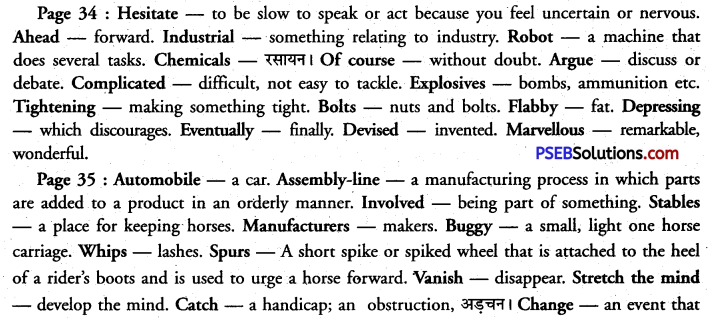
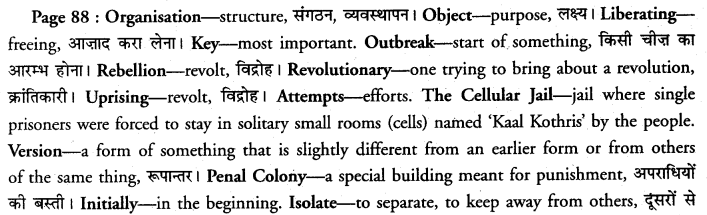
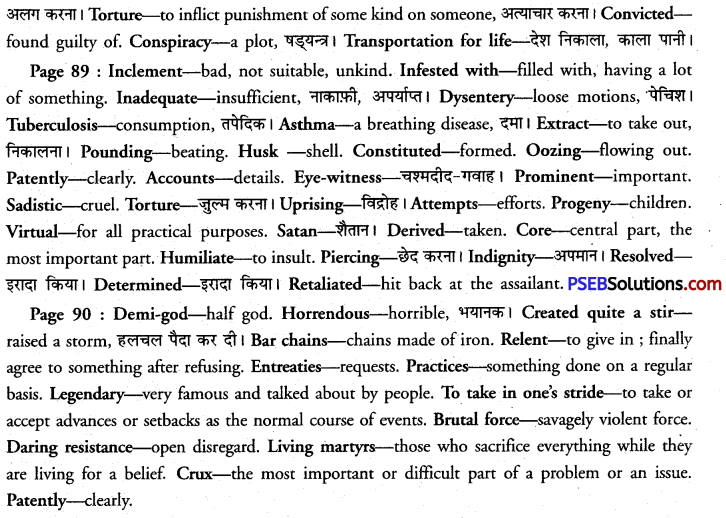
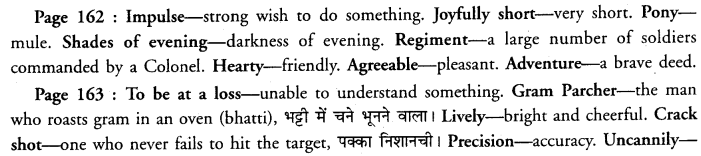
Word Meanings

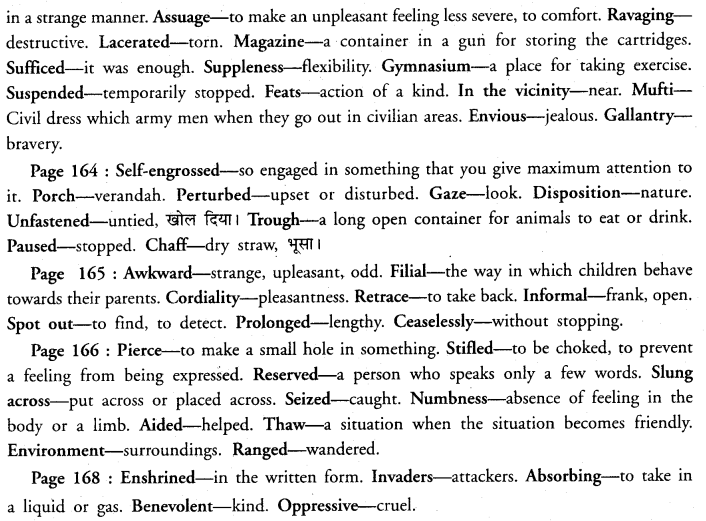
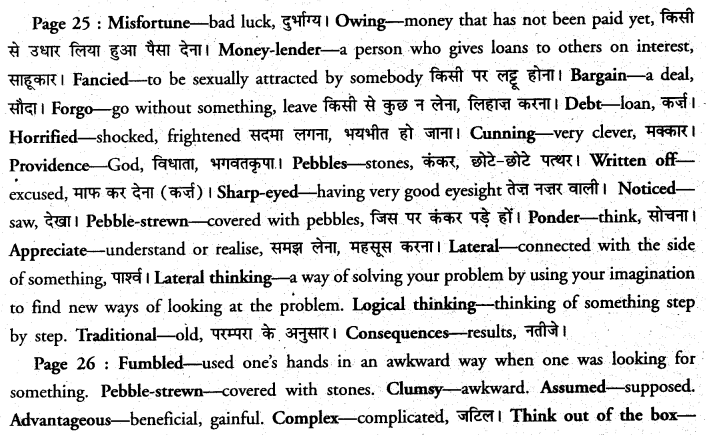
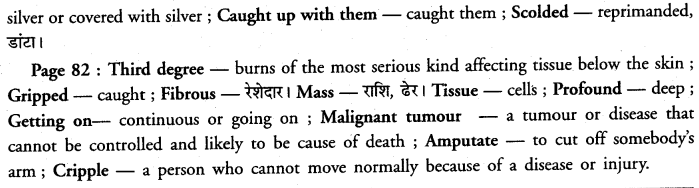
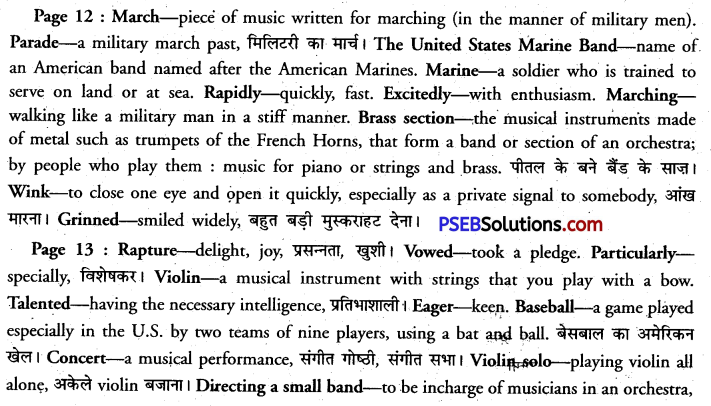
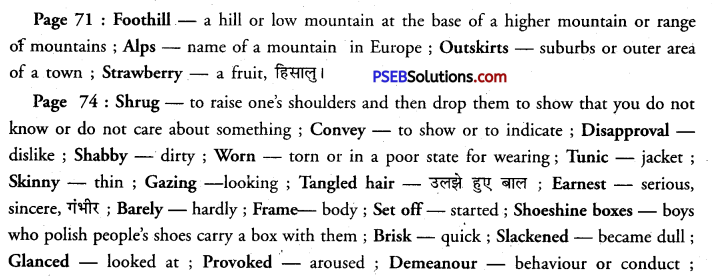
PSEB 12th Class English Solutions Chapter 2 The March King 1PSEB 12th Class English Solutions Chapter 2 The March King 2

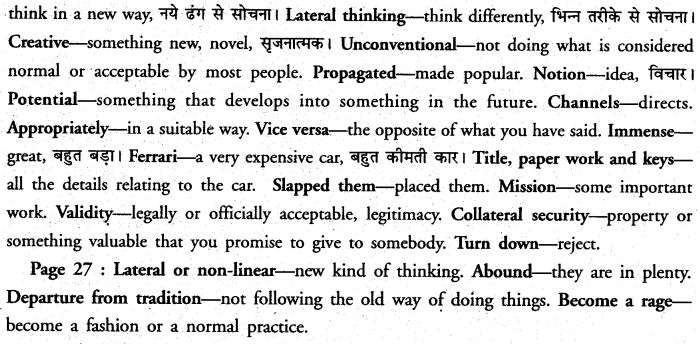
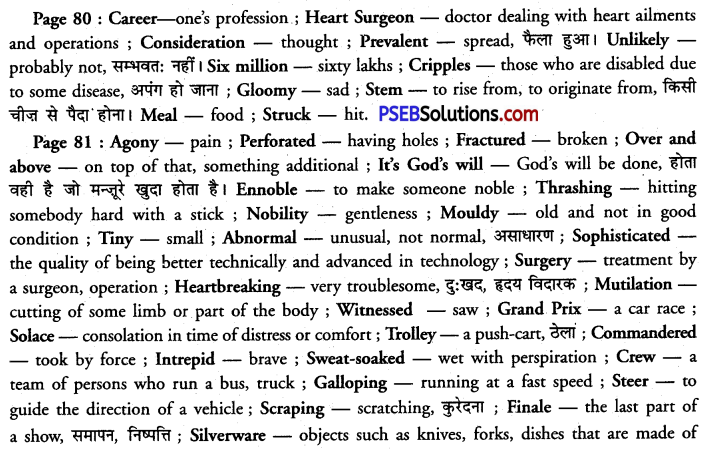
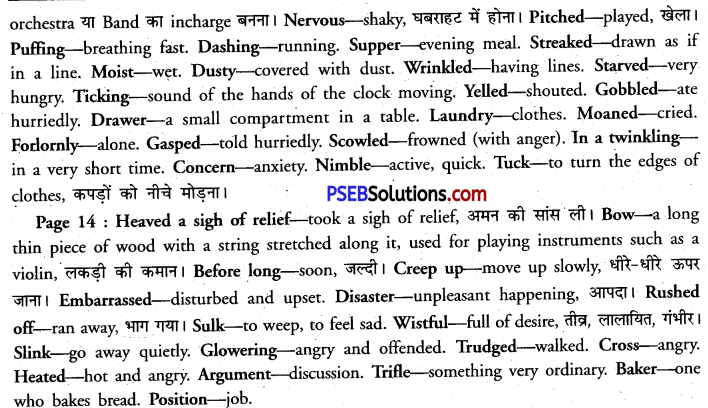
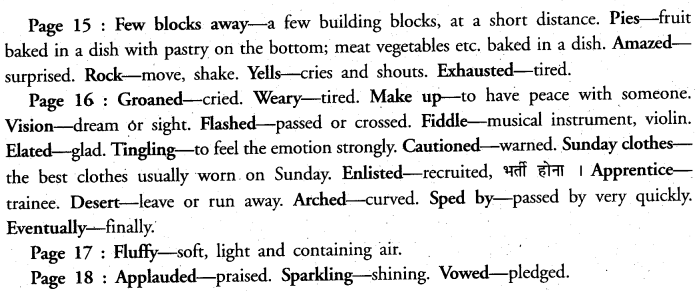
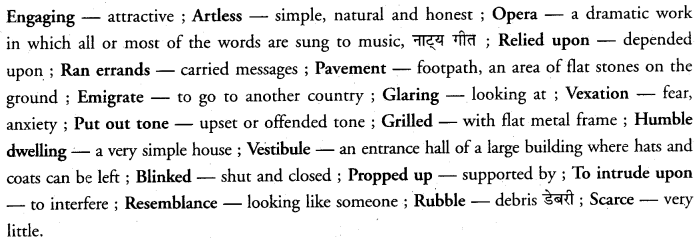
PSEB 12th Class English Solutions Chapter 2 The March KingPSEB 12th Class English Solutions Chapter 2 The March King 3

A Rainbow of English 12 Class Guide Prose

Father Returning Home Question Answer Class 12 English Book Poem Chapter 6 PSEB Solutions

Punjab State Board PSEB 12th Class English Book Solutions Poem 6 Father Returning Home Textbook Exercise Questions and Answers.

Class 12th English Book Poem Chapter 6 Father Returning Home Question Answers

Father Returning Home Class 12 Questions and Answers

1. My father travels on the late evening train
Standing among silent commuters in the yellow light
Suburbs slide past his unseeing eyes
His shirt and pants are soggy and his black raincoat
Stained with mud and his bag stuffed with books Is falling apart.
Is falling apart.

Word-Notes :
Commuter-a daily passenger travelling up and down; Suburbs – areas outside the centre of a town where people live; Slide – slip away; Soggywet; Stained-made dirty; Stuffed-full of; Is falling apart-is getting torn.

PSEB 12th Class English Solutions Poem 6 Father Returning Home

Explanation:
In these lines the poet talks about his father. He travels back home. He stands in the compartment of the local train. He stands silently among other commuters. His compartment has yellow light. The train goes on moving smoothly passing by suburbs. His eyes do not see the sliding suburbs. His shirt and trousers are wet and soft. His black raincoat is dirty with mud. His bag is stuffed with books and it seems to be getting torn.

इन पंक्तियों में कवि अपने पिता के बारे बात करता है। वह Local गाड़ी से अपने काम से घर लौट रहा है। वह लोकल गाड़ी के डिब्बे में खड़े होकर यात्रा करता है। वह दूसरे यात्रियों के बीच में चुपचाप खड़ा रहता है। उसके डिब्बे में पीला सा प्रकाश है। गाड़ी उपनगरियों को पीछे छोड़कर आगे निविघ्न चलती जा रही है। उसकी कमीज़ और पतलून गीली और नर्म हो गई है। उसका काला रेन-कोट कीचड़ से गंदा है। उसके थैले में किताबें भरी पड़ी हैं और थैला फटता नज़र आ रहा है।

2. His eyes dimmed by age
Face homeward through the humid monsoon night.
Now I can see him getting off the train
Like a word dropped from a long sentence.
He hurries across the length of the grey platform,
Crosses the railway line, enters the lane,
His chapplas arc sticky with mud, but he hurries forward.

Explanation:
The poet says that his father’s eyes have become weak due to old age. In dim light they look at the home through the wet monsoon night. Now the poet can see him getting off the train. While getting off the train, his father looks like a word dropped from a long sentence. He hurries across the length of the grey platform. He crosses the railway line. He enters the lane where his home is situated. His chappals are slippery because of the mud sticking to them. But he hurries and proceeds to his home.

कवि के पिता की आँखें वृद्ध अवस्था के कारण कमजोर हो गई हैं। वे मद्धम प्रकाश में भीगी हुई मानसून की रात में से अपने घर की ओर देखती हैं। अब कवि अपने पिता को गाड़ी से उतरते हुए देखता है। गाड़ी से उतरते समय वह ऐसे लगता है जैसे किसी लम्बे वाक्य से एक शब्द अलग हो गया हो। वह शीघ्रता से प्लेटफार्म की लम्बाई को लांघता जाता है। वह रेलवे लाईन को पार कर जाता है। वह उस तंग गली में आ जाता है जहां उसका घर स्थित है। उसकी चप्पलें कीचड़ के कारण फिसलने वाली हैं। लेकिन वह जल्दी-जल्दी घर लौट रहा

PSEB 12th Class English Solutions Poem 6 Father Returning Home

3. Home again, I see him drinking weak tea,
Eating a stale chapati, reading a book.
He goes into the toilet to contemplate
Man’s estrangement from a man-made world.
Coming out, he trembles at the sink
The cold water running over his brown hands,
A few droplets cling to the greying hairs on his wrists.

Word-Notes :
Home again – the writer’s father has returned home after work ; Weak tea – tea with light brew ; Stale – not fresh ; Sink-a basin for washing pots ; Estrangement – no longer friendly or loyal; Contemplate – to think over, to view some thing ; Droplets – small drops.

Explanation:
In these lines the poet says that his father has come back home from work. He then sees him drinking weak tea. He sees him eating a stale chapati, reading a book. Then he sees him going to the toilet to think over man’s situation. Probably, his father would be thinking over man’s being alienated from the man-made world. He comes out of the toilet. Then he goes to the sink and trembles at the touch of cold water. The cold water runs over his brown hands. A few drops of water cling to the grey hairs on his wrists.

इन पंक्तियों में कवि कहता है कि उसका पिता काम से घर वापस लौट आया है। फिर वह उसको हल्की चाय पीते देखता है। फिर वह उसको एक बासी चपाती खाते हुए देखता है। फिर वह शौचालय में जाता है जहां वह आदमी की स्थिति पर विचार करता है। सम्भवतः वह सोचता होगा कि आदमी आज की दुनिया से विमुख क्यों हो गया है। वह शौचालय से बाहर आता है। फिर वह sink के पास जाता है। वह वहां कांपता है। ठंडा पानी उसके भूरे हाथों पर बहता है। पानी के कुछ बिन्दू (कतरे) उसकी कलाईयों पर सफेद बालों से चिपक

PSEB 12th Class English Solutions Poem 6 Father Returning Home

4. His sullen children have often refused to share
Jokes and secrets with him. He will now go to sleep
Listening to the static on the radio, dreaming
of his ancestors and grandchildren, thinking
of nomads entering a subcontinent through a narrow pass.

Word-Notes :
Sullen -ill-tempered ; Static-noise produced on the radio; Nomads wandering tribes moving from place to place.

Explanation:
The poet here says that the ill-tempered children do not talk with their father. They do not share their jokes and secrets with him. Now it is time for the old man to retire to his bed. He listens to some noise and music on the radio. He dreams of his ancestors and grandchildren. He thinks of wandering tribes moving along with their cattle from place to place. Probably the nomads are entering a subcontinent through a narrow passage in the mountains.

कवि यहाँ कहता है कि चिड़चिड़े बच्चे अपने पिता के साथ बात नहीं करते। वे उसके साथ अपने मज़ाक सांझा नहीं करते और न ही उसको अपने भेद बताते हैं। अब वृद्ध व्यक्ति के सोने का समय है। वह रेडियो पर कुछ संगीत सुनने की चेष्टा करता है। उसको रेडियो से शोर सुनाई देता है। फिर वह अपने पूर्वजों और पोतेपोतियों के बारे सपने देखता है। वह इधर से उधर घूमने वाली जन-जातियों के बारे सपने देखता है। सम्भवतः वे खानाबदोश लोग पर्वतों के संकीर्ण मार्ग में से होते हुए एक उपमहाद्वीप में प्रवेश कर रहे हैं।

Comprehension Of Stanzas

1. My father travels on the late evening train
Standing among silent commuters in the yellow light
Suburbs slide past his unseeing eyes
His shirt and pants are soggy and his black raincoats
Stained with mud and his bag stuffed with books
Is falling apart. His eyes dimmed by age
face homeward through the humid monsoon night.

Questions :
(a) Name the poem and the poet.
(b) What is the condition of the eyes of the poet’s father ?
(c) What is wrong with the clothes of the commuter described by the poet ?
(d) What does the passage tell you about the weather in the late evening ?
Answers :
(a) The name of the poem is ‘Father Returning Home’. It is written by Dilip Chitre.
(b) His eyes are dimmed becauses of his old age.
(c) His clothes are a bit wet and soft.
(d) It is warm and damp.

PSEB 12th Class English Solutions Poem 6 Father Returning Home

2. Now I can see him getting off the train
Like a word dropped from a long sentence.
He hurries across the length of the grey platform,
Crosses the railway line, enters the lane.
His chappals are sticky with mud, but he hurries onward.

Questions :
(a) Name the poet and the poem.
(b) Give the figure of speech used in these lines :
Now I can see him getting off the train
Like a word dropped from a long sentence.
(c) What does the poet’s father do after crossing the railway line ?
(d) Do the sticky chappals of the poet’s father stand in the way of his hurrying forward ?
Answers :
(a) The name of the poet is Dilip Chitre and the name of the poem is ‘Father Returning Home’.
(b) Like a word dropped from a long sentence …………….. simile.
(c) He enters the lane.
(d) No, they don’t.

3. (Based on textual exercise)
(a) Which line in the poem describes father’s irrelevance to the train ?
(b) Write two reasons for father’s eyes being dimmed.
(c) Where does father go after getting off the train ?
Answers :
(a) Now I can see him getting off the train
Like a word dropped from a long sentence.
(b) His eyes are dimmed because of old age and humid monsoon night.
(c) After crossing the railway line he enters the lane where his home is situated.

4. His sullen children have refused to share
Jokes and secrets with him. He will now go to sleep
Listening to the static on the radio, dreaming
Of his ancestors and grandchildren, thinking
Of nomads entering a subcontinent through a narrow pass.

Questions :
(a) Explain the behaviour of the old man’s children towards him.
(b) What does he do after being written off by his children ?
(c) How can you say that his dream mirrors that the old man is either thinking about his past or future ?
(d) Draw a pen portrait of the poet’s father. (V. Imp.)
Answers :
(a) The children are indifferent to their father and they have refused to share their jokes and secrets with him.
(b) He goes to sleep listening to the radio which is accompanied with noise.
(c) He dreams of his ancestors and grandchildren.
(d) The poet’s father is a sad old man. He travels to work by a local train every day in Mumbai. He does not feel comfortable in his home or environment. He feels lonely even in a crowd. He is isolated from his family and friends. He is alienated from people. He lives in a world of his own dreams.

Father Returning Home Summary in English

Father Returning Home Introduction:

This poem has been taken from Dilip Chitre’s collection of poems. The title of the collection is ‘Travelling in a Cage’. It gives us the picture of a sad old man who travels to work by a local train every day in Mumbai. He does not feel comfortable in his environment. He feels lonely even in a crowd. His isolation is seen in his inability to have dialogue with his family or friends. He feels uneasy in his present. So the old man enters into the distant world of the past or into the world of his own dreams. The modern man seems to be alienated in a complex urban world.

Father Returning Home Summary in English:

This poem gives us the picture of the poet’s father who is an old man. He goes to work by a local train. He stands in the compartment among silent daily travellers (commuters) in the yellow light. Suburbs of the city pass by and he does not see them. He has dim eyes. His shirt and trousers have become wet and soft. His black raincoat is dirty because of mud fallen on it. His bag is stuffed with books.

The bag seems to be falling apart. His eyes are dim because of old age. Through the wet monsoon night, he is coming to his home. The poet sees his father getting off the train. He is coming alone. He looks like a word dropped from a long sentence. He walks quickly across the length of the grey platform. He then enters the lane where his house is situated. His chappals are sticky with mud. But he gogs on moving quickly.

PSEB 12th Class English Solutions Poem 6 Father Returning Home

He reaches his home. The poet sees his father drinking weak tea. He eats a stale chapati. He reads a book. Then he goes into the toilet to think over man’s disconnection from a man-made world. Old people feel that they are cut off from the rest of the world. He comes to the sink. He washes his hands. Some drops of water stick to the greying hair on his wrists. His bad-tempered children do not talk with him.

They have refused to share jokes and secrets with him. Now it is time for the old man to go to sleep. He listens to music on the radio. He dreams of his ancestors and grandchildren. He thinks of wandering tribes moving along with their animals from place to place. Probably the momads are entering a subcontinent through a narrow passage in the mountains.

Father Returning Home Summary in Hindi

Father Returning Home Introduction:

यह कविता दिलीप चित्रे की कविताओं के संग्रह से ली गई है । संग्रह का नाम है ‘Travelling in a Cage’ । यह कविता हमें एक उदास बूढ़े आदमी का चित्र प्रस्तुत करती है जो एक लोकल गाड़ी द्वारा हर रोज़ Mumbai में काम पर जाता है। उसे अपने वातावरण में बेचैनी सी महसूस होती है। वह अपने आप को लोगों की भीड़ में भी अकेला पाता है। उसका अलगाव इस बात में देखा जा सकता है कि वह किसी से बातचीत भी नहीं कर सकता। उसे वर्तमान समय में बेचैनी रहती है। इसलिए यह बूढ़ा व्यक्ति भूतकाल की दुनिया में दाखिल होता है या अपने सपनों की दुनिया में खो जाता है। वर्तमान युग का आदमी जटिल शहरी दुनिया से अलग-थलग रहता है।

Father Returning Home Summary in Hindi:

यह कविता हमें कवि के पिता का चित्र प्रस्तुत करती है जो कि एक बूढ़ा मनुष्य है। वह एक Local गाड़ी द्वारा अपने काम पर जाता है। वह गाड़ी के डिब्बे में दैनिक यात्रियों के मध्य में चुपचाप खड़ा रहता है और वहां पीली सी रोशनी होती है। उसकी गाड़ी उपनगरियों के पास से गुजरती जाती है और वह उ.को देखता तक नहीं। उसकी आँखों की रोशनी मद्धम हो गई है। उसकी कमीज़ और पतलुन गीली और नई पड गई हैं। उसका काले रंग का रेन-कोट गंदा हो गया है क्योंकि इसके ऊपर कीचड़ गिरा हुआ है।

उसका थेला पुस्तकों से भरा पड़ा है और यह फटता नज़र आता है। बूढ़ी अवस्था के कारण उसकी आँखों का प्रकाश मद्धम पड़ गया है। भीगी मानसून की रात में वह अपने घर की ओर आ रहा है। कवि अपने पिता को गाड़ी से उतरते हुए देखता है। वह अकेला आ रहा है। वह ऐसे लगता है जैसे कि एक लम्बे वाक्य में से एक शब्द को हटा दिया गया है। वह सलेटी रंग के प्लेटफार्म को तेज़ी से चलते हुए पार करता है। फिर वह उस तंग गली में दाखिल होता है जहां उसका घर स्थित है। उसकी चप्पलें भी कीचड़ लगने से चिपचिपी हो गई हैं। लेकिन वह तेजी से आगे चला जाता है।

वह अपने घर पहुँच जाता है। कवि अपने पिता को हल्की सी चाय पीते हुए देखता है। वह एक बासी चपाती खाता है। वह एक पुस्तक पढ़ता है। फिर वह शौचालय में चला जाता है और वह सोचने लगता है कि मनुष्य मनुष्य द्वारा बनाई गई दुनिया से अलग-थलग हो चुका है। बूढ़े लोग सोचते हैं कि वे बाकी ससार से कटे हुए हैं। वह sink के पास आता है। वह अपने हाथ धोता है। पानी के कुछ बिन्दू (कतरे ) उसकी कलाईयों के सफेद बालों पर गिरते हैं। उसके चिड़चिड़े बच्चे उसके साथ बात नहीं करते।

PSEB 12th Class English Solutions Poem 6 Father Returning Home

उन्होंने (बच्चों ने) उसके साथ मज़ाक सांझा करना या उसको गुप्त बातें बतानी बंद कर दी हैं। अब इस वृद्ध व्यक्ति के सोने का समय हो गया है। वह रेडियो पर संगीत जिसमें शोर भी होता है का आनन्द लेता है। वह अपने पूर्वजों और अपने पोते-पोतियों के बारे स्वप्न देखता है। वह उन जन-जातियों के बारे भी स्वप्न देखता है जो अपने पशुओं के साथ एक स्थान से दूसरे स्थान तक घूमते हुए जाते हैं। सम्भवतः खानाबदोश लोग पहाड़ों में एक संकीर्ण मार्ग से होते हुए एक उपमहाद्वीप में प्रवेश कर रहे हैं।

Father Returning Home Central Idea

The central idea of this poem is modern man’s alienation from the man-made world. This world is full of hurry and worry. Nobody has the time to take interest in others. The senior citizens are a neglected lot in society. The poem gives us a picture of a sad old man who travels to work by local train every day in the city of Mumbai. He does not feel comfortable or at home in his environment.

He feels lonely even in a crowd. His isolation is seen in his inability to have dialogue with his family or friends. He feels uneasy in his present. So the old man enters into the distant world of the past or into the world of his own dreams. The modern man is alienated in a complex urban world.

Father Returning Home Central Idea In Hindi

यह कविता एक आधुनिक आदमी का आदमी द्वारा बनाई हुई दुनिया से परायापन (बेगानगी) से सम्बन्ध रखती है। यह संसार शीघ्रता और चिन्ता से भरपूर है। दूसरे में रुचि लेने का किसी के पास समय नहीं है। वरिष्ठ नागरिकों की कोई परवाह नहीं करता। यह कविता एक उदास, वृद्ध व्यक्ति का चित्र प्रस्तुत करती है जोकि काम पर हर रोज़ Mumbai में Local गाड़ी द्वारा आता-जाता है।

उसे अपने वातावरण में कोई आराम या चैन उपलब्ध नहीं है। उसे भीड़ में भी अकेलापन महसूस होता है। अपने परिवार या मित्रों से वार्तालाप करने की अयोग्यता से उसका अलगाव प्रगट होता है। वर्तमान स्थिति में उसको बेचैनी रहती है। इसलिए वृद्ध व्यक्ति भूतकाल की दुनिया में प्रवेश करता है या वह अपने सपनों की दुनिया में शरण लेता है। आधुनिक काल का व्यक्ति जटिल शहरी दुनिया में परायापन में रहता है।

A Rainbow of English 12 Class Solutions PSEB Poetry

Two Gentlemen of Verona Question Answer Class 12 English Book Chapter 8 PSEB Solutions

Punjab State Board PSEB 12th Class English Book Solutions Chapter 8 Two Gentlemen of Verona Textbook Exercise Questions and Answers.

Class 12th English Book Chapter 8 Two Gentlemen of Verona Question Answers

Two Gentlemen of Verona Class 12 Questions and Answers

Short Answer Type Questions

Question 1.
Explain in brief the conditions in which the two boys grew up.
संक्षेप में उन परिस्थितियों का वर्णन करें जिनमें दोनों लड़के बड़े हुए।
Answer:
The two boys led a very miserable life after the death of their widower father. In their childhood they lived a comfortable and cultured life. Their sister wanted to train as a singer. Their life became very miserable in the war. Their home was bombed in Verona, and completely destroyed. So they became homeless.

They had to suffer from starvation and exposure to the terrible winter in Verona. This made them angry. They became spies for the resistance group. They faced risks. They visited their sister every week in the hospital and paid her dues to the hospital. The author found the three siblings a happy family.

PSEB 12th Class English Solutions Chapter 8 Two Gentlemen of Verona

अपने विधुर बाप की मौत के बाद दोनों लड़कों का जीवन में दुःख था। इससे पहले अपने बचपन में वे आरामदेह और सुसंस्कृत जीवन व्यतीत करते थे। उनकी बहन एक गायिका बनना चाहती थी। जंग के दौरान उनका जीवन दुखद हो गया। उनका घर बमबारी से पूरी तरह ध्वस्त हो गया।

इस लिए वे बिल्कुल बेघर हो गये। उन्हें भुखमरी से पीड़ित होना पड़ा और Verona की सर्दी में उन्हें अनाश्रयता झेलनी पड़ी। इससे वे क्रुद्ध थे। वे खिलाफत समूह के लिए काम करते थे। उनको खतरों का सामना करना पड़ा। वे हर सप्ताह अपनी बहन को मिलने अस्पताल आते थे और अपनी बहन के इलाज का खर्च देते थे। लेखक ने महसूस किया कि तीनों बहन-भाई एक प्रसन्न परिवार था।

Question 2.
What I the message conveyed by the story, Two Gentlemen of Verona’ ? (Imp.)
‘Two Gentlemen of Verona’ कहानी क्या संदेश देती है?
Answer:
The message of the story is clear. Care of one’s sister strengthens the family ties. Care for the sick and suffering would make the world a better place to live in. The two young boys have set a glorious example of noble conduct for others to follow. Such a sacrifice develops values which are good for the health of society.

PSEB 12th Class English Solutions Chapter 8 Two Gentlemen of Verona

कहानी का उद्देश्य स्पष्ट है। अपनी बहन की देखभाल करने से परिवार के रिश्ते दृढ़ होते है। रोग से पीड़ित और दुःखी लोगों की देखभाल करने से यह संसार रहने के लिए अच्छा बन जायेगा। दो किशोर लड़कों ने उत्तम व्यवहार का शानदार उदाहरण पेश किया है जिस का दूसरे अनुसरण करेंगे। इस तरह का बलिदान ऐसे मूल्यों को विकसित करता है जो समाज की सेहत के लिए अच्छे होते हैं।

Long Answer Type Questions

Question 1.
Draw a brief character sketch of the two boys in the story.
कहानी में दोनों लड़कों का संक्षिप्त चरित्र चित्रण करो।
Answer:
Nicola and Jacopo were two brothers. Their widower father died in the war. Their house was bombed. So they were homeless and orphans. Their sister was in the hospital suffering from tuberculosis of the spine. They led wretched lives. They sold newspapers and fruit. They carried messages for others and took the tourists to places of tourist interest in Verona.

Their tender age and small size made them very serviceable. The two boys were devoted to their sister. They earned money by all sorts of work to pay the expenses of their sister in the hospital. The writer looked upon them as a happy family. Their selfless service of their sister gave promise of a greater hope for human society.

Nicola और Jacopo दो भाई थे। उनका विधुर बाप जंग में मारा गया। उनके घर पर बमबारी की गई। इस लिए वे बेघर हो गए और अनाथ थे। उनकी बहन अस्पताल में दाखिल कर ली गई क्योंकि वह रीढ़ की हड्डी की T.B. से पीड़ित थी। उनका जीवन शोकसन्तप्त था। वे अखबार और फल बेचते थे। वे दूसरों के लिए संदेश लेकर जाते थे और पर्यटकों को Verona में पर्यटन के देखने योग्य स्थानों पर लेकर जाया करते थे।

उनकी छोटी आयु और छोटे कद ने उन्हें बड़ा उपयोगी बना दिया। दोनों लड़के अपनी बहन के प्रति समर्पित थे। वे कई प्रकार के काम करके अपनी बहन के लिए अस्तपताल में इलाज के लिए पैसे देते थे। लेखक उनको एक प्रसन्न परिवार समझता था। उनकी अपनी बहन की नि:स्वार्थ सेवा मानवीय समाज के लिए एक बड़ी आशा का संकेत और वायदा था।

PSEB 12th Class English Solutions Chapter 8 Two Gentlemen of Verona

Question 2.
Write the theme of the story, ‘Two Gentlemen of Verona, in your own words. (V. Imp.)
Two Gentlemen of Verona कहानी का विषय-वस्तु अपने शब्दों में लिखो।
Answer:
This story is based on the theme that selfless action brings a new nobility into human life. It gives a promise of a greater hope for human society. The author finds the two boys involved in an exemplary action of self-sacrifice for their sister. The message is clear.

Care of one’s sister strengthens the family ties. Care for the sick and suffering would make the world a better place to live in. What we see in the world is that selfishness is the order of the day. The two young boys have set a glorious example of noble conduct for others to follow. Such a sacrifice develops values which are good for the health of society.

यह कहानी इस विषय पर आधारित है कि निःस्वार्थ काम मानवीय जीवन में एक नई श्रेष्ठता लाता है। यह इन्सानी समाज के लिए एक बड़ी आशा लाता है। लेखक देखता है कि दो लड़के अपनी बहन के लिए नि:स्वार्थ सेवा के आदर्श कार्य में व्यस्त हैं। संदेश स्पष्ट है।

अपनी बहन की देखभाल करने से परिवार के बन्धन मज़बूत हो जाते हैं। रोग से पीड़ित और दुःखी लोगों की देखभाल करने से यह संसार रहने के लिए अच्छा बन जायेगा। हम संसार में जो देखते हैं वह यह है कि दुनिया मतलब की यारी है। दो किशोरों ने अच्छे आचरण का ऐसा उदाहरण पेश कर दिया है जिसका दूसरे अनुसरण करेंगे। ऐसा बलिदान, ऐसी मान्यताएं पैदा करता है जो कि समाज के स्वास्थ्य के लिए अच्छी होती हैं।

Objective Type Questions

This question will consist of 3 objective type questions carrying one mark each. These objective questions will include questions to be answered in one word to one-sentence or fill in the blank or true/false or multiple choice type questions.

Question 1.
What were the jobs that the two boys undertook ?
Answer:
They polished shoes, sold fruit, hawked newspapers, conducted tourists round the town and ran errands.

Question 2.
Describe the physical appearance of both the boys.
Answer:
The two brothers were little figures with their brown skins, tangled hair and earnest eyes Jacopo was lively as a squirrel and Nicola had an attractive smile.

Question 3.
How were the two boys useful for the narrator and his friend in many ways ?
Answer:
They were useful in getting them American chocolates, booking seats for the opera or telling the name of a good restaurant etc.

PSEB 12th Class English Solutions Chapter 8 Two Gentlemen of Verona

Question 4.
Why did the two boys work endlessly ?
Answer:
They worked very hard to pay for the treatment of their sister suffering from tuberculosis of the spine.

Question 5.
Where did the narrator drive the two boys ?
Answer:
He drove them to a village beyond Poleta to enable them to see their sister in the hospital.

Question 6.
Who was the woman at the village ?
Answer:
She was a pleasant-looking trained nurse.

Question 7.
What made the narrator follow the boys ?
Answer:
The narrator followed the boys Nicola and Jacopo to see whom they were visiting.

Question 8.
What did. Lucia aspire to be ?
Answer:
She aspired to be a singer.

Question 9.
Why was the narrator deeply moved ?
Answer:
He was deeply moved by the two boys’ devotion to their sick sister.

Question 10.
What made the two brothers and their sister orphans ?
Answer:
They were the children of a widower killed in the war and the destruction of their home made them orphans.

Question 11.
What is the message conveyed by the two boys in the story ? Write in your own words. (Imp.)
Answer:
The message is : Care of one’s sister strengthens family ties; care for the sick and suffering would make the world a better place to live in.

PSEB 12th Class English Solutions Chapter 8 Two Gentlemen of Verona

Question 12.
Name the two boys who are the two gentlemen of Verona in the title of the story.
Answer:
Nicola and Jacopo.

Question 13.
What does the story tell you about the father of the two boys ?
Answer:
He was a famous singer, killed during the war.

Question 14.
To which place did the boys request the narrator to take them ?
Answer:
Poleta.

Question 15.
Choose one of the options about the sister of the boys :
(i) She wanted to be a dancer.
(ii) She wanted to be a singer.
(iii) She wanted to be an actress.
(iv) She wanted to be a model.
Answer:
(ii) She wanted to be a singer.

Question 16.
What did the boys find in the quality of their life when German Elite Guards came to their town ? Write your answer in two words.
Answer:
More wretched.

Question 17.
Choose the correct option of the disease from which Lucia was suffering :
(i) Cholera
(ii) Cancer
(iii) Epilepsy
(iv) Tuberculosis.
Answer:
(iv) Tuberculosis.

Question 18.
Name the writer of the story.
Answer:
A.J. Cronin.

Question 19.
What was attractive about Nicola ?
Answer:
His smile.

Question 20.
With whom has Jacopo been compared ?
Answer:
With a squirrel.

Question 21.
What had Lucia been suffering from ?
Answer:
She had been suffering from consumption of the spine.

Question 22.
Verona is a place in one of these countries :
(a) Spain
(b) Ireland
(c) Italy
(d) Germany.
Answer:
(c) Italy.

PSEB 12th Class English Solutions Chapter 8 Two Gentlemen of Verona

Question 23.
Name the two brothers in the story ‘Two Gentlemen of Verona :
(a) Nicola and Jacopo
(b) Ronaldo and Nicola
(c) Alberto and Ronaldo
(d) Jacopo and Ronaldo
Answer:
(a) Nicola and Jacopo.

Question 24.
Lucia had a desire to be one of these :
(a) Doctor
(b) Singer
(c) Model
(d) Teacher.
Answer:
(b) Singer

Two Gentlemen of Verona Summary in English

Two Gentlemen of Verona Introduction:

The title of this story has been taken from one of the plays of William Shakespeare. The author describes the life of two small boys who love their sister. They are Nicola and Jacopo. They work very hard so that they could pay for the treatment of their sister suffering from tuberculosis (T.B.). The boys’ sacrifice for their sister gives a new hope for society.

Two Gentlemen of Verona Summary in English:

‘Two Gentlemen of Verona’ is the story of two brothers, Nicola and Jacopo. They belong to Verona in Italy. (Shakespeare wrote a play of the same title). Nicola is thirteen and Jacopo is twelve. The narrator and his friend meet them when they are driving through the foothills of Alps. They buy a basket of strawberries from them. Then they go to the hotel.

The driver of the narrator told him not to buy fruit from the boys. They would be able to get better fruit in Verona. The next morning they find the two boys at the public square. The boys tell the narrator that they do all sorts of work including guiding tourists. The narrator tells the boys to take him and his friend around the city. They also feel impressed by their manners and behaviour. Despite their untidy clothes, they leave a good impression on the narrator and his friend.

PSEB 12th Class English Solutions Chapter 8 Two Gentlemen of Verona

One night, the narrator and his friend see the boys at a deserted square. They were resting on a pavement stone. They are waiting for the last bus from Padua so that they can sell the newspapers. Both the brothers look tired. They are as usual in unclean clothes. The narrator asks them the reason for their not being dressed in clean clothes and for not eating well.

The narrator had thought that the boys were saving money to travel to the States. But the boys tell him that they are not interested in going to the States. They have something else in their mind. They ask the narrator if he can take them to Poleta in his car. The narrator agrees.

They drive down to Poleta the next afternoon. The narrator finds them entering a villa. They tell him that they will stay in the villa for an hour or so and that he can go to a cafe for a drink. After some time, the narrator rings the bell of the villa. A nurse opens the door.

He asks her about two young boys who have just gone to the house. She takes the narrator along and the narrator finds himself in a hospital. He finds Japoco and Nicola sitting at the bedside of their sister. He requests the nurse to tell him everything about the two boys. The nurse tells him their story.

The narrator comes to know that the two boys and their sister are the children of a well-known singer at La Scala who was killed during the war. Their house was destroyed and the children had to suffer all kinds of hardships. The German Elite Guards came to their town and their life became more wretched.

The boys joined the resistance movement. They carried errands (messages) to its leaders and informed them of the movements of German troops. Their sister Lucia was suffering from tuberculosis of the spine. She had been in the hospital for the last 12 months. Her brothers visited her in the hospital every week to clear the dues.

The narrator then waits for the boys. He drives them back to the city. He does not tell them what he has learnt about their sister and her ailment. He is impressed by their selfless devotion to their sister. He feels that the selfless devotion to their sister brings new nobility to human life. The young boys’ selfless service of their sister was an indication of the selfless service of the human society.

Two Gentlemen of Verona Summary in Hindi

Two Gentlemen of Verona Introduction:

इस कहानी का शीर्षक William Shakespeare के नाटक से लिया गया है। लेखक दो छोटे लड़कों के जीवन की कहानी बताता है। वे अपनी बहन से प्यार करते हैं। उनके नाम हैं Nicola और Japoco । वे बहुत परिश्रम करते हैं ताकि वे अपनी बहन के इलाज के लिए पैसे दे सकें। उनकी बहन spine की T.B. (तपेदिक) से पीड़ित है। लड़कों का अपनी बहन के लिए बलिदान समाज के लिए एक नई आशा का संकेत है।

Two Gentlemen of Verona Summary in Hindi:

Two Gentlemen of Verona दो भाईयों Nicola और Jacopo की कहानी है। वे इटली के Verona नगर के रहने वाले हैं। Nicola 13 साल का है और Japoco 12 साल का है। कहानी का वर्णनकर्ता और उसका मित्र उनको तब मिलते हैं जब वे Alps पर्वत की पादगिरी की पहाड़ियों से गाड़ी चलाकर जा रहे हैं। वे उनसे strawberry (हिसालू) का टोकरा खरीदते हैं। फिर वे होटल में चले जाते हैं। वर्णनकर्ता के ड्राईवर ने अपने मालिक को कहा कि वह उनसे strawberry न खरीदे। उनको Verona में इससे बेहतर फल मिल जायेंगे।

अगले दिन प्रातः के समय उनको दोनों लड़के एक Public Square (वर्गाकार भवन-समूह) में मिलते हैं। लड़के वर्णनकर्ता (लेखक) को बताते हैं कि वे हर प्रकार का काम करते हैं और वे tourists (पर्यटकों) के लिए Tourist Guide का भी काम करते हैं। लेखक लड़कों को कहता है कि वे उसको और उसके मित्र को नगर में घुमायें। वे उनके शिष्टाचार और आचरण से बहुत प्रभावित होते हैं।

PSEB 12th Class English Solutions Chapter 8 Two Gentlemen of Verona

अपने गंदे कपड़ों के बावजूद लड़के (Nicola और Japoco) लेखक और उसके मित्र पर अच्छा प्रभाव डालने में सफल हो जाते हैं। . एक रात लेखक और उसका मित्र लड़कों को एक सुनसान square (वर्गाकार) में देखते हैं। वे एक फुटपाथ के एक पत्थर पर आराम कर रहे हैं। वे Padua से आने वाली अन्तिम बस की प्रतीक्षा कर रहे हैं ताकि वे अखबार

बेच सकें। वे थके-थके नज़र आते हैं। उन्होंने नियमानुसार गंदे कपड़े पहने हुए थे। लेखक उन्हें पूछता है कि उन्होंने गन्दे कपड़े क्यों पहने हुए थे और वे पेट भर कर अच्छी तरह खाना क्यों नहीं खाते थे। लेखक का विचार था कि वे पैसे बचा रहे थे ताकि वे अमेरिका जा सकें। लेकिन लड़के लेखक को बताते हैं कि उन्हें अमेरिका जाने में कोई रुचि नहीं है। उनके दिमाग़ में तो और ही कोई बात है। वे लेखक को पूछते हैं क्या वह उनको अपनी गाड़ी में Poleta ले जा सकता है। लेखक उनको ले जाने के लिए सहमत हो जाता है। अगले दिन वे अपराह्न कार में बैठ कर Poleta पहुंच जाते हैं।

वे लेखक को बताते हैं कि वे घर (villa) में एक घंटा या कुछ देर के लिए ठहरेंगे और लेखक को वे कहते हैं कि वह चाय पानी के लिए cafe में जा सकता है। कुछ देर बाद लेखक उनके villa की घंटी बजाता है। एक नर्स दरवाजा खोलती है। लेखक उसको दो लड़कों के बारे में पूछता है जो कि अभी-अभी घर में प्रवेश किए हैं। वह लेखक को अपने साथ ले जाती है। लेखक अपने आपको अस्पताल में पाता है। वह Nicola और Jacopo को अपनी बहन के बिस्तर पर बैठे हुए देखता है। वह नर्स से याचना करता है कि वह उसे दोनों लड़कों के बारे में सब कुछ बताये। नर्स लेखक को उनकी कहानी बता देती है।

लेखक को पता चलता है कि दो लड़के और उनकी बहन La Scala की एक प्रसिद्ध गायिका के बच्चे हैं जो कि युद्ध के दौरान मारी गई थी। उसका घर तबाह हो गया और बच्चों को हर प्रकार का कष्ट उठाना पड़ा। इसके बाद German Elite Guard से उनका सामना हो गया। फिर उनके शहर और उनका अपना जीवन दुर्भाग्य या बदनसीबी वाला हो गया। लड़के खिलाफत आन्दोलन में भर्ती हो गये।

वे खिलाफत आन्दोलन के नेताओं के पास संदेश लेकर जाते थे और वे उनको जर्मन सेनाओं के बारे में बताते थे। उनकी बहन Lucia रीढ़ की हड्डी की T.B. के रोग से ग्रस्त थी। वह अस्पताल में 12 महीनों से रहती आ रही थी। उसके भाई उसकी बीमारी पर खर्च होने का हिसाब करके हर सप्ताह पैसे दिया करते थे।

PSEB 12th Class English Solutions Chapter 8 Two Gentlemen of Verona

लेखक फिर लड़कों की प्रतीक्षा करता है। वह उनको फिर अपनी कार में शहर ले जाता है। वह उनको यह नहीं बताता है कि उसने उनकी बहन के बारे में क्या पता लगाया है। अपनी बहन के लिए उनके निःस्वार्थ बलिदान से लेखक बहत प्रभावित होता है और वह महसूस करता है कि इस तरह की सेवा और बलिदान से इन्सानी जीवन में एक नई श्रेष्ठता आ जाती है। अपनी बहन के लिए बिना स्वार्थ सेवा से इनकी कहानी इन्सानी समाज में निष्काम सेवा का एक अच्छा. उदाहरण है।

Word Meanings:

PSEB 12th Class English Solutions Chapter 8 Two Gentlemen of Verona 1
PSEB 12th Class English Solutions Chapter 8 Two Gentlemen of Verona 2

A Rainbow of English 12 Class Guide Prose

The Barber’s Trade Union Question Answer Class 12 English Supplementary Chapter 5 PSEB Solutions

Punjab State Board PSEB 12th Class English Book Solutions Supplementary Chapter 5 The Barber’s Trade Union Textbook Exercise Questions and Answers.

Class 12th English Supplementary Chapter 5 The Barber’s Trade Union Question Answers

The Barber’s Trade Union Class 12 Questions and Answers

Short Answer Type Questions

Question 1.
How did the village elders behave when Chandu dressed up like a doctor?
गांव के वयोवृद्धों ने कैसा व्यवहार किया जब Chandu डाक्टरों की तरह कपड़े पहन कर आया ?
Answer:
The landlord called Chandu the son of a pig. He cursed him by saying that he was bringing a leather bag of cow-hide into his house and a coat of some animal’s marrow. He told him to get out of his house less he should defile his religion.

PSEB 12th Class English Solutions Supplementary Chapter 5 The Barber's Trade Union

The Sahukar abused Chandu in the foulest way. He told him that he had come wearing the defiled clothes of the hospital people. He told him to come after wearing his own clothes. Only then will he let him cut his hair.

जमींदार ने उसको सूअर का पुत्र कह कर पुकारा। उसने उसे यह कहकर गाली दी कि वह उसके घर में चमड़े का बैग लेकर आया जोकि गाय की चमड़ी का बना है और उसने कोट पहना है जो किसी पशु के मज्जे से बना है। उसने उसको आदेश दिया कि वह उसके घर से निकल जाये ताकि वह उसके धर्म को भ्रष्ट न कर दे। साहूकार ने भी बड़े गन्दे शब्दों में Chandu को गालियां दीं। उसने उसको कहा कि वह हस्पताल के लोगों के गन्दे कपड़े पहन कर आ गया था। उसने उसे कहा कि वह अपने कपड़े पहन कर आये। तभी वह उससे अपने बाल कटवायेगा।

Question 2.
Give a brief character-sketch of Chandu’s mother.
Chandu की माता का संक्षेप में चरित्र-चित्रण दीजिए।
Answer:
Chandu’s mother was an ill-tempered woman. She was over sixty years old. She could always read the nature of the upper caste people. But she was very kind to the narrator. She did not have a good word for the upper caste people.

Probably, she must have suffered at the hands of the upper caste people. She was happy when Chandu started earning more money by shaving and cutting hair of people in the town. We can only pity Chandu’s old mother because she did not have a good quality of life.

Chandu की माता चिड़चिड़े स्वभाव की महिला थी। वह साठ साल से ऊपर उम्र की थी। वह उच्चजाति के लोगों के स्वभाव को जान लेने में सक्षम थी। लेकिन वह वर्णनकर्ता पर बहुत मेहरबान थी। उसका ऊँची जाति के लोगों के बारे में कोई अच्छा विचार नहीं था। सम्भवतः उसने ऊँची जाति के लोगों से कष्ट उठाये हैं। वह खुश थी जब चन्दू ने शहर में जाकर लोगों की दाढ़ी और हजामत करके अधिक पैसे कमाने शुरू कर दिये। हमें उसकी बूढ़ी माता पर दया आती है क्योंकि उसने अच्छे प्रकार का जीवन व्यतीत नहीं किया है।

Long Answer Type Questions

Question 1.
Give a brief character-sketch of Chandu.
Answer:
Chandu is the barber boy of the narrator’s village. He is the main character of the story. He is a close friend of the narrator. The narrator calls him one of the makers of modern India. He organises barbers into a union.

He stops going to people’s homes to give them a haircut or shave beards. He refuses to dance to the tune of upper-caste people. Chandu is the narrator’s senior. He takes lead in all matters. He is very fond of his boyish mischiefs.

He likes catching wasps. Then he takes out the poison from their tails. He makes them fly by tying their legs with a thread. The narrator considers him the embodiment of perfection. He is an expert at making kites of various designs. Despite his skill in other matters, he is a duffer in learning. He is a member of a low caste. Upper caste people often abused him and insulted him. They did not like the narrator to mix with him.

PSEB 12th Class English Solutions Supplementary Chapter 5 The Barber's Trade Union

Chandu is self-respecting. He did not like to be insulted by the upper-caste people. He decided to teach them a lesson. He bought a cycle and started shaving people in the town. He set up a barber’s shop. He organised some barbers in villages into a union.

They stopped going to people’s homes for haircutting and shaving. They forced the people to come to their shops. We cannot help admiring Chandu for his skill of enterprise.

Chandu वर्णनकर्ता के गांव के नाई का लड़का है। वह कहानी का मुख्य पात्र है। वह वर्णनकर्ता का घनिष्ठ मित्र है। वर्णनकर्ता उसको आधुनिक भारत के निर्माताओं में से एक समझता है। वह नाईयों के Union का आयोजन करता है। वह लोगों के घरों में जाकर उनके लिए बतौर नाई का काम करने से इन्कार कर देता है। वह ऊँची जाति के लोगों के इशारों पर नाचने से मना कर देता है। Chandu वर्णनकर्ता से वरिष्ठ है। वह तमाम मामलों में अगवाई करता है। वह लड़कों वाली शरारतें करता है।

वह भिड़ों को पकड़ना पसन्द करता है। फिर वह उनका विष निकालता है। उनकी टांगों को धागे से बांध कर उनको उड़ता है। वर्णनकर्ता Chandu को पूर्णता का साकार समझता है। वह कई designs वाले पतंग बनाने में बहुत निपुण है। दूसरे मामलों में प्रवीणता के बावजूद, वह पढ़ाई में निकम्मा है। वह निचली जाति का सदस्य है। ऊँची जाति के लोग उसको प्रायः गालियां देते थे और अपमानित करते थे। वे नहीं चाहते थे कि वर्णनकर्ता उससे मेलजोल रखे।

Chandu स्वाभिमानी है। वह नहीं चाहता कि ऊँची जाति के लोग उसका अपमान करें। उसने उनको सबक सिखाने का निर्णय कर लिया। उसने भिन्न गांवों के कुछ नाईयों का Union स्थापित कर लिया। उसने एक साइकिल खरीद लिया और इस पर सवार होकर अपना नाई का काम करने लगा। उसने नाई की दुकान खोल ली। नाईयों ने लोगों के घरों में हजामत और शेव आदि के लिए जाना बन्द कर दिया। हम उसकी उद्यमशीलता के लिए Chandu की प्रशंसा किए बिना नहीं रह सकते।

Question 2.
Why did Chandu go on a strike ? What was the result of the strike ?
Chandu ने हड़ताल क्यों की ? हड़ताल का क्या नतीजा निकला ?
Answer:
Chandu was a barber in a village. He used to go to people’s homes to cut their hair and shave their beards. He started going to the town from time to time. He earned more money there by haircutting. One day he put on a doctor’s dress and went on the round of his village to shave the beards of a landlord, a sahukar and some other person. They were all from higher castes. But Chandu belonged to a lower caste.

The narrator and the landlord’s little boy Devi were happy to see him in the doctor’s dress. The landlord called him the son of a pig. He insulted him by saying that he was carrying a leather bag of cow-hide and the coat of the marrow of some animal.

He told him to get out of his house. He did not want his house and his religion to be defiled. He asked him to wear the clothes that suit his profession. Then he went to the village Shaukar’s house. He abused Chandu in the foulest way.

He told him not to go about dressed like a clown. He should shoulder his own responsibilities and look after his old mother. He should not wear the defiled clothes of the hospital folk. He told him to go and come back in his own clothes.

PSEB 12th Class English Solutions Supplementary Chapter 5 The Barber's Trade Union

Then he would let him cut his hair. He decided to teach the orthodox village idiots a lesson. He would go on strike and not go to their houses to attend to them. They were forced to go to his shop to get their beards shaved and their hair cut.

Chandu गांव का नाई था। वह लोगों के घरों में जाकर उनके बाल काटता था और दाढ़ियां साफ़ किया करता था। उसने कभी-कभी शहर जाना भी शुरू कर दिया। वहां वह हजामतों द्वारा अधिक पैसे कमा लेता था। एक दिन उसने डॉक्टर की dress पहन ली और उसने अपने गांव का चक्कर लगाना आरम्भ किया ताकि वह एक जमींदार, एक साहूकार और किसी और व्यक्ति की दाढ़ी की shave कर दे। वे सब ऊँची जाति के थे। परन्तु Chandu नीची जाति का था। वर्णनकर्ता और ज़मींदार का छोटा बच्चा उसको डॉक्टर के कपड़ों में देखकर बहुत खुश हुए। लेकिन जमींदार ने उसको सूअर का पुत्र कह कर पुकारा।

उसने यह कर उसका अपमान किया कि उसने गाय की त्वचा से बने बैग और किसी पशु के मजे का कोट पहना हुआ था। उसने उसको कहा कि वह उसके घर से बाहर निकल जाये। वह नहीं चाहता कि उसका घर और धर्म भ्रष्ट हो जायें। उसने उसको यह भी कहा कि वह कपड़े पहने जो उसके व्यवसाय के अनुसार उचित हो। इसके बाद वह गांव के साहूकार के घर गया। उसने चन्दू को बहुत ही गन्दी गालियां दीं।

उसने उसे कहा कि वह जोकर के कपड़े पहन कर न घूमे फिरे। उसे अपनी जिम्मेदारियां निभानी चाहिये और अपनी बूढी माता का ध्यान रखना चाहिए। उसे हस्पताल के लोगों के प्रदूषित कपड़े नहीं पहनने चाहिए। उसने उसे कहा कि वह जाये और अपने कपड़ों में वापस आये। तब वह उसके बाल काट सकेगा। उसने गांव के गांव के रुढ़िवादी मूल् को सबक सिखाने का निर्णय किया। वह हड़ताल करेगा और उनकी सेवा में उनके घरों में नहीं जायेगा। उन्हें विवश होकर Chandu की दुकान पर जाना पड़ा ताकि वे अपने बाल और दाढ़ियां कटवा सकें।

कि ऊँची जाति के लोग उसका अपमान करें। उसने उनको सबक सिखाने का निर्णय कर लिया। उसने भिन्न गांवों के कुछ नाईयों का Union स्थापित कर लिया। उसने एक साइकिल खरीद लिया और इस पर सवार होकर अपना नाई का काम करने लगा। उसने नाई की दुकान खोल ली। नाईयों ने लोगों के घरों में हजामत और शेव आदि के लिए जाना बन्द कर दिया। हम उसकी उद्यमशीलता के लिए Chandu की प्रशंसा किए बिना नहीं रह सकते।

Question 2.
Why did Chandu go on a strike ? What was the result of the strike ?
Chandu ने हड़ताल क्यों की ? हड़ताल का क्या नतीजा निकला ?
Answer:
Chandu was a barber in a village. He used to go to people’s homes to cut their hair and shave their beards. He started going to the town from time to time. He earned more money there by haircutting. One day he put on a doctor’s dress and went on the round of his village to shave the beards of a landlord, a sahukar and some other person. They were all from higher castes. But Chandu belonged to a lower caste.

PSEB 12th Class English Solutions Supplementary Chapter 5 The Barber's Trade Union

The narrator and the landlord’s little boy Devi were happy to see him in the doctor’s dress. The landlord called him the son of a pig. He insulted him by saying that he was carrying a leather bag of cow-hide and the coat of the marrow of some animal.

He told him to get out of his house. He did not want his house and his religion to be defiled. He asked him to wear the clothes that suit his profession. Then he went to the village Shaukar’s house.

He abused Chandu in the foulest way. He told him not to go about dressed like a clown. He should shoulder his own responsibilities and look after his old mother. He should not wear the defiled clothes of the hospital folk. He told him to go and come back in his own clothes.

Then he would let him cut his hair. He decided to teach the orthodox village idiots a lesson. He would go on strike and not go to their houses to attend to them. They were forced to go to his shop to get their beards shaved and their hair cut.

Chandu गांव का नाई था। वह लोगों के घरों में जाकर उनके बाल काटता था और दाढ़ियां साफ़ किया करता था। उसने कभी-कभी शहर जाना भी शुरू कर दिया। वहां वह हजामतों द्वारा अधिक पैसे कमा लेता था। एक दिन उसने डॉक्टर की dress पहन ली और उसने अपने गांव का चक्कर लगाना आरम्भ किया ताकि वह एक जमींदार, एक साहूकार और किसी और व्यक्ति की दाढ़ी की shave कर दे। वे सब ऊँची जाति के थे।

परन्तु Chandu नीची जाति का था। वर्णनकर्ता और ज़मींदार का छोटा बच्चा उसको डॉक्टर के कपड़ों में देखकर बहुत खुश हुए। लेकिन जमींदार ने उसको सूअर का पुत्र कह कर पुकारा। उसने यह कर उसका अपमान किया कि उसने गाय की त्वचा से बने बैग और किसी पशु के मजे का कोट पहना हुआ था।

उसने उसको कहा कि वह उसके घर से बाहर निकल जाये। वह नहीं चाहता कि उसका घर और धर्म भ्रष्ट हो जायें। उसने उसको यह भी कहा कि वह कपड़े पहने जो उसके व्यवसाय के अनुसार उचित हो। इसके बाद वह गांव के साहूकार के घर गया। उसने चन्दू को बहुत ही गन्दी गालियां दीं।

उसने उसे कहा कि वह जोकर के कपड़े पहन कर न घूमे फिरे। उसे अपनी जिम्मेदारियां निभानी चाहिये और अपनी बूढी माता का ध्यान रखना चाहिए। उसे हस्पताल के लोगों के प्रदूषित कपड़े नहीं पहनने चाहिए। उसने उसे कहा कि वह जाये और अपने कपड़ों में वापस आये। तब वह उसके बाल काट सकेगा। उसने गांव के गांव के रुढ़िवादी मूल् को सबक सिखाने का निर्णय किया। वह हड़ताल करेगा और उनकी सेवा में उनके घरों में नहीं जायेगा। उन्हें विवश होकर Chandu की दुकान पर जाना पड़ा ताकि वे अपने बाल और दाढ़ियां कटवा सकें।

PSEB 12th Class English Solutions Supplementary Chapter 5 The Barber's Trade Union

Objective Type Questions:

This question will consist of 3 objective type questions carrying one mark each. These objective questions will include questions to be answered in one word to one sentence or fill in the blank or true/false or multiple choice type questions.

Question 1.
What was the age difference between Chandu and the narrator ?
Answer:
It was a difference of six months; Chandu was senior to the narrator.

Question 2.
Why did the narrator consider Chandu the embodiment of perfection for him ?
Answer:
He considered him the embodiment of perfection because he could make and fly paper kites of complicated designs and balance which the narrator could not do.

Question 3.
Why was Chandu not good at doing sums at school ?
Answer:
He was not good at doing sums because he did not do any homework given by teachers and he went to learn the work as a barber.

Question 4.
Why did the narrator’s mother constantly dissuade him to play with Chandu ?
Answer:
She dissuaded him by saying that Chandu was a low-caste barber’s son and he had to keep up the status of his caste and class.

Question 5.
What does the narrator tell us about Chandu’s dress?
Answer:
Chandu wore a Khaki shorts, black velvet waist-coat with many buttons and a round felt cap.

Question 6.
What did Chandu tell the narrator about Kalan Khan’s appearance ?
Answer:
He was a young man with parted hair, dressed in a starched shirt, an ivory collar and bow tie, a black coat and striped trousers and a wonderful rubber overcoat.

Question 7.
Why did Bijay Chand, the landlord, turn Chandu out of his house ?
Answer:
He told him to get out of his house as he was defiling it with a leather bag of cow hide, a coat of some animal’s marrow and to wear the dress suiting his profession.

Question 8.
What did the Sahukar think about Chandu’s wearing clothes like a doctor ?
Answer:
He abused him and told him to come back in his own clothes and not wear the defiled clothes of the hospital people.

Question 9.
Why had the landlord summoned Pandit Parmanand ?
Answer:
He had been called by the landlord to discuss the unholy emergency in which Chandu had landed by wearing English shoes and a doctor’s dress.

Question 10.
What type of woman was Chandu’s mother ?
Answer:
She was an ill-tempered woman from low caste and knew the reality about upper caste people.

Question 11.
How did Chandu’s mother treat the narrator ?
Answer:
She was very kind to the narrator though she spoke to him in a joking manner.

PSEB 12th Class English Solutions Supplementary Chapter 5 The Barber's Trade Union

Question 12.
Why did Chandu decide to go on strike ?
Answer:
He decided to go on strike by stopping to shave the upper-caste people as they had been abusing him.

Question 13.
Why did Chandu decide to buy a bicycle ?
Answer:
He decided to buy a cycle in order to shave people and give them a haircut and earn money after stopping to do the haircut of the upper-caste people.

Question 14.
Why had the men gathered in the Sahukar’s shop ?
Answer:
They had gathered there round the figure of the landlord to talk with him.

Question 15.
How did the Sahukar look without being trimmed by the barber?
Answer:
He looked like a leper with the brown colour of tobacco on his big moustaches.

Question 16.
What jokes became popular in every home and why?
Answer:
Jokes about the unclean beards of the elders and the landlord’s young wife threatening to run away with somebody because of his shabby appearance became popular.

Question 17.
What was the reason of the rumour that the landlord’s wife had threatened to run away with someone else ?
Answer:
She threatened to do so because being twenty years younger than her husband, she had tolerated him as long as he kept in trim. But now his unclean beard was disgusting to her.

Question 18.
What did the village elders threaten Chandu ?
Answer:
They threatened to have him sent to prison for his offences and ordered his mother to force him to obey them.

Question 19.
Name the union that gave birth to many other active trade unions in the town.
Answer:
The name was ‘Rajkot District Barber Brothers’ Hairdressing and Shaving Saloon’.

Question 20.
Was the narrator of the story caste conscious ?
Answer:
No.

PSEB 12th Class English Solutions Supplementary Chapter 5 The Barber's Trade Union

Question 21.
Did the narrator’s mother like him to play with Chandu ?
Answer:
No.

Question 22.
Who was Kala Khan ?
Answer:
Dentist.

Question 23.
Who abused Chandu ?
Answer:
The Sahukar.

Question 24.
What was the name of the landlord’s son ?
Answer:
Devi.

Question 25.
What was the opinion of Chandu’s mother about the high caste people ?
Answer:
They were hypocrites.

Question 26.
What was Chandu going to buy with five rupees ?
Answer:
A Japanese cycle.

Question 27.
The landlord’s wife threatead to run away unless :
(i) he gave her all his money.
(ii) he stopped staying away from home.
(iii) he looked smart, trim and handsome.
Answer:
(iii) he looked smart, trim and handsome.

Question 28.
Who was younger of the landlord and his wife ?
Answer:
His wife.

Question 29.
The landlord’s wife wanted to run away with someone smarter and trim. (True/False)
Answer:
True.

Question 30.
What was Chandu in Barbers’ Trade Union ?
Answer:
He was a barber boy.

The Barber’s Trade Union Summary in English

The Barber’s Trade Union Introduction:

This is the story of a barber boy. He is the main character in the story. The author calls him one of the makers of modern India. He does a great act. He unites the barbers and asks them to open their own barber shops and not to go to people’s homes to give them a haircut or shave. Thus the upper-caste people are compelled to go to the shops for hair-cut or a shave. The barber boy is senior to the narrator.

He is also the narrator’s close friend. He takes the lead in all the matters. He is very fond of boyish mischiefs. He likes catching wasps. Then he takes the poison out of their tails and makes them fly by tying their legs with a thread. He knows how to make very good kites of various designs. Despite these talents he is very dull at school. Chandu adopted the profession of his father.

As he belonged to a low caste, people of higher castes made fun of him. In the end he decided to go on strike and stopped visiting people’s houses for giving a hair-cut or shave. The people of the village had to go to barbers’ shops for hair-cuts. Then he becomes the organiser of Barbers’ Union.

The Barber’s Trade Union Summary in English:

Chandu is the barber boy of the narrator’s village. He has a place in the history of India as one of the makers of modern India. He has done something which has great significance. But he never had any idea about his greatness. The narrator knows him since his childhood. They used to play together in the streets of their village near Amritsar. Their mothers felt happy to see them at play.

Chandu was the narrator’s senior by six months. He always took the lead in all matters. The narrator always followed him because he was an expert at catching wasps, taking the poison out of their tails, tying their tails with a thread and making them fly. But the narrator used to be stung on his cheeks if he went near the wasp.

PSEB 12th Class English Solutions Supplementary Chapter 5 The Barber's Trade Union

The narrator considered Chandu to be perfect because he could make and fly kites of very good designs. At school, Chandu was not so good at doing sums as the narrator because his father put him in learning the trade of a barber. His father used to send him to villages for hair-cutting. He had no time for doing home work. But he was good at reciting poetry. He remembered all the verses in the textbook.

The narrator’s mother did not feel happy when Chandu won a scholarship at school while the narrator had to pay fees to be taught. She constantly told the narrator not to play with Chandu by saying that he was a low-caste boy and he must keep up the status of caste and class. The narrator had no sense of superiority of his class or caste.

His mother used to put a red caste-mark on his forehead every morning and he put on uchkin, the tight trousers, the gold worked shoes and the silk turban. He wanted to wear clothes like Chandu. Chandu used to wear a pair of khakhi shorts which the retired subedar had given him, a black velvet waist-coat and a round cap which had once belonged to Lala Hukam Chand, the lawyer of their village.

The narrator envied Chandu the freedom of movement which he enjoyed after the death of his father. He used to go to the houses of upper caste people and cut their hair or shave them. When Lala Hukam Chand went to town in his carriage (buggy), Chandu went with him by sitting on the foot-rest of the buggy. The narrator had to walk three miles to attend his school at Jandiala. Chandu did not have to go to school. But he used to bring some gifts for the narrator.

Chandu saw sahibs, the lawyers, the chaprasis and the policemen wearing English style clothes. Once he told the narrator that he wanted to steal some money from home to buy a dress like that of Kalan Khan, the dentist. He said that Kalan Khan was fitting people with dentures and even new eyes. Kalan Khan was a young man. He was dressed in a starched shirt, an ivory collar and bow tie. He wore a blank coat and striped trousers and rubber overcoat and pumps.

Then he asked the narrator if he, a barber educated up to the fifth class, would not look more dignified by wearing a dress like Dr. Kalan Khan. Chandu added that though he was not a doctor, he has learnt how to treat pimples, boils and cuts on people’s bodies from his father who had learnt from his father.

The narrator agreed with his plan. He encouraged him a good deal that his hero did. One day Chandu dressed up in a turban, a white rubber coat, a pair of pumps with a leather bag in his hand. He was going on his round and had come to see the narrator. How smart he looked in his new dress. The narrator told him that he looked marvellous.

Then he left for the house of the landlord to shave every morning. The narrator followed Chandu. He looked nice in a doctor’s dress. He reached the door-step of the landlord. Devi, the little son of the landlord clapped his hands to announce the coming of Chandu the barber in a beautiful heroic dress like the Padre Sahib of the Mission School.

PSEB 12th Class English Solutions Supplementary Chapter 5 The Barber's Trade Union

Bijay Chand, the stout landlord was taking the name of God. He was just coming out of the lavatory. He called Chandu the son of a pig. He regretted that Chandu was bringing a leather bag of cow-hide into his house, and the coat of the marrow of some animal, and black shoes. He ordered him to get out as he was defiling his house.

Chandu told him that he was wearing the dress of a doctor. He ordered him to wear clothes suiting his status as a barber. Chandu returned. His face was flushed as he had been insulted before the narrator. Then he rushed to the shop of Thanu Ram, the village Sahukar. He had a grocer’s store at the corner of the lane.

When the narrator reached Sahukar’s shop. Devi, the landlord’s son began to cry at his father’s harsh words for Chandu. He abused Chandu in the foulest words for wearing the dirty clothes of the hospital folk. He told him to come back in his own clothes. Then only he will let him cut his hair.

Chandu felt very angry. He ran angrily past the narrator. He felt that Chandu hated him because he belonged to a superior caste. The narrator shouted after Chandu that he should go to Pandit Parmanand and tell him that the clothes were not dirty.

Pandit Parmanand came out of the landlord’s house. He said that the boys of the village had been spoiled by education. But the low caste boy has no right to such clothes. He has to touch the heads and beards of people in the village. He should not defile them. Chandu heard what was said by Parmanand. He ran away from there. He seemed to have some set purpose in mind.

The narrator’s mother called him and told him that it was time for him to go to school. So he should eat and go to school. She advised him not to mix with the barber boy. But the narrator was very disturbed about Chandu’s fate all day. On his way back from school, he called in at the hut where Chandu lived with his mother. His mother was an ill-tempered woman.

As a low caste-woman she could understand the upper caste people. She however liked the narrator. She asked him if he had come to see his friend. She also told him that if his mother came to know that he had come to this hut, she would accuse her for casting her evil eyes on his sweet face. She asked him if he was as innocent as he looked or if he was a hypocrite like the rest of others of his caste.

The narrator wanted to know where Chandu was. She did not know where he was. She said that he earned some money by shaving people on the roadside. She also said that he was having some funny ideas. She added that he should serve the clients his father used to serve. He is only a boy. She told the narrator that she will tell him that his friend wanted to play with him. He has just gone up the road. The narrator took leave of Chandu’s mother.

Chandu whistled for the narrator in the afternoon. He came. He invited the narrator to come for a walk. He told him that he earned a rupee shaving and hair cutting near the court that morning as he had to come back on the back bar of Hukam Chand’s carriage early. In the afternoon, he should have earned more.

He told the narrator that he was going to teach a lesson to the caste conscious idiots. He was going on strike. He will not go to their houses to attend to them. He was going to buy a Japanese bicycle for five rupees. He shall learn to ride it.

Then he will go to town every day. He will ride the bicycle with his overcoat, his black shoes, and white turban on his head. He will look fine in this dress. The narrator said that he would definitely look nice.

PSEB 12th Class English Solutions Supplementary Chapter 5 The Barber's Trade Union

The narrator supported Chandu’s ideas. Chandu bought a cycle with the money le had made by haircuts and shaving in the town. Then one day he started learning how to cycle. Chandu got on the cycle and the narrator started pushing him from the backside. Chandu could not keep balance and he fell down on the other side along with the cycle.

There were peals of laughter from the shop of the Sahukar. Then the Sahukar abused Chandu for being a rascal. He said that he would come to his sense only if he broke his bones. Chandu hung his head in shame. He told the narrator that he was worthless. The narrator had thought that Chandu would grip him by the neck and give him a good beating.

Chandu did not lose courage. He decided to try riding cycle again. The narrator told Chandu that he would hold the cycle tightly this time. The landlord again said that Chandu would break his bones by falling from the cycle. Chandu however told the narrator that he was not bothered.

Chandu again began to try riding. The people at the Sahukar’s shop were watching with interest. The narrator thought that Chandu would again fall and come to greif. Chandu’s feet had got quite rightly on the pedals and he was riding smoothly. The narrator was running behind the cycle. The narrator did not see Chandu the next day.

For one or two days the narrator did not see Chandu. But on the third day, Chandu showed the narrator some men of the village sitting round the Sahukar. He showed him the unshaven faces of the villagers. They were all looking unclean.

Chandu told the narrator to run past the shop and call the elderly people beavers. The narrator did so. The peasants who had gathered round the shop laughed. The Sahukar shouted that the narrator should be caught. They said that the upper-caste boy was also with Chandu.

The rumour about the barber boy’s strike spread. Jokes about the dirty beards of the elders also spread. The landlord’s wife threatened to run away with someone because she was twenty years younger than her husband. She had tolerated him as long as he looked neat and trim. But now she was disgusted with him because his appearance had become shabby.

But Chandu’s mother was seeing prosperity because of Chandu’s increasing income. Then they thought of getting the barber of Verka to come and attend them. They offered him an anna instead of the two pice they had usually paid to Chandu. Chandu opened a new shop and he asked other barbers from other villages to come and start their shops.

He convinced them that it was time that the villagers came to them for hair-cut and shave. The Union of barbers was given a new name. The name was “Rajkot District Barber Brothers Hairdressing and Shaving Saloon”. The Union has been followed by many other trade unions of working men.

The Barber’s Trade Union Summary in Hindi

The Barber’s Trade Union Introduction:

यह एक नाई लड़के की कहानी है। वह इस कहानी में मुख्य पात्र है। लेखक उसको आधुनिक भारत के निर्माताओं में एक समझता है। वह एक महान कार्यकर्ता है। वह नाईयों को एक कर देता है और उनको कहता है कि वे अपनी-अपनी नाई की दुकान खोल लें और लोगों को घरों में उनके बाल काटने या शेव करने के लिए न जायें।

इस तरह ऊंची जाति के लोगों को विवश होकर नाई की दुकानों पर जाना पड़ता है। कहानी के मुख्य पात्र का नाम चन्दू है। वह वर्णनकर्ता का मित्र है। वह वर्णनकर्ता से बड़ा है। वह वर्णनकर्ता का घनिष्ट मित्र भी है। बड़ा होने के कारण Chandu हर मामले में अगवाई करता है। वह लड़कों वाली शरारतें करने का बहुत शौकीन है।

वह भिड़ों को पकड़ना पसन्द करता है। फिर वह उनकी दुमों से विष निकालता है और उनकी टांगों को धागे से बांध कर उड़ाता है। वह अच्छे नमूने के पंतग बनाना भी जानता है। इन योग्यताओं के बावजूद वह स्कूल में मन्दबुद्धि वाला छात्र है। वह जाति से नाई था। उसने अपने पिता का व्यवसाय अपना लिया।

चूंकि Chandu निचली जाति से सम्बन्ध रखता था, ऊंची जाति के लोग उसका अपमान किया करते थे। वे उसको गालियां भी दिया करते थे। अन्त में वह हड़ताल करने का निर्णय करता है और वह shave करने के लिए लोगों के घरों में जाना बन्द कर देता है। अब गांव के लोगों को हजामत करवाने के लिए उसकी दुकान में जाना पड़ता था।

The Barber’s Trade Union Summary in Hindi:

Chandu वर्णनकर्ता के गांव के नाई का लड़का है। उसका भारत के इतिहास में भारत के निर्माणकर्ताओं में से एक होने में उसका नाम है। उसने कुछ ऐसा काम किया है जिसका बड़ा महत्त्व है। लेकिन उसको अपनी महानता के बारें कोई विचार नहीं था। वर्णनकर्ता उसको अपने बचपन से जानता है।

Amritsar के समीप स्थित अपने गांव की गलियों में वे खेला करते थे। उनकी माताएं उनको खेलते हुए देखकर प्रसन्न हुआ करती थीं। Chandu वर्णनकर्ता से छः महीने बड़ा था। वह सब मामलों में अगवाई करता था। वर्णनकर्ता सदा उसका अनुसरण करता था क्योंकि वह भिड़ों (तातैया) को पकड़ने में निपुण था। वह उनकी दुमों से विष निकालता था और उनकी टांगों में धागा बांधता था और उनको उड़ाया करता था। लेकिन यदि वर्णनकर्ता भिड़ों के पास जाता तो वे उसकी गालों पर डंक मारती थीं।

वर्णनकर्ता Chandu को हर पक्ष में निपुण समझता था क्योंकि वह बहुत से नमूने के पतंग बना सकता था और उनको उड़ा भी सकता था। स्कूल में चन्दू गणित के प्रश्न हल करने में इतना अच्छा नहीं था क्योंकि उसके पिता ने उसको नाई का काम सीखने में डाल दिया था। उसका पिता उसको गांव में लोगों के बाल काटने के लिए भेजा करता था। Chandu के पास स्कूल से दिया हुआ homework करने के लिए समय नहीं था।

लेकिन वह कविता पाठ में अच्छा था। पाठ्य पुस्तकों की सब कविताएं उसे स्मरण थीं। – वर्णनकर्ता की माता खुश नहीं थी जब Chandu को स्कूल में छात्रवृत्ति मिली, जब कि वर्णनकर्ता को अपनी पढ़ाई के लिए फीस देनी पड़ती थी। वह लगातार वर्णनकर्ता को कहती थी कि वह चन्दू के साथ न खेला करे यह कहते हुए कि वह निचली जाति का लड़का था और उसे अपनी जाति और श्रेणी की प्रतिष्ठा बनाकर रखनी चाहिए। वर्णनकर्ता में अपनी श्रेणी या जाति की श्रेष्ठता के बारे कोई विचार तक नहीं था।

उसकी माता उसके माथे पर लाल रंग का तिलक लगाया करती थी और वह अचकन, चूड़ीदार पाजामा, तिल्ले वाले जूते और रेशमी पगड़ी पहना करता था। वह चन्दू जैसे कपड़े पहनना चाहता था। चन्दू खाकी निक्कर पहना करता था जो रिटायर्ड (retired) सूबेदार ने उसे दी थी और काली मखमल की बास्कट पहनता था। और साथ ही felt cap पहनता था जो कि लाला हुक्म चन्द ने उसे दी थी।

PSEB 12th Class English Solutions Supplementary Chapter 5 The Barber's Trade Union

वर्णनकर्ता Chandu से ईर्ष्या करता था क्योंकि उसको घूमने फिरने की आज़ादी थी जो उसको अपने बाप की मौत के बाद उपलब्ध थी। वह ऊंची जाति के लोगों के घरों में जाया करता था और बाल काटा करता था या उनकी Shave किया करता था। जब Chandu Lala Hukam Chand की बग्गी में शहर जाया करता था तो बग्गी के पायदान पर बैठ जाता था। वर्णनकर्ता को Jandiala के स्कूल में जाने के लिए तीन मील चलना

पड़ता था। अब Chandu को स्कूल नहीं जाना पड़ता था। लेकिन वह वर्णनकर्ता के लिए कुछ उपहार लेकर आया करता था। Chandu साहिबों, वकीलों, चपरासियों और पुलिस वाले को देखा करता था जिन्होंने अंग्रेज़ी शैली के कपड़े पहने होते थे। एक बार चन्दू ने वर्णनकर्ता को बताया कि वह अपने घर से कुछ पैसे चुराकर दांतों के डाक्टर कालन खान की तरह एक dress खरीद लेगा।

वह कहता कि कालन खान लोगों के नये दांत लगाता था और नई आंखें भी लगाता था। वह स्टारच (कलफ वाली) लगी कमीज़ पहनता था, एक हाथी दांत का कालर और एक Bow tie भी पहनता था। वह एक काला कोट भी पहनता था और लकीरदार पतलून पहनता था और रबड़ का overcoat पहनता था और चमड़े के पम्पशू (गुरगाबी) पहनता था।

फिर वह वर्णनकर्ता से पूछता क्या वह पांचवी श्रेणी पढ़ा हुआ डॉक्टर कालन खान जैसे कपड़े पहनकर रोबदार और सम्मानित दिखेगा। चन्दू कहता गया कि यद्यपि वह डाक्टर नहीं भी है फिर भी उसने pimples (मुहांसो), फुसियों और काटे जाने के कारण घावों का इलाज करना सीखा हुआ है।

उसने यह सब अपने बाप से सीखा है। वर्णनकर्ता चन्दू की स्कीम से सहमत हो गया। उसका नायक (hero) जो कुछ भी करता था वर्णनकर्ता उसकी बहुत प्रशंसा करता था। एक दिन चन्दू ने Dr. Kalan Khan जैसे कपड़े पहन लिए, पगड़ी भी पहन ली, एक सफेद रबड़ का कोट पहन लिया, पम्पशू भी पहने और अपने हाथ में चमड़े का बैग ले लिया। वह लोगों की Shave आदि करने के लिए अपने दौरे पर जा रहा था।

और वह वर्णनकर्ता को मिलने आया था। वर्णनकर्ता ने उसे कहा कि वह कमाल का लगता है। फिर वह जमींदार के घर की ओर चल दिया ताकि वह उसकी हजामत करे। वर्णनकर्ता भी उसके पीछे चल दिया। वह (चन्दू) जमींदार के घर की दहलीज तक पहुंचा। चन्दू डाक्टर की dress में बहुत अच्छा लगता था। जमींदार के लड़के देवी ने चन्दू की शानदार वेशभूषा देखकर तालिया बजाईं। उसके अनुसार वह मिशन स्कूल के पादरी साहिब की तरह लगता था।

Bijay Chand जमींदार अभी शौचालय से बाहर आ रहा था। उसने Chandu को सूअर का बच्चा कह कर पुकारा। उसे दुःख था कि चन्दू गाय की त्वचा से बना हुआ चमड़े का बैग लिए जा रहा था और वह किसी जानवर के मजे का बना कोट पहने हुआ था और काले जूते। उसने चन्दू को कहा कि वह उसके घर से बाहर निकल जाये क्योंकि वह उसके घर को प्रदूषित कर रहा था। चन्दू ने कहा कि वह डाक्टर की dress पहने हुए था।

उसने उसे कहा कि वह नाईयों को ठीक लगने वाले कपड़े पहना करे। Chandu वहां से वापस चला गया। उसका चेहरा लाल हो गया था क्योंकि उसका वर्णनकर्ता के सामने अपमान हो गया था। फिर वह जल्दी-जल्दी गांव के साहूकार Thanu Ram की दुकान पर गया। उसकी किरयाने की दुकान गली के कोने में थी।

जब वर्णनकर्ता साहूकार की दुकान पर पहुंचा, जमींदार का लड़का देवी रोने लग पड़ा क्योंकि उसके बाप ने Chandu के लिए बड़े सख्त शब्द प्रयोग किए थे। उसने चन्दू को बहुत गन्दे शब्दों के प्रयोग से उसको गालियां दी क्योंकि उसके अनुसार चन्दू ने हस्पताल के लोगों के गन्दे कपड़े पहने थे। उसने उसे कहा कि वह अपने कपड़े पहन कर आये। तब ही वह उसको अपने बाल काटने देगा।

चन्दू को बहुत गुस्सा आया। वह वर्णनकर्ता के पास से निकल गया। उसने महसूस किया कि चन्दू उससे घृणा करता था क्योंकि वह ऊंची जाति से था। वर्णनकर्ता ने ऊंची आवाज़ में कहा कि वह पंडित परमानन्द के पास जाए और कहे कि कपड़े गन्दे नहीं थे। पंडित परमानन्द ज़मींदार के घर से बाहर आया।

उसने बाहर आकर कहा कि गांव के लड़कों को शिक्षा ने खराब कर दिया था लेकिन नीची जाति के लड़के को ऐसे कपड़े पहनने का कोई अधिकार नहीं था। उसने तो गांव के लोगों की दाढ़ियां और सिरों को हाथ लगाना है। उसे उनको प्रदूषित नहीं करना चाहिए। चन्दू ने वह सब जो परमानन्द ने कहा था सुन लिया। वह वहां से दौड़ गया। वर्णनकर्ता की माता ने उसको बुलाया और उसे कहा कि उसके स्कूल जाने का समय हो गया है। इस लिए उसे कुछ खाकर स्कूल जाना चाहिए।

उसने उसको कहा कि वह Chandu के साथ मेलजोल न रखे क्योंकि वह निचली जाति से सम्बन्ध रखता है। लेकिन वर्णनकर्ता को चन्दू की दशा के बारे में बहुत चिन्ता थी। स्कूल से वापस लौटते समय वह चन्दू की झोपड़ी में गया, जहां पर चन्दू अपनी माता के साथ रहता था। . उसकी माता बड़े चिड़चिड़े स्वभाव की थी। निचली जाति की होने के कारण वह ऊंची जाति के लोगों को अच्छी तरह से समझती थी।

फिर भी वह वर्णनकर्ता को पसन्द करती थी। उसने वर्णनकर्ता से पूछा क्या वह अपने मित्र को मिलने आया था। उसने उसे यह भी कहा कि यदि उसकी माता को पता लग गया कि वह इस झोपड़ी में आया था तो वह उसको दोष देगी कि वह उसके प्यारे चेहरे पर बुरी नज़र डालती है। उसने वर्णनकर्ता को पूछा कि क्या वह उतना ही मासूम है जितना वह दिखाई देता है या अपनी जाति के दूसरे लोगों की तरह बगुलाभक्त है।

वर्णनकर्ता जानना चाहता था कि चन्दू कहां है उसकी माता को नहीं पता था कि वह कहां है। उसने कहा कि चन्दू ने सड़क के पास बैठे हुए कुछ लोगों की Shave करके कुछ पैसे कमाये थे। उसने यह भी कहा कि Chandu के कुछ विचित्र विचार थे।

वर्णनकर्ता ने चन्दू के विचारों का समर्थन किया। Chandu ने कमाए हुए पैसों से साईकल खरीद लिया। उसने साईकल पर सवार होना भी सीखने की कोशिश की। Chandu cycle पर बैठ गया और वर्णनकर्ता ने पिछली तरफ से धकेलना शुरू कर दिया। चन्दू अपना सन्तुलन न रख सका और वह cycle से दूसरी साईड पर गिर गया और साथ ही उसका साईकल भी गिर गया।

साहूकार की दुकान से हंसी के ठहाके आने लगे। फिर साहूकार ने Chandu को गालियां दे कर कहा कि वह उल्लू का पट्ठा है। उसने फिर कहा कि उसके होश ठिकाने तब ही आयेंगे जब वह अपनी हड्डियां तोड़ लेगा। Chandu का सिर शर्म से झुक गया। उसने वर्णनकर्ता को कहा कि वह निकम्मा है।

वर्णनकर्ता ने सोचा कि Chandu उसको गर्दन से पकड़ लेगा और उसकी खूब पिटाई करेगा। Chandu ने हिम्मत नहीं हारी। उसने cycle पर फिर सवारी करने का फैसला कर लिया। वर्णनकर्ता ने चन्दू को कहा कि वह अब की बार साईकल को मज़बूती से पकड़ेगा। जमींदार ने कहा कि Chandu साईकल से गिरकर अपनी हड्डियां तोड़ लेगा। Chandu ने वर्णनकर्ता को कहा कि उसको कोई परवाह नहीं है।

Chandu ने फिर साईकल पर सवारी करने की कोशिश की। Sahukar की दुकान में बैठा जनसमूह बड़ी रुचि से देख रहा था। वर्णनकर्ता ने सोचा कि Chandu फिर से गिर जायेगा और उसको कष्ट होगा। Chandu के पांव अच्छी तरह पैडलों पर जम गए और वह आसानी से साईकल चलाता गया।

वर्णनकर्ता साईकल के पीछे भागता गया। अगले दिन वर्णनकर्ता Chandu को नहीं मिला। एक दो दिन वर्णनकर्ता Chandu से मिल नहीं सका। लेकिन तीसरे दिन Chandu ने वर्णनकर्ता को कुछ आदमी साहूकार के गिर्द बैठे हुए दिखाये। उसने वर्णनकर्ता को गांव वालों के चेहरे दिखाए जिनकी दाढ़ियां साफ-सुथरी नहीं थीं। वे सब गंदे नज़र आ रहे थे।

Chandu ने वर्णनकर्ता को कहा कि वह उस दुकान के पास दौड़ कर निकल जाये और वृद्धों को ऊदबिलाव कह कर पुकारे। वर्णनकर्ता ने वैसे ही किया। जो किसान दुकानों में बैठे थे वे हंसने लगे। Sahukar चिल्लाया कि वर्णनकर्ता को पकड़ना चाहिए। वे कहने लगे कि वह ऊंची जाति का लड़का था जो Chandu के साथ है।

नाई लड़के की हड़ताल के बारे अफवाह फैल गई। गंदी दाढ़ियों के बारे तरह-तरह के मज़ाक लोगों को सुनने में मिलने लगे। ज़मींदार की पत्नी ने धमकी दी कि वह किसी के साथ भाग जायेगी क्योंकि वह अपने पति से 20 साल कम आयु की थी। उसने तब तक उसको सहन किया था जब तक वह साफ-सुथरा था।

PSEB 12th Class English Solutions Supplementary Chapter 5 The Barber's Trade Union

लेकिन अब उसको घृणा या विरक्ति हो गई थी क्योंकि उसकी शक्ल गंदी लगती थी। तब गांव वालों ने Verka से एक नाई लाने के बारे में सोचा। Chandu ने दुकान खोल ली। नाईयों का Union बना लिया गया। इस तरह उस ने गांव वालों को दुकानों पर आने पर विवश कर दिया। Barbers के Union को नया नाम दे गिया गया।

Word Meanings:

PSEB 12th Class English Solutions Supplementary Chapter 5 The Barber's Trade Union 1
PSEB 12th Class English Solutions Supplementary Chapter 5 The Barber's Trade Union 2

Class 12 PSEB Solutions Supplementary Reading

Hassan’s Attendance Problem Question Answer Class 12 English Book Chapter 1 PSEB Solutions

Punjab State Board PSEB 12th Class English Book Solutions Chapter 1 Hassan’s Attendance Problem Textbook Exercise Questions and Answers.

Class 12th English Book Chapter 1 Hassan’s Attendance Problem Question Answers

Hassan’s Attendance Problem Class 12 Questions and Answers

Short Answer Type Questions

Question 1.
How would Hassan apologise for his absence in the class ?
Class में अपनी अनुपस्थिति के लिए हसन कैसे माफी मांगता था ?
Answer:
Hassan was rarely present in the narrator’s class. He used to come if there was a class test or during examination. The narrator met him often for attendance shortage meetings. He would beg for attendance in a pitiful manner. So it was difficult for the narrator to say no. Sometimes the narrator felt upset. Then she told him that she could not give him attendance.

She told him that there should be discipline. He would beg to be excused. Then he told her that she had taught them a good lesson in that respect. She had told them that human beings make mistakes. He who pardons them acts like God. So he was pardoned.

PSEB 12th Class English Solutions Chapter 1 Hassan's Attendance Problem

हसन वर्णनकर्ता की Class में शायद ही कभी present होता था। वह class में तब आता था जब कोई class test होता था या परीक्षा के दिनों में आता था। वर्णनकर्ता प्रायः उसे हाज़िरी कमी की meetings में मिला करती थी। वह दया याचना के ढंग से अपनी हाज़िरी के लिए कहता था। यह ढंग वर्णनकर्ता के हृदय पर प्रभावशाली होता था। अतः वर्णनकर्ता के लिए उसे इन्कार करना कठिन हो जाता था। कई बार तो वर्णनकर्ता परेशान हो जाती थी।

फिर वह उसे कह देती कि वह उसकी attendance पूरी नहीं कर सकती थी। वह उसे कहती कि अनुशासन भी होना चाहिए। वह बड़ी नम्रता से वर्णनकर्ता को कहता कि उसे क्षमा कर दिया जाये। फिर वह वर्णनकर्ता को संकेत करता कि उन्होंने उनको एक अच्छा पाठ सिखाया था। उनको सिखलाया गया था कि इन्सान तो गलतियां करते हैं। जो उन्हें क्षमा कर देता है, वह परमात्मा की तरह होता है। इसलिए उसको क्षमा कर दिया गया।

Question 2.
Describe in your own words the narrator’s meeting with Hassan’s parents.
वर्णनकर्ता की Hassan के माता-पिता के साथ meeting का वर्णन करो।
Answer:
The narrator got tired of Hassan’s absence from her class or late-coming. So she called his parents. She told them that their son was bright but he should be disciplined. If he came to the class regularly and attended the lab, he would get a position.

Hassan’s father did not take the narrator’s words very seriously. He told the narrator that children did not listen to their parents. They learn from life. Hassan’s mother told the narrator that Hassan did not listen to her. He spent all night listening to music and chatting with friends. He slept at six in the morning. So he could not go to class.

PSEB 12th Class English Solutions Chapter 1 Hassan's Attendance Problem

वर्णनकर्ता हसन के class से absent रहने या class में देर से आने के कारण तंग आ गई। उसने हसन १ के माता-पिता को बुलाया। उसने उनको बताया कि उनका बेटा बुद्धिमान था लेकिन उसे अनुशासित होना चाहिए। अगर वह class में नियमित तौर पर आये और Lab भी attend करे, तो उसकी कोई पोजीशन आ जायेगी।

Hassan के पिता ने वर्णनकर्ता के शब्दों को गम्भीरता से नहीं लिया। उसने वर्णनकर्ता को कहा कि बच्चे मां-बाप की बात पर ध्यान नहीं देते। वे तो जीवन से सीखते हैं। Hassan की मां ने वर्णनकर्ता को कहा कि हसन उसकी बात पर ध्यान नहीं देता। वह सारी रात संगीत सुनने में या अपने मित्रों के साथ गपशप लगाने में व्यतीत कर देता था। वह सुबह छ: बजे सोता था। इसलिए वह Class में नहीं जा सकता था।

Long Answer Type Questions

Question 1.
Draw a brief character-sketch of Hassan.
हसन का संक्षेप में चरित्र-चित्रण करें।
Answer:
Hassan was a student of Master in Computer Applications at a Bangalore college. He was tall, handsome, with very good memory. He came to college irregularly. He was always short of attendance. He was not a serious student.

He prepared some important questions and stood first in his class. He was warned by his teacher and parents to be punctual and regular in college but he did not bother. He had a poor opinion of his class-fellows who worked hard.

His class-fellows got good jobs after passing out. They became famous and rich. But Hassan was lazy as usual. He got a job at one or two places. But he was sacked from the jobs for his lazy habits and irregularity. His father told him to live separately.

He became a salesman of computer software. One day he met the narrator. She was shocked to see him doing a small job. She advised him to give up his laziness, work hard and rise in life. He promised to follow her advice.

PSEB 12th Class English Solutions Chapter 1 Hassan's Attendance Problem

Hassan Bangalore के एक college में Master in Computer Applications का student था। वह लम्बा, खूबसूरत और अच्छी स्मरण-शक्ति वाला था। वह कॉलिज में अनियमित तौर से आता था। उसको lectures की कमी रहती थी। वह गम्भीर student नहीं था। वह कुछ important प्रश्न तैयार कर लेता था और अपनी class में first आ जाता था।

उसकी teacher और माता-पिता उसको college में समय पर जाने के लिए चेतावनी दिया करते थे लेकिन वह परवाह नहीं करता था। अपने class के परिश्रमी लड़कों के बारे उसकी राय अच्छी न थी। College से Pass out होने के बाद उसके सहपाठियों को अच्छी नौकरियां मिल गईं।

वे प्रसिद्ध और अमीर हो गये। लेकिन Hassan पहले की तरह सुस्त ही रहा। उसको एक दो स्थानों पर नौकरी मिली। लेकिन अपनी अनियमितता के कारण उसे नौकरी छोड़नी पड़ी। वह computer के software का salesman बन गया। एक दिन वह वर्णनकर्ता को मिला।

उसको यह देखकर झटका लगा कि Hassan एक मामूली सी नौकरी करता है। उसने उसको शिक्षा दी कि वह अपनी सुस्ती छोड़ दे, परिश्रम करे और जीवन में उन्नति करे। उसने वर्णनकर्ता से वायदा किया कि वह परिश्रम द्वारा बेहतर इन्सान बनने का प्रयत्न करेगा।

Question 2.
What is the theme of the chapter ‘Hassan’s Attendance Problem’?.
Hassan’s Attendance Problem की कथा-वस्तु क्या है ?
Answer:
‘Hassan’s Attendance Problem’ is based on the theme that students must attend their classes regularly and complete their courses and gain knowledge. They can make their careers by being regular and hard working. If they are irregular, they fail to gain knowledge.

This was the case with Hassan who was a Computer Application student at a Bangalore college. He used to remain absent from his class on most days. He was lazy and used to be late for college. He had attendance problem. He used to prepare some important questions and stand first in his class but he had no knowledge.

His hard working class-fellows rose in life. They became rich and famous. Hassan was disliked by his parents. His employers did not like his laziness and irresponsible behaviour. He became a salesman of computer software. He met his class teacher long after finishing his course.

PSEB 12th Class English Solutions Chapter 1 Hassan's Attendance Problem

He felt ashamed and disappointed. He felt that he was himself responsible for his misfortune. His teacher advised him that he had the potential to improve. He could change his habits and rise in life. He felt encouraged and promised to be a better person.

Hassan’s Attendance Problem इस विषय पर आधारित है कि students को अपनी श्रेणी में नियमित तौर पर जाना चाहिए और अपना कोर्स मुकम्मल करना चाहिए और उन्हें कठोर परिश्रम करना चाहिए। वे नियमित तौर पर पढ़ाई करके और कठिन परिश्रम के द्वारा अपनी जीवन वृत्ति या पेशे में उन्नति कर सकते हैं।

यदि वे अनियमित होंगे, तो वे पेशे सम्बन्धी पूरा ज्ञान भी प्राप्त नहीं कर सकते। यह परिस्थिति हसन की थी जो Bangalore के एक कॉलेज में Computer Applications का student था। वह अपनी class से प्रायः absent रहता था। उसे कम हाज़िरी होने की भी समस्या थी। वह कुछ important प्रश्न तैयार करके परीक्षा में अपनी class में first आ जाता था लेकिन उसे अपने विषय का पूरा ज्ञान नहीं था।

उसके परिश्रमी सहपाठी अपनी जीवन वृत्ति में उन्नति कर गये। वे धनी और प्रसिद्ध हो गये। उसके मातापिता भी उसको पसन्द नहीं करते थे। उसको नौकरी पर रखने वाले उसकी सुस्ती और गैर-ज़िम्मेदार व्यवहार को पसन्द नहीं करते थे। वह computer software का salesman बन गया।

कॉलेज में पढ़ाई के कई वर्ष बाद वह अपनी Teacher को मिला। उसे शर्म और निराशा महसूस हुई। उसने महसूस कर लिया कि वह स्वयं अपने दुर्भाग्य के लिए जिम्मेदार है। उसकी teacher ने उसको नसीहत दी कि उसमें बेहतर बनने की समर्थता थी। वह अपनी आदतों को बदलकर उन्नति कर सकता है। वह उत्साहित हो गया और उसने बेहतर इन्सान बनने का वायदा किया।

Question 3.
Draw a character-sketch of the narrator.
वर्णनकर्ता का चरित्र-चित्रण करो।
Answer:
Mrs. Sudha Murthy is the narrator of the lesson. She is a computer science teacher at a Bangalore college. As a teacher, she was very kind-hearted. Hassan used to be late for class. He was often absent. He used to run short of attendance.

PSEB 12th Class English Solutions Chapter 1 Hassan's Attendance Problem

He could have been detained for the final exam for shortage of attendance. But the narrator did not like to do this. She asked Hassan to be regular and responsible. The narrator was very popular among her students. She looked upon her students as her children. They often invited her to their family functions. One day Hassan came to see her as he had become a salesman of computer software. She pitied him as his class-fellows had risen in life.

They had become rich and famous. Hassan told her that he was responsible for his bad luck. She told him not to feel disappointed. She assured him that he had the potential to improve. He should change his old habits. He should remember that the battle may be lost but the war could be won.

Mrs. Sudha Murthy पाठ की वर्णनकर्ता है। वह Bangalore के किसी कॉलेज में Computer Science की टीचर है। टीचर होने के नाते वह बड़ी दयालु थी। हसन Class में लेट आया करता था। वह प्रायः अनुपस्थित होता था। उसे हाज़िरी की कमी हो जाती थी। हाजिरी की कमी के कारण उसे अंतिम परीक्षा देने से रोका जा सकता था।

परन्तु वर्णनकर्ता ऐसा नहीं करना चाहती थी। उसने हसन को नियमित और ज़िम्मेदार होने को कहा। वर्णनकर्ता अपने विद्यार्थियों में बहुत लोकप्रिय थी। वे उसे विवाहों और दूसरे पारिवारिक समारोहों में निमन्त्रण दिया करते थे। एक दिन Hassan उसे मिलने के लिए आया क्योंकि वह computer software का salesman बन गया था। उसे उस पर दया आ गई क्योंकि उसके सहपाठी अपनी जीवन वृत्ति (career) में उन्नति कर गये थे।

वे धनी और प्रसिद्ध हो गये थे। Hassan ने उसको बताया कि वह अपने दुर्भाग्य के लिए स्वयं ज़िम्मेदार था। उसने उसे कहा कि वह निराश न हो। उसने उसे विश्वास दिलाया कि उसमें उन्नति करने के लिए समर्थता थी। उसे अपनी पुरानी आदतें बदल लेनी चाहिए। उसे याद रखना चाहिए कि लड़ाई तो हारी जाये परन्तु युद्ध जीता जा सकता है।

Objective Type Questions

This question will consist of 3 objective type questions carrying one mark each. These objective questions will include questions to be answered in one word to one sentence or fill in the blank or true/false or multiple choice type questions.

Question 1.
What was the narrator’s occupation/profession?
Answer:
The narrator was a computer science teacher at a college.

Question 2.
Why was Hassan not noticed by the teacher in the class?
Answer:
The teacher did not notice Hassan because he was rarely present.

Question 3.
Why would the narrator render attendance to Hassan every time ?
Answer:
He would beg for attendance in a pitiful manner and the narrator could not say no.

PSEB 12th Class English Solutions Chapter 1 Hassan's Attendance Problem

Question 4.
Why were Hassan’s parents called to school ?
Answer:
They were called to be told about the irregular attendance and indisciplined ways. of Hassan.

Question 5.
During which days would Hassan often show up in the class ?
Answer:
Hassan would show up during class test days or during examinations.

Question 6.
What was Hassan’s mother’s plea to his father?
Answer:
Hassan’s mother told his father that he should talk to him firmly.

Question 7.
Why did the parent-teacher meeting end fruitlessly?
Answer:
The meeting ended fruitlessly because they could not decide how to correct Hassan.

Question 8.
Describe the physical appearance of Hassan when he met his teacher after several years.
Answer:
Hassan was a man of thirty-five years, fat, with a bald head and not smartly dressed.

PSEB 12th Class English Solutions Chapter 1 Hassan's Attendance Problem

Question 9.
What had the narrator expected Hassan to become in his life?
Answer:
The narrator had expected that Hassan would do well in life as he was bright in his class.

Question 10.
How did Hassan study when he was in his college ?
Answer:
He did not come to college regularly but stood first in his class exam. by preparing some important questions.

Question 11.
According to Hassan, who were nerds ?
Answer:
Hard workers were nerds.

Question 12.
Why did Hassan start living separately ?
Answer:
His father told him to do so because of his quarrelsome nature.

Question 13.
What made Hassan feel optimistic when he left the narrator’s office ?
Answer:
He felt so when his teacher told him that he had the ability to lead a better life by hard work.

Question 14.
How old was Hassan when he met the narrator as a software salesman ?
Answer:
Thirty five.

Question 15.
Hassan studied the entire course to stand first. (True/False)
Answer:
False.

Question 16.
Hassan could not rise in his career. (True/False)
Answer:
True.

Question 17.
Hassan did not care for the advice of his parents.. (True/False)
Answer:
True.

Question 18.
Hassan was told by his father/mother to live separately. Choose the correct option.
Answer:
Father.

Question 19.
Name the writer of this lesson.
Answer:
Sudha Murthy.

Question 20.
According to Hassan, nerds were :.
(i) dull students
(ii) hard workers
(iii) average students.
Answer:
(ii) hard workers.

PSEB 12th Class English Solutions Chapter 1 Hassan's Attendance Problem

Question 21.
Hassan was absent during class tests or examination. (False/True)
Answer:
False.

Question 22.
Hassan felt …………….. on leaving the narrator’s office. (Fill in the blank)
Answer:
optimistic. …

Question 23.
How was Hassan’s attitude to studies ? (Choose the correct option)
(i) He did not attend college.
(ii) He studied only important questions.
(iii) He studied by fits and starts.
Answer:
(ii) He studied only important questions.

Question 24.
Hassan got his computer education at a college in one of these cities :
(a) Thrissur
(b) Thiruvananthapuram
(c) Bangalore
(d) Mangalore.
Answer:
(c) Bangalore.

Question 25.
Which profession did Hassan adopt after completing his education ?
(a) College teacher
(b) School teacher
(c) Street hawker
(d) Seller of software.
Answer:
(d) Seller of software.

Question 26.
How old was Hassan when he went to see his college teacher ?
(a) 34
(b) 35
(c) 36
(d) 37
Answer:
(b) 35.

PSEB 12th Class English Solutions Chapter 1 Hassan's Attendance Problem

Question 27.
Complete the oft-repeated sentence spoken by Mrs Sudha Murthy in her class.”
“From a window you can see the outside world but from the outside
Answer:
you cannot see all that is inside.

Hassan’s Attendance Problem Summary in English

Hassan’s Attendance Problem Introduction:

This lesson has been written by Sudha Murthy who is the wife of a big owner of an I.T. (Information Technology) company. She used to teach computer science to students studying for their Master’s in Computer Applications at a Bangalore college. She interacted with many students. She could not forget one of the students. He was Hassan. He did not attend her class regularly. He was often absent. His attendance problem was serious.

This problem was brought to the notice of his parents. But they could not mend his habits. He met the teacher when there was a problem of attendance shortage. Then he gave the promise to the teacher that he would be punctual or regular in the future. For a few days he was punctual but then again he would be absent. He used to stand first in the class by preparing some expected questions. Even in the final examination he stood first.

PSEB 12th Class English Solutions Chapter 1 Hassan's Attendance Problem

He left college. His classmates rose in life. They got good jobs. Some of them became rich. But Hassan was lazy as usual. He got jobs at one or two places. His employers did not like him for his laziness and indisciplined ways. He had to leave the job. He became a salesman of computer software. One day Hassan met his teacher. She advised him to be disciplined and active and rise in life. He promised to do so. The teacher wanted to see him as a changed man. But old habits die hard.

Hassan’s Attendance Problem Summary in English:

The narrator (Sudha Murthy) was a computer science teacher teaching students for their Master’s in Computer Applications at a college in Bangalore. She came in contact with many students. She remembers some of the students. She remembers one of them as he was something very different from the others.

He was a very bright boy named Hassan in her first batch. He was tall, handsome with a very good memory. He belonged to a wealthy family. He was the only son of his parents. The narrator did not know about his presence in the class because he was hardly ever present. Once in a while he was seen if there was a class test or during examinations.

The narrator met him more often for attendance shortage meetings. He would beg for attendance in a moving manner. The narrator did not say ‘no’ to him. But sometimes she told him to be more regular and disciplined. He begged pardon of the narrator and promised to be more punctual from the next semester onwards.

PSEB 12th Class English Solutions Chapter 1 Hassan's Attendance Problem

The narrator was kind-hearted. She did not like his being irregular but she did not want to stop him from appearing in the examinations because of shortage of attendance. As Hassan was very brilliant, he used to get a first class in the exams. But it was his regular practice to beg the narrator for the attendance problem. The narrator was fed up with his attendance problem. She called his parents to the college and told them to mend their son.

They expressed their helplessness. Hassan’s mother told the narrator that Hassan spent all night listening to music and chatting with his friends. He slept at six in the morning. So it was not possible for him to come to her class in time. Hassan continued in his ways. He passed out of his course, as usual in first class. He was thankful to the narrator. He told the narrator that he wished that all teachers were like her. Hassan parted from the narrator. The narrator did not see him for a long time.

Several years had passed after Hassan left his college. One Monday, a man came to see the narrator. It was the afternoon time. The narrator could not recognise him. He was about thirty-five, fat, with a bald head. He had a CD of the software in his hand. He said, “From a window you can see the outside world but from the outside you cannot see all that is inside.”

The narrator often used this phrase in her class. So she was sure that he was one of her students. Hassan spoke out that he was the regular late-comer of her class. She at once understood that he was Hassan. She knew that all his class-mates had risen in life.

PSEB 12th Class English Solutions Chapter 1 Hassan's Attendance Problem

They had become rich. She thought that Hassan too might have done well in life. But he was doing a small job of selling high school software from door to door. Hassan admitted to the narrator that he was very irregular in college. The same habit continued even after graduation.

He used to get up very late and was very lazy. His mother used to get angry but he never bothered about her. He took up a job but continued with the same habits of going late to office and not being responsible. At college also he was careless. He prepared some important questions and got a first class. He often laughed at those people who worked hard.

Today those hard working class-fellows had become richer. He lost whatever job he took. No employer was willing to keep him. He lost one job after the other. The narrator told Hassan not to feel disappointed.

She told him that one may lose the battle but one could always win the war. Hassan then told the narrator that old habits died hard. She told Hassan that old habits could be changed. There is nothing that is impossible. She further said that excellence does not come by chance but by practice.

The words of the narrator encouraged Hassan. He promised that he would try to do his best to improve in life. He took leave of the narrator. She did not meet him after this meeting. She hoped to see him one day. Then she would find him happy and successful.

Hassan’s Attendance Problem Summary in Hindi

Hassan’s Attendance Problem Introduction:

यह पाठ सुधा मूर्ति ने लिखा है जिसका पति एक बड़ी IT कम्पनी का मालिक है। वह विद्यार्थियों को Bangalore के एक कालिज में M.C.A. की पढ़ाई करवाने में Computer Science पढ़ाया करती थी। उसका कई विद्यार्थियों से वार्तालाप होता था। उनमें से एक विद्यार्थी को वह भूल नहीं सकी। उसका नाम हसन था।

वह उसकी कक्षा में नियमपूर्वक नहीं आया करता था। वह प्रायः अनुपस्थित ही हुआ करता था। उसकी अनुपस्थिति का मामला काफी गम्भीर था। यह बात उसके माता-पिता के ध्यान में लाई गई, परन्तु वे उसकी आदतों को ठीक नहीं कर सके। वह अपने टीचर से उस समय भेंट करने जाता था जब उसके सामने हाजिरी की कमी की समस्या हुआ करती थी।

PSEB 12th Class English Solutions Chapter 1 Hassan's Attendance Problem

फिर वह टीचर से वायदा कर देता कि वह भविष्य में नियमित हुआ करेगा। वह कुछ महत्त्वपूर्ण प्रश्न तैयार करके कक्षा में प्रथम आया करता था। अंतिम परीक्षा में भी वह प्रथम ही रहा। उसके सहपाठियों को अच्छी नौकरियां मिल गईं। उनमें से कई अमीर हो गये। लेकिन हसन बहुत सुस्त था। उसको एक-दो स्थानों पर नौकरी मिल गई। उसके मालिक उसके आलस्य और अनुशासनहीनता को पसन्द नहीं करते थे।

उसको नौकरी छोड़नी पड़ी। वह साफ्टवेयर कम्पूयटर का Salesman बन गया। एक दिन हसन अपनी टीचर से मिला। उसने उसको कहा कि वह अनुशासनबद्ध हो और चुस्त बने और जीवन में उन्नति करे। टीचर चाहती थी कि वह बेहतर इन्सान बने। मगर पुरानी आदतों को बदलना बहुत कठिन होता है।

Hassan’s Attendance Problem Summary in Hindi:

वर्णनकर्ता Bangalore के एक कॉलेज में Master of Computer Applications के विद्यार्थियों को Computer Science पढ़ाती थी। उसका कई विद्यार्थियों के साथ सम्पर्क होता था। उसको एक विद्यार्थी के बारे कुछ याद है क्योंकि वह दूसरों से बहुत भिन्न था। वह उसके पहले ही batch में एक बड़ा बुद्धिमान लड़का था जिसका नाम था Hassan | वह लम्बा, सुन्दर और अच्छी स्मरण शक्ति वाला था। वह धनी परिवार से सम्बन्ध रखता था।

वह अपने माता-पिता का इकलौता बेटा था। वर्णनकर्ता class में उसकी हाज़िरी के बारे नहीं जानती थी क्योंकि वह class में बहुत कम आया करता था। Class test या exam के दिनों में वह थोड़ी देर के लिए दिखाई देता था। वर्णनकर्ता से उसकी मुलाकात attendance shortage की मीटिंग में हुआ करती थी। वह बड़े प्रभावी ढंग से attendance की कमी को पूरा करने हेतु वर्णनकर्ता से प्रार्थना करता था।

वर्णनकर्ता उसको कभी इन्कार नहीं करती थी। परन्तु कभी-कभार उसको नियमित और अनुशासित भी होना चाहिए। वह वर्णनकर्ता से क्षमा माँग लेता और वायदा दे देता कि वह अगले semester से नियमित हो जाएगा। . वर्णनकर्ता दयालु थी। वह उसकी अनियमितता को पसन्द नहीं करती थी लेकिन वह यह भी नहीं चाहती थी कि वह हाज़िरी की कमी के कारण परीक्षा में न बैठ सके।

PSEB 12th Class English Solutions Chapter 1 Hassan's Attendance Problem

चूँकि हसन बहुत प्रतिभाशाली था, वह परीक्षा में first class लिया करता था। परन्तु यह उसकी नियमित practice थी कि वह वर्णनकर्ता से हाज़िरी की कमी के लिए याचना किया करता था। वर्णनकर्ता उसकी हाज़िरी की समस्या से तंग आ चुकी थी।

उसने उसके मातापिता को कालिज में बुलाया और उनको कहा कि वे अपने बेटे के आचरण को सुधारें। वे ऐसा कर सकने में बेबस थे। हसन की माता ने तो वर्णनकर्ता को बताया कि हसन सारी रात गाना सुनने में और अपने मित्रों के साथ गप-शप करने में व्यतीत कर देता था। वह सवेरे छः बजे सोता था। इसलिए उसके लिए उनकी class में समय पर आ पाना सम्भव नहीं था। Hassan अपने तौर-तरीकों पर चलता रहा।

उसने अपना कोर्स पास कर लिया। नियम अनुसार उसने first class भी प्राप्त कर ली। वह वर्णनकर्ता का धन्यवादी था। उसने वर्णनकर्ता को कहा कि उसकी यह इच्छा थी कि सब teacher उनकी तरह हों। हसन वर्णनकर्ता से विदा हो गया। वर्णनकर्ता ने हसन को चिरकाल तक नहीं देखा।

हसन को कॉलिज छोड़ने के बाद कई वर्ष व्यतीत हो गये। एक सोमवार एक आदमी वर्णनकर्ता को मिलने आया। अपराह्न का समय हो गया था। वर्णनकर्ता उस आदमी को पहचान नहीं सकी। वह आदमी 35 वर्ष का था, वह मोटा था और उसका सिर गंजा था। उसके हाथ में Software की C.D. थी।

वर्णनकर्ता उसको पहचान न सकी। उस आदमी ने कहा, “खिड़की से तुम बाहर की दुनिया देख सकते हो लेकिन बाहर से तुम यह नहीं देख सकते कि उस खिड़की के अन्दर क्या है।” वर्णनकर्ता अपनी Class में इस Phrase का प्रयोग किया करती थी। उसे पूरा विश्वास था कि वह उसकी Class में पढ़ा हुआ Student था। हसन ने कहा कि वह सदा लेट

आने वाला Student था। उसे एक दम पता चल गया कि वह हसन था। वर्णनकर्ता को पता था कि उसके सब सहपाठी अपने-2 जीवन में उन्नति कर गये थे। वे धनी हो चुके थे। उसका विचार था कि हसन भी उन्नति कर गया होगा। परन्तु वह एक तुच्छ सी नौकरी कर रहा था और वह स्कूलों में Computer के Software बेचा करता है। हसन ने फिर वर्णनकर्ता को बताया कि वह कॉलिज में बहुत ही अनियमित तौर पर पढ़ा करता था।

उसकी यह आदत graduation के बाद भी बनी रही। वह बड़ी देर से सोकर उठता था और वह बहुत ही आलसी था। उसकी माता क्रुद्ध हुआ करती थी लेकिन उसने कभी उसकी परवाह नहीं की। उसने नौकरी कर ली लेकिन दफ्तर में लेट जाना उसकी आदत थी। इसके अतिरिक्त वह ज़िम्मेदार व्यक्ति नहीं था। कॉलिज में भी वह बेपरवाह था। वह कुछ महत्वपूर्ण प्रश्न तैयार करके परीक्षा में बैठ जाता था और first class ले लेता था। वह प्रायः उन लोगों की हंसी उड़ाया करता था जो परिश्रम किया करते थे।

आज उसके परिश्रमी सहपाठी धनी बन चुके थे लेकिन उसको जो भी नौकरी मिलती थी, वह उसके हाथ से निकल जाती थी। कोई भी उसको नौकरी पर नहीं रखना चाहता था। एक के बाद दूसरी नौकरी उसके हाथ से निकलती गई। वर्णनकर्ता ने Hassan को कहा कि वह निराश न हो।

उसने यह भी कहा कि आदमी लड़ाई बेशक हार सकता है लेकिन युद्ध में उसकी विजय अवश्य होती है। फिर हसन ने वर्णनकर्ता को कहा कि पुरानी आदतें आदमी को कभी नहीं छोड़तीं। वर्णनकर्ता ने हसन को कहा कि पुरानी आदतें बदली जा सकती हैं। कोई ऐसा काम नहीं होता जो असम्भव होता है।

PSEB 12th Class English Solutions Chapter 1 Hassan's Attendance Problem

उसने फिर कहा कि श्रेष्ठता या विशिष्टता संयोगवश नहीं आती, परन्तु अभ्यास या परिश्रम से आती है। वर्णनकर्ता के शब्दों से Hassan बहुत उत्साहित हुआ। उसने वायदा किया कि वह जीवन में उन्नति करने की पूरी कोशिश करेगा। फिर हसन ने वर्णनकर्ता से विदा ली। इस मुलाकात के बाद वर्णनकर्ता और हसन कभी मिल नहीं पाए। उसे आशा थी कि एक दिन वह उसे मिलेगा। उसको वह प्रसन्न और सफल देखेगी।

Word Meanings:

PSEB 12th Class English Solutions Chapter 1 Hassan's Attendance Problem 1
PSEB 12th Class English Solutions Chapter 1 Hassan's Attendance Problem 2

PSEB 12th Class English Solutions Chapter 1 Hassan's Attendance Problem

PSEB 12th Class English Solutions Chapter 1 Hassan's Attendance Problem 3

A Rainbow of English 12 Class Guide Prose

Cheerfulness Taught By Reason Question Answer Class 12 English Book Poem Chapter 5 PSEB Solutions

Punjab State Board PSEB 12th Class English Book Solutions Poem 5 Cheerfulness Taught By Reason Textbook Exercise Questions and Answers.

Class 12th English Book Poem Chapter 5 Cheerfulness Taught By Reason Question Answers

Cheerfulness Taught By Reason Class 12 Questions and Answers

1. I think we are too ready with complaint
In this fair world of God. Had we no hope
Indeed beyond the zenith and this slope
Of yon gray and blank of sky, we might grow faint.
To muse upon eternity’s constraint
Round our aspirant souls.

PSEB 12th Class English Solutions Poem 5 Cheerfulness Taught By Reason

Word-Notes :
Too ready-always ready. Fair world-beautiful world. Zenith-the highest point that the sun or moon reaches in the sky, directly above you. Faintunconscious, very weak.

Explanation:
The poetess says that we are always ready to have some complaint in this beautiful world made by God. If we had no hope to see the vast sky between the highest point over our heads and the slope, then we may have reason to feel upset or even very much disturbed. We might feel weak or upset thinking of the restraint imposed by eternity on man. But this is not so.

कवयित्री कहती है कि हम परमात्मा द्वारा बनाई गई दुनिया के विरुद्ध कोई न कोई शिकवा या शिकायत रखते हैं। यदि हमें चरम बिन्दु (पराकाष्ठा) और ढाल के बीच विस्तृत आकाश नज़र न आये तो हो सकता है हम भीरु या कमजोर बन जायें। शायद हम भविष्य द्वारा मनुष्य पर लगाये प्रतिबंध के बारे में सोच कर कमज़ोर और परेशान हो जायें। लेकिन ऐसा नहीं होता।

2. To muse upon eternity’s constraint
Round our aspirant souls, but since the scope
Must widen early, is it well to droop,
For a few days consumed in loss and taint ?

Word-Notes :
Muse upon-think of. Eternity-future life, everlasting period. Scopeability for improvement.

Explanation:
Here the poetess says that one should be optimistic in life. If we have no hope to see the vast sky between the highest point above our heads and the slope, we might grow upset or weak. We might start thinking over the restrictions imposed by the future on our ambition of aspiring souls. We should not go on thinking of some loss. We have vast scope for improvement. We should not be pessimistic. It does not help us at all if we are worried about our loss for a few days.

यहां कवयित्री कहती है कि हमें जीवन में आशावादी होना चाहिए। यदि हमें चरम बिंदु (पराकाष्ठा) और ढाल के बीच विस्तृत आकाश नज़र न आये तो हो सकता है हम भीरू या कमज़ोर बन जायें। हो सकता है कि हम उन प्रतिबन्धों के बारे सोचना शुरू कर दें जो भविष्य द्वारा हम पर लागू किये गये हैं। हमें किसी प्रकार की हानि के बारे सोचते नहीं रहना चाहिये। सुधार के लिए हमारे पास विस्तृत क्षेत्र है। हमें निराश नहीं होना चाहिये। इससे हमें रत्ती भर भी सहायता नहीं मिलती यदि हम कुछ दिनों की अपनी हानि के बारे चिन्तित रहें।

PSEB 12th Class English Solutions Poem 5 Cheerfulness Taught By Reason

3. O Pusillanimous Heart, be comforted
And, like cheerful traveller, take the road
Singing beside the hedge. What if thy bread
Be bitter in thine inn, and thou unshod
To meet the flints ? At least it may be said
Because the way is short, I thank thee, God.

Word-Notes :
Pusillanimous—cowardly. Beside—by the side of. Hedge—a group of bushes or small trees planted along the edge of a field or road. Inn—hotel or house. Thine-your. Unshod-without shoes. Thee-you. Flints-very hard grey stones.

Explanation:
The poetess addresses a man with a cowardly heart. She tells the person to feel comfortable and at ease. He should undertake his journey like a cheerful traveller. He should walk along the road and go on singing happily. It does not matter if the food in his house or hotel is bitter and he is without shoes to walk on the stony road. He should be thankful to God that he has to cover a short distance to reach his destination.

कवयित्री एक कमज़ोर दिल वाले व्यक्ति को संबोधित करती है। वह कहती है कि उसे निश्चिन्त महसूस करना चाहिए और उसे ब्रेफिक्र होना चाहिए। उसे एक प्रसन्नचित्त यात्री की तरह अपनी यात्रा करनी चाहिए। उसे प्रसन्नता से सड़क पर गाते हुए चलना चाहिये। उसे इस बात की बिल्कुल परवाह नहीं करनी चाहिये कि उसके घर या होटल का भोजन कड़वा है और पथरीली सड़क पर चलने के लिए उसके पाँव में जूते नहीं हैं। उसको परमात्मा का धन्यवादी होना चाहिए क्योंकि गन्तव्य पर पहुँचने के लिए उसको थोड़े फासले पर ही चलना है।

Comprehension Of Stanzas

1. I think we are too ready with complaint.
In this fair world of God’s.
Had we no hope Indeed beyond the zenith and the slope
Of yon gray blank of sky, we might grow faint
To muse upon eternity’s constraint
Round our aspirant souls.

Questions :
(a) According to the poet, what are we too ready to do ?
(b) How should man conduct himself in his life ?
(c) Why should we hope beyond the zenith and the slope of yon gray blank of sky?
(d) Write the rhyme scheme followed by the poet in the first four lines of the stanza.
Answers :
(a) We are ready to complain about this beautiful world created by God.
(b) He should have an optimistic outlook in life.
(c) We should hope beyond the zenith and the slope of yon gray blank of sky in order to avoid disappointment.
(d) The rhyme scheme is : ab ba.

2. But since the scope
Must widen early, is it well to droop
For a few days consumed in loss and taint ?

Questions :
(a) Name the poem and the poet.
(b) Explain : Is it well to droop
For a few days consumed in loss and taint ?
(c) What lesson does the poetess seek to give in these lines ?
(d) Explain : The scope must widen early.
Answers :
(a) The name of the poem is ‘Cheerfulness Taught by Reason’ written by Elizabeth Barrett Browning.
(b) It is not wise to feel disappointed and depressed if we have a few setbacks through loss and damage. We must have a cheerful outlook on life.
(c) We should learn to take temporary setbacks and failures in our stride.
(d) We must believe that every midnight has a budding morrow. (Raat Bhar ka hai mehman andhera Kiske rokay ruka hai savera)

PSEB 12th Class English Solutions Poem 5 Cheerfulness Taught By Reason

3. O Pusillanimous Heart, be comforted
And, like cheerful traveller, take the road
Singing beside the hedge.

Questions :
(a) Name the poet and the poem.
(b) Which figure of speech is used in the above lines ?
(c) Pusillanimous Heart is :
(i) the heart that is enjoying life.
(ii) the heart that is frightened to take risks.
(iii) the heart that is ready to take risks.
(d) In which manner should one move on a journey ?
Answers :
(a) The name of the poet is Elizabeth Barrett Browning and the name of the poem is Cheerfulness Taught by Reason.
(b) Pusillanimous Heart ………. Personification.
And, like cheerful traveller, take the road ……………. simile.

(c) Pusillanimous Heart is the heart that is frightened to take risks.
One must go on a journey in a cheerful manner.

4. What if the bread
Be bitter in thine inn, and thou unshod
To meet the flints ? At least it may be said,
‘Because the way is short, I thank thee, God.

Questions :
(a) What are the two complaints in the above lines ?
(b) The poet asks us to be …………. in life. (careful, alert, optimistic)
(c) …………….. and thou unshod to meet the flints ?
(i) Meeting people during the journey.
(ii) Walking on a stony path without shoes.
(d) Why should we thank God ?
Answers :
(a) The two complaints are :
(i) The bread in our inn iş bitter.
(ii) We have to walk on a stony path without shoes.
(b) optimistic
(c) walking on a stony path without shoes.
(d) We should thank God because we have to walk a very short distance.

Cheerfulness Taught By Reason Summary in English

Cheerfulness Taught By Reason Introduction:

It is a short poem. But it has a big idea. It tells man to be optimistic in life. It is no use complaining about what we do not have. We should be thankful to God for what we have. One should have a brave heart to accept things as they are. We should not go on complaining that our path is full of stones. We should be thankful to God that the path is short.

Cheerfulness Taught By Reason Summary in English:

The poetess tells us to learn to be optimistic in life. It is no use complaining about what you do not have. The best thing would be to be thankful for what we have. In this beautiful world made by God, most of us are always ready to complain about what we do not possess. We are likely to be deprived of so many things in our life. We may not be able to reach the highest point in the sky.

PSEB 12th Class English Solutions Poem 5 Cheerfulness Taught By Reason

We may become unconscious thinking that there is some restriction put on our soul to reach the sky. It is not wise to keep on feeling sad or depressed if we cannot reach such a distant destination. Our weak heart should feel strong. It must go on marching on the road singing in a cheerful mood. We should not complain that the road to our destination is full of stones. We should be thankful to God that we have to cover only a very short distance.

Cheerfulness Taught By Reason Summary in Hindi

Cheerfulness Taught By Reason Introduction:

यह एक छोटी-सी कविता है। लेकिन इसकी एक बड़ी धारणा है। यह मनुष्य को कहती है कि उसे अपने जीवन में आशावादी होना चाहिए। जो चीज़ हमारे पास नहीं है उसके बारे में हमें कोई शिकवा या शिकायत नहीं होनी चाहिए। जो कुछ हमारे पास है उसके लिए हमें भगवान का धन्यवादी होना चाहिए। चीजें जैसे भी हैं, उन्हें हमें दलेर दिल से स्वीकार कर लेना चाहिए। हमें यह शिकायत नहीं करते रहना चाहिए कि हमारे रास्ते में पत्थर हैं। हमें परमात्मा का धन्यवादी होना चाहिए क्योंकि हमारा रास्ता छोटा-सा है।

Cheerfulness Taught By Reason Summary in Hindi:

कवयित्री हमें कहती है कि जीवन में हमें आशावादी होना चाहिए। जो कुछ हमारे पास नहीं होता उसके बारे शिकायत करने का कोई लाभ नहीं होता। सर्वोत्तम तो वही बात होती है कि जो कुछ हमारे पास है उसके लिए हमें धन्यवादी होना चाहिए। अपने जीवन में हमें कई चीजों से वंचित रहना पड़ता है। हम में से बहुत से ऐसे लोग होते हैं जो हमेशा शिकायत करने के लिए तैयार रहते हैं यदि उनके पास कोई वस्तु न हो। हमें अपने जीवन में कई चीजों से वंचित होना पड़ता है।

हम आकाश में सबसे ऊँचे बिन्दु पर पहुँचने के योग्य नहीं हो सकते। हमें उदास या निराश बिल्कुल नहीं होना चाहिए यदि हम किसी दूर स्थित गन्तव्य पर नहीं पहुंच पाते। हमें अपने कमज़ोर हृदय को मजबूत बनाना चाहिए। इसे पथ पर चलते रहना चाहिए और खुशी का गीत गाते जाना चाहिए। हमें यह शिकायत नहीं करनी चाहिए कि हमारे गन्तव्य का मार्ग अड़चनों से भरा पड़ा है। हमें परमात्मा का शुक्राना करना चाहिए क्योंकि हमारी मंजिल थोड़ी सी दूरी पर है।

Cheerfulness Taught By Reason Central Idea

This is a small poem with a big idea. It calls upon the readers to be optimistic in life. It is no use grumbling and whining about what we do not possess. We should rather be thankful for what we have. We should have a brave heart. We should not be cowardly. We should take things in our stride. We should stop grumbling if there are difficulties in our way or if our path is full of stones. We should be thankful to God that the way is short and destination is about to come.

PSEB 12th Class English Solutions Poem 5 Cheerfulness Taught By Reason

Cheerfulness Taught By Reason Central Idea In Hindi

यह एक छोटी कविता है जो बड़े विचार को व्यक्त करती है। यह पाठकों से अनुरोध करती है कि उन्हें जीवन में आशावादी होना चाहिये। जो चीज़ हमारे पास नहीं है उसके बारे रोने-धोने का कोई लाभ नहीं है। हमें उस चीज़ के लिए धन्यवादी होना चाहिये जो हमारे पास है। हमारा दिल दलेर होना चाहिए। हमें भीरु या बुज़दिल नहीं बनना चाहिए। हमें चीज़ों को या स्थिति को सहज में लेना चाहिये। यदि हमारे रास्ते में कठिनाईयाँ हों या यदि हमारे रास्ते में पत्थर हों तो हमें बुड़-बुड़ नहीं करना चाहिये। हमें परमात्मा का धन्यवादी होना चाहिये कि हमारा रास्ता छोटा है और हमारा गन्तव्य आने ही वाला है।

A Rainbow of English 12 Class Solutions PSEB Poetry

The Story of My Life Question Answer Class 12 English Book Chapter 7 PSEB Solutions

Punjab State Board PSEB 12th Class English Book Solutions Chapter 7 The Story of My Life Textbook Exercise Questions and Answers.

Class 12th English Book Chapter 7 The Story of My Life Question Answers

The Story of My Life Class 12 Questions and Answers

Short Answer Type Questions

Question 1.
Describe Helen Keller’s experience with her teacher.
वर्णनकर्ता का अपने teacher के साथ अनुभव का वर्णन करो।
Answer:
Helen’s teacher came to teach Helen Keller at her home. She gave her a doll. For some time she played with the doll. Miss Sullivan (the teacher) slowly spelled into her hand the word d-o-l-l. Helen felt interested in the finger-play. She learnt many words like pin, hat, cup and a few words like sit, stand and walk. After a few weeks she learnt that everything has a name.

Helen Keller के घर उसकी अध्यापिका उसको पढ़ाने के लिए आई। उसने उसे एक गुड़िया दी। वह इस गुड़िया के साथ कुछ समय के लिए खेलती रही। Miss Sullivan ने धीरे-धीरे उसके हाथ में ‘d-o-1-1’ शब्द के spelling लिख दिए। उसे ऊँगलियों के खेल में रुचि महसूस हुई। उसने कई शब्द सीखे जैसे pin, hat, cup और कुछ verbs भी सीखे जैसे sit, stand और walk । कुछ सप्ताहों के बाद उसने यह बात भी सीख ली कि हर एक चीज़ का नाम होता है।

PSEB 12th Class English Solutions Chapter 7 The Story of My Life

Question 2.
Describe briefly Helen Keller’s tussle with her teacher.
Helen Keller का अपनी अध्यापिका के साथ हुए झगड़े का वर्णन करो।
Answer:
One day Miss Sullivan put Helen’s big doll into her lap. She again spelled the word
d-o-l-l and tried to make Helen understand that d-o-l-l applied to both. Then Helen had a tussle with her teacher over the words ‘mug’ and ‘water’. Miss Sullivan tried to impress upon Helen that mug is mug and water is water. Helen went on confusing the two. She became impatient and broke the doll. She had no regrets.

एक दिन Miss Sullivan ने Helen की बड़ी गुडिया उसकी गोद में रख दी। उसने पुनः d-o-l-l शब्द के spelling लिख दिए और Helen को यह समझाने की कोशिश की d-o-l-l शब्द दोनों चीज़ों पर लागू होता है। इसके बाद Helen और उसकी अध्यापिका में ‘mug’ और ‘water’ पर झगड़ा हो गया। Miss Sullivan ने Helen को प्रभावित करने की कोशिश कि ‘मग’ एक ‘मग’ होता है और पानी, पानी होता है। Helen को दोनों शब्दों में भ्रांति लगती थी। वह अधीर हो गई और उसने गुड़िया को तोड़ दिया। उसे कोई अफ़सोस नहीं था।

PSEB 12th Class English Solutions Chapter 7 The Story of My Life

Question 3.
How was the mystery of language revealed to Helen Keller? (V. Important)
Helen Keller को भाषा का भेद किस तरह प्रकट हुआ?
Answer:
Someone was drawing water at the well-house. Helen’s teacher placed Helen’s one hand under the spout. She spelled the word w-a-t-e-r on the other hand. Helen stood still. Her attention was fixed on the motion of her fingers. Somehow the mystery of language was revealed to her.

कोई व्यक्ति कुएं में से पानी निकाल रहा था। Helen की अध्यापिका ने उसका एक हाथ पाईप के नीचे कर दिया। उसने दूसरे हाथ पर शब्द w-a-t-e-r के speeling लिख दिए। Helen निश्चल खड़ी रही। उसका ध्यान उसकी उंगलों की गति पर केन्द्रित था। किसी तरह से भाषा का भेद उस पर प्रकट हो गया।

Long Answer Type Questions.

Question 1.
Write the theme of the chapter ‘The Story of My Life’ in your own words.
अपने शब्दों में ‘The Story of My Life’ का विषय लिखो।
Answer:
This lesson is based on the theme that even the blind and the deaf can lead a fuller and more adventurous life. A gifted person, even if he is handicapped, can make a worthwhile contribution to society and to the world. Helen Keller was such a person. Despite being blind and deaf she had a remarkable gift for communication. A teacher named Anne Sullivan came to teach her and to reveal to her the mystery of language.

Her teacher began to teach her to communicate by spelling words into her hand. She wrote her autobiography ‘The Story of My Life’. Before her education she was like a ship shut in thick fog. Her teacher’s efforts and her own willingness to learn revealed to her the mystery of language. Her life proves the strength of the proverb that the wind and the weather are always on the side of the ablest navigator.

यह पाठ इस विषय पर आधारित है कि अन्धे और बहरे भी परिपूर्ण जीवन व्यतीत कर सकते हैं। कोई प्रतिभाशाली व्यक्ति अपंग होकर भी समाज और संसार को अच्छा योगदान दे सकता है। Helen Keller एक ऐसी ही महिला थी। अन्धी और बहरी होने के बावजूद संचारण के लिए उसके पास अलौकिक उपहार था।

एक अध्यापिका जिसका नाम Anne Sullivan था Helen Keller के लिए भाषा का रहस्य खोलने के लिए आई। उसने ऐसा उसके हाथ पर कुछ शब्दों का spelling लिखकर किया। Helen Keller ने अपने जीवन की कथा लिखी। अपनी शिक्षा से पहले Helen Keller एक जहाज़ की तरह थी जो घनी धुंध में बंद हो। उसकी अध्यापिका की कोशिशों और सीखने के लिए उसकी रजामन्दी ने उसके लिए भाषा के रहस्य को खोल दिया। उसका जीवन इस कहावत की सच्चाई को सिद्ध करता है कि हवा और मौसम सबसे योग्य जहाजरानी मार्ग निर्देशक के साथ होते हैं।

PSEB 12th Class English Solutions Chapter 7 The Story of My Life

Question 2.
Give a brief character sketch of the narrator (Helen Keller).
Helen Keller का संक्षेप में चरित्र-चित्रण करें।
Answer:
Helen Keller became blind and deaf at the age of nineteen months because of fever. Despite her handicap, she went on to live a fuller and more adventurous life. She had a remarkable gift for communication. She learned to read and write. She was an eager learner.

Her teacher Anne Sullivan did a lot of hard work in teaching her by spelling words through finger-play. She had some difficulty in knowing the difference between certain words. But her teacher’s patience and labour revealed to her the mystery of language.

She was delighted when the mystery of language was revealed to her. Helen Keller wrote her autobiography at the age of 22. She rose to be an outstanding personality through her education.

ज्वर के कारण Helen Keller 19 महीने की अवस्था में अंधी और गूंगी हो गई। अपनी अक्षमता के बावजूद उसने परिपूर्ण जीवन व्यतीत किया और उसका जीवन अपूर्व अनुभव था। अभिव्यक्तिशीलता के लिए उसकी प्रतिभा अलौकिक थी। उसने पढ़ना और लिखना सीख लिया। वह बड़ी उत्सुक शिष्या थी।

उसकी अध्यापिका ने बड़े परिश्रम से उसको finger-play द्वारा spelling करना सिखाया। उसे दो शब्दों के बीच अन्तर जानने में कुछ कठिनाई आई लेकिन उसकी अध्यापिका के सब्र और परिश्रम ने उसको भाषा के रहस्य का ज्ञान करा दिया। जब उसे भाषा के रहस्य का ज्ञान हो गया तो उसे बहुत प्रसन्नता हुई। Helen ने अपनी आत्मकथा 22 साल की आयु में लिख डाली। अपनी शिक्षा के कारण Helen Keller एक विशिष्ट व्यक्तित्व वाली महिला बन कर उभरी।

Question 3.
Describe the narrator’s experience with her teacher.
वर्णनकर्ता का अपनी अध्यापिका के साथ अनुभव का वर्णन करो।
Answer:
Anne Sullivan came to Helen Keller’s house to teach her. The morning after she came, she was led into her room. She gave her a doll. She played with it a little while. Miss Sullivan slowly spelled into her hand the word d-o-l-l. She felt interested in the finger-play.

She learnt many words like pin, hat, cup and a few verbs like sit, stand and walk. After a few weeks, she learnt that everything has a name. One day Miss Sullivan put Helen’s big rag doll into her lap.

She again spelled the word “d-o-l-l” and tried to make Helen understand that d-o-l-l applied to both. Then she had a tussle with her teacher over the words ‘mug’ and ‘water’. She felt fed up with her teacher’s efforts to teach her the difference between the two words.

PSEB 12th Class English Solutions Chapter 7 The Story of My Life

Then they went to the well-house. Her teacher placed her hand under the spout from which cool water flowed on her hand. She felt a thrill of returning thought. Her soul awakened. The mystery of language was revealed to her. She learnt a number of words. Finally she wrote her autobiography.

Anne Sullivan Helen Keller के घर उसको पढ़ाने के लिए आई। अगली प्रातः उसे Anne Sullivan के कमरे में ले जाया गया। उसने उसे एक गुड़िया दी। वह इस गुड़िया के साथ कुछ समय के लिए खेलती रही। Miss Sullivan ने धीरे-धीरे उसके हाथ में ‘d-o-l-l’ शब्द के spelling लिख दिए।

उसे ऊँगलियों के खेल में रुचि महसूस हुई। उसने कई शब्द सीख जैसे pin, hat, cup और कुछ verbs भी सीखे- जैसे sit, stand और walk। कुछ सप्ताहों के बाद उसने यह बात भी सीख ली कि हर एक चीज़ का नाम होता है। एक दिन Miss Sullivan ने Helen की कपड़े से बनाई हुई बड़ी गुड़िया उसकी गोद में रख दी।

उसने फिर Helen को समझाने की कोशिश की कि ‘d-o-l-l’ दोनों गुड़ियों को लागू होता है। फिर उसका अपनी अध्यापिका से ‘mug’ और ‘water’ शब्दों पर झगड़ा हो गया। वह अपनी अध्यापिका की दोनों words के बीच अन्तर समझाने की कोशिशों से तंग आ गई। फिर वे कुँआ-घर की ओर चली गईं।

उसकी अध्यापिका ने उसके हाथ को pipe के नीचे रखा जहां से ठंडा पानी उसके हाथ में बह कर आता था। उसे किसी विचार के वापस आने की कम्पन महसूस हुई। उसकी आत्मा जाग पड़ी। भाषा का रहस्य उस पर प्रकट हो गया। उसने कई शब्द सीख लिये। अन्त में उसने अपने जीवन की कहानी लिखी।

Objective Type Questions

Question 1.
Who was Anne Mansfield Sullivan ?
Answer:
She was Helen Keller’s teacher.

Question 2.
What was something unusual happening at the narrator’s home ?
Answer:
Helen’s teacher was expected to come, so Helen’s mother was hurrying to and fro in the house.

Question 3.
What was the narrator doing while sitting on the steps ?
Answer:
She was waiting with beating heart for something to happen.

PSEB 12th Class English Solutions Chapter 7 The Story of My Life

Question 4.
What was the wordless cry of the narrator’s soul ?
Answer:
It was the gift of light and the light of love shone on her in that very hour.

Question 5.
Who had sent the doll for the narrator ?
Answer:
Blind children at the Perkins Institution had sent it.

Question 6.
How did the narrator learn to spell the words ?
Answer:
She learnt it by finger-play.

Question 7.
Why did the narrator dash the doll upon the floor?
Answer:
The narrator did so because she felt disgusted with the efforts of Anne Sullivan to tell her the difference between mug and water.

Question 8.
List the few words that the narrator’s teacher made her learn.
Answer:
The words were pin, hat, cup and a few verbs like sit, stand and walk.

Question 9.
What did the narrator learn at the well-house ?
Answer:
She learnt the mystery of language as the cool water flowed over her hand.

Question 10.
Choose the correct date on which Helen Keller’s teacher came to her.
(i) Third of March, 1887
(ii) 13th April, 1887
(iii) 28th June 1887
Answer:
Third of March, 1887.

Question 11.
Choose the correct option :
The name of Helen Keller’s teacher was :
(i) Anne Marilyn
(ii) Anne Sullivan
(iii) Anne Solomon
(iv) Gloria Sullivan.
Answer:
(ii) Anne Sullivan.

Question 12.
Choose the correct option :
(i) The children of Perkins Institution sent a doll to Helen.
(ii) The children of Columbia Institution sent Helen a doll.
(iii) The girls of St. Mary School sent Helen a doll.
Answer:
(i) The children of Perkins Institution sent a doll to Helen.

Question 13.
Name the correct method through which Helen Keller learnt to spell words
(i) finger-play
(ii) spelling words
(iii) finger-crossing
Answer:
finger-play.

Question 14.
Helen Keller had a tussle with her teacher over the words :
(i) Jug and coffee
(ii) Mug and water
(iii) Beer and tankard
Answer:
Mug and water.

Question 15.
Give two words which Helen Keller learned through finger-play.
Answer:
Pin, hat.

Question 16.
Anne Mansfield Sullivan was Helen Keller’s :
(a) Sister
(b) Aunt
(c) Teacher
(d) Friend.
Answer:
(c) Teacher

PSEB 12th Class English Solutions Chapter 7 The Story of My Life

Question 17.
Small children of Perkins Institution had sent for Helen Keller :
(a) a packet of chocolates
(b) a doll
(c) a woollen cap
(d) a camera.
Answer:
(b) a doll.

The Story of My Life Summary in English

The Story of My Life Introduction:

Helen Keller became blind and deaf through fever at the age of nineteen months. She was born in 1880. In those days people often did not care for the blind and the deaf. They used to be sent to the poor house or an asylum. But Helen Keller was a determined person.

She went on to live a fuller life. Although she was blind and deaf, Helen Keller had a great gift for communication. She learned to read and write Braille. She began to read lips by feeling the shapes and vibrations formed by people’s mouths as they spoke. This form of lip-reading is very difficult. Many people cannot do it successfully.

Anne Sullivan came to Helen’s house in March 1887. She immediately began to teach Helen to communicate by spelling into her hand. At the age of 22, Helen Keller published her life story, “The Story of My Life’ with the help of Sullivan and Sullivan’s husband, John Macy. It tells the story of her life up to the age of 21 and was written during her time in college.

The Story of My Life Summary in English:

The writer remembers the most important day of her life. It is the day on which her teacher Anne Sullivan came to her. She was filled with wonder. There is a great contrast between the two lives which it connects. She came to her on the third of March, 1887. It was three months before she was seven years old.

The day of Anne Sullivan’s arrival was full of excitement. She thought that something unusual was going to happen. She was tense and anxious. She was like a great ship trying to touch the shore. She was waiting for something to happen. Then she felt the approaching footsteps. She stretched out her hand. She expected her mother to take it. Someone took her hand. It was her teacher Anne Sullivan who came.

The morning after Anne Sullivan came, she led Helen into her room. She gave her a doll. It had been sent by the little blind children at the Perkins Institution. Helen played with the doll for some time. Miss Sullivan slowly spelled into her hand the word “d-ol-l”. Helen felt interested in the finger play and tried to imitate it. She succeeded in making the letters correctly.

She felt happy and proud. She ran downstairs to her mother. She held up her hand and made the letters for doll. She did not know that she was spelling a word or even that words existed. She was simply making her fingers go in monkey-like imitation. She learned to spell a great many words. Some of these words were pin, hat, cup and a few verbs like sit, stand and walk. After several weeks she understood that everything has a name.

One day, while she was playing with her new doll, Miss Sullivan put her doll into her lap and also spelled d-0-l-l and tried to make her understand that “d-o-l-l”applied to both. They also had a tussle over the words ‘mug’ and ‘w-a-t-e-r’. Miss Sullivan tried to impress it upon Helen that “mug is mug” and “water is water”. But Helen went on confusing the two.

Miss Sullivan dropped the subject for some time. She renewed it again after some time. Helen became impatient. She broke the new doll. She had no regrets. Her teacher Miss Sullivan swept the pieces of the broken doll to one side. She was satisfied that the cause of her discomfort was removed. Her hat was brought. Then they walked to the well-house.

At the well-house, someone was drawing water. Her teacher placed her hand under the spout. The cool stream of water flowed over Helen’s one hand. She spelled the word water into the other hand, first slowly, then quickly. Helen stood still. Her whole attention was fixed upon the motions of her fingers. Somehow the mystery of language was revealed to her. She knew then that w-a-t-e-r meant the wonderful cool something that was flowing over her hand.

She left the well-house. She was eager to learn. Everything had a name. Each name gave birth to a new thought. On reaching the house, she remembered that she had broken the doll. She felt her way to the place of the broken doll. Then she tried to put the pieces of the broken doll together. Then her eyes filled with tears. She felt sorry for what she had done.

PSEB 12th Class English Solutions Chapter 7 The Story of My Life

She learnt many words that day. Some important words were mother, father, sister, teacher. She felt that these words were going to open the world for her. She was very happy. She lay in her crib. She longed for a new day to come.

The Story of My Life Summary in Hindi

The Story of My Life Introduction:

Helen Keller ज्वर से पीड़ित होने के कारण 19 महीनों की आयु में अन्धी और बहरी हो गई। वह 1880 में पैदा हुई थी। उन दिनों में लोग प्रायः अन्धों और बहरों की परवाह नहीं किया करते थे। उनको निर्धनों के रहने के लिए घरों या आश्रमों में भेज दिया जाता था। लेकिन Helen Keller एक पक्के इरादे वाली थी।

उसने परिपूर्ण जीवन व्यतीत किया। यद्यपि वह अन्धी और बहरी थी, Helen Keller के पास संचारण की महान प्रतिभा थी। उसने Braille सिस्टम पढ़ना और लिखना सीख लिया। उसने लोगों को बोलते समय अपने मुखों के द्वारा बनाये हुए आकारों और कम्पनों को अनुभव करके लोगों के होंठो को पढ़ना शुरू कर दिया। इस प्रकार होंठो को पढ़ना अति कठिन है। बहुत से लोग lip-reading सुगमता से नहीं कर सकते।

Anne Sullivan Helen के घर March 1887 में आई। उसने तुरन्त Helen को उसके हाथ में spelling लिखकर पढ़ाना शुरू कर दिया ताकि वह संचारण कर सके। 22 वर्ष की अवस्था में Helen ने अपने जीवन की कहानी को छपवा दिया जिस का नाम था ‘The Story of My Life’ ।

PSEB 12th Class English Solutions Chapter 7 The Story of My Life

इसको लिखने में Helen की सहायता Sullivan ने और उसके पति John Macy ने की थी। यह पुस्तक 21 साल तक उसके जीवन की कहानी बताती है और उसके कालिज में पढ़ाई के दिनों में लिखी गई थी।

The Story of My Life Summary in Hindi:

लेखिका को अपने जीवन का बहुत महत्त्वपूर्ण दिन याद है। यह वह दिन है जिस दिन उसकी Teacher Ann Sullivan उसके पास आई। वह आश्चर्य से भर गई। उन दोनों के जीवनों में बहुत अन्तर है जिनको Ann Sullivan का आना जोड़ता है। वह उसके पास 3 March, 1887 को आई। Helen Keller की 7 साल की आयु में अभी 3 महीने बाकी थे जब Ann Sullivan उसके पास आई।

Ann Sullivan के आने का दिन जोश से भरा हुआ था। उसने सोचा कि कुछ असामान्य घटने वाला था। वह तनावदार और चिन्ताग्रस्त थी। वह एक बड़े समुद्री जहाज़ की तरह थी जो छोर तक पहुंचने का प्रयास कर रहा था। वह किसी चीज़ के घटित होने की प्रतीक्षा कर रही थी। तब उसको Ann Sullivan के पास आते हुए पगों की ध्वनि सुनाई दी।

उसने अपना हाथ आगे को पसारा। उसे आशा थी कि उसकी माँ उसका हाथ थाम लेगी। किसी ने उसका हाथ पकड़ लिया। यह उसकी Teacher Ann Sullivan थी जो उसके घर आई।

अपने आने के अगले दिन Ann Sullivan Helen को अपने कमरे में ले गई। उसने उसको एक गुड़िया दी। यह गुड़िया Perkins Institution के छोटे-छोटे अन्धे बच्चों ने उसके लिए भेजी थी। Helen कुछ समय तक गुड़िया के साथ खेलती रही। Miss Sullivan ने धीरे से Helen के हाथ में d-o-l-l का शब्द spell कर दिया।

Helen को अपने हाथ ऊँगलियों के खेल में रुचि पैदा हो गई और उसने इसकी नकल करने की कोशिश की। वह d-o-l-l के अक्षर ठीक तरह लिखने में (Finger play द्वारा ) सफल हो गई। वह प्रसन्न हुई और उसे अपने आप पर गर्व महसूस हुआ।

वह सीढ़ियों से नीचे उतर कर अपनी माँ के पास गई। उसने अपने हाथ को ऊपर करके दिखलाया और d-o-l-l के लिए अक्षर बनाये। उसको यह ज्ञान नहीं था कि वह एक शब्द के spelling कर रही थी और यह कि शब्दों का भी अस्तित्व होता है। वह अपनी ऊँगलियों को बन्दरों की तरह नकल करने में प्रयोग कर रही थी। उसने बहुत से शब्दों को spell करना सीख लिया। उनमें से कुछ शब्द थे pin, hat, cup

और कुछ verb जैसे sit, stand और walk कई सप्ताहों के बाद वह समझ गई कि हर एक चीज़ का नाम होता है। एक दिन जब वह अपनी नई गुड़िया के साथ खेल रही थी तो Miss Sullivan ने उसकी गुड़िया को उसकी गोद में रख दिया और ‘d-o-l-l’ शब्द को spell भी कर दिया और उसको यह समझाने की कोशिश की कि ‘d-o-l-l’ दोनों को लागू होती है। उनका ‘mug’ और ‘water’ शब्दों पर भी झगड़ा हुआ। Miss Sulivan ने Helen को समझाने की कोशिश की कि ‘Mug’ ‘Mug’ होता है और पानी पानी होता है लेकिन वे दोनों शब्दों में उलझ जाती हैं।

Miss Sullivan ने इस विषय को कुछ देर के लिए टाल दिया। उसने कुछ देर के बाद फिर शुरू कर दिया। Helen बेसब्र हो गई। उसने नई गुड़िया तोड़ डाली। उसे कोई खेद नहीं हुआ। Miss Sullivan ने टूटी हुई गुड़िया के टुकड़ों को झाडू से साफ़ करके एक side पर लगा दिया। इसके बाद वे कुँआ-घर की ओर चले गये।

कुंआ-घर पर कोई व्यक्ति पानी निकाल रहा था। उसकी Teacher उसके हाथ को पानी की पाईप के नीचे करके पानी की ठंडी धारा Helen के एक हाथ पर बहाती गई। उसने Helen के दूसरे हाथ में ‘water’ शब्द के spelling बना दिए। पहले धीरे-धीरे, बाद में, फिर तेज़ी से।

PSEB 12th Class English Solutions Chapter 7 The Story of My Life

Helen चुपचाप खड़ी रही। उसका पूरा ध्यान उसकी ऊँगलियों की हरकत पर लगा हुआ था। किसी तरह भाषा का रहस्य उस पर प्रकट हो गया। फिर उसे पता चल गया कि पानी का अर्थ था कोई विचित्र ठंडी चीज़ जो कि उसके हाथ पर बह रही थी। वह well-house से चली गई। वह और सीखने के लिए उत्सुक थी। हर एक चीज़ का कोई नाम था। प्रत्येक नाम एक नये विचार को जन्म देता था। घर पहुँचकर उसे याद आया कि उसने गुड़िया को तोड़ दिया है।

वह टूटी हुई गुड़िया की जगह पर गई। फिर उसने टूटी हुई गुड़िया के टुकड़ों को जोड़ना चाहा। फिर उसकी आँखें अश्रुओं से भर गई। जो कुछ उसने किया था, उस पर उसको बहुत दुःख हुआ। उस दिन उसने बहुत से शब्द सीखे। कुछ महत्त्वपूर्ण शब्द थे mother, father, sister, teacher । उसने महसूस किया कि ये शब्द संसार के सारे द्वार उसके लिए खोल देंगे। वह बहुत प्रसन्न थी। वह अपने खटोले में या शिशुशैया में लेट गई। वह चाहती थी कि अगला दिन जल्दी आए।

Word Meanings:

PSEB 12th Class English Solutions Chapter 7 The Story of My Life 1
PSEB 12th Class English Solutions Chapter 7 The Story of My Life 2

A Rainbow of English 12 Class Guide Prose

Once upon a Time Question Answer Class 12 English Book Poem Chapter 4 PSEB Solutions

Punjab State Board PSEB 12th Class English Book Solutions Poem 4 Once upon a Time Textbook Exercise Questions and Answers.

Class 12th English Book Poem Chapter 4 Once upon a Time Question Answers

Once upon a Time Class 12 Questions and Answers

1. Once upon a time son,
they used to laugh with their hearts
and laugh with their eyes ;
but now they only laugh with their teeth,
while their ice-block-cold eyes
search behind my shadow.

Word-Notes.
Laugh with their hearts – laughed sincerely ; they laughed with real joy in their hearts. Laughter was sincere and natural. Laugh with their eyes – expression of joy in the eyes. Laugh with their teeth – their laughter is artificial. There is no feeling of joy in their laughter. Ice-block-cold eyescold and feelingless eyes almost as cold as a block of ice.

PSEB 12th Class English Solutions Poem 4 Once upon a Time

Explanation.
In these lines the poet says that there was a time when people laughed out of real joy at heart. Such laughter could be seen reflected even in their eyes. Their eyes looked bright and cheerful. But now, they laugh even when they are not happy. Their eyes remain cold and they do not express any joy. They are as cold and expressionless as a block of ice.

इन पंक्तियों में कवि कहता है कि कोई ज़माना था जब लोग अपने हृदय की प्रसन्नता के कारण हंसा करते थे। ऐसी हंसी उनकी आँखों में भी देखी जा सकती थी। उनकी आंखें चमकीली और प्रसन्न दिखती थीं। लेकिन अब तो लोग तब भी हंसते हैं जब वे वास्तव में प्रसन्न नहीं होते। उनकी आँखों में रूखापन होता है और वे प्रसन्नता को व्यक्त नहीं करते। अब उनकी आंखें भावशून्य और बर्फ की तरह ठंडी होती हैं।

2. There was a time indeed
they used to shake hands with their hearts,
but that’s gone, son.
Now they shake hands without hearts
while their left hands search
my empty pockets.

Word-Notes. Shake hands with their hearts – sincere warmth of feelings. That’s gone rob the person.

Explanation.
In these lines the poet tells his son that in the past people shook hands with others out of friendship and good feelings. People were genuine and honest. Now that is changed. People shake hands with one hand and with the other they try to rob the pockets of the other person. The poet expresses his nostalgic feelings for the past.

इन पंक्तियों में कवि अपने बेटे को बताता है कि भूतकाल में लोग दूसरों के साथ मित्रतापूर्ण और अच्छी भावनाओं के साथ हाथ मिलाते थे। वे सच्चे और ईमानदार थे। अब तो परिवर्तन आ गया है। अब लोग एकदूसरे के साथ हाथ मिलाते हैं और दूसरे हाथ के साथ दूसरे आदमी की जेब काटने की कोशिश करते हैं। कवि भूतकाल से अपने बिछुड़ने की भावनाओं को उजागर करता है।

3. ‘Feel at home,’ ‘Come again’,
they say, and when I come
again and feel
at home, once, twice,
there will be no thrice
for then I find the doors shut on me.

Word-Notes. Feel at home – make yourself feel. easy.

Explanation. In these lines the poet tells his son that in the past people were very hospitable. They used to give a warm welcome to their guests. Now there is a change in their attitude. Now people welcome their guests, ask them to feel at home insincerely. When the guest leaves, they invite him to come again.

But if the guests come again, the guest may be entertained once or twice. After that he is no more welcomed. The doors of the host are shut on that guest for ever. People become inhospitable towards their guest. The poet regrets that there is a lot of change in the attitude of people towards their guests.

PSEB 12th Class English Solutions Poem 4 Once upon a Time

इन पंक्तियों में कवि अपने बेटे से कहता है कि भूतकाल के लोग बड़े मेहमाननवाज़ थे। वे अपने मेहमानों का बड़ी गर्मजोशी से स्वागत करते थे। अब उनके व्यवहार में परिवर्तन आ गया है। अब लोग अपने अतिथियों का सत्कार करते हैं, उनको झूठ बोल कर कह देते है कि उनके घर को अपना ही घर समझें। जब अतिथि जाने लगता है वे उसे फिर उनके यहाँ दोबारा आने का न्यौता देते है।

लेकिन यदि मेहमान दोबारा आ जाये, तो एक या दो बार मेहमान का सत्कार कर दिया जाता है। उसके बाद उसका बिल्कुल सत्कार नहीं किया जाता। यजमान के द्वारा ऐसे मेहमान के लिए दरवाज़े सदा के लिए बन्द कर दिए जाते हैं। लोग अपने मेहमान का आदर नहीं करते। कवि खेद से कहता है कि लोगों का अपने मेहमानों के प्रति व्यवहार में काफ़ी परिवर्तन आ गया है।

4. So, I have learnt many things, son,
I have learned to wear many faces
like dresses-homeface,
office face, streetface, hostface,
cocktailface, with all their conforming smiles
like a fixed portrait smile.

Word-Notes.
Wear faces—put on false expressions on the face. Homeface–face sported when one is at home. Officeface—face worn by a person in an office. Streetface-face worn in the street while encountering other people. Hostface-a face worn by the host when entertaining a guest. Cocktailface-face worn at the time of a party. Conforming-suiting to. A portrait smile-artificial smile for a portrait or picture or painting. Fixed—a smile that remains on the face but does not change.

Explanation.
In these lines the poet tells his son that he has learnt many things from this changed situation. He has learnt to change the expression on his face. He has different face expressions at home, in the office, in the street, as a host and as a guest. He has also a fixed smile suiting the occasion and situation of the guest.

कवि अपने बेटे को कहता है कि उसने बदली हुई स्थिति से कई चीजें सीख ली हैं। उसने अपने चेहरे की अभिव्यक्ति को भिन्न-भिन्न स्थानों पर बदल लेना सीख लिया है। उसके चेहरे का हाव-भाव दफ्तर में, गली में, बतौर यजमान और अतिथि बदल जाता है। अवसर और स्थिति के अनुसार उसकी एक निश्चित मुस्कान भी होती है।

PSEB 12th Class English Solutions Poem 4 Once upon a Time

5. [And I have learned, too,
to laugh with only my teeth
and shake hands without my heart.]
I have also learnt to say, ‘Goodbye’
when I mean ‘Good-riddance’ ; 
to say ‘Glad to meet you’.
without being glad ; and to say ‘It’s been
nice talking to you’, after being bored.

Word-Notes. Good-riddance—feeling a sense of relief on getting free of an unwanted guest or person. Bored-having been fed up with someone.

Explanation. In these lines the poet explains to his son that he too has learnt to laugh without being happy and to shake hands without any warmth of feelings. He can say: goodbye to a person whom he has not liked to be with. He says ‘glad to meet you’ without being glad and ‘It has been nice talking to you’, without enjoying the talk.

इन पंक्तियों में कवि अपने बेटे को समझाता है कि बिना प्रसन्न हुए उसने हंसना सीख लिया है और उसने यह भी सीख लिया है कि बिना गर्मजोशी के दूसरों के साथ कैसे हाथ मिलाना है। उसने उस आदमी से भी विदा लेना सीख लिया है जिस आदमी के साथ वह पल भर भी नहीं टिक सकता। बिना खुश हुए वह किसी को भी कह सकता है कि ‘मुझे तुमको मिलकर बहुत खुशी हुई।’ ‘तुम्हारे साथ बातचीत करके बहुत अच्छा लगा’, हालांकि बातचीत करके कोई मज़ा नहीं आया।

6. But believe me, son,
I want to be what I used to be
when I was like you. I want,
to unlearn all these muting things.
Most of all, I want to relearn
how to laugh, for my laugh in the mirror
shows only my teeth like a snake’s bare fangs!

Word-Notes. Unlearn-forget. Muting things-things that change the nature of man. Bare-naked. Fangs-serpent’s teeth with which it injects poison into the victim of its bite.

Explanation. In these lines the poet tells his son that he wants to be as he was earlier. He wants to be innocent, genuine and sincere-hearted like his son. He wants to forget all those things which have changed his nature. He wants to learn laughing in the real sense once again.

Now when he looks at himself laughing in the mirror, his teeth look like the poisonous teeth of a snake. Modern men are like Shakespeare’s villain lago who used to say, “I am not what I am.” We are not to judge the modern people by what they say. They are insincere, hypocritical and deceptive.

PSEB 12th Class English Solutions Poem 4 Once upon a Time

इन पंक्तियों में कवि अपने बेटे को कहता है कि वह ऐसे बनना चाहता है जैसे वह पहले था। वह अपने बेटे की तरह भोलाभाला, निष्कपट और सच्चे हृदय वाला बनना चाहता है। वह उन सब चीज़ों को भूल जाना चाहता है जिन्होंने उसके स्वभाव को बदल दिया है। वह असली अर्थ में एक बार फिर हंसना सीखना चाहता है।

अब जब वह अपने को दर्पण में हंसते हुए देखता है तो उसके दांत ऐसे दिखते हैं जैसे सांप के जहरीले दांत हों। आधुनिक युग के सब आदमी ऐसे होते हैं जैसे Shakespeare का खलनायक Iago जो कहा करता था, “मैं वैसे नहीं दिखता जैसे मैं वास्तव में हूँ।” हमें आधुनिक काल के लोगों को उनके शब्दों द्वारा जज नहीं करना चाहिए। वे झूठे, कपटी और धोखेबाज़ हैं।

7. So, show me son
how to laugh ; show me how
I used to laugh and smile
Once upon a time when I was like you.

Word-Notes. When I was like you—when I had the innocence and simplicity of childhood.

Explanation. In these lines the poet expresses a strong desire to get back the simplicity and innocence of his childhood days. He requests his son to teach him how to laugh in the real sense of the word. He should show to his father how he laughs and smiles now. The poet himself used to laugh and smile innocently in his childhood. He would like to get back the simplicity and innocence of his earlier days when he was like his son.

इन पंक्तियों में कवि अपने बचपन के दिनों की सादगी और भोलेपन को फिर हासिल करने की बड़ी ज़ोरदार इच्छा व्यक्त करता है। वह अपने बेटे को कहता है कि वह उसे सिखलाये कि शब्द के असली अर्थ में किस तरह हंसना चाहिए। उसे अपने पिता को यह दिखाना चाहिए कि वह अब कैसे हंसता और मुस्कराता है। कवि भी अपने बचपन में स्वयं भी निष्कपट रूप से हंसता और मुस्कराया करता था। वह अपने पिछले दिनों की सादगी और भोलापन पुनः प्राप्त करना चाहता है जब वह अपने बेटे की तरह था।

Comprehension Of Stanzas

1. Once upon a time son,
they used to laugh with their hearts
but now they only laugh with their teeth,
while their ice-block-cold eyes
search behind my shadow.

Questions :
(a) How did the people laugh in olden days ? How do they laugh now?
(b) Name the poem and its poet.
(c) Explain : They laugh with their teeth.
(d) How do their eyes look now ?
Answers :
(a) In olden days people laughed sincerely and naturally. They laughed out of real joy at heart.
(b) The name of the poem is ‘Once Upon a Time’. It is written by Gabriel Okara.
(c) Their laughter is artificial. There is no feeling of joy in their laughter.
(d) Their eyes look cold and feelingless.

PSEB 12th Class English Solutions Poem 4 Once upon a Time

2. There was a time indeed
they used to shake hands with their hearts,
but that’s gone, son.
Now they shake hands without hearts
while their left hands search
my empty pockets.

Questions :
(a) What is gone, according to the poet ?
(b) How do people shake hands now?
(c) What do the people do with their left hands ?
(d) What kind of feelings does the poet express for the past ?
Answers :
(a) The genuineness and sincerity of the people is gone now. Now people are insincere.
(b) They shake hands insincerely. They shake hands with one hand.
(c) With their left hands, they try to rob the pockets of the other person.
(d) He expresses nostalgic (thinking of things of the past) feelings for the past.

3. “Feel at home,’ ‘Come again’,
they say, and when I come
again and feel
at home, once, twice,
there will be no thrice
for then I find the doors shut on me.

Questions :
(a) Who is being asked to come again ?
(b) Where is he being invited to ?
(c) By whom is he being invited ?
(d) What is meant by ‘feel at home’ ?
Answers :
(a) The poet is being asked to come again.
(b) He is being invited to the home of the host.
(c) He is being invited by the host.
(d) It means to make oneself comfortable and to feel easy.

4. So, I have learnt many things, son,
I have learned to wear many faces
like dresses – homeface,
officeface with all their conforming smiles
like a fixed portrait smile
And I have learned, too,
to laugh with only teeth.

Questions :
(a) What has the poet learned ?
(b) What is involved in wearing faces ?
(c) What is a portrait smile ?
(d) What is a cocktail face ?
Answers :
(a) He has learned to wear many faces like dresses.
(b) Wearing faces involves putting on false expressions on the face.
(c) It is an artificial smile for a portrait or picture or painting.
(d) It is a face worn at the time of a cocktail party.

5. And I have learned, too,
to laugh with only my teeth
and shake hands without my heart.
I have also learned to say, ‘Goodbye
when I mean “Good riddance’ ;
to say ‘Glad to meet you’
without being glad ; and to say “It’s been
nice talking to you,’ after being bored.

PSEB 12th Class English Solutions Poem 4 Once upon a Time

Questions :
(a) Who is the speaker in the poem ?
(b) What has the poet learned to do with his feelings ?
(c) What is the meaning of laughing with only my teeth ?
(d) What kind of life is the poet living ?
Answers :
(a) The poet (Gabriel Okara) is the speaker in the poem.
(b) He has learned to put on false expressions on his face to hide his real feelings.
(c) He has learned to laugh without being happy. His laughter is artificial. It does not express the joy of his heart.
(d) He is living an artificial life.

6. But believe me, son, 
I want to be what I used to be
when I was like you. I want
to unlearn all these muting things.
Most of all, I want to relearn
how to laugh, for my laugh in the mirror
shows only my teeth like a snake’s bare fangs.

Questions :
(a) Whom is the poet talking to ?
(b) What are the things that the poet wants to unlearn ?
(c) What does the poet compare his teeth to ?.
(d) Write the significance of the title, ‘Once Upon a Time’. (V.V. Imp.)
Answers :
(a) The poet is talking to his son.
(b) The poet wants to unlearn the muting things like hypocrisy and deception.
(c) He compares his teeth to the poisonous teeth of a snake.
(d) The title brings out the difference between the past and the present. The title shows the poet’s longing for the past. He glorifies the past simplicity and innocence in man’s behaviour. In olden days there was love in man’s heart for others. All his actions sprang from the depth of his heart. His eyes showed the depth of his feelings. The modern man is hypocritical in his behaviour.

Once upon a Time Summary in English

Once upon a Time Introduction:

This poem has been written by a Nigerian poet Gabriel Okara. In this poem the poet satirises (criticises) the hypocrisy and artificial behaviour of the modern man. He presents two contrasted pictures of human behaviour. In the past human beings were true, sincere and friendly in their relations with others. But now the situation is entirely different Outwardly man appears to be cordial and friendly, but in reality, it is a pose entirely. At heart, he is selfish and cunning. The poet himself has seen a change in his own behaviour with growing years. He sees innocence and purity in the nature of his son. He wants his son to help him get back his basic nature.

Once upon a Time Summary in English:

The poet tells his son that there was a time when human beings were true and free from any kind of artificiality. When they laughed, they laughed from the heart. Even their eyes shone with the light of joy. But now, they laugh only to show to others that they are laughing. So, their laughter shows only their teeth. It is not an expression of real joy. Their eyes also remain cold and feelingless, as if looking not at the man in front of them, but at his shadow.

In the past, human beings were sincere in their relationship with others. When they shook hands with somebody, it showed the warmth of their feelings. But now that sincerity does not exist in human relationships. When they shake hands, it is a mere formality. While they are shaking hands one tries to pick the pocket of the other with his left hand. Thus, a handshake is no more an expression of warm feelings.

PSEB 12th Class English Solutions Poem 4 Once upon a Time

The modern man poses to be a good and happy host in front of his guests. When his friends and relatives visit him, he pretends to be happy over their coming. He entertains them and asks them to feel at home. He does so once or twice only. When the same guest visits him for the third time, the doors are closed for him.

The poet tells his son that seeing this kind of behaviour around him, he too, has changed. He has now learnt to change his face, his expressions and behaviour like his dresses. Now he can pose well. He wears different face expressions for different places and occasions. He knows what kind of face he should wear at home, in the office, in the street, as a host and as a guest in a cocktail party. His smile changes according to the situation and the type of persons he is with.

The poet says that he has now learnt all kinds of artificial behaviour. He can laugh without being happy at heart. He shakes hands with others without any warmth of feelings. Now he can say goodbye to his guests when at heart he is happy to be rid of them. When he is not glad to see a person, he can tell him that he is glad to meet him. Similarly, when he is bored in conversation with someone, he can say that it was nice talking to him. Thus, he has become an expert in hypocrisy.

The poet is not happy with all this. He tells his son that he heartily wants to regain his old self. He wants to be true and sincere as he was in his childhood. Then he used to be like his son simple, sincere and straightforward. He wants to forget all those things which have caused a change in his nature.

Above everything else, he wants to learn real laughter once again. Now when he sees his laughter in the mirror, he sees only his teeth. They look like the poisonous and dangerous fangs of a snake. No real joy is reflected in that laughter. So he requests his son to show him how to laugh sincerely. He wants to laugh and smile as he used to when he was innocent and true at heart like his son.

Once upon a Time Summary in Hindi

Once upon a Time Introduction:

यह कविता Nigeria के एक कवि Gabriel Okara द्वारा लिखी गई है। इस कविता में कवि आधुनिक व्यक्ति के ढोंगी और बनावटी व्यवहार का उपहास करता है। वह मानवीय व्यवहार के दो भिन्न-भिन्न चित्रों को प्रस्तुत करता है। भूतकाल में मनुष्य सच्चे, निष्कपट और मैत्रीपूर्ण हुआ करते थे। लेकिन अब स्थिति बिल्कुल भिन्न है। बाहरी तौर पर तो मनुष्य स्नेहपूर्ण और मैत्रीपूर्ण दिखाई देता है लेकिन वास्तव में यह केवल एक pose या आडम्बर होता है। उसका दिल टटोलने पर पता चलता है कि वह स्वार्थी और मक्कार होता है। समय बीतने के साथसाथ कवि को स्वयम् अपने व्यवहार में परिवर्तन नज़र आता है। उसको अपने बेटे के स्वभाव में निष्कपटता और शुद्धता नज़र आती है। वह चाहता है कि उसका बेटा बुनियादी स्वभाव को वापिस लाने में उसकी सहायता करे।

Once upon a Time Summary in Hindi:

यह कविता नाईजीरियाई कवि गैबरियल ओकारा के द्वारा लिखी गई है। इस कविता में वह आधुनिक व्यक्ति पर व्यंग्य करता है जो दूसरों के प्रति अपने व्यवहार में अति पाखण्डी और छलपूर्ण हो गया है। अब उसके व्यवहार में वह पहले जैसे सादगी, ईमानदारी और प्रेम-भावना नहीं रही है। वह अपने व्यवहार में प्यार और स्नेह का मात्र खोखला आडम्बर करता है जबकि उसके दिल में छल और कपट भरा होता है। बाहरी रूप से वह किसी व्यक्ति के आने का स्वागत करता है जबकि अपने दिल में वह उससे छुटकारा पाना चाहता है।

PSEB 12th Class English Solutions Poem 4 Once upon a Time

बाहर से वह मुस्करा रहा होता है जबकि उसके दिल में क्रोध भरा होता है। कवि को ये सभी बातें स्वयं अपने में भी दिखलाई देने लगी हैं। वह स्वयं अपने में और अपने पुत्र में बहुत बड़ा अन्तर देखता है। उसका पुत्र अब भी वही पुराने समय की सच्चाई और सादगी रखता है। उसके व्यवहार में कोई छल-कपट नहीं हैं। इसलिए कवि अपने पुत्र से कहता है कि वह उसे भी अपना भोलापन और अपनी सच्ची सादगी सिखला दे ताकि वह पहले की भांति अपने दिल से हंसना और मुस्कराना सीख जाए।

Once upon a Time Central Ideas

This poem is a criticism of modern life. The poet satirises the modern man’s hypocrisy and insincerity. His actions do not reflect his feelings. They are a mere pose. He can laugh without being happy. He can shake his right hand with you while picking your pocket with his left hand. He says ‘good-bye’ when he means good riddance’. There are no feelings of love and sincerity in the heart of the modern man. In good old days people were sincere, affectionate and virtuous. The poet glorifies the past simplicity and sincerity in man’s behaviour.

Once upon a Time Central Idea In Hindi

यह कविता आधुनिक जीवन की कड़ी आलोचना करती है। कवि वर्तमान समय के आदमी के ढोंग और पाखंड का उपहास करता है। उसके व्यवहार से उसकी असली भावनाओं का पता नहीं लगता। उसकी कार्यप्रणाली में आडम्बर होता है। बिना खुश हुए वह हंसता है। वह तुम्हारे साथ दांया हाथ मिलाते समय बाएं हाथ से तुम्हारी जेब काट सकता है। वह तुम्हें अलविदा कहते हुए वास्तव में तुम्हारे जाने पर तुमसे छुटकारा पाता है। आधुनिक मनुष्य के हृदय में प्रेम और सच्चाई की भावनाएं नहीं होतीं। भूतकाल के दिनों में लोग सच्चे, स्नेही और वास्तविक गुणों वाले होते थे। कवि आदमी के व्यवहार में पुराने समय की सादगी और संजीदगी का गुणगान करता है।

A Rainbow of English 12 Class Solutions PSEB Poetry

On Saying “Please” Question Answer Class 12 English Book Chapter 6 PSEB Solutions

Punjab State Board PSEB 12th Class English Book Solutions Chapter 6 On Saying “Please” Textbook Exercise Questions and Answers.

Class 12th English Book Chapter 6 On Saying “Please” Question Answers

On Saying “Please” Class 12 Questions and Answers

Short Answer Type Questions

Question 1.
Write in your own words the theme of the chapter ‘On Saying Please’. (V.V. Imp.)
‘On Saying Please’ अध्याय का विषय-वस्तु अपने शब्दों में लिखो।
Answer:
This essay tells us about the value of good manners. Bad manners are not a legal crime. But a man with bad manners is disliked by everybody. Words like ‘Please’ and ‘Thank you’ help us in making our passage through life smooth.

The law does not permit us to hit back if we are the victims of bad manners. Bad manners create a chain reaction. A good mannered person will find that his work becomes easier by the ready co-operation of others

मानव जीवन में शिष्टाचार का बहुत मूल्य है। कानून की दृष्टि में बुरा व्यवहार अपराध नहीं है। लेकिन बुरे व्यवहार या शिष्टाचार वाले व्यक्ति को कोई पसन्द नहीं करता। ‘Please’ और ‘Thank you’ जैसे शब्द जीवन में हमारे रास्ते को समतल बनाने में हमारी सहायता करते हैं। यदि हम बुरे व्यवहार का शिकार बनते हैं तो कानून हमें पलटवार करने की आज्ञा नहीं देता। बुरे आचरण से प्रतिक्रिया की कड़ी आरम्भ हो जाती है। शिष्टाचार वाले व्यक्ति का काम दूसरों के सहयोग से अधिक सुगम हो जाता है।

PSEB 12th Class English Solutions Chapter 6 On Saying

Question 2.
Describe the narrator’s encounter with the bus conductor.
वर्णनकर्ता की bus conductor के साथ भेंट का वर्णन करो।
Answer:
One day the writer boarded a bus. He found that he had no money in his pocket. He told the conductor that he had no money. He wanted to go back for the money. To his surprise, the conductor told him that he did not need to go back for money.

He gave the writer a ticket without demanding the fare. The writer asked the conductor where he should send the fare. The conductor told the writer that he would see him on the route some day. In the meantime, he found a shilling in his pocket and the account was settled. The conductor’s behaviour left a very good impression on the writer.

एक दिन लेखक बस में सवार हुआ। उसे पता चला कि उसकी जेब में कोई पैसा नहीं था। उसने कंडक्टर को बताया कि उसके पास पैसे नहीं थे। वह पैसे लाने के लिए वापस जाना चाहता था। लेखक को बहुत आश्चर्य हुआ, जब कंडक्टर ने उसे बताया कि उसे पैसों के लिये वापस जाने की आवश्यकता नहीं है।

कंडक्टर ने किराया मांगे बगैर लेखक को टिकट दे दिया। लेखक ने कंडक्टर से पूछा उसे किराया कहां भेजना चाहिये। कंडक्टर ने उत्तर दिया कि वह लेखक को उसी रूट पर किसी दिन मिल जायेगा। इतने में लेखक को अपनी जेब में एक शिलिंग प्राप्त हुआ और उसने हिसाब चुका दिया। कंडक्टर के व्यवहार ने लेखक पर बहुत अच्छा प्रभाव डाला।

Long Answer Type Questions

Question 1.
Draw a brief character-sketch of the bus conductor in your own words. बस कंडक्टर का संक्षेप में चरित्र-चित्रण करो। (Imp.)
Answer:
The bus conductor was a very cheerful and good-natured man. He was full of patience. He never lost his temper. He kept his passengers comfortable. He was very helpful to his passengers. With elderly passengers, he was like a respectful son. With children, he was like a loving father. He cracked jokes with young persons He took special care of the blind and the handicapped people. He was gentle and soft-spoken.

Once he gladly agreed to give the writer the bus ticket and charge from him the fare later. Once he trampled the writer’s toe which caused him great pain. He apologised to him. Travelling in his bus was like getting a lesson in good manners.

PSEB 12th Class English Solutions Chapter 6 On Saying

बस कंडक्टर प्रसन्नता उत्पन्न करने वाला और अच्छे स्वभाव का व्यक्ति था। वह धैर्य से भरपूर था और कभी क्रोध में नहीं आता था। वह अपने यात्रियों को आरामदायक ढंग से रखता था। बूढ़ों के लिये वह श्रद्धालु बेटा था। बच्चों के साथ वह स्नेही पिता था। युवा व्यक्तियों के साथ वह मज़ाक किया करता था।

वह अन्धों और अपंग लोगों का विशेष ध्यान रखता था। वह भद्र और कोमल बोलने वाला था। एक बार वह खुशी से लेखक को बस का टिकट देने और बाद में उससे किराया लेने को मान गया। एक बार उसने लेखक के पैर का अंगूठा कुचल दिया जिससे उसे बहुत दर्द हुआ। उसने लेखक से क्षमा मांगी। उसकी बस में यात्रा करना अच्छे शिष्टाचार का पाठ लेने की तरह था।

Question 2.
Why did the lift-man throw the passenger out of the lift ? Do you approve of his action ?
लिफ्ट-चालक ने यात्री को लिफ्ट से बाहर क्यों धकेला ? क्या तुम उसके काम से सहमत हो ?
Answer:
A passenger got inside a lift and wanted to go to the top floor. He ordered the lift-man to take him to the ‘top’. The lift-man thought that the passenger was rude. He wanted the passenger to say “Top Please’. So he suggested to the passenger to say so. The passenger did not agree.

The lift-man got angry at this. He threw the passenger out of the lift. I do not approve of the lift-man’s action. Discourtesy is not a legal offence. Nobody can force others to be polite. The lift-man used violence against the passenger. This was certainly against law. So he was rightly punished

एक यात्री लिफ्ट में गया और वह सबसे ऊपर की छत पर जाना चाहता था। उसने लिफ्ट वाले को Top का निर्देश दिया। लिफ्ट वाले ने समझा कि यात्री गुस्ताख था। वह चाहता था कि यात्री ‘Top Please” कहे। इसलिये उसने यात्री को ऐसा कहने की सलाह दी। यात्री न माना। इस पर लिफ्ट वाले को क्रोध आया।

लिफ्ट वाले ने यात्री को लिफ्ट से बाहर फेंक दिया। मैं लिफ्ट वाले के काम को पसन्द नहीं करता। अशिष्ट व्यवहार कोई कानूनी अपराध नहीं है। कोई व्यक्ति दूसरों को विनम्र होने पर विवश नहीं कर सकता। लिफ्ट वाले ने यात्री के विरुद्ध हिंसा का प्रयोग किया। यह निश्चित तौर पर कानून के विरुद्ध था। इसलिए लिफ्ट वाले को दण्ड मिलना ठीक था।

PSEB 12th Class English Solutions Chapter 6 On Saying

Question 3.
Explain how a case of bad manners leads to a vicious circle.
वर्णन करो कि बुरे व्यवहार से दुष्टता का चक्कर कैसे चल पड़ता है।
Answer:
Bad manners generally form a vicious circle. The writer gives the example of the sensitive lift-man. He felt hurt by the rudeness of the passenger. He might have got more pain from this challenge to his social status than he would get from a kick on the shin. The passenger might be expressing his rudeness that his employer showed him in the morning by not wishing him good morning.

The employer might be in a bad temper because he had been scolded by his wife, when dealing with the cook. The cook had been insulted by the housemaid. Thus the bad manners and ill-humour of one man do a lot of harm by starting a chain reaction.

बुरे व्यवहार से दुष्टता का चक्कर बन जाता है। लेखक संवेदनशील लिफ्ट वाले का उदाहरण देता है। उसने यात्री की गुस्ताखी पर ठेस महसूस की। उसने अपनी सामाजिक स्थिति पर इस चुनौती से अपने घुटने के नीचे वाली हड्डी पर मुक्के की अपेक्षा अधिक दर्द महसूस किया। यात्री शायद अपना गुस्सा उस पर इसलिए निकाल रहा हो क्योंकि उसके मालिक ने उसे सुबह नमस्ते न करके अपनी गुस्ताखी दिखाई हो।

मालिक का मिज़ाज शायद अपनी पत्नी से झिड़क खाने के कारण खराब हो। पत्नी बावर्ची से निपटते समय क्रुद्ध हुई थी। बावर्ची के साथ नौकरानी ने अशिष्ट ढंग से बात की हो। इस तरह एक व्यक्ति के बुरे व्यवहार से काफ़ी हानि की प्रतिक्रिया आरम्भ हो जाती है।

Question 4.
What are A.G. Gardiner’s views on bus conductors ? How did the polite bus conductor impress him
A.G. Gardiner के बस कंडक्टरों के बारे क्या विचार हैं ? विनम्र बस कंडक्टर ने उसे कैसे प्रभावित किया ?
Answer:
A.G. Gardiner thinks that the profession of a conductor is a very difficult one. Still, a majority of the bus conductors show great patience and good manners in dealing with the passengers. Only a few conductors are ill-mannered. The writer was highly impressed by the polite bus conductor. He was full of patience. He was helpful to all the passengers.

He was kind at heart. He spread cheerfulness around him. Once he gladly agreed to give the writer the bus ticket and charge from him the fare later. Once he trampled the writer’s toes, causing him great pain. He apologised to the writer. The writer was all praise for his decent behaviour.

A.G. Gardiner का विचार है कि कंडक्टर का काम बहुत कठिन होता है। फिर भी बहुत से कंडक्टर यात्रियों के साथ व्यवहार करने में बहुत सहनशीलता और शिष्टाचार का प्रदर्शन करते हैं। केवल बहुत थोड़े कंडक्टर बुरे शिष्टाचार वाले होते हैं। लेखक विनम्र बस कंडक्टर से बहुत प्रभावित हुआ। वह धैर्य से भरपूर था।

वह सब यात्रियों की सहायता करता था। वह दयालु हृदय वाला था। वह अपने इर्द-गिर्द प्रसन्नता फैलाता था। एक बार वह लेखक को बस का टिकट देने पर राजी हो गया और उसने किराया बाद में लेना मान लिया। एक बार उसने लेखक के पांव की उंगलियों को कुचला, जिससे लेखक को काफ़ी पीड़ा हुई। उसने लेखक से क्षमा मांगी। लेखक उसके व्यवहार पर प्रशंसा से भरपूर था।

Question 5.
Describe the value of polite behaviour as expressed in A.G. Gardiner’s essay ‘On Saying Please’.
or
What is the importance of polite words like ‘Please’ and ‘Thank you’ in our life ? Support your answer with examples from your textbook. (V.V. Important)
A.G. Gardiner द्वारा ‘On Saying Please’ निबन्ध में व्यक्त किए गए विनम्र व्यवहार का महत्त्व बताओ।
अथवा
“Please” और “Thank you” शब्दों का हमारे जीवन में क्या महत्त्व है ? अपनी पाठ्य-पुस्तक के उदाहरण से अपने उत्तर का समर्थन करो।
Answer:
Words like ‘Please’ and ‘Thank you’ help us in making our passage through life smooth. Bad manners and rude behaviour create bitterness. A lift-man was punished for throwing an ill-mannered passenger out of a lift. If a person knocks down a thief, he is justified. But the lift-man was in the wrong because he had used violence which is not permitted by the law. Discourtesy is not a legal offence. If a person is hurt physically he can go to the law.

But no law guides us regarding our manners. It is the social practice that requires us to be civil. Good manners are also infectious. An ill-mannered man is a misfit in a cheerful company. A cheerful person, like pleasant weather, removes darkness and spreads light. The writer gives the example of a very polite bus conductor. He was gentle and good humoured with his passengers and his conduct infected the passengers.

“Please” और “Thank you” जैसे शब्द जीवन में हमारे रास्ते को समतल बना देते हैं। अशिष्ट व्यवहार और रूखा आचरण कड़वाहट पैदा करते हैं। एक Lift-man को किसी अशिष्ट व्यवहार वाले यात्री को Lift से बाहर धकेलने के लिए सज़ा दी गई थी। यदि कोई व्यक्ति चोर को मारता है तो वह न्यायोचित है।

लेकिन Lift-man गलत था क्योंकि उसने हिंसा का प्रयोग किया था जिसकी कानून हमें अनुमति नहीं देता। अशिष्टता कानूनी अपराध नहीं है। यदि किसी व्यक्ति को शारीरिक चोट पहुंचाई जाए तो वह कानून का सहारा ले सकता है। लेकिन कोई कानून हमारे शिष्टाचार का पथ-प्रदर्शक नहीं है। सामाजिक व्यवहार हमें शिष्ट बनने पर बाध्य करता है।

PSEB 12th Class English Solutions Chapter 6 On Saying

अच्छा शिष्टाचार भी संक्रमणकारी सिद्ध होता है। एक अशिष्ट व्यक्ति प्रसन्नचित्त व्यक्तियों की संगति में ठीक नहीं बैठता। सुहावने मौसम की तरह एक प्रसन्नचित्त व्यक्ति अन्धकार को परे हटा कर रोशनी फैलाता है। लेखक एक बहुत ही विनम्र बस कंडक्टर का उदाहरण देता है। वह अपने यात्रियों के साथ शराफत और हंसीपूर्वक मज़ाक करता था और उसके व्यवहार का यात्रियों पर अच्छा प्रभाव पड़ता था।

Question 6.
Explain what A.G. Gardiner means by saying “We infect the world with illhumours.”
वर्णन करो कि A.G. Gardiner का यह कहने से क्या अभिप्राय है “हम दुर्भावना से विश्व को दूषित करते हैं।”
Answer:
The writer says that bad manners and bad temper spread like an infection. They create a vicious circle and spoil the atmosphere. The passenger was impolite to the lift-man because his employer had not wished him good morning. The employer had been discourteous because his wife had been rude to him at breakfast. The wife had been rude to him because the cook had been insulting. And the cook had been insulting because the housemaid had answered him back.

In this way one act of rudeness made way for another. In the same way, Sir Anthony Absolute snubbed Captain Absolute. The Captain went out and bullied his man, Fag. Fag went downstairs and kicked the page-boy. In this way there is the chain of bad manners. We infect the world with our illhumours. Bad manners do more to poison the stream of general life than all the crimes in the world.

लेखक कहता है कि बुरा शिष्टाचार और बुरा मिज़ाज संक्रमण की तरह फैलता है। वे एक बुरा दायरा पैदा करते हैं और वातावरण खराब कर देते हैं। यात्री लिफ़्ट-चालक के प्रति नम्र नहीं था क्योंकि उसके मालिक ने उसे शुभ प्रभात नहीं कहा था। मालिक अभद्र था क्योंकि नाश्ते पर उसकी पत्नी गुस्ताख थी। पत्नी ने उस पर गुस्ताखी की क्योंकि खानसामे ने उसका अपमान किया था। खानसामे ने अपमान किया था क्योंकि नौकरानी ने उसको जवाब दिया था।

इस तरह गुस्ताखी का एक कार्य दूसरे को रास्ता देता है। इसी ढंग से, Sir Anthony Absolute ने Captain Absolute को दबोचा था। Captain बाहर गया और अपने आदमी Fag को दबोचा। Fag नीचे गया और पेज लड़के को मुक्का मारा। इस तरह बुरे शिष्टाचार की कड़ी चलती रहती है। हम अपने बुरे स्वभाव से विश्व को दूषित करते हैं। बुरा शिष्टाचार विश्व में सब जुर्मों की अपेक्षा जीवन की सामान्य धारा को अधिक ज़हरीला बनाता है।

PSEB 12th Class English Solutions Chapter 6 On Saying

Objective Type Questions

This question will consist of 3 objective type questions carrying one mark each. These objective questions will include questions to be answered in one word to one sentence or fill in the blank or true/false or multiple choice type questions.

Question 1.
Why was the passenger hurled out of the lift?
Answer:
The passenger asked the liftman rudely to carry him to the top and the offended liftman hurled the passenger out of the lift.

Question 2.
How could the liftman restore his equilibrium ?
Answer:
Feeling insulted by the ill-mannered passenger, the liftman visited his anger on his. wife to restore his equilibrium.

Question 3.
Describe the vicious circle that possibly led to the liftman’s outburst.
Answer:
Bad manners generally form a vicious circle ; the liftman felt hurt by the rudeness of the passenger who expressed his rudeness to his employer who had been scolded
by his wife.

Question 4.
What is the first requirement of civility ? (Important)
Answer:
The first requirement is that we should acknowledge a service.

Question 5.
What serves as ‘Little Courtesies’ in our daily life ?
Answer:
Words like “Please’ and ‘Thank you are the little courtesies in our daily life.

Question 6.
What does à conductor in the bus generally think about the passengers ?
Answer:
Most conductors behave well though some of them regard the passengers as their natural enemies.

Question 7.
Why was the narrator annoyed at himself in the bus ?
Answer:
He was annoyed because he had boarded the bus without having any money in his pocket.

Question 8.
Describe the glow of pleasure that the narrator experienced.
Answer:
The narrator experienced this at the willingness of the conductor in giving him the bus ticket without money.

Question 9.
What were the good qualities of the conductor ?
Answer:
He was cheerful and polite, helpful to passengers, and well-mannered.

Question 10.
How could have the liftman avoided the trouble ?
Answer:
He could have avoided it by being very polite.

Question 11.
The damage done by unkind words is more painful than ………… injury. (Fill up the blank by one of the words : physical, spiritual, social)
Answer:
physical.

Question 12.
A discourtesy is not a ………… offence. (Fill up the blank with a suitable word : legal/punishable.
Answer:
legal.

Question 13.
Civility oils the machine ……………… life. (Fill in the blank)
Answer:
of.

Question 14.
The law does not compel us to be polite. (True/False)
Answer:
True.

PSEB 12th Class English Solutions Chapter 6 On Saying

Question 15.
Social practice requires us to be ………….. (happy/serious / civil) (Fill up the blank with appropriate word)
Answer:
civil.

Question 16.
A cheerful person can make the gloomiest person cheerful….(True/False)
Answer:
True.

Question 17.
There is no harm in getting a moral lesson from a ………… person. (poor/brilliant) (Fill up the blank with the appropriate word)
Answer:
poor.

Question 18.
We infect the world with out ill humour. (True/False)
Answer:
True.

Question 19.
Evil manners start a vicious circle. (True/False)
Answer:
True.

Question 20.
‘On Saying Please’ is written by…………
Answer:
A.G. Gardiner.

Question 21.
Choose the author of essay ‘On Saying Please’ :
(a) Joseph Addison
(b) A.G. Gardiner
(c) William Hazlitt
(d) Charles Lamb.
Answer:
(b) A.G. Gardiner.

Question 22.
Whom did the liftman throw out of the following ?
(a) His boss.
(b) His wife.
(c) A passenger.
(d) The passenger’s wife.
Answer:
(c) A passenger.

Question 23.
Who out of the following happened to trample upon the writer’s toe ?
(a) The bus conductor.
(b) His lady companion.
(c) His neighbour.
(d) A stranger.
Answer:
(a) The bus conductor.

The Story of My Life Summary in English

The Story of My Life Introduction:

This essay tells us about the value of good manners. Bad manners are anti-social. But they are not a crime in the eyes of the law and therefore the law does not permit us to hit back if we have been the victims of bad manners. People begin to avoid a man with bad manners. He is not liked by anyone. A person with good manners brings us sunshine. His company is indeed very pleasant.

The Story of My Life Summary in English:

This essay deals with little but socially important incidents from daily life. It shows us the importance of words like ‘please’ and ‘thank you’ in our daily life. They settle bitter quarrels and soften bad tempers. The damage done by unkind words is more painful than physical injury.

A lift-man in an office threw a passenger out of the lift as the latter was impolite. He did not use the word ‘please’ while asking him to take him to the top. The author is of the opinion that discourtesy is not a legal offence. If a person knocks another person down because he has broken the law, the former will be acquitted.

PSEB 12th Class English Solutions Chapter 6 On Saying

But the lift-man was in the wrong because the law does not permit anybody to use violence, if another person is discourteous. Even if a person is discourteous the law will protect him against attack. An uncivil person may be called ill-mannered but he cannot be compelled by the law to say ‘please’. Moral and intellectual damages have nothing to do in this case.

The lift-man was perhaps badly hurt because he considered it a blot on his social position. If he had been kicked on the shin he could have approached law for getting it redressed, but the pain of a wound to self-respect, would last a longer period. If a person’s self-respect is wounded, he remains uneasy till he inflicts such a wound on some other person.

Evil manners start a vicious circle. In Sheridan’s play “The Rivals the father, Sir Anthony Absolute, rebukes the son, Captain Absolute. Captain Absolute goes out and scolds his personal servant Fag. Fag gets relief for his feelings by going into the servants’ quarters and kicking the page boy.

Similarly, it is quite possible that the employer, in his turn, had been insulted by his wife who was simply trying to work off the temper which she got from the ill manners of the cook. The cook in his turn was sore because the house-maid had been rude. A bad mood and bad temper cause a widespread infection. They do more harm to the social life than the crimes recognised by the penal code. All the same the law cannot operate in this area because it is so vast.

It is true that no law requires us to be polite. Politeness in speech and manners is not only beneficial for the individual who practises it but also for those around. Bad manners poison the general stream of life. Civility oils the machine of life, makes things easier and keeps human beings in good relationship. It is not a social but a moral obligation.

The writer pays a rich tribute to a bus conductor. With his good behaviour he spread joy around him. A polite word to an impolite person is a sweeter form of revenge than the revenge of throwing stones at him who throws a stone at you.

Although the law does not compel us to be polite yet social practice requires us to be civil. Words like ‘Please’ and ‘Thank you’ do keep the machine of life in a good working order. They teach us co-operation and we can get better work by the use of these words. The author once boarded a bus. He found that he had no money in his pocket. He . was in a fix what to do.

He was expecting that the conductor would call his statement an old trick. But when he told the conductor that he had forgotten to bring money with him, he accepted his explanation and gave him the ticket upto his destination. When the author asked him where he should give him the fare, his simple reply was : “Oh you’ll see me some day all right.” Luckily the author found a shilling in one of the corners of his pocket and he settled the account.

A few days later the author was hurt by the heavy boots of the conductor. But he behaved in a very decent manner and the author did not mind it. The conductor always tried to make his passengers comfortable. A journey with him was a lesson in natural courtesy and good manners. If we are uncivil, others also become uncivil. If we show good manners, others will also behave well.

A cheerful person can make the gloomiest person cheerful. The author feels that it is always better to be on the bus of that conductor when going from one place to another. It is a sound investment to possess good manners. If Wordsworth could get a lesson from the poor leech-gatherer, there is no harm in getting lessons from a person like a bus conductor who has good manners.

The Story of My Life Summary in Hindi

The Story of My Life Introduction:

यह निबन्ध हमें शिष्टाचार का महत्त्व बताता है। बुरे आचार समाज विरोधी होते हैं। क्योंकि न्याय की दृष्टि में वे अपराध नहीं हैं और इसलिए यदि हम बुरे शिष्टाचार के शिकार बनते हैं तो कानून हमें बदला लेने की आज्ञा नहीं देता। लोग बुरे आचार वाले व्यक्ति से बचना शुरु कर देते हैं। उसको कोई पसन्द नहीं करता। एक अच्छे शिष्टाचार वाला व्यक्ति हमारे लिये चमकते सूर्य की तरह है। उसकी संगति बड़ी सुहावनी होती है।

The Story of My Life Summary in Hindi:

यह निबन्ध प्रतिदिन के जीवन की छोटी लेकिन महत्त्वपूर्ण सामाजिक घटनाओं के साथ सम्बन्ध रखता है। यह हमारे प्रतिदिन के जीवन में “Please” और “Thank you” जैसे शब्दों का हमें महत्त्व बताता है। ये झगड़ों को निपटाते हैं और अक्खड़ स्वभाव को नम्र बना देते हैं। अप्रिय शब्द कहने से जो पीड़ा होती है वह शारीरिक पीड़ा से अधिक कष्टप्रद है। एक लिफ्टचालक ने यात्री को Lift से बाहर धकेल दिया क्योंकि यात्री का व्यवहार अभद्र था।

उसनें “Please” शब्द का प्रयोग नहीं किया जब उसने उसे ऊपर ले जाने के लिए कहा। लेखक की राय है कि अभद्रता कानूनी अपराध नहीं है। यदि एक व्यक्ति दूसरे को मार कर नीचे गिरा देता है क्योंकि उसने कानून का उल्लंघन किया है तो पहले को बरी कर दिया जायेगा। लेकिन लिफ्टचालक गलत था क्योंकि कानून किसी व्यक्ति को हिंसा का प्रयोग करने की आज्ञा नहीं देता यदि दूसरा अभद्र हो।

PSEB 12th Class English Solutions Chapter 6 On Saying

यदि कोई व्यक्ति अभद्र है, तो कानून आक्रमण के विरुद्ध उसकी रक्षा करेगा। एक अभद्र व्यक्ति को अभद्र कहा जा सकता है लेकिन कानून उसे “Please” कहने के लिए मजबूर नहीं कर सकता। नैतिक तथा बौद्धिक क्षति का इससे कोई सम्बन्ध नहीं।

लिफ्टचालक को शायद काफ़ी दुःख हुआ क्योंकि उसने अपनी पोजीशन पर इसे धब्बा समझा। यदि उसने टांग के नीचे की हड्डी पर मारा होता, तो कानून द्वारा उसकी सुनवाई हो जाती। लेकिन आत्म-सम्मान को लगी ठेस की दर्द काफ़ी देर तक रहती है। यदि किसी व्यक्ति के आत्मसम्मान को ठेस पहुंचती है, वह तब तक बेचैन रहता है जब तक वह किसी दूसरे व्यक्ति को ठेस नहीं पहुंचाता।।

‘बुरे व्यवहार से दुष्टता का चक्कर चल पड़ता है। शैरीडन के नाटक The Rivals में पिता Sir Anthony Absolute अपने पुत्र Captain Al olute को बुरा-भला कहता है। कैप्टन ऐबसोल्यूट अपने बैरे फैग के साथ बुरा व्यवहार करता है। बैरा फैग नौकरी के क्वार्टरों में जाकर एक छोटे लड़के को पीट कर अपना क्रोध उतारता है। इसी प्रकार यह संभव है कि लिफ्टचालक भी उस दिन हताश हो गया था क्योंकि उसके स्वामी ने उसके साथ शिष्ट व्यवहार नहीं किया था।

यह भी संभव है कि स्वामी को उसकी पत्नी ने तंग किया होगा। उसकी पत्नी बावरची की धृष्टता से तंग होगी और बावरची के साथ घर की नौकरानी ने बुरा व्यवहार किया होगा। बुरी मनोदशा और चिड़चिड़ी आदत छूत की बीमारी है। ये सामाजिक जीवन को अपराधों की अपेक्षा अधिक हानि पहंचाते हैं। फिर भी कानून इस क्षेत्र में कुछ सहायता नहीं कर सकता क्योंकि कानून का क्षेत्र बहुत फैला हुआ है। यह सच है कि कोई कानून हमें नम्र होने के लिए विवश नहीं करता। लिए भी लाभप्रद है। अभद्र व्यवहार ज़िन्दगी के सामान्य प्रवाह को विषाक्त करता है।

सदाचार ज़िन्दगी की मशीन को तेल देता है, वस्तुओं को सुलभ बनाता है. और इन्सानों के सम्बन्धों को अच्छा बनाकर रखता है। यह सामाजिक नहीं बल्कि एक नैतिक दायित्व है। लेखक एक बस कण्डक्टर को भावभीनी

श्रद्धांजलि देता है जिसने सद्व्यवहार से अपने सब ओर प्रसन्नता प्रदान की। एक धृष्ट मनुष्य को बदले की भावना से कि ईंट का जवाब पत्थर से दिया जाये एक विनम्र शब्द कहना ज़्यादा अच्छा है। यद्यपि कानून हमें विनम्र होने के लिए मजबूर नहीं करता लेकिन सामाजिक व्यवहार चाहता है कि हम नैतिक बनें।

Please और Thank you शब्द जीवन रूपी मशीन को अच्छी अवस्था में रखते हैं। ये हमें सहयोग करना सिखाते हैं और हम इन शब्दों के प्रयोग से अच्छा काम करवा सकते हैं। एक बार लेखक एक बस में सवार हुआ। उसने देखा कि उसकी जेब में कोई पैसा नहीं है। वह इस उलझन में था कि क्या करे। वह आशा कर रहा था कि बस कण्डक्टर उसकी इस बात को एक पुराना बहाना कहेगा। परन्तु जब उसने कण्डक्टर को बताया कि वह घर से पैसे लाना भूल गया है तो कण्डक्टर ने उसकी बात पर विश्वास करके उसे उसके गन्तव्य तक का टिकट दे दिया।

जब लेखक ने उससे पूछा कि वह इस राशि को कहां पहुँचाये तो उसका साधारण सा जवाब था कि आप मुझे किसी भी दिन मिल सकेंगे। सौभाग्य से लेखक को अपनी जेब के किसी कोने में से एक शिलिंग का सिक्का मिल गया और उसने उसका हिसाब चुका दिया।

कुछ दिन बाद कण्डक्टर का भारी बूट लेखक के पैर के अंगूठे पर आ पड़ा। परन्तु वह बहुत ही सभ्य ढंग से लेखक के साथ पेश आया और लेखक ने इसका बुरा न मनाया। कण्डक्टर अपने यात्रियों को सदा सुखी रखने का यत्न करता था। उसके साथ यात्रा करना सदाचार और विनम्रता का सबक था। यदि हम अभद्र हैं तो दूसरे भी अभद्र बन जाते हैं। यदि हम अच्छे आचरण का अनुसरण करेंगे तो दूसरे भी हमसे अच्छा व्यवहार करेंगे। हंसमुख व्यक्ति बहुत दुःखी मनुष्य को भी खुश कर सकता है। जब कभी भी सफर करना हो तो लेखक उस कण्डक्टर की बस में ही सफर करना ठीक समझता है। अच्छे आचरण को ग्रहण करना एक अद्वितीय खज़ाना है।

PSEB 12th Class English Solutions Chapter 6 On Saying

यदि वर्डजवर्थ एक निर्धन जोक वाले से सबक प्राप्त कर सकता है तो उस भद्र कण्डक्टर से सबक सीखने में कोई बुराई नहीं। युद्ध ने जीवन की शिष्टताओं को प्रभावित किया है परन्तु इन्हें जीवन को सुखद, विनम्र और सहनशील बनाने के लिए लाना ही होगा। कानून इन्हें लाने में हमारी सहायता नहीं कर सकता। यह केवल हमारी शारीरिक आक्रमण के विरुद्ध रक्षा कर सकता है। आत्मिक विजय के लिए हमें दूसरों के प्रति विनम्र होना चाहिए। यदि लिफ्टचालक ने यात्री के साथ भद्र व्यवहार किया होता तो यह उसकी उस पर नैतिक विजय होती।

Word Meanings:

PSEB 12th Class English Solutions Chapter 6 On Saying Please 4
PSEB 12th Class English Solutions Chapter 6 On Saying Please 5

PSEB 12th Class English Solutions Chapter 6 On Saying

PSEB 12th Class English Solutions Chapter 6 On Saying Please 6
PSEB 12th Class English Solutions Chapter 6 On Saying Please 7
PSEB 12th Class English Solutions Chapter 6 On Saying Please 8
PSEB 12th Class English Solutions Chapter 6 On Saying Please 9

PSEB 12th Class English Solutions Chapter 6 On Saying

PSEB 12th Class English Solutions Chapter 6 On Saying Please 10
PSEB 12th Class English Solutions Chapter 6 On Saying Please 11
PSEB 12th Class English Solutions Chapter 6 On Saying Please 12

PSEB 12th Class English Solutions Chapter 6 On Saying

PSEB 12th Class English Solutions Chapter 6 On Saying Please 13
PSEB 12th Class English Solutions Chapter 6 On Saying Please 14
PSEB 12th Class English Solutions Chapter 6 On Saying Please 15

PSEB 12th Class English Solutions Chapter 6 On Saying

PSEB 12th Class English Solutions Chapter 6 On Saying Please 16

A Rainbow of English 12 Class Guide Prose

The Echoing Green Question Answer Class 12 English Book Poem Chapter 3 PSEB Solutions

Punjab State Board PSEB 12th Class English Book Solutions Poem 3 The Echoing Green Textbook Exercise Questions and Answers.

Class 12th English Book Poem Chapter 3 The Echoing Green Question Answers

The Echoing Green Class 12 Questions and Answers

1. The sun doth arise
And make happy the skies,
The merry bells ring
To welcome the spring
The skylark and thrush
The birds of the bush
Sing louder around
To the bells’ cheerful sound,
While our sports shall be seen
On the Echoing Green.

Word-Notes : The echoing green–the spot where plenty of vegetation, plants, trees, etc. are growing, making it a pleasant place for boys and girls to play the sport. It is echoing with sounds of church bells and birds’ songs etc. The merry bells – the bells of a nearby church. Thrush and Skylark-songbirds who live in bushes.

PSEB 12th Class English Solutions Poem 3 The Echoing Green

Explanation. This poem brings us a scene of a village green on a warm afternoon in the late spring. The sun rises. With the rising of the sun the skies are bright. Happy church bells ring to welcome the spring season. The skylark and the thrush who live in the bushes sing loudly in tune with the cheerful sound of the bells. On the village green plain voices echo. Now the sports played by boys and girls will be seen.

यह कविता हमें बसन्त ऋतु के अन्त में एक गाँव के हरे-भरे मैदान का दृश्य प्रस्तुत करती है। सूर्य उदय होता है। सूर्य उदय होने के साथ आकाश चमकदार प्रतीत होता है। गिरजाघर की घंटियाँ बजती हैं और वे प्रसन्न दिखती हैं। ये घंटियां बसन्त ऋतु का स्वागत कर रही हैं। Skylark और Thrush झाड़ियों में रहने वाले पक्षी हैं। वे ऊँची आवाज में गाते हैं। उनकी आवाज़ घंटियों के बजने के साथ मिल जाती है। गाँव के हरे-भरे मैदान पर लड़कों और लड़कियों की आवाजें गूंजती हैं। अब हम लड़कों और लड़कियों की खेलें देखेंगे।

2. Old John with white hair
Does laugh away care,
Sitting under the oak
Among the old folk.
They laugh at our play,
And soon they all say;
Such, such were the joys
When we all girls and boys.
In our youth time were seen
On the Echoing Green

Word-Notes : Old John-He does not refer to one particular person, but to old men in general.

Explanation. Here the poet says that Old John with grey hair laughs away his cares and worries. The old people keep sitting under the oak tree. They laugh at the play of boys and girls. They say that they were young once. These pleasures of playing on the Echoing Green were also enjoyed by them. According to them, the Echoing Green of the village was a symbol of a happy day.

कवि कहता है कि बूढ़ा John जिसके बाल सफेद हो चुके हैं अब हंसता है और अपनी चिन्ताओं को भूल गया है। बूढ़े लोग बलूत के पेड़ के नीचे बैठते हैं। वे लड़कों और लड़कियों को खेलते हुए देखकर हंसते हैं। वे कहते हैं कि एक बार वे भी जवान थे। वे इस हरे-भरे गूंजते हुए मैदान पर खेलों का मज़ा लिया करते थे। उनके अनुसार गाँव का हरा-भरा मैदान जिस पर शोर भी होता था एक प्रसन्नता वाले दिन का प्रतीक था।

3. Till the little ones, weary,
No more can be merry;
The sun does descend,
And our sports have an end.
Round the laps of their mothers
Many sisters and brothers,
Like birds in their nest,
Are ready for rest,
And sport no more seen
On the darkening Green.

Word-Notes : Weary-tired. Merry-happy. Does descend-come down or set.

Explanation. In these lines the poet says that children are tired and can no longer enjoy the play. The sun is going to set, so the sports of children come to an end. As birds gather round their nests to take rest, children gather near their mothers to fall asleep. And on the Echoing Green, no more sport is seen.

इन पंक्तियों में कवि कहता है कि बच्चे खेलकूद कर थक जाते हैं। अतः वे खेल का मज़ा नहीं ले सकते। सूर्य अस्त होने वाला है। इसलिए बच्चों की खेल समाप्त हो जाती है। जैसे पक्षी अपने घौंसलों के पास इकट्ठे हो जाते हैं, बच्चे भी अपनी माताओं के समीप आ जाते हैं ताकि वे उनकी गोद में सो सकें और फिर बच्चों के शोर और खेल-कूद से गूंजने वाले हरे-भरे मैदान में कोई खेल देखने को नहीं मिलती।

PSEB 12th Class English Solutions Poem 3 The Echoing Green

This poem is a little idyll (a happy piece of music in the peaceful countryside) of a village green on a warm afternoon in the spring. Young boys and girls have gathered for fun and frolic through their play. Some old men like John are sitting under the oak tree. Mothers of children also watch their young ones at play. The open green space of playground comes alive with the cheerful shouts of children and the songs of birds.

As the children play, the old people watch them. They are reminded of their own childhood. Old people forget the problems of their lives for the time being. The children go back home at sunset. Birds go to their nests to sleep for the night. The presence of children, birds, men and women on the ground shows the harmony between man and Nature.

यह कविता एक ग्राम काव्य है और इसका दृश्य है बसन्त ऋतु में गाँव का हरा-भरा मैदान जिसमें खेलते हुए बच्चों का शोर और पक्षियों के चहचहाने की आवाजें भी सुनाई देती हैं। किशोर बालक और बालिकाएं कूदफांद के लिए एकत्रित हुए हैं। Old John जैसे बूढ़े व्यक्ति वहाँ बैठे हुए बच्चों को देख रहे हैं। बच्चों की माताएं भी अपने बच्चों को खेलते हुए देख रही हैं।

वृद्ध व्यक्तियों को बच्चों को खेलते हुए देखकर अपना बचपन याद आता है। वे अपने जीवन की दैनिक समस्याओं को भी भूल जाते हैं। सूर्यास्त होने पर बच्चे अपने-अपने घर चले जाते हैं। पक्षी अपने घौंसलों में चले जाते हैं ताकि वे आराम कर सकें। Echoing Green पर बच्चों, पक्षियों, स्त्रियों और पुरुषों की उपस्थिति यह दर्शाती है कि मनुष्यों और प्रकृति में तालमेल है।

Comprehension Of Stanzas

1. Read the lines given below and answer the questions that follow :

The sun does rise And make happy the skies
The merry bells ring
To welcome the spring.
The skylark and thrush,
The birds of the bush,
Sing louder around
To the bells cheerful sound
While our sports shall be seen
On the Echoing Green.

Questions :
(a) Name the poet and the poem.
(b) Name the birds which sing to welcome the spring.
(c) What purpose does the ringing of the merry bells serve in the poem ?
(d) How can you say that the mood in the poem is happy and carefree, celebrating a close bond between man and nature ? (Imp.)
Answers :
(a) The poet is William Blake and the poem is “The Echoing Green’.
(b) The skylark and the thrush are singing songs to welcome the spring.
(c) People have gathered in some nearby church where bells are ringing and welcoming … the spring season.
(d) The mood in the poem is happy and carefree. The sun has risen and the skies are bright. Happy boys and girls are having fun and frolic. Birds are singing. There
seems to be harmony between Nature and man.

2. Read the lines given below and answer the questions that follow :

Till the little ones weary,
No more can be merry;
The sun does descend
And our sports have an end.
Round the laps of their mothers
Many sisters and brothers
Like birds in their nest
Are ready for rest.
And sport no more seen
On the darkening Green.

Questions :
(a) What do the words weary, descend, an end and rest suggest?
(b) Name the things that take rest at the end of the day.
(c) Why has the echoing green become the darkening green?
(d) Name the figure of speech used in the lines :
Many sisters and brothers Like birds in their nest
Are ready for rest.
(e) Give the rhyme scheme in the first four lines of the passage.
Answers :
(a) They suggest that all activities on the Echoing Green are going to end.
(b) Children, birds, men and women take rest at the end of the day.
(c) The sun sets, night falls and the echoing green becomes the darkening green.
(d) Like birds—-simile.
(e) aa, bb.

The Echoing Green Summary in English

The Echoing Green Introduction:

This poem has been taken from William Blake’s Songs of Innocence. We get a picture of the open green space with the cheerful shouts of children and the songs of birds. As the children play, the older people relax under an oak tree. These old people feel happy as they watch the children at play. They are reminded of their own childhood. John tries to forget the cares and miseries of his life. He thus shares the carefree laughter of the children. The poem shows a link between man and Nature.

The Echoing Green Summary in English:

It is a simple poem. We are taken to the open green space outside a village. We hear cheerful shouts of children and the songs of birds. The sun rises and with it the skies are bright. Happy bells ring to welcome the spring season. The skylark and the thrush who live in the bushes sing loudly in tune with the cheerful sound. While on the green plain where voices echo, our sports will be seen.

PSEB 12th Class English Solutions Poem 3 The Echoing Green

Grey haired old John laughs away his cares and miseries. The old people, sitting under the oak tree, laugh at the play of the children. They say that in their youth also, when they were still boys and girls, these joys (which children have now) were there on this Echoing Green which is a symbol of a happy day.

At last, the little children are tired and can no longer enjoy the play. The sun sets and the play comes to an end. As birds gather around their nests to take rest, children gather near their mothers to fall asleep. On the echoing green, no more sport is seen.

The Echoing Green Summary in Hindi

The Echoing Green Introduction:

यह कविता William Blake के ‘Songs of Innocence’ से ली गई है| इसमे खुले हरे – भरे मैदान का चित्र प्रस्तुत किया गया है जहाँ हमें बच्चों की उल्लास भरी आवाजें गूंजती हुई और पक्षियों के गाने की आवाजें सुनाई देती हैं। जब बच्चे खेलते हैं तब वृद्ध बलूत के पेड़ के नीचे विश्राम करते हैं। यहां वृद्ध लोग बच्चों को खेलते हुए देख कर प्रसन्न होते हैं। उन्हें अपना बचपन याद आ जाता है। कविता आदमी और प्रकृति के बीच एक संबंध प्रकट करती है।

The Echoing Green Summary in Hindi:

यह एक सरल सी कविता है। हम एक गांव के बाहर खुले और हरे-भरे मैदान में पहुंच जाते हैं। हम बच्चों की प्रसन्न चिल्लाहट और पक्षियों के गाने सुनते हैं। सूर्य उदय होता है और आकाश चमकदार दिखाई देता है। बसन्त ऋतु का स्वागत करने के लिए किसी गिर्जे की घंटिया बजती हैं। Skylark (भरल पक्षी) और thrush (बाम्कार पक्षी) जो झाड़ियों में रहते हैं, ऊँची-ऊँची प्रसन्न आवाज़ में गाते हैं। हरे-भरे मैदान में जहाँ आवाजें गूंजती हैं, हमारी खेलें देखी जायेंगी।

सफेद बालों वाला बूढ़ा John अपनी चिन्ताओं और तंग हाली को भूल जाता है। बूढ़े लोग जो बलूत के पेड़ के नीचे बैठे हुए हैं, वे बच्चों की खेलकूद पर हंसते हैं। वे कहते हैं कि जब वे छोटे लड़के थे तब वे भी इस हरे-भरे मैदान में खेलकूद का मज़ा लिया करते थे।  खेलते-कूदते छोटे बच्चे अन्त में थक जाते हैं। सूर्य अस्त हो जाता है और बच्चों के खेल समाप्त हो जाते हैं। जब पक्षी अपने घौंसलों के गिर्द विश्राम करने के लिए इकट्ठे हो जाते हैं, बच्चे अपनी माताओं के पास सोने के लिए चले जाते हैं। हरे-भरे गूंजते हुए मैदान पर खेल बन्द हो जाते हैं।

The Echoing Green Central Idea:

This poem is a little idyll (a happy piece of music in the peaceful countryside) of a village green on a warm afternoon in the spring. Young boys and girls have gathered for fun and frolic through their play. Some old men like John are sitting under the oak tree. Mothers of children also watch their young ones at play.

The open green space of playground comes alive with the cheerful shouts of children and the songs of birds. As the children play, the old people watch them. They are reminded of their own childhood. Old people forget the problems of their lives for the time being. The children go back home at sunset. Birds go to their nests to sleep for the night. The presence of children, birds, men and women on the ground shows the harmony between man and Nature.

The Echoing Green Central Idea in Hindi:

यह कविता एक ग्राम काव्य है और इसका दृश्य है बसन्त ऋतु में गाँव का हरा-भरा मैदान जिसमें खेलते हुए बच्चों का शोर और पक्षियों के चहचहाने की आवाजें भी सुनाई देती हैं। किशोर बालक और बालिकाएं कूदफांद के लिए एकत्रित हुए हैं। Old John जैसे बूढ़े व्यक्ति वहाँ बैठे हुए बच्चों को देख रहे हैं। बच्चों की माताएं भी अपने बच्चों को खेलते हुए देख रही हैं।

PSEB 12th Class English Solutions Poem 3 The Echoing Green

वृद्ध व्यक्तियों को बच्चों को खेलते हुए देखकर अपना बचपन याद आता है। वे अपने जीवन की दैनिक समस्याओं को भी भूल जाते हैं। सूर्यास्त होने पर बच्चे अपने-अपने घर चले जाते हैं। पक्षी अपने घौंसलों में चले जाते हैं ताकि वे आराम कर सकें। Echoing Green पर बच्चों, पक्षियों, स्त्रियों और पुरुषों की उपस्थिति यह दर्शाती है कि मनुष्यों और प्रकृति में तालमेल है।

A Rainbow of English 12 Class Solutions PSEB Poetry