PSEB 9th Class Welcome Life Notes Chapter 4 Empathy

This PSEB 9th Class Welcome Life Notes Chapter 4 Empathy will help you in revision during exams.

PSEB 9th Class Welcome Life Notes Chapter 4 Empathy

→ Emotions are an important part of our life.

→ We use many of the emotions in our daily life such as anger, love, fear, hardness, pain, etc.

→ As emotions are an important part of our life, it is necessary to learn that which emotion could be used at what time.

→ For example, laughter is good for health but laughing at the time of death of anyone becomes a wrong expression.

→ It is a must for us to identify the emotions, accept them and keep them under control.

→ Our society is based on social values and such a society is known as a civilized society.

→ Society runs smoothly due to such values as norms, honesty, respect, sense of responsibility, etc.

PSEB 9th Class Welcome Life Notes Chapter 4 Empathy

→ Few other emotions are also important such as cooperation, maintaining balance with others, etc.

→ The whole of the world is full of diversity and every creature knows that he is different from others.

→ While living in society, we come to know about many languages, customs, cultures, etc.

→ India is full of such diversity.

→ That’s why unity in diversity is quite visible in India.

→ Many communities and groups live in society.

→ We must live in peace and harmony with the people of different languages, religions, etc. We must respect such diversity.

→ Helping others is quite good but while helping, keep in mind that the person is needy or not. If not then the help will be in vain.

PSEB 9th Class Welcome Life Notes Chapter 3 Interpersonal Relationships

This PSEB 9th Class Welcome Life Notes Chapter 3 Interpersonal Relationships will help you in revision during exams.

PSEB 9th Class Welcome Life Notes Chapter 3 Interpersonal Relationships

→ This chapter deals with the issue of interpersonal relationships and how we have to deal with mutual relations.

→ Family is just like a tree. Every member of the family is like a branch of a tree.

→ Each member of the family has its own importance.

→ If a member dies, the person is greatly missed.

PSEB 9th Class Welcome Life Notes Chapter 3 Interpersonal Relationships

→ The family tree continues to grow.

→ That’s why it is important for us to continue to water this family tree with respect and love.

→ This will make the tree grow and flourish.

→ A small story is also given in the chapter ‘Live and Let Others Live’.

→ This story has many characters such as Komal Preet Kaur, Pooja Sharma, Anmol, and Manjit Singh.

→ This story starts with the conversation between Pooja and Komal and they move to tuitions.

→ After this, Manjot and Simran misbehave with Pooja and Komal and try to harass them.

→ Then Komal and Pooja discuss that how to get rid of this problem.

→ They do not want to discuss the matter with their parents or teachers as they could take out their own fault in it.

→ Then they think of Anmol who is a common friend of all.

→ Komal and Pooja share the whole of the incident with Anmol who further says that he will discuss the matter with Manjot and Simran.

→ Anmol meets both of the boys and tells them that in adolescent age, there is a character-building process.

→ That’s why they must keep control of themselves.

PSEB 9th Class Welcome Life Notes Chapter 3 Interpersonal Relationships

→ Anmol tells them that teasing girls is called Eve Teasing and teasing boys is known as Adam Teasing.

→ It is a criminal offense and an individual can be punished for such actions.

→ After listening to this from Anmol and both the girls, both Manjot and Simranjit understand the things and apologize for their actions. They promise them not to repeat the same mistake.

→ Anmol says that we must follow the concept of Live and Let Live.

→ In this way, they will become good friends.

PSEB 9th Class Welcome Life Notes Chapter 2 Critical Thinking

This PSEB 9th Class Welcome Life Notes Chapter 2 Critical Thinking will help you in revision during exams.

PSEB 9th Class Welcome Life Notes Chapter 2 Critical Thinking

→ We live in society and while living in society, we have certain dreams.

→ To fulfill our dreams, occasionally we do daydreaming or talk in vague.

→ We have to fight and win the war to fulfill our dreams.

PSEB 9th Class Welcome Life Notes Chapter 2 Critical Thinking

→ We have to work hard to fulfill our dreams which give us determination.

→ Only with a concentration of mind, we can make our dreams come true.

→ While living in the world, we compare many things with others. Sometimes, the comparison is positive which is good.

→ But if the comparison becomes negative then the person becomes jealous and starts walking on the path of despair.

→ If we are not satisfied with our situation and do not adopt positive thinking then we cannot have all-around development.

→ So, instead of trying to be negative, we must learn good things from others and should talk in a constructive way.

→ No two individuals are the same in this world.

→ They must have some differences between them.

→ We must learn from such differences to move forward, Modern media has made the whole world much smaller.

→ We can see and talk to a person sitting thousands of kilometers away.

→ But we must use the media wisely and not let them dominate us.

PSEB 9th Class Welcome Life Notes Chapter 2 Critical Thinking

→ In the age of modernization, one should use the means of entertainment for one’s own entertainment but we must not forget the books which cannot be replaced in any case.

→ We must use social media wisely and in a constructive way.

→ We must not let social media dominate us and only use it to increase our knowledge.

PSEB 9th Class Welcome Life Notes Chapter 1 Self Awareness and Self Discipline

This PSEB 9th Class Welcome Life Notes Chapter 1 Self Awareness and Self Discipline will help you in revision during exams.

PSEB 9th Class Welcome Life Notes Chapter 1 Self Awareness and Self Discipline

→ Man is a social animal and from the ages, he is struggling to find his identity and true existence.

→ That’s why he needs to coordinate with others to live in society, there is much hidden in a person’s mind and personality.

→ The real purpose of self-consciousness is to identify oneself correctly.

PSEB 9th Class Welcome Life Notes Chapter 1 Self Awareness and Self Discipline

→ Every person has some of the other quality and often he does not even know it.

→ You need to find and use that particular quality.

→ Everyone needs to build their identity while living in society and he can do this by finding qualities within himself.

→ One should always analyze oneself and needs to find the answers to all the questions which revolve around his identity. We must always improve ourselves.

→ If a person has qualities then he also has weaknesses.

→ One can only make one’s true identity if one realizes one’s shortcomings and does not allow them to dominate one another.

→ In this way, he should always be willing to cooperate with others.

→ There is a time limit for everyone. He must complete his tasks on time and live a disciplined life.

→ We must know the importance of time.

→ Once the time is gone, it doesn’t come back.

→ So, we must not waste our time on idle work and spend it on fruitful work, That’s why we must know how to manage the time, must make the time table.

PSEB 9th Class Welcome Life Notes Chapter 1 Self Awareness and Self Discipline

→ Everyone does his work only while living in society.

→ In this way, everyone’s duty is to fulfill their responsibilities properly.

→ If everyone does not fulfill their responsibilities properly, society will not move properly.

→ We have many obligations to other people and if we fulfill these obligations properly, it helps in our physical, emotional, and social development.

PSEB 9th Class SST Notes Civics Chapter 6 Fundamental Rights of Citizens under Constitution

This PSEB 9th Class Social Science Notes Civics Chapter 6 Fundamental Rights of Citizens under Constitution will help you in revision during exams.

PSEB 9th Class Social Science Notes Civics Chapter 6 Fundamental Rights of Citizens under Constitution

→ While living in society, people enjoy many facilities such as equality, expression of speech, to move anywhere, to adopt any occupation, to follow any religion, etc. Such facilities are called rights.

→ We can say that the rights are such genuine demands of an individual or group of individuals which are recognized by society and state.

→ To give citizens a happy life and to maintain the dignity of individuals, our Constitution has given us a few rights which are known as fundamental rights.

PSEB 9th Class SST Notes Civics Chapter 6 Fundamental Rights of Citizens under Constitution

→ These are given in the 3rd part and under Articles 12-35 of the Constitution.

→ Our rights are quite lengthy and extensive, positive and negative, they are limited but justiceable and they cannot be violated.

→ Initially, the Indian citizens were given seven fundamental rights out of which the right to property was deleted in 1978 through the 44th constitutional amendment and was made a legal right Consequently this number came down to six.

→ In 2002, through the 86th constitutional amendment, children were given the Right to Education (RTE) and it was kept under Article 21A.

→ We are given six fundamental rights and these are:

  • Right to Equality (Articles 14-18)
  • Right to Freedom (Articles 19-22)
  • Right against Exploitation (Articles 23-24)
  • Right to Freedom of Religion (Articles 25-28)
  • Cultural and Educational Right (Articles 29-30)
  • Right to Constitutional Remedy (Articles 32)

→ In our country, many provisions are kept to maintain the security and independence of the judiciary.

→ This is done so that judiciary must give its decisions without any fear.

→ Our courts (Supreme Court and High Courts) are given the power of judicial review.

→ It means that the judiciary can check any law made by the legislature.

PSEB 9th Class SST Notes Civics Chapter 6 Fundamental Rights of Citizens under Constitution

→ If it feels that the law made by the legislature is against the basic structure of the Constitution, it can declare that law illegal (null and void).

→ The power of judicial review is given so that the different organs of government must work according to their jurisdiction and according to the spirit of the Constitution.

→ Fundamental Rights are fundamental because they are very much necessary for the all-round development of an individual.

PSEB 9th Class SST Notes Civics Chapter 5 Democracy and Election Politics

This PSEB 9th Class Social Science Notes Civics Chapter 5 Democracy and Election Politics will help you in revision during exams.

PSEB 9th Class Social Science Notes Civics Chapter 5 Democracy and Election Politics

→ Our country is a democratic country and the most important feature of democracy is its electoral politics.

→ In a democracy, elections are held after a fixed period of time and a new government is elected.

→ To run the administration, few decisions are taken and the power to take decisions lies in the hands of those who are elected directly by the people.

→ People elect their representatives to solve their problems at the local level or they will have to run from pillar to post for the solution of their problems.

PSEB 9th Class SST Notes Civics Chapter 5 Democracy and Election Politics

→ Presently, elections are quite important because it helps in changing the government and it restrict the government from becoming autocratic.

→ In our country, a concept of one adult-one vote-one value is implemented to bring equality in electoral politics.

→ In our country, direct elections are conducted for Lok Sabha, State Legislative Assemblies, and for local self-government.

→ To conduct all such elections, a voters’ list is prepared by the Election Commission.

→ In India, elections are conducted on the basis of adult franchise and those individuals who have attained the age of 18 years have the right to vote.

→ Voters of the country are given the right to secretly cast their vote so that no one should come to know that to whom one has given his valuable vote.

→ The responsibility of conducting elections in our countries is given to an independent and impartial Election Commission.

→ It consists of three members who are appointed by the President of India.

→ Election Commission performs many important functions such as preparing voters’ lists, directing the elections, framing election-related rules, implementation of code of conduct, allot election symbols, giving recognition to political parties, conducting elections, etc.

→ Independent and impartial elections are expected in a democracy.

→ That’s why the government and the election commission have made many changes in the process of elections.

→ The process of elections is quite lengthy which includes delimitation of constituencies, the announcement of election dates, filing of nomination and withdrawal, election campaigning, conducting elections, counting, and declaration of results.

PSEB 9th Class SST Notes Civics Chapter 5 Democracy and Election Politics

→ Political parties play a very important role in democracy because, in their absence, elections cannot be conducted.

→ There is a multi-party system in India.

→ There are two types of parties in the country – National Parties and Regional Parties.

→ There are 7 national parties and many regional parties in the country.

PSEB 9th Class SST Notes Civics Chapter 4 India’s Parliamentary Democracy

This PSEB 9th Class Social Science Notes Civics Chapter 4 India’s Parliamentary Democracy will help you in revision during exams.

PSEB 9th Class Social Science Notes Civics Chapter 4 India’s Parliamentary Democracy

→ There are three organs of government-legislature, executive, and judiciary.

→ The major function of the legislature is to make laws, the executive is to implement the laws and the judiciary is to use the laws.

→ Our country has the parliamentary form of government which means that the members of the council of ministers must be the members of Parliament.

PSEB 9th Class SST Notes Civics Chapter 4 India’s Parliamentary Democracy

→ Any minister can remain on his post until he enjoys a majority in Legislature.

→ In the parliamentary form of government, there is a constitutional Head of the country who is given enormous powers.

→ But practically he cannot use his powers. On his name, his powers are used by the Council of Ministers.

→ In this system, the administration of the country is run by the political party, for a fixed period of time which enjoys a majority in the Parliament (Lok Sabha).

→ In the Parliamentary form of government, Prime Minister is the leader of the Council of Ministers and the leader of the majority party. He uses all the powers assigned to the President.

→ Article 79 of the Indian Constitution has made arrangements of the Parliament which consists of Lok Sabha and Rajya Sabha and the President.

→ Lok Sabha is elected by the whole public on the basis of Universal Adult Franchise and it represents the people.

→ Rajya Sabha represents the states and its members are elected indirectly by the members of State Legislative Assemblies.

→ The Constitutional Head of the country is the President who is elected by the elected members of an electoral college.

→ The whole of the country’s administration is run in the name of the President.

→ The Constitution has given many powers to the President but an arrangement has been made that he will use all of his powers on the advice of the council of ministers.

→ He is given many legislative, executive, financial, judicial, emergency powers, etc.

→ To aid Prime Minister, a council of ministers is appointed which consists of three types of ministers-Cabinet Minister, Minister of state, and Deputy Minister.

PSEB 9th Class SST Notes Civics Chapter 4 India’s Parliamentary Democracy

→ In the Parliamentary form of government, actual power lies in the hands of the Prime Minister.

→ Whichever political party gets a clear-cut majority after Lok Sabha elections, elects its leader who is appointed as the Prime Minister by the President.

→ After looking at the powers of the Prime Minister, it seems that he is above all but it’s not that.

→ His powers are limited to an extent and he cannot oppose public opinion.

PSEB 9th Class SST Notes Civics Chapter 3 Establishment of Indian Democracy and its Nature

This PSEB 9th Class Social Science Notes Civics Chapter 3 Establishment of Indian Democracy and its Nature will help you in revision during exams.

PSEB 9th Class Social Science Notes Civics Chapter 3 Establishment of Indian Democracy and its Nature

→ Man is a social animal and while living in society, he is required to follow certain rules.

→ It helps not only in one’s personality development but also helps in the smooth functioning of society.

→ To run society smoothly, the state forms certain rules which are formed according to the constitution of the country.

→ The Constitution is a legal document or a book of rules and regulations according to which a country is governed.

PSEB 9th Class SST Notes Civics Chapter 3 Establishment of Indian Democracy and its Nature

→ The process of the making of the Indian Constitution was initiated even before the Indian independence.

→ According to the clauses of the Cabinet Mission 1946, indirect elections for the Constituent Assembly were held.

→ The Constituent Assembly had 389 members which remained 299 after the Indian Independence as a separate Constituent Assembly was formed for Pakistan.

→ Many individuals gave great contributions to the making of the Indian Constitution and some of them were Dr. Rajendra Prasad, Jawahar Lal Nehru, Dr. B.R. Ambedkar, Sardar Vallabh Bhai Patel, J.B. kriplani, Maulana Abul Kalam Azad, T.T. Kishnamachari, etc.

→ On 26th November 1949 rough sketch of the Indian Constitution was passed by the Constituent Assembly but it come into force on 26th January 1950. With this, India became a Republic country.

→ The Constitution starts with the Preamble which can also be called as the essence of the Constitution.

→ All the basic principles of the constitution are given in the Preamble.

→ Our Constitution is a written constitution in which all the rules of running the administration are given.

→ That’s why it is the lengthiest among all the constitutions of the world.

PSEB 9th Class SST Notes Civics Chapter 3 Establishment of Indian Democracy and its Nature

→ Many sources were used in the making of our constitution.

→ The constitution of Britain, U.S.A. Canada, Australia, Ireland, Germany, erstwhile U.S.S.R., South Africa, Japan, etc. were consulted.

→ The laws made by the British Parliament before 1947 also became its important parts.

→ Our constitution has given India the status of a Sovereign, Democratic, Republic, Socialist, and Secular State.

→ Indian Constitution has given us a federal structure which means powers will be divided among Central and State governments.

→ Along with this, a few unitary features are also given according to which the Central government is more powerful.

→ Democratic setup has been established in India which gives all the citizens the right to elect their government. It is known as Universal Adult Franchise.

PSEB 9th Class SST Notes Civics Chapter 3 Establishment of Indian Democracy and its Nature

→ Our Constitution can be amended but for this, consent of the Parliament as well as of the states is required.

→ First Constitutional Amendment was made in 1951 and till today, 103 amendments have been made.

PSEB 7th Class Maths Solutions Chapter 6 Triangles Ex 6.3

Punjab State Board PSEB 7th Class Maths Book Solutions Chapter 6 Triangles Ex 6.3 Textbook Exercise Questions and Answers.

PSEB Solutions for Class 7 Maths Chapter 6 Triangles Ex 6.3

1. Find the length of the unknown side in each of following figures

Question (i).
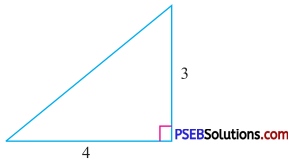
PSEB 7th Class Maths Solutions Chapter 6 Triangles Ex 6.3 1
Answer:
Take a = 3 cm, b = 4 cm and unknown side = c
By Pythagoras Theorem
c2 = a2 + b2
c2 = (3)2 + (4)2
c2 = 9 + 16
c2 = 25
∴ c = \(\sqrt{25}\)
c = 5
Thus, the length of unknown side = 5 cm.

Question (ii).
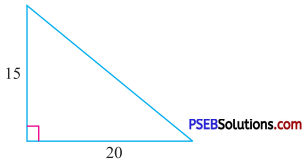
PSEB 7th Class Maths Solutions Chapter 6 Triangles Ex 6.3 2
Answer:
Take a = 15 cm, b = 20 cm
By Pythagoras Theorem
c2 = a2 + b2
∴ c2 = (15)2 + (20)2
c2 = 225 + 400
c2 = 625
∴ c = \(\sqrt{625}\)
c = 25
Thus, the length of unknown side = 5 cm

PSEB 7th Class Maths Solutions Chapter 6 Triangles Ex 6.3

2. Which of the following can be the sides of a right triangle ?
(i) 4 cm, 5 cm, 7 cm
(ii) 1.5 cm, 2 cm, 2.5 cm
(iii) 2 cm, 2 cm, 5 cm
In the case of right angled triangles, identify the right angles.
Solutions:
(i) Let in ΔABC, the longest side is AB = 7 cm
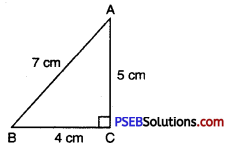
PSEB 7th Class Maths Solutions Chapter 6 Triangles Ex 6.3 3
(BC)2 + (AC)2
= (4)2 + (5)2
= 16 + 25 = 41
(BC)2 + (AC)2 = 41
Also AB2 = (7)2 = 49
Since AB2 ≠ (BC)2 + (AC)2
∴ The triangles with the given sides is not a right triangle.

(ii) Let in ΔABC, the longest side is AB = 2.5 cm
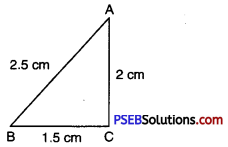
PSEB 7th Class Maths Solutions Chapter 6 Triangles Ex 6.3 4
(AB)2 = (2.5)2 = 6.25 ….(1)
(BC)2 + (AC)2
= (1.5)2 + (2)2
= 2.25 + 4
= 6.25
∴ (BC)2 + (AC)2 = 6.25 ….(2)
From (1) and (2)
(AB)2 = (BC)2 + (AC)2
Therefore, the given triangle is a right triangle.
The angle opposite to the longest side is right angle.

(iii) Let in ΔABC, the longest side is AB = 5 cm
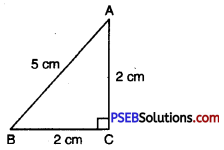
PSEB 7th Class Maths Solutions Chapter 6 Triangles Ex 6.3 5
(AB)2 = (5)2
(AB)2 = 25 ….(1)
(BC)2 + (AC)2 = (2)2 + (2)2
(BC)2 + (AC)2 = 4 + 4
(BC)2 + (AC)2 = 8 …..(2)
From (1) and (2)
(AB)2 ≠ (BC)2 + (AC)2
Therefore the triangle whose sides are 5 cm, 2 cm and 2 cm is not a right triangle.

PSEB 7th Class Maths Solutions Chapter 6 Triangles Ex 6.3

3. Find the area and the perimeter of the rectangle whose length is 15 cm and the length of one diagonal is 17 cm.
Solution:
Let ABCD be a rectangle with length AB = 15 cm and diagonal AC = 17 cm.
In ΔABC, ∠B = 90° (Each angle of a rectangle)
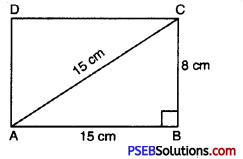
PSEB 7th Class Maths Solutions Chapter 6 Triangles Ex 6.3 6a
By Pythagoras Theorem,
(AC)2 = (AB)2 + (BC)2
(17)2 = (15)2 + (BC)2
289 = 225 + (BC)2
(BC)2 = 289 – 225 = 64
BC = 8 cm
Area of rectangle ABCD
= AB × BC
= 15 cm × 8 cm
= 120 cm2
Perimeter of rectangle ABCD = 2(AB + BC)
= 2(15 cm + 8 cm)
= 2(23 cm) = 46 cm2

4. A 15 m long ladder reached a window 12 m high from the ground on placing it against a wall at a distance, find the distance of the foot of the ladder from the wall.
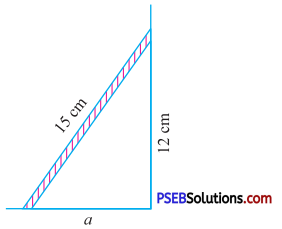
PSEB 7th Class Maths Solutions Chapter 6 Triangles Ex 6.3 11
Solution:
Let AB be the ladder and BC be the distance of the foot of the ladder from the wall then AB = 15 m and AC = 12 m
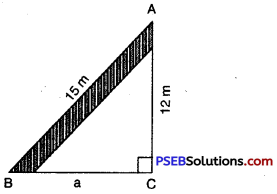
PSEB 7th Class Maths Solutions Chapter 6 Triangles Ex 6.3 7
By Pythagoras Theorem,
AB2 = BC2 + AC2
(15)2 = BC2 + (12)2
225 = BC2 + 144
BC2 = 225 – 144
BC2 = 81
BC =9
Hence the distance of the foot of the ladder from the wall is 9 m.

PSEB 7th Class Maths Solutions Chapter 6 Triangles Ex 6.3

5. The side of a rhombus is 5 cm. If the length of one of the diagonals of the rhombus is 8 cm, then find the length of the other diagonal.
Solution:
Let ABCD be a rhombus with side AB = 5 cm and diagonal AC = 8 cm
Let diagonal AC and BD bisect each other at O.
Then OA = OC = \(\frac {8}{2}\) cm = 4 cm
The diagonals of a rhombus bisect each other at right angle
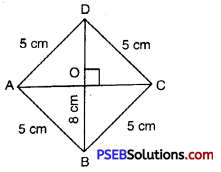
PSEB 7th Class Maths Solutions Chapter 6 Triangles Ex 6.3 8
∴ In right angled ΔAOB,
AO = 4 cm, AB = 5 cm
By Pythagoras Theorem,
OA2 + OB2 = AB2
(4)2 + OB2 = (5)2
16 + OB2 = 25
OB2 = 25 – 16 = 9
OB = 3 cm
Diagonal BD = 2 × OB = 2 × 3cm = 6cm
Therefore other diagonal of rhombus = 6 cm.

6. A right triangle is isosceles. If the square of the hypotenuse is 50 m, what is length of each of its sides ?
Solution:
Let ΔABC is a right isosceles triangle in which (AC)2 = 50 m and AB = AC
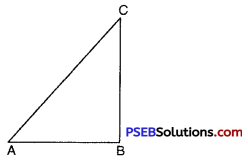
PSEB 7th Class Maths Solutions Chapter 6 Triangles Ex 6.3 9
∴ By Pythagoras Theorem
AB2 + BC2 = AC2
∴ AB2 + AB2 = AC2
2AB2 = 50
AB2 = 25
AB = 5
Therefore length of each equal side = 5m.

7. ΔABC is a triangle right angled at C if AC = 8 cm and BC = 6 cm, find AB.
Solution:
In right angled triangle ABC right angle at C
AC = 8 cm and BC = 6 cm
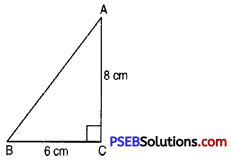
PSEB 7th Class Maths Solutions Chapter 6 Triangles Ex 6.3 10
By Pythagoras Theorem
AB2 = AC2 + BC2
AB2 = (8)2 + (6)2
AB2 = 100
AB = 10 cm.

PSEB 7th Class Maths Solutions Chapter 6 Triangles Ex 6.3

8. State whether the following triplets are Pythagorean or not.

Question (i).
(5, 7, 12)
Solution:
Let a = 5, b = 1, c = 12
∴ c2 = (12)2 = 144
a2 + b2 = (5)2 + (7)2
= 25 + 49 = 74
∴ a2 + b2 ≠ c2
∴ (5, 7, 12) is not a pythagorean triplet.

Question (ii).
(3, 4, 5)
Solution:
Let a = 3, b = 4, c = 5
∴ a2 + b2 = (3)2 + (4)2
= 9 + 16 = 25
c2 = (5)2 = 25
∴ c2 = a2 + b2
∴ (3, 4, 5) is a pythagorean triplet

Question (iii).
(8, 9, 10)
Solution:
Let a = 8, b = 9, c = 10
∴ a2 + b2 = (8)2 + (9)2
= 64 + 81 = 145
c2 = (10)2 = 100
c2 ≠ a2 + b2
Therefore (8, 9, 10) is not a pythagorean triplet.

Question (iv).
(5, 12, 13)
Solution:
Let a = 5, b = 12, c = 13
∴ a2 + b2 = (5)2 + (12)2
= 25 + 144 = 169
c2 = (13)2 = 169
a2 + b2 ≠ c2
Therefore (5, 12, 13) is a pythagorean triplet.

PSEB 7th Class Maths Solutions Chapter 6 Triangles Ex 6.3

9. Multiple Choice Questions :

Question (i).
In a ΔABC, if ∠A = 40° and ∠B = 55° then ∠C is
(a) 75°
(b) 80°
(c) 95°
(d) 85°
Answer:
(d) 85°

Question (ii).
If the angles of a triangle are 35°, 35° and 110°, then it is
(a) an isosceles triangle
(b) an equilateral triangle
(c) a scalene triangle
(d) right angled triangle
Answer:
(a) an isosceles triangle

Question (iii).
A triangle can have two
(a) right angles
(b) obtuse angles
(c) acute angles
(d) straight angles
Answer:
(c) acute angles

Question (iv).
A triangle whose angles measure 35°, 55° and 90° is
(a) acute angled
(b) right angled
(c) obtuse angled
(d) isosceles
Answer:
(b) right angled

PSEB 7th Class Maths Solutions Chapter 6 Triangles Ex 6.3

Question (v).
A triangle is not possible whose angles measure
(a) 40°, 65°, 75°
(b) 50°, 56°, 74°
(c) 72°, 63°, 45°
(d) 67°, 42°, 81°
Answer:
(d) 67°, 42°, 81°

Question (vi).
A triangle is not possible with sides of lengths (in cm)
(a) 6, 4, 10
(b) 5, 3, 7
(c) 7, 8, 9
(d) 3.6, 5.4, 8
Answer:
(a) 6, 4, 10

Question (vii).
In a right angled triangle, the length of two legs are 6 cm and 8 cm. The length of the hypotenuse is
(a) 14 cm
(b) 10 cm
(c) 11 cm
(d) 12 cm
Answer:
(b) 10 cm

PSEB 8th Class Science Notes Chapter 8 Cell Structure and Functions

This PSEB 8th Class Science Notes Chapter 8 Cell Structure and Functions will help you in revision during exams.

PSEB 8th Class Science Notes Chapter 8 Cell Structure and Functions

→ All living things carry out certain basic functions.

→ Roots, stems, leaves, and flowers are the organs of plants.

→ Animals have also parts such as hands, feet, legs, etc.

→ You cannot observe small pores in your skin without the help of a magnifying lens.

→ All living organisms take and digest food, respire, and excrete waste products.

PSEB 8th Class Science Notes Chapter 8 Cell Structure and Functions

→ Each organism represents an individual of its own kind.

→ Cells in living organisms are complex structures unlike bricks in a building.

→ Cells found in living organisms show a variety of numbers, shapes, and sizes.

→ Single-celled organisms like Amoeba, Paramecium, and Bacteria are called unicellular organisms.

→ Cells in multicellular plants and animals have a variety of shapes. Cells are generally round or spherical in shape.

→ The yellow part of the hen’s egg is called yolk and it is surrounded by white albumen, yellow yolk represents a single cell.

→ All cells are bounded by a membrane called plasma membrane or cell membrane.

→ Plasma membrane encloses a liquid substance known as protoplasm.

→ The cell wall is present in plant cells which are made up of cellulose.

→ Both the plasma membrane and cell wall give shape to the cell.

→ Ostrich egg represents the largest cell visible to the unaided eye.

PSEB 8th Class Science Notes Chapter 8 Cell Structure and Functions

→ Each cell has smaller components called cell organelles.

→ Cell multiplies and organisms become multicellular and grow in size.

→ Cells in the living organism are basic structural units.

→ Different groups of cells perform a variety of functions.

→ The number of cells being less in smaller organisms does not affect the functioning of the organisms.

→ WBC in human blood is also single-celled.

→ A group of cells performing a definite function is called a tissue.

→ Each organ is made up of a number of tissues.

→ Organ: These are the smaller parts of all living organisms. Each organ is made up of a number of tissues.

→ Tissue: A group of cells performing a definite function is called a tissue.

→ Cell: It is the basic structural and functional unit of all living organisms.

→ Unicellular: Some living organisms are made up of only a single cell that performs all the metabolic functions. Such organisms are called unicellular.

→ Multicellular: Some organisms are made up of a number of cells. Such organisms are called multicellular. In these organisms, different cells perform different functions.

PSEB 8th Class Science Notes Chapter 8 Cell Structure and Functions

→ Pseudopodia: These are finger-like false feet of amoeba.

→ White Blood Cell (WBC): These are some of the components of blood cells that engulf harmful foreign materials. These are single-celled.

→ Cell Membrane or Plasma Membrane: It is a thin covering present outside the cell which gives shape to it.

→ Cytoplasm: It is a liquid portion present between the cell membrane and nucleus of a cell.

→ Organelles: These are the living components of cells present in their cytoplasm.

→ Cell Wall: It is an extra covering present around the cell membrane of only plant cells. It gives shape and rigidity to the cell.

→ Nucleus: It is the round part of the cell which is called the controlling centre of the cell.

→ Nucleolus: It is a component of the nucleus which is dense and has a spherical body.

→ Nuclear Membrane: The nucleus is separated from the cytoplasm by a membrane called the nuclear membrane.

→ Prokaryotes: The organisms whose cells are without a well-organized nucleus i.e. lacking nuclear membrane are called prokaryotes.

→ Eukaryotes: The organisms whose cells have a distinct and clear nucleus bounded by the nuclear membrane are called eukaryotes.

PSEB 8th Class Science Notes Chapter 8 Cell Structure and Functions

→ Vacuole: The fluid-filled organelles present in a cell are called vacuoles.

→ Plastids: Small coloured bodies present in plant cells only are called plastids.

→ Chloroplasts: Green plastids present in plant cells are called chloroplasts.

→ Gene: Genes are dot-like structures present on chromosomes that help in the inheritance of characters from parents to the next generation.

→ Chromosome: These are thread-like structures present in the nucleus of a cell.