Punjab State Board PSEB 10th Class Science Important Questions Chapter 16 Management of Natural Resources Important Questions and Answers.
PSEB 10th Class Science Important Questions Chapter 16 Management of Natural Resources
Long Answer Type Questions
Question 1.
Explain the three R’s to serve the environment.
Answer:
The three R’s to save the environment : Reduce, Recycle and Reuse. What do they refer to?
- Reduce: This means that use less. Save electricity by switching off unnecessary lights and fans. Save water by repairing leaky taps. Do not waste food.
- Recycle: This means that collection of plastic, paper, glass and metal items and recycle this material to make required things instead of synthesising or extracting fresh plastic, paper, glass or metal. In order of recycle, first need to segregate waste so that the material that can be recycled is not dumped along with other waste.
- Reuse: This is actually even better than recycling because the process of recycling uses some energy. In the ‘reuse’ strategy, simply use things again and again. Instead of throwing away used envelopes, you can reverse it and use it again. The plastic bottles in which you buy various food-items like jam or pickle can be used for storing things in the kitchen.
Question 2.
Write a short note on wildlife.
Answer:
Various plants and animals found in forest are collectively called wildlife. The diverse groups of animals live in forests. Similarly, there are many varieties of plants and trees too, are there in forests. In ancient times, there were comparatively more forests where animals could live with more ease. The number of lions, panthers, rhinos, elephants etc. was exceptionally high. But from the time when human beings started shedding down the forests, the number of animals started decreasing. The number of wild animals is continuously decreasing very rapidly.
Wildlife now needs more protection because of their usefulness and more dependence on it. Wildlife sanctuaries and National Parks have been established for animals where they are provided better safety. Poaching has been strictly banned. Only by protecting wild animals we can help them in breeding and thus can save them from extinction.
Question 3.
What is the importance of forest resources?
Answer:
A. Productive functions
- Forests provide wood. Indian forests yield valuable timber wood like teak, sal, deodar, shisham etc.
- Forests provide paper. The conifers and bamboos are used as raw material to prepare paper.
- Medicinal plants of forests provide medicine of great importance.
- Forests provide number of products like resins, gums, rubber, food and insecticides.
- Forests provide shelter to variety of animals.
- Forests also provide the cork e.g. oak (Quercus).
B. Protective functions
Role of forests in the protection of lands. Forests play a vital role in the life and economy of all tribes living in the forests.
- Forests prevent erosion of soil by wind and water.
- Large trees provide shade which prevents the soil from becoming dry and friable during the summer.
- They check the velocity of rain drops or wind striking the ground and reduce dislodging of the soil particles.
- The root system of plants firmly binds the soil.

Question 4.
What are the methods for safety of forests?
Answer:
- Banning deforestation.
- Only such trees should be cut those have dried up or have been affected by some diseases. New plants/trees should be grown in place of removed trees.
- Van Mahotsav should be celebrated. In this week, thousands of new plants/trees should be planted.
- Newly planted trees should be taken care of.
- Trees should be counted every year and the target set on Van Mahotsav should be attained.
- New plans of Van Mahotsav should be followed.
- Steps should be taken to protect forest from the danger of fire.
- To protect trees from diseases, chemical and medicines must be used.
Question 5.
Discuss various intermediaries of environmental pollution.
Answer:
Human beings and environment have a strong and unbreakable natural bond. Human beings only either protect or pollute the environment and the consequences of it affect them. Clean and healthy environment is very necessary for human society. Unplanned acts of human beings harms the environment. Smoke from trucks and buses, dirty water of sewerages in rivers and rubbish on roads, pollutes the environment of cities.
Constant increase in population is one of the main reason of environment degradation. Need of houses, clothing and food increases due to increasing population. Natural resources are affected adversely in order to meet these demands like deforestation, uncontrollable use of underground water, industrialisation etc. All these are the major reasons of pollution.
When natural sources do not help properly to clean the environment again, it causes pollution. Industrial mishappenings and illegal setting of factories also help in causing pollution. Over use of harmful chemical is one of its factors. Over exploitation of natural resources also pollutes the environment. Industrial revolution causes water and air pollution. Acid rain is caused due to sulphur oxides which are expelled out from the engines of the vehicles. Ozone layer gets depleted due to excessive use of aerosols.
Waste materials are produced mainly due to various activities which cause environmental degradation. These waste products are very harmful and their effects spread very rapidly.
It is a universal issue now to get rid of it. Recycling and reuse of material only can protect our environment from degradation.
Man is the major factor of environmental pollution and he himself is being affected very adversely because of his own blunders.
Question 6.
Comment on ‘Chipko Movement’.
Answer:
‘Chipko Movement’ was the result of policy to separate people living in mountaineous region from forests. This movement started by incident that took place in ‘Raini’ village in Garhwal located in Himalayan range in 1970. The problem was started between local people and the wood contractors. The contract of shedding down the trees near the village was given to wood contractors. On the specific day, labour of the contractor came to cut down the trees. The local male population was not present at that time but women of that village reached there instantly and hugged the trees and didn’t allow them to cut the trees. Since they stuck themselves to trees and the labour of contractor was forced to stop the work.
Question 7.
Why should coal and petroleum be used carefully?
Answer:
Coal and petroleum are the results of dead and decayed fossils of plants and animals in which hydrogen, nitrogen and sulphur are present along with carbon. On burning these carbon dioxide, water, nitrogen oxides and oxides of sulphur are produced.
On burning them in the inadequate supply of air, carbon monoxide is produced in place of carbon dioxide. All these gaseous products are poisonous in nature. Carbon dioxide is a greenhouse gas. Carbon is present in large amount in coal and petroleum. If complete carbon present in them is not burnt, then availability of oxygen will become abundant on earth and it will change to carbon dioxide. It will lead to global warming of our earth as well. So, coal and petroleum should be used carefully.
Question 8.
How is Ganga river polluted? Comment on its cleanliness plan.
Answer:
Ganga covers the distance of 2500 km from Gangotri situated in Himalaya mountain to Bay of Bengal. It flows from different states with more than one hundred cities due to which it gets polluted.
Following are the types of pollution which are responsible for Ganga’s pollution :
- Industrial waste.
- Unprocessed Excreta.
- Burning the dead bodies near its banks and immersing the remains of dead bodies.
- Taking bath in Ganga because of certain superstitions.
Cleanliness plan of Ganga. Remains of dead bodies are immersed in the water of Ganga because of traditional customs that is why coliform bacteria is present in it and it goes on increasing in downstream water. Cleanliness plan of Ganga was started in 1985. Who the budget in first step was 462 crores and in second step it was 416 crores. Under this plan 873 million litres water was to be treated daily. To have a control on pollution of Ganga, immediate need is to increase the functioning of this plan.
Question 9.
What are the methods of conserving water resources?
Answer:
Conservation of water resources
For conservation and management of fresh water following methods can be employed :
- Reducing agricultural water wastage by increasing efficiency of irrigation system.
- Afforestation and protection of watersheds to improve economy.
- Formation of artificial clouds, so that a change can be brought in the atmosphere.
- Changes in the vegetation of a particular area, so that even in the dry season maximum amount of water can be stored. In addition to this, dams should be constructed to stop the drainage of rain water.
- Control the distribution of water by constructing big dams.
- Desalinization of sea water and saline ground water.
- Proper utilization of underground water.
- Attempt to extract minerals from water.
- Melt the glaciers and snow for using as a fresh water resource.
- Regular dredging and desiltation of water bodies.
Question 10.
Discuss various ways of water harvesting.
Answer:
Water harvesting can be undertaken through a variety of ways such as follows :
- Capturing run off from roof tops.
- Capturing run off form local catchments.
- Capturing floodwaters from local streams.
- Conserving water through watershed management.
Question 11.
Why use of coal and petroleum should be restricted?
Answer:
Necessity of Judicious Use of Coal and Petroleum. The fossil fuels, coal and petroleum get exhausted and their combustion pollutes our environment, so a judicious use of these resources is necessary.
- Since coal and petroleum have been formed from biomass, in addition to carbon, these contain hydrogen, nitrogen and sulphur.
- When these are burnt, the products formed are carbon dioxide, water, oxides of nitrogen and oxides of sulphur. When combustion takes place in insufficient air (oxygen), then carbon monoxide is formed instead of carbon dioxide.
- Of these products, the oxides of sulphur and nitrogen and carbon monoxide are poisonous at high concentrations and carbon dioxide is a greenhouse gas which leads to global warming.
- Another way of looking at coal and petroleum is that they are huge reservoirs of carbon and if all of this carbon is converted to carbon dioxide, then the amount of carbon dioxide in the atmosphere is going to increase leading to intense global warmings. Thus, we need to use these resources judiciously.
Question 12.
Explain any four measure for conservation of wild life.
Answer:
Some of the steps involved in the conservation of wild life are :
- The wild life should be protected in natural habitats (in-situ conservation) as well as in places under human control such as zoological and botanical gardens, genetic re-source centres, culture collection (Ex-situ conservation).
- The threatened species should be given preference over others in the conservation programme. Among these, the endangered species should get priority over the vulner¬able species, and the latter over the rare species.
- The habitats of wild relatives of useful plants and animals should be preserved in protected areas.
- The critical habitats of wild animals should be kept intact.
Short Answer Type Questions
Question 1.
Define Natural resources with example.
Answer:
Natural Resources. Resources which exist naturally in nature and are useful to human beings are called natural resources e.g. air, water, soil, coal, petroleum etc. are natural resources.
Question 2.
Explain the principles of first ‘R’ in 3R’s.
Answer:
First ‘R’ stands for Reduce. It means that we should use the resources in limited exten. For example we can switch off the fans and bulbs when not in use and can save electricity. In the same way by using water in less amount and by getting leaking pipes repaired, we can save water from wastage.
Question 3.
Explain the principle of second ‘R’ in 3R’s.
Answer:
Second ‘R’ stands for ‘recycle. It means that we should reuse plastics, paper, glass and should make these in making useful in our daily life. We should not discard them by throwing in dust bin instead should keep them separately for using again.
Question 4.
What is the importance of third ‘R’ in R’s?
Or
How is ‘reuse’ helpful in the conservation of environment?
Answer:
Third ‘R’ represents ‘ Reuse’. This is considered better than recycling. In recycling some of the energy definitely goes waste. In the process of reusing, same thing can be used again and again. For example the containers and bottles of eatables can be used for storage of other things.
Question 5.
Give in detail the journey of Ganga and discuss how is it getting polluted?
Answer:
Ganga runs its course of 2500 km from Gangotri in Himalayas to Bay of Bengal. It crosses through Uttar Pradesh, Bihar, Bengal and 100 more cities which are responsible for its pollution. Its main reason is that garbage waste and excreta from these cities are made to flow in it. Apart from this , other human activities like bathing, washing clothes, passing the remains of dead people are also the causes of its pollution and toxic and chemical waste from industries have increased its pollution. These industries contribute chemical effluents to the Ganga’s pollution load and toxicity kills fish in large section of the rivers.
Question 6.
How can we control the pollution of river Ganga?
Answer:
Pollution of Ganga can be controlled by the following steps :
- By not allowing disposal of industrial waste material in the river.
- By not disposing toxic substances and the dead remains of animals.
- By not expelling the domestic waste in river water.
- Avoid washing clothes in the river.
- By not pouring ash and remains of dead bodies.
Question 7.
What is recyling? What can we do for it?
Answer:
Old newspapers, books, notebooks, old products made of metals etc. can be easily transformed into other useful products, which is called recycling. Re-cycled product can be used again and again.
We can do the following works for recycling of materials :
- Buying those things which can be recycled.
- By using such things which are produced by recycling process.
- By selling things for recycling before they get completely destroyed.
Question 8.
Write the contribution of Bishnoi community in Rajasthan to protect environment.
Answer:
Bishnoi community of Rajasthan made applaudable efforts to protect forests and wildlife which has now become a part of their traditional culture. In 1731, in Khejreli village near Jodhpur, 363 people sacrificed their lives to protect ‘Khejri’ trees. This is why the Government of India has instituted an Amrita Devi Bishnoi National Award’ for wild life conservation in memory of Amrita Devi.
Question 9.
“The human intervention has been very much a part of the forest landscape’— what should be the nature and limit of intervention to control over it?
Answer:
We should certainly make some arrangements to control over the nature and limitation of this intervention. Forest resources should be used in such a way that environment and development both may get advantage from these. Local people should get more of its advantage where environment is conserved. It is a decentralisation system that can help both monetary development and environmental conservation. Environment cannot be accepted just as a collection of plants and animals. It is a complex and complicated system. We have many natural resources for the use of it. We must use all these resources very carefully for our financial and social development.
Question 10.
What did Chipko Movement teach to the government and people? Explain.
Answer:
Chipko Movement spread very rapid in various communities. Many social organisations and media also played a vital role in it. It compelled the government to rethink about the decisions needed to be taken in use of forest resources. People by their experience learnt that deforestation not only affects the availability of trees but also quality of soil and water level too gets spoiled. Participation of local people in management of forests must be encouraged.
Question 11.
Explain with an example the role of people in forest management.
Answer:
In 1972, the forest department of West Bengal made some changes in their policy because of getting failure in reviving the degraded Sal forests. Those sal were destroyed in south-west regions. They started their movement at Madinipura in the region of Arabari. A far sighted forest officer of the department A.K Banerjee. encouraged villagers to join the movement and with their help they protected badly degraded sal forests of about 1272 hectares area.
Question 12.
What are the three main problems in constructing of big dams?
Answer:
- Social problems: Large number of people are forced to migrate and they get affected badly. They have to leave their houses and business. Farmers are forced to leave their agricultural lands.
- Economic Problems: A huge amount of public money is used without generation of proportionate benefits.
- Environmental Problems: Deforestation is taking place on large scale. Bio-diversity is adversely affecteu and environmental problems are arising enormously.
Question 13.
What is the importance of water shed management?
Answer:
More importance is given to scientific soil and water conservation to increase the biomass production in water shed management. Its main importance is to develop primary sources of land and water such that secondary resources of plants and animals may not cause ecological imbalance.
Question 14.
What are the advantages of underground water?
Answer:
- It does not evaporate to mix in atmosphere.
- Vegetation Plants animals are not present in it.
- It improves the water level.
- It provides dampness to plants.
- It does not get polluted due to the presence of living beings.
Question 15.
How can underground water level be recharged in largely level terrain?
Answer:
In largely level terrain water harvesting structures are made. These are mainly crescentshaped earthen embankments. These may be low, straight concrete check dams built across seasonal flooded gullies. Rain water gets stored in Monsoon rains behind the structures. Most of the water dries up in six months after monsoons. It recharges the ground water beneath.
Question 16.
What are fossil fuels and how are they made? Give two examples of these.
Answer:
The remains of animals and plants got compressed under the crust of earth in the absence of oxygen million of years ago. Thus they could not get oxygen. Under the crust neither oxidation of these was possible nor destruction but because of the internal pressure water and volatile substances squeezed out. These substances are termed fossil fuels. Actually fossil fuels are the molecules of carbonic compounds. These are the results of degradation of biomass millions of years ago. The examples of fossil fuel are coal, petroleum and natural gas.
Question 17.
Water is very essential for survival of life’. Justify this statement.
Answer:
Water is essential due to following reasons :
- It takes part in all chemical reactions taking place in our body.
- It maintains the temperature of body.
- It is important for body to carry nutrients to all parts of the body.
- It helps in excretion of organic waste from the body.
- It is important for transportation of substances.
- Irrigation, industries and electricity are totally dependent on water.
Question 18.
Write some major means of water conservation.
Answer:
We can conserve water by :
- Using water for irrigation.
- Flood control, hydrological survey and construction of dams.
- Recharging of underground water and avoiding its wastage.
- Transformation of high water levels into low water levels.
- Safety of soil to avoid soil erosion.
Question 19.
Mention the names of air pollutants.
Answer:
The main air pollutants are :
- Carbon monoxide
- Carbon dioxide
- Oxides of sulphur and nitrogen
- Compounds of flourides
- Hydrocarbons
Question 20.
Write some methods by which pollution can be controlled.
Answer:
- By getting knowledge of the causes and control on pollution.
- By installing the control devices in factories to check the air pollution.
- By recycling the waste products.
- Disposal of excreta and expelled waste material in correct way.
- By using Gobar gas plants.
Question 21.
What is the role of increasing population in destruction of natural resources?
Answer:
Population is increasing constantly due to which human needs are increasing day-by-day. To meet these requirements natural resources are being continuously exhausted. Natural resources are available in large amount but even then these are limited because population has risen at its verge. Our resources are very limited to meet the needs of increasing population. If the monster of increasing population grows at this rate then it will be very difficult to maintain balance between the natural resources and ecology.
Question 22.
Give five points to control pollution.
Answer:
Pollution can be controlled in following ways :
- Gobar gas plants should be installed.
- Bio-degradable substances should be disposed in pits.
- Waste material should be recycled.
- Excreta and disposal matter should be disposed of in a correct way.
- CNG should be used in automobiles.
Question 23.
What are the harmful effects of deforestation?
Answer:
If rate of deforestation is more than the rate of afforestation, then the number of trees will reduce with the passage of time. Trees release water vapours in large amount during transpiration and clouds are formed with the help of these. Rainfall is always less in the area where trees are less in number. Due to this the fertile lands convert into deserts. Deforestation slowly causes removal of upper fertile surface of soil that gets carried away through rain water to rivers ultimately.
Question 24.
How can coal and petroleum be saved for long time?
Answer:
Use of coal and petroleum depend on the quality of machines. In vehicles used for transportation consume excess fuel. Scientists have been researching for the complete combustion of fuel. Efforts are being made to get such fuels having more efficiency, less pollution and capacity for storage of enhanced period.
Question 25.
What are the problems faced in the construction of big dams?
Answer:
- Large numbers of forest, vegetation and bio diversity are lost.
- Migration of people causes unstability and mental tension.
- Migrated persons face number of social and economic problems.
- Benefits are less than the money spent in constructing big dams.
Question 26.
Write difference between National Parks and Animal sanctuaries.
Answer:
| National Parks |
Animal Sanctuaries |
| 1. These provide shelter to special wild animals like cheetah, rhino, lion, etc. |
1. Animals are protected in natural environment. |
| 2. These are spread over 100 to 50C kilometres of area. |
2. These are spread over 500 to 1000 sq. kilometres of area. |
| 3. Strong walls are erected around these. |
3. Tall and high fenced temporary walls are erected around these. |
Question 27.
What are the harms caused by burning of fossil fuels?
Answer:
- Burning of fossil fuel produces harmful gases like CO2, CO, SO2, NO2, etc. are produced.
- Many respiratory problems are caused due to air pollution.
- Chances of skin problems increase.
- Burning sensation is felt in the eyes.
Question 28.
How does rate of development affect the environment? Explain.
Answer:
The rate of development is always beneficial but at the same time it affects the environment. Deforestation is resulted due to urbanisation. Land suitable for agriculture is used for constructing factories. Smoke expelled through chimneys of factories pollutes the air and leaves a harmful effect on health of all living beings. Due to urbanisation cities expand resulting in deleting of villages due to which agricultural land is extincting. Transportation and telecommunication are increased due to which roads and railway need more land. Deforestation is needed for these.
Question 29.
What are uses of water shed management?
Answer:
- To face the situation of drought.
- To get rid of floods.
- Long life of dams and water reservoirs.
- For conservation of water.
- To make water available for irrigation for the whole year.
Question 30.
What are Kulhs? How were these managed?
Answer:
Kulhs are the local irrigation canals evolved by the people of Himachal Pradesh about 400 years ago. The water of natural waterfalls and flowing in streams w as diverted into man-made channels which took this water to numerous villages down the hillside. The management of water flowing in these kulhs was based on a common agreement among the villages. During planting season, watjr-was first of all supplied to the village farthest away from the source of Kulh. The water flow in Kulhs was managed by two-three persons who were paid by the villagers. Apart from irrigation these Kulh’s also percolated into the soil that helped the springs to feed at various points. Government took over these kulhs later but after some time irrigation department lost control and these became non-functional.
Question 31.
What was the losses of inequality in distribution of water?
Answer:
Canal systems leading from dams transfer water from one place to the other distant places. Indra Gandhi canal has helped a big part of Rajasthan to get green now but due to unequal distribution of water and poor management many people could not get benefits from this system. Water is not equally distributed due to which people living near the water source are able to grow crops like sugarcane and wheat which need water in large amount whereas people living away cannot get sufficient amount of water. They cannot grow crops of their choice.
Question 32.
Find out the traditional methods of water storage in your nearby locations.
Answer:
The water harvesting has been a traditional system in India. In Rajasthan by Khad, tanks and Nadis, in Maharashtra by bandharas and Tals, in Madhya Pradesh and Uttar Pradesh by Bundhis the water is harvested. In Bihar Aahar and Pynes, in Himachal Pradesh Kulhs, in Jammu region Ponds and in Tamil Nadu by Eris, in Kerala by surangams and in Karnataka by Kattas rain water is harvested.
Question 33.
Explain a traditional Rain water Harvesting system.
Answer:
Water harvesting is a traditional system in India. In Rajasthan by Khadin, in, Maharashtra by bandharas and Tals, in Madhya Pradesh and Uttar Pradesh by Bundhis, in Bihar by Aahar and Pynes, in Himachal Pradesh by Kulhs and in Jammu regions of Jammu by ponds the rain water in harvested and is still in use by people living there. Rain water is stored in dams and is used for different persons. This water becomes the reason of increasing water level in wells.
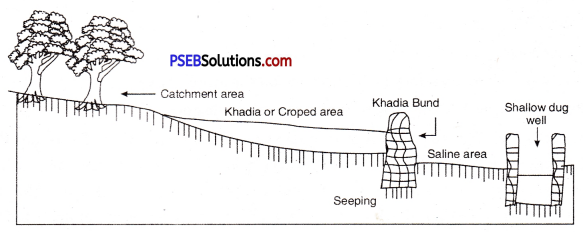
Traditional water harvesting system-khadin system
Very Short Answer Type Questions
Question 1.
What is Pollution?
Answer:
Substances which are found in natural state or when they get mixed with dust or toxic substances is called as pollution.
Question 2.
Write five Natural resources.
Answer:
- Forest
- Wildlife
- Water
- Coal
- Petroleum.
Question 3.
What are 3R’s?
Answer:
- Reduce
- Recycle
- Reuse.
Question 4.
Write things which can be recycled?
Answer:
Plastic, glass, paper and things made of metals.
Question 5.
Which energy do we get on earth?
Answer:
Solar energy that we get from the sun.
Question 6.
Write full form of CFC.
Answer:
Chloro-Fluoro Carbons.
Question 7.
Name the living beings responsible for biodiversity.
Answer:
Bacteria, fungi, ferns, flowers, plants, nematodes, insects, birds, reptiles.
Question 8.
When was Ganga cleanliness plan enacted?
Answer:
In 1985.
Question 9.
What is coliform?
Answer:
A coliform is a group of bacteria which is found in human intestines due to water pollution.
Question 10.
Write the origin of river Ganga and its course of run.
Answer:
Ganga runs its course of over 2500 km from Gangotri in Himalyas to Ganga Sagar in the Bay of Bengal.
Question 11.
What do we get from sea water?
Answer:
We get iodine from sea water.
Question 12.
How do get solar energy?
Answer:
We get solar energy from sunlight which comes directly from sun and we intake them through plants.
Question 13.
Name three toxic gases.
Answer:
Nitrogen oxide (NO), Sulphur dioxide (SO2), Carbon monoxide (CO).
Question 14.
Name three trees which are found in forests.
Answer:
Pine, Eucalyptus, Timber.
Question 15.
How does the growth of grass stop in Alpine forests?
Answer:
Grass grows very tall and it falls down on ground which haults the growth of grass.
Question 16.
When and where Chipko Andolan was started?
Answer:
Chipko Andolan was started in village Reni of Garhwal in 1970.
Question 17.
Name three major resources of minerals.
Answer:
Coper, Iron and Manganese.
Question 18.
Write three renewable sources of energy.
Answer:
Wood, Water and Solar energy.
Question 19.
Write two non-renewable sources of energy.
Answer:
Coal and Petroleum.
Question 20.
Name two traditional sources of energy.
Answer:
Fossil fuel and flowing water.
Question 21.
Name two major constituent gases of atmosphere.
Answer:
- Nitrogen 78%,
- Oxygen 21%.
Question 22.
What is universal indicator?
Answer:
Litmus paper is called as universal indicator.
Question 23.
What is measured by litmus paper?
Answer:
pH is measured easily with the help of litmus paper.
Question 24.
Why is reuse better than recycle?
Answer:
In recycling some amount of energy is wasted.
Question 25.
Who is the main stakeholders of forests when we think about conservation of forests?
Answer:
The main stakeholders are people who live in and around the forests and are dependent on forest for different needs.
Question 26.
What is the other name of timber?
Answer:
The other name of timber is carpet-wood.
Question 27.
For what forests are considered as source of industries?
Answer:
For raw materials.
Question 28.
Mention two industrial requirements those lead to deforestation.
Answer:
Construction of roads and dams.
Question 29.
On what rains of our country are dependent?
Answer:
Monsoon. The duration of rainy season is limited for a few months.
Question 30.
What is the ancient system of water harvesting in India?
Answer:
Dams, ponds and rivers.
Question 31.
What are Kulhs?
Answer:
400 years ago a traditional harvesting system was developed in Himachal Pardesh canal water. These were called as Kulhs.
Question 32.
If these natural resources are used at the present rate, for how long will they exist?
Answer:
Petroleum will be available for about next 40 years and coal resource for next 200 years.
Question 33.
On what pressure is always maintained in watershed arrangement?
Answer:
Soil and water management.
Question 34.
Name two categories in which waste substance can be divided. Which among these two is comparatively more harmful?
Answer:
- Biodegradable substances.
- Non-biodegradable substances. Non-biodegradable substances are comparatively more harmful.
Question 35.
What is the main reason behind the establishment of National Parks and sanctuaries?
Answer:
To protect wildlife.
Question 36.
Write two harmful effects caused by industries on air setting up heavy industries on local climate.
Answer:
- Air pollution.
- Increase in temperature of atmosphere.
Question 37.
Write the main cause of global warming.
Answer:
High amount of CO2 a green house gas, in the atmosphere due to burning of fossil fuel is resulting in global warming.
Question 38.
Name two renewable natural resources.
Answer:
- Forests and
- Water.
Question 39.
Name any one endangered plant species.
Answer:
Podophythum.
Question 40.
Name the person who started Appiko movement in South.
Answer:
Pandu Kumar Hegde started appiko movement in Karnataka in 1983.
Multiple Choice Questions
Question 1.
What is the desired minimum total coliforin count level in the Ganga?
(A) 500 MPN/100 ml
(B) 600 MPN/100 ml
(C) 1000 MPN/100 ml
(D) 1200 MPN/100 ml.
Answer:
(A) 500 MPN/100 ml
Question 2.
Chipko Andolan was started by:
(A) Amrita Devi Bishnoi
(B) H.N. Bahuguna
(C) Sunder Lai Bahuguna
(D) A.K. Bannerji.
Answer:
(C) Sunder Lai Bahuguna
Question 3.
Which of the following is/are example(s) of people partici pation in the management of forests?
(A) Chipko Andolan
(B) Arabara forest range of Midnapur
(C) Appiko movement
(D) Khejri tree movement.
Answer:
(B) Arabara forest range of Midnapur
Question 4.
Which of the following represents the regulative function of forest?
(A) Storage and release of gases
(B) production of wood
(C) production of essential oils
(D) conservation of soil and water.
Answer:
(D) conservation of soil and water.
Question 5.
Extensive planting of trees to increase forest cover is called :
(A) afforestation
(B) agroforestry
(C) deforestation
(D) social forestry.
Answer:
(A) afforestation
Question 6.
Enviromnent is formed of:
(A) only biotic component
(B) Only abiotic
(C) Both (A) and (B)
(D) None of above.
Answer:
(C) Both (A) and (B)
Question 7.
Environment day falls on:
(A) 28th Feb
(B) 23rd March
(C) 5th June
(D) 14th Nov.
Answer:
(C) 5th June
Question 8.
Joint Forest management is an example of:
(A) Political equality
(B) Participatory approach
(C) Food stabilization
(D) Economic equality.
Answer:
(B) Participatory approach
Fill in the Blanks :
Question 1.
Chipko Andolan was started by _________ in 1970.
Answer:
Sundar Lai Bahuguna.
Question 2.
Ganga Action Plan was launched in _________
Answer:
1985.
Question 3.
_________ (coal and petroleum) are important sources of energy.
Answer:
Fossil Fuels.
Question 4.
Three R’s to save the environment are Reduce, _________ and _________
Answer:
Recycle, Reuse.
Question 5.
_________ is the ultimate source of energy.
Answer:
Sun.
Question 6.
Tehu Dam is built on _________
Answer:
River Ganga.
Question 7.
Forests provide _________ and plants.
Answer:
Wood, medicinal.

