PSEB 4th Class EVS Solutions Chapter 16 Water Conservation

Punjab State Board PSEB 4th Class EVS Book Solutions Chapter 16 Water Conservation Textbook Exercise Questions and Answers.

PSEB Solutions for Class 4 EVS Chapter 16 Water Conservation

EVS Guide for Class 4 PSEB Water Conservation Textbook Questions and Answers

Textbook Page No. 116

Question 1.
What was the main source of irrigation in old times?
Answer:
Rainwater.

PSEB 4th Class EVS Solutions Chapter 16 Water Conservation

Question 2.
How is groundwater affected by the cultivation of paddy?
Answer:
Ground water is getting depleated due to cultivation of paddy.

Question 3.
What is the main source of irrigation in Punjab, now-a-days?
Answer:
Tubewells.

Question 4.
Write any one way to conserve water at home.
Answer:
We can wash the utensils with the waste water of RO filter.

Activity-2.
Enlist the public taps in your village and note how many of them are not turned off after use.
Answer:
Do it yourself.

PSEB 4th Class EVS Solutions Chapter 16 Water Conservation

Textbook Page No. 119-120

Question 5.
Answer the following questions in brief:
(a) What measures should be adopted to minimise the use of water in agriculture? –
Answer:
We should adopt the modern techniques of irrigation e.g. drip system, fountain system of irrigation.

(b) What is the effect of submersible pumps on the use of water in houses?
Answer:
Ground water is getting depleated, we are not using water wisely. We waste a lot of water.

(c) Why can we not use water of ocean?
Answer:
Many Unwanted salts are dissolved in sea water, it is not fit for direct consumption.

(d) What is the proper way of using water while brushing/bathing?
Answer:
We should use Bucket and mug and should not let the tap turned on.

PSEB 4th Class EVS Solutions Chapter 16 Water Conservation

Question 6.
Tick (✓) the right option :
(a) Without which thing we can not survive?
Chocolate
Water
Mobile
Answer:
Water.

(b) What percentage of Earth’s surface is under water?
65%
75%
70%
Answer:
70%.

(c) Underground water is drawn out
with
Tubewell
Pond 1
Canals
Answer:
Tubewell.

PSEB 4th Class EVS Solutions Chapter 16 Water Conservation

(d) How does the ocean water taste?
Sweet
Bitter
Salty
Answer:
Salty.

(e) Which crop needs more water?
Wheat
Paddy
Millet
Answer:
Paddy.

Question 7.
Fill in the blanks :
(Water, down, less, save, submersible)
(a) We should water.
(b) There is a little on earth for use.
(c) People deploy pumps in house.
(d) The crops like gram, millet and guwar need water.
(e) The level of underground water is going
Answer:
(a) save,
(b) water,
(c) submersible,
(d) less,
(e) down.

PSEB 4th Class EVS Solutions Chapter 16 Water Conservation

Question 8.
Tick (✓) the correct and cross (✗) the wrong sentences :
(a) Conservation of water is essential.
(b) Submersible pumps are deployed in houses to save water.
(c) The level of underground water is going down rapidly.
(d) We can use the salty water of ocean in houses.
(e) Water is a renewable resource.
Answer:
(a) ✓
(b) ✗
(c) ✓
(d) ✗
(e) ✓
PSEB 4th Class EVS Solutions Chapter 15 Cleanliness of Habitat

Punjab State Board PSEB 4th Class EVS Book Solutions Chapter 15 Cleanliness of Habitat Textbook Exercise Questions and Answers.

PSEB Solutions for Class 4 EVS Chapter 15 Cleanliness of Habitat

EVS Guide for Class 4 PSEB Cleanliness of Habitat Textbook Questions and Answers

Textbook Page No. 107

Question 1.
What are the harms of using plastic bags?
Answer:
After using plastic bags we throw them in the garbage. Animals can swallow them and this can be fatal. These bags block the drainage system. These also cause soil pollution. These are non-biodegradable.

PSEB 4th Class EVS Solutions Chapter 15 Cleanliness of Habitat

Question 2.
Write the names of diseases that spread from openly dumped garbage.
Answer:
Plague, typhoid, cholera, brain fever, dysentery, jaundice, skin disease etc.

Textbook Page No. 112-114

Question 3.
Fill in the blanks :
(Polythene, Dustbins, environment, fresh-air)
(a) Sun light and …………………… are necessary things in the house.
(b) Garbage causes harmful effects on health and ………………….. .
(c) We should minimise the use of ………………….. .
(d) …………………… should be used to put garbage.
Answer:
(a) fresh-air,
(b) environment,
(c) polythene,
(d) Dustbins.

Question 4.
Tick (✓) the right and cross (✗) the wrong sentence :
(a) Openly dumped garbage causes air pollution.
(b) Garbage should be put in dustbins.
(c) There should be maximum use of plastics.
(d) Plastics bottles can be reused.
(e) Rock Garden is situated in Ludhiana.
Answer:
(a) ✓
(b) ✓
(c) ✗
(d) ✓
(e) ✗

PSEB 4th Class EVS Solutions Chapter 15 Cleanliness of Habitat

Question 5.
Tick (✓) the right answer:
(a) What is included in biodegradable waste?
Plastic
Paper
Glass
Answer:
Paper.

(b) What is included in non-biodegradable waste?
Leaves
Peels
Polythene
Answer:
Polythene.

(c) Which of these is a cause of maximising garbage?
Stray animals
Urbanization
Agriculture
Answer:
Urbanization.

(d) Which garden is made by Sh. Nek chand Ji?
Rock Garden
Rose Garden
Nek Garden
Answer:
Rock Garden.

PSEB 4th Class EVS Solutions Chapter 15 Cleanliness of Habitat

(e) What is produce by gobar?
Paper
Bio-gas
Card-board
Answer:
Bio-gas.

Question 6.
Match the Column :
(A) – (B)
1. Dustbin – (a) Cement
2. Polythene – (b) Chandigarh
3. Concrete – (c) Roof
4. Lintel – (d) Envelops
5. Rock-garden – (e) Dustbin.
Answer:
1. (e),
2. (d),
3. (a),
4. (c),
5. (b).

Question 7.
Answer the following questions in brief:

(a) What is a dustbin?
Answer:
It is a container in which we throw garbage.

(b) Write any one use of cleanliness?
Answer:
Environment remains clean and we remain healthy.

PSEB 4th Class EVS Solutions Chapter 15 Cleanliness of Habitat

(c) What is included in biodegradable waste?
Answer:
Paper, leaves, vegetables and fruit skin and remains, cow dung, wastage of garden.

(d) What is included in non- biodegradable waste?
Answer:
Plastic bags, glass, tin, iron, breakage of articles made up from plastic.

(e) Why two different coloured dustbins are used?
Answer:
Red dustbin-For non-biodegradable waste.
Green Dustbin-For biodegradable wastes.

(f) What is meant by cleanliness?
Answer:
Meaning of cleanliness in keeping ourselves and our environment clean.

(g) Why there is increase in garbage?
Answer:
Increased production of usable items, consumable items is the main cause of increase in garbage. People do not recycle the things and also do not reuse them.

(h) What are the harmful effects of garbage?
Answer:
It causes bad smell, pollutes air, water and soil, can spread diseases.

PSEB 4th Class EVS Solutions Chapter 15 Cleanliness of Habitat

(i) How can garbage be managed?
Answer:

  • Leaves, vegetable and fruit wastage can be used as fodder for the animals.
  • Prepare manure from garden waste, cow dung, leaves, vegetable and fruit peels by dumping them in compost pit.

(j) What should, we do to reduce waste?
Answer:
We should reduce the use of paper and should write on both sides of the paper. We should use slate. Keep the books clean and after completing your class donate these to book bank. We should use cloth bag while going to market and should avoid polythene bags. We should reuse the things by repairing the faulty articles.

PSEB 4th Class EVS Solutions Chapter 14 Habitat of Animals

Punjab State Board PSEB 4th Class EVS Book Solutions Chapter 14 Habitat of Animals Textbook Exercise Questions and Answers.

PSEB Solutions for Class 4 EVS Chapter 14 Habitat of Animals

EVS Guide for Class 4 PSEB Habitat of Animals Textbook Questions and Answers

Textbook Page No. 98

Activity-1.
Below are written the names of a few animals. Find out who lives where: Tortoise, Lion, Fish, Dog, Cat, Sparrow, Snake, Monkey, Crocodile, Buffalo, Duck, Octopus.
Answer:

On Land In Water Both on land and in water
Lion, Dog, Cat, Sparrow, Snake, Monkey, Buffalo. Fish, Duck, Octopus Tortoise, Crocodile

PSEB 4th Class EVS Solutions Chapter 14 Habitat of Animals

Textbook Page No. 101

Question 1.
Which birds have you seen around you?
Answer:
Sparrow, crow, eagle, parrot, pigeon, owl, woodpecker etc.

Textbook Page No. 102

Activity-2:
Make a list of animals/birds seen around and write the habitat in front of their name :
Answer:
Do it yourself.

Textbook Page No. 103-104

Question 2.
Fill in the blanks :
(aquatic, teeth, den, Cockroach, Eggs)
(a) Lion lives in a …………………………
(b) Birds do not have …………………………
(c) ……………………….. of birds are safe in the nest.
(d) Octopus is an ……………………….. animal.
(e) ……………………….. lives in a moist (damp) and dark place.
Answer:
(a) Den,
(b) teeth,
(c) Eggs,
(d) aquatic,
(e) Cockroach.

PSEB 4th Class EVS Solutions Chapter 14 Habitat of Animals

Question 3.
Tick (✓) the correct and cross (✗) the wrong sentences :
(a) Sea horse lives in water.
{b) Snakes live in a den.
(c) Penguin cannot fly.
(d) Tiger is an aquatic animal.
(e) The nest of weaver bird is like a
hanging bottle.
Answer:
(a) V, (b) x, (c) V, (d) x, (e) V.

Question 4.
Tick the (✓) correct answer :
(a) What do the honeybees make to live in?
Hives
Beehives
Mound
Answer:
Beehives.

(b) Where do the elephants live?
In caved den
In water
Under the trees.
Answer:
Under the trees.

PSEB 4th Class EVS Solutions Chapter 14 Habitat of Animals

(c) Which animals out of the following live in den?
Bear
Dear
Giraffe
Answer:
Bear.

(d) Which animal out of the following live in tree cavities?
Pigeon
Sparrow
Owl
Answer:
Owl.

(e) Which bird out of the following make nest on trees?
Lapwing
Vulture
Crow
Answer:
Crow.

Question 5.
Match the Columns :
1. Horse (a) Web
2. Sheep/goat (b) stable
3. Buffalo/Cow (c) sheds
4. Spiders (d) hives
5. Wasps (e) Pen.
Answer:
1. (b),
2. (e),
3. (c),
4. (a),
5. (d).

PSEB 4th Class EVS Solutions Chapter 14 Habitat of Animals

Question 6.
Write the names of a few wild animals.
Answer:
Lion, tiger, bear etc.

Question 7.
Write the names of a few pet animals.
Answer:
Dog, buffalo, horse, goat, camel.

Question 8.
Write the names of a few aquatic animals.
Answer:
Whale, Dolphine, Octopus, Sea¬horse, fish.

Question 9.
Where do the ants and termite live?
Answer:
Ants an
d termite live in mounds under the soil.

PSEB 4th Class EVS Solutions Chapter 14 Habitat of Animals

Question 10.
With which material spiders make their webs?
Answer:
Spider throw a viscous material from its mouth and this material is used to form a web.

PSEB 4th Class EVS Solutions Chapter 13 Human Habitat

Punjab State Board PSEB 4th Class EVS Book Solutions Chapter 13 Human Habitat Textbook Exercise Questions and Answers.

PSEB Solutions for Class 4 EVS Chapter 13 Human Habitat

EVS Guide for Class 4 PSEB Human Habitat Textbook Questions and Answers

Textbook Page No. 94

Activity:
Make a model of a house with ice cream/kulfi sticks.
Answer:
Do it yourself.

PSEB 4th Class EVS Solutions Chapter 13 Human Habitat

Textbook Page No. 96

Question 1.
Fill in the blanks :
(big cities, bricks, jobs, forests, good citizen)
(a) Early man lived in
(b) Pucca house is built from
and cement.
(c) There are multistoreyed buildings in
(d) Most of the people of cities do
and trade
(e) School helps the children to become
Answer:
(a) Forests
(b) bricks
(c) big cities
(d) jobs
(e) good citizen.

PSEB 4th Class EVS Solutions Chapter 13 Human Habitat

Question 2.
Tick (✓) the correct and cross (✗) the wrong sentence :
(a) Early man used to live in pucca houses.
(b) Agriculture is the main occupation of villagers.
(c) Kutcha house is built with the help of bricks and cement.
(d) There is no need of sun light and fresh air in house.
Answer:
(a) x,
(b) V,
(c) x,
(d) x.

Question 3.
Tick (✓) the right answer :
(a) What are multistoreyed buildings called?
Flat
Basti
Slum
Answer:
Flat.

(b) Panchayat meetings are held :
Under trees
In Panchayat house
In Post office
Answer:
In Panchayat house.

(c) Health services are provided in villages :
By Post Office
By Health Centre
By Villagers
Answer:
By Health Centre.

PSEB 4th Class EVS Solutions Chapter 13 Human Habitat

Question 4.
What is meant by flats?
Answer:
Houses built in multi storeyed buildings are called flats.

Textbook Page No. 97

Question 5.
What type of life is led by slum people?
Answer: They do not live a healthy life.

Question 6.
What materials are used in making Kutcha houses?
Answer:
Mud. earth, grass.

Question 7.
What materials are used in making pucca houses?
Answer:
Cement, sand, gravel, iron, wood, bricks, marble etc.

PSEB 4th Class EVS Solutions Chapter 13 Human Habitat

Question 8.
Mind Mapping :
PSEB 4th Class EVS Solutions Chapter 13 Human Habitat 1
Answer:
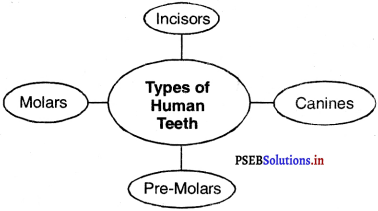
PSEB 4th Class EVS Solutions Chapter 13 Human Habitat 2

PSEB 4th Class EVS Solutions Chapter 12 Beaks and Teeth

Punjab State Board PSEB 4th Class EVS Book Solutions Chapter 12 Beaks and Teeth Textbook Exercise Questions and Answers.

PSEB Solutions for Class 4 EVS Chapter 12 Beaks and Teeth

EVS Guide for Class 4 PSEB Beaks and Teeth Textbook Questions and Answers

Textbook Page No. 82

Activity-1.
Speak some tongue-twister sentences rapidly. Few are given below :
1. Kutcha papad pucca papad-Kutcha papad pucca papad.
2. Dilli de dukandar, dadi de do dukhde danda di dawai de de.
Answer:
Do it yourself.

PSEB 4th Class EVS Solutions Chapter 12 Beaks and Teeth

Question 1.
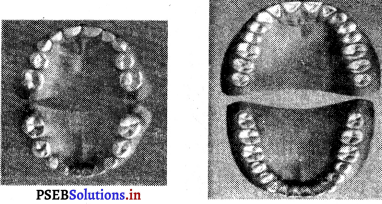
Write the number of milk teeth and permanent teeth.
Answer:
Milk teeth-20 Permanent teeth-32
PSEB 4th Class EVS Solutions Chapter 12 Beaks and Teeth 1

Question 2.
What are the functions of tongue?
Answer:
1. Helps in knowing the taste.
2. Helps in speech.

Activity-2.
Write down the number and health of teeth of your family.

Name of Member Relation Number of Teeth Health of Teeth

Answer:
Do it yourself.

PSEB 4th Class EVS Solutions Chapter 12 Beaks and Teeth

Question 3.
What is Enamel?
Answer:
Hardest outer white layer of teeth is called Enamel.

Textbook Page No. 83

Question 4.
What do you do to prevent tooth decay?
Answer:
We should clean our teeth before sleeping and after getting up early in the morning.

Question 5.
Match the Columns :
(A) (B)
1. Incisors (a) Tearing of food
2. Canines (b) Chewing of food
3. Pre-Molars (c) Grinding of food
4. Molars (d) Cutting of food
Answer:
1. (d),
2. (a),
3. (b),
4. (c).

Question 6.
Which tastes are felt with tongue?
Answer:
Sweet, sour, salty, bitter.

PSEB 4th Class EVS Solutions Chapter 12 Beaks and Teeth

Textbook Page No. 84

Question 7.
What do you mean by “Haathi de dand, khan de hor, vikhaun de hor”?
Answer:
Elephants have a pair of teeth outside the mouth which are not used for eating purpose. Therefore it is said that ‘Haathi de dand, khan de hor, vikhaun de hor.

Question 8.
What is the function of long teeth (incisors) of dog?
Answer:
Dog is a carnivorous animal. They tear the flesh with the help of these long teeth.

Activity-3 :
Observe the food habits of animals living around you.

Name of animal Food Herbivorous/

Carnivorous

shape of incisors

Answer:
Do it yourself.

PSEB 4th Class EVS Solutions Chapter 12 Beaks and Teeth

Textbook Page No. 85

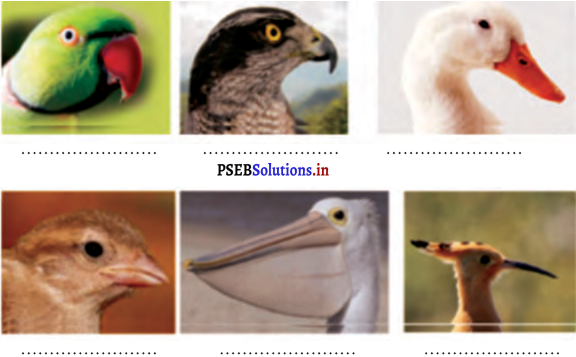
Write names of the birds below the Pictures.
PSEB 4th Class EVS Solutions Chapter 12 Beaks and Teeth 2
Answer:
1. Parrot
2. Eagle
3. duck
4. Sparrow
5. Pelican
6. Woodpecker.

Textbook Page No. 86

Question 9.
Tick (✓) the correct answer:

(a) Which of these birds eat fish?
Parrot
Kingfisher
Crow
Pigeon
Answer:
Pigeon

(b) Which of these birds have a pouch under its beak ?
Duck
Pelican
Woodpecker
Kingfisher
Answer:
Pelican.

PSEB 4th Class EVS Solutions Chapter 12 Beaks and Teeth

Question 10.
Why is the beak of woodpecker larger than beak of Sparrow?
Answer:
Woodpecker picks insects from the holes of the trees so it has long beak but sparrow picks grains so its beak is small.

Question 11.
Which of the birds eat flesh after preying?
Answer:
owl, eagle, kite.

Activity-4 :
Write the names of the birds with long and short beaks and their food.

Long beaked birds Food Short beaked birds Food

Answer:
Do it yourself.

PSEB 4th Class EVS Solutions Chapter 12 Beaks and Teeth

Textbook Page No. 87

Activity-
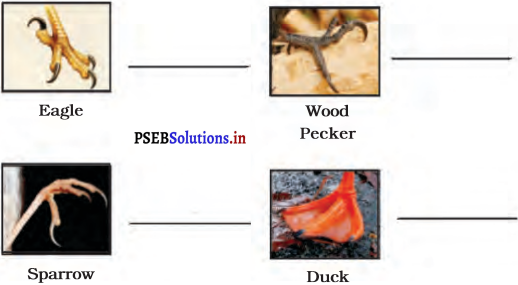
Claws of different birds are given, write their functions.
PSEB 4th Class EVS Solutions Chapter 12 Beaks and Teeth 3
Answer:
Catching prey and tearing flesh
Can catch the bark of the tree
tightly hold the tree
To swim and to walk over water

Textbook Page No. 88-89

Question 12.
How does the eagle use its claws?
Answer:
It uses its claw to catch its prey.

Question 13.
How do the Claws of a duck useful for it?
Answer:
It helps in swimming over the water.

PSEB 4th Class EVS Solutions Chapter 12 Beaks and Teeth

Question 14.
Which bird can easily climb the trees?
Answer:
Woodpecker.

Activity-5 :
Write the function of nails by seeing the birds around :

Name of the bird Function of nails

Answer:
Do it yourself.

Activity-6.
Put the grains for the birds at same place daily in your house and write down the name and number of birds who came there to eat grains :

Name of the bird Number Name of bird Number

Answer:
Do it yourself.

PSEB 4th Class EVS Solutions Chapter 12 Beaks and Teeth

Question 15.
Mind Mapping :
PSEB 4th Class EVS Solutions Chapter 12 Beaks and Teeth 4
PSEB 4th Class EVS Solutions Chapter 12 Beaks and Teeth 5
Answer:
PSEB 4th Class EVS Solutions Chapter 12 Beaks and Teeth 6
PSEB 4th Class EVS Solutions Chapter 12 Beaks and Teeth 7

PSEB 4th Class EVS Solutions Chapter 11 Eat Good, Stay Healthy

Punjab State Board PSEB 4th Class EVS Book Solutions Chapter 11 Eat Good, Stay Healthy Textbook Exercise Questions and Answers.

PSEB Solutions for Class 4 EVS Chapter 11 Eat Good, Stay Healthy

EVS Guide for Class 4 PSEB Eat Good, Stay Healthy Textbook Questions and Answers

Textbook Page No. 73

Question 1.
Write the names of different nutrients present in food.
Answer:
Carbohydrates, fats, proteins, vitamins, and minerals.

PSEB 4th Class EVS Solutions Chapter 11 Eat Good, Stay Healthy

Question 2.
What is provided by carbohydrates and fats to the body?
Answer:
They provide energy to the body.

Question 3.
Write different sources of vitamins and minerals.
Answer:
Vitamin. Tomato, orange, carrot, milk, egg, sun light.
Minerals, green vegetables, fresh fruits and milk.

Question 4.
Fill in the blanks : (Vitamin D, Protein, balanced, energy)
(a) ………………. is necessary for growth of our body.
(b) We get ………………. from sunlight.
(c) All the nutrients are present in a ………………. diet.
(d) We get ………………. by eating Ghee.
Answer:
(a) Protein,
(b) Vitamin D,
(c) balanced,
(d) energy.

PSEB 4th Class EVS Solutions Chapter 11 Eat Good, Stay Healthy

Textbook Page No. 74

Activity-1.
Make a list of food available in the marriage ceremony.
Answer:
Do it yourself.

Textbook Page No. 75

Activity-2.
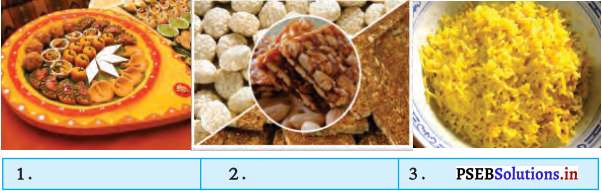
Write down the names of foods shown in pictures prepared on different occasions.
PSEB 4th Class EVS Solutions Chapter 11 Eat Good, Stay Healthy 1
Answer:
1. Sweets,
2. Reori-Gachak,
3. Rice.

PSEB 4th Class EVS Solutions Chapter 11 Eat Good, Stay Healthy

Textbook Page No. 76

Activity-2.
Write down the weekly menu of mid-day meal

Day
Food

Answer:
Do it yourself.

Textbook Page No. 77

Question 5.
Fill in the blanks :
(a) There were different types of …………………….. in marriage ceremony. (stall/shops)
(b) We should take food according to our …………………….. in ceremonies. (need/plate)
(c) Mid-Day-Meal is provided …………………….. in School. (daily/sometimes)
(d) …………………….. is the name of the kitchen present in the train. (Pantry car/Dhabas)
(e) There are …………………….. types of shake in marriage. (one/different)
Answer:
(a) stall,
(b) need,
(c) daily,
(d) Pantry car,
(e) different.

PSEB 4th Class EVS Solutions Chapter 11 Eat Good, Stay Healthy

Question 6.
Match the following :
Festival – Food
1. Diwali (a) Puri-Channels
2. Lohri (b) Sugar toys (Sugar Chips)
3. Spring (c) Gachhak and Reori
4. Sawan (d) Yellow rice
5. Navratras (e) Mathis and Puas.
Answer:
1. (b),
2. (c),
3. (d),
4. (e),
5. (a).

Textbook Page No. 78

Question 7.
How many times food is provided in a hostel?
Answer:
Three times in a day.

Question 8.
What should the children do before and after taking meals?
Answer:
Children should wash their hands using soap and water before and after taking meals.

PSEB 4th Class EVS Solutions Chapter 11 Eat Good, Stay Healthy

Question 9.
Which habits are developed by taking meals together?
Answer:
Feeling of love is developed and feeling of brotherhood and co-operation is developed.

PSEB 4th Class EVS Solutions Chapter 10 Field to Home

Punjab State Board PSEB 4th Class EVS Book Solutions Chapter 10 Field to Home Textbook Exercise Questions and Answers.

PSEB Solutions for Class 4 EVS Chapter 10 Field to Home

EVS Guide for Class 4 PSEB Field to Home Textbook Questions and Answers

Textbook Page No. 62

Activity-1.
Keep different spices on a table in the classroom. The teacher will ask students one by one to identify various spices by tasting and smelling them. Prepare a list of spices identified by them.

With smell ………………………
With taste ………………………
Answer:
Do it yourself.

PSEB 4th Class EVS Solutions Chapter 10 Field to Home

Textbook Page No. 63

Activity-2.
Which spices are used for cooking at your home? Know from your mother and write below :
Answer:
Turmeric, cumin seed, aniseed, Black pepper, Ajwain, corriander, cinamon, Clove, Mustard seed etc.

Activity-3.
Which cereals, pulses and edible oils are used in your houses? Write with the help of your mother :
Answer:
Cereal : Wheat, Maize, Bajra.
Pulses : Mash, Mothh, Moongi, Masar, Grams, Arhar etc.
Oil : Mustard oil, Olive oil, Soyabean oil, Ground nut oil, Cotton seed oil.

Textbook Page No. 67, 68

Question 1.
Write the names of three summer and winter vegetables each :
Summer Vegetables ……………………..
Winter Vegetables ……………………..
Answer:
Summer Vegetables Tinda, Ladyfinger, Arbi, Ramatori, Pumpkin.
Winter Vegetables. Carrot, Turnip, Pea, Cauliflower, Fenugreek, Spinach, Mustard.

PSEB 4th Class EVS Solutions Chapter 10 Field to Home

Question 2.
Write the names of three summer and winter fruits each :
Summer Fruits ……………………..
Winter fruits ……………………..
Answer:
Summer Fruits. Water melon, Muskmelon, Loquat, Peach.
Winter Fruits. Orange, Chickoo, Apple.

Question 3.
Guess, what is it? [Hari aur Lai Mirch, Nariyal, Piaz, Chhalli, Kela (Banana)]
(a) Katore ch Katora, Beta Baap Toh vi gora.
(b) Vatt te Khara patwari, lattan thothian Sir bhari.
(c) Nikka Jiha sipahi, Odi Khich ke vardi lahi.
(d) Hari ci, man bhari ci, lallan moti jari ci Raja Ji de bagh ch dushala lye khari ci.
(e) Hari-Hari Laal-Laal lagdi c sohni, Muh vich pa lyi bari hoi anhoni.
Answer:
(a) Nariyal,
(b) Piaz,
(c) Kela (Banana),
(d) Chhalli,
(e) Hari aur Lai Mirch.

PSEB 4th Class EVS Solutions Chapter 10 Field to Home

Activity-4.
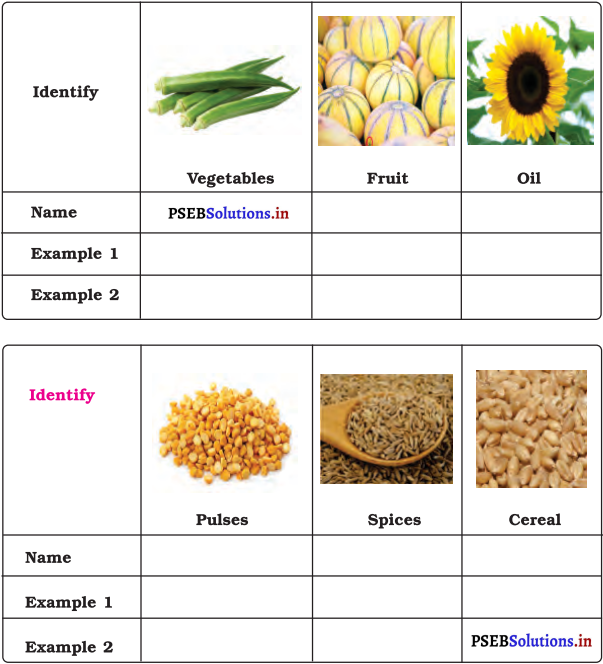
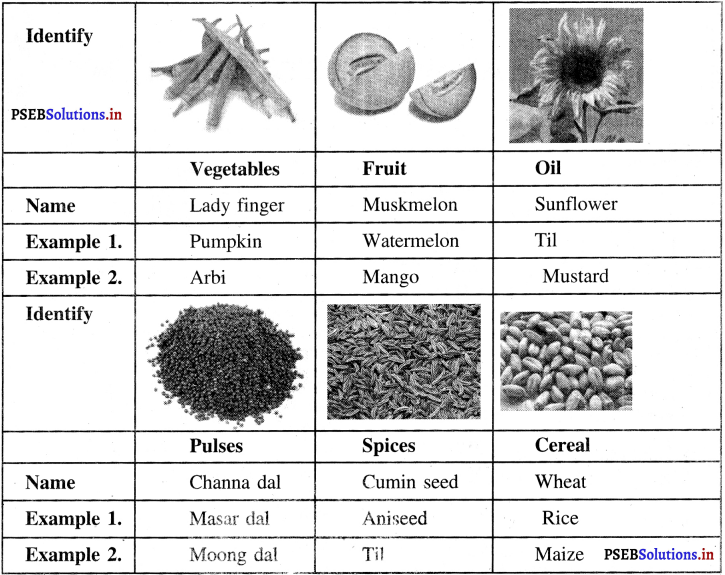
Identify and write the names in front of pictures given below. Write the names of two more such crops, in the spaces given :
PSEB 4th Class EVS Solutions Chapter 10 Field to Home 1
Answer:
PSEB 4th Class EVS Solutions Chapter 10 Field to Home 3

PSEB 4th Class EVS Solutions Chapter 10 Field to Home

Textbook Page No. 69

Question 4.
Write the names of spices produced in South India.
Answer:
Black pepper, cumin, curry leaves, clove, cinnamon, cardamom etc.

Question 5.
How do the fruits and vegetables reach our home?
Answer:
Growers or farmers take their produce to the main market, there the small vendors purchase these fruits and vegetables. They sell in the streets. We purchase from them according to our needs.

Question 6.
Which fruits are grown in your area?
Answer:
Guava is they’main fruit grown in our area.

PSEB 4th Class EVS Solutions Chapter 10 Field to Home

Question 7.
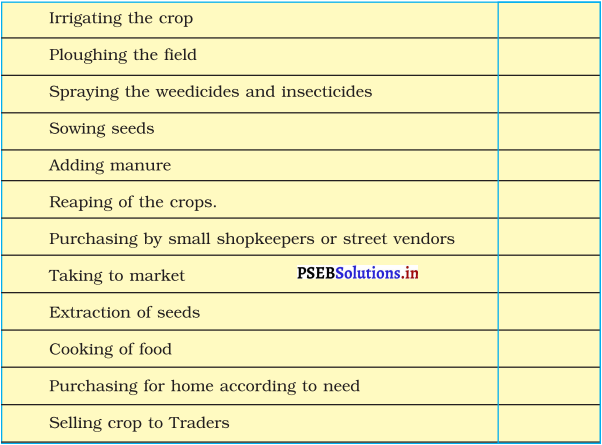
Write the different stages of farming according to the proper order in the column provided :
PSEB 4th Class EVS Solutions Chapter 10 Field to Home 2
Answer:

Wrong order Proper order
1. Irrigating the crop 2
2. Ploughing the field 5
3. Spraying the weedicides and insecticides 4
4. Sowing seeds 1
5. Adding manure 3
6. Reaping of the crops 6
7. Purchasing by small shopkeepers or street vendors 9
8. Taking to market 8
9. Extraction of seeds PSEB 4th Class EVS Solutions Chapter 10 Field to Home 2
10. Cooking of food 7
11. Purchasing for home according to need 11
12. Selling crop to Traders  10

PSEB 4th Class EVS Solutions Chapter 9 Trees and Benefits

Punjab State Board PSEB 4th Class EVS Book Solutions Chapter 9 Trees and Benefits Textbook Exercise Questions and Answers.

PSEB Solutions for Class 4 EVS Chapter 9 Trees and Benefits

EVS Guide for Class 4 PSEB Trees and Benefits Textbook Questions and Answers

Textbook Page No. 55

Question 1.
You must have eaten fruits after plucking them from trees or collecting them from land, under the trees in your area (field, school, garden, etc.) Write the names of those trees.
Answer:
Guava, Mango, Pears, Pomegranate, Jamun, Ber.

PSEB 4th Class EVS Solutions Chapter 9 Trees and Benefits

Textbook Page No. 56

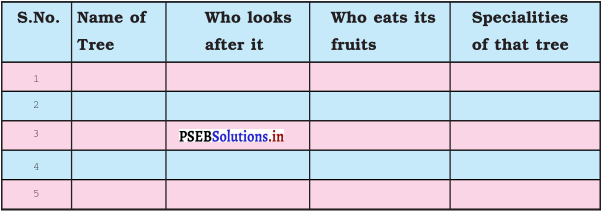
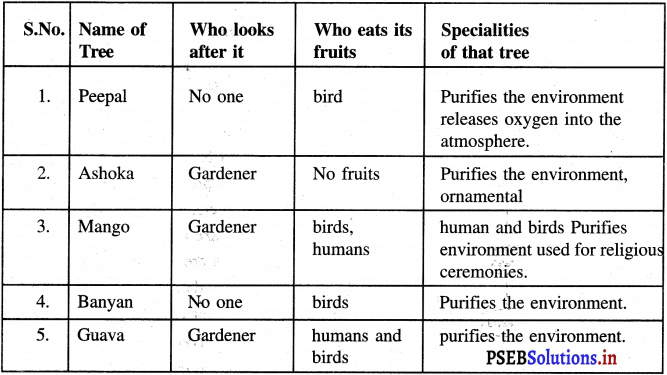
Activity-1.
Look carefully at the trees around you and complete the following exercise. You can take the help of your teacher :
PSEB 4th Class EVS Solutions Chapter 9 Trees and Benefits 1
Answer:
PSEB 4th Class EVS Solutions Chapter 9 Trees and Benefits 2

PSEB 4th Class EVS Solutions Chapter 9 Trees and Benefits

Textbook Page No. 58

Question 2.
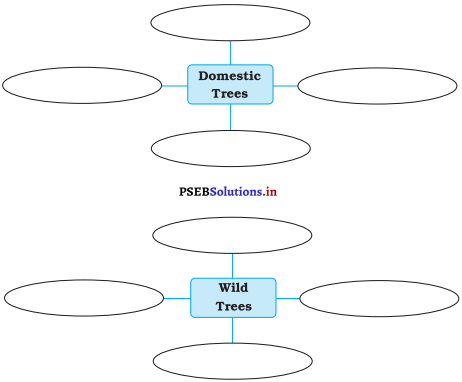
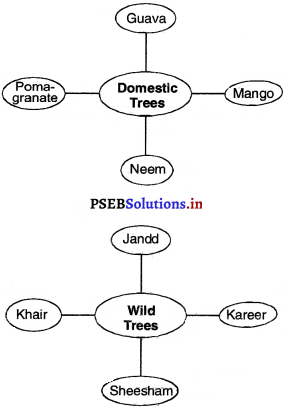
Mind Mapping.
PSEB 4th Class EVS Solutions Chapter 9 Trees and Benefits 3
Answer:
PSEB 4th Class EVS Solutions Chapter 9 Trees and Benefits 4

PSEB 4th Class EVS Solutions Chapter 9 Trees and Benefits

Textbook Page No. 60

Question 3.
Fill in the blanks :
(oxygen, medicines, trees, mulberry)
(a) There were …………………. trees in desert.
(b) The trees provide us …………………. which is an essential gas for our life.
(c) The life of tribal people is fully dependent on ………………… .
(d) Different parts of plants are used in Ktilt ………………… .
Answer:
(a) mulberry,
(b) oxygen,
(c) trees,
(d) medicines.

Question 4.
Tick (✓) the right and cross (✗) the wrong sentence :
(a) We should grow more and more trees.
(b) Shadow of trees can be bought from any shop.
(c) Neem tree was cut due to Rani’s wisdom.
(d) We have harmed the environment by cutting the trees.
(e) Everybody should be friendly with
trees.
Answer:
(a) ✓
(b) ✗
(c) ✗
(d) ✓
(e) ✓

PSEB 4th Class EVS Solutions Chapter 9 Trees and Benefits

Textbook Page No. 61

Question 5.
What is provided by the trees ?
Answer:
Trees provide us shadow, fruits, wood, oxygen etc.

Question 6.
Who are the Tribals ?
Answer:
Tribals are the people who live in jungle and depend on the things available in the forest for their daily needs.

Question 7.
Which tree bears mulberries ?
Answer:
Mulberry tree (Sahatut).

PSEB 4th Class EVS Solutions Chapter 8 Colourful Flowers

Punjab State Board PSEB 4th Class EVS Book Solutions Chapter 8 Colourful Flowers Textbook Exercise Questions and Answers.

PSEB Solutions for Class 4 EVS Chapter 8 Colourful Flowers

EVS Guide for Class 4 PSEB Colourful Flowers Textbook Questions and Answers

Textbook Page No. 46

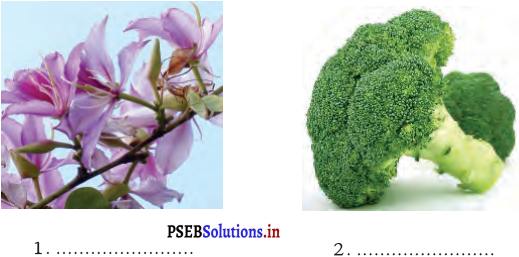
Activity-1.
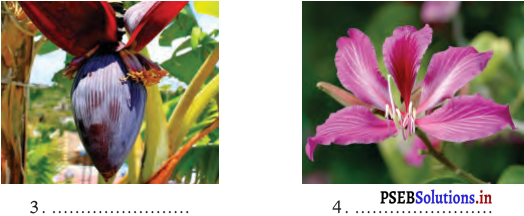
Write the names of the flowers :
PSEB 4th Class EVS Solutions Chapter 8 Colourful Flowers 1 PSEB 4th Class EVS Solutions Chapter 8 Colourful Flowers 2
Answer:
1. Moringa,
2. Broccoli,
3. Banana,
4. Kachnar

PSEB 4th Class EVS Solutions Chapter 8 Colourful Flowers

Textbook Page No. 47, 48

Question 1.
Which flowers are cooked as vegetable?
Answer:
Kachnar, Banana, Broccoli.

Question 2.
What is made from Broccoli flower?
Answer:
Salad and sabji.

Activity-2.
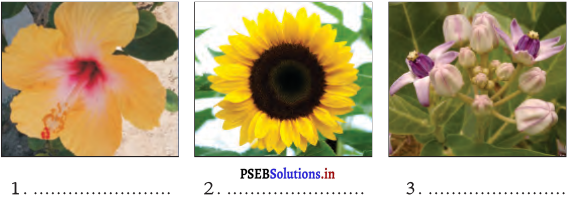
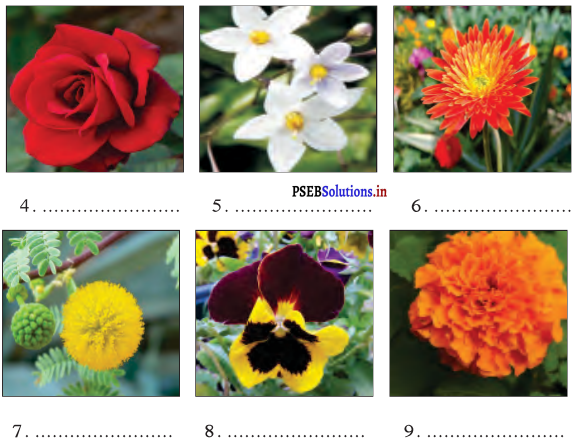
Write the names of the flowers in the provided space.
PSEB 4th Class EVS Solutions Chapter 8 Colourful Flowers 3 PSEB 4th Class EVS Solutions Chapter 8 Colourful Flowers 4
Answer:
1. Hibiscus
2. Sunflower
3. Kalian
4. Rose
5. Jasmine
6. Dahlia
7. Chhuimmui
8. Panty
9. Marigold

PSEB 4th Class EVS Solutions Chapter 8 Colourful Flowers

Question 3.
Give the names and uses of any two flowers in the above picture.
Answer:
1. We get rose water, gulkand and scent from rose flowers.
2. Dyes are obtained from hibiscus.

Textbook Page No. 50

Activity-1.
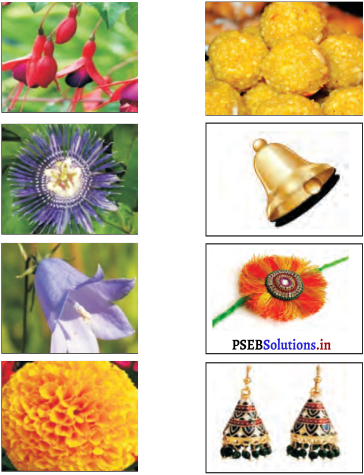
Some items and flowers are given in the picture. Match, which flower resembles which item?

Match the following
PSEB 4th Class EVS Solutions Chapter 8 Colourful Flowers 5
Answer:
1. (d),
2. (c),
3. (b),
4. (a).

PSEB 4th Class EVS Solutions Chapter 8 Colourful Flowers

Textbook Page No. 51

Activity-2.
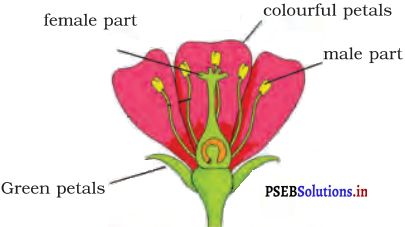
With the help of teacher, visit a garden and get knowledge about parts of flower.

PSEB 4th Class EVS Solutions Chapter 8 Colourful Flowers 6

Activity-3.
Sukhman’s mother played a game with him. You can also play this game. Choose any three different flowers and tell.

Name of the flower
1. ……………….
2. ……………….
3. ……………….
Answer:
1. Rose
2. Hibiscus
3. Sunflower

PSEB 4th Class EVS Solutions Chapter 8 Colourful Flowers

Colour of the flower
1. ……………….
2. ……………….
3. ……………….
Answer:
1. Pink
2. Red
3. Yellow

Number of the petals
1. ……………….
2. ……………….
3. ……………….
Answer:
1. 26 to 40
2. 5
3. 34

Textbook Page No. 53

Question 4.
Fill correct word in the blanks : (nectar, rose, flowers, suhanjana)
(a) Gulkand is made from flowers.
(b) We make pakoras with flowers.
(c) Some bloom during night only.
(d) Honeybees and butterflies suck from flowers.
Answer:
(a) rose,
(b) suhanjana,
(c) flowers,
(d) nectar.

PSEB 4th Class EVS Solutions Chapter 8 Colourful Flowers

Question 5.
Tick (✓) the correct and cross (✗) the wrong sentences :
(a) Kachnar and Banana flowers are used for making vegetables.
(b) Perfumed oil is prepared from Jasmine (Chameli) and lavander flowers.
(c) Flowers always bloom.
(d) Marigold (Genda) flower blooms in water.
Answer:
(a) ✓
(b) ✓
(c) ✗
(d) ✗

Question 6.
Tick the (✓) correct answer :
(a) Which flower grows in water?
Marigold
Lotus
Rose
Answer:
Lotus

(b) Which flower is used for making perfume?
Banana
Broccoli
Rose
Answer:
Rose

PSEB 4th Class EVS Solutions Chapter 8 Colourful Flowers

(c) What is prepared from flowers of ‘Wild Aak’.
Medicine
Gulkand
Vegetable
Answer:
Medicine.

(d) Which flower is large in size?
Marigold
Neem
Kikar
Answer:
Marigold.

Question 7.
What is prepared from rose flower?
Answer:
Rose water, gulkand, medicines dyes.

Question 8.
Which flowers are used for making perfumed oil?
Answer:
Jasmine and lavender.

Question 9.
On which occasions, decoration is done with flowers?
Answer:
Marriages, parties, festivals, religious functions.

PSEB 4th Class EVS Solutions Chapter 8 Colourful Flowers

Question 10.
Match the columns :

(A) – (B)
1. Flower blooming at night – (a) ‘Gulmohar’
2. Flower blooming at noon – (b) ‘Jhumka’
3. Flower blooming on creeper – (c) ‘Lili’
4. Flower blooming on tree – (d) ‘Raat Ki
Answer:
1. (d),
2. (c),
3. (b),
4. (a)

PSEB 4th Class EVS Solutions Chapter 7 The Roots of Plants

Punjab State Board PSEB 4th Class EVS Book Solutions Chapter 7 The Roots of Plants Textbook Exercise Questions and Answers.

PSEB Solutions for Class 4 EVS Chapter 7 The Roots of Plants

EVS Guide for Class 4 PSEB The Roots of Plants Textbook Questions and Answers

Textbook Page No. 40

Activity-1.
Find out the oldest tree in your school. Give information about it in the following blanks :

Name : ……………….
Age : ……………….
(Approximate) : ……………….
Answer:
Banyan tree, 100 yrs.

PSEB 4th Class EVS Solutions Chapter 7 The Roots of Plants

Textbook Page No. 41

Question 1.
Which part of the plant absorbs water?
Answer:
Root.

Question 2.
Write the functions of roots.
Answer:
Roots absorb water from under the soil and tightly hold the plant in the soil.

Textbook Page No. 42

Activity.
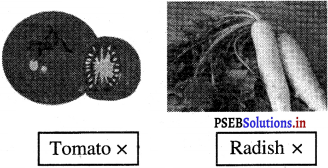
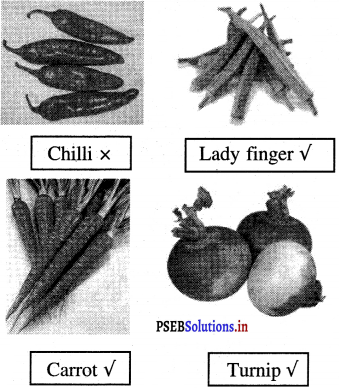
We eat some roots in the form of vegetables. Put tick (✓) on such vegetables in the picture.
PSEB 4th Class EVS Solutions Chapter 7 The Roots of Plants 1
Answer:
PSEB 4th Class EVS Solutions Chapter 7 The Roots of Plants 3
PSEB 4th Class EVS Solutions Chapter 7 The Roots of Plants 4

PSEB 4th Class EVS Solutions Chapter 7 The Roots of Plants

Textbook Page No. 44

Have you seen any other such tree? Write its name and place where have you seen?
Name …………..
Place …………..
Answer:
Do it yourself.

Textbook Page No. 45

Question 3.
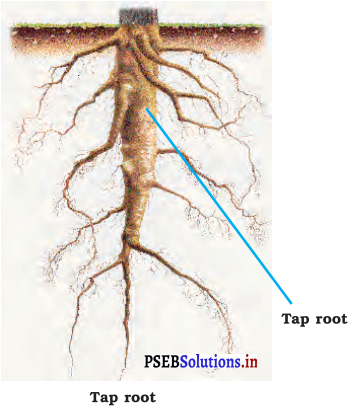
Make diagram of Tap root?
PSEB 4th Class EVS Solutions Chapter 7 The Roots of Plants 2

Question 4.
Fill in the blanks with suitable word : (root, soil, thicker, water)
(a) Roots of trees are in ………………
(b) Kachalu is a ………………
(c) Roots absorb ………………
Answer:
(a) soil,
(b) root,
(c) water.

PSEB 4th Class EVS Solutions Chapter 7 The Roots of Plants

Question 5.
Why was guava tree not pulled out?
Answer:
Roots were tightly holding the soil therefore guava tree was not pulled out.

Question 6.
What is tap root?
Answer:
Tap root is thicker than all other roots and goes straight under the soil.
PSEB 4th Class EVS Solutions Chapter 7 The Roots of Plants 2

Question 7.
Which of the plant roots can be eaten?
Answer:
Turnip, carrot, radish, sweet potato, kachalu etc.

PSEB 4th Class EVS Solutions Chapter 7 The Roots of Plants

Question 8.
Why should we not cut the trees?
Answer:
Trees help in rainfall and also clean the environment by absorbing carbon dioxide. They also provide us fruits, medicines, shelter for birds etc. So we should not cut the trees.